EP0045075A1 - Procédé pour transformer des signaux digitaux, codés d'une manière linéaire, dans des signaux digitaux codés d'une manière non linéaire, d'après une caractéristique de segment multiple répondant à la loi A - Google Patents
Procédé pour transformer des signaux digitaux, codés d'une manière linéaire, dans des signaux digitaux codés d'une manière non linéaire, d'après une caractéristique de segment multiple répondant à la loi A Download PDFInfo
- Publication number
- EP0045075A1 EP0045075A1 EP81105881A EP81105881A EP0045075A1 EP 0045075 A1 EP0045075 A1 EP 0045075A1 EP 81105881 A EP81105881 A EP 81105881A EP 81105881 A EP81105881 A EP 81105881A EP 0045075 A1 EP0045075 A1 EP 0045075A1
- Authority
- EP
- European Patent Office
- Prior art keywords
- value
- bits
- linear
- bit
- coded
- Prior art date
- Legal status (The legal status is an assumption and is not a legal conclusion. Google has not performed a legal analysis and makes no representation as to the accuracy of the status listed.)
- Granted
Links
- 238000006243 chemical reaction Methods 0.000 title claims abstract description 6
- 238000000034 method Methods 0.000 claims abstract description 11
- 230000015654 memory Effects 0.000 claims description 51
- 230000000295 complement effect Effects 0.000 abstract description 9
- 210000000352 storage cell Anatomy 0.000 abstract description 5
- 230000015572 biosynthetic process Effects 0.000 abstract 1
- 238000013139 quantization Methods 0.000 description 7
- 210000004027 cell Anatomy 0.000 description 4
- 230000009977 dual effect Effects 0.000 description 2
- JHQVCQDWGSXTFE-UHFFFAOYSA-N 2-(2-prop-2-enoxycarbonyloxyethoxy)ethyl prop-2-enyl carbonate Chemical compound C=CCOC(=O)OCCOCCOC(=O)OCC=C JHQVCQDWGSXTFE-UHFFFAOYSA-N 0.000 description 1
- 238000009825 accumulation Methods 0.000 description 1
- 238000005056 compaction Methods 0.000 description 1
- 230000007423 decrease Effects 0.000 description 1
- 230000000737 periodic effect Effects 0.000 description 1
- 238000005070 sampling Methods 0.000 description 1
- 239000013589 supplement Substances 0.000 description 1
Images
Classifications
-
- H—ELECTRICITY
- H03—ELECTRONIC CIRCUITRY
- H03M—CODING; DECODING; CODE CONVERSION IN GENERAL
- H03M7/00—Conversion of a code where information is represented by a given sequence or number of digits to a code where the same, similar or subset of information is represented by a different sequence or number of digits
- H03M7/30—Compression; Expansion; Suppression of unnecessary data, e.g. redundancy reduction
- H03M7/50—Conversion to or from non-linear codes, e.g. companding
Definitions
- the invention relates to a method for converting positive linearly coded digital signals and their two's complement into nonlinearly coded digital signals according to a multiple segment characteristic curve that complies with the A law.
- One of the compaction characteristics based on the Praicis o ft xu basis, obeys the so-called A law and is composed of 13 straight-line segments.
- the slope of the straight line of this characteristic curve decreases in each of the two half-planes from segment to segment by a factor of 2.
- Each segment in turn is divided into 16 quantization compartments of equal size, the height of which increases by a factor of 2 from segment to segment.
- This regularity is interrupted in the first segment since it contains 32 positive and 32 negative quantization areas, each of which comprises two values of the linearly coded information.
- 9192 steps in a linear code representation are contrasted with 256 steps in a companded representation.
- the non-linear signal value is composed of the most significant bit of the linearly coded signal value to be converted, the segment address read from the first memory and a step address read out of the second memory within such a segment.
- the linearly coded signal values to be converted in this way can be the result of an arithmetic operation, for example in a telephone system in which conference connections are possible, the sums or differences of signal values that are supplied by the individual conference participants.
- Such arithmetic operations can be carried out particularly easily if the negative linear values are represented as the two's complement of the associated positive values.
- this object is achieved in that the assignment of n signal values coded to the two coding types takes place with the aid of memories, of which the first most significant bit, which determines the sign, and as many subsequent higher-order bits of a linearly coded one signal value is supplied as drive addresses how to indicate the segment of the characteristic curve erforder-lie h, in which the signal value in question falls, where in the storage cells of this first store di- gitalworte stored, the three most significant bits, the following on the sign of are the most significant bits of the corresponding non-linearly coded signal value, which indicate the segment of the characteristic curve, are significant values which indicate the segment of the characteristic curve on which this signal value is located, and the remaining bits of which are a partial address to the partial memory of the second memory for control purposes of the second memory, the most significant Actuation address bit the most significant bit of the respective linearly cited signal value and, as the least significant actuation address part following the mentioned actuation address part supplied by the first memory, the remaining bits not used as
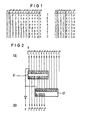
- FIG. 1 is limited to the representation of the relationships in the positive half of a 13-segment characteristic curve that complies with the A law.
- bit combinations of 13 bits 2 0 - V are represented, which represent linearly coded signal values.
- the right part of the figure shows 8 bit 2 0 - V bit combinations which illustrate the corresponding nonlinearly coded signal values.
- the numbers 0 to 7 entered between the two code word groups indicate that the corresponding lines relate to segments 0 to 7 of the positive half of the characteristic curve, it being noted that segments 0 and 1 of both half of the characteristic curve each have the same slope, so that the complete characteristic curve is actually composed of 13 straight lines.
- the quantization subjects increase by a factor of 2 each, i.e. in segment 2 the 16 non-linearly coded code values each have 4 linearly coded code values, which are possible in the combination of bit 2 0 and 2 1 differ, in segment 3 the 16 non-linearly coded code values are each opposed by eight linearly coded code values, which differ in the possible combinations of bits 2 0 to 2 2 etc. etc. in segment 7 the 16 non-linearly represented code values 123 each linearly coded code values corresponding to the possible combinations of bits 2 0 to 2 6 .
- the method according to the invention is used when, in arithmetic operations, the negative, linearly coded signal values differ from the corresponding positive signal values only in that the one denoted by V or 2 13 has the other binary value the two's complement are shown.
- the dwarf complement is a code combination that represents the supplement to the next higher power of 2. For example, if there is a four-digit code combination 1111 that includes the base powers 2 0 to 2 3 and corresponds to the decimal number 15, its two's complement is the addition to the next higher base power 2 4 , that is, the addition to the binary number 10000. This additional dual number has the code combination 0001, which corresponds to the decimal number 1. Subtraction can now be performed by adding the complement of the minutes. Negative differences are then again represented as a two's complement of the difference. Such two's complements are then converted directly into non-linearly coded code words when the method according to the invention is carried out.
- the arrangement according to FIG. 2 for carrying out the method according to the invention has two memories K1 and K2, which are read-only memories (ROM).
- the memory K1 is supplied with the sign bit V or 2 12 and as many subsequent higher-order bits of line-coded signals SDL as are required to identify the segment of the characteristic curve in which the signal value in question falls. These are, as shown in FIG. 1, bits 2 11 A to 2 5 , since it can only be determined with the inclusion of all of these bits, which position are the bits a, b, c, d that indicate the level limits in the individual segments apart from segments 0 and 1, from segment to segment include other bits 2 1 to 2 10 .
- this memory Sellen stored their three most significant bits in ent pursueander assignment digital words to the sign bit following most significant bits, the most significant to the Vorschbi bit s of the corresponding non-linearly coded in f ORMA t ionswer t are, which, as explained above, the segment of the characteristic curve state on which this information value lies.
- the aforementioned memory cells of the first programmable memory K1 therefore require memory space for 8 bits each, so that the total memory volume is 2048 bits.
- the partial addresses mentioned for the second programmable memory K2 which can be read out from the first programmable memory K1, represent a higher-value part of its control addresses.
- the most significant bit of the control address for the memory K2 is the sign bit V of the linearly coded signal values SDL.
- FIG. 2 also shows, to form the non-linearly coded digital signals SDK, the sign bit V of the linearly coded signals SDL as the most significant bit and thus as the sign bit V, the three.
- the aforementioned bits which can be read out from the first programmable memory K1 are used as bits 2 to 2 4 of the subsequent value and thus as bits representing segments and finally the four bits which can be read out from the second programmable memory K2 are used as least significant bits 2 3 to 2 0 .
- the least significant bit 2 0 of the linearly coded digital signal is not taken into account for the reasons mentioned above.
- the entries in the memories K1 and K2 can also be such that the non-linearly coded signal values appear in the so-called NININI code, which differs from the above-mentioned code in that its most significant bit remains unchanged, the bit that follows in terms of value is inverted, the next bit is not inverted, etc. etc.
Landscapes
- Physics & Mathematics (AREA)
- Nonlinear Science (AREA)
- Engineering & Computer Science (AREA)
- Theoretical Computer Science (AREA)
- Compression, Expansion, Code Conversion, And Decoders (AREA)
- Transmission Systems Not Characterized By The Medium Used For Transmission (AREA)
- Image Processing (AREA)
Priority Applications (1)
| Application Number | Priority Date | Filing Date | Title |
|---|---|---|---|
| AT81105881T ATE16440T1 (de) | 1980-07-29 | 1981-07-24 | Verfahren zur umwandlung von linear codierten digitalen signalen in nichtlinear codierte digitale signale gemaess einer dem a-gesetz gehorchenden mehrfachsegmentkennlinie. |
Applications Claiming Priority (2)
| Application Number | Priority Date | Filing Date | Title |
|---|---|---|---|
| DE19803028734 DE3028734A1 (de) | 1980-07-29 | 1980-07-29 | Verfahren zur umwandlung von positiven linear codierten digitalen signalen sowie deren zweierkomplement in nichtlinear codierte digitale signale gemaess einer der a-gesetz gehorchenden mehrfachsegmentkennlinie |
| DE3028734 | 1980-07-29 |
Publications (2)
| Publication Number | Publication Date |
|---|---|
| EP0045075A1 true EP0045075A1 (fr) | 1982-02-03 |
| EP0045075B1 EP0045075B1 (fr) | 1985-11-06 |
Family
ID=6108381
Family Applications (1)
| Application Number | Title | Priority Date | Filing Date |
|---|---|---|---|
| EP81105881A Expired EP0045075B1 (fr) | 1980-07-29 | 1981-07-24 | Procédé pour transformer des signaux digitaux, codés d'une manière linéaire, dans des signaux digitaux codés d'une manière non linéaire, d'après une caractéristique de segment multiple répondant à la loi A |
Country Status (3)
| Country | Link |
|---|---|
| EP (1) | EP0045075B1 (fr) |
| AT (1) | ATE16440T1 (fr) |
| DE (1) | DE3028734A1 (fr) |
Cited By (2)
| Publication number | Priority date | Publication date | Assignee | Title |
|---|---|---|---|---|
| GB2127599A (en) * | 1982-09-17 | 1984-04-11 | British Broadcasting Corp | Decoding digital data |
| GB2178577A (en) * | 1985-07-27 | 1987-02-11 | Plessey Co Plc | A signal converter |
Citations (9)
| Publication number | Priority date | Publication date | Assignee | Title |
|---|---|---|---|---|
| GB1336824A (en) * | 1971-06-07 | 1973-11-14 | Ibm | Data processing apparatus |
| GB1472885A (en) * | 1974-05-01 | 1977-05-11 | Int Computers Ltd | Digital code conversion arrangements |
| DE2801988A1 (de) * | 1977-03-04 | 1978-09-07 | Ibm | Arithmetische codierung von symbolfolgen |
| DE2830924A1 (de) * | 1977-07-14 | 1979-02-01 | Indep Broadcasting Authority | Einrichtung zum aufzeichnen und/oder uebertragung von digitalen signalen |
| DE2837578A1 (de) * | 1977-08-30 | 1979-03-08 | Western Electric Co | Signalwandler mit datenkompressor |
| DE2900844A1 (de) * | 1978-01-13 | 1979-07-19 | Philips Nv | Anordnung zum filtern komprimierter pulskodemodulierter signale |
| DE2900586A1 (de) * | 1978-01-13 | 1979-07-19 | Ncr Co | Anordnung zum decodieren von codewoertern variabler laenge |
| DE2906156A1 (de) * | 1978-02-20 | 1979-08-23 | Philips Nv | Digitale filteranordnung fuer nicht- linear quantisierte pcm |
| DE2938984A1 (de) * | 1979-09-26 | 1981-04-09 | Siemens AG, 1000 Berlin und 8000 München | Verfahren zur umwandlung von linear codierten digitalen signalen in nicht linear codierte digitale signale gemaess einer dem a-gesetz oder dem my-gesetz gehorchenden mehrfachsegmentkennlinie |
Family Cites Families (2)
| Publication number | Priority date | Publication date | Assignee | Title |
|---|---|---|---|---|
| US3863248A (en) * | 1973-01-02 | 1975-01-28 | Univ Sherbrooke | Digital compressor-expander |
| GB1597468A (en) * | 1977-06-02 | 1981-09-09 | Post Office | Conversion between linear pcm representation and compressed pcm |
-
1980
- 1980-07-29 DE DE19803028734 patent/DE3028734A1/de active Granted
-
1981
- 1981-07-24 AT AT81105881T patent/ATE16440T1/de not_active IP Right Cessation
- 1981-07-24 EP EP81105881A patent/EP0045075B1/fr not_active Expired
Patent Citations (9)
| Publication number | Priority date | Publication date | Assignee | Title |
|---|---|---|---|---|
| GB1336824A (en) * | 1971-06-07 | 1973-11-14 | Ibm | Data processing apparatus |
| GB1472885A (en) * | 1974-05-01 | 1977-05-11 | Int Computers Ltd | Digital code conversion arrangements |
| DE2801988A1 (de) * | 1977-03-04 | 1978-09-07 | Ibm | Arithmetische codierung von symbolfolgen |
| DE2830924A1 (de) * | 1977-07-14 | 1979-02-01 | Indep Broadcasting Authority | Einrichtung zum aufzeichnen und/oder uebertragung von digitalen signalen |
| DE2837578A1 (de) * | 1977-08-30 | 1979-03-08 | Western Electric Co | Signalwandler mit datenkompressor |
| DE2900844A1 (de) * | 1978-01-13 | 1979-07-19 | Philips Nv | Anordnung zum filtern komprimierter pulskodemodulierter signale |
| DE2900586A1 (de) * | 1978-01-13 | 1979-07-19 | Ncr Co | Anordnung zum decodieren von codewoertern variabler laenge |
| DE2906156A1 (de) * | 1978-02-20 | 1979-08-23 | Philips Nv | Digitale filteranordnung fuer nicht- linear quantisierte pcm |
| DE2938984A1 (de) * | 1979-09-26 | 1981-04-09 | Siemens AG, 1000 Berlin und 8000 München | Verfahren zur umwandlung von linear codierten digitalen signalen in nicht linear codierte digitale signale gemaess einer dem a-gesetz oder dem my-gesetz gehorchenden mehrfachsegmentkennlinie |
Cited By (3)
| Publication number | Priority date | Publication date | Assignee | Title |
|---|---|---|---|---|
| GB2127599A (en) * | 1982-09-17 | 1984-04-11 | British Broadcasting Corp | Decoding digital data |
| GB2178577A (en) * | 1985-07-27 | 1987-02-11 | Plessey Co Plc | A signal converter |
| EP0210738A3 (fr) * | 1985-07-27 | 1989-01-25 | Plessey Overseas Limited | Convertisseur de signal |
Also Published As
| Publication number | Publication date |
|---|---|
| ATE16440T1 (de) | 1985-11-15 |
| EP0045075B1 (fr) | 1985-11-06 |
| DE3028734C2 (fr) | 1989-03-16 |
| DE3028734A1 (de) | 1982-03-04 |
Similar Documents
| Publication | Publication Date | Title |
|---|---|---|
| DE3237393A1 (de) | Verfahren zum korrigieren der gradation der ausgangsdaten, zur anwendung bei einem digitalen bildverarbeitungssystem | |
| DE3523809A1 (de) | Verfahren zur zeitkompression von informationen in digitaler form | |
| DE2932525A1 (de) | Verfahren zur umwandlung von bilddaten in ein farbvideo-darstellungsformat sowie geraet zur durchfuehrung dieses verfahrens | |
| DE3643161A1 (de) | Verfahren und vorrichtung zur offsetspannungs-korrektur in einem analog/digital-umsetzer | |
| DE2451983A1 (de) | Digital-/analogwandler | |
| EP0029490B1 (fr) | Procédé pour convertir des signaux numériques codés linéairement en des signaux numériques codés non linéairement selon une caractéristique à segments multiples obéissant à la loi A ou la loi mu | |
| EP0472555B1 (fr) | Convertisseur numerique-analogique a haute linearite | |
| DE2505388C2 (de) | Anordnung zur logarithmischen Umwandlung eines Meßwertes | |
| DE68926613T2 (de) | Gerät zur Signalwandlung, für Fernmeldevermittlungsanwendungen das die Quantisierungsfehler reduziert | |
| EP0045075A1 (fr) | Procédé pour transformer des signaux digitaux, codés d'une manière linéaire, dans des signaux digitaux codés d'une manière non linéaire, d'après une caractéristique de segment multiple répondant à la loi A | |
| EP0217119A2 (fr) | Méthode de conversion numérique-analogique d'information numérique en signaux analogiques bipolaires | |
| DE2906740A1 (de) | Verfahren zur erhoehung der genauigkeit ein digital-analog- bzw. analog-digital- wandlers und schaltungsanordnung zur durchfuehrung des verfahrens | |
| DE2939077A1 (de) | Verfahren und anordnung zum bestimmen charakteristischer werte aus einem geraeuschsignal | |
| EP0057753B1 (fr) | Procédé de conversion de mots codés en MIC linéaire en mots codés en MIC nonlinéaire et inversement de mots codés en MIC nonlinéaire en mots codés en MIC linéaire selon une caractéristique à 13 segments obéissant à la loi A | |
| DE3028726C2 (de) | Verfahren und Schaltungsanordnung zur Umwandlung von linear codierten digitalen Signalen in nicht linear codierte digitale Signale gemäß einer dem my-Gesetz gehorchenden Mehrfachsegment-Kennlinie | |
| DE3104528C2 (de) | Verfahren zur Umwandlung linear codierter PCM-Worte in nichtlinear codierte PCM-Worte und umgekehrt | |
| EP0064097B1 (fr) | Procédé pour la conversion des signaux d'entrées numériques pour systèmes de transmission par guides d'ondes optiques | |
| DE3332305C2 (de) | Verfahren zur steuerbaren Dämpfung von digitalen Signalen | |
| EP0103248B1 (fr) | Système de modulation par impulsions codées | |
| DE3533867C2 (fr) | ||
| DE3513038C2 (fr) | ||
| DE2411561C3 (de) | Digital-Analog-Umsetzer, insbesondere für einen nach dem Iteratiwerfahren arbeitenden Codierer | |
| DE69205857T2 (de) | Vorrichtung zum Festlegen von Parametern für eine Motorregeleinheit. | |
| DE3706791A1 (de) | Verfahren und schaltungsanordnung zur kompression von datenworten mit hilfe eines skalenfaktors | |
| EP0501598A2 (fr) | Procédé de conversion numérique-analogique et dispositif pour la mise en oeuvre du procédé |
Legal Events
| Date | Code | Title | Description |
|---|---|---|---|
| PUAI | Public reference made under article 153(3) epc to a published international application that has entered the european phase |
Free format text: ORIGINAL CODE: 0009012 |
|
| 17P | Request for examination filed |
Effective date: 19811030 |
|
| AK | Designated contracting states |
Designated state(s): AT CH FR GB IT NL SE |
|
| ITF | It: translation for a ep patent filed | ||
| GRAA | (expected) grant |
Free format text: ORIGINAL CODE: 0009210 |
|
| AK | Designated contracting states |
Designated state(s): AT CH FR GB IT LI NL SE |
|
| REF | Corresponds to: |
Ref document number: 16440 Country of ref document: AT Date of ref document: 19851115 Kind code of ref document: T |
|
| ET | Fr: translation filed | ||
| PLBE | No opposition filed within time limit |
Free format text: ORIGINAL CODE: 0009261 |
|
| STAA | Information on the status of an ep patent application or granted ep patent |
Free format text: STATUS: NO OPPOSITION FILED WITHIN TIME LIMIT |
|
| 26N | No opposition filed | ||
| PGFP | Annual fee paid to national office [announced via postgrant information from national office to epo] |
Ref country code: GB Payment date: 19900614 Year of fee payment: 10 |
|
| PGFP | Annual fee paid to national office [announced via postgrant information from national office to epo] |
Ref country code: FR Payment date: 19900724 Year of fee payment: 10 |
|
| PGFP | Annual fee paid to national office [announced via postgrant information from national office to epo] |
Ref country code: SE Payment date: 19900727 Year of fee payment: 10 |
|
| ITTA | It: last paid annual fee | ||
| PGFP | Annual fee paid to national office [announced via postgrant information from national office to epo] |
Ref country code: NL Payment date: 19900731 Year of fee payment: 10 |
|
| PGFP | Annual fee paid to national office [announced via postgrant information from national office to epo] |
Ref country code: AT Payment date: 19910628 Year of fee payment: 11 |
|
| PG25 | Lapsed in a contracting state [announced via postgrant information from national office to epo] |
Ref country code: GB Effective date: 19910724 |
|
| PG25 | Lapsed in a contracting state [announced via postgrant information from national office to epo] |
Ref country code: SE Effective date: 19910725 |
|
| PGFP | Annual fee paid to national office [announced via postgrant information from national office to epo] |
Ref country code: CH Payment date: 19911030 Year of fee payment: 11 |
|
| PG25 | Lapsed in a contracting state [announced via postgrant information from national office to epo] |
Ref country code: NL Effective date: 19920201 |
|
| NLV4 | Nl: lapsed or anulled due to non-payment of the annual fee | ||
| GBPC | Gb: european patent ceased through non-payment of renewal fee | ||
| PG25 | Lapsed in a contracting state [announced via postgrant information from national office to epo] |
Ref country code: FR Effective date: 19920331 |
|
| REG | Reference to a national code |
Ref country code: FR Ref legal event code: ST |
|
| PG25 | Lapsed in a contracting state [announced via postgrant information from national office to epo] |
Ref country code: AT Effective date: 19920724 |
|
| PG25 | Lapsed in a contracting state [announced via postgrant information from national office to epo] |
Ref country code: LI Effective date: 19920731 Ref country code: CH Effective date: 19920731 |
|
| REG | Reference to a national code |
Ref country code: CH Ref legal event code: PL |
|
| EUG | Se: european patent has lapsed |
Ref document number: 81105881.7 Effective date: 19920210 |