EP0045276A2 - 1:2-Chrom- und Kobaltkomplexfarbstoffe - Google Patents
1:2-Chrom- und Kobaltkomplexfarbstoffe Download PDFInfo
- Publication number
- EP0045276A2 EP0045276A2 EP81810278A EP81810278A EP0045276A2 EP 0045276 A2 EP0045276 A2 EP 0045276A2 EP 81810278 A EP81810278 A EP 81810278A EP 81810278 A EP81810278 A EP 81810278A EP 0045276 A2 EP0045276 A2 EP 0045276A2
- Authority
- EP
- European Patent Office
- Prior art keywords
- dye
- chromium
- formula
- dyes
- mixture
- Prior art date
- Legal status (The legal status is an assumption and is not a legal conclusion. Google has not performed a legal analysis and makes no representation as to the accuracy of the status listed.)
- Granted
Links
- 0 CC(C1)[C@@]1(C1)*(CC2=*C2)CC1=* Chemical compound CC(C1)[C@@]1(C1)*(CC2=*C2)CC1=* 0.000 description 2
Classifications
-
- C—CHEMISTRY; METALLURGY
- C09—DYES; PAINTS; POLISHES; NATURAL RESINS; ADHESIVES; COMPOSITIONS NOT OTHERWISE PROVIDED FOR; APPLICATIONS OF MATERIALS NOT OTHERWISE PROVIDED FOR
- C09B—ORGANIC DYES OR CLOSELY-RELATED COMPOUNDS FOR PRODUCING DYES, e.g. PIGMENTS; MORDANTS; LAKES
- C09B45/00—Complex metal compounds of azo dyes
- C09B45/02—Preparation from dyes containing in o-position a hydroxy group and in o'-position hydroxy, alkoxy, carboxyl, amino or keto groups
- C09B45/14—Monoazo compounds
Definitions
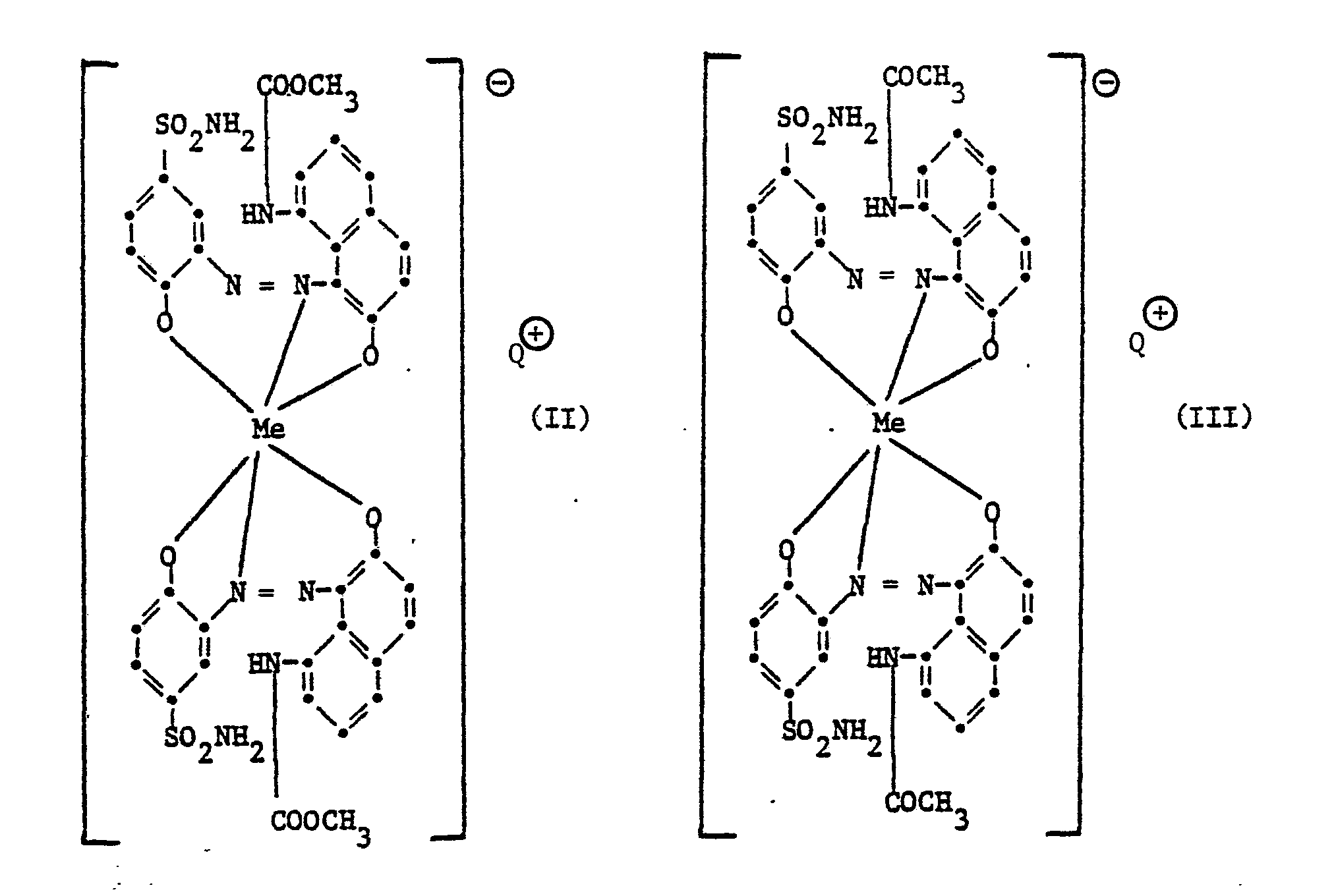
- the present invention relates to 1: 2 metal complex dyes of the formula I. in which Me is chromium or cobalt and Q ⁇ is a cation, and their mixtures with the metal complex dyes of the formulas II and III wherein Me and Q ⁇ have the meanings given above.
- Q ⁇ means an alkali, especially sodium or lithium cation or an ammonium ion or the cation of an organic amine, such as triethanolamine.
- the symmetrical 1: 2 chromium complexes according to formulas II and III above are known.
- the 1: 2 chromium or cobalt complex dyes of the formula II gel in the usual padding liquors or printing pastes, so that the padding liquors or printing pastes are usually unusable.
- the 1: 2 chromium complex dye of formula III does not show satisfactory results with all wet fastness properties.
- the object of the present invention was to develop similar dyes which do not have these disadvantages.
- Chromium complex dyes are preferred among the metal complex dyes of the formula I and their mixtures with the metal complex dyes of the formulas II and III.
- the mixtures of the metal complex dyes of the formulas I, II and III are prepared, for example, by using a mixture of the azo dyes of the formulas IV and V with a cobalt or preferably chromium donating agent.
- the azo dyes of the formulas IV and V are suspended in water, an organic solvent or a mixture of water and an organic solvent, a chromium- or cobalt-releasing agent is added, and the mixture is preferably stirred at 80 to 100.degree. and set a pH between 6 and 9.
- composition of the mixture can be varied by a suitable choice of the quantitative ratio of the dyes of the formulas IV and V used for the metallization.
- the two dyes are preferably used in a molar ratio of 35:65 to 65:35, in particular 45:55 to 55:45.
- the pure asymmetrical chromium complex dye, which of the formula VI where Q worin is a cation is obtained by first using the 1: 1 chromium complex dye of the dye of the formula IV or the 1: 1 chromium complex dye of the dye of the formula V
- the 1: 1 chromium complex dye of the dye of the formula IV or V is suspended in water, an organic solvent or a mixture of water and an organic solvent, and the dye of the formula V or IV is added , the mixture is stirred at a temperature between 80 and 100 ° C., a pH value between 6 and 9 is set, and the 1: 2 chromium complex dye of the formula VI is then isolated from the reaction solution.
- the metallization is carried out according to the usual methods, e.g. with cobalt sulfate or acetate or with sodium chromium salicylate in neutral or weakly alkaline solution.
- the 1: 1 chromium complex of the azo compound of the formula IV or V is preferably first prepared in acidic solution, and this is then reacted with the azo compound of the formula V or IV in neutral to weakly alkaline medium.
- Suitable organic solvents are e.g. Ketones, e.g. Methyl isobutyl ketone, or alcohols such as e.g. Glycol or butanol.
- the new metal complex dyes obtainable by the above process are isolated in the form of their salts, especially alkali, especially sodium or lithium salts, or also ammonium salts or salts of organic amines with a positively charged nitrogen atom and are suitable for dyeing and printing various substances but especially for dyeing nitrogenous materials, such as silk, leather and especially wool, as well as for synthetic fibers made of polyamides or polyurethanes. They are primarily for dyeing from weakly alkaline, neutral or weakly acidic, e.g. Acetic acid bath suitable. The dyeings obtained in this way are uniform and have good fastness to light, washing, water, hot water, walking, decaturation and carbonization.
- the 1: 2 chromium complex dyes of the formula I according to the invention and the mixtures of the 1: 2 chromium or cobalt complex dyes of the formulas I, II and III offer particular advantages when used in aqueous padding liquors or printing pastes, since there are no problems due to gelling.
- the padding liquors or printing pastes generally contain further additives, for example wetting agents, anti-foaming agents or agents influencing the properties of the textile material, such as e.g. Plasticizers, additives for flame-retarding or dirt, water and oil-repellent agents, but above all natural or synthetic thickeners.
- wetting agents for example wetting agents, anti-foaming agents or agents influencing the properties of the textile material, such as e.g. Plasticizers, additives for flame-retarding or dirt, water and oil-repellent agents, but above all natural or synthetic thickeners.
- Suitable natural thickeners are, for example, core flour ether, starch ether, alginates, starch, tragacanth, carboxymethyl cellulose and cellulose ether.
- synthetic thickeners are high molecular weight mono- or copolymers of acrylic acid, methacrylic acid, maleic acid with ethylenically unsaturated comonomers such as ethylene, butadiene, hydroxyalkylacrylates, divinyldioxane and divinylbenzene, in the form of water-soluble alkali metal, ammonium or amine salts.
- Block dyeing or printing is carried out according to the usual methods.
- Example 1 20.8 parts of the dye of the formula IV
- Example 2 20.8 parts of the dye of the formula IV and 20 parts of the dye of the formula V are stirred in 800 parts by volume of water with 14.8 parts of cobalt sulfate heptahydrate, corresponding to 3.1 parts of cobalt, at 90-95 ° until no more starting dye can be detected. It is ensured by adding about 5 N sodium hydroxide solution that the pH of the reaction mixture is about 7. The mixture of the cobalt-containing dyes is then precipitated by adding sodium chloride solution. After filtering and drying, it is a dark powder that colors wool from neutral to slightly acidic baths in very real corinth tones.
- 23.3 parts of the complex chromium compound of the 1 atom chrome type are suspended in 250 parts by volume of ethylene glycol: 1 molecule of dye, which contains 2.6 parts of chromium and 20.8 parts of monoazo dye of the formula IV (obtained by methods known per se, for example by chromating the monoazo dye in butanol with chromium chloride hexahydrate) corresponds to 20 parts of the monoazo dye of the formula V.
- the mixture is heated to 80-85 ° and at the same time the pH of the suspension is increased to 7 to 7.5 by adding 5N sodium hydroxide solution and is kept at this temperature and constant pH for as long -Value by further adding 5 N sodium hydroxide solution until the starting products have disappeared.
- the new, chromium-containing dye is then precipitated by adding sodium chloride solution; it is filtered off and dried. After drying, it is a dark powder that dissolves in water with a gray color and dyes wool in gray, real tones.
- Example 5 A printing paste of the following composition is prepared:
- the printing paste thus obtained is very well suited for printing in terms of its consistency and retains its good properties even after standing for several days; it does not gel.
- a fabric made of wool or polyamide is printed with this printing paste and steamed for 20-30 minutes at 0.2 bar (102-104 °).
- the gray-printed material thus obtained has good fastness properties, especially wet fastness properties.
- Example 6 2 parts of the dye mixture according to Example 1 are dissolved in 4000 parts of water, 100 parts of wool are added at 50 °, 3 parts of ammonium acetate are added, the mixture is heated to boiling within 45 minutes and kept at this temperature while the wool is being removed for 1 1/2 hours, rinses and dries.
- the wool dyed in gray tones is characterized by good fastness properties.
Landscapes
- Chemical & Material Sciences (AREA)
- Organic Chemistry (AREA)
- Coloring (AREA)
- Non-Silver Salt Photosensitive Materials And Non-Silver Salt Photography (AREA)
- Pigments, Carbon Blacks, Or Wood Stains (AREA)
Abstract
Description
- Gegenstand der vorliegenden Erfindung sind 1:2-Metallkomplexfarbstoffe der Formel I


- Die symmetrischen 1:2-Chromkomplexe gemäss den obenstehenden Formeln II und III sind bekannt. Die l:2-Chrom- oder Kobaltkomplexfarbstoffe der Formel II gelieren in den üblichen Klotzflotten oder Druckpasten, so dass die Klotzflotten oder Druckpasten meistens unbrauchbar sind. Der 1:2-Chromkomplexfarbstoff der Formel III zeigt nicht bei allen Nassechtheiten befriedigende Ergebnisse.
- Der vorliegenden Erfindung lag die Aufgabe zugrunde, ähnliche Farbstoffe zu entwickeln, welche diese Nachteile nicht aufweisen.
- Diese Aufgabe wird durch die erfindungsgemässen Farbstoffe bzw. Farbstoffmischungen gelöst. Ueberraschenderweise gelieren Klotzflotten oder Druckpasten mit dem 1:2-Chromkomplexfarbstoff der Formel.I bzw. Mischungen der l:2-Chrom- oder Kobaltkomplexfarbstoffe der Formel I, II und III nicht und die Nassechtheiten sind besser, als bei dem l:2-Chromkomplexfarbstoff der Formel III.
- Unter den Metallkomplexfarbstoffen der Formel I und deren Mischungen mit den Metallkomplexfarbstoffen der Formeln II und III sind die Chromkomplexfarbstoffe bevorzugt.
- Die Gemische der Metallkömplexfarbstoffe der Formeln I, II und III werden z.B. hergestellt, indem man ein Gemisch der Azofarbstoffe der Formeln IV und V

- Durch geeignete Wahl des Mengenverhältnisses der zur Metallisierung eingesetzten Farbstoffe der Formeln IV und V lässt sich die Zusammensetzung der Mischung variieren. Vorzugsweise setzt man die beiden Farbstoffe im Molverhältnis 35:65 bis 65:35, insbesondere 45:55 bis 55:45 ein.
- Der reine asymmetrische Chromkomplexfarbstoff, welcher der Formel VI


- herstellt und diesen anschliessend mit dem Farbstoff der Formel V oder IV zum 1:2-Chromkomplexfarbstoff der Formel VI umsetzt. Dieser stellt eine bevozugte Form der erfindungsgemässen Farbstoffe dar. Dazu wird der 1:1-Chromkomplexfarbstoff des Farbstoffes der Formel IV oder V in Wasser, einem organischen Lösungsmittel oder einem Gemisch aus Wasser und einem organischen Lösungsmittel suspendiert, der Farbstoff der Formel V oder IV zugesetzt, die Mischung bei einer Temperatur zwischen 80 und 100°C verrührt, ein pH-Wert zwischen 6 und 9 eingestellt und anschliessend der 1:2-Chromkomplexfarbstoff der Formel VI aus der Reaktionslösung isoliert.
- Die Metallisierung wird nach den üblichen Verfahren durchgeführt, z.B. mit Kobaltsulfat oder -acetat oder mit Natriumchromsalicylat in neutraler oder schwach alkalischer Lösung. Im Falle der Farbstoffe der Formel VI wird vorzugsweise zuerst in saurer Lösung der 1:1-Chromkomplex der Azoverbindung der Formel IV oder V hergestellt, und dieser anschliessend in neutralem bis schwach alkalischem Medium mit der Azoverbindung der Formel V oder IV umgesetzt.
- Als organische Lösungsmittel eignen sich z.B. Ketone, wie z.B. Methylisobutylketon, oder Alkohole, wie z.B. Glykol oder Butanol.
- Die nach dem obigen Verfahren .erhältlichen neuen Metallkomplexfarbstoffe werden in Form ihrer Salze, insbesondere Alkali-, vor allem Natrium- oder Lithiumsalze, oder auch Ammoniumsalze oder Salze von organischen Aminen mit positiv geladenem Stickstoffatom isoliert und eignen sich zum Färben und Bedrucken verschiedener Stoffe, vor allem aber zum Färben stickstoffhaltiger Materialien, wie Seide, Leder und insbesondere Wolle, sowie auch für synthetische Fasern aus Polyamiden oder Polyurethanen. Sie sind vor allem zum Färben aus schwach alkalischem, neutralem oder schwach saurem, z.B. essigsaurem Bade geeignet. Die so erhaltenen Färbungen sind gleichmässig und haben eine gute Licht-, Wasch-, Wasser-, Heisswasser-, Walk-, Dekatur- und Carbonisierechtheit.
- Falls man braune Farbstoffe mit gelbstichiger Nuance herstellen will, so gibt man bei der Mischchromierung bzw. -kobaltierung der obengenannten Farbstoffe der Formeln IV und V bis zu 65 Molprozent des Azofarbstoffes der Formel VII

- Die erfindungsgemässen 1:2-Chromkomplexfarbstoffe der Formel I und die Mischungen der 1:2-Chrom- oder -Kobaltkomplexfarbstoffe der Formeln I, II und III bieten insbesondere Vorteile bei der Verwendung in wässrigen Klotzflotten oder Druckpasten, da keine Probleme infolge Gelierens auftreten.
- Die Klotzflotten oder Druckpasten enthalten in der Regel weitere Zusätze, beispielsweise Netzmittel, Antischaummittel oder die Eigenschaften des Textilmaterials beeinflussende Mittel, wie z.B. Weichmachungsmittel, Zusätze zum Flammfestausrüsten oder schmutz-, wasser- und ölabweisende Mittel, vor allem aber natürliche oder synthetische Verdicker.
- Geeignete natürliche Verdickungsmittel sind beispielsweise Kernmehläther, Stärkeäther, Alginate, Stärke, Tragant, Carboxymethylcellulose und Celluloseäther. Als synthetische Verdickungsmittel kommen beispielsweise hochmolekulare Mono- oder Copolymerisate von Acrylsäure, Methacrylsäure, Maleinsäure mit äthylenisch ungesättigten Comonomeren wie Aethylen, Butadien, Hydroxyalkylacrylate, Divinyldioxan und Divinylbenzol, in Form von wasserlöslichen Alkali-, Ammonium- oder Amin-Salzen, in Frage.
- Das Klotzfärben oder Bedrucken erfolgt nach den üblichen Methoden.
- In den nachfolgenden Beispielen bedeuten die Teile, sofern nichts anderes angegeben wird, Gewichtsteile, die Prozente Gewichtsprozente, und die Temperaturen sind in Celsiusgraden angegeben.
-


- Ersetzt man im obigen Beispiel die 20.8 Teile des Farbstoffes der Formel IV und die 20 Teile des Farbstoffes der Formel V durch die in der Tabelle angegebenen Teile, so erhält man graue Farbstoffmischungen mit ähnlichen Eigenschaften.

- Beispiel 2: 20.8 Teile des Farbstoffes der Formel IV und 20 Teile des Farbstoffes der Formel V werden in 800 Volumenteilen Wasser mit 14.8 Teilen Kobaltsulfatheptahydrat, entsprechend 3,1 Teilen Kobalt solange bei 90-95.°verrührt, bis kein Ausgangsfarbstoff mehr nachweisbar ist. Dabei sorgt man durch Zugabe von ca. 5 N Natronlauge dafür, dass der pH-Wert des Reaktionsgemisches ca. 7 beträgt. Die Mischung der kobalthaltigen Farbstoffe wird hierauf durch Zugabe von Natriumchlorid-Lösung ausgefällt. Nach Filtrieren und Trocknen stellt sie ein dunkles Pulver dar, das Wolle aus neutralem bis schwach saurem Bade in sehr echten Korinthtönen färbt.
- Ersetzt man im obigen Beispiel die 20.8 Teile des Farbstoffes der Formel IV durch 22.9 Teile dieses Farbstoffes und die 20 Teile des Farbstoffes der Formel V durch 18 Teile desselben Farbstoffes, so erhält man eine Farbstoffmischung von ähnlichen färberischen Eigenschaften.
-

- In 250 Volumenteilen Aethylenglykol suspendiert man 23.3 Teile der komplexen Chromverbindung vom Typus 1 Atom Chrom:1 Molekül Farbstoff, welche 2.6 Teile Chrom und 20.8 Teile Monoazofarbstoff der Formel IV (erhalten nach an sich bekannten Methoden, z.B. durch Chromieren des Monoazofarbstoffes in Butanol mit Chromchloridhexahydrat) entspricht, mit 20 Teilen des Monoazofarbstoffes der Formel V. Man erhitzt das Gemisch auf 80-85° und erhöht gleichzeitig den pH-Wert der Suspension auf 7 bis 7.5 durch Zugabe von 5 n Natronlauge und hält es so lange bei dieser Temperatur und konstantem pH-Wert durch weitere Zugabe von 5 N Natronlauge, bis die Ausgangsprodukte verschwunden sind. Der neue, chromhaltige Farbstoff wird hierauf durch Zugabe von Natriumchlorid- lösung ausgefällt; man filtriert ihn ab und trocknet ihn. Nach dem Trocknen stellt er ein dunkles Pulver dar, das sich in Wasser mit grauer Farbe löst und Wolle in grauen, echten Tönen färbt.
- 10.4 Teile des Farbstoffes der Formel IV


- Ersetzt man im obigen Beispiel die 20.5 Teile des Pyrazolonfarbstoffes der Formel VIII durch 18.7 Teile des Farbstoffes aus diazotiertem 2-Amino-l-hydroxybenzol-4-sulfonsäureamid und 1-Phenyl-3-methyl-5-pyrazolon, so erhält man eine Farbstoffmischung mit ähnlich guten Eigenschaften.
- Chromiert man die oben beschriebenen Farbstöffmischungen nach an sich bekannten Methoden, z.B. mit einer wässrigen Lösung von chromsalicylsaurem Natrium am Rückfluss, so erhält man ebenfalls braune Farbstoffe mit guten Echtheiten.
- Beispiel 5: Man bereitet eine Druckpaste folgender Zusammensetzung:
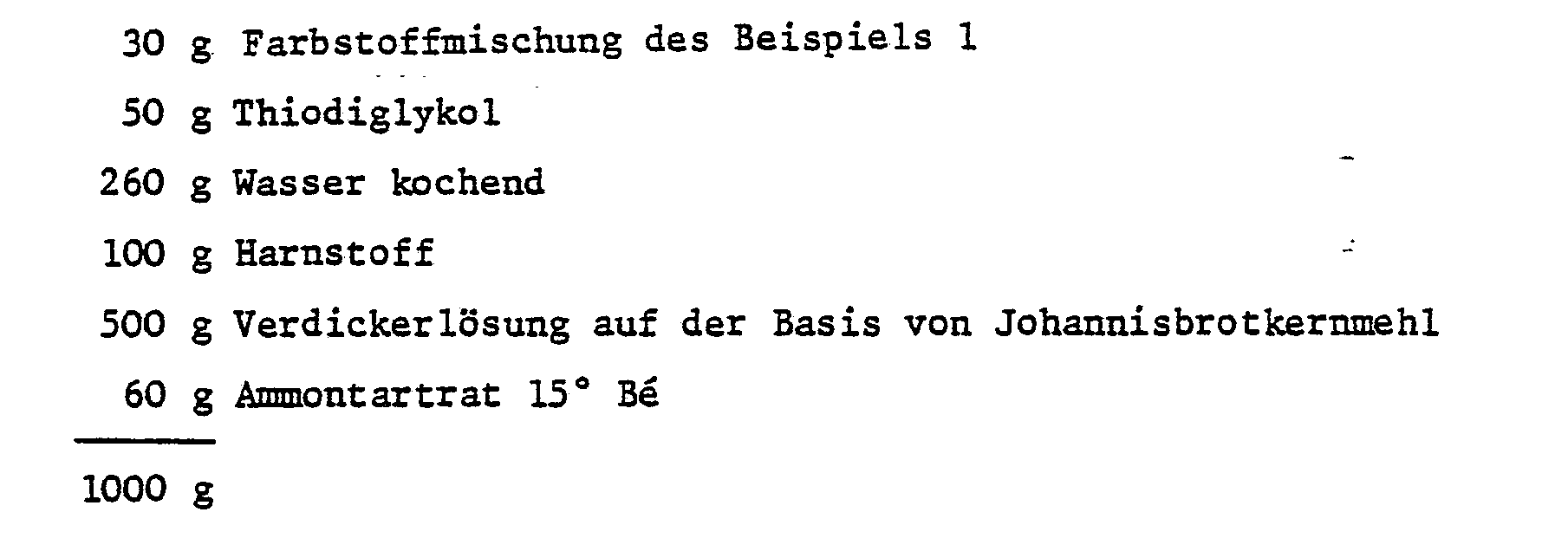
- Die so erhaltene Druckpaste ist in Bezug auf ihre Konsistenz für den Druck sehr gut geeignet und behält ihre guten Eigenschaften auch nach dem Stehen über mehrere Tage bei; sie geliert nicht.
- Mit dieser Druckpaste wird ein Gewebe aus Wolle oder Polyamid bedruckt und während 20-30 Minuten bei 0.,2 bar (102-104°) gedämpft. Das so erhaltene, grau-bedruckte Material besitzt gute Echtheitseigenschaften, vor allem Nassechtheiten.
- Ersetzt man in der oben beschriebenen Druckpaste die Farbstoffmischung des Beispiels 1 durch die gleiche Menge des symmetrischen l:2-Chromkomplexes des Farbstoffes der Formel IV, so erhält man eine Druckpaste, die sehr stark geliert und daher für den Druck nicht mehr brauchbar ist.
- Beispiel 6: Man löst 2 Teile der Farbstoffmischung gemäss Beispiel 1 in 4000 Teilen Wasser, geht mit 100 Teilen Wolle bei 50° ein, setzt 3 Teile Ammoniumacetat zu, erhitzt innerhalb von 45 Minuten zum Kochen und hält bei dieser Temperatur unter gutem Umziehen der Wolle während 1 1/2 Stunden, spült und trocknet. Die so in grauen Tönen gefärbte Wolle zeichnet sich durch gute Echtheiten aus.
Claims (13)



Applications Claiming Priority (2)
| Application Number | Priority Date | Filing Date | Title |
|---|---|---|---|
| CH5456/80 | 1980-07-16 | ||
| CH545680 | 1980-07-16 |
Publications (3)
| Publication Number | Publication Date |
|---|---|
| EP0045276A2 true EP0045276A2 (de) | 1982-02-03 |
| EP0045276A3 EP0045276A3 (en) | 1982-02-17 |
| EP0045276B1 EP0045276B1 (de) | 1983-06-22 |
Family
ID=4293898
Family Applications (1)
| Application Number | Title | Priority Date | Filing Date |
|---|---|---|---|
| EP19810810278 Expired EP0045276B1 (de) | 1980-07-16 | 1981-07-10 | 1:2-Chrom- und Kobaltkomplexfarbstoffe |
Country Status (6)
| Country | Link |
|---|---|
| EP (1) | EP0045276B1 (de) |
| JP (2) | JPS5912695B2 (de) |
| BR (1) | BR8104525A (de) |
| CA (1) | CA1169052A (de) |
| DE (1) | DE3160489D1 (de) |
| ES (1) | ES503976A0 (de) |
Cited By (2)
| Publication number | Priority date | Publication date | Assignee | Title |
|---|---|---|---|---|
| EP0061670A1 (de) * | 1981-03-23 | 1982-10-06 | Ciba-Geigy Ag | Verfahren zum Färben von Leder und Pelzen mit Farbstoffmischungen |
| US4611890A (en) * | 1984-01-24 | 1986-09-16 | Research Corporation | Redox chromophore compounds and electrodes of metal containing substituted bipyridines |
Families Citing this family (4)
| Publication number | Priority date | Publication date | Assignee | Title |
|---|---|---|---|---|
| JPS60138788U (ja) * | 1984-02-28 | 1985-09-13 | 株式会社 きもと | 図柄の上に書き消しできる筆記シ−ト |
| JPS6183986U (de) * | 1984-11-08 | 1986-06-03 | ||
| JPS6247416U (de) * | 1985-09-12 | 1987-03-24 | ||
| JPS63173826U (de) * | 1987-05-06 | 1988-11-11 |
Family Cites Families (4)
| Publication number | Priority date | Publication date | Assignee | Title |
|---|---|---|---|---|
| US2499133A (en) * | 1945-12-18 | 1950-02-28 | Allied Chem & Dye Corp | Monazo dyestuff |
| US2610175A (en) * | 1949-11-18 | 1952-09-09 | Ciba Ltd | Complex chromium compounds of monoazo-dyestuffs |
| US2813853A (en) * | 1954-06-29 | 1957-11-19 | Saul & Co | Monoazo dyestuffs and metal complex compounds thereof |
| NL293371A (de) * | 1962-02-09 |
-
1981
- 1981-07-10 DE DE8181810278T patent/DE3160489D1/de not_active Expired
- 1981-07-10 EP EP19810810278 patent/EP0045276B1/de not_active Expired
- 1981-07-14 CA CA000381720A patent/CA1169052A/en not_active Expired
- 1981-07-15 BR BR8104525A patent/BR8104525A/pt unknown
- 1981-07-15 ES ES503976A patent/ES503976A0/es active Granted
- 1981-07-16 JP JP11011181A patent/JPS5912695B2/ja not_active Expired
-
1983
- 1983-07-01 JP JP11835183A patent/JPS6052175B2/ja not_active Expired
Cited By (2)
| Publication number | Priority date | Publication date | Assignee | Title |
|---|---|---|---|---|
| EP0061670A1 (de) * | 1981-03-23 | 1982-10-06 | Ciba-Geigy Ag | Verfahren zum Färben von Leder und Pelzen mit Farbstoffmischungen |
| US4611890A (en) * | 1984-01-24 | 1986-09-16 | Research Corporation | Redox chromophore compounds and electrodes of metal containing substituted bipyridines |
Also Published As
| Publication number | Publication date |
|---|---|
| JPS59172552A (ja) | 1984-09-29 |
| JPS6052175B2 (ja) | 1985-11-18 |
| BR8104525A (pt) | 1982-03-30 |
| CA1169052A (en) | 1984-06-12 |
| EP0045276B1 (de) | 1983-06-22 |
| EP0045276A3 (en) | 1982-02-17 |
| JPS5749662A (en) | 1982-03-23 |
| JPS5912695B2 (ja) | 1984-03-24 |
| ES8203939A1 (es) | 1982-04-16 |
| DE3160489D1 (en) | 1983-07-28 |
| ES503976A0 (es) | 1982-04-16 |
Similar Documents
| Publication | Publication Date | Title |
|---|---|---|
| EP0045276B1 (de) | 1:2-Chrom- und Kobaltkomplexfarbstoffe | |
| DE1258525B (de) | Verfahren zur Herstellung von Farbstoffen | |
| DE2313722B2 (de) | Chromischkomplex-farbstoffe und ihre verwendung zum faerben und bedrucken von stickstoffhaltigen fasermaterialien | |
| DE1046220B (de) | Verfahren zur Herstellung von Monoazofarbstoffen und deren Metallkomplexverbindungen | |
| DE1644366B1 (de) | Verfahren zur Herstellung von metallhaltigen wasserloeslichen Pyrimidinreaktiv-Azofarbstoffen | |
| DE1271857B (de) | Verfahren zur Herstellung chromhaltiger Azofarbstoffe | |
| DE957506C (de) | Verfahren zur Herstellung kobalthaltiger Azofarbstoffe | |
| DE1012007B (de) | Verfahren zur Herstellung chromhaltiger Azofarbstoffe | |
| AT166451B (de) | Verfahren zur Herstellung neuer chromhaltiger Monoazofarbstoffe | |
| DE1644219C3 (de) | 2 zu 1-Metallkomplexmonoazofarbstoffe Verfahren zu ihrer Herstellung und ihre Verwendung | |
| DE909758C (de) | Verfahren zur Herstellung von chromhaltigen Monoazofarbstoffen | |
| DE2017873C3 (de) | Blaue Diazofarbstoffe | |
| DE1419837C3 (de) | Reaktive Monoazokupferkomplexfarbstoffe, Verfahren zu ihrer Herstellung und ihre Verwendung | |
| EP0037377B1 (de) | Metallkomplexfarbstoffe, deren Herstellung und Verwendung | |
| DE2019827C3 (de) | Chromhaltige Komplexfarbstoffe und Verfahren zu deren Herstellung | |
| EP0047427A1 (de) | Sulfonsäuregruppenhaltige 1:2-Chromkomplexfarbstoffe | |
| EP0112281B1 (de) | Unsymmetrische 1:2-Chromkomplexfarbstoffe, enthaltend eine Azo- und eine Azomethinverbindung | |
| DE1444719A1 (de) | Verfahren zur Herstellung von metallhaltigen Formazanfarbstoffen | |
| DE955881C (de) | Verfahren zur Herstellung kobalthaltiger Azofarbstoffe | |
| DE2457589C2 (de) | Neue Metallkomplexfarbstoffe, deren Herstellung und Verwendung | |
| DE1153839B (de) | Verfahren zur Herstellung methylolgruppenhaltiger Farbstoffe | |
| DE1008254B (de) | Verfahren zum Faerben stickstoffhaltiger Fasern | |
| DE921225C (de) | Verfahren zur Herstellung von Disazofarbstoffen | |
| DE731320C (de) | Verfahren zur Herstellung von metallhaltigen Azofarbstoffen | |
| DE1644164C3 (de) | 2 zu 1-Chromkomplex-Monoazofarbstoffe, Verfahren zu ihrer Herstellung und ihre Verwendung |
Legal Events
| Date | Code | Title | Description |
|---|---|---|---|
| PUAI | Public reference made under article 153(3) epc to a published international application that has entered the european phase |
Free format text: ORIGINAL CODE: 0009012 |
|
| PUAL | Search report despatched |
Free format text: ORIGINAL CODE: 0009013 |
|
| 17P | Request for examination filed |
Effective date: 19810713 |
|
| AK | Designated contracting states |
Designated state(s): BE CH DE FR GB IT |
|
| AK | Designated contracting states |
Designated state(s): BE CH DE FR GB IT |
|
| ITF | It: translation for a ep patent filed | ||
| GRAA | (expected) grant |
Free format text: ORIGINAL CODE: 0009210 |
|
| AK | Designated contracting states |
Designated state(s): BE CH DE FR GB IT LI |
|
| REF | Corresponds to: |
Ref document number: 3160489 Country of ref document: DE Date of ref document: 19830728 |
|
| ET | Fr: translation filed | ||
| PGFP | Annual fee paid to national office [announced via postgrant information from national office to epo] |
Ref country code: BE Payment date: 19830831 Year of fee payment: 3 |
|
| PG25 | Lapsed in a contracting state [announced via postgrant information from national office to epo] |
Ref country code: BE Effective date: 19840710 |
|
| PLBE | No opposition filed within time limit |
Free format text: ORIGINAL CODE: 0009261 |
|
| STAA | Information on the status of an ep patent application or granted ep patent |
Free format text: STATUS: NO OPPOSITION FILED WITHIN TIME LIMIT |
|
| 26N | No opposition filed | ||
| BERE | Be: lapsed |
Owner name: CIBA-GEIGY A.G. Effective date: 19840710 |
|
| ITTA | It: last paid annual fee | ||
| PGFP | Annual fee paid to national office [announced via postgrant information from national office to epo] |
Ref country code: FR Payment date: 19910522 Year of fee payment: 11 |
|
| PGFP | Annual fee paid to national office [announced via postgrant information from national office to epo] |
Ref country code: DE Payment date: 19910605 Year of fee payment: 11 |
|
| PGFP | Annual fee paid to national office [announced via postgrant information from national office to epo] |
Ref country code: CH Payment date: 19910627 Year of fee payment: 11 |
|
| PGFP | Annual fee paid to national office [announced via postgrant information from national office to epo] |
Ref country code: GB Payment date: 19920430 Year of fee payment: 12 |
|
| PG25 | Lapsed in a contracting state [announced via postgrant information from national office to epo] |
Ref country code: LI Effective date: 19920731 Ref country code: CH Effective date: 19920731 |
|
| PG25 | Lapsed in a contracting state [announced via postgrant information from national office to epo] |
Ref country code: FR Effective date: 19930331 |
|
| REG | Reference to a national code |
Ref country code: CH Ref legal event code: PL |
|
| PG25 | Lapsed in a contracting state [announced via postgrant information from national office to epo] |
Ref country code: DE Effective date: 19930401 |
|
| REG | Reference to a national code |
Ref country code: FR Ref legal event code: ST |
|
| PG25 | Lapsed in a contracting state [announced via postgrant information from national office to epo] |
Ref country code: GB Effective date: 19930710 |
|
| GBPC | Gb: european patent ceased through non-payment of renewal fee |
Effective date: 19930710 |