EP0045367A1 - Equipement pour diabétiques - Google Patents
Equipement pour diabétiques Download PDFInfo
- Publication number
- EP0045367A1 EP0045367A1 EP81104624A EP81104624A EP0045367A1 EP 0045367 A1 EP0045367 A1 EP 0045367A1 EP 81104624 A EP81104624 A EP 81104624A EP 81104624 A EP81104624 A EP 81104624A EP 0045367 A1 EP0045367 A1 EP 0045367A1
- Authority
- EP
- European Patent Office
- Prior art keywords
- set according
- receiving part
- insulin
- diabetic
- holders
- Prior art date
- Legal status (The legal status is an assumption and is not a legal conclusion. Google has not performed a legal analysis and makes no representation as to the accuracy of the status listed.)
- Withdrawn
Links
- 206010012601 diabetes mellitus Diseases 0.000 title claims abstract description 39
- NOESYZHRGYRDHS-UHFFFAOYSA-N insulin Chemical compound N1C(=O)C(NC(=O)C(CCC(N)=O)NC(=O)C(CCC(O)=O)NC(=O)C(C(C)C)NC(=O)C(NC(=O)CN)C(C)CC)CSSCC(C(NC(CO)C(=O)NC(CC(C)C)C(=O)NC(CC=2C=CC(O)=CC=2)C(=O)NC(CCC(N)=O)C(=O)NC(CC(C)C)C(=O)NC(CCC(O)=O)C(=O)NC(CC(N)=O)C(=O)NC(CC=2C=CC(O)=CC=2)C(=O)NC(CSSCC(NC(=O)C(C(C)C)NC(=O)C(CC(C)C)NC(=O)C(CC=2C=CC(O)=CC=2)NC(=O)C(CC(C)C)NC(=O)C(C)NC(=O)C(CCC(O)=O)NC(=O)C(C(C)C)NC(=O)C(CC(C)C)NC(=O)C(CC=2NC=NC=2)NC(=O)C(CO)NC(=O)CNC2=O)C(=O)NCC(=O)NC(CCC(O)=O)C(=O)NC(CCCNC(N)=N)C(=O)NCC(=O)NC(CC=3C=CC=CC=3)C(=O)NC(CC=3C=CC=CC=3)C(=O)NC(CC=3C=CC(O)=CC=3)C(=O)NC(C(C)O)C(=O)N3C(CCC3)C(=O)NC(CCCCN)C(=O)NC(C)C(O)=O)C(=O)NC(CC(N)=O)C(O)=O)=O)NC(=O)C(C(C)CC)NC(=O)C(CO)NC(=O)C(C(C)O)NC(=O)C1CSSCC2NC(=O)C(CC(C)C)NC(=O)C(NC(=O)C(CCC(N)=O)NC(=O)C(CC(N)=O)NC(=O)C(NC(=O)C(N)CC=1C=CC=CC=1)C(C)C)CC1=CN=CN1 NOESYZHRGYRDHS-UHFFFAOYSA-N 0.000 claims abstract description 124
- 102000004877 Insulin Human genes 0.000 claims abstract description 63
- 108090001061 Insulin Proteins 0.000 claims abstract description 63
- 229940125396 insulin Drugs 0.000 claims abstract description 62
- LFQSCWFLJHTTHZ-UHFFFAOYSA-N Ethanol Chemical compound CCO LFQSCWFLJHTTHZ-UHFFFAOYSA-N 0.000 claims abstract description 14
- 238000003780 insertion Methods 0.000 claims description 22
- 230000037431 insertion Effects 0.000 claims description 22
- 239000004033 plastic Substances 0.000 claims description 9
- 229920003023 plastic Polymers 0.000 claims description 9
- 239000000344 soap Substances 0.000 claims description 4
- 239000011521 glass Substances 0.000 claims description 3
- 239000012858 resilient material Substances 0.000 claims description 2
- 238000000926 separation method Methods 0.000 claims description 2
- 125000006850 spacer group Chemical group 0.000 claims description 2
- 238000013461 design Methods 0.000 description 8
- 238000002347 injection Methods 0.000 description 4
- 239000007924 injection Substances 0.000 description 4
- 238000012549 training Methods 0.000 description 4
- 238000004519 manufacturing process Methods 0.000 description 3
- 229920001971 elastomer Polymers 0.000 description 2
- 238000001746 injection moulding Methods 0.000 description 2
- 238000005507 spraying Methods 0.000 description 2
- 241000510164 Cumberlandia monodonta Species 0.000 description 1
- 229920005830 Polyurethane Foam Polymers 0.000 description 1
- 230000000295 complement effect Effects 0.000 description 1
- 230000006735 deficit Effects 0.000 description 1
- 230000000249 desinfective effect Effects 0.000 description 1
- 238000011161 development Methods 0.000 description 1
- 230000014509 gene expression Effects 0.000 description 1
- 239000004026 insulin derivative Substances 0.000 description 1
- 230000009191 jumping Effects 0.000 description 1
- 239000000463 material Substances 0.000 description 1
- 238000000034 method Methods 0.000 description 1
- 238000000465 moulding Methods 0.000 description 1
- 239000011496 polyurethane foam Substances 0.000 description 1
- 230000001681 protective effect Effects 0.000 description 1
- 239000007787 solid Substances 0.000 description 1
Images



Classifications
-
- A—HUMAN NECESSITIES
- A61—MEDICAL OR VETERINARY SCIENCE; HYGIENE
- A61M—DEVICES FOR INTRODUCING MEDIA INTO, OR ONTO, THE BODY; DEVICES FOR TRANSDUCING BODY MEDIA OR FOR TAKING MEDIA FROM THE BODY; DEVICES FOR PRODUCING OR ENDING SLEEP OR STUPOR
- A61M5/00—Devices for bringing media into the body in a subcutaneous, intra-vascular or intramuscular way; Accessories therefor, e.g. filling or cleaning devices, arm-rests
- A61M5/002—Packages specially adapted therefor, e.g. for syringes or needles, kits for diabetics
-
- A—HUMAN NECESSITIES
- A61—MEDICAL OR VETERINARY SCIENCE; HYGIENE
- A61M—DEVICES FOR INTRODUCING MEDIA INTO, OR ONTO, THE BODY; DEVICES FOR TRANSDUCING BODY MEDIA OR FOR TAKING MEDIA FROM THE BODY; DEVICES FOR PRODUCING OR ENDING SLEEP OR STUPOR
- A61M5/00—Devices for bringing media into the body in a subcutaneous, intra-vascular or intramuscular way; Accessories therefor, e.g. filling or cleaning devices, arm-rests
- A61M5/002—Packages specially adapted therefor, e.g. for syringes or needles, kits for diabetics
- A61M5/003—Kits for diabetics
Definitions
- the invention relates to a diabetic set with a pressure-resistant housing for holding at least one insulin bottle, a syringe and, where appropriate, alcohol wipes or the like.
- Such a diabetic set developed by the applicant itself, has the advantage that the diabetic can carry with him at any time and without too much space, everything he needs to be able to give himself one or more insulin injections. In this way, diabetics are more independent when traveling and - which is the case in very many cases - can also eat in restaurants without any problems, since they can then immediately administer the necessary insulin injection thanks to the diabetic set they carry with them.
- the invention is therefore based on the object of developing a diabetic set of the type mentioned in such a way that an operation is possible which makes it unnecessary to disassemble the housing or parts of the housing, so that under all circumstances and while maintaining the best possible hygienic Prerequisites the user of such a diabetic set can give himself an insulin injection.
- the diabetic set should be designed so that not only is it as break-resistant as possible, but that there is no risk of damage to the syringes or insulin bottles even if it falls.
- the invention provides that the housing is provided with a cap-like removable cover cover and that the receiving part is designed with its holders so that the syringe releasably held next to the insulin bottle after its inclusion in the holder remaining insulin bottle can be inserted.
- the cap-shaped lid according to the invention instead of a flat hinged lid allows on the one hand the design of the receiving part in such a way that it is open on at least one side, so that it does not have to be removed from the receiving part to insert the syringe into the insulin bottle.
- this cap-like design results in a much greater stiffness and thus breaking strength of the entire arrangement.
- the insulin bottles should preferably be held inside the housing with heads exposed on all sides. so that even a possible removal of the lid when used from a hygienic point of view can bring no impairment with it.
- the cover either remains connected to the lower part by means of a connecting band so that it simply hangs down after it has been pulled off, or that it is attached to the foot end of the receiving part from the opposite side, while attaching the syringe to the insulin bottle at the exposed top.
- the holders for the insulin bottles are to be designed in such a way that bottles of different diameters and / or lengths can be held.
- the range of variation need not be kept too large, since the commercially available insulin bottles - this applies in any case to the market-leading brands - only differ by a few millimeters in diameter.
- the housing can be designed in the manner of a cross-sectionally oval plug-in case for glasses, the receiving part being essentially dumbbell-shaped at least at the upper end.
- This cross-section results from two lateral insertion sleeves for the insulin bottles and a web wall connecting them with snap holders for the syringes.
- the common insulin bottles are relatively short and compact, in any case much shorter than the syringes.
- the insertion sleeves should therefore be of elongated design such that there is space for a reserve bottle under each insulin bottle.
- the web wall lies approximately in the central plane of the insertion sleeves and the cap-like cover is made relatively long, so that on only a short oval sleeve needs to be provided at the lower end of the receiving part.
- the web wall protrudes freely for most of its length after the cover has been removed, so that the syringes do not have to be pulled out of narrow channels, but rather only protrude with their ends into the short sleeve and are simple to remove and replace Swinging forward or backward is required.
- the receptacles for the two syringes should be separated from one another by spacers, for example a longitudinal rib, attached to the web wall.
- spacers for example a longitudinal rib, attached to the web wall.
- the syringes are protected in a trough formed by the side insertion sleeves for the insulin bottles, so that there is no risk of breakage even if the housing should fall on the floor, not even if the cap-like lid has already been removed at this time is.
- the walls of the lower oval sleeve section of the receiving part lying parallel to the central web wall result not only in the receiving space for the ends of the syringes, but also on the opposite side a receiving space for alcohol wipes for disinfecting the puncture points on the body of the user.
- the holders for the insulin bottles should be designed so that the insulin bottles partially protrude from the holders in their operating position, so that the labels are partially visible. This is particularly important for diabetics who have to use two different insulins at the same time so that they can see at a glance which insulin is in which bottle Usually the necessary proportions of the two varieties are not the same size. In order to ensure a particularly high level of protection against damage, even when handled carelessly, the insulin bottles in their holders should then be protruded on one side by a wall section.
- the housing instead of said brillenetuiartigen housing with a relatively long back also, for example, soap dish-like with access to the I nsulinflaschen releasing recesses formed in the side walls be.
- these side walls can be practically completely omitted, while the longitudinal side walls should in any case remain at least in the central region of the receiving part, in order to ensure better handling during use.
- This soap dish-like basic shape of the housing with the possibility of being able to provide recesses in the two opposite side walls makes it possible to provide holders for two insulin bottles juxtaposed in the longitudinal center line of the receiving part, while clamp holders for the syringes are arranged to the left and right of the holder device for the bottles.
- the alcohol wipes are accommodated on the inside of the lid, on which corresponding fastening devices are provided, for example in the form of a simple tensioning rubber that overlaps the wipes and can be unhooked on one side.
- the configuration may be devised again so that the lid after removing itself can attach to the bottom of the receiving part so that it also sets the -ered to B does not need to be given from the hand.
- the cover is designed as a flat cuboid open on a longitudinal narrow side, from which the receiving part, which is essentially a plate with the integrally formed missing cuboid wall, can be pulled out laterally.
- Guides can be provided for the slide bearings of the receiving part, for example in the form of grooves receiving the open end edges of the plate in the end walls of the cover lying parallel to the starting direction, or also in grooves in the cover walls parallel to the plate, in which rudimentary end wall webs of the receiving part are guided are.
- a diabetic set which can in principle be made of any material, gives the particularly advantageous possibility of manufacturing the lower part and the cover of the housing as one-piece molded parts made of plastic, although it is nevertheless possible through a particularly leather-like grain ensure a pleasing, valuable appearance of these plastic parts on the surface. It is also within the scope of the invention to use foamed plastics, for example polyurethane foam, which give high breaking strength with very low weight.
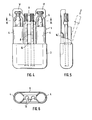
- the diabetic set designed in the manner of a glasses case according to FIGS. 1-3 consists of the lower part 1 and an attachable cap-like cover 2, which overlaps the lower part so that the lower part 3 of the receiving part corresponding to the cap-like cover 2 1 is relatively low.
- the receiving part comprises two lateral insertion sleeves 4 for receiving insulin bottles 5 and 6, wherein the clamping sleeves of these insulin bottles 5 and 6 and to adapt to different bottle diameters, the insertion sleeves are slotted at 7, so that they are resiliently expandable.
- the insertion sleeves would not need to be designed as long as the lower part itself, the length of which is essentially determined by the length of the syringes 8, which is detachable in the lower part 1 between the insertion sleeves 4 for the insulin bottles 5 and 6 are supported.
- the insertion sleeves 4 are connected by a rear wall 9 and a front wall 10 set back relative to the tangential front plane of the insertion sleeves 4, so that between them a receiving space for the, which is possibly divided again by a transverse wall Syringes are created.
- Undercut groove recesses 11 in the walls 9 and 10 allow the transverse attachments 12, which are used for handling the syringes, to snap into place, which normally rest on the index and middle fingers when the syringe is actuated.
- the insertion sleeves 4 for the insulin syringes 5 and 6 would not need to go through the entire length.
- the design of the diabetic set according to the invention does not make it necessary for the lower part to be placed somewhere for handling or for the insulin bottle to be removed from its holder at all.
- a syringe 8 is removed from its resiliently locked insertion position and can then be inserted and drawn into one and / or another insulin bottle in the direction of arrow P. After spraying, the syringe is reinserted in its receptacle and the cap 2 is pushed on.
- the shown training also results in a very high degree of rigidity and pressure resistance, so that the risk is practically completely eliminated that an insulin bottle or a syringe can break, even if the set should fall to the floor once. This is particularly important because a diabetic who breaks his diabetic set on the go, for example on vacation - has to interrupt his trip and go home again.
- the front wall 10 is omitted in the connecting section between the two insertion sleeves 4, so that the syringes immediately in front of the rear wall 9 enable loosening by pivoting forward Locking recesses 15 are held.
- the separation of the recordings for two syringes 8 insteckhülsen from the web wall 9 between the E in this embodiment is a simple, 4 reduces forwardly projecting pin sixteenth
- the insertion and removal is carried out, as indicated by dash-dotted lines in FIG. 5, by pivoting the syringes forwards or pivoting insertion into the receiving space formed by the lower part 3.
- the wall 9 is, as in FIG. 5 can be seen particularly well, provided with a bulge in order to form this receiving space 14 'for the alcohol wipes.
- the web wall 9 is provided in the region of the insulin bottles 5 and 6 with projections 17 which protrude from it and which protect the insulin bottles against breakage during handling.
- the design of the insertion sleeves 4 in such a way that the insulin bottles 5 and 6 can see a whole way out in front is essential so that diabetics who have to use two different types of insulin at the same time can immediately recognize which insulin is in which bottle by the label that appears.
- the manageability of the diabetic set according to the invention without removing the insulin bottles and without putting down essential parts, even removing the cap can be avoided by using a cord or the like. always remains connected to the lower part, so that it simply hangs down from the lower part during handling of the set, can, as shown in FIGS. 7-9, also be achieved by practically completely omitting the end walls 18 of the lower part 1.
- the syringe can again be attached to one of the insulin bottles 5 or 6 either in the direction of arrow P 1 from above or in the direction of arrow P 2 from below.
- the syringes are not held between the receptacles for the insulin bottles 5 and 6, as in the embodiments according to FIGS. 1-6, but to the side of them.
- the fork-shaped clamp holders 19 for the syringes 8 can be molded directly onto the side legs 20 of the clamp holder for the insulin bottles 5 and 6.
- the longitudinal side walls 21 of the receiving part 1 of the housing are, as can be seen particularly well from FIG. 8, at least in the middle part, so that they can be better grasped by hand.
- the complementary to the curved side walls of the lower part formed side walls of the cap-like cover 2 with their recessed free edge edges in the manner of the usual connection of the dish and lid in soap dishes in the receiving part 1.
- a holding device is arranged in the interior of the cover 2, which can include, inter alia, a tensioning rubber 23 which holds the alcohol wipes in a clamped manner on the inside.
- the variant of a diabetic set according to the invention shown schematically in FIGS. 10 and 11 comprises a holding part 1, which can be pulled out of the cap-shaped cover 2, so that the only schematically indicated, for example as shown in FIG. 7, on the plate 24 of the receiving part 1, insulin bottles 5, 6 can be pierced by means of the removed syringe 8 from one or the other end faces lying parallel to the plane of the drawing.
- the lower part 1 comprises single Lich the plate 24 and the longitudinal side wall 25 closing the open front of the cap 2 and of course the holder for the syringe and the insulin bottles and possibly the alcohol wipes on the underside of the page 24.
- the guide can be done in that the plate 24 with side edges 26 in engages formed by expressions 27 of the end walls of the cap 2.
- an additional inner longitudinal side wall 28 could also be provided, which, in conjunction with projecting edge webs 29, represents a limitation of the extension of the receiving part and which is guided with knobs-like extensions 30 in channels 33 pressed out of the cover surfaces 31 and 32 of the cap.
- the variant of the invention shown Sets 11 and 12 Ee in FIGS. Is particularly advantageous in view of the connectedness of recording and cover in the extended operating position with regard to the hygienic handling and can thereby also quite easy to prepare.
- the invention is not restricted to the exemplary embodiments shown.
- the training according to the invention in which the user takes a syringe in one hand while he is doing the entire rest of the Can keep sets in the other hand without having to remove any parts or have to put them down anywhere else with a number of other training methods.
- the housing is as thermally insulating as possible, which can be achieved, for example, by using foamed plastic.
- it should be moisture-proof and - tight, so that it can be kept at home or in the hotel in the fridge, as it is known that insulin should be kept cool.
Landscapes
- Health & Medical Sciences (AREA)
- Diabetes (AREA)
- Vascular Medicine (AREA)
- Engineering & Computer Science (AREA)
- Anesthesiology (AREA)
- Biomedical Technology (AREA)
- Heart & Thoracic Surgery (AREA)
- Hematology (AREA)
- Life Sciences & Earth Sciences (AREA)
- Animal Behavior & Ethology (AREA)
- General Health & Medical Sciences (AREA)
- Public Health (AREA)
- Veterinary Medicine (AREA)
- Medical Preparation Storing Or Oral Administration Devices (AREA)
- Infusion, Injection, And Reservoir Apparatuses (AREA)
Applications Claiming Priority (2)
| Application Number | Priority Date | Filing Date | Title |
|---|---|---|---|
| DE3029226 | 1980-08-01 | ||
| DE19803029226 DE3029226A1 (de) | 1980-08-01 | 1980-08-01 | Diabetiker-set |
Publications (1)
| Publication Number | Publication Date |
|---|---|
| EP0045367A1 true EP0045367A1 (fr) | 1982-02-10 |
Family
ID=6108680
Family Applications (1)
| Application Number | Title | Priority Date | Filing Date |
|---|---|---|---|
| EP81104624A Withdrawn EP0045367A1 (fr) | 1980-08-01 | 1981-06-16 | Equipement pour diabétiques |
Country Status (6)
| Country | Link |
|---|---|
| US (1) | US4446970A (fr) |
| EP (1) | EP0045367A1 (fr) |
| JP (1) | JPS5757559A (fr) |
| AU (1) | AU7315581A (fr) |
| DE (1) | DE3029226A1 (fr) |
| ES (1) | ES8206190A1 (fr) |
Families Citing this family (27)
| Publication number | Priority date | Publication date | Assignee | Title |
|---|---|---|---|---|
| US4657138A (en) * | 1986-04-11 | 1987-04-14 | Watson Frank K | Carrying case for insulin syringes |
| US4917867A (en) * | 1987-08-26 | 1990-04-17 | Forensic Applications Corporation | Apparatus for the collection and transportation of dual biological samples |
| US4767008A (en) * | 1987-11-02 | 1988-08-30 | Warnecke Armand E | Injection monitor appliance |
| US4867316A (en) * | 1988-05-02 | 1989-09-19 | William Rollender | Fungi identification kit |
| USD325126S (en) | 1988-10-21 | 1992-04-07 | Igloo Products Corporation | Insulated carrying case for a diabetic kit |
| CA2147369A1 (fr) * | 1992-10-21 | 1994-04-28 | Fh Faulding Pty Ltd. | Boite a compartiment multiple |
| WO1995009579A1 (fr) * | 1993-10-07 | 1995-04-13 | Muodonmuutos Oy | COFFRET POUR EQUIPEMENTS MEDICAUX à USAGE DOMESTIQUE |
| US5950827A (en) * | 1998-10-08 | 1999-09-14 | Odom; Jeffrey L. | Injector pen storage case |
| US6502699B1 (en) * | 2000-06-21 | 2003-01-07 | Robert L. Watson | Method and kit for making injections and withdrawing blood without the use of protective gloves |
| US20030012701A1 (en) * | 2001-07-13 | 2003-01-16 | Sangha Jangbir S. | Insulated specimen sampling and shipping kit |
| US6745785B2 (en) * | 2002-01-18 | 2004-06-08 | Irwin Kotovsky | Cane |
| US7562774B2 (en) * | 2002-02-15 | 2009-07-21 | Arkray, Inc. | Kit holding adapter |
| US20050016895A1 (en) * | 2003-07-24 | 2005-01-27 | Glenn David R. | Travel case for transporting insulin |
| EP1740254B1 (fr) * | 2004-04-30 | 2019-12-25 | Becton Dickinson and Company | Systemes et procedes d'administration d'un regime medical |
| JP2006066714A (ja) * | 2004-08-27 | 2006-03-09 | Matsushita Electric Ind Co Ltd | トランジスタ |
| USD524049S1 (en) | 2005-04-14 | 2006-07-04 | Hughes Linda M | Medical organizer travel bag |
| JP5744005B2 (ja) * | 2009-03-31 | 2015-07-01 | サノフィ−アベンティス・ドイチュラント・ゲゼルシャフト・ミット・ベシュレンクテル・ハフツング | 固定手段 |
| EP2266647A1 (fr) | 2009-06-25 | 2010-12-29 | Sanofi-Aventis Deutschland GmbH | Mécanisme d'entraînement pour dispositif d'administration de médicament |
| USD758712S1 (en) | 2010-10-04 | 2016-06-14 | Raymond O. Ladegast | Portable medication cooling device |
| US9572922B2 (en) * | 2012-12-21 | 2017-02-21 | Larry Leonard | Inventive diabetic systems, tools, kits, and supplies for better diabetic living and mobility |
| US8550251B1 (en) | 2012-05-06 | 2013-10-08 | Edna Ford | Diabetic two-fold medical case |
| US9381294B2 (en) * | 2012-06-17 | 2016-07-05 | Ulrike H. M. Ziegner | Auto-injector case |
| US9884242B2 (en) | 2012-07-26 | 2018-02-06 | Hillerich & Bradsby Co. | Glove with expansion zones along sides of fingers |
| JP6422479B2 (ja) | 2013-03-15 | 2018-11-14 | ハイプロテック、 インク. | 複数チャンバ式の注射デバイス |
| US11130043B2 (en) | 2015-05-21 | 2021-09-28 | Hillerich & Bradsby Co. | Glove with expandable finger stall |
| USD890952S1 (en) | 2018-07-31 | 2020-07-21 | Duane Searles | Diabetic testing equipment organizer |
| US11602486B2 (en) * | 2021-06-29 | 2023-03-14 | Daniel Singh | Device for chilling insulin in a travel mug |
Citations (3)
| Publication number | Priority date | Publication date | Assignee | Title |
|---|---|---|---|---|
| US1625035A (en) * | 1927-04-19 | Hxpodebmic kit | ||
| US2174329A (en) * | 1938-03-18 | 1939-09-26 | John A O'neill | Insulin bottle and syringe holder |
| US2740516A (en) * | 1954-01-29 | 1956-04-03 | William Renn | Diabetic's emergency kit |
Family Cites Families (13)
| Publication number | Priority date | Publication date | Assignee | Title |
|---|---|---|---|---|
| US191607A (en) * | 1877-06-05 | Improvement in medicine-cases | ||
| US799593A (en) * | 1904-07-23 | 1905-09-12 | Alfred R L Dohme | Display-package. |
| US1582823A (en) * | 1923-06-04 | 1926-04-27 | Clarence E Jones | First-aid kit |
| US1995799A (en) * | 1932-08-22 | 1935-03-26 | Doniger Sundel | Medicinal kit |
| US2093537A (en) * | 1936-05-15 | 1937-09-21 | Alvin A Balint | Medical case |
| US2426865A (en) * | 1944-02-25 | 1947-09-02 | Nat Folding Box Company Inc | Display container with extensions |
| US2410928A (en) * | 1944-06-05 | 1946-11-12 | Ames Co | Container |
| US3670938A (en) * | 1970-10-19 | 1972-06-20 | Samuel C Brocato | Dish tray |
| DE7340562U (de) * | 1973-11-13 | 1974-05-22 | Draegerwerk Ag | Atemalkohol-pruefgeraet |
| US4212390A (en) * | 1977-10-20 | 1980-07-15 | Propper Manufacturing Co., Inc. | Wound clip rack |
| US4250998A (en) * | 1979-08-06 | 1981-02-17 | Frank Taylor | Diabetic travel kit |
| US4321998A (en) * | 1980-03-06 | 1982-03-30 | Norton Company | Earplug container |
| US4339633A (en) * | 1980-10-06 | 1982-07-13 | International Standard Electric Corporation | Modular telecommunications system |
-
1980
- 1980-08-01 DE DE19803029226 patent/DE3029226A1/de not_active Withdrawn
-
1981
- 1981-06-16 EP EP81104624A patent/EP0045367A1/fr not_active Withdrawn
- 1981-07-21 US US06/285,572 patent/US4446970A/en not_active Expired - Fee Related
- 1981-07-21 AU AU73155/81A patent/AU7315581A/en not_active Abandoned
- 1981-07-22 ES ES504183A patent/ES8206190A1/es not_active Expired
- 1981-07-31 JP JP56119419A patent/JPS5757559A/ja active Pending
Patent Citations (3)
| Publication number | Priority date | Publication date | Assignee | Title |
|---|---|---|---|---|
| US1625035A (en) * | 1927-04-19 | Hxpodebmic kit | ||
| US2174329A (en) * | 1938-03-18 | 1939-09-26 | John A O'neill | Insulin bottle and syringe holder |
| US2740516A (en) * | 1954-01-29 | 1956-04-03 | William Renn | Diabetic's emergency kit |
Also Published As
| Publication number | Publication date |
|---|---|
| DE3029226A1 (de) | 1982-03-18 |
| AU7315581A (en) | 1982-02-04 |
| US4446970A (en) | 1984-05-08 |
| JPS5757559A (en) | 1982-04-06 |
| ES504183A0 (es) | 1982-08-16 |
| ES8206190A1 (es) | 1982-08-16 |
Similar Documents
| Publication | Publication Date | Title |
|---|---|---|
| EP0045367A1 (fr) | Equipement pour diabétiques | |
| EP0919431B1 (fr) | Véhicule avec au moins deux éléments fonctionnels montés à l'intérieur du couvercle d'une boíte à gants | |
| DE1553842A1 (de) | Ausgabegeraet fuer Rasierklingenbloecke und dazugehoeriger Rasierapparat | |
| EP0198434A2 (fr) | Procédé et dispositif pour la conservation de supports d'enregistrements plats | |
| DE2926381A1 (de) | Wandhalter fuer einen elektrorasierer | |
| WO1999007247A2 (fr) | Porte-pieces fonctionnelles, en particulier un couteau de poche | |
| WO1992022065A1 (fr) | Coffret (boites a disques compacts) pour disques compacts (disques audio-numeriques) et autres supports similaires d'informations sous forme de disques | |
| DE3243508A1 (de) | Buerste | |
| EP0332664B1 (fr) | Guidage pour tiroirs de preference en plastique | |
| DE9403713U1 (de) | Faltbare Verpackung für Waren | |
| DE3442867A1 (de) | Schutzkappe fuer einen oder mehrere rasierapparate und rasierapparatepack | |
| DE3011772A1 (de) | Essbesteck | |
| DE10305969A1 (de) | Sicherheitsreibe | |
| DE3877888T2 (de) | Schutzblattapparat fuer toilettensitz. | |
| EP0365999B1 (fr) | Ensemble pour soins, en particulier pour voyage | |
| EP0277271B1 (fr) | Rasoir à sec | |
| DE2609881A1 (de) | Behaelter fuer magnetbandkassetten | |
| DE69015073T2 (de) | Modulares, insbesondere elektrisches, Gerät mit Schutzdeckel für Hinweisschilder. | |
| EP1264669A1 (fr) | Dispositif à couper des fruits, des légumes ou analogue | |
| EP0120372B1 (fr) | Container du genre étui | |
| DE3330477C2 (de) | Klingenspender für Klingeneinheiten für Rasiermesser bzw. Effiliermesser | |
| DE69526071T2 (de) | Unterbringungs- und Haltevorrichtung für Geräte, Instrumente, Werkzeuge oder dergleichen | |
| DE2615457A1 (de) | Magazin | |
| EP1351874B1 (fr) | Distributeur de film | |
| DE8913207U1 (de) | Aufbewahrungsbox für Schraubendrehereinsätze |
Legal Events
| Date | Code | Title | Description |
|---|---|---|---|
| PUAI | Public reference made under article 153(3) epc to a published international application that has entered the european phase |
Free format text: ORIGINAL CODE: 0009012 |
|
| AK | Designated contracting states |
Designated state(s): AT BE CH FR GB IT LU NL SE |
|
| 17P | Request for examination filed |
Effective date: 19820728 |
|
| STAA | Information on the status of an ep patent application or granted ep patent |
Free format text: STATUS: THE APPLICATION IS DEEMED TO BE WITHDRAWN |
|
| 18D | Application deemed to be withdrawn |
Effective date: 19840816 |