EP0045502A2 - Métronome à indication optique et/ou acoustique - Google Patents
Métronome à indication optique et/ou acoustique Download PDFInfo
- Publication number
- EP0045502A2 EP0045502A2 EP81106042A EP81106042A EP0045502A2 EP 0045502 A2 EP0045502 A2 EP 0045502A2 EP 81106042 A EP81106042 A EP 81106042A EP 81106042 A EP81106042 A EP 81106042A EP 0045502 A2 EP0045502 A2 EP 0045502A2
- Authority
- EP
- European Patent Office
- Prior art keywords
- note
- sequence
- metronome
- output device
- optical
- Prior art date
- Legal status (The legal status is an assumption and is not a legal conclusion. Google has not performed a legal analysis and makes no representation as to the accuracy of the status listed.)
- Granted
Links
Images

Classifications
-
- G—PHYSICS
- G04—HOROLOGY
- G04F—TIME-INTERVAL MEASURING
- G04F5/00—Apparatus for producing preselected time intervals for use as timing standards
- G04F5/02—Metronomes
- G04F5/025—Electronic metronomes
Definitions
- the invention relates to a metronome with optical and / or acoustic signaling at an adjustable beat frequency, an input device being provided for inputting a sequence of note or pause values which forms at least one cycle duration, furthermore a memory for the input sequence, a circuit for the repeatable generation of control signals corresponding to the input sequence, taking into account the set beat frequency and at least one optical output device responsive to these control signals.
- the invention also relates to a method for operating a metronome.
- Metronomes It is known, for example from DE-OS 25 08 509, to provide metronomes with acoustic and optical signaling options. At regular intervals, acoustic and optical signals are generated, which are audible and visible in the set beat frequency as beats and thus serve as a measure of time when practicing or performing pieces of music. Metronomes of the known type have the disadvantage, which is particularly important for people who are less well-versed in music, that they are pure strikers, which, regardless of the time signature and rhythm mus provide gleichmässi g e signals.
- each note value of the sequence can be optically displayed in a manner characteristic of it within the course of time of at least one cycle duration.
- the solution according to the invention has the advantage that after inputting the sequence of notes or pause values of interest, which is also readily possible for the beginner, the corresponding rhythm is generated in the selected beat frequency and its sequence can be detected optically.
- the beat frequency can first be set low for exercise purposes and increased later without influencing the entered clock structure.
- the metronome preferably has an optical output device according to claims 2 and 3 or 2 and 4. This makes it possible in a simple manner to implement the chronological sequence of the note values or pauses in a spatial sequence, which improves the clarity of the sequence and thus the learnability ter facilitates and allows greater precision in understanding the rhythm.
- the memory provided according to claim 1 for the entered sequence of note or pause values has a capacity to accommodate a sequence comprising several clock periods. This has among other things the advantage that time changes can also be represented and the rhythm of longer musical themes can be generated.
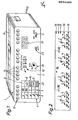
- Fig. 1 an embodiment is shown in front view, as the user has in front of him.
- the metronome is located in a housing 1, which has a relatively low height, so that it can be arranged under the sheet of music on a music stand.
- a holding strap 2 or other suitable means, such as clips, can be used to attach it to the music stand.
- the metronome is advantageously arranged such that both the note image and the front plate 3 of the metronome can be grasped at a glance.
- the most important operating and display elements are arranged on the front panel 3.
- a keypad 4 is used to enter the sequence of note or pause values to be reproduced.
- the input process is as follows: after switching on the device by means of a switch 5 and pressing a reset button 22, successive Pressing the correspondingly labeled touch buttons 6 or pause buttons 7 type in the rhythm to be played. Dotted notes are entered by pressing a puncture key 8 after pressing the corresponding key 6.
- a triplet key 9 is provided for the input of triplet figures, which is actuated before the input of three note values which represent the triplet in the note image.
- the measure end key 10 is actuated, which in the optical display, as will be explained in detail below, causes a reset to the beginning.
- note or pause values up to the note total 1 can be entered within one bar, ie up to 16 sixteenth notes or two quarter notes and eight sixteenth notes etc. per bar. Of course, for example, to display a 3/4 measure, note or pause values can also be entered that together make up less than the value 1. The most important time signatures can thus be set. In the present exemplary embodiment, up to 8 cycles can be typed in contiguously, cycle changes, for example from 3/4 cycle to 4/4 cycle and back, are also readily possible.
- operation of the metronome is triggered by actuating a start button 11.
- a foot pedal can be provided for starting. First, an empty bar is output in the rhythm of the first bar entered.
- the entered sequence is then reproduced repeatedly at a specific beat frequency set by means of a three-decimal switch 12.
- An optical and an acoustic output device are used for signaling and are described in detail below.
- the optical output device 13 consists of a series of optical display elements, for example formed by a row of light-emitting diodes 14, which is divided into groups of four. A total of four groups of four are planned.
- the visual representation is now carried out in such a way that, while maintaining the set beat frequency, the note values within the bar are assigned a number of light-emitting diodes corresponding to their position in the bar and their value.
- the note values are displayed in that the corresponding light-emitting diodes light up successively in the frequency of the smallest representable note value, and remain in this state until the note duration has expired.
- the actuated LEDs go out at the same time.
- the e.g. third quarter note represented by successive lighting of the LEDs 14 of the third group in the rhythm of the sixteenth notes.
- the quarter note expires, the whole group goes out at the same time.
- each diode lights up only for the duration of a sixteenth note and then goes out immediately.
- Breaks are displayed by skipping a corresponding number of display elements, with no element lighting up during the duration of the break.
- the display elements corresponding to the breaks light up dimly or that elements of different colors are provided for this.
- the described optical output device can be used to represent rhythms in a wide variety of time signatures whose note values per measure do not exceed the sum of 1, e.g. in 2/2, 2/4, 4/4; 3/4, 6/8 time, etc., which are the most common time signatures.
- FIG. 2 shows a further possible optical output device which is operated essentially in the same way as that explained above, but the individual note values can also be represented as such.
- the note values drawn in FIG. 2 are to be understood as electrode arrangements for a liquid crystal display, which become visible only when actuated and are otherwise imperceptible.
- the lowest row of electrodes 15 is used to represent Sixteenth notes and triplets. This row is operated like row 13 of the display elements in FIG. 1, which is why a further explanation is omitted.
- the corresponding note value is now visible in its entire duration in one of the upper rows 16 to 19.
- This arrangement has the advantage, especially for beginners, that the display largely matches the note image with regard to note values.
- an acoustic output device is also provided which can be adjusted or switched off to the desired volume by means of an actuating button 20 (FIG. 1).
- the acoustic output device has a loudspeaker, which is preferably arranged on the bottom or top of the housing 1 (not shown) and which generates a tone of a specific frequency, preferably 440 Hz, so that the instruments can then be tuned at the same time. Its duration is dependent on the note value to be displayed, but is shortened by a fixed amount of time so that successive notes can be distinguished without a break.
- an external exit can be provided, at which e.g. headphones or a tape can be connected.
- the acoustic output device can first be used together with the optical output device until the rhythm has been learned. After that, the optical display can be used alone and ensure accurate reproduction.
- the metronome also has a decadic, three-digit clock counter display 21 on its front plate 3.
- the number of cycles played is displayed. On the one hand, this allows for longer pauses in an instrument when playing the ensemble without tedious counting, but on the other hand it also allows you to easily number musical notes that have not yet been numbered. Furthermore, it allows the conductor to easily determine, in a rehearsal without counting the measures, in which measure corrections have to be made to the playing style, etc.
- the measure counter is reset to 0 each time a reset button 22 "Reset" is pressed.
- an external connection 23 is arranged on the front plate 3, by means of which several metronomes of the type shown can be electrically connected to one another. This makes it possible to start several metronomes at the same time, so that several synchronous metronomes can be used in an ensemble, which further increases the effectiveness of the optical output device compared to conventional optical metronomes.
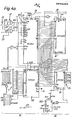
- the keypad 4 is connected to a first input unit 24. Furthermore, the decimal switch 12 is connected to a second input unit 25. These input units are connected by means of an 8-bit data bus 26 to a microprocessor and memory 27 for the input note sequence.
- the microprocessor 27 has a quartz oscillator 28 which oscillates at a frequency of 4 MHz.
- the microprocessor 27 is connected via an 11-bit address bus 29 to a read-only memory 30, in which an operating program is permanently stored.
- the read-only memory 30 is in turn connected to the 8-bit data bus 26, which leads to an output unit 31.
- the optical output device 13 with a plurality of light-emitting diodes, a clock counter 32 with the clock counter display 21 and an oscillator 33 with loudspeaker 34 for acoustic signaling are connected to the latter.
- the first input unit 24 has a 2 ⁇ .8-bit input register 50, via which the commands entered by means of the keypad 4, which contains the keys shown in FIG. 1 (without the reset key? 2), on the 8-bit Data bus.
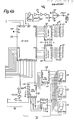
- the second input unit 25 has an 8-bit input register 36, to which a BCD switch 25a, 25b is connected for the tens and one input of the time measure.
- the hundred units are entered via a BCD switch 25c, which is part of the first input unit 24 and can be set to the values 0.1 or 2.
- the microprocessor 27 processes 8- bit words with the cycle time of 1 us and has a read / write memory with the capacity 128 bytes, in which these notes are stored. As mentioned, this allows the entry of a sequence of 8 measures. From the 4 MHz quartz oscillator 28, the working cycle of the device as well as the beat frequency and the note duration are derived.
- the reset button 22 is connected to a reset input 35 via a circuit 37 for eliminating switch bounce effects, which also has the external reset connection 23.
- the microprocessor 27 is connected via an 11-bit address bus to a read-only memory 30 which has a capacity of 2048 8-bit words.
- the read-only memory contains the program for the explained functional sequences. It is not shown here to reproduce this program because, due to the described mode of operation of the metronome, it lies within the range of the skilled person and is not the subject of the invention.
- the output unit 31 has a 2 x 8-bit output register 39 and two 8-bit buffer registers 40, each of which is connected to 8 LEDs 14.
- the output unit 31 is also connected to the clock counter 32, which is BCD-coded.
- the clock counter is connected to a display multiplex unit 41 and a BCD-7 segment converter 42, by means of which the clock counter display 21 is operated.
- the clock counter can be set to zero by means of the clock counter reset circuit 38.
- the output register 39 also has the 440 Hz oscillator 33 with loudspeaker 34 at an output.
- a power supply unit provides the necessary supply voltages.
- a rechargeable battery can also be provided for this.
- the device described has the advantage that any rhythm can be generated within the framework of the typable note or pause values, it being possible to achieve a signal which represents the passage of time with the optical output device.
- This allows the rhythm to be reproduced precisely even after the initially useful acoustic signal, which later becomes disruptive when making music, is switched off, since not only the length of time that has already elapsed, but also the one that is still to come, is visible, especially with longer note values.
- this not only clearly defines the start of a note value, but also the end of it.
Landscapes
- Engineering & Computer Science (AREA)
- Multimedia (AREA)
- Physics & Mathematics (AREA)
- General Physics & Mathematics (AREA)
- Electrophonic Musical Instruments (AREA)
Applications Claiming Priority (2)
| Application Number | Priority Date | Filing Date | Title |
|---|---|---|---|
| CH5934/80 | 1980-08-05 | ||
| CH593480A CH627565A5 (de) | 1980-08-05 | 1980-08-05 | Metronom mit optischer und/oder akustischer signalgabe. |
Publications (3)
| Publication Number | Publication Date |
|---|---|
| EP0045502A2 true EP0045502A2 (fr) | 1982-02-10 |
| EP0045502A3 EP0045502A3 (en) | 1982-02-17 |
| EP0045502B1 EP0045502B1 (fr) | 1986-04-23 |
Family
ID=4301740
Family Applications (1)
| Application Number | Title | Priority Date | Filing Date |
|---|---|---|---|
| EP81106042A Expired EP0045502B1 (fr) | 1980-08-05 | 1981-08-01 | Métronome à indication optique et/ou acoustique |
Country Status (3)
| Country | Link |
|---|---|
| EP (1) | EP0045502B1 (fr) |
| CH (1) | CH627565A5 (fr) |
| DE (1) | DE3174458D1 (fr) |
Cited By (6)
| Publication number | Priority date | Publication date | Assignee | Title |
|---|---|---|---|---|
| FR2616239A1 (fr) * | 1987-06-04 | 1988-12-09 | Rechem Fabrice Van | Dispositif pour afficher une vitesse metronomique et pour moduler la frequence du signal sonore produit |
| FR2628225A1 (fr) * | 1988-03-07 | 1989-09-08 | Deschaud Rene | Appareil metronome a fonctions multiples, notamment pour la pratique et etude de la musique |
| DE19500704C1 (de) * | 1995-01-12 | 1996-08-22 | Arnd Dr Rer Nat Diestelhorst | Verfahren zur Schlagfrequenz-, Takt- und Rhythmuseinstellung eines Metronoms und Metronom mit einer dies ausnutzenden Einstellvorrichtung |
| GB2328296A (en) * | 1997-08-13 | 1999-02-17 | Wit James Peter De | Metronome |
| WO2001002913A1 (fr) * | 1999-07-06 | 2001-01-11 | Pingwei Zeng | Dispositif et procede permettant d'indiquer le rythme acousto-optique |
| CN115128935A (zh) * | 2022-07-25 | 2022-09-30 | 韩金龙 | “v”字形数码节拍器 |
Family Cites Families (3)
| Publication number | Priority date | Publication date | Assignee | Title |
|---|---|---|---|---|
| DE2508509B2 (de) * | 1975-02-27 | 1979-08-30 | Rainer Dr. 4950 Minden Boehm | Taktanzeigevorrichtung |
| DE2547632A1 (de) * | 1975-10-24 | 1977-04-28 | Alfons Dipl Ing Roschel | Rhytmusgeber |
| US4089246A (en) * | 1976-08-09 | 1978-05-16 | Kooker Stephen L | Musical rhythm-tempo tutoring device |
-
1980
- 1980-08-05 CH CH593480A patent/CH627565A5/de not_active IP Right Cessation
-
1981
- 1981-08-01 DE DE8181106042T patent/DE3174458D1/de not_active Expired
- 1981-08-01 EP EP81106042A patent/EP0045502B1/fr not_active Expired
Cited By (7)
| Publication number | Priority date | Publication date | Assignee | Title |
|---|---|---|---|---|
| FR2616239A1 (fr) * | 1987-06-04 | 1988-12-09 | Rechem Fabrice Van | Dispositif pour afficher une vitesse metronomique et pour moduler la frequence du signal sonore produit |
| FR2628225A1 (fr) * | 1988-03-07 | 1989-09-08 | Deschaud Rene | Appareil metronome a fonctions multiples, notamment pour la pratique et etude de la musique |
| DE19500704C1 (de) * | 1995-01-12 | 1996-08-22 | Arnd Dr Rer Nat Diestelhorst | Verfahren zur Schlagfrequenz-, Takt- und Rhythmuseinstellung eines Metronoms und Metronom mit einer dies ausnutzenden Einstellvorrichtung |
| GB2328296A (en) * | 1997-08-13 | 1999-02-17 | Wit James Peter De | Metronome |
| GB2328296B (en) * | 1997-08-13 | 2001-01-24 | Wit James Peter De | Metronome apparatus |
| WO2001002913A1 (fr) * | 1999-07-06 | 2001-01-11 | Pingwei Zeng | Dispositif et procede permettant d'indiquer le rythme acousto-optique |
| CN115128935A (zh) * | 2022-07-25 | 2022-09-30 | 韩金龙 | “v”字形数码节拍器 |
Also Published As
| Publication number | Publication date |
|---|---|
| EP0045502A3 (en) | 1982-02-17 |
| CH627565A5 (de) | 1982-01-15 |
| DE3174458D1 (en) | 1986-05-28 |
| EP0045502B1 (fr) | 1986-04-23 |
Similar Documents
| Publication | Publication Date | Title |
|---|---|---|
| DE3033534C2 (fr) | ||
| DE3150853C2 (de) | Vorrichtung zum Erkennen der Art eines Spieltastenanschlags und entsprechender Änderung der charakteristischen Merkmale eines Musikklangs bei einem elektrischen Musikinstrument (Anschlag-Aufnehmer) | |
| DE2107409C3 (de) | Elektronisches Musikinstrument | |
| DE3415792C2 (fr) | ||
| DE3886352T2 (de) | Metronom-Vorrichtung. | |
| DE2808285A1 (de) | Elektronisches musikinstrument | |
| DE60215750T2 (de) | Vorrichtung und Verfahren zum Anzeigen von Akkorden | |
| DE3308431C2 (fr) | ||
| DE2056509A1 (de) | Elektrisches Tastenmusikinstrument | |
| DE3629420A1 (de) | Elektronisches tasteninstrument | |
| DE3150363A1 (de) | Zeitgebervorrichtung mit spielfunktion | |
| DE3116810C2 (de) | "Elektronisches Musikinstrument" | |
| DE3035750A1 (de) | Sprechendes elektronisches spiel | |
| DE2111505A1 (de) | Vorrichtung zur automatischen Rhythmusklangerzeugung | |
| DE2539950B2 (de) | Bassakkordautomatik | |
| CH649857A5 (de) | Signalgabevorrichtung mit einstellbarer schlagfrequenz. | |
| EP0045502B1 (fr) | Métronome à indication optique et/ou acoustique | |
| DE2911854A1 (de) | Elektronische uhr mit akustischer zeitansage | |
| DE2251056A1 (de) | Elektronisches musikinstrument | |
| DE1949313C3 (de) | Elektronische Orgel | |
| DE2228053C2 (de) | Einrichtung zur automatischen Baßbegleitung in einem elektronischen Musikinstrument | |
| WO1983002508A1 (fr) | Metronome a signaux optiques et/ou acoustiques | |
| DE2410873C3 (de) | Vorrichtung zum Einstudieren von Musikstücken | |
| DE2314098A1 (de) | Metronom | |
| DE2440420C3 (de) | Einrichtung zur Erzeugung eines automatischen Baßlaufs als Begleitung zu einem auf einem elektronischen Musikinstrument gespielten Musikstück |
Legal Events
| Date | Code | Title | Description |
|---|---|---|---|
| PUAI | Public reference made under article 153(3) epc to a published international application that has entered the european phase |
Free format text: ORIGINAL CODE: 0009012 |
|
| PUAL | Search report despatched |
Free format text: ORIGINAL CODE: 0009013 |
|
| AK | Designated contracting states |
Designated state(s): DE FR GB |
|
| AK | Designated contracting states |
Designated state(s): DE FR GB |
|
| 17P | Request for examination filed |
Effective date: 19820817 |
|
| GRAA | (expected) grant |
Free format text: ORIGINAL CODE: 0009210 |
|
| AK | Designated contracting states |
Kind code of ref document: B1 Designated state(s): DE FR GB |
|
| REF | Corresponds to: |
Ref document number: 3174458 Country of ref document: DE Date of ref document: 19860528 |
|
| ET | Fr: translation filed | ||
| REG | Reference to a national code |
Ref country code: GB Ref legal event code: 732 |
|
| REG | Reference to a national code |
Ref country code: FR Ref legal event code: TP |
|
| PLBE | No opposition filed within time limit |
Free format text: ORIGINAL CODE: 0009261 |
|
| STAA | Information on the status of an ep patent application or granted ep patent |
Free format text: STATUS: NO OPPOSITION FILED WITHIN TIME LIMIT |
|
| 26N | No opposition filed | ||
| PG25 | Lapsed in a contracting state [announced via postgrant information from national office to epo] |
Ref country code: GB Effective date: 19890801 |
|
| GBPC | Gb: european patent ceased through non-payment of renewal fee | ||
| PG25 | Lapsed in a contracting state [announced via postgrant information from national office to epo] |
Ref country code: FR Effective date: 19900427 |
|
| PG25 | Lapsed in a contracting state [announced via postgrant information from national office to epo] |
Ref country code: DE Effective date: 19900501 |
|
| REG | Reference to a national code |
Ref country code: FR Ref legal event code: ST |