EP0045546A2 - Dispositif pour commander la rotation d'un axe d'un angle présélectionné - Google Patents
Dispositif pour commander la rotation d'un axe d'un angle présélectionné Download PDFInfo
- Publication number
- EP0045546A2 EP0045546A2 EP81200826A EP81200826A EP0045546A2 EP 0045546 A2 EP0045546 A2 EP 0045546A2 EP 81200826 A EP81200826 A EP 81200826A EP 81200826 A EP81200826 A EP 81200826A EP 0045546 A2 EP0045546 A2 EP 0045546A2
- Authority
- EP
- European Patent Office
- Prior art keywords
- free
- lever
- shaft
- disc
- wheel
- Prior art date
- Legal status (The legal status is an assumption and is not a legal conclusion. Google has not performed a legal analysis and makes no representation as to the accuracy of the status listed.)
- Granted
Links
- 239000011796 hollow space material Substances 0.000 claims abstract description 15
- 230000002093 peripheral effect Effects 0.000 claims description 5
- 230000000994 depressogenic effect Effects 0.000 abstract description 4
- 238000010276 construction Methods 0.000 description 2
- 238000004873 anchoring Methods 0.000 description 1
- 230000007547 defect Effects 0.000 description 1
- 230000010363 phase shift Effects 0.000 description 1
- 230000036316 preload Effects 0.000 description 1
- 230000000717 retained effect Effects 0.000 description 1
Images

Classifications
-
- H—ELECTRICITY
- H01—ELECTRIC ELEMENTS
- H01H—ELECTRIC SWITCHES; RELAYS; SELECTORS; EMERGENCY PROTECTIVE DEVICES
- H01H3/00—Mechanisms for operating contacts
- H01H3/22—Power arrangements internal to the switch for operating the driving mechanism
- H01H3/30—Power arrangements internal to the switch for operating the driving mechanism using spring motor
- H01H3/3005—Charging means
- H01H3/3021—Charging means using unidirectional coupling
-
- H—ELECTRICITY
- H01—ELECTRIC ELEMENTS
- H01H—ELECTRIC SWITCHES; RELAYS; SELECTORS; EMERGENCY PROTECTIVE DEVICES
- H01H3/00—Mechanisms for operating contacts
- H01H3/22—Power arrangements internal to the switch for operating the driving mechanism
- H01H3/30—Power arrangements internal to the switch for operating the driving mechanism using spring motor
- H01H2003/3063—Decoupling charging handle or motor at end of charging cycle or during charged condition
Definitions
- This invention relates to a device for controlling the rotation of a shaft through a preselected angle narrower than 360°. More particularly, this device is intended to be employed in an electric switch for loading the closure springs thereof.
- closure springs act between a fixed point of the switch casing and a disc integral with a shaft which, through appropriate linkages, actuates the movable contacts of the switch concerned.
- the angle through which the shaft must be rotated to bring the springs from the unloaded condition to the condition of maximum load must be very accurate if it is desired that the springs may reliably attain the loading position and, if it is de - sired, on the other hand, that the stopping abutment be, in turn, not too heavily loaded as to make its unlatching by a preselected force too difficult at the prescribed instant of time.
- a conventional control device of this kind generally comprises two free-wheels secured to the shaft which must be rotated and at least a lever actuated by appropriate motive means for being reciprocated along a virtually rectilinear path and capable of acting upon either free-wheel to cause the shaft to be rotated through a small angle during its advance stroke, whereas during the return stroke of the lever the second free-wheel prevents the return rotation of the shaft.
- two levers can be provided, each of which is associated to each free-wheel and acting with a phase shift on the free-wheel in such a way that, when either lever goes along an advance stroke, the other goes along its return stroke.
- the motive means are stopped but, due to their inertia, they cannot be stopped instantaneously and can thus bring about a further rotation of the shaft and originate the shortcomings indicated above. Another possibility is that the motive means are stopped too early.
- An object of the present invention is to provide a control device for the rotation of a shaft through a preselected angle which is capable of reliably carrying out the stoppage of the shaft as soon as the desired angle of rotation is attained even if the motive means cannot be stopped instantaneously.
- the device according to the invention which comprises two free-wheels mounted on the shaft to be rotated and at least a thrust lever connected with the outer ring of either free-wheel which can be rotated in both directions, said lever being actuated by motive means so as to bring about a substantially rectilinear reciprocation, said device being characterized in that the connection between said thrust lever and the outer ring of said free-wheel is embodied by a pin integral with the outer ring and engaged by a shaped slot formed in the vicinity of the lever end, in that the general trend of said slot is in a direction which forms with the direction of motion of the lever an angle which is wider than 90° and narrower than 180° and in that the lever end insists upon the peripheral surface of a circular disc keyed to the shaft to be rotated beside the free-wheel, said disc having, at a preselected angular location, a hollow space which is depressed relative to its circular periphery, resilient means being further provided which tend to lift the lever end above the periphery of said disc
- the thrust lever in its advance stroke, can transfer its drive to the pin integral with the free-wheel only if its end rests on the periphery of the disc integral with the shaft, whereas, as soon as this contact is discontinued because the depressed hollow space is reached, the thrust lever, while being permitted to continue its reciprocations, cannot drive to rotation any longer the outer ring of the free-wheel, so that the shaft is reliably stopped in the desired angular position as determined by the location of said hollow space.
- the disc can be made as an entity with the driven portion of the free-wheel(s) which is integral with the shaft to be rotated.
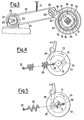
- the device is shown only diagrammatically in the drawings but in a manner which is sufficient to make its operability understandable and to indicate the means necessary for such operability.
- the subject matter is the application of the device to an electric switch (not shown because it is not a part of the invention) for loading the closing spring(s) of the switch in question. It is understood,at any rate, that the device can find profitable uses in other cases in which a shaft must be rotated, starting from an angular starting position, along a single sense of rotation and through a preselected angle narrower than 360°.
- a device of the kind referred to herein generally comprises two free-wheels, generally indicated at 10 , 11 and mounted on the shaft 12 which must be rotated in the direction of the arrow 13 about its axis through a preselected angle which is narrower than 360° from a preselected starting position.
- the free-wheels 10, 11 are equal to one another and their construction is conventional. It is sufficient to note that each of them comprises a portion 14 keyed to the shaft 12 (indicated in dotted lines in FIGURES 1 and 3), said portion 14 has, formed peripherally thereof, wedge-shaped hollow spaces 15, in each of which a friction roller, 16, is freely inserted.
- a ring 17 is mounted with its actuation arm 18.
- the ring 17 is rotated in a direction (corresponding to the direction 13 in which it is desired to have the shaft 12, whereon the free-wheel is mounted, driven to rotation)so that the rollers 16 are caused to roll along the thrust into the restricted section of their wedge-shaped seatings 15, the rotary motion,through said rollers 16 is transferred to the portion 14 keyed to the shaft 12, so that these latter are driven to rotation. If, conversely, the ring 17 is rotated in the reverse direction, the rollers 16 are positioned in the deeper portion of their seatings 15 and cannot transfer their drive to the portion 14: in this direction of rotation the ring 17 turns idly.
- the device provides, in the case in point,two levers 19, 20, which are connected, in a manner which will be explained in more detail hereinafter, to the actuation arms 18 of the respective free-wheels 10, 11.
- the levers 19,20 are mounted on two eccentrics 21, 22, which are keyed, with an angular shift of 180° relative to one another, to a drive shaft 23 actuated by a motive unit 24 so as to be rotated always in the same direction of rotation.
- the two levers 19, 20 are driven to a virtually rectilinear reciprocation and, while either lever is advanced, the other is pushed backwards, and vice versa.
- a device such as described hereinbefore is already known.
- the control lever(s) was merely pivoted to the actuation arms of the respective free-wheels.
- the free-wheels are necessarily actuated not only until such time as the motive unit is active, but until such time as it is finally stopped after a transitional inertial motion period which is started at the instant of time when the motive unit is switched off.
- the actual angle by which the shaft was caused to be rotated with the known device could not accurately established beforehand.
- the object of the improvements provided by the present invention is exactly to offset this defect.
- the arm 18 carries a pin 25 and the thrust lever 20, rather than being merely pivoted about such pin, displays a slot 26 in which the pin 25 is engaged.
- the slot 26 is arcuate but its general trend is in a direction which forms with the predominantly rectilinear direction of motion of the lever 20 an angle, which is indicated with alpha in FIGURE 1 and which, in any case, must be wider than 90° and narrower than 180°.
- a circular disc 28 is provided, having a peripheral cylindrical track 29, the disc being keyed to the shaft 12.
- the free end of the lever 20 is prevented from being lowered so that it transfers the thrust onto the pin 25 which is engaged by its slot 26, so that, when the lever is moved forward in the direction of the arrow 27, the ring 17 of the free-wheel is rotated in the direction of the arrow 13 and, through the rollers 16 transfers the rotary drive to the portion 14 and thus to the shaft 12.
- the unitary angle of rotation is a function of the forward stroke of the lever 20 as originated by the eccentric 22.
- the disc 28 and its track 29 have, in the desired angular position, a hollow space 30.
- the lever 20 is biased by a spring 31 which tends to lift the lever itself.
- a single disc 28 with a cylindrical track 29 and a hollow space 30 may serve for both levers, said disc being keyed to the shaft 12 to be rotated, between the two free-wheels 10, 11. From the constructional standpoint, the disc 28 can also be made so as to make up an entity with the portions 14 of the free-wheels which are secured to the shaft.
- the depth of the hollow space 30 in the disc 28, the shape of the slot 26 in the levers 19, 20 and the reciprocation stroke of the latter must be properly coordinated with each other in order that a correct operation of the device may be obtained.
- the slots 26 must be such as to make possible, when the relative pins 25 are in desired end of stroke position, to carry out the entire stroke of the respective levers 19, 20 without any interferences, either upwards and downwards.
- the hollow space 30 must be so shaped as to be capable of receiving in its interior the free ends of the levers 19, 20 during their idle runs without any interferences.
- FIGURES 4 and 5, read together with FIGURE 2, show the application of the device for loading the closing spring of an electric switch.
- FIGURES 2 and 4 are illustrative of the condition in which the spring 36 is unloaded, because the point 38 wherein the spring 36 is secured to the disc 33 is situated, relative to the axis of rotation of the disc, on the same side as the fixed anchoring point 37.
- preload the spring 36 it is necessary to have the shaft 12 and the disc 33 rotated, for example, in the direction of the arrow 13, so as to bring the point 38 to the opposite side of the axis of rotation relative to the fixed point 37.
- the advantage achieved by the device according to this invention is important. Inasmuch that a preselected total angle of rotation is warranted (in the case in point slightly wider than 180°) of the shaft 12 as being rotated by the device, it is sure that the spring 36 may reach the correct preloading position and that the disc 33 is not stopped, possibly, at a position wherein the line conjoining the points 37, 38 where the spring is fastened, has not overtaken the center of rotation: if so, the result would be a rotation of the shaft 12 in a direction contrary to the expected one as the spring 36 is cleared, that is as the stopping abutment 39 is removed.
- the stopping abutment 39 is prevented from being loaded too much and becoming too heavily wedged between the cam profile 34 and the roller 35, thus making difficult, or even impossible, to clear it with the required force. Such an event could occur if the shaft 12 should be rotated by the device which controls its rotation through an angle wider than the preselected width.
Landscapes
- Transmission Devices (AREA)
- Mechanical Control Devices (AREA)
Priority Applications (1)
| Application Number | Priority Date | Filing Date | Title |
|---|---|---|---|
| AT81200826T ATE9854T1 (de) | 1980-07-31 | 1981-07-20 | Vorrichtung zum steuern der drehbewegung einer welle um einen vorgewaehlten winkel. |
Applications Claiming Priority (2)
| Application Number | Priority Date | Filing Date | Title |
|---|---|---|---|
| IT8023844A IT1209249B (it) | 1980-07-31 | 1980-07-31 | Dispositivo di comando della rotazione di un albero di un angolo prestabilito. |
| IT2384480 | 1980-07-31 |
Publications (3)
| Publication Number | Publication Date |
|---|---|
| EP0045546A2 true EP0045546A2 (fr) | 1982-02-10 |
| EP0045546A3 EP0045546A3 (en) | 1982-02-17 |
| EP0045546B1 EP0045546B1 (fr) | 1984-10-10 |
Family
ID=11210367
Family Applications (1)
| Application Number | Title | Priority Date | Filing Date |
|---|---|---|---|
| EP81200826A Expired EP0045546B1 (fr) | 1980-07-31 | 1981-07-20 | Dispositif pour commander la rotation d'un axe d'un angle présélectionné |
Country Status (7)
| Country | Link |
|---|---|
| EP (1) | EP0045546B1 (fr) |
| AR (1) | AR227197A1 (fr) |
| AT (1) | ATE9854T1 (fr) |
| BR (1) | BR8104939A (fr) |
| DE (1) | DE3166600D1 (fr) |
| IT (1) | IT1209249B (fr) |
| NZ (1) | NZ197890A (fr) |
Cited By (3)
| Publication number | Priority date | Publication date | Assignee | Title |
|---|---|---|---|---|
| US4787480A (en) * | 1986-08-13 | 1988-11-29 | Sachesenwerk, Aktiengesellschaft | Tensioning device for the energy store of an electrical switch |
| US8035329B2 (en) | 2003-09-13 | 2011-10-11 | Abb Technology Ag | Apparatus for actuating an electrical switching device |
| WO2018050760A1 (fr) * | 2016-09-14 | 2018-03-22 | Eaton Industries (Netherlands) B.V. | Mécanisme d'ouverture et de fermeture d'un disjoncteur |
Family Cites Families (4)
| Publication number | Priority date | Publication date | Assignee | Title |
|---|---|---|---|---|
| FR1179601A (fr) * | 1957-07-18 | 1959-05-27 | Merlin Gerin | Commande à accumulation d'énergie, notamment pour interrupteurs |
| CH417270A (de) * | 1962-07-09 | 1966-07-15 | Sig Schweiz Industrieges | Getriebe mit stufenlos veränderbarem Übersetzungsverhältnis |
| DE1143896B (fr) * | 1963-01-22 | 1963-02-21 | ||
| DE7143984U (de) * | 1971-11-23 | 1972-02-03 | Siemens Ag | Antrieb fur einen elektrischen Leistungs Schalter |
-
1980
- 1980-07-31 IT IT8023844A patent/IT1209249B/it active
-
1981
- 1981-07-20 DE DE8181200826T patent/DE3166600D1/de not_active Expired
- 1981-07-20 AT AT81200826T patent/ATE9854T1/de active
- 1981-07-20 EP EP81200826A patent/EP0045546B1/fr not_active Expired
- 1981-07-30 AR AR286283A patent/AR227197A1/es active
- 1981-07-30 NZ NZ197890A patent/NZ197890A/en unknown
- 1981-07-30 BR BR8104939A patent/BR8104939A/pt unknown
Cited By (4)
| Publication number | Priority date | Publication date | Assignee | Title |
|---|---|---|---|---|
| US4787480A (en) * | 1986-08-13 | 1988-11-29 | Sachesenwerk, Aktiengesellschaft | Tensioning device for the energy store of an electrical switch |
| US8035329B2 (en) | 2003-09-13 | 2011-10-11 | Abb Technology Ag | Apparatus for actuating an electrical switching device |
| WO2018050760A1 (fr) * | 2016-09-14 | 2018-03-22 | Eaton Industries (Netherlands) B.V. | Mécanisme d'ouverture et de fermeture d'un disjoncteur |
| US10734169B2 (en) | 2016-09-14 | 2020-08-04 | Eaton Intelligent Power Limited | Mechanism for opening and closing a circuit breaker |
Also Published As
| Publication number | Publication date |
|---|---|
| IT8023844A0 (it) | 1980-07-31 |
| NZ197890A (en) | 1984-09-28 |
| IT1209249B (it) | 1989-07-16 |
| EP0045546A3 (en) | 1982-02-17 |
| AR227197A1 (es) | 1982-09-30 |
| EP0045546B1 (fr) | 1984-10-10 |
| DE3166600D1 (en) | 1984-11-15 |
| BR8104939A (pt) | 1982-04-20 |
| ATE9854T1 (de) | 1984-10-15 |
Similar Documents
| Publication | Publication Date | Title |
|---|---|---|
| US3978613A (en) | Turnstile mechanism | |
| EP0045546B1 (fr) | Dispositif pour commander la rotation d'un axe d'un angle présélectionné | |
| EP0216949B1 (fr) | Mécanisme de type actionné par un ressort pour un interrupteur | |
| JP2004521371A (ja) | クロノグラフ | |
| EP3264200B1 (fr) | Pièce d'horlogerie comprenant un dispositif de commutation d'un mécanisme horloger | |
| US4544000A (en) | Synchronized rotating dobby for weaving looms | |
| RU2741490C1 (ru) | Стопор каретки часового механизма с поднимющимся пальцем и стопорным пальцем | |
| CA1099937A (fr) | Mecanisme d'entrainement a impulsions a bonds d'etendue variable | |
| EP3159753B1 (fr) | Temporisateur de rappel de réveil réglable pour montre mécanique | |
| CA1146999A (fr) | Mecanisme de commande a canne | |
| KR910005781Y1 (ko) | 회로차단기의 전기조작장치 | |
| KR920008678A (ko) | 회전이동 가능한 클리닝 부재를 구비한 클리닝 유니트와 자기헤드 클리닝 시스템 | |
| KR20130093478A (ko) | 스텝 변압기의 온로드 탭 전환기를 위한 인덱싱 기어 트레인 | |
| US20050172775A1 (en) | Punching apparatus | |
| US5167376A (en) | Device for removing adhesive tape from a reel of strip material | |
| CN101025062B (zh) | 安全锁 | |
| CA1305508C (fr) | Dispositif de tension de ressort d'emmagasinage d'energie dans un commutateur | |
| US4101949A (en) | Single control key for tape recorders | |
| EP0159219B1 (fr) | Dispositif d'affichage à présélection pour son programmateur | |
| US4191067A (en) | Ratchet feed mechanism | |
| US4113081A (en) | Mechanism for actuating a member of a typewriter | |
| CA1057064A (fr) | Embrayage de minuterie pour appareil a sous | |
| US2945169A (en) | Remote shaft positioner | |
| EP0179643B1 (fr) | Lecteur à bande magnétique | |
| US2962908A (en) | Latching relay |
Legal Events
| Date | Code | Title | Description |
|---|---|---|---|
| PUAI | Public reference made under article 153(3) epc to a published international application that has entered the european phase |
Free format text: ORIGINAL CODE: 0009012 |
|
| PUAL | Search report despatched |
Free format text: ORIGINAL CODE: 0009013 |
|
| AK | Designated contracting states |
Designated state(s): AT BE CH DE FR GB LU NL SE |
|
| AK | Designated contracting states |
Designated state(s): AT BE CH DE FR GB LU NL SE |
|
| 17P | Request for examination filed |
Effective date: 19820715 |
|
| GRAA | (expected) grant |
Free format text: ORIGINAL CODE: 0009210 |
|
| AK | Designated contracting states |
Designated state(s): AT BE CH DE FR GB LI LU NL SE |
|
| REF | Corresponds to: |
Ref document number: 9854 Country of ref document: AT Date of ref document: 19841015 Kind code of ref document: T |
|
| REF | Corresponds to: |
Ref document number: 3166600 Country of ref document: DE Date of ref document: 19841115 |
|
| ET | Fr: translation filed | ||
| PGFP | Annual fee paid to national office [announced via postgrant information from national office to epo] |
Ref country code: AT Payment date: 19850715 Year of fee payment: 5 |
|
| PG25 | Lapsed in a contracting state [announced via postgrant information from national office to epo] |
Ref country code: LU Free format text: LAPSE BECAUSE OF NON-PAYMENT OF DUE FEES Effective date: 19850731 |
|
| PGFP | Annual fee paid to national office [announced via postgrant information from national office to epo] |
Ref country code: NL Payment date: 19850731 Year of fee payment: 5 |
|
| PLBE | No opposition filed within time limit |
Free format text: ORIGINAL CODE: 0009261 |
|
| STAA | Information on the status of an ep patent application or granted ep patent |
Free format text: STATUS: NO OPPOSITION FILED WITHIN TIME LIMIT |
|
| 26N | No opposition filed | ||
| PG25 | Lapsed in a contracting state [announced via postgrant information from national office to epo] |
Ref country code: AT Effective date: 19860720 |
|
| PG25 | Lapsed in a contracting state [announced via postgrant information from national office to epo] |
Ref country code: SE Effective date: 19860721 |
|
| PG25 | Lapsed in a contracting state [announced via postgrant information from national office to epo] |
Ref country code: LI Effective date: 19860731 Ref country code: CH Effective date: 19860731 Ref country code: BE Effective date: 19860731 |
|
| BERE | Be: lapsed |
Owner name: ANSALDO S.P.A. Effective date: 19860731 |
|
| PG25 | Lapsed in a contracting state [announced via postgrant information from national office to epo] |
Ref country code: NL Effective date: 19870201 |
|
| NLV4 | Nl: lapsed or anulled due to non-payment of the annual fee | ||
| PG25 | Lapsed in a contracting state [announced via postgrant information from national office to epo] |
Ref country code: FR Free format text: LAPSE BECAUSE OF NON-PAYMENT OF DUE FEES Effective date: 19870331 |
|
| REG | Reference to a national code |
Ref country code: CH Ref legal event code: PL |
|
| PG25 | Lapsed in a contracting state [announced via postgrant information from national office to epo] |
Ref country code: DE Effective date: 19870401 |
|
| GBPC | Gb: european patent ceased through non-payment of renewal fee | ||
| REG | Reference to a national code |
Ref country code: FR Ref legal event code: ST |
|
| PG25 | Lapsed in a contracting state [announced via postgrant information from national office to epo] |
Ref country code: GB Effective date: 19881118 |
|
| EUG | Se: european patent has lapsed |
Ref document number: 81200826.6 Effective date: 19870609 |