EP0045549A1 - Einrichtung zur Zeichenerkennung - Google Patents
Einrichtung zur Zeichenerkennung Download PDFInfo
- Publication number
- EP0045549A1 EP0045549A1 EP81200847A EP81200847A EP0045549A1 EP 0045549 A1 EP0045549 A1 EP 0045549A1 EP 81200847 A EP81200847 A EP 81200847A EP 81200847 A EP81200847 A EP 81200847A EP 0045549 A1 EP0045549 A1 EP 0045549A1
- Authority
- EP
- European Patent Office
- Prior art keywords
- circuit
- layer structure
- store
- code
- branches
- Prior art date
- Legal status (The legal status is an assumption and is not a legal conclusion. Google has not performed a legal analysis and makes no representation as to the accuracy of the status listed.)
- Withdrawn
Links
Images

Classifications
-
- G—PHYSICS
- G06—COMPUTING OR CALCULATING; COUNTING
- G06V—IMAGE OR VIDEO RECOGNITION OR UNDERSTANDING
- G06V10/00—Arrangements for image or video recognition or understanding
- G06V10/40—Extraction of image or video features
- G06V10/44—Local feature extraction by analysis of parts of the pattern, e.g. by detecting edges, contours, loops, corners, strokes or intersections; Connectivity analysis, e.g. of connected components
-
- G—PHYSICS
- G06—COMPUTING OR CALCULATING; COUNTING
- G06V—IMAGE OR VIDEO RECOGNITION OR UNDERSTANDING
- G06V30/00—Character recognition; Recognising digital ink; Document-oriented image-based pattern recognition
- G06V30/10—Character recognition
Definitions
- the invention relates to an apparatus for the recognition of characters, preferably of hand-written figures on documents, comprising a camera, a threshold circuit, a device for discretizing the signal delivered by the threshold circuit, a binary store, a store for information obtained from a learning set and a processor for controlling the apparatus.
- Such an apparatus is kriown, e.g. from the British Patent Specification 1..472 443.
- a large number of properties are derived from the data of the characters to be recognized, so that the equipment required is very comprehensive.
- the apparatus according to the invention is based on the idea of utilizing only one type of feature, which is derived in four viewing directions.
- This feature describes the entire basic structure seen in said viewing direction, which basic structure can be thought of as constituted by a set of layers which are found successively.
- Said object can be attained by so arranging the apparatus that it is characterized by a device for scanning and geometrically separating a portion of the binary store containing the information of one character, a circuit for establishing quasi-topologic code tables in four viewing directions, a circuit for transforming these code tables into four layer structure codes, and a circuit in which probability tables are utilized for determining, by means of a circuit, the most probable class of the signal to be recognized.
- the basic structure which a character pattern exhibits when viewed in a given direction is represented in a special manner by the layer structure, which constitutes a stylized image of the character pattern.
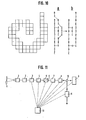
- This stylized image seems to be obtained, as it were, by compressing the character pattern against a vertical wall placed.at the left of it, the requirement having been set that no branches shall be pressed together (Fig. 4).
- a layer is so coded that the layer structure can be unambiguously recovered. For example, for the "nine" described earlier (Fig. 6):
- Coding in layers is e.g. generating the following code by evaluating the layer from top to bottom:
- the whole layer structure can be coded as follows:
- the layer structure code can be supplemented with a table stating all branch lengths of the stylized character patterns. These branch lengths enhance the adequacy of the description of the layer structure, because the stylized character pattern is known then, as it were, in its correct proportions. Said branch lengths are not utilized in the recognition method that will be described hereinafter.
- the layer structure code for a given viewing direction can be generated in several different ways, as determined by the manner in which the black-and-white character pattern has been recorded. If e.g. the contour functions have been established by means of a flying-spot scanner (cf. J.R.
- the layer structure code can be deduced from it.
- the parameter representation x (t), y (t) is found, given a specified co-ordinate system. If the y-axis is chosen as vertical, the layer structure code associated with e.g. the left-hand aspect can be generated by noting the maxima and minima in the .function y (t). This can easily be seen from Fig. 3.
- the invention is based on the quasi-topological codes already mentioned. These codes have, inter alia, the advantage that they can be derived simultaneously in four directions by one scanning of the binary image, -as described by Nadler in the second article mentioned hereinbefore.
- the quasi-topological codes must be adapted or corrected and have been given a somewhat different interpretation in view of the subsequent determination of the layer structure code.
- the symbol 0 (of opening) (Fig. 7) has been replaced by V A, branching to a splitting (Fig. 8).
- the effect is the same, i.e. I branch coming in and 2 branches going out.
- the code V A is oriented towards the left-hand aspect and, as opposed to the code 0, is also suited to describe multiple branchings (Fig.9).
- the layer structure code b for the left-hand aspect in the example of Fig. 10 will be: B V V E ⁇ A E 0 ⁇ B S.
- the layer structure code can immediately be generated, without the necessity of drawing up the rearranged table first. It has to be noted then, using a number of counters, how many codes have already been derived on each line from the table.
- the transformation described here is realized, in the present case, by means of a specially-programmed microprocessor, which does this work in approximately 200 ⁇ s. Specially-built hardware circuits comprising counters, shift registers and the like can hardly do this quicker, because in that case, too, the operation must be more or less sequential. Consequently, a microprocessor is particularly suited for this purpose.
- FIG. 11 gives a block diagram of such a system.
- a device for reading the information from a document d e.g. a camera 1
- passes the character pattern information via a threshold circuit 2 to a discretizing circuit 3,which,in its turn, shifts the information to a binary store 4.
- the technique described so far does not differ from the method according to, e.g., the British patent specification 1 472 443.
- a combined circuit 5, 6 serves for selecting one single rectangle and for geometrically separating the character patterns; the technique has been described e.g. in the British patent specification 1 442 273.
- a circuit 7 generates, in one scanning of the store in circuit 5, 6, the quasi-topological codes for four viewing directions at a time.
- a circuit 8 provided with a specially-programmed microprocessor, transforms the four quasi-topological code tables into four layer structure codes and, moreover, signals the completion of the operation, so that central processor 12 can note it and distribute new tasks.
- a store 9 contains data about the nature and the frequency of the layer structure codes occurring in a learning set. By using tables mentioning how often the layer structure codes for the four viewing directions and combinations thereof occur in the learning set for each class, it is determined, with the aid of comparator 10, which class is the most probable.
Landscapes
- Engineering & Computer Science (AREA)
- Computer Vision & Pattern Recognition (AREA)
- Physics & Mathematics (AREA)
- General Physics & Mathematics (AREA)
- Multimedia (AREA)
- Theoretical Computer Science (AREA)
- Character Discrimination (AREA)
Applications Claiming Priority (2)
| Application Number | Priority Date | Filing Date | Title |
|---|---|---|---|
| NL8004426 | 1980-08-01 | ||
| NL8004426A NL8004426A (nl) | 1980-08-01 | 1980-08-01 | Inrichting voor het herkennen van tekens. |
Publications (1)
| Publication Number | Publication Date |
|---|---|
| EP0045549A1 true EP0045549A1 (de) | 1982-02-10 |
Family
ID=19835697
Family Applications (1)
| Application Number | Title | Priority Date | Filing Date |
|---|---|---|---|
| EP81200847A Withdrawn EP0045549A1 (de) | 1980-08-01 | 1981-07-24 | Einrichtung zur Zeichenerkennung |
Country Status (3)
| Country | Link |
|---|---|
| EP (1) | EP0045549A1 (de) |
| JP (1) | JPS5833781A (de) |
| NL (1) | NL8004426A (de) |
Cited By (1)
| Publication number | Priority date | Publication date | Assignee | Title |
|---|---|---|---|---|
| EP0800146A3 (de) * | 1996-03-26 | 1999-01-27 | Sharp Kabushiki Kaisha | Zeichenerkennungsmethode |
Citations (2)
| Publication number | Priority date | Publication date | Assignee | Title |
|---|---|---|---|---|
| GB1442273A (en) * | 1973-02-21 | 1976-07-14 | Nederlanden Staat | Method and device for reading characters preferably digits |
| GB1472443A (en) * | 1973-07-30 | 1977-05-04 | Nederlanden Staat | Method of and apparatus for recognition of characters |
-
1980
- 1980-08-01 NL NL8004426A patent/NL8004426A/nl not_active Application Discontinuation
-
1981
- 1981-07-24 EP EP81200847A patent/EP0045549A1/de not_active Withdrawn
- 1981-07-31 JP JP56119379A patent/JPS5833781A/ja active Pending
Patent Citations (2)
| Publication number | Priority date | Publication date | Assignee | Title |
|---|---|---|---|---|
| GB1442273A (en) * | 1973-02-21 | 1976-07-14 | Nederlanden Staat | Method and device for reading characters preferably digits |
| GB1472443A (en) * | 1973-07-30 | 1977-05-04 | Nederlanden Staat | Method of and apparatus for recognition of characters |
Non-Patent Citations (3)
| Title |
|---|
| IEEE Transactions on Computers, Vol. C-21, No. 7, July 1972, New York, US TOU et al. "Recognition of Handwritten Characters by Topological Feature Extraction and Multilevel Categorization", pages 776-785 * |
| Proceedings of the International Joint Conference on Pattern Recognition, Corronado, 8- 11 November 1976, Proc. 3, IEEE Long Beach, US NADLER: "Structural Codes for Omnifont and Handwritten Characters", pages 135-139. * |
| Proceedings of the Second International Joint Conference on Pattern Recognition, Copenhagen, 13-15 August 1974 Proc. 2, IEEE Washington, US SPANJERSBERG: "Combinations of Different Systems for the Recognition of Handwritten Digits", pages 208-209. * |
Cited By (2)
| Publication number | Priority date | Publication date | Assignee | Title |
|---|---|---|---|---|
| EP0800146A3 (de) * | 1996-03-26 | 1999-01-27 | Sharp Kabushiki Kaisha | Zeichenerkennungsmethode |
| US6185338B1 (en) | 1996-03-26 | 2001-02-06 | Sharp Kabushiki Kaisha | Character recognition using candidate frames to determine character location |
Also Published As
| Publication number | Publication date |
|---|---|
| NL8004426A (nl) | 1982-03-01 |
| JPS5833781A (ja) | 1983-02-28 |
Similar Documents
| Publication | Publication Date | Title |
|---|---|---|
| EP0288266B1 (de) | Unterscheidungsvorrichtung für handgeschriebene und maschinengedruckte Buchstaben | |
| EP0621542B1 (de) | Verfahren und Gerät zur automatischen Spracherkennung von Dokumenten | |
| US4903312A (en) | Character recognition with variable subdivisions of a character region | |
| Sabourin et al. | Off-line identification with handwritten signature images: Survey and perspectives | |
| US6364209B1 (en) | Data reading apparatus | |
| EP0483391A1 (de) | Automatische Unterschriftsprüfung | |
| US5805740A (en) | Bar-code field detecting apparatus performing differential process and bar-code reading apparatus | |
| US4813078A (en) | Character recognition apparatus | |
| JPH05242292A (ja) | 分離方法 | |
| EP0343786A3 (de) | Verfahren und Gerät zum Lesen und Speichern von Text in digitaler Form | |
| JPS6259350B2 (de) | ||
| GB1563123A (en) | Character recognition equipment | |
| JPS60216877A (ja) | 対象物分類装置 | |
| JPS60153574A (ja) | 文字読取方法 | |
| Vo et al. | Distorted music score recognition without staffline removal | |
| Oulamara et al. | An application of the Hough transform to automatic recognition of Berber characters | |
| JPS58197581A (ja) | 文字図形認識方法とその装置 | |
| JPS6037952B2 (ja) | 最適二値化方式 | |
| JPH0797390B2 (ja) | 文字認識装置 | |
| JP3199033B2 (ja) | 光学式文字読取方法、及び光学式文字読取装置 | |
| JPS613287A (ja) | 図形入力方式 | |
| JPS5850078A (ja) | 文字認識装置 | |
| JPH03269780A (ja) | 指紋データの2値化方法 | |
| NL8004426A (nl) | Inrichting voor het herkennen van tekens. | |
| JPS60142486A (ja) | 汎用図面認識装置 |
Legal Events
| Date | Code | Title | Description |
|---|---|---|---|
| PUAI | Public reference made under article 153(3) epc to a published international application that has entered the european phase |
Free format text: ORIGINAL CODE: 0009012 |
|
| AK | Designated contracting states |
Designated state(s): BE CH DE FR GB SE |
|
| DET | De: translation of patent claims | ||
| 17P | Request for examination filed |
Effective date: 19820727 |
|
| STAA | Information on the status of an ep patent application or granted ep patent |
Free format text: STATUS: THE APPLICATION IS DEEMED TO BE WITHDRAWN |
|
| 18D | Application deemed to be withdrawn |
Effective date: 19841025 |
|
| RIN1 | Information on inventor provided before grant (corrected) |
Inventor name: WILCKE, ROBERT |