EP0045638A2 - Verfahren zum Entfernen von H2S und/oder Asche aus geschmolzenem Schwefel - Google Patents
Verfahren zum Entfernen von H2S und/oder Asche aus geschmolzenem Schwefel Download PDFInfo
- Publication number
- EP0045638A2 EP0045638A2 EP81303512A EP81303512A EP0045638A2 EP 0045638 A2 EP0045638 A2 EP 0045638A2 EP 81303512 A EP81303512 A EP 81303512A EP 81303512 A EP81303512 A EP 81303512A EP 0045638 A2 EP0045638 A2 EP 0045638A2
- Authority
- EP
- European Patent Office
- Prior art keywords
- sulfur
- ash
- molten sulfur
- agent
- compounds
- Prior art date
- Legal status (The legal status is an assumption and is not a legal conclusion. Google has not performed a legal analysis and makes no representation as to the accuracy of the status listed.)
- Withdrawn
Links
Images


Classifications
-
- C—CHEMISTRY; METALLURGY
- C01—INORGANIC CHEMISTRY
- C01B—NON-METALLIC ELEMENTS; COMPOUNDS THEREOF; METALLOIDS OR COMPOUNDS THEREOF NOT COVERED BY SUBCLASS C01C
- C01B17/00—Sulfur; Compounds thereof
- C01B17/02—Preparation of sulfur; Purification
- C01B17/0232—Purification, e.g. degassing
Definitions
- This invention relates to a method for the removal of H 2 S and/or ash from molten sulfur. More specifically this invention relates to the removal of residual H 2 S and/or ash or ash forming compounds from molten sulfur by the addition to the molten sulfur of one or more compounds described hereinafter which promote the removal of H 2 S and hasten the decomposition of hydrogen polysulfides to H 2 S, and/or which promote the flotation and agglomeration of ash and/or ash forming compounds to the surface of the molten sulfur where it can be removed.
- the remaining hydrogen sulfide is removed by passing the gas stream through a venturi/absorber section where the hydrogen sulfide is absorbed by an aqueous solution containing salts.
- the hydrogen sulfide is converted to elemental sulfur which is subsequently precipitated from the scrubbing solution for further treatment.
- This sulfur which may contain from about 30 to more than 12,000 parts per million by weight (wppm) of salt impurities, may be sent to a separate sulfur rentention facility or it may be blended with relatively large quantities of low ash sulfur.
- ash-forming compounds in the sulfur, since these compounds may adversely affect subsequent processing of the sulfur.
- the sulfur is first burned to S0 3 in a spray jet burner. Salts and other impurities in the sulfur may form ash that plugs the orifices of the burner nozzles.
- the term "ash-forming compounds" is defined to mean any impurity in the molten sulfur which forms an ash-type residue when burned or strongly heated.
- the ash-forming compounds in the sulfur will be primarily inorganic salts from the absorption process which inadvertently become entrained in the sulfur, although other ash-forming compounds also may be present.
- H 2 S is highly toxic, flammable and may form explosive mixtures with air. Accordingly, the presence of H 2 S in molten sulfur is being limited in many locations by increasingly stringent regulations.
- a method for increasing the rate of this "weathering off” process uses a circulatory spraying system.
- this requires the purchase and use of additional circulatory equipment and may not reduce the residual hydrogen sulfide and hydrogen polysulfide to sufficiently low levels.
- S0 2 is not desirable for several reasons. Sulfur dioxide is difficult to store, since it is gaseous at ambient conditions. Thus, means must be provided for injecting the S02 directly into the molten sulfur and for adjusting the relative quantities of S0 2 and the other additive metered into the molten sulfur. In addition, S0 2 is toxic, a strong irritant to the eyes and mucous membranes and an air contaminant. Moreover, S0 2 is corrosive to the carbon steel surfaces of some sulfur handling facilities. These factors may complicate or restrict its use in commercial facilities.
- U.S. Patent No. 3,278,269 describes several classes of compounds which may be added to molten sulfur to improve the friability of solidified sulfur.
- the compounds disclosed include the following:
- U.S. Patent No. 3,364,655 discloses that H 2 S can be removed from liquid sulfur by atomizing the sulfur, and that this process can be further improved by the addition of ammonia. No method for removing ash-forming compounds are disclosed.
- the subject invention is a method for reducing the concentration of hydrogen sulfide and hydrogen polysulfides and/or ash forming compounds in molten sulfur comprising the addition to the sulfur of an effective amount of an agent selected from the class of compounds consisting of dithionates, dithionites, thiosulfates, bisulfides, bisulfites and organo-phosphorous compounds.
- an agent selected from the class of compounds consisting of dithionates, dithionites, thiosulfates, bisulfides, bisulfites and organo-phosphorous compounds.
- organo-phosphorous compounds are the phosphates, phosphines, phosphites, phosphine oxides, phosphine sulfides and hypophosphates.
- a solution or a melt of the agent is metered by gravity flow into the molten sulfur.
- the solution or melt is pumped into the molten sulfur.
- the agent reduces the ash-forming compounds present in the molten sulfur, at least a portion of the ash-forming compounds rise to, and collect at the surface of the molten sulfur where they can be removed.
- Molten sulfur from conventional sulfur recovery sources typically may contain as much as 50-500 parts per million by weight (wppm) of ash and 700 parts per million by weight (wppm) of H 2 S and hydrogen polysulfides.
- the agents used to convert hydrogen polysulfides to hydrogen sulfide and/or to reduce the concentration of ash-forming compounds preferably should be effective at relatively low concentrations and be relatively easily volatilized from the sulfur so that they do not adversely affect the residual ash content of the product sulfur.
- the compounds described hereinafter have been found to be effective agents at relatively low concentrations. Many of the compounds described hereinafter are readily volatilizable. This further minimizes their effect on product sulfur ash content. It has been found that certain classes of compounds are effective agents as indicated below:
- Inorganic and organo phosphorous compounds including phosphates, hypophosphates, phosphines, phosphites, phosphine oxides and phosphine sulfides.
- Preferred compounds are the easily volatilized salts, such as ammonium phosphonium and alkyl ammonium salts.
- Specific preferred compounds are triammonium orthophosphates, diammonium hydrogen phosphate and triphenyl phosphine.
- Urea and urea derivatives including but not limited to urea, thiourea, mono-, di-, tri-, and tetra-ureas and cyclic ureas.
- Preferred compounds are those easily volatilized, such as urea and thiourea.
- Samples of candidate agents were screened for effectiveness in H2S degassing according to the following procedure.
- Samples of molten sulfur were taken from the combustor rundown line of a commercial sulfur plant so that sulfur having the highest H 2 S levels would be obtained for testing purposes.
- the samples approximately 150 ml each, were poured from a sample dipper directly into spoutless 300 ml Berzelius beakers which also were used to contain the sulfur during analysis. The samples were kept hot during transport to the laboratory.
- a three-hole rubber stopper equipped with a thermometer and two unequal lengths of glass tubing was placed in the beaker opening. One piece of glass tubing extended below the surface of the sulfur while the other terminated above the surface.
- Each compound screened was added to a stirred sulfur sample maintained at 130°C. Dry nitrogen was sparged through each sample for 2.5 hours with the released H 2 S and exiting nitrogen being directed through two gas absorption bottles containing a 3% zinc acetate solution. After the sulfur was purged for 2.5 hours, the two gas absorption bottles were removed and replaced by two gas absorption bottles containing fresh 3%' zinc acetate solution positioned as previously described.
- lead sulfide is known in the art to be highly effective in promoting the decomposition of hydrogen polysulfides to H 2 S, this compound is not used commercially to degas molten sulfur because of toxicity concerns from the presence of trace amounts of lead in the sulfur and because lead sulfide would increase the ash content of the sulfur.
- This known effectiveness of lead sulfide was used as a standard to determine the degassing characteristics of the compounds screened. One gram of lead sulfide was then added to the sulfur samples containing the agents to decompose any hydrogen polysulfides which had not been removed by the agent added during the first 2.5 hour period.
- the relative degassing ability of the compounds may be seen more clearly by their effectiveness at low concentrations in the sulfur.
- the relative effectiveness of three selected compounds in degassing sulfur at varying concentrations in the sulfur may be seen from Figure 1, in which the agent concentration is plotted against the percent of the total H 2 S released in the first 2.5 hours.
- ammonium ion is not the portion of the ammonium salt that was active in degassing the molten sulfur.
- ammonium chloride and ammonium bisulfate were totally ineffective as degassing agents.
- Even ammonium salts of weaker acids such as oxalic, formic and carbonic acids were much less effective than the best degassing agents tested, ammonium thiosulfate, ammonium phosphate, and sodium dithionite.
- Ammonium compounds may be added to the molten sulfur at temperatures at which substantially no ammonia is produced, since it appears that ammonia is not essential for effective implemention of the method of the present invention.
- the ability of certain of the agents to reduce the concentration of ash-forming compounds then was determined as follows.
- the ash determination involved merely burning a 100 gram sample of the sulfur in a preweighed crucible and weighing the ash remaining in the crucible after combustion and subsequent cooling in a desiccator.
- ammonium thiosulfate The ability of ammonium thiosulfate to reduce the ash contents of samples both high and low in inorganic salt levels was determined in the presence of concrete and carbon steel.
- ammonium thiosulfate caused no corrosion of metal or damage to concrete in these tests.
- the rate of corrosion of carbon steel actually decreased after the addition of ammonium thiosulfate.
- the ash content of the treated samples is higher than the controls for the samples taken from the top.
- the effectiveness of the ammonium thiosulfate in causing ash forming compounds to float to the top may be seen from the sample having the high salt content.
- the sample from the top of the treated sample was higher in ash content than the control, while the sample from the bottom of the treated sample was lower in ash content than the control.
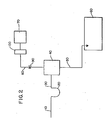
- FIG 2 a preferred embodiment for adding the agent to a conventional molten sulfur facility is shown.
- the facility comprises an inlet, inspection box, outlet and sulfur pit.
- many lines, valves and all instrumentation have been omitted for simplicity.
- Molten sulfur leaving the sulfur recovery system passes through inlet 10 at a temperature in excess of 114 0 C, typically about 130 to about 165 0 C.
- the sulfur then passes through seal 20 and line 30 into inspection box 40.
- the molten sulfur typically containing about 50 to about 650 wppm of hydrogen sulfide and hydrogen polysulfides and from about 0 to about 50 wppm of ash-forming compounds leaves inspection box 40 through line 50 for storage and cooling in a sulfur storage facility such as sulfur pit 60.
- a solution, preferably an aqueous solution, of at least one of the agents is metered into inspection box 40 from storage tank 70 through line 80.
- the agent may be added as a melt.
- storage tank 70 may be placed above inspection box 40, and the agent gravity fed. The flow rate is controlled by metering valve 90.
- the agent solution or melt also may be metered into the molten sulfur installation using a conventional pump.
- a filter 100 also may be added to minimize contamination of the molten sulfur and to prevent plugging of metering valve 90.
- Stages 1, 2 and 3 were equipped with sulfur recirculation pumps having 160, 130 and 150 GPM capacities, respectively, to recirculate the sulfur within the same stage. These results are presented in Table VII and indicate that on a commercial scale ammonium thiosulfate effectively catalyzes the degassing of sulfur.
- the combination of reducing the concentration of ash forming compounds in the sulfur and degassing the sulfur can be achieved by removing the ash forming compounds from the surface of the sulfur. This may be achieved by conventional liquid-solid separation means. Among the methods which appear to be particularly applicable are skimming the surface of the sulfur pit and passing at least the upper portion of the molten sulfur through a filtration means.
- Figure 3 is a plot of the residual H 2 S concentration in molten sulfur contained in a non- stirred sulfur pit where the sulfur, to which about 100 wppm of urea was added using an aqueous solution of 40 wt.% urea had an average residence time ranging from about 3.5 to about 6 days.
- the residual concentration of H 2 S decreased significantly, illustrating that continuous use of urea also decreases the residual H 2 S concentration of the sulfur even in the absence of sulfur agitation.
- the ash content of the sulfur beth at the commencement and termination of the test, remained at less than 5 wppm, thus indicating that the urea addition did not adversely affect the ash content of the sulfur.
- the concentration of agent utilized is not critical and will be dependent on the specific agent used. Generally, the rate of addition of the agent to the molten sulfur will range between 1 (one) part per billion and 5000 parts per million by weight, and preferably from about 50 to about 200 parts per million by weight.
Landscapes
- Chemical & Material Sciences (AREA)
- Organic Chemistry (AREA)
- Inorganic Chemistry (AREA)
- Processing Of Solid Wastes (AREA)
- Organic Low-Molecular-Weight Compounds And Preparation Thereof (AREA)
Applications Claiming Priority (4)
| Application Number | Priority Date | Filing Date | Title |
|---|---|---|---|
| US17443380A | 1980-08-01 | 1980-08-01 | |
| US174432 | 1980-08-01 | ||
| US06/174,432 US4313922A (en) | 1980-08-01 | 1980-08-01 | Reducing ash content of molten sulfur |
| US174433 | 1980-08-01 |
Publications (2)
| Publication Number | Publication Date |
|---|---|
| EP0045638A2 true EP0045638A2 (de) | 1982-02-10 |
| EP0045638A3 EP0045638A3 (de) | 1982-02-24 |
Family
ID=26870213
Family Applications (1)
| Application Number | Title | Priority Date | Filing Date |
|---|---|---|---|
| EP81303512A Withdrawn EP0045638A3 (de) | 1980-08-01 | 1981-07-31 | Verfahren zum Entfernen von H2S und/oder Asche aus geschmolzenem Schwefel |
Country Status (3)
| Country | Link |
|---|---|
| EP (1) | EP0045638A3 (de) |
| AU (1) | AU544992B2 (de) |
| CA (1) | CA1168022A (de) |
Cited By (2)
| Publication number | Priority date | Publication date | Assignee | Title |
|---|---|---|---|---|
| US11214919B2 (en) | 2018-05-31 | 2022-01-04 | Ecolab Usa Inc. | Wet web strength for fiberglass mats |
| CN114590946A (zh) * | 2022-03-24 | 2022-06-07 | 安徽益硫环境科技有限公司 | 一种硫泡沫及脱硫废液的干燥方法 |
Family Cites Families (9)
| Publication number | Priority date | Publication date | Assignee | Title |
|---|---|---|---|---|
| GB372781A (en) * | 1931-02-11 | 1932-05-11 | John Stanley Dunn | Process for the removal of arsenic from sulphur |
| DE581147C (de) * | 1931-08-11 | 1933-07-21 | I G Farbenindustrie Akt Ges | Gewinnung von reinem Schwefel |
| US3042503A (en) * | 1958-10-09 | 1962-07-03 | Freeport Sulphur Co | Purification of sulfur |
| NL129706C (de) * | 1963-08-13 | |||
| US3447903A (en) * | 1966-10-27 | 1969-06-03 | Freeport Sulphur Co | Sulphur production |
| US3488092A (en) * | 1967-12-18 | 1970-01-06 | Phillips Petroleum Co | Method for producing acid-gas well containing sulfur |
| CA964040A (en) * | 1971-04-30 | 1975-03-11 | Reginald S. Anderson | Removal of h2sx from molten sulfur |
| NL173735C (nl) * | 1972-05-24 | 1988-06-16 | Shell Int Research | Werkwijze voor het verwijderen van waterstofsulfide uit gesmolten zwavel. |
| CA1088276A (en) * | 1976-08-02 | 1980-10-28 | Paul T. Pendergraft | Process for removal of hydrogen sulfide and hydrogen polysulfide from liquid sulfur |
-
1981
- 1981-07-31 CA CA000383035A patent/CA1168022A/en not_active Expired
- 1981-07-31 AU AU73623/81A patent/AU544992B2/en not_active Ceased
- 1981-07-31 EP EP81303512A patent/EP0045638A3/de not_active Withdrawn
Cited By (2)
| Publication number | Priority date | Publication date | Assignee | Title |
|---|---|---|---|---|
| US11214919B2 (en) | 2018-05-31 | 2022-01-04 | Ecolab Usa Inc. | Wet web strength for fiberglass mats |
| CN114590946A (zh) * | 2022-03-24 | 2022-06-07 | 安徽益硫环境科技有限公司 | 一种硫泡沫及脱硫废液的干燥方法 |
Also Published As
| Publication number | Publication date |
|---|---|
| AU7362381A (en) | 1982-02-04 |
| CA1168022A (en) | 1984-05-29 |
| EP0045638A3 (de) | 1982-02-24 |
| AU544992B2 (en) | 1985-06-27 |
Similar Documents
| Publication | Publication Date | Title |
|---|---|---|
| DE2250959A1 (de) | Verfahren zur gewinnung von schwefel aus so tief 2 enthaltenden gasen | |
| US4018572A (en) | Desulfurization of fossil fuels | |
| DE3122488A1 (de) | Verfahren zur entfernung von kohlenoxysulfid aus gasstroemen | |
| US3974254A (en) | Process for purifying metallurgical gases containing sulphurous anhydride by extracting mercury | |
| US5431895A (en) | Process for the removal of lead and cadmium from phosphoric acid | |
| US8034318B1 (en) | Process for preparation of calcium thiosulfate liquid solution from lime, sulfur, and sulfur dioxide | |
| US4897251A (en) | Catalytic removal of hydrogen sulphide from liquid sulphur | |
| US4313922A (en) | Reducing ash content of molten sulfur | |
| USRE32009E (en) | Degassing molten sulfur | |
| US4849204A (en) | Catalytic removal of hydrogen sulfides from liquid sulfur | |
| US4423025A (en) | Degassing molten sulfur | |
| EP0045638A2 (de) | Verfahren zum Entfernen von H2S und/oder Asche aus geschmolzenem Schwefel | |
| EP0045636B1 (de) | Verfahren zur Beseitigung von H2S und/oder Asche aus geschmolzenem Schwefel | |
| US4299811A (en) | Degassing molten sulfur | |
| CA2641135A1 (en) | Process for the production of stable aqueous suspensions of sulphur starting from hydrogen sulphide and possible disposal of the suspensions thus obtained | |
| DE2221022A1 (de) | Verfahren zur Herabsetzung der in fluessigem Schwefel geloesten Schwefelwasserstoffmenge waehrend des Pumpens durch eine Rohrleitung | |
| CA1297266C (en) | Process for purifying phosphoric acid for electrical semiconductor use | |
| US9617154B1 (en) | Superdegas—a process of integrating sulfur collection and degassing for zero emission | |
| US2041397A (en) | Treating sulphur-mining bleed-water | |
| EP0476079A1 (de) | Verfahren zur reinigung und rückgewinnung von quecksilber in metallform aus quecksilber enthaltenden rostgasen | |
| US1951984A (en) | Recovery of phosphorus from dilute gases | |
| CA2173271C (en) | Purification of elemental sulphur | |
| US3442611A (en) | Process for the production of highly concentrated phosphoric acid | |
| US7452521B2 (en) | Method for the removal of mercury from sulphuric acid with thiosulphate precipitation | |
| DE69414304T2 (de) | Verfahren zur Reduzierung des Ammoniakgehalts von Abgasen aus Harnstoff-Herstellungsfabriken |
Legal Events
| Date | Code | Title | Description |
|---|---|---|---|
| PUAI | Public reference made under article 153(3) epc to a published international application that has entered the european phase |
Free format text: ORIGINAL CODE: 0009012 |
|
| PUAL | Search report despatched |
Free format text: ORIGINAL CODE: 0009013 |
|
| AK | Designated contracting states |
Designated state(s): BE DE FR GB IT NL SE |
|
| AK | Designated contracting states |
Designated state(s): BE DE FR GB IT NL SE |
|
| 17P | Request for examination filed |
Effective date: 19820714 |
|
| STAA | Information on the status of an ep patent application or granted ep patent |
Free format text: STATUS: THE APPLICATION HAS BEEN WITHDRAWN |
|
| 18W | Application withdrawn |
Withdrawal date: 19840402 |
|
| RIN1 | Information on inventor provided before grant (corrected) |
Inventor name: LERNER, HOWARD Inventor name: LEDFORD, THOMAS HOWARD Inventor name: PEREZ, RAUL EDGARDO |