EP0045716A2 - Procédé et appareil de combustion - Google Patents
Procédé et appareil de combustion Download PDFInfo
- Publication number
- EP0045716A2 EP0045716A2 EP81730069A EP81730069A EP0045716A2 EP 0045716 A2 EP0045716 A2 EP 0045716A2 EP 81730069 A EP81730069 A EP 81730069A EP 81730069 A EP81730069 A EP 81730069A EP 0045716 A2 EP0045716 A2 EP 0045716A2
- Authority
- EP
- European Patent Office
- Prior art keywords
- water
- combustion
- decomposing
- water vapor
- fuel
- Prior art date
- Legal status (The legal status is an assumption and is not a legal conclusion. Google has not performed a legal analysis and makes no representation as to the accuracy of the status listed.)
- Withdrawn
Links
Images



Classifications
-
- F—MECHANICAL ENGINEERING; LIGHTING; HEATING; WEAPONS; BLASTING
- F23—COMBUSTION APPARATUS; COMBUSTION PROCESSES
- F23L—SUPPLYING AIR OR NON-COMBUSTIBLE LIQUIDS OR GASES TO COMBUSTION APPARATUS IN GENERAL ; VALVES OR DAMPERS SPECIALLY ADAPTED FOR CONTROLLING AIR SUPPLY OR DRAUGHT IN COMBUSTION APPARATUS; INDUCING DRAUGHT IN COMBUSTION APPARATUS; TOPS FOR CHIMNEYS OR VENTILATING SHAFTS; TERMINALS FOR FLUES
- F23L7/00—Supplying non-combustible liquids or gases, other than air, to the fire, e.g. oxygen, steam
- F23L7/002—Supplying water
- F23L7/005—Evaporated water; Steam
-
- C—CHEMISTRY; METALLURGY
- C01—INORGANIC CHEMISTRY
- C01B—NON-METALLIC ELEMENTS; COMPOUNDS THEREOF; METALLOIDS OR COMPOUNDS THEREOF NOT COVERED BY SUBCLASS C01C
- C01B3/00—Hydrogen; Gaseous mixtures containing hydrogen; Separation of hydrogen from mixtures containing it; Purification of hydrogen; Reversible storage of hydrogen
- C01B3/02—Production of hydrogen; Production of gaseous mixtures containing hydrogen
- C01B3/06—Production of hydrogen; Production of gaseous mixtures containing hydrogen by reaction of inorganic compounds containing electro-positively bound hydrogen with inorganic reducing agents
- C01B3/08—Production of hydrogen; Production of gaseous mixtures containing hydrogen by reaction of inorganic compounds containing electro-positively bound hydrogen with inorganic reducing agents by reaction of inorganic compounds with metals
- C01B3/10—Production of hydrogen; Production of gaseous mixtures containing hydrogen by reaction of inorganic compounds containing electro-positively bound hydrogen with inorganic reducing agents by reaction of inorganic compounds with metals by reaction of water vapour with metals
-
- Y—GENERAL TAGGING OF NEW TECHNOLOGICAL DEVELOPMENTS; GENERAL TAGGING OF CROSS-SECTIONAL TECHNOLOGIES SPANNING OVER SEVERAL SECTIONS OF THE IPC; TECHNICAL SUBJECTS COVERED BY FORMER USPC CROSS-REFERENCE ART COLLECTIONS [XRACs] AND DIGESTS
- Y02—TECHNOLOGIES OR APPLICATIONS FOR MITIGATION OR ADAPTATION AGAINST CLIMATE CHANGE
- Y02E—REDUCTION OF GREENHOUSE GAS [GHG] EMISSIONS, RELATED TO ENERGY GENERATION, TRANSMISSION OR DISTRIBUTION
- Y02E60/00—Enabling technologies; Technologies with a potential or indirect contribution to GHG emissions mitigation
- Y02E60/30—Hydrogen technology
- Y02E60/36—Hydrogen production from non-carbon containing sources, e.g. by water electrolysis
Definitions
- This invention relates to a combustion method for combusting a fuel such as kerosene, heavy oil, propane gas or the like, wherein the combustion is carried out in the presence of water vapor of a high temperature, and further relates to a combustion apparatus for carrying out this method.
- a fuel such as kerosene, heavy oil, propane gas or the like
- combustion method wherein a fuel is mixed with water
- a combustion method wherein water is jetted into a flame of a burning fuel
- a combustion method wherein hydrogen is preliminarily mixed with a fuel
- this method it is required to prepare an emulsion by mixing the fuel with water before combustion, and, accordingly, this method requires provision of a special mixing apparatus and use of an emulsifier. By these reasons, this method cannot be a common one. And yet, the saving of the fuel enabled by this method is as low as 30%. In addition, this method cannot be applied.to'a fuel such as a gas fuel which cannot be emulsified.
- the method (2) has a disadvantage in that the temperature of the flame is lowered by the water jetted thereinto, making the combustion unstable. Therefore, substances such as carbon particles remaining unburned in the flame cannot be reacted with water sufficiently to obtain desired'effects. Moreover, there is a possibility that the flame is extinguished by the jetting of water. Thus, this method is not practical.
- the method (3) also involves problems such that the fuel must be mixed with explosive.hydrogen before combustion, and, therefore, has a difficulty in handling. In addition, at present, hydrogen is more expensive than the fossil fuel. Thus, this method is also impractical.
- a combustion method and apparatus for combusting a fuel such as kerosene, heavy oil, gas oil, propane gas or natural gas, wherein water is heated to produce water vapor of a high temperature, said water vapor of a high temperature is injected into a flame accompanying the combustion of the fuel, and said water vapor, is reacted with unburned substances remaining in the flame for accelerating the combustion thereof.
- a fuel such as kerosene, heavy oil, gas oil, propane gas or natural gas
- a combustion method and apparatus for combusting a fuel such as kerosene, heavy oil, gas oil, propane gas or natural gas, wherein water is pyrolytically decomposed to produce hydrogen, said hydrogen is burned within a flame accompanying the combustion of the fuel to generate water vapor of a high temperature, and said water vapor is reacted unburned substances remaining in the flame for accelerating the combustion thereof.
- a fuel such as kerosene, heavy oil, gas oil, propane gas or natural gas
- a method according to a first embodiment of the present invention comprises a first step for burning a fuel such as kerosene, heavy oil, gas oil, propane gas, natural gas or the like; a second step for producing water vapor of a high temperature and injecting the same; and a third step for reacting the water vapor with substances remaining unburned.
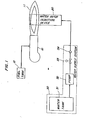
- This method is carried out, for example, by a combustion apparatus as illustrated in Fig. 1.
- the combustion apparatus of Fig. 1 includes a burner 10 for burning a fuel such as kerosene, heavy oil, etc., a water vapor injection device 20 adapted to be heated by the burner 10 and a water supply system 30 for supplying water to the water vapor injection device 20.
- a carbon-fuel such as kerosene, heavy oil, gas oil, propane gas, natural gas or the like -is fed from a fuel tank 12 and caused to undergo combustion by the burner 10.
- the major portion of heat of the combustion is used as a heat source for a boiler (not shown) etc. and a small portion thereof is used as a heat source for producing water vapor in the second step as will be described in detail later.
- the burner 10 is used as the heat source .
- a separate heating means such as a special burner for heating the device 20, an electrical heater, etc. may additionally be provided.
- water supplied from the outside is heated to produce water vapor of a high temperature and this water vapor is injected into a flame accompanying the combustion of the fuel.
- the heating is effected, for example, by disposing the water vapor injection device 20 in a position where the flame 11 of the burner 10 reaches the device 20 as illustrated in Fig. 1.
- the water vapor injection device 20 has such a structure as illustrated in Figs. 2 and 3, wherein a vaporizing chamber 24 and a heating section 25 are provided in a body 21 of the water vapor injection device 20 and a water inlet nozzle 23 is fitted at a lower end of the vaporizing chamber 24.
- the water vapor injection device 20 is mounted, at a fixing portion 22 provided at a lower portion of the body 21, in a combustion chamber of a boiler etc.
- the water vapor injection device 20 is.located so that at least a periphery 27a of the heating section 25 may be in contact with the flame 11 of the burner 10.
- the water vapor injection device 20 it is preferred to locate the water vapor injection device 20 in such a manner that an upper end of the heating section 25, may be in contact with a flame portion of a lower temperature, to attain the heating more effectively.
- the water vapor injection device 20 is located substantially at a'right angle to the flame 10 in the embodiment as illustrated, the position of the water vapor injection device 20 relative to the flame 11 is not limited thereto.
- the body 21 is made of a heat-resistant material and is proof against the heating at a high temperature by the flame 11. Fins may be provided around the periphery 27 a of the body 21, especially, of the heating section 25 to enhance the heat exchange efficiency of the body 21.
- the water inlet nozzle 23 is made, for example, of iron and threadedly engaged with the lower end of the vaporizing chamber 24.
- This water inlet nozzle 23 has a throttling function to instantaneously vaporize, in the vaporizing chamber, water fed from the water supply system 30 .
- the diameter of the nozzle 23 is determined by. the water pressure, the volume of the vaporizing chamber 24 and the inner diameter and length of the heating section 25 , and is determined, for example, to be smaller than half of the inner diameter of the heating section 25.
- the vaporizing chamber 24 is formed at the lower portion of the body 21 and communicates, at the upper end thereof, with.the heating section 25 and, at the lower end thereof, with the water supply system 30 through the water inlet nozzle 23.
- the heating section 25 is formed substantially cylindrical and has an inner diameter smaller than that of the vaporizing chamber 24 so as to allow water vapor to contact an inner wall 27b of the heating section 2 5 more effectively.
- the heating section 25 has, at the upper end thereof, an injection nozzle 26.
- the water vapor injection device 20 is heated by the burner 10 at a temperature around 750°C. Under this condition, water is taken into the vaporizing chamber 24 while being subjected to the throttling by the water inlet nozzle 23, when water is momentarily vaporized into water vapor. The obtained water vapor is further heated to a high temperature at the heating section 25 and injected into the flame 11 through the injection nozzle 26.
- Water supply is carried out by the water supply system 30 comprised of a water tank 31, a pump 32, an electromagnetic valve 33 and a check valve 34.
- the pump 32 pumps water in the water tank 31 into the water vapor injection device 20.
- the water supply pressure is, for example, 0.1 ⁇ 10 kg/cm.
- a force of gravity may be utilized or tap water may directly be used. In these cases, the pump 32 may be omitted.
- the electromagnetic valve 33 controls the water supply to the water,vapor injection device 20, and is adapted to be driven by a signal from a timer, bimetal, etc. so as to start water supply after the heating section 25 has been heated to a sufficiently high temperature.
- the electromagnetic valve 33 may be driven by a manual switch.
- the check valve 34 functions to prevent back flow of water by the vapor pressure in the vaporizing chamber 24 and prevent lowering of the vapor pressure.
- the water supply is carried out by the water supply system 30 as described above in such a manner that, after the water vapor injection device 20 has been heated by the burner 10 to a predetermined temperature, the electromagnetic valve 33 is driven by the bimetal or the manual switch and the pump 32 is actuated so as to supply water in the water tank 31 to the water vapor injection device 20.
- the water to be supplied to the device 20 there can be mentioned tap water, water from a well and hot water or steam from a boiler.
- the third step is a step for. reacting water vapor of a high temperature injected into the flame with substances remaining unburned in the flame to accelerate combustion of the unburned substances.
- the water vapor of a high temperature in the flame is further heated to a temperature as high as 1000 to 1200°C which substantially equals to the temperature of the flame.
- the so heated water vapor is-caused to react with the unburned substances, e.g., unburned carbon particles as follows:
- the unburned carbon particles are gasified so as to be readily burned.
- the water vapor of a high temperature reacts with carbon monoxide existing in the flame to accelerate combustion of the carbon monoxide which is relatively slow to burn as follows:
- a combustion method comprises a first step for burning a fuel containing carbon, hydrocarbon, etc. such as kerosene, heavy oil, gas oil, propane gas, natural gas and the like; a second step for pyrolytically decomposing water to generate hydrogen and burning the generated hydrogen in a flame to produce water vapor of a high temperature; and a third step for reacting the water vapor with unburned substances in the flame.
- a fuel containing carbon, hydrocarbon, etc. such as kerosene, heavy oil, gas oil, propane gas, natural gas and the like
- a second step for pyrolytically decomposing water to generate hydrogen and burning the generated hydrogen in a flame to produce water vapor of a high temperature
- a third step for reacting the water vapor with unburned substances in the flame.
- Fig. 4 illustrates one form of a combustion apparatus for carrying out this combustion method.
- the apparatus illustrated in Fig. 4 comprises a burning means such as a burner 10 for burning a carbon fuel, a water decomposing device 40 adapted to be heated by the burner 10 and a water supply system 30 for supplying water to the water decomposing device 40.
- the burner 10.and the water supply system 30 are identical with those used in the first embodiment.
- the water decomposing device 40 includes, for example, a decomposing portion 43 formed in a body 41 and a water inlet portion 44 and a hydrogen injecting portion 45 which are provided at the lower and the upper end of the decomposing portion 43, respectively, as illustrated in,Figs. 5 and 6.
- the water decomposing device 40 is mounted, at a fixing portion 42 provided at a lower portion of the body 41, in a combustion chamber, for example, of a boiler.
- the water decomposing device 40 is located at a position where a flame 11 of the burner 10 reaches the outer periphery of the decomposing portion 43.
- the water decomposing device 40 may preferably be located at a position where the flame 11 surrounds the outer periphery of the decomposing portion 43 to attain the desired effect more effectively.
- the water decomposing device 40 is disposed substantially at a right angle to the flame 11 in this embodiment, the position of the device 40 is not limited thereto.
- the body 41 is made of a heat-resistant material such as titanium, tantalum, stainless steel, ceramic, etc. and formed cylindrical to provide the decomposing portion 4 3 therein.
- the heating means the burner 10 in this embodiment
- water is caused to pyrolytically react, at the heating portion 43, with a material as will be described in detail leter.
- the body 41 may preferably have fins around the outer periphery thereof to enhance the heat absorption by the body 41.
- the decomposing portion 43 communicate, at the lower end thereof, with the water inlet portion 44 through a support plate 46 having openings, and, at the upper end thereof, with the hydrogen-injecting portion 45 through a filter 47.
- the decomposing portion 43 is packed with finely divided materials48.
- the material may be a metal which reacts-with water to produce hydrogen or a low oxide thereof. Finely divided titanium is used in the present embodiment, but the material is not limited thereto.
- the material may be used in the form of a particle or powder.
- the filter 47 has small openings 47a for letting hydrogen pass therethrough. It prevents fly loss of the finely divided materials, but allows hydrogen produced in the decomposing chamber 43 to pass therethrough.
- the second step is carried out in such a manner that water supplied from the water supply system 30 is pyrolytically decomposed to produce hydrogen and the resulting hydrogen is burned in the flame accompanying the burning in the first step, to produce water vapor of a high temperature.
- the pyrolytic decomposition is effected by reacting the metal or the low oxide thereof with water under heating.
- a fuel is supplied from the fuel tank 12 and burned by the burner 10.
- the water decomposing device 40 is heated together with a boiler (not shown)'by the flame 11.
- the water decomposing device 4 0 is heated to a temperature at which finely divided titanium reacts with water to produce hydrogen. If the heated temperature is too high, the reaction proceeds too rapidly. In case titanium is used, the heated temperature is preferred to be about 600°C.
- the electromagnetic valve 33 is driven and the pump 32 is actuated to pump water in the water storage tank 31 to the water decomposing device 40.
- the water supplied is throttled at the water inlet portion 44 and fed, through the openings 46a of the support plate 46, to the heated decomposing portion 43, where the water is momentarily vaporized to become water vapor, spread within the decomposing portion 43 and reacted with the finely divided titanium to produce hydrogen.
- This reaction is considered to.include the following reactions:
- the produced hydrogen reaches the hydrogen injecting portion 45 through five openings 47a of the filter 47 and injected outwardly therefrom.
- the hydrogen is injected into the flame 11 and caused to undergo combustion. This combustion produces water vapor of a high temperature and the produced water vapor reacts with unburned substances and carbon monoxide in the flame 11 to accelerate the combustion thereof in the third step.
- the metal oxide or high oxide thereof (for example TiO 2 ) produced together with hydrogen by the reaction as described above may be removed and replaced by fresh metal or low oxide of the metal, or reduced by introducing a reducing gas into the water decomposing device 40 for reusing the metal.
- a reducing gas for example TiO 2
- carbon monoxide in the flame may be introduced into the water decomposing means 40 or carbon may be pyrolytically reacted with water in the water decomposing device 40 to produce carbon monoxide.
- the fuel contains a reducing material, a portion of the fuel may be introduced into the water decomposing device 40.
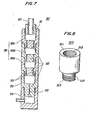
- Fig. 7 illustrates another form of the water decomposing device used in the combustion apparatus for carrying out the second embodiment of the present invention.
- This water decomposing device is so constructed that a plurality of small chambers are formed in series by partitions 52 in a body 51 of substantially cylindrical shape. These small chambers include an inlet portion 54, a vaporizing portion 55 and decomposing-portions 56a, 56b and 56c. 'Each of the partitions 52 has one or more slits 53 so that the inlet portion 54 may communicate with the decomposing portion 56c.
- the body 51 is formed, for example, of unit members 510 as illustrated in Fig. 8.
- Each of the unit members 510 is formed substantially in a cylindrical shape having a recessed portion 511 and a projected portion 512.
- the recessed portion 511 and the projected portion 512 each have a thread 513 so as to threadedly engage with a projected portion and a recessed portion of another unit member, respectively.
- the unit members 510 of this structure are coupled to each other through the threaded engagement as described above to form the ⁇ vaporizing portion 55.and the decomposing portions 56a to 56c.
- Another cylindrical member having a bottom for constituting the inlet-portion 54 is further threadedly engaged with the assembly of the unit members 510 as described above to form the body 31.
- the members constituting the decomposing portions 56a, 56b and 56c are made of a material which is capable of pyrolytically decomposing water to produce hydrogen, such as iron, stainless steel, titanium, etc.
- These members, especially the member or members which are subjected to heating at a high temperature are preferably made of a material having a heat-resistance, for example, titanium.
- the members constituting the inlet portions 54 and the vaporizing portion 55 may be made of any suitable-materials and of course they may be made of the same material as those of the decomposing portions 56a to 56c.
- the structure and material of the body 51 is not limited to such a structure and materials as described above, and the body 51 may be formed of an integral, cylindrical member having partitions provided therein.
- the so constructed water decomposing means 50 is mounted, for example, in a boiler (not shown) in the same manner as of the water decomposing device 40 illustrated in Fig. 4, and the burner 10 and the water supply system 30 as illustrated in Fig. 4 are used to carry out the combustion method according to the second embodiment of the present invention.
- the first and the second step are substantially the same as those of the first embodiment of the present invention, and so they are not referred to here.
- water is supplied from the water supply system 30 to the water decomposing device 50 heated by the burner 10 to a predetermined temperature, through the inlet portion 54.
- the supplied water is vaporized at the vaporizing portion 55 and the resulting water vapor-is injected into the decomposing portion 56a through the slits 53.
- the water vapor is further heated at the decomposing portion 56a and a portion of the water vapor reacts with the inner wall of the decomposing portion 56a to produce hydrogen.
- the water vapor containing the produced hydrogen is,injected to the second decomposing portion 56b through the slits 53.
- a portion of the water vapor produces hydrogen in the same manner as described above.
- the water vapor with hydrogen then reaches the decomposing portion 56c and injected, while being further subjected to heating, from the nozzle 57 into the flame 11 of the burner 10.
- Hydrogen is instantaneously burned in the flame 11 to produce water vapor of a high temperature, which is then reacted with unburned substances in the flame 11 to accelerate combustion thereof.
- water vapor of a high temperature is injected from the water decomposing device 50 and this water vapor of a high temperature also serves to accelerate the combustion of the unburned substances.
- the decomposing portion 56 is of a three-stage structure in the present embodiment, the number of the stages may be varied according to necessity.
- a water decomposing device having the same structure as that of Fig. 3.
- a body is made of a heat-resistant, reducing material, and a vaporizing portion and a decomposing portion are formed in the body.
- the combustion apparatus of the present invention can be attached, for use, to an existing combustion system and can be operated easily, so that the present invention can readily be applied not only to an industrial, large- scale boiler but a household, small-scale boiler etc.
- Fig. 9 is an explanatory view showing the application of the combustion apparatus according to the present invention to a household boiler.
- the combustion apparatus of Fig. 9 is so arranged that the water decomposing device 40 with fins 41a provided around the body 41 is disposed at a central portion in a combustion chamber 61 of a boiler 60 so as to be in contact with a flame of the burner 10.
- Water is supplied from the water storage tank 31 through the pump 32, the electromagnetic valve 33 and the check.valve 34.
- Fig. 10 is a graph showing consumptions of kerosene by months from September to the next March by a boiler equipped with the combustion apparatus of the present invention and an identical boiler but without the combustion apparatus of the present invention.
- the solid line A designates the kerosene consumption by the boiler with the combustion apparatus of the present invention and the broken line B designates the kerosene consumption by the boiler without the combustion apparatus of the present invention.
- the fuel consumption was reduced to 1/3 of that of the conventional combustion system.
- soot deposition was found, for a considerably long time, in the exhaust tube of the boiler equipped with the combustion apparatus of the present invention, whereas soot deposition was found in the exhaust tube of the other boiler, shortly after the initiation of driving of the boiler.
- the combustion apparatus of the present invention enables complete combustion of a fuel and purification of the exhaust gas.
- a plurality of water decomposing device may be used for a plurality of burners, respectively, or one water decomposing device may be used for a plurality of burners.
- combustion of a fuel is carried out in the presence of a water vapor of a high temperature to accelerate the combustion of the fuel, so that the com-' bustion method of the present invention can be readily applied to either of a liquid or gas fuel without special preliminary operations.
- This method also enables continuous, stable combustion without lowering the temperature of.a flame, remarkable reduction of fuel consumption, and purification of the exhaust gas by a complete combustion of the fuel.
Landscapes
- Chemical & Material Sciences (AREA)
- Engineering & Computer Science (AREA)
- Chemical Kinetics & Catalysis (AREA)
- Combustion & Propulsion (AREA)
- Organic Chemistry (AREA)
- Health & Medical Sciences (AREA)
- General Health & Medical Sciences (AREA)
- Inorganic Chemistry (AREA)
- Mechanical Engineering (AREA)
- General Engineering & Computer Science (AREA)
- Air Supply (AREA)
Applications Claiming Priority (2)
| Application Number | Priority Date | Filing Date | Title |
|---|---|---|---|
| JP105071/80 | 1980-08-01 | ||
| JP10507180A JPS5731709A (en) | 1980-08-01 | 1980-08-01 | Conbustion method |
Publications (2)
| Publication Number | Publication Date |
|---|---|
| EP0045716A2 true EP0045716A2 (fr) | 1982-02-10 |
| EP0045716A3 EP0045716A3 (fr) | 1982-12-08 |
Family
ID=14397709
Family Applications (1)
| Application Number | Title | Priority Date | Filing Date |
|---|---|---|---|
| EP81730069A Withdrawn EP0045716A3 (fr) | 1980-08-01 | 1981-07-28 | Procédé et appareil de combustion |
Country Status (2)
| Country | Link |
|---|---|
| EP (1) | EP0045716A3 (fr) |
| JP (1) | JPS5731709A (fr) |
Cited By (6)
| Publication number | Priority date | Publication date | Assignee | Title |
|---|---|---|---|---|
| DE3514756A1 (de) * | 1985-04-24 | 1986-11-06 | Peter 5030 Hürth Stautzebach | Zusatzeinrichtung fuer heizoelbrenner |
| DE3920206A1 (de) * | 1989-06-21 | 1991-01-10 | Forschungszentrum Juelich Gmbh | Verfahren zum betreiben eines heizkessels, dem als brennstoffe oel oder gas dienen, und heizkessel zur durchfuehrung des verfahrens |
| WO2002066896A1 (fr) * | 2001-02-16 | 2002-08-29 | Boiko Raichev Bojilov | Procede d'utilisation de vapeur d'eau evacuee au cours de la combustion de combustibles solides, de combustibles liquides et de combustibles gazeux |
| FR2830923A1 (fr) * | 2001-10-12 | 2003-04-18 | Alix | Dispositif de production d'energie a partir de la decomposition thermique de l'eau et son procede de fonctionnement |
| WO2015019375A1 (fr) * | 2013-08-09 | 2015-02-12 | Unicenergy S.R.L | Procédé pour la production en temps réel de gaz combustible |
| EP4390221A1 (fr) * | 2022-12-23 | 2024-06-26 | André Lutz | Four à production d'hydrogène intégrée |
Family Cites Families (2)
| Publication number | Priority date | Publication date | Assignee | Title |
|---|---|---|---|---|
| GB258657A (en) * | 1925-06-23 | 1926-09-23 | Hans Knudsen | Improvements in or relating to liquid fuel burners |
| GB2005814B (en) * | 1977-07-12 | 1982-01-20 | Burgess I | Energy conversion apparatus and proces |
-
1980
- 1980-08-01 JP JP10507180A patent/JPS5731709A/ja active Pending
-
1981
- 1981-07-28 EP EP81730069A patent/EP0045716A3/fr not_active Withdrawn
Cited By (7)
| Publication number | Priority date | Publication date | Assignee | Title |
|---|---|---|---|---|
| DE3514756A1 (de) * | 1985-04-24 | 1986-11-06 | Peter 5030 Hürth Stautzebach | Zusatzeinrichtung fuer heizoelbrenner |
| DE3920206A1 (de) * | 1989-06-21 | 1991-01-10 | Forschungszentrum Juelich Gmbh | Verfahren zum betreiben eines heizkessels, dem als brennstoffe oel oder gas dienen, und heizkessel zur durchfuehrung des verfahrens |
| WO2002066896A1 (fr) * | 2001-02-16 | 2002-08-29 | Boiko Raichev Bojilov | Procede d'utilisation de vapeur d'eau evacuee au cours de la combustion de combustibles solides, de combustibles liquides et de combustibles gazeux |
| FR2830923A1 (fr) * | 2001-10-12 | 2003-04-18 | Alix | Dispositif de production d'energie a partir de la decomposition thermique de l'eau et son procede de fonctionnement |
| WO2015019375A1 (fr) * | 2013-08-09 | 2015-02-12 | Unicenergy S.R.L | Procédé pour la production en temps réel de gaz combustible |
| EP4390221A1 (fr) * | 2022-12-23 | 2024-06-26 | André Lutz | Four à production d'hydrogène intégrée |
| CH720390A1 (de) * | 2022-12-23 | 2024-06-28 | Andre Lutz | Ofen mit integrierter Wasserstofferzeugung |
Also Published As
| Publication number | Publication date |
|---|---|
| EP0045716A3 (fr) | 1982-12-08 |
| JPS5731709A (en) | 1982-02-20 |
Similar Documents
| Publication | Publication Date | Title |
|---|---|---|
| US5154599A (en) | Method for apparatus for combusting fuel in a combustion chamber | |
| US4561363A (en) | Method and chamber for combustion of effluent gases from the pyrolysis of combustible material | |
| KR0148195B1 (ko) | 내연 동력원으로 부터 산화질소 이미션을 감소시키기 위한 장치 및 방법 | |
| US5762009A (en) | Plasma energy recycle and conversion (PERC) reactor and process | |
| US4388892A (en) | Process and apparatus for generation of steam via catalytic combustion | |
| US5181475A (en) | Apparatus and process for control of nitric oxide emissions from combustion devices using vortex rings and the like | |
| JPH11166705A (ja) | 水−化石燃料混合エマルジョンの燃焼方法及び燃焼装置 | |
| US4544350A (en) | Burner apparatus for simultaneously incinerating liquid, dry gas and wet gas streams | |
| EP0045716A2 (fr) | Procédé et appareil de combustion | |
| US7201882B2 (en) | Device for producing a plasma, ionization method, use of said method and production processes using said device | |
| CN1281544A (zh) | 燃烧燃料的方法和反应器 | |
| US7249946B2 (en) | Thermal generator and combustion method for limiting nitrogen oxides emissions by re-combustion of fumes | |
| US2973808A (en) | Flame stabilizer-mixer | |
| WO1989005422A1 (fr) | Reacteur servant a reduire la teneur en oxydes d'azote et en oxydes de soufre dans des gaz de combustion | |
| RU81786U1 (ru) | Устройство для подачи топлива в топку | |
| RU2055269C1 (ru) | Способ сжигания углеводородного топлива и устройство для его осуществления | |
| US3174530A (en) | Furnace combustion chamber | |
| RU2182239C2 (ru) | Способ плазменной конверсии моторных топлив в синтез-газ и плазменный конвертор для его реализации | |
| EP4455554A1 (fr) | Dispositif de brûlage d'ammoniac | |
| US4931012A (en) | Phase contactor/process for generating high temperature gaseous phase | |
| RU2137706C1 (ru) | Реактор-генератор для гомогенного восстановления кислородсодержащего сернистого газа | |
| KR100294307B1 (ko) | 개선된인젝터를이용한저산화버너 | |
| WO2008005460A2 (fr) | contrôle de la quantité de mouvement d'un jet dans des courants de traitement | |
| RU2035008C1 (ru) | Способ сжигания углеводородного топлива | |
| SU1213310A1 (ru) | Устройство пульсирующего сжигани топлива |
Legal Events
| Date | Code | Title | Description |
|---|---|---|---|
| PUAI | Public reference made under article 153(3) epc to a published international application that has entered the european phase |
Free format text: ORIGINAL CODE: 0009012 |
|
| AK | Designated contracting states |
Designated state(s): CH DE FR GB |
|
| RBV | Designated contracting states (corrected) |
Designated state(s): CH DE FR GB LI |
|
| PUAL | Search report despatched |
Free format text: ORIGINAL CODE: 0009013 |
|
| AK | Designated contracting states |
Designated state(s): CH DE FR GB |
|
| STAA | Information on the status of an ep patent application or granted ep patent |
Free format text: STATUS: THE APPLICATION HAS BEEN WITHDRAWN |
|
| 18W | Application withdrawn |
Withdrawal date: 19830526 |
|
| RIN1 | Information on inventor provided before grant (corrected) |
Inventor name: SUMIYOSHI, YOSHIMITSU |