EP0045937B1 - Dérivés de céphalosporine et procédés pour leur préparation - Google Patents
Dérivés de céphalosporine et procédés pour leur préparation Download PDFInfo
- Publication number
- EP0045937B1 EP0045937B1 EP81106108A EP81106108A EP0045937B1 EP 0045937 B1 EP0045937 B1 EP 0045937B1 EP 81106108 A EP81106108 A EP 81106108A EP 81106108 A EP81106108 A EP 81106108A EP 0045937 B1 EP0045937 B1 EP 0045937B1
- Authority
- EP
- European Patent Office
- Prior art keywords
- compound
- cephem
- acetamido
- pyridiniomethyl
- syn isomer
- Prior art date
- Legal status (The legal status is an assumption and is not a legal conclusion. Google has not performed a legal analysis and makes no representation as to the accuracy of the status listed.)
- Expired
Links
- 0 CC([C@](C)NC/C(/*)=C(\*1)/O)C1=O Chemical compound CC([C@](C)NC/C(/*)=C(\*1)/O)C1=O 0.000 description 5
Classifications
-
- C—CHEMISTRY; METALLURGY
- C07—ORGANIC CHEMISTRY
- C07D—HETEROCYCLIC COMPOUNDS
- C07D277/00—Heterocyclic compounds containing 1,3-thiazole or hydrogenated 1,3-thiazole rings
- C07D277/02—Heterocyclic compounds containing 1,3-thiazole or hydrogenated 1,3-thiazole rings not condensed with other rings
- C07D277/20—Heterocyclic compounds containing 1,3-thiazole or hydrogenated 1,3-thiazole rings not condensed with other rings having two or three double bonds between ring members or between ring members and non-ring members
- C07D277/587—Heterocyclic compounds containing 1,3-thiazole or hydrogenated 1,3-thiazole rings not condensed with other rings having two or three double bonds between ring members or between ring members and non-ring members with aliphatic hydrocarbon radicals substituted by carbon atoms having three bonds to hetero atoms with at the most one bond to halogen, e.g. ester or nitrile radicals, directly attached to ring carbon atoms, said aliphatic radicals being substituted in the alpha-position to the ring by a hetero atom, e.g. with m >= 0, Z being a singly or a doubly bound hetero atom
Definitions
- the present invention relates to new cephem compounds and pharmaceutically acceptable salts thereof. More particularly, it relates to new cephem compounds and pharmaceutically acceptable salts thereof, which have antimicrobial activities and to processes for preparation thereof, as well as to pharmaceutical composition comprising the same.
- the compounds of the invention are therapeutically useful in the treatment of infectious diseases in human beings and animals.
- Another object of the present invention is to provided processes for the preparation of new cephem compounds and pharmaceutically acceptable salts thereof.
- a further object of the present invention is to provide pharmaceutical composition comprising, as active ingredients, said new cephem compounds and pharmaceutically acceptable salts thereof.
- the object cephem compounds can be represented by the following general formula (I). wherein
- Cephalosporin antibiotics having 1-pyridiniomethyl in 3-position and having a 2-oxyimino-2-heterocycle-acetamido group in 7-position are known from FR-A-2 137 899.
- the same class of compounds having a 2-aminothiazole-4-yl group in the 7-acetamido side chain are known from FR-A-2 385 722.
- the new cephem compounds (I) can be prepared by various processes which are illustrated in the following schemes. wherein
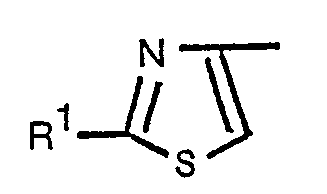
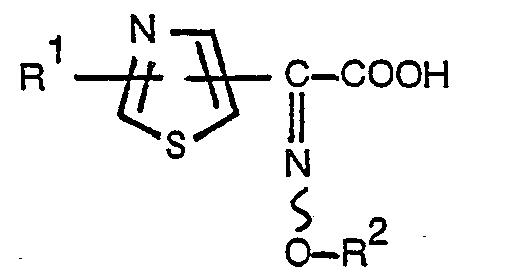
- syn isomer means one geometrical isomer having the partial structure represented by the following formula: (wherein R 1 and R 2 are each as defined above) and anti isomer means the other geometrical isomer having the partial structure represented by the following formula: (wherein R 1 and R 2 are each as defined above).
- syn isomer and the anti isomer can also be referred to the same geometrical isomers as illustrated for the compound (I).
- Suitable pharmaceutically acceptable salts of the object compounds (I) are e.g., conventional non-toxic salts, and include metal salts such as an alkali metal salt (e.g. sodium salt, potassium salt) and an alkaline earth metal salt (e.g. calcium salt, magnesium salt), an ammonium salt, an organic base salt (e.g. trimethylamine salt, triethylamine salt, pyridine salt, picoline salt, dicyclohexylamine salt, N,N'-dibenzylethylenediamine salt), an organic acid salt (e.g.
- metal salts such as an alkali metal salt (e.g. sodium salt, potassium salt) and an alkaline earth metal salt (e.g. calcium salt, magnesium salt), an ammonium salt, an organic base salt (e.g. trimethylamine salt, triethylamine salt, pyridine salt, picoline salt, dicyclohexylamine salt, N,N'-dibenzylethylenediamine salt), an organic acid
- acetate maleate, tartrate, methanesulfonate, benzenesulfonate, formate, toluenesulfonate
- an inorganic acid salt e.g. hydrochloride, hydrobromide, sulfat, phosphate
- a salt with an amino acid e.g. arginine, aspartic acid, glutamic acid
- Suitable "protected amino" for R 1 and R 1a may include, e.g. an acylamino or an amino group substituted by a conventinal protecting group such as ar(lower)alkyl which may have at least one suitable subsituent(s), (e.g. benzyl, trityl).
- a conventinal protecting group such as ar(lower)alkyl which may have at least one suitable subsituent(s), (e.g. benzyl, trityl).
- a suitable acyl moiety in the term "amino protected by acyl” may include carbamoyl, aliphatic acyl group and acyl group containing an aromatic or heterocyclic ring.
- suitable examples of the said acyl may be lower alkanoyl (e.g. formyl, acetyl, propionyl, butyryl, isobutyryl, valeryl, isovaleryl, oxalyl, succinyl, pivaloyl); lower alkoxycarbonyl (e.g.
- ar(lower)alkanoyl e.g. phenylacetyl, phenylpropionyl
- ar(lower)alkoxycarbonyl e.g. benzyloxycarbonyl, phenethyloxycarbonyl.
- the acyl moiety as stated above may have at least one suitable substituent(s) such as halogen (chlorine, bromine, fluorine and iodine) or the like.
- C 2 - 6 alkenyl moiety in the terms "C 2 - 6 alkenyl which may have a carboxy or a protected carboxy substituent” for R 2 , "C 2-6 alkenyl having a protected carboxy substituent” for R 2a , and "C 2 - 6 alkenyl having a carboxy group” for R Zb may include vinyl, 1-propenyl, allyl, 1-methylallyl, 1 or 2 or 3-butenyl, 1 or 2 or 3 or 4-pentenyl, 1 or 2 or 3 or 4 or 5-hexenyl, and preferably one having 2 to 4 carbon atoms.
- Suitable "protected carboxy" on said C 2 - 6 alkenyl may include, e.g., an esterified carboxy such as C i - 6 alkoxycarbonyl (e.g. methoxycarbonyl, ethoxycarbonyl, propoxycarbonyl, t-butoxycarbonyl.
- an esterified carboxy such as C i - 6 alkoxycarbonyl (e.g. methoxycarbonyl, ethoxycarbonyl, propoxycarbonyl, t-butoxycarbonyl.
- Suitable "C 2 - 6 alkynyl" for R 2 is one having 2 to 6 carbon atoms and may include e.g., ethynyl, 2-propynyl, 1-methyl-2-propynyl, 1 or 2 or 3-butynyl, 1 or 2 or 3 or 4-pentynyl, 1 or 2 or 3 or 4 or 5-hexynyl and preferably one having 2 to 4 carbon atoms.
- Suitable "cycloalkyl” for R 2 is one having 3 to 8 carbon atoms and may include, e.g., cyclopropyl, cyclobutyl, cyclopentyl, cyclohexyl, cycloheptyl, and preferably one having 4 to 7 carbon atoms.
- a suitable "C 1-6 alkyl” moiety in the terms "ar(C 1-6 )alkyl which may have a halogen substituent” and "C 1-6 alkylthio(C 1-6 )alkyl” for R 2 and "hydroxy(C 1-6 )alkyl” for R 3 may include, e.g., methyl, ethyl, propyl, isopropyl, butyl, isobutyl, tert-butyl, pentyl, tert-pentyl and hexyl and preferably one having 1 to 4 carbon atoms(s).
- a suitable "ar(C 1 - 6 )alkyl" moiety in the term "ar(C1-6)alkyl which may have a halogen substituent" for R 2 may include phenyl(lower)alkyl wherein the lower alkyl moiety is as defined above.
- Halogen is represented by chlorine, bromine, fluorine or iodine.
- Suitable group which can be substituted with a group of the formula may include e.g., acyloxy, halogen and azido, wherein acyl moiety in the term “acyloxy” can be referred to the ones as exemplified for "acylamino".
- Suitable "protected carboxy” in the terms “lower alkenyl having a protected carboxy substituent” may include the ones as defined above.
- the preferable examples of the object compound (I) are exemplifed as follows.
- the object compound (I) or a salt thereof can be prepared by reacting the compound (II) or its reactive derivative at the amino group or a salt thereof with the compound (III) or its reactive derivative at the carboxy group or a salt thereof.
- Suitable reactive derivative at the amino group of the compound (II) may include Schiff's base type imino or its tautomeric enamine type isomer formed by the reaction of the compound (II) with a carbonyl compound such as aldehyde and ketone; a silyl derivative formed by the reaction of the compound (11) with a silyl compound such as bis(trimethylsilyl)acetamide; a derivative formed by reaction of the compound (II) with e.g. phosphorus trichloride or phosgene.
- Suitable salt of the compounds (11) and (III) may include, e.g., an acid addition salt such as an organic acid salt (e.g., acetate, maleate, tartrate, benzenesulfonate and toluenesulfonate) or an inorganic acid salt (e.g., hydrochloride, hydrobromide, sulfate and phosphate); a metal salt (e.g., sodium salt, potassium salt, calcium salt and magnesium salt); ammonium salt; an organic amine salt (e.g., triethylamine salt and dicyclohexylamine salt).
- an acid addition salt such as an organic acid salt (e.g., acetate, maleate, tartrate, benzenesulfonate and toluenesulfonate) or an inorganic acid salt (e.g., hydrochloride, hydrobromide, sulfate and phosphate); a metal salt (e.g., sodium salt, potassium salt
- Suitable reactive derivative at the carboxy group of the compound (III) may include, e.g., an acid halide, an acid anhydride, an activated amide and an activated ester.
- the suitable example may be an acid chloride, an acid azide; a mixed acid anhydride with an acid such as substituted phosphoric acid (e.g., dialkylphosphoric acid, phenylphosphoric acid, diphenylphosphoric acid, dibenzylphosphoric acid and halogenated phosphoric acid), dialkylphosphorous acid, sulfurous acid, thiosulfuric acid, sulfuric acid, alkylcarbonic acid, aliphatic carboxylic acid (e.g., pivalic acid, pentanoic acid, isopentanoic acid, 2-ethyl butyric acid or trichloroacetic acid) or aromatic carboxylic acid (e.g.
- substituted phosphoric acid e.g., dialkylphosphoric acid, phenylphosphoric acid, di
- the reaction is usually carried out in a conventional solvent such as water, acetone, dioxane, acetonitrile, chloroform, methylene chloride, ethylene chloride, tetrahydrofuran, ethyl acetate, N,N-dimethylformamide, pyridine or any other organic solvents which do not adversely influence the reaction.
- a conventional solvent such as water, acetone, dioxane, acetonitrile, chloroform, methylene chloride, ethylene chloride, tetrahydrofuran, ethyl acetate, N,N-dimethylformamide, pyridine or any other organic solvents which do not adversely influence the reaction.
- a conventional solvent such as water, acetone, dioxane, acetonitrile, chloroform, methylene chloride, ethylene chloride, tetrahydrofuran, ethyl acetate, N,N-dimethylformamide, pyridine
- the reaction is preferably carried out, e.g., in the presence of a conventional condensing agent such as N,N'-dicyclohexylcarbodiimide; N-cyclohexyl-N'-morpholinoethylcarbodiimide; N-cyclohexyl-N'-(4-diethylamino- cyclohexyl)carbodiimide; N,N'-diethylcarbodiimide, N,N'-diisopropylcarbodiimide; N-ethyl-N'-(3-dimethylaminopropyl)carbodiimide; N,N-carbonylbis-(2-methyl imidazole); pentamethyleneketene-N-cyclohexylimine; diphenylketene-N-cyclohexylimine; ethoxyacetylene, 1-alkoxy
- the reaction may also be carried out in the presence of an inorganic or organic base such as an alkali metal bicarbonate, tri(lower)alkylamine, pyridine, N-(lower)alkylmorphorine or N,N-di(lower)alkyl- benzylamine.
- an inorganic or organic base such as an alkali metal bicarbonate, tri(lower)alkylamine, pyridine, N-(lower)alkylmorphorine or N,N-di(lower)alkyl- benzylamine.
- the reaction temperature is not critical, and the reaction is usually carried out under cooling or at ambient temperature.
- a syn isomer of the object compound (I) can be obtained preferably by conducting the present reaction of the compound (II) with the corresponding syn isomer of the starting compound (III), for example, in the presence of a Vilsmeier reagent as mentioned above and under around neutral condition.
- the object compound (lb) or a salt thereof can be prepared by subjecting the compound (la) or a salt thereof to elimination reaction of the amino protective group.
- Suitable salt of the compound (la) can be referred to those exemplified for the compound (II).
- the elimination reaction is carried out in accordance with a conventional method such as hydrolysis; reduction; a method treating the compound (la) wherein R1a is acylamino with iminohalogenating agent, iminoetherifying agent and then, if necessary, hydorlyzing the resultant; or the like.
- the hydrolysis may include a method using, e.g., an acid or base or hydrazine. These methods may be selected depending on the kind of the protective groups to be eliminated.
- hydrolysis using an acid is one of the most common and preferable method for eliminating the protective groups such as substituted or unsubstituted alkoxycarbonyl, for example, tert- pentyloxycarbonyl, lower alkanoyl (e.g., formyl and acetyl), cycloalkoxycarbonyl, substituted or unsubstituted aralkoxycarbonyl, aralkyl (e.g., trityl), substituted phenylthio, substituted aralkylidene, substituted alkylidene or substituted cycloalkylidene.
- aralkyl e.g., trityl
- substituted phenylthio substituted aralkylidene
- substituted alkylidene substituted alkylidene or substituted cycloalkylidene.
- Suitable acid includes, e.g., an organic or inorganic acid such as formic acid, trifluoroacetic acid, benenesulfonic acid, p-toluenesulfonic acid and hydrochloric acid, and the most suitable acid is an acid which can be easily removed from the reaction mixture by a conventional manner such as distillation under reduced pressure, for example, formic acid, trifluoroacetic acid and hydrochloric acid.
- an organic or inorganic acid such as formic acid, trifluoroacetic acid, benenesulfonic acid, p-toluenesulfonic acid and hydrochloric acid
- the most suitable acid is an acid which can be easily removed from the reaction mixture by a conventional manner such as distillation under reduced pressure, for example, formic acid, trifluoroacetic acid and hydrochloric acid.
- the acids can be selected according to the kind of the protective group to be eliminated.
- the elimination reaction is conducted with an acid, it can be carried out in the presence of absence of a solvent.
- Suitable solvent includes water, a conventional organic solvent or a mixture thereof.
- the elimination reaction using trifluoroacetic acid may be carried out in the presence of anisole.
- the hydrolysis using hydrazine is commonly applied for eliminating a phthaloyl, succinyl type aminoprotective group.
- Suitable base may include, for example, an inorganic base such as alkali metal hydroxide (e.g. sodium hydroxide, potassium hydroxide), alkaline earth metal hydroxide (e.g. magnesium hydroxide, calcium hydroxide), alkali metal carbonate (e.g. sodium carbonate, potassium carbonate), alkaline earth metal carbonate (e.g. magnesium carbonate, calcium carbonate, alkali metal bicarbonate (e.g. sodium bicarbonate, potassium bicarbonate, alkali metal acetate (e.g. sodium acetate, potassium acetate), alkaline earth metal phosphate (e.g.
- alkali metal hydroxide e.g. sodium hydroxide, potassium hydroxide
- alkaline earth metal hydroxide e.g. magnesium hydroxide, calcium hydroxide
- alkali metal carbonate e.g. sodium carbonate, potassium carbonate
- alkaline earth metal carbonate e.g. magnesium carbonate, calcium carbonate
- alkali metal bicarbonate
- magnesium phosphate calcium phosphate
- alkali metal hydrogen phosphate e.g. disodium hydrogen phosphate, dipotassium hydrogen phosphate
- an organic base such as trialkylamine (e.g. trimethylamine, triethylamine), picoline, N-methylpyrrolidine, N-methylmorpholine, 1,5-diazobicyclo[4,3,0]non-5- ene, 1,4-diazobicyclo[2,2,2]octane or 1,5-diazabicyclo[5,4,O]undecane-5.
- the hydrolysis using a base is often carried out in water or a hydrophilic organic solvent or a mixed solvent thereof.
- Suitable reduction may include, for example, reduction with an alkali metal borohydride (e.g. sodium borohydride), reduction with a combination of a metal (e.g. tin, zinc, iron) or the said metal together with a metal salt compound (e.g. chromous chloride, chromous acetate) and an organic or inorganic acid (e.g. acetic acid, propionic acid, hydrochloric acid); and catalytic reduction.
- Suitable catalyst includes, e.g., a conventional one, for example, Raney nickel, platinum oxide, palladium on charcoal.
- the acyl group can generally be eliminated by hydrolysis.
- halogen substituted-alkoxycarbonyl and 8-quinoyloxycarbonyl groups are usually eliminated by treating with a heavy metal such as copper or zinc.
- the acyl group can also be eliminated by treating with an iminohalogenating agent (e.g. phosphorus oxychloride) and an iminoetherifying agent such as lower alkanol (e.g. methanol, ethanol), if necessary, followed by hydrolysis.
- an iminohalogenating agent e.g. phosphorus oxychloride
- an iminoetherifying agent such as lower alkanol (e.g. methanol, ethanol)
- reaction temperature is not critical and may suitable by selected in accordance with the kind of the protective group for the amino group and the elimination method as mentioned above, and the reaction is preferably carried out under a mild condition such as under cooling or at slightly elevated temperature.
- the object compound (I) or a salt thereof can be prepared by reacting the compound (IV) or a salt thereof with the compound (V).
- Suitable salt of the compound (IV) can be referred to the ones exemplified for the compound (I).
- the present reaction may be carried out in a solvent such as water, phosphate buffer, acetone, chloroform, nitrobenzene, methylene chloride, ethylene chloride, formamide, dimethylformamide, methanol, ethanol, ether, tetrahydrofuran, dimethylsulfoxide, or any other organic solvent which does not adversely affect the reaction, preferably in ones having strong polarities.
- a solvent such as water, phosphate buffer, acetone, chloroform, nitrobenzene, methylene chloride, ethylene chloride, formamide, dimethylformamide, methanol, ethanol, ether, tetrahydrofuran, dimethylsulfoxide, or any other organic solvent which does not adversely affect the reaction, preferably in ones having strong polarities.
- hydrophilic solvents may be used in a mixture with water.
- the reaction is preferably carried out in around neutral medium.
- the reaction is preferably conducted in the presence of a base, for example, inorganic base such as alkali metal hydroxide, alkali metal carbonate, alkali metal bicarbonate, and organic base such as trialkylamine.
- a base for example, inorganic base such as alkali metal hydroxide, alkali metal carbonate, alkali metal bicarbonate, and organic base such as trialkylamine.
- the reaction temperature is not critical, and the reaction is usually carried out at ambient temperature, under warming or under slightly heating.
- the present reaction is preferably carried out in the presence of, e.g. alkali metal halide (e.g., sodium iodide, potassium iodide), alkali metal thiocyanate (e.g., sodium thiocyanate, potassium thiocyanate).
- the object compound (ld) or a salt thereof can be prepared by subjecting the compound (lc) or a salt thereof to elimination reaction of the protective group of the carboxy.
- Suitable salts of the compound (lc) can be referred to the ones exemplified for the compound (I).
- Suitable base may include an inorganic base and an organic base as aforementioned.
- Suitable acid may include an organic acid (e.g. formic acid, acetic acid, propionic acid) and an inorganic acid (e.g. hydrochloric acid, hydrobromic acid, sulfuric acid).
- organic acid e.g. formic acid, acetic acid, propionic acid
- inorganic acid e.g. hydrochloric acid, hydrobromic acid, sulfuric acid
- the present hydrolysis is usually carried out in an organic solvent, water or a mixed solvent thereof.
- the elimination using Lewis acid is preferable to eliminate substituted or unsubstituted ar(lower)alkyl ester and lower alkyl ester (e.g. tert-butyl ester, 1-cyclopropylethyl ester), and carried out by reacting the compound (I e ) or a salt thereof with Lewis acid such as boron trihalide (e.g. boron trichloride, boron trifluoride), titanium tetrahalide (e.g. titanium tetrachloride, titanium tetrabromide), tin tetrahalide (e.g. tin tetrachloride, tin tetrabromide), aluminium halide (e.g.
- boron trihalide e.g. boron trichloride, boron trifluoride
- titanium tetrahalide e.g. titanium tetrachloride, titanium tetrabromide
- This elimination reaction is preferably carried out in the presence of cation trapping agents (e.g. anisole, phenol) and is usually carried out in a solvent such as nitroalkane (e.g. nitromethane, nitroethane), alkylene halide (e.g. methylene chloride, ethylene chloride), diethyl ether, carbon disulfide or any other solvents which do not adversely effect the reaction.
- a solvent such as nitroalkane (e.g. nitromethane, nitroethane), alkylene halide (e.g. methylene chloride, ethylene chloride), diethyl ether, carbon disulfide or any other solvents which do not adversely effect the reaction.
- solvents may be used as a mixture thereof.
- the reductive elimination can be applied preferably for elimination of the protective group such as halo(lower)alkyl ester (e.g. 2-iodoethyl, 2,2,2-trichloroethyl).
- the reduction method applicable for the elimination reaction may include, for example, reduction by using a combination of a metal (e.g. zinc, zinc amalgam) or a salt of chrome compound (e.g. chromous chloride, chromous acetate) and an organic or inorganic acid (e.g. acetic acid, propionic acid, hydrochloric acid); and conventional catalytic reduction in the presence of a conventional metallic catalyst.
- the reaction temperature is not critical, and the reaction is usually carried out under cooling, at ambient temperature or under warming.
- the present invention includes, within its scope, the case that protected amino is transformed into the corresponding free amino according to the reaction conditions and kinds of the protective groups in the course of the aforementioned reactions and/or in post-treatment of the reactions in Processes 1 to 4.
- the aforementioned geometrical isomer and/or tautomeric isomer may occasionally be transformed into the other geometrical isomer and/or tautomeric isomer and such cases are to be also included in the scope of the present invention.
- the object compound (I) may be transformed into its pharmaceutically acceptable salt as aforementioned by a conventional method.
- the object compound (I) of the present invention exhibits high antimicrobial activity and inhibits the growth of a number of microorganisms including pathogenic Gram-positive and Gram-negative bacteria.
- cephalosporin compounds according to the present invention are used in the form of pharmaceutical preparation which contain said compounds in admixture with a pharmaceutically acceptable carriers such as an organic or inorganic solid or liquid excipient suitable for oral, parenteral or external administration.
- a pharmaceutically acceptable carriers such as an organic or inorganic solid or liquid excipient suitable for oral, parenteral or external administration.
- the pharmaceutical preparations may be in solid form such as capsule, tablet, dragee, ointment or suppository, or in liquid form such as solution, suspension, or emulsion.
- auxiliary substances stabilizing agents, wetting or emulsifying agents, buffers and other commonly used additives.
- While the dosage of the compounds may vary from and also depend upon the age and condition of the patient, an average single dose of about 50 mg., 100 mg., 250 mg., and 500 mg. of the compounds according to the present invention has proved to be effective for treating of infectious diseases caused by a number of pathogenic bacteria. In general amounts, daily dose between 1 mg/body and about 1000 mg/ body or even more may be administered.
- test data an anti-microbial activity of a representative compound of the present invention are shown below.
- tert-butyl 4-aminooxycrotonate (10.0 g) were added ethanol (150 ml) and water (150 ml), followed by gradually adding (2-formamidothiazol-4-yl)glyoxylic acid (11.0 g) with stirring. During the addition, the mixture was adjusted to pH 5 to 5.5 with 10% aqueous sodium hydroxide, and the stirring was continued at ambient temperature for 2 hours. After removal of the ethanol, to the remaining aqueous solution was added ethyl acetate, followed by adjusting to pH 7.5 with 10% aqueous sodium hydroxide. The aqueous layer was separated and washed with ethyl acetate.
- the precipitated substance was collected by filtration, washed with a mixed solvent of water and ethanol (1:1 by volume), followed by addition of water and ethyl acetate, and adjusting to pH 2.0 with 10% hydrochloric acid.
- the organic layer was separated, washed with a saturated aqueous sodium chloride and then dried over magnesium sulfate. Removal of the solvent gave a residue, which was pulverized with n-hexane and tetrahydrofuran to obtain 2-(3-t-butoxycarbonyl-2-propenyloxyimino)-2-(2- formamidothiazol-4-yl)acetic acid (syn isomer) (12.01 g).
- the aqueous solution was adjusted to pH 4.0 with 10% aqueous hydrochloric acid under ice cooling.
- the solution was subjected to column chromatography on macroporous non-ionic adsorption resin "Diaion HP-20" (Trademark: prepared by Mitsubishi Chemical Industries) and eluted with 10% aqueous solution of iso-propyl alcohol.
- the aqueous layer was adjusted to pH 4.5 with 10% aqueous hydrochloric acid. After removing the solvent under reduced pressure, the aqueous solution was adjusted to pH 4.0 with 10% aqueous hydrochloric acid under ice cooling. The solution was subjected to column chromatography on macroporous non-ionic adsorption resin "Diaion HP-20" (Trademark: prepared by Mitsubishi Chemical Industries) and eluted with 10% aqueous solution of iso-propyl alcohol.
- the aqueous layer was adjusted to pH 5.0 with 10% aqueous solution of sodium hydroxide. After removing the solvent under reduced pressure, the aqueous solution was adjusted to pH 4.0 with 10% aqueous hydrochloric acid under ice-cooling. The solution was subjected to column chromatography on macroporous non-ionic adsorption resin "Diaion HP-20" (Trademark: prepared by Mitsubishi Chemical Industries) and eluted with 10% aqueous solution of isopropyl alcohol.
- the aqueous layer was adjusted to pH 5.Q with 10% aqueous solution of sodium hydroxide. After removing the solvent under reduced pressure, the aqueous solution was adjusted to pH 4.0 with 10% aqueous hydrochloric acid under ice cooling. The solution was subjected to column chromatography on macroporous non-ionic adsorption resin "Diaion HP-20" (Trademark: prepared by Mitsubishi Chemical Industries) and eluted with 10% aqueous solution of isopropyl alcohol.
- the filtrate was adjusted to pH 5.5 with 10% aqueous solution of sodium hydroxide. After removing the solvent under reduced pressure, the aqueous solution was adjusted to pH 3.6 with 10% aqueous hydrochloric acid under ice cooling. The solution was subjected to column chromatography on macroporous non-ionic adsorption resin "Diaion HP-20" (Trademark: prepared by Mitsubishi Chemical Industries) and eluted with 10% aqueous solution of isopropyl alcohol.
- Trifluoroacetic acid (13.2 ml) was added to a suspension of 7 - [2 - (3 - t - butoxycarbonyl - 2 - propenyloxyimino) - 2 - (2 - aminothiazol -4 -yl)acetamido] - 3 - (1 - pyridiniomethyl) - 3 - cephem - 4 - carboxylic acid dihydrochloride (syn isomer) (3.3 g) in dichloromethane (7 ml) and anisole (3.3 ml) at ambient temperature and the mixture was stirred for 1.5 hours at same temperature. To the resulting solution was added isopropyl ether under stirring.
- the precipitates were collected by filtration, washed with isopropyl ether.
- the precipitates were added to a mixture of water and ethyl acetate and adjusted to pH 7.0 with 10% aqueous sodium hydroxide.
- the separated aqueous layer was adjusted to pH 4.0 with 10% hydrochloric acid.
- the solution was subjected to column chromatography on macroporous non-ionic resin "Diaion HP-20" and eluted with 15% aqueous solution of isopropyl alcohol.
Landscapes
- Chemical & Material Sciences (AREA)
- Organic Chemistry (AREA)
- Cephalosporin Compounds (AREA)
Claims (17)





Priority Applications (1)
| Application Number | Priority Date | Filing Date | Title |
|---|---|---|---|
| AT81106108T ATE16492T1 (de) | 1980-08-11 | 1981-08-05 | Cephalosporinderivate und verfahren zu ihrer herstellung. |
Applications Claiming Priority (4)
| Application Number | Priority Date | Filing Date | Title |
|---|---|---|---|
| GB8026112 | 1980-08-11 | ||
| GB8026112 | 1980-08-11 | ||
| GB8100848 | 1981-01-12 | ||
| GB8100848 | 1981-01-12 |
Publications (3)
| Publication Number | Publication Date |
|---|---|
| EP0045937A2 EP0045937A2 (fr) | 1982-02-17 |
| EP0045937A3 EP0045937A3 (en) | 1982-10-13 |
| EP0045937B1 true EP0045937B1 (fr) | 1985-11-13 |
Family
ID=26276517
Family Applications (1)
| Application Number | Title | Priority Date | Filing Date |
|---|---|---|---|
| EP81106108A Expired EP0045937B1 (fr) | 1980-08-11 | 1981-08-05 | Dérivés de céphalosporine et procédés pour leur préparation |
Country Status (3)
| Country | Link |
|---|---|
| US (1) | US4443444A (fr) |
| EP (1) | EP0045937B1 (fr) |
| DE (1) | DE3172904D1 (fr) |
Families Citing this family (15)
| Publication number | Priority date | Publication date | Assignee | Title |
|---|---|---|---|---|
| CA1213882A (fr) * | 1982-03-04 | 1986-11-12 | Jun Okumura | Cephalosporines |
| US4563449A (en) * | 1982-07-19 | 1986-01-07 | Fujisawa Pharmaceutical Co., Ltd. | Cephem compounds |
| US4486586A (en) * | 1983-02-10 | 1984-12-04 | Bristol-Myers Company | Cephalosporin derivatives |
| DE3330605A1 (de) * | 1983-08-25 | 1985-03-14 | Hoechst Ag, 6230 Frankfurt | Cephalosporinderivate und verfahren zu ihrer herstellung |
| GB8329030D0 (en) * | 1983-10-31 | 1983-11-30 | Fujisawa Pharmaceutical Co | Cephem compounds |
| EP0210815A3 (fr) * | 1985-07-25 | 1988-04-20 | Beecham Group Plc | Dérivés d'acide 6-bêta-(alpha-oxyimino éthérifié)acylamino pénicillanique, leurs préparation et application |
| US5084453A (en) * | 1986-04-14 | 1992-01-28 | Banyu Pharmaceutical Co., Ltd. | 1-carboxy-1-vinyloxyimino aminothiazole cephalosporin derivatives |
| PT3616695T (pt) | 2011-09-09 | 2024-11-18 | Merck Sharp & Dohme | Ceftolozano/tazobactam para tratar infeções intrapulmonares |
| US8809314B1 (en) | 2012-09-07 | 2014-08-19 | Cubist Pharmacueticals, Inc. | Cephalosporin compound |
| US8476425B1 (en) | 2012-09-27 | 2013-07-02 | Cubist Pharmaceuticals, Inc. | Tazobactam arginine compositions |
| US20140274996A1 (en) | 2013-03-15 | 2014-09-18 | Cubist Pharmaceuticals, Inc. | Tazobactam and ceftolozane antibiotic compositions |
| US9872906B2 (en) | 2013-03-15 | 2018-01-23 | Merck Sharp & Dohme Corp. | Ceftolozane antibiotic compositions |
| PE20160048A1 (es) | 2013-03-15 | 2016-02-12 | Merck Sharp & Dohme | Composiciones antibioticas de ceftolozano |
| WO2015035376A2 (fr) | 2013-09-09 | 2015-03-12 | Calixa Therapeutics, Inc. | Traitement d'infections au moyen de ceftolozane/tazobactam chez des sujets ayant une fonction rénale altérée |
| US8906898B1 (en) | 2013-09-27 | 2014-12-09 | Calixa Therapeutics, Inc. | Solid forms of ceftolozane |
Family Cites Families (10)
| Publication number | Priority date | Publication date | Assignee | Title |
|---|---|---|---|---|
| GB1399086A (en) * | 1971-05-14 | 1975-06-25 | Glaxo Lab Ltd | Cephalosporin compounds |
| DE2715385A1 (de) * | 1976-04-14 | 1977-11-10 | Takeda Chemical Industries Ltd | Cephalosporinderivate, verfahren zu ihrer herstellung und sie enthaltende arzneimittel |
| JPS53144594A (en) * | 1976-12-27 | 1978-12-15 | Fujisawa Pharmaceut Co Ltd | 3,7-di-substitued-3-cephem-4-carboxylic acid derivatives |
| DE2716677C2 (de) * | 1977-04-15 | 1985-10-10 | Hoechst Ag, 6230 Frankfurt | Cephemderivate und Verfahren zu ihrer Herstellung |
| DE2714880A1 (de) * | 1977-04-02 | 1978-10-26 | Hoechst Ag | Cephemderivate und verfahren zu ihrer herstellung |
| AR228726A1 (es) * | 1978-05-26 | 1983-04-15 | Glaxo Group Ltd | Procedimiento para la preparacion del antibiotico(6r,7r)-7-((z)-2-(2-aminotiazol-4-il)-2-(2-carboxiprop-2-oxiimino)acetamido)-3-(1-piridiniometil)cef-3-em-4-carboxilato |
| US4332798A (en) * | 1978-12-29 | 1982-06-01 | Fujisawa Pharmaceutical Co., Ltd. | 7-Amino-thia-diazole oxyimino derivatives of cephem and cephem compounds |
| ES8103105A1 (es) * | 1979-03-22 | 1981-02-16 | Glaxo Group Ltd | Un procedimiento para la preparacion de antibioticos de ce- falosporina |
| US4329453A (en) * | 1979-10-02 | 1982-05-11 | Glaxo Group Limited | Cephalosporin antibiotic |
| US4336253A (en) * | 1981-03-11 | 1982-06-22 | Eli Lilly And Company | Cephalosporin antibiotics |
-
1981
- 1981-08-03 US US06/289,503 patent/US4443444A/en not_active Expired - Fee Related
- 1981-08-05 DE DE8181106108T patent/DE3172904D1/de not_active Expired
- 1981-08-05 EP EP81106108A patent/EP0045937B1/fr not_active Expired
Also Published As
| Publication number | Publication date |
|---|---|
| DE3172904D1 (en) | 1985-12-19 |
| EP0045937A2 (fr) | 1982-02-17 |
| EP0045937A3 (en) | 1982-10-13 |
| US4443444A (en) | 1984-04-17 |
Similar Documents
| Publication | Publication Date | Title |
|---|---|---|
| EP0057422B1 (fr) | Dérivés de céphalosporine, leur préparation et les compositions pharmaceutiques les contenant | |
| US5401734A (en) | Cephem compounds | |
| US4443444A (en) | Cephem compounds | |
| US4366153A (en) | Cephem compounds | |
| EP0069872B1 (fr) | Dérivés céphem et procédés pour leur préparation | |
| EP0047491B1 (fr) | Dérivés de céphalosporines et procédés pour leur préparation | |
| EP0345671B1 (fr) | Composés céphem et procédés pour leur préparation | |
| EP0025199B1 (fr) | Dérivés de céphalosporine, procédés pour leur préparation et compositions pharmaceutiques les contenant | |
| EP0008442B1 (fr) | Acides 2-alcoyl inférieur-7-substitués-2 ou 3-cephem-4-carboxyliques, procédés pour leur préparation et compositions pharmaceutiques les contenant | |
| US4463000A (en) | Cephem compounds | |
| US4367228A (en) | Cephem compound and composition | |
| WO1992021683A1 (fr) | Nouveaux composes cephem | |
| EP0237735B1 (fr) | Dérivés 3,7-disubstitués-3-céphem et procédé pour leur préparation | |
| US4515788A (en) | Cephem compounds | |
| JPH0240679B2 (fr) | ||
| US4332800A (en) | Cephem compounds | |
| US4463003A (en) | Cephem compounds | |
| EP0109683B1 (fr) | Dérivés de céphalosporine et procédés pour leur préparation | |
| US4409217A (en) | Cephem compounds | |
| IE45222B1 (en) | Cephalosporin derivatives and the preparation thereof | |
| US4191762A (en) | 2-Lower alkyl-7-substituted amino-2 or 3-cephem-4-carboxylic acid compounds | |
| EP0048915B1 (fr) | Dérivés de céphalosporines, leur préparation et compositions pharmaceutiques les contenant | |
| US4507293A (en) | Antimicrobial cephem compounds | |
| US4408042A (en) | Cephem compounds | |
| WO1992018508A1 (fr) | Nouveaux composes de cephem |
Legal Events
| Date | Code | Title | Description |
|---|---|---|---|
| PUAI | Public reference made under article 153(3) epc to a published international application that has entered the european phase |
Free format text: ORIGINAL CODE: 0009012 |
|
| AK | Designated contracting states |
Designated state(s): AT BE CH DE FR GB IT LU NL SE |
|
| PUAL | Search report despatched |
Free format text: ORIGINAL CODE: 0009013 |
|
| AK | Designated contracting states |
Designated state(s): AT BE CH DE FR GB IT LU NL SE |
|
| 17P | Request for examination filed |
Effective date: 19830406 |
|
| GRAA | (expected) grant |
Free format text: ORIGINAL CODE: 0009210 |
|
| AK | Designated contracting states |
Designated state(s): AT BE CH DE FR GB IT LI LU NL SE |
|
| REF | Corresponds to: |
Ref document number: 16492 Country of ref document: AT Date of ref document: 19851115 Kind code of ref document: T |
|
| ET | Fr: translation filed | ||
| ITF | It: translation for a ep patent filed | ||
| REF | Corresponds to: |
Ref document number: 3172904 Country of ref document: DE Date of ref document: 19851219 |
|
| PGFP | Annual fee paid to national office [announced via postgrant information from national office to epo] |
Ref country code: AT Payment date: 19860821 Year of fee payment: 6 |
|
| PG25 | Lapsed in a contracting state [announced via postgrant information from national office to epo] |
Ref country code: LU Free format text: LAPSE BECAUSE OF NON-PAYMENT OF DUE FEES Effective date: 19860831 |
|
| PLBE | No opposition filed within time limit |
Free format text: ORIGINAL CODE: 0009261 |
|
| STAA | Information on the status of an ep patent application or granted ep patent |
Free format text: STATUS: NO OPPOSITION FILED WITHIN TIME LIMIT |
|
| 26N | No opposition filed | ||
| PGFP | Annual fee paid to national office [announced via postgrant information from national office to epo] |
Ref country code: NL Payment date: 19870831 Year of fee payment: 7 |
|
| PG25 | Lapsed in a contracting state [announced via postgrant information from national office to epo] |
Ref country code: GB Effective date: 19890805 Ref country code: AT Effective date: 19890805 |
|
| PG25 | Lapsed in a contracting state [announced via postgrant information from national office to epo] |
Ref country code: SE Effective date: 19890806 |
|
| PG25 | Lapsed in a contracting state [announced via postgrant information from national office to epo] |
Ref country code: LI Effective date: 19890831 Ref country code: CH Effective date: 19890831 Ref country code: BE Effective date: 19890831 |
|
| BERE | Be: lapsed |
Owner name: FUJISAWA PHARMACEUTICAL CO. LTD. Effective date: 19890831 |
|
| PG25 | Lapsed in a contracting state [announced via postgrant information from national office to epo] |
Ref country code: NL Effective date: 19900301 |
|
| GBPC | Gb: european patent ceased through non-payment of renewal fee | ||
| NLV4 | Nl: lapsed or anulled due to non-payment of the annual fee | ||
| PG25 | Lapsed in a contracting state [announced via postgrant information from national office to epo] |
Ref country code: FR Effective date: 19900427 |
|
| REG | Reference to a national code |
Ref country code: CH Ref legal event code: PL |
|
| PG25 | Lapsed in a contracting state [announced via postgrant information from national office to epo] |
Ref country code: DE Effective date: 19900501 |
|
| REG | Reference to a national code |
Ref country code: FR Ref legal event code: ST |
|
| EUG | Se: european patent has lapsed |
Ref document number: 81106108.4 Effective date: 19900418 |