EP0046143A1 - Lidocain-Derivate und diese als wirksamen Grundstoff enthaltende therapeutische Zusammensetzungen - Google Patents
Lidocain-Derivate und diese als wirksamen Grundstoff enthaltende therapeutische Zusammensetzungen Download PDFInfo
- Publication number
- EP0046143A1 EP0046143A1 EP81830136A EP81830136A EP0046143A1 EP 0046143 A1 EP0046143 A1 EP 0046143A1 EP 81830136 A EP81830136 A EP 81830136A EP 81830136 A EP81830136 A EP 81830136A EP 0046143 A1 EP0046143 A1 EP 0046143A1
- Authority
- EP
- European Patent Office
- Prior art keywords
- lidocaine
- salicylate
- active principle
- therapeutic compositions
- salicylate monohydrate
- Prior art date
- Legal status (The legal status is an assumption and is not a legal conclusion. Google has not performed a legal analysis and makes no representation as to the accuracy of the status listed.)
- Granted
Links
- NNJVILVZKWQKPM-UHFFFAOYSA-N Lidocaine Chemical class CCN(CC)CC(=O)NC1=C(C)C=CC=C1C NNJVILVZKWQKPM-UHFFFAOYSA-N 0.000 title claims abstract description 59
- 239000000203 mixture Substances 0.000 title claims description 5
- 230000001225 therapeutic effect Effects 0.000 title claims description 5
- 229960004194 lidocaine Drugs 0.000 claims abstract description 55
- 230000003288 anthiarrhythmic effect Effects 0.000 claims abstract description 10
- 239000003589 local anesthetic agent Substances 0.000 claims abstract description 10
- JVKVEOKPRHZKNW-UHFFFAOYSA-N 2-hydroxybenzoic acid;hydrate Chemical compound O.OC(=O)C1=CC=CC=C1O JVKVEOKPRHZKNW-UHFFFAOYSA-N 0.000 claims abstract description 8
- 230000000747 cardiac effect Effects 0.000 claims abstract description 7
- YGSDEFSMJLZEOE-UHFFFAOYSA-N salicylic acid Chemical compound OC(=O)C1=CC=CC=C1O YGSDEFSMJLZEOE-UHFFFAOYSA-N 0.000 claims description 12
- 230000003444 anaesthetic effect Effects 0.000 claims description 10
- 150000003839 salts Chemical class 0.000 claims description 9
- XLYOFNOQVPJJNP-UHFFFAOYSA-N water Substances O XLYOFNOQVPJJNP-UHFFFAOYSA-N 0.000 claims description 9
- 238000000034 method Methods 0.000 claims description 7
- LFQSCWFLJHTTHZ-UHFFFAOYSA-N Ethanol Chemical compound CCO LFQSCWFLJHTTHZ-UHFFFAOYSA-N 0.000 claims description 6
- OKKJLVBELUTLKV-UHFFFAOYSA-N Methanol Chemical compound OC OKKJLVBELUTLKV-UHFFFAOYSA-N 0.000 claims description 6
- FJKROLUGYXJWQN-UHFFFAOYSA-N papa-hydroxy-benzoic acid Natural products OC(=O)C1=CC=C(O)C=C1 FJKROLUGYXJWQN-UHFFFAOYSA-N 0.000 claims description 6
- 229960004889 salicylic acid Drugs 0.000 claims description 6
- 239000003960 organic solvent Substances 0.000 claims description 5
- CSCPPACGZOOCGX-UHFFFAOYSA-N Acetone Chemical compound CC(C)=O CSCPPACGZOOCGX-UHFFFAOYSA-N 0.000 claims description 4
- 239000002904 solvent Substances 0.000 claims description 3
- RYHBNJHYFVUHQT-UHFFFAOYSA-N 1,4-Dioxane Chemical compound C1COCCO1 RYHBNJHYFVUHQT-UHFFFAOYSA-N 0.000 claims description 2
- 238000001704 evaporation Methods 0.000 claims description 2
- 239000000969 carrier Substances 0.000 claims 3
- 239000007810 chemical reaction solvent Substances 0.000 claims 1
- 238000004519 manufacturing process Methods 0.000 claims 1
- 150000001875 compounds Chemical class 0.000 abstract description 10
- YGSDEFSMJLZEOE-UHFFFAOYSA-M salicylate Chemical compound OC1=CC=CC=C1C([O-])=O YGSDEFSMJLZEOE-UHFFFAOYSA-M 0.000 description 26
- 229960001860 salicylate Drugs 0.000 description 23
- 229960004393 lidocaine hydrochloride Drugs 0.000 description 17
- YECIFGHRMFEPJK-UHFFFAOYSA-N lidocaine hydrochloride monohydrate Chemical compound O.[Cl-].CC[NH+](CC)CC(=O)NC1=C(C)C=CC=C1C YECIFGHRMFEPJK-UHFFFAOYSA-N 0.000 description 17
- 230000000694 effects Effects 0.000 description 16
- 206010003119 arrhythmia Diseases 0.000 description 13
- 230000006793 arrhythmia Effects 0.000 description 12
- UHOVQNZJYSORNB-UHFFFAOYSA-N Benzene Chemical compound C1=CC=CC=C1 UHOVQNZJYSORNB-UHFFFAOYSA-N 0.000 description 9
- 241000283973 Oryctolagus cuniculus Species 0.000 description 7
- 239000000243 solution Substances 0.000 description 7
- 229940079593 drug Drugs 0.000 description 6
- 239000003814 drug Substances 0.000 description 6
- 241001465754 Metazoa Species 0.000 description 5
- 238000001990 intravenous administration Methods 0.000 description 5
- 241000700199 Cavia porcellus Species 0.000 description 4
- 241000786363 Rhampholeon spectrum Species 0.000 description 4
- ABBQHOQBGMUPJH-UHFFFAOYSA-M Sodium salicylate Chemical compound [Na+].OC1=CC=CC=C1C([O-])=O ABBQHOQBGMUPJH-UHFFFAOYSA-M 0.000 description 4
- 239000003416 antiarrhythmic agent Substances 0.000 description 4
- 230000008595 infiltration Effects 0.000 description 4
- 238000001764 infiltration Methods 0.000 description 4
- 229960004025 sodium salicylate Drugs 0.000 description 4
- 230000002861 ventricular Effects 0.000 description 4
- 206010002091 Anaesthesia Diseases 0.000 description 3
- IAZDPXIOMUYVGZ-UHFFFAOYSA-N Dimethylsulphoxide Chemical compound CS(C)=O IAZDPXIOMUYVGZ-UHFFFAOYSA-N 0.000 description 3
- 230000037005 anaesthesia Effects 0.000 description 3
- 230000003440 anti-fibrillation Effects 0.000 description 3
- 239000007864 aqueous solution Substances 0.000 description 3
- 125000003118 aryl group Chemical group 0.000 description 3
- 210000004400 mucous membrane Anatomy 0.000 description 3
- 230000033764 rhythmic process Effects 0.000 description 3
- 238000001228 spectrum Methods 0.000 description 3
- 230000000638 stimulation Effects 0.000 description 3
- IJGRMHOSHXDMSA-UHFFFAOYSA-N Atomic nitrogen Chemical compound N#N IJGRMHOSHXDMSA-UHFFFAOYSA-N 0.000 description 2
- 206010015856 Extrasystoles Diseases 0.000 description 2
- DHMQDGOQFOQNFH-UHFFFAOYSA-N Glycine Chemical compound NCC(O)=O DHMQDGOQFOQNFH-UHFFFAOYSA-N 0.000 description 2
- 238000010521 absorption reaction Methods 0.000 description 2
- WDIHJSXYQDMJHN-UHFFFAOYSA-L barium chloride Chemical compound [Cl-].[Cl-].[Ba+2] WDIHJSXYQDMJHN-UHFFFAOYSA-L 0.000 description 2
- 229910001626 barium chloride Inorganic materials 0.000 description 2
- 238000009835 boiling Methods 0.000 description 2
- 238000001816 cooling Methods 0.000 description 2
- 210000004087 cornea Anatomy 0.000 description 2
- 125000001495 ethyl group Chemical group [H]C([H])([H])C([H])([H])* 0.000 description 2
- 238000002360 preparation method Methods 0.000 description 2
- 230000002441 reversible effect Effects 0.000 description 2
- 231100001274 therapeutic index Toxicity 0.000 description 2
- 0 CCC1[C@](*)C1*([C@@]([C@@](CCC1)C([N+](*)[O-])=*C)[N+]1[O-])=C Chemical compound CCC1[C@](*)C1*([C@@]([C@@](CCC1)C([N+](*)[O-])=*C)[N+]1[O-])=C 0.000 description 1
- 206010011091 Coronary artery thrombosis Diseases 0.000 description 1
- 208000005373 Dyshidrotic Eczema Diseases 0.000 description 1
- VEXZGXHMUGYJMC-UHFFFAOYSA-N Hydrochloric acid Chemical compound Cl VEXZGXHMUGYJMC-UHFFFAOYSA-N 0.000 description 1
- 208000000418 Premature Cardiac Complexes Diseases 0.000 description 1
- 241001342522 Vampyrum spectrum Species 0.000 description 1
- 206010047281 Ventricular arrhythmia Diseases 0.000 description 1
- 230000007059 acute toxicity Effects 0.000 description 1
- 231100000403 acute toxicity Toxicity 0.000 description 1
- ZGUNAGUHMKGQNY-UHFFFAOYSA-N alpha-phenylglycine Chemical compound OC(=O)C(N)C1=CC=CC=C1 ZGUNAGUHMKGQNY-UHFFFAOYSA-N 0.000 description 1
- QGZKDVFQNNGYKY-UHFFFAOYSA-O ammonium group Chemical group [NH4+] QGZKDVFQNNGYKY-UHFFFAOYSA-O 0.000 description 1
- 150000001450 anions Chemical class 0.000 description 1
- 230000001746 atrial effect Effects 0.000 description 1
- 239000008280 blood Substances 0.000 description 1
- 210000004369 blood Anatomy 0.000 description 1
- 230000037396 body weight Effects 0.000 description 1
- 206010061592 cardiac fibrillation Diseases 0.000 description 1
- 230000036459 cardiodepression Effects 0.000 description 1
- 238000006243 chemical reaction Methods 0.000 description 1
- 208000002528 coronary thrombosis Diseases 0.000 description 1
- 239000013078 crystal Substances 0.000 description 1
- 238000002425 crystallisation Methods 0.000 description 1
- 210000004207 dermis Anatomy 0.000 description 1
- 125000001664 diethylamino group Chemical group [H]C([H])([H])C([H])([H])N(*)C([H])([H])C([H])([H])[H] 0.000 description 1
- 239000012153 distilled water Substances 0.000 description 1
- 239000003925 fat Substances 0.000 description 1
- 230000002349 favourable effect Effects 0.000 description 1
- 230000002600 fibrillogenic effect Effects 0.000 description 1
- 239000012458 free base Substances 0.000 description 1
- 230000036747 functional refractory period Effects 0.000 description 1
- 229960002449 glycine Drugs 0.000 description 1
- 235000013905 glycine and its sodium salt Nutrition 0.000 description 1
- 210000002837 heart atrium Anatomy 0.000 description 1
- 125000002887 hydroxy group Chemical group [H]O* 0.000 description 1
- 238000001727 in vivo Methods 0.000 description 1
- 238000002690 local anesthesia Methods 0.000 description 1
- 229960005015 local anesthetics Drugs 0.000 description 1
- -1 monohydrate salt Chemical class 0.000 description 1
- 150000004682 monohydrates Chemical class 0.000 description 1
- 229910052757 nitrogen Inorganic materials 0.000 description 1
- 231100000957 no side effect Toxicity 0.000 description 1
- 230000036961 partial effect Effects 0.000 description 1
- 201000011414 pompholyx Diseases 0.000 description 1
- 230000002035 prolonged effect Effects 0.000 description 1
- 230000036279 refractory period Effects 0.000 description 1
- 238000003756 stirring Methods 0.000 description 1
- 238000011287 therapeutic dose Methods 0.000 description 1
- 230000000699 topical effect Effects 0.000 description 1
- 230000001988 toxicity Effects 0.000 description 1
- 231100000419 toxicity Toxicity 0.000 description 1
- 210000003462 vein Anatomy 0.000 description 1
Images




Classifications
-
- C—CHEMISTRY; METALLURGY
- C07—ORGANIC CHEMISTRY
- C07C—ACYCLIC OR CARBOCYCLIC COMPOUNDS
- C07C65/00—Compounds having carboxyl groups bound to carbon atoms of six—membered aromatic rings and containing any of the groups OH, O—metal, —CHO, keto, ether, groups, groups, or groups
- C07C65/01—Compounds having carboxyl groups bound to carbon atoms of six—membered aromatic rings and containing any of the groups OH, O—metal, —CHO, keto, ether, groups, groups, or groups containing hydroxy or O-metal groups
- C07C65/03—Compounds having carboxyl groups bound to carbon atoms of six—membered aromatic rings and containing any of the groups OH, O—metal, —CHO, keto, ether, groups, groups, or groups containing hydroxy or O-metal groups monocyclic and having all hydroxy or O-metal groups bound to the ring
- C07C65/05—Compounds having carboxyl groups bound to carbon atoms of six—membered aromatic rings and containing any of the groups OH, O—metal, —CHO, keto, ether, groups, groups, or groups containing hydroxy or O-metal groups monocyclic and having all hydroxy or O-metal groups bound to the ring o-Hydroxy carboxylic acids
- C07C65/10—Salicylic acid
-
- A—HUMAN NECESSITIES
- A61—MEDICAL OR VETERINARY SCIENCE; HYGIENE
- A61P—SPECIFIC THERAPEUTIC ACTIVITY OF CHEMICAL COMPOUNDS OR MEDICINAL PREPARATIONS
- A61P25/00—Drugs for disorders of the nervous system
-
- A—HUMAN NECESSITIES
- A61—MEDICAL OR VETERINARY SCIENCE; HYGIENE
- A61P—SPECIFIC THERAPEUTIC ACTIVITY OF CHEMICAL COMPOUNDS OR MEDICINAL PREPARATIONS
- A61P9/00—Drugs for disorders of the cardiovascular system
Definitions
- This invention relates to a new lidocaine salt, the process for its preparation and therapeutic compositions which contain it as their active principle. More precisely, this invention relates to lidocaine salycy- late monohydrate of formula:
- Lidocaine is a compound which has been known for some time 'as a local anesthetic, and is particularly used clinically for various types of anesthesia by infiltration.
- lidocaine also has good cardiac antiarrhythmic action, because of which it has been used in cardiology, especially in the immediate treatment of coronary thrombosis.
- lidocaine is always used in the form of one of its salts, in particular the hydrochloride.
- lidocaine hydrochloride which is the simplest and most inexpensive salt, is now always used in practice.
- Lidocaine salicylate monohydrate (I) has now been prepared, and forms the subject matter of the present invention. This is a salt of lidocaine with salicylic acid which, completely unexpectedly, has proved to possess an anesthetic and cardiac antiarrhythmic activity which are superior to those of lidocaine both in intensity and duration.
- Lidocaine salicylate monohydrate is prepared by dissolving equimolecular quantities of lidocaine and salicylic acid in the minimum quantity of water or of an aqueous organic solvent, then evaporating the solution to dryness preferably under reduced pressure, then redissolving the residue in the minimum quantity of a boiling organic solvent, and allowing the crystalline monohydrate salt to separate by cooling.
- Ethanol, methanol, acetone or dioxane can conveniently be used as the organic solvent in the first reaction stage; benzene or water can be conveniently used as the solvent in the salt crystallisation stage. In all cases, the organic solvents used must contain 1-2% of water.
- compound (I) is prepared as described in the following example: 750 g (3.2 moles) of basic lidocaine are dissolved in 750 ml of 90% ethanol. 442 g (3.2 moles) of salicylic acid are slowly added under stirring. A clear solution is placed in a rotary evaporator and the solvent is distilled off under vacuum. The mass obtained is redissolved in 2500 ml of boiling benzene, and the solution, filtered if necessary, is left standing.
- the lidocaine salicylate crystallises out in the form of transparent crystals having a M.P. of 64-70°. 1125 g of salt are obtained, equal to 90% of the theoretical.
- the salt is further crystallised from benzene (100 g in 200 ml). The product obtained in this manner gave the following results on analysis:
- the values relative to the groups adjacent to the diethylamino group of aminophenylacetic acid which, because of the effect of the salification on the nitrogen, undergo a shift towards lower fields than those of the basic lidocaine.
- the group attributable to the CH 2 of aminoacetic acid is located at ⁇ 3.82 p.p.m., in comparison with the ⁇ 3.11 p.p.m. of the basic lidocaine, that of the CH 2 of the ethyl group is present as a quartet centred at ⁇ 3.01 p.p.m. ( ⁇ 2.61 p.p.m.
- the new compound possesses local anesthetic properties which can be demonstrated both by infiltration into the cutis and by apposition on the mucous membranes.
- Anesthetic activity by dermic infiltration was determined by the interdermic pompholyx method on the cutis of the back of the guinea-pig in accordance with Bulhring E.and Wajda F. "Biological comparison of local anesthetics", J.Pharmacol. Exp. Ther. 85, 78-84, 1945, by recording the number of negative-responses to a set of six suitable stimulations at successive times after administering the drug.
- lidocaine salicylate shows its maximum anesthetic activity even at a concentration of 0.5%. This activity is readily manifested, and is perfectly reversible.
- lidocaine salicylate has a local anesthepic activity which is both superior to that of lidocaine hydro chloride and much more prolonged in time.
- the local anesthetic effect by apposition on the mucous membranes was evaluated by the corneal anesthesia test in the the rat in accordance with Sollman T., J.Pharmacol. Exp. Ther. 11, 1, 1918.
- lidocaine salicylate has proved to be a strong local anesthetic both by infiltration into the dermis and by apposition on to the mucous membranes. Its action appears even at very low concentration, is perfectly reversible and is superior to that of lidocaine hydrochloride both in intensity and in duration.
- the dashed curve relates to a 1% solution of lidocaine hydro chloride and the continuous curve relates to a 1% solution of lidocaine salicylate, both applied to the cornea of the rabbit in equal volumes.
- the antiarrhythmic (antifibrillatory) activity of the new compound was tested on rabbits by the method of Szekeres L. and Papp. G.Y.J. in "Experimental Cardiac Arrhythmias and Antiarrhythmic Drugs", p.64-69, 1971, Akedemias Kiedo, Budapest.
- arrhythmia is induced by slowly injecting (> 30 seconds) a 2% aqueous solution of BaCl 2 into the marginal vein of the ear in the standard dose of 4 mg/lg of body weight. This dose causes the immediate appearance of rhythm disturbances which remain for more than 30 minutes.
- the arrhythmia begins with polymorphous extra- systoles of ventricular origin.
- the cardiac activity is evaluated by electrocardiograph recording. The tests were carried out by administering compound (I) to 12 rabbits, and lidocaine hydrochloride and sodium salicylate to 12 rabbits in order to allow comparison, and the following results were obtained:
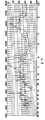
- Figure 6 shows a significant portion of the prechordial electrocardiogram determined on rabbits under various conditions.
- Graph A 1 relates to a control
- graph A 2 relates to a rabbit treated with 4 mg/kg of BaCl 2 in which the arrhythmia rapidly appears, to stabilise in a bigeminal pulse rhythm
- graph B 1 shows the electrocardiogram for the same rabbit returned to normal after administering 4 mg/kg of lidocaine hydrochloride.
- the electrocardiogram remained as shown in B 1 until the seventh minute, after which the arrhythmia reappeared as shown by graph B 2 .
- the arrhythmia still exists after 10 min. (C 1 ), treatment with lidocaine salicylate immediately halting the arrhythmia to return to a normal electrocardiogram (C 2 ) for 15 min. After 15 min., the arrhythmia reappears (C 3 ).
- the arrhythmia is still present after 22 min. (D 1 ) and a further treatment with 4 mg/kg of lidocaine hydrochloride re-establishes normal rhythm (D 2 ). This antiarrhythmic effect lasts only for 4 min., after which the arrhythmia reappears (D 3 ).
- lidocaine salicylate has an immediate antiarrhythmic effect, as has lidocaine, but this effect is produced at about half the dose of this latter, and thus with a much smaller quantity.
- An extremely important factor is also the fact that the antiarrhythmic effect lasts for at least 15 min., and sometimes completely disappears, in comparison to a maximum duration of action of 7 min. obtained with lidocaine.
- lidocaine salicylate was also examined by reference to the cardiodepressing effect.
- the antiarrhythmic effect is often accompanied in drugs by a cardiodepressing action which makes them dangerous or practically unusable.
- the contractile force was determined on ventricular guinea-pig strips by means of preparations electrically guided at a frequency of 2.5 Hz, and a determination was also made of the refractory period in the atrial function on isolated guinea-pig atria and the ventricular functional refractory period on right ventricular guinea-pig strips (coupled stimulation method of Govier W.C., J.Pharma- col.Exp.Ther., 148, 100-105, 1965) 15 minutes after the introduction of the drug.
- the cardiodepression becomes apparent at molar concentrations of 10 -5 to 10 -4 , i.e. at concentrations of about 10 times greater than those which are reached in the blood on administering 2-4 mg/kg of the drug, i.e. on administering the therapeutic dose of the drug.
- the new compound (I) has a safety factor greater than 10.
- the DL 50 for lidocaine salicylate is given in the following table, in comparison with the DL 50 for lidocaine hydrochloride.
- lidocaine salicylate is, completely unexpectedly, considerably less than that of lidocaine hydrochloride. Moreover, considering that the effective average doses are 4 mg/kg for L.C. and 3 mg/kg for L.S., a much more favourable therapeutic index is obtained for the new compound.
- lidocaine salicylate proves completely unexpectedly to be a powerful local anesthetic and cardiac anti arrhythmic agent, the activities of which do not derive from the sum of the inherent activities of lidocaine and of the salicylate ion.
- this is more intense and, in particular, of greater duration than that of the normal lidocaine salts, so allowing a complete and often definitive reversion of a serious ventricular arrhythmia by the intravenous administration of a single dose.
- lidocaine salicylate is preferably used clinically diluted with water or fats at a concentration of 0.1-10%.
- lidocaine salicylate When used clinically as a cardiac antiarrhythmic agent, lidocaine salicylate is preferably injected intravenously diluted with water in doses of 0.1-10%.
Landscapes
- Organic Chemistry (AREA)
- Chemical & Material Sciences (AREA)
- Health & Medical Sciences (AREA)
- Medicinal Chemistry (AREA)
- General Chemical & Material Sciences (AREA)
- Veterinary Medicine (AREA)
- Chemical Kinetics & Catalysis (AREA)
- Life Sciences & Earth Sciences (AREA)
- Pharmacology & Pharmacy (AREA)
- Nuclear Medicine, Radiotherapy & Molecular Imaging (AREA)
- Engineering & Computer Science (AREA)
- Bioinformatics & Cheminformatics (AREA)
- Public Health (AREA)
- Animal Behavior & Ethology (AREA)
- General Health & Medical Sciences (AREA)
- Heart & Thoracic Surgery (AREA)
- Cardiology (AREA)
- Biomedical Technology (AREA)
- Neurology (AREA)
- Neurosurgery (AREA)
- Acyclic And Carbocyclic Compounds In Medicinal Compositions (AREA)
- Pharmaceuticals Containing Other Organic And Inorganic Compounds (AREA)
- Organic Low-Molecular-Weight Compounds And Preparation Thereof (AREA)
Priority Applications (1)
| Application Number | Priority Date | Filing Date | Title |
|---|---|---|---|
| AT81830136T ATE4589T1 (de) | 1980-08-08 | 1981-07-29 | Lidocain-derivate und diese als wirksamen grundstoff enthaltende therapeutische zusammensetzungen. |
Applications Claiming Priority (2)
| Application Number | Priority Date | Filing Date | Title |
|---|---|---|---|
| IT8024104A IT1209253B (it) | 1980-08-08 | 1980-08-08 | Derivato della lidocaina e composizioni terapeutiche che lo contengono come principio attivo. |
| IT2410480 | 1980-08-08 |
Publications (2)
| Publication Number | Publication Date |
|---|---|
| EP0046143A1 true EP0046143A1 (de) | 1982-02-17 |
| EP0046143B1 EP0046143B1 (de) | 1983-09-07 |
Family
ID=11211990
Family Applications (1)
| Application Number | Title | Priority Date | Filing Date |
|---|---|---|---|
| EP81830136A Expired EP0046143B1 (de) | 1980-08-08 | 1981-07-29 | Lidocain-Derivate und diese als wirksamen Grundstoff enthaltende therapeutische Zusammensetzungen |
Country Status (10)
| Country | Link |
|---|---|
| US (1) | US4891386A (de) |
| EP (1) | EP0046143B1 (de) |
| JP (1) | JPS5775949A (de) |
| AT (1) | ATE4589T1 (de) |
| CA (1) | CA1170272A (de) |
| DE (1) | DE3160851D1 (de) |
| DK (1) | DK149884C (de) |
| ES (1) | ES504647A0 (de) |
| IE (1) | IE51485B1 (de) |
| IT (1) | IT1209253B (de) |
Families Citing this family (5)
| Publication number | Priority date | Publication date | Assignee | Title |
|---|---|---|---|---|
| US5776859A (en) * | 1995-11-15 | 1998-07-07 | Nickel; Alfred A. | Sodium channel active novel compounds and related processes and bioassay techniques |
| EP0838225A3 (de) * | 1996-10-25 | 1999-03-24 | Hiji, Yasutake | Wässrige Lösung eines Lokalanästheticum |
| RU2203267C1 (ru) * | 2001-10-10 | 2003-04-27 | Ананьев Евгений Николаевич | КРИСТАЛЛИЧЕСКАЯ γ-МОДИФИКАЦИЯ ГИДРОХЛОРИДА 2-ДИМЕТИЛАМИНОЭТИЛОВОГО ЭФИРА П-БУТИЛАМИНОБЕНЗОЙНОЙ КИСЛОТЫ В КАЧЕСТВЕ МЕСТНОАНЕСТЕЗИРУЮЩЕГО СРЕДСТВА И СПОСОБ ЕЕ ПОЛУЧЕНИЯ |
| US20040076671A1 (en) * | 2002-10-21 | 2004-04-22 | Aletha Tippett | Methods and compositions for topical wound treatment |
| WO2010078300A1 (en) * | 2008-12-29 | 2010-07-08 | The Board Of Trustees Of The University Of Alabama | Dual functioning ionic liquids and salts thereof |
Family Cites Families (4)
| Publication number | Priority date | Publication date | Assignee | Title |
|---|---|---|---|---|
| US2382546A (en) * | 1941-11-03 | 1945-08-14 | Curtis David | Anesthetic solutions |
| US2441498A (en) * | 1943-07-15 | 1948-05-11 | Astra Apotekarnes Kem Fab | Alkyl glycinanilides |
| GB1387630A (en) * | 1971-05-07 | 1975-03-19 | Ici Ltd | Phenoxyalkanolamine derivatives |
| US4237068A (en) * | 1971-07-28 | 1980-12-02 | Astra Pharmaceutical Products, Inc. | Primary aminoacylanilides |
-
1980
- 1980-08-08 IT IT8024104A patent/IT1209253B/it active
-
1981
- 1981-07-29 DE DE8181830136T patent/DE3160851D1/de not_active Expired
- 1981-07-29 EP EP81830136A patent/EP0046143B1/de not_active Expired
- 1981-07-29 AT AT81830136T patent/ATE4589T1/de active
- 1981-08-07 CA CA000383477A patent/CA1170272A/en not_active Expired
- 1981-08-07 JP JP56123180A patent/JPS5775949A/ja active Granted
- 1981-08-07 IE IE1805/81A patent/IE51485B1/en not_active IP Right Cessation
- 1981-08-07 DK DK351081A patent/DK149884C/da active
- 1981-08-07 ES ES504647A patent/ES504647A0/es active Granted
-
1984
- 1984-09-17 US US06/651,651 patent/US4891386A/en not_active Expired - Fee Related
Non-Patent Citations (3)
| Title |
|---|
| Chemical Abstracts, Vol. 78, No. 11, 19 March 1973, page 30, abstract nr. 67010g, Columbus, Ohio, US, H. Fujimura et al.: "Analgesic and antiinflammotry effects of vipratox (Methyl salicylate-camphor-snake venom-embrocation)", & Oyo Yakuri, 1972, 6 (4), 821-30. * |
| Chemical Abstracts, Vol. 86, Nr. 4, 24 January 1977, page 339, abstract nr. 21795d, Columbus, Ohio, US, & JP-A-51 095 117 (Nakano, Naomi) 20.08.1976. * |
| Unlisted Drugs, Vol. 26, Nr. 10, October 1974, page 154. * |
Also Published As
| Publication number | Publication date |
|---|---|
| ES8204980A1 (es) | 1982-06-01 |
| US4891386A (en) | 1990-01-02 |
| IT8024104A0 (it) | 1980-08-08 |
| IE51485B1 (en) | 1987-01-07 |
| JPS5775949A (en) | 1982-05-12 |
| DE3160851D1 (en) | 1983-10-13 |
| IT1209253B (it) | 1989-07-16 |
| DK149884B (da) | 1986-10-20 |
| ATE4589T1 (de) | 1983-09-15 |
| IE811805L (en) | 1982-02-08 |
| EP0046143B1 (de) | 1983-09-07 |
| DK351081A (da) | 1982-02-09 |
| DK149884C (da) | 1987-04-21 |
| JPH0231064B2 (de) | 1990-07-11 |
| CA1170272A (en) | 1984-07-03 |
| ES504647A0 (es) | 1982-06-01 |
Similar Documents
| Publication | Publication Date | Title |
|---|---|---|
| DE3783988T2 (de) | Zyklische enolderivate, herstellung und anwendung. | |
| KR100275603B1 (ko) | 아미노-치환된 벤조일구아니딘, 이의 제조방법 및 이를 함유하는 약제학적 조성물 | |
| DE4321306A1 (de) | Disulfide | |
| US3987177A (en) | Vincaminic acid esters | |
| EP0541802B1 (de) | Diphenylpiperazinderivat | |
| EP0046143B1 (de) | Lidocain-Derivate und diese als wirksamen Grundstoff enthaltende therapeutische Zusammensetzungen | |
| US4859707A (en) | Sulfur-substituted phenylacetamides | |
| US5470852A (en) | Tetrahydroprotoberberine quaternary ammonium compounds useful in for treating arrhythmia | |
| US4451485A (en) | Treatment of cardio-vascular diseases with 3-(2,2,2-trimethylhydrazinium) propionate dihydrate | |
| US5194445A (en) | Ascorbic acid derivative | |
| US4329290A (en) | Antithrombotic derivatives of ammonium ascorbate | |
| Librowski et al. | Comparative investigations of hydroxyamine carane derivative and its R, S-diastereoisomers with strong local anesthetic activity | |
| US4164585A (en) | Anti-thrombotic compound and method of making and using the same for pharmaceutical purposes | |
| US4148898A (en) | N-oxy-ajmaline and the use thereof in treating cardiovascular disorders | |
| RU2180583C1 (ru) | Лекарственный препарат для лечения различных форм нарушения ритма сердца | |
| US4590209A (en) | Alkoxy-acyl carnitines and pharmaceutical compositions containing same | |
| SU1766910A1 (ru) | Литиева соль N- @ -изобутоксибензоил- @ -аминомасл ной кислоты, обладающа активностью улучшать микроциркул цию мозга | |
| US4146628A (en) | Antiarrhythmic quinuclidine carboxylic acid xylidide and method of producing the same and similar compounds | |
| DE2014201C3 (de) | Hydrochlorid des 10-(beta-morpholinopropionyl)-phenothiazin-2-carbamin-saeureaethylesters, verfahren zu dessen herstellung und pharmazeutisches mittel | |
| CA1107734A (en) | Antiarrhythmic quinuclidine carboxylic acid xylidide and method of producing the same and similar compounds | |
| US4704403A (en) | 3-(2,2,2-trisubstituted hydrazinium) propionates | |
| US4758560A (en) | Phenyl-(3-hexamethyleneiminopropyl)-ketone | |
| SU1287751A3 (ru) | Способ получени производных индолизина или их фармацевтически-приемлемых солей с кислотой | |
| CA1290347C (en) | Diamine derivatives | |
| GB1569380A (en) | Pharmaceutical compositions comprising substituted phenyl-amino-alcohol and process for preparing these compositions |
Legal Events
| Date | Code | Title | Description |
|---|---|---|---|
| PUAI | Public reference made under article 153(3) epc to a published international application that has entered the european phase |
Free format text: ORIGINAL CODE: 0009012 |
|
| AK | Designated contracting states |
Designated state(s): AT BE CH DE FR GB LU NL SE |
|
| 17P | Request for examination filed |
Effective date: 19820701 |
|
| GRAA | (expected) grant |
Free format text: ORIGINAL CODE: 0009210 |
|
| AK | Designated contracting states |
Designated state(s): AT BE CH DE FR GB LI LU NL SE |
|
| REF | Corresponds to: |
Ref document number: 4589 Country of ref document: AT Date of ref document: 19830915 Kind code of ref document: T |
|
| REF | Corresponds to: |
Ref document number: 3160851 Country of ref document: DE Date of ref document: 19831013 |
|
| ET | Fr: translation filed | ||
| ET1 | Fr: translation filed ** revision of the translation of the patent or the claims | ||
| NLXE | Nl: other communications concerning ep-patents (part 3 heading xe) |
Free format text: ON 19 OCTOBER, 1983, NEW PAGES 1 AND 15 OF THE TRANSLATION HAVE BEEN RECEIVED |
|
| PLBE | No opposition filed within time limit |
Free format text: ORIGINAL CODE: 0009261 |
|
| STAA | Information on the status of an ep patent application or granted ep patent |
Free format text: STATUS: NO OPPOSITION FILED WITHIN TIME LIMIT |
|
| 26N | No opposition filed | ||
| EPTA | Lu: last paid annual fee | ||
| EAL | Se: european patent in force in sweden |
Ref document number: 81830136.8 |
|
| PGFP | Annual fee paid to national office [announced via postgrant information from national office to epo] |
Ref country code: CH Payment date: 20000607 Year of fee payment: 20 |
|
| PGFP | Annual fee paid to national office [announced via postgrant information from national office to epo] |
Ref country code: SE Payment date: 20000616 Year of fee payment: 20 |
|
| PGFP | Annual fee paid to national office [announced via postgrant information from national office to epo] |
Ref country code: NL Payment date: 20000619 Year of fee payment: 20 Ref country code: FR Payment date: 20000619 Year of fee payment: 20 |
|
| PGFP | Annual fee paid to national office [announced via postgrant information from national office to epo] |
Ref country code: LU Payment date: 20000627 Year of fee payment: 20 Ref country code: GB Payment date: 20000627 Year of fee payment: 20 |
|
| PGFP | Annual fee paid to national office [announced via postgrant information from national office to epo] |
Ref country code: AT Payment date: 20000628 Year of fee payment: 20 |
|
| PGFP | Annual fee paid to national office [announced via postgrant information from national office to epo] |
Ref country code: DE Payment date: 20000703 Year of fee payment: 20 |
|
| PGFP | Annual fee paid to national office [announced via postgrant information from national office to epo] |
Ref country code: BE Payment date: 20000704 Year of fee payment: 20 |
|
| BE20 | Be: patent expired |
Free format text: 20010729 *MOLTENI & C. DEI F.LLI ALITTI S.P.A. |
|
| PG25 | Lapsed in a contracting state [announced via postgrant information from national office to epo] |
Ref country code: LI Free format text: LAPSE BECAUSE OF EXPIRATION OF PROTECTION Effective date: 20010728 Ref country code: GB Free format text: LAPSE BECAUSE OF EXPIRATION OF PROTECTION Effective date: 20010728 Ref country code: CH Free format text: LAPSE BECAUSE OF EXPIRATION OF PROTECTION Effective date: 20010728 |
|
| PG25 | Lapsed in a contracting state [announced via postgrant information from national office to epo] |
Ref country code: NL Free format text: LAPSE BECAUSE OF EXPIRATION OF PROTECTION Effective date: 20010729 Ref country code: LU Free format text: LAPSE BECAUSE OF EXPIRATION OF PROTECTION Effective date: 20010729 Ref country code: AT Free format text: LAPSE BECAUSE OF EXPIRATION OF PROTECTION Effective date: 20010729 |
|
| PG25 | Lapsed in a contracting state [announced via postgrant information from national office to epo] |
Ref country code: SE Free format text: THE PATENT HAS BEEN ANNULLED BY A DECISION OF A NATIONAL AUTHORITY Effective date: 20010730 |
|
| REG | Reference to a national code |
Ref country code: GB Ref legal event code: PE20 Effective date: 20010728 |
|
| REG | Reference to a national code |
Ref country code: CH Ref legal event code: PL |
|
| EUG | Se: european patent has lapsed |
Ref document number: 81830136.8 |
|
| NLV7 | Nl: ceased due to reaching the maximum lifetime of a patent |
Effective date: 20010729 |