EP0046230A2 - Umhüllte pyrotechnische Nebelsatz- oder Brandsatz-Ladung, ihre Zusammensetzung sowie Verfahren zu ihrer Herstellung - Google Patents
Umhüllte pyrotechnische Nebelsatz- oder Brandsatz-Ladung, ihre Zusammensetzung sowie Verfahren zu ihrer Herstellung Download PDFInfo
- Publication number
- EP0046230A2 EP0046230A2 EP81106031A EP81106031A EP0046230A2 EP 0046230 A2 EP0046230 A2 EP 0046230A2 EP 81106031 A EP81106031 A EP 81106031A EP 81106031 A EP81106031 A EP 81106031A EP 0046230 A2 EP0046230 A2 EP 0046230A2
- Authority
- EP
- European Patent Office
- Prior art keywords
- charge
- pyrotechnic charge
- pyrotechnic
- ignition
- binder
- Prior art date
- Legal status (The legal status is an assumption and is not a legal conclusion. Google has not performed a legal analysis and makes no representation as to the accuracy of the status listed.)
- Granted
Links
Images


Classifications
-
- C—CHEMISTRY; METALLURGY
- C06—EXPLOSIVES; MATCHES
- C06D—MEANS FOR GENERATING SMOKE OR MIST; GAS-ATTACK COMPOSITIONS; GENERATION OF GAS FOR BLASTING OR PROPULSION (CHEMICAL PART)
- C06D3/00—Generation of smoke or mist (chemical part)
-
- C—CHEMISTRY; METALLURGY
- C06—EXPLOSIVES; MATCHES
- C06B—EXPLOSIVES OR THERMIC COMPOSITIONS; MANUFACTURE THEREOF; USE OF SINGLE SUBSTANCES AS EXPLOSIVES
- C06B33/00—Compositions containing particulate metal, alloy, boron, silicon, selenium or tellurium with at least one oxygen supplying material which is either a metal oxide or a salt, organic or inorganic, capable of yielding a metal oxide
-
- F—MECHANICAL ENGINEERING; LIGHTING; HEATING; WEAPONS; BLASTING
- F42—AMMUNITION; BLASTING
- F42B—EXPLOSIVE CHARGES, e.g. FOR BLASTING, FIREWORKS, AMMUNITION
- F42B12/00—Projectiles, missiles or mines characterised by the warhead, the intended effect, or the material
- F42B12/02—Projectiles, missiles or mines characterised by the warhead, the intended effect, or the material characterised by the warhead or the intended effect
- F42B12/36—Projectiles, missiles or mines characterised by the warhead, the intended effect, or the material characterised by the warhead or the intended effect for dispensing materials; for producing chemical or physical reaction; for signalling ; for transmitting information
- F42B12/44—Projectiles, missiles or mines characterised by the warhead, the intended effect, or the material characterised by the warhead or the intended effect for dispensing materials; for producing chemical or physical reaction; for signalling ; for transmitting information of incendiary type
-
- F—MECHANICAL ENGINEERING; LIGHTING; HEATING; WEAPONS; BLASTING
- F42—AMMUNITION; BLASTING
- F42B—EXPLOSIVE CHARGES, e.g. FOR BLASTING, FIREWORKS, AMMUNITION
- F42B12/00—Projectiles, missiles or mines characterised by the warhead, the intended effect, or the material
- F42B12/02—Projectiles, missiles or mines characterised by the warhead, the intended effect, or the material characterised by the warhead or the intended effect
- F42B12/36—Projectiles, missiles or mines characterised by the warhead, the intended effect, or the material characterised by the warhead or the intended effect for dispensing materials; for producing chemical or physical reaction; for signalling ; for transmitting information
- F42B12/46—Projectiles, missiles or mines characterised by the warhead, the intended effect, or the material characterised by the warhead or the intended effect for dispensing materials; for producing chemical or physical reaction; for signalling ; for transmitting information for dispensing gases, vapours, powders or chemically-reactive substances
- F42B12/48—Projectiles, missiles or mines characterised by the warhead, the intended effect, or the material characterised by the warhead or the intended effect for dispensing materials; for producing chemical or physical reaction; for signalling ; for transmitting information for dispensing gases, vapours, powders or chemically-reactive substances smoke-producing, e.g. infrared clouds
-
- F—MECHANICAL ENGINEERING; LIGHTING; HEATING; WEAPONS; BLASTING
- F42—AMMUNITION; BLASTING
- F42B—EXPLOSIVE CHARGES, e.g. FOR BLASTING, FIREWORKS, AMMUNITION
- F42B12/00—Projectiles, missiles or mines characterised by the warhead, the intended effect, or the material
- F42B12/72—Projectiles, missiles or mines characterised by the warhead, the intended effect, or the material characterised by the material
- F42B12/76—Projectiles, missiles or mines characterised by the warhead, the intended effect, or the material characterised by the material of the casing
Definitions
- the invention relates to a pyrotechnic charge as a smoke or as a fire in the form of individual pressed bodies arranged in a casing, optionally with an ignition charge, and a process for their production.
- mist-producing substances or mixtures of substances and devices which fire them into or over a target area are known.
- the mist mixtures are usually shaped and pressed into compacts, stacked in a metal sleeve and, if ignited, are ejected from the sleeve opening, if necessary using an igniter, and are distributed conically like a shot.
- the individual segments are designed in such a way that they are partially destroyed into small particles by the pressure load that occurs during ignition.
- the shell usually made of metal, from which the smoke or incendiary devices are ejected at a certain height, then falls undamaged as a part to the ground and can also cause considerable injuries under unfavorable circumstances.
- Another disadvantage of the known charges used as a mist set comes from the composition of the mist mixtures. These often react acidic or develop phosphorus pentoxide, which is converted to phosphoric acid in the air, cause breathing difficulties and coughing or attack internal organs. Such disadvantages are particularly undesirable when one thinks of the use of fog loads in wine-growing areas to prevent frost or when used for exercise and maneuvering purposes.
- DE-AS 24 51 701 describes a smoke or mist set that contains an organic chlorine donor, metal powder and / or metal oxide.
- the known mist set contains at least one of the high molecular weight chlorine donors chloroparaffin, chlorinated polyphenylene, chlorinated polyphenoxy resin and polyester from tetrachlorophthalic acid with chlorinated polyalcohol as a binder.
- smoke and mist sets consist of a mixture of hexachloroethane with metal powder, such as zinc, aluminum, titanium, magnesium and iron.
- Usual igniter sets for fire or smoke sets contain magnesium powder, black powder flour and a binding agent as main components. They have the disadvantage that they do not ignite under clearly defined conditions and, moreover, are only mechanically resilient.
- Another set of fog is known from DE-OS 27 43 363. It contains zinc oxide, ammonium perchlorate, polychloroisoprene as well as a plasticizer and ammonium chloride for buffering. This mist set also has the disadvantage that carcinogenic combustion products are formed when it burns. Furthermore, the process for its production is very complex, since it has to be cast and provided with two coatings for stabilization and protection against external influences.
- the object of the invention is to provide a pyrotechnic charge as a smoke or as a fire in the form of individual moldings arranged in a casing, which is simple and inexpensive to manufacture and enables a better distribution of the ignited smoke or incendiary charges.
- Another object of the invention is to provide a new mixture of a fog, fire and primer, and methods for their production, which is improved over the prior art.
- the object is achieved by a pyrotechnic charge as a fog or as a fire in the form of individual compacts arranged in a casing, in that the casing for the pressed body consists of plastic or light metal provided with predetermined breaking points.
- Such a cover easily hides after ignition and therefore ensures a better distribution of the fog or incendiary charges, in addition, only small parts of the cover remain, so that there is no risk of injury.
- the pressing bodies are preferably provided with cutouts and arranged one above the other in the form of a layer. This configuration of the pressed body ensures that it is better disassembled and thus also better space distribution is achieved.
- the recesses of all the pressing bodies form a continuous channel in which igniting charges are arranged to fill the space. This eliminates the need for an additional ignition tube and prevents friction between the individual compacts.
- Preferred pyrotechnic charges as a mist set are claims 4 to 7, a process for their preparation from claim 8.
- a preferred pyrotechnic charge is set as a fire and in claim 10, an advantageous method for its production.
- Claims 11 to 16 preferably represent ignition charges to be used for the pyrotechnic charges according to the invention, claim 17 represents an advantageous method for their production.
- a pyrotechnic charge as a smoke or fire charge is arranged in a preferably cylindrical shell 1.
- the envelope 1 (FIG. 1) is provided with longitudinal and / or transverse breaking points 2. These can be produced as notches or fracture lines on the inside of the casing 1 or in the form of material dilutions.
- the sleeve 1 is made of a plastic, but can also be made of a light metal, such as Made of aluminum or light metal alloys.
- the mist or incendiary mixtures are stacked on top of one another as disk-shaped pressing bodies 3.
- the outside diameter and the shape of the disk-shaped pressing bodies correspond to the inside diameter and the shape of the casing 1.
- the pressing bodies 3 have recesses 4, which are preferably arranged axially symmetrically and enclose the central area. 1 and 2 cross-shaped recesses 4 are shown, but they can also be star-shaped with any number of points or rounded in a leaf shape or as a simple rectangular slot.
- the disk-shaped pressing bodies are easy to manufacture and just as easy to insert into the casing.
- the ignition charge compression bodies 7 burn, ignite the compression bodies 3 of the fog or incendiary charge, which burst at the predetermined breaking points 5 given by the recesses 4, whereupon the casing 1 at the predetermined breaking points 2 arranged there due to the increasing internal pressure bursts.
- the individual parts of the press body 3 of the mist or incendiary device are further broken down and distributed in all directions.
- the three components of primer, mist or incendiary and casing therefore work together optimally in that the ignition and pressure build up occur at the same time.
- the individual parts are distributed over a definable field, e.g. a homogeneous fog is created.
- the fog or the fire segments are quickly and permanently generated.
- the fog or fire time can be determined by varying the thickness of the pressed body and, in particular, by varying its composition, with different burn-off times being achieved will control.
- mist set that has the following composition in% by weight:
- Preferred binders are an elastomer or a rubber-based polymer.
- compositions of fog sentences have the following composition in% by weight:
- the mist mixtures are produced in the form of compacts in that the components are mixed with one another with a solvent-containing binder, dried, comminuted with a friction shredder and subsequently pressed to form compacts using a pressure of 500 to 1500 bar.
- This process produces particularly stable compacts, which have a high mechanical strength and do not burst into small parts.
- the high mechanical stability of the pressed body can be attributed to several factors. It results from the mixture of the individual components, from the completely irregular shape of the particles and their compression under pressure.
- the bodies can be made in different sizes up to at least 155 caliber.
- the firing time can be controlled by varying the thickness of the pressed body.
- a batch of 2.2 kg of PVC powder, 3.3 kg of zinc oxide (dried), 2.2 kg of ammonium chloride and 2.64 kg of thiourea is pressed through a sieve with a mesh size of 0.3 to 0.55 mm and then intensely mixed.
- the batch is then introduced into a kneading machine and pasted for 15 minutes with 2.4 kg (based on the solid portion, i.e. without solvent portion) of a highly viscous elastomer binder.
- ammonium perchlorate processed in the same sieving process is added in an amount of 7.26 kg. This mixture is kneaded for a further 15 minutes, then spread out on trays and subsequently dried at a temperature of 45 ° C. for 6 hours.
- the dry matter obtained is then comminuted in a grating machine and finally under a pressure of about 1000 bar pressed into compacts.
- a pyrotechnic charge as a fire set has the following composition in% by weight:
- the preparation takes place in such a way that the substances mentioned are introduced into a mixer without a binder and mixed with the binder, preferably an elastomer binder, and then granulated.
- the finished granulate is dried on drying trays for 5 hours and then pressed into shaped articles.
- the ignition kits for pyrotechnic charges which contain magnesium powder, black powder flour, an oxygen donor and a binder, have a magnesium powder with a grain size of less than 100 ⁇ m, preferably less than 60 ⁇ m and additionally amorphous boron, in order to obtain precise, defined and constant ignition conditions.
- a catalyst preferably in the form of an iron (II) iron (III) complex, in particular iron blue, can additionally be provided to accelerate the burning off.
- Solid chlorinated paraffin serves as a binder.
- Ignition charges according to the invention have the following composition in% by weight:
- a preferred composition has, in% by weight:
- the components of the primer are mixed in a solvent, dried, granulated and then pressed into shaped articles using a pressure of 500 to 4000 bar
- the primers according to the invention are characterized by precise and constant ignition processes and a high mechanical strength.
Landscapes
- Engineering & Computer Science (AREA)
- Chemical & Material Sciences (AREA)
- Combustion & Propulsion (AREA)
- General Engineering & Computer Science (AREA)
- Organic Chemistry (AREA)
- Thermal Sciences (AREA)
- Metallurgy (AREA)
- Physics & Mathematics (AREA)
- Materials Engineering (AREA)
- Life Sciences & Earth Sciences (AREA)
- Botany (AREA)
- Pest Control & Pesticides (AREA)
- Plant Pathology (AREA)
- Air Bags (AREA)
- Powder Metallurgy (AREA)
- Feeding, Discharge, Calcimining, Fusing, And Gas-Generation Devices (AREA)
- Casting Or Compression Moulding Of Plastics Or The Like (AREA)
- Disintegrating Or Milling (AREA)
Abstract
Description
- Die Erfindung betrifft eine pyrotechnische Ladung als Nebel- oder als Brandsatz in Form von in einer Hülle angeordneten einzelnen Preßkörpern, gegebenenfalls mit einem Anzündsatz,und Verfahren zu ihrer Herstellung.
- Es sind zahlreiche Arten von nebelerzeugenden Stoffen oder Stoffgemischen sowie Vorrichtungen, welche sie in ein oder über ein Zielgebiet verschießen, bekannt. üblicherweise werden die Nebelmischungen geformt und zu Preßkörpern verpreßt, in einer Metallhülse gestapelt und bei Zündung gegebenenfalls unter Verwendung eines Anzündsatzes aus der Hülsenöffnung ausgestoßen, wobei sie sich wie ein Schrotschuß kegelförmig verteilen.
- Aus der DE-OS 19 13 790 ist eine Vorrichtung zur Erzeugung einer künstlichen Nebeldecke bekannt, in welcher die Preßkörper in einer berstsicheren Hülle um ein Zündrohr gestapelt sind. Diese Vorrichtung weist erhebliche Nachteile auf. So wird der Raum in der Hülle durch die in ihr gestapelten segmentierten Preßkörper nicht optimal genutzt. Vielmehr liegen Hohlräume vor, welche die Ladungsdichte vermindern. Außerdem entsteht insbesondere bei der Herstellung und beim Transport durch Abrieb an den Grenzflächen der Preßkörper ein erhöhter Staubanteil im Nebelsatz, der die Wirkung herabsetzende Materialverluste bewirkt. Schließlich ist auch der fertigungstechnische Aufwand sowohl zur Herstellung der segmentierten Preßkörper, als auch zu deren Einfügung in eine Ladungshülle unter Verwendung eines Zündrohres erheblich.
- Entsprechend aufgebaut sind bekannteBrandsätze.
- Weitere Nachteile derartiger bekannter pyrotechnischer Ladungen resultieren aus dem Ausstoßprinzip. Da der Ausstoß der Preßkörper nur in einer Richtung erfolgt, ist zwangsläufig eine Begrenzung der Flächenbelegung vorgegeben. Die Flächenbelegung ist damit immer von der Ausstoßhöhe abhängig und kann bei schrotschußartiger Ausstoßung nicht variiert werden, was insbesondere bei Nebelsätzen nachteilig ist, aber auch bei Brandsätzen von Bedeutung sein kann.
- Ferner entsteht durch den Ausstoß in einer Richtung aufgrund der Reibung der Preßkörper entlang der Hülle ein weiterer Materialverlust. Außerdem sind die Einzelsegmente derart beschaffen, daß sie durch die bei der Zündung auftretende Druckbelastung teilweise zu kleinen Partikeln zerstört werden.
- Ein weiterer Nachteil der bekannten Ladungen liegt in der zentralen Anordnung eines zusätzliche Kosten erzeugenden Siebrohres als Zündrohr, wodurch ein unmittelbarer Kontakt zwischen Anzündsäule und Nebelkörpern nicht gegeben ist.
- Die meist aus Metall bestehende Hülle, aus welcher die Nebel- oder Brandsätze in einer bestimmten Höhe ausgestoßen werden, fällt anschließend unzerstört als ein Teil zu Boden und kann unter ungünstigen Umständen auch erhebliche Verletzungen hervorrufen.
- Ein weiterer Nachteil der bekannten, als Nebelsatz verwendeten Ladungen rührt von der Zusammensetzung der Nebelmischungen her. Diese reagieren häufig sauer bzw. entwickeln Phosphorpentoxid, welches an der Luft zu Phosphorsäure umgesetzt wird, rufen Atembeschwerden und Hustenreiz hervor oder greifen innere Organe an. Derartige Nachteile sind besonders unerwünscht, wenn man an die Verwendung von Nebelladungen in Weinanbaugebieten zur Frostverhinderung oder bei Anwendung zu Ubungs- und Manöverzwecken denkt.
- Bekannt sind auch verschiedene Rauch- und Nebelmischungen. Beispielsweise wird in derDE-AS 24 51 701 ein Rauch- oder Nebelsatz beschrieben, der einen organischen Chlordonator, Metallpulver und/oder Metalloxid enthält. Der bekannte Nebelsatz enthält als Bindemittel mindestens einen der hochmolekularen Chlordonatoren Chlorparaffin, chloriertes Polyphenylen, chloriertes Polyphenoxyharz und Polyester aus Tetrachlorphthalsäure mit chloriertem Polyalkohol.
- Nachteilig bei diesen bekannten Nebelsätzen sind deren Hustenreiz verursachende und in Abhängigkeit von der genauen Zusammensetzung mehr oder weniger toxische Eigenschaften Andere Rauch- und Nebelsätze bestehen aus einer Mischung von Hexachloräthan mit Metallpulver, wie Zink, Aluminium, Titan, Magnesium und Eisen.
- Diese Mischungen weisen den Nachteil auf, daß das Hexachloräthan sehr hydrolyseempfindlich ist und leicht bereits im Herstellungsprozeß mit Wasserdampf oder Feuchtigkeit reagiert. Darüber hinaus sind derartige Mischungen wenig lagerstabil und neigen zu Brennzeitänderungen.
- Übliche Anzündsätze für Brand- oder Nebelsätze weisen als Hauptbestandteile Magnesiumpulver, Schwarzpulvermehl und ein Bindemittel auf. Sie besitzen den Nachteil, daß sie nicht unter eindeutig zu definierenden Bedingungen zünden und darüber hinaus nur gering mechanisch belastbar sind.
- Ein weiterer Nebelsatz ist aus der DE-OS 27 43 363 bekannt. Als Bestandteile weist er Zinkoxid, Ammoniumperchlorat, Polychlorisopren sowie einen Weichmacher und zur Abpufferung Ammoniumchlorid auf. Auch dieser Nebelsatz weist den Nachteil auf, daß beim Abbrennen cancerogene Verbrennungsprodukte entstehen. Ferner ist das Verfahren zu seiner Herstellung sehr aufwendig, da er vergossen und mit zwei Überzügen zur Stabilisierung und zum Schutz gegen äußere Einflüsse versehen werden muß.
- Aufgabe der Erfindung ist es, eine pyrotechnische Ladung als Nebel- oder als Brandsatz in Form von in einer Hülle angeordneten einzelnen Preßkörpern anzugeben, die einfach und billig herstellbar ist und eine bessere Verteilung der gezündeten Nebel- oder Brandsätze ermöglicht.
- Eine weitere Aufgabe der Erfindung ist es, eine gegenüber dem Stand der Technik verbesserte neue Mischung eines Nebel-, Brand- und Zündsatzes sowie Verfahren zu deren Herstellung bereitzustellen.
- Die Aufgabe wird durch eine pyrotechnische Ladung als Nebel- oder als Brandsatz in Form von in einer Hülle angeordneten einzelnen Preßkörpern, dadurch gelöst, daß die Hülle für die Preßkörper aus mit Sollbruchstellen versehenem Kunststoff oder Leichtmetall besteht.
- Eine derartige Hülle verbirst leicht nach der Zündung und sichert daher eine bessere Raumverteilung der Nebel- bzw. Brandsätze, außerdem verbleiben nur kleine Hüllenteile, so daß eine Verletzungsgefahr dadurch nicht gegeben ist.
- Vorzugsweise sind die Preßkörper mit Aussparungen versehen und schichtförmig übereinander angeordnet. Durch diese Ausgestaltung der Preßkörper wird deren bessere Zerlegung gesichert und damit auch eine bessere Raumverteilung erreicht.
- Es ist vorteilhaft, daß die Aussparungen aller Preßkörper einen durchgehenden Kanal bilden, in dem zerlegend wirkende Anzündsätze raumfüllend angeordnet sind. Hierdurch erübrigt sich ein zusätzliches Zündrohr und es wird die Reibung zwischen den einzelnen Preßkörpern ausgeschlossen.
- Bevorzugte pyrotechnische Ladungen als Nebelsatz sind den Ansprüchen 4 bis 7, ein Verfahren zu deren Herstellung dem Anspruch 8 zu entnehmen.
- Im Anspruch 9 ist eine bevorzugte pyrotechnische Ladung als Brandsatz und in Anspruch 10 ein vorteilhaftes Verfahren zu deren Herstellung angegeben.
- Die Ansprüche 11 bis 16 geben vorzugsweise für die erfindungsgemäßen pyrotechnischen Ladungen zu verwendende Anzündsätze wieder, Anspruch 17 gibt ein vorteilhaftes Verfahren zu deren Herstellung wieder.
- Nachstehend wird die Erfindung anhand von Ausführungsbeispielen unter Bezug auf Zeichnungen näher erläutert. Es zeigt:
- Fig. 1 eine pyrotechnische Ladung aus Preßkörpern mit Anzündsatz in einer Hülle,
- Fig. 2a einen Preßkörper in perspektivischer Darstellung,
- Fig. 2b-d die Zerlegung eines Preßkörpers nach dem Zünden des Zündsatzes in Draufsicht.
- Eine pyrotechnische Ladung als Nebel- oder Brandsatz ist in einer vorzugsweise zylindrischen Hülle 1 angeördnet. Die Hülle 1 (Fig. 1) ist mit Längs- und/oder Quersollbruchstellen 2 versehen. Diese können als an der Innenseite der Hülle 1 ausgeführte Kerben oder Bruchlinien oder in Form von Materialverdünnungen hergestellt sein. Die Hülle 1 besteht aus einem Kunststoff, kann aber auch aus einem Leichtmetall, wie z.B. Aluminium oder aus Leichtmetall-Legierungen bestehen.
- In der Hülle 1 sind die Nebel- oder Brandsatzmischungen als scheibenförmige Preßkörper 3 aufeinandergestapelt angeordnet. Der Außendurchmesser und die Gestalt der scheibenförmigen Preßkörper entspricht dem Innendurchmesser und der Gestalt der Hülle 1. Die Preßkörper 3 weisen Aussparungen 4 auf, die vorzugsweise achssymmetrisch angeordnet und den zentralen Bereich einschließen. In Fig. 1 und 2 sind kreuzförmige Aussparungen 4 dargestellt, sie können aber auch sternförmig mit beliebiger Zackenzahl oder auch blattförmig gerundet oder als einfacher rechteckiger Schlitz ausgeführt sein.
- Die zum Außenrand weisenden Teile der Aussparungen 4 bilden gleichzeitig Sollbruchstellen 5 beim Zerlegen der Preßkörper 3 werden derart mittels eines entfernbaren Zentrierstabes, der die Form der Aussparungen 4 wiedergibt, übereinander geschichtet, daß die Aussparungen 4 einen durchgehenden Kanal 6 bilden. In den Kanal 6 werden anschließend raumfüllende Anzündsatzpreßkörper 7 eingeführt. Durch die Gestalt der Preßkörper 4 wird die Hülle 1 lückenlos gefüllt, wobei ein zentrales Innenzündrohr überflüssig wird. Der gebildete Kanal-6 wird ebenfalls lückenlos mittels der Anzündsatzpreßkörper 7 gefüllt, so daß ein vorzeitiges Verkrümeln der Ladung beim Transport ausgeschlossen ist und ein unmittelbarer Kontakt zwischen Anzündsatz und Nebel- bzw. Brandsatz gegeben ist. Die scheibenförmigen Preßkörper sind leicht herzustellen und ebenso leicht in die Hülle einzubringen.
- Im Zeitpunkt der Zündung der Ladung brennen die Anzündsatzpreßkörper 7 durch, entzünden die Preßkörper 3 des Nebel- bzw. Brandsatzes, die an den durch die Aussparungen 4 vorgegebenen Sollbruchstellen 5 zerbersten, worauf aufgrund des stärker werdenden Innendruckes die Hülle 1 an den dort angeordneten Sollbruchstellen 2 zerbirst. Dadurch werden die Einzelteile der Preßkörper 3 des Nebel- bzw. Brandsatzes weiter zerlegt und in alle Richtungen verteilt. Die drei Komponenten Anzündsatz, Nebel- bzw. Brandsatz und Hülle wirken also auch insofern optimal zusammen, als Anzündung und Druckaufbau zum selben Zeitpunkt eintreten. Je nach vorgegebener und variabler Zerlegungsenergie verteilen sich die Einzelteile über ein definierbares Feld, wobei z.B. ein homogener Nebel erzeugt wird.
- Der Nebel bzw. die Brandsegmente werden schnell und gleichzeitig dauerhaft erzeugt. Die Nebel- bzw. Brandzeit läßt sich durch unterschiedliche Dicke der Preßkörper als auch insbesondere durch Variation ihrer Zusammensetzung, wobei unterschiedliche Abbrandzeiten erreicht werden, steuern.
- Die Nachteile bekannter Nebelmischungen, wie saure Reaktion der Nebelpartikel, Lagerinstabilität und Neigung zu Brennzeitänderungen, werden durch einen Nebelsatz vermieden, der folgende Zusammensetzung in Gew.% aufweist:

- Bevorzugte Bindemittel sind ein Elastomer oder ein Polymerisat auf Kautschukbasis.
- Bevorzugte Zusammensetzungen von Nebelsätzen weisen folgende Zusammensetzung in Gew.% auf:


- Erfindungsgemäß werden die Nebelmischungen in Form von Preßkörpern dadurch hergestellt, daß die Komponenten mit einem lösungsmittelhaltigen Bindemittel miteinander vermischt, getrocknet, mit einem Reibschnitzler zerkleinert und nachfolgend unter Anwendung eines Druckes von 500 bis 1500 bar zu Preßkörpern verpreßt werden. Durch dieses Verfahren werden besonders stabile Preßkörper erzeugt, die eine hohe mechanische Belastbarkeit aufweisen und nicht in kleine Teile zerplatzen. Die hohe mechanische Stabilität der Preßkörper ist auf mehrere Faktoren zurückzuführen. Sie ergibt sich aus dem Gemisch der einzelnen Komponenten, aus der völlig unregelmäßigen Schnitzelform der Teilchen und ihrem Verpressen unter Druck. Die Körper sind in verschiedenen Größen bis zu mindestens 155-er Kaliber herzustellen. Durch die Variation der Stärke der Preßkörper kann die Brennzeit gesteuert werden.
- Nachstehend wird ein konkretes Ausführungsbeispiel der Herstellung von Preßkörpern eines Nebelsatzes angeführt.
- Ein Ansatz von 2,2 kg PVC-Pulver, 3,3 kg Zinkoxid (getrocknet), 2,2 kg Ammoniumchlorid und 2,64 kg Thioharnstoff wird durch ein Sieb mit einer Maschenweite von 0,3 bis 0,55 mm gedrückt und anschließend intensiv vermischt. Sodann wird der Ansatz in eine Knetmaschine eingebracht und mit 2,4 kg (bezogen auf den festen Anteil, d.h. ohne Lösungsmittelanteil) eines hochviskosen Elastomerbinders 15 Minuten angeteigt. Nach Beendigung des Knetvorgangs wird nach demselben Siebverfahren bearbeitetes Ammoniumperchlorat in einer Menge von 7,26 kg zugegeben. Dieser Ansatz wird weitere 15 Minuten geknetet, sodann auf Horden ausgebreitet und nachfolgend 6 Stunden bei einer Temperatur von 45°C getrocknet.
- Anschließend wird die erhaltene Trockenmasse in einer Reibschnitzelmaschine zerkleinert und schließlich unter einem Druck von etwa 1000 bar zu Preßkörpern verpreßt.
- Eine pyrotechnische Ladung als Brandsatz weist folgende Zusammensetzung in Gew.% auf:

- Die Herstellung erfolgt so, daß die genannten Substanzen ohne Bindemittel in einen Mischer eingebracht und mit dem Bindemittel, vorzugsweise einem Elastomerbinder, versetzt und dann granuliert werden. Das fertige Granulat wird 5 Stunden auf Trockenhorden getrocknet und anschließend zu Formkörpern verpreßt.
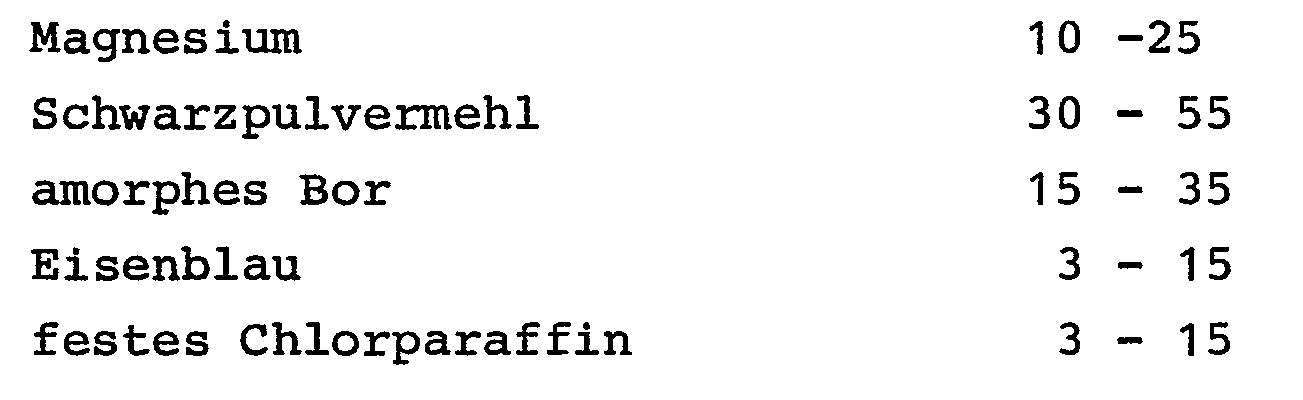
- Die Anzündsätze für pyrotechnische Ladungen, die Magnesiumpulver, Schwarzpulvermehl, einen Sauerstoffdonator und ein Bindemittel enthalten, weisen,um präzise, definierte und konstante Zündbedingungen zu erhalten, ein Magnesiumpulver mit einer Korngröße unter 100 µm, vorzugsweise unter 60 µm und zusätzlich amorphes Bor auf. Zur Beschleunigung des Abbrennens kann zusätzlich ein Katalysator, vorzugsweise in Form eines Eisen(II)-Eisen(III)-Komplexes - insbesondere Eisenblau -vorgesehen sein. Als Bindemittel dient festes Chlorparaffin.
- Erfindungsgemäße Anzündsätze weisen folgende Zusammensetzung in Gew.% auf:

- Eine bevorzugte Zusammensetzung weist in Gew.% auf:

- Die Komponenten des Anzündsatzes werden in einem Lösungsmittel vermischt, getrocknet, granuliert und nachfolgend unter Anwendung eines Preßdruckes von 500 bis 4000 bar zu Formkörpern verpreßt
- Nachstehend wird ein konkretes Ausführungsbeispiel der Herstellung von Preßkörpern eines Anzündsatzes angeführt.
- In einem Mischbehälter werden 1,2 kg Magnesiumpulver und 0,9 kg Eisenblau gut untereinander vermischt. Zu dieser Vormischung gibt man 0,8 kg Chlorparaffin (pulverförmig), welches in 2 Liter Perchloräthylen gelöst wurde. Die Lösung wird mit der Vormischung in einem Mischer 10 Minuten gut vermengt. Danach gibt man 2,39 kg Bor amorph zu und wiederholt den Mischvorgang 5 Minuten. Als letzte Komponente gibt man 4,71 kg Schwarzpulvermehl (auf 2 Komponenten-Basis, d.h. ohne Schwefelzusatz) in das Mischgefäß und läßt nochmals 10 Minuten mischen. Danach wird der lösungsmittelfeuchte Satz durch ein 1,5 mm Sieb gerüttelt und auf Trockenhorden ausgebreitet. Nach einer Trockenzeit von 5 Stunden bei 45°C kann der Satz mit einem Preßdruck von 1500 bar zu Stangen verpreßt werden.
- Die erfindungsgemäßen Zündsätze zeichnen sich durch präzise und konstante Zündvorgänge und eine hohe mechanische Belastbarkeit aus.
Claims (17)
dadurch gekennzeichnet ,
daß die Hülle (1) für die Preßkörper (3) aus mit Sollbruchstellen (2) versehenem Kunststoff oder Leichtmetall besteht.



Priority Applications (1)
| Application Number | Priority Date | Filing Date | Title |
|---|---|---|---|
| AT81106031T ATE17167T1 (de) | 1980-08-20 | 1981-07-31 | Umhuellte pyrotechnische nebelsatz- oder brandsatz-ladung, ihre zusammensetzung sowie verfahren zu ihrer herstellung. |
Applications Claiming Priority (2)
| Application Number | Priority Date | Filing Date | Title |
|---|---|---|---|
| DE3031369 | 1980-08-20 | ||
| DE3031369A DE3031369C2 (de) | 1980-08-20 | 1980-08-20 | Pyrotechnische Ladung aus Nebelsatz und Anzündsatz und Verfahren zur Herstellung der Nebelmischung und des Anzündsatzes |
Publications (3)
| Publication Number | Publication Date |
|---|---|
| EP0046230A2 true EP0046230A2 (de) | 1982-02-24 |
| EP0046230A3 EP0046230A3 (en) | 1982-05-26 |
| EP0046230B1 EP0046230B1 (de) | 1985-12-27 |
Family
ID=6109994
Family Applications (1)
| Application Number | Title | Priority Date | Filing Date |
|---|---|---|---|
| EP81106031A Expired EP0046230B1 (de) | 1980-08-20 | 1981-07-31 | Umhüllte pyrotechnische Nebelsatz- oder Brandsatz-Ladung, ihre Zusammensetzung sowie Verfahren zu ihrer Herstellung |
Country Status (4)
| Country | Link |
|---|---|
| US (1) | US4474715A (de) |
| EP (1) | EP0046230B1 (de) |
| AT (1) | ATE17167T1 (de) |
| DE (2) | DE3031369C2 (de) |
Cited By (7)
| Publication number | Priority date | Publication date | Assignee | Title |
|---|---|---|---|---|
| FR2529318A1 (fr) * | 1982-06-25 | 1983-12-30 | Thomson Brandt | Dispositif de dispersion d'un produit fumigene et projectile comportant un tel dispositif |
| EP0108939A3 (de) * | 1982-10-16 | 1985-07-03 | Pyrotechnische Fabrik F. Feistel GmbH + Co KG | Nebelwurfkörper und Verfahren zur Erzeugung eines gleichzeitig optisch und im Infrarotbereich deckenden Nebels |
| EP0357412A3 (de) * | 1988-09-01 | 1992-03-18 | Astra Holdings Plc | Artikel zur Raucherzeugung |
| EP0780658A2 (de) | 1995-12-22 | 1997-06-25 | Buck Werke GmbH & Co | Schnellnebelhandgranate |
| WO2002001530A3 (en) * | 2000-06-28 | 2002-06-06 | Ici America Inc | Flexible smoke generator |
| DE10065816B4 (de) * | 2000-12-27 | 2009-04-23 | Buck Neue Technologien Gmbh | Munition zur Erzeugung eines Nebels |
| EP3076121A1 (de) * | 2015-04-01 | 2016-10-05 | Diehl BGT Defence GmbH & Co. Kg | Nebelwurfkörper |
Families Citing this family (30)
| Publication number | Priority date | Publication date | Assignee | Title |
|---|---|---|---|---|
| AT376499B (de) * | 1982-08-03 | 1984-11-26 | Oregon Ets Patentverwertung | Geschosshaube fuer sprengstofflose kampfstoffgranaten, insbesondere fuer rauchgranaten |
| DE3407238A1 (de) * | 1984-02-28 | 1985-11-21 | Fraunhofer-Gesellschaft zur Förderung der angewandten Forschung e.V., 8000 München | Vorrichtung zum herstellen von treibladungspulver in strangform |
| DE3421708A1 (de) * | 1984-06-12 | 1985-12-12 | Buck Chemisch-Technische Werke GmbH & Co, 7347 Bad Überkingen | Einrichtung zur erzeugung einer scheinzielwolke, insbesondere einer infrarot-scheinzielwolke |
| JPH0633990B2 (ja) * | 1985-01-11 | 1994-05-02 | 旭エンジニアリング株式会社 | 含水爆薬包及びその製造方法 |
| DE3515166A1 (de) * | 1985-04-26 | 1986-10-30 | Buck Chemisch-Technische Werke GmbH & Co, 7347 Bad Überkingen | Wurfkoerper zur darstellung eines infrarot-flaechenstrahlers |
| NO156224C (no) * | 1985-04-30 | 1987-08-12 | Raufoss Ammunisjonsfabrikker | Roekgranat. |
| US4581998A (en) * | 1985-06-19 | 1986-04-15 | The United States Of America As Represented By The Secretary Of The Army | Programmed-splitting solid propellant grain for improved ballistic performance of guns |
| DE3728380C1 (de) * | 1987-08-26 | 1988-11-24 | Nico Pyrotechnik | Pyrotechnische Mischung zur Erzeugung eines Tarnnebels und Anzuendmischung hierfuer |
| CH674742A5 (de) * | 1987-12-24 | 1990-07-13 | Eidgenoess Munitionsfab Thun | |
| US5591496A (en) * | 1990-11-20 | 1997-01-07 | Linpac Plastics International Limited | Method of manufacturing composite sheet materials |
| NO171750C (no) * | 1991-01-21 | 1993-04-28 | Raufoss As | Anordning ved roeykgranat |
| DE19704070C2 (de) * | 1997-02-04 | 1998-12-24 | Buck Chem Tech Werke | Tarn- und/oder Täuscheinrichtung |
| NL1005529C2 (nl) * | 1997-03-13 | 1998-09-15 | Tno | Samenstelling voor het genereren van rook. |
| SE512205C2 (sv) * | 1998-12-18 | 2000-02-14 | Bofors Ab | Sätt att vid initiering av artilleridrivkrutladdningar bestående av ett flertal efter varandra anordnade drivkrutsmoduler åstadkomma en jämn övertändning mellan dessa samt i enlighet med sättet utformade drivkrutsmoduler och kompletta laddningar |
| DE19914097A1 (de) * | 1999-03-27 | 2000-09-28 | Piepenbrock Pyrotechnik Gmbh | Pyrotechnische Wirkmasse zur Erzeugung eines im Infraroten stark emissiven und im Visuellen undurchdringlichen Aerosols |
| US6817298B1 (en) * | 2000-04-04 | 2004-11-16 | Geotec Inc. | Solid propellant gas generator with adjustable pressure pulse for well optimization |
| US7806999B2 (en) * | 2000-10-26 | 2010-10-05 | Dennis Gordon Verity | Metal and metal oxide granules and forming process |
| DE20020099U1 (de) * | 2000-11-27 | 2001-04-05 | TRW Airbag Systems GmbH & Co. KG, 84544 Aschau | Gasgenerator |
| US6431072B1 (en) * | 2000-11-30 | 2002-08-13 | The United States Of America As Represented By The Secretary Of The Navy | Propellant grain configuration |
| DE10152023B4 (de) * | 2001-10-22 | 2005-06-16 | Buck Neue Technologien Gmbh | Schockunempfindliche Nebelwurfkörper |
| JP3884741B2 (ja) * | 2004-03-15 | 2007-02-21 | 勝義 近藤 | マグネシウム合金顆粒状粉体原料の製造方法 |
| DE102004018862A1 (de) * | 2004-04-19 | 2005-11-03 | Diehl Bgt Defence Gmbh & Co. Kg | Verfahren und Vorrichtung zur Erzeugung eines Infrarot-Flächenstrahlers |
| RU2353897C2 (ru) * | 2004-11-04 | 2009-04-27 | Государственное образовательное учреждение высшего профессионального образования "Московский государственный технический университет имени Н.Э. Баумана" (ГОУ ВПО "МГТУ им. Н.Э.Баумана") | Картечный снаряд |
| DE102006008309B4 (de) * | 2006-02-23 | 2008-03-27 | Diehl Bgt Defence Gmbh & Co. Kg | Nebelwurfkörper |
| DE102010026641A1 (de) | 2010-07-09 | 2012-01-12 | Diehl Bgt Defence Gmbh & Co. Kg | Nebelwurfkörper |
| DE102011107960B3 (de) | 2011-07-20 | 2012-03-22 | Rheinmetall Waffe Munition Gmbh | Munition |
| RU2602568C1 (ru) * | 2015-10-05 | 2016-11-20 | Акционерное общество "Чебоксарское производственное объединение имени В.И. Чапаева" | Дымовой пиротехнический состав |
| JP6563773B2 (ja) * | 2015-10-20 | 2019-08-21 | 株式会社ダイセル | 煙幕発生器 |
| CN110950727A (zh) * | 2019-12-09 | 2020-04-03 | 张倩韬 | 一种黑色发烟剂的制备方法以及黑色发烟剂 |
| CN111256551A (zh) * | 2020-03-27 | 2020-06-09 | 北京中大爆破工程有限公司 | 一种快速确定故障雷管的方法 |
Citations (3)
| Publication number | Priority date | Publication date | Assignee | Title |
|---|---|---|---|---|
| DE1913790A1 (de) | 1969-03-19 | 1970-10-08 | Buck Kg | Verfahren und Vorrichtung zur Erzeugung einer kuenstlichen Nebel- und/oder Flammendecke |
| DE2412346A1 (de) | 1974-03-14 | 1975-09-25 | Buck Kg | Handabfeuerungsgeraet mit brandladung |
| DE2743363A1 (de) | 1977-09-27 | 1979-04-05 | Nico Pyrotechnik | Nebelsatz und verfahren zu seiner herstellung |
Family Cites Families (18)
| Publication number | Priority date | Publication date | Assignee | Title |
|---|---|---|---|---|
| US2995526A (en) * | 1951-07-27 | 1961-08-08 | Ment Jack De | Composition for smoke production |
| US3025153A (en) * | 1959-01-21 | 1962-03-13 | Foundry Services Int Ltd | Heat-producing mixtures |
| US3110256A (en) * | 1960-11-10 | 1963-11-12 | Cyrus S Goodyear | Explosive devices for spreading insecticides and the like |
| DE1180657B (de) * | 1961-07-13 | 1964-10-29 | Oregon Ets Patentverwertung | Nebelkerze |
| US3389027A (en) * | 1962-01-19 | 1968-06-18 | Army Usa | Long-burning pyrotechnic material containing depleted uranium for spotting rifle projectiles |
| US3376175A (en) * | 1963-04-18 | 1968-04-02 | North American Rockwell | Prereaction of binders for quickmix processing of propellants |
| US3629129A (en) * | 1967-06-29 | 1971-12-21 | Ethyl Corp | Chemiluminescent smokes |
| US3453959A (en) * | 1967-08-08 | 1969-07-08 | Goodyear Aerospace Corp | Adjustable delay timer for explosive device |
| US4183302A (en) * | 1967-11-06 | 1980-01-15 | General Dynamics Pomona Division | Sequential burst system |
| US3986909A (en) * | 1970-03-24 | 1976-10-19 | Atlantic Research Corporation | Boron-fuel-rich propellant compositions |
| US3749019A (en) * | 1971-09-08 | 1973-07-31 | E Hancock | Rocket-powered signaling device |
| US3724382A (en) * | 1971-09-23 | 1973-04-03 | Ensign Bickford Co | Caseless smoke grenade including polyvinyl chloride binder |
| US4256521A (en) * | 1973-09-05 | 1981-03-17 | Metal Sales Company (Proprietary) Limited | Porous metal agglomerates |
| US4089715A (en) * | 1973-09-05 | 1978-05-16 | Metal Sales Company (Proprietary) Limited | Explosive grade aluminum powder |
| DE2451701C3 (de) * | 1974-10-31 | 1978-03-09 | Pyrotechnische Fabrik F. Feistel Kg, 6719 Goellheim | Rauch- oder Nebelsatz und Verfahren zu seiner Herstellung |
| US4007691A (en) * | 1975-12-23 | 1977-02-15 | The United States Of America As Represented By The Secretary Of The Navy | Smoke marker |
| US4115165A (en) * | 1977-06-23 | 1978-09-19 | Atlas Powder Company | Hydrophobic aluminum sensitizing agents for explosives |
| DE2854120A1 (de) * | 1978-12-15 | 1980-06-19 | Messerschmitt Boelkow Blohm | Gasgenerator zum ausstoss von munition aus einem gefechtskopf o.dgl. munitionsbehaeltnis |
-
1980
- 1980-08-20 DE DE3031369A patent/DE3031369C2/de not_active Expired
-
1981
- 1981-07-31 AT AT81106031T patent/ATE17167T1/de not_active IP Right Cessation
- 1981-07-31 DE DE8181106031T patent/DE3173299D1/de not_active Expired
- 1981-07-31 EP EP81106031A patent/EP0046230B1/de not_active Expired
- 1981-08-18 US US06/293,909 patent/US4474715A/en not_active Expired - Lifetime
Patent Citations (3)
| Publication number | Priority date | Publication date | Assignee | Title |
|---|---|---|---|---|
| DE1913790A1 (de) | 1969-03-19 | 1970-10-08 | Buck Kg | Verfahren und Vorrichtung zur Erzeugung einer kuenstlichen Nebel- und/oder Flammendecke |
| DE2412346A1 (de) | 1974-03-14 | 1975-09-25 | Buck Kg | Handabfeuerungsgeraet mit brandladung |
| DE2743363A1 (de) | 1977-09-27 | 1979-04-05 | Nico Pyrotechnik | Nebelsatz und verfahren zu seiner herstellung |
Cited By (9)
| Publication number | Priority date | Publication date | Assignee | Title |
|---|---|---|---|---|
| FR2529318A1 (fr) * | 1982-06-25 | 1983-12-30 | Thomson Brandt | Dispositif de dispersion d'un produit fumigene et projectile comportant un tel dispositif |
| EP0108939A3 (de) * | 1982-10-16 | 1985-07-03 | Pyrotechnische Fabrik F. Feistel GmbH + Co KG | Nebelwurfkörper und Verfahren zur Erzeugung eines gleichzeitig optisch und im Infrarotbereich deckenden Nebels |
| EP0357412A3 (de) * | 1988-09-01 | 1992-03-18 | Astra Holdings Plc | Artikel zur Raucherzeugung |
| EP0780658A2 (de) | 1995-12-22 | 1997-06-25 | Buck Werke GmbH & Co | Schnellnebelhandgranate |
| DE19548436C1 (de) * | 1995-12-22 | 1997-06-26 | Buck Chem Tech Werke | Schnellnebelhandgranate |
| WO2002001530A3 (en) * | 2000-06-28 | 2002-06-06 | Ici America Inc | Flexible smoke generator |
| US6552660B1 (en) | 2000-06-28 | 2003-04-22 | 3Si Security Systems, Inc. | Flexible smoke generator |
| DE10065816B4 (de) * | 2000-12-27 | 2009-04-23 | Buck Neue Technologien Gmbh | Munition zur Erzeugung eines Nebels |
| EP3076121A1 (de) * | 2015-04-01 | 2016-10-05 | Diehl BGT Defence GmbH & Co. Kg | Nebelwurfkörper |
Also Published As
| Publication number | Publication date |
|---|---|
| DE3173299D1 (en) | 1986-02-06 |
| EP0046230A3 (en) | 1982-05-26 |
| ATE17167T1 (de) | 1986-01-15 |
| EP0046230B1 (de) | 1985-12-27 |
| DE3031369C2 (de) | 1987-01-02 |
| DE3031369A1 (de) | 1982-02-25 |
| US4474715A (en) | 1984-10-02 |
Similar Documents
| Publication | Publication Date | Title |
|---|---|---|
| EP0046230B1 (de) | Umhüllte pyrotechnische Nebelsatz- oder Brandsatz-Ladung, ihre Zusammensetzung sowie Verfahren zu ihrer Herstellung | |
| DE3238455C2 (de) | Nebelwurfkörper | |
| DE2819863C2 (de) | ||
| DE2048583A1 (de) | Gießbare Weißrauchmischung | |
| DE2245510A1 (de) | Treibmasse fuer huellenlose explosive treibladungen und verfahren zu deren herstellung | |
| DE1571227A1 (de) | Sprengstoffmassen | |
| DE2323709C3 (de) | Verfahren zur Herstellung gehäusefreier Treibsätze | |
| WO2012174669A2 (de) | Verwendung eines feststoffs zur herstellung eines treibladungspulvers | |
| DE2756259C3 (de) | Einstückige Pulver-Treibladung, ihre Herstellung und Verwendung | |
| DE2530209C3 (de) | Brandmittel-Zusammensetzung aus Magnesium, einem Oxydationsmittel sowie einem Bindemittel | |
| DE2900020C2 (de) | Verfahren zur Herstellung eines mehrbasigen Treibladungspulvers | |
| CH674742A5 (de) | ||
| EP0086382B1 (de) | Treibladung für Hülsenmunition und Verfahren zu ihrer Herstellung | |
| DE3104464C2 (de) | Verfahren zum Herstellen eines Nebelsatzes sowie Nebeltopf mit darin untergebrachtem Nebelsatz | |
| DE2337524A1 (de) | Pyrotechnischer brennsatz | |
| DE2709949C2 (de) | Kristalliner Hochleistungssprengstoff | |
| DE1571241A1 (de) | Verfahren zur Herstellung eines Treibmittelkorns | |
| DE2448615C3 (de) | Feste Treibmittel und ihre Verwendung | |
| DE3006475C2 (de) | Treibstoff für Base-Bleed-Gasgeneratoren, Verfahren zu seiner Herstellung sowie zur Herstellung eines Treibsatzes aus diesem Treibstoff | |
| DE69111097T2 (de) | Verfahren zur Herstellung temperaturbeständiger zerfallsfähiger Treibladungen, entsprechende Treibladungspulver sowie so hergestellte Treibladungen. | |
| DE86568C (de) | ||
| DE2142185C3 (de) | Chemischer Sauerstoffgenerator | |
| EP0650947A1 (de) | Nebelsatz sowie Verfahren zu seiner Herstellung und dessen Verwendung | |
| DE2554021C3 (de) | Pyrotechnische Masse, Verfahren zu deren Herstellung und Verwendung in Signalpatronen | |
| DE1909701C (de) | Brennbare Munitionshulse und Verfah ren zu deren Herstellung |
Legal Events
| Date | Code | Title | Description |
|---|---|---|---|
| PUAI | Public reference made under article 153(3) epc to a published international application that has entered the european phase |
Free format text: ORIGINAL CODE: 0009012 |
|
| AK | Designated contracting states |
Designated state(s): AT BE CH DE FR GB IT LU NL SE |
|
| PUAL | Search report despatched |
Free format text: ORIGINAL CODE: 0009013 |
|
| AK | Designated contracting states |
Designated state(s): AT BE CH DE FR GB IT LU NL SE |
|
| 17P | Request for examination filed |
Effective date: 19821111 |
|
| ITF | It: translation for a ep patent filed | ||
| GRAA | (expected) grant |
Free format text: ORIGINAL CODE: 0009210 |
|
| AK | Designated contracting states |
Designated state(s): AT BE CH DE FR GB IT LI LU NL SE |
|
| REF | Corresponds to: |
Ref document number: 17167 Country of ref document: AT Date of ref document: 19860115 Kind code of ref document: T |
|
| REF | Corresponds to: |
Ref document number: 3173299 Country of ref document: DE Date of ref document: 19860206 |
|
| ET | Fr: translation filed | ||
| PLBE | No opposition filed within time limit |
Free format text: ORIGINAL CODE: 0009261 |
|
| STAA | Information on the status of an ep patent application or granted ep patent |
Free format text: STATUS: NO OPPOSITION FILED WITHIN TIME LIMIT |
|
| 26N | No opposition filed | ||
| REG | Reference to a national code |
Ref country code: CH Ref legal event code: PFA Free format text: PIEPENBROCK PYROTECHNIK GMBH |
|
| ITPR | It: changes in ownership of a european patent |
Owner name: CONFERIMENTO AZIENDA;PIEPENBROCK PYROTECHNIK GMBH |
|
| NLT1 | Nl: modifications of names registered in virtue of documents presented to the patent office pursuant to art. 16 a, paragraph 1 |
Owner name: FEISTEL PYROTECHNIK GMBH + CO. KG TE GOELLHEIM, BO |
|
| NLS | Nl: assignments of ep-patents |
Owner name: PIEPENBROCK PYROTECHNIK GMBH TE GOELLHEIM, BONDSRE |
|
| ITTA | It: last paid annual fee | ||
| REG | Reference to a national code |
Ref country code: FR Ref legal event code: TP |
|
| PGFP | Annual fee paid to national office [announced via postgrant information from national office to epo] |
Ref country code: GB Payment date: 19920716 Year of fee payment: 12 Ref country code: FR Payment date: 19920716 Year of fee payment: 12 |
|
| PGFP | Annual fee paid to national office [announced via postgrant information from national office to epo] |
Ref country code: SE Payment date: 19920724 Year of fee payment: 12 |
|
| PGFP | Annual fee paid to national office [announced via postgrant information from national office to epo] |
Ref country code: AT Payment date: 19920727 Year of fee payment: 12 |
|
| PGFP | Annual fee paid to national office [announced via postgrant information from national office to epo] |
Ref country code: NL Payment date: 19920731 Year of fee payment: 12 |
|
| PGFP | Annual fee paid to national office [announced via postgrant information from national office to epo] |
Ref country code: LU Payment date: 19920804 Year of fee payment: 12 |
|
| PGFP | Annual fee paid to national office [announced via postgrant information from national office to epo] |
Ref country code: BE Payment date: 19920807 Year of fee payment: 12 |
|
| PGFP | Annual fee paid to national office [announced via postgrant information from national office to epo] |
Ref country code: CH Payment date: 19920819 Year of fee payment: 12 |
|
| PGFP | Annual fee paid to national office [announced via postgrant information from national office to epo] |
Ref country code: DE Payment date: 19920918 Year of fee payment: 12 |
|
| EPTA | Lu: last paid annual fee | ||
| PG25 | Lapsed in a contracting state [announced via postgrant information from national office to epo] |
Ref country code: LU Free format text: LAPSE BECAUSE OF NON-PAYMENT OF DUE FEES Effective date: 19930731 Ref country code: LI Effective date: 19930731 Ref country code: GB Effective date: 19930731 Ref country code: CH Effective date: 19930731 Ref country code: BE Effective date: 19930731 Ref country code: AT Effective date: 19930731 |
|
| PG25 | Lapsed in a contracting state [announced via postgrant information from national office to epo] |
Ref country code: SE Effective date: 19930801 |
|
| BERE | Be: lapsed |
Owner name: PIEPENBROCK PYTECHNIK G.M.B.H. Effective date: 19930731 |
|
| PG25 | Lapsed in a contracting state [announced via postgrant information from national office to epo] |
Ref country code: NL Effective date: 19940201 |
|
| NLV4 | Nl: lapsed or anulled due to non-payment of the annual fee | ||
| GBPC | Gb: european patent ceased through non-payment of renewal fee |
Effective date: 19930731 |
|
| PG25 | Lapsed in a contracting state [announced via postgrant information from national office to epo] |
Ref country code: FR Effective date: 19940331 |
|
| REG | Reference to a national code |
Ref country code: CH Ref legal event code: PL |
|
| PG25 | Lapsed in a contracting state [announced via postgrant information from national office to epo] |
Ref country code: DE Effective date: 19940401 |
|
| REG | Reference to a national code |
Ref country code: FR Ref legal event code: ST |
|
| EUG | Se: european patent has lapsed |
Ref document number: 81106031.8 Effective date: 19940310 |