EP0046237B1 - Procédé pour la préparation de solutions de colorants azoiques cationiques - Google Patents
Procédé pour la préparation de solutions de colorants azoiques cationiques Download PDFInfo
- Publication number
- EP0046237B1 EP0046237B1 EP81106117A EP81106117A EP0046237B1 EP 0046237 B1 EP0046237 B1 EP 0046237B1 EP 81106117 A EP81106117 A EP 81106117A EP 81106117 A EP81106117 A EP 81106117A EP 0046237 B1 EP0046237 B1 EP 0046237B1
- Authority
- EP
- European Patent Office
- Prior art keywords
- denotes
- alkyl
- water
- solutions
- ethyl
- Prior art date
- Legal status (The legal status is an assumption and is not a legal conclusion. Google has not performed a legal analysis and makes no representation as to the accuracy of the status listed.)
- Expired
Links
- 238000000034 method Methods 0.000 title claims description 23
- 238000004519 manufacturing process Methods 0.000 title description 5
- -1 carboxylate ion Chemical class 0.000 claims description 58
- QTBSBXVTEAMEQO-UHFFFAOYSA-N Acetic acid Chemical compound CC(O)=O QTBSBXVTEAMEQO-UHFFFAOYSA-N 0.000 claims description 32
- 238000010168 coupling process Methods 0.000 claims description 27
- 230000008878 coupling Effects 0.000 claims description 26
- 238000005859 coupling reaction Methods 0.000 claims description 26
- 239000000975 dye Substances 0.000 claims description 19
- LYCAIKOWRPUZTN-UHFFFAOYSA-N Ethylene glycol Chemical compound OCCO LYCAIKOWRPUZTN-UHFFFAOYSA-N 0.000 claims description 13
- 125000000217 alkyl group Chemical group 0.000 claims description 13
- 229910052736 halogen Inorganic materials 0.000 claims description 12
- 150000002367 halogens Chemical class 0.000 claims description 12
- JBKVHLHDHHXQEQ-UHFFFAOYSA-N epsilon-caprolactam Chemical compound O=C1CCCCCN1 JBKVHLHDHHXQEQ-UHFFFAOYSA-N 0.000 claims description 10
- UFHFLCQGNIYNRP-UHFFFAOYSA-N Hydrogen Chemical compound [H][H] UFHFLCQGNIYNRP-UHFFFAOYSA-N 0.000 claims description 8
- 150000001412 amines Chemical class 0.000 claims description 7
- 229910052739 hydrogen Inorganic materials 0.000 claims description 7
- 239000001257 hydrogen Substances 0.000 claims description 7
- 150000003839 salts Chemical class 0.000 claims description 7
- XLYOFNOQVPJJNP-UHFFFAOYSA-N water Substances O XLYOFNOQVPJJNP-UHFFFAOYSA-N 0.000 claims description 7
- QAOWNCQODCNURD-UHFFFAOYSA-N Sulfuric acid Chemical compound OS(O)(=O)=O QAOWNCQODCNURD-UHFFFAOYSA-N 0.000 claims description 6
- 150000001735 carboxylic acids Chemical class 0.000 claims description 6
- 125000004432 carbon atom Chemical group C* 0.000 claims description 5
- 239000003960 organic solvent Substances 0.000 claims description 5
- 238000002360 preparation method Methods 0.000 claims description 5
- 125000003545 alkoxy group Chemical group 0.000 claims description 4
- 125000001424 substituent group Chemical group 0.000 claims description 4
- 125000002252 acyl group Chemical group 0.000 claims description 3
- 125000004442 acylamino group Chemical group 0.000 claims description 3
- 229910052784 alkaline earth metal Inorganic materials 0.000 claims description 3
- 125000003342 alkenyl group Chemical group 0.000 claims description 3
- 125000003710 aryl alkyl group Chemical group 0.000 claims description 3
- 125000004104 aryloxy group Chemical group 0.000 claims description 3
- 150000007942 carboxylates Chemical class 0.000 claims description 3
- 125000002768 hydroxyalkyl group Chemical group 0.000 claims description 3
- 239000003021 water soluble solvent Substances 0.000 claims description 3
- 125000002947 alkylene group Chemical group 0.000 claims description 2
- 150000001768 cations Chemical class 0.000 claims description 2
- 125000004122 cyclic group Chemical group 0.000 claims description 2
- 150000004679 hydroxides Chemical class 0.000 claims description 2
- 239000001117 sulphuric acid Substances 0.000 claims description 2
- 239000000376 reactant Substances 0.000 claims 2
- 229910052783 alkali metal Inorganic materials 0.000 claims 1
- 229910052936 alkali metal sulfate Inorganic materials 0.000 claims 1
- 150000003467 sulfuric acid derivatives Chemical class 0.000 claims 1
- 235000011149 sulphuric acid Nutrition 0.000 claims 1
- 239000000243 solution Substances 0.000 description 18
- 238000006193 diazotization reaction Methods 0.000 description 17
- LPXPTNMVRIOKMN-UHFFFAOYSA-M sodium nitrite Chemical compound [Na+].[O-]N=O LPXPTNMVRIOKMN-UHFFFAOYSA-M 0.000 description 16
- 125000002496 methyl group Chemical group [H]C([H])([H])* 0.000 description 14
- 229960000583 acetic acid Drugs 0.000 description 12
- 125000001495 ethyl group Chemical group [H]C([H])([H])C([H])([H])* 0.000 description 12
- 239000007864 aqueous solution Substances 0.000 description 11
- 238000006243 chemical reaction Methods 0.000 description 10
- 125000001997 phenyl group Chemical group [H]C1=C([H])C([H])=C(*)C([H])=C1[H] 0.000 description 9
- 125000000484 butyl group Chemical group [H]C([*])([H])C([H])([H])C([H])([H])C([H])([H])[H] 0.000 description 8
- 238000001914 filtration Methods 0.000 description 8
- 239000012362 glacial acetic acid Substances 0.000 description 8
- 125000001436 propyl group Chemical group [H]C([*])([H])C([H])([H])C([H])([H])[H] 0.000 description 8
- 235000010288 sodium nitrite Nutrition 0.000 description 8
- HEMHJVSKTPXQMS-UHFFFAOYSA-M Sodium hydroxide Chemical compound [OH-].[Na+] HEMHJVSKTPXQMS-UHFFFAOYSA-M 0.000 description 6
- PMZURENOXWZQFD-UHFFFAOYSA-L Sodium Sulfate Chemical compound [Na+].[Na+].[O-]S([O-])(=O)=O PMZURENOXWZQFD-UHFFFAOYSA-L 0.000 description 5
- 229910052938 sodium sulfate Inorganic materials 0.000 description 5
- 235000011152 sodium sulphate Nutrition 0.000 description 5
- 239000000987 azo dye Substances 0.000 description 4
- 125000002091 cationic group Chemical group 0.000 description 4
- 125000000449 nitro group Chemical group [O-][N+](*)=O 0.000 description 4
- 125000006527 (C1-C5) alkyl group Chemical group 0.000 description 3
- LFQSCWFLJHTTHZ-UHFFFAOYSA-N Ethanol Chemical compound CCO LFQSCWFLJHTTHZ-UHFFFAOYSA-N 0.000 description 3
- ZMXDDKWLCZADIW-UHFFFAOYSA-N N,N-Dimethylformamide Chemical compound CN(C)C=O ZMXDDKWLCZADIW-UHFFFAOYSA-N 0.000 description 3
- DNIAPMSPPWPWGF-UHFFFAOYSA-N Propylene glycol Chemical compound CC(O)CO DNIAPMSPPWPWGF-UHFFFAOYSA-N 0.000 description 3
- 238000000354 decomposition reaction Methods 0.000 description 3
- 150000002431 hydrogen Chemical class 0.000 description 3
- 239000000203 mixture Substances 0.000 description 3
- 125000000951 phenoxy group Chemical group [H]C1=C([H])C([H])=C(O*)C([H])=C1[H] 0.000 description 3
- 125000003170 phenylsulfonyl group Chemical group C1(=CC=CC=C1)S(=O)(=O)* 0.000 description 3
- 239000002244 precipitate Substances 0.000 description 3
- 239000011541 reaction mixture Substances 0.000 description 3
- 239000011734 sodium Substances 0.000 description 3
- 239000000725 suspension Substances 0.000 description 3
- 125000000229 (C1-C4)alkoxy group Chemical group 0.000 description 2
- 125000000954 2-hydroxyethyl group Chemical group [H]C([*])([H])C([H])([H])O[H] 0.000 description 2
- WKBOTKDWSSQWDR-UHFFFAOYSA-N Bromine atom Chemical compound [Br] WKBOTKDWSSQWDR-UHFFFAOYSA-N 0.000 description 2
- 0 C=*c(cc(C1NC1)c(N1CC1)c1)c1N Chemical compound C=*c(cc(C1NC1)c(N1CC1)c1)c1N 0.000 description 2
- ZAMOUSCENKQFHK-UHFFFAOYSA-N Chlorine atom Chemical compound [Cl] ZAMOUSCENKQFHK-UHFFFAOYSA-N 0.000 description 2
- KFZMGEQAYNKOFK-UHFFFAOYSA-N Isopropanol Chemical compound CC(C)O KFZMGEQAYNKOFK-UHFFFAOYSA-N 0.000 description 2
- LRHPLDYGYMQRHN-UHFFFAOYSA-N N-Butanol Chemical compound CCCCO LRHPLDYGYMQRHN-UHFFFAOYSA-N 0.000 description 2
- QAOWNCQODCNURD-UHFFFAOYSA-L Sulfate Chemical compound [O-]S([O-])(=O)=O QAOWNCQODCNURD-UHFFFAOYSA-L 0.000 description 2
- 125000000738 acetamido group Chemical group [H]C([H])([H])C(=O)N([H])[*] 0.000 description 2
- 239000003513 alkali Substances 0.000 description 2
- 125000001797 benzyl group Chemical group [H]C1=C([H])C([H])=C(C([H])=C1[H])C([H])([H])* 0.000 description 2
- GDTBXPJZTBHREO-UHFFFAOYSA-N bromine Substances BrBr GDTBXPJZTBHREO-UHFFFAOYSA-N 0.000 description 2
- 229910052794 bromium Inorganic materials 0.000 description 2
- 150000001732 carboxylic acid derivatives Chemical class 0.000 description 2
- 229910052801 chlorine Inorganic materials 0.000 description 2
- 239000000460 chlorine Substances 0.000 description 2
- 125000000113 cyclohexyl group Chemical group [H]C1([H])C([H])([H])C([H])([H])C([H])(*)C([H])([H])C1([H])[H] 0.000 description 2
- PXBRQCKWGAHEHS-UHFFFAOYSA-N dichlorodifluoromethane Chemical compound FC(F)(Cl)Cl PXBRQCKWGAHEHS-UHFFFAOYSA-N 0.000 description 2
- 125000001664 diethylamino group Chemical group [H]C([H])([H])C([H])([H])N(*)C([H])([H])C([H])([H])[H] 0.000 description 2
- XBDQKXXYIPTUBI-UHFFFAOYSA-N dimethylselenoniopropionate Natural products CCC(O)=O XBDQKXXYIPTUBI-UHFFFAOYSA-N 0.000 description 2
- KKQMEQZNUNEBKP-UHFFFAOYSA-N ethoxy-methoxy-nitro-lambda3-chlorane Chemical compound COCl([N+](=O)[O-])OCC KKQMEQZNUNEBKP-UHFFFAOYSA-N 0.000 description 2
- 125000003754 ethoxycarbonyl group Chemical group C(=O)(OCC)* 0.000 description 2
- 239000000835 fiber Substances 0.000 description 2
- 239000000543 intermediate Substances 0.000 description 2
- NNPPMTNAJDCUHE-UHFFFAOYSA-N isobutane Chemical compound CC(C)C NNPPMTNAJDCUHE-UHFFFAOYSA-N 0.000 description 2
- JVTAAEKCZFNVCJ-UHFFFAOYSA-N lactic acid Chemical compound CC(O)C(O)=O JVTAAEKCZFNVCJ-UHFFFAOYSA-N 0.000 description 2
- AJDUTMFFZHIJEM-UHFFFAOYSA-N n-(9,10-dioxoanthracen-1-yl)-4-[4-[[4-[4-[(9,10-dioxoanthracen-1-yl)carbamoyl]phenyl]phenyl]diazenyl]phenyl]benzamide Chemical compound O=C1C2=CC=CC=C2C(=O)C2=C1C=CC=C2NC(=O)C(C=C1)=CC=C1C(C=C1)=CC=C1N=NC(C=C1)=CC=C1C(C=C1)=CC=C1C(=O)NC1=CC=CC2=C1C(=O)C1=CC=CC=C1C2=O AJDUTMFFZHIJEM-UHFFFAOYSA-N 0.000 description 2
- 239000004745 nonwoven fabric Substances 0.000 description 2
- 239000000049 pigment Substances 0.000 description 2
- 239000000047 product Substances 0.000 description 2
- 125000002572 propoxy group Chemical group [*]OC([H])([H])C(C([H])([H])[H])([H])[H] 0.000 description 2
- 150000003254 radicals Chemical class 0.000 description 2
- 239000001044 red dye Substances 0.000 description 2
- 238000000926 separation method Methods 0.000 description 2
- 125000005420 sulfonamido group Chemical group S(=O)(=O)(N*)* 0.000 description 2
- 239000001043 yellow dye Substances 0.000 description 2
- OSSNTDFYBPYIEC-UHFFFAOYSA-N 1-ethenylimidazole Chemical compound C=CN1C=CN=C1 OSSNTDFYBPYIEC-UHFFFAOYSA-N 0.000 description 1
- GUMCAKKKNKYFEB-UHFFFAOYSA-N 2,4,5-trichloroaniline Chemical compound NC1=CC(Cl)=C(Cl)C=C1Cl GUMCAKKKNKYFEB-UHFFFAOYSA-N 0.000 description 1
- SMZOUWXMTYCWNB-UHFFFAOYSA-N 2-(2-methoxy-5-methylphenyl)ethanamine Chemical compound COC1=CC=C(C)C=C1CCN SMZOUWXMTYCWNB-UHFFFAOYSA-N 0.000 description 1
- OEPOKWHJYJXUGD-UHFFFAOYSA-N 2-(3-phenylmethoxyphenyl)-1,3-thiazole-4-carbaldehyde Chemical compound O=CC1=CSC(C=2C=C(OCC=3C=CC=CC=3)C=CC=2)=N1 OEPOKWHJYJXUGD-UHFFFAOYSA-N 0.000 description 1
- NIXOWILDQLNWCW-UHFFFAOYSA-N 2-Propenoic acid Natural products OC(=O)C=C NIXOWILDQLNWCW-UHFFFAOYSA-N 0.000 description 1
- FCYVWWWTHPPJII-UHFFFAOYSA-N 2-methylidenepropanedinitrile Chemical group N#CC(=C)C#N FCYVWWWTHPPJII-UHFFFAOYSA-N 0.000 description 1
- KGIGUEBEKRSTEW-UHFFFAOYSA-N 2-vinylpyridine Chemical compound C=CC1=CC=CC=N1 KGIGUEBEKRSTEW-UHFFFAOYSA-N 0.000 description 1
- PYSGFFTXMUWEOT-UHFFFAOYSA-N 3-(dimethylamino)propan-1-ol Chemical compound CN(C)CCCO PYSGFFTXMUWEOT-UHFFFAOYSA-N 0.000 description 1
- OYAHSBDYBOBAAQ-UHFFFAOYSA-N 3-phenyl-1,2,4-thiadiazol-5-amine Chemical compound S1C(N)=NC(C=2C=CC=CC=2)=N1 OYAHSBDYBOBAAQ-UHFFFAOYSA-N 0.000 description 1
- TYMLOMAKGOJONV-UHFFFAOYSA-N 4-nitroaniline Chemical compound NC1=CC=C([N+]([O-])=O)C=C1 TYMLOMAKGOJONV-UHFFFAOYSA-N 0.000 description 1
- NLHHRLWOUZZQLW-UHFFFAOYSA-N Acrylonitrile Chemical compound C=CC#N NLHHRLWOUZZQLW-UHFFFAOYSA-N 0.000 description 1
- KLSJWNVTNUYHDU-UHFFFAOYSA-N Amitrole Chemical compound NC1=NC=NN1 KLSJWNVTNUYHDU-UHFFFAOYSA-N 0.000 description 1
- URLKBWYHVLBVBO-UHFFFAOYSA-N Cc1ccc(C)cc1 Chemical compound Cc1ccc(C)cc1 URLKBWYHVLBVBO-UHFFFAOYSA-N 0.000 description 1
- 229920003043 Cellulose fiber Polymers 0.000 description 1
- XTHFKEDIFFGKHM-UHFFFAOYSA-N Dimethoxyethane Chemical compound COCCOC XTHFKEDIFFGKHM-UHFFFAOYSA-N 0.000 description 1
- PXGOKWXKJXAPGV-UHFFFAOYSA-N Fluorine Chemical compound FF PXGOKWXKJXAPGV-UHFFFAOYSA-N 0.000 description 1
- GRYLNZFGIOXLOG-UHFFFAOYSA-N Nitric acid Chemical class O[N+]([O-])=O GRYLNZFGIOXLOG-UHFFFAOYSA-N 0.000 description 1
- IOVCWXUNBOPUCH-UHFFFAOYSA-M Nitrite anion Chemical compound [O-]N=O IOVCWXUNBOPUCH-UHFFFAOYSA-M 0.000 description 1
- JCXJVPUVTGWSNB-UHFFFAOYSA-N Nitrogen dioxide Chemical class O=[N]=O JCXJVPUVTGWSNB-UHFFFAOYSA-N 0.000 description 1
- IOVCWXUNBOPUCH-UHFFFAOYSA-N Nitrous acid Chemical class ON=O IOVCWXUNBOPUCH-UHFFFAOYSA-N 0.000 description 1
- 239000004952 Polyamide Substances 0.000 description 1
- XTXRWKRVRITETP-UHFFFAOYSA-N Vinyl acetate Chemical compound CC(=O)OC=C XTXRWKRVRITETP-UHFFFAOYSA-N 0.000 description 1
- BZHJMEDXRYGGRV-UHFFFAOYSA-N Vinyl chloride Chemical compound ClC=C BZHJMEDXRYGGRV-UHFFFAOYSA-N 0.000 description 1
- 239000002250 absorbent Substances 0.000 description 1
- 230000002745 absorbent Effects 0.000 description 1
- 239000003929 acidic solution Substances 0.000 description 1
- 125000004423 acyloxy group Chemical group 0.000 description 1
- 150000001298 alcohols Chemical class 0.000 description 1
- 125000004453 alkoxycarbonyl group Chemical group 0.000 description 1
- 125000005194 alkoxycarbonyloxy group Chemical group 0.000 description 1
- 125000004448 alkyl carbonyl group Chemical group 0.000 description 1
- 125000004390 alkyl sulfonyl group Chemical group 0.000 description 1
- 125000004414 alkyl thio group Chemical group 0.000 description 1
- 150000003868 ammonium compounds Chemical class 0.000 description 1
- 150000005840 aryl radicals Chemical class 0.000 description 1
- 125000003236 benzoyl group Chemical group [H]C1=C([H])C([H])=C(C([H])=C1[H])C(*)=O 0.000 description 1
- 230000015572 biosynthetic process Effects 0.000 description 1
- 239000006227 byproduct Substances 0.000 description 1
- 125000002915 carbonyl group Chemical group [*:2]C([*:1])=O 0.000 description 1
- 238000001816 cooling Methods 0.000 description 1
- 229920001577 copolymer Polymers 0.000 description 1
- 125000004093 cyano group Chemical group *C#N 0.000 description 1
- 125000004663 dialkyl amino group Chemical group 0.000 description 1
- 150000008049 diazo compounds Chemical class 0.000 description 1
- 125000000664 diazo group Chemical group [N-]=[N+]=[*] 0.000 description 1
- 239000012954 diazonium Substances 0.000 description 1
- 150000001989 diazonium salts Chemical class 0.000 description 1
- MTHSVFCYNBDYFN-UHFFFAOYSA-N diethylene glycol Chemical group OCCOCCO MTHSVFCYNBDYFN-UHFFFAOYSA-N 0.000 description 1
- 125000002147 dimethylamino group Chemical group [H]C([H])([H])N(*)C([H])([H])[H] 0.000 description 1
- 238000004043 dyeing Methods 0.000 description 1
- 125000006125 ethylsulfonyl group Chemical group 0.000 description 1
- 239000004744 fabric Substances 0.000 description 1
- 229910052731 fluorine Inorganic materials 0.000 description 1
- 239000011737 fluorine Substances 0.000 description 1
- 150000002334 glycols Chemical class 0.000 description 1
- XLYOFNOQVPJJNP-UHFFFAOYSA-M hydroxide Chemical compound [OH-] XLYOFNOQVPJJNP-UHFFFAOYSA-M 0.000 description 1
- 125000002887 hydroxy group Chemical group [H]O* 0.000 description 1
- WGCNASOHLSPBMP-UHFFFAOYSA-N hydroxyacetaldehyde Natural products OCC=O WGCNASOHLSPBMP-UHFFFAOYSA-N 0.000 description 1
- 238000009413 insulation Methods 0.000 description 1
- 239000001282 iso-butane Substances 0.000 description 1
- 239000004310 lactic acid Substances 0.000 description 1
- 235000014655 lactic acid Nutrition 0.000 description 1
- 229920005610 lignin Polymers 0.000 description 1
- 239000007788 liquid Substances 0.000 description 1
- 125000005397 methacrylic acid ester group Chemical group 0.000 description 1
- 125000001160 methoxycarbonyl group Chemical group [H]C([H])([H])OC(*)=O 0.000 description 1
- 125000001570 methylene group Chemical group [H]C([H])([*:1])[*:2] 0.000 description 1
- 125000004170 methylsulfonyl group Chemical group [H]C([H])([H])S(*)(=O)=O 0.000 description 1
- 238000002156 mixing Methods 0.000 description 1
- 150000002825 nitriles Chemical class 0.000 description 1
- 150000002826 nitrites Chemical class 0.000 description 1
- 230000009935 nitrosation Effects 0.000 description 1
- 238000007034 nitrosation reaction Methods 0.000 description 1
- GQPLMRYTRLFLPF-UHFFFAOYSA-N nitrous oxide Inorganic materials [O-][N+]#N GQPLMRYTRLFLPF-UHFFFAOYSA-N 0.000 description 1
- 150000007524 organic acids Chemical class 0.000 description 1
- 238000004806 packaging method and process Methods 0.000 description 1
- 229920002647 polyamide Polymers 0.000 description 1
- 229920000728 polyester Polymers 0.000 description 1
- 229920000642 polymer Polymers 0.000 description 1
- 238000001556 precipitation Methods 0.000 description 1
- 235000019260 propionic acid Nutrition 0.000 description 1
- 125000001501 propionyl group Chemical group O=C([*])C([H])([H])C([H])([H])[H] 0.000 description 1
- 238000000746 purification Methods 0.000 description 1
- AOJFQRQNPXYVLM-UHFFFAOYSA-N pyridin-1-ium;chloride Chemical group [Cl-].C1=CC=[NH+]C=C1 AOJFQRQNPXYVLM-UHFFFAOYSA-N 0.000 description 1
- IUVKMZGDUIUOCP-BTNSXGMBSA-N quinbolone Chemical compound O([C@H]1CC[C@H]2[C@H]3[C@@H]([C@]4(C=CC(=O)C=C4CC3)C)CC[C@@]21C)C1=CCCC1 IUVKMZGDUIUOCP-BTNSXGMBSA-N 0.000 description 1
- 238000007086 side reaction Methods 0.000 description 1
- 239000007787 solid Substances 0.000 description 1
- 239000002904 solvent Substances 0.000 description 1
- 239000000126 substance Substances 0.000 description 1
- YNJBWRMUSHSURL-UHFFFAOYSA-N trichloroacetic acid Chemical compound OC(=O)C(Cl)(Cl)Cl YNJBWRMUSHSURL-UHFFFAOYSA-N 0.000 description 1
- ZIBGPFATKBEMQZ-UHFFFAOYSA-N triethylene glycol Chemical compound OCCOCCOCCO ZIBGPFATKBEMQZ-UHFFFAOYSA-N 0.000 description 1
- 125000000391 vinyl group Chemical group [H]C([*])=C([H])[H] 0.000 description 1
- 239000002351 wastewater Substances 0.000 description 1
Classifications
-
- C—CHEMISTRY; METALLURGY
- C09—DYES; PAINTS; POLISHES; NATURAL RESINS; ADHESIVES; COMPOSITIONS NOT OTHERWISE PROVIDED FOR; APPLICATIONS OF MATERIALS NOT OTHERWISE PROVIDED FOR
- C09B—ORGANIC DYES OR CLOSELY-RELATED COMPOUNDS FOR PRODUCING DYES, e.g. PIGMENTS; MORDANTS; LAKES
- C09B44/00—Azo dyes containing onium groups
- C09B44/02—Azo dyes containing onium groups containing ammonium groups not directly attached to an azo group
- C09B44/04—Azo dyes containing onium groups containing ammonium groups not directly attached to an azo group from coupling components containing amino as the only directing group
-
- C—CHEMISTRY; METALLURGY
- C09—DYES; PAINTS; POLISHES; NATURAL RESINS; ADHESIVES; COMPOSITIONS NOT OTHERWISE PROVIDED FOR; APPLICATIONS OF MATERIALS NOT OTHERWISE PROVIDED FOR
- C09B—ORGANIC DYES OR CLOSELY-RELATED COMPOUNDS FOR PRODUCING DYES, e.g. PIGMENTS; MORDANTS; LAKES
- C09B41/00—Special methods of performing the coupling reaction
- C09B41/006—Special methods of performing the coupling reaction characterised by process features
- C09B41/009—Diazotising and coupling in one step
-
- C—CHEMISTRY; METALLURGY
- C09—DYES; PAINTS; POLISHES; NATURAL RESINS; ADHESIVES; COMPOSITIONS NOT OTHERWISE PROVIDED FOR; APPLICATIONS OF MATERIALS NOT OTHERWISE PROVIDED FOR
- C09B—ORGANIC DYES OR CLOSELY-RELATED COMPOUNDS FOR PRODUCING DYES, e.g. PIGMENTS; MORDANTS; LAKES
- C09B67/00—Influencing the physical, e.g. the dyeing or printing properties of dyestuffs without chemical reactions, e.g. by treating with solvents grinding or grinding assistants, coating of pigments or dyes; Process features in the making of dyestuff preparations; Dyestuff preparations of a special physical nature, e.g. tablets, films
- C09B67/0071—Process features in the making of dyestuff preparations; Dehydrating agents; Dispersing agents; Dustfree compositions
- C09B67/0075—Preparations with cationic dyes
- C09B67/0076—Preparations of cationic or basic dyes in liquid form
Definitions
- Nonionic substituents of the dyes are the common substituents in dye chemistry, such as cyan, hydroxy, halogen, such as fluorine, chlorine or bromine, nitro, alkyl, mono- and dialkylamino, phenyl, alkoxy, acyloxy, alkoxycarbonyl, which do not dissociate under the production and application conditions , Alkoxycarbonyloxy, phenoxy, benzyloxy, sulfonamido, carbonamido, alkylsulfonyl, phenylsulfonyl, alkylmercapto or phenylmercapto.
- Particularly suitable alkyl radicals are those with 1-4 carbon atoms.
- R 4 radicals are unsubstituted and substituted by C 1 -C 4 alkoxy, C 2 -C 4 alkenyloxy, phenoxy or benzyloxy 2-hydroxypropyl and butyl radicals.
- Suitable radicals R are z.
- B straight-chain and branched alkylene radicals with 2-5 C atoms, which may be substituted; e.g. B. a methylene group can be replaced by a carbonyl group.
- Suitable aryl radicals are in particular optionally substituted phenyl and naphthyl radicals.
- Suitable acyl radicals are in particular alkylcarbonyl and alkylsulfonyl radicals with 1-4 C atoms in the alkyl radical or benzoyl.
- n 1-3, q 0 or 1 are methyl or ethyl, Rg 2-hydroxypropyl, R 10 and R 11 are hydrogen or methyl, R 12 is chlorine, bromine , Cyan or nitro, R 13 , R 14 and R 15 are hydrogen, phenyl or nitro and an (-) acetate.
- Suitable amines II, suitable coupling components 111 and suitable amines of the formula which can be converted into the coupling components 111 by alkoxylation are described in US Pat. No. 4,036,826.
- Particularly suitable water-soluble carboxylic acids are C 1 -C 3 -carboxylic acids such as formic, acetic, propionic and mono-, di- and trichloroacetic acid and lactic acid, preferably acetic acid and propionic acid.
- organic water-soluble solvents examples include alcohols such as ethanol, isopropanol, isobutane and n-butanol, glycols such as ethylene glycol, propylene glycol, diethylene and triethylene glycol, mono- and dialkyl glycol ethers such as methyl and dimethyl glycol, dimethylformamide, caprolactam and methyl pyrolidone.
- alcohols such as ethanol, isopropanol, isobutane and n-butanol
- glycols such as ethylene glycol, propylene glycol, diethylene and triethylene glycol
- mono- and dialkyl glycol ethers such as methyl and dimethyl glycol, dimethylformamide, caprolactam and methyl pyrolidone.
- the process is preferably carried out in such a way that the amine 11 and the coupling component 111 are suspended in the aqueous carboxylic acid, optionally with the addition of the organic solvent, and cooled to, for example, 0-5 ° C.
- the nitrile preferably the sodium nitrite
- the simultaneous diazotization and coupling is then carried out at 0-40 ° C., in particular at room temperature.
- the precipitated sulfate preferably sodium sulfate as 7-10 hydrate, is separated off at temperatures below 30 ° C., for example at room temperature.
- Another variant of the method consists in the possibility of mixing different diazo components and a cationic coupling component, which are diazotized and coupled together in order to obtain a finished dye solution with the desired color.
- the process according to the invention offers the surprising possibility of producing highly concentrated, stable solutions of cationic dyes, the physical stability of which is guaranteed by the extremely low content of inorganic salts of less than 1%, preferably less than 0.25%.
- the solutions which are produced in a very simple manner, can be put on the market without further purification.
- the dyes of the solutions which can be prepared according to the invention are e.g. B. from US-PS 4 036 826 and DE-OS 1 644 323 known: They are known to be suitable for dyeing and printing fibers, fabrics and nonwovens from polymers of acrylonitrile or 1,1-dicyanethylene or copolymers of these components with other vinyl compounds, such as vinyl chloride, vinylidene chloride, vinyl acetate, vinyl pyridine, vinyl imidazole, acrylic acid and methacrylic acid esters; from acid-modified polyesters, such as are described, for example, in US Pat. Nos. 2,893,816, 3018272 and 3166531, and from acid-modified polyamides, as described, for example, in US Pat. Nos. 3,039,009 and 3,454,351.
- these dyes can also be used to dye cellulose fibers and lignin-containing fibers, such as those used for the production of nonwovens, absorbent papers, sized writing and packaging papers, with excellent lightfastness.
- the good wind-up behavior is particularly surprising. They also completely soak up at the liquor ratio of 1: 100-1000 that is common in paper production and result in colorless waste water.
- US Pat. No. 2,478,768 describes a one-step process for the preparation of water-insoluble pigments in which diazotization and coupling are carried out at a pH ⁇ 6 will.
- water-insoluble Ba salts of the azo dyes are removed from further side reactions by constant precipitation.
- a similar process is described in U.S. Patent 2,478,767, in which diazotization and coupling are maintained in the pH range between pH 6.0-7.2.
- DE-OS 1 927453 describes a process for the preparation of metal-free azo pigments by diazotization and coupling in organic solvents which contain at most 10% water. This process takes place in a heterogeneous phase.
- DE-OS 2 058 299 describes a similar process with the difference that the reaction mixture is anhydrous and an organic acid with a pH ⁇ 3 is added in an amount ⁇ 1 mol based on 1 mol of amine.
- anhydrous medium By carrying out the reaction in an anhydrous medium, it is necessary to use the nitrous acid esters. These must be manufactured separately and handled with the greatest of precautionary measures.
- DE-AS 2 139 311 describes a process for the single-stage preparation of azo dyes, the pH for diazotization and coupling being 4 or lower if the reaction mixture is diluted with 25% of its volume of water.
- the examples work with amounts of 17-127 moles of acetic acid to 1 mole of amine, which makes these processes useless for the production of concentrated liquid brands.
- GB-PS 2 009 208 describes the simultaneous diazotization and coupling of coupling components substituted by pyridinium chloride in acetic acid and ethylene glycol at pH 2.8 when the reaction mixture is diluted with 25% water.
- the inorganic salts cannot be separated off by filtration.
Landscapes
- Chemical & Material Sciences (AREA)
- Organic Chemistry (AREA)
- Chemical Kinetics & Catalysis (AREA)
- Coloring (AREA)
- Inks, Pencil-Leads, Or Crayons (AREA)
Claims (4)

les substituants cycliques et acycliques pouvant porter d'autres substituants non ioniques,
à partir d'amines de formule

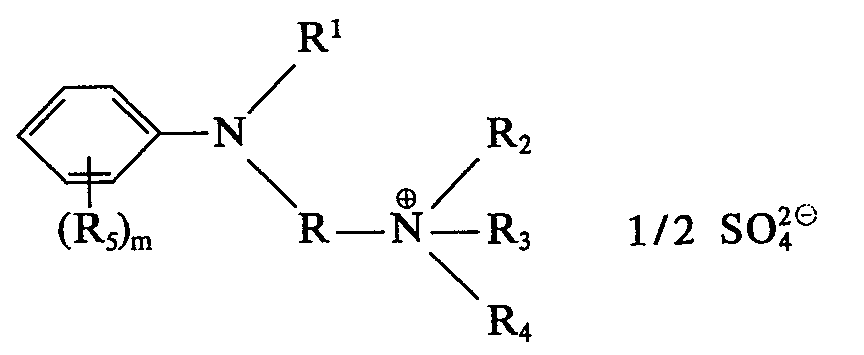
Applications Claiming Priority (2)
| Application Number | Priority Date | Filing Date | Title |
|---|---|---|---|
| DE3030918 | 1980-08-16 | ||
| DE19803030918 DE3030918A1 (de) | 1980-08-16 | 1980-08-16 | Verfahren zur herstellung von loesungen kationischer azofarbstoffe |
Publications (2)
| Publication Number | Publication Date |
|---|---|
| EP0046237A1 EP0046237A1 (fr) | 1982-02-24 |
| EP0046237B1 true EP0046237B1 (fr) | 1984-02-22 |
Family
ID=6109694
Family Applications (1)
| Application Number | Title | Priority Date | Filing Date |
|---|---|---|---|
| EP81106117A Expired EP0046237B1 (fr) | 1980-08-16 | 1981-08-05 | Procédé pour la préparation de solutions de colorants azoiques cationiques |
Country Status (4)
| Country | Link |
|---|---|
| US (1) | US4468349A (fr) |
| EP (1) | EP0046237B1 (fr) |
| JP (1) | JPS5753563A (fr) |
| DE (2) | DE3030918A1 (fr) |
Families Citing this family (5)
| Publication number | Priority date | Publication date | Assignee | Title |
|---|---|---|---|---|
| US4818815A (en) * | 1985-07-26 | 1989-04-04 | Ciba-Geigy Corporation | Cationic 1,2,3-thiadiazole-azo-aniline or tetrahydroquinoline compounds |
| US4923972A (en) * | 1987-04-23 | 1990-05-08 | Basf Aktiengesellschaft | Preparation of liquid formulations of basic azo dyes in carboxylic acid solution and subsequent heating |
| US4952680A (en) * | 1987-04-23 | 1990-08-28 | Basf Aktiengesellschaft | Preparation of stable solutions of azo dyes of m-phenylenediamine by reaction with formic acid |
| EP0514336B1 (fr) * | 1991-05-17 | 1996-12-11 | Ciba-Geigy Ag | Procédé de préparation de solutions aqueuses hautement concentrées de colorants azoiques cationiques |
| EP1756232A1 (fr) * | 2004-05-26 | 2007-02-28 | Clariant International Ltd. | Solution de colorant concentree |
Family Cites Families (13)
| Publication number | Priority date | Publication date | Assignee | Title |
|---|---|---|---|---|
| US2478767A (en) * | 1945-10-04 | 1949-08-09 | Du Pont | Manufacture of azo compounds |
| DE1162665B (de) * | 1954-05-08 | 1964-02-06 | Posalux Frautschi & Monney | Hydraulische Spindelvorschubeinrichtung fuer Bohrmaschinen |
| NL134483C (fr) * | 1962-03-29 | |||
| FR1355911A (fr) * | 1962-03-29 | 1964-03-20 | Basf Ag | Solutions hautement concentrées de colorants basiques, d'une bonne stabilité |
| IT986751B (it) * | 1964-01-24 | 1975-01-30 | Sandoz Ag | Processo per la preparazione di coloranti basici |
| CH482814A (de) * | 1967-08-23 | 1969-12-15 | Ciba Geigy | Stabile, hochkonzentrierte Lösung von basischen Farbstoffen und Verfahren zu deren Herstellung |
| US3941768A (en) * | 1968-05-30 | 1976-03-02 | Ciba-Geigy Ag | One step diazotization coupling process |
| CH185570A4 (fr) * | 1969-01-20 | 1972-09-15 | ||
| US3793305A (en) * | 1970-09-14 | 1974-02-19 | Du Pont | One-step process of preparing azo dyes by simultaneous diazotization |
| DE2049620C3 (de) * | 1970-10-09 | 1975-04-30 | Basf Ag, 6700 Ludwigshafen | Stabile, konzentrierte, saure Stammlösungen von anionischen Farbstoffen, Verfahren zu ihrer Herstellung und ihre Verwendung |
| DE2209478C3 (de) * | 1972-02-29 | 1975-04-10 | Basf Ag, 6700 Ludwigshafen | Verfahren zur Herstellung von konzentrierten Lösungen metallfreier anionischer sulfonsäuregruppenhaltiger Azofarbstoffe |
| DD113239A5 (fr) * | 1973-02-26 | 1975-05-20 | ||
| GB2009208A (en) * | 1977-11-28 | 1979-06-13 | Ici Ltd | Azo Compounds |
-
1980
- 1980-08-16 DE DE19803030918 patent/DE3030918A1/de not_active Withdrawn
-
1981
- 1981-07-30 US US06/288,567 patent/US4468349A/en not_active Expired - Fee Related
- 1981-08-05 EP EP81106117A patent/EP0046237B1/fr not_active Expired
- 1981-08-05 DE DE8181106117T patent/DE3162374D1/de not_active Expired
- 1981-08-13 JP JP56126023A patent/JPS5753563A/ja active Pending
Also Published As
| Publication number | Publication date |
|---|---|
| JPS5753563A (en) | 1982-03-30 |
| DE3030918A1 (de) | 1982-04-01 |
| EP0046237A1 (fr) | 1982-02-24 |
| US4468349A (en) | 1984-08-28 |
| DE3162374D1 (en) | 1984-03-29 |
Similar Documents
| Publication | Publication Date | Title |
|---|---|---|
| EP0115818B1 (fr) | Colorants polyazoiques cationiques, leurs solutions stabilisées, leur préparation et leur utilisation | |
| EP0592838B1 (fr) | Colorants au soufre solubles dans l'eau, leur préparation et leur utilisation | |
| DE2139311A1 (de) | Verfahren zur Herstellung von Azofarbstoffen | |
| EP0056578B1 (fr) | Procédé de préparation de solutions de colorants azoiques cationiques | |
| DE2702584C2 (de) | Konzentrierte wäßrige oder wäßrig-organische Lösungen von Acetoacetylaminoarylsulfonsäuresalzen, Verfahren zu deren Herstellung und Verfahren zur Herstellung von konzentrierten Lösungen sulfonsäuregruppenhaltiger Azofarbstoffe aus den vorgenannten Lösungen | |
| EP0046237A1 (fr) | Procédé pour la préparation de solutions de colorants azoiques cationiques | |
| DE2152523B2 (de) | Stabile konzentrierte Lösungen von wasserlöslichen tertiären Ammonsalzen von Direktfarbstoffen, Verfahren zu deren Herstellung und ihre Verwendung zum Färben von Cellulosematerial, insbesondere Papier | |
| EP0045840B1 (fr) | Procédé pour la préparation de solutions de colorants polyazoiques cationiques | |
| DE3217224C2 (de) | Verfahren zur Herstellung von Arylazoaminonaphtholsulfonsäuren und deren Verwendung | |
| EP0281920A2 (fr) | Colorants à groupes N-(2-aminométhyle)-pipérazine et leur utilisation | |
| DE2840121C2 (de) | Verfahren zur Herstellung von Chlorzinksalzen von Thiazoliumazofarbstoffen | |
| EP0229980B1 (fr) | Procédé de préparation de colorants hydrazoniques cationiques | |
| DE69527545T2 (de) | Monoazopigmente | |
| DE2516032C2 (de) | Verfahren zum Diazotieren aromatischer Amine | |
| EP0514336B1 (fr) | Procédé de préparation de solutions aqueuses hautement concentrées de colorants azoiques cationiques | |
| EP0055218A2 (fr) | Préparation de composés azoiques | |
| DE2453209C2 (de) | Disazofarbstoffe, Verfahren zu deren Herstellung und deren Verwendung | |
| EP0042556B1 (fr) | Procédé de préparation de colorants alkylaryl-hydrazoniques cationiques et de leurs bases de colorants | |
| DE2816350A1 (de) | Verfahren zur herstellung eines 1,2,4-triazolyl-3-azo-farbstoffs | |
| EP0651026A1 (fr) | Procédé de fabrication de colorants azoiques | |
| EP0553672A1 (fr) | Mélanges de colorants contenant deux colorants monoazoiques différents | |
| EP0003767A1 (fr) | Sels d'acides N-acylaminohydroxynaphtalène sulfoniques, leur procédé de préparation et leur utilisation comme copulants dans la préparation de colorants azoiques | |
| DE3009267A1 (de) | Verfahren zur herstellung kationischer farbstoffe sowie ihre verwendung | |
| EP0095638A1 (fr) | 2,6-Dicyanoanilines | |
| DE2521655C2 (de) | Azoverbindungen, Verfahren zu ihrer Herstellung und ihre Verwendung |
Legal Events
| Date | Code | Title | Description |
|---|---|---|---|
| PUAI | Public reference made under article 153(3) epc to a published international application that has entered the european phase |
Free format text: ORIGINAL CODE: 0009012 |
|
| 17P | Request for examination filed |
Effective date: 19810805 |
|
| AK | Designated contracting states |
Designated state(s): CH DE FR GB IT |
|
| ITF | It: translation for a ep patent filed | ||
| GRAA | (expected) grant |
Free format text: ORIGINAL CODE: 0009210 |
|
| AK | Designated contracting states |
Designated state(s): CH DE FR GB IT LI |
|
| REF | Corresponds to: |
Ref document number: 3162374 Country of ref document: DE Date of ref document: 19840329 |
|
| ET | Fr: translation filed | ||
| PLBE | No opposition filed within time limit |
Free format text: ORIGINAL CODE: 0009261 |
|
| STAA | Information on the status of an ep patent application or granted ep patent |
Free format text: STATUS: NO OPPOSITION FILED WITHIN TIME LIMIT |
|
| 26N | No opposition filed | ||
| PGFP | Annual fee paid to national office [announced via postgrant information from national office to epo] |
Ref country code: GB Payment date: 19900724 Year of fee payment: 10 |
|
| PGFP | Annual fee paid to national office [announced via postgrant information from national office to epo] |
Ref country code: DE Payment date: 19900728 Year of fee payment: 10 |
|
| PGFP | Annual fee paid to national office [announced via postgrant information from national office to epo] |
Ref country code: FR Payment date: 19900816 Year of fee payment: 10 |
|
| PGFP | Annual fee paid to national office [announced via postgrant information from national office to epo] |
Ref country code: CH Payment date: 19900824 Year of fee payment: 10 |
|
| PG25 | Lapsed in a contracting state [announced via postgrant information from national office to epo] |
Ref country code: GB Effective date: 19910805 |
|
| PG25 | Lapsed in a contracting state [announced via postgrant information from national office to epo] |
Ref country code: LI Effective date: 19910831 Ref country code: CH Effective date: 19910831 |
|
| GBPC | Gb: european patent ceased through non-payment of renewal fee | ||
| PG25 | Lapsed in a contracting state [announced via postgrant information from national office to epo] |
Ref country code: FR Effective date: 19920430 |
|
| REG | Reference to a national code |
Ref country code: CH Ref legal event code: PL |
|
| PG25 | Lapsed in a contracting state [announced via postgrant information from national office to epo] |
Ref country code: DE Effective date: 19920501 |
|
| REG | Reference to a national code |
Ref country code: FR Ref legal event code: ST |