EP0047060A2 - Génération d'effets de désaccord dans un instrument de musique électronique - Google Patents
Génération d'effets de désaccord dans un instrument de musique électronique Download PDFInfo
- Publication number
- EP0047060A2 EP0047060A2 EP81303394A EP81303394A EP0047060A2 EP 0047060 A2 EP0047060 A2 EP 0047060A2 EP 81303394 A EP81303394 A EP 81303394A EP 81303394 A EP81303394 A EP 81303394A EP 0047060 A2 EP0047060 A2 EP 0047060A2
- Authority
- EP
- European Patent Office
- Prior art keywords
- detuning
- tone generator
- circuit
- detuning control
- integrated circuit
- Prior art date
- Legal status (The legal status is an assumption and is not a legal conclusion. Google has not performed a legal analysis and makes no representation as to the accuracy of the status listed.)
- Withdrawn
Links
- 230000000694 effects Effects 0.000 title claims abstract description 42
- 230000011664 signaling Effects 0.000 claims abstract description 10
- 239000003990 capacitor Substances 0.000 claims description 16
- 230000000737 periodic effect Effects 0.000 claims description 7
- 230000004044 response Effects 0.000 description 5
- 238000010586 diagram Methods 0.000 description 4
- 230000008878 coupling Effects 0.000 description 3
- 238000010168 coupling process Methods 0.000 description 3
- 238000005859 coupling reaction Methods 0.000 description 3
- 238000000034 method Methods 0.000 description 2
- 230000004048 modification Effects 0.000 description 2
- 238000012986 modification Methods 0.000 description 2
- 230000007704 transition Effects 0.000 description 2
- 230000004075 alteration Effects 0.000 description 1
- 230000035559 beat frequency Effects 0.000 description 1
- 230000008859 change Effects 0.000 description 1
- 230000001419 dependent effect Effects 0.000 description 1
- 210000000056 organ Anatomy 0.000 description 1
- 230000001960 triggered effect Effects 0.000 description 1
Images

Classifications
-
- G—PHYSICS
- G10—MUSICAL INSTRUMENTS; ACOUSTICS
- G10H—ELECTROPHONIC MUSICAL INSTRUMENTS; INSTRUMENTS IN WHICH THE TONES ARE GENERATED BY ELECTROMECHANICAL MEANS OR ELECTRONIC GENERATORS, OR IN WHICH THE TONES ARE SYNTHESISED FROM A DATA STORE
- G10H1/00—Details of electrophonic musical instruments
- G10H1/02—Means for controlling the tone frequencies, e.g. attack or decay; Means for producing special musical effects, e.g. vibratos or glissandos
- G10H1/06—Circuits for establishing the harmonic content of tones, or other arrangements for changing the tone colour
- G10H1/08—Circuits for establishing the harmonic content of tones, or other arrangements for changing the tone colour by combining tones
- G10H1/10—Circuits for establishing the harmonic content of tones, or other arrangements for changing the tone colour by combining tones for obtaining chorus, celeste or ensemble effects
-
- G—PHYSICS
- G10—MUSICAL INSTRUMENTS; ACOUSTICS
- G10H—ELECTROPHONIC MUSICAL INSTRUMENTS; INSTRUMENTS IN WHICH THE TONES ARE GENERATED BY ELECTROMECHANICAL MEANS OR ELECTRONIC GENERATORS, OR IN WHICH THE TONES ARE SYNTHESISED FROM A DATA STORE
- G10H1/00—Details of electrophonic musical instruments
- G10H1/02—Means for controlling the tone frequencies, e.g. attack or decay; Means for producing special musical effects, e.g. vibratos or glissandos
- G10H1/04—Means for controlling the tone frequencies, e.g. attack or decay; Means for producing special musical effects, e.g. vibratos or glissandos by additional modulation
- G10H1/043—Continuous modulation
-
- Y—GENERAL TAGGING OF NEW TECHNOLOGICAL DEVELOPMENTS; GENERAL TAGGING OF CROSS-SECTIONAL TECHNOLOGIES SPANNING OVER SEVERAL SECTIONS OF THE IPC; TECHNICAL SUBJECTS COVERED BY FORMER USPC CROSS-REFERENCE ART COLLECTIONS [XRACs] AND DIGESTS
- Y10—TECHNICAL SUBJECTS COVERED BY FORMER USPC
- Y10S—TECHNICAL SUBJECTS COVERED BY FORMER USPC CROSS-REFERENCE ART COLLECTIONS [XRACs] AND DIGESTS
- Y10S84/00—Music
- Y10S84/04—Chorus; ensemble; celeste
Definitions
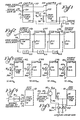
- the detuning circuits are responsive to suitable control input signals on the pins 14, 16 for detuning the tones produced by the associated tone generator circuits of the chips 10 and 12 in a predetermined fashion, depending upon the type of signal provided at the respective control inputs 14, 16.
- both of the chips 10 and 12 are assigned to production of the same note or range of notes.
- each of these chips 10 and 12 is responsive to an input signal identifying the tone to be generated, received on a serial data line 18 at respective input pins 20, 22.
- a high frequency clock signal on a line 24 is also fed to input pins 26, 28 of the respective tone generator chips 10, 12.
- This high frequency clock signal is preferably on the order of four megahertz and provides a master signal from which the audio tones to be generated by the chips 10, 12 are derived.
- the tone generator circuitry on the chips 10 and 12 is responsive to the serial data in 18 for identifying the note or tone to be derived from this high frequency clock signal 24.
- this relative detuning is accomplished by coupling the drop-clock pin 16 of the chip 12 with the junction between a selected resistor 38 and a selected capacitor 40, which are joined in series between a positive reference potential V DD and ground. At the same time the drop-clock pin 14 of the chip 10 is coupled with ground. Accordingly, an amount of detuning depending upon the values selected for the resistor 38 and the capacitor 40 and of the value of the voltage V DD" is experienced in the tones generated by the chip 12, while the tones generated by the chip 10 experience no detuning.
- the values R, C of resistor 38a and capacitor 40a associated with the chip 42 are chosen so as to achieve an internally derived drop-clock or detuning frequency of substantially on the order of 40 ICHz.
- the values of resistors 38b, 38c and 38d in the ratio of 2R, 4R and 8R, respectively are such as to provide internally derived drop-clock or detuning control frequencies of substantially on the order of 20KHz, 10 KHz arid 5 KHz, respectively.
- the novel detuning control arrangements illustrated in Fig. 2 and Fig. 3 achieve a desired degree of detuning of each of the tone generators included in the integrated circuit tone generator chips 42, 44, 46 and 48. Consequently, a musically pleasing celeste effect of from one to five beats per second is obtained when the output signals or tones of these chips are mixed with the "in tune" output signals or tones produced by their co-assigned chips, such as the chip 10 to 1A of Fig. 1, which have their detuning control inputs tied to ground, so as to remain inactive.
- a vibrato effect is also achievable by providing a selected detuning control signal to the drop-clock 10 of any integrated circuit tone generator chip of the type illustrated and described above with reference to Figs. 1 through 3, inclusive.
- the integrated circuit chip 10 of Fig. 1 is again illustrated in Fig. 4, but now receiving a different detuning control signal at its drop-clock pin 14.
- the detuning control signal introduced at the pin 14 causes production of a selectable vibrato effect in conjunction with the tone signals produced by the tone generator chip 10.
- a switch 72 is provided at the pin 14 for alternatively selecting a ground reference potential 74, which produces no detuning or alteration of the tone signals produced by the tone generator chip 10 or alternatively a vibrato control signal provided at the output of a voltage controlled oscillator (VCO) 76.
- VCO voltage controlled oscillator
- This voltage controlled oscillator 76 produces an output signal of variable frequency in response to a varying voltage signal 80 at its input.
- the celeste control circuitry of the invention would be provided with switching means (not shown) so as to be selectively operable only with the chip 12 while the vibrato control circuit of the invention would be selectively applicable by means of a suitable switch (not shown) only to the chip 10.
- the switches for selecting the vibrato or celeste effects would be provided in a mutually exclusive form to permit the selection of only one of these effects at any given time.
- the switching circuits 118 and 120 are each controllable by the control line 70, mentioned above, for delivering the output of the drop clock oscillator 122 or alternatively for effectively inserting a selected divider circuit 124, 126 in series with this drop clock oscillator 122.
Landscapes
- Physics & Mathematics (AREA)
- Engineering & Computer Science (AREA)
- Acoustics & Sound (AREA)
- Multimedia (AREA)
- Electrophonic Musical Instruments (AREA)
Applications Claiming Priority (2)
| Application Number | Priority Date | Filing Date | Title |
|---|---|---|---|
| US06/182,121 US4342247A (en) | 1980-08-28 | 1980-08-28 | Production of detuning effects in an electronic musical instrument |
| US182121 | 1980-08-28 |
Publications (2)
| Publication Number | Publication Date |
|---|---|
| EP0047060A2 true EP0047060A2 (fr) | 1982-03-10 |
| EP0047060A3 EP0047060A3 (fr) | 1982-03-17 |
Family
ID=22667138
Family Applications (1)
| Application Number | Title | Priority Date | Filing Date |
|---|---|---|---|
| EP81303394A Withdrawn EP0047060A3 (fr) | 1980-08-28 | 1981-07-24 | Génération d'effets de désaccord dans un instrument de musique électronique |
Country Status (4)
| Country | Link |
|---|---|
| US (1) | US4342247A (fr) |
| EP (1) | EP0047060A3 (fr) |
| JP (1) | JPS5773797A (fr) |
| AU (1) | AU7331481A (fr) |
Families Citing this family (1)
| Publication number | Priority date | Publication date | Assignee | Title |
|---|---|---|---|---|
| US9286863B2 (en) * | 2013-09-12 | 2016-03-15 | Nancy Diane Moon | Apparatus and method for a celeste in an electronically-orbited speaker |
Family Cites Families (9)
| Publication number | Priority date | Publication date | Assignee | Title |
|---|---|---|---|---|
| US3516318A (en) * | 1968-01-02 | 1970-06-23 | Baldwin Co D H | Frequency changer employing opto-electronics |
| US3794748A (en) * | 1971-12-06 | 1974-02-26 | North American Rockwell | Apparatus and method for frequency modulation for sampled amplitude signal generating system |
| US3828109A (en) * | 1973-02-20 | 1974-08-06 | Chicago Musical Instr Co | Chorus generator for electronic musical instrument |
| JPS53106023A (en) * | 1977-02-26 | 1978-09-14 | Nippon Gakki Seizo Kk | Electronic musical instrument |
| US4242935A (en) * | 1977-08-25 | 1981-01-06 | Peterson Richard H | Musical tone generator system using multiple frequency synthesizers |
| US4262575A (en) * | 1977-09-19 | 1981-04-21 | Kimball International, Inc. | Quasi-random phase shift system for an electronic musical instrument |
| US4186637A (en) * | 1977-09-22 | 1980-02-05 | Norlin Industries, Inc. | Tone generating system for electronic musical instrument |
| US4196651A (en) * | 1978-06-20 | 1980-04-08 | The Wurlitzer Company | Non-redundant generator unlocking |
| US4215616A (en) * | 1979-05-24 | 1980-08-05 | Norlin Industries, Inc. | Asynchronous tone generator |
-
1980
- 1980-08-28 US US06/182,121 patent/US4342247A/en not_active Expired - Lifetime
-
1981
- 1981-07-22 AU AU73314/81A patent/AU7331481A/en not_active Abandoned
- 1981-07-24 EP EP81303394A patent/EP0047060A3/fr not_active Withdrawn
- 1981-08-27 JP JP56133465A patent/JPS5773797A/ja active Pending
Also Published As
| Publication number | Publication date |
|---|---|
| EP0047060A3 (fr) | 1982-03-17 |
| AU7331481A (en) | 1982-03-04 |
| US4342247A (en) | 1982-08-03 |
| JPS5773797A (en) | 1982-05-08 |
Similar Documents
| Publication | Publication Date | Title |
|---|---|---|
| US4271495A (en) | Electronic clock with a chime system | |
| US4273019A (en) | Electronic tone generator | |
| US3479440A (en) | Randomly-perturbed,locked-wave generator | |
| US3861263A (en) | Variable time constant circuit for use in an electronic musical instrument | |
| US3902396A (en) | Electronic musical instrument | |
| JPS5925234B2 (ja) | 電子楽器 | |
| US4534257A (en) | Electronic musical instrument | |
| US3809787A (en) | Tone generator system | |
| US3992973A (en) | Pulse generator for an electronic musical instrument | |
| US4342247A (en) | Production of detuning effects in an electronic musical instrument | |
| US3764721A (en) | Electronic musical instrument | |
| US3629482A (en) | Electronic musical instrument with a pseudorandom pulse sequence generator | |
| US4635517A (en) | Electric musical instrument | |
| US3974729A (en) | Automatic rhythm playing apparatus | |
| US4236437A (en) | Organ brass pulse keyer | |
| US3701040A (en) | Electronic musical instrument master oscillator with provision for frequency control | |
| US4117759A (en) | Apparatus for forming chord signal | |
| US4319508A (en) | Modular, expandable digital organ system | |
| US4242935A (en) | Musical tone generator system using multiple frequency synthesizers | |
| GB1365716A (en) | Musical devices | |
| US4256002A (en) | Large scale integrated circuit generator chip for electronic organ | |
| US3624265A (en) | Tone-generating device for electronic musical instrument | |
| US3778525A (en) | Electronic musical instrument with phase shift tremulant system | |
| US4108038A (en) | Time shared tone keying system in electronic musical instrument | |
| US3735013A (en) | System for producing an aperiodic vibrato signal |
Legal Events
| Date | Code | Title | Description |
|---|---|---|---|
| PUAI | Public reference made under article 153(3) epc to a published international application that has entered the european phase |
Free format text: ORIGINAL CODE: 0009012 |
|
| PUAL | Search report despatched |
Free format text: ORIGINAL CODE: 0009013 |
|
| AK | Designated contracting states |
Designated state(s): DE GB IT |
|
| AK | Designated contracting states |
Designated state(s): DE GB IT |
|
| STAA | Information on the status of an ep patent application or granted ep patent |
Free format text: STATUS: THE APPLICATION IS DEEMED TO BE WITHDRAWN |
|
| 18D | Application deemed to be withdrawn |
Effective date: 19830225 |
|
| RIN1 | Information on inventor provided before grant (corrected) |
Inventor name: IPPOLITO, ANTHONY C. Inventor name: HOSKINSON, WILLIAM R. |