EP0047069B1 - Résine dérivée de l'acénaphtène et procédé pour sa préparation - Google Patents
Résine dérivée de l'acénaphtène et procédé pour sa préparation Download PDFInfo
- Publication number
- EP0047069B1 EP0047069B1 EP81303552A EP81303552A EP0047069B1 EP 0047069 B1 EP0047069 B1 EP 0047069B1 EP 81303552 A EP81303552 A EP 81303552A EP 81303552 A EP81303552 A EP 81303552A EP 0047069 B1 EP0047069 B1 EP 0047069B1
- Authority
- EP
- European Patent Office
- Prior art keywords
- resin
- acenaphthene
- acid
- oligomers
- thermally stable
- Prior art date
- Legal status (The legal status is an assumption and is not a legal conclusion. Google has not performed a legal analysis and makes no representation as to the accuracy of the status listed.)
- Expired
Links
- 239000011347 resin Substances 0.000 title claims description 49
- 229920005989 resin Polymers 0.000 title claims description 49
- CWRYPZZKDGJXCA-UHFFFAOYSA-N acenaphthene Chemical compound C1=CC(CC2)=C3C2=CC=CC3=C1 CWRYPZZKDGJXCA-UHFFFAOYSA-N 0.000 title claims description 32
- 238000000034 method Methods 0.000 title claims description 19
- HXGDTGSAIMULJN-UHFFFAOYSA-N acetnaphthylene Natural products C1=CC(C=C2)=C3C2=CC=CC3=C1 HXGDTGSAIMULJN-UHFFFAOYSA-N 0.000 title claims description 16
- 238000004519 manufacturing process Methods 0.000 title claims description 5
- WSFSSNUMVMOOMR-UHFFFAOYSA-N Formaldehyde Chemical compound O=C WSFSSNUMVMOOMR-UHFFFAOYSA-N 0.000 claims description 40
- 238000006243 chemical reaction Methods 0.000 claims description 13
- 150000001412 amines Chemical class 0.000 claims description 11
- QTBSBXVTEAMEQO-UHFFFAOYSA-N Acetic acid Chemical compound CC(O)=O QTBSBXVTEAMEQO-UHFFFAOYSA-N 0.000 claims description 9
- 150000008064 anhydrides Chemical class 0.000 claims description 7
- 125000004062 acenaphthenyl group Chemical group C1(CC2=CC=CC3=CC=CC1=C23)* 0.000 claims description 6
- 239000002253 acid Substances 0.000 claims description 5
- 125000005486 naphthalic acid group Chemical group 0.000 claims description 5
- 150000003142 primary aromatic amines Chemical class 0.000 claims description 5
- 229930194542 Keto Natural products 0.000 claims description 4
- 229960000583 acetic acid Drugs 0.000 claims description 4
- 239000003377 acid catalyst Substances 0.000 claims description 4
- SOCTUWSJJQCPFX-UHFFFAOYSA-N dichromate(2-) Chemical compound [O-][Cr](=O)(=O)O[Cr]([O-])(=O)=O SOCTUWSJJQCPFX-UHFFFAOYSA-N 0.000 claims description 4
- 125000000468 ketone group Chemical group 0.000 claims description 4
- 238000009833 condensation Methods 0.000 claims description 3
- 230000005494 condensation Effects 0.000 claims description 3
- 239000012362 glacial acetic acid Substances 0.000 claims description 3
- 238000007254 oxidation reaction Methods 0.000 claims description 3
- CBCKQZAAMUWICA-UHFFFAOYSA-N 1,4-phenylenediamine Chemical compound NC1=CC=C(N)C=C1 CBCKQZAAMUWICA-UHFFFAOYSA-N 0.000 claims description 2
- YBRVSVVVWCFQMG-UHFFFAOYSA-N 4,4'-diaminodiphenylmethane Chemical compound C1=CC(N)=CC=C1CC1=CC=C(N)C=C1 YBRVSVVVWCFQMG-UHFFFAOYSA-N 0.000 claims description 2
- 230000018044 dehydration Effects 0.000 claims description 2
- 238000006297 dehydration reaction Methods 0.000 claims description 2
- 150000007524 organic acids Chemical class 0.000 claims description 2
- 230000003647 oxidation Effects 0.000 claims description 2
- 229920000642 polymer Polymers 0.000 claims description 2
- 150000004984 aromatic diamines Chemical class 0.000 claims 1
- 229920006037 cross link polymer Polymers 0.000 claims 1
- YXFVVABEGXRONW-UHFFFAOYSA-N Toluene Chemical compound CC1=CC=CC=C1 YXFVVABEGXRONW-UHFFFAOYSA-N 0.000 description 11
- WFDIJRYMOXRFFG-UHFFFAOYSA-N Acetic anhydride Chemical compound CC(=O)OC(C)=O WFDIJRYMOXRFFG-UHFFFAOYSA-N 0.000 description 6
- 229920001721 polyimide Polymers 0.000 description 6
- XLYOFNOQVPJJNP-UHFFFAOYSA-N water Chemical compound O XLYOFNOQVPJJNP-UHFFFAOYSA-N 0.000 description 6
- 229920005575 poly(amic acid) Polymers 0.000 description 5
- 239000004642 Polyimide Substances 0.000 description 4
- CDBYLPFSWZWCQE-UHFFFAOYSA-L Sodium Carbonate Chemical compound [Na+].[Na+].[O-]C([O-])=O CDBYLPFSWZWCQE-UHFFFAOYSA-L 0.000 description 4
- QAOWNCQODCNURD-UHFFFAOYSA-N Sulfuric acid Chemical compound OS(O)(=O)=O QAOWNCQODCNURD-UHFFFAOYSA-N 0.000 description 4
- 239000000539 dimer Substances 0.000 description 4
- BBEAQIROQSPTKN-UHFFFAOYSA-N pyrene Chemical compound C1=CC=C2C=CC3=CC=CC4=CC=C1C2=C43 BBEAQIROQSPTKN-UHFFFAOYSA-N 0.000 description 4
- 239000001117 sulphuric acid Substances 0.000 description 4
- 235000011149 sulphuric acid Nutrition 0.000 description 4
- 229930040373 Paraformaldehyde Natural products 0.000 description 3
- 229920002866 paraformaldehyde Polymers 0.000 description 3
- IJGRMHOSHXDMSA-UHFFFAOYSA-N Atomic nitrogen Chemical compound N#N IJGRMHOSHXDMSA-UHFFFAOYSA-N 0.000 description 2
- KFSLWBXXFJQRDL-UHFFFAOYSA-N Peracetic acid Chemical compound CC(=O)OO KFSLWBXXFJQRDL-UHFFFAOYSA-N 0.000 description 2
- VSCWAEJMTAWNJL-UHFFFAOYSA-K aluminium trichloride Chemical compound Cl[Al](Cl)Cl VSCWAEJMTAWNJL-UHFFFAOYSA-K 0.000 description 2
- 239000011280 coal tar Substances 0.000 description 2
- 238000004821 distillation Methods 0.000 description 2
- 239000012153 distilled water Substances 0.000 description 2
- GVEPBJHOBDJJJI-UHFFFAOYSA-N fluoranthrene Natural products C1=CC(C2=CC=CC=C22)=C3C2=CC=CC3=C1 GVEPBJHOBDJJJI-UHFFFAOYSA-N 0.000 description 2
- 239000000463 material Substances 0.000 description 2
- 239000009719 polyimide resin Substances 0.000 description 2
- 238000002360 preparation method Methods 0.000 description 2
- 229910000029 sodium carbonate Inorganic materials 0.000 description 2
- SCYULBFZEHDVBN-UHFFFAOYSA-N 1,1-Dichloroethane Chemical compound CC(Cl)Cl SCYULBFZEHDVBN-UHFFFAOYSA-N 0.000 description 1
- BGJSXRVXTHVRSN-UHFFFAOYSA-N 1,3,5-trioxane Chemical compound C1OCOCO1 BGJSXRVXTHVRSN-UHFFFAOYSA-N 0.000 description 1
- 239000002841 Lewis acid Substances 0.000 description 1
- 125000003118 aryl group Chemical group 0.000 description 1
- 230000015572 biosynthetic process Effects 0.000 description 1
- 238000006482 condensation reaction Methods 0.000 description 1
- 239000012024 dehydrating agents Substances 0.000 description 1
- 150000004985 diamines Chemical class 0.000 description 1
- 238000005227 gel permeation chromatography Methods 0.000 description 1
- 238000010438 heat treatment Methods 0.000 description 1
- 150000007517 lewis acids Chemical class 0.000 description 1
- 230000014759 maintenance of location Effects 0.000 description 1
- RTWNYYOXLSILQN-UHFFFAOYSA-N methanediamine Chemical compound NCN RTWNYYOXLSILQN-UHFFFAOYSA-N 0.000 description 1
- 238000002156 mixing Methods 0.000 description 1
- 239000000203 mixture Substances 0.000 description 1
- 230000004048 modification Effects 0.000 description 1
- 238000012986 modification Methods 0.000 description 1
- 229910052757 nitrogen Inorganic materials 0.000 description 1
- 150000004967 organic peroxy acids Chemical class 0.000 description 1
- 239000007800 oxidant agent Substances 0.000 description 1
- -1 peroxy acetic acid Chemical class 0.000 description 1
- 230000000704 physical effect Effects 0.000 description 1
- 230000035484 reaction time Effects 0.000 description 1
- 238000010992 reflux Methods 0.000 description 1
- 238000000926 separation method Methods 0.000 description 1
- 239000007858 starting material Substances 0.000 description 1
- 238000003756 stirring Methods 0.000 description 1
- 125000003944 tolyl group Chemical group 0.000 description 1
- 239000013638 trimer Substances 0.000 description 1
Images
Classifications
-
- C—CHEMISTRY; METALLURGY
- C08—ORGANIC MACROMOLECULAR COMPOUNDS; THEIR PREPARATION OR CHEMICAL WORKING-UP; COMPOSITIONS BASED THEREON
- C08G—MACROMOLECULAR COMPOUNDS OBTAINED OTHERWISE THAN BY REACTIONS ONLY INVOLVING UNSATURATED CARBON-TO-CARBON BONDS
- C08G73/00—Macromolecular compounds obtained by reactions forming a linkage containing nitrogen with or without oxygen or carbon in the main chain of the macromolecule, not provided for in groups C08G12/00 - C08G71/00
- C08G73/06—Polycondensates having nitrogen-containing heterocyclic rings in the main chain of the macromolecule
- C08G73/10—Polyimides; Polyester-imides; Polyamide-imides; Polyamide acids or similar polyimide precursors
- C08G73/1067—Wholly aromatic polyimides, i.e. having both tetracarboxylic and diamino moieties aromatically bound
-
- C—CHEMISTRY; METALLURGY
- C07—ORGANIC CHEMISTRY
- C07C—ACYCLIC OR CARBOCYCLIC COMPOUNDS
- C07C65/00—Compounds having carboxyl groups bound to carbon atoms of six—membered aromatic rings and containing any of the groups OH, O—metal, —CHO, keto, ether, groups, groups, or groups
- C07C65/32—Compounds having carboxyl groups bound to carbon atoms of six—membered aromatic rings and containing any of the groups OH, O—metal, —CHO, keto, ether, groups, groups, or groups containing keto groups
- C07C65/34—Compounds having carboxyl groups bound to carbon atoms of six—membered aromatic rings and containing any of the groups OH, O—metal, —CHO, keto, ether, groups, groups, or groups containing keto groups polycyclic
-
- C—CHEMISTRY; METALLURGY
- C08—ORGANIC MACROMOLECULAR COMPOUNDS; THEIR PREPARATION OR CHEMICAL WORKING-UP; COMPOSITIONS BASED THEREON
- C08G—MACROMOLECULAR COMPOUNDS OBTAINED OTHERWISE THAN BY REACTIONS ONLY INVOLVING UNSATURATED CARBON-TO-CARBON BONDS
- C08G10/00—Condensation polymers of aldehydes or ketones with aromatic hydrocarbons or halogenated aromatic hydrocarbons only
- C08G10/02—Condensation polymers of aldehydes or ketones with aromatic hydrocarbons or halogenated aromatic hydrocarbons only of aldehydes
-
- C—CHEMISTRY; METALLURGY
- C08—ORGANIC MACROMOLECULAR COMPOUNDS; THEIR PREPARATION OR CHEMICAL WORKING-UP; COMPOSITIONS BASED THEREON
- C08G—MACROMOLECULAR COMPOUNDS OBTAINED OTHERWISE THAN BY REACTIONS ONLY INVOLVING UNSATURATED CARBON-TO-CARBON BONDS
- C08G10/00—Condensation polymers of aldehydes or ketones with aromatic hydrocarbons or halogenated aromatic hydrocarbons only
- C08G10/02—Condensation polymers of aldehydes or ketones with aromatic hydrocarbons or halogenated aromatic hydrocarbons only of aldehydes
- C08G10/04—Chemically-modified polycondensates
-
- C—CHEMISTRY; METALLURGY
- C08—ORGANIC MACROMOLECULAR COMPOUNDS; THEIR PREPARATION OR CHEMICAL WORKING-UP; COMPOSITIONS BASED THEREON
- C08G—MACROMOLECULAR COMPOUNDS OBTAINED OTHERWISE THAN BY REACTIONS ONLY INVOLVING UNSATURATED CARBON-TO-CARBON BONDS
- C08G73/00—Macromolecular compounds obtained by reactions forming a linkage containing nitrogen with or without oxygen or carbon in the main chain of the macromolecule, not provided for in groups C08G12/00 - C08G71/00
- C08G73/06—Polycondensates having nitrogen-containing heterocyclic rings in the main chain of the macromolecule
- C08G73/20—Pyrrones
Definitions
- This invention relates to a resin derived from acenaphthene and to a process for its production.
- Pyrrone BBB a pyrrone polymer known as Pyrrone BBB.
- This material is thought to be poly-(benzimidazobenzophenanthroline)dione, and retains some strength at temperatures up to 700°C.
- Pyrrone BBB is said to be produced from pyrene which is isolated from coal tar. Since the separation of pure pyrene from coal tar is difficult, the cost of Pyrrone BBB is very high. It is therefore desirable to be able to produce a product of similar thermal stability to Pyrrone BBB from a more readily available starting material.
- a process for the production of a thermally stable resin comprises the steps of:-
- the intermediate resin is to be reacted with a difunctional amine, it is first dehydrated to produce its anhydride derivative.
- the present invention also includes, in another aspect, the thermally stable resin produced by the process.
- the thermally stable resin produced by the process will be either a polyimide, if made using a difunctional amine, or a benzimidazodione, if made using a tetrafunctional amine.
- the resin may be linear or cross-linked.
- a thermally stable resin comprising oligomers of naphthalic acid groups bridged by substantially only keto groups, the oligomers being joined together with a di- or tetrafunctional primary aromatic amine wherein the oligomers are derived from a low molecular weight resin comprising oligomers of acenaphthene moieties joined by substantially only methylene bridges, produced by the acid-catalysed condensation of acenaphthene and a formaldehyde donor.
- the molar ratio of formaldehyde to acenaphthene should be in the range 4:1 to 0.3:1 and is preferably about 0.5:1.
- the formaldehyde donor may be formaldehyde itself, paraformaldehyde or trioxane.
- the acid catalyst may be sulphuric acid or a Lewis acid such as aluminium chloride.
- the condensation reaction is carried out at a temperature from 30 to 95°C for a time from 5 minutes to 8 hours.
- the reaction is carried out in glacial acetic acid, since the condensation resin is insoluble in this medium and is therefore precipitated as it is formed.
- the oxidation reaction of step (2) may be carried out using an organic peroxy acid such as peroxy acetic acid, but is preferably carried out using an inorganic oxidising agent, such as acid dichromate.
- the intermediate resin may then be reacted directly with a tetrafunctional amine such as 3,4,3',4'-tetraaminodiphenyl or 2,3,2',3'-tetraaminodiphenylmethane.
- a tetrafunctional amine such as 3,4,3',4'-tetraaminodiphenyl or 2,3,2',3'-tetraaminodiphenylmethane.
- the dehydration of the intermediate resin to produce an anhydride derivative for reaction with a difunctional amine is preferably carried out using an organic acid anhydride as the dehydrating agent.
- an organic acid anhydride for instance, acetic anhydride is particularly suitable.
- the difunctional amine for reaction with the anhydride derivative may be for instance 1,4-diaminobenzene or di-(4-aminophenyl)methane.
- the anhydride derivative is first treated with the diamine at a relatively low temperature, about 100°C, to form a polyamic acid.
- the polyamic acid is subsequently heated to about 300°C whereupon cyclisation occurs, yielding a polyimide resin.
- the thermally stable resin of the present invention is envisaged as being of particular, but not exclusive, use in the production of, for instance, drogue parachutes. However, it will also find use in applications demanding good thermal stability and retention of physical properties at temperatures up to 700°C.
- the resin is formed using a difunctional amine, it is likely to be less stable and may only be useful at temperatures up to about 500°C.
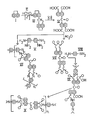
- acenaphthene (I) and formaldehyde (II) react together in the presence of an acid catalyst to form a low molecular weight resin (III) comprising from two to about six acenaphthene units linked by methylene bridges.
- a low molecular weight resin (III) comprising from two to about six acenaphthene units linked by methylene bridges.
- the acenaphthene units are converted to naphthalic acid units and the methylene bridges are oxidised to carbonyl bridges, thus producing an intermediate resin (IV).
- the intermediate resin may then be reacted directly with a tetrafunctional primary aromatic amine (V) to yield a benzimidazodione resin (VI).
- the intermediate resin may be dehydrated to produce its anhydride derivative (VII) which reacts with an aromatic primary diamine (VIII) to form first a polyamic acid (IX) and then a polyimide resin (X).
- VII anhydride derivative
- VIII aromatic primary diamine
- thermally stable resins are prepared as follows (Examples 1-4 refer to the preparation of low molecular weight resin):
- the reaction time was taken from the point of mixing the water/sulphuric acid/paraformaldehyde with the acenaphthene in acetic acid, to the removal of the flask from the oil bath.
- the contents of the flask were added to toluene (100 g) and, after stirring for 5 minutes, the mass was filtered to separate the soluble and insoluble fractions.
- the toluene solution was thereafter washed with water and dilute sodium carbonate solution until its pH reached about 8.0. Thereafter the toluene was removed by distillation, facilitated by passing nitrogen through the solution.
- the resin was then characterised and the data obtained are given in Table 1.
- Example 2 The procedure described in Example 1 above, was repeated except that toluene was replaced by 1:2-dichloroethane.
- the solution obtained was washed, as previously, with water and then dilute sodium carbonate solution until the water decanted had a pH of about 8.0.
- the dichloroethane was then removed by distillation to yield resins whose properties are given in Table 2.
- Example 2 The procedure described in Example 2 above was repeated except that 98% sulphuric acid was used without the addition of 1.9 g distilled water. Also, lower reaction temperatures were employed. Apart from these modifications all other reaction conditions were maintained as previously. The experimental conditions and the properties of the resins obtained are shown in Table 3.
- Example 3 The procedure described in Example 3 was repeated except that the molar ratio of formaldehyde to acenaphthene was reduced from 0.76 to 0.5. Under these conditions the resins obtained had the properties given in Table 4.
- the dimer was oxidised with acid dichromate to give keto bridged di-naphthalic acid. This was then converted to the corresponding anhydride by reaction with acetic anhydride and then reacted with 1:4-diaminobenzene to yield the polyamic acid. On heating at 300°C the polyamic acid was converted to a thermally stable linear polyimide.
- the product was also converted into a benzimidazodione resin.
- the dimer was oxidised with acid dichromate to give keto bridged dinaphthalic acid, which was reacted at 100°C with 3,4,3',4'-tetraaminodiphenyl. After reaction the material was heated to 300°C to cause cyclisation, thus forming a benzimidazodione resin.
Landscapes
- Chemical & Material Sciences (AREA)
- Organic Chemistry (AREA)
- Health & Medical Sciences (AREA)
- Chemical Kinetics & Catalysis (AREA)
- Medicinal Chemistry (AREA)
- Polymers & Plastics (AREA)
- General Chemical & Material Sciences (AREA)
- Organic Low-Molecular-Weight Compounds And Preparation Thereof (AREA)
- Macromolecular Compounds Obtained By Forming Nitrogen-Containing Linkages In General (AREA)
- Phenolic Resins Or Amino Resins (AREA)
Claims (10)
Applications Claiming Priority (2)
| Application Number | Priority Date | Filing Date | Title |
|---|---|---|---|
| GB8027953 | 1980-08-29 | ||
| GB8027953 | 1980-08-29 |
Publications (2)
| Publication Number | Publication Date |
|---|---|
| EP0047069A1 EP0047069A1 (fr) | 1982-03-10 |
| EP0047069B1 true EP0047069B1 (fr) | 1984-07-11 |
Family
ID=10515721
Family Applications (1)
| Application Number | Title | Priority Date | Filing Date |
|---|---|---|---|
| EP81303552A Expired EP0047069B1 (fr) | 1980-08-29 | 1981-08-04 | Résine dérivée de l'acénaphtène et procédé pour sa préparation |
Country Status (5)
| Country | Link |
|---|---|
| US (1) | US4334055A (fr) |
| EP (1) | EP0047069B1 (fr) |
| JP (1) | JPS5774321A (fr) |
| DE (1) | DE3164718D1 (fr) |
| GB (1) | GB2083055B (fr) |
Families Citing this family (3)
| Publication number | Priority date | Publication date | Assignee | Title |
|---|---|---|---|---|
| US4403089A (en) * | 1980-07-25 | 1983-09-06 | Johnson & Johnson Products, Inc. | Carboxylated naphthalene formaldehyde condensation polymers as dental plaque barriers |
| US4914181A (en) * | 1984-11-16 | 1990-04-03 | Ciba-Geigy Corporation | Polyimides, a process for their preparation and their use, and tetracarboxylic acids and tetracarboxylic acid derivatives |
| US4698295A (en) * | 1984-11-16 | 1987-10-06 | Ciba-Geigy Corporation | Polyimides, a process for their preparation and their use, and tetracarboxylic acids and tetracarboxylic acid derivatives |
Family Cites Families (9)
| Publication number | Priority date | Publication date | Assignee | Title |
|---|---|---|---|---|
| US2954360A (en) * | 1951-03-07 | 1960-09-27 | Basf Ag | Process for producing oxygen-containing condensation resins from aromatic hydrocarbons and product produced thereby |
| US3165558A (en) * | 1960-03-31 | 1965-01-12 | Imoto Minoru | Production of thermosetting, aromatic hydrocarbon resins |
| GB912355A (en) * | 1960-05-27 | 1962-12-05 | Sumitomo Bakelite Co | Process of producing lower aromatic hydrocarbon-formaldehyde resin |
| US3513221A (en) * | 1966-07-21 | 1970-05-19 | Mitsubishi Gas Chemical Co | Curable compositions containing epoxy resins and amine modified hydrocarbon-aldehyde resins |
| US3755254A (en) * | 1970-10-30 | 1973-08-28 | Celanese Corp | Process for the preparation of polyamidoximes and poly(bisbenzimidazobenzophenanthroline) (bbb) type polymers derived therefrom |
| US3767616A (en) * | 1970-10-30 | 1973-10-23 | Celanese Corp | Process for producing polyamidoximes and poly bisbenzimidazobenzophenanthroline bbb type polymers derived therefrom |
| US3714131A (en) * | 1971-08-11 | 1973-01-30 | Gen Electric | Polyamideimides |
| SU652194A1 (ru) * | 1976-08-09 | 1979-03-15 | Ордена Ленина Институт Элементоорганических Соединений Ан Ссср | Способ получени поли(нафтоиленбензимидазолов) |
| EP0027305A1 (fr) * | 1979-09-21 | 1981-04-22 | Coal Industry (Patents) Limited | Résines polyamide-imides thermiquement stables dérivées de phénanthrène et procédé pour leur préparation |
-
1981
- 1981-08-04 DE DE8181303552T patent/DE3164718D1/de not_active Expired
- 1981-08-04 EP EP81303552A patent/EP0047069B1/fr not_active Expired
- 1981-08-07 GB GB8124163A patent/GB2083055B/en not_active Expired
- 1981-08-11 US US06/292,037 patent/US4334055A/en not_active Expired - Fee Related
- 1981-08-28 JP JP56134384A patent/JPS5774321A/ja active Pending
Also Published As
| Publication number | Publication date |
|---|---|
| GB2083055B (en) | 1984-02-08 |
| DE3164718D1 (en) | 1984-08-16 |
| GB2083055A (en) | 1982-03-17 |
| EP0047069A1 (fr) | 1982-03-10 |
| JPS5774321A (en) | 1982-05-10 |
| US4334055A (en) | 1982-06-08 |
Similar Documents
| Publication | Publication Date | Title |
|---|---|---|
| US4097456A (en) | Preparation of acetylene-substituted polyimide oligomers and polyimide polymers | |
| US4711964A (en) | Bisdiene from bis-benzocyclobutene compound | |
| US4312976A (en) | Single-stage melt polymerization process for the production of high molecular weight polybenzimidazole | |
| US4110279A (en) | High temperature polymers from methoxy functional ether aromatic monomers | |
| US5155196A (en) | Polymer resulting from the cure of a preformed chromene-containing mixture | |
| US4687823A (en) | Alkynyl-bridged poly(arylcyclobutene) resins | |
| US2954360A (en) | Process for producing oxygen-containing condensation resins from aromatic hydrocarbons and product produced thereby | |
| US4916235A (en) | Resin systems derived from benzocyclobutene-maleimide compounds | |
| JPS59179525A (ja) | 高分子量ポリベンゾイミダゾ−ルの製法 | |
| US3966729A (en) | Addition curable phenyl-quinoxaline compositions and their synthesis | |
| EP0047069B1 (fr) | Résine dérivée de l'acénaphtène et procédé pour sa préparation | |
| EP0230653A3 (fr) | Résines réticulées et leur procédé de préparation | |
| US4587312A (en) | Sulfone-ester polymers containing pendent ethynyl groups | |
| US4379896A (en) | Keto/polycarboxy containing resin | |
| JPS6058738B2 (ja) | P−イソプロペニルフエノ−ルの線状3量体の製法 | |
| US4064176A (en) | Di-substituted meta-terphenyl compounds and resulting polymers | |
| US2654726A (en) | Polysulphone aminotriazoles | |
| US3789055A (en) | Aliphatically unsaturated imides and method for making same | |
| US5449740A (en) | Resin systems derived from insitu-generated bisdienes from bis-benzocyclobutene compounds | |
| US4732963A (en) | Thermosetting bis(isoimide)-diphenol resin | |
| US4147728A (en) | Disubstituted meta-terphenyl compounds and resulting polymers | |
| US4622182A (en) | 5-(4-ethynylophenoxy)isophthalic chloride | |
| Pyriadi et al. | Preparation of phenol formaldehyde resins containing pendant isoimides and their isomerization to stable resins | |
| EP0036710B1 (fr) | Résine polyimide, obtenue en utilisant du phénanthrène comme produit de départ | |
| JPS6341456A (ja) | 新規ビスマレイミド化合物およびその製造方法 |
Legal Events
| Date | Code | Title | Description |
|---|---|---|---|
| PUAI | Public reference made under article 153(3) epc to a published international application that has entered the european phase |
Free format text: ORIGINAL CODE: 0009012 |
|
| AK | Designated contracting states |
Designated state(s): DE FR IT NL |
|
| 17P | Request for examination filed |
Effective date: 19820313 |
|
| ITF | It: translation for a ep patent filed | ||
| GRAA | (expected) grant |
Free format text: ORIGINAL CODE: 0009210 |
|
| PGFP | Annual fee paid to national office [announced via postgrant information from national office to epo] |
Ref country code: FR Payment date: 19840607 Year of fee payment: 4 |
|
| AK | Designated contracting states |
Designated state(s): DE FR IT NL |
|
| PGFP | Annual fee paid to national office [announced via postgrant information from national office to epo] |
Ref country code: DE Payment date: 19840716 Year of fee payment: 4 |
|
| REF | Corresponds to: |
Ref document number: 3164718 Country of ref document: DE Date of ref document: 19840816 |
|
| ET | Fr: translation filed | ||
| PLBE | No opposition filed within time limit |
Free format text: ORIGINAL CODE: 0009261 |
|
| STAA | Information on the status of an ep patent application or granted ep patent |
Free format text: STATUS: NO OPPOSITION FILED WITHIN TIME LIMIT |
|
| 26N | No opposition filed | ||
| PGFP | Annual fee paid to national office [announced via postgrant information from national office to epo] |
Ref country code: NL Payment date: 19870831 Year of fee payment: 7 |
|
| PG25 | Lapsed in a contracting state [announced via postgrant information from national office to epo] |
Ref country code: NL Effective date: 19900301 |
|
| NLV4 | Nl: lapsed or anulled due to non-payment of the annual fee | ||
| PG25 | Lapsed in a contracting state [announced via postgrant information from national office to epo] |
Ref country code: FR Effective date: 19900427 |
|
| PG25 | Lapsed in a contracting state [announced via postgrant information from national office to epo] |
Ref country code: DE Effective date: 19900501 |
|
| REG | Reference to a national code |
Ref country code: FR Ref legal event code: ST |