EP0047363A1 - Kontinuierliches Verfahren zur direkten Umwandlung von Kaliumchlorid zu Kaliumchlorat durch Elektrolyse - Google Patents
Kontinuierliches Verfahren zur direkten Umwandlung von Kaliumchlorid zu Kaliumchlorat durch Elektrolyse Download PDFInfo
- Publication number
- EP0047363A1 EP0047363A1 EP81104765A EP81104765A EP0047363A1 EP 0047363 A1 EP0047363 A1 EP 0047363A1 EP 81104765 A EP81104765 A EP 81104765A EP 81104765 A EP81104765 A EP 81104765A EP 0047363 A1 EP0047363 A1 EP 0047363A1
- Authority
- EP
- European Patent Office
- Prior art keywords
- effluent
- weight
- cell
- chlorate
- electrolysis
- Prior art date
- Legal status (The legal status is an assumption and is not a legal conclusion. Google has not performed a legal analysis and makes no representation as to the accuracy of the status listed.)
- Granted
Links
- WCUXLLCKKVVCTQ-UHFFFAOYSA-M Potassium chloride Chemical compound [Cl-].[K+] WCUXLLCKKVVCTQ-UHFFFAOYSA-M 0.000 title claims abstract description 62
- 235000011164 potassium chloride Nutrition 0.000 title claims abstract description 30
- 239000001103 potassium chloride Substances 0.000 title claims abstract description 30
- 238000005868 electrolysis reaction Methods 0.000 title claims abstract description 23
- VKJKEPKFPUWCAS-UHFFFAOYSA-M potassium chlorate Chemical compound [K+].[O-]Cl(=O)=O VKJKEPKFPUWCAS-UHFFFAOYSA-M 0.000 title claims abstract description 21
- 238000006243 chemical reaction Methods 0.000 title description 7
- 238000010924 continuous production Methods 0.000 title 1
- 238000000034 method Methods 0.000 claims abstract description 70
- 230000008569 process Effects 0.000 claims abstract description 67
- 229910052751 metal Inorganic materials 0.000 claims abstract description 11
- 239000002184 metal Substances 0.000 claims abstract description 11
- XTEGARKTQYYJKE-UHFFFAOYSA-M Chlorate Chemical compound [O-]Cl(=O)=O XTEGARKTQYYJKE-UHFFFAOYSA-M 0.000 claims description 18
- 239000000243 solution Substances 0.000 claims description 18
- 238000001816 cooling Methods 0.000 claims description 14
- 239000007787 solid Substances 0.000 claims description 9
- XLYOFNOQVPJJNP-UHFFFAOYSA-N water Substances O XLYOFNOQVPJJNP-UHFFFAOYSA-N 0.000 claims description 9
- 239000007864 aqueous solution Substances 0.000 claims description 8
- 239000013078 crystal Substances 0.000 claims description 7
- 238000004519 manufacturing process Methods 0.000 claims description 7
- ZAMOUSCENKQFHK-UHFFFAOYSA-N Chlorine atom Chemical compound [Cl] ZAMOUSCENKQFHK-UHFFFAOYSA-N 0.000 claims description 5
- RTAQQCXQSZGOHL-UHFFFAOYSA-N Titanium Chemical compound [Ti] RTAQQCXQSZGOHL-UHFFFAOYSA-N 0.000 claims description 5
- 239000000460 chlorine Substances 0.000 claims description 5
- 229910052801 chlorine Inorganic materials 0.000 claims description 5
- 239000010970 precious metal Substances 0.000 claims description 5
- 239000010936 titanium Substances 0.000 claims description 5
- 229910052719 titanium Inorganic materials 0.000 claims description 5
- 239000000463 material Substances 0.000 claims description 4
- BASFCYQUMIYNBI-UHFFFAOYSA-N platinum Chemical compound [Pt] BASFCYQUMIYNBI-UHFFFAOYSA-N 0.000 claims description 4
- QCWXUUIWCKQGHC-UHFFFAOYSA-N Zirconium Chemical compound [Zr] QCWXUUIWCKQGHC-UHFFFAOYSA-N 0.000 claims description 2
- XTEGARKTQYYJKE-UHFFFAOYSA-N chloric acid Chemical group OCl(=O)=O XTEGARKTQYYJKE-UHFFFAOYSA-N 0.000 claims description 2
- 239000011248 coating agent Substances 0.000 claims description 2
- 238000000576 coating method Methods 0.000 claims description 2
- 229910052735 hafnium Inorganic materials 0.000 claims description 2
- VBJZVLUMGGDVMO-UHFFFAOYSA-N hafnium atom Chemical compound [Hf] VBJZVLUMGGDVMO-UHFFFAOYSA-N 0.000 claims description 2
- 229910044991 metal oxide Inorganic materials 0.000 claims description 2
- 150000004706 metal oxides Chemical class 0.000 claims description 2
- 229910052697 platinum Inorganic materials 0.000 claims description 2
- HWLDNSXPUQTBOD-UHFFFAOYSA-N platinum-iridium alloy Chemical class [Ir].[Pt] HWLDNSXPUQTBOD-UHFFFAOYSA-N 0.000 claims description 2
- 229910001925 ruthenium oxide Inorganic materials 0.000 claims description 2
- WOCIAKWEIIZHES-UHFFFAOYSA-N ruthenium(iv) oxide Chemical compound O=[Ru]=O WOCIAKWEIIZHES-UHFFFAOYSA-N 0.000 claims description 2
- 229910052715 tantalum Inorganic materials 0.000 claims description 2
- GUVRBAGPIYLISA-UHFFFAOYSA-N tantalum atom Chemical compound [Ta] GUVRBAGPIYLISA-UHFFFAOYSA-N 0.000 claims description 2
- 229910052726 zirconium Inorganic materials 0.000 claims description 2
- 229910000923 precious metal alloy Inorganic materials 0.000 claims 1
- FAPWRFPIFSIZLT-UHFFFAOYSA-M Sodium chloride Chemical compound [Na+].[Cl-] FAPWRFPIFSIZLT-UHFFFAOYSA-M 0.000 abstract description 32
- 239000011780 sodium chloride Substances 0.000 abstract description 16
- 238000000354 decomposition reaction Methods 0.000 abstract description 7
- WQYVRQLZKVEZGA-UHFFFAOYSA-N hypochlorite Inorganic materials Cl[O-] WQYVRQLZKVEZGA-UHFFFAOYSA-N 0.000 description 8
- VEXZGXHMUGYJMC-UHFFFAOYSA-M Chloride anion Chemical compound [Cl-] VEXZGXHMUGYJMC-UHFFFAOYSA-M 0.000 description 7
- -1 alkali metal chlorates Chemical class 0.000 description 7
- 238000002425 crystallisation Methods 0.000 description 7
- 230000008025 crystallization Effects 0.000 description 7
- 239000003792 electrolyte Substances 0.000 description 7
- BZSXEZOLBIJVQK-UHFFFAOYSA-N 2-methylsulfonylbenzoic acid Chemical group CS(=O)(=O)C1=CC=CC=C1C(O)=O BZSXEZOLBIJVQK-UHFFFAOYSA-N 0.000 description 6
- HPALAKNZSZLMCH-UHFFFAOYSA-M sodium;chloride;hydrate Chemical compound O.[Na+].[Cl-] HPALAKNZSZLMCH-UHFFFAOYSA-M 0.000 description 6
- 229910052783 alkali metal Inorganic materials 0.000 description 5
- 239000012267 brine Substances 0.000 description 5
- PXHVJJICTQNCMI-UHFFFAOYSA-N Nickel Chemical compound [Ni] PXHVJJICTQNCMI-UHFFFAOYSA-N 0.000 description 4
- QVGXLLKOCUKJST-UHFFFAOYSA-N atomic oxygen Chemical compound [O] QVGXLLKOCUKJST-UHFFFAOYSA-N 0.000 description 4
- 238000012986 modification Methods 0.000 description 4
- 230000004048 modification Effects 0.000 description 4
- 239000001301 oxygen Substances 0.000 description 4
- 229910052760 oxygen Inorganic materials 0.000 description 4
- 238000010587 phase diagram Methods 0.000 description 3
- 238000005057 refrigeration Methods 0.000 description 3
- 239000007789 gas Substances 0.000 description 2
- 239000012452 mother liquor Substances 0.000 description 2
- 229910052759 nickel Inorganic materials 0.000 description 2
- 229910001414 potassium ion Inorganic materials 0.000 description 2
- 239000002002 slurry Substances 0.000 description 2
- JHWIEAWILPSRMU-UHFFFAOYSA-N 2-methyl-3-pyrimidin-4-ylpropanoic acid Chemical compound OC(=O)C(C)CC1=CC=NC=N1 JHWIEAWILPSRMU-UHFFFAOYSA-N 0.000 description 1
- OYPRJOBELJOOCE-UHFFFAOYSA-N Calcium Chemical compound [Ca] OYPRJOBELJOOCE-UHFFFAOYSA-N 0.000 description 1
- RYGMFSIKBFXOCR-UHFFFAOYSA-N Copper Chemical compound [Cu] RYGMFSIKBFXOCR-UHFFFAOYSA-N 0.000 description 1
- DGAQECJNVWCQMB-PUAWFVPOSA-M Ilexoside XXIX Chemical compound C[C@@H]1CC[C@@]2(CC[C@@]3(C(=CC[C@H]4[C@]3(CC[C@@H]5[C@@]4(CC[C@@H](C5(C)C)OS(=O)(=O)[O-])C)C)[C@@H]2[C@]1(C)O)C)C(=O)O[C@H]6[C@@H]([C@H]([C@@H]([C@H](O6)CO)O)O)O.[Na+] DGAQECJNVWCQMB-PUAWFVPOSA-M 0.000 description 1
- WHXSMMKQMYFTQS-UHFFFAOYSA-N Lithium Chemical compound [Li] WHXSMMKQMYFTQS-UHFFFAOYSA-N 0.000 description 1
- 229910000566 Platinum-iridium alloy Inorganic materials 0.000 description 1
- ZLMJMSJWJFRBEC-UHFFFAOYSA-N Potassium Chemical compound [K] ZLMJMSJWJFRBEC-UHFFFAOYSA-N 0.000 description 1
- GWEVSGVZZGPLCZ-UHFFFAOYSA-N Titan oxide Chemical compound O=[Ti]=O GWEVSGVZZGPLCZ-UHFFFAOYSA-N 0.000 description 1
- HCHKCACWOHOZIP-UHFFFAOYSA-N Zinc Chemical compound [Zn] HCHKCACWOHOZIP-UHFFFAOYSA-N 0.000 description 1
- 229910001514 alkali metal chloride Inorganic materials 0.000 description 1
- 150000008044 alkali metal hydroxides Chemical group 0.000 description 1
- 229910045601 alloy Inorganic materials 0.000 description 1
- 239000000956 alloy Substances 0.000 description 1
- 239000002585 base Substances 0.000 description 1
- 238000010923 batch production Methods 0.000 description 1
- 230000015572 biosynthetic process Effects 0.000 description 1
- 239000006172 buffering agent Substances 0.000 description 1
- 239000011575 calcium Substances 0.000 description 1
- 229910052791 calcium Inorganic materials 0.000 description 1
- 238000005119 centrifugation Methods 0.000 description 1
- 229910017052 cobalt Inorganic materials 0.000 description 1
- 239000010941 cobalt Substances 0.000 description 1
- GUTLYIVDDKVIGB-UHFFFAOYSA-N cobalt atom Chemical compound [Co] GUTLYIVDDKVIGB-UHFFFAOYSA-N 0.000 description 1
- 229910052802 copper Inorganic materials 0.000 description 1
- 239000010949 copper Substances 0.000 description 1
- 238000010586 diagram Methods 0.000 description 1
- 238000001914 filtration Methods 0.000 description 1
- 230000008570 general process Effects 0.000 description 1
- 238000009434 installation Methods 0.000 description 1
- 229910052744 lithium Inorganic materials 0.000 description 1
- 238000011068 loading method Methods 0.000 description 1
- WPBNNNQJVZRUHP-UHFFFAOYSA-L manganese(2+);methyl n-[[2-(methoxycarbonylcarbamothioylamino)phenyl]carbamothioyl]carbamate;n-[2-(sulfidocarbothioylamino)ethyl]carbamodithioate Chemical compound [Mn+2].[S-]C(=S)NCCNC([S-])=S.COC(=O)NC(=S)NC1=CC=CC=C1NC(=S)NC(=O)OC WPBNNNQJVZRUHP-UHFFFAOYSA-L 0.000 description 1
- 239000000203 mixture Substances 0.000 description 1
- 229910000510 noble metal Inorganic materials 0.000 description 1
- 238000013386 optimize process Methods 0.000 description 1
- 229910052700 potassium Inorganic materials 0.000 description 1
- 239000011591 potassium Substances 0.000 description 1
- 238000000746 purification Methods 0.000 description 1
- 238000011084 recovery Methods 0.000 description 1
- 230000002441 reversible effect Effects 0.000 description 1
- 238000000926 separation method Methods 0.000 description 1
- 229910052708 sodium Inorganic materials 0.000 description 1
- 239000011734 sodium Substances 0.000 description 1
- OGIDPMRJRNCKJF-UHFFFAOYSA-N titanium oxide Inorganic materials [Ti]=O OGIDPMRJRNCKJF-UHFFFAOYSA-N 0.000 description 1
- 230000007704 transition Effects 0.000 description 1
- 229910052723 transition metal Inorganic materials 0.000 description 1
- 150000003624 transition metals Chemical class 0.000 description 1
- 229910052725 zinc Inorganic materials 0.000 description 1
- 239000011701 zinc Substances 0.000 description 1
Images


Classifications
-
- C—CHEMISTRY; METALLURGY
- C25—ELECTROLYTIC OR ELECTROPHORETIC PROCESSES; APPARATUS THEREFOR
- C25B—ELECTROLYTIC OR ELECTROPHORETIC PROCESSES FOR THE PRODUCTION OF COMPOUNDS OR NON-METALS; APPARATUS THEREFOR
- C25B1/00—Electrolytic production of inorganic compounds or non-metals
- C25B1/01—Products
- C25B1/24—Halogens or compounds thereof
- C25B1/26—Chlorine; Compounds thereof
- C25B1/265—Chlorates
Definitions
- This invention relates to the production of alkali metal chlorates, in particular, potassium chlorate, directly by the electrolysis of an aqueous solution of the corresponding chloride.
- U.S. Patent No. 3,883,406 the disclosure of which is fully incorporated herein by reference, is directed to a process for recovering electrolytically produced alkali metal chlorates obtained by the direct electrolysis of sodium chloride to sodium chlorate in diaphragmless cells equipped with dimensionally stable anodes of a valve metal, such as titanium, coated with a noble metal and/or oxide thereof.
- a valve metal such as titanium
- a noble metal and/or oxide thereof a noble metal and/or oxide thereof.
- NaCl is less soluble than NaClO 3 at the temperatures conventionally used, so that during the concentration and evaporative cooling steps of the prior art, NaCl crystals separate from the cell liquor first and are removed by filtration or centrifugation. This NaCl may then be redissolved and returned to the cell.
- 3,883,406 itself discloses processes wherein solutions are achieved having chlorate concentrations in excess of 700 grams NaClO 3 per liter and chloride concentrations as low as 40 grams NaCl per liter. At the high chlorate/chloride concentrations obtained, evaporative cooling causes the chlorate to crystallize first if sufficient vacuum is applied.
- the particular advantages of the process disclosed in Patent No. 3,883,406 are achieved by electrolyzing the NaCl solution to produce a ratio of NaC10 3 :NaCl of at least 5:1 and preferably at least 7:1.
- alkali metal hypochlorite When the direct electrolysis of alkali metal chlorides to alkali metal chlorates in aqueous solution is carried out, chlorine is produced at the anode while alkali metal hydroxide forms at the cathode. The chlorine and hydroxyl ions are thus free to react chemically to form alkali metal hypochlorite, as is shown by the following equation illustrating the process with potassium: The hypochlorite rapidly converts to form chlorate; The reversible nature of the formation of alkali metal hypochlorite accounts for significant process inefficiencies where oxygen is liberated into the cell liquor when the hypochlorite decomposes instead of disproportionating into the chloride and the chlorate.
- U.S. Patent No. 4,046,653 discloses a process for producing sodium or potassium chlorate by the direct electrolysis of the corresponding chloride at temperatures of 90-l10°C.
- the working example that discloses the electrolysis of potassium chloride starts with a solution containing 300 g per liter of solution as a starting electrolyte, achieving concentrations of 90 g/1 potassium chloride and 210 g/1 potassium chlorate at steady state operating conditions.
- This invention provides a continuous closed-loop process for the direct production by electrolysis of potassium chlorate from potassium chloride, wherein an aqueous solution of potassium chloride is electrolyzed in a suitable electrolytic cell having a metal cathode and a metal anode coated with a precious metal or a precious metal oxide.
- the base of the metal anode may be a metal selected from the group consisting of titanium, zirconium, tantalum and hafnium, with titanium being preferred.
- the coating may be a precious metal, for example, platinum, etc.; an alloy, for example platinum-iridium alloy, etc.; an oxide, for example ruthenium oxide, titanium oxide, etc., including mixtures thereof; or a platinate, for example lithium platinate, calcium platinated etc.
- the solution is removed as an effluent from the cell and is cooled until crystals of the chlorate form.
- This cooling may be adiabatic, e.g. under a vacuum, or it may be carried out by refrigeration.
- the crystals After the crystals have formed, they are removed from the effluent by conventional means.
- the effluent that remains is enriched by adding a controlled amount of potassium chloride to the effluent either as solid potassium chloride or as a concentrated potassium chloride brine. This enriched effluent is then returned to the electrolytic cell as part of the aqueous solution for further electrolysis, at a volume rate equal to the rate at which the unenriched effluent is removed from the cell for cooling crystallization.
- this invention involves a process wherein the effluent removed from the electrolytic cell contains about 8-20% by weight KC1 and about 8-20% by weight KClO 3 , in the ratio of about 0.5-2.5 parts by weight KC1 to each part by weight KCl0 3 .
- the effluent may contain about 10% KClO 3 by weight and less than about 15% KC1 by weight.
- the invention further comprehends electrolytic cell effluents which contain about 10-14% KCI03 and 10-16% by weight KCL.
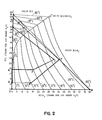
- the operation parameters of the process in accordance with this invention are described in Figs. 2 and 3 of the drawings. The process according to this invention may be particularly carried out within the area HIJK as set forh in Fig. 2.
- the process in accordance with our invention may also include a step, interposed in the process at the point after which the effluent is removed from the electrolytic cell and before the effluent is subjected to cooling crystallization, wherein any elemental chlorine present in the effluent is stripped therefrom.
- the termperature of the electrolytic cell can be controlled when the cell is equipped with coils or, preferably, when the cell liquor is passed through a heat exchanger through which is passed water at a temperature which is above the temperature at which the KClO 3 will crystallize from aqueous solutions when it is present in the concentrations selected for use in the process.
- concentrations of KCl and KCI0 3 in the electrolyte will reach an equilibrium.
- sufficient solid KCl, or KCl brine is added to the effluent to restore the KCl concentration in the enriched effluent that is returned to the cell to the level of KCL concentration in the equilibrium solution electrolyzed in the cell.
- One of the main features of this invention is the provision for the first time of a practical continuous closed-loop process for the direct conversion of potassium chloride to potassium chlorate, without the attendant inefficiencies of the prior double decomposition process.
- Another important feature of this invention is the provision of a process for producing potassium chlorate that can be practiced in the same apparatus used to convert sodium chloride to sodium chlorate electrolytically, while providing unexpected increases in current efficiency and power consumption.
- Yet another feature of the invention is that it provides a process for producing potassium chlorate that may be practiced within a wide range of operating conditions wihtout detriment to the efficiency of the process.
- potassium chloride is converted by direct electrolysis into potassium chlorate in electrolytic cells using titanium anodes, for example.
- the cells are operated individually or in groups employing series or parallel flow, so that the final cell product contains 8-20% KCI0 3 and 8-20% KCl.
- These solutions preferably have a , ratio of chloride to chlorate of at least about 0.5:1 and not more than about 2.5:1.
- Fig. 1 shows the steps of the process by reference to the apparatus components and general process conditions we employ.
- the cell product, or effluent When the cell product, or effluent, is removed from the cell or cells, it may optionally be passed through a stripper to remove dissolved elemental chlorine from the effluent before it is cooled.
- the stripped effluent liquor then passes to a cooling crystallizer, which may be operated either under a vacuum or with refrigeration.
- the effluent is cooled under a high vacuum (28 in. Hg) to a temperature of about 100°F (38°C) at which point KC10 3 crystals form as a slurry at the bottom of the crystallizer.
- the KCI0 3 product is rendered from the slurry by a conventional cyclone and a centrifuge.
- Figs. 2 and 3 illustrate the parameters of operation of this process.
- area ABC represents the theoretical range covered by our process. Outside of area ABC it is not possible to perform the steps of electrolysis (line AB) crystallization (line BC) and resaturation with solid KCl or KC1 brine (line CA). Realistically the process is most practicable within the area DEFG, while smaller area HIJK represents the desired range of operation for the continuous closed-loop process of this invention.
- Fig. 3 depicts the operation within the area HIJK of Fig. 2, with the theoretical and practical limits of a particular process set-up added for emphasis.
- the area RbFaMR represents the theoretical limits of operation for the particular process design depicted, while are RdFcMR represents the practical limits of that same design. Points R, F and M delimit the process described in the Example below.
- Line A represents the electrolytic conversion of KC1 to KCl0 3
- line B represents the vacuum flash crystallization of KCLO 3 (at a temperature of about 100°F, as indicated above);
- line C represents the resaturation of the effluent liquor with solid KC1, thus closing the material balance.
- crystallization line B on Fig. 3 will more closely approximate dM than line FM depicted. This, , and other, modifications of the process are apparent to persons skilled in this art from an examination of Figs. 2 and 3.
- a pilot cell (as disclosed in U.S. Patent No. 3,824,172) of 5000 amperes capability was operated for 22 days to produce a liquor concentration of 150 g/1 KClO 3 and 175 g/1 KC1 (13% KClO 3 and 15.3% KCl respectively).
- the material was passed through a crystallizer tank operated at 100°F.
- the recycle liquor was returned to a saturator tank where solid KC1 was added to achieve the material balance.
- Solid KClO 3 was removed from the crystallizer tank, washed and analyzed.
- the cell liquor was maintained at 75°C by a heat exchanger on the circulating liquor. Hot water was used as the cooling media to prevent chlorate purification in the exchanger and the cell.
- the power consumption during this period averaged 3800 KWH (DC) per ton of KClO 3 produced.
- Table I shows that under the same conditions of temperature and current density, the electrolysis of KC1 to KClO 3 in accordance with our process is 12% more efficient, consumes 25% less power per ton of product and produces significantly less oxygen in the cell gas, as compared with the electrolysis of NaCl to NaClO 3 .
- the efficiency of our process is further enhanced by ensuring that the apparatus in which the process is carried out is constructed so that all portions of the system which come into contact with the effluent are substantially devoid of nickel and other transition elements, in particular copper, manganese, zinc and cobalt. It has been determined that the oxygen content of the cell gas, which negatively correlates with the efficiency of conversion of chloride to chlorate (the oxygen being liberated by the undesired decomposition of the hypochlorite intermediate), is significantly reduced from usual levels when the nickel and other transition metals loadings in the cell liquor are kept below 1 ppm.
- Another refinement is the control of the water temperature, in the exchanger at a temperature which is above the temperature in which KCl0 3 will crystallize from aqueous solution when present in a particular concentration chosen for operation of the process.
- the electrolytic conversion of potassium chloride to potassium chlorate is known to be exothermic, but in the past, workers in this art have preferred to rely upon the rapid movement of the electrolyte itself through the cell to provide cooling.
- the process yields may be increased by permitting additional residence time in the cell, if the liquor is cooled, not with cold water, but with water that has a temperature which is selected to be below the equilibrium temperature of the cell, which is ordinarily about 167°F (75°C), but above the temperature at which KC10 3 will crystallize from the solution along the walls of the cell.
- This method also has the advantage of reducing power consumption for cooling over either refrigerative cooling or providing cooling by rapid transport of electrolyte through the cell.
Landscapes
- Chemical & Material Sciences (AREA)
- Inorganic Chemistry (AREA)
- Engineering & Computer Science (AREA)
- Chemical Kinetics & Catalysis (AREA)
- Electrochemistry (AREA)
- Materials Engineering (AREA)
- Metallurgy (AREA)
- Organic Chemistry (AREA)
- Electrolytic Production Of Non-Metals, Compounds, Apparatuses Therefor (AREA)
Applications Claiming Priority (2)
| Application Number | Priority Date | Filing Date | Title |
|---|---|---|---|
| US185972 | 1980-09-10 | ||
| US06/185,972 US4339312A (en) | 1980-09-10 | 1980-09-10 | Continuous process for the direct conversion of potassium chloride to potassium chlorate by electrolysis |
Publications (2)
| Publication Number | Publication Date |
|---|---|
| EP0047363A1 true EP0047363A1 (de) | 1982-03-17 |
| EP0047363B1 EP0047363B1 (de) | 1984-04-18 |
Family
ID=22683135
Family Applications (1)
| Application Number | Title | Priority Date | Filing Date |
|---|---|---|---|
| EP81104765A Expired EP0047363B1 (de) | 1980-09-10 | 1981-06-22 | Kontinuierliches Verfahren zur direkten Umwandlung von Kaliumchlorid zu Kaliumchlorat durch Elektrolyse |
Country Status (9)
| Country | Link |
|---|---|
| US (1) | US4339312A (de) |
| EP (1) | EP0047363B1 (de) |
| JP (1) | JPS5779183A (de) |
| CA (1) | CA1181718A (de) |
| CS (1) | CS231989B2 (de) |
| DD (1) | DD201918A5 (de) |
| DE (1) | DE3163194D1 (de) |
| ES (1) | ES505323A0 (de) |
| PL (1) | PL129355B1 (de) |
Families Citing this family (8)
| Publication number | Priority date | Publication date | Assignee | Title |
|---|---|---|---|---|
| US4470888A (en) * | 1983-09-08 | 1984-09-11 | Pennwalt Corporation | Method for preparing alkali metal chlorates by electrolysis |
| CA1339969C (en) * | 1988-04-22 | 1998-07-28 | Dominique Marais | Continuous process for the manufacture of potassium chlorate by coulpling with a sodium chlorate production plant |
| US6616907B2 (en) | 2000-06-13 | 2003-09-09 | M. Fazlul Hoq | Chemical preparation of chlorate salts |
| US7153586B2 (en) * | 2003-08-01 | 2006-12-26 | Vapor Technologies, Inc. | Article with scandium compound decorative coating |
| US20070026205A1 (en) | 2005-08-01 | 2007-02-01 | Vapor Technologies Inc. | Article having patterned decorative coating |
| US7708808B1 (en) | 2007-06-01 | 2010-05-04 | Fisher-Klosterman, Inc. | Cyclone separator with rotating collection chamber |
| RU2518899C2 (ru) * | 2009-05-15 | 2014-06-10 | Акцо Нобель Кемикалз Интернэшнл Б.В. | Активация катода |
| CN115353075B (zh) * | 2022-07-27 | 2023-06-27 | 浏阳市化工厂有限公司 | 一种利用电解余热重结晶提纯氯酸钾工艺及其提纯设备 |
Citations (1)
| Publication number | Priority date | Publication date | Assignee | Title |
|---|---|---|---|---|
| DE1269108B (de) * | 1964-11-26 | 1968-05-30 | Huron Nassau Ltd | Verfahren und Vorrichtung zur Herstellung von Alkalichloraten und -perchloraten durch Elektrolyse von Alkalihalogenidloesungen |
Family Cites Families (9)
| Publication number | Priority date | Publication date | Assignee | Title |
|---|---|---|---|---|
| US3329594A (en) * | 1964-12-08 | 1967-07-04 | Pittsburgh Plate Glass Co | Electrolytic production of alkali metal chlorates |
| US3948748A (en) * | 1972-03-28 | 1976-04-06 | Oronzio De Nora Impianti Elettrochimici S.P.A. | Apparatus for the production of alkali metal chlorates |
| US3824172A (en) * | 1972-07-18 | 1974-07-16 | Penn Olin Chem Co | Electrolytic cell for alkali metal chlorates |
| US3883406A (en) * | 1973-07-06 | 1975-05-13 | Pennwalt Corp | Process for recovering electrolytically produced alkali metal chlorates |
| US3878072A (en) * | 1973-11-01 | 1975-04-15 | Hooker Chemicals Plastics Corp | Electrolytic method for the manufacture of chlorates |
| US3943042A (en) * | 1974-08-02 | 1976-03-09 | Hooker Chemicals & Plastics Corporation | Anode for electrolytic processes |
| US3940323A (en) * | 1974-08-02 | 1976-02-24 | Hooker Chemicals & Plastics Corporation | Anode for electrolytic processes |
| IT1031897B (it) * | 1975-02-20 | 1979-05-10 | Oronzio De Nora Impianti | Procedimento e apparecchiatura per la produzione di alogenati alcalini |
| US4075077A (en) * | 1977-05-16 | 1978-02-21 | Pennwalt Corporation | Electrolytic cell |
-
1980
- 1980-09-10 US US06/185,972 patent/US4339312A/en not_active Expired - Lifetime
-
1981
- 1981-06-22 DE DE8181104765T patent/DE3163194D1/de not_active Expired
- 1981-06-22 EP EP81104765A patent/EP0047363B1/de not_active Expired
- 1981-07-15 CA CA000381780A patent/CA1181718A/en not_active Expired
- 1981-09-07 CS CS816591A patent/CS231989B2/cs unknown
- 1981-09-08 JP JP56140434A patent/JPS5779183A/ja active Granted
- 1981-09-09 PL PL1981232964A patent/PL129355B1/pl unknown
- 1981-09-09 ES ES505323A patent/ES505323A0/es active Granted
- 1981-09-09 DD DD81233161A patent/DD201918A5/de not_active IP Right Cessation
Patent Citations (1)
| Publication number | Priority date | Publication date | Assignee | Title |
|---|---|---|---|---|
| DE1269108B (de) * | 1964-11-26 | 1968-05-30 | Huron Nassau Ltd | Verfahren und Vorrichtung zur Herstellung von Alkalichloraten und -perchloraten durch Elektrolyse von Alkalihalogenidloesungen |
Also Published As
| Publication number | Publication date |
|---|---|
| PL232964A1 (de) | 1982-05-10 |
| ES8302798A1 (es) | 1982-12-01 |
| US4339312A (en) | 1982-07-13 |
| JPS6330991B2 (de) | 1988-06-21 |
| CA1181718A (en) | 1985-01-29 |
| PL129355B1 (en) | 1984-05-31 |
| CS231989B2 (en) | 1985-01-16 |
| JPS5779183A (en) | 1982-05-18 |
| DD201918A5 (de) | 1983-08-17 |
| DE3163194D1 (en) | 1984-05-24 |
| EP0047363B1 (de) | 1984-04-18 |
| ES505323A0 (es) | 1982-12-01 |
Similar Documents
| Publication | Publication Date | Title |
|---|---|---|
| EP0544686B1 (de) | Herstellung von chlordioxid ausgehend von chlorsäure | |
| US4036713A (en) | Process for the production of high purity lithium hydroxide | |
| EP0532188A2 (de) | Elektrochemisches Verfahren | |
| JP3089595B2 (ja) | 電解採取によるインジウムの回収方法 | |
| CA1287596C (en) | Production of sodium chlorate | |
| NO310284B1 (no) | Fremgangsmåte ved fremstilling av kloridoksyd | |
| US3597340A (en) | Recovery of lithium as lioh.h20 from aqueous chloride brines containing lithium chloride and sodium chloride | |
| EP0047363B1 (de) | Kontinuierliches Verfahren zur direkten Umwandlung von Kaliumchlorid zu Kaliumchlorat durch Elektrolyse | |
| US5004527A (en) | Continuous electrolytic production of alkali metal perchlorates | |
| CA2104746A1 (en) | Process for the production of alkali metal hydroxides and elemental sulfur from sulfur-containing alkali metal salts | |
| US3883406A (en) | Process for recovering electrolytically produced alkali metal chlorates | |
| US2511516A (en) | Process for making sodium chlorate | |
| AU630031B2 (en) | Process for the separation of sulphate | |
| JPH06158373A (ja) | アルカリ金属塩素酸塩の製造方法および装置 | |
| CA2121628A1 (en) | Process for the Production of Alkali Metal Chlorate | |
| US3043757A (en) | Electrolytic production of sodium chlorate | |
| EP0532535B1 (de) | Elektrochemische herstellung von sauren chloratloesungen | |
| JPH07145494A (ja) | 重金属電気精練法 | |
| US3553088A (en) | Method of producing alkali metal chlorate | |
| WO2000036185A2 (en) | Electrolytic production of silver salts | |
| US7250144B2 (en) | Perchlorate removal from sodium chlorate process | |
| CA2095063C (en) | Method for separating impurities from an aqueous alkali metal chlorate electrolyte | |
| US2810685A (en) | Electrolytic preparation of manganese | |
| US3400063A (en) | Two-stage electrolytic process for preparing high-concentration sodium chlorate soluttions | |
| JP3043437B2 (ja) | クロム酸の製造方法 |
Legal Events
| Date | Code | Title | Description |
|---|---|---|---|
| PUAI | Public reference made under article 153(3) epc to a published international application that has entered the european phase |
Free format text: ORIGINAL CODE: 0009012 |
|
| AK | Designated contracting states |
Designated state(s): BE DE FR GB IT NL SE |
|
| 17P | Request for examination filed |
Effective date: 19820525 |
|
| ITF | It: translation for a ep patent filed | ||
| GRAA | (expected) grant |
Free format text: ORIGINAL CODE: 0009210 |
|
| AK | Designated contracting states |
Designated state(s): BE DE FR GB IT NL SE |
|
| REF | Corresponds to: |
Ref document number: 3163194 Country of ref document: DE Date of ref document: 19840524 |
|
| ET | Fr: translation filed | ||
| PGFP | Annual fee paid to national office [announced via postgrant information from national office to epo] |
Ref country code: BE Payment date: 19840930 Year of fee payment: 4 |
|
| PLBE | No opposition filed within time limit |
Free format text: ORIGINAL CODE: 0009261 |
|
| STAA | Information on the status of an ep patent application or granted ep patent |
Free format text: STATUS: NO OPPOSITION FILED WITHIN TIME LIMIT |
|
| 26N | No opposition filed | ||
| PG25 | Lapsed in a contracting state [announced via postgrant information from national office to epo] |
Ref country code: BE Effective date: 19860630 |
|
| BERE | Be: lapsed |
Owner name: PENNWALT CORP. Effective date: 19860630 |
|
| REG | Reference to a national code |
Ref country code: GB Ref legal event code: 732 |
|
| ITPR | It: changes in ownership of a european patent |
Owner name: TRASFORMAZIONE SOCIETARIA;ATOCHEM NORTH AMERICA IN |
|
| PGFP | Annual fee paid to national office [announced via postgrant information from national office to epo] |
Ref country code: SE Payment date: 19910605 Year of fee payment: 11 |
|
| PGFP | Annual fee paid to national office [announced via postgrant information from national office to epo] |
Ref country code: NL Payment date: 19910630 Year of fee payment: 11 |
|
| PGFP | Annual fee paid to national office [announced via postgrant information from national office to epo] |
Ref country code: GB Payment date: 19920323 Year of fee payment: 12 |
|
| PG25 | Lapsed in a contracting state [announced via postgrant information from national office to epo] |
Ref country code: SE Effective date: 19920623 |
|
| PGFP | Annual fee paid to national office [announced via postgrant information from national office to epo] |
Ref country code: DE Payment date: 19920629 Year of fee payment: 12 |
|
| REG | Reference to a national code |
Ref country code: FR Ref legal event code: CD |
|
| PG25 | Lapsed in a contracting state [announced via postgrant information from national office to epo] |
Ref country code: NL Effective date: 19930101 |
|
| NLV4 | Nl: lapsed or anulled due to non-payment of the annual fee | ||
| PGFP | Annual fee paid to national office [announced via postgrant information from national office to epo] |
Ref country code: FR Payment date: 19930603 Year of fee payment: 13 |
|
| PG25 | Lapsed in a contracting state [announced via postgrant information from national office to epo] |
Ref country code: GB Effective date: 19930622 |
|
| GBPC | Gb: european patent ceased through non-payment of renewal fee |
Effective date: 19930622 |
|
| PG25 | Lapsed in a contracting state [announced via postgrant information from national office to epo] |
Ref country code: DE Effective date: 19940301 |
|
| EUG | Se: european patent has lapsed |
Ref document number: 81104765.3 Effective date: 19930109 |
|
| PG25 | Lapsed in a contracting state [announced via postgrant information from national office to epo] |
Ref country code: FR Effective date: 19950228 |
|
| REG | Reference to a national code |
Ref country code: FR Ref legal event code: ST |