EP0048430B1 - Korrosions- und kavitationshemmende Kühlflüssigkeit - Google Patents
Korrosions- und kavitationshemmende Kühlflüssigkeit Download PDFInfo
- Publication number
- EP0048430B1 EP0048430B1 EP81107256A EP81107256A EP0048430B1 EP 0048430 B1 EP0048430 B1 EP 0048430B1 EP 81107256 A EP81107256 A EP 81107256A EP 81107256 A EP81107256 A EP 81107256A EP 0048430 B1 EP0048430 B1 EP 0048430B1
- Authority
- EP
- European Patent Office
- Prior art keywords
- alkali metal
- weight
- carbon atoms
- hydrogen
- alkyl
- Prior art date
- Legal status (The legal status is an assumption and is not a legal conclusion. Google has not performed a legal analysis and makes no representation as to the accuracy of the status listed.)
- Expired
Links
- 239000012809 cooling fluid Substances 0.000 title 1
- 238000005260 corrosion Methods 0.000 claims abstract description 25
- 230000007797 corrosion Effects 0.000 claims abstract description 23
- PEDCQBHIVMGVHV-UHFFFAOYSA-N Glycerine Chemical compound OCC(O)CO PEDCQBHIVMGVHV-UHFFFAOYSA-N 0.000 claims abstract description 22
- 239000000110 cooling liquid Substances 0.000 claims abstract description 22
- 239000007788 liquid Substances 0.000 claims abstract description 22
- -1 alkylene glycols Chemical class 0.000 claims abstract description 21
- 125000004432 carbon atom Chemical group C* 0.000 claims abstract description 21
- 229910052739 hydrogen Inorganic materials 0.000 claims abstract description 13
- 239000001257 hydrogen Substances 0.000 claims abstract description 13
- 239000003112 inhibitor Substances 0.000 claims abstract description 13
- 125000000217 alkyl group Chemical group 0.000 claims abstract description 12
- 230000002401 inhibitory effect Effects 0.000 claims abstract description 12
- 229910052783 alkali metal Inorganic materials 0.000 claims abstract description 9
- 125000003342 alkenyl group Chemical group 0.000 claims abstract description 9
- 150000001875 compounds Chemical class 0.000 claims abstract description 8
- 229910052910 alkali metal silicate Inorganic materials 0.000 claims abstract description 7
- 150000005846 sugar alcohols Polymers 0.000 claims abstract description 7
- 125000001589 carboacyl group Chemical group 0.000 claims abstract description 6
- 125000004435 hydrogen atom Chemical group [H]* 0.000 claims abstract description 6
- 150000001565 benzotriazoles Chemical class 0.000 claims abstract description 4
- 150000003839 salts Chemical class 0.000 claims abstract description 4
- 150000001340 alkali metals Chemical group 0.000 claims abstract description 3
- 239000000470 constituent Substances 0.000 claims abstract description 3
- 125000006353 oxyethylene group Chemical group 0.000 claims abstract description 3
- GOOHAUXETOMSMM-UHFFFAOYSA-N Propylene oxide Chemical group CC1CO1 GOOHAUXETOMSMM-UHFFFAOYSA-N 0.000 claims abstract 2
- 229910001963 alkali metal nitrate Inorganic materials 0.000 claims abstract 2
- 229910000318 alkali metal phosphate Inorganic materials 0.000 claims abstract 2
- UFHFLCQGNIYNRP-UHFFFAOYSA-N Hydrogen Chemical compound [H][H] UFHFLCQGNIYNRP-UHFFFAOYSA-N 0.000 claims description 10
- 150000003254 radicals Chemical class 0.000 claims description 7
- ZLMJMSJWJFRBEC-UHFFFAOYSA-N Potassium Chemical group [K] ZLMJMSJWJFRBEC-UHFFFAOYSA-N 0.000 claims description 4
- DGAQECJNVWCQMB-PUAWFVPOSA-M Ilexoside XXIX Chemical group C[C@@H]1CC[C@@]2(CC[C@@]3(C(=CC[C@H]4[C@]3(CC[C@@H]5[C@@]4(CC[C@@H](C5(C)C)OS(=O)(=O)[O-])C)C)[C@@H]2[C@]1(C)O)C)C(=O)O[C@H]6[C@@H]([C@H]([C@@H]([C@H](O6)CO)O)O)O.[Na+] DGAQECJNVWCQMB-PUAWFVPOSA-M 0.000 claims description 3
- 150000002431 hydrogen Chemical group 0.000 claims description 3
- 229910052700 potassium Chemical group 0.000 claims description 3
- 239000011591 potassium Chemical group 0.000 claims description 3
- 229910052708 sodium Inorganic materials 0.000 claims description 3
- 239000011734 sodium Chemical group 0.000 claims description 3
- WCYWZMWISLQXQU-UHFFFAOYSA-N methyl Chemical compound [CH3] WCYWZMWISLQXQU-UHFFFAOYSA-N 0.000 claims description 2
- 229910052799 carbon Inorganic materials 0.000 description 24
- 239000003513 alkali Substances 0.000 description 16
- 238000001816 cooling Methods 0.000 description 10
- 238000012360 testing method Methods 0.000 description 8
- XLYOFNOQVPJJNP-UHFFFAOYSA-N water Substances O XLYOFNOQVPJJNP-UHFFFAOYSA-N 0.000 description 8
- LYCAIKOWRPUZTN-UHFFFAOYSA-N Ethylene glycol Chemical compound OCCO LYCAIKOWRPUZTN-UHFFFAOYSA-N 0.000 description 7
- 239000002826 coolant Substances 0.000 description 7
- 238000002485 combustion reaction Methods 0.000 description 6
- MTHSVFCYNBDYFN-UHFFFAOYSA-N diethylene glycol Chemical compound OCCOCCO MTHSVFCYNBDYFN-UHFFFAOYSA-N 0.000 description 6
- 230000000694 effects Effects 0.000 description 6
- 235000011187 glycerol Nutrition 0.000 description 6
- 150000002334 glycols Chemical class 0.000 description 6
- DNIAPMSPPWPWGF-UHFFFAOYSA-N Propylene glycol Chemical compound CC(O)CO DNIAPMSPPWPWGF-UHFFFAOYSA-N 0.000 description 5
- 229910052751 metal Inorganic materials 0.000 description 5
- 239000002184 metal Substances 0.000 description 5
- 150000002739 metals Chemical class 0.000 description 5
- 230000033228 biological regulation Effects 0.000 description 4
- 238000002156 mixing Methods 0.000 description 4
- 239000000126 substance Substances 0.000 description 4
- 229910000838 Al alloy Inorganic materials 0.000 description 3
- 239000000654 additive Substances 0.000 description 3
- 150000001298 alcohols Chemical class 0.000 description 3
- 230000002528 anti-freeze Effects 0.000 description 3
- 239000002518 antifoaming agent Substances 0.000 description 3
- 239000000463 material Substances 0.000 description 3
- 230000003647 oxidation Effects 0.000 description 3
- 238000007254 oxidation reaction Methods 0.000 description 3
- 229920006395 saturated elastomer Polymers 0.000 description 3
- GDTSJMKGXGJFGQ-UHFFFAOYSA-N 3,7-dioxido-2,4,6,8,9-pentaoxa-1,3,5,7-tetraborabicyclo[3.3.1]nonane Chemical compound O1B([O-])OB2OB([O-])OB1O2 GDTSJMKGXGJFGQ-UHFFFAOYSA-N 0.000 description 2
- KXDHJXZQYSOELW-UHFFFAOYSA-N Carbamic acid Chemical class NC(O)=O KXDHJXZQYSOELW-UHFFFAOYSA-N 0.000 description 2
- LFQSCWFLJHTTHZ-UHFFFAOYSA-N Ethanol Chemical compound CCO LFQSCWFLJHTTHZ-UHFFFAOYSA-N 0.000 description 2
- OAKJQQAXSVQMHS-UHFFFAOYSA-N Hydrazine Chemical compound NN OAKJQQAXSVQMHS-UHFFFAOYSA-N 0.000 description 2
- XEEYBQQBJWHFJM-UHFFFAOYSA-N Iron Chemical compound [Fe] XEEYBQQBJWHFJM-UHFFFAOYSA-N 0.000 description 2
- DIOYAVUHUXAUPX-KHPPLWFESA-N Oleoyl sarcosine Chemical compound CCCCCCCC\C=C/CCCCCCCC(=O)N(C)CC(O)=O DIOYAVUHUXAUPX-KHPPLWFESA-N 0.000 description 2
- 229910019142 PO4 Inorganic materials 0.000 description 2
- 229910052782 aluminium Inorganic materials 0.000 description 2
- XAGFODPZIPBFFR-UHFFFAOYSA-N aluminium Chemical compound [Al] XAGFODPZIPBFFR-UHFFFAOYSA-N 0.000 description 2
- 150000001558 benzoic acid derivatives Chemical class 0.000 description 2
- QRUDEWIWKLJBPS-UHFFFAOYSA-N benzotriazole Chemical compound C1=CC=C2N[N][N]C2=C1 QRUDEWIWKLJBPS-UHFFFAOYSA-N 0.000 description 2
- 150000001642 boronic acid derivatives Chemical class 0.000 description 2
- SZXQTJUDPRGNJN-UHFFFAOYSA-N dipropylene glycol Chemical compound OCCCOCCCO SZXQTJUDPRGNJN-UHFFFAOYSA-N 0.000 description 2
- 229920001971 elastomer Polymers 0.000 description 2
- 239000000806 elastomer Substances 0.000 description 2
- 239000006260 foam Substances 0.000 description 2
- 238000005187 foaming Methods 0.000 description 2
- WGCNASOHLSPBMP-UHFFFAOYSA-N hydroxyacetaldehyde Natural products OCC=O WGCNASOHLSPBMP-UHFFFAOYSA-N 0.000 description 2
- 239000007769 metal material Substances 0.000 description 2
- 239000000203 mixture Substances 0.000 description 2
- 150000002823 nitrates Chemical class 0.000 description 2
- 150000002826 nitrites Chemical class 0.000 description 2
- 150000007524 organic acids Chemical class 0.000 description 2
- 235000005985 organic acids Nutrition 0.000 description 2
- 230000010355 oscillation Effects 0.000 description 2
- 235000021317 phosphate Nutrition 0.000 description 2
- 150000003013 phosphoric acid derivatives Chemical class 0.000 description 2
- 239000004033 plastic Substances 0.000 description 2
- 229920003023 plastic Polymers 0.000 description 2
- 239000003381 stabilizer Substances 0.000 description 2
- 239000003760 tallow Substances 0.000 description 2
- 238000002604 ultrasonography Methods 0.000 description 2
- 238000005303 weighing Methods 0.000 description 2
- 230000004580 weight loss Effects 0.000 description 2
- XUJLWPFSUCHPQL-UHFFFAOYSA-N 11-methyldodecan-1-ol Chemical compound CC(C)CCCCCCCCCCO XUJLWPFSUCHPQL-UHFFFAOYSA-N 0.000 description 1
- LCZVSXRMYJUNFX-UHFFFAOYSA-N 2-[2-(2-hydroxypropoxy)propoxy]propan-1-ol Chemical compound CC(O)COC(C)COC(C)CO LCZVSXRMYJUNFX-UHFFFAOYSA-N 0.000 description 1
- BWDBEAQIHAEVLV-UHFFFAOYSA-N 6-methylheptan-1-ol Chemical compound CC(C)CCCCCO BWDBEAQIHAEVLV-UHFFFAOYSA-N 0.000 description 1
- PLLBRTOLHQQAQQ-UHFFFAOYSA-N 8-methylnonan-1-ol Chemical compound CC(C)CCCCCCCO PLLBRTOLHQQAQQ-UHFFFAOYSA-N 0.000 description 1
- BVKZGUZCCUSVTD-UHFFFAOYSA-L Carbonate Chemical compound [O-]C([O-])=O BVKZGUZCCUSVTD-UHFFFAOYSA-L 0.000 description 1
- RWSOTUBLDIXVET-UHFFFAOYSA-N Dihydrogen sulfide Chemical class S RWSOTUBLDIXVET-UHFFFAOYSA-N 0.000 description 1
- SNRUBQQJIBEYMU-UHFFFAOYSA-N Dodecane Natural products CCCCCCCCCCCC SNRUBQQJIBEYMU-UHFFFAOYSA-N 0.000 description 1
- 229910001060 Gray iron Inorganic materials 0.000 description 1
- 239000004440 Isodecyl alcohol Substances 0.000 description 1
- 229910002651 NO3 Inorganic materials 0.000 description 1
- NHNBFGGVMKEFGY-UHFFFAOYSA-N Nitrate Chemical compound [O-][N+]([O-])=O NHNBFGGVMKEFGY-UHFFFAOYSA-N 0.000 description 1
- IOVCWXUNBOPUCH-UHFFFAOYSA-M Nitrite anion Chemical compound [O-]N=O IOVCWXUNBOPUCH-UHFFFAOYSA-M 0.000 description 1
- KEAYESYHFKHZAL-UHFFFAOYSA-N Sodium Chemical compound [Na] KEAYESYHFKHZAL-UHFFFAOYSA-N 0.000 description 1
- 125000002252 acyl group Chemical group 0.000 description 1
- 229910001854 alkali hydroxide Inorganic materials 0.000 description 1
- 150000008044 alkali metal hydroxides Chemical class 0.000 description 1
- 125000002947 alkylene group Chemical group 0.000 description 1
- WPYMKLBDIGXBTP-UHFFFAOYSA-N benzoic acid Chemical compound OC(=O)C1=CC=CC=C1 WPYMKLBDIGXBTP-UHFFFAOYSA-N 0.000 description 1
- 239000012964 benzotriazole Substances 0.000 description 1
- 230000015572 biosynthetic process Effects 0.000 description 1
- 229920003086 cellulose ether Polymers 0.000 description 1
- 239000007795 chemical reaction product Substances 0.000 description 1
- 239000003795 chemical substances by application Substances 0.000 description 1
- 230000000052 comparative effect Effects 0.000 description 1
- 125000003074 decanoyl group Chemical group [H]C([H])([H])C([H])([H])C([H])([H])C([H])([H])C([H])([H])C([H])([H])C([H])([H])C([H])([H])C([H])([H])C(*)=O 0.000 description 1
- 125000002704 decyl group Chemical group [H]C([H])([H])C([H])([H])C([H])([H])C([H])([H])C([H])([H])C([H])([H])C([H])([H])C([H])([H])C([H])([H])C([H])([H])* 0.000 description 1
- 238000007865 diluting Methods 0.000 description 1
- 125000003438 dodecyl group Chemical group [H]C([H])([H])C([H])([H])C([H])([H])C([H])([H])C([H])([H])C([H])([H])C([H])([H])C([H])([H])C([H])([H])C([H])([H])C([H])([H])C([H])([H])* 0.000 description 1
- 150000002170 ethers Chemical class 0.000 description 1
- 239000012530 fluid Substances 0.000 description 1
- 229910001385 heavy metal Inorganic materials 0.000 description 1
- 150000002429 hydrazines Chemical class 0.000 description 1
- 125000001183 hydrocarbyl group Chemical group 0.000 description 1
- 230000005764 inhibitory process Effects 0.000 description 1
- 229910052742 iron Inorganic materials 0.000 description 1
- 125000000400 lauroyl group Chemical group O=C([*])C([H])([H])C([H])([H])C([H])([H])C([H])([H])C([H])([H])C([H])([H])C([H])([H])C([H])([H])C([H])([H])C([H])([H])C([H])([H])[H] 0.000 description 1
- 125000002960 margaryl group Chemical group [H]C([*])([H])C([H])([H])C([H])([H])C([H])([H])C([H])([H])C([H])([H])C([H])([H])C([H])([H])C([H])([H])C([H])([H])C([H])([H])C([H])([H])C([H])([H])C([H])([H])C([H])([H])C([H])([H])C([H])([H])[H] 0.000 description 1
- 238000005259 measurement Methods 0.000 description 1
- 125000001421 myristyl group Chemical group [H]C([*])([H])C([H])([H])C([H])([H])C([H])([H])C([H])([H])C([H])([H])C([H])([H])C([H])([H])C([H])([H])C([H])([H])C([H])([H])C([H])([H])C([H])([H])C([H])([H])[H] 0.000 description 1
- 230000009972 noncorrosive effect Effects 0.000 description 1
- 125000001117 oleyl group Chemical group [H]C([*])([H])C([H])([H])C([H])([H])C([H])([H])C([H])([H])C([H])([H])C([H])([H])C([H])([H])/C([H])=C([H])\C([H])([H])C([H])([H])C([H])([H])C([H])([H])C([H])([H])C([H])([H])C([H])([H])C([H])([H])[H] 0.000 description 1
- 150000002894 organic compounds Chemical class 0.000 description 1
- 125000000913 palmityl group Chemical group [H]C([*])([H])C([H])([H])C([H])([H])C([H])([H])C([H])([H])C([H])([H])C([H])([H])C([H])([H])C([H])([H])C([H])([H])C([H])([H])C([H])([H])C([H])([H])C([H])([H])C([H])([H])C([H])([H])[H] 0.000 description 1
- 125000002958 pentadecyl group Chemical group [H]C([*])([H])C([H])([H])C([H])([H])C([H])([H])C([H])([H])C([H])([H])C([H])([H])C([H])([H])C([H])([H])C([H])([H])C([H])([H])C([H])([H])C([H])([H])C([H])([H])C([H])([H])[H] 0.000 description 1
- 239000001267 polyvinylpyrrolidone Substances 0.000 description 1
- 235000013855 polyvinylpyrrolidone Nutrition 0.000 description 1
- 229920000036 polyvinylpyrrolidone Polymers 0.000 description 1
- 230000001105 regulatory effect Effects 0.000 description 1
- 125000004079 stearyl group Chemical group [H]C([*])([H])C([H])([H])C([H])([H])C([H])([H])C([H])([H])C([H])([H])C([H])([H])C([H])([H])C([H])([H])C([H])([H])C([H])([H])C([H])([H])C([H])([H])C([H])([H])C([H])([H])C([H])([H])C([H])([H])C([H])([H])[H] 0.000 description 1
- 238000010998 test method Methods 0.000 description 1
- 125000002889 tridecyl group Chemical group [H]C([*])([H])C([H])([H])C([H])([H])C([H])([H])C([H])([H])C([H])([H])C([H])([H])C([H])([H])C([H])([H])C([H])([H])C([H])([H])C([H])([H])C([H])([H])[H] 0.000 description 1
- ZIBGPFATKBEMQZ-UHFFFAOYSA-N triethylene glycol Chemical compound OCCOCCOCCO ZIBGPFATKBEMQZ-UHFFFAOYSA-N 0.000 description 1
- 125000000297 undecanoyl group Chemical group O=C([*])C([H])([H])C([H])([H])C([H])([H])C([H])([H])C([H])([H])C([H])([H])C([H])([H])C([H])([H])C([H])([H])C([H])([H])[H] 0.000 description 1
- 125000002948 undecyl group Chemical group [H]C([*])([H])C([H])([H])C([H])([H])C([H])([H])C([H])([H])C([H])([H])C([H])([H])C([H])([H])C([H])([H])C([H])([H])C([H])([H])[H] 0.000 description 1
Classifications
-
- C—CHEMISTRY; METALLURGY
- C09—DYES; PAINTS; POLISHES; NATURAL RESINS; ADHESIVES; COMPOSITIONS NOT OTHERWISE PROVIDED FOR; APPLICATIONS OF MATERIALS NOT OTHERWISE PROVIDED FOR
- C09K—MATERIALS FOR MISCELLANEOUS APPLICATIONS, NOT PROVIDED FOR ELSEWHERE
- C09K5/00—Heat-transfer, heat-exchange or heat-storage materials, e.g. refrigerants; Materials for the production of heat or cold by chemical reactions other than by combustion
- C09K5/20—Antifreeze additives therefor, e.g. for radiator liquids
Definitions
- the invention relates to a corrosion and cavitation-inhibiting coolant, especially for internal combustion engines.
- Water is generally used to cool technical equipment such as heat engines, pumps and the like, and, in the event of a risk of frost, polyhydric alcohols such as ethylene glycol, propylene glycol and glycerol or mixtures of water and polyhydric alcohols.
- polyhydric alcohols such as ethylene glycol, propylene glycol and glycerol or mixtures of water and polyhydric alcohols.
- various auxiliaries are added in an effective amount, preferably corrosion- and cavitation-inhibiting compounds, optionally also pH stabilizers and anti-foaming agents.
- the cooling liquids should provide a good cooling effect and, on the other hand, should not cause any damage to the cooling system, which generally consists of metallic materials, in particular no damage by corrosion and cavitation.
- cavitation damage is generally shown in the form of hollowing out or cavity formation, whereby the surface of the material is roughened and destroyed like a sponge.
- German Offenlegungsschrift 14 92 524 describes an anticorrosive and plastics, preferably elastomers, non-corrosive antifreeze based on glycols and / or glycerin.
- the inhibitory effect is achieved by adding alkali tetraborate, mercaptans, sulfurized ethers and / or alkali silicates.
- alkali tetraborate, mercaptans, sulfurized ethers and / or alkali silicates In order to avoid foaming during the circulation of the cooling liquid in the cooling circuit, small amounts of higher aliphatic alcohols and cellulose ethers are added.
- the pH value of the antifreeze is regulated with the help of an appropriate amount of alkali hydroxide or alkali carbonate.
- This known cooling liquid is probably anticorrosive, but it has a relatively low anti-cavitation effect.
- cooling liquids for internal combustion engines which essentially consist of a) water and / or alkylene glycols (antifreeze) as the main component, b) an effective amount of conventional anti-corrosion agents and c) one effective amount of anti-cavitation compounds exist.
- the cavitation-inhibiting compounds used are higher alcohols, preferably monohydric and dihydric alcohols having 6 to 20 carbon atoms, polyvinylpyrrolidone with an average molecular weight of 300,000 to 1,000,000 and reaction products of organic compounds carrying active hydrogen atoms with an alkylene oxide, preferably oxalkylene glycols.
- Cavitation-inhibiting substances are primarily intended to provide very good protection against cavitation, regardless of the type of metallic material.
- automobile engines in particular have increasingly been manufactured from light metals, preferably from aluminum or aluminum alloys.
- light metals are far more at risk of cavitation than heavy metals, for example gray cast iron.
- Cavitation-inhibiting substances must therefore be particularly effective against light metals. In addition, they should also meet a number of other requirements.
- US-A-3 629 111 describes a corrosion inhibitor combination for a hydraulic fluid based on glycols, which consists of hydrazine or hydrazine derivatives as one and organic acids as the other corrosion inhibitor.
- organic acids such as N-oleoylsarcosine are also mentioned.
- This corrosion inhibitor system for liquids based on glycols does not meet current requirements. In particular, it is not very stable to oxidation, which is why a relatively large amount of oxidation stabilizers such as alkylphenols are required, as can be seen from the examples of the patent specification.
- GB-A-2 009 133 also describes a corrosion inhibitor system composed of aminocarboxylic acids and another special nitrogen-containing organic compound which is said to be particularly effective against iron.
- the corrosion-inhibiting effect on light metals in particular leaves something to be desired.
- the object of the invention is now to provide a cooling liquid based on polyhydric alcohols, especially for internal combustion engines, which meets today's requirements with regard to both corrosion protection and cavitation protection.
- the new coolant is also said to provide excellent protection against corrosion and cavitation
- Light metals preferably aluminum and aluminum alloys have. It should also be stable, that is to say represent a homogeneous liquid both at low and high temperatures, should not foam appreciably and should be easy to handle.
- radicals R and R 1 can be straight-chain or branched, they are preferably straight-chain.
- alkenyl and alkenoyl radicals those with 1 to 2 double bonds in the hydrocarbon chain are preferred.
- Palm kernel alkyl corresponds to the following typical chain distribution in percent by weight: Saturated: C 6 0.5%, C 8 4%, C 10 5%, C 12 50%, C 14 15%, C 16 7% and C 18 2%; unsaturated: C 16 (with one double bond) 0.5%, C 18 (with one double bond) 15% and C 18 (with two double bonds) 1%.
- Component A of the cooling liquid according to the invention is preferably glycerol, an alkylene glycol with 2 to 4 carbon atoms and / or an oxalkylene glycol from the group of diethylene glycol, triethylene glycol, dipropylene glycol and tripropylene glycol.
- Monoethylene glycol, diethylene glycol, monopropylene glycol and / or dipropylene glycol are particularly preferred as component A.
- Component A is the main component of the new coolant.
- the amount is generally 87 to 98% by weight, preferably 92 to 97% by weight, based on the weight of the liquid (total weight).
- Component B consists of an effective amount of at least one corrosion inhibitor from the group of alkali borates, alkali benzoates, alkali nitrites, alkali nitrates, alkali silicates, alkali phosphates, benzotriazoles and alkanolamines and their salts. Since these compounds generally also have a pH-stabilizing effect, own buffer substances are no longer required. As a rule, a mixture of the corrosion inhibitors mentioned is used.
- a preferred corrosion inhibitor consists essentially of alkali tetraborate in an amount of 0.5 to 5% by weight, alkali benzoate in an amount of 0.5 to 5% by weight, alkali nitrite in an amount of 0.1 to 0.6% by weight %, Alkali nitrate in an amount of 0.05 to 0.5% by weight, alkali silicate in an amount of 0.01 to 0.5% by weight and benzotriazole in an amount of 0.01 to 0.5 % By weight, percent by weight, in each case based on the weight of the liquid.
- the amount of corrosion inhibitor in the cooling liquid according to the invention is generally 2 to 10% by weight, preferably 3 to 7% by weight, based on the weight of the liquid.
- the amount of component C in the cooling liquid according to the invention is preferably 0.05 to 1% by weight, in particular 0.1 to 0.5% by weight, based on the weight of the liquid.
- cooling liquid according to the invention can also contain useful additives, for example anti-foaming agents, in effective amounts.
- Suitable antifoams are, for example, higher aliphatic alcohols, preferably monohydric alcohols having 8 to 20 carbon atoms, for example iso-octyl alcohol, iso-decyl alcohol and iso-tridecyl alcohol.
- the effective amount is 0.01 to 1 wt .-%, based on the weight of the liquid.
- the amount of water is generally 0.1 to 1 wt .-%, based on the weight of the liquid.
- the cooling liquid according to the invention is produced simply by mixing the individual components together. This can be done, for example, in a container equipped with a stirrer.
- the cooling liquid according to the invention is distinguished by a surprisingly high anti-cavitation and anti-corrosion effect. Since the individual components of the liquid are compatible with one another, it is stable even at relatively high and low temperatures. It shows low foaming, especially when using known anti-foaming agents.
- the coolant according to the invention is versatile. It is preferably used in the cooling circuit of heat engines and pumps, especially internal combustion engines. It is expediently diluted with water so that it is present in a concentration of 20 to 45 percent by volume.
- a cooling liquid according to the invention was produced by mixing the following components:
- a cooling liquid according to the invention was produced by mixing the following components:
- a cooling liquid according to the invention was produced by mixing the following components: sarcosins)
- Connection 4 is: (
- Connection 5 is:
- Connection 6 is:
- Example 7 comparative example
- This cooling liquid consists of the components of Example 1, but without the addition of N-oleoylsarcosine according to the invention:
- test specimens made from the aluminum alloy AlCuMg 2 were measured in accordance with this test method. Each test specimen was exposed to vibration cavitation in the liquid to be tested in an ultrasound apparatus, the oscillation frequency being 20 kHz ⁇ 250 Hz and amplitude of the oscillation on the test specimen 20 ⁇ m, and the temperature of the cooling liquid being 80 ° C ⁇ 1.
Landscapes
- Chemical & Material Sciences (AREA)
- Engineering & Computer Science (AREA)
- Physics & Mathematics (AREA)
- Chemical Kinetics & Catalysis (AREA)
- Combustion & Propulsion (AREA)
- Thermal Sciences (AREA)
- Materials Engineering (AREA)
- Organic Chemistry (AREA)
- Preventing Corrosion Or Incrustation Of Metals (AREA)
Description
- Die Erfindung betrifft eine korrosions- und kavitationshemmende Kühlflüssigkeit, insbesondere für Verbrennungsmotoren.
- Zum Kühlen von technischen Einrichtungen wie Wärmekraftmaschinen, Pumpen und dergleichen werden im allgemeinen Wasser, und im Falle von Frostgefahr mehrwertige Alkohole wie Ethylenglykol, Propylenglykol und Glycerin oder Mischungen von Wasser und mehrwertigen Alkoholen eingesetzt. Zur Erreichung einer optimalen Funktion werden verschiedene Hilfsmittel in wirksamer Menge, vorzugsweise korrosions- und kavitationshemmende Verbindungen, gegebenenfalls auch pH-Wert-Stabilisatoren und Antischaummittel, zugesetzt. Die Kühlflüssigkeiten sollen nämlich einerseits eine gute Kühlwirkung liefern und andererseits keine Schädigung an dem in der Regel aus metallischen Werkstoffen bestehenden Kühlsystem hervorrufen, insbesondere keine Schädigung durch Korrosion und Kavitation.
- Während die Schädigung des Werkstoffes durch Korrosion auf einem rein chemischen Angriff des Werkstoffes beruht, spielen bei der Kavitation auch physikalische Erscheinungen eine wesentliche Rolle. Die Kavitationsschädigung zeigt sich im allgemeinen in Form von Aushöhlung oder Hohlraumbildung, wobei die Oberfläche des Werkstoffes aufgerauht und schwammartig zerstört wird.
- In der deutschen Offenlegungsschrift 14 92 524 wird ein korrosionshemmendes und Kunststoffe, vorzugsweise Elastomere, nicht angreifendes Frostschutzmittel auf der Basis von Glykolen und/oder Glycerin beschrieben. Die inhibitorische Wirkung wird durch einen Zusatz von Alkalitetraborat, Merkaptanen, sulfurierten Ethern und/oder Alkalisilikaten erreicht. Um die Schaumbildung während des Umlaufes der Kühlflüssigkeit im Kühlkreislauf zu vermeiden, werden geringe Mengen an aliphatischen höheren Alkoholen und Celluloseethern zugesetzt. Der pH-Wert des Frostschutzmittels wird mit Hilfe einer entsprechenden Menge an Alkalihydroxid oder Alkalicarbonat reguliert.
- Diese bekannte Kühlflüssigkeit ist wohl antikorrosiv ausgerüstet, sie weist jedoch eine relativ geringe kavitationshemmende Wirkung auf.
- Aus den deutschen Patentschriften 12 39 137, 12 39 138 und 12 63 398 sind Kühlflüssigkeiten für Verbrennungsmotoren bekannt, die im wesentlichen aus a) Wasser und/oder Alkylenglykolen (Frostschutzmittel) als Hauptbestandteil, b) einer wirksamen Menge von üblichen Antikorrosionsmitteln und c) einer wirksamen Menge von kavitationshemmenden Verbindungen bestehen.
- Als kavitationshemmende Verbindungen werden höhere Alkohole, vorzugsweise einwertige und zweiwertige Alkohole mit 6 bis 20 Kohlenstoffatomen, Polyvinylpyrrolidon mit einem mittleren Molekulargewicht von 300 000 bis 1 000000 und Umsetzungsprodukte von aktive Wasserstoffatome tragenden organischen Verbindungen mit einem Alkylenoxid, vorzugsweise Oxalkylenglykole eingesetzt.
- Diese Kühlflüssigkeiten weisen eine zufriedenstellende Korrosionsinhibierung auf. Die verwendeten Korrosionsinhibitoren sind mit der Hauptkomponente verträglich und sie geben auch einen relativ guten Korrosionsschutz. Dagegen läßt aber das Verhalten und die Wirkung der kavitationshemmenden Verbindungen zu wünschen übrig.
- Kavitationshemmende Substanzen sollen vor allem einen sehr guten Schutz gegen Kavitation liefern, und zwar unabhängig von der Art des metallischen Werkstoffes. In neuerer Zeit werden insbesondere die Automobilmotoren zunehmend aus Leichtmetallen, vorzugsweise aus Aluminium oder Aluminiumlegierungen, hergestellt. Leichtmetalle sind aber weit mehr kavitationsgefährdet als Schwermetalle, beispielsweise Grauguß. Kavitationshemmende Substanzen müssen daher insbesondere auch gegenüber Leichtmetallen wirksam sein. Darüberhinaus sollten sie auch noch eine Reihe weiterer Forderungen erfüllen. Darunter sind insbesondere zu nennen : genügende Löslichkeit in Wasser und in ein- und mehrwertigen Alkoholen, vorzugsweise Glycerin, Alkylenglykolen und Oxalkylenglykolen ; Verträglichkeit mit den verwendeten Korrosionsinhibitoren ; keine oder keine nennenswerte Entmischungsneigung sowohl bei tiefen als auch bei höheren Temperaturen ; keine oder keine nennenswerte Neigung zur Schaumbildung ; und Inertheit gegenüber Kunststoffen, vorzugsweise gegenüber Elastomeren.
- In der US-A-3 629 111 ist eine Korrosionsinhibitor-Kombination für eine hydraulische Flüssigkeit auf der Basis von Glykolen beschrieben, die aus Hydrazin oder Hydrazinderivaten als dem einen und aus organischen Säuren als dem anderen Korrosionsinhibitor besteht. Unter den vielen in Betracht kommenden organischen Säuren werden auch Aminocarbonsäuren wie N-Oleoylsarkosin genannt. Dieses Korrosionsinhibitorsystem für Flüssigkeiten auf der Basis von Glykolen genügt den derzeitigen Forderungen nicht. Es ist insbesondere wenig oxidationsstabil, weshalb eine relativ große Menge an Oxidationsstabilisatoren wie Alkylphenolen erforderlich sind, wie aus den Beispielen der Patentschrift hervorgeht.
- Auch in der GB-A-2 009 133 wird ein Korrosionsinhibitorsystem aus Aminocarbonsäuren und einer weiteren speziellen Stickstoff enthaltenden organischen Verbindung beschrieben, das insbesondere gegenüber Eisen wirksam sein soll. Neben der geringen Oxidationsstabilität läßt insbesondere die korrosionsinhibierende Wirkung gegenüber Leichtmetallen zu wünschen übrig.
- Die Aufgabe der Erfindung besteht nun darin, eine Kühlflüssigkeit auf der Basis von mehrwertigen Alkoholen zur Verfügung zu stellen, insbesondere für Verbrennungsmotoren, die den heutigen Forderungen sowohl hinsichtlich Korrosionsschutz als auch hinsichtlich Kavitationsschutz gerecht wird. Die neue Kühlflüssigkeit soll einen hervorragenden Korrosions- und Kavitationsschutz auch gegenüber Leichtmetallen, vorzugsweise Aluminium und Aluminiumlegierungen, aufweisen. Sie soll ferner stabil sein, das heißt eine homogene Flüssigkeit sowohl bei tiefen als auch bei hohen Temperaturen darstellen, nicht nennenswert schäumen und leicht zu handhaben sein.
- Diese Aufgabe wird erfindungsgemäß gelöst durch eine Kühlflüssigkeit, bestehend im wesentlichen aus
- A) mindestens einem mehrwertigen Alkohol aus der Gruppe von Glycerin, Alkylenglykolen mit 2 bis 6 C-Atomen und Oxalkylenglykolen des Oxethylens und/oder Oxpropylens mit insgesamt 4 bis 12 C-Atomen als Hauptbestandteil,
- B) einer wirksamen Menge von mindestens einem Korrosionsinhibitor aus der Gruppe Alkaliborate, Alkalibenzoate, Alkalinitrite, Alkalinitrate, Alkalisilicate, Alkaliphosphate, Benztriazole und Alkanolamine und deren Salze, und
- C) 0,01 bis 3,0 Gew.-%, bezogen auf das Gewicht der Flüssigkeit, von mindestens einer Verbindung der Formel I

- R einen Alkyl-, Alkenyl-, Alkanoyl- oder Alkenoylrest mit 4 bis 25 C-Atomen,
- R1 Wasserstoff oder einen Alkylrest mit 1 bis 4 C-Atomen,
- M Wasserstoff oder ein Alkalimetall, und
- x eine ganze Zahl von 1 bis 5.
- R bedeutet vorzugsweise einen Alkyl-, Alkenyl-, Alkanoyl- oder Alkenoylrest mit 8 bis 18 C-Atomen, insbesondere mit 12 bis 18 C-Atomen.
- R1 bedeutet vorzugsweise Wasserstoff oder einen Alkylrest mit 1 bis 3 C-Atomen, insbesondere Wasserstoff oder den Methylrest.
- M bedeutet vorzugsweise Wasserstoff, Natrium oder Kalium.
- x bedeutet vorzugsweise eine ganze Zahl von 1 bis 3, insbesondere 1.
- Die Reste R und R1 können geradkettig oder verzweigt sein, sie sind vorzugsweise geradkettig. Von den Alkenyl- und Alkenoylresten sind diejenigen mit 1 bis 2 Doppelbindungen in der KohlenwasserstoffKette bevorzugt.
- Vorteilhafte Vertreter von R sind beispielsweise : Decyl, Undecyl, Dodecyl, Tridecyl, Tetradecyl, Pentadecyl, Hexadecyl, Heptadecyl, Stearyl, Oleyl, Cocosalkyl, Talgalkyl und Palmkernalkyl, und die entsprechenden Acylreste (Decanoyl, Undecanoyl, Dodecanoyl usw.) Cocosalkyl entspricht der folgenden typischen Kettenverteilung in Gewichtsprozent:
- Gesättigt : C6 0,5 %, C8 8 %, C10 7 %, C12 48%, C14 17 %, C16 9 % und C18 2 % ; ungesättigt: C16 (mit einer Doppelbindung) 0,2 %, C18 (mit einer Doppelbindung) 7 % und C18 (mit 2 Doppelbindungen) 1,3 %. Talgalkyl entspricht der folgenden typischen Kettenverteilung in Gewichtsprozent: Gesättigt : C12 0,5 %, C14 3 %, C15 1 %, C16 25 %, C17 2 %, C18 19 % und C20 1 % ; ungesättigt: C14 (mit einer Doppelbindung) 0,5%, C16 (mit einer Doppelbindung) 3%, C18 (mit einer Doppelbindung) 40%, C18 (mit zwei Doppelbindungen) 4% und C18 (mit drei Doppelbindungen) 1 %.
- Palmkernalkyl entspricht der folgenden typischen Kettenverteilung in Gewichtsprozent: Gesättigt : C6 0,5 %, C8 4%, C10 5%, C12 50 %, C14 15 %, C16 7% und C18 2%; ungesättigt: C16 (mit einer Doppelbindung) 0,5 %, C18 (mit einer Doppelbindung) 15 % und C18 (mit zwei Doppelbindungen) 1 %.
- Die Komponente A der erfindungsgemäßen Kühlflüssigkeit ist vorzugsweise Glycerin, ein Alkylenglykol mit 2 bis 4 C-Atomen und/oder ein Oxalkylenglykol aus der Gruppe von Diethylenglykol, Triethylenglykol, Dipropylenglykol und Tripropylenglykol. Besonders bevorzugt als Komponente A ist Monoethylenglykol, Diethylenglykol, Monopropylenglykol und/oder Dipropylenglykol.
- Die Komponente A bildet den Hauptbestandteil der neuen Kühlflüssigkeit. Die Menge beträgt im allgemeinen 87 bis 98 Gew.-%, vorzugsweise 92 bis 97 Gew.-%, bezogen auf das Gewicht der Flüssigkeit (Gesamtgewicht).
- Die Komponente B besteht aus einer wirksamen Menge von mindestens einem Korrosionsinhibitor aus der Gruppe der Alkaliborate, Alkalibenzoate, Alkalinitrite, Alkalinitrate, Alkalisilicate, Alkaliphosphate, Benztriazole und Alkanolamine und deren Salze. Da diese Verbindungen im allgemeinen auch pH-Wertstabilisierend wirken, sind eigene Puffersubstanzen nicht mehr erforderlich. In der Regel wird eine Mischung aus den genannten Korrosionsinhibitoren verwendet. Ein bevorzugter Korrosionsinhibitor besteht im wesentlichen aus Alkalitetraborat in einer Menge von 0,5 bis 5 Gew.-%, Alkalibenzoat in einer Menge von 0,5 bis 5 Gew.-%, Alkalinitrit in einer Menge von 0,1 bis 0,6 Gew.-%, Alkalinitrat in einer Menge von 0,05 bis 0,5 Gew.-%, Alkalisilicat in einer Menge von 0,01 bis 0,5 Gew.-% und Benztriazol in einer Menge von 0,01 bis 0,5 Gew.-%, Gewichtsprozent, jeweils bezogen auf das Gewicht der Flüssigkeit.
- Die Menge an Korrosionsinhibitor in der erfindungsgemäßen Kühlflüssigkeit beträgt im allgemeinen 2 bis 10 Gew.-%, vorzugsweise 3 bis 7 Gew.-%, bezogen auf das Gewicht der Flüssigkeit.
- Die Menge an der Komponente C in der erfindungsgemäßen Kühlflüssigkeit beträgt vorzugsweise 0,05 bis 1 Gew.-%, insbesondere 0,1 bis 0,5 Gew.-%, bezogen auf das Gewicht der Flüssigkeit.
- Die erfindungsgemäße Kühlflüssigkeit kann zusätzlich zu den Komponenten A, B und C auch noch zweckmäßige Additive, beispielsweise Antischaummittel, in wirksamen Mengen enthalten.
- Als Antischaummittel kommen beispielsweise höhere aliphatische Alkohole, vorzugsweise einwertige Alkohole mit 8 bis 20 C-Atomen, beispielsweise iso-Octylalkohol, iso-Decylalkohol und iso-Tridecylalkohol, in Betracht. Die wirksame Menge liegt bei 0,01 bis 1 Gew.-%, bezogen auf das Gewicht der Flüssigkeit.
- Um die Löslichkeit der Komponenten und der Additive zu erleichtern, können geringe Mengen Wasser zugesetzt werden. Die Menge an Wasser beträgt im allgemeinen 0,1 bis 1 Gew.-%, bezogen auf das Gewicht der Flüssigkeit.
- Die Herstellung der erfindungsgemäßen Kühlflüssigkeit erfolgt einfach durch Zusammenmischen der einzelnen Komponenten. Dies kann beispielsweise in einem mit Rührer ausgestatteten Behälter vorgenommen werden.
- Die erfindungsgemäße Kühlflüssigkeit zeichnet sich durch eine überraschendhohe kavitationshemmende und korrosionshemmende Wirkung aus. Da die einzelnen Komponenten der Flüssigkeit miteinander verträglich sind, ist sie stabil auch bei relativ hohen und tiefen Temperaturen. Sie zeigt, insbesondere bei Verwendung bekannter Antischaummittel, geringe Schaumbildung.
- Das erfindungsgemäße Kühlmittel ist vielseitig einsetzbar. Es wird vorzugsweise im Kühlkreislauf von Wärmekraftmaschinen und Pumpen, insbesondere von Verbrennungsmotoren, eingesetzt. Dabei wird es zweckmäßigerweise mit Wasser verdünnt, so daß es in einer Konzentration von 20 bis 45 Volumenprozent vorliegt.
- Die Erfindung wird nun durch die folgenden Beispiele noch näher erläutert.
- Es wurde eine erfindungsgemäße Kühlflüssigkeit hergestellt durch Mischen der folgenden Komponenten :

- Es wurde eine erfindungsgemäße Kühlflüssigkeit hergestellt durch Mischen der folgenden Komponenten :

- Es wurde eine erfindungsgemäße Kühlflüssigkeit hergestellt durch Mischen der folgenden Komponenten :

- Die Beispiele 4 bis 6 zeigen weitere erfindungsgemäße Kühlflüssigkeiten ; die einzelnen Komponenten und ihre Anteile in Gewichtsprozent sind nachstehend zusammengefaßt:

- Die Verbindung 4 ist : (
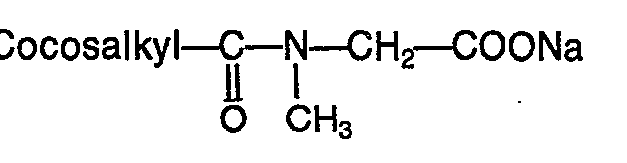
- Die Verbindung 5 ist :

- Die Verbindung 6 ist :

- Diese Kühlflüssigkeit besteht aus den Komponenten des Beispiels 1, jedoch ohne den erfindungsgemäßen Zusatz von N-Oleoylsarkosin :

- Die Prüfung der Kühlflüssigkeiten nach den Beispielen 1 bis 7 auf ihre antikavitative Wirkung erfolgte nach den Vorschriften der Forschungsvereinigung Verbrennungskraftmaschinen E. V. Frankfurt/Main, Bundesrepublik Deutschland.
- Diese Vorschriften sind in den Richtlinien zur « Prüfung der Eignung von Kühlmittelzusätzen für die Kühlflüssigkeiten von Verbrennungsmotoren », Heft R 315, Jahr 1977, beschrieben.
- Entsprechend dieser Prüfmethode wurde die Gewichtsabnahme von Prüfkörpern aus der Aluminiumlegierung AlCuMg2, gemessen. Je ein Prüfkörper wurde in der zu testenden Flüssigkeit in einer Ultraschallapparatur der Schwingungskavitation ausgesetzt, wobei die Schwingungsfrequenz 20 kHz ± 250 Hz und Amplitude der Schwingung am Prüfkörper 20 µm beträgt, und die Temperatur der Kühlflüssigkeit bei 80 °C ± 1 liegt.
- Entsprechend den gennanten Vorschriften wurden jeweils 4000 ml Flüssigkeit eingesetzt, die dadurch bereitet worden ist, daß die Kühlflüssigkeit gemäß den Beispielen 1 bis 7 mit Wasser 1 : 10 verdünnt wurde. Die Prüfkörper wurden achtmal hintereinander, nach jeweils 10 Minuten Behandlung in der gennanten Ultraschallapparatur, gewogen. Die Auswertung der acht Wägungen pro Prüfkörper und pro Kühlflüssigkeit erfolgte ebenfalls nach den genannten Vorschriften :
- Danach werden die ersten vier Wägungen nicht berücksichtigt. Von den restlichen vier Werten wird der höchste und der niedrigste Wert ebenfalls nicht berücksichtigt. Aus den verbleibenden zwei Werten wird das arithmetische Mittel gebildet. Dieser Gewichtswert, ausgedrückt in Milligramm pro Stunde, stellt das Testergebnis, nämlich die Gewichtsabnahme des Prüfkörpers, dar.
- Nachstehend sind die Meßergebnisse mit den Kühlflüssigkeiten gemäß den Beispielen 1 bis 7 zusammengefaßt :

Claims (5)

Priority Applications (1)
| Application Number | Priority Date | Filing Date | Title |
|---|---|---|---|
| AT81107256T ATE10854T1 (de) | 1980-09-19 | 1981-09-15 | Korrosions- und kavitationshemmende kuehlfluessigkeit. |
Applications Claiming Priority (2)
| Application Number | Priority Date | Filing Date | Title |
|---|---|---|---|
| DE3035326 | 1980-09-19 | ||
| DE19803035326 DE3035326A1 (de) | 1980-09-19 | 1980-09-19 | Korrosions- und kavitationshemmende kuehlfluessigkeit |
Publications (2)
| Publication Number | Publication Date |
|---|---|
| EP0048430A1 EP0048430A1 (de) | 1982-03-31 |
| EP0048430B1 true EP0048430B1 (de) | 1984-12-19 |
Family
ID=6112333
Family Applications (1)
| Application Number | Title | Priority Date | Filing Date |
|---|---|---|---|
| EP81107256A Expired EP0048430B1 (de) | 1980-09-19 | 1981-09-15 | Korrosions- und kavitationshemmende Kühlflüssigkeit |
Country Status (3)
| Country | Link |
|---|---|
| EP (1) | EP0048430B1 (de) |
| AT (1) | ATE10854T1 (de) |
| DE (2) | DE3035326A1 (de) |
Families Citing this family (4)
| Publication number | Priority date | Publication date | Assignee | Title |
|---|---|---|---|---|
| FR2620134B1 (fr) * | 1987-09-09 | 1991-11-22 | France Etat Armement | Composition inhibitrice de corrosion pour metaux |
| RU2139907C1 (ru) * | 1998-05-26 | 1999-10-20 | ОАО "Нижнекамскнефтехим" | Жидкий теплоноситель |
| RU2137798C1 (ru) * | 1998-11-10 | 1999-09-20 | Открытое акционерное общество "Ракетно-космическая корпорация "Энергия" им.С.П.Королева | Композиция низкотемпературного теплоносителя |
| US20080230740A1 (en) * | 2003-11-13 | 2008-09-25 | Vladisav Milovanovic | Nontoxic Watery Solution Against Freezing and Corrosion and the Regenerator For the Utilized Antifreeze |
Family Cites Families (5)
| Publication number | Priority date | Publication date | Assignee | Title |
|---|---|---|---|---|
| US2790779A (en) * | 1953-07-27 | 1957-04-30 | Geigy Chem Corp | Rust preventive compositions containing monoamidocarboxylic acids |
| CH357130A (de) * | 1957-07-11 | 1961-09-30 | Geigy Ag J R | Rostschutzmittel |
| US3629111A (en) * | 1970-10-02 | 1971-12-21 | Olin Corp | Hydraulic fluids containing novel inhibitor compositions |
| US3787227A (en) * | 1972-06-29 | 1974-01-22 | Grace W R & Co | Rust preventative compositions |
| US4238350A (en) * | 1977-11-16 | 1980-12-09 | Malaco Ag | Method and a composition for inhibiting corrosion |
-
1980
- 1980-09-19 DE DE19803035326 patent/DE3035326A1/de not_active Withdrawn
-
1981
- 1981-09-15 EP EP81107256A patent/EP0048430B1/de not_active Expired
- 1981-09-15 AT AT81107256T patent/ATE10854T1/de not_active IP Right Cessation
- 1981-09-15 DE DE8181107256T patent/DE3167843D1/de not_active Expired
Also Published As
| Publication number | Publication date |
|---|---|
| DE3035326A1 (de) | 1982-05-06 |
| DE3167843D1 (en) | 1985-01-31 |
| EP0048430A1 (de) | 1982-03-31 |
| ATE10854T1 (de) | 1985-01-15 |
Similar Documents
| Publication | Publication Date | Title |
|---|---|---|
| EP0048429B1 (de) | Korrosionsinhibierende und kavitationsinhibierende Kühlflüssigkeit | |
| DE2141441C3 (de) | Wasserunempfindliche hydraulische Flüssigkeit | |
| DE69609193T2 (de) | Neosäure als korrosinsinhibitoren | |
| DE69905072T2 (de) | Korrosionsinhibitoren und synergistische inhibitorkombinationen zum schutz von leichtmetallen in wärmeübertragungsflüssigkeiten und motorkühlflüssigkeiten | |
| DE69220209T2 (de) | Korrosionsverhindernde Gefrierschutzmittel | |
| EP0880566B1 (de) | Verwendung von quaternierten imidazolen als buntmetall-korrosionsinhibitoren und diese enthaltende gefrierschutzmittelkonzentrate und kühlmittelzusammensetzungen | |
| DE10064737A1 (de) | Wäßrige Kühlmittel für die Motoreneinlaufphase enthaltend Dampfraumkorrosionsinhibitoren | |
| DE69430139T2 (de) | Nicht-wässrige wärmeträgerflüssigkeit | |
| EP0237959A1 (de) | Wasserlösliche Mischungen von Fettsäure-Ammonium-Salzen und Polyolfettsäuren bzw. deren Alkali-oder Ammoniumsalzen, Verfahren zu ihrer Herstellung und ihre Verwendung als Korrosionsinhibitoren in wässrigen Systemen | |
| DE4204809A1 (de) | Hartwasserstabile, phosphathaltige kuehlstoffmischungen | |
| DE19930682A1 (de) | Silikat-, borat- und phosphatfreie Kühlflüssigkeiten auf Basis von Glykolen mit verbessertem Korrosionsverhalten | |
| DE69815418T2 (de) | Gefrier-/Kühlmittelzusammensetzung | |
| EP0048430B1 (de) | Korrosions- und kavitationshemmende Kühlflüssigkeit | |
| EP0863960B1 (de) | Gefrierschutzmittel | |
| EP1098949B1 (de) | Gefrierschutzmittelkonzentrate und diese enthaltende kühlmittelzusammensetzungen für kühlkreisläufe in verbrennungsmotoren | |
| EP0027870B1 (de) | Kavitationshemmende, frostsichere Kühl- bzw. Wärmeübertragungsflüssigkeiten sowie Verwendung eines kavitationshemmenden Zusatzes in frostsicheren Kühl- bzw. Wärmeübertragungsflüssigkeiten | |
| EP0081738B1 (de) | Nitritfreie Kühlflüssigkeiten auf der Basis von Glykolen | |
| EP1111092B1 (de) | Benzoat enthaltende wässrige Motoreinlauf-Kühlflüssigkeit mit Dampfraumkorrosionsschutz | |
| EP1025181B1 (de) | Kühlflüssigkeit zur verwendung in bauteilen aus magnesium | |
| DE10201446A1 (de) | Wässrige Kühlmittel für die Motoreneinlaufphase enthaltend Ammoniumsalze von Phthalsäuremonoamiden | |
| DE3512351C2 (de) | Antikorrodierende Schmiermittelzusammensetzungen zur Behandlung von Metallplatten | |
| EP0345613B1 (de) | Korrosionsinhibierte und physiologisch vorteilhafte funktionelle Flüssigkeiten auf der Basis von Glykolen | |
| DE10235390A1 (de) | Gefrierschutzmittel | |
| DE1262679B (de) | Korrosionshemmendes Gefrierschutzmittel | |
| DE19952482A1 (de) | Gefrierschutzmittelkonzentrate auf Basis von Dicarbonsäuren, Monolybdat und Thiazolen und diese umfassende Kühlmittelzusammensetzungen |
Legal Events
| Date | Code | Title | Description |
|---|---|---|---|
| PUAI | Public reference made under article 153(3) epc to a published international application that has entered the european phase |
Free format text: ORIGINAL CODE: 0009012 |
|
| 17P | Request for examination filed |
Effective date: 19811028 |
|
| AK | Designated contracting states |
Designated state(s): AT BE CH DE FR GB IT NL SE |
|
| ITF | It: translation for a ep patent filed | ||
| GRAA | (expected) grant |
Free format text: ORIGINAL CODE: 0009210 |
|
| AK | Designated contracting states |
Designated state(s): AT BE CH DE FR GB IT LI NL SE |
|
| REF | Corresponds to: |
Ref document number: 10854 Country of ref document: AT Date of ref document: 19850115 Kind code of ref document: T |
|
| REF | Corresponds to: |
Ref document number: 3167843 Country of ref document: DE Date of ref document: 19850131 |
|
| ET | Fr: translation filed | ||
| PLBE | No opposition filed within time limit |
Free format text: ORIGINAL CODE: 0009261 |
|
| STAA | Information on the status of an ep patent application or granted ep patent |
Free format text: STATUS: NO OPPOSITION FILED WITHIN TIME LIMIT |
|
| 26N | No opposition filed | ||
| PGFP | Annual fee paid to national office [announced via postgrant information from national office to epo] |
Ref country code: AT Payment date: 19860825 Year of fee payment: 6 |
|
| PGFP | Annual fee paid to national office [announced via postgrant information from national office to epo] |
Ref country code: NL Payment date: 19860930 Year of fee payment: 6 |
|
| PG25 | Lapsed in a contracting state [announced via postgrant information from national office to epo] |
Ref country code: AT Effective date: 19870915 |
|
| PG25 | Lapsed in a contracting state [announced via postgrant information from national office to epo] |
Ref country code: SE Effective date: 19870916 |
|
| PG25 | Lapsed in a contracting state [announced via postgrant information from national office to epo] |
Ref country code: LI Effective date: 19870930 Ref country code: CH Effective date: 19870930 Ref country code: BE Effective date: 19870930 |
|
| BERE | Be: lapsed |
Owner name: HOECHST A.G. Effective date: 19870930 |
|
| PG25 | Lapsed in a contracting state [announced via postgrant information from national office to epo] |
Ref country code: NL Effective date: 19880401 |
|
| NLV4 | Nl: lapsed or anulled due to non-payment of the annual fee | ||
| PG25 | Lapsed in a contracting state [announced via postgrant information from national office to epo] |
Ref country code: FR Free format text: LAPSE BECAUSE OF NON-PAYMENT OF DUE FEES Effective date: 19880531 |
|
| REG | Reference to a national code |
Ref country code: CH Ref legal event code: PL |
|
| GBPC | Gb: european patent ceased through non-payment of renewal fee | ||
| REG | Reference to a national code |
Ref country code: FR Ref legal event code: ST |
|
| PG25 | Lapsed in a contracting state [announced via postgrant information from national office to epo] |
Ref country code: GB Free format text: LAPSE BECAUSE OF NON-PAYMENT OF DUE FEES Effective date: 19881118 |
|
| PG25 | Lapsed in a contracting state [announced via postgrant information from national office to epo] |
Ref country code: DE Effective date: 19900601 |
|
| EUG | Se: european patent has lapsed |
Ref document number: 81107256.0 Effective date: 19880906 |