EP0048609B1 - Une fourrure artificielle et une méthode pour sa fabrication - Google Patents
Une fourrure artificielle et une méthode pour sa fabrication Download PDFInfo
- Publication number
- EP0048609B1 EP0048609B1 EP81304317A EP81304317A EP0048609B1 EP 0048609 B1 EP0048609 B1 EP 0048609B1 EP 81304317 A EP81304317 A EP 81304317A EP 81304317 A EP81304317 A EP 81304317A EP 0048609 B1 EP0048609 B1 EP 0048609B1
- Authority
- EP
- European Patent Office
- Prior art keywords
- fibres
- pile
- ground construction
- fur
- group
- Prior art date
- Legal status (The legal status is an assumption and is not a legal conclusion. Google has not performed a legal analysis and makes no representation as to the accuracy of the status listed.)
- Expired
Links
- 238000000034 method Methods 0.000 title claims abstract description 32
- 238000004519 manufacturing process Methods 0.000 title claims description 17
- 238000010276 construction Methods 0.000 claims abstract description 148
- 239000004744 fabric Substances 0.000 claims abstract description 137
- 239000000835 fiber Substances 0.000 claims abstract description 136
- 210000004209 hair Anatomy 0.000 claims abstract description 59
- 238000012545 processing Methods 0.000 claims abstract description 6
- 239000002657 fibrous material Substances 0.000 claims description 3
- 239000000463 material Substances 0.000 abstract description 55
- 238000004043 dyeing Methods 0.000 abstract description 10
- 238000007730 finishing process Methods 0.000 abstract description 3
- 239000012467 final product Substances 0.000 description 15
- 238000005516 engineering process Methods 0.000 description 11
- 239000000126 substance Substances 0.000 description 11
- ZMXDDKWLCZADIW-UHFFFAOYSA-N N,N-Dimethylformamide Chemical compound CN(C)C=O ZMXDDKWLCZADIW-UHFFFAOYSA-N 0.000 description 9
- 229920001707 polybutylene terephthalate Polymers 0.000 description 7
- 239000000306 component Substances 0.000 description 6
- 238000011160 research Methods 0.000 description 6
- 229920000742 Cotton Polymers 0.000 description 5
- 241000219146 Gossypium Species 0.000 description 5
- 238000005520 cutting process Methods 0.000 description 5
- 238000012986 modification Methods 0.000 description 5
- 230000004048 modification Effects 0.000 description 5
- 229920000728 polyester Polymers 0.000 description 5
- 229920001296 polysiloxane Polymers 0.000 description 5
- 241000772415 Neovison vison Species 0.000 description 4
- 208000012886 Vertigo Diseases 0.000 description 4
- 238000002474 experimental method Methods 0.000 description 4
- 229920002635 polyurethane Polymers 0.000 description 4
- 239000004814 polyurethane Substances 0.000 description 4
- 229920005749 polyurethane resin Polymers 0.000 description 4
- 238000009987 spinning Methods 0.000 description 4
- 229920002994 synthetic fiber Polymers 0.000 description 4
- 238000005406 washing Methods 0.000 description 4
- 238000009941 weaving Methods 0.000 description 4
- YXFVVABEGXRONW-UHFFFAOYSA-N Toluene Chemical compound CC1=CC=CC=C1 YXFVVABEGXRONW-UHFFFAOYSA-N 0.000 description 3
- 238000007796 conventional method Methods 0.000 description 3
- 238000013461 design Methods 0.000 description 3
- 239000000839 emulsion Substances 0.000 description 3
- 238000002156 mixing Methods 0.000 description 3
- -1 polybutylene terephthalate Polymers 0.000 description 3
- 239000000047 product Substances 0.000 description 3
- 238000009732 tufting Methods 0.000 description 3
- XLYOFNOQVPJJNP-UHFFFAOYSA-N water Substances O XLYOFNOQVPJJNP-UHFFFAOYSA-N 0.000 description 3
- 239000004793 Polystyrene Substances 0.000 description 2
- VQLYBLABXAHUDN-UHFFFAOYSA-N bis(4-fluorophenyl)-methyl-(1,2,4-triazol-1-ylmethyl)silane;methyl n-(1h-benzimidazol-2-yl)carbamate Chemical compound C1=CC=C2NC(NC(=O)OC)=NC2=C1.C=1C=C(F)C=CC=1[Si](C=1C=CC(F)=CC=1)(C)CN1C=NC=N1 VQLYBLABXAHUDN-UHFFFAOYSA-N 0.000 description 2
- 238000002788 crimping Methods 0.000 description 2
- 239000000975 dye Substances 0.000 description 2
- 238000007667 floating Methods 0.000 description 2
- 238000009940 knitting Methods 0.000 description 2
- 238000005259 measurement Methods 0.000 description 2
- 238000009971 piece dyeing Methods 0.000 description 2
- 229920000139 polyethylene terephthalate Polymers 0.000 description 2
- 229920000642 polymer Polymers 0.000 description 2
- 229920002223 polystyrene Polymers 0.000 description 2
- 239000011148 porous material Substances 0.000 description 2
- QTBSBXVTEAMEQO-UHFFFAOYSA-M Acetate Chemical compound CC([O-])=O QTBSBXVTEAMEQO-UHFFFAOYSA-M 0.000 description 1
- 229920002972 Acrylic fiber Polymers 0.000 description 1
- 244000299507 Gossypium hirsutum Species 0.000 description 1
- 235000009432 Gossypium hirsutum Nutrition 0.000 description 1
- 240000006240 Linum usitatissimum Species 0.000 description 1
- 235000004431 Linum usitatissimum Nutrition 0.000 description 1
- 239000004952 Polyamide Substances 0.000 description 1
- 229920000297 Rayon Polymers 0.000 description 1
- 239000003513 alkali Substances 0.000 description 1
- 238000013459 approach Methods 0.000 description 1
- 239000002585 base Substances 0.000 description 1
- 230000015572 biosynthetic process Effects 0.000 description 1
- 230000001680 brushing effect Effects 0.000 description 1
- 239000013043 chemical agent Substances 0.000 description 1
- 239000003795 chemical substances by application Substances 0.000 description 1
- 239000008358 core component Substances 0.000 description 1
- 230000003247 decreasing effect Effects 0.000 description 1
- 230000007547 defect Effects 0.000 description 1
- 238000009826 distribution Methods 0.000 description 1
- 238000001035 drying Methods 0.000 description 1
- 238000010981 drying operation Methods 0.000 description 1
- 229920001971 elastomer Polymers 0.000 description 1
- 239000000806 elastomer Substances 0.000 description 1
- 238000010438 heat treatment Methods 0.000 description 1
- 238000002844 melting Methods 0.000 description 1
- 230000008018 melting Effects 0.000 description 1
- 239000000203 mixture Substances 0.000 description 1
- 239000008041 oiling agent Substances 0.000 description 1
- 239000002245 particle Substances 0.000 description 1
- 238000005498 polishing Methods 0.000 description 1
- 229920002647 polyamide Polymers 0.000 description 1
- 239000005020 polyethylene terephthalate Substances 0.000 description 1
- 238000006116 polymerization reaction Methods 0.000 description 1
- 239000002994 raw material Substances 0.000 description 1
- 239000002964 rayon Substances 0.000 description 1
- 229920005989 resin Polymers 0.000 description 1
- 239000011347 resin Substances 0.000 description 1
- 238000012360 testing method Methods 0.000 description 1
- ILJSQTXMGCGYMG-UHFFFAOYSA-N triacetic acid Chemical compound CC(=O)CC(=O)CC(O)=O ILJSQTXMGCGYMG-UHFFFAOYSA-N 0.000 description 1
- 210000002268 wool Anatomy 0.000 description 1
- 238000009970 yarn dyeing Methods 0.000 description 1
Images



Classifications
-
- D—TEXTILES; PAPER
- D04—BRAIDING; LACE-MAKING; KNITTING; TRIMMINGS; NON-WOVEN FABRICS
- D04H—MAKING TEXTILE FABRICS, e.g. FROM FIBRES OR FILAMENTARY MATERIAL; FABRICS MADE BY SUCH PROCESSES OR APPARATUS, e.g. FELTS, NON-WOVEN FABRICS; COTTON-WOOL; WADDING ; NON-WOVEN FABRICS FROM STAPLE FIBRES, FILAMENTS OR YARNS, BONDED WITH AT LEAST ONE WEB-LIKE MATERIAL DURING THEIR CONSOLIDATION
- D04H11/00—Non-woven pile fabrics
-
- D—TEXTILES; PAPER
- D04—BRAIDING; LACE-MAKING; KNITTING; TRIMMINGS; NON-WOVEN FABRICS
- D04H—MAKING TEXTILE FABRICS, e.g. FROM FIBRES OR FILAMENTARY MATERIAL; FABRICS MADE BY SUCH PROCESSES OR APPARATUS, e.g. FELTS, NON-WOVEN FABRICS; COTTON-WOOL; WADDING ; NON-WOVEN FABRICS FROM STAPLE FIBRES, FILAMENTS OR YARNS, BONDED WITH AT LEAST ONE WEB-LIKE MATERIAL DURING THEIR CONSOLIDATION
- D04H11/00—Non-woven pile fabrics
- D04H11/08—Non-woven pile fabrics formed by creation of a pile on at least one surface of a non-woven fabric without addition of pile-forming material, e.g. by needling, by differential shrinking
-
- D—TEXTILES; PAPER
- D10—INDEXING SCHEME ASSOCIATED WITH SUBLASSES OF SECTION D, RELATING TO TEXTILES
- D10B—INDEXING SCHEME ASSOCIATED WITH SUBLASSES OF SECTION D, RELATING TO TEXTILES
- D10B2501/00—Wearing apparel
- D10B2501/04—Outerwear; Protective garments
- D10B2501/044—Fur garments; Garments of fur substitutes
-
- Y—GENERAL TAGGING OF NEW TECHNOLOGICAL DEVELOPMENTS; GENERAL TAGGING OF CROSS-SECTIONAL TECHNOLOGIES SPANNING OVER SEVERAL SECTIONS OF THE IPC; TECHNICAL SUBJECTS COVERED BY FORMER USPC CROSS-REFERENCE ART COLLECTIONS [XRACs] AND DIGESTS
- Y10—TECHNICAL SUBJECTS COVERED BY FORMER USPC
- Y10T—TECHNICAL SUBJECTS COVERED BY FORMER US CLASSIFICATION
- Y10T428/00—Stock material or miscellaneous articles
- Y10T428/23907—Pile or nap type surface or component
- Y10T428/23929—Edge feature or configured or discontinuous surface
- Y10T428/23936—Differential pile length or surface
-
- Y—GENERAL TAGGING OF NEW TECHNOLOGICAL DEVELOPMENTS; GENERAL TAGGING OF CROSS-SECTIONAL TECHNOLOGIES SPANNING OVER SEVERAL SECTIONS OF THE IPC; TECHNICAL SUBJECTS COVERED BY FORMER USPC CROSS-REFERENCE ART COLLECTIONS [XRACs] AND DIGESTS
- Y10—TECHNICAL SUBJECTS COVERED BY FORMER USPC
- Y10T—TECHNICAL SUBJECTS COVERED BY FORMER US CLASSIFICATION
- Y10T428/00—Stock material or miscellaneous articles
- Y10T428/23907—Pile or nap type surface or component
- Y10T428/23957—Particular shape or structure of pile
Definitions
- the present invention relates to an artificial fur and a method for the manufacture thereof, and in more detail, to an artificial fur having a unique construction and feeling to the touch (referred to herein as "hand” or "feel") which are quite similar to those of genuine fur of a high grade quality, and also to a method for its manufacture.
- U.S. Patent 2 737 702 Some new technologies such as that disclosed in U.S. Patent 2 737 702 are comparatively advanced in the field of producing artificial fur.
- the method is proposed of producing an artificial fur by means of a knitting machine from a sliver composed of staple fibres of a first group, which form a layer of so-called guard hair of the fur, and staple fibres of a second group, which form the under fur of the artificial fur.
- the use of a particular kind of fibre is proposed for the first group of fibres, wherein each fibre is provided with two tapered end portions. It can be recognized that the quality of this artificial fur is similar to genuine fur in that a free end of each of the guard hairs is tapered.
- the hand of this artificial fur is coarse; particularly the feel of the guard hairs is rather coarse, so that the fur-like soft and elegant hand is not realized from this artificial fur.
- the above-mentioned problems are mainly due to the structural feature of the guard hairs; that is, in more detail, the root portion of the guard fibres, which is locked in the ground construction of the artificial fur, is not thin.
- the principal object of the present invention is to produce an artificial fur having characteristic features similar to the features of high grade genuine fur, such as the structure, appearance and hand thereof.
- Another object of the invention is to provide a unique method for manufacturing such artificial fur.
- an artificial fur comprises a ground construction and numerous units of pile fibres projected upwardly from the ground construction, the root portion of each unit of pile fibres being in the form of a yarn-like bundle firmly locked in the ground construction whilst the pile fibres of each unit are separated from each other from a position above the root portion, said pile fibres consisting of a first group of pile fibres to form a layer of guard hairs in the artificial fur and a second group of pile fibres to form a layer of under fur, the fibres of the first group having an average length greater than the average length of the fibres of the second group, each fibre of the first group having a tapered free end portion, and a part of the fibres of the first group, viz. that part of the fibres forming the longest guard hairs, being locked in the ground construction at a tapered end portion.
- the fibres of the first group of pile fibres are less numerous than the fibres of the second group of pile fibres.
- the ground construction may be woven or knitted with or without backing substance, or of non-woven construction with or without backing substance.
- the yarn-like bundle may be a twisted yarn or a bundle of fibres, and each bundle preferably contains pile fibres of each group. It is desirable that the main portion of the fibres for the guard hairs shall be thicker than the fibres for the under fur.
- the invention also provides a novel method of manufacturing an artificial fur incorporating a ground construction and numerous units of pile fibres projecting upwardly from the ground construction so that part of the pile fibres form under fur while another part of the pile fibres function as guard hairs projecting beyond the ground fur.
- the finishing operation of the third step may be a softening treatment of the pile cloth by some chemical agent, for example, by silicone emulsion, or an additional raising operation, to create a better appearance and hand and other features similar to the guard hairs and under fur of genuine fur.
- so-called dyed fibre material such as dope dyed fibre material
- the conventional yarn dyeing, fibre dyeing or piece dyeing technology can be also applied, suitably between said first and third steps of processing, to produce an artificial fur having a coloured appearance.
- it is also applicable to use dyed yarn to form the pile cloth however, in this case it is necessary to apply a rather strong raising operation to the pile yarns of the pile cloth, because there is a strong tendency to resist the raising action of the pile fibres from the pile yarns.
- a pile cloth composed of a ground construction and a plurality of pile fibres projected upward from the ground construction can be utilized as a material for producing artificial fur according to the present invention, and a conventional power loom for producing a single or double pile fabric, a conventional knitting machine for producing pile knit goods or a tufting machine is preferably used for producing the above-mentioned pile cloth.
- various methods for producing a pile material such as a method for firmly fixing a plurality of pile-yarns on a suitable ground cloth by utilizing a suitable known fixing agent, can be used.
- pile fibres of the first and second groups 2 and 3 are projected upward from a ground construction 4 provided with a backing layer 5.
- Each pile fibre 2 is provided with at least a tapered free end portion.
- the above-mentioned pile fibres 2 form a layer of guard-hair-like pile fibres, having a maximum fibre length P ⁇ .
- pile fibres 3 the thickness of which is relatively finer than that of the main portion of the above-mentioned guard-hair-like pile fibres 2 form a part of the above-mentioned pile fibres.
- the length of these fine pile fibres 3 is shorter than the above-mentioned pile fibres 2 and the maximum length thereof projected from the ground construction is represented by P 2 in Fig. 1.
- the fine pile fibres 3 form a portion corresponding to a layer of under fur of the artificial fur according to the present invention.
- the length of pile fibres which are projected upward from the ground construction thereof varies from almost zero to the maximum fibre length of the material fibre.
- the thickness of the guard-hair-like pile fibres 2 having a sharpened tip end portion varies along the lengthwise direction from thin at the root portion thereof to thick at the main portion thereof.
- pile cloth In the pile cloth shown in Fig. 1, many pile fibres 3 and a comparatively smaller number of pile fibres 2 are projected upward from a ground construction 4 in a bundled condition to form units of pile fibres. Such units of pile fibres are formed in a yarn like bundle of fibres at the stage of producing a pile cloth which is utilized to make the artificial fur according to the present invention.
- the unit of pile fibres 2 and 3 is provided with a yarn like root portion 2a firmly woven into the groundconstruc- tion provided with yarns 4c.
- each unit of a pile consists of many thin pile fibres 3 of the second group and a comparatively smaller number of pile fibres 2 of the first group. It is one of the characteristic features of the present invention that the pile fibres 2 and 3 are distributed uniformly in a surface of the ground construction 4 (Fig. 1) from where those pile fibres 2 and 3 are projected upward.
- the pile fibre 2 of the guard hair is created by utilizing a fibre material having two tapered end portions. Therefore, if a single fibre 2 of the guard hair firmly held by the ground construction 4 is observed, it can be seen that the tapered bottom end portion of this fibre 2 is locked into or entangled with the ground construction 4 in the shape of the letter "U” or "W", or in the shape of triple folded condition. Therefore, it can be said that the above-mentioned construction of the pile cloth at the root portion of each unit of the pile fibres is quite similar to the structural feature of the guard hairs and the under fur of genuine fur at the root portion thereof.
- each unit of pile fibre woven into the ground construction 4 it is preferable to firmly fix the bottom portion of each unit of pile fibre woven into the ground construction 4, by forming a backing layer 5 by using a chemical substance on the back surface of the ground construction 4.
- a chemical substance can be chosen from various high polymer elastomers.
- soft polyurethane can be used as a preferable backing substance to produce the pile cloth as a material for producing a high grade artificial fur.
- the pile fibres 2 and 3 can be firmly held by the ground construction 4, the above-mentioned formation of the layer 5 of backing substance can be omitted.
- the density of the pile fibres is at least 5 x 10 3 /cm 2
- the density of the guard-hair-like pile fibres 2 is at least 150/cm z
- the thickness of the thickest portion of the pile fibres 2 corresponds to a denier in a range between 15 and 100, preferably between 30 and 80 denier
- the thickness of the pile fibres 3 corresponds to a denier between 0.5 and 10.
- the pile fibres 2 may suitably be between 15 and 60 mm (preferably between 20 and 50 mm) long and the pile fibres 3 may have a length between 15 and 40 mm.
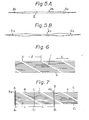
- a staple fibre having a particular shape mentioned hereinafter is preferably utilized as a material for forming the guard-hair-like pile fibre 2. That is, a staple fibre having two tapered end portions 2a and an intermediate thick portion 2b between two portions 2a as shown in Fig. 5A, or a staple fibre having two tapered end portions 2a and at least one thin portion 2c formed at the intermediate portion between two end portions 2a as shown in Fig. 5B, or a staple fibre having a shape similar to those staple fibres, is preferably used as the material for forming the guard-hair-' like pile fibre 2.
- a material for the above-mentioned pile fibres having such particular shape can be made by means of the following known technologies; for example, by applying a method for dissolving or melting both end portions of a staple fibre having a uniform thickness along the lengthwise direction, a method of applying a nonuniform taking-up speed at the spinning stage, or a method of utilizing a revolving nozzle in a spinning pack at the spinning stage.
- the length of this staple fibre material for creating the guard-hair-like pile fibre 2 must be chosen so as to satisfy the functional features of the pile fibres as the guard hairs of artificial fur produced from this pile cloth, which were described hereinbefore.
- the fibres to create the pile fibre 2 and the fibres to create the pile fibre are designated as fibres (of a first group) "a” and fibres (of a second group) "b", respectively.
- the conventional synthetic fibres such as a polyester fibre, polyamide fibre or acrylic fibre, natural fibres such as cotton fibre, wool, flax, etc., regenerated fibres such as rayon staple fibre, other artificial fibres such as acetate fibre or triacetate fibre can be satisfactorily used.
- polybutylene-telephthalate fibre is preferably utilized as the fibre "a" of the first group to create the guard-hair-like pile fibre.
- fibres having a circular cross- section or another geometrical shape can be utilized, and if necessary, fibres treated by alkali solution can be used.
- a yarn composed of a staple fibre having the function of the above-mentioned guard-hair-like pile fibres 2 and another staple fibre having the function of the above-mentioned pile fibre 3 in a blended condition is preferably utilized.
- the former staple fibres and the latter staple fibres are identified as the staple fibres of the first group and the staple fibres of the second group, respectively, as mentioned already.
- the weight ratio of fibres of the first group to fibres of the second group may suitably be within the range 20:80 to 70:30.
- a yarn with twists or a bundle of fibrous materials tightly bundled without twists can be used to attain the purpose of the present invention. Therefore, if the fibre arrangement along the longitudinal direction of the yarn is imagined, it is possible to understand that those fibres are arranged in an aligned condition in staggered relationship in the sense that the beginnings and ends of the fibres are at different positions along the yarn. This is illustrated in Fig. 6, wherein the fibre arrangement of the fibres of the first group only is shown.
- the length of the pile yarn "L” is not shorter than the length defined by the maximum or mean fibre length of the component fibres of the pile yarn minus the effective locking length of the pile in the ground construction, wherein the effective locking length of the pile means the length of the root of said unit of pile locked or anchored in the ground construction. It was confirmed by experiments conducted by the inventors that the length of the above-mentioned root portion varies in accordance with the construction of the ground construction; however, it is preferable to have a length which is 5 times the thickness of the ground construction.
- a conventional method for producing a pile cloth can be utilized as the method of the first step for producing the pile cloth according to the present invention.
- a conventional method for producing a pile fabric composed of a woven ground construction and numerous loop piles projected upward from the ground construction as shown in Fig.
- a conventional method for producing a pile fabric comprising the first step of producing a material fabric wherein two ground constructions are connected by a plurality of pile yarns woven into the above-mentioned ground constructions, and the second step of cutting the above-mentioned pile yarns at a central intermediate portion between the above-mentioned two ground constructions, are two of the methods which can be employed for producing a pile cloth for producing the artificial fur according to the present invention. If only a single pile yarn of the above-mentioned pile cloth provided with two ground constructions described in the above-mentioned method is considered, the fibre arrangement in the pile yarn can be imagined to be as shown in Fig. 7, in a similar manner to that shown in Fig. 6.
- the thickness of the above-mentioned ground constructions 4a and 4b represents the length of the root portion of each unit pile 1, which is firmly held by the respective ground constructions 4a and 4b, and the distance L between two lines AA, and CC, or the distance between two lines BB, and CC" represents the length defined by "the length of pile projected upward from the ground construction" plus "the length of the root portion of the above-mentioned pile".
- the rate of removing fibres must be carefully considered.
- the above-mentioned raising operation can be applied to the material fabric just after completing the cutting operation of pile yarns 1 or after firmly fixing the pile yarn 1 to the respective ground constructions 4a and 4b by means of a chemical treatment such as a backing operation.
- each guard-hair-like pile fibre 2 of the first group is provided with at least a tapered free end portion and a thin root portion projected upward from the ground construction 4, as shown in Fig. 1, can be created.
- the ground construction or the ground construction having received a chemical treatment such as a backing operation functions as the base portion to which the pile fibres 2 and 3 are affixed.
- a blended spun yarn composed of the fibres "a" of the first group and the fibres "b" of the second group is utilized as a pile yarn 1.
- the above-mentioned blended spun yarn is one of a number of thread-like materials which can be utilized as a pile yarn to produce pile cloth according to the present invention.
- a thread-like material composed of elements of two fibre components provided with definite respective lengths arranged along the longitudinal direction thereof with a certain twist as shown in Fig. 5, each element being provided with two tapered end portions, can be used as material to form pile yarn in the pile cloth. Since the above-mentioned blended spun yarn satisfies the required condition hereinbefore explained and such spun yarn can be produced by a conventional spinning technique without any difficulty, it may be understood that such blended spun yarn is the most preferable material to produce the pile cloth.
- a yarn comprising a so-called islands in a sea fibre as the material to create the fibres "a” of the first group is applicable.
- the fibres "a" of the first group which correspond to the guard hair of genuine fur
- either fibre materials having a so-called square-cut fibre length or those having a so-called variable-cut fibre length can be used.
- a fibre material of variable-cut fibre length it is preferable to satisfy the condition that the length "L" of the pile 1 is not shorter than the average fibre length I of the above-mentioned fibres "a” minus the effective locking length of the pile, or the above-mentioned length "L” of the pile 1 is preferably not shorter than the maximum length I of the fibres "a” of the first group minus the effective locking length of the pile.
- a double fabric comprising two layers of ground construction which are connected by a plurality of pile yarns and each pile yarn is woven into the respective ground construction one by one, is preferably used for producing the pile cloth according to the present invention.
- Another modification is the application of the method of producing a plush fabric.
- Still another modification is the method of producing a conventional pile fabric provided with a plurality of looped pile yarns projected upward from the ground construction.
- the length "L” regarding the looped pile projected upward from the ground construction is not shorter than the length defined by the maximum length of the fibres "a” minus "the effective locking length of the pile on one side of the root portion of the above-mentioned loop pile". It has also been confirmed that the effective locking length of the pile is preferably five times the thickness of the ground construction of the pile cloth.
- the pile yarn 1 concerned is represented by a straight band-like representation, wherein the schematic arrangement of the fibres "a" of the first group along the lengthwise direction of the pile yarn 1 is shown.
- the pile yarn 1 is formed by a plurality of straight zones which represent the ground construction 4 (in Fig. 8) perpendicular to the lengthwise direction of the pile yarn 1.
- the thickness of this zone represents the length of the root portion of the looped pile 1.
- the distance between two adjacent lines AA 1 and A' A'1 should be set so as to satisfy the above-mentioned requirement regarding "L". Therefore, it can be easily understood from the drawing shown in Fig.
- the back of the pile fabric by applying a chemical treatment such as a backing treatment so as to firmly hold the pile fibres by the ground construction.
- a soft polyurethane resin is utilized for the backing treatment wherein this resin is immersed into the ground construction, an excellent hand of the pile fabric, which is similar to genuine fur, can be created.
- the raising operation is applied to the pile fabric shown in Fig. 8, since the free fibres can be removed easily from the pile yarn 1, the structural features mentioned in the introduction part of this specification can be effectively created.
- the pile cloth according to the present invention is used for producing an artificial fur having excellent appearance, hand, drape property and otherfunc- tional features, which are similar to those of genuine fur. Therefore, the pile cloth produced by the above-mentioned method can be subjected to subsequent processes such as a piece-dyeing process, and finishing process such as an oiling or chemical treatment, etc. However, besides the above-mentioned processing, it is very important to carefully design the construction of the pile fabric together with the selection of fibre materials which are used for not only the pile fibres "a" and "b" of the pile yarn 1.
- the ground construction of this material pile cloth is designed to be thin, or designed so as to be able to have a good stretchable property and/or less stiffness.
- Such design also contributes to improving the sewability of the artificial fur cloth according to the present invention.
- a yarn made of such particular fibres as fusible fibres, islands in a sea fibre or a fibre having a very fine thickness; or a crimped textured yarn or an elastic yarn, etc. can be utilized for making the ground construction of the material pile cloth, according to the present invention.
- the yarn for making the ground construction of the material pile cloth it is preferable to use a spun yarn composed of a very fine staple fibre having its thickness in a range from 0.005 to 0.9 denier, or a multi-filament yarn composed of a plurality of very fine individual filaments having the above-mentioned range of fine denier; it is particularly desirable to use a yarn composed of a plurality of multi-core component fibres which are capable of separating into cores having a thickness in a range between 0.005 and 0.9 denier.
- the structural feature thereof is remarkably improved by applying such construction characterized by the shape of the free end portion of each pile fibre of guard hair, two layers of the pile fibres, the particular construction of the root portion of the pile fibre of guard hair, etc. Therefore, the pile fabric disclosed in the present invention very much contributes to produce the artificial fur of the present invention having excellent properties such as a very elegant appearance and an almost natural hand, excellent quality of flutter, excellent drapability, etc., which are quite similar to those of genuine fur.
- a pile cloth was made from a fabric having a so-called double velvet weaving construction in the following condition:
- each of the thus produced pile fabrics was subjected to the following backing operation. That is, a polyurethane resin dissolved in a dimethylformamide solution was infused into the ground construction of the above-mentioned pile fabric, and thereafter the polyurethane resin was coagulated by removing the dimethylformamide component, and then the pile fabric was dried so that the polyurethane resin became part of the ground construction of the pile fabric.
- this pile fabric was subjected to the conventional raising operation so as to remove the free fibres contained in the piles from the ground construction. Based on a measuring test of the pile fibres, it was confirmed that the number of thicker pile fibres projecting upward from the ground construction forming the guard hairs was 400/cm 2 , while the number of thinner fibres for forming the under fur in the final product was 14000/cm 2 . Thereafter, polystyrene, which is the sea component of the islands in a sea fibre, was dissolved by utilizing toluene.
- the thus produced pile fabric was provided with a suede-like ground construction; and an excellent appearance, hand, and also, a good quality of flutter, which were quite similar to genuine high grade fur, such as mink fur. Therefore, it was confirmed that the above-mentioned final pile fabric product can be used as an artificial fur of very high quality.
- a pile fabric was made from a fabric having a so-called double velvet weaving construction in the following condition:
- a backing operation was accomplished by applying a polyurethane 30% DMF solution to the above-mentioned pile fabric, a raising operation was repeatedly applied to the above treated pile fabric, after washing and extracting water from the washed material, so that each pile projecting from the ground construction was opened by means of eliminating twists of the yarn, and fibres, not firmly held by the ground construction, were removed from each pile yarn.
- the produced pile fabric was subjected to a polishing treatment, so that the undesirable turning or crimping tendency of the thicker fibres, which form the guard-hair-like pile fibres in the final product, was corrected, a desired lustre of the thicker fibre was created, and a good lie of the hair was also achieved.
- the softening operation by silicone which is identical to the operation explained in Example 1 was applied to the pile fabric. After drying the pile fabric, an additional raising was performed.
- a pile fabric was made from a fabric having a so-called double velvet weaving construction in the following condition:
- a backing operation by a polyurethane 40% DMF solution was applied to the above-mentioned pile fabric, a raising operation was repeatedly applied to the above-mentioned treated pile fabric after washing and extracting water from the washed material, so that each pile projected from the ground construction was opened from the root portion thereof by means of eliminating the twists of the yarn, and fibres, which were not firmly held by the ground construction, were removed from each pile yarn so that the undesirable turning or crimping tendency of the synthetic pile fibre for creating the guard hair was corrected.
- the thus treated fabric was polished and corrected and a good lie of the hair was achieved. In this condition, the number or remaining pile fibres firmly held by the ground construction was measured.
- a pile cloth in which a plurality of loop piles project from a ground construction of a conventional non-woven cloth made of polyester fibres, was produced by means of a conventional tufting machine.
- the pile yarn a blended spun yarn identical to the pile yarn used in Example 3, was utilized. The following conditions apply to the production of the above-mentioned pile cloth. That is, the length of the loop piles was 38 mm and the tufting operation was carried out at 10 stitches/25.4 mm.
- the dyeing operation was carried out in the following condition:
- the above-mentioned dyeing operation may be carried out at a stage before the raising operation or the backing operation.
- a warp pile fabric was made from a fabric having a so-called double velvet weaving construction in the following condition:
- a backing operation of a polyurethane 30% DMF solution was applied to the above-mentioned pile fabric, a raising operation was repeatedly applied to the above-mentioned treated pile fabric after washing and extracting water from the washed material, so that the twist of the piles were eliminated from the root portion thereof and the free fibres in each pile portion, which were not firmly held by the ground construction, were removed from the ground construction of the pile fabric.
- the number of pile fibres projecting from the ground construction was measured. The following is the. data of this measurement.
- the number of the thicker fibres was 370/cm 2
- the number of the thinner fibres was 12000/ cm 2 .
- the pile fabric thus produced it was observed that the number of crimps formed in each of the thinner staple fibres was reduced to almost half of the original number, while the length of the pile fibres for forming the guard hair in the pile fabric was almost 35 mm, which is shorter than the staple length in the material condition.
- a bottom end portion of the thicker fibre was firmly held by the ground construction, in other words, the bottom end portion of this fibre, which was almost 5 mm length, was held by the ground construction, it could be confirmed that the sharpened free end portion of these pile fibres was not damaged very much by the above-mentioned raising operation.
- the thus produced pile fabric was subjected to a finishing operation similar to that of Example 2, and it was confirmed that the pile fabric thus obtained had excellent structural features, which satisfied the requirement to be an artificial fur of a very high grade, having a mink-like appearance and other features.
Landscapes
- Engineering & Computer Science (AREA)
- Textile Engineering (AREA)
- Knitting Of Fabric (AREA)
- Woven Fabrics (AREA)
- Synthetic Leather, Interior Materials Or Flexible Sheet Materials (AREA)
- Prostheses (AREA)
- Treatment Of Fiber Materials (AREA)
- Nitrogen And Oxygen Or Sulfur-Condensed Heterocyclic Ring Systems (AREA)
- Compounds Of Unknown Constitution (AREA)
- Yarns And Mechanical Finishing Of Yarns Or Ropes (AREA)
- Automatic Embroidering For Embroidered Or Tufted Products (AREA)
Claims (14)
Priority Applications (1)
| Application Number | Priority Date | Filing Date | Title |
|---|---|---|---|
| AT81304317T ATE17266T1 (de) | 1980-09-22 | 1981-09-21 | Kuenstlicher pelz und verfahren zu dessen herstellung. |
Applications Claiming Priority (2)
| Application Number | Priority Date | Filing Date | Title |
|---|---|---|---|
| JP130786/80 | 1980-09-22 | ||
| JP55130786A JPS5756574A (en) | 1980-09-22 | 1980-09-22 | Production of leather like pile fabric |
Publications (2)
| Publication Number | Publication Date |
|---|---|
| EP0048609A1 EP0048609A1 (fr) | 1982-03-31 |
| EP0048609B1 true EP0048609B1 (fr) | 1986-01-02 |
Family
ID=15042639
Family Applications (1)
| Application Number | Title | Priority Date | Filing Date |
|---|---|---|---|
| EP81304317A Expired EP0048609B1 (fr) | 1980-09-22 | 1981-09-21 | Une fourrure artificielle et une méthode pour sa fabrication |
Country Status (8)
| Country | Link |
|---|---|
| US (1) | US4415611A (fr) |
| EP (1) | EP0048609B1 (fr) |
| JP (1) | JPS5756574A (fr) |
| AT (1) | ATE17266T1 (fr) |
| AU (1) | AU542665B2 (fr) |
| CA (1) | CA1164639A (fr) |
| DE (1) | DE3173383D1 (fr) |
| SU (1) | SU1389686A3 (fr) |
Families Citing this family (34)
| Publication number | Priority date | Publication date | Assignee | Title |
|---|---|---|---|---|
| CA1176046A (fr) * | 1980-11-28 | 1984-10-16 | Seiichi Yamagata | Methode et dispositif de fabrication de simili-pelages |
| JPS58180638A (ja) * | 1982-04-12 | 1983-10-22 | 東レ株式会社 | 人造毛皮およびその製造方法 |
| JPS59127750A (ja) * | 1983-01-07 | 1984-07-23 | 東レ株式会社 | フロツク加工品およびその製造方法 |
| JPS60155781A (ja) * | 1984-01-25 | 1985-08-15 | Toray Ind Inc | 人工毛皮およびその縫製品 |
| US4546020A (en) * | 1984-10-01 | 1985-10-08 | Toray Industries, Inc. | Artificial fur with guard hair fibers and under fur fibers |
| DE3677695D1 (de) * | 1985-10-25 | 1991-04-04 | Toray Industries | Kuenstliches pelzwerk. |
| JP2626230B2 (ja) * | 1990-10-09 | 1997-07-02 | 東レ株式会社 | 毛皮調パイル布帛およびその製造方法 |
| US5652038A (en) * | 1995-07-12 | 1997-07-29 | Springs Industries, Inc. | Yarn and tufted fabric for use in a bathroom rug |
| US7503190B1 (en) * | 2007-10-12 | 2009-03-17 | Seamless Technologies, Llc | Forming a tubular knit fabric for a paint roller cover |
| US6766668B2 (en) * | 2002-07-16 | 2004-07-27 | Daniel L. Sinykin | Silver-knit material |
| US7021085B2 (en) * | 2002-09-26 | 2006-04-04 | Teijin Fibers Limited | Concave and convex-patterned multi-colored fiber pile fabric |
| JP4223367B2 (ja) * | 2003-10-08 | 2009-02-12 | 株式会社クラレ | ペイントローラー用ハイパイル地 |
| US8118967B2 (en) | 2008-01-17 | 2012-02-21 | Seamless Technologies, Llc | Methods of manufacturing paint roller covers from a tubular fabric sleeve |
| US7596972B2 (en) * | 2007-04-25 | 2009-10-06 | Seamless Technologies, Llc | Tubular knit fabric having alternating courses of sliver fiber pile and cut-pile for paint roller covers |
| US7905980B2 (en) | 2007-04-25 | 2011-03-15 | Seamless Technologies, Llc | Method of manufacturing paint roller covers from a tubular fabric sleeve |
| US7503191B2 (en) * | 2007-04-25 | 2009-03-17 | Seamless Technologies, Llc | Tubular sliver knit fabric for paint roller covers |
| US7748241B2 (en) * | 2007-04-25 | 2010-07-06 | Seamless Technologies, Llc | Tubular cut pile knit fabric for paint roller covers |
| US8182645B2 (en) * | 2008-01-17 | 2012-05-22 | Seamless Technologies, Llc | Methods of manufacturing paint roller covers from a tubular fabric sleeve |
| US8298364B2 (en) | 2008-01-17 | 2012-10-30 | Seamless Technologies, Llc | Methods of manufacturing paint roller covers from a tubular fabric sleeve |
| US8221578B2 (en) | 2007-04-25 | 2012-07-17 | Seamless Technologies, Llc | Methods of manufacturing paint roller covers from a tubular fabric sleeve |
| US8858750B2 (en) | 2007-04-25 | 2014-10-14 | Seamless Technologies, Llc | Methods of manufacturing paint roller covers from a tubular fabric sleeve |
| US8882957B2 (en) | 2007-04-25 | 2014-11-11 | Seamless Technologies, Llc | Methods of manufacturing paint roller covers from a tubular fabric sleeve |
| EP2212455A4 (fr) * | 2007-10-12 | 2018-04-25 | Seamless Technologies, Llc | Formation d'un tricot tubulaire pour une couverture de rouleau à peindre |
| BR112012015550A2 (pt) * | 2010-11-11 | 2016-05-03 | Weiren Tang | couro artificial de microfibra e o seu método de fabricação |
| US9657420B2 (en) | 2012-03-30 | 2017-05-23 | Deckers Outdoor Corporation | Sheared wool weaving method |
| US10801139B2 (en) | 2017-01-27 | 2020-10-13 | Deckers Outdoor Corporation | Sheared wool fleece and method for making sheared wool fleece utilizing yarn knitting |
| US11713524B2 (en) | 2017-01-27 | 2023-08-01 | Deckers Outdoor Corporation | Sheared wool fleece and method for making sheared wool fleece utilizing yarn knitting |
| DE102017118207B4 (de) * | 2017-04-12 | 2022-10-27 | Well Linkage Limited | Tablett zur Aufnahme von Farbe |
| DE102017208200A1 (de) | 2017-05-16 | 2018-11-22 | Adler Pelzer Holding Gmbh | Teppich |
| US12037721B2 (en) * | 2019-02-06 | 2024-07-16 | Sobel Westex | Terry fabric having surfaces with varying pile weights |
| US12529169B2 (en) * | 2019-02-06 | 2026-01-20 | Sobel Westex | Terry fabric having faces with varying weight |
| IT201900015695A1 (it) * | 2019-09-05 | 2021-03-05 | Dclass Soc A Responsabilita Limitata | Materiale in pelliccia artificiale e suo metodo di fabbricazione |
| IT202100011663A1 (it) * | 2021-05-06 | 2022-11-06 | Inseta S R L | Un metodo e relativo macchinario per la produzione di una pelliccia ecologica |
| WO2023146836A2 (fr) * | 2022-01-25 | 2023-08-03 | Stuebler Martin | Textile en tissu à poils à base de fibres végétales naturelles et son procédé de fabrication |
Family Cites Families (4)
| Publication number | Priority date | Publication date | Assignee | Title |
|---|---|---|---|---|
| US3755057A (en) * | 1971-08-23 | 1973-08-28 | H Scott | Synthetic fur |
| JPS5247053B2 (fr) * | 1972-10-16 | 1977-11-30 | ||
| US4233349A (en) * | 1979-03-26 | 1980-11-11 | E. I. Du Pont De Nemours And Company | Suede-like product and process therefor |
| JPS5927420B2 (ja) * | 1979-10-25 | 1984-07-05 | 東レ株式会社 | 毛皮調立毛繊維構造物 |
-
1980
- 1980-09-22 JP JP55130786A patent/JPS5756574A/ja active Pending
-
1981
- 1981-09-10 US US06/300,963 patent/US4415611A/en not_active Expired - Lifetime
- 1981-09-14 CA CA000385846A patent/CA1164639A/fr not_active Expired
- 1981-09-17 AU AU75446/81A patent/AU542665B2/en not_active Ceased
- 1981-09-21 EP EP81304317A patent/EP0048609B1/fr not_active Expired
- 1981-09-21 AT AT81304317T patent/ATE17266T1/de not_active IP Right Cessation
- 1981-09-21 SU SU813340592A patent/SU1389686A3/ru active
- 1981-09-21 DE DE8181304317T patent/DE3173383D1/de not_active Expired
Also Published As
| Publication number | Publication date |
|---|---|
| AU7544681A (en) | 1982-04-01 |
| US4415611A (en) | 1983-11-15 |
| DE3173383D1 (en) | 1986-02-13 |
| ATE17266T1 (de) | 1986-01-15 |
| CA1164639A (fr) | 1984-04-03 |
| AU542665B2 (en) | 1985-02-28 |
| EP0048609A1 (fr) | 1982-03-31 |
| JPS5756574A (en) | 1982-04-05 |
| SU1389686A3 (ru) | 1988-04-15 |
Similar Documents
| Publication | Publication Date | Title |
|---|---|---|
| EP0048609B1 (fr) | Une fourrure artificielle et une méthode pour sa fabrication | |
| EP0091676B1 (fr) | Etoffe chenille tissée ou tricotée et son procédé de fabrication | |
| US4773135A (en) | Method for manufacturing artificial furs | |
| CA1051753A (fr) | Procede de fabrication d'un tissu simili-daim | |
| EP0045611B1 (fr) | Matériau synthétique imitant la fourrure et procédé pour sa fabrication | |
| US4546020A (en) | Artificial fur with guard hair fibers and under fur fibers | |
| US4118529A (en) | Suede woven fabric and a process of manufacturing the same | |
| US5534336A (en) | Fabric superior in anti-drape stiffness, stiffness and soft handle, and manufacture thereof | |
| KR101757244B1 (ko) | 삼베와 같은 질감을 갖는 인견직물 및 그의 제직 방법 | |
| KR100667622B1 (ko) | 표면과 이면의 염색특성이 상이한 스웨이드조 경편지 및그의 제조방법. | |
| KR100614625B1 (ko) | 외관 및 촉감이 우수한 스웨이드조 경편지 및 그의 제조방법 | |
| JP3997592B2 (ja) | 人工皮革およびその製造方法 | |
| JPS5822588B2 (ja) | 天然毛皮調編織物の製造法 | |
| KR100358361B1 (ko) | 스웨드조 환편지의 제조방법 및 그 스웨드조 환편지 | |
| KR101002292B1 (ko) | 스웨이드조 스트레치 직물의 제조방법 | |
| GB2062537A (en) | A multi-component composite filament | |
| JP3543483B2 (ja) | 紡毛布帛の製造方法 | |
| JPS6045610A (ja) | 複合繊維 | |
| JPS5929709B2 (ja) | 起毛布帛 | |
| JPH11172544A (ja) | 溶剤紡糸セルロース繊維を用いた複合紡績糸 | |
| JPS623256B2 (fr) | ||
| KR100740305B1 (ko) | 자연스러운 외관을 발현하는 스웨이드조 경편지 및 그의제조방법 | |
| JPH0544137A (ja) | スエード調織物の製造方法 | |
| CA1138165A (fr) | File composite | |
| JPH06306733A (ja) | 特殊編織物 |
Legal Events
| Date | Code | Title | Description |
|---|---|---|---|
| PUAI | Public reference made under article 153(3) epc to a published international application that has entered the european phase |
Free format text: ORIGINAL CODE: 0009012 |
|
| AK | Designated contracting states |
Designated state(s): AT CH DE FR GB IT NL SE |
|
| RBV | Designated contracting states (corrected) |
Designated state(s): AT CH DE FR GB IT LI NL SE |
|
| 17P | Request for examination filed |
Effective date: 19820601 |
|
| GRAA | (expected) grant |
Free format text: ORIGINAL CODE: 0009210 |
|
| AK | Designated contracting states |
Designated state(s): AT CH DE FR GB IT LI NL SE |
|
| REF | Corresponds to: |
Ref document number: 17266 Country of ref document: AT Date of ref document: 19860115 Kind code of ref document: T |
|
| ITF | It: translation for a ep patent filed | ||
| ET | Fr: translation filed | ||
| REF | Corresponds to: |
Ref document number: 3173383 Country of ref document: DE Date of ref document: 19860213 |
|
| PLBE | No opposition filed within time limit |
Free format text: ORIGINAL CODE: 0009261 |
|
| STAA | Information on the status of an ep patent application or granted ep patent |
Free format text: STATUS: NO OPPOSITION FILED WITHIN TIME LIMIT |
|
| 26N | No opposition filed | ||
| ITTA | It: last paid annual fee | ||
| EAL | Se: european patent in force in sweden |
Ref document number: 81304317.1 |
|
| PGFP | Annual fee paid to national office [announced via postgrant information from national office to epo] |
Ref country code: FR Payment date: 19970909 Year of fee payment: 17 |
|
| PGFP | Annual fee paid to national office [announced via postgrant information from national office to epo] |
Ref country code: GB Payment date: 19970912 Year of fee payment: 17 Ref country code: AT Payment date: 19970912 Year of fee payment: 17 |
|
| PGFP | Annual fee paid to national office [announced via postgrant information from national office to epo] |
Ref country code: SE Payment date: 19970918 Year of fee payment: 17 |
|
| PGFP | Annual fee paid to national office [announced via postgrant information from national office to epo] |
Ref country code: DE Payment date: 19970926 Year of fee payment: 17 |
|
| PGFP | Annual fee paid to national office [announced via postgrant information from national office to epo] |
Ref country code: NL Payment date: 19970929 Year of fee payment: 17 |
|
| PGFP | Annual fee paid to national office [announced via postgrant information from national office to epo] |
Ref country code: CH Payment date: 19971007 Year of fee payment: 17 |
|
| PG25 | Lapsed in a contracting state [announced via postgrant information from national office to epo] |
Ref country code: GB Free format text: LAPSE BECAUSE OF NON-PAYMENT OF DUE FEES Effective date: 19980921 Ref country code: AT Free format text: LAPSE BECAUSE OF NON-PAYMENT OF DUE FEES Effective date: 19980921 |
|
| PG25 | Lapsed in a contracting state [announced via postgrant information from national office to epo] |
Ref country code: SE Free format text: LAPSE BECAUSE OF NON-PAYMENT OF DUE FEES Effective date: 19980922 |
|
| PG25 | Lapsed in a contracting state [announced via postgrant information from national office to epo] |
Ref country code: LI Free format text: LAPSE BECAUSE OF NON-PAYMENT OF DUE FEES Effective date: 19980930 Ref country code: CH Free format text: LAPSE BECAUSE OF NON-PAYMENT OF DUE FEES Effective date: 19980930 |
|
| PG25 | Lapsed in a contracting state [announced via postgrant information from national office to epo] |
Ref country code: NL Free format text: LAPSE BECAUSE OF NON-PAYMENT OF DUE FEES Effective date: 19990401 |
|
| GBPC | Gb: european patent ceased through non-payment of renewal fee |
Effective date: 19980921 |
|
| REG | Reference to a national code |
Ref country code: CH Ref legal event code: PL |
|
| EUG | Se: european patent has lapsed |
Ref document number: 81304317.1 |
|
| PG25 | Lapsed in a contracting state [announced via postgrant information from national office to epo] |
Ref country code: FR Free format text: LAPSE BECAUSE OF NON-PAYMENT OF DUE FEES Effective date: 19990531 |
|
| NLV4 | Nl: lapsed or anulled due to non-payment of the annual fee |
Effective date: 19990401 |
|
| PG25 | Lapsed in a contracting state [announced via postgrant information from national office to epo] |
Ref country code: DE Free format text: LAPSE BECAUSE OF NON-PAYMENT OF DUE FEES Effective date: 19990701 |
|
| REG | Reference to a national code |
Ref country code: FR Ref legal event code: ST |