EP0048670B1 - Catalyseurs d'hydrotraitement d'hydrocarbures et application desdits catalyseurs - Google Patents
Catalyseurs d'hydrotraitement d'hydrocarbures et application desdits catalyseurs Download PDFInfo
- Publication number
- EP0048670B1 EP0048670B1 EP81401448A EP81401448A EP0048670B1 EP 0048670 B1 EP0048670 B1 EP 0048670B1 EP 81401448 A EP81401448 A EP 81401448A EP 81401448 A EP81401448 A EP 81401448A EP 0048670 B1 EP0048670 B1 EP 0048670B1
- Authority
- EP
- European Patent Office
- Prior art keywords
- catalysts
- weight
- catalyst
- charge
- frequency
- Prior art date
- Legal status (The legal status is an assumption and is not a legal conclusion. Google has not performed a legal analysis and makes no representation as to the accuracy of the status listed.)
- Expired
Links
Images


Classifications
-
- B—PERFORMING OPERATIONS; TRANSPORTING
- B01—PHYSICAL OR CHEMICAL PROCESSES OR APPARATUS IN GENERAL
- B01J—CHEMICAL OR PHYSICAL PROCESSES, e.g. CATALYSIS OR COLLOID CHEMISTRY; THEIR RELEVANT APPARATUS
- B01J35/00—Catalysts, in general, characterised by their form or physical properties
- B01J35/30—Catalysts, in general, characterised by their form or physical properties characterised by their physical properties
-
- B—PERFORMING OPERATIONS; TRANSPORTING
- B01—PHYSICAL OR CHEMICAL PROCESSES OR APPARATUS IN GENERAL
- B01J—CHEMICAL OR PHYSICAL PROCESSES, e.g. CATALYSIS OR COLLOID CHEMISTRY; THEIR RELEVANT APPARATUS
- B01J23/00—Catalysts comprising metals or metal oxides or hydroxides, not provided for in group B01J21/00
- B01J23/70—Catalysts comprising metals or metal oxides or hydroxides, not provided for in group B01J21/00 of the iron group metals or copper
- B01J23/76—Catalysts comprising metals or metal oxides or hydroxides, not provided for in group B01J21/00 of the iron group metals or copper combined with metals, oxides or hydroxides provided for in groups B01J23/02 - B01J23/36
- B01J23/84—Catalysts comprising metals or metal oxides or hydroxides, not provided for in group B01J21/00 of the iron group metals or copper combined with metals, oxides or hydroxides provided for in groups B01J23/02 - B01J23/36 with arsenic, antimony, bismuth, vanadium, niobium, tantalum, polonium, chromium, molybdenum, tungsten, manganese, technetium or rhenium
- B01J23/85—Chromium, molybdenum or tungsten
- B01J23/88—Molybdenum
-
- B—PERFORMING OPERATIONS; TRANSPORTING
- B01—PHYSICAL OR CHEMICAL PROCESSES OR APPARATUS IN GENERAL
- B01J—CHEMICAL OR PHYSICAL PROCESSES, e.g. CATALYSIS OR COLLOID CHEMISTRY; THEIR RELEVANT APPARATUS
- B01J23/00—Catalysts comprising metals or metal oxides or hydroxides, not provided for in group B01J21/00
- B01J23/70—Catalysts comprising metals or metal oxides or hydroxides, not provided for in group B01J21/00 of the iron group metals or copper
- B01J23/76—Catalysts comprising metals or metal oxides or hydroxides, not provided for in group B01J21/00 of the iron group metals or copper combined with metals, oxides or hydroxides provided for in groups B01J23/02 - B01J23/36
- B01J23/84—Catalysts comprising metals or metal oxides or hydroxides, not provided for in group B01J21/00 of the iron group metals or copper combined with metals, oxides or hydroxides provided for in groups B01J23/02 - B01J23/36 with arsenic, antimony, bismuth, vanadium, niobium, tantalum, polonium, chromium, molybdenum, tungsten, manganese, technetium or rhenium
- B01J23/85—Chromium, molybdenum or tungsten
- B01J23/88—Molybdenum
- B01J23/882—Molybdenum and cobalt
-
- B—PERFORMING OPERATIONS; TRANSPORTING
- B01—PHYSICAL OR CHEMICAL PROCESSES OR APPARATUS IN GENERAL
- B01J—CHEMICAL OR PHYSICAL PROCESSES, e.g. CATALYSIS OR COLLOID CHEMISTRY; THEIR RELEVANT APPARATUS
- B01J35/00—Catalysts, in general, characterised by their form or physical properties
- B01J35/60—Catalysts, in general, characterised by their form or physical properties characterised by their surface properties or porosity
- B01J35/61—Surface area
- B01J35/615—100-500 m2/g
-
- B—PERFORMING OPERATIONS; TRANSPORTING
- B01—PHYSICAL OR CHEMICAL PROCESSES OR APPARATUS IN GENERAL
- B01J—CHEMICAL OR PHYSICAL PROCESSES, e.g. CATALYSIS OR COLLOID CHEMISTRY; THEIR RELEVANT APPARATUS
- B01J35/00—Catalysts, in general, characterised by their form or physical properties
- B01J35/60—Catalysts, in general, characterised by their form or physical properties characterised by their surface properties or porosity
- B01J35/63—Pore volume
- B01J35/635—0.5-1.0 ml/g
-
- C—CHEMISTRY; METALLURGY
- C10—PETROLEUM, GAS OR COKE INDUSTRIES; TECHNICAL GASES CONTAINING CARBON MONOXIDE; FUELS; LUBRICANTS; PEAT
- C10G—CRACKING HYDROCARBON OILS; PRODUCTION OF LIQUID HYDROCARBON MIXTURES, e.g. BY DESTRUCTIVE HYDROGENATION, OLIGOMERISATION, POLYMERISATION; RECOVERY OF HYDROCARBON OILS FROM OIL-SHALE, OIL-SAND, OR GASES; REFINING MIXTURES MAINLY CONSISTING OF HYDROCARBONS; REFORMING OF NAPHTHA; MINERAL WAXES
- C10G45/00—Refining of hydrocarbon oils using hydrogen or hydrogen-generating compounds
- C10G45/02—Refining of hydrocarbon oils using hydrogen or hydrogen-generating compounds to eliminate hetero atoms without changing the skeleton of the hydrocarbon involved and without cracking into lower boiling hydrocarbons; Hydrofinishing
- C10G45/04—Refining of hydrocarbon oils using hydrogen or hydrogen-generating compounds to eliminate hetero atoms without changing the skeleton of the hydrocarbon involved and without cracking into lower boiling hydrocarbons; Hydrofinishing characterised by the catalyst used
- C10G45/06—Refining of hydrocarbon oils using hydrogen or hydrogen-generating compounds to eliminate hetero atoms without changing the skeleton of the hydrocarbon involved and without cracking into lower boiling hydrocarbons; Hydrofinishing characterised by the catalyst used containing nickel or cobalt metal, or compounds thereof
- C10G45/08—Refining of hydrocarbon oils using hydrogen or hydrogen-generating compounds to eliminate hetero atoms without changing the skeleton of the hydrocarbon involved and without cracking into lower boiling hydrocarbons; Hydrofinishing characterised by the catalyst used containing nickel or cobalt metal, or compounds thereof in combination with chromium, molybdenum, or tungsten metals, or compounds thereof
-
- B—PERFORMING OPERATIONS; TRANSPORTING
- B01—PHYSICAL OR CHEMICAL PROCESSES OR APPARATUS IN GENERAL
- B01J—CHEMICAL OR PHYSICAL PROCESSES, e.g. CATALYSIS OR COLLOID CHEMISTRY; THEIR RELEVANT APPARATUS
- B01J21/00—Catalysts comprising the elements, oxides, or hydroxides of magnesium, boron, aluminium, carbon, silicon, titanium, zirconium, or hafnium
- B01J21/12—Silica and alumina
-
- B—PERFORMING OPERATIONS; TRANSPORTING
- B01—PHYSICAL OR CHEMICAL PROCESSES OR APPARATUS IN GENERAL
- B01J—CHEMICAL OR PHYSICAL PROCESSES, e.g. CATALYSIS OR COLLOID CHEMISTRY; THEIR RELEVANT APPARATUS
- B01J2235/00—Indexing scheme associated with group B01J35/00, related to the analysis techniques used to determine the catalysts form or properties
-
- B—PERFORMING OPERATIONS; TRANSPORTING
- B01—PHYSICAL OR CHEMICAL PROCESSES OR APPARATUS IN GENERAL
- B01J—CHEMICAL OR PHYSICAL PROCESSES, e.g. CATALYSIS OR COLLOID CHEMISTRY; THEIR RELEVANT APPARATUS
- B01J35/00—Catalysts, in general, characterised by their form or physical properties
- B01J35/60—Catalysts, in general, characterised by their form or physical properties characterised by their surface properties or porosity
Definitions
- the present invention relates to hydrocarbon hydrotreatment catalysts. It relates in particular to the application of said catalysts to the hydrotreatment of hydrocarbon feedstocks having a boiling point above 350 ° C. under atmospheric pressure.
- Catalysts composed of an alumina support on which is deposited at least one metal from groups VIII and VIA are well known. They are used in particular for the hydrodesulfurization of hydrocarbon feeds, originating for example from the fractionation of crude oil, by distillation under atmospheric pressure, then under reduced pressure. This fractionation leads to the production of a range of products ranging from gasolines to residues from distillation under reduced pressure, hereinafter called vacuum residues, via diesel. These products must be desulphurized before use as fuel or as fuel.
- Such catalysts are in particular constituted by a support of refractory mineral oxide such as alumina, on which are deposited cobalt and molybdenum.
- the object of the present invention is therefore to obtain hydrotreatment catalysts, which can be used particularly in hydrodesulfurization and hydrodemetallization of hydrocarbon feedstocks, in particular of distillation residues under atmospheric pressure or under vacuum.
- FR-A-2187883 describes catalysts for hydrodesulfurization of a crude oil, comprising an alumina support on which is deposited at least one metal of Groups VI and VIII of the Periodic Table, in particular molybdenum and cobalt and / or the nickel.
- the invention relates more particularly to the catalysts defined above and in which the support has a specific surface of between 15 and 500 m 2 per gram and a specific pore volume of between 0.1 and 2 cm 3 per gram and, preferably , respectively between 100 and 400 m 2 per gram and 0.3 and 1.2 cm 3 per gram.
- the catalyst support according to the invention can in particular be alumina or an aluminosilicate. It can be an alumina which can contain up to 70% by weight of silica.
- the catalysts according to the invention preferably contain, based on the total weight of the catalyst, from 5 to 25% by weight of molybdenum and from 1 to 8% by weight of at least one metal chosen from the group consisting of nickel and cobalt.
- the catalysts according to the invention can be prepared by impregnating the support with at least one solution containing at least one element chosen from the group consisting of molybdenum, nickel and cobalt, said impregnation being followed by calcination at a temperature between 300 and 700 ° C and preferably between 450 and 650 ° C.
- the catalysts according to the invention can in particular be used for the hydrotreatment of hydrocarbon feedstocks originating from the distillation of crude oil and having a boiling point, at atmospheric pressure, equal or greater lower at 350 ° C, in order to desulfurize and demetalize these charges.
- the catalysts Prior to the operations of desulfurization of hydrocarbon feedstocks, it may be advantageous to presulfurize the catalysts in the presence of hydrogen by known methods; in general, after hydrogen pressure between 50 and 200 ° C, the temperature is raised to about 350 to 400 ° C, by passing over the catalyst compounds capable of releasing sulfur, such as mixtures of hydrogen and hydrogen sulfide, mercaptans or carbon sulfide, or even a diesel oil containing sulfur.
- hydrogen pressure between 50 and 200 ° C
- the temperature is raised to about 350 to 400 ° C, by passing over the catalyst compounds capable of releasing sulfur, such as mixtures of hydrogen and hydrogen sulfide, mercaptans or carbon sulfide, or even a diesel oil containing sulfur.
- Example 1 relates to the preparation of catalysts A and B according to the invention.
- Example 2 relates to hydrodesulfurization tests of a hydrocarbon feedstock using catalysts A and B prepared in example 1 and commercial control catalysts T1 and T2.
- This example relates to the preparation of catalysts A and B according to the invention.
- the gel obtained is filtered, washed with water, then with acetone. The gel is then dried for 16 hours at 120 ° C. A xerogel is thus obtained containing approximately 25% of water.
- the xerogel is ground, then an aqueous solution of ethyl orthosilicate is added to the powder obtained, in an amount such that the final alumina obtained contains 5% of Si0 2 .
- the alumina After adding water to obtain a paste, the alumina is extruded.
- the extrudates obtained are dried for 16 hours at 120 ° C, then calcined for 2 hours at 600 ° C.
- extrudates are impregnated with alcoholic solutions of cobalt nitrate and molybdenum acetylacetonate, in amounts such that the final catalyst contains approximately 4% by weight of cobalt oxide and approximately 20% by weight of molybdenum oxide. .
- extrudates impregnated with these solutions are dried for 16 hours at 120 ° C. and calcined for 2 hours at 550 ° C.
- the catalysts A and B according to the invention are thus obtained, the composition and characteristics of which are given below in Table 1, as well as those of commercial control catalysts, T1 and T2, which will be tested in Example 2 with catalysts A and B.
- This example relates to the hydrodesulfurization of a hydrocarbon feedstock constituted by the vacuum residue of a “KIRKOUK” crude oil, the boiling point of which at atmospheric pressure is greater than 525 ° C.
- a pilot unit with gas recycling and continuous withdrawal is used.
- the volume of catalyst is 150 cm 3 .
- the catalyst is presulfided with a gas oil, the distillation range of which is between 250 and 380 ° C. and containing 1.3% by weight of sulfur.
- This presulphurization is carried out under a hydrogen pressure of 24 bars, at an hourly space speed of 3 and a hydrogen / charge rate of 200 normal-liters / liter.
- the temperature is gradually increased in 24 hours, so as to reach 375 ° C.
- the temperature is maintained so as to obtain a sulfur content in the effluent of 1.5% by weight.
- the drop in activity of the catalyst is compensated by a regular increase in temperature.
- the test is stopped at 410 ° C.
- the evolution of the temperature as a function of time is shown in Figure 8.
- the catalysts A and B according to the invention have excellent resistance to poisoning of the contaminants contained in the charge, unlike the catalysts T1 and T2.
Landscapes
- Chemical & Material Sciences (AREA)
- Engineering & Computer Science (AREA)
- Organic Chemistry (AREA)
- Chemical Kinetics & Catalysis (AREA)
- Materials Engineering (AREA)
- Oil, Petroleum & Natural Gas (AREA)
- General Chemical & Material Sciences (AREA)
- Catalysts (AREA)
- Production Of Liquid Hydrocarbon Mixture For Refining Petroleum (AREA)
Description
- La présente invention concerne des catalyseurs d'hydrotraitement d'hydrocarbures. Elle concerne notamment l'application desdits catalyseurs à l'hydrotraitement de charges d'hydrocarbures ayant un point d'ébullition supérieur à 350 °C sous la pression atmosphérique.
- Les catalyseurs composés d'un support d'alumine sur lequel est déposé au moins un métal des groupes VIII et VIA sont bien connus. Ils servent notamment à l'hydrodésulfuration de charges d'hydrocarbures, provenant par exemple du fractionnement du pétrole brut, par distillation sous pression atmosphérique, puis sous pression réduite. Ce fractionnement conduit à l'obtention d'une gamme de produits allant des essences aux résidus de distillation sous pression réduite, appelés ci-après résidus sous vide, en passant par les gazoles. Ces produits doivent être désulfurés avant emploi comme carburant ou comme combustible.
- De tels catalyseurs sont notamment constitués par un support en oxyde minéral réfractaire tel que l'alumine, sur lequel sont déposés du cobalt et du molybdène. La durée de vie de tels cataly-. seurs est limitée par un empoisonnement progressif de ceux-ci par le soufre, mais aussi, selon la nature de la charge, par des produits azotés, des métaux ou des produits de haut poids moléculaire favorisant la formation de coke. C'est le cas, notamment, pour les coupes les plus lourdes, telles que les résidus de distillation sous pression atmosphérique ou sous vide, dont la valorisation devient de plus en plus importante, compte tenu des conditions économiques actuelles du marché du pétrole brut.
- Il est donc particulièrement intéressant d'avoir un catalyseur résistant à cet empoisonnement.
- Le but de la présente invention est par conséquent l'obtention de catalyseurs d'hydrotraitement, utilisables particulièrement dans l'hydrodésulfuration et l'hydrodémétallisation de charges d'hydrocarbures, notamment de résidus de distillation sous pression atmosphérique ou sous vide.
- FR-A-2187883 décrit des catalyseurs d'hydrodésulfuration d'une huile brute, comprenant un support en alumine sur lequel est déposé au moins un métal des Groupes VI et VIII de la Classification Périodique, notamment le molybdène et le cobalt et/ou le nickel.
- C'est à ce type de catalyseurs que s'intéresse la présente invention.
- En effet, sans qu'elle puisse avancer une explication scientifique de cette propriété, la Demanderesse a établi que de tels catalyseurs, présentant un spectre particulier, lors de leur étude par spectroscopie RAMAN, sont de très bons catalyseurs d'hydrotraitement d'hydrocarbures et notamment d'hydrodésulfuration et d'hydrodémétallisation.
- L'invention a donc pour objet des catalyseurs d'hydrotraitement d'hydrocarbures comprenant:
- a) un support en oxyde minéral réfractaire;
- b) sous forme libre ou combinée, de 0,5 à 30% en poids, rapporté au poids total du catalyseur, de molybdène;
- c) sous forme libre ou combinée, de 0,5 à 10% en poids, rapporté au poids total du catalyseur, d'au moins un métal choisi dans le groupe constitué par le nickel et le cobalt;
- lesdits catalyseurs étant caractérisés en ce que les raies du spectre obtenu en les étudiant par spectroscopie Raman conventionnelle et de fréquences allant de 900 à 1020 cm-' ont la distribution suivante:
- - 25% au plus ont une fréquence comprise entre 900 et 930 cm-1,
- - au moins 40% ont une fréquence comprise entre 930 et 955 cm -1
- - 40% au plus ont une fréquence comprise entre 955 et 1020 cm-1.
- Par étude par microscopie Raman, la distribution ci-dessus correspond à la répartition suivante:
- - 25% au plus des raies ont une fréquence comprise entre 900 et 930 cm-\
- - au moins 50% des raies ont une fréquence comprise entre 930 et 955 cm-',
- - 30% au plus des raies ont une fréquence comprise entre 955 cm-1 et 1020 cm-1.
- Ces définitions du spectre RAMAN du catalyseur décrivent en fait un pic fin dans la zone de fréquence comprise entre 900 et 1020 cm-1 et qui correspond aux atomes de molybdène.
- La Demanderesse a constaté que cette forme particulière du spectre correspondait à des catalyseurs particulièrement intéressants en hydrodésulfuration et en hydrodémétallisation de charges d'hydrocarbures.
- L'invention concerne plus particulièrement les catalyseurs définis ci-dessus et dans lesquels le support a une surface spécifique comprise entre 15 et 500 m2 par gramme et un volume poreux spécifique compris entre 0,1 et 2 cm3 par gramme et, de préférence, compris respectivement entre 100 et 400 m2 par gramme et 0,3 et 1,2 cm3 par gramme.
- Le support du catalyseur selon l'invention peut être notamment l'alumine ou un aluminosilicate. Il peut s'agir d'une alumine pouvant contenir jusqu'à 70% en poids de silice.
- Les catalyseurs selon l'invention contiennent, de préférence, rapporté au poids total du catalyseur, de 5 à 25% en poids de molybdène et de 1 à 8% en poids d'au moins un métal choisi dans le groupe constitué par le nickel et le cobalt.
- Les catalyseurs selon l'invention peuvent être préparés par une imprégnation du support par au moins une solution contenant au moins un élément choisi dans le groupe constitué par le molybdène, le nickel et le cobalt, ladite imprégnation étant suivie d'une calcination à une température comprise entre 300 et 700 °C et, de préférence, entre 450 et 650 °C.
- Les catalyseurs selon l'invention peuvent être notamment utilisés pour l'hydrotraitement de charges d'hydrocarbures provenant de la distillation du pétrole brut et ayant un point d'ébullition, sous la pression atmosphérique, égal ou supérieur à 350 °C, en vue de désulfurer et de démétal- liser ces charges.
- L'opération d'hydrotraitement peut s'effectuer dans les conditions suivantes:
- - température comprise entre 340 et 440°C, - pression comprise entre 30 et 200 bars,

- - vitesse volumique horaire de la charge, mesurée à l'état liquide, de préférence comprise entre 0,2 et 4 (la vitesse volumique horaire étant le volume de liquide passant par heure sur une unité de volume de catalyseur).
- Préalablement aux opérations de désulfuration des charges d'hydrocarbures, il peut être avantageux de présulfurer les catalyseurs en présence d'hydrogène par des procédés connus; en général, après mise sous pression d'hydrogène entre 50 et 200°C, on monte la température jusqu'à environ 350 à 400°C, en faisant passer sur le catalyseur des composés susceptibles de libérer du soufre, tels que des mélanges d'hydrogène et de sulfure d'hydrogène, des mercaptans ou du sulfure de carbone, ou même un gas-oil contenant du soufre.
- Les exemples qui suivent, et qui n'ont aucun caractère limitatif, illustrent l'invention.
- L'exemple 1 concerne la préparation de catalyseurs A et B selon l'invention.
- L'exemple 2 concerne des essais d'hydrodésulfuration d'une charge d'hydrocarbures à l'aide des catalyseurs A et B préparés dans l'exemple 1 et de catalyseurs commerciaux témoins T1 et T2.
- Les huit figures annexées seront explicitées au cours de la description de ces exemples.
- Cet exemple concerne la préparation de catalyseurs A et B selon l'invention.
- On ajoute, sous forte agitation, 7,04 I d'une solution aqueuse d'aluminate de sodium, contenant 204 g d'aluminate de sodium, à 0,6 d'une solution aqueuse de chlorure d'aluminium, contenant 200 g de chlorure d'aluminium.
- Le gel obtenu est filtré, lavé à l'eau, puis à l'acétone. Le gel est ensuite séché pendant 16 heures à 120 °C. On obtient ainsi un xérogel contenant environ 25% d'eau.
- Le xérogel est broyé, puis on ajoute à la poudre obtenue une solution aqueuse d'orthosilicate d'éthyle, en quantité telle que l'alumine finale obtenue contienne 5% de Si02.
- Après addition d'eau pour obtenir une pâte, on extrude l'alumine.
- Les extrudés obtenus sont séchés pendant 16 heures, à 120°C, puis calcinés pendant 2 heures, à 600°C.
- On imprègne les extrudés par des solutions alcooliques de nitrate de cobalt et d'acétylacéto- nate de molybdène, en quantités telles que le catalyseur final contienne environ 4% en poids d'oxyde de cobalt et environ 20% en poids d'oxyde de molybdène.
- Les extrudés imprégnés par ces solutions sont séchés pendant 16 heures, à 120°C, et calcinés pendant 2 heures, à 550°C.
- On obtient ainsi les catalyseurs A et B selon l'invention, dont la composition et les caractéristiques sont données ci-après dans le Tableau l, ainsi que celles de catalyseurs témoins commerciaux, T1 et T2, qui seront testés dans J'exemple 2 avec les catalyseurs A et B.

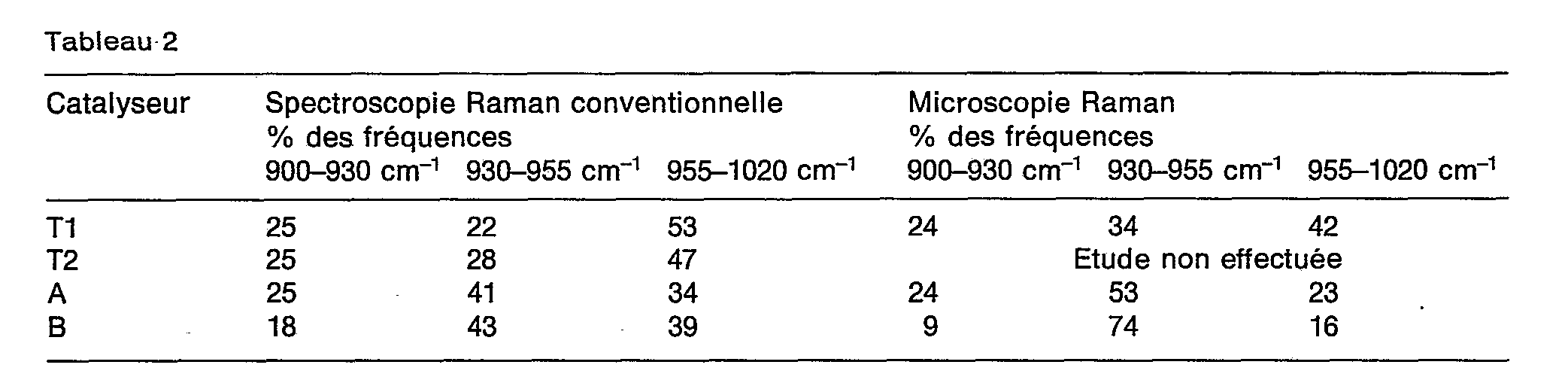
- Ces catalyseurs ont été étudiés par spectroscopie RAMAN conventionnelle et par microscopie RAMAN.
- Les spectres de ces catalyseurs limités à la zone de fréquence 900-1020 cm-' sont représentés sur les figures 1 à 7. Les figures 1 à 4 correspondent à la spectroscopie conventionnelle et les figures 5 à 7 à la microscopie.
- On constate que les pics correspondant aux catalyseurs selon l'invention (figures 3 et 4 et figures 6 et 7) ont une forme beaucoup plus fine que ceux des catalyseurs témoins (figures 1 et 2 et figure 5).
- De ces figures, on peut calculer la répartition des fréquences des raies qui est donnée dans le Tableau Il ci-après.
- Cet exemple concerne l'hydrodésulfuration d'une charge d'hydrocarbures constituée par le résidu sous vide d'un pétrole brut «KIRKOUK», dont le point d'ébullition sous pression atmosphérique est supérieur à 525°C.
- Ses caractéristiques sont les suivantes:
- - Densité à 15°C 1,0205,
- - Viscosité à 100°C 750 centistokes,
- - Teneur en soufre 5,1% en poids,
- - Teneur en azote 0,36% en poids, .
- - Teneur en nickel 55 ppm,
- - Teneur en vanadium 121 ppm,
- - Teneur en asphaltènes (selon norme AFNOR T60-115) 7,3% en poids,
- - Résidu CONRADSON (selon norme AFNOR T60-116) 18% en poids.
- Les essais sont effectués de la façon suivante.
- On utilise une unité pilote à recycle de gaz et à soutirage en continu. Le volume de catalyseur est de 150 cm3.
- Avant le test proprement dit, on présulfure le catalyseur avec un gazole, dont l'intervalle de distillation est compris entre 250 et 380 °C et contenant 1,3% en poids de soufre.
- Cette présulfuration est effectuée sous une pression d'hydrogène de 24 bars, à une vitesse spatiale horaire de 3 et un taux hydrogène/charge de 200 normaux-litres/litre. On augmente en 24 heures la température progressivement, de façon à atteindre 375°C.
- Les conditions opératoires des tests proprement dits sont les suivantes:
- - pression d'hydrogène 140 bars,
- - pression totale 150 bars,
- - pression d'hydrogène sulfuré 6 bars,
- - vitesse spatiale horaire 0,5,
- - rapport hydrogène/ hydrocarbures 1000 normaux-litres/litre.
- On maintient la température de façon à obtenir une teneur en soufre dans l'effluent de 1,5% en poids.
- La baisse d'activité du catalyseur est compensée par une augmentation régulière de la température. On arrête l'essai à 410°C. L'évolution de la température en fonction du temps est représentée sur la figure 8.
- On constate que les catalyseurs A et B selon l'invention ont une excellente résistance vis-à-vis de l'empoisonnement des contaminants contenus dans la charge contrairement aux catalyseurs T1 et T2.
- Les essais ont été conduits dans des conditions telles que les taux de démétallisation et de déazo- tation sont respectivement:
- - pour le vanadium: 83%,
- - pour le nickel: 70%,
- - pour l'azote: 55%.
Claims (4)
Applications Claiming Priority (2)
| Application Number | Priority Date | Filing Date | Title |
|---|---|---|---|
| FR8020219A FR2490507A1 (fr) | 1980-09-19 | 1980-09-19 | Catalyseurs d'hydrotraitement d'hydrocarbures et application desdits catalyseurs |
| FR8020219 | 1980-09-19 |
Publications (2)
| Publication Number | Publication Date |
|---|---|
| EP0048670A1 EP0048670A1 (fr) | 1982-03-31 |
| EP0048670B1 true EP0048670B1 (fr) | 1985-05-02 |
Family
ID=9246110
Family Applications (1)
| Application Number | Title | Priority Date | Filing Date |
|---|---|---|---|
| EP81401448A Expired EP0048670B1 (fr) | 1980-09-19 | 1981-09-17 | Catalyseurs d'hydrotraitement d'hydrocarbures et application desdits catalyseurs |
Country Status (6)
| Country | Link |
|---|---|
| EP (1) | EP0048670B1 (fr) |
| JP (1) | JPS5787840A (fr) |
| CA (1) | CA1171841A (fr) |
| DE (1) | DE3170296D1 (fr) |
| FR (1) | FR2490507A1 (fr) |
| MX (1) | MX159152A (fr) |
Cited By (1)
| Publication number | Priority date | Publication date | Assignee | Title |
|---|---|---|---|---|
| RU2319543C1 (ru) * | 2006-09-21 | 2008-03-20 | Открытое акционерное общество "Ангарский завод катализаторов и органического синтеза" (ОАО "АЗКиОС") | Катализатор защитного слоя для гидроочистки нефтяных фракций |
Families Citing this family (4)
| Publication number | Priority date | Publication date | Assignee | Title |
|---|---|---|---|---|
| FR2560789B1 (fr) * | 1984-03-06 | 1987-03-20 | Raffinage Cie Francaise | Catalyseurs d'hydrotraitement d'hydrocarbures et applications de ces catalyseurs |
| FR2598631B1 (fr) * | 1986-05-14 | 1988-11-25 | Total France | Catalyseur d'hydrotraitement d'hydrocarbures et application dudit catalyseur |
| FR2598632B1 (fr) * | 1986-05-14 | 1988-11-10 | Total France | Catalyseurs d'hydrotraitement d'hydrocarbures et applications de ces catalyseurs |
| RU2147256C1 (ru) * | 1998-09-29 | 2000-04-10 | Общество с ограниченной ответственностью "Новокуйбышевский завод катализаторов" | Катализатор гидроочистки нефтяных фракций и способ его приготовления |
Family Cites Families (3)
| Publication number | Priority date | Publication date | Assignee | Title |
|---|---|---|---|---|
| US3814684A (en) * | 1972-06-14 | 1974-06-04 | Gulf Research Development Co | Residue hydrodesulfurization process with catalysts whose pores have a small orifice size |
| NL7314097A (nl) * | 1973-10-12 | 1975-04-15 | American Cyanamid Co | Werkwijze ter bereiding van katalysatoren. |
| FR2424062A1 (fr) * | 1978-04-26 | 1979-11-23 | American Cyanamid Co | Catalyseur d'hydrodesulfuration et son procede de preparation |
-
1980
- 1980-09-19 FR FR8020219A patent/FR2490507A1/fr active Granted
-
1981
- 1981-09-11 MX MX189143A patent/MX159152A/es unknown
- 1981-09-16 CA CA000386067A patent/CA1171841A/fr not_active Expired
- 1981-09-17 DE DE8181401448T patent/DE3170296D1/de not_active Expired
- 1981-09-17 EP EP81401448A patent/EP0048670B1/fr not_active Expired
- 1981-09-18 JP JP56147692A patent/JPS5787840A/ja active Granted
Cited By (1)
| Publication number | Priority date | Publication date | Assignee | Title |
|---|---|---|---|---|
| RU2319543C1 (ru) * | 2006-09-21 | 2008-03-20 | Открытое акционерное общество "Ангарский завод катализаторов и органического синтеза" (ОАО "АЗКиОС") | Катализатор защитного слоя для гидроочистки нефтяных фракций |
Also Published As
| Publication number | Publication date |
|---|---|
| FR2490507A1 (fr) | 1982-03-26 |
| DE3170296D1 (en) | 1985-06-05 |
| JPS5787840A (en) | 1982-06-01 |
| FR2490507B1 (fr) | 1984-10-26 |
| JPH0249780B2 (fr) | 1990-10-31 |
| CA1171841A (fr) | 1984-07-31 |
| MX159152A (es) | 1989-04-26 |
| EP0048670A1 (fr) | 1982-03-31 |
Similar Documents
| Publication | Publication Date | Title |
|---|---|---|
| US6506297B1 (en) | Biodegradable high performance hydrocarbon base oils | |
| EP0343045B1 (fr) | Composition catalytique comprenant un sulfure métallique en suspension dans un liquide contenant des asphaltènes et procédé d'hydroviscoreduction d'une charge d'hydrocarbures | |
| US3852207A (en) | Production of stable lubricating oils by sequential hydrocracking and hydrogenation | |
| JP4874977B2 (ja) | 重油のアップグレードにおける活性スラリー触媒組成物のリサイクル法 | |
| JP2002527530A (ja) | フィッシャー−トロプシュワックスの水素異性化油をPt/H−モルデナイトにより脱ロウして製造されるイソパラフィン基油 | |
| FR2785908A1 (fr) | Procede de production d'essences a faible teneur en soufre | |
| CA1072903A (fr) | Extraction du petrole en presence dans le schiste bitumineux, par hydrotraitement a l'aide de deux reacteurs de catalyse en serie | |
| CN1735675A (zh) | 生产低苯汽油的方法 | |
| US5292426A (en) | Wax conversion process | |
| FR2864102A1 (fr) | Catalyseur d'hydrogenation selective d'olefines et sa preparation ainsi que son utilisation | |
| US3915841A (en) | Process for hydrodesulfurizing and hydrotreating lubricating oils from sulfur-containing stock | |
| JPS6027711B2 (ja) | 潤滑油の製造法 | |
| WO1998020969A1 (fr) | Catalyseur contenant du phosphore et procede d'hydrotraitement de charges petrolieres avec ce catalyseur | |
| CN1195828C (zh) | 润滑油基础油加氢精制方法 | |
| EP0048670A1 (fr) | Catalyseurs d'hydrotraitement d'hydrocarbures et application desdits catalyseurs | |
| RU2675852C1 (ru) | Способ получения высокоиндексных компонентов базовых масел группы iii/iii+ | |
| Beuther et al. | Hydrotreating to produce high viscosity index lubricating oils | |
| CA1263362A (fr) | Catalyseurs d'hydrotraitement d'hydrocarbures et applications de ces catalyseurs | |
| EP0246159B1 (fr) | Procédé d'hydrotraitement catalytique d'hydrocarbures | |
| EP0183364A1 (fr) | Procédé pour la production d'huiles de base lubrifiantes traitées par de l'hydrogène et leur stabilisation par addition de l'hydrogène sulfuré | |
| EP0246160B1 (fr) | Procédé d'hydrotraitement catalytique d'hydrocarbures | |
| US20090065395A1 (en) | Hydrotreating processes for fabricating petroleum distillates from light fischer-tropsch liquids | |
| CN1033831A (zh) | 重油裂化方法 | |
| RU2258732C1 (ru) | Способ облагораживания бензина каталитического крекинга | |
| US8231776B2 (en) | Hydrotreating processes for fabricating petroleum distillates from light fischer-tropsch liquids |
Legal Events
| Date | Code | Title | Description |
|---|---|---|---|
| PUAI | Public reference made under article 153(3) epc to a published international application that has entered the european phase |
Free format text: ORIGINAL CODE: 0009012 |
|
| AK | Designated contracting states |
Designated state(s): BE DE GB IT NL |
|
| ITCL | It: translation for ep claims filed |
Representative=s name: BARZANO' E ZANARDO MILANO S.P.A. |
|
| TCNL | Nl: translation of patent claims filed | ||
| 17P | Request for examination filed |
Effective date: 19820408 |
|
| DET | De: translation of patent claims | ||
| ITF | It: translation for a ep patent filed | ||
| GRAA | (expected) grant |
Free format text: ORIGINAL CODE: 0009210 |
|
| AK | Designated contracting states |
Designated state(s): BE DE GB IT NL |
|
| REF | Corresponds to: |
Ref document number: 3170296 Country of ref document: DE Date of ref document: 19850605 |
|
| PLBE | No opposition filed within time limit |
Free format text: ORIGINAL CODE: 0009261 |
|
| STAA | Information on the status of an ep patent application or granted ep patent |
Free format text: STATUS: NO OPPOSITION FILED WITHIN TIME LIMIT |
|
| 26N | No opposition filed | ||
| ITTA | It: last paid annual fee | ||
| PGFP | Annual fee paid to national office [announced via postgrant information from national office to epo] |
Ref country code: GB Payment date: 19930806 Year of fee payment: 13 |
|
| PGFP | Annual fee paid to national office [announced via postgrant information from national office to epo] |
Ref country code: BE Payment date: 19930915 Year of fee payment: 13 |
|
| PGFP | Annual fee paid to national office [announced via postgrant information from national office to epo] |
Ref country code: NL Payment date: 19930930 Year of fee payment: 13 |
|
| PGFP | Annual fee paid to national office [announced via postgrant information from national office to epo] |
Ref country code: DE Payment date: 19931029 Year of fee payment: 13 |
|
| PG25 | Lapsed in a contracting state [announced via postgrant information from national office to epo] |
Ref country code: GB Effective date: 19940917 |
|
| PG25 | Lapsed in a contracting state [announced via postgrant information from national office to epo] |
Ref country code: BE Effective date: 19940930 |
|
| BERE | Be: lapsed |
Owner name: CIE FRANCAISE DE RAFFINAGE Effective date: 19940930 |
|
| PG25 | Lapsed in a contracting state [announced via postgrant information from national office to epo] |
Ref country code: NL Effective date: 19950401 |
|
| NLV4 | Nl: lapsed or anulled due to non-payment of the annual fee | ||
| GBPC | Gb: european patent ceased through non-payment of renewal fee |
Effective date: 19940917 |
|
| PG25 | Lapsed in a contracting state [announced via postgrant information from national office to epo] |
Ref country code: DE Effective date: 19950601 |