EP0048854A1 - Système téléphonique radio mobile pour la transmission numérique de parole - Google Patents
Système téléphonique radio mobile pour la transmission numérique de parole Download PDFInfo
- Publication number
- EP0048854A1 EP0048854A1 EP81107143A EP81107143A EP0048854A1 EP 0048854 A1 EP0048854 A1 EP 0048854A1 EP 81107143 A EP81107143 A EP 81107143A EP 81107143 A EP81107143 A EP 81107143A EP 0048854 A1 EP0048854 A1 EP 0048854A1
- Authority
- EP
- European Patent Office
- Prior art keywords
- fuko
- mobile
- phrase
- subscriber
- vst
- Prior art date
- Legal status (The legal status is an assumption and is not a legal conclusion. Google has not performed a legal analysis and makes no representation as to the accuracy of the status listed.)
- Ceased
Links
- 230000005540 biological transmission Effects 0.000 title claims abstract description 32
- 230000003139 buffering effect Effects 0.000 claims description 6
- 238000000547 structure data Methods 0.000 claims description 4
- 230000003111 delayed effect Effects 0.000 claims description 3
- 230000001960 triggered effect Effects 0.000 claims description 3
- 230000000977 initiatory effect Effects 0.000 claims 1
- 238000012432 intermediate storage Methods 0.000 claims 1
- 238000012544 monitoring process Methods 0.000 claims 1
- 238000000034 method Methods 0.000 description 12
- 239000000872 buffer Substances 0.000 description 3
- 238000011161 development Methods 0.000 description 2
- 230000018109 developmental process Effects 0.000 description 2
- 230000007704 transition Effects 0.000 description 2
- 240000003517 Elaeocarpus dentatus Species 0.000 description 1
- 230000001427 coherent effect Effects 0.000 description 1
- 238000000280 densification Methods 0.000 description 1
- 238000001514 detection method Methods 0.000 description 1
- 230000004044 response Effects 0.000 description 1
Images

Classifications
-
- H—ELECTRICITY
- H04—ELECTRIC COMMUNICATION TECHNIQUE
- H04W—WIRELESS COMMUNICATION NETWORKS
- H04W76/00—Connection management
- H04W76/10—Connection setup
Definitions
- the present invention relates to a telephone mobile radio system for digital voice transmission, in which each mobile subscriber has at least one radio. Connection to a fixed radio concentrator is connectable.
- Speech interpolation requires a brief temporary storage of digital signals that are formed, representing so-called speech phases or phrases. It is therefore important to ensure that the maximum runtime limit from subscriber to subscriber, which is set at 400 ms, is not exceeded. If one takes into account that a satellite section already takes about 300 ms running time, then only about 100 ms remain for the remaining sections. This is particularly important for worldwide speech connections.
- the known methods of voice interpolation are generally used in sections, for example between two switching centers. Each of the two exchanges has a bundle of outgoing channels available from which it allocates the channels to the news channels as required.
- a star-shaped network is present in a mobile radio system. Only at one section end do all channels begin or end in one place. If the mobile subscribers at the other end of the section also have all access to all incoming and outgoing channels, they are not in a common place due to their mobility. In a mobile radio system, using voice interpolation, it would therefore be necessary to allocate all channels at the central end of the section, both for the channels arriving at the mobile subscriber and for the channels leaving the mobile subscriber. In such a case, the requirements of these channels must be transmitted via a central control circuit.
- the present invention has for its object to provide a telephone mobile radio system in which the speech is transmitted in the form of digital signals and a speech interpolation can be carried out, in which system each mobile subscriber can be connected to a fixed radio concentrator via at least one radio connection.
- the telephone mobile radio system according to the invention offers the advantage that the available channels can be better used and thus the number of participants can be increased considerably compared to known systems.
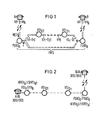
- FIG. 1 shows various connection setup options for a voice connection between two mobile telephone subscribers. It is assumed that the two transmission directions can be switched completely independently of one another. This prerequisite is necessary because there are periods in a conversation in which both conversation partners speak at the same time. Then the transmitter and receiver must also be switched on at the same time for a subscriber.
- the fixed radio station located centrally in one area namely the radio concentrator FUKO A or FUKO B , has 60 channels in the direction of the mobile subscribers for voice transmission. It is also assumed that there are also 60 channels in the opposite direction and one control channel in each of the two directions. For example, each channel should have a transmission speed of 16 kbit / s.
- the radio concentrator in question can then accept 120 virtual connections. Any further connection request is rejected by a busy signal.
- the radio concentrator controls the voice transmission in the direction of the mobile subscriber via a special control channel in the direction of the mobile subscriber, which is not identical to an organizational channel which is used for establishing and clearing the connection.
- the radio concentrator in question assigns the connection a number that is only valid for the duration of the connection and only for this radio concentrator. Since the radio concentrator can only accept 120 connections per control circuit, 7 bits are sufficient. Together with 1 bit for parity protection, the result is just 1 octet.
- the 60 channels of the radio concentrator are also numbered.
- the direction of the channel has to be marked with a bit.
- the binary value 1 is used for those channels towards the subscriber in the first position of an octet. 6 bits are sufficient to identify the 60 channels.
- the eighth bit of the octet is used to ensure parity.
- the radio concentrator is therefore able to assign each of the maximum of 120 connections to one of the 2 x 60 channels with two octets in the control channel towards the mobile subscriber.
- the radio concentrator If the radio concentrator now has to transmit speech from the landline network during a call to a mobile subscriber, see FIG. 2, it divides the speech into phrases using a speech detector. (A phrase is a coherent language section). Each phrase is temporarily stored for 15 ms in order to be able to determine at the beginning of a phrase whether it is really language or just a short click. This time is used to notify the receiving device concerned of the subscriber via the control channel that a new phrase will be transmitted and via which channel this is to be done. In this case, the radio concentrator, hereinafter referred to as "FUKO", transmits the connection number first and the channel number with the next octet. After receiving the two control octets, the receiver of the mobile subscriber adjusts to the channel mentioned within about 3 ms and receives it. Phrase that is forwarded to FUKO 15 ms after arrival.
- octets of the form 1'1111111 are transmitted in the idle state.
- the beginning of a phrase is indicated by an octet of the form 00000000. If the receiver receives the combination 00000000, it decodes the following octet as language.
- the phrase start octet 00000000 can be dispensed with if it is ensured that the first octet which represents language is different from octets of the forms 11111111, 01101000 and 01111110 or is made different from the transmitter and the receiver evaluates this.
- These octets each represent identifiers assigned internally.
- the throughput time of the language through the FUKO is always the same.
- the FUKO searches for a free channel for the current beginning phrase. As a rule, this search process will lead to the allocation of a channel.
- the receiver on the mobile subscriber is set to this channel and can receive the phrase.
- the phrase must not be delayed. Rather, as many octets are suppressed at the beginning of the phrase as correspond to the length of time in which the phrase must wait for a free channel.
- 16 octets of the form 11111111 are sent out. If the analog voice signal requires the transmission of 16 octets of the form 11111111 during a phrase, which would simulate the end of a phrase, it can be determined that the FUKO changes the bit with the least significance from 1 to 0 at the sixteenth octet. However, there is only a slight probability that the analog voice signal requires the transmission of 16 octets of the form 11111111, which is why this measure can advantageously be dispensed with.
- the recipient not only check whether the mobile station has 16 octets of the form 11111111 in order to deduce that the phrase has ended. Rather, he must also check whether the following octet does not have the form 01101000.
- the radio receiver After completing the phrase, the radio receiver will switch back to the control channel.
- Synchronization characters are transmitted in the control channel towards the mobile subscribers in the idle state, for. B. Octets of the form 01101000. This combination is not used when numbering the virtual connection or when numbering the channels.
- the control receivers of all mobile subscribers synchronize the mobile subscriber stations to this cycle. To separate two successive phrase start blocks, at least 1 octet of the form 01101000 is inserted.
- the control channel through the phrases is towards the mobile subscribers busy.
- the procedure for voice transmission from mobile subscribers to the FUKO is similar to that in the opposite direction. Only the speech channels are not assigned on the sending side, but on the receiving side, namely from the FUKO.
- the subscriber station must request the allocation of a channel towards the FUKO. For this purpose - after switching on the transmitter - it sends 3 octets on the control channel to FUKO, namely 2 octets of the form 01101000, as well as the connection number. Then it releases the control channel by switching the transmitter off again.
- the FUKO assigns a voice channel to the opposite direction via the control channel by first sending an octet to identify the connection and then an octet to identify the assigned channel. In the case of channel identification, the bit of the first digit of the octet is set to 0 to indicate that it is a channel in the direction from the subscriber to the FUKO.
- the mobile subscriber station now sets its transmitter to the allocated speech channel within 3 ms, switches the transmitter on, sends two octets of the form 01101000, then an octet of the form 00000000 and then the signal representing the speech.
- the processing time of a dedicated allocation computer in the FUKO is 5 ms, the channel can be available within 15 ms - also taking into account the run times.
- the mobile subscriber station sends out 16 octets of the form 111111111 and then releases the allocated speech channel again by switching the transmitter off and, as a precaution, re-adjusting to the control channel.
- the control channel in the direction from the FUKO to the mobile subscriber is also occupied with the control signals for the phrases from the mobile subscriber to the FUKO.
- the additional market value is approximately 0.1 income, so that this control channel is occupied with a total of approximately 0.2 income. Since the FUKO can coordinate the transmission of the control signals for the two directions, this traffic load is not too great. However, FUKO must ensure that the 15 ms response time mentioned is not exceeded when controlling the channels from the mobile subscriber to the FUKO. Otherwise, the handset must There is always the impression that his request has been "ignored”. Therefore, the control signals for this direction should be preferred.
- the longitudinal parity is preferably additionally secured, for which purpose an octet must also be transmitted in each case.
- the traffic information for the control channels then increases by 33% (from 0.09 to 0.12 Erl and from 0.18 to 0.24 Erl).
- a so-called forward correction method can also be used with the same amount of redundancy.
- the mobile station at FUKO can. Request a channel via the control channel, but the FUKO cannot assign the channel to the mobile station via the control channel because the receiver of the mobile station is still connected to the speech channel.
- the FUKO therefore interrupts the S p computing channel for 10 ms and sends 16 octets of the form 11111111, then two octets of the form 01101000 as well as the connection number and the speech channel number.
- a radio switching center such as a node switch
- You should the radio concentrators (FUKO) can be assigned in a star shape via fixed lines.
- the FUKO are connected to the mobile stations as described above.
- FuVSt voice detection and recoding for the land users to the radio exchange
- FuVSt the voice detection and recoding for the land users to the radio exchange
- the transition to the system's wire network works like a FUKO.
- the participant If the participant has communicated his connection request to the FUKO via the organizational channel, the latter reports the virtual connection to the FuVSt with a specially marked, secured connection start frame ("frame").
- frame For example, a separate line, for example an organizational line, can also be used for the identification.
- This start frame contains the identifiers for the called party and for the calling party. It also contains an octet for local, i.e. Identification of the radio connection of the calling subscriber, namely the originating subscriber A, only understandable in the original FUKO.
- the FuVSt "remembers" the FUKO from which the start frame came, reads the number of the called subscriber, finds it in an active file, adds the start frame to the two FUKO for local identification of the incoming and outgoing bundle Octet, namely a trunk group identifier, and sends the start frame on a line to the destination FUKO.
- the FUKO of the called party namely the destination party B, finally receives the start frame which contains the octets with which the original FUKO and the FuVSt have marked the connection in their area, as well as the numbers of the calling and called subscriber, namely identification information I and the dialing information W.
- the FUKO of the called subscriber assigns a connection identifier (1 octet) that is only in this FUKO is understandable, adds this to the start frame and sends the start frame back to the FUKO of the calling subscriber, marked as a receipt.
- the start frame and the receipt frame have now passed through the FuVSt. With the help of the subscriber number, these two frames can be identified there, and the information of the receipt frame can be saved.
- the FuVSt can thus monitor the virtual connection.
- the call begins, which is reported to the calling subscriber.
- the mobile subscriber station which divides the flow of speech into phrases P by means of a speech detector and buffers the coded speech signal for 15 ms, requests a speech channel for a phrase P from the FUKO in question
- the FUKO not only allocates a speech channel to the mobile subscriber, but searches also a voice channel to the FuVSt and sends a target identifier sequence Z there via the control channel.
- the target identifier sequence Z consists of the identifier of the speech channel which the FUKO has selected, an octet which contains the target FUKO, namely the FUKO . , identifies, and from the connection identification, namely the identification of the virtual connection to the mobile subscriber, that the target FUKO has awarded.
- the last two labels are the original FUKO, namely the FUKO . , known from the receipt frame.
- the originating FUKO sends the three octets of the target identifier sequence Z to the FuVSt in the order specified here.
- the FuVSt reads the first and the second octet from the target identifier sequence Z, assigns a speech channel from the source FUKO (designated by the first octet) to the target FUKO designated by the second octet and sends a further target identifier sequence via the control channel to the target -FUKO.
- This further target identifier sequence consists of two octets. The first of these specifies the speech channel on which the phrase P is to be transmitted from the FuVSt to the target FUKO.
- the second octet of the further target identification sequence is the third octet from the target identification sequence Z mentioned first.
- octets of the combination 01101000 are transmitted in the idle state. This combination is therefore not used to identify channels or virtual connections. It is important that at least one octet of the form 01101000 is inserted to separate two successive target criteria.
- the target FUKO in turn reads the two octets of the target identifier sequence, assigns the radio link (denoted by the second octet) to the mobile subscriber and assigns this to the speech channel denoted by the first octet of the further target identifier sequence.
- the virtual connection is triggered or cleared in that the FUKO of the triggering mobile subscriber sends out a trigger frame corresponding to the start acknowledgment frame, which passes through the FuVSt and is received and acknowledged by the FUKO of the other subscriber. All participating institutions delete the corresponding memory entries one after the other.
- a timer is set to its "zero" state. If the timer expires without a phrase P being transmitted in one of the two directions, the connection is released by sending trigger frames to the calling party or to both parties.
- a method for the transmission of speech with speech interpolation in a digital network has been described such that the FUKO acts as a sub-FuVSt.
- the FUKO is also able to connect two mobile subscribers who are within its range to each other on request in the active file without further involvement of the FuVSt. This case can be of particular interest for some of the subscriber classes of the "non-public mobile land radio" NöbL.
- the so-called "public mobile land radio" ⁇ bL mainly involves connections from mobile users to the wire network and vice versa.
- FIGS. 3 and 4 each schematically show the structure of a first and a second structure data sequence D ′ and D ′′.
- W is the dialing information which contains the destination exchange identifier KVSt B and the destination subscriber identifier KB.
- I designates the identification information which contains the originating exchange identification KVSt A and the originating subscriber identification KA.
- the line bundle identifiers are designated with A - D 1 or D 1 - B.
- FIG. 5 shows, as also already explained, schematically the structure of speech information S, Z denoting the target identifier sequence, P the phrase and E an end identifier.
Landscapes
- Engineering & Computer Science (AREA)
- Computer Networks & Wireless Communication (AREA)
- Signal Processing (AREA)
- Mobile Radio Communication Systems (AREA)
Applications Claiming Priority (2)
| Application Number | Priority Date | Filing Date | Title |
|---|---|---|---|
| DE3036739 | 1980-09-29 | ||
| DE19803036739 DE3036739A1 (de) | 1980-09-29 | 1980-09-29 | Fernsprech-mobilfunksystem zur digitalen sprachuebertragung |
Publications (1)
| Publication Number | Publication Date |
|---|---|
| EP0048854A1 true EP0048854A1 (fr) | 1982-04-07 |
Family
ID=6113161
Family Applications (1)
| Application Number | Title | Priority Date | Filing Date |
|---|---|---|---|
| EP81107143A Ceased EP0048854A1 (fr) | 1980-09-29 | 1981-09-10 | Système téléphonique radio mobile pour la transmission numérique de parole |
Country Status (2)
| Country | Link |
|---|---|
| EP (1) | EP0048854A1 (fr) |
| DE (1) | DE3036739A1 (fr) |
Cited By (9)
| Publication number | Priority date | Publication date | Assignee | Title |
|---|---|---|---|---|
| GB2138652A (en) * | 1983-04-23 | 1984-10-24 | Standard Telephones Cables Ltd | Distributed PABX |
| EP0332825A3 (en) * | 1988-03-18 | 1990-11-28 | Motorola, Inc. | Cellular data telephone system and cellular data telephone therefor |
| EP0642283A3 (fr) * | 1993-09-06 | 1996-03-27 | Nokia Mobile Phones Ltd | Transmission de données dans un réseau radio-téléphonique. |
| US5640395A (en) * | 1994-05-03 | 1997-06-17 | Nokia Mobile Phones Ltd. | System for transmitting packet data in digital cellular time division multiple access (TDMA) air interface |
| US5729541A (en) * | 1994-06-08 | 1998-03-17 | Nokia Mobile Phones Ltd. | System for transmitting packet data in radio telephone TDMA systems |
| US6014374A (en) | 1985-03-20 | 2000-01-11 | Interdigital Technology Corporation | Subscriber RF telephone system for providing multiple speech and/or data signals simultaneously over either a single or a plurality of RF channels |
| US6208630B1 (en) | 1993-09-30 | 2001-03-27 | Interdigital Technology Corporation | Modulary clustered radiotelephone system |
| CN1085473C (zh) * | 1995-03-01 | 2002-05-22 | 诺基亚流动电话有限公司 | 无线电话网络中的数据传输 |
| US9888774B2 (en) | 2009-01-09 | 2018-02-13 | Arxium, Inc. | Medication cabinetry |
Families Citing this family (1)
| Publication number | Priority date | Publication date | Assignee | Title |
|---|---|---|---|---|
| DE4119672A1 (de) * | 1991-06-14 | 1992-12-17 | Standard Elektrik Lorenz Ag | Verbindungsaufbau zwischen endgeraeten fuer mobile teilnehmer eines netzverbundes |
Citations (5)
| Publication number | Priority date | Publication date | Assignee | Title |
|---|---|---|---|---|
| DE2241573A1 (de) * | 1971-08-27 | 1973-03-08 | Western Electric Co | Digitales datenverarbeitungssystem |
| DE2441099A1 (de) * | 1973-08-29 | 1975-03-13 | Int Standard Electric Corp | System zur vermittlung und uebertragung digitaler nachrichten ueber ein stufenvermittlungsnetzwerk |
| DE2522758A1 (de) * | 1975-05-22 | 1976-12-02 | Siemens Ag | Personensucheinrichtung in fernsprechanlagen |
| DE2736858A1 (de) * | 1976-08-18 | 1978-02-23 | Post Office | Paketschaltzentrale |
| DE2659635A1 (de) * | 1976-12-30 | 1978-07-06 | Siemens Ag | Verfahren zur digitalen informationsuebertragung ueber funk |
Family Cites Families (12)
| Publication number | Priority date | Publication date | Assignee | Title |
|---|---|---|---|---|
| US2662974A (en) * | 1949-11-19 | 1953-12-15 | Bell Telephone Labor Inc | Arragngement for single-channel time sharing |
| DE829911C (de) * | 1950-03-10 | 1952-01-31 | Siemens & Halske A G | Anordnung zur Ermoeglichung des getrennten Nachrichtenverkehrs mit mehreren auf gleicher Frequenz arbeitenden Teilnehmern |
| DE1299734B (de) * | 1966-03-29 | 1969-07-24 | Siemens Ag | Schaltungsanordnung fuer ein mit Pulsmodulation, insbesondere Pulscodemodulation arbeitendes Nachrichtenverbindungsnetz zwischen mehreren AEmtern in Zeitmultiplextechnik |
| US3555424A (en) * | 1967-06-21 | 1971-01-12 | Itt | Means for allocating radio link channels in mobile telephone systems |
| DE2141333C3 (de) * | 1971-08-18 | 1982-10-28 | Licentia Patent-Verwaltungs-Gmbh, 6000 Frankfurt | Nachrichtenübertragungssystem |
| SE371064B (fr) * | 1973-03-09 | 1974-11-04 | Philips Svenska Ab | |
| NL7407717A (nl) * | 1974-06-10 | 1975-12-12 | Philips Nv | Radiotelefoniesysteem. |
| DE2536452A1 (de) * | 1975-08-16 | 1977-02-24 | Licentia Gmbh | Verfahren zur teilnehmersuche in einem funkuebertragungssystem |
| DE2537683C2 (de) * | 1975-08-23 | 1986-06-26 | Licentia Patent-Verwaltungs-Gmbh, 6000 Frankfurt | Anordnung zur Kanalzuweisung in einem Funkübertragungssystem mit ortsfesten Funkstationen und Fahrzeugstationen |
| GB1574714A (en) * | 1976-01-26 | 1980-09-10 | Post Office | Communication systems |
| DE2743965C3 (de) * | 1977-09-30 | 1980-10-02 | Siemens Ag, 1000 Berlin Und 8000 Muenchen | Verfahren zur sprachgesteuerten multiplexen Übertragung |
| FR2451680A1 (fr) * | 1979-03-12 | 1980-10-10 | Soumagne Joel | Discriminateur parole/silence pour interpolation de la parole |
-
1980
- 1980-09-29 DE DE19803036739 patent/DE3036739A1/de not_active Ceased
-
1981
- 1981-09-10 EP EP81107143A patent/EP0048854A1/fr not_active Ceased
Patent Citations (7)
| Publication number | Priority date | Publication date | Assignee | Title |
|---|---|---|---|---|
| DE2241573A1 (de) * | 1971-08-27 | 1973-03-08 | Western Electric Co | Digitales datenverarbeitungssystem |
| US3749845A (en) * | 1971-08-27 | 1973-07-31 | Bell Telephone Labor Inc | Digital data communication system |
| DE2441099A1 (de) * | 1973-08-29 | 1975-03-13 | Int Standard Electric Corp | System zur vermittlung und uebertragung digitaler nachrichten ueber ein stufenvermittlungsnetzwerk |
| DE2522758A1 (de) * | 1975-05-22 | 1976-12-02 | Siemens Ag | Personensucheinrichtung in fernsprechanlagen |
| DE2736858A1 (de) * | 1976-08-18 | 1978-02-23 | Post Office | Paketschaltzentrale |
| FR2362546A1 (fr) * | 1976-08-18 | 1978-03-17 | Post Office | Central d'aiguillage d'informations groupees |
| DE2659635A1 (de) * | 1976-12-30 | 1978-07-06 | Siemens Ag | Verfahren zur digitalen informationsuebertragung ueber funk |
Non-Patent Citations (3)
| Title |
|---|
| Colloque International de Commutation, Paris, 7-11 Mai 1979 Paris, FR IKEDA et al.: "Systeme de Commutation de Circuits Virtuels: un Nouveau Concept Pour les Reseaux Numeriques e Services Integres seiten 757-764 * seite 759, linke spalte, zeile 8 - seite 764, linke spalte, zeile 12; figuren 3, 7, 9, 12-5 * * |
| IEEE Transactions on Communications Band COM-28, Nr. 9, September 1980 New York, US MOWAFI et al.: "Integrated Voice/Data Packet Switching Techniques for Future Military Networks", seiten 1655-1662 * seite 1665, rechte spalte, zeile 5 - seite 1666, linke spalte, zeile 23 * * |
| Internation Conference on Communications, 8-12 Juni 1980 Seattle, US SPILLING et al.: "Digital Voice Communications in the Packet Radio Network", seiten 21.4.1 - 21.4.7 * Vollstandig * * |
Cited By (19)
| Publication number | Priority date | Publication date | Assignee | Title |
|---|---|---|---|---|
| GB2138652A (en) * | 1983-04-23 | 1984-10-24 | Standard Telephones Cables Ltd | Distributed PABX |
| US6771667B2 (en) | 1985-03-20 | 2004-08-03 | Interdigital Technology Corporation | Subscriber RF telephone system for providing multiple speech and/or data signals simultaneously over either a single or a plurality of RF channels |
| US6954470B2 (en) | 1985-03-20 | 2005-10-11 | Interdigital Technology Corporation | Subscriber RF telephone system for providing multiple speech and/or data signals simultaneously over either a single or a plurality of RF channels |
| US6393002B1 (en) | 1985-03-20 | 2002-05-21 | Interdigital Technology Corporation | Subscriber RF telephone system for providing multiple speech and/or data signals simultaneously over either a single or a plurality of RF channels |
| US6842440B2 (en) | 1985-03-20 | 2005-01-11 | Interdigital Technology Corporation | Subscriber RF telephone system for providing multiple speech and/or data signals simultaneously over either a single or a plurality of RF channels |
| US6282180B1 (en) | 1985-03-20 | 2001-08-28 | Interdigital Technology Corporation | Subscriber RF telephone system for providing multiple speech and/or data signals simultaneously over either a single or a plurality of RF channels |
| US6014374A (en) | 1985-03-20 | 2000-01-11 | Interdigital Technology Corporation | Subscriber RF telephone system for providing multiple speech and/or data signals simultaneously over either a single or a plurality of RF channels |
| EP0332825A3 (en) * | 1988-03-18 | 1990-11-28 | Motorola, Inc. | Cellular data telephone system and cellular data telephone therefor |
| US5802465A (en) * | 1993-09-06 | 1998-09-01 | Nokia Mobile Phones Ltd. | Data transmission in a radio telephone network |
| EP0642283A3 (fr) * | 1993-09-06 | 1996-03-27 | Nokia Mobile Phones Ltd | Transmission de données dans un réseau radio-téléphonique. |
| EP1739986A3 (fr) * | 1993-09-06 | 2009-12-23 | Nokia Corporation | Système, procédé et appareil pour accélérer l'établissement d'un canal de communication réel (non virtuel) |
| US6208630B1 (en) | 1993-09-30 | 2001-03-27 | Interdigital Technology Corporation | Modulary clustered radiotelephone system |
| US6496488B1 (en) | 1993-09-30 | 2002-12-17 | Interdigital Technology Corporation | Modularly clustered radiotelephone system |
| US7245596B2 (en) | 1993-09-30 | 2007-07-17 | Interdigital Technology Corporation | Modularly clustered radiotelephone system |
| US5640395A (en) * | 1994-05-03 | 1997-06-17 | Nokia Mobile Phones Ltd. | System for transmitting packet data in digital cellular time division multiple access (TDMA) air interface |
| USRE39375E1 (en) * | 1994-05-03 | 2006-11-07 | Nokia Mobile Phones Ltd | System for transmitting packet data in digital cellular time division multiple access (TDMA) air interface |
| US5729541A (en) * | 1994-06-08 | 1998-03-17 | Nokia Mobile Phones Ltd. | System for transmitting packet data in radio telephone TDMA systems |
| CN1085473C (zh) * | 1995-03-01 | 2002-05-22 | 诺基亚流动电话有限公司 | 无线电话网络中的数据传输 |
| US9888774B2 (en) | 2009-01-09 | 2018-02-13 | Arxium, Inc. | Medication cabinetry |
Also Published As
| Publication number | Publication date |
|---|---|
| DE3036739A1 (de) | 1982-06-03 |
Similar Documents
| Publication | Publication Date | Title |
|---|---|---|
| DE2727808C3 (de) | Automatisches Funkfernsprechsystem | |
| EP0048861B1 (fr) | Réseau numérique radio mobile universel pour la transmission de données par paquets commutés | |
| DE3036649C2 (fr) | ||
| DE1491977B2 (de) | Satelliten-nachrichtenuebertragungssystem mit beliebigem zugriff | |
| DE2257515A1 (de) | Senderimpulszeitsteuerung | |
| EP0048854A1 (fr) | Système téléphonique radio mobile pour la transmission numérique de parole | |
| DE1199333B (de) | Schaltungsanordnung fuer Fernmelde-, insbesondere Fernsprechwaehlanlagen, in denen Sprechwege und besondere Signalkanaele zur Herstellung einer Verbindung verwendet werden | |
| DE1009245B (de) | Schaltungsanordnung fuer Fernmelde-, insbesondere Fernsprechfernwaehlanlagen | |
| DE2714401A1 (de) | Schaltungsanordnung fuer fernmeldevermittlungsanlagen, insbesondere fernsprechvermittlungsanlagen, mit verbindungsindividuellen leitungssaetzen und mit identifizierern | |
| DE1215217B (de) | Schaltungsanordnung fuer Nachrichten-vermittlungsanlagen mit Haupt- und Unteraemtern | |
| EP0048860B1 (fr) | Réseau numérique universel pour la transmission d'information par paquets commutés | |
| DE3220511C3 (de) | Schaltungsanordnung fuer eine fernsprechvermittlungsanlage mit verbindungsindividuellen leitungsuebertragungen. | |
| DE3828003A1 (de) | Mehrere sprachkanaele und einen organisationskanal umfassendes buendelfunknetz | |
| DE3112549C2 (de) | Verfahren zum Austausch von Signalisierinformationen zwischen einer Fernmelde-, insbesondere Fernsprechnebenstellenanlage und dem öffentlichen Fernsprechnetz | |
| DE10036687C2 (de) | Verfahren zur nutzkanalunabhängigen Übertragung von Informationssignalen in einem Vermittlungsnetzsystem | |
| DE1256265C2 (de) | Schaltungsanordnung fuer fernmeldevermittlungsanlagen, insbesondere fernsprechanlagen, mit einem koppelfeld, einrichtungen fuer die aufnahme und weitergabe von wahlkennzeichen und einem zentralen markierer | |
| AT282702B (de) | Einrichtung zur Nachrichtenübertragung mittels eines Zeitmultiplexsystems | |
| DE1491977C3 (de) | Satelliten-Nachrichtenübertragungssystem mit beliebigem Zugriff | |
| DE1487945C3 (de) | Schaltungsanordnung für Fernmeldevermittlungsanlagen, insbesondere Fernsprechanlagen, mit einem zentralen Markierer | |
| DE2243580C3 (de) | Zentralgesteuerte Multiptex-Fernsprechnebenstellenvermittlungsanlage | |
| AT398663B (de) | Verfahren und anordnung zur übertragung von nachrichten | |
| DE2160660C2 (de) | Schaltungsanordnung für Fernmeldevermittlungsanlagen. insbesondere Fernsprechvermittlungsanlagen mit der Verbindungsherstellung dienenden Datenübertragungseinrichtungen | |
| AT247420B (de) | Schaltungsanordnung für Fernmelde-, insbesondere Fernsprechwählanlagen | |
| DE1537763C3 (de) | Schaltungsanordnung zur Herstellung von Verbindungswegen in zentral gesteuerten Fernsprechvermittlungsanlagen | |
| DE1487945B2 (de) | Schaltungsanordnung für Femmeldevermittlungsanlagen, insbesondere Fernsprechanlagen, mit einem zentralen Markierer |
Legal Events
| Date | Code | Title | Description |
|---|---|---|---|
| PUAI | Public reference made under article 153(3) epc to a published international application that has entered the european phase |
Free format text: ORIGINAL CODE: 0009012 |
|
| 17P | Request for examination filed |
Effective date: 19811030 |
|
| AK | Designated contracting states |
Designated state(s): BE FR GB IT NL SE |
|
| STAA | Information on the status of an ep patent application or granted ep patent |
Free format text: STATUS: THE APPLICATION HAS BEEN REFUSED |
|
| 18R | Application refused |
Effective date: 19850423 |
|
| RIN1 | Information on inventor provided before grant (corrected) |
Inventor name: VOLLMEYER, WERNER, DR. |