EP0048860A1 - Réseau numérique universel pour la transmission d'information par paquets commutés - Google Patents
Réseau numérique universel pour la transmission d'information par paquets commutés Download PDFInfo
- Publication number
- EP0048860A1 EP0048860A1 EP81107149A EP81107149A EP0048860A1 EP 0048860 A1 EP0048860 A1 EP 0048860A1 EP 81107149 A EP81107149 A EP 81107149A EP 81107149 A EP81107149 A EP 81107149A EP 0048860 A1 EP0048860 A1 EP 0048860A1
- Authority
- EP
- European Patent Office
- Prior art keywords
- vst
- information
- exchange
- identifier
- digital network
- Prior art date
- Legal status (The legal status is an assumption and is not a legal conclusion. Google has not performed a legal analysis and makes no representation as to the accuracy of the status listed.)
- Granted
Links
- 230000005540 biological transmission Effects 0.000 title claims abstract description 62
- 238000000034 method Methods 0.000 claims abstract description 26
- 238000000547 structure data Methods 0.000 claims description 5
- 230000011664 signaling Effects 0.000 claims description 2
- 230000001960 triggered effect Effects 0.000 claims description 2
- 230000003139 buffering effect Effects 0.000 claims 3
- 230000006378 damage Effects 0.000 claims 1
- 238000012432 intermediate storage Methods 0.000 description 2
- 238000012546 transfer Methods 0.000 description 2
- 230000015572 biosynthetic process Effects 0.000 description 1
- 230000001427 coherent effect Effects 0.000 description 1
- 238000004891 communication Methods 0.000 description 1
- 230000003111 delayed effect Effects 0.000 description 1
- 238000000280 densification Methods 0.000 description 1
- 238000001514 detection method Methods 0.000 description 1
- 238000011161 development Methods 0.000 description 1
- 230000018109 developmental process Effects 0.000 description 1
- 230000006870 function Effects 0.000 description 1
- 238000012544 monitoring process Methods 0.000 description 1
- 238000011084 recovery Methods 0.000 description 1
- 238000003860 storage Methods 0.000 description 1
Images
Classifications
-
- H—ELECTRICITY
- H04—ELECTRIC COMMUNICATION TECHNIQUE
- H04L—TRANSMISSION OF DIGITAL INFORMATION, e.g. TELEGRAPHIC COMMUNICATION
- H04L9/00—Cryptographic mechanisms or cryptographic arrangements for secret or secure communications; Network security protocols
- H04L9/40—Network security protocols
Definitions
- the present invention relates to a universal digital network for packet-switched information transmission.
- speech signals are digitized in a telephone system
- transmission of such digitized speech signals can be equated with digital data transmission.
- one channel is switched through for a respective speech connection if there is actually speech in the respective direction. In all other periods, the channel capacity is available for further individual speech connections.
- the known methods of voice interpolation are generally used in sections, for example between two switching centers. Each of the two exchanges has a bundle of outgoing channels available, from which it allocates the channels to the news channels as required. In contrast, in a complete telephone network there is usually a star-shaped or even a meshed network. A connection usually consists of several sections. Because of the required buffer time, however, there would be several sections (up to 12) a much too long runtime. This would not lead to a realistic solution.
- the present invention has for its object to provide a universal digital network for voice and data transmission in which digital non-speech-related data and / or voice are transmitted in the same way, in which the disadvantages of networks with packet switching are avoided and in which it is simple Means or measures can be achieved, but still use the advantages of voice interpolation where connections are wide and in any direction, running across different exchanges, connecting participants.
- the object on which the invention is based is achieved by a universal digital network for packet-switched information transmission, which is characterized in that, in a manner known per se, dialing information entered by an originating terminal into an originating exchange is used to transmit an originating exchange, if necessary via or or to set up a plurality of transit exchanges running and reaching up to a destination exchange to which a relevant destination terminal is connected, that one to.
- transmitting information is divided into sections of information with variable lengths, not limited by the transmission method and the switching method, and each section of information in the form of a block with a preceding destination identifier sequence, which contains information about virtual sub-connections to be traversed, and one at the end of the block and the end of the signaling end identifier is transmitted in the correct time via the real partial connection established for a relevant current information section between two exchanges and that the virtual connection is terminated after the information transmission has ended.
- the invention offers the advantage that the known method of speech interpolation in any form for the transmission of digital speech signals NEN telephone networks can be used to save channel capacity, that this type of transmission and switching methods does not impair the voice quality by different durations of the speech sections and that non-voice-related data can also be transmitted using the same method, saving channel capacity.
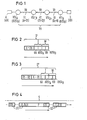
- FIG. 1 shows schematically the structure of a universal digital network according to the present invention.
- a "calling" terminal namely the originating terminal A, shares its switching center, namely the originating switching center VSt A , by means of a call set-up packet, which is secured, for example, by the known high-data link control method HDLC and below the connection start frame or start frame (frame here in the meaning "HDLC block carrying useful information), in a channel with a data transmission rate of 64 kbit / s, the number of the desired terminal in the form of dialing information W, which a destination switching center Contains identifier KVSt B and a destination terminal identifier KB, at the same time or beforehand, if necessary, a corresponding information exchange could take place in a separate subscriber signal circuit in order to ensure that the subscriber request is in the 64 kbit / s circle is received and acknowledged by the operator.
- the exchange does not switch a line for the connection - as is usual with circuit-switched exchanges - but searches for a line bundle in the desired direction that has enough free capacity and reports the virtual connection to the next exchange with a specially marked and secured connection start frame, for example the first transit switching center - VSt D1 .
- a specially marked and secured connection start frame for example the first transit switching center - VSt D1 .
- This start frame contains the identifiers for the called and for the calling subscriber, namely identification information I with the originating exchange identifier KVSt A and the originating device identifier KA. It also contains an octet for local identification of the outgoing bundle, which is only understandable in this exchange. With this marking, the two combinations. 00000000 and 11111111 not used.
- the local identification of a bundle corresponds to the local addressing of a direction and, after the virtual connection has been set up, is used for routing.
- the next exchange namely VSt D1 , "remembers”.
- the next exchange namely VSt D1 , "remembers” the bundle from which the start frame came reads the number of the destination exchange VSt B of the destination terminal B, searches for the corresponding bundle, adds an octet to the beginning frame for local identification of the incoming and outgoing bundle and sends the start Frame on a line of the selected outgoing bundle.
- the destination exchange VSt . of the called subscriber namely the destination terminal B, finally receives the start frame, which contains the octets with which the exchanges through which the consecutively designated the bundles to be used, as well as the numbers of the calling and the called subscriber, including the number of the associated end exchanges.
- the exchange of the called subscriber sends the start frame back to the exchange of the calling subscriber, identified as an acknowledgment.
- the start frame and acknowledgment frame then went through all transit exchanges. With the help of the subscriber numbers, these two frames can be identified there. The information of the receipt frame can be saved. The transit exchanges can thus monitor the virtual connections.
- the virtual connection is now also known to the two end exchanges.
- the called party is called, the calling party receives the call acknowledgment. After the called subscriber has answered, the information is transmitted digitally on the subscriber line.
- each bundle is bordered by two different octets from the two the exchanges are identified locally and independently and these two octets must also be transmitted in the start and acknowledgment frames
- 8 bits can be used to designate 256 bundles in the vicinity of the exchange. If the combinations 11111111 and 00000000 are left out, there are still 254 bundle indicators. On the other hand, there are certainly more than 254 bundles in one country.
- the trunk group identifiers will therefore have to be used several times.
- a strategy - for example similar to that used for mobile radio in small-zone networks for the frequencies of the channels - must ensure that ambiguities are avoided.
- a switching center may accept a maximum of 2 N virtual connections. It is assumed that the bundle has at least 35 circles. If it has fewer than 35 circles, a utilization factor less than 2 should be selected.
- the lines of a bundle must have uniform properties, in particular run times that are as similar as possible. For example, pupin and TF lines or satellite and sea cable lines must not be mixed, because otherwise runtime changes can occur abruptly during an information transmission, which is usually the case with a patent transmission does not interfere, but means a reduction in quality for a voice transmission.
- the transmission state begins, which is reported to the calling party.
- the voice dialogue is divided into phrases P by the two subscriber exchanges.
- a phrase is a coherent language section.
- a speech detector known per se analyzes digitized speech information S coming from the subscriber and recognizes the beginning of a phrase P.
- the coded speech signal is buffered for 5 15 ms and a target identification sequence Z is transmitted during this time.
- the target identifier sequence can advantageously be secured against errors. Then 16 bits would have to be added. However, it can generally be assumed that on the one hand the frequency of transmission errors in a digital network is sufficiently small and that, on the other hand, double connections are occasionally accepted in an analog network today. As a result, the description of the fuse can be omitted.
- the start of destination character is structured such that it differs from the octet 11111111 in at least 2 bits. It indicates the number of octets still present in the target identifier sequence Z and also contains a service identifier.
- the transmission time for the target identification sequence Z is ⁇ 2 ms.
- the above Intermediate storage time of ⁇ 15 ms arises because, in addition to the transmission time, a waiting period is also necessary in which it must be reliably recognized that it is actually a voice signal and not a single click.
- the waiting period is only required at the first exchange.
- the other exchanges need only be cached for about 0.5 ms.
- the transmission of a phrase P on a line is completed by the fact that, based on an octet clock of the network, transmission is carried out octet-wise in a criterion which indicates the idle position of the line, e.g. B. the combination 11111111.
- the first octet that the first exchange sends as the start identifier for a phrase P on the line (selected from the correct bundle) to the second exchange is the destination start character and then the octet that identifies the bundle to the third exchange. This is followed by the octet, which identifies the bundle to the fourth exchange, etc., until all bundles to the last exchange are identified.
- the last trunk group identifier for example D 1 -B, is followed by the two-octet number of the subscriber at the relevant exchange. This is followed by the coded speech Instead of the combination 11111111, some other combinations can also be used. It is. ensure that the selected combination is in a HDLC powered. Data connection does not occur.
- the second exchange reads only the first octet after the start of the target, destroys it and sets it.
- the destination start character existing information about the number of octets in the target identifier sequence Z by one and sends the destination start character and the following on a line of the bundle designated by the first octet.
- the following exchanges do the same.
- the last exchange is a pure subscriber exchange, which apart from the bundle to the higher-level exchange only has lines to subscribers. This exchange always reads two octets after the start signal, destroys them and sends the following on the line of the subscriber designated by the two octets.
- each exchange sends octets 11111111 on the line until it has a new phrase P - usually from another dialog, ie for another virtual connection.
- the receiving central office sends octets with the meaning "no speech signal" on the subscriber line, e.g. B. PCM 00000000.
- the phrases P of a dialog from participant to participant must all have the same duration. It must therefore be ensured that the throughput time through an exchange is the same for all phrases P of the dialogue.
- the throughput time is at least as long as it takes to read the first trunk group identifier, to search for a free line and to switch to it. If no line is currently free, the phrase P must not be delayed additionally. Rather, the first 8 ms part of the phrase should be suppressed.
- the phrase P is now transmitted in the correct time, if possible with its second 8 ms part. If there is no line free, the second 8 ms part is suppressed and the third part is started at the correct time etc. In any case, even with shortened phrase P, the line bundle IDs still to be processed and the start of prefix are prefixed.
- the exchange is based on the start of the destination sign.
- the virtual connection V can advantageously also be continued beyond the terminal exchange into a private branch exchange or to the subscriber, by moving the functions of pause recognition, the formation of phrases P and, in the case of large private branch exchanges, also voice interpolation there, and setting up and clearing down the virtual connection V v to the private branch exchange or to the subscriber.
- the specified method is practically independent of the type of speech coding. Not only is it possible to work with PCM and the various DPCMs, but it is also possible to extend this method to higher-quality speech coding methods, in which the analog speech is coded with more or fewer bits per sample depending on the instantaneous property of the speech signal. If the signals emitted by a microphone are also coded with a low bit rate during the pauses in speech, it should be possible to transmit background information instead of a pause in the introduction of further line speeds.
- the virtual connection V v is triggered or broken down in that the switching center of the triggering subscriber sends out a triggering frame corresponding to the start acknowledgment frame, which goes through all transit switching centers and from the switching center of the other subscriber is received and acknowledged. All exchanges delete the corresponding memory entries one after the other.
- a timer in its "zero" state is set for each new information section or for each new phrase P in each exchange. If the timer expires without an information section or phrase P being transmitted in either direction, the connection is released by sending trigger frames to the calling party or to both parties.
- the packet-wise transport of data, text and low-redundancy facsimile and image information from subscriber to subscriber requires not only so-called end-to-end backups but also secure transmission.
- the well-known data transmission method "HDLC" guarantees this on a temporarily disturbed data connection. However, you can Fluctuations in packet transit times occur due to block repetitions.
- an HDLC procedure variant is suitable for the transmission of packets of all mentioned services and is determined by CCITT. Under this condition, it is sufficient to support all services that the network allows not only voice phrases but also HDLC frames to be transmitted from subscriber to subscriber without fluctuations in transit time.
- duplex connection which is continuous from subscriber to subscriber and which is designed as a real connection section between the subscriber and the respectively associated end office and contains virtual connection sections between the two end exchanges.
- connection existing from subscriber to subscriber is considered in the following as a data connection on which HDLC frames with the uniform transmission speed, e.g. B. 64 kbit / s are transmitted. Since this connection is duplex, data can be transmitted in both directions simultaneously.
- connection behaves like an unsecured data connection on which - due to possible temporary overload cases in the bundles - additional faults occur and HDLC frames can be lost.
- HDLC guarantees secure data transmission in every case.
- HDLC With HDLC, the data is transported in HDLC frames.
- the beginning and end of an HDLC frame are identified by flags of the code tion 01111110, although it should be noted that these flags do not have to be in the octet frame of the network. In the following, this frame limitation is treated as part of the frame.
- octets of the combination 11111111 should be transmitted on the subscriber line before the first and after the last HDLC frame.
- octets can also occur between the HDLC frames.
- each terminal exchange must receive a switchover criterion from the associated subscriber "switching to data transmission" and the corresponding downshift at the end of the data transmission.
- This switchover criterion can either be transmitted in the 64 kbit / s circuit - if the associated exchange is aware of it - or in a separate subscriber signal circuit.
- the participants After establishing the data connection, the participants set up their data transmission section point-to-point according to HDLC.
- the HDLC addresses agreed and used between the HDLC subscribers are ignored on the virtual connection sections neither in the end exchanges nor in the transit exchanges.
- the HDLC frames contain HDLC control information and information for the HDLC user. Outside of the frames, the synchronization of the HDLC partners is normally maintained with permanently sent flags. This is not necessary and not desirable in digital networks. In idle phases, the criterion "Idle" - defined as at least 16 consecutive bits set to 1 - can be sent instead. The synchronization can then be restored with at least two flags.
- Idle allows a frame or a frame sequence connected with flags to be transmitted between the end exchanges like a speech phrase.
- the end switching center puts the virtual connection to the other end switching center into the idle state.
- the agreed-upon criterion indicating the idle state of the line for example 2 or 16 combinations 11111111 or other combinations that cannot occur in HDLC frames, is then successively sent to the virtual connection sections between the end exchanges.
- the octet 11111111 seems particularly suitable for this because it is already used in the HDLC bit stream for the meaning "idle" (idle state). For the sake of simplicity, the following consideration is limited to this combination for displaying the idle state of a line.
- the HDLC receiver is notified by the received exchange "Idle".
- the transmission procedure between the end exchanges guarantees. a correct transmission of phrases or frames even if "Idle" only lasts for example two octets. In this case, another free line is automatically searched for the subsequent frame sequence.
- voice and HDLC connections are not to be differentiated in the network, voice phrases and phrases containing HDLC frames must be able to be conveyed uniformly. Even if a distinction is made in the network between voice connections and data connections, it is desirable to choose an identical structure for speech phrases and phrases that contain HDLC frames.
- the switching network is only aware of the structure that is defined for speech phrases.
- a "speech phrase" can contain several HDLC frames that are interrupted by short HDLC idle states.
- the network of the subscriber device supplies the bit and octet clocks at the interface.
- the strategy can be improved in the event of a temporary overload.
- the "speech phrases” that contain HDLC frames can then be temporarily "stored” in the memory "before” an outgoing bundle and output undamaged in the order in which they arrive at a later point in time. If the buffer memory overflows, the "speech phrases" (containing HDLC frames) are handled in exactly the same way as with ordinary speech phrases.
- the multi-point subscriber can be subscriber-specific. (Containing HDLC frames) "voice phrases "with the corresponding destination identifier. The associated end agency will forward this correctly.
- the multi-point-capable subscriber can also explicitly assign the right to send at a higher communication level, in the sense of a "single poll method".
- An analog concept can be used for voice connections if you want to implement the "brokering" feature.
- FIGS. 2 and 3 each schematically show the structure of a first and a second structure data sequence D '. D ".
- W the dialing information
- the identification information is designated, which contains the originating switching center identifier KVST A, and the originating subscriber identifier KA.
- a - D 1 and D 1 - D 2 are called trunk group identifiers.
Landscapes
- Engineering & Computer Science (AREA)
- Computer Security & Cryptography (AREA)
- Computer Networks & Wireless Communication (AREA)
- Signal Processing (AREA)
- Telephonic Communication Services (AREA)
- Data Exchanges In Wide-Area Networks (AREA)
Applications Claiming Priority (2)
| Application Number | Priority Date | Filing Date | Title |
|---|---|---|---|
| DE19803036740 DE3036740A1 (de) | 1980-09-29 | 1980-09-29 | Universelles digitalnetz zur paketvermittelten informationsuebertragung |
| DE3036740 | 1980-09-29 |
Publications (2)
| Publication Number | Publication Date |
|---|---|
| EP0048860A1 true EP0048860A1 (fr) | 1982-04-07 |
| EP0048860B1 EP0048860B1 (fr) | 1985-12-27 |
Family
ID=6113163
Family Applications (1)
| Application Number | Title | Priority Date | Filing Date |
|---|---|---|---|
| EP81107149A Expired EP0048860B1 (fr) | 1980-09-29 | 1981-09-10 | Réseau numérique universel pour la transmission d'information par paquets commutés |
Country Status (2)
| Country | Link |
|---|---|
| EP (1) | EP0048860B1 (fr) |
| DE (1) | DE3036740A1 (fr) |
Cited By (2)
| Publication number | Priority date | Publication date | Assignee | Title |
|---|---|---|---|---|
| WO1984000266A1 (fr) * | 1982-06-25 | 1984-01-19 | Western Electric Co | Agencement de memoire d'information d'une extremite a l'autre dans un controleur de ligne |
| EP0275076A3 (en) * | 1987-01-12 | 1990-10-24 | Fujitsu Limited | Control system for communication between units |
Families Citing this family (1)
| Publication number | Priority date | Publication date | Assignee | Title |
|---|---|---|---|---|
| DE3212031A1 (de) * | 1982-03-31 | 1983-10-06 | Siemens Ag | Universelles netz zur zeitrichtigen uebermittlung von informationsabschnitten, naemlich sprache mit sprachinterpolation oder nachrichten in bloecken |
Citations (3)
| Publication number | Priority date | Publication date | Assignee | Title |
|---|---|---|---|---|
| DE2241573A1 (de) * | 1971-08-27 | 1973-03-08 | Western Electric Co | Digitales datenverarbeitungssystem |
| DE2441099A1 (de) * | 1973-08-29 | 1975-03-13 | Int Standard Electric Corp | System zur vermittlung und uebertragung digitaler nachrichten ueber ein stufenvermittlungsnetzwerk |
| DE2736858A1 (de) * | 1976-08-18 | 1978-02-23 | Post Office | Paketschaltzentrale |
Family Cites Families (3)
| Publication number | Priority date | Publication date | Assignee | Title |
|---|---|---|---|---|
| DE2522759C3 (de) * | 1975-05-22 | 1981-10-29 | Siemens AG, 1000 Berlin und 8000 München | Verfahren und Schaltungsanordnung zur Übertragung von digitalen Nachrichtensignalen von Signalsendern zu Signalempfängern über eine Koppeleinrichtung |
| CH591190A5 (fr) * | 1975-04-25 | 1977-09-15 | Hasler Ag | |
| BR7707476A (pt) * | 1976-11-10 | 1978-08-01 | Int Standard Electric Corp | Sistemas de comunicacoes de dados comutados em pacotes |
-
1980
- 1980-09-29 DE DE19803036740 patent/DE3036740A1/de not_active Ceased
-
1981
- 1981-09-10 EP EP81107149A patent/EP0048860B1/fr not_active Expired
Patent Citations (5)
| Publication number | Priority date | Publication date | Assignee | Title |
|---|---|---|---|---|
| DE2241573A1 (de) * | 1971-08-27 | 1973-03-08 | Western Electric Co | Digitales datenverarbeitungssystem |
| US3749845A (en) * | 1971-08-27 | 1973-07-31 | Bell Telephone Labor Inc | Digital data communication system |
| DE2441099A1 (de) * | 1973-08-29 | 1975-03-13 | Int Standard Electric Corp | System zur vermittlung und uebertragung digitaler nachrichten ueber ein stufenvermittlungsnetzwerk |
| DE2736858A1 (de) * | 1976-08-18 | 1978-02-23 | Post Office | Paketschaltzentrale |
| FR2362546A1 (fr) * | 1976-08-18 | 1978-03-17 | Post Office | Central d'aiguillage d'informations groupees |
Non-Patent Citations (2)
| Title |
|---|
| Colloque International de Commutation International Switching Symposium, 7. - 11. Mai 1979, seiten 757-764 Paris, FR. Y. IKEDA et al.: "Systeme de Commutation de Circuits Virtuels: Un Nouveau Concept Pour les Reseaux Numeriques a Service Integres" * seite 759, linke spalte, zeile 8- seite 764, linke spalte, zeile 12; figuren 3, 7, 9, 12 - 15 * * |
| IEEE Transactions on Communications, Part I, Band Com-28, Nr. 9, September 1980, seiten 1655-1662 New York, U.S.A. O.A. MOWAFI et al.: "Integrated Voice-Data Packet Switching Techniques for Future Military Networks" * seite 1665, rechte splate, zeile 5 - seite 1666, linke spalte, zeile 23 * * |
Cited By (3)
| Publication number | Priority date | Publication date | Assignee | Title |
|---|---|---|---|---|
| WO1984000266A1 (fr) * | 1982-06-25 | 1984-01-19 | Western Electric Co | Agencement de memoire d'information d'une extremite a l'autre dans un controleur de ligne |
| US4488288A (en) * | 1982-06-25 | 1984-12-11 | At&T Bell Laboratories | End-to-end information memory arrangement in a line controller |
| EP0275076A3 (en) * | 1987-01-12 | 1990-10-24 | Fujitsu Limited | Control system for communication between units |
Also Published As
| Publication number | Publication date |
|---|---|
| EP0048860B1 (fr) | 1985-12-27 |
| DE3036740A1 (de) | 1982-05-13 |
Similar Documents
| Publication | Publication Date | Title |
|---|---|---|
| EP0631454B1 (fr) | Méthode pour créer des connections virtuelles dans des réseaux de commutation de pacquets | |
| DE3906890C2 (de) | Teilnehmerkommunikationssystem | |
| DE60133316T2 (de) | System und verfahren zum abfangen von telekommunikationen | |
| EP0048853B1 (fr) | Réseau de commutation téléphonique pour la transmission numérique de parole | |
| EP0048861B1 (fr) | Réseau numérique radio mobile universel pour la transmission de données par paquets commutés | |
| DE1491977B2 (de) | Satelliten-nachrichtenuebertragungssystem mit beliebigem zugriff | |
| DE2515801A1 (de) | Verfahren und schaltungsanordnungen zur zeitmultiplexen datenuebertragung | |
| DE1199333B (de) | Schaltungsanordnung fuer Fernmelde-, insbesondere Fernsprechwaehlanlagen, in denen Sprechwege und besondere Signalkanaele zur Herstellung einer Verbindung verwendet werden | |
| DE2819119A1 (de) | Schaltungsanordnung fuer zeitmultiplex digital durchschaltende fernmelde-, insbesondere fernsprechvermittlungsanlagen | |
| DE69801728T2 (de) | Gerät und Verfahren zur Teilung eines Signalisierungskanals | |
| DE1537011B2 (de) | Schaltungsanordnung zur uebertragung von signalabtast werten in fernmelde insbesondere fernsprechanlagen | |
| DE3036739A1 (de) | Fernsprech-mobilfunksystem zur digitalen sprachuebertragung | |
| EP0048860B1 (fr) | Réseau numérique universel pour la transmission d'information par paquets commutés | |
| EP0332809A2 (fr) | Système de commutation de communication numérique, en particulier un central privé, pour signaux de voix, des données, d'images fixes, de vidéo-téléphone, etc. | |
| DE2514188C3 (de) | Schaltungsanordnung zur Übertragung von Schaltkennzeichen zwischen zwei Vermittlungsstellen | |
| DE69209368T2 (de) | Übertragungskanäle mit veränderlicher Datenrate für digitale Netzwerke | |
| DE3211969A1 (de) | Universelles digitales kommunikationsnetz zur paketvermittelten informationsuebertragung zwischen ortsgebundenen stationen | |
| DE3203052A1 (de) | Verfahren zum aufbauen von verbindungen in sprache und daten uebertragenden digitalen fernmeldenetzen und vermittlungseinrichtungen | |
| EP0631455A1 (fr) | Méthode pour la conservation des connections virtuelles après au moins une disparition partielle de branches de connection | |
| DE3112549C2 (de) | Verfahren zum Austausch von Signalisierinformationen zwischen einer Fernmelde-, insbesondere Fernsprechnebenstellenanlage und dem öffentlichen Fernsprechnetz | |
| DE19706081A1 (de) | Verfahren und Schaltungsanordnung zum Übertragen von Datenpaketen mit einem erweiterten ISDN-Verfahren | |
| DE1273595B (de) | Vermittlungssystem, insbesondere Zeitmultiplex-Fernsprechvermittlungssystem | |
| DE3212031C2 (fr) | ||
| DE2243580C3 (de) | Zentralgesteuerte Multiptex-Fernsprechnebenstellenvermittlungsanlage | |
| DE69722929T2 (de) | Verfahren und detektoreinheit zum verbindungsaufbau in einem fernübertragungsnetz |
Legal Events
| Date | Code | Title | Description |
|---|---|---|---|
| PUAI | Public reference made under article 153(3) epc to a published international application that has entered the european phase |
Free format text: ORIGINAL CODE: 0009012 |
|
| 17P | Request for examination filed |
Effective date: 19811030 |
|
| AK | Designated contracting states |
Designated state(s): BE FR GB IT NL |
|
| ITF | It: translation for a ep patent filed | ||
| GRAA | (expected) grant |
Free format text: ORIGINAL CODE: 0009210 |
|
| AK | Designated contracting states |
Designated state(s): BE FR GB IT NL |
|
| ET | Fr: translation filed | ||
| PLBE | No opposition filed within time limit |
Free format text: ORIGINAL CODE: 0009261 |
|
| STAA | Information on the status of an ep patent application or granted ep patent |
Free format text: STATUS: NO OPPOSITION FILED WITHIN TIME LIMIT |
|
| 26N | No opposition filed | ||
| ITTA | It: last paid annual fee | ||
| PGFP | Annual fee paid to national office [announced via postgrant information from national office to epo] |
Ref country code: GB Payment date: 19920820 Year of fee payment: 12 |
|
| PGFP | Annual fee paid to national office [announced via postgrant information from national office to epo] |
Ref country code: BE Payment date: 19920915 Year of fee payment: 12 |
|
| PGFP | Annual fee paid to national office [announced via postgrant information from national office to epo] |
Ref country code: FR Payment date: 19920917 Year of fee payment: 12 |
|
| PGFP | Annual fee paid to national office [announced via postgrant information from national office to epo] |
Ref country code: NL Payment date: 19920930 Year of fee payment: 12 |
|
| PG25 | Lapsed in a contracting state [announced via postgrant information from national office to epo] |
Ref country code: GB Effective date: 19930910 |
|
| PG25 | Lapsed in a contracting state [announced via postgrant information from national office to epo] |
Ref country code: BE Effective date: 19930930 |
|
| BERE | Be: lapsed |
Owner name: SIEMENS A.G. BERLIN UND MUNCHEN Effective date: 19930930 |
|
| PG25 | Lapsed in a contracting state [announced via postgrant information from national office to epo] |
Ref country code: NL Effective date: 19940401 |
|
| GBPC | Gb: european patent ceased through non-payment of renewal fee |
Effective date: 19930910 |
|
| NLV4 | Nl: lapsed or anulled due to non-payment of the annual fee | ||
| PG25 | Lapsed in a contracting state [announced via postgrant information from national office to epo] |
Ref country code: FR Free format text: LAPSE BECAUSE OF NON-PAYMENT OF DUE FEES Effective date: 19940531 |
|
| REG | Reference to a national code |
Ref country code: FR Ref legal event code: ST |