EP0048865B1 - Procédé pour la reconnaissance d'informations numériques lors d'une transmission numérique d'information, en particulier une transmission d'information dans des systèmes de communication entre postes radioélectriques mobiles - Google Patents
Procédé pour la reconnaissance d'informations numériques lors d'une transmission numérique d'information, en particulier une transmission d'information dans des systèmes de communication entre postes radioélectriques mobiles Download PDFInfo
- Publication number
- EP0048865B1 EP0048865B1 EP81107157A EP81107157A EP0048865B1 EP 0048865 B1 EP0048865 B1 EP 0048865B1 EP 81107157 A EP81107157 A EP 81107157A EP 81107157 A EP81107157 A EP 81107157A EP 0048865 B1 EP0048865 B1 EP 0048865B1
- Authority
- EP
- European Patent Office
- Prior art keywords
- sampling
- information
- pulse
- information element
- error rate
- Prior art date
- Legal status (The legal status is an assumption and is not a legal conclusion. Google has not performed a legal analysis and makes no representation as to the accuracy of the status listed.)
- Expired
Links
- 238000000034 method Methods 0.000 title claims description 19
- 230000005540 biological transmission Effects 0.000 title claims description 13
- 238000004891 communication Methods 0.000 title claims description 8
- 238000005070 sampling Methods 0.000 claims description 29
- 238000011156 evaluation Methods 0.000 description 4
- 238000010586 diagram Methods 0.000 description 2
- 238000011161 development Methods 0.000 description 1
- 230000018109 developmental process Effects 0.000 description 1
- 230000000694 effects Effects 0.000 description 1
- 238000005562 fading Methods 0.000 description 1
- 230000002349 favourable effect Effects 0.000 description 1
- 238000011017 operating method Methods 0.000 description 1
- 230000001105 regulatory effect Effects 0.000 description 1
Images
Classifications
-
- H—ELECTRICITY
- H04—ELECTRIC COMMUNICATION TECHNIQUE
- H04L—TRANSMISSION OF DIGITAL INFORMATION, e.g. TELEGRAPHIC COMMUNICATION
- H04L25/00—Baseband systems
- H04L25/02—Details ; arrangements for supplying electrical power along data transmission lines
- H04L25/06—DC level restoring means; Bias distortion correction ; Decision circuits providing symbol by symbol detection
- H04L25/068—DC level restoring means; Bias distortion correction ; Decision circuits providing symbol by symbol detection by sampling faster than the nominal bit rate
-
- H—ELECTRICITY
- H04—ELECTRIC COMMUNICATION TECHNIQUE
- H04L—TRANSMISSION OF DIGITAL INFORMATION, e.g. TELEGRAPHIC COMMUNICATION
- H04L1/00—Arrangements for detecting or preventing errors in the information received
- H04L1/20—Arrangements for detecting or preventing errors in the information received using signal quality detector
Definitions
- the present invention relates to a method for recognizing digital information in a digital information transmission, in particular information transmission in mobile radio communication systems, and a circuit arrangement for carrying out the method.
- Speech, data and images are the forms of information that are to be transmitted in known, wired communication systems and in future mobile radio communication systems.
- a problem with the transmission of information, in particular digitized information in a mobile radio communication system, is that so-called multipath propagation on the radio path results in the known fading, which can cause bit errors during a transmission process.
- a method for recognizing digital information in digital information transmission in which a plurality of sampling pulses are derived from the digital information available at the receiving end, preferably with an integer multiple of the information clock frequency, and in which the sampling times in the respective area of an information element is placed, in which the pulse to be scanned representing this information element assumes its presumable quasi-stationary state.
- the edges of the sampling pulses are placed at a corresponding number of sampling times within a wider span of time of the pulse representing the information element, that a comparison of a first sampling result with one or more subsequent sampling results is carried out and that a majority decision is made on the basis of the existing scanning results is taken.
- This known method does not offer the possibility of using one of several possible sampling modes in order to obtain the lowest error bit rate that can be achieved.
- the present invention has for its object to provide a method for recognizing digital information in a digital information transmission of the type mentioned, by means of which favorable error bit rates can be achieved without having to accept one of the aforementioned disadvantages.
- the object on which the invention is based is achieved by a method for recognizing digital information in a digital information transmission, in particular information transmission in mobile radio communication systems, in which several scanning pulses are derived from the digital information available at the receiving end, preferably with an integral multiple of the information clock frequency, and in which the sampling times in the the respective area of an information element in which the pulse to be scanned, which represents this information element, assumes its presumable quasi-stationary state, at least one further scanning pulse being derived from the digital information available at the receiving end, which has a further integer multiple of the information clock frequency, with further edges of the Sampling pulse at a corresponding number of sampling times within a wider scanning range of the information element nt representing the impulse and in each case a comparison of a first scanning result with one or more subsequent scanning results for an individual information element is carried out, which is characterized in that different scanning modes are used, among which by comparing the scanning results for an individual information element Search mode is selected that has the smallest detected information bit error rate.
- the present invention offers the advantage that multiple scanning of the information elements can be carried out in a simple manner, and impulses that are generally error-free, but represent distorted information elements, can be accepted as error-free, so that the information transmission has a higher useful effect.
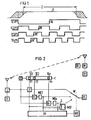
- the receiver-side circuit arrangement for carrying out the method includes a demodulator D, a carrier frequency generator TF, various non-correlating clock generation devices TE1, TE2 ... TEn, a plurality of majority decision stages ME2 ... MEn, an error rate evaluation unit FA, a majority decision stage for assessing the average Error rate MEF, a selector W, a selector control WS, a device for generating a setting criterion for a time range setting SZ and the information sink IS are provided.
- Devices known per se and shown only for understanding the relationships, such as an information source 10, a carrier frequency generator TF and a modulator M, are shown on the transmitter side, cf. Figure 2.
- the pulse representing the information element can be scanned in differently wide scanning areas by means of the different scanning pulses P1, P2 ... Pn at different scanning times PA, PA '.
- a comparison of a first scan result with one or more subsequent scan results for an individual information element is carried out.
- the scanning mode that has the smallest detected information bit error rate is used.
- each of these clock generating devices assigned individual comparators V1, V2 ... Vn are connected to a scanning device T, which contains the different clock generating devices TE1, TE2 ... Ten.
- the scanning results which result from a respective multiple scanning of a single individual information element are compared with one another.
- Individual majority decision stages ME2 ... MEn are connected to the comparators V2 ... Vn, each of which selects the scanning result as the "correct" scanning result in a manner known per se, for example by means of a so-called majority logic, which is predominantly in the multitude of individual scanning results for a single information element has occurred.
- the signal output of the relevant majority decision level for the relevant evaluation period will be deactivated by tri-state logic, for example.
- All final scanning results determined in this way from the individual comparisons V1, V2 ... Vn are fed to the error rate evaluation device FA. In it, they are processed or processed together in a manner known per se. Signal inputs of the majority decision stage for assessing an average error rate MEF are connected to the signal inputs of this error rate evaluation device FA via weighting stages G that are activated as required. With this last-mentioned device, which can also contain a so-called majority logic, a setting criterion for the voter control WS is obtained, on the basis of which the voter control WS can set the selector device W to the scanning mode, namely the scanning pulse, for example P2, which is the smallest has detected information bit error rate.
- the information sink IS the information receiver is connected to the signal output of this dialing device W.
- a time range setting SZ which can act on the scanning device T
- the time range Z in which the scanning pulse edges lie within the pulse representing the information element, can be set analogously by a phase control. This can be done either by a single setting or by a constantly regulated setting influenced by the mean error rate.
- the manipulated variable for setting the time range can serve as a criterion for selecting the optimal scanning mode.
- the optimal sampling mode can also be selected by setting a time range that can be set in such a way that no edge of the pulse representing the current information element occurs within this time range, and that the manipulated variable required for setting the time range forms a criterion for the selection .
- the method according to the invention and a circuit arrangement suitable for carrying out this method have created a method for recognizing digital information which makes the recognition of this digital information less sensitive to interference.
Landscapes
- Engineering & Computer Science (AREA)
- Computer Networks & Wireless Communication (AREA)
- Signal Processing (AREA)
- Power Engineering (AREA)
- Quality & Reliability (AREA)
- Synchronisation In Digital Transmission Systems (AREA)
- Detection And Prevention Of Errors In Transmission (AREA)
- Dc Digital Transmission (AREA)
Claims (4)
Applications Claiming Priority (2)
| Application Number | Priority Date | Filing Date | Title |
|---|---|---|---|
| DE19803036614 DE3036614A1 (de) | 1980-09-29 | 1980-09-29 | Verfahren zur erkennung von digitalinformation bei einer digitalen informationsuebertragung, insbesondere informationsuebertragung in mobilfunk-kommunikationssystemen |
| DE3036614 | 1980-09-29 |
Publications (2)
| Publication Number | Publication Date |
|---|---|
| EP0048865A1 EP0048865A1 (fr) | 1982-04-07 |
| EP0048865B1 true EP0048865B1 (fr) | 1984-12-27 |
Family
ID=6113073
Family Applications (1)
| Application Number | Title | Priority Date | Filing Date |
|---|---|---|---|
| EP81107157A Expired EP0048865B1 (fr) | 1980-09-29 | 1981-09-10 | Procédé pour la reconnaissance d'informations numériques lors d'une transmission numérique d'information, en particulier une transmission d'information dans des systèmes de communication entre postes radioélectriques mobiles |
Country Status (3)
| Country | Link |
|---|---|
| US (1) | US4432094A (fr) |
| EP (1) | EP0048865B1 (fr) |
| DE (1) | DE3036614A1 (fr) |
Families Citing this family (8)
| Publication number | Priority date | Publication date | Assignee | Title |
|---|---|---|---|---|
| US4596024A (en) * | 1983-05-23 | 1986-06-17 | At&T Bell Laboratories | Data detector using probabalistic information in received signals |
| NL8400630A (nl) * | 1984-02-29 | 1985-09-16 | Philips Nv | Decodeerinrichting voor een stroom van codesymbolen die woordsgewijze beschermd zijn door een dubbele reed-solomon-code met een minimum hamming-afstand van 5 over de codesymbolen en een verbladeringsmechanisme tussen de beide codes, alsmede speler voorzien van zo een decodeerinrichting. |
| GB2156117A (en) * | 1984-03-14 | 1985-10-02 | Philips Electronic Associated | Method of, and a circuit for, estimating true data from distorted digital data signals |
| DE3606354A1 (de) * | 1986-02-27 | 1987-09-03 | Bbc Brown Boveri & Cie | Verfahren zur uebermittlung von daten ueber die leitungen eines stromversorgungsnetzes |
| US5719904A (en) * | 1994-10-13 | 1998-02-17 | Samsung Electronics Co., Ltd. | Data restoring circuit |
| AT413252B (de) * | 1997-09-29 | 2005-12-15 | Molisch Andreas F Dr | Verfahren zur bestimmung des optimalen abtastzeitpunktes von digitalen signalfolgen mittels trainingsfolgen |
| US7087577B2 (en) * | 1998-10-16 | 2006-08-08 | Zimmer Orthobiologies, Inc. | Method of promoting natural bypass |
| GB2375274A (en) * | 2001-03-27 | 2002-11-06 | Acuid Corp Ltd | Receiver with automatic skew compensation |
Citations (1)
| Publication number | Priority date | Publication date | Assignee | Title |
|---|---|---|---|---|
| DE1804719A1 (de) * | 1968-10-23 | 1970-05-27 | Siemens Ag | Automatische Beurteilung der Eigenschaften eines Datenuebertragungsweges mit Hilfe eines Toleranzschemas |
Family Cites Families (15)
| Publication number | Priority date | Publication date | Assignee | Title |
|---|---|---|---|---|
| US2398490A (en) * | 1944-03-01 | 1946-04-16 | Rca Corp | Circuit for removing noise |
| US3217258A (en) * | 1962-08-23 | 1965-11-09 | Gorham Corp | Timing system for setting clocks to distorted standard pulses |
| GB1053189A (fr) * | 1963-11-04 | |||
| DE1252727B (de) * | 1965-03-01 | 1967-10-26 | International Business Machines Corporation, Armonk, NY (V St A) | Verfahren zum störungsfreien Empfang übertragener Daten |
| FR1522253A (fr) * | 1966-12-27 | 1968-04-26 | Lignes Telegraph Telephon | Appareillage de mesure d'une distorsion en modulation télégraphique |
| FR2017594A1 (fr) * | 1968-09-09 | 1970-05-22 | Dresser Ind | |
| GB1268366A (en) * | 1968-11-27 | 1972-03-29 | Standard Telephones Cables Ltd | Telecommunication switching centre |
| FR2039522A5 (fr) * | 1969-04-02 | 1971-01-15 | Cit Alcatel | |
| DE2360930C2 (de) * | 1973-12-06 | 1975-05-07 | Siemens Ag, 1000 Berlin Und 8000 Muenchen | Schaltungsanordnung zur Auswahl eines Diversitykanals |
| GB1548252A (en) * | 1975-07-02 | 1979-07-11 | Siemens Ag | Diversity data transmission systems |
| AT351610B (de) * | 1975-11-14 | 1979-08-10 | Siemens Ag | Schaltungsanordnung zur empfangsseitigen regelung der phase eines taktsignals bei einer datenuebertragung mit teilinformationsimpulsen |
| FR2345019A1 (fr) * | 1976-03-19 | 1977-10-14 | Cit Alcatel | Dispositif de transmission de donnees et application a la transmission de signaux analogiques et de donnees dans un reseau avec modulation delta |
| FR2377729A1 (fr) * | 1977-01-14 | 1978-08-11 | Thomson Csf | Dispositif de decodage de signaux numeriques, et systeme comportant un tel dispositif |
| DE2842328A1 (de) * | 1978-09-28 | 1980-04-17 | Siemens Ag | Verfahren und schaltungsanordnungen zum empfang von aus isochron binaer modulierten signalen gebildeten zeichen |
| DE2924922A1 (de) * | 1979-06-20 | 1981-01-22 | Siemens Ag | Verfahren und schaltungsanordnung zur taktsynchronisierung bei der uebertragung von digitalen nachrichtensignalen |
-
1980
- 1980-09-29 DE DE19803036614 patent/DE3036614A1/de not_active Withdrawn
-
1981
- 1981-08-27 US US06/296,867 patent/US4432094A/en not_active Expired - Fee Related
- 1981-09-10 EP EP81107157A patent/EP0048865B1/fr not_active Expired
Patent Citations (1)
| Publication number | Priority date | Publication date | Assignee | Title |
|---|---|---|---|---|
| DE1804719A1 (de) * | 1968-10-23 | 1970-05-27 | Siemens Ag | Automatische Beurteilung der Eigenschaften eines Datenuebertragungsweges mit Hilfe eines Toleranzschemas |
Also Published As
| Publication number | Publication date |
|---|---|
| EP0048865A1 (fr) | 1982-04-07 |
| US4432094A (en) | 1984-02-14 |
| DE3036614A1 (de) | 1982-05-13 |
Similar Documents
| Publication | Publication Date | Title |
|---|---|---|
| DE69534625T2 (de) | Mehrschwellendetektion für 0.3-GMSK | |
| DE69212016T2 (de) | Mobile Endstelleneinrichtung zur Übertragung von Daten und Verfahren zu deren Empfang | |
| DE69530554T2 (de) | Datenratenermittlung für eine Endstation | |
| DE69623363T2 (de) | Verfahren und Vorrichtung zur Überprufung eines Übertragungskanals in einem Kommunikationssystem | |
| DE4314739C2 (de) | Verfahren zum adaptiven Strahlbündeln eines Hochfrequnzfunksenders | |
| DE4241882A1 (fr) | ||
| DE4447230A1 (de) | Aufwärtsverbindungs-Zugriffsvorrichtung in einem Direktsequenz-Codeunterteilungs-Mehrfach- zugriffs-System | |
| DE3001397C2 (fr) | ||
| EP0048865B1 (fr) | Procédé pour la reconnaissance d'informations numériques lors d'une transmission numérique d'information, en particulier une transmission d'information dans des systèmes de communication entre postes radioélectriques mobiles | |
| EP0048859B1 (fr) | Procédé pour la reconnaissance d'informations numériques lors d'une transmission numérique d'information, en particulier une transmission d'information dans des systèmes de communication entre postes radioélectriques mobiles | |
| EP0048866B1 (fr) | Procédé pour la reconnaissance d'informations numériques lors d'une transmission numérique d'information, en particulier une transmission d'information dans des systèmes de communication entre postes radioélectriques mobiles | |
| DE19616828C2 (de) | Verfahren zur Separierung eines empfangenen Signalgemisches | |
| DE69026040T2 (de) | Synchronisations-Worterkennungsanordnung | |
| DE69825274T2 (de) | Bitdetektionsverfahren in einem funkkommunikationssystem | |
| DE4401786A1 (de) | Verfahren zur Prüfung der Qualität eines Übertragungskanals | |
| DE2461581A1 (de) | Adaptives deltamodulationssystem | |
| EP1490962B1 (fr) | Demodulation d'un signal de reception analogique module en frequence numeriquement par evaluation des ecarts temporels entre les passages par zero | |
| EP0916206A1 (fr) | Procede et dispositif pour evaluer la qualite d'un signal vocal transmis | |
| DE10337068B4 (de) | Adaptive Kanalschätzung mittels Variation der Integrationslänge bei der Entspreizung spreizkodierter Trainingssymbolfolgen | |
| EP4062608B1 (fr) | Émetteur-récepteur à modulation d'implusions en amplitude, appareil de terrain et procédé pour faire fonctionner l'émetteur-récepteur à modulation d'impulsions en amplitude | |
| DE3134846C2 (fr) | ||
| EP4062609B1 (fr) | Procédé de détermination d'une réponse impulsionnelle inverse d'un canal de communication | |
| DE69021951T2 (de) | Verfahren zum Erzeugen eines Maskierungsbits während eines dynamischen Vergleichs eines seriellen Datenstroms mit einer Referenz. | |
| DE2643135C3 (de) | Verfahren zur Fehlerratenennittlung bei mehrstufigen digitalen Signalen und Anordnung zur Durchführung des Verfahrens | |
| DE2502889C3 (de) | Schaltungsanordnung zur empfangsseitigen Signalentzerrung für eine Übertragungsstrecke |
Legal Events
| Date | Code | Title | Description |
|---|---|---|---|
| PUAI | Public reference made under article 153(3) epc to a published international application that has entered the european phase |
Free format text: ORIGINAL CODE: 0009012 |
|
| 17P | Request for examination filed |
Effective date: 19811030 |
|
| AK | Designated contracting states |
Designated state(s): BE FR GB IT NL SE |
|
| ITF | It: translation for a ep patent filed | ||
| GRAA | (expected) grant |
Free format text: ORIGINAL CODE: 0009210 |
|
| AK | Designated contracting states |
Designated state(s): BE FR GB IT NL SE |
|
| ET | Fr: translation filed | ||
| PG25 | Lapsed in a contracting state [announced via postgrant information from national office to epo] |
Ref country code: SE Effective date: 19850911 |
|
| PG25 | Lapsed in a contracting state [announced via postgrant information from national office to epo] |
Ref country code: BE Effective date: 19850930 |
|
| PLBE | No opposition filed within time limit |
Free format text: ORIGINAL CODE: 0009261 |
|
| STAA | Information on the status of an ep patent application or granted ep patent |
Free format text: STATUS: NO OPPOSITION FILED WITHIN TIME LIMIT |
|
| 26N | No opposition filed | ||
| BERE | Be: lapsed |
Owner name: SIEMENS A.G. BERLIN UND MUNCHEN Effective date: 19850910 |
|
| PG25 | Lapsed in a contracting state [announced via postgrant information from national office to epo] |
Ref country code: NL Effective date: 19860401 |
|
| GBPC | Gb: european patent ceased through non-payment of renewal fee | ||
| NLV4 | Nl: lapsed or anulled due to non-payment of the annual fee | ||
| PG25 | Lapsed in a contracting state [announced via postgrant information from national office to epo] |
Ref country code: FR Free format text: LAPSE BECAUSE OF NON-PAYMENT OF DUE FEES Effective date: 19860530 |
|
| REG | Reference to a national code |
Ref country code: FR Ref legal event code: ST |
|
| PG25 | Lapsed in a contracting state [announced via postgrant information from national office to epo] |
Ref country code: GB Effective date: 19881118 |
|
| EUG | Se: european patent has lapsed |
Ref document number: 81107157.0 Effective date: 19860729 |