EP0048948A1 - Procédé pour fabriquer des films en polymères de chlorure de vinyle étirés biaxialement et grainés - Google Patents
Procédé pour fabriquer des films en polymères de chlorure de vinyle étirés biaxialement et grainés Download PDFInfo
- Publication number
- EP0048948A1 EP0048948A1 EP81107565A EP81107565A EP0048948A1 EP 0048948 A1 EP0048948 A1 EP 0048948A1 EP 81107565 A EP81107565 A EP 81107565A EP 81107565 A EP81107565 A EP 81107565A EP 0048948 A1 EP0048948 A1 EP 0048948A1
- Authority
- EP
- European Patent Office
- Prior art keywords
- film
- embossing
- temperature
- roller
- embossed
- Prior art date
- Legal status (The legal status is an assumption and is not a legal conclusion. Google has not performed a legal analysis and makes no representation as to the accuracy of the status listed.)
- Granted
Links
- 238000004519 manufacturing process Methods 0.000 title claims abstract description 7
- BZHJMEDXRYGGRV-UHFFFAOYSA-N Vinyl chloride Chemical compound ClC=C BZHJMEDXRYGGRV-UHFFFAOYSA-N 0.000 title description 11
- 229920006254 polymer film Polymers 0.000 title 1
- 229920000915 polyvinyl chloride Polymers 0.000 claims abstract description 37
- 239000004800 polyvinyl chloride Substances 0.000 claims abstract description 34
- 238000000034 method Methods 0.000 claims abstract description 25
- 238000004049 embossing Methods 0.000 claims description 73
- 239000002390 adhesive tape Substances 0.000 abstract description 16
- 229920001971 elastomer Polymers 0.000 description 7
- 239000000853 adhesive Substances 0.000 description 6
- 230000001070 adhesive effect Effects 0.000 description 6
- 238000003490 calendering Methods 0.000 description 6
- 239000000314 lubricant Substances 0.000 description 6
- 229920000642 polymer Polymers 0.000 description 6
- 239000012790 adhesive layer Substances 0.000 description 5
- 230000000181 anti-adherent effect Effects 0.000 description 5
- 229920001577 copolymer Polymers 0.000 description 5
- 229920001519 homopolymer Polymers 0.000 description 5
- 239000000463 material Substances 0.000 description 5
- NLHHRLWOUZZQLW-UHFFFAOYSA-N Acrylonitrile Chemical compound C=CC#N NLHHRLWOUZZQLW-UHFFFAOYSA-N 0.000 description 4
- -1 Ethylen, Propylen, Styrol Chemical class 0.000 description 4
- 239000011888 foil Substances 0.000 description 4
- 239000003381 stabilizer Substances 0.000 description 4
- PUPZLCDOIYMWBV-UHFFFAOYSA-N (1R)-1,3-butanediol Natural products CC(O)CCO PUPZLCDOIYMWBV-UHFFFAOYSA-N 0.000 description 3
- KAKZBPTYRLMSJV-UHFFFAOYSA-N Butadiene Chemical compound C=CC=C KAKZBPTYRLMSJV-UHFFFAOYSA-N 0.000 description 3
- VGGSQFUCUMXWEO-UHFFFAOYSA-N Ethene Chemical compound C=C VGGSQFUCUMXWEO-UHFFFAOYSA-N 0.000 description 3
- PEDCQBHIVMGVHV-UHFFFAOYSA-N Glycerine Chemical compound OCC(O)CO PEDCQBHIVMGVHV-UHFFFAOYSA-N 0.000 description 3
- 239000004609 Impact Modifier Substances 0.000 description 3
- PPBRXRYQALVLMV-UHFFFAOYSA-N Styrene Chemical compound C=CC1=CC=CC=C1 PPBRXRYQALVLMV-UHFFFAOYSA-N 0.000 description 3
- 229920000578 graft copolymer Polymers 0.000 description 3
- 239000010410 layer Substances 0.000 description 3
- 229920006302 stretch film Polymers 0.000 description 3
- 239000012815 thermoplastic material Substances 0.000 description 3
- 238000004804 winding Methods 0.000 description 3
- UJTRCPVECIHPBG-UHFFFAOYSA-N 3-cyclohexylpyrrole-2,5-dione Chemical compound O=C1NC(=O)C(C2CCCCC2)=C1 UJTRCPVECIHPBG-UHFFFAOYSA-N 0.000 description 2
- 239000005977 Ethylene Substances 0.000 description 2
- QQONPFPTGQHPMA-UHFFFAOYSA-N Propene Chemical compound CC=C QQONPFPTGQHPMA-UHFFFAOYSA-N 0.000 description 2
- XSQUKJJJFZCRTK-UHFFFAOYSA-N Urea Chemical compound NC(N)=O XSQUKJJJFZCRTK-UHFFFAOYSA-N 0.000 description 2
- XTXRWKRVRITETP-UHFFFAOYSA-N Vinyl acetate Chemical compound CC(=O)OC=C XTXRWKRVRITETP-UHFFFAOYSA-N 0.000 description 2
- 239000004676 acrylonitrile butadiene styrene Substances 0.000 description 2
- 229920000122 acrylonitrile butadiene styrene Polymers 0.000 description 2
- 239000002318 adhesion promoter Substances 0.000 description 2
- 238000001816 cooling Methods 0.000 description 2
- 229910003460 diamond Inorganic materials 0.000 description 2
- 239000010432 diamond Substances 0.000 description 2
- 239000000839 emulsion Substances 0.000 description 2
- UIWXSTHGICQLQT-UHFFFAOYSA-N ethenyl propanoate Chemical compound CCC(=O)OC=C UIWXSTHGICQLQT-UHFFFAOYSA-N 0.000 description 2
- 239000012760 heat stabilizer Substances 0.000 description 2
- 235000013872 montan acid ester Nutrition 0.000 description 2
- UTOPWMOLSKOLTQ-UHFFFAOYSA-N octacosanoic acid Chemical compound CCCCCCCCCCCCCCCCCCCCCCCCCCCC(O)=O UTOPWMOLSKOLTQ-UHFFFAOYSA-N 0.000 description 2
- 238000002360 preparation method Methods 0.000 description 2
- 229920005989 resin Polymers 0.000 description 2
- 239000011347 resin Substances 0.000 description 2
- 239000000725 suspension Substances 0.000 description 2
- 229920001567 vinyl ester resin Polymers 0.000 description 2
- 239000004709 Chlorinated polyethylene Substances 0.000 description 1
- 229920009204 Methacrylate-butadiene-styrene Polymers 0.000 description 1
- 235000021355 Stearic acid Nutrition 0.000 description 1
- HCHKCACWOHOZIP-UHFFFAOYSA-N Zinc Chemical compound [Zn] HCHKCACWOHOZIP-UHFFFAOYSA-N 0.000 description 1
- 239000002253 acid Substances 0.000 description 1
- 150000007513 acids Chemical class 0.000 description 1
- XECAHXYUAAWDEL-UHFFFAOYSA-N acrylonitrile butadiene styrene Chemical compound C=CC=C.C=CC#N.C=CC1=CC=CC=C1 XECAHXYUAAWDEL-UHFFFAOYSA-N 0.000 description 1
- 239000000654 additive Substances 0.000 description 1
- 230000002411 adverse Effects 0.000 description 1
- 150000007933 aliphatic carboxylic acids Chemical class 0.000 description 1
- 229910052783 alkali metal Inorganic materials 0.000 description 1
- 150000001340 alkali metals Chemical class 0.000 description 1
- 150000001336 alkenes Chemical class 0.000 description 1
- 238000012662 bulk polymerization Methods 0.000 description 1
- BZDKYAZTCWRUDZ-UHFFFAOYSA-N buta-1,3-diene;methyl 2-methylprop-2-enoate;prop-2-enenitrile;styrene Chemical compound C=CC=C.C=CC#N.COC(=O)C(C)=C.C=CC1=CC=CC=C1 BZDKYAZTCWRUDZ-UHFFFAOYSA-N 0.000 description 1
- WWNGFHNQODFIEX-UHFFFAOYSA-N buta-1,3-diene;methyl 2-methylprop-2-enoate;styrene Chemical compound C=CC=C.COC(=O)C(C)=C.C=CC1=CC=CC=C1 WWNGFHNQODFIEX-UHFFFAOYSA-N 0.000 description 1
- 159000000007 calcium salts Chemical class 0.000 description 1
- 239000004202 carbamide Substances 0.000 description 1
- 150000001735 carboxylic acids Chemical class 0.000 description 1
- 239000011248 coating agent Substances 0.000 description 1
- 238000000576 coating method Methods 0.000 description 1
- 238000007334 copolymerization reaction Methods 0.000 description 1
- 238000005520 cutting process Methods 0.000 description 1
- WCRDXYSYPCEIAK-UHFFFAOYSA-N dibutylstannane Chemical compound CCCC[SnH2]CCCC WCRDXYSYPCEIAK-UHFFFAOYSA-N 0.000 description 1
- 235000014113 dietary fatty acids Nutrition 0.000 description 1
- PWEVMPIIOJUPRI-UHFFFAOYSA-N dimethyltin Chemical compound C[Sn]C PWEVMPIIOJUPRI-UHFFFAOYSA-N 0.000 description 1
- HGQSXVKHVMGQRG-UHFFFAOYSA-N dioctyltin Chemical compound CCCCCCCC[Sn]CCCCCCCC HGQSXVKHVMGQRG-UHFFFAOYSA-N 0.000 description 1
- 230000000694 effects Effects 0.000 description 1
- 238000007786 electrostatic charging Methods 0.000 description 1
- 238000007720 emulsion polymerization reaction Methods 0.000 description 1
- 238000001125 extrusion Methods 0.000 description 1
- 229930195729 fatty acid Natural products 0.000 description 1
- 239000000194 fatty acid Substances 0.000 description 1
- 238000010559 graft polymerization reaction Methods 0.000 description 1
- 238000010438 heat treatment Methods 0.000 description 1
- 239000007788 liquid Substances 0.000 description 1
- 229920012128 methyl methacrylate acrylonitrile butadiene styrene Polymers 0.000 description 1
- 239000000203 mixture Substances 0.000 description 1
- 239000000178 monomer Substances 0.000 description 1
- 239000004206 montan acid ester Substances 0.000 description 1
- HHFDXDXLAINLOT-UHFFFAOYSA-N n,n'-dioctadecylethane-1,2-diamine Chemical compound CCCCCCCCCCCCCCCCCCNCCNCCCCCCCCCCCCCCCCCC HHFDXDXLAINLOT-UHFFFAOYSA-N 0.000 description 1
- QIQXTHQIDYTFRH-UHFFFAOYSA-N octadecanoic acid Chemical compound CCCCCCCCCCCCCCCCCC(O)=O QIQXTHQIDYTFRH-UHFFFAOYSA-N 0.000 description 1
- OQCDKBAXFALNLD-UHFFFAOYSA-N octadecanoic acid Natural products CCCCCCCC(C)CCCCCCCCC(O)=O OQCDKBAXFALNLD-UHFFFAOYSA-N 0.000 description 1
- AQSJGOWTSHOLKH-UHFFFAOYSA-N phosphite(3-) Chemical class [O-]P([O-])[O-] AQSJGOWTSHOLKH-UHFFFAOYSA-N 0.000 description 1
- 229920003229 poly(methyl methacrylate) Polymers 0.000 description 1
- 238000006116 polymerization reaction Methods 0.000 description 1
- 239000004926 polymethyl methacrylate Substances 0.000 description 1
- 125000004805 propylene group Chemical group [H]C([H])([H])C([H])([*:1])C([H])([H])[*:2] 0.000 description 1
- 230000005855 radiation Effects 0.000 description 1
- 239000003507 refrigerant Substances 0.000 description 1
- 230000000717 retained effect Effects 0.000 description 1
- 150000003839 salts Chemical class 0.000 description 1
- 235000012424 soybean oil Nutrition 0.000 description 1
- 239000003549 soybean oil Substances 0.000 description 1
- 239000008117 stearic acid Substances 0.000 description 1
- 239000000126 substance Substances 0.000 description 1
- 238000010557 suspension polymerization reaction Methods 0.000 description 1
- 150000003585 thioureas Chemical class 0.000 description 1
- 125000000391 vinyl group Chemical group [H]C([*])=C([H])[H] 0.000 description 1
- XLYOFNOQVPJJNP-UHFFFAOYSA-N water Substances O XLYOFNOQVPJJNP-UHFFFAOYSA-N 0.000 description 1
- 229910052725 zinc Inorganic materials 0.000 description 1
- 239000011701 zinc Substances 0.000 description 1
Images

Classifications
-
- B—PERFORMING OPERATIONS; TRANSPORTING
- B29—WORKING OF PLASTICS; WORKING OF SUBSTANCES IN A PLASTIC STATE IN GENERAL
- B29C—SHAPING OR JOINING OF PLASTICS; SHAPING OF MATERIAL IN A PLASTIC STATE, NOT OTHERWISE PROVIDED FOR; AFTER-TREATMENT OF THE SHAPED PRODUCTS, e.g. REPAIRING
- B29C59/00—Surface shaping of articles, e.g. embossing; Apparatus therefor
- B29C59/02—Surface shaping of articles, e.g. embossing; Apparatus therefor by mechanical means, e.g. pressing
- B29C59/04—Surface shaping of articles, e.g. embossing; Apparatus therefor by mechanical means, e.g. pressing using rollers or endless belts
-
- B—PERFORMING OPERATIONS; TRANSPORTING
- B29—WORKING OF PLASTICS; WORKING OF SUBSTANCES IN A PLASTIC STATE IN GENERAL
- B29C—SHAPING OR JOINING OF PLASTICS; SHAPING OF MATERIAL IN A PLASTIC STATE, NOT OTHERWISE PROVIDED FOR; AFTER-TREATMENT OF THE SHAPED PRODUCTS, e.g. REPAIRING
- B29C55/00—Shaping by stretching, e.g. drawing through a die; Apparatus therefor
- B29C55/02—Shaping by stretching, e.g. drawing through a die; Apparatus therefor of plates or sheets
- B29C55/10—Shaping by stretching, e.g. drawing through a die; Apparatus therefor of plates or sheets multiaxial
- B29C55/12—Shaping by stretching, e.g. drawing through a die; Apparatus therefor of plates or sheets multiaxial biaxial
- B29C55/14—Shaping by stretching, e.g. drawing through a die; Apparatus therefor of plates or sheets multiaxial biaxial successively
- B29C55/146—Shaping by stretching, e.g. drawing through a die; Apparatus therefor of plates or sheets multiaxial biaxial successively firstly transversely to the direction of feed and then parallel thereto
-
- B—PERFORMING OPERATIONS; TRANSPORTING
- B29—WORKING OF PLASTICS; WORKING OF SUBSTANCES IN A PLASTIC STATE IN GENERAL
- B29K—INDEXING SCHEME ASSOCIATED WITH SUBCLASSES B29B, B29C OR B29D, RELATING TO MOULDING MATERIALS OR TO MATERIALS FOR MOULDS, REINFORCEMENTS, FILLERS OR PREFORMED PARTS, e.g. INSERTS
- B29K2027/00—Use of polyvinylhalogenides or derivatives thereof as moulding material
- B29K2027/06—PVC, i.e. polyvinylchloride
-
- B—PERFORMING OPERATIONS; TRANSPORTING
- B29—WORKING OF PLASTICS; WORKING OF SUBSTANCES IN A PLASTIC STATE IN GENERAL
- B29K—INDEXING SCHEME ASSOCIATED WITH SUBCLASSES B29B, B29C OR B29D, RELATING TO MOULDING MATERIALS OR TO MATERIALS FOR MOULDS, REINFORCEMENTS, FILLERS OR PREFORMED PARTS, e.g. INSERTS
- B29K2995/00—Properties of moulding materials, reinforcements, fillers, preformed parts or moulds
- B29K2995/0037—Other properties
- B29K2995/005—Oriented
- B29K2995/0053—Oriented bi-axially
-
- B—PERFORMING OPERATIONS; TRANSPORTING
- B29—WORKING OF PLASTICS; WORKING OF SUBSTANCES IN A PLASTIC STATE IN GENERAL
- B29K—INDEXING SCHEME ASSOCIATED WITH SUBCLASSES B29B, B29C OR B29D, RELATING TO MOULDING MATERIALS OR TO MATERIALS FOR MOULDS, REINFORCEMENTS, FILLERS OR PREFORMED PARTS, e.g. INSERTS
- B29K2995/00—Properties of moulding materials, reinforcements, fillers, preformed parts or moulds
- B29K2995/0037—Other properties
- B29K2995/0077—Yield strength; Tensile strength
-
- B—PERFORMING OPERATIONS; TRANSPORTING
- B29—WORKING OF PLASTICS; WORKING OF SUBSTANCES IN A PLASTIC STATE IN GENERAL
- B29L—INDEXING SCHEME ASSOCIATED WITH SUBCLASS B29C, RELATING TO PARTICULAR ARTICLES
- B29L2007/00—Flat articles, e.g. films or sheets
- B29L2007/001—Flat articles, e.g. films or sheets having irregular or rough surfaces
-
- B—PERFORMING OPERATIONS; TRANSPORTING
- B29—WORKING OF PLASTICS; WORKING OF SUBSTANCES IN A PLASTIC STATE IN GENERAL
- B29L—INDEXING SCHEME ASSOCIATED WITH SUBCLASS B29C, RELATING TO PARTICULAR ARTICLES
- B29L2007/00—Flat articles, e.g. films or sheets
- B29L2007/005—Tarpaulins
Definitions
- the invention relates to a process for the production of biaxially stretched and embossed polyvinyl chloride films.
- Biaxially stretched polyvinyl chloride films are described in German publication 15 94 129. They are used as carrier films for the preparation of adhesive tapes. The biaxial stretching ensures that the carrier film obtains those properties which are desired with regard to the use for the production of adhesive tapes.
- the finished adhesive tape consists of the backing film and an adhesive layer applied to it on one side, which is composed of an adhesion promoter and the actual adhesive.
- the purpose of the adhesion promoter is to anchor the adhesive on the carrier film in such a way that the adhesive is not transferred to the other, uncoated surface of the carrier film when the adhesive tape is unwound. When the adhesive tape is unwound, however, there is a risk that the adhesive tape will tear off, in particular if the adhesion between the layer containing the adhesive and the uncoated surface of the carrier film is very great.
- An adhesive tape is known from German utility model 79 31 547, which consists of a carrier film made of a polyvinyl chloride film and an adhesive-containing layer, the polyvinyl chloride film being embossed. With the embossing of the carrier film, it is achieved that the anti-adhesive layer can be dispensed with.
- the object of the present invention is to provide a process for the production of films from vinyl chloride polymers which are both biaxially stretched and embossed.
- the films are said to be particularly suitable as carrier films for the preparation of adhesive tapes.
- the polyvinyl chloride film on which the process according to the invention is based is generally a film produced by calendering or extrusion. Its thickness is generally 0.04 to 0.18 mm, preferably 0.06 to 0.13 mm.
- the calendering is usually carried out according to the low temperature process (Luvitherm process), that is to say at a calendering temperature of 150 to 190 ° C., or according to the high temperature process, that is to say at a calendering temperature of 180 to 230 ° C.
- Hard polyvinyl chloride films are preferred.
- Vinyl chloride polymers or polyvinyl chloride are understood not only as homopolymers of vinyl chloride but also as copolymers, such as copolymers and graft polymers of vinyl chloride, which are prepared by the known continuous or batch polymerization processes, for example by the emulsion, suspension and bulk polymerization processes.
- the polymerized vinyl chloride content is generally at least 50% by weight, preferably at least 85% by weight, based on the polymer.
- Preferred polyvinyl chlorides are homopolymers of vinyl chloride and its copolymers and graft polymers with a content of at least 85% by weight of polymerized vinyl chloride.
- the K values (DIN 53 726) of the polyvinyl chlorides are advantageously 50 to 80, preferably 55 to 78.
- Organotin-sulfur compounds, urea and thiourea derivatives, salts of the alkali metals and of zinc with aliphatic carboxylic acids or oxicarboxylic acids, optionally together with costabilizers such as epoxidized soybean oil and phosphites, are preferably used as heat stabilizers.
- Organotin-sulfur compounds such as dimethyltin bis-2-ethylhexylthioglycolate, di-n-butyltin bis-2-ethylhexylthioglycolate and di-n-octyltin bis-2-ethylhexylthioglycolate are preferred.
- the amount of stabilizers is generally 0.5 to 3.0% by weight, preferably 0.7 to 2.0% by weight, based on the polyvinyl chloride.
- the preferred lubricants used are limed 1,3-butanediol montanic acid esters, so that about 40% by weight of the montanic acid used for liming is present as a calcium salt (wax OP), 1,3-butanediol montanic acid ester (wax E), bis-stearylethylenediamine (wax C) , Stearic acid and / or fatty acid esters of glycerol.
- the amount of lubricant is generally 0.5 to 3.0% by weight, preferably 0.5 to 2.0% by weight, based on the polyvinyl chloride.
- the impact modifiers used are preferably acrylonitrile-butadiene-styrene (ABS) resins, methyl methacrylate-acrylonitrile-butadiene-styrene (MABS) resins, methyl methacrylate-butadiene-styrene (MBS) resins, polymethyl methacrylate, copolymers of ethylene and vinyl acetate and / or chlorinated polyethylene used.
- the amount of impact modifier is generally 5 to 20% by weight, preferably 8 to 15% by weight, based on the polyvinyl chloride.
- the biaxial stretching of the polyvinyl chloride film (step a) of the process according to the invention) is preferably carried out at a temperature of 110 to 140 ° C. with a transverse stretching ratio of 1.3: 1 to 1.8: 1 and a longitudinal stretch ratio of 1.9: 1 to 2.3: 1, the product of the transverse and longitudinal stretch ratio (that is the area stretch ratio) being at most 3.5: 1.
- an area stretch ratio of at least 2.0: 1, preferably at least 2.5: 1, should be achieved.
- the stretching of the polyvinyl chloride film can be carried out on the known devices for stretching thermoplastic materials.
- German patent 15 04 242 Such devices are described in detail, for example, in the aforementioned German specification 15 94 129, in German patent 15 04 242, in French patent 2 007 313 and in German patent 20 24 308.
- the transverse stretching of the polyvinyl chloride film is preferably carried out using the device described in German Patent 20 24 308. Thereafter, the polyvinyl chloride film, heated to the specified stretching temperature, is guided over the disks which are inclined to the film running direction, on which it is pressed in a force-fitting manner. The inclination of the discs is set up so that the specified transverse stretching ratios are achieved.
- the heating of the film, which is removed, for example, from a winding roll or comes from a calender or extruder, to the stretching temperature is preferably carried out by passing the film over correspondingly heated rollers which are arranged in front of the disks. It can also be done using conventional infrared radiation devices.
- the film can optionally be passed over one or more appropriately heated or cooled rollers before it runs onto the inclined disks.
- the longitudinal stretching of the polyvinyl chloride film is preferably carried out in such a way that the film running off the panes runs over a conventional roller device.
- roller arrangements for the longitudinal stretching of thermoplastic materials are described in detail in the French patent 2 007 313 already mentioned.
- the running speed of the longitudinal stretching roller is set in relation to the running speed of the film in front of this roll in such a way that the film is stretched longitudinally in the specified ratio.
- directly means that the film does not experience any appreciable cooling on the way after stretching until embossing, but rather maintains the stretching temperature, preferably the longitudinal stretching temperature.
- This is preferably achieved by stretching the film lengthwise through the embossing unit itself, consisting of the embossing roller and the impression roller.
- the embossing (deep-drawing deformation) of the stretched polyvinyl chloride film is carried out using the known devices for embossing thermoplastic materials. Such devices are described for example in German Offenlegungsschrift 28 33 982.
- the embossing roller has line, line, dome or dot patterns, preferably a diamond pattern, a fine linen pattern, a shirting pattern, a pattern of closely spaced, longitudinal grooves or superimpositions (mixtures) of such patterns.
- the depth (embossing depth) of the pattern of the embossing roller is 0.02 to 0.25 mm, preferably 0.05 to 0.18 mm.
- the temperature of the film during embossing is preferably 110 to 140 ° C.
- the film therefore preferably runs onto the embossing roller at the temperature which it had during the preceding longitudinal stretching.
- the temperature of the embossing roller is preferably 5 to 30 ° C. This temperature is expediently set with a liquid, for example water or refrigerant, which is passed through the roller at the appropriate temperature.
- the temperature of the impression roller which preferably consists of a rubber roller, lies between the film temperature and room temperature.
- the impression roller inevitably assumes such a temperature because it is neither cooled nor heated.
- the embossing pressure (line pressure in the embossing gap) in the method according to the invention is generally 10 to 200 Newtons per centimeter of film width (N / cm), preferably 50 to 90 N / cm.
- the speed of the film on the embossing roller (speed of the embossing roller) is generally 50 to 300 m / min, preferably 100 to 150 m / min.
- the film After leaving the embossing roll, the film is cooled further, preferably by passing it over one or more cooling rolls, and then wound up.
- the film stretched and embossed according to the invention has an average material thickness of generally 0.02 to 0.05 mm, preferably 0.025 to 0.035 mm.
- the total thickness of the film (that is its material thickness including embossing) is generally 0.025 to 0.15 mm, preferably 0.035 to 0.085 mm. This results in the depth of the embossed pattern 0.005 to 0.10 mm, preferably 0.01 to 0.05 mm.
- the method according to the invention for the biaxial stretching and embossing of polyvinyl chloride films has a number of advantages. It is simple and can also be carried out at high film speeds.
- the film produced according to the invention as a carrier film for adhesive tapes, the application of an anti-adhesive layer (release coat) is no longer necessary.
- the film coated with adhesive can be removed very easily. At the There is no noticeable noise when unrolling from the roll.
- cutting into adhesive tapes with the desired dimensions there are no tears, as with an unprinted hard polyvinyl chloride film, which is provided with an anti-adhesive layer.
- the film experiences only a slight loss in width caused by the longitudinal stretching process (that is to say no additional loss due to the stamping process).
- the film produced according to the invention can be easily printed.
- the electrostatic charging of this film when running over rollers is significantly slower than that of an unembossed film.
- the film according to the invention is the fact that, despite the embossing after stretching, the relatively high mechanical strength values desired for carrier films for the production of adhesive tapes are surprisingly obtained with respect to the impact strength in the transverse direction of the film, which values are surprisingly significantly improved, for example in the case of the The fine linen pattern embossed film is even 50% higher than that of the non-embossed film, and that the pattern embossed into the film and its depth is retained even when the stretched and embossed film is heated to a temperature of up to about 80 ° C.
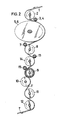
- 1 and 2 show two devices which are preferably used to carry out the method according to the invention.
- the starting point is a hard polyvinyl chloride film, produced by the calender high-temperature process from a suspension homopolymer with a K value of 55, which is stabilized with a conventional organotin stabilizer and contains a lubricant (wax OP) that is customary for calendering.
- the film has a thickness of 0.093 mm.
- the starting point is a hard polyvinyl chloride film produced by the calender high-temperature process from a bulk homopolymer with a K value of 60, which stabilizes with a conventional organotin stabilizer, at 10% by weight, based on polyvinyl chloride. is impact modified by a conventional acrylonitrile-butadiene-styrene polymer and contains a lubricant (wax C) which is customary for calendering.
- the film now has a thickness of 0.13.
- the stretched and embossed film has a total thickness of 0.06 mm, the embossing depth in the film is 0.025 mm and the average material thickness of the film is 0.035 mm.
- the stretched and embossed film has a total thickness of 0.05 mm, the embossing depth in the film is 0.02 mm and the average material thickness of the film is 0.03 mm.
Landscapes
- Engineering & Computer Science (AREA)
- Mechanical Engineering (AREA)
- Shaping By String And By Release Of Stress In Plastics And The Like (AREA)
- Manufacture Of Macromolecular Shaped Articles (AREA)
- Shaping Of Tube Ends By Bending Or Straightening (AREA)
- Laminated Bodies (AREA)
- Casting Or Compression Moulding Of Plastics Or The Like (AREA)
- Compositions Of Macromolecular Compounds (AREA)
Priority Applications (1)
| Application Number | Priority Date | Filing Date | Title |
|---|---|---|---|
| AT81107565T ATE13397T1 (de) | 1980-09-26 | 1981-09-23 | Verfahren zur herstellung von biaxial gestreckten und gepraegten folien aus vinylchloridpolymerisaten. |
Applications Claiming Priority (2)
| Application Number | Priority Date | Filing Date | Title |
|---|---|---|---|
| DE3036289 | 1980-09-26 | ||
| DE19803036289 DE3036289A1 (de) | 1980-09-26 | 1980-09-26 | Verfahren zur herstellung von biaxial gestreckten und gepraegten folien aus vinylchloridpolymerisaten |
Publications (2)
| Publication Number | Publication Date |
|---|---|
| EP0048948A1 true EP0048948A1 (fr) | 1982-04-07 |
| EP0048948B1 EP0048948B1 (fr) | 1985-05-22 |
Family
ID=6112897
Family Applications (1)
| Application Number | Title | Priority Date | Filing Date |
|---|---|---|---|
| EP81107565A Expired EP0048948B1 (fr) | 1980-09-26 | 1981-09-23 | Procédé pour fabriquer des films en polymères de chlorure de vinyle étirés biaxialement et grainés |
Country Status (11)
| Country | Link |
|---|---|
| US (1) | US4379774A (fr) |
| EP (1) | EP0048948B1 (fr) |
| JP (1) | JPS5787330A (fr) |
| AT (1) | ATE13397T1 (fr) |
| CA (1) | CA1165082A (fr) |
| DE (2) | DE3036289A1 (fr) |
| DK (1) | DK154053C (fr) |
| ES (1) | ES505671A0 (fr) |
| FI (1) | FI71690C (fr) |
| GR (1) | GR81374B (fr) |
| IE (1) | IE51680B1 (fr) |
Cited By (2)
| Publication number | Priority date | Publication date | Assignee | Title |
|---|---|---|---|---|
| EP0307535A3 (en) * | 1983-09-14 | 1989-06-14 | J. H. Benecke Ag | Method for continuous embossing the surface of a cold prefabricated thermoplastic sheet by heat and pressure using an embossing roller |
| WO1999016608A1 (fr) * | 1997-10-01 | 1999-04-08 | Minnesota Mining And Manufacturing Company | Films polymeres orientes et gaufres |
Families Citing this family (8)
| Publication number | Priority date | Publication date | Assignee | Title |
|---|---|---|---|---|
| DE3133507A1 (de) * | 1981-08-25 | 1983-03-17 | Hoechst Ag, 6000 Frankfurt | Polyvinylchlorid-folie mit speziellen eigenschaften und verfahren zu ihrer herstellung |
| SE446056B (sv) * | 1982-10-25 | 1986-08-11 | Moelnlycke Ab | Anordning vid engangsbloja |
| US4744936A (en) * | 1986-01-30 | 1988-05-17 | Plastic Film Corporation Of America | Process for embossing thermoplastic material |
| US4817816A (en) * | 1988-05-20 | 1989-04-04 | Minnesota Mining And Manufacturing Company | Embossed tape for closure system |
| DE3833679C2 (de) * | 1988-10-04 | 1994-09-22 | Hoechst Ag | Verfahren und Vorrichtung zur Herstellung von PVC-Folien für die Tiefziehverarbeitung |
| DE4001105C1 (fr) * | 1990-01-17 | 1991-08-08 | Hermann Berstorff Maschinenbau Gmbh, 3000 Hannover, De | |
| US5182069A (en) * | 1991-01-04 | 1993-01-26 | Exxon Chemical Patents Inc. | Process for producing micropattern-embossed oriented elastomer films |
| US9902102B2 (en) * | 2013-08-30 | 2018-02-27 | Berry Plastics Corporation | Process for forming film |
Citations (7)
| Publication number | Priority date | Publication date | Assignee | Title |
|---|---|---|---|---|
| US2689378A (en) * | 1951-03-10 | 1954-09-21 | Elizabeth Muth | Process for embossing plastic sheet materials |
| FR1550529A (fr) * | 1966-12-13 | 1968-12-20 | ||
| US3589973A (en) * | 1966-10-31 | 1971-06-29 | Grace W R & Co | Suede type product |
| US3664780A (en) * | 1968-12-17 | 1972-05-23 | Fmc Corp | Apparatus for making oriented webs |
| UST927010I4 (en) * | 1973-11-20 | 1974-10-01 | Defensive publication | |
| DE2460663B2 (de) * | 1973-12-26 | 1977-11-10 | Ethjf I Gk^ Richm/rad, Ya,. (V St A.\ | Aus thermoplastischer folie gepraegte kunststoffbahn als webstoffersatz |
| DE2833982A1 (de) * | 1978-08-03 | 1980-02-21 | Hoechst Ag | Verfahren zum praegen von thermoplastischen kunststoffolien |
Family Cites Families (5)
| Publication number | Priority date | Publication date | Assignee | Title |
|---|---|---|---|---|
| GB883396A (en) * | 1957-03-18 | 1961-11-29 | Bx Plastics Ltd | Improvements in or relating to embossing polyvinyl chloride and polystyrene sheet material |
| US3060515A (en) * | 1960-06-10 | 1962-10-30 | Nat Distillers Chem Corp | Method for conditioning thin sheets of a thermoplastic material to improve windability |
| US3621085A (en) * | 1968-03-28 | 1971-11-16 | Toyo Boseki | Production of light-polarizing film |
| US3842152A (en) * | 1970-08-19 | 1974-10-15 | Du Pont | Embossed polyester film preparation |
| US3950480A (en) * | 1973-01-12 | 1976-04-13 | Ethyl Corporation | Method for embossing plastic material |
-
1980
- 1980-09-26 DE DE19803036289 patent/DE3036289A1/de not_active Withdrawn
-
1981
- 1981-09-21 ES ES505671A patent/ES505671A0/es active Granted
- 1981-09-21 US US06/303,775 patent/US4379774A/en not_active Expired - Fee Related
- 1981-09-23 AT AT81107565T patent/ATE13397T1/de active
- 1981-09-23 DE DE8181107565T patent/DE3170618D1/de not_active Expired
- 1981-09-23 EP EP81107565A patent/EP0048948B1/fr not_active Expired
- 1981-09-24 FI FI812979A patent/FI71690C/fi not_active IP Right Cessation
- 1981-09-24 GR GR66124A patent/GR81374B/el unknown
- 1981-09-25 CA CA000386659A patent/CA1165082A/fr not_active Expired
- 1981-09-25 DK DK426681A patent/DK154053C/da not_active IP Right Cessation
- 1981-09-25 IE IE2230/81A patent/IE51680B1/en unknown
- 1981-09-25 JP JP56150846A patent/JPS5787330A/ja active Granted
Patent Citations (7)
| Publication number | Priority date | Publication date | Assignee | Title |
|---|---|---|---|---|
| US2689378A (en) * | 1951-03-10 | 1954-09-21 | Elizabeth Muth | Process for embossing plastic sheet materials |
| US3589973A (en) * | 1966-10-31 | 1971-06-29 | Grace W R & Co | Suede type product |
| FR1550529A (fr) * | 1966-12-13 | 1968-12-20 | ||
| US3664780A (en) * | 1968-12-17 | 1972-05-23 | Fmc Corp | Apparatus for making oriented webs |
| UST927010I4 (en) * | 1973-11-20 | 1974-10-01 | Defensive publication | |
| DE2460663B2 (de) * | 1973-12-26 | 1977-11-10 | Ethjf I Gk^ Richm/rad, Ya,. (V St A.\ | Aus thermoplastischer folie gepraegte kunststoffbahn als webstoffersatz |
| DE2833982A1 (de) * | 1978-08-03 | 1980-02-21 | Hoechst Ag | Verfahren zum praegen von thermoplastischen kunststoffolien |
Cited By (4)
| Publication number | Priority date | Publication date | Assignee | Title |
|---|---|---|---|---|
| EP0307535A3 (en) * | 1983-09-14 | 1989-06-14 | J. H. Benecke Ag | Method for continuous embossing the surface of a cold prefabricated thermoplastic sheet by heat and pressure using an embossing roller |
| WO1999016608A1 (fr) * | 1997-10-01 | 1999-04-08 | Minnesota Mining And Manufacturing Company | Films polymeres orientes et gaufres |
| US6514597B1 (en) | 1997-10-01 | 2003-02-04 | #M Innovative Properties Company | Embossed oriented polymer films |
| US6585920B1 (en) | 1997-10-01 | 2003-07-01 | 3M Innovative Properties Company | Method of making embossed oriented polymer films |
Also Published As
| Publication number | Publication date |
|---|---|
| DE3036289A1 (de) | 1982-06-03 |
| ES8205635A1 (es) | 1982-08-16 |
| DK154053C (da) | 1989-02-27 |
| GR81374B (fr) | 1984-12-11 |
| FI812979L (fi) | 1982-03-27 |
| EP0048948B1 (fr) | 1985-05-22 |
| DK154053B (da) | 1988-10-10 |
| JPH0115371B2 (fr) | 1989-03-16 |
| US4379774A (en) | 1983-04-12 |
| FI71690B (fi) | 1986-10-31 |
| JPS5787330A (en) | 1982-05-31 |
| IE51680B1 (en) | 1987-02-04 |
| DE3170618D1 (en) | 1985-06-27 |
| DK426681A (da) | 1982-03-27 |
| FI71690C (fi) | 1987-02-09 |
| ATE13397T1 (de) | 1985-06-15 |
| ES505671A0 (es) | 1982-08-16 |
| IE812230L (en) | 1982-03-26 |
| CA1165082A (fr) | 1984-04-10 |
Similar Documents
| Publication | Publication Date | Title |
|---|---|---|
| EP0008382B1 (fr) | Procédé pour gaufrer des films en matière thermoplastique | |
| DE69205966T2 (de) | Feinmustergeprägte elastomerfolien und verfahren. | |
| DE2105527C2 (de) | Verfahren zur Herstellung eines photographischen Schichtträgers und dessen Verwendung zur Herstellung von photographischen Filmen | |
| DD241039A5 (de) | Verfahren zur herstellung von folien, insbesondere auf der basis von polyvinylbutyral mit geringer oberflaechenklebrigkeit | |
| DE69117720T2 (de) | Abs/acryl-laminierungsverfahren | |
| DE68902246T2 (de) | Fuer weichmacher unempfindlicher thermoplastischer film und druckempfindliche klebstreifen aus diesem film. | |
| EP0048948B1 (fr) | Procédé pour fabriquer des films en polymères de chlorure de vinyle étirés biaxialement et grainés | |
| DE2801221C3 (de) | Kontinuierliches Gießverfahren für flüssige Methylmethacrylatsirupe | |
| DE2706688A1 (de) | Verfahren und vorrichtung zur herstellung von biaxial gereckten baendern, folien und vollprofilen aus thermoplastischem kunststoff | |
| DE1704732A1 (de) | Verfahren zur Herstellung von Folien und Baendern | |
| DE1629675A1 (de) | Verschweissbare Schaumstoffe mit verschleissfester Oberflaeche und Verfahren zu deren Herstellung | |
| EP0073046B1 (fr) | Procédé pour la fabrication d'une feuille à propriétés spéciales, en chlorure de polyvinyle | |
| DE2226645A1 (de) | Verfahren zur Herstellung von poly olefinharz kaschierten Polyurethanschaum stoffen | |
| DE2104817A1 (de) | Druckempfindliches Klebeband | |
| DE2918923C2 (de) | Schichtstoff mit einer Polyvinylidenfluoridschicht | |
| DE69016197T2 (de) | Methode zur Behandlung der Rückseite eines druckempfindlichen Klebebands oder -blatts. | |
| EP0010646A1 (fr) | Procédé de fabrication par emboutissage profond d'articles à surface uniformément matte en polymères du chlorure de vinyle | |
| DE1804049B2 (de) | Durch Deformation eine permanente Farbänderung erleidende thermoplastische Polyvinylchlorid-Formmassen und -Formkörper | |
| DE2629742A1 (de) | Verfahren zur herstellung von thermoplastischen folien mit gleichmaessig matter oberflaeche | |
| DE2160520C3 (de) | Verfahren zur Herstellung von Folien aus Vinylchloridpolymerisaten nach dem Kalandrierverfahren | |
| DE1704733A1 (de) | Polyaethylenterephthalatfolie und Verfahren zu deren Herstellung | |
| DE2939500C2 (fr) | ||
| DE1569922B2 (de) | Verfahren zur herstellung von klebefolien | |
| DE2611134A1 (de) | Verfahren und vorrichtung zum herstellen einer folie aus thermisch instabilen thermoplastischen kunststoffen | |
| DE2122633C3 (de) | Verfahren zur Herstellung von druckempfindlichen Klebmaterialien |
Legal Events
| Date | Code | Title | Description |
|---|---|---|---|
| PUAI | Public reference made under article 153(3) epc to a published international application that has entered the european phase |
Free format text: ORIGINAL CODE: 0009012 |
|
| 17P | Request for examination filed |
Effective date: 19811028 |
|
| AK | Designated contracting states |
Designated state(s): AT BE CH DE FR GB IT NL SE |
|
| ITF | It: translation for a ep patent filed | ||
| GRAA | (expected) grant |
Free format text: ORIGINAL CODE: 0009210 |
|
| AK | Designated contracting states |
Designated state(s): AT BE CH DE FR GB IT LI NL SE |
|
| REF | Corresponds to: |
Ref document number: 13397 Country of ref document: AT Date of ref document: 19850615 Kind code of ref document: T |
|
| REF | Corresponds to: |
Ref document number: 3170618 Country of ref document: DE Date of ref document: 19850627 |
|
| ET | Fr: translation filed | ||
| PLBE | No opposition filed within time limit |
Free format text: ORIGINAL CODE: 0009261 |
|
| STAA | Information on the status of an ep patent application or granted ep patent |
Free format text: STATUS: NO OPPOSITION FILED WITHIN TIME LIMIT |
|
| 26N | No opposition filed | ||
| PGFP | Annual fee paid to national office [announced via postgrant information from national office to epo] |
Ref country code: AT Payment date: 19860825 Year of fee payment: 6 |
|
| PGFP | Annual fee paid to national office [announced via postgrant information from national office to epo] |
Ref country code: NL Payment date: 19870930 Year of fee payment: 7 |
|
| PG25 | Lapsed in a contracting state [announced via postgrant information from national office to epo] |
Ref country code: LI Effective date: 19880930 Ref country code: CH Effective date: 19880930 |
|
| REG | Reference to a national code |
Ref country code: CH Ref legal event code: PL |
|
| PG25 | Lapsed in a contracting state [announced via postgrant information from national office to epo] |
Ref country code: AT Effective date: 19890923 |
|
| PG25 | Lapsed in a contracting state [announced via postgrant information from national office to epo] |
Ref country code: SE Effective date: 19890924 |
|
| PG25 | Lapsed in a contracting state [announced via postgrant information from national office to epo] |
Ref country code: BE Effective date: 19890930 |
|
| BERE | Be: lapsed |
Owner name: HOECHST A.G. Effective date: 19890930 |
|
| PG25 | Lapsed in a contracting state [announced via postgrant information from national office to epo] |
Ref country code: NL Effective date: 19900401 |
|
| NLV4 | Nl: lapsed or anulled due to non-payment of the annual fee | ||
| PGFP | Annual fee paid to national office [announced via postgrant information from national office to epo] |
Ref country code: FR Payment date: 19900816 Year of fee payment: 10 |
|
| PGFP | Annual fee paid to national office [announced via postgrant information from national office to epo] |
Ref country code: GB Payment date: 19900824 Year of fee payment: 10 |
|
| ITTA | It: last paid annual fee | ||
| PGFP | Annual fee paid to national office [announced via postgrant information from national office to epo] |
Ref country code: DE Payment date: 19901120 Year of fee payment: 10 |
|
| PG25 | Lapsed in a contracting state [announced via postgrant information from national office to epo] |
Ref country code: GB Effective date: 19910923 |
|
| GBPC | Gb: european patent ceased through non-payment of renewal fee | ||
| PG25 | Lapsed in a contracting state [announced via postgrant information from national office to epo] |
Ref country code: FR Effective date: 19920529 |
|
| PG25 | Lapsed in a contracting state [announced via postgrant information from national office to epo] |
Ref country code: DE Effective date: 19920602 |
|
| REG | Reference to a national code |
Ref country code: FR Ref legal event code: ST |
|
| EUG | Se: european patent has lapsed |
Ref document number: 81107565.4 Effective date: 19900521 |