EP0049416B1 - Substituierte 6-Halogen-tert.-butyl-1,2,4-triazin-5-one, Verfahren zu ihrer Herstellung sowie ihre Verwendung als Herbizide - Google Patents
Substituierte 6-Halogen-tert.-butyl-1,2,4-triazin-5-one, Verfahren zu ihrer Herstellung sowie ihre Verwendung als Herbizide Download PDFInfo
- Publication number
- EP0049416B1 EP0049416B1 EP81107511A EP81107511A EP0049416B1 EP 0049416 B1 EP0049416 B1 EP 0049416B1 EP 81107511 A EP81107511 A EP 81107511A EP 81107511 A EP81107511 A EP 81107511A EP 0049416 B1 EP0049416 B1 EP 0049416B1
- Authority
- EP
- European Patent Office
- Prior art keywords
- formula
- butyl
- triazin
- tert
- ones
- Prior art date
- Legal status (The legal status is an assumption and is not a legal conclusion. Google has not performed a legal analysis and makes no representation as to the accuracy of the status listed.)
- Expired
Links
- 0 CC(*)(*)C1=NN=C(C)N(*)C1=O Chemical compound CC(*)(*)C1=NN=C(C)N(*)C1=O 0.000 description 4
Classifications
-
- C—CHEMISTRY; METALLURGY
- C07—ORGANIC CHEMISTRY
- C07D—HETEROCYCLIC COMPOUNDS
- C07D253/00—Heterocyclic compounds containing six-membered rings having three nitrogen atoms as the only ring hetero atoms, not provided for by group C07D251/00
- C07D253/02—Heterocyclic compounds containing six-membered rings having three nitrogen atoms as the only ring hetero atoms, not provided for by group C07D251/00 not condensed with other rings
- C07D253/06—1,2,4-Triazines
- C07D253/065—1,2,4-Triazines having three double bonds between ring members or between ring members and non-ring members
- C07D253/07—1,2,4-Triazines having three double bonds between ring members or between ring members and non-ring members with hetero atoms, or with carbon atoms having three bonds to hetero atoms with at the most one bond to halogen, e.g. ester or nitrile radicals, directly attached to ring carbon atoms
- C07D253/075—Two hetero atoms, in positions 3 and 5
-
- A—HUMAN NECESSITIES
- A01—AGRICULTURE; FORESTRY; ANIMAL HUSBANDRY; HUNTING; TRAPPING; FISHING
- A01N—PRESERVATION OF BODIES OF HUMANS OR ANIMALS OR PLANTS OR PARTS THEREOF; BIOCIDES, e.g. AS DISINFECTANTS, AS PESTICIDES OR AS HERBICIDES; PEST REPELLANTS OR ATTRACTANTS; PLANT GROWTH REGULATORS
- A01N43/00—Biocides, pest repellants or attractants, or plant growth regulators containing heterocyclic compounds
- A01N43/64—Biocides, pest repellants or attractants, or plant growth regulators containing heterocyclic compounds having rings with three nitrogen atoms as the only ring hetero atoms
- A01N43/707—1,2,3- or 1,2,4-triazines; Hydrogenated 1,2,3- or 1,2,4-triazines
Definitions
- the present invention relates to new 6-halogen-tert-butyl-1,2,4-triazin-5-ones, a process for their preparation and their use as herbicides, in particular as selective herbicides.
- substituted 1,2,4-triazin-5-ones such as in particular 4-amino-3-methylthio-6-tert-butyl-1,2,4-triazin-5-one
- can be used as herbicides see, for example, DE-C 1795784, GB-A 1182801, GB-A 1182802 and US-A 3671523).
- 4-Amino-3-methylthio-6- (2,2-dichloro-1-methylcyclopropyl) -1,2,4-triazin-5-one has also become known as a herbicidally active compound from the same group of substances (see DE-A 2726016).
- substituted 6-halogenated-butyl-1,2,4-triazin-5-ones of the formula (I) have good herbicidal, in particular selective, herbicidal properties.
- the compounds according to the invention compared with the known 4-amino-3-methylthio-6-tert-butyl-1,2,4-triazin-5-one, show a significantly better compatibility with important crop plants, such as in particular, with an equally good general herbicidal action for corn, cotton and cereals.
- the compounds according to the invention also show superior activity, in particular better selectivity.
- the active compounds according to the invention thus represent a substantial enrichment of the herbicidal compositions, in particular of the selective chemical weed control.
- Formula (I) provides a general definition of the substituted 6-halo-tert-butyl-1,2,4-triazine-5-ones according to the invention.
- R 2 preferably represents methyl-, ethyl- or propylthio, furthermore methyl-, ethyl- or propylthio, furthermore methyl-, ethyl-, dimethyl-, diethyl- and ethylmethylamino
- X preferably represents fluorine, chlorine or bromine
- Y and Z are preferably hydrogen, fluorine, chlorine or bromine.
- Formula (11) provides a general definition of the halopivaloyl cyanides to be used as starting materials for the process according to the invention.
- X, Y and Z preferably represent the radicals which have already been mentioned for these substituents in connection with the description of the substances of the formula (I) according to the invention.
- This process for the preparation of the halopivaloyl cyanides of the formula (11) is optionally carried out in the presence of a diluent.
- a diluent preferably include inert organic solvents such as ketones, e.g. Acetone and methyl ethyl ketone; Nitriles, e.g. Acetonitrile; Ethers, e.g. Tetrahydrofuran or dioxane; as well as aromatic hydrocarbons, e.g. Benzene, toluene or xylene.
- the process is preferably carried out without a solvent.
- reaction temperatures can be varied within a substantial range when carrying out this process. Generally one works between 50 and 250 ° C, preferably between 80 and 180 ° C.
- halopivaloyl halides or anhydrides of the formulas (VIIIa) or (VIIIb) are known, or they can be obtained in a generally known manner.
- the first stage of the process according to the invention can be carried out in the absence or in the presence of a lower aliphatic carboxylic acid which is liquid under the reaction conditions as solvent.
- solvents are preferably carboxylic acids having 1 to 6 carbon atoms, such as acetic acid, propionic acid or formic acid.
- the first stage of the process according to the invention is carried out with the aid of a strong inorganic acid.
- a strong inorganic acid preferably include the hydrohalic acids, such as hydrogen chloride and hydrogen bromide, and concentrated sulfuric acid.
- reaction temperatures can be varied over a wide range when carrying out this process step. Generally one works between -20 and + 50 ° C, preferably between 0 and + 40 ° C.
- the second step of the process according to the invention is preferably carried out without prior isolation of the halogenated trimethylpyruvic acid amides of the formula (IIla) and after saponification thereof in the usual manner to give free acids of the formula (IIIb).
- the second stage of the process according to the invention is carried out in aqueous or in the presence of an aqueous acidic solution, such as a hydrohalic acid, preferably a hydrochloric acid, or a sulfuric acid solution.
- an aqueous acidic solution such as a hydrohalic acid, preferably a hydrochloric acid, or a sulfuric acid solution.
- organic solvent any customary organic solvents are suitable, such as in particular dimethylformamide.
- reaction temperatures can be varied within a substantial range when carrying out the second stage of the process according to the invention. Generally one works between 0 and 120 ° C, preferably between 0 and 100 ° C.
- the starting materials are preferably used in molar amounts or with an excess of compounds of the formula (IV).
- the intermediates of the formula (V) are isolated in the customary manner.
- the third stage of the process according to the invention is carried out in the presence of a base.
- alkali metal hydroxides such as sodium hydroxide
- alkali metal alcoholates such as sodium methylate, excess alcohol being used as the solvent.
- reaction temperatures can be varied over a wide range when carrying out the third stage of the process according to the invention. Generally one works between 0 and 100 ° C, preferably between 0 and 50 ° C.
- Suitable diluents for the fourth stage of the process according to the invention are preferably organic solvents, such as, in particular, isopropanol / glacial acetic acid.
- reaction temperatures can be varied over a wide range when carrying out the fourth stage of the process according to the invention. Generally one works between 20 and 180 ° C, preferably between 40 and 150 ° C.
- the active compounds according to the invention influence plant growth and can therefore be used as defoliants, desiccants, haulm killers, germ inhibitors and in particular as weed killers. Weeds in the broadest sense are understood to mean all plants that grow up in places where they are undesirable. Whether the substances according to the invention act as total or selective herbicides depends essentially on the amount used.
- the compounds are suitable for total weed control, e.g. on industrial and track systems and on paths and squares with and without tree cover.
- the compounds for weed control in permanent crops can e.g. Forestry, ornamental wood, wine, citrus, nut, banana, coffee, tea, rubber, oil palm, cocoa, berry fruit and hop plants and for selective weed control in annual crops.
- the active compounds according to the invention are well tolerated by useful plants. This makes it possible to selectively harvest harmful grasses in important crops, such as to combat in corn, soybeans, cotton and cereals.
- the active compounds can be converted into the customary formulations, such as solutions, emulsions, wettable powders, suspensions, powders, dusts, pastes, soluble powders, granules, suspension-emulsion concentrates, active substance-impregnated natural and synthetic substances, very fine encapsulations in polymeric substances.
- formulations are made in a known manner, e.g. by mixing the active ingredients with extenders, that is to say liquid solvents and / or solid carriers, optionally using surface-active agents, that is to say emulsifiers and / or dispersants and / or foam-generating agents. If water is used as an extender, e.g. organic solvents can also be used as auxiliary solvents.
- extenders that is to say liquid solvents and / or solid carriers
- surface-active agents that is to say emulsifiers and / or dispersants and / or foam-generating agents.
- water e.g. organic solvents can also be used as auxiliary solvents.
- aromatics such as xylene, toluene, or alkylnaphthalenes
- chlorinated aromatics or chlorinated aliphatic hydrocarbons such as chlorobenzenes, chloroethylene or methylene chloride
- aliphatic hydrocarbons such as cyclohexane or paraffins, e.g. Petroleum fractions, alcohols such as butanol or glycol and their ethers and esters, ketones such as acetone, methyl ethyl ketone, methyl isobutyl ketone or cyclohexanone, strongly polar solvents such as dimethylformamide and dimethyl sulfoxide, and water.
- Possible solid carriers are: e.g. natural rock powders, such as kaolins, clays, talc, chalk, quartz, attapulgite, montmorillonite or diatomaceous earth and synthetic rock powders, such as highly disperse silica, aluminum oxide and silicates; as solid carriers for granules are possible: e.g. broken and fractionated natural rocks such as calcite, marble, pumice, sepiolite, dolomite and synthetic granules from inorganic and organic flours as well as granules from organic material such as sawdust, coconut shells, corn cobs and tobacco stems; as emulsifying and / or foaming agents are possible: e.g.
- non-ionic and anti-ionic emulsifiers such as polyoxyethylene fatty acid esters, polyoxyethylene fatty alcohol ethers, e.g. Alkylaryl polyglycol ethers, alkyl sulfonates, alkyl sulfates, aryl sulfonates and protein hydrolyzates;
- Possible dispersants are: e.g. Lignin sulfite liquor and methyl cellulose.
- Adhesives such as carboxymethyl cellulose and natural and synthetic polymers in the form of powders, granules or latices, such as gum arabic, polyvinyl alcohol and polyvinyl acetate, can be used in the formulations.
- Dyes such as inorganic pigments, e.g. Iron oxide, titanium oxide, ferrocyan blue and organic dyes such as alizarin, azo, metal phthalocyanine dyes and trace nutrients such as salts of iron, manganese, boron, copper, cobalt, molybdenum and zinc can be used.
- the formulations generally contain between 0.1 and 95 percent by weight of active compound, preferably between 0.5 and 90%.
- the active compounds according to the invention can also be used for combating weeds, in a mixture with known herbicides, finished formulation or tank mixture being possible.
- a mixture with other known active compounds such as fungicides, insecticides, acaricides, nematicides, bird repellants, growth agents, plant nutrients and agents which improve soil structure, is also possible.
- the active compounds can be used as such, in the form of their formulations or in the use forms prepared therefrom by further dilution, such as ready-to-use solutions, suspensions, emulsions, powders, pastes and granules. They are used in the usual way, e.g. by watering, spraying, spraying, sprinkling.
- the active compounds according to the invention can be applied both before and after the plants emerge. It is preferably used before the plants emerge, that is to say in the pre-emergence process. They can also be worked into the soil before sowing.
- the amount of active ingredient used can fluctuate in larger areas. It essentially depends on the type of effect you want. In general, the application rates are between 0.1 and 10 kg of active ingredient per ha, preferably between 0.1 and 5 kg / ha.
- Example 1 starting from fluoropivaloyl cyanide, crude 4-amino-6-fluoro-tert-butyl-3-mercapto-1,2,4-triazin-5-one is obtained in 80% yield and by further reaction with Methyl iodide also in 80% yield 4-amino-6-fluoro-tert-butyl-3-methylthio-1,2,4-triazin-5-one with a melting point of 121-122 ° C.
- active compound 1 part by weight of active compound is mixed with the stated amount of solvent, the stated amount of emulsifier is added and the concentrate is diluted with water to the desired concentration.
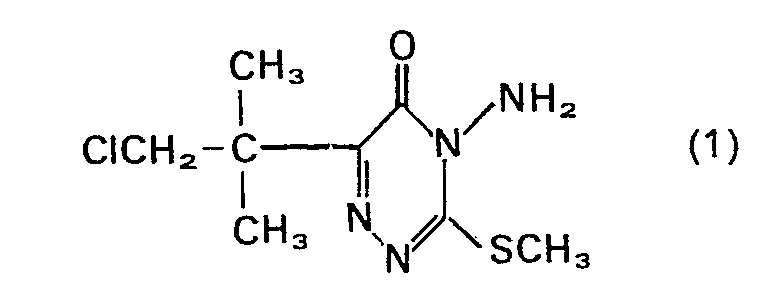
- the compound (1) according to the invention in particular shows, with the same good activity, a significantly better selectivity in maize than the compound (A) known from the prior art.
Landscapes
- Life Sciences & Earth Sciences (AREA)
- Organic Chemistry (AREA)
- Chemical & Material Sciences (AREA)
- Health & Medical Sciences (AREA)
- Environmental Sciences (AREA)
- Engineering & Computer Science (AREA)
- Dentistry (AREA)
- General Health & Medical Sciences (AREA)
- Wood Science & Technology (AREA)
- Zoology (AREA)
- Plant Pathology (AREA)
- Pest Control & Pesticides (AREA)
- Agronomy & Crop Science (AREA)
- Agricultural Chemicals And Associated Chemicals (AREA)
- Plural Heterocyclic Compounds (AREA)
- Pharmaceuticals Containing Other Organic And Inorganic Compounds (AREA)
- Medicines Containing Material From Animals Or Micro-Organisms (AREA)
Description
- Die vorliegende Erfindung betrifft neue 6-Halogen-tert.-butyl-1,2,4-triazin-5-one, ein Verfahren zu ihrer Herstellung sowie ihre Verwendung als Herbizide, insbesondere als selektive Herbizide.
- Es ist bereits bekannt geworden, dass substituierte 1,2,4-Triazin-5-one, wie insbesondere das 4-Amino-3-methylthio-6-tert.-butyl-1,2,4-triazin-5-on, als Herbizide verwendet werden können (vgl. z.B. DE-C 1795784, GB-A 1182801, GB-A 1182802 und US-A 3671523). Aus der gleichen Stoffgruppe ist weiterhin das 4-Amino-3-methyl- thio-6-(2,2-dichlor-1-methyl-cyclopropyl)-1,2,4-triazin-5-on als herbizid wirksame Verbindung bekannt geworden (vgl. DE-A 2726016). Ferner ist es bekannt, dass auch bestimmte 4-alkylsubstituierte 1,2,4-Triazin-5-one, wie z.B. das 4-Methyl-3-methylthio-6-isopropyl-1,2,4-triazin-5-on, herbizide Eigenschaften aufweisen (vgl. FR-A 1577658). In bestimmten Kulturen ist jedoch ein selektiver Einsatz der vorbekannten Triazinone nicht möglich, da es infolge der durchweg hohen herbiziden Potenz dieser Stoffgruppe auch bei bestimmten Nutzpflanzen zu Schäden kommen kann; die Verträglichkeit gegenüber den vorbekannten Triazinonen ist demnach bei verschiedenen Nutzpflanzen nicht ausreichend.
- Es wurden neue substituierte 6-Halogen-tert.-butyl-1,2,4-triazin-5-one der allgemeinen Formel

- R' für Amino oder Methyl steht,
- R2 für C1-4-Alkylmercapto, C1-4-Alkylamino oder Di-(C1-4)-alkylamino steht,
- X für Halogen steht, und
- Y und Z für Wasserstoff oder Halogen stehen, gefunden.
- Weiterhin wurde gefunden, dass man die substituierten 6-Halogen-tert.-butyl-1,2,4-triazon-5- oneder Formel (I) erhält, wenn man in einer ersten Stufe Halogenpivaloylcyanide der Formel in welcher

- X, Y und Z die oben angegebene Bedeutung haben,
gegebenenfalls in Gegenwart einer flüssigen Carbonsäure als Lösungsmittel, mit einer anorganischen Säure umsetzt und die hierbei entstehenden halogenierten Trimethylbrenztraubensäureamide der Formel
- X, Y und Z die oben angegebene Bedeutung haben,
in einer zweiten Stufe in an sich bekannter Weise entweder direkt in der anfallenden Lösung oder nach Zwischenisolierung, gegebenenfalls nach vorheriger Verseifung zu den freien halogenierten Trimethylbrenztraubensäuren der Formel in welcher
- X, Y und Z die oben angegebene Bedeutung haben,
mit Verbindungen der Formel in welcher
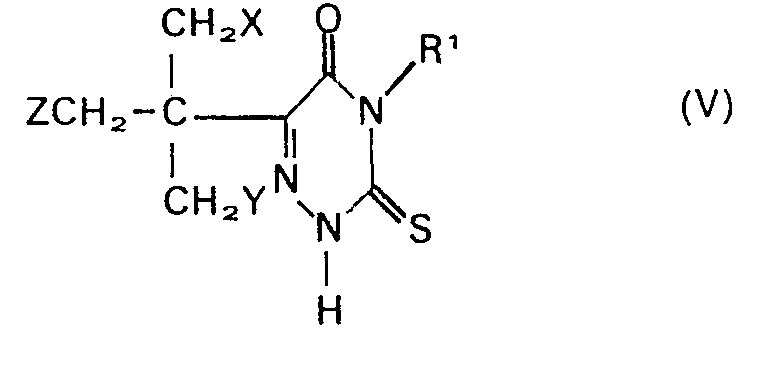
- R' die oben angegebene Bedeutung hat, in wässriger bzw. in wässrig-saurer Lösung, gegebenenfalls in Gegenwart eines organischen Verdünnungsmittels, zu 6-Halogen-tert.-butyl-3-mercapto-1,2,4-triazin-5-onen der Formel

- R1 , X, Y und Z die oben angegebene Bedeutung haben,
umsetzt, diese in einer dritten Stufe in bekannter Weise in alkalischer Lösung mittels Alkylhalogenid, vorzugsweise Alkyljodid oder -bromid, zu 6-Halogen-tert.-butyl-1,2,4-triazin-5-onen der Formel
- R1 , X, Y und Z die oben angegebene Bedeutung haben und
- R3 für Alkyl, vorzugsweise mit 1 bis 4 Kohlenstoffatomen, steht,
alkyliert und diese gegebenenfalls in einer vierten Stufe mit Aminen der Formel
- R4 für Wasserstoff oder Alkyl, vorzugsweise mit 1 bis 4 Kohlenstoffatomen, steht, und
- R" für Alkyl, vorzugsweise mit 1 bis 4 Kohlenstoffatomen, steht,
in Gegenwart eines Verdünnungsmittels umsetzt. - Ausserdem wurde gefunden, dass die substituierten 6-Halogentert.-butyl-1,2,4-triazin-5-one der Formel (I) gute herbizide, insbesondere selektiv-herbizide Eingenschaften aufweisen.
- Überraschenderweise zeigen die erfindungsgemässen Verbindungen gegenüber dem bekannten 4-Amino-3-methylthio-6-tert.-butyl-1,2,4-triazin-5-on bei gleich guter allgemeiner herbizider Wirkung eine deutlich bessere Verträglichkeit bei wichtigen Kulturpflanzen, wie insbesondere bei Mais, Baumwolle und Getreide. Auch im Vergleich zu den übrigen vorbekannten Triazinonen zeigen die erfindungsgemässen Verbindungen eine überlegene Wirksamkeit, insbesondere eine bessere Selektivität. Die erfindungsgemässen Wirkstoffe stellen somit eine wesentliche Bereicherung der herbiziden Mittel, insbesondere der selektiven chemischen Unkrautbekämpfung dar.
- Die erfindungsgemässen substituierten 6-Halogen-tert.-butyl-1,2,4-triazin-5-onesind durch die Formel (I) allgemein definiert. In dieser Formel steht R2 vorzugsweise für Methyl-, Ethyl- oder Propylthio, ferner für Methyl-, Ethyl-, oder Propylthio, ferner für Methyl-, Ethyl-, Dimethyl-, Diethyl- sowie Ethylmethylamino; X steht vorzugsweise für Fluor, Chlor oder Brom; Y und Z stehen vorzugsweise für Wasserstoff, Fluor, Chlor oder Brom.
- Verwendet man beispielsweise Chlorpivaloylcyanid als Ausgangsstoff in der ersten Stufe, setzt in der zweiten Stufe die entsprechende freie Säure mit Thiocarbohydrazid um und verwendet in der dritten Stufe Methylbromid als Alkylierungsmittel, so kann der Reaktionsverlauf durch das folgende Formelschema wiedergegeben werden:

- Verwendet man das so erhaltene 4-Amino-6-chlor-tert.-butyl-3-methylthio-1,2,4-triazin-5-on und Dimethylamin als Ausgangsstoffe für die vierte Stufe, so kann der Reaktionsablauf durch das folgende Formelschema wiedergegeben werden:

- Die für das erfindungsgemässe Verfahren als Ausgangsstoffe zu verwendenden Halogenpivaloylcyanide sind durch die Formel (11) allgemein definiert. In dieser Formel stehen X, Y und Z vorzugsweise für die Reste, die bereits im Zusammenhang mit der Beschreibung der erfindungsgemässen Stoffe der Formel (I) vorzugsweise für diese Substituenten genannt wurden.
- Die Halogenpivaloylcyanide der Formel (11) sind noch nicht bekannt. Sie werden erhalten, indem man die entsprechenden Halogenpivaloylhalogenide bzw. -anhydride der Formeln


- Hal für Halogen, vorzugsweise Chlor oder Brom, steht, und
- X, Y und Z die oben angegebene Bedeutung haben,
- Dieses Verfahren zur Herstellung der Halogenpivaloylcyanide der Formel (11) wird gegebenenfalls in Gegenwart eines Verdünnungsmittels durchgeführt. Hierzu gehören vorzugsweise inerte organische Lösungsmittel, wie Ketone, z.B. Aceton und Methylethylketon; Nitrile, z.B. Acetonitril; Ether, z.B. Tetrahydrofuran oder Dioxan; sowie aromatische Kohlenwasserstoffe, z.B. Benzol, Toluol oder Xylol.
- Vorzugsweise wird ohne Lösungsmittel gearbeitet.
- Die Reaktionstemperaturen können bei der Durchführung dieses Verfahrens in einem grösseren Bereich variiert werden. Im allgemeinen arbeitet man zwischen 50 und 250° C, vorzugsweise zwischen 80 und 180° C.
- Bei der Durchführung dieses Verfahrens arbeitet man vorzugsweise mit äquivalenten Mengen an Ausgangsstoffen. Die Isolierung der Verbindungen der Formel (11) erfolgt in üblicher Weise.
- Die Halogenpivaloylhalogenide bzw. -anhydride der Formeln (Vlla) bzw. (Vllb) sind bekannt, bzw. können sie in allgemein bekannter Art und Weise erhalten werden.
- Die erste Stufe des erfindungsgemässen Verfahrens kann in Abwesenheit oder in Gegenwart einer unter den Reaktionsbedingungen flüssigen, niederaliphatischen Carbonsäure als Lösungsmittel durchgeführt werden. Als solche Lösungsmittel kommen vorzugsweise Carbonsäuren mit 1 bis 6 Kohlenstoffatomen, wie Essigsäure, Propionsäure oder Ameisensäure, in Frage.
- Die erste Stufe des erfindungsgemässen Verfahrens wird mit Hilfe einer starken anorganischen Säure durchgeführt. Hierzu gehören vorzugsweise die Halogenwasserstoffsäuren, wie Chlorwasserstoff und Bromwasserstoff, sowie konzentrierte Schwefelsäure.
- Die Reaktionstemperaturen können bei der Durchführung dieser Verfahrensstufe in einem grösseren Bereich variiert werden. Im allgemeinen arbeitet man zwischen -20 und +50° C, vorzugsweise zwischen 0 und +40° C.
- Bei der Durchführung der ersten Stufe des erfindungsgemässen Verfahrens setzt man auf 1 mol Halogenpivaloylcyanid der Formel (11) vorzugsweise 1 bis 10 mol an anorganischer Säure ein.
- Die zweite Stufe des erfindungsgemässen Verfahrens erfolgt vorzugsweise ohne vorherige Zwischenisolierung der halogenierten Trimethylbrenztraubensäureamide der Formel (Illa) und nach Verseifung derselben in üblicher Weise zu freien Säuren der Formel (IIIb).
- Die zweite Stufe des erfindungsgemässen Verfahrens wird in wässeriger bzw. in Gegenwart einer wässerig-sauren Lösung, wie einer halogenwasserstoffsauren, vorzugsweise einer salzsauren, oder einer schwefelsauren Lösung durchgeführt.
- Wird in Gegenwart eines organischen Lösungsmittels gearbeitet, so kommen alle üblichen organischen Lösungsmittel in frage, wie insbesondere Dimethylformamid.
- Die Reaktionstemperaturen können bei der Durchführung der zweiten Stufe des erfindungsgemässen Verfahrens in einem grösseren Bereich variiert werden. Im allgemeinen arbeitet man zwischen 0 und 120° C, vorzugsweise zwischen 0 und 100° C.
- Bei der Durchführung der zweiten Stufe des erfindungsgemässen Verfahrens setzt man die Ausgangsstoffe vorzugsweise in molaren Mengen bzw. mit einem Überschuss an Verbindungen der Formel (IV) ein. Die Isolierung der Zwischenprodukte der Formel (V) erfolgt in üblicher Weise.
- Die dritte Stufe des erfindungsgemässen Verfahres wird in Gegenwart einer Base durchgeführt. Hierbei werden vorzugsweise Alkalihydroxide, wie Natriumhydroxid, in wässeriger Lösung oder Alkalialkoholate, wie Natriummethylat, wobei, überschüssiger Alkohol als Lösungsmittel verwendet wird, eingesetzt.
- Die Reaktionstemperaturen können bei der Durchführung der dritten Stufe des erfindungsgemässen Verfahrens in einem grösseren Bereich variiert werden. Im allgemeinen arbeitet man zwischen 0 und 100° C, vorzugsweise zwischen 0 und 50° C.
- Bei der Durchführung der dritten Stufe des erfindungsgemässen Verfahrens setzt man auf 1 mol Zwischenprodukt der Formel (V) vorzugsweise 1 bis 1,5 mol Alkylierungsmittel ein. Die Isolierung der Zwischenprodukte bzw. Endprodukte der Formel (la) erfolgt in üblicher Weise.
- Als Verdünnungsmittel kommen für die vierte Stufe des erfindungsgemässen Verfahrens vorzugsweise organische Lösungsmittel in Frage, wie insbesondere Isopropanol/Eisessig.
- Die Reaktionstemperaturen können bei der Durchführung der vierten Stufe des erfindungsgemässen Verfahrens in einem grösseren Bereich variiert werden. Im allgemeinen arbeitet man zwischen 20 und 180° C, vorzugsweise zwischen 40 und 150° C.
- Bei der Durchführung der vierten Stufe des erfindungsgemässen Verfahrens setzt man auf 1 mol der Verbindung der Formel (la) vorzugsweise 1 bis 3 mol Amin der Formel (VI) ein. Die Isolierung der Endprodukte erfolgt in üblicher Weise.
- Die erfindungsgemässen Wirkstoffe beeinflussen das Pflanzenwachstum und können deshalb als Defoliants, Desiccants, Krautabtötungsmittel, Keimhemmungsmittel und insbesondere als Unkrautvernichtungsmittel verwendet werden. Unter Unkraut im weitesten Sinne sind alle Pflanzen zu verstehen, die an Orten aufwachsen, wo sie unerwünscht sind. Ob die erfindungsgemässen Stoffe als totale oder selektive Herbizide wirken, hängt im wesentlichen von der angewendeten Menge ab.
- Die erfindungsgemässen Wirkstoffe können z. B. bei den folgenden Pflanzen verwendet werden:
- Dikotyle Unkräuter der Gattungen: Sinapis, Lepidium, Galium, Stellaria, Matricaria, Anthemis, Galinsoga, Chenopodium, Urtica, Senecio, Amaranthus, Portulaca, Xanthium, Convolvulus, Ipomoea, Polygonum, Sesbania, Ambrosia, Cirsium, Carduus, Sonchus, Solanum, Rorippa, Rotala, Lindernia, Lamium, Veronica, Abutilon, Emex, Datura, Viola, Galeopsis, Papaver, Centaurea.
- Dicotyle Kulturen der Gattungen: Gossypium, Glycine, Beta, Daucus, Phaseolus, Pisum, Solanum, Linum, lpomoea, Vicia, Nicotiana, Lycopersicon, Arachis, Brassica, Lactuca, Cucumis, Cuburbita.
- Monokotyle Unkräuter der Gattungen: Echinochloa, Setaria, Panicum, Digitaria, Phleum, Poa, Festuca, Eleusine, Brachiaria, Lolium, Bromus, Avena, Cyperus, Sorghum, Agropyron, Cynodon, Monochoria, Fimbristylis, Sagittaria, Eleocharis, Scirpus, Paspalum, Ischaemum, Sphenoclea, Dactyloctenium, Agrostis, Alopecurus, Apera.
- Monokotyle Kulturen der Gattungen: Oryza, Zea, Triticum, Hordeum, Avena, Secale, Sorghum, Panicum, Saccharum, Ananas, Asparagus, Allium.
- Die Verwendung der erfindungsgemässen Wirkstoffe ist jedoch keineswegs auf diese Gattungen beschränkt, sondern erstreckt sich in gleicher Weise auch auf andere Pflanzen.
- Die Verbindungen eignen sich in Abhängigkeit von der Konzentration zur totalunkrautbekämpfung z.B. auf Industrie- und Gleisanlagen und auf Wegen und Plätzen mit und ohne Baumbewuchs. Ebenso können die Verbindungen zur Unkrautbekämpfung in Dauerkulturen z.B. Forst-, Ziergehölz-, Wein-, Citrus-, Nuss-, Bananen-, Kaffee-, Tee-, Gummi-, Ölpalm-, Kakao-, Beerenfrucht-und Hopfenanlagen und zur selektiven Unkrautbekämpfung in einjährigen Kulturen eingesetzt werden.
- Die erfindungsgemässen Wirkstoffe zeigen neben einer sehr guten allgemeinen herbiziden Wirkung eine gute Verträglichkeit gegenüber Nutzpflanzen. So ist er möglich, wichtige Schadgräser selektiv in wichtigen Kulturpflanzen, wie z.B. in Mais, Soja, Baumwolle und Getreide zu bekämpfen.
- Die Wirkstoffe können in die üblichen Formulierungen übergeführt werden, wie Lösungen, Emulsionen, Spritzpulver, Suspensionen, Pulver, Stäubemittel, Pasten, lösliche Pulver, Granulate, Suspensions- Emulsions- Konzentrate, wirkstoffimprägnierte Natur- und synthetische Stoffe, Feinstverkapselungen in polymeren Stoffen.
- Diese Formulierungen werden in bekannter Weise hergestellt, z.B. durch Vermischen der Wirkstoffe mit Streckmitteln, also flüssigen Lösungsmitteln und/oder festen Trägerstoffen, gegebenenfalls unter Verwendung von oberflächenaktiven Mitteln, also Emulgiermitteln und/oder Dispergiermitteln und/oder schaumerzeugenden Mitteln. Im Falle der Benutzung von Wasser als Streckmittel können z.B. auch organische Lösungsmittel als Hilfslösungsmittel verwendet werden. Als flüssige Lösungsmittel kommen im wesentlichen in Frage: Aromaten, wie Xylol, Toluol, oder Alkylnaphthaline, chlorierte Aromaten oder chlorierte aliphatische Kohlenwasserstoffe, wie Chlorbenzole, Chloräthylene oder Methylenchlorid, aliphatische Kohlenwasserstoffe, wie Cyclohexan oder Paraffine, z.B. Erdölfraktionen, Alkohole, wie Butanol oder Glycol sowie deren Äther und Ester, Ketone wie Aceton, Methyläthylketon, Methylisobutylketon oder Cyclohexanon, stark polare Lösungsmittel, wie Dimethylformamid und Dimethylsulfoxid, sowie Wasser.
- Als feste Trägerstoffe kommen in Frage: z.B. natürliche Gesteinsmehle, wie Kaoline, Tonerden, Talkum, Kreide, Quarz, Attapulgit, Montmorillonit oder Diatomeenerde und synthetische Gesteinsmehle, wie hochdisperse Kieselsäure, Alminiumoxid und Silicate; als feste Trägerstoffe für Granulate kommen in Frage: z.B. gebrochene und fraktionierte natürliche Gesteine wie Calcit, Marmor, Bims, Sepiolith, Dolomit sowie synthetische Granulate aus anorganischen und organischen Mehlen sowie Granulate aus organischem Material wie Sägemehl, Kokosnussschalen, Maiskolben und Tabakstengel; als Emulgier- und/oder schaumerzeugende Mittel kommen in Frage: z.B. nichtionogene und antiionische Emulgatoren, wie Polyoxyethylen-Fettsäure-Ester, Polyoxyethylen-Fettalkohol-Ether, z.B. Alkylarylpolyglykolether, Alkylsulfonate, Alkylsulfate, Arylsulfonate sowie Eiweisshydrolysate; als Dispergiermittel kommen in Frage: z.B. Lignin-Sulfitablaugen und Methylcellulose.
- Es können in den Formulierungen Haftmittel wie Carboxymethylcellulose, natürliche und synthetische pulverige, körnige oder latexförmige Polymere verwendet werden, wie Gummiarabicum, Polyvinylalkohol, Polyvinylacetat.
- Es können Farbstoffe wie anorganische Pigmente, z.B. Eisenoxid, Titanoxid, Ferrocyanblau und organische Farbstoffe, wie Alizarin-, Azo-, Metallphthalocyaninfarbstoffe und Spurennährstoffe wie Salze von Eisen, Mangan, Bor, Kupfer, Kobalt, Molybdän und Zink verwendet werden.
- Die Formulierungen enthalten im allgemeinen zwischen 0,1 und 95 Gewichtsprozent Wirkstoff, vorzugsweise zwischen 0,5 und 90%.
- Die erfindungsgemässen Wirkstoffe können als solche oder in ihren Formulierungen auch in Mischung mit bekannten Herbiziden zur Unkrautbekämpfung Verwendung finden, wobei Fertigformulierung oder Tankmischung möglich ist. Auch eine Mischung mit anderen bekannten Wirkstoffen, wie Fungiziden, Insektiziden, Akariziden, Nematiziden, Schutzstoffen gegen Vogelfrass, Wuchsstoffen, Pflanzennährstoffen und Bodenstrukturverbesserungsmitteln ist möglich.
- Die Wirkstoffe können als solche, in Form ihrer Formulierungen oder der daraus durch weiteres Verdünnen bereiteten Anwendungsformen, wie gebrauchsfertige Lösungen, Suspensionen, Emulsionen, Pulver, Pasten und Granulate angewandt werden. Die Anwendung geschieht in üblicher Weise, z.B. durch Giessen, Spritzen, Sprühen, Streuen.
- Die erfindungsgemässen Wirkstoffe können sowohl vor als auch nach dem Auflaufen der Pflanzen appliziert werden. Die Anwendung wird vorzugsweise vor dem Auflaufen der Pflanzen, also im pre-emergence-Verfahren, vorgenommen. Sie können auch vor der Saat in den Boden eingearbeitet werden.
- Die aufgewandte Wirkstoffmenge kann in grösseren Bereichen schwanken. Sie hängt im wesentlichen von der Art des gewünschten Effekts ab. Im allgemeinen liegen die Aufwandmengen zwischen 0,1 und 10 kg Wirkstoff pro ha, vorzugsweise zwischen 0,1 und 5 kg/ha.
- Die nachfolgenden Beispiele dienen zur weiteren Erläuterung der Erfindung.
-

- Zu 9 einer Lösung von Bromwasserstoff in Eisessig (33%ig) werden unter Rühren 2,31 kg (15,88 mol) Chlorpivaloylcyanid bei Raumtemperaturgegeben. Man Iässt 4 Stunden bei Raumtemperatur nachrühren. Anschliessend werden bei 7 bis 10°C 288 ml (15,88 mol) Wasser zugegeben (exotherme Reaktion, ca. 37° C) und 3 Stunden bei Raumtemperatur nachgerührt. Die Reaktionslösung wird danach bei 7 bis 10° C in eine Mischung von 2,03 kg Thiocarbohydrazid und 15,9 I in 1 N-Salzsäure eingetragen (stark exotherme Reaktion). Dieses Reaktionsgemisch wird 2 Stunden bei 7 bis 10°C und 14 Stunden bei Raumtemperatur nachgerührt. Danach wird das ausfallende Kristallisat abfiltriert, mit Wasser gewaschen und getrocknet. Man erhält 2995 g (80,4% der Theorie) rohes 4-Amino-6-chlor-tert.-butyl-3-mercapto-1,2,4-triazin-5-on vom Schmelzpunkt 202-208° C.
- 2813,4 g (12 mol) des so erhaltenen 4-Amino-6-chlor-tert.-butyl-3-mercapto-1,2,4-triazin-5- ons werden in 15 I 1N-Natronlauge gelöst. Nach vollständiger Lösung des Produktes werden bei 7 bis 10°C 1873,6 g Methyljodid zugetropft. Nach beendeter Zugabe lässt man 2 Stunden bei 7 bis 10°C und über Nacht bei Raumtemperatur nachrühren. Danach wird der entstandene Feststoff abgesaugt, mit Wasser gewaschen und getrocknet. Man erhält 1938 g (65% der Theorie) 4-Amino-6-chlor-tert.-butyl-3-methylthio-1,2,4-triazin-5-on vom Schmelzpunkt 98° C.
-

- 8300 g (49,5 mol) 92,5%iges β-Chlorpivaloylchlorid werden auf 100°C erwärmt und innerhalb von etwa 2 Stunden mit4950 g (50 mol) Trimethylsilylcyanid versetzt. Das entstehende Trimethylsilylchlorid wird gleichzeitig abdestilliert. Nach beendeter Zugabe wird die Temperatur langsam auf 140°C gesteigert und etwa 1,5 Stunden bei dieser Temperatur gerührt. Anschliessend wird die Reaktionsmischung im Vakuum destilliert. Man erhält 7500 g β-Chlorpivaloylcyanid vom Siedepunkt 62-65° C/16 mbar.
-

- Entsprechend Beispiel 1 erhält man, ausgehend von Fluorpivaloylcyanid, in 80%iger Ausbeute zunächst rohes 4-Amino-6-fluor-tert.-butyl-3-mercapto-1,2,4-triazin-5-on und durch weitere Umsetzung mit Methyljodid ebenfalls in 80%iger Ausbeute 4-Amino-6-fluor-tert.-butyl-3-methyl- thio-1,2,4-triazin-5-on vom Schmelzpunkt 121-122° C.
-

- 13,6 g (0,3 mol) Dimethylamin werden unter Eiskühlung in eine Mischung von 350 ml lsopropanol und 12 g Eisessig eingeleitet. Diese Reaktionslösung wird anschliessend mit 21,8 g (0,1 mol) 4-Amino-6-fluor-tert.-butyl-3-methyl- thio-1,2,4-triazin-5-on (Beispiel 2) versetzt. Man lässt auf Raumtemperatur erwärmen und erhitzt anschliessend 15 Stunden unter Rückfluss. Danach wird das Reaktionsgemisch eingeengt und der ölige Rückstand in Wasser eingeerührt. Man extrahiert mit Methylenchlorid, trocknet über Natriumsulfat und engt ein. Der ölige Rückstand wird in Diisopropylether aufgenommen, angeimpft und der auskristallisierende Feststoff abgesaugt und getrocknet. Man erhält 15,9 g (69% der Theorie) 4-Amino-3-dimethylamino-6-fluor-tert.-butyl-1,2,4-triazin-5-on vom Schmelzpunkt 86-87°C.
-

- Zu 92,8 g einer Lösung von Bromwasserstoff in Eisessig (33%ig) werden unter Rühren 15 g (0,116 mol) Fluorpivaloylcyanid bei Raumtemperaturzugetropft. Nach beendeter Zugabe lässtman 2 Stunden bei Raumtemperatur nachrühren. Anschliessend tropft man 1,1 g (0,06 mol) Wasser zu (exotherme Reaktion) und rührt 3 Stunden bei Raumtemperatur nach. Danach wird bei 30°C im Vakuum eingeengt. Der Rückstand wird in 23 ml Dimethylformamid gelöst und unter Rückfluss zu 12,8 g (0,116 mol) 4-Methylthiosemicarbazid in 232 ml Wasser gegeben. Man lässt 48 Stunden unter Rückfluss rühren und saugt anschliessend das ausgefallene Kristallisat ab. Nach Verreiben mit Ligroin/Petrolether und säulenchromatographischer Reinigung erhält man 11 g (44% der Theorie) 6-Fluor-tert.-butyl-3-mercapto-4-methyl-1,2,4-triazin-5-on vom Schmelzpunkt 179-180°C.
- 5,4 g (0,024 mol) des so erhaltenen 6-Fluor- tert.-butyl-3-mercapto-4-methyl-1,2,4-triazin-5- ons werden in 0,96 g (0,024 mol) Natriumhydroxid in 14 ml Wasser gelöst. Nach vollständiger Lösung des Produktes werden 3,9 g (0,028 mol) Methyljodid zugetropft. Man lässt bei Raumtemperatur über Nacht rühren. Danach wird der entstandene Feststoff abgesaugt, mit Wasser gewaschen und getrocknet. Nach säulenchromatographischer Reinigung erhält man 4 g (73% der Theorie) 6-Fluor-tert.-butyl-4-methyl-3-methylt- hio-1,2,4-triazin-5-on vom Schmelzpunkt 102-104° C.
- In analoger Weise und entsprechend dem erfindungsgemässen Verfahren werden die in der nachfolgenden Tabelle 1 aufgeführten Verbindungen der allgemeinen Formel (I) erhalten:


- In den nachfolgenden Beispielen wird die nachstehend angegebene Verbindung als Vergleichsubstanz eingesetzt:

- 4-Amino-3-methylthio-6-tert.-butyl-1,2,4-triazin-5-on (bekannt z.B. aus US-PS 3671523).
-
- Pre-emergence-Test
- Lösungsmittel: 5 Gewichtsteile Aceton
- Emulgator: 1 Gewichtsteil Alkylarylpolyglykolether
- Zur Herstellung einerzweckmässigen Wirkstoffzubereitung vermischt man 1 Gewichtsteil Wirkstoff mit der angegebenen Menge Lösungsmittel, gibt die angegebene Menge Emulgatorzu und verdünnt das Konzentrat mit Wasser auf die gewünschte Konzentration.
- Samen der Testpflanzen werden in normalen Boden ausgesät und nach 24 Stunden mit der Wirkstoffzubereitung begossen. Dabei hält man die Wassermenge pro Flächeneinheit zweckmässigerweise konstant. Die Wirkstoffkonzentration in der Zubereitung spielt keine Rolle, entscheidend ist nur die Aufwandmenge des Wirkstoffs pro Flächeneinheit. Nach drei Wochen wird der Schädigungsgrad der Pflanzen bonitiert in % Schädigung im Vergleich zur Entwicklung der unbehandelten Kontrolle. Es bedeuten:
- 0% = keine Wirkung (wie unbehandelte Kontrolle)
- 100% = totale Vernichtung
- In diesem Test zeigen z. B. die Verbindungen gemäss Herstellungsbeispielen 1 und 2 bei vergleichbar guter Wirksamkeit eine bessere Selektivität in Mais, Baumwolle und Weizen als die aus dem Stand der Technik bekannte Verbindung (A).
-
- Pre-emergence-Test / Freiland
- Lösungsmittel: 5 Gewichtsteile Aceton
- Emulgator: 1 Gewichtsteil Alkylarylpolyglykoläther
- Zur Herstellung einer zweckmässigen Wirkstoffzubereitung wurde 1 Gewichtsteil Wirkstoff mit der angegebenen Menge Lösungsmittel vermischt, die angegebene Menge Emulgator zugegeben und das Konzentrat mit Wasser auf die gewünschte Konzentration verdünnt.
- Kurz nach dem Aussäen der Testpflanzen im Freiland wurden die einzelnen Parzellen mit einer solchen Menge der Wirkstoffzubereitung begossen, wie für eine gleichmässige Benetzung der Bodenfläche erforderlich war. Die Wirkstoffkonzentration in der Zubereitung spielt dabei keine Rolle, entscheidend ist nur die Aufwandmenge des Wirkstoffes pro Flächeneinheit.
- Nach 5 Wochen wurde der Schädigungsgrad der Testpflanzen bonitiert in % Schädigung im Vergleich zur Entwicklung der unbehandelten Kontrolle. Es bedeuten:
- 0% = keine Wirkung
- 100% = totale Vernichtung
- In diesem Test zeigt insbesondere die erfindungsgemässe Verbindung (1) bei gleich guter Wirksamkeit eine wesentlich bessere Selektivität in Mais als die aus dem Stand der Technik bekannte Verbindung (A).
mit Trimethylsilylcyanid gegebenenfalls in Gegenwart eines Verdünnungsmittels umsetzt. Trimethylsilylcyanid, (CH3)3Si-CN, ist bekannt (vgl. z.B. "Synthesis" 1979, Seiten 522 und 523).
Claims (9)



gegebenenfalls in Gegenwart einer flüssigen Carbonsäure als Lösungsmittel, mit einer anorganischen Säure umsetzt und die hierbei entstehenden halogenierten Trimethylbrenztraubensäureamide der Formel in welcher

in einer zweiten Stufe in an sich bekannter Weise entweder direkt in der anfallenden Lösung oder nach Zwischenisolierung, gegebenenfalls nach vorheriger Verseifung zu den freien halogenierten Trimethylbrenztraubensäuren der Formel


in wässeriger bzw. in wässerig-saurer Lösung, gegebenenfalls in Gegenwart eines organischen Verdünnungsmittels, zu 6-Halogen-tert.-butyl-3-mercapto-1,2,4-triazin-5-onen der Formel

alkyliert und diese gegebenenfalls in einer vierten Stufe mit Aminen der Formel

in Gegenwart eines Verdünnungsmittels umsetzt.
Priority Applications (1)
| Application Number | Priority Date | Filing Date | Title |
|---|---|---|---|
| AT81107511T ATE8393T1 (de) | 1980-10-02 | 1981-09-22 | Substituierte 6-halogen-tert.-butyl-1,2,4-triazin-5-one, verfahren zu ihrer herstellung sowie ihre verwendung als herbizide. |
Applications Claiming Priority (2)
| Application Number | Priority Date | Filing Date | Title |
|---|---|---|---|
| DE3037300 | 1980-10-02 | ||
| DE19803037300 DE3037300A1 (de) | 1980-10-02 | 1980-10-02 | Substituierte 6-halogen-tert.-butyl-1,2,4-triazin-5-one, verfahren zu ihrer herstellung sowie ihre verwendung als herbizide |
Publications (3)
| Publication Number | Publication Date |
|---|---|
| EP0049416A2 EP0049416A2 (de) | 1982-04-14 |
| EP0049416A3 EP0049416A3 (en) | 1982-07-28 |
| EP0049416B1 true EP0049416B1 (de) | 1984-07-11 |
Family
ID=6113472
Family Applications (1)
| Application Number | Title | Priority Date | Filing Date |
|---|---|---|---|
| EP81107511A Expired EP0049416B1 (de) | 1980-10-02 | 1981-09-22 | Substituierte 6-Halogen-tert.-butyl-1,2,4-triazin-5-one, Verfahren zu ihrer Herstellung sowie ihre Verwendung als Herbizide |
Country Status (25)
| Country | Link |
|---|---|
| US (1) | US4386953A (de) |
| EP (1) | EP0049416B1 (de) |
| JP (1) | JPS5791979A (de) |
| AT (1) | ATE8393T1 (de) |
| AU (1) | AU541234B2 (de) |
| BR (1) | BR8106270A (de) |
| CA (1) | CA1159063A (de) |
| CS (1) | CS237322B2 (de) |
| DD (1) | DD207846A5 (de) |
| DE (2) | DE3037300A1 (de) |
| DK (1) | DK436181A (de) |
| EG (1) | EG15197A (de) |
| ES (1) | ES8207161A1 (de) |
| GR (1) | GR78238B (de) |
| HU (1) | HU187373B (de) |
| IE (1) | IE52104B1 (de) |
| IL (1) | IL63958A (de) |
| NZ (1) | NZ198495A (de) |
| OA (1) | OA06913A (de) |
| PH (1) | PH18374A (de) |
| PL (1) | PL127945B1 (de) |
| PT (1) | PT73718B (de) |
| TR (1) | TR21291A (de) |
| ZA (1) | ZA816790B (de) |
| ZW (1) | ZW21981A1 (de) |
Families Citing this family (6)
| Publication number | Priority date | Publication date | Assignee | Title |
|---|---|---|---|---|
| DE3135413A1 (de) * | 1981-09-07 | 1983-03-24 | Bayer Ag, 5090 Leverkusen | "azomethine von 4-amino-6-halogen-tert.-butyl-1,2,4 -triazin-5-onen, verfahren zu ihrer herstellung sowie ihre verwendung als herbizide" |
| DE3135392A1 (de) * | 1981-09-07 | 1983-03-17 | Bayer Ag, 5090 Leverkusen | "substituierte 6-alkoxy-tert.-butyl-1,2,4-triazin-5-one, verfahren zu ihrer herstellung sowie ihre verwendung als herbizide" |
| DE3201110A1 (de) * | 1982-01-15 | 1983-07-28 | Bayer Ag, 5090 Leverkusen | 3-alken(in)yl-mercapto(amino)-4-amino-6-tert.-butyl-1,2,4-triazin-5-one, verfahren zu ihrer herstellung sowie ihrer verwendung als herbizide |
| DE3339859A1 (de) * | 1983-11-04 | 1985-05-15 | Bayer Ag, 5090 Leverkusen | Verfahren zur herstellung von 3,4,6-trisubstituierten 3-alkyl-thio-1,2,4-triazin-5-on-derivaten |
| DE3912508A1 (de) * | 1989-04-17 | 1990-10-18 | Bayer Ag | 3,4-disubstituierte 6-(1,1-dichlor-2-methyl-2-propyl)-1,2,4-triazin-5 (4h)-one, verfahren zu ihrer herstellung und ihre verwendung als herbizide |
| US5932578A (en) | 1996-03-28 | 1999-08-03 | Alteon Inc. | Triazine compounds and methods of use therefor |
Family Cites Families (10)
| Publication number | Priority date | Publication date | Assignee | Title |
|---|---|---|---|---|
| DE1542873C3 (de) * | 1966-04-16 | 1978-07-13 | Bayer Ag, 5090 Leverkusen | Herbizides Mittel auf Basis von 4-Amino-1,2,4-triazin-5-onen |
| US4036632A (en) * | 1966-04-16 | 1977-07-19 | Bayer Aktiengesellschaft | Herbicidal agents |
| CH495110A (de) | 1966-04-16 | 1970-08-31 | Bayer Ag | Herbizides Mittel |
| US4346220A (en) * | 1966-11-28 | 1982-08-24 | E. I. Du Pont De Nemours And Company | 1,2,4-Triazin-5-ones |
| US3905801A (en) * | 1966-11-28 | 1975-09-16 | Du Pont | Substituted 1,2,4-triazine-5-ones as herbicides |
| DE1670912C3 (de) | 1967-08-18 | 1981-06-11 | Bayer Ag, 5090 Leverkusen | Herbizide Mittel auf Basis von 1,2,4-Triazin-5-onen |
| DE2165554A1 (de) | 1971-12-30 | 1973-07-05 | Bayer Ag | Verfahren zur herstellung von 1,2,4triazin-5-on-derivaten |
| DE2726016A1 (de) | 1977-06-08 | 1979-01-04 | Ciba Geigy Ag | Herbizid wirksames 1,2,4-triazin- 5-on-derivat |
| US4309538A (en) * | 1980-01-31 | 1982-01-05 | Bayer Aktiengesellschaft | Preparation of 4-amino-6-tert.-butyl-3-alkylthio-1,2,4-triazin-5(4H)-ones |
| DE3008921A1 (de) * | 1980-03-08 | 1981-09-24 | Bayer Ag, 5090 Leverkusen | Verfahren zur herstellung von 4-amino-6-tert.-butyl-3-methylthio-1,2,4,-triazin-5(4h)-on |
-
1980
- 1980-10-02 DE DE19803037300 patent/DE3037300A1/de not_active Withdrawn
-
1981
- 1981-09-07 GR GR66158A patent/GR78238B/el unknown
- 1981-09-08 US US06/299,919 patent/US4386953A/en not_active Expired - Fee Related
- 1981-09-08 ZW ZW219/81A patent/ZW21981A1/xx unknown
- 1981-09-15 AU AU75237/81A patent/AU541234B2/en not_active Ceased
- 1981-09-22 DE DE8181107511T patent/DE3164745D1/de not_active Expired
- 1981-09-22 PT PT73718A patent/PT73718B/pt unknown
- 1981-09-22 EP EP81107511A patent/EP0049416B1/de not_active Expired
- 1981-09-22 AT AT81107511T patent/ATE8393T1/de active
- 1981-09-25 PH PH26265A patent/PH18374A/en unknown
- 1981-09-28 DD DD81233631A patent/DD207846A5/de unknown
- 1981-09-28 IL IL63958A patent/IL63958A/xx unknown
- 1981-09-29 TR TR21291A patent/TR21291A/xx unknown
- 1981-09-29 NZ NZ198495A patent/NZ198495A/en unknown
- 1981-09-30 BR BR8106270A patent/BR8106270A/pt not_active Application Discontinuation
- 1981-09-30 EG EG554/81A patent/EG15197A/xx active
- 1981-09-30 ES ES505901A patent/ES8207161A1/es not_active Expired
- 1981-10-01 DK DK436181A patent/DK436181A/da not_active Application Discontinuation
- 1981-10-01 ZA ZA816790A patent/ZA816790B/xx unknown
- 1981-10-01 IE IE2290/81A patent/IE52104B1/en unknown
- 1981-10-01 CA CA000387065A patent/CA1159063A/en not_active Expired
- 1981-10-01 PL PL1981233282A patent/PL127945B1/pl unknown
- 1981-10-01 OA OA57508A patent/OA06913A/xx unknown
- 1981-10-01 JP JP56154933A patent/JPS5791979A/ja active Granted
- 1981-10-01 CS CS817183A patent/CS237322B2/cs unknown
- 1981-10-02 HU HU812855A patent/HU187373B/hu unknown
Also Published As
| Publication number | Publication date |
|---|---|
| ES505901A0 (es) | 1982-09-01 |
| IE812290L (en) | 1982-04-02 |
| EG15197A (en) | 1985-12-31 |
| AU541234B2 (en) | 1984-12-20 |
| PT73718B (en) | 1982-12-30 |
| JPS5791979A (en) | 1982-06-08 |
| DK436181A (da) | 1982-04-03 |
| OA06913A (fr) | 1983-05-31 |
| PL233282A1 (de) | 1982-05-24 |
| JPH0234945B2 (de) | 1990-08-07 |
| AU7523781A (en) | 1982-04-08 |
| TR21291A (tr) | 1984-02-28 |
| DE3164745D1 (en) | 1984-08-16 |
| CS718381A2 (en) | 1984-12-14 |
| GR78238B (de) | 1984-09-26 |
| NZ198495A (en) | 1984-11-09 |
| DD207846A5 (de) | 1984-03-21 |
| PL127945B1 (en) | 1983-12-31 |
| IE52104B1 (en) | 1987-06-24 |
| DE3037300A1 (de) | 1982-05-27 |
| ES8207161A1 (es) | 1982-09-01 |
| IL63958A (en) | 1985-04-30 |
| ZW21981A1 (en) | 1981-12-02 |
| BR8106270A (pt) | 1982-06-15 |
| IL63958A0 (en) | 1981-12-31 |
| PH18374A (en) | 1985-06-13 |
| CS237322B2 (en) | 1985-07-16 |
| HU187373B (en) | 1985-12-28 |
| CA1159063A (en) | 1983-12-20 |
| ZA816790B (en) | 1982-09-29 |
| US4386953A (en) | 1983-06-07 |
| ATE8393T1 (de) | 1984-07-15 |
| PT73718A (en) | 1981-10-01 |
| EP0049416A3 (en) | 1982-07-28 |
| EP0049416A2 (de) | 1982-04-14 |
Similar Documents
| Publication | Publication Date | Title |
|---|---|---|
| EP0137358A2 (de) | 1,3-Diaryl-5-methylen-perhydropyrimidin-2-one | |
| EP0096354B1 (de) | Substituierte Pyridyl-phenyl-ether | |
| EP0003584B1 (de) | Phenoxypropionsäure-Derivate, Verfahren zu ihrer Herstellung und ihre Verwendung als Herbizide | |
| EP0073999B1 (de) | Hetero-substituierte 4-Pyridon-Derivate, Verfahren zu ihrer Herstellung sowie ihre Verwendung als Herbizide | |
| EP0084774A1 (de) | 3-Alken(in)yl-mercapto(amino)-4-amino-6-tert.-butyl-1,2,4-triazin-5-one, Verfahren zu ihrer Herstellung sowie ihrer Verwendung als Herbizide | |
| EP0010163B1 (de) | N-Diazolylalkyl-chloracetanilide, Verfahren zu ihrer Herstellung sowie ihre Verwendung als Herbizide | |
| EP0049416A2 (de) | Substituierte 6-Halogen-tert.-butyl-1,2,4-triazin-5-one, Verfahren zu ihrer Herstellung sowie ihre Verwendung als Herbizide | |
| EP0074538A1 (de) | Substituierte 6-Alkoxy-tert.-butyl-1,2,4-triazin-5-one, Verfahren zu ihrer Herstellung sowie ihre Verwendung als Herbizide | |
| EP0024017A2 (de) | N-Pyrimidinylmethyl-halogenacetanilide, Verfahren zu ihrer Herstellung sowie ihre Verwendung als Herbizide; Zwischenprodukte und ihre Herstellung | |
| EP0112531A2 (de) | Optisch aktive Phenoxypropionsäure-Derivate | |
| EP0170860A1 (de) | Imidazo-pyrrolo-pyridin-Derivate | |
| EP0138085A1 (de) | 2-Aryl-2-Halogenalkyloxirane | |
| EP0316733A1 (de) | 3-Aminopyrazolin-5-one | |
| EP0074539A1 (de) | Azomethine von 4-Amino-6-halogen-tert.-butyl-1,2,4-triazin-5-onen, Verfahren zu ihrer Herstellung sowie ihre Verwendung als Herbizide | |
| EP0130517A2 (de) | 3,6-Disubstituierte 4-Amino-1,2,4-triazin-5-one | |
| EP0130519A2 (de) | 6-(2,3-Dimethyl-but-2-yl)-1,2,4-triazin-5-on-Derivate | |
| EP0130518A1 (de) | 6-Cyclobutyl-1,2,4-triazin-5-on-Derivate | |
| DE3513488A1 (de) | Herbizide mittel | |
| DE3035021A1 (de) | 3-dimethylamino-4-methyl-6-phenyl-1, 2,4-triazin-5-one, verfahren zu ihrer herstellung sowie ihre verwendung als herbizide | |
| EP0057872A2 (de) | Dihalogenierte Imidazolcarbonsäure-amide, Verfahren zu ihrer Herstellung und ihre Verwendung als Herbizide | |
| EP0094538A2 (de) | Fluorhaltige 4,6-Diamino-s-triazine, Verfahren und neue Zwischenprodukte zu ihrer Herstellung und ihre Verwendung als Herbizide | |
| EP0003586A1 (de) | Phenoxyessigsäure-Derivate, Verfahren zu ihrer Herstellung und ihre Verwendung als Herbizide | |
| DE3328502A1 (de) | Substituierte phenylguanidine | |
| EP0284901A1 (de) | Neue 3,4,6-trisubstituierte 1,2,4-Triazin-5(4H)- one | |
| EP0126361A1 (de) | Optisch aktive Propionsäure-Derivate |
Legal Events
| Date | Code | Title | Description |
|---|---|---|---|
| PUAI | Public reference made under article 153(3) epc to a published international application that has entered the european phase |
Free format text: ORIGINAL CODE: 0009012 |
|
| 17P | Request for examination filed |
Effective date: 19810922 |
|
| AK | Designated contracting states |
Designated state(s): AT BE CH DE FR GB IT NL SE |
|
| PUAL | Search report despatched |
Free format text: ORIGINAL CODE: 0009013 |
|
| AK | Designated contracting states |
Designated state(s): AT BE CH DE FR GB IT NL SE |
|
| ITF | It: translation for a ep patent filed | ||
| GRAA | (expected) grant |
Free format text: ORIGINAL CODE: 0009210 |
|
| AK | Designated contracting states |
Designated state(s): AT BE CH DE FR GB IT LI NL SE |
|
| REF | Corresponds to: |
Ref document number: 8393 Country of ref document: AT Date of ref document: 19840715 Kind code of ref document: T |
|
| REF | Corresponds to: |
Ref document number: 3164745 Country of ref document: DE Date of ref document: 19840816 |
|
| ET | Fr: translation filed | ||
| PGFP | Annual fee paid to national office [announced via postgrant information from national office to epo] |
Ref country code: SE Payment date: 19840930 Year of fee payment: 4 |
|
| PLBE | No opposition filed within time limit |
Free format text: ORIGINAL CODE: 0009261 |
|
| STAA | Information on the status of an ep patent application or granted ep patent |
Free format text: STATUS: NO OPPOSITION FILED WITHIN TIME LIMIT |
|
| 26N | No opposition filed | ||
| PGFP | Annual fee paid to national office [announced via postgrant information from national office to epo] |
Ref country code: AT Payment date: 19850909 Year of fee payment: 5 |
|
| PG25 | Lapsed in a contracting state [announced via postgrant information from national office to epo] |
Ref country code: AT Effective date: 19860922 |
|
| PG25 | Lapsed in a contracting state [announced via postgrant information from national office to epo] |
Ref country code: SE Effective date: 19860923 |
|
| PGFP | Annual fee paid to national office [announced via postgrant information from national office to epo] |
Ref country code: DE Payment date: 19890816 Year of fee payment: 9 |
|
| PGFP | Annual fee paid to national office [announced via postgrant information from national office to epo] |
Ref country code: FR Payment date: 19890829 Year of fee payment: 9 |
|
| PGFP | Annual fee paid to national office [announced via postgrant information from national office to epo] |
Ref country code: CH Payment date: 19890908 Year of fee payment: 9 |
|
| PGFP | Annual fee paid to national office [announced via postgrant information from national office to epo] |
Ref country code: BE Payment date: 19890920 Year of fee payment: 9 |
|
| ITTA | It: last paid annual fee | ||
| PGFP | Annual fee paid to national office [announced via postgrant information from national office to epo] |
Ref country code: NL Payment date: 19890930 Year of fee payment: 9 Ref country code: GB Payment date: 19890930 Year of fee payment: 9 |
|
| PG25 | Lapsed in a contracting state [announced via postgrant information from national office to epo] |
Ref country code: GB Effective date: 19900922 |
|
| PG25 | Lapsed in a contracting state [announced via postgrant information from national office to epo] |
Ref country code: LI Effective date: 19900930 Ref country code: CH Effective date: 19900930 Ref country code: BE Effective date: 19900930 |
|
| BERE | Be: lapsed |
Owner name: BAYER A.G. Effective date: 19900930 |
|
| PG25 | Lapsed in a contracting state [announced via postgrant information from national office to epo] |
Ref country code: NL Effective date: 19910401 |
|
| NLV4 | Nl: lapsed or anulled due to non-payment of the annual fee | ||
| GBPC | Gb: european patent ceased through non-payment of renewal fee | ||
| PG25 | Lapsed in a contracting state [announced via postgrant information from national office to epo] |
Ref country code: FR Effective date: 19910530 |
|
| REG | Reference to a national code |
Ref country code: CH Ref legal event code: PL |
|
| PG25 | Lapsed in a contracting state [announced via postgrant information from national office to epo] |
Ref country code: DE Effective date: 19910601 |
|
| REG | Reference to a national code |
Ref country code: FR Ref legal event code: ST |
|
| EUG | Se: european patent has lapsed |
Ref document number: 81107511.8 Effective date: 19870812 |