EP0049417A2 - Bissilylierte 1-Hydroxycyclopropancarbonsäuren, Verfahren zu ihrer Herstellung sowie ihre Verwendung als Zwischenprodukte - Google Patents
Bissilylierte 1-Hydroxycyclopropancarbonsäuren, Verfahren zu ihrer Herstellung sowie ihre Verwendung als Zwischenprodukte Download PDFInfo
- Publication number
- EP0049417A2 EP0049417A2 EP81107512A EP81107512A EP0049417A2 EP 0049417 A2 EP0049417 A2 EP 0049417A2 EP 81107512 A EP81107512 A EP 81107512A EP 81107512 A EP81107512 A EP 81107512A EP 0049417 A2 EP0049417 A2 EP 0049417A2
- Authority
- EP
- European Patent Office
- Prior art keywords
- hydroxycyclopropanecarboxylic
- acids
- bissilylated
- bis
- formula
- Prior art date
- Legal status (The legal status is an assumption and is not a legal conclusion. Google has not performed a legal analysis and makes no representation as to the accuracy of the status listed.)
- Withdrawn
Links
- GQXURJDNDYACGE-UHFFFAOYSA-N 1-hydroxycyclopropane-1-carboxylic acid Chemical class OC(=O)C1(O)CC1 GQXURJDNDYACGE-UHFFFAOYSA-N 0.000 title claims abstract description 20
- 239000013067 intermediate product Substances 0.000 title 1
- 238000004519 manufacturing process Methods 0.000 title 1
- 238000000034 method Methods 0.000 claims abstract description 7
- 238000002360 preparation method Methods 0.000 claims abstract description 7
- 239000001301 oxygen Substances 0.000 claims abstract description 5
- 229910052760 oxygen Inorganic materials 0.000 claims abstract description 5
- QVGXLLKOCUKJST-UHFFFAOYSA-N atomic oxygen Chemical compound [O] QVGXLLKOCUKJST-UHFFFAOYSA-N 0.000 claims abstract description 4
- 238000006243 chemical reaction Methods 0.000 claims description 13
- 125000000217 alkyl group Chemical group 0.000 claims description 10
- UFHFLCQGNIYNRP-UHFFFAOYSA-N Hydrogen Chemical compound [H][H] UFHFLCQGNIYNRP-UHFFFAOYSA-N 0.000 claims description 5
- 239000003054 catalyst Substances 0.000 claims description 4
- 239000001257 hydrogen Substances 0.000 claims description 4
- 229910052739 hydrogen Inorganic materials 0.000 claims description 4
- 239000000543 intermediate Substances 0.000 claims description 4
- 229920006395 saturated elastomer Polymers 0.000 claims description 4
- 239000003085 diluting agent Substances 0.000 claims description 3
- 239000007800 oxidant agent Substances 0.000 claims description 3
- 229910000039 hydrogen halide Inorganic materials 0.000 claims description 2
- 239000012433 hydrogen halide Substances 0.000 claims description 2
- 238000002955 isolation Methods 0.000 claims 1
- 150000001875 compounds Chemical class 0.000 abstract description 5
- 230000003647 oxidation Effects 0.000 abstract description 2
- 238000007254 oxidation reaction Methods 0.000 abstract description 2
- YXFVVABEGXRONW-UHFFFAOYSA-N Toluene Chemical compound CC1=CC=CC=C1 YXFVVABEGXRONW-UHFFFAOYSA-N 0.000 description 12
- 238000009835 boiling Methods 0.000 description 7
- 239000000203 mixture Substances 0.000 description 5
- WOBRFSDEZREQAB-UHFFFAOYSA-N trimethyl-(2-trimethylsilyloxycyclobuten-1-yl)oxysilane Chemical compound C[Si](C)(C)OC1=C(O[Si](C)(C)C)CC1 WOBRFSDEZREQAB-UHFFFAOYSA-N 0.000 description 5
- -1 2-tert-butyltrimethylsiloxycyclopropanecarboxylic acid trimethylsilyl ester Chemical compound 0.000 description 4
- VEXZGXHMUGYJMC-UHFFFAOYSA-N Hydrochloric acid Chemical compound Cl VEXZGXHMUGYJMC-UHFFFAOYSA-N 0.000 description 4
- SYSQUGFVNFXIIT-UHFFFAOYSA-N n-[4-(1,3-benzoxazol-2-yl)phenyl]-4-nitrobenzenesulfonamide Chemical class C1=CC([N+](=O)[O-])=CC=C1S(=O)(=O)NC1=CC=C(C=2OC3=CC=CC=C3N=2)C=C1 SYSQUGFVNFXIIT-UHFFFAOYSA-N 0.000 description 4
- 238000003756 stirring Methods 0.000 description 4
- RTZKZFJDLAIYFH-UHFFFAOYSA-N Diethyl ether Chemical compound CCOCC RTZKZFJDLAIYFH-UHFFFAOYSA-N 0.000 description 3
- ZMANZCXQSJIPKH-UHFFFAOYSA-N Triethylamine Chemical compound CCN(CC)CC ZMANZCXQSJIPKH-UHFFFAOYSA-N 0.000 description 3
- 230000015572 biosynthetic process Effects 0.000 description 3
- 229910000041 hydrogen chloride Inorganic materials 0.000 description 3
- IXCSERBJSXMMFS-UHFFFAOYSA-N hydrogen chloride Substances Cl.Cl IXCSERBJSXMMFS-UHFFFAOYSA-N 0.000 description 3
- 238000003786 synthesis reaction Methods 0.000 description 3
- IJGRMHOSHXDMSA-UHFFFAOYSA-N Atomic nitrogen Chemical compound N#N IJGRMHOSHXDMSA-UHFFFAOYSA-N 0.000 description 2
- MYMOFIZGZYHOMD-UHFFFAOYSA-N Dioxygen Chemical compound O=O MYMOFIZGZYHOMD-UHFFFAOYSA-N 0.000 description 2
- CTQNGGLPUBDAKN-UHFFFAOYSA-N O-Xylene Chemical compound CC1=CC=CC=C1C CTQNGGLPUBDAKN-UHFFFAOYSA-N 0.000 description 2
- 150000004945 aromatic hydrocarbons Chemical class 0.000 description 2
- 125000004432 carbon atom Chemical group C* 0.000 description 2
- 239000007795 chemical reaction product Substances 0.000 description 2
- MVPPADPHJFYWMZ-UHFFFAOYSA-N chlorobenzene Chemical compound ClC1=CC=CC=C1 MVPPADPHJFYWMZ-UHFFFAOYSA-N 0.000 description 2
- 229910052736 halogen Inorganic materials 0.000 description 2
- 150000002367 halogens Chemical class 0.000 description 2
- 238000002844 melting Methods 0.000 description 2
- 230000008018 melting Effects 0.000 description 2
- 239000003960 organic solvent Substances 0.000 description 2
- 239000000047 product Substances 0.000 description 2
- 239000007787 solid Substances 0.000 description 2
- 239000007858 starting material Substances 0.000 description 2
- 239000000126 substance Substances 0.000 description 2
- VZGDMQKNWNREIO-UHFFFAOYSA-N tetrachloromethane Chemical compound ClC(Cl)(Cl)Cl VZGDMQKNWNREIO-UHFFFAOYSA-N 0.000 description 2
- HGTNMUVJEVREFH-UHFFFAOYSA-N trimethylsilyl 1-trimethylsilyloxycyclopropane-1-carboxylate Chemical compound C[Si](C)(C)OC(=O)C1(O[Si](C)(C)C)CC1 HGTNMUVJEVREFH-UHFFFAOYSA-N 0.000 description 2
- 239000008096 xylene Substances 0.000 description 2
- CBSMCRFOBBYBCX-UHFFFAOYSA-N (3-ethyl-2-trimethylsilyloxycyclobuten-1-yl)oxy-trimethylsilane Chemical compound CCC1CC(O[Si](C)(C)C)=C1O[Si](C)(C)C CBSMCRFOBBYBCX-UHFFFAOYSA-N 0.000 description 1
- ZECQZAPYZWLPND-UHFFFAOYSA-N (3-tert-butyl-2-trimethylsilyloxycyclobuten-1-yl)oxy-trimethylsilane Chemical compound CC(C)(C)C1CC(O[Si](C)(C)C)=C1O[Si](C)(C)C ZECQZAPYZWLPND-UHFFFAOYSA-N 0.000 description 1
- KVWCLKDNIMPGIA-UHFFFAOYSA-N 1-hydroxy-2-propan-2-ylcyclopropane-1-carboxylic acid Chemical compound CC(C)C1CC1(O)C(O)=O KVWCLKDNIMPGIA-UHFFFAOYSA-N 0.000 description 1
- 150000001477 2,4-oxazolidinediones Chemical class 0.000 description 1
- 0 CC1(*)*(*)(*)C1(ON)ON=O Chemical compound CC1(*)*(*)(*)C1(ON)ON=O 0.000 description 1
- DGAQECJNVWCQMB-PUAWFVPOSA-M Ilexoside XXIX Chemical compound C[C@@H]1CC[C@@]2(CC[C@@]3(C(=CC[C@H]4[C@]3(CC[C@@H]5[C@@]4(CC[C@@H](C5(C)C)OS(=O)(=O)[O-])C)C)[C@@H]2[C@]1(C)O)C)C(=O)O[C@H]6[C@@H]([C@H]([C@@H]([C@H](O6)CO)O)O)O.[Na+] DGAQECJNVWCQMB-PUAWFVPOSA-M 0.000 description 1
- 238000005684 Liebig rearrangement reaction Methods 0.000 description 1
- 238000005481 NMR spectroscopy Methods 0.000 description 1
- 239000002253 acid Substances 0.000 description 1
- 150000007513 acids Chemical class 0.000 description 1
- 239000004480 active ingredient Substances 0.000 description 1
- 238000006657 acyloin condensation reaction Methods 0.000 description 1
- 150000008280 chlorinated hydrocarbons Chemical class 0.000 description 1
- 238000001816 cooling Methods 0.000 description 1
- 239000013078 crystal Substances 0.000 description 1
- 238000002425 crystallisation Methods 0.000 description 1
- 230000008025 crystallization Effects 0.000 description 1
- KPUWHANPEXNPJT-UHFFFAOYSA-N disiloxane Chemical compound [SiH3]O[SiH3] KPUWHANPEXNPJT-UHFFFAOYSA-N 0.000 description 1
- 150000002148 esters Chemical class 0.000 description 1
- 150000002170 ethers Chemical class 0.000 description 1
- 230000005284 excitation Effects 0.000 description 1
- 230000000855 fungicidal effect Effects 0.000 description 1
- 238000004817 gas chromatography Methods 0.000 description 1
- 238000010348 incorporation Methods 0.000 description 1
- 239000012948 isocyanate Substances 0.000 description 1
- 150000002513 isocyanates Chemical class 0.000 description 1
- 150000002825 nitriles Chemical class 0.000 description 1
- 229910052757 nitrogen Inorganic materials 0.000 description 1
- 238000005580 one pot reaction Methods 0.000 description 1
- 230000003287 optical effect Effects 0.000 description 1
- 125000004430 oxygen atom Chemical group O* 0.000 description 1
- 239000002244 precipitate Substances 0.000 description 1
- 230000000717 retained effect Effects 0.000 description 1
- 150000003839 salts Chemical class 0.000 description 1
- 125000003808 silyl group Chemical group [H][Si]([H])([H])[*] 0.000 description 1
- 229910052708 sodium Inorganic materials 0.000 description 1
- 239000011734 sodium Substances 0.000 description 1
- 125000003003 spiro group Chemical group 0.000 description 1
- 125000001424 substituent group Chemical group 0.000 description 1
- 150000003900 succinic acid esters Chemical class 0.000 description 1
- 229910052723 transition metal Inorganic materials 0.000 description 1
- 150000003624 transition metals Chemical class 0.000 description 1
- LYGTXSYDOXFKRK-UHFFFAOYSA-N trimethyl-(3-methyl-2-trimethylsilyloxycyclobuten-1-yl)oxysilane Chemical compound CC1CC(O[Si](C)(C)C)=C1O[Si](C)(C)C LYGTXSYDOXFKRK-UHFFFAOYSA-N 0.000 description 1
- PPVABACCXJZLPT-UHFFFAOYSA-N trimethyl-(3-propan-2-yl-2-trimethylsilyloxycyclobuten-1-yl)oxysilane Chemical compound CC(C)C1CC(O[Si](C)(C)C)=C1O[Si](C)(C)C PPVABACCXJZLPT-UHFFFAOYSA-N 0.000 description 1
- XHJKMIWBWQSSFQ-UHFFFAOYSA-N trimethyl-[(7-trimethylsilyloxy-8-bicyclo[4.2.0]octa-3,7-dienyl)oxy]silane Chemical compound C1C=CCC2C(O[Si](C)(C)C)=C(O[Si](C)(C)C)C21 XHJKMIWBWQSSFQ-UHFFFAOYSA-N 0.000 description 1
- BMHFKIKNICICIR-UHFFFAOYSA-N trimethylsilyl 2-ethyl-1-trimethylsilyloxycyclopropane-1-carboxylate Chemical compound CCC1CC1(O[Si](C)(C)C)C(=O)O[Si](C)(C)C BMHFKIKNICICIR-UHFFFAOYSA-N 0.000 description 1
- JYKPZNPUYRIEDD-UHFFFAOYSA-N trimethylsilyl 7-trimethylsilyloxybicyclo[4.1.0]hept-3-ene-7-carboxylate Chemical compound C1C=CCC2C(C(=O)O[Si](C)(C)C)(O[Si](C)(C)C)C21 JYKPZNPUYRIEDD-UHFFFAOYSA-N 0.000 description 1
Classifications
-
- C—CHEMISTRY; METALLURGY
- C07—ORGANIC CHEMISTRY
- C07F—ACYCLIC, CARBOCYCLIC OR HETEROCYCLIC COMPOUNDS CONTAINING ELEMENTS OTHER THAN CARBON, HYDROGEN, HALOGEN, OXYGEN, NITROGEN, SULFUR, SELENIUM OR TELLURIUM
- C07F7/00—Compounds containing elements of Groups 4 or 14 of the Periodic Table
- C07F7/02—Silicon compounds
- C07F7/08—Compounds having one or more C—Si linkages
- C07F7/18—Compounds having one or more C—Si linkages as well as one or more C—O—Si linkages
- C07F7/1896—Compounds having one or more Si-O-acyl linkages
-
- C—CHEMISTRY; METALLURGY
- C07—ORGANIC CHEMISTRY
- C07C—ACYCLIC OR CARBOCYCLIC COMPOUNDS
- C07C62/00—Compounds having carboxyl groups bound to carbon atoms of rings other than six—membered aromatic rings and containing any of the groups OH, O—metal, —CHO, keto, ether, groups, groups, or groups
- C07C62/02—Saturated compounds containing hydroxy or O-metal groups
Definitions
- the present invention relates to new bissilylated 1-hydroxycyclopropanecarboxylic acids which can be used as intermediates for the synthesis of 1-hydroxycyclopropanecarboxylic acids and to a process for their preparation.
- the compounds of the formula (I) according to the invention can optionally occur in geometric (cis, trans) and optical isomers; they are preferably obtained as mixtures of isomers.
- R 1 , R 2 , R 3 and R 4 are the same or different and are preferably hydrogen or alkyl having 1 to 4 carbon atoms.
- R 2 and R 3 also together preferably represent an optionally unsaturated tetramethylene bridge.
- R 5 , R 6 and R 7 are the same or different and are preferably alkyl having 1 to 4 carbon atoms. Examples include:
- Formula (II) provides a general definition of the 1,2-bis-trialkylsiloxy-cyclobut-1-enes to be used as starting materials for the process according to the invention.
- R 1 to R 7 preferably represent those radicals which have already been mentioned for these substituents in the description of the substances of the formula (I) according to the invention.
- the 1,2-bis-trialkylsiloxy-cyclobut-1-enes of the formula (II) are known (compare, for example, Synthesis 1971, 236ff) or they can be obtained by the processes given there by acyloin condensation of the succinic acid esters in the presence of trialkylsilanes and sodium will.
- the oxygen to be used as the oxidizing agent for the process according to the invention is preferably used in the form of air. It is also possible to work with singlet oxygen generated by light excitation in the presence of a sensitizer.
- the reaction according to the invention is optionally carried out in the presence of an inert organic diluent.
- organic diluent preferably include aromatic hydrocarbons such as toluene and xylene; Ethers such as diethyl ether; or chlorinated hydrocarbons, such as chlorobenzene or carbon tetrachloride.
- the reaction according to the invention can optionally be carried out in the presence of a catalyst. It is possible to use all catalysts which can usually be used for air oxidation, such as oxides and salts of transition metals. But you can also work in the presence of light.
- reaction temperatures can be varied within a wide range in the reaction according to the invention. Generally one works between 0 and 150 ° C, preferably between 20 and 120 ° C.
- the new bissilylated 1-hydroxycyclopropanecarboxylic acids of the formula (I) thus represent interesting intermediates for the preparation of 1-hydroxycyclopropanecarboxylic acids, which in this way are pure and in good yields, even on an industrial scale, in a simple one-pot reaction can be.
- the 1-hydroxycyclopropanecarboxylic acids of the formula (III) are largely known (compare e.g. Liebigs Ann. Chem. 1976, 463ff). They are generally interesting intermediates, especially for the synthesis of fungicidal active ingredients.
Landscapes
- Chemical & Material Sciences (AREA)
- Organic Chemistry (AREA)
Abstract
Description
- Die vorliegende Erfindung betrifft neue bissilylierte 1-Hydroxycyclopropancarbonsäuren, die als Zwischenprodukte für die Synthese von 1-Hydroxycyclopropancarbonsäuren verwendet werden können , sowie ein Verfahren zu deren Herstellung.
- Es wurden als neue Verbindungen die bissilylierten 1-Hydroxycycloprcpancarbonsäuren der allgemeinen Formel

- R1, R2, R3 und R4 gleich oder verschieden sind und für Wasserstoff oder Alkyl stehen,außerdem können R2 und R3 auch gemeinsam für eine gesättigte oder ungesättigte 3- bis 5- gliedrige Methylenbrücke stehen, und
- R5,R6und R7 gleich oder verschieden sind und für Alkyl stehen,
- gefunden.
- Die erfindungsgemäßen Verbindungen der Formel (I) können gegebenenfalls in geometrischen (cis,trans) und optischen Isomeren vorkommen; vorzugsweise fallen sie als Isomerengemische an.
- Weiterhin wurde gefunden, daß man die bissilylierten 1-Hydroxycyclopropancarbonsäuren der Formel (I) erhält, wenn man 1,2-Bis-trialkylsiloxy-cyclo-but-1-ene der Formel

- R1 bis R7 die oben angegebene Bedeutung haben,
- Die erfindungsgemäßen Stoffe sind durch die Formel (I) allgemein definiert. In dieser Formel sind R1,R2,R3 und R4 gleich oder verschieden und stehen vorzugsweise für Wasserstoff oder Alkyl mit 1 bis 4 Kohlenstoffatomen. R2 und R3 stehen außerdem gemeinsam vorzugsweise für eine gegebenenfalls ungesättigte Tetramethylenbrücke. R5,R6 und R7 sind gleich oder verschieden und stehen vorzugsweise für Alkyl mit 1 bis 4 Kohlenstoffatomen. Als Beispiele seien genannt:

- Verwendet man beispielsweise 1,2-Bis-trimethylsiloxy- cyclobut-1-ene und Luft als Ausgangsstoffe, so kann der Reaktionsablauf durch das folgende Formelschema wiedergegeben werden:

- Es ist ausgesprochen überraschend, daß unter den angegebenen Reaktionsbedingungen beide Silylgruppen erhalten bleiben und unter Aufnahme von formal einem Sauerstoffatom die Ringverengung eintritt.
- Die für das erfindungsgemäße Verfahren als Ausgangsstoffe zu verwendenden 1,2-Bis-trialkylsiloxy-cyclobut-1-ene sind durch die Formel (II) allgemein definiert. In dieser Formel stehen R1 bis R7 vorzugsweise für diejenigen Reste, die bereits bei der Beschreibung der erfindungsgemäßen Stoffe der Formel (I) vorzugsweise für diese Substituenten genannt wurden.
- Die 1,2-Bis-trialkylsiloxy-cyclobut-1-ene der Formel (II) sind bekannt (vergleiche z.B. Synthesis 1971,236ff), bzw. können sie nach den dort angegebenen Verfahren durch Acyloinkondensation der Bernsteinsäureester in Gegenwart von Trialkylsilanen und Natrium erhalten werden.
- Der für das erfindungsgemäße Verfahren als Oxidationsmittel zu verwendende Sauerstoff wird vorzugsweise in Form von Luft eingesetzt. Es ist auch möglich, mit durch Lichtanregung in Gegenwart eines Sensibilisators erzeugtem Singulett-Sauerstoff zu arbeiten.
- Die erfindungsgemäße Umsetzung wird gegebenenfalls in Gegenwart eines inerten organischen Verdünnungsmittels durchgeführt. Hierzu gehören vorzugsweise aromatische Kohlenwasserstoffe, wie Toluol und Xylol; Ether wie Diethylether; oder chlorierte Kohlenwasserstoffe, wie Chlorbenzol oder Tetrachlorkohlenstoff.
- Es sind aber grundsätzlich auch andere inerte organische Lösungsmittel möglich, wie beispielsweise Nitrile und Ester.
- Die erindungsgemäße Umsetzung kann gegebenenfalls in Gegenwart eines Katalysators durchgeführt werden. Man kann alle üblicherweise für die Luftoxidation verwendbaren Katalysatoren einsetzen, wie beispielsweise Oxide und Salze von Uebergangsmetallen. Es kann aber auch in Gegenwart von Licht gearbeitet werden.
- Die Reaktionstemperaturen können bei der erfindungsgemäßen Umsetzung in einem größeren Bereich variiert werden. Im allgemeinen arbeitet man zwischen 0 und 150°C, vorzugsweise zwischen 20 und 120°C.
- Die Verbindungen der Formel (I) können in üblicher Weise isoliert werden. Sie lassen sich aber auch direkt weiter zu den entsprechenden 1-Hydroxycyclopropancarbonsäuren der Formel
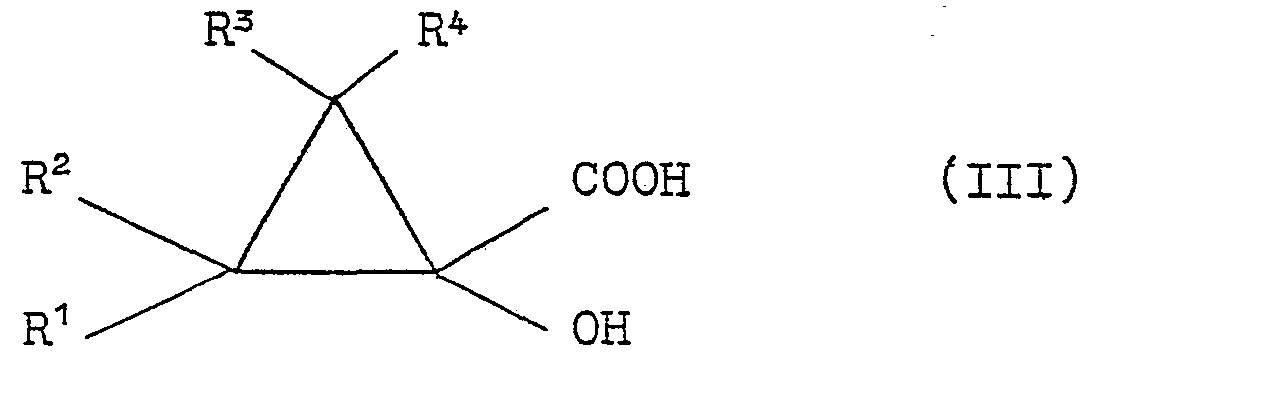
- R1 bis R4 die oben angegebene Bedeutung haben, umsetzen, indem man in die Reaktionslösung trockenen, gasförmigen Halogenwasserstoff, wie insbesondere Chlorwasserstoff, einleitet. Dabei fallen die 1-Hydroxycyclopropancarbonsäuren als kristalline Feststoffe an, die abgesaugt und getrocknet werden.
- Die neuen bissilylierten 1-Hydroxycyclopropancarbonsäuren der Formel (I) stellen somit, wie schon erwähnt, interessante Zwischenprodukte zur Herstellung von 1-Hydroxycyclopropancarbonsäuren dar, die auf diese Art und Weise in einer einfachen Eintopfreaktion rein und in guten Ausbeuten, auch im technischen Maßstab, erhalten werden können.
- Die 1-Hydroxycyclopropancarbonsäuren der Formel (III) sind weitgehend bekannt (vergleiche z.B. Liebigs Ann. Chem. 1976, 463ff). Sie stellen allgemein interessante Zwischenprodukte dar, insbesondere auch für die Synthese von fungiziden Wirkstoffen.
- So erhält man z.B. durch Umsetzung mit 3,5-Dihalogenphenylisocyanaten in Gegenwart eines inerten organischen Lösungsmittels, wie beispielsweise aromatische Kohlenwasserstoffe, und gegebenenfalls in Gegenwart einer Base, wie beispielsweise Triethylamin, bei Temperaturen zwischen 20 und 100°C die fungizid gut wirksamen Spiro-Derivate von 3-(3,5-Dihalogenphenyl)-oxazolidin-2,4-dionen der Formel

- R1 bis R4 die oben angegebene Bedeutung haben und
- X und Y für Halogen stehen (vergleiche DE-OS 28 04 824 [LeA 18 673] und DE-OS 28 52 924 [LeA 19 330] ).
-

- a) In 46,0 g (0,2 Mol) Cyclobuten-1,2-diol-bis-trimethyl- silylether wird bei 120°C Badtemperatur unter Rühren getrocknete Luft eingeleitet. Der Umsatz wird NMRspektroskopisch verfolgt. Nach 6,5 Stunden läßt man abkühlen und destilliert fraktionierend an einer Ringspaltkolonne. Man erhält 33,7 g (68 % der Theorie) 1-Trimethylsiloxy-cyclopropancarbonsäure-trimethylsilylester vom Siedepunkt 78-80 C/17,5 mbar und vom Brechungsindex

- b) In 46,0 g (0,2 Mol) Cyclobuten-1,2-diol-bis-trimethyl- silylether wird bei einer Temperatur von 20°C unter Rühren getrocknete Luft eingeleitet, bis vollständiger Umsatz erfolgt ist (72 Stunden). Das schwach gelb gefärbte Reaktionsprodukt wird an der Ringspaltkolonne destilliert. Man erhält 32,0 g (66 % der Theorie) 1-Trimethylsiloxycyclopropancarbonsäure-trimethylsilylester vom oben genannten Siedepunkt. Folgeprodukt

- 80g 1,2-Bis(trimethylsiloxy)-cyclobut-1-en werden mit 250 ml Toluol verdünnt und unter Rühren wird bei 90°C 18-24 Stunden Luft eingeleitet. Die Vollständigkeit der Umsetzung wird gaschromatographisch kontrolliert. Anschließend wird bei Raumtemperatur 2 bis 3 Stunden Chlorwasserstoff eingeleitet, das ausgefallene Kristallisat abgesaugt und aus Toluol umkristallisiert. Man erhält 26,7 g (75 % der Theorie, bezogen auf eingesetzten Silylether) 1-Hydroxy-cyclopropancarbonsäure vom Schmelzpunkt 102 - 105°C.
-

- In 20,0g (0,082 Mol) 3-Methyl-1,2-bis(trimethylsiloxy)-cyclobut-1-en wird bei 100°C unter Rühren getrocknete Luft eingeleitet, bis vollständiger Umsatz erfolgt ist (4-6 Stunden). Nach Abkühlen auf 50°C destilliert man fraktionierend. Man erhält 14,2g (67 % der Theorie) 2-Methyl-1-trimetrylsiloxy-cyclopropancarbensäure-tri- methylsilylester als Isomerengemisch vom Siedepunkt 90-97°C/17,5 mbar und vom Brechungsindex

-

- Entsprechend Beispiel 2 erhält man, ausgehend von 3-Ethyl-1,2-bis(trimethylsiloxy)-cyclobut-1-en in 75 %-iger Ausbeute 2-Ethyl-1-trimethylsiloxy-cyclopropan-carbonsäure- trimethylsilylester als Isomerengemisch vom Siedepunkt 48-57°C/ 0,4 mbar und vom Brechungsindex

-

- Entsprechend Beispiel 2 erhält man, ausgehend von 3-tert-Butyl-1,2-bis(trimethylsiloxy)-cyclobut-1-en in 57 %-iger Ausbeute (bezogen auf Umsatz) 2-tert-Butyll-trimethylsiloxycyclopropancarbonsäure-trimethylsilylester als Isomerengemisch vom Siedepunkt 48 - 57°C / 0,2 mbar und vom Brechungsindex

-

- Entsprechend Beispiel 2 erhält man ausgehend von 3-Isopropyl-1,2-bis(Trimethylsiloxy)-cyclobut-1-en (0,1 mol) in 60 %-iger Ausbeute 2-Isopropyl-1-trimethylsiloxy- cyclopropancarbonsäure-trimethylsilylester vom Siedepunkt 100 - 111°C/13 mbar und vom Brechungsindex

-

- 17,0 g ( 0,06 mol) 2-Isopropyl-1-trimethylsiloxy- cyclopropancarbonsäure-trimethylsilylester werden 2 h in 100 ml mit Chlorwasserstoff gesättigtem Toluol bei 30°C gerührt. Anschließend leitet man 1 h trockenen Stickstoff durch die Lösung und filtriert den Niederschlag ab. Kristallisieren aus Xylol liefert 2-Isopropyl-1-hydroxy-cyclopröpancarbonsäure (6,1 g) vom Schmelzpunkt 135 - 138°C.
-

- Entsprechend Beispiel 2 erhält man, ausgehend von 7,8-Bis-Trimethylsiloxy-bicyclo[4,2,0]octa-3,7-dien (0,1 mol) in 54 %-iger Ausbeute 7-Trimethylsiloxy- bicyclo[4,1,0]hept-3-en-7-carbonsäuretrimethylsilyl- ester vom Siedepunkt 71 - 82°C./ 0,1 - 1,0 mbar und vom Brechungsindex

mit Sauerstoff als Oxidationsmittel, gegebenenfalls in Gegenwart eines inerten organischen Verdünnungsmittels sowie gegebenenfalls in Gegenwart eines Katalysators, umsetzt.
Claims (4)


dadurch gekennzeichnet, daß man 1,2-Bis-trialkylsiloxy- cyclobut-1-ene der Formel

Applications Claiming Priority (2)
| Application Number | Priority Date | Filing Date | Title |
|---|---|---|---|
| DE3037302 | 1980-10-02 | ||
| DE19803037302 DE3037302A1 (de) | 1980-10-02 | 1980-10-02 | Bissilylierte l-hydroxycyclopropancarbonsaeuren, verfahren zu ihrer herstellung sowie ihre verwendung als zwischenprodukte |
Publications (2)
| Publication Number | Publication Date |
|---|---|
| EP0049417A2 true EP0049417A2 (de) | 1982-04-14 |
| EP0049417A3 EP0049417A3 (de) | 1982-06-23 |
Family
ID=6113474
Family Applications (1)
| Application Number | Title | Priority Date | Filing Date |
|---|---|---|---|
| EP81107512A Withdrawn EP0049417A3 (de) | 1980-10-02 | 1981-09-22 | Bissilylierte 1-Hydroxycyclopropancarbonsäuren, Verfahren zu ihrer Herstellung sowie ihre Verwendung als Zwischenprodukte |
Country Status (5)
| Country | Link |
|---|---|
| US (1) | US4363926A (de) |
| EP (1) | EP0049417A3 (de) |
| JP (1) | JPS57158793A (de) |
| DE (1) | DE3037302A1 (de) |
| IL (1) | IL63957A0 (de) |
Cited By (1)
| Publication number | Priority date | Publication date | Assignee | Title |
|---|---|---|---|---|
| AU593955B2 (en) * | 1986-11-20 | 1990-02-22 | Roussel-Uclaf | New derivatives of 2,2-dimethyl cyclopropane carboxylic acid having a saturated halogenated chain in position 3, the process and the intermediates for their preparation, their use as pesticides and the compositions containing them |
Family Cites Families (4)
| Publication number | Priority date | Publication date | Assignee | Title |
|---|---|---|---|---|
| DE2128327C3 (de) | 1971-06-08 | 1980-09-18 | Bayer Ag, 5090 Leverkusen | Verfahren zur Herstellung von 1-Hydroxy-cyclopropan-l-carbonsäuren |
| US4293704A (en) * | 1975-09-25 | 1981-10-06 | American Cyanamid Company | Novel 2-substituted-3,4-epoxycyclopentan-1-ones, 2-substituted-3,4-epoxycyclopentan-1-ols, and various 2-substituted-cyclopentenones |
| IT1113412B (it) | 1979-02-15 | 1986-01-20 | Oronzio De Nora Impianti | Procedimento eletttrolitico ed apparecchiatura per la preparazione di ipoalogenito di metallo alcalino |
| DE3006358A1 (de) * | 1979-02-23 | 1980-09-04 | Ciba Geigy Ag | Cyclopropankarbonsaeuresiliziumester, verfahren zu deren herstellung und deren verwendung |
-
1980
- 1980-10-02 DE DE19803037302 patent/DE3037302A1/de not_active Withdrawn
-
1981
- 1981-09-18 US US06/303,668 patent/US4363926A/en not_active Expired - Fee Related
- 1981-09-22 EP EP81107512A patent/EP0049417A3/de not_active Withdrawn
- 1981-09-28 IL IL63957A patent/IL63957A0/xx unknown
- 1981-09-30 JP JP56154029A patent/JPS57158793A/ja active Pending
Cited By (1)
| Publication number | Priority date | Publication date | Assignee | Title |
|---|---|---|---|---|
| AU593955B2 (en) * | 1986-11-20 | 1990-02-22 | Roussel-Uclaf | New derivatives of 2,2-dimethyl cyclopropane carboxylic acid having a saturated halogenated chain in position 3, the process and the intermediates for their preparation, their use as pesticides and the compositions containing them |
Also Published As
| Publication number | Publication date |
|---|---|
| EP0049417A3 (de) | 1982-06-23 |
| DE3037302A1 (de) | 1982-05-27 |
| JPS57158793A (en) | 1982-09-30 |
| US4363926A (en) | 1982-12-14 |
| IL63957A0 (en) | 1981-12-31 |
Similar Documents
| Publication | Publication Date | Title |
|---|---|---|
| EP0038987B1 (de) | Verfahren zur Herstellung von Acylcyaniden | |
| EP0040356B1 (de) | Verfahren zur Herstellung von Trimethylsilylcyanid | |
| DE2533920A1 (de) | Verfahren zur herstellung von resorcinen | |
| DE2213865B2 (de) | Verfahren zur Herstellung von Chlorthiazolen | |
| EP0076413A2 (de) | Verfahren zur Herstellung von Trimethylsilylcyanid | |
| EP0330058A1 (de) | Verfahren zur Herstellung von Perfluoralkylgruppen enthaltenden Silyläthern und Alkoholen | |
| EP0132733A2 (de) | Neue Fluorpivalsäurefluoride und Verfahren zu ihrer Herstellung | |
| EP0124002A1 (de) | Verfahren zur Herstellung von aromatischen Verbindungen, die über ein Heteroatom gebundene perfluorierte Seitenketten enthalten | |
| EP0004641A2 (de) | Verfahren zur Herstellung von Carbonsäureanhydriden | |
| EP0735016A1 (de) | Verfahren zur Herstellung von Alpha-Chloralkylarylketonen | |
| EP0165521A1 (de) | Verfahren zur Herstellung eines Gemisches aus einem gegebenenfalls substituierten Zimtsäureester und einem gegebenenfalls substituierten Beta-Alkoxy-Beta-phenyl-propionsäureester sowie Verfahren zur Herstellung von gegebenenfalls substituierter Zimtsäure | |
| EP0079004B1 (de) | Verfahren zur Herstellung von Acylcyaniden | |
| DE2614241B2 (de) | Verfahren zur Herstellung von Acylcyaniden | |
| EP0089485B1 (de) | Verfahren zur Herstellung von 5-Chlor-1H-tetrazol-1-carbonsäureestern sowie Verfahren zur Herstellung der erforderlichen Dichlorisonitril-carbonsäureester | |
| EP0060419B1 (de) | Verfahren zur Herstellung von o- und p-Acylphenolen | |
| EP0046193B1 (de) | 1-Hydroxypyrazol und Verfahren zu seiner Herstellung | |
| EP0365914B1 (de) | Neue Fluor enthaltende und an der CH3-Gruppe gegebenenfalls halogenierte Acetophenone und deren Herstellung aus neuen Fluor enthaltenden Benzonitrilen | |
| DE3037302A1 (de) | Bissilylierte l-hydroxycyclopropancarbonsaeuren, verfahren zu ihrer herstellung sowie ihre verwendung als zwischenprodukte | |
| EP0187216B1 (de) | Verfahren zur Herstellung von halogenierten 3,3-Dimethyl-5-hexen-2-onen | |
| EP0002477B1 (de) | Verfahren zur Herstellung von 1,1-Dihalogen-4-methyl-1,3-pentadienen | |
| EP0079005B1 (de) | Verfahren zur Herstellung von Carbonsäureanhydriden | |
| EP0120297B1 (de) | Verfahren zur Herstellung von 3-Formyl-5,6-dihydro-2H-pyran | |
| EP0492347B1 (de) | Verfahren zur Herstellung von threo-4-Alkoxy-5-(arylhydroxymethyl)-2(5H)-furanonen | |
| EP0111120B1 (de) | Verfahren zur Herstellung von Anthrachinonen | |
| DE2413824C2 (de) | Verfahren zur Herstellung von tertiären (Hydroxymehtyl)-methylphosphinoxiden |
Legal Events
| Date | Code | Title | Description |
|---|---|---|---|
| PUAI | Public reference made under article 153(3) epc to a published international application that has entered the european phase |
Free format text: ORIGINAL CODE: 0009012 |
|
| 17P | Request for examination filed |
Effective date: 19810922 |
|
| AK | Designated contracting states |
Designated state(s): BE CH DE FR GB IT NL |
|
| PUAL | Search report despatched |
Free format text: ORIGINAL CODE: 0009013 |
|
| AK | Designated contracting states |
Designated state(s): BE CH DE FR GB IT NL |
|
| STAA | Information on the status of an ep patent application or granted ep patent |
Free format text: STATUS: THE APPLICATION HAS BEEN WITHDRAWN |
|
| 18W | Application withdrawn |
Withdrawal date: 19820721 |
|
| RIN1 | Information on inventor provided before grant (corrected) |
Inventor name: KNOPS, HANS-JOACHIM, DR. Inventor name: PRIESNITZ, UWE, DR. Inventor name: HEINE, HANS-GEORG, DR. |