EP0049483A2 - Wasserlösliches Etikett, Verfahren zu seiner Herstellung und seine Verwendung - Google Patents
Wasserlösliches Etikett, Verfahren zu seiner Herstellung und seine Verwendung Download PDFInfo
- Publication number
- EP0049483A2 EP0049483A2 EP81107808A EP81107808A EP0049483A2 EP 0049483 A2 EP0049483 A2 EP 0049483A2 EP 81107808 A EP81107808 A EP 81107808A EP 81107808 A EP81107808 A EP 81107808A EP 0049483 A2 EP0049483 A2 EP 0049483A2
- Authority
- EP
- European Patent Office
- Prior art keywords
- water
- soluble
- adhesive
- layer
- polyvinyl alcohol
- Prior art date
- Legal status (The legal status is an assumption and is not a legal conclusion. Google has not performed a legal analysis and makes no representation as to the accuracy of the status listed.)
- Granted
Links
Images
Classifications
-
- G—PHYSICS
- G09—EDUCATION; CRYPTOGRAPHY; DISPLAY; ADVERTISING; SEALS
- G09F—DISPLAYING; ADVERTISING; SIGNS; LABELS OR NAME-PLATES; SEALS
- G09F3/00—Labels, tag tickets, or similar identification or indication means; Seals; Postage or like stamps
- G09F3/08—Fastening or securing by means not forming part of the material of the label itself
- G09F3/10—Fastening or securing by means not forming part of the material of the label itself by an adhesive layer
-
- G—PHYSICS
- G09—EDUCATION; CRYPTOGRAPHY; DISPLAY; ADVERTISING; SEALS
- G09F—DISPLAYING; ADVERTISING; SIGNS; LABELS OR NAME-PLATES; SEALS
- G09F3/00—Labels, tag tickets, or similar identification or indication means; Seals; Postage or like stamps
- G09F3/02—Forms or constructions
-
- G—PHYSICS
- G09—EDUCATION; CRYPTOGRAPHY; DISPLAY; ADVERTISING; SEALS
- G09F—DISPLAYING; ADVERTISING; SIGNS; LABELS OR NAME-PLATES; SEALS
- G09F3/00—Labels, tag tickets, or similar identification or indication means; Seals; Postage or like stamps
- G09F3/02—Forms or constructions
- G09F2003/023—Adhesive
- G09F2003/0233—Resistance to humidity
-
- G—PHYSICS
- G09—EDUCATION; CRYPTOGRAPHY; DISPLAY; ADVERTISING; SEALS
- G09F—DISPLAYING; ADVERTISING; SIGNS; LABELS OR NAME-PLATES; SEALS
- G09F3/00—Labels, tag tickets, or similar identification or indication means; Seals; Postage or like stamps
- G09F3/02—Forms or constructions
- G09F2003/023—Adhesive
- G09F2003/0242—Adhesive soluble in water
-
- G—PHYSICS
- G09—EDUCATION; CRYPTOGRAPHY; DISPLAY; ADVERTISING; SEALS
- G09F—DISPLAYING; ADVERTISING; SIGNS; LABELS OR NAME-PLATES; SEALS
- G09F3/00—Labels, tag tickets, or similar identification or indication means; Seals; Postage or like stamps
- G09F3/02—Forms or constructions
- G09F2003/0255—Forms or constructions laminated
-
- G—PHYSICS
- G09—EDUCATION; CRYPTOGRAPHY; DISPLAY; ADVERTISING; SEALS
- G09F—DISPLAYING; ADVERTISING; SIGNS; LABELS OR NAME-PLATES; SEALS
- G09F3/00—Labels, tag tickets, or similar identification or indication means; Seals; Postage or like stamps
- G09F3/02—Forms or constructions
- G09F2003/0272—Labels for containers
- G09F2003/0273—Labels for bottles, flasks
-
- Y—GENERAL TAGGING OF NEW TECHNOLOGICAL DEVELOPMENTS; GENERAL TAGGING OF CROSS-SECTIONAL TECHNOLOGIES SPANNING OVER SEVERAL SECTIONS OF THE IPC; TECHNICAL SUBJECTS COVERED BY FORMER USPC CROSS-REFERENCE ART COLLECTIONS [XRACs] AND DIGESTS
- Y10—TECHNICAL SUBJECTS COVERED BY FORMER USPC
- Y10T—TECHNICAL SUBJECTS COVERED BY FORMER US CLASSIFICATION
- Y10T428/00—Stock material or miscellaneous articles
- Y10T428/26—Web or sheet containing structurally defined element or component, the element or component having a specified physical dimension
- Y10T428/263—Coating layer not in excess of 5 mils thick or equivalent
- Y10T428/264—Up to 3 mils
- Y10T428/265—1 mil or less
-
- Y—GENERAL TAGGING OF NEW TECHNOLOGICAL DEVELOPMENTS; GENERAL TAGGING OF CROSS-SECTIONAL TECHNOLOGIES SPANNING OVER SEVERAL SECTIONS OF THE IPC; TECHNICAL SUBJECTS COVERED BY FORMER USPC CROSS-REFERENCE ART COLLECTIONS [XRACs] AND DIGESTS
- Y10—TECHNICAL SUBJECTS COVERED BY FORMER USPC
- Y10T—TECHNICAL SUBJECTS COVERED BY FORMER US CLASSIFICATION
- Y10T428/00—Stock material or miscellaneous articles
- Y10T428/27—Web or sheet containing structurally defined element or component, the element or component having a specified weight per unit area [e.g., gms/sq cm, lbs/sq ft, etc.]
-
- Y—GENERAL TAGGING OF NEW TECHNOLOGICAL DEVELOPMENTS; GENERAL TAGGING OF CROSS-SECTIONAL TECHNOLOGIES SPANNING OVER SEVERAL SECTIONS OF THE IPC; TECHNICAL SUBJECTS COVERED BY FORMER USPC CROSS-REFERENCE ART COLLECTIONS [XRACs] AND DIGESTS
- Y10—TECHNICAL SUBJECTS COVERED BY FORMER USPC
- Y10T—TECHNICAL SUBJECTS COVERED BY FORMER US CLASSIFICATION
- Y10T428/00—Stock material or miscellaneous articles
- Y10T428/28—Web or sheet containing structurally defined element or component and having an adhesive outermost layer
- Y10T428/2813—Heat or solvent activated or sealable
- Y10T428/2817—Heat sealable
- Y10T428/2826—Synthetic resin or polymer
-
- Y—GENERAL TAGGING OF NEW TECHNOLOGICAL DEVELOPMENTS; GENERAL TAGGING OF CROSS-SECTIONAL TECHNOLOGIES SPANNING OVER SEVERAL SECTIONS OF THE IPC; TECHNICAL SUBJECTS COVERED BY FORMER USPC CROSS-REFERENCE ART COLLECTIONS [XRACs] AND DIGESTS
- Y10—TECHNICAL SUBJECTS COVERED BY FORMER USPC
- Y10T—TECHNICAL SUBJECTS COVERED BY FORMER US CLASSIFICATION
- Y10T428/00—Stock material or miscellaneous articles
- Y10T428/28—Web or sheet containing structurally defined element or component and having an adhesive outermost layer
- Y10T428/2813—Heat or solvent activated or sealable
- Y10T428/283—Water activated
-
- Y—GENERAL TAGGING OF NEW TECHNOLOGICAL DEVELOPMENTS; GENERAL TAGGING OF CROSS-SECTIONAL TECHNOLOGIES SPANNING OVER SEVERAL SECTIONS OF THE IPC; TECHNICAL SUBJECTS COVERED BY FORMER USPC CROSS-REFERENCE ART COLLECTIONS [XRACs] AND DIGESTS
- Y10—TECHNICAL SUBJECTS COVERED BY FORMER USPC
- Y10T—TECHNICAL SUBJECTS COVERED BY FORMER US CLASSIFICATION
- Y10T428/00—Stock material or miscellaneous articles
- Y10T428/28—Web or sheet containing structurally defined element or component and having an adhesive outermost layer
- Y10T428/2839—Web or sheet containing structurally defined element or component and having an adhesive outermost layer with release or antistick coating
-
- Y—GENERAL TAGGING OF NEW TECHNOLOGICAL DEVELOPMENTS; GENERAL TAGGING OF CROSS-SECTIONAL TECHNOLOGIES SPANNING OVER SEVERAL SECTIONS OF THE IPC; TECHNICAL SUBJECTS COVERED BY FORMER USPC CROSS-REFERENCE ART COLLECTIONS [XRACs] AND DIGESTS
- Y10—TECHNICAL SUBJECTS COVERED BY FORMER USPC
- Y10T—TECHNICAL SUBJECTS COVERED BY FORMER US CLASSIFICATION
- Y10T428/00—Stock material or miscellaneous articles
- Y10T428/28—Web or sheet containing structurally defined element or component and having an adhesive outermost layer
- Y10T428/2848—Three or more layers
-
- Y—GENERAL TAGGING OF NEW TECHNOLOGICAL DEVELOPMENTS; GENERAL TAGGING OF CROSS-SECTIONAL TECHNOLOGIES SPANNING OVER SEVERAL SECTIONS OF THE IPC; TECHNICAL SUBJECTS COVERED BY FORMER USPC CROSS-REFERENCE ART COLLECTIONS [XRACs] AND DIGESTS
- Y10—TECHNICAL SUBJECTS COVERED BY FORMER USPC
- Y10T—TECHNICAL SUBJECTS COVERED BY FORMER US CLASSIFICATION
- Y10T428/00—Stock material or miscellaneous articles
- Y10T428/28—Web or sheet containing structurally defined element or component and having an adhesive outermost layer
- Y10T428/2852—Adhesive compositions
- Y10T428/2878—Adhesive compositions including addition polymer from unsaturated monomer
Definitions
- the invention relates to a water-soluble label which consists of a printable and / or inscribable top layer and a water-soluble adhesive layer and, if appropriate, a cover layer protecting the adhesive layer, and to a process for producing this label and the use of the label.
- a self-adhesive label with a printable and / or inscribable layer of cellulose-containing or textile material and a pressure-sensitive, water-soluble adhesive layer is already known (cf. German Ausletschrift 26 35 643).
- the printable layer consists of a material with a fiber structure that is soluble in water, and the layer has a water-impermeable but water-permeable coating.
- the known self-adhesive label is used for labeling beverage kegs, in particular aluminum beer kegs, as well as beverage bottles and pharmaceutical bottles.
- a modification of the self-adhesive label described is that the coating is transparent, is resistant to the action of water at a relatively low temperature up to a limit temperature and, at higher temperatures, is a water-releasing and / or water-dissolving and / or water-permeable Has structure (see German Offenlegungsschrift 27 21 120).
- the coating consists of a material that seals the pores of the layer to be printed below the limit temperature and encloses its fibers in a watertight manner, for example wax, linseed oil varnish or water glass.
- the limit temperature is 30 to 60 0 C.
- the object of the invention is to provide a self-adhesive label which is resistant to cold water and can be removed and dissolved with the aid of hot water and can be produced in a simple and inexpensive manner.
- the invention relates to a water-soluble label consisting of a printable and / or inscribable top layer and a water-soluble adhesive layer and optionally a cover layer protecting the adhesive layer, characterized in that the top layer consists of polyvinyl alcohol and the adhesive layer consists of a synthetic adhesive which is soluble in water .
- the upper layer of the label (outer material) consists of polyvinyl alcohol: this is preferably insoluble in cold water and soluble in hot water.
- the polyvinyl alcohol may also be soluble in cold water or may be delayed in cold water.
- cold means a temperature of at most 30 ° C.
- hot means a temperature of at least 50 ° C.
- the top layer is dimensionally stable in cold water and shrinkable in hot water.
- the 4issprozentige aqueous solution of the polyvinyl alcohol has a viscosity from 4 to 70 mPa.s, preferably 10 to 60 mPa.s (measured at a temperature of 20 o C).
- the ester number of the polyvinyl alcohol is in the range from 10 to 250 mg KOH / g, preferably 20 to 200 mg KOH / g.
- the adhesive layer of the label consists of a synthetic adhesive that is soluble in water.
- the adhesive is a pressure sensitive adhesive or a fixed adhesive; the latter can preferably be activated by water and / or heat.
- the adhesive layer has a weight per unit area of 5 to 25 g / m 2 , preferably 10 to 20 g / m 2 .
- the adhesive is in particular an organic polymer, preferably a vinyl polymer.
- organic polymer preferably a vinyl polymer.
- examples include polyvinyl esters such as polyvinyl acetate, polyvinyl propionate and vinyl acetate copolymers, polyvinyl ethers such as polyvinyl methyl ether, polyvinyl acetals such as polyvinyl butyral and polyvinyl alcohol.
- cold water-soluble polyvinyl alcohol is suitable as an adhesive if the top layer consists of a cold water-insoluble but hot water-soluble polyvinyl alcohol.
- the adhesive layer is optionally protected by a cover layer, especially when using a pressure sensitive adhesive.
- the cover layer consists of a cover film, preferably a cover paper such as siliconized paper, which can be easily removed from the adhesive layer.
- the invention also relates to a method for producing a water-soluble label which consists of a printable and / or inscribable top layer and a water-soluble adhesive layer and optionally a cover layer protecting the adhesive layer, and is characterized in that a film made of polyvinyl alcohol is coated on one side with an adhesive, if necessary, the adhesive layer obtained is laminated with a cover layer, and the label is punched out of the film composite obtained.
- the polyvinyl alcohol film serving as the top layer is produced by the casting process or preferably by blow extrusion. It has a thickness of 10 to 150 / um, preferably way 20 to 100 / um.
- the polyvinyl alcohol film is usually transparent; but it can also be colored, namely if a polyvinyl alcohol is used which contains a pigment or an organic dye.
- the amount of pigment is then 1 to 10 percent by weight, preferably 2 to 5 percent by weight (based on the polyvinyl alcohol), while the amount of the dye is in the range of 0.5 to 5 percent by weight, preferably 1 to 3 percent by weight (based on the polyvinyl alcohol) .
- Titanium dioxide as well as kaolin, chalk and satin white are particularly suitable as pigments, while usual food and cosmetic dyes can be used as dyes.
- the adhesive layer on the polyvinyl alcohol film is generally formed by applying the adhesive in the form of a solution or an aqueous dispersion to the film and then removing the solvent or dispersant; water or a water-miscible organic solvent, e.g. Acetone, methanol or ethanol, used as a solvent, while water serves as a dispersant.
- a water-miscible organic solvent e.g. Acetone, methanol or ethanol
- a particularly simple and preferred modification of the process according to the invention is that in a coextrusion process, a film is simultaneously made from a cold water-insoluble and hot water-soluble polyvinyl alcohol and a film from a cold water-insoluble polyvinyl alcohol and is joined together, e.g. with the help of rollers.
- the water-soluble label according to the invention is preferably used for labeling vessels with a smooth surface, which are temporarily exposed to cold water.
- vessels are in particular barrels and buckets made of metal and bottles made of glass, porcelain or earthenware, which are used to store beverages, food or Drugs.
- the label is distinguished by the fact that it does not become detached from the vessel due to the action of condensed water, splashed water or rainwater or aqueous liquids below a temperature of 30 ° C. 50 ° C, can be removed and dissolved properly. The removal of the label is facilitated by the fact that the polyvinyl alcohol top layer shrinks when exposed to hot water.
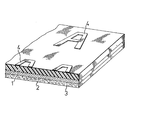
- a label according to the invention is shown in cross section. It consists of the top layer 1, which is connected to the adhesive layer 2. The adhesive layer 2 is protected by the cover layer 3. The upper layer 1 is provided with an imprint 4.
- the polyvinyl alcohol film is then coated on one side with the aid of a doctor blade with a 50 percent solution of a commercially available polyvinyl methyl ether in acetone. After the acetone has evaporated, an adhesive layer is obtained a basis weight of 15 g / m 2 , which is immediately laminated with a siliconized paper using a pressure roller. Rectangular labels are then punched out and printed from the film composite obtained.
- the labels are stuck to glass bottles after the cover paper has been removed.
- the bottles are stored in water at a temperature of 20 ° C for 12 hours without the labels peeling off. If the labeled bottles are treated with water at 70 ° C, the labels first detach from the surface of the bottle within 10 seconds by spontaneous shrinking and then after a further 60 seconds.
- a polyvinyl alcohol film produced in accordance with Example 1 is coated with a 55 percent aqueous commercial polyvinyl acetate dispersion using a doctor blade. After the water has evaporated, an adhesive layer with a weight per unit area of 10 g / m 2 is obtained . Labels are then punched out of the coated film and printed.
- the labels are stuck to an aluminum barrel after the adhesive layer has been moistened with water. After the labels have dried on, the keg is stored in water at a temperature of 30 ° C. for 12 hours without the labels coming off. After treating the keg with water at 70 ° C, the labels are removed without any problems and dissolve.
- the polyvinyl alcohol film is then provided with an adhesive layer, this is laminated and labels are punched out.
- the labels are stuck to porcelain pots.
- the pots are stored in water at a temperature of 20 ° C. for 12 hours without the labels coming off. After treating the pots with water at 70 ° C, the labels peel off and dissolve perfectly.
- a commercially available polyvinyl alcohol which has an ester number of 10 mg KOH / g and whose 4 percent aqueous solution has a viscosity of 28 mPa s, is dissolved in water at 85 ° C. to form a 20 percent solution.
- the solution is filtered and poured onto an endless plastic belt: the thickness of the film is adjusted using a squeegee.
- the plastic belt runs through a drying tunnel in which the water evaporates.
- a glass-clear cast film with a thickness of 50 ⁇ m is obtained.
- the film is insoluble in water at a temperature of 30 ° C, but soluble at 70 ° C.
- the polyvinyl alcohol film is then provided with an adhesive layer, this is laminated and labels are punched out.
- the labels are stuck to glass bottles.
- the bottles are stored in water at a temperature of 30 ° C for 12 hours without the labels peeling off. If the labeled bottles are treated with water at 70 ° C, the labels are removed without any problems and dissolve in the hot water.
- a polyvinyl alcohol which has an ester number of 10 mg KOH / g and whose 4 percent aqueous solution has a viscosity of 28 mPa's, is dissolved in water at 85 ° C. to form a 20 percent solution. 5 (based on PVAL) titanium dioxide are suspended in this solution.
- a film is produced from this suspension in accordance with Example 4. The film is colored milky white and has a thickness of 50 ⁇ m. It is insoluble in water at a temperature of 30 ° C, but soluble at 70 ° C.
- the polyvinyl alcohol film is then provided with an adhesive layer, this is laminated and labels are punched out.
- the adhesive layer of the labels is moistened with water and the labels are stuck on glass bottles. After the labels have dried on, the glass bottles are stored in water at a temperature of 20 ° C. for 12 hours without the labels coming off. If the labeled bottles are treated with water at 70 ° C, the labels peel off perfectly and then dissolve.
Landscapes
- Physics & Mathematics (AREA)
- General Physics & Mathematics (AREA)
- Engineering & Computer Science (AREA)
- Theoretical Computer Science (AREA)
- Adhesive Tapes (AREA)
- Adhesives Or Adhesive Processes (AREA)
- Making Paper Articles (AREA)
- Organic Low-Molecular-Weight Compounds And Preparation Thereof (AREA)
- Processes Of Treating Macromolecular Substances (AREA)
- Compositions Of Macromolecular Compounds (AREA)
- Agricultural Chemicals And Associated Chemicals (AREA)
- Polysaccharides And Polysaccharide Derivatives (AREA)
- Paper (AREA)
- Wrappers (AREA)
- Medicinal Preparation (AREA)
Abstract
Description
- Die Erfindung bezieht sich auf ein wasserlösliches Etikett, das aus einer bedruckbaren und/oder beschriftbaren Oberschicht und einer wasserlöslichen Haftschicht sowie gegebenenfalls einer die Haftschicht schützenden Deckschicht besteht, sowie auf ein Verfahren zur Herstellung dieses Etiketts und die Verwendung des Etiketts.
- Ein Selbstklebeetikett mit einer bedruckbaren und/oder beschriftbaren Schicht aus zellstoffhaltigem oder textilem Werkstoff und einer druckempfindlichen, wasserlöslichen Haftschicht ist bereits bekannt (vgl. deutsche Auslegeschrift 26 35 643). Dabei besteht die bedruckbare Schicht aus einem Material mit einer in Wasser auflösbaren Faserstruktur, und die Schicht trägt einen von Wasser nicht benetzbaren, jedoch wasserdurchlässigen Überzug. Das bekannte Selbstklebeetikett wird zum Etikettieren von Getränkefässern, insbesondere Bierfässern aus Aluminium, sowie Getränkeflaschen und Arzneimittelflaschen verwendet.
- Eine Modifikation des beschriebenen Selbstklebeetiketts besteht darin, daß der Überzug durchsichtig ist, bei relativ niedriger Temperatur bis zu einer Grenztemperatur gegenüber der Einwirkung von Wasser resistent ist und bei höheren Temperaturen eine sich unter Einwirkung von Wasser ablösende und/oder in Wasser auflösende und/oder wasserdurchlässige Struktur aufweist (vgl. deutsche Offenlegungsschrift 27 21 120). Der Überzug besteht aus einem Material, das unterhalb der Grenztemperatur die Poren der zu bedruckenden Schicht abdichtet und deren Fasern wasserdicht umschließt, z.B. Wachs, Leinölfirnis oder Wasserglas. Die Grenztemperatur liegt bei 30 bis 600C.
- Aufgabe der Erfindung ist die Bereitstellung eines Selbstklebeetiketts, das gegen kaltes Wasser resistent und mit Hilfe von heißem Wasser ablösbar und auflösbar ist und in einfacher und kostengünstiger Weise hergestellt werden kann.
- Die Erfindung betrifft ein wasserlösliches Etikett, bestehend aus einer bedruckbaren und/oder beschriftbaren Oberschicht und einer wasserlöslichen Haftschicht sowie gegebenenfalls einer die Haftschicht schützenden Deckschicht, dadurch gekennzeichnet, daß die Oberschicht aus Polyvinylalkohol und die Haftschicht aus einem synthetischen Klebstoff besteht, der in Wasser löslich ist.
- Wesentliches Merkmal des erfindungsgemäßen Etiketts ist die Tatsache, daß die Oberschicht des Etiketts (Obermaterial) aus Polyvinylalkohol besteht: dieser ist vorzugsweise in kaltem Wasser unlöslich und in heißem Wasser löslich. Der Polyvinylalkohol ist gegebenenfalls auch in kaltem Wasser löslich oder in kaltem Wasser verzögert löslich. Hierbei wird unter "kalt" eine Temperatur von höchstens 300C und unter "heiß" eine Temperatur von mindestens 500C verstanden. Für die Ablösbarkeit des Etiketts ist es von besonderem Vorteil, wenn die Oberschicht in kaltem Wasser formstabil und in heißem Wasser schrumpffähig ist.
- Der erfindungsgemäß verwendete Polyvinylalkohol wird in bekannter Weise hergestellt durch Verseifung, vorzugsweise durch Alkoholyse, von Polyvinylestern, vorzugsweise Polyvinylacetat (vgl. z.B. deutsche Patentschrift 17 20 709 = britische Patentschrift 11 68 757). Die 4gewichtsprozentige wäßrige Lösung des Polyvinylalkohols weist eine Viskosität von 4 bis 70 mPa.s, vorzugsweise 10 bis 60 mPa.s auf (gemessen bei einer Temperatur von 20oC). Die Esterzahl des Polyvinylalkohols liegt im Bereich von 10 bis 250 mg KOH/g, vorzugsweise 20 bis 200 mg KOH/g.
- Die Haftschicht des Etiketts besteht aus einem synthetischen Klebstoff, der in Wasser löslich ist. Der Klebstoff ist ein Haftkleber oder ein Festkleber; letzterer ist vorzugsweise durch Wasser und/oder Wärme aktivierbar. Die Haftschicht hat ein Flächengewicht von 5 bis 25 g/m2, vorzugsweise 10 bis 20 g/m2.
- Der Klebstoff ist insbesondere ein organisches Polymer, vorzugsweise ein Vinylpolymer. Beispielsweise sind Polyvinylester wie Polyvinylacetat, Polyvinylpropionat und Vinylacetat-Copolymere, Polyvinylether wie Polyvinylmethylether, Polyvinylacetale wie Polyvinylbutyral sowie Polyvinylalkohol. Insbesondere kaltwasserlöslicher Polyvinylalkohol eignet sich als Klebstoff, wenn die Oberschicht aus einem kaltwasserunlöslichen, aber heißwasserlöslichen Polyvinylalkohol besteht.
- Die Haftschicht wird gegebenenfalls durch eine Deckschicht geschützt, insbesondere bei Verwendung eines Haftklebers. Die Deckschicht besteht aus einer Abdeckfolie, vorzugsweise einem Abdeckpapier wie silikonisertem Papier, die sich leicht von der Haftschicht abziehen läßt.
- Die Erfindung betrifft auch ein Verfahren zur Herstellung eines wasserlöslichen Etiketts, das einer bedruckbaren und/ oder beschriftbaren Oberschicht und einer wasserlöslichen Haftschicht sowie gegebenenfalls einer die Haftschicht schützenden Deckschicht besteht, und ist dadurch gekennzeichnet, daß man eine Folie aus Polyvinylalkohol einseitig mit einem Klebstoff beschichtet, gegebenenfalls die erhaltene Haftschicht mit einer Deckschicht kaschiert, und aus dem erhaltenen Folienverbund das Etikett ausstanzt.
- Die als Oberschicht dienende Polyvinylalkohol-Folie wird im Gießverfahren oder vorzugsweise durch Blasextrusion hergestellt. Sie besitzt eine Dicke von 10 bis 150/um, vorzugsweise 20 bis 100/um. Die Polyvinylalkohol-Folie ist normalerweise transparent; sie kann aber auch gefärbt sein, wenn nämlich ein Polyvinylalkohol verwendet wird, der ein Pigment oder einen organischen Farbstoff enthält. Die Menge des Pigments beträgt dann 1 bis 10 Gewichtsprozent, vorzugsweise 2 bis 5 Gewichtsprozent (bezogen auf den Polyvinylalkohol), während die Menge des Farbstoffs im Bereich von 0,5 bis 5 Gewichtsprozent, vorzugsweise 1 bis 3 Gewichtsprozent liegt (bezogen auf den Polyvinylalkohol). Als Pigment eignet sich insbesondere Titandioxid sowie auch Kaolin, Kreide und Satinweiß, während als Farbstoffe übliche Lebensmittelfarbstoffe und Kosmetikfarbstoffe verwendbar sind.
- Die Haftschicht auf der Polyvinylalkohol-Folie entsteht im allgemeinen dadurch, daß man den Klebstoff in Form einer Lösung oder einer wäßrigen Dispersion auf die Folie aufbringt und das Lösemittel oder Dispersionsmittel anschließend entfernt; dabei wird Wasser oder ein mit Wasser mischbares organisches Lösemittel, z.B. Aceton, Methanol oder Ethanol, als Lösemittel eingesetzt, während Wasser als Dispergiermittel dient.
- Eine besonders einfache und bevorzugte Modifikation des erfindungsgemäßen Verfahrens besteht darin, daß man in einem .Koextrusionsverfahren gleichzeitig eine Folie aus einem kaltwasserunlöslichen und heißwasserlöslichen Polyvinylalkohol und eine Folie aus einem kaltwasserunlöslichen Polyvinylalkohol herstellt und miteinander verbindet, z.B. mit Hilfe von Walzen.
- Das erfindungsgemäße wasserlösliche Etikett wird vorzugsweise zum Etikettieren von Gefäßen mit glatter Oberfläche, die zeitweise der Einwirkung von kaltem Wasser ausgesetzt sind, verwendet. Solche Gefäße sind insbesondere Fässer und Eimer aus Metall sowie Flaschen aus Glas, Porzellan oder Steingut, die der Aufbewahrung von Getränken, Lebensmitteln oder Arzneimitteln dienen. Das Etikett ist dadurch ausgezeichnet, daß es durch die Einwirkung von Kondens-, Spritz-oder Regenwasser oder wäßriger Flüssigkeiten unterhalb einer Temperatur von 30°C nicht vom Gefäß abgelöst wird, sich aber beim Reinigen des Gefäßes mit Wasser, das eine Temperatur von mehr als 50°C aufweist, einwandfrei ablösen und auflösen läßt. Das Ablösen des Etiketts wird dadurch erleichtert, daß die Polyvinylalkohol-Oberschicht bei der Einwirkung von heißem Wasser schrumpft.
- In Figur 1 ist ein erfindungsgemäßes Etikett im Querschnitt dargestellt. Es besteht aus der Oberschicht 1, die mit der Haftschicht 2 verbunden ist. Die Haftschicht 2 ist durch die Deckschicht 3 geschützt. Die Oberschicht 1 ist mit einem Aufdruck 4 versehen.
- Die folgenden Beispiele dienen zu näheren Erläuterung der Erfindung. Prozentangaben beziehen sich auf das Gewicht.
- 6 kg eines handelsüblichen, granulierten Polyvinylalkohols, der eine Esterzahl von 20 mg KOH/g und dessen 4prozentige wäßrige Lösung eine Viskosität von 20 mPa.s aufweist, werden mit 1,5 kg Glycerin, 0,9 kg Wasser und 180 g Titandioxid homogen vermischt. Das erhaltene Gemisch wird auf einem Einschneckenextruder zu einer weißen, undurchsichtigen Blasfolie extrudiert, deren Dicke 30/um beträgt. Die Folie ist in Wasser bei einer Temperatur von 30°C unlöslich, bei 70°C jedoch löslich.
- Die Polyvinylalkohol-Folie wird dann mit Hilfe eines Rakels einseitig mit einer 50prozentigen Lösung eines handelsüblichen Polyvinylmethylethers in Aceton beschichtet. Nach dem Abdunsten des Acetons erhält man eine Haftschicht mit einem Flächengewicht von 15 g/m2, die über eine Andruckwalze sofort mit einem silikonisierten Papier kaschiert wird. Aus dem erhaltenen Folienverbund werden anschließend rechteckige Etiketten ausgestanzt und bedruckt.
- Die Etiketten werden nach Abziehen des Abdeckpapiers auf Glasflaschen geklebt. Die Flaschen werden 12 Stunden lang in Wasser bei einer Temperatur von 20 °C gelagert, ohne daß die Etiketten sich ablösen. Werden die etikettierten Flaschen mit Wasser von 70°C behandelt, so lösen sich die Etiketten zunächst durch spontanes Schrumpfen innerhalb von 10 Sekunden von der Flaschenoberfläche ab und nach weiteren 60 Sekunden auf.
- Eine entsprechend Beispiel 1 hergestellte Polyvinylalkohol-Folie wird mit Hilfe eines Rakels mit einer 55prozentigen wäßrigen handelsüblichen Polyvinylacetat-Dispersion beschichtet. Nach dem Abdunsten des Wassers erhält man eine Haftschicht mit einem Flächengewicht von 10 g/m2. Aus der beschichteten Folie werden dann Etiketten ausgestanzt und bedruckt.
- Die Etiketten werden auf ein Aluminiumfaß geklebt, nachdem die Haftschicht mit Wasser befeuchtet worden war. Nach dem Antrocknen der Etiketten wird das Faß 12 Stunden lang in Wasser bei einer Temperatur von 30 0C gelagert, ohne daß die Etiketten sich ablösen. Nach Behandlung des Fasses mit Wasser von 70°C werden die Etiketten einwandfrei abgelöst und lösen sich auf.
- 6 kg eines handelsüblichen, granulierten Polyvinylalkohols, der eine Esterzahl von 90 mg KOH/g und dessen 4prozentige wäßrige Lösung eine Viskosität von 30 mPa s aufweist, werden mit 1 kg Glycerin, 0,3 kg Wasser und 180 g Titandioxid homogen vermischt. Das erhaltene Gemisch wird auf einem Einschneckenextruder zu einer weißen, undurchsichtigen Blasfolie extrudiert, deren Dicke 40 µm beträgt. Die Folie ist in Wasser bei einer Temperatur von 30°C unlöslich, bei 70°C jedoch löslich.
- Entsprechend Beispiel 1 wird dann die Polyvinylalkohol-Folie mit einer Haftschicht versehen, diese wird kaschiert, und Etiketten werden ausgestanzt.
- Die Etiketten werden nach Abziehen des Abdeckpapiers auf Porzellantöpfe geklebt. Die Töpfe werden 12 Stunden lang in Wasser bei einer Temperatur von 20 0C gelagert, ohne daß die Etiketten sich ablösen. Nach Behandlung der Töpfe mit Wasser von 70°C lösen sich die Etiketten einwandfrei ab und lösen sich auf.
- Ein handelsüblicher Polyvinylalkohol, der eine Esterzahl von 10 mg KOH/g und dessen 4prozentige wäßrige Lösung eine Viskosität von 28 mPa s aufweist, wird in Wasser von 85°C zu einer 20prozentigen Lösung gelöst. Die Lösung wird filtriert und auf ein endlos umlaufendes Kunststoffband gegossen: dabei wird die Stärke des Films mit Hilfe eines Rakels eingestellt. Das Kunststoffband durchläuft einen Trockenkanal, in dem das Wasser verdunstet. Man erhält am Ende des Kunststoffbandes eine glasklare Gießfolie mit einer Dicke von 50 µm. Die Folie ist in Wasser bei einer Temperatur von 30°C unlöslich, bei 70°C jedoch löslich.
- Entsprechend Beispiel 1 wird die Polyvinylalkohol-Folie dann mit einer Haftschicht versehen, diese wird kaschiert, und Etiketten werden ausgestanzt.
- Die Etiketten werden nach Abziehen des Trennpapiers auf Glasflaschen geklebt. Die Flaschen werden 12 Stunden lang in Wasser bei einer Temperatur von 30°C gelagert, ohne daß die Etiketten sich ablösen. Werden die etikettierten Flaschen mit Wasser von 70°C behandelt, so werden die Etiketten einwandfrei abgelöst und lösen sich in dem heißen Wasser auf.
- Ein Polyvinylalkohol, der eine Esterzahl von 10 mg KOH/g und dessen 4prozentige wäßrige Lösung eine Viskosität von 28 mPa's aufweist, wird in Wasser von 85 °C zu einer 20prozentigen Lösung gelöst. In dieser Lösung werden 5 (bezogen auf PVAL) Titandioxid suspendiert. Aus dieser Suspension wird entsprechend Beispiel 4 eine Folie hergestellt. Die Folie ist milchig-weiß gefärbt und weist eine Dicke von 50 µm auf. Sie ist in Wasser bei einer Temperatur von 30°C unlöslich, bei 70°C jedoch löslich.
- Entsprechend Beispiel 2 wird die Polyvinylalkohol-Folie dann mit einer Haftschicht versehen, diese wird kaschiert, und Etiketten werden ausgestanzt.
- Die Haftschicht der Etiketten wird mit Wasser befeuchtet, und die Etiketten werden auf Glasflaschen geklebt. Nach dem Antrocknen der Etiketten werden die Glasflaschen 12 Stunden lang in Wasser bei einer Temperatur von 20 C gelagert, ohne daß die Etiketten sich ablösen. Werden die etikettierten Flaschen mit Wasser von 70°C behandelt, so lösen die Etiketten sich einwandfrei ab und lösen sich dann auf.
Claims (9)
Priority Applications (1)
| Application Number | Priority Date | Filing Date | Title |
|---|---|---|---|
| AT81107808T ATE11837T1 (de) | 1980-10-04 | 1981-10-01 | Wasserloesliches etikett, verfahren zu seiner herstellung und seine verwendung. |
Applications Claiming Priority (2)
| Application Number | Priority Date | Filing Date | Title |
|---|---|---|---|
| DE19803037640 DE3037640A1 (de) | 1980-10-04 | 1980-10-04 | Verwendung einer polyvinylalkohol-folie zur herstellung von haftmaterial, wie etikettenmaterial |
| DE3037640 | 1980-10-04 |
Publications (3)
| Publication Number | Publication Date |
|---|---|
| EP0049483A2 true EP0049483A2 (de) | 1982-04-14 |
| EP0049483A3 EP0049483A3 (en) | 1982-06-02 |
| EP0049483B1 EP0049483B1 (de) | 1985-02-13 |
Family
ID=6113671
Family Applications (1)
| Application Number | Title | Priority Date | Filing Date |
|---|---|---|---|
| EP81107808A Expired EP0049483B1 (de) | 1980-10-04 | 1981-10-01 | Wasserlösliches Etikett, Verfahren zu seiner Herstellung und seine Verwendung |
Country Status (15)
| Country | Link |
|---|---|
| US (1) | US4444839A (de) |
| EP (1) | EP0049483B1 (de) |
| JP (1) | JPS5790076A (de) |
| AT (1) | ATE11837T1 (de) |
| AU (1) | AU7598881A (de) |
| BR (1) | BR8106358A (de) |
| CA (1) | CA1195113A (de) |
| DD (1) | DD201947A5 (de) |
| DE (2) | DE3037640A1 (de) |
| DK (1) | DK437881A (de) |
| GR (1) | GR75022B (de) |
| NZ (1) | NZ198547A (de) |
| PT (1) | PT73765B (de) |
| YU (1) | YU237381A (de) |
| ZA (1) | ZA816827B (de) |
Cited By (5)
| Publication number | Priority date | Publication date | Assignee | Title |
|---|---|---|---|---|
| WO1986003613A1 (fr) * | 1984-12-08 | 1986-06-19 | Albert Kamber | Label de controle, de qualite et d'appreciation pour matieres textiles |
| EP0326039A1 (de) * | 1988-01-20 | 1989-08-02 | Fuji Seal Industry Co. Ltd. | Ablösbares rohrförmiges Etikett |
| WO1990001764A1 (en) * | 1988-08-11 | 1990-02-22 | Enagy Limited | Adhesive coated substrates |
| EP0615838A1 (de) * | 1993-02-12 | 1994-09-21 | Cofradec S.A. | Laminiertes Verbundwerkstoffprodukt |
| NL1002508C2 (nl) * | 1996-03-01 | 1997-06-06 | Wavin Trepak B V | Werkwijze voor het aanbrengen van een verwijderbare bedrukking op een houder en houder voorzien van een verwijderbare bedrukking. |
Families Citing this family (38)
| Publication number | Priority date | Publication date | Assignee | Title |
|---|---|---|---|---|
| GB2143178A (en) * | 1983-07-05 | 1985-02-06 | Letraset International Ltd | Production of coloured legends |
| AU563019B2 (en) * | 1984-05-21 | 1987-06-25 | H.B. Fuller Licensing And Financing Inc. | Starch-based corrugating adhesive containing soluble polyvinyl alcohol |
| US5454898A (en) * | 1984-05-21 | 1995-10-03 | H. B. Fuller Licensing & Financing Inc. | Fast setting starch-based corrugating adhesive having partially hydrolized water soluble polyvinyl alcohol component |
| US4677145A (en) * | 1984-05-21 | 1987-06-30 | H. B. Fuller Company | Fast setting starch-based corrugating adhesive having partially hydrolized water soluble polyvinyl alcohol component |
| US4601934A (en) * | 1984-07-27 | 1986-07-22 | Beverly James A | Masking of electrical printed circuit boards |
| US4608284A (en) * | 1985-01-22 | 1986-08-26 | Cellu-Craft Inc. | Heat shrinkable label and related container |
| USRE37248E1 (en) | 1986-07-14 | 2001-06-26 | The Dow Chemical Company | Coextruded plastic film label for in-mold labeling |
| DE3738786A1 (de) * | 1987-11-14 | 1989-05-24 | Belland Ag | Im waessrigem alkali aufloesbare klebefolie, wie etikett und dgl. |
| CA2002286C (en) * | 1988-11-07 | 2001-08-28 | Thomas L. Brandt | Container label and method for applying same |
| US5093393A (en) * | 1989-02-13 | 1992-03-03 | H. B. Fuller Company | Starch-based corrugating adhesive having a polyvinyl alcohol component |
| DE3909089A1 (de) * | 1989-03-20 | 1990-09-27 | Haack Karl Werner An | Etikett aus kunststoffolie und verfahren zur etikettierung von mehrwegbehaeltern mit einem solchen etikett |
| US5284091A (en) * | 1990-04-12 | 1994-02-08 | Lintec Corporation | Plate roll and an adhesive sheet therefor |
| US5798152A (en) * | 1990-07-24 | 1998-08-25 | Novon International | Biodegradable composite polymeric articles comprising polyvinyl alcohol |
| DE4126230C2 (de) * | 1991-08-08 | 1994-02-17 | Lohmann Gmbh & Co Kg | Haftklebeband und seine Verwendung |
| GB9119118D0 (en) * | 1991-09-07 | 1991-10-23 | Ultramark Adhesive Products Lt | Labels |
| US5861201A (en) * | 1994-02-15 | 1999-01-19 | Owens-Illinois Labels Inc. | Multilayer label material |
| CN1121670C (zh) * | 1996-03-20 | 2003-09-17 | 海内肯技术服务公司 | 转印标签及包含这种标签的容器 |
| PT888602E (pt) * | 1996-03-20 | 2002-11-29 | Heineken Tech Services | Etiqueta recipiente contendo a referida etiqueta e metodo de lavagem desse recipiente |
| DE29806781U1 (de) * | 1998-04-15 | 1999-09-02 | Steinbeis PPL GmbH, 83098 Brannenburg | Leicht entfernbares Etikett für Mehrwegbehälter |
| US6047992A (en) * | 1998-09-10 | 2000-04-11 | Hampton; Patricia | Shampoo and hair conditioner containers indicating system |
| JP3853091B2 (ja) * | 1998-10-05 | 2006-12-06 | 株式会社吉野工業所 | タックラベル及びタックラベル付きポリエステル製ボトル |
| CA2370038C (en) | 1999-04-14 | 2008-06-17 | Steinbeis Ppl Gmbh | Easily removable label for reusable containers |
| GB0106410D0 (en) * | 2001-03-15 | 2001-05-02 | Ucb Sa | Labels |
| US6828018B2 (en) * | 2001-05-29 | 2004-12-07 | Cmc Daymark Corporation | Water dissolvable tape |
| DE60226740D1 (de) * | 2001-07-16 | 2008-07-03 | Avery Dennison Co | Artikel mit lösbaren klebstoff |
| WO2003047854A1 (en) * | 2001-12-06 | 2003-06-12 | Arrow Coated Products Limited | Multilayered films |
| US20050170123A1 (en) * | 2003-03-13 | 2005-08-04 | Colleen Zielske | Pressure sensitive label |
| EP1469012A1 (de) * | 2003-04-17 | 2004-10-20 | TEMSA International Inc. | Polymerisationsinitiatorensystem |
| JP4505296B2 (ja) * | 2004-09-17 | 2010-07-21 | 富士フイルム株式会社 | 液体試料分析用多層分析素子 |
| FI117072B (fi) * | 2005-04-15 | 2006-05-31 | Raflatac Oy | Poispestävä etiketti |
| US8037545B2 (en) * | 2007-03-16 | 2011-10-18 | Branders.Com, Inc. | Article and method including a temporary decoration |
| US20090196533A1 (en) * | 2008-01-28 | 2009-08-06 | Axis Co., Ltd. | Shopping bag made of nonwoven fabric |
| US8567338B2 (en) * | 2008-04-29 | 2013-10-29 | Ethicon Endo-Surgery, Inc. | Reprocessing indicator for single patient use medical instruments |
| US9418576B2 (en) | 2008-05-14 | 2016-08-16 | Avery Dennison Corporation | Dissolvable thermal direct adhesive label and label assembly including the same |
| CN102800245B (zh) * | 2012-08-30 | 2014-07-09 | 广东溢达纺织有限公司 | 水溶性商标及其制备方法 |
| CN103921477A (zh) * | 2014-04-23 | 2014-07-16 | 佛山荷韵特种材料有限公司 | 一种水离型纸质标签及其制备工艺 |
| US11883084B2 (en) | 2020-05-01 | 2024-01-30 | Glass Tats Llc | Water-soluble sticker for marking glassware |
| US20230274665A1 (en) * | 2022-02-25 | 2023-08-31 | David Schuster-Wachsberger | Dissolvable label |
Family Cites Families (13)
| Publication number | Priority date | Publication date | Assignee | Title |
|---|---|---|---|---|
| US2348220A (en) * | 1941-01-10 | 1944-05-09 | Western Union Telegraph Co | Adhesive paper |
| US2578150A (en) * | 1947-12-12 | 1951-12-11 | Meyercord Co | Decalcomania and method of applying same |
| US2654170A (en) * | 1949-01-17 | 1953-10-06 | Minnesota Mining & Mfg | Disintegrable label and washable container labeled therewith |
| US2793966A (en) * | 1954-01-11 | 1957-05-28 | Nashua Corp | Non-curling gummed paper, method and composition for making same |
| JPS456776Y1 (de) * | 1965-03-27 | 1970-04-03 | ||
| JPS456777Y1 (de) * | 1965-08-18 | 1970-04-03 | ||
| US3592682A (en) * | 1966-10-27 | 1971-07-13 | Cps Ind | Water activated adhesive ribbon |
| JPS4518195Y1 (de) * | 1967-06-19 | 1970-07-24 | ||
| BE755927A (fr) * | 1969-09-10 | 1971-02-15 | Litton Business Systems Inc | Etiquette adhesive sensible a la pression et decollable a l'eauchaude |
| JPS4894983A (de) * | 1972-03-18 | 1973-12-06 | ||
| JPS5324340A (en) * | 1976-08-18 | 1978-03-07 | Kuraray Co Ltd | Double-sided remoistening adhering material |
| DE2721120C2 (de) * | 1977-05-11 | 1986-01-16 | Etifix Gebr. Dudzik, 7441 Neckartailfingen | Selbstklebeetikett |
| US4258092A (en) * | 1978-08-31 | 1981-03-24 | Morgan Adhesives Co. | Laminate with removable scored paper backing |
-
1980
- 1980-10-04 DE DE19803037640 patent/DE3037640A1/de not_active Withdrawn
-
1981
- 1981-09-29 GR GR66191A patent/GR75022B/el unknown
- 1981-10-01 DD DD81233792A patent/DD201947A5/de unknown
- 1981-10-01 DE DE8181107808T patent/DE3168919D1/de not_active Expired
- 1981-10-01 YU YU02373/81A patent/YU237381A/xx unknown
- 1981-10-01 AT AT81107808T patent/ATE11837T1/de not_active IP Right Cessation
- 1981-10-01 EP EP81107808A patent/EP0049483B1/de not_active Expired
- 1981-10-02 AU AU75988/81A patent/AU7598881A/en not_active Abandoned
- 1981-10-02 PT PT73765A patent/PT73765B/pt unknown
- 1981-10-02 US US06/308,235 patent/US4444839A/en not_active Expired - Fee Related
- 1981-10-02 CA CA000387152A patent/CA1195113A/en not_active Expired
- 1981-10-02 JP JP56156344A patent/JPS5790076A/ja active Granted
- 1981-10-02 BR BR8106358A patent/BR8106358A/pt unknown
- 1981-10-02 NZ NZ198547A patent/NZ198547A/en unknown
- 1981-10-02 ZA ZA816827A patent/ZA816827B/xx unknown
- 1981-10-02 DK DK437881A patent/DK437881A/da not_active Application Discontinuation
Cited By (10)
| Publication number | Priority date | Publication date | Assignee | Title |
|---|---|---|---|---|
| WO1986003613A1 (fr) * | 1984-12-08 | 1986-06-19 | Albert Kamber | Label de controle, de qualite et d'appreciation pour matieres textiles |
| EP0326039A1 (de) * | 1988-01-20 | 1989-08-02 | Fuji Seal Industry Co. Ltd. | Ablösbares rohrförmiges Etikett |
| WO1990001764A1 (en) * | 1988-08-11 | 1990-02-22 | Enagy Limited | Adhesive coated substrates |
| EP0358341A1 (de) * | 1988-08-11 | 1990-03-14 | Enagy Limited | Mit Klebstoff überzogene Träger |
| EP0615838A1 (de) * | 1993-02-12 | 1994-09-21 | Cofradec S.A. | Laminiertes Verbundwerkstoffprodukt |
| NL1002508C2 (nl) * | 1996-03-01 | 1997-06-06 | Wavin Trepak B V | Werkwijze voor het aanbrengen van een verwijderbare bedrukking op een houder en houder voorzien van een verwijderbare bedrukking. |
| WO1997032293A1 (en) * | 1996-03-01 | 1997-09-04 | Heineken Technical Services B.V. | Method for applying a removable printed marking to a container |
| AU719097B2 (en) * | 1996-03-01 | 2000-05-04 | Heineken Technical Services B.V. | Method for applying a removable printed marking to a container |
| US6314875B1 (en) | 1996-03-01 | 2001-11-13 | Heineken Technical Services B.V. | Method for applying a removable printed marking to a container |
| US6602566B2 (en) | 1996-03-01 | 2003-08-05 | Heineken Technical Services B.V. | Method for applying a removable printed marking to a container |
Also Published As
| Publication number | Publication date |
|---|---|
| AU7598881A (en) | 1982-04-22 |
| JPS6220235B2 (de) | 1987-05-06 |
| YU237381A (en) | 1983-12-31 |
| DE3168919D1 (en) | 1985-03-28 |
| EP0049483A3 (en) | 1982-06-02 |
| PT73765A (en) | 1981-11-01 |
| JPS5790076A (en) | 1982-06-04 |
| CA1195113A (en) | 1985-10-15 |
| EP0049483B1 (de) | 1985-02-13 |
| PT73765B (en) | 1983-06-20 |
| DK437881A (da) | 1982-04-05 |
| US4444839A (en) | 1984-04-24 |
| DD201947A5 (de) | 1983-08-17 |
| GR75022B (de) | 1984-07-12 |
| ZA816827B (en) | 1982-10-27 |
| BR8106358A (pt) | 1982-06-22 |
| NZ198547A (en) | 1984-02-03 |
| DE3037640A1 (de) | 1982-05-19 |
| ATE11837T1 (de) | 1985-02-15 |
Similar Documents
| Publication | Publication Date | Title |
|---|---|---|
| EP0049483B1 (de) | Wasserlösliches Etikett, Verfahren zu seiner Herstellung und seine Verwendung | |
| DE69012423T2 (de) | Fälschungssichere Etikette. | |
| EP0316676B1 (de) | In wässrigem Alkali auflösbare Klebefolie, wie Etikett und dgl | |
| EP0814963B1 (de) | Mehrschichtiges, flexibles übertragungsband, ein verfahren zu dessen herstellung sowie dessen verwendung in einem handgerät | |
| DE9090114U1 (de) | Selbstklebendes Anreibebild | |
| DE29806781U1 (de) | Leicht entfernbares Etikett für Mehrwegbehälter | |
| DE941766C (de) | Photographisches Material mit Lichthofschutzschicht | |
| DE1296363B (de) | Verfahren zum Verkleben eines Papierbogens mit einem biegsamen, zaehen und durchsichtigen Kunststoffilm | |
| DE2635643C3 (de) | Selbstklebeetikett | |
| DE3037250C2 (de) | ||
| DE29708409U1 (de) | Aufklebbarer Etikettenabschnitt | |
| DE2842139C2 (de) | Verfahren zur Herstellung von Schildern | |
| DE2754560A1 (de) | Schaelbarer knueppel und daraus hergestellte erzeugnisse | |
| DE2446373C2 (de) | Chemisch resistentes, unter Anwendung von Wärme aufzubringendes Etikett | |
| DE2121205B2 (de) | Wärmeübertragungsmaterial und Verfahren zum Übertragen von Bildern | |
| DE2028952A1 (en) | Adhesive - coated metallised films - for application to glass to reduce radiation,using alcohol-activated adhesives | |
| DE701503C (de) | Verfahren zur Herstellung von splittersicherem Glas | |
| CH626465A5 (en) | Self-adhesive labels | |
| WO2010066417A1 (de) | Etikett auf basis einer polyolefinfolie | |
| DE881901C (de) | Beschriftungsblaetter | |
| DE1671531C (de) | Abziehbild für Kunststoffbehälter | |
| DE19618549A1 (de) | Klebstoff-System zum Verkleben von Rundumetiketten | |
| DE1075641B (de) | Verfahren zum Aufbringen dauerhafter und gut verbundener Muster oder Oberflachenuberzuge aus Druck farbe und anderen anhaftenden filmbil denden Stoffen auf Polymerfilmen die rotmalerweise keine Druckfarben fest halten | |
| DE19522568A1 (de) | Etikettierklebstoff-System zur rückstandsfreien Ablösung von Rundumetiketten | |
| DE1811915A1 (de) | Verfahren zum Aufkleben von aus Aluminium und Papier zusammengesetzten Etiketten auf Glasflaschen sowie Etikette zum Durchfuehren des Verfahrens |
Legal Events
| Date | Code | Title | Description |
|---|---|---|---|
| PUAI | Public reference made under article 153(3) epc to a published international application that has entered the european phase |
Free format text: ORIGINAL CODE: 0009012 |
|
| PUAL | Search report despatched |
Free format text: ORIGINAL CODE: 0009013 |
|
| AK | Designated contracting states |
Designated state(s): AT BE CH DE FR GB IT NL SE |
|
| AK | Designated contracting states |
Designated state(s): AT BE CH DE FR GB IT NL SE |
|
| 17P | Request for examination filed |
Effective date: 19820505 |
|
| ITF | It: translation for a ep patent filed | ||
| GRAA | (expected) grant |
Free format text: ORIGINAL CODE: 0009210 |
|
| AK | Designated contracting states |
Designated state(s): AT BE CH DE FR GB IT LI NL SE |
|
| REF | Corresponds to: |
Ref document number: 11837 Country of ref document: AT Date of ref document: 19850215 Kind code of ref document: T |
|
| REF | Corresponds to: |
Ref document number: 3168919 Country of ref document: DE Date of ref document: 19850328 |
|
| ET | Fr: translation filed | ||
| PLBE | No opposition filed within time limit |
Free format text: ORIGINAL CODE: 0009261 |
|
| STAA | Information on the status of an ep patent application or granted ep patent |
Free format text: STATUS: NO OPPOSITION FILED WITHIN TIME LIMIT |
|
| 26N | No opposition filed | ||
| PGFP | Annual fee paid to national office [announced via postgrant information from national office to epo] |
Ref country code: AT Payment date: 19901010 Year of fee payment: 10 |
|
| PGFP | Annual fee paid to national office [announced via postgrant information from national office to epo] |
Ref country code: FR Payment date: 19901012 Year of fee payment: 10 |
|
| PGFP | Annual fee paid to national office [announced via postgrant information from national office to epo] |
Ref country code: GB Payment date: 19901016 Year of fee payment: 10 |
|
| PGFP | Annual fee paid to national office [announced via postgrant information from national office to epo] |
Ref country code: CH Payment date: 19901018 Year of fee payment: 10 |
|
| PGFP | Annual fee paid to national office [announced via postgrant information from national office to epo] |
Ref country code: SE Payment date: 19901019 Year of fee payment: 10 |
|
| PGFP | Annual fee paid to national office [announced via postgrant information from national office to epo] |
Ref country code: BE Payment date: 19901026 Year of fee payment: 10 |
|
| PGFP | Annual fee paid to national office [announced via postgrant information from national office to epo] |
Ref country code: NL Payment date: 19901031 Year of fee payment: 10 |
|
| PGFP | Annual fee paid to national office [announced via postgrant information from national office to epo] |
Ref country code: DE Payment date: 19901127 Year of fee payment: 10 |
|
| PG25 | Lapsed in a contracting state [announced via postgrant information from national office to epo] |
Ref country code: GB Effective date: 19911001 Ref country code: AT Effective date: 19911001 |
|
| PG25 | Lapsed in a contracting state [announced via postgrant information from national office to epo] |
Ref country code: SE Effective date: 19911002 |
|
| ITTA | It: last paid annual fee | ||
| PG25 | Lapsed in a contracting state [announced via postgrant information from national office to epo] |
Ref country code: LI Effective date: 19911031 Ref country code: CH Effective date: 19911031 Ref country code: BE Effective date: 19911031 |
|
| BERE | Be: lapsed |
Owner name: HOECHST A.G. Effective date: 19911031 Owner name: DUDZIK WINFRIED Effective date: 19911031 Owner name: DUDZIK JOACHIM Effective date: 19911031 |
|
| PG25 | Lapsed in a contracting state [announced via postgrant information from national office to epo] |
Ref country code: NL Effective date: 19920501 |
|
| GBPC | Gb: european patent ceased through non-payment of renewal fee | ||
| NLV4 | Nl: lapsed or anulled due to non-payment of the annual fee | ||
| PG25 | Lapsed in a contracting state [announced via postgrant information from national office to epo] |
Ref country code: FR Effective date: 19920630 |
|
| REG | Reference to a national code |
Ref country code: CH Ref legal event code: PL |
|
| PG25 | Lapsed in a contracting state [announced via postgrant information from national office to epo] |
Ref country code: DE Effective date: 19920701 |
|
| REG | Reference to a national code |
Ref country code: FR Ref legal event code: ST |
|
| EUG | Se: european patent has lapsed |
Ref document number: 81107808.8 Effective date: 19920510 |