EP0049682A2 - Triorganozinngruppen enthaltende Triazinverbindungen - Google Patents
Triorganozinngruppen enthaltende Triazinverbindungen Download PDFInfo
- Publication number
- EP0049682A2 EP0049682A2 EP81810367A EP81810367A EP0049682A2 EP 0049682 A2 EP0049682 A2 EP 0049682A2 EP 81810367 A EP81810367 A EP 81810367A EP 81810367 A EP81810367 A EP 81810367A EP 0049682 A2 EP0049682 A2 EP 0049682A2
- Authority
- EP
- European Patent Office
- Prior art keywords
- alkyl
- formula
- coosn
- compound according
- compound
- Prior art date
- Legal status (The legal status is an assumption and is not a legal conclusion. Google has not performed a legal analysis and makes no representation as to the accuracy of the status listed.)
- Granted
Links
Classifications
-
- C—CHEMISTRY; METALLURGY
- C07—ORGANIC CHEMISTRY
- C07D—HETEROCYCLIC COMPOUNDS
- C07D251/00—Heterocyclic compounds containing 1,3,5-triazine rings
- C07D251/02—Heterocyclic compounds containing 1,3,5-triazine rings not condensed with other rings
- C07D251/12—Heterocyclic compounds containing 1,3,5-triazine rings not condensed with other rings having three double bonds between ring members or between ring members and non-ring members
- C07D251/26—Heterocyclic compounds containing 1,3,5-triazine rings not condensed with other rings having three double bonds between ring members or between ring members and non-ring members with only hetero atoms directly attached to ring carbon atoms
- C07D251/40—Nitrogen atoms
- C07D251/54—Three nitrogen atoms
- C07D251/70—Other substituted melamines
-
- A—HUMAN NECESSITIES
- A01—AGRICULTURE; FORESTRY; ANIMAL HUSBANDRY; HUNTING; TRAPPING; FISHING
- A01N—PRESERVATION OF BODIES OF HUMANS OR ANIMALS OR PLANTS OR PARTS THEREOF; BIOCIDES, e.g. AS DISINFECTANTS, AS PESTICIDES OR AS HERBICIDES; PEST REPELLANTS OR ATTRACTANTS; PLANT GROWTH REGULATORS
- A01N55/00—Biocides, pest repellants or attractants, or plant growth regulators, containing organic compounds containing elements other than carbon, hydrogen, halogen, oxygen, nitrogen and sulfur
- A01N55/02—Biocides, pest repellants or attractants, or plant growth regulators, containing organic compounds containing elements other than carbon, hydrogen, halogen, oxygen, nitrogen and sulfur containing metal atoms
- A01N55/04—Tin
-
- C—CHEMISTRY; METALLURGY
- C07—ORGANIC CHEMISTRY
- C07D—HETEROCYCLIC COMPOUNDS
- C07D251/00—Heterocyclic compounds containing 1,3,5-triazine rings
- C07D251/02—Heterocyclic compounds containing 1,3,5-triazine rings not condensed with other rings
- C07D251/12—Heterocyclic compounds containing 1,3,5-triazine rings not condensed with other rings having three double bonds between ring members or between ring members and non-ring members
- C07D251/26—Heterocyclic compounds containing 1,3,5-triazine rings not condensed with other rings having three double bonds between ring members or between ring members and non-ring members with only hetero atoms directly attached to ring carbon atoms
- C07D251/40—Nitrogen atoms
- C07D251/48—Two nitrogen atoms
- C07D251/52—Two nitrogen atoms with an oxygen or sulfur atom attached to the third ring carbon atom
-
- C—CHEMISTRY; METALLURGY
- C07—ORGANIC CHEMISTRY
- C07F—ACYCLIC, CARBOCYCLIC OR HETEROCYCLIC COMPOUNDS CONTAINING ELEMENTS OTHER THAN CARBON, HYDROGEN, HALOGEN, OXYGEN, NITROGEN, SULFUR, SELENIUM OR TELLURIUM
- C07F7/00—Compounds containing elements of Groups 4 or 14 of the Periodic Table
- C07F7/22—Tin compounds
- C07F7/2224—Compounds having one or more tin-oxygen linkages
Definitions
- the present invention relates to triorganotin triazine compounds, processes for their preparation and their use in pest control.
- Halogen, C 1 -C 4 alkyl, C 1 -C 4 alkoxy or trifluoromethyl are suitable as substituents on the benzyl, phenyl or cyclohexyl at R '.
- Halogen is to be understood as fluorine, chlorine, bromine or iodine, but especially chlorine.
- the alkyl groups at X ", X"'andR' can be straight-chain or branched.
- Examples of such groups include: methyl, ethyl, propyl, isopropyl, n-, i-, sec- or tert-butyl, n-pentyl, n-hexyl, n-decyl or n-dodecyl and their isomers. Methyl, ethyl, isopropyl or propyl are preferred.
- alkylene groups in question in Y can be straight-chain or branched.
- the preferred example of this group is methylene.
- the compounds of the formula I can be prepared, for example, as follows by methods known per se:
- X ",. X"'. and R ' has the meaning given for the formula I
- X iv stands for -SY-COOH, -0-Y-COOH or -NH-Y-COOH, where YC 1 -C 6 -alkylene, and X for a (R ') 3 SnO or HO group or a halogen atom, especially for chlorine. If X represents a halogen atom, the reaction must be carried out in the presence of a base as a hydrogen halide acceptor.
- Those compounds of the formula II which have the radicals X ", X '" and X iv are particularly preferred.
- Suitable bases are in particular tertiary amines, such as trialkylamines, pyridines and dialkylanilines, furthermore hydroxides, oxides, carbonates and bicarbonates of alkali and alkaline earth metals and alkali metal alcoholates such as e.g. Potassium tert-butylate and sodium methylate into consideration.
- tertiary amines such as trialkylamines, pyridines and dialkylanilines
- hydroxides, oxides, carbonates and bicarbonates of alkali and alkaline earth metals and alkali metal alcoholates such as e.g. Potassium tert-butylate and sodium methylate into consideration.
- the processes are advantageously carried out at a temperature between -10 to 150 ° C., preferably between. 20 to 80 ° C, at normal or slightly elevated pressure (up to 5 bar) and preferably in the presence of a solvent or diluent which is inert to the reactants.
- Suitable solvents or diluents are e.g. Ethers and ethereal compounds such as diethyl ether, di-isopropyl ether, dioxane and tetrahydrofuran; aromatic or aliphatic hydrocarbons such as pentane, hexane, decalin, benzene, toluene and xylenes; and ketones such as acetone, methyl ethyl ketone and cyclohexanone.
- Ethers and ethereal compounds such as diethyl ether, di-isopropyl ether, dioxane and tetrahydrofuran
- aromatic or aliphatic hydrocarbons such as pentane, hexane, decalin, benzene, toluene and xylenes
- ketones such as acetone, methyl ethyl ketone and cyclohexanone.
- the starting materials of the formula III are known and can be prepared by known methods.
- the starting materials of Formula II are new. They can be produced by known methods and also form one. Subject of the present invention.
- the compounds of the formula I are suitable for controlling various types of pests on animals and plants. They can be used to control all stages of insect development, e.g. of the order Lepidoptera, Coleoptera, Homoptera, Heteroptera, Diptera, Thysanoptera, Orthoptera, Anoplura, Siphonaptera, Mallophaga, Thysanura, Isoptera, Psocoptera and Hymenoptera. They also have a good fungicidal action. Above all, compounds of the formula I are suitable for controlling phytopathogenic and parasitic mites and ticks of the Acarina order.
- the compounds of the formula I are used in unchanged form or preferably together with the auxiliaries customary in formulation technology and are therefore used, for example, to emulsion concentrates, directly sprayable or dilutable solutions, diluted emulsions, wettable powders, soluble powders, dusts, granules, also encapsulations in e.g. polymeric materials processed in a known manner.
- the application methods such as spraying, atomizing, dusting, scattering or pouring, are selected in the same way as the type of agent, in accordance with the desired objectives and the given conditions.
- the formulations i.e. the agents, preparations or compositions containing the active ingredient of formula I and optionally a solid or liquid additive are prepared in a known manner, e.g. by intimately mixing and / or grinding the active ingredients with extenders, e.g. with solvents, solid carriers, and optionally surface-active compounds (surfactants).
- extenders e.g. with solvents, solid carriers, and optionally surface-active compounds (surfactants).
- Possible solvents are: aromatic hydrocarbons, preferably fractions C to C 121 such as xylene mixtures or substituted naphthalenes, phthalic esters such as dibutyl or dioctyl phthalate, aliphatic hydrocarbons such as cyclohexane or paraffins, alcohols and glycols and their ethers and esters such as ethanol, Ethylene glycol, ethylene glycol monomethyl or ethyl ether, ketones such as cyclohexanone, strongly polar solvents such as N-methyl-2-pyrrolidone, dimethyl sulfoxide or dimethylformamide, and optionally epoxidized vegetable oils such as epoxidized coconut oil or soybean oil; or water.
- aromatic hydrocarbons preferably fractions C to C 121 such as xylene mixtures or substituted naphthalenes, phthalic esters such as dibutyl or dioctyl phthalate, aliphatic hydrocarbons
- Natural rock flours such as calcite, talc, kaolin, montmorillonite or attapulgite, are generally used as solid carriers, for example for dusts and dispersible powders.
- highly disperse pebbles acid or highly disperse absorbent polymers can be added.
- Porous types such as pumice, broken brick, sepiolite or bentonite are suitable as granular, adsorptive granule carriers, and non-sorptive carrier materials, such as calcite or sand.
- a large number of pregranulated materials of inorganic or organic nature such as, in particular, dolomite or comminuted plant residues can be used.
- suitable surface-active compounds are nonionic, cationic and / or anionic surfactants with good emulsifying, dispersing and wetting properties.
- surfactants are also to be understood as mixtures of surfactants.
- Suitable anionic surfactants can be both so-called water-soluble soaps and water-soluble synthetic surface-active compounds.
- Suitable soaps are the alkali metal, alkaline earth metal or optionally substituted ammonium salts of higher fatty acids (C 10 -C 22 ), such as the Na or K salts of oleic or stearic acid, or of natural fatty acid mixtures, for example from coconut - or tallow oil can be obtained.
- the fatty acid methyl taurine salts should also be mentioned.
- the fatty sulfonates or sulfates are generally present as alkali, alkaline earth or optionally substituted ammonium salts and have an alkyl radical with 8 to 22 carbon atoms, alkyl also including the alkyl part of acyl radicals, for example the sodium or calcium salt lignin sulfonic acid, dodecyl sulfuric acid ester or one of Fatty alcohol sulfate mixture produced from natural fatty acids.
- This subheading also includes the salts of sulfuric acid esters and sulfonic acids from fatty alcohol-ethylene oxide adducts.
- the sulfonated benzimidazole derivatives preferably contain 2 sulfonic acid groups and a fatty acid residue with 8-22 carbon atoms.
- Alkylarylsulfonates are, for example, the sodium, calcium or triethanolamine salts of dodecylbenzenesulfonic acid, dibutylnaphthalenesulfonic acid or a naphthalenesulfonic acid / formaldehyde concentration product.
- Corresponding phosphates such as e.g. Salts of the phosphoric acid ester of a p-nonylphenol- (4-14) -ethylene oxide adduct in question.
- Suitable nonionic surfactants are primarily polyglycol ether derivatives of aliphatic or cycloaliphatic alcohols, saturated or unsaturated fatty acids and alkylphenols, which can contain 3 to 30 glycol ether groups and 8 to 20 carbon atoms in the (aliphatic) hydrocarbon radical and 6 to 18 carbon atoms in the alkyl radical of the alkylphenols .
- nonionic surfactants are the water-soluble polyethylene oxide adducts containing 20 to 250 ethylene glycol ether groups and 10 to 100 propylene glycol ether groups with polypropylene glycol, ethylene diaminopolypropylene glycol and alkyl polypropylene glycol with 1 to 10 carbon atoms in the alkyl chain.
- the compounds mentioned usually contain 1 to 5 ethylene glycol units per propylene glycol unit.
- nonionic surfactants include nonylphenol polyethoxyethanols, castor oil polyglycol ethers, polypropylene-polyethylene oxide adducts, tributylphenoxypolyethoxyethanol, polyethylene glycol and octylphenoxypolyethoxyethanol.
- Fatty acid esters of polyoxyethylene sorbitan such as polyoxyethylene sorbitan trioleate, are also suitable.
- the cationic surfactants are primarily quaternary ammonium salts which contain at least one alkyl radical having 8 to 22 carbon atoms as N substituents and have lower, optionally halogenated alkyl, benzyl or lower hydroxyalkyl radicals as further substituents.
- the salts are preferably in the form of halides, methyl sulfates or ethyl sulfates, e.g. the stearyltrimethylammonium chloride or the benzyldi (2-chloroethyl) ethylammonium bromide.
- the pesticidal preparations generally contain 0.1 to 99%, in particular 0.1 to 95%, active ingredient of the formula I, 1 to 99.9% of a solid or liquid additive and 0 to 25%, in particular 0.1 to 25 %, a surfactant.
- the agents can also contain other additives such as stabilizers, defoamers, viscosity regulators, binders, adhesives and fertilizers or other active ingredients to achieve special effects.
- Emulsions of any desired concentration can be prepared from such concentrates by dilution with water.
- the solutions are suitable for use in the form of tiny drops.
- the active ingredient is dissolved in methylene chloride, sprayed onto the carrier and the solvent is then evaporated off in vacuo.
- Ready-to-use dusts are obtained by intimately mixing the carrier substances with the active ingredient.
- the active ingredient is mixed well with the additives and ground well in a suitable mill.
- Spray powder is obtained which can be diluted with water to form suspensions of any desired concentration.
- Emulsions of any desired concentration can be prepared from this concentrate by dilution with water.
- Ready-to-use dusts are obtained by mixing the active ingredient with the carrier and grinding it in a suitable mill.
- the active ingredient is mixed with the additives, ground and moistened with water. This mixture is extruded and then dried in an air stream.
- the finely ground active ingredient is evenly applied in a mixer to the kaolin moistened with polyethylene glycol. In this way, dust-free coating granules are obtained.
- the finely ground active ingredient is intimately mixed with the additives. This gives a suspension concentrate from which suspensions of any desired concentration can be prepared by dilution with water.
- the compound of the formula is also obtained in an analogous manner, but with the intermediate product prepared under b) with a melting point of 72-75 ° C.
- Example 3 Action against plant-damaging acarids: Tetranychus urticae (OP-sensitive) and Tetranychus. cinnabarinus (surgical resistant).
- the primary leaves of Phaseolus vul g ar i s plants were used 16 hours prior to start of the experiment with infested leaf pieces from mass breeding of Tetranychus urtica (OP-sensitive) and Tetranychus cinnabarinus (OP-resistant). One plant was used for each species (and concentration). After the leaf pieces had been removed, the plants contained both eggs, larvae and adults of the test mites.
- the treatment with the active ingredient was carried out by direct spray to runoff in a dilution series which was prepared from a 25% emulsion concentrate and had concentrations of 50, 100, 200 and 400 ppm of active ingredient.
- the plants treated in this way were kept in greenhouse cabins at 25.degree. C. for the entire duration of the experiment.
- the evaluation was carried out 2 and 7 days after the application of the active substance, the mortality of eggs (7 days), larvae and adults (2 and 7 days) being determined and given in percent.
Landscapes
- Chemical & Material Sciences (AREA)
- Organic Chemistry (AREA)
- Life Sciences & Earth Sciences (AREA)
- Agronomy & Crop Science (AREA)
- Pest Control & Pesticides (AREA)
- Plant Pathology (AREA)
- Health & Medical Sciences (AREA)
- Engineering & Computer Science (AREA)
- Dentistry (AREA)
- General Health & Medical Sciences (AREA)
- Wood Science & Technology (AREA)
- Zoology (AREA)
- Environmental Sciences (AREA)
- Agricultural Chemicals And Associated Chemicals (AREA)
- Organic Low-Molecular-Weight Compounds And Preparation Thereof (AREA)
- Macromolecular Compounds Obtained By Forming Nitrogen-Containing Linkages In General (AREA)
- Compositions Of Macromolecular Compounds (AREA)
- Plural Heterocyclic Compounds (AREA)
Abstract

- X' -S-Y-COOSn (R')3, -O-Y-COOSn (R')3 oder -NH-Y-COOSn(R')3,
- X" und X"' je X', Halogen, (C1-C6-Alkyl)2N-, (C1-C6-Alkyl)-NH-(C1-C6-Alkyl)-O- oder (C1-C6-Alkyl)-S-,
- Y C1-C6-Alkylen und die Reste
- R' gleich oder verschieden sind und Cl-C,2-Alkyl oder gegebenenfalls substituiertes Benzyl, Phenyl oder Cyclohexyl bedeuten,
Description
- Die vorliegende Erfindung betrifft Triorganozinn-Triazinverbindungen, Verfahren zu ihrer Herstellung und ihre Verwendung in der Schädlingsbekämpfung.
- Die Triorganozinn-Triazinverbindungen haben die Formel

- X' -S-Y-COOSn (R')3, -O-Y-COOSn (R')3 oder -NH-Y-COOSn(R')3,
- X" und X"' je X', Halogen, (C1-C6-Alkyl)2N-, (C1-C6-Alkyl)-NH-(C1-C6-Alkyl)-O- oder (C1-C6-Alkyl)-S-,
- Y C1-C6-Alkylen und die Reste
- R' gleich oder verschieden sind und C1-C12-Alkyl oder gegebenenfalls substituiertes Benzyl, Phenyl oder Cyclohexyl bedeuten.
- Als Substituenten an den Benzyl, Phenyl oder Cyclohexyl bei R' kommen Halogen, C1-C4-Alkyl, C1-C4-Alkoxy oder Trifluormethyl in Frage. Unter Halogen ist Fluor, Chlor, Brom oder Jod, insbesondere aber Chlor, zu verstehen. Die bei X", X"' und R' stehenden Alkylgruppen können geradkettig oder verzweigt sein. Beispiele solcher Gruppen sind u.a.: Methyl, Aethyl, Propyl, Isopropyl, n-, i-, sek.- oder tert.-Butyl, n-Pentyl, n-Hexyl, n-Decyl oder n-Dodecyl sowie deren Isomere. Bevorzugt sind Methyl, Aethyl, Isopropyl oder Propyl.
- Die bei Y in Frage kommenden Alkylengruppen können geradkettig oder verzweigt sein. Das bevorzugte Beispiel dieser Gruppe ist Methylen.
- Bevorzugt sind Verbindungen der Formel I, worin
- X' -S-Y-COO Sn (R')3,
- X" und X"' je (C1-C6-Alkyl)NH-,
- Y Methylen und
- R' n-Butyl, Phenyl oder Cyclohexyl bedeuten.
- Besonders bevorzugt sind Verbindungen der Formel I, worin
- X' -S-Y-COO Sn (R')3,
- X" und X'" je (C1-C6-Alkyl)NH-,
- Y Methylen und
- R' Cyclohexyl bedeuten.
- Die Verbindungen der Formel I können nach an sich bekannten Methoden z.B. wie folgt hergestellt werden:

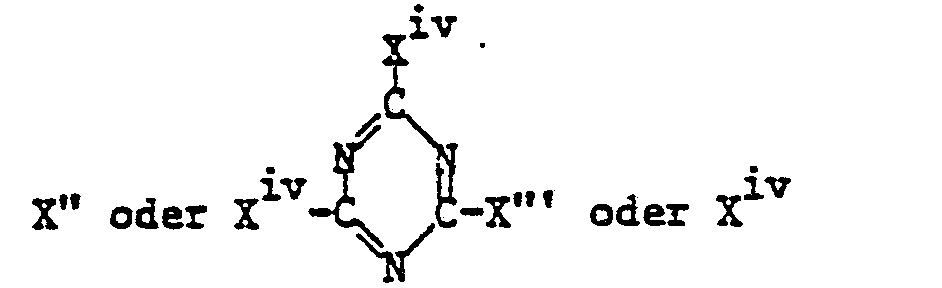
- In den Formeln II und III haben X",. X"'. und R' die für die Formel I angegebene Bedeutung, Xiv steht für -S-Y-COOH, -0-Y-COOH oder -NH-Y-COOH, worin Y C1-C6-Alkylen bedeutet, und X für eine (R')3SnO-oder HO-Gruppe oder ein Halogenatom, insbesondere für Chlor. Falls X ein Halogenatom darstellt, muss die Reaktion in Gegenwart einer Base als Halogenwasserstoffakzeptor durchgeführt werden. Besonders bevorzugt sind solche Verbindungen der Formel II, welche die Reste X", X'" und Xiv aufweisen.
- Als geeignete Basen kommen insbesondere tertiäre Amine, wie Trialkylamine, Pyridine und Dialkylaniline, ferner Hydroxide, Oxide, Carbonate und Bicarbonate von Alkali- und Erdalkalimetallen sowie Alkalimetallalkoholate wie z.B. Kalium-tert.butylat und Natrium-methylat in Betracht.
- Die Verfahren werden zweckmässig bei einer Temperatur zwischen -10 bis 150°C, vorzugsweise zwischen. 20 bis 80°C, bei normalem oder leicht erhöhtem Druck (bis 5 bar) und vorzugsweise in Gegenwart eines gegenüber den Reaktionsteilnehmern inerten Lösungs- oder Verdünnungsmittels durchgeführt.
- Als Lösungs- oder Verdünnungsmittel eignen sich z.B. Aether und ätherartige Verbindungen wie Diäthyläther, Di-isopropyläther, Dioxan und Tetrahydrofuran; aromatische oder aliphatische Kohlenwasserstoffe wie Pentan, Hexan, Dekalin, Benzol, Toluol und Xylole; und Ketone wie Aceton, Methyläthylketon und Cyclohexanon.
- Die Ausgangsstoffe der Formel III sind bekannt und können nach bekannten Methoden hergestellt werden. Die Ausgangsstoffe der Formel II sind neu. Sie können nach bekannten Methoden hergestellt werden und bilden ebenfalls einen. Gegenstand der vorliegenden Erfindung.
- Die Verbindungen der Formel I eignen sich zur Bekämpfung von verschiedenartigen Schädlingen an Tieren und Pflanzen. So können sie zur Bekämpfung aller Entwicklungsstadien von Insekten, z.B. der Ordnung Lepidoptera, Coleoptera, Homoptera, Heteroptera, Diptera, Thysanoptera, Orthoptera, Anoplura, Siphonaptera, Mallophaga, Thysanura, Isoptera, Psocoptera und Hymenoptera eingesetzt werden. Ferner weisen sie auch eine gute fungizide Wirkung auf. Vor allem eignen sich Verbindungen der Formel I jedoch zur Bekämpfung von phytopathogenen und tierparasitären Milben und von Zecken der Ordnung Acarina.
- Die Verbindungen der Formel I werden in unveränderter Form oder vorzugsweise zusammen mit den in der Formulierungstechnik üblichen Hilfsmitteln eingesetzt und werden daher z.B. zu Emulsionskonzentraten, direkt versprühbaren oder verdünnbaren Lösungen, verdünnten Emulsionen, Spritzpulvern, löslichen Pulvern, Stäubemitteln, Granulaten, auch Verkapselungen in z.B. polymeren Stoffen in bekannter Weise verarbeitet. Die Anwendungsverfahren wie Versprühen, Vernebeln, Verstäuben, Verstreuen oder Giessen werden gleich wie die Art der Mittel den angestrebten Zielen und den gegebenen Verhältnissen entsprechend gewählt.
- Die Formulierungen, d.h. die den Wirkstoff der Formel I und gegebenenfalls einen festen oder flüssigen Zusatzstoff enthaltenden Mittel, Zubereitungen oder Zusammensetzungen werden in bekannter Weise hergestellt, z.B. durch inniges Vermischen und/oder Vermahlen der Wirkstoffe mit Streckmitteln, wie z.B. mit Lösungsmitteln, festen Trägerstoffen, und gegebenenfalls oberflächenaktiven Verbindungen (Tensiden).
- Als Lösungsmittel können in Frage kommen: Aromatische Kohlenwasserstoffe, bevorzugt die Fraktionen C bis C121 wie z.B. Xylolgemische oder substituierte Naphthaline, Phthalsäureester wie Dibutyl- oder Dioctylphthalat, aliphatische Kohlenwasserstoffe wie Cyclohexan oder Paraffine, Alkohole und Glykole sowie deren Aether und Ester, wie Aethanol, Aethylenglykol, Aethylenglykolmonomethyl- oder -äthyläther, Ketone wie Cyclohexanon, stark polare Lösungsmittel wie N-Methyl-2-pyrrolidon, Dimethylsulfoxid oder Dimethylformamid, sowie gegebenenfalls epoxydierte Pflanzenöle wie epoxydiertes Kokosnussöl oder Sojaöl; oder Wasser.
- Als feste Trägerstoffe, z.B. für Stäubemittel und dispergierbare Pulver, werden in der Regel natürliche Gesteinsmehle verwendet, wie Calcit, Talkum, Kaolin, Montmorillonit oder Attapulgit. Zur Verbesserung der physikalischen Eigenschaften können auch hochdisperse Kieselsäure oder hochdisperse saugfähige Polymerisate zugesetzt werden. Als gekörnte, adsorptive Granulatträger kommen poröse Typen, wie z.B. Bimsstein, Ziegelbruch, Sepiolit oder Bentonit, als nicht sorptive Trägermaterialien z.B. Calcit oder Sand in Frage. Darüberhinaus kann eine Vielzahl von vorgranulierten Materialien anorganischer oder organischer Natur wie insbesondere Dolomit oder zerkleinerte Pflanzenrückstände verwendet werden.
- Als oberflächenaktive Verbindungen kommen je nach der Art des zu formulierenden Wirkstoffes der Formel I nichtionogene, kation- und/ oder anionaktive Tenside mit guten Emulgier-, Dispergier- und Netzeigenschaften in Betracht. Unter Tensiden sind auch Tensidgemische zu verstehen.
- Geeignete anionische Tenside können sowohl sog. wasserlösliche Seifen wie wasserlösliche synthetische oberflächenaktive Verbindungen sein.
- Als Seifen eignen sich die Alkali-, Erdalkali- oder gegebenenfalls substituierten Ammoniumsalze von höheren Fettsäuren (C10-C22), wie z.B..die Na- oder K-Salze der Oel- oder Stearinsäure, oder von natürlichen Fettsäuregemischen, die z.B. aus Kokosnuss- oder Talgöl gewonnen werden können. Ferner sind auch die Fettsäure-methyl-taurinsalze zu erwähnen.
- Häufiger werden jedoch sog. synthetische Tenside verwendet, insbesondere Fettsulfonate, Fettsulfate, sulfonierte Benzimidazolderivate oder Alkylarylsulfonate.
- Die Fettsulfonate oder -sulfate liegen in der Regel als Alkali-, Erdalkali- oder gegebenenfalls substituierte Ammoniumsalze vor und weisen einen Alkylrest mit 8 bis 22 C-Atomen auf, wobei Alkyl auch den Alkylteil von Acylresten einschliesst, z.B. das Na- oder Ca-Salz der Ligninsulfonsäure, des Dodecylschwefelsäureesters oder eines aus natürlichen Fettsäuren hergestellten Fettalkoholsulfatgemisches. Hierher gehören auch die Salze der Schwefelsäureester und Sulfonsäuren von Fettalkohol-Aethylenoxyd-Addukten. Die sulfonierten Benzimidazolderivate enthalten vorzugsweise 2 Sulfonsäuregruppen und einen Fettsäurerest mit 8-22 C-Atomen. Alkylarylsulfonate sind z.B. die Na-, Ca-oder Triäthanolaminsalze der Dodecylbenzolsulfonsäure, der Dibutylnaphthalinsulfonsäure, oder eines Naphthalinsulfonsäure-Formaldehydkonzentrationsproduktes.
- Ferner kommen auch entsprechende Phosphate wie z.B. Salze des Phosphorsäureesters eines p-Nonylphenol-(4-14)-Aethylenoxyd-Adduktes in Frage.
- Als nichtionische Tenside kommen in erster Linie Polyglykolätherderivate von aliphatischen oder cycloaliphatischen.Alkoholen, gesättigten oder ungesättigten Fettsäuren und Alkylphenolen in Frage, die 3 bis 30 Glykoläthergruppen und 8 bis 20 Kohlenstoffatome im (aliphatischen) Kohlenwasserstoffrest und 6 bis 18 Kohlenstoffatome im Alkylrest der Alkylphenole enthalten können.
- Weitere geeignete nichtionische Tenside sind die wasserlöslichen, 20 bis 250 Aethylenglykoläthergruppen und 10 bis 100 Propylenglykoläthergruppen enthaltenden Polyäthylenoxidaddukte an Polypropylenglykol, Aethylendiaminopolypropylenglykol und Alkylpolypropylenglykol mit 1 bis 10 Kohlenstoffatomen in der Alkylkette. Die genannten Verbindungen enthalten üblicherweise pro Propylenglykol-Einheit 1 bis 5 Aethylenglykoleinheiten.
- Als Beispiele nichtionischer Tenside seien Nonylphenolpolyäthoxy- äthanole, Ricinusölpolyglycoläther, Polypropylen-Polyäthylenoxydaddukte, Tributylphenoxypolyäthoxyäthanol, Polyäthylenglykol und Octylphenoxypolyäthoxyäthanol erwähnt.
- Ferner kommen auch Fettsäureester von Polyoxyäthylensorbitan wie das Polyoxyäthylensorbitan-trioleat in Betracht.
- Bei den kationischen Tensiden handelt es sich vor allem um quartäre Ammoniumsalze, welche als N-Substituenten mindestens einen Alkylrest mit 8 bis 22 C-Atomen enthalten und als weitere Substituenten niedrige, gegebenenfalls halogenierte Alkyl-, Benzyl- oder niedrige Hydroxyalkylreste aufweisen. Die Salze liegen vorzugsweise als Halogenide, Methylsulfate oder Aethylsulfate vor, z.B. das Stearyltrimethylamnoniumchlorid oder das Benzyldi(2-chloräthyl)-äthylammoniumbromid.
- Die in der Formulierungstechnik gebräuchlichen Tenside sind u.a. in folgender Publikation beschrieben:
- "Mc Cutcheon's Detergents and Emulsifiers Annual" MC Publishing Corp., Ringwood, New Jersey, 1980.
- Die pestiziden Zubereitungen enthalten in der Regel 0,1 bis 99%, insbesondere 0,1 bis 95%, Wirkstoff der Formel I, 1 bis 99,9% eines festen oder flüssigen Zusatzstoffes und 0 bis 25%, insbesondere 0,1 bis 25%, eines Tensides.
- Während als Handelsware eher konzentrierte Mittel bevorzugt werden, verwendet der Endverbraucher in der Regel verdünnte Mittel.
- Die Mittel können auch weitere Zusätze wie Stabilisatoren, Entschäumer, Viskositätsregulatoren, Bindemittel, Haftmittel sowie Dünger oder andere Wirkstoffe zur Erzielung spezieller Effekte enthalten.
- Formulierungsbeispiele für flüssige Wirkstoffe der Formel I (% = Gewichtsprozent)
-


- Die Lösungen sind zur Anwendung in Form kleinster Tropfen geeignet.

- Der Wirkstoff wird in Methylenchlorid gelöst, auf den Träger aufgesprüht und das Lösungsmittel anschliessend im Vakuum abgedampft.

- Durch inniges Vermischen der Trägerstoffe mit dem Wirkstoff erhält man gebrauchsfertige Stäubemittel.
-
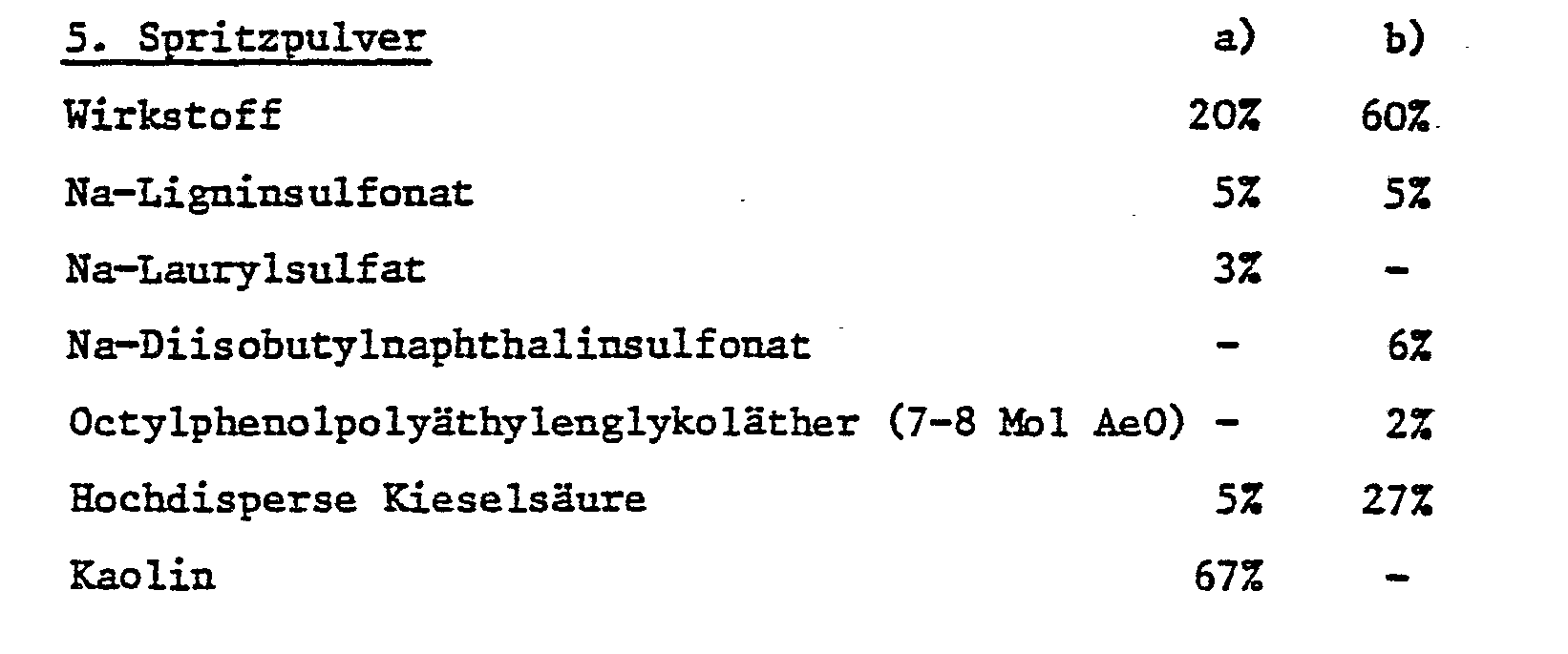

- Aus diesem Konzentrat können durch Verdünnen mit Wasser Emulsionen jeder gewünschten Konzentration hergestellt werden.

- Man erhält anwendungsfertige Stäubemittel, indem der Wirkstoff mit dem Träger vermischt und auf einer geeigneten Mühle vermahlen wird.

- Der Wirkstoff wird mit den Zusatzstoffen vermischt, vermahlen und mit Wasser angefeuchtet. Dieses Gemisch wird extrudiert und anschliessend im Luftstrom getrocknet.

- Der fein gemahlene Wirkstoff wird in einem Mischer auf das mit Polyäthylenglykol angefeuchtete Kaolin gleichmässig aufgetragen. Auf diese Weise erhält man staubfreie Umhüllungs-Granulate.


- Der fein gemahlene Wirkstoff wird mit den Zusatzstoffen innig vermischt. Man erhält so ein Suspensions-Konzentrat, aus welchem durch Verdünnen mit Wasser Suspensionen jeder gewünschten Konzentration hergestellt werden können.
-

-


- Auf analoge Weise werden auch folgende Verbindungen hergestellt :


-
- a) Herstellung des Ausgangsproduktes der Formel

- b) Herstellung des Ausgangsproduktes der Formel

- c) Herstellung der Endprodukte 0,3 g der Verbindung der Formel


- Auf analoge Weise, aber mit dem unter b) hergestellten Zwischenprodukt erhält man auch die Verbindung der Formel

- Die Primärblätter von Phaseolus vulgaris Pflanzen wurden 16 Stunden vor Versuchsbeginn mit infestierten Blattstücken aus Massenzuchten von Tetranychus urtica (OP-sensibel) und Tetranychus cinnabarinus (OP-resistent) belegt. Dabei wurde für jede Spezies (und Konzentration) eine Pflanze eingesetzt. Nach Entfernung der Blattstücke befanden sich auf den Pflanzen sowohl Eier wie Larven und Adulte der Testmilben. Die Behandlung mit dem Wirkstoff erfolgte durch Direktspray bis zur Tropfnässe in einer Verdünnungsreihe, die aus einem 25%igen Emulsionskonzentrat hergestellt wurde und Konzentrationen von 50, 100, 200 und 400 ppm Wirkstoff aufwies. Die so behandelten Pflanzen wurden während der ganzen Versuchsdauer in Gewächshauskabinen bei 25°C gehalten. Die Auswertung wurde 2 und 7 Tage nach erfolgter Wirkstoffapplikation vorgenommen, wobei die Mortalität von Eiern (7 Tage), Larven und Adulten (2 und 7 Tage) festgestellt und in Prozenten angegeben wird.

Claims (13)



Priority Applications (1)
| Application Number | Priority Date | Filing Date | Title |
|---|---|---|---|
| AT81810367T ATE6936T1 (de) | 1980-09-12 | 1981-09-07 | Triorganozinngruppen enthaltende triazinverbindungen. |
Applications Claiming Priority (2)
| Application Number | Priority Date | Filing Date | Title |
|---|---|---|---|
| CH688280 | 1980-09-12 | ||
| CH6882/80 | 1980-09-12 |
Publications (3)
| Publication Number | Publication Date |
|---|---|
| EP0049682A2 true EP0049682A2 (de) | 1982-04-14 |
| EP0049682A3 EP0049682A3 (en) | 1982-06-30 |
| EP0049682B1 EP0049682B1 (de) | 1984-04-04 |
Family
ID=4316544
Family Applications (1)
| Application Number | Title | Priority Date | Filing Date |
|---|---|---|---|
| EP81810367A Expired EP0049682B1 (de) | 1980-09-12 | 1981-09-07 | Triorganozinngruppen enthaltende Triazinverbindungen |
Country Status (9)
| Country | Link |
|---|---|
| US (1) | US4390538A (de) |
| EP (1) | EP0049682B1 (de) |
| JP (1) | JPS5781495A (de) |
| AT (1) | ATE6936T1 (de) |
| CA (1) | CA1160224A (de) |
| DE (1) | DE3162979D1 (de) |
| ES (1) | ES505399A0 (de) |
| IL (1) | IL63788A0 (de) |
| ZA (1) | ZA816314B (de) |
Cited By (1)
| Publication number | Priority date | Publication date | Assignee | Title |
|---|---|---|---|---|
| US4472396A (en) * | 1981-10-13 | 1984-09-18 | Ciba-Geigy Corporation | Triorganotin-isocyanuric compounds and the use thereof for combating pests |
Families Citing this family (1)
| Publication number | Priority date | Publication date | Assignee | Title |
|---|---|---|---|---|
| US6756431B2 (en) | 2002-04-09 | 2004-06-29 | Crompton Corporation | Heterocyclic tin flame retardants/smoke suppressants and halogen-containing polymer composition containing same |
Family Cites Families (9)
| Publication number | Priority date | Publication date | Assignee | Title |
|---|---|---|---|---|
| BE555210A (de) * | 1956-02-23 | |||
| US3056760A (en) * | 1958-09-30 | 1962-10-02 | Dal Mon Research Co | Homopolymers and copolymers of triazinyl vinyl monomers |
| US3050496A (en) * | 1958-09-30 | 1962-08-21 | Dal Mon Research Co | Polymers of triazinyl vinyl monomers |
| US3047532A (en) * | 1958-09-30 | 1962-07-31 | Dal Mon Research Co | Triazinyl vinyl monomer and polymer and copolymers thereof |
| US3053796A (en) * | 1958-09-30 | 1962-09-11 | Dal Mon Research Co | Polymerization products of unsaturated triazine derivatives |
| CH417216A (de) * | 1964-07-10 | 1967-01-31 | Agripat Sa | Verfahren zum Schützen von Textilmaterial vor dem Befall durch schädliche Mikroorganismen und Insekten |
| NL6907245A (en) * | 1969-05-12 | 1970-11-16 | Organometallic triazine fungicides | |
| DE2054483A1 (en) * | 1970-11-05 | 1972-05-10 | Lak-En Verffabrieken Brink N.V., Groot-Ammers (Niederlande) | Protection of organic materials against harm - ful organisms using organotin tria zines |
| US4316853A (en) * | 1978-12-21 | 1982-02-23 | M&T Chemicals Inc. | Insecticidal tetraorganotin compounds |
-
1981
- 1981-08-31 US US06/297,884 patent/US4390538A/en not_active Expired - Fee Related
- 1981-09-07 EP EP81810367A patent/EP0049682B1/de not_active Expired
- 1981-09-07 DE DE8181810367T patent/DE3162979D1/de not_active Expired
- 1981-09-07 AT AT81810367T patent/ATE6936T1/de not_active IP Right Cessation
- 1981-09-10 CA CA000385565A patent/CA1160224A/en not_active Expired
- 1981-09-10 IL IL63788A patent/IL63788A0/xx unknown
- 1981-09-11 ZA ZA816314A patent/ZA816314B/xx unknown
- 1981-09-11 ES ES505399A patent/ES505399A0/es active Granted
- 1981-09-12 JP JP56144553A patent/JPS5781495A/ja active Pending
Cited By (1)
| Publication number | Priority date | Publication date | Assignee | Title |
|---|---|---|---|---|
| US4472396A (en) * | 1981-10-13 | 1984-09-18 | Ciba-Geigy Corporation | Triorganotin-isocyanuric compounds and the use thereof for combating pests |
Also Published As
| Publication number | Publication date |
|---|---|
| ATE6936T1 (de) | 1984-04-15 |
| US4390538A (en) | 1983-06-28 |
| ES8205811A1 (es) | 1982-07-01 |
| CA1160224A (en) | 1984-01-10 |
| EP0049682B1 (de) | 1984-04-04 |
| ZA816314B (en) | 1982-09-29 |
| JPS5781495A (en) | 1982-05-21 |
| ES505399A0 (es) | 1982-07-01 |
| EP0049682A3 (en) | 1982-06-30 |
| IL63788A0 (en) | 1981-12-31 |
| DE3162979D1 (en) | 1984-05-10 |
Similar Documents
| Publication | Publication Date | Title |
|---|---|---|
| EP0129513A2 (de) | Oxamidsäure-Derivate | |
| EP0125204A1 (de) | 3-Phenoxybenzyl-(2-phenyl-2,2-alkylen-äthyl)-äther und -thioäther, Verfahren zu ihrer Herstellung und ihre Verwendung in der Schädlingsbekämpfung | |
| EP0097126B1 (de) | 2-(3-Pyridyl)-1,3,4-oxadiazole, Verfahren zu ihrer Herstellung und ihre Verwendung in der Schädlingsbekämpfung | |
| EP0110829B1 (de) | Schädlingsbekämpfungsmittel | |
| EP0086748B1 (de) | 3-Amidino-benzisothiazol-1,1-dioxide, Verfahren zu ihrer Herstellung und ihre Verwendung in der Schädlingsbekämpfung | |
| EP0049682B1 (de) | Triorganozinngruppen enthaltende Triazinverbindungen | |
| EP0113317B1 (de) | Carbamate | |
| EP0149977B1 (de) | Neue N-Phosphoryl- oder N-Thiophosphoryl-N'-s-triazinyl-formamidine | |
| EP0077300B1 (de) | Triorganozinnhydantoin-Verbindungen, Verfahren zu ihrer Herstellung und ihre Verwendung in der Schädlingsbekämpfung | |
| EP0077296B1 (de) | Organozinnverbindungen | |
| EP0036839A2 (de) | 4-N,N-Dimethylcarbamoyloxy-5-methyl-pyrimidine, Verfahren zu ihrer Herstellung und ihre Verwendung in der Schädlingsbekämpfung, sowie die als Zwischenprodukte verwendeten 4-Hydroxy-5-methyl-pyrimidine | |
| EP0062003B1 (de) | Neue carboxylierte Oximcarbamate, Verfahren zu ihrer Herstellung, und ihre Verwendung in der Schädlingsbekämpfung | |
| EP0049684B1 (de) | N-(Benzamidosulfenyl)-N-methyl-carbamate, Zwischenprodukte, Herstellung und Verwendung in der Schädlingsbekämpfung | |
| EP0039308B1 (de) | Cyclobutanonoximcarbamate, Verfahren zu ihrer Herstellung und ihre Verwendung in der Schädlingsbekämpfung sowie die als Zwischenprodukte dienenden Cyclobutanonoxime | |
| EP0077301B1 (de) | Triorganozinn-isocyanurverbindungen, ein Verfahren zu ihrer Herstellung und ihre Verwendung in der Schädlingsbekämpfung | |
| EP0054517B1 (de) | Phenyl-N-(cyanoalkylsulfenyl)-N-methylcarbamate, Verfahren zu ihrer Herstellung und ihre Verwendung in der Schädlingsbekämpfung | |
| EP0094909B1 (de) | N-Alkyliden-imino-oxicarbonyl-N-methyl-(2,2-dimethyl-2,3-di-hydrobenzofuranyl(7))-carbamate, Verfahren zu ihrer Herstellung und ihre Verwendung in der Schädlingsbekämpfung | |
| EP0051565A1 (de) | 1-N,N-Dimethylcarbamoyl-3(5)-cyclopropyl-1,2,4-triazole, Verfahren zu ihrer Herstellung und ihre Verwendung in der Schädlingsbekämpfung | |
| EP0053096A1 (de) | Unsymmetrische Bis-Carbamate, Verfahren zu ihrer Herstellung und ihre Verwendung in der Schädlingsbekämpfung | |
| EP0041920A2 (de) | Neue Organophosphate | |
| EP0200686A2 (de) | Oximderivate | |
| DE3146528A1 (de) | "formamidocarbamate, verfahren zu ihrer herstellung und ihre verwendung in der schaedlingsbekaempfung" | |
| EP0048696A2 (de) | Zinnverbindungen | |
| EP0062612A1 (de) | Neue Thiazolinderivate | |
| EP0056217A1 (de) | 2-Methyl-4-N,N-dimethylcarbamoyloxy-6-amino-pyrimidine und deren Salze, Verfahren zu ihrer Herstellung und ihre Verwendung in der Schädlingsbekämpfung |
Legal Events
| Date | Code | Title | Description |
|---|---|---|---|
| PUAI | Public reference made under article 153(3) epc to a published international application that has entered the european phase |
Free format text: ORIGINAL CODE: 0009012 |
|
| 17P | Request for examination filed |
Effective date: 19810909 |
|
| AK | Designated contracting states |
Designated state(s): AT BE CH DE FR GB IT NL |
|
| PUAL | Search report despatched |
Free format text: ORIGINAL CODE: 0009013 |
|
| AK | Designated contracting states |
Designated state(s): AT BE CH DE FR GB IT NL |
|
| ITF | It: translation for a ep patent filed | ||
| GRAA | (expected) grant |
Free format text: ORIGINAL CODE: 0009210 |
|
| AK | Designated contracting states |
Designated state(s): AT BE CH DE FR GB IT LI NL |
|
| REF | Corresponds to: |
Ref document number: 6936 Country of ref document: AT Date of ref document: 19840415 Kind code of ref document: T |
|
| REF | Corresponds to: |
Ref document number: 3162979 Country of ref document: DE Date of ref document: 19840510 |
|
| ET | Fr: translation filed | ||
| PGFP | Annual fee paid to national office [announced via postgrant information from national office to epo] |
Ref country code: DE Payment date: 19840806 Year of fee payment: 4 |
|
| PGFP | Annual fee paid to national office [announced via postgrant information from national office to epo] |
Ref country code: AT Payment date: 19840821 Year of fee payment: 4 |
|
| PGFP | Annual fee paid to national office [announced via postgrant information from national office to epo] |
Ref country code: FR Payment date: 19840828 Year of fee payment: 4 |
|
| PGFP | Annual fee paid to national office [announced via postgrant information from national office to epo] |
Ref country code: NL Payment date: 19840930 Year of fee payment: 4 Ref country code: BE Payment date: 19840930 Year of fee payment: 4 |
|
| PGFP | Annual fee paid to national office [announced via postgrant information from national office to epo] |
Ref country code: CH Payment date: 19841011 Year of fee payment: 4 |
|
| PLBE | No opposition filed within time limit |
Free format text: ORIGINAL CODE: 0009261 |
|
| STAA | Information on the status of an ep patent application or granted ep patent |
Free format text: STATUS: NO OPPOSITION FILED WITHIN TIME LIMIT |
|
| 26N | No opposition filed | ||
| PG25 | Lapsed in a contracting state [announced via postgrant information from national office to epo] |
Ref country code: AT Effective date: 19850907 |
|
| PG25 | Lapsed in a contracting state [announced via postgrant information from national office to epo] |
Ref country code: LI Effective date: 19850930 Ref country code: CH Effective date: 19850930 Ref country code: BE Effective date: 19850930 |
|
| BERE | Be: lapsed |
Owner name: CIBA-GEIGY A.G. Effective date: 19850907 |
|
| PG25 | Lapsed in a contracting state [announced via postgrant information from national office to epo] |
Ref country code: NL Effective date: 19860401 |
|
| GBPC | Gb: european patent ceased through non-payment of renewal fee | ||
| NLV4 | Nl: lapsed or anulled due to non-payment of the annual fee | ||
| PG25 | Lapsed in a contracting state [announced via postgrant information from national office to epo] |
Ref country code: FR Free format text: LAPSE BECAUSE OF NON-PAYMENT OF DUE FEES Effective date: 19860530 |
|
| REG | Reference to a national code |
Ref country code: CH Ref legal event code: PL |
|
| PG25 | Lapsed in a contracting state [announced via postgrant information from national office to epo] |
Ref country code: DE Effective date: 19860603 |
|
| REG | Reference to a national code |
Ref country code: FR Ref legal event code: ST |
|
| PG25 | Lapsed in a contracting state [announced via postgrant information from national office to epo] |
Ref country code: GB Effective date: 19881118 |
|
| ITCP | It: supplementary protection certificate |
Spc suppl protection certif: CCP 188 |