EP0049687A2 - Modified amine hardener system for epoxy resins, and its use - Google Patents
Modified amine hardener system for epoxy resins, and its use Download PDFInfo
- Publication number
- EP0049687A2 EP0049687A2 EP81810396A EP81810396A EP0049687A2 EP 0049687 A2 EP0049687 A2 EP 0049687A2 EP 81810396 A EP81810396 A EP 81810396A EP 81810396 A EP81810396 A EP 81810396A EP 0049687 A2 EP0049687 A2 EP 0049687A2
- Authority
- EP
- European Patent Office
- Prior art keywords
- hardener
- systems
- epoxy resins
- curable mixture
- diglycidyl ether
- Prior art date
- Legal status (The legal status is an assumption and is not a legal conclusion. Google has not performed a legal analysis and makes no representation as to the accuracy of the status listed.)
- Granted
Links
Classifications
-
- C—CHEMISTRY; METALLURGY
- C08—ORGANIC MACROMOLECULAR COMPOUNDS; THEIR PREPARATION OR CHEMICAL WORKING-UP; COMPOSITIONS BASED THEREON
- C08G—MACROMOLECULAR COMPOUNDS OBTAINED OTHERWISE THAN BY REACTIONS ONLY INVOLVING UNSATURATED CARBON-TO-CARBON BONDS
- C08G59/00—Polycondensates containing more than one epoxy group per molecule; Macromolecules obtained by polymerising compounds containing more than one epoxy group per molecule using curing agents or catalysts which react with the epoxy groups
- C08G59/18—Macromolecules obtained by polymerising compounds containing more than one epoxy group per molecule using curing agents or catalysts which react with the epoxy groups ; e.g. general methods of curing
- C08G59/182—Macromolecules obtained by polymerising compounds containing more than one epoxy group per molecule using curing agents or catalysts which react with the epoxy groups ; e.g. general methods of curing using pre-adducts of epoxy compounds with curing agents
- C08G59/184—Macromolecules obtained by polymerising compounds containing more than one epoxy group per molecule using curing agents or catalysts which react with the epoxy groups ; e.g. general methods of curing using pre-adducts of epoxy compounds with curing agents with amines
Definitions
- Addition products of amines and mono- and diepoxides have long been used industrially as hardeners for epoxy resins.
- the advantages of forming such add-on products include lower volatility, less risk of irritation, a reduced tendency to tarnish and exude, and the like.
- Such addition products are discussed in "Handbook of Epoxy Resins" by H. Lee and K. Neville, McGraw Hill (1967).
- the main subject of this invention is a modified curing system for epoxy resins which improves the performance of diaminophenyl sulfone curing agents.
- Another object is the use of such hardener systems with very different epoxy resins in order to provide prepreg and laminating resins with improved performance characteristics.
- reaction of the diaminodiphenyl sulfone with a diglycidyl ether of a polyhydric phenol can dramatically improve the processing characteristics of the curing system and the performance characteristics of the epoxy resin cured with it, without significantly reducing the other desired properties, compromise.
- the latter parameters are particularly evident when using the modified hardener together with tetraglycidylated methylenedianiline.
- the improved compatibility with the resin and the increased melt viscosity remarkably lead to controllable flow properties.
- the systems obtained can be laminated or used in honeycomb skins and show improved impact resistance, toughness, strength and water resistance.
- the modified hardener system is suitable for use in primary composite structures, an area of application in which the existing systems did not have a satisfactory performance.
- the modified hardener system can also be used with a wide variety of difunctional and multifunctional epoxy resins for use in a wide range of applications such as coatings, crushing castings, adhesives and fiber packages.
- the modified hardener system is produced by carrying out an addition reaction of the epoxy resin with the diaminodiphenyl sulfone compound.
- the diaminodiphenyl sulfones to be used correspond to the formula wherein R 1 , R 2 , R 3 and R 4 independently of one another represent hydrogen, straight-chain or branched alkyl having 1 to 12 carbon atoms, preferably 1 to 4 carbon atoms, or halogen.
- Commercial sulfones include 2,4'-, 3,3'- and 4,4'-diaminodiphenyl sulfone. Such.
- Diaminodiphenyl sulfones are preferred for the purposes of the invention.
- the epoxy resins to be used are diglycidyl ethers of polyhydric phenols.
- Such substances include bisphenol diglycidyl ether of the formula where m is 0-50 and X is -CH 2 -, stands.
- ethers which can be used include the diglycidyl ethers of resorcinol, pyrocatechol, hydroquinones and the like.
- the various ethers on the respective phenyl rings can be substituted by non-reactive substituents such as alkyl, halogen and the like.
- the general procedure for the preparation of the modified hardener consists in preparing a solution of the diglycidyl ether in a suitable solvent, mixing in the sulfone and heating the resulting mixture at a temperature of about 130-180 ° C. until the reaction has ended. This generally takes 2-6 hours and can be followed by analytical procedures, with the disappearance of the epoxy function indicating completeness.
- the solvent is generally removed by evaporation during further processing.
- Usable solvents include ketones, aromatic hydrocarbons such as toluene, and the like. Depending on the type of component mixture, the solvent can be omitted in some cases.
- concentrations of the sulfone are chosen so that a modified hardener system with about 2.5 to 100 equivalents of amino hydrogen per epoxide equivalent is obtained. 'These values are selected so that gelation at lower than the specified values and poorer physical properties at higher ones are avoided.
- the modified hardener system can be processed with very different epoxy resins.
- resins such as epoxy resins based on polyhydric phenols such as bisphenol A, F and S, epoxidation products of cresol novolaks and phenol novolaks, hydantoine epoxy resins, polyglycidyl esters, glycidylated aromatic amines, glycidylated aminophenols and certain cycloaliphatic epoxy resins.
- tetraglycidylated methylene dianiline is preferred.
- the resin based on bisphenol A diglycidyl ether is widely used for use in adhesives, coatings and fiber windings.
- the modified hardener is used in stoichiometric amounts ⁇ 50% based on the epoxy resin, with 85% of the stoichiometric amount being preferred.
- the technique for making prepregs is well known to those skilled in the art.
- hides reinforced with graphite, glass or Kevlar, as well as others, can easily be produced from the present system.
- the technique for making laminates is accordingly well known.
- Such laminates can be produced by pressing or molding in an autoclave and can cover a wide range of thicknesses.
- the addition products according to the invention are also useful as hardeners for very different epoxy resins in different hot curing applications.
- hardening means the conversion of the above adducts and epoxy substances into insoluble and infusible crosslinked products with simultaneous deformation into shaped bodies such as castings Compacts or laminates or to form structures such as coatings, paint colors or adhesive bonds. Because of the improved compatibility with resins and the increased toughness of the resulting hardened coatings, the modified hardener system is particularly advantageous in the production of coatings.
- addition products prepared according to the invention and mixed with other polyepoxide compounds can also be mixed at any stage prior to curing with conventional modifiers such as extenders, fillers and reinforcing agents, pigments, dyes, organic solvents, plasticizers, agents for improving dry tack, rubbers, accelerators, connecting agents and the like .
- conventional modifiers such as extenders, fillers and reinforcing agents, pigments, dyes, organic solvents, plasticizers, agents for improving dry tack, rubbers, accelerators, connecting agents and the like .
- extenders reinforcing agents, fillers and pigments which can be used in the curable mixtures according to the invention: coal tar, bitumen, glass fibers, boron fibers, carbon fibers, cellulose, polyethylene powder, polypropylene powder, mica, asbestos, quartz powder, gypsum, antimony trioxide, bentonite, silica gel ("Aerosil”), lithopone, barite, titanium dioxide, carbon black, graphite, iron oxide or metal powder such as aluminum or iron powder.
- customary additives for example flame retardants, thixotropic agents, leveling agents such as silicones, cellulose acetate butyrate, polyvinyl butyrate, waxes, stearates and the like (which in some cases also serve as mold release agents) can also be added to the curable mixtures.
- flame retardants for example flame retardants, thixotropic agents, leveling agents such as silicones, cellulose acetate butyrate, polyvinyl butyrate, waxes, stearates and the like (which in some cases also serve as mold release agents)
- leveling agents such as silicones, cellulose acetate butyrate, polyvinyl butyrate, waxes, stearates and the like (which in some cases also serve as mold release agents) can also be added to the curable mixtures.
- rubbers such as acrylonitrile / butadiene rubber with carbonyl end groups
- modifying resins such as triglycidyl-p-aminophenol
- accelerators such as boron trifluoride-monoethylamine or imidazole complexes
- further additional hardeners such as dicyandiamide
- the curable mixtures can be prepared in the usual way using known mixing apparatus (stirrers, kneaders, whale zen and the like).
- Example 1 The following example explains the production of typical hardeners modified according to the invention.
- the diglycidyl ether is placed in a vessel and heated to 100 ° C. Then add bisphenol A and NaOH, keeping the temperature at 100 ° C.
- the diglycidyl ether is placed in a vessel and heated to 115 ° C. Then add bisphenol A and NaOH, keeping the temperature at 100 ° C. The pressure is reduced to about 133 mbar and the temperature is raised to 190 ° C. and held at 190 ° C.-200 ° C. for three hours until the epoxy value reaches 0.050 equivalents per 100 grams. It is then switched to reflux at atmospheric pressure, the ketones are added to dissolve the resin and the system is cooled. Then add the diaminodiphenyl sulfone. For the distillation, the slurry is heated to 180 ° C-185 ° C and the pressure is again reduced to 100 Torr. The system is kept at 180 ° C-185 ° C for three hours after which the molten product is discharged.
- Example 3 The following examples relate to the performance characteristics of the modified hardeners from Examples 1 and 2 and to the processed epoxy resin. Tetraglycidylated methylene dianiline (epoxy resin B) is used in each case. An unmodified 4,4'-diaminodiphenyl sulfone ether is used as a control if checked. In all combinations, the amino hydrogen is 85% of the stoichiometric amount based on epoxy equivalent.
- Tetraglycidylated methylene dianiline epoxy resin B
- An unmodified 4,4'-diaminodiphenyl sulfone ether is used as a control if checked. In all combinations, the amino hydrogen is 85% of the stoichiometric amount based on epoxy equivalent.
- the average molecular weight of the modified hardeners increases from No. 1 to No. 4, as can be seen from the solution viscosities, and that all modified hardener designs have improved solubility in the melted epoxy resin B, while the pure hardener less is tolerated.
- the melt viscosities for the five systems are determined by adding a known amount of epoxy resin to an aluminum pan and heating to 150 ° C. Then add the required amount of hardener and mix thoroughly for 142 seconds. The shell is removed from the heat source and allowed to cool to room temperature.
- Controlled flow can be defined as a higher minimum melt flow viscosity during an unchangeable processing cycle. This property is for prepreg systems with little or no spout for use as honeycomb skins advantageous.
- the modified systems show different amounts of increases in melt viscosity or "controlled course” depending on the molecular weight distribution of the hardener. The data above demonstrate this effect with a more than 100-fold increase in melt flow viscosity in system # 4 over the standard system.
- Pure resin castings are made by carefully heating epoxy resin B to 135 ° C and slowly stirring in the powdered hardener until a clear mixture is obtained.
- the epoxy and hardener together are degassed for 20 minutes at 135 ° C in vacuum at 762 torr to remove any air or dissolved gases. Then the material is poured into a plate mold and hardened.
- the curing schedule and epoxy / curing agent proportions for the systems tested are given below.
- the bending and strength data of the cured pure resin for the five systems are obtained at room temperature and 150 ° C according to ASTM test methods D-790 and D-638.
- the compressive strength properties at room temperature are determined in accordance with ASTM D-695.
- thermomechanical analysis TMA is carried out in a puncture test with a heating rate of 10 ° C / min. and 5 gram load performed
- the data for the physical properties of the investigated pure resin systems illustrate the significant improvements in room temperature bending and tensile strengths obtained for the modified systems with a certain decrease in the thermal applicability observed by HDT.
- Systems # 3 and # 4 have the best tensile properties at room temperature, while the tensile properties of systems # 1 and # 2 are superior at elevated temperatures.
- the bend data shows that all modified systems are stronger than the control at room temperature, with systems # 1 and # 2 having the best strengths at elevated temperatures among the modified forms.
- the compressive strengths and moduli for systems # 1 through # 4 are comparable to the control, while the crushing stress shows a decrease, probably due to a reduction in the crosslink density.
- systems # 3 and # 4 show the best static mechanical properties at room temperature, while systems # 1 and # 2 have the best properties at elevated temperature.
- Impact tests at room temperature are carried out on the pure resin systems using two methods.
- the first is a non-notched Charpy sample to determine the energy required to initiate and propagate the fracture. This test is carried out according to ASTM D-256, except that no notch is made on the sample.
- the second method consists of a modified Gardner impact test, where a 25 x 25 x 3 mm, non-clamped sample is broken by a falling weight with a 6 mm nose radius. Impact resistance is measured as the force at which breakage occurs. These values are given below together with the tensile strains at room temperature and 150 ° C.
- the moisture tests on the pure resin systems are carried out at 80 ° C and 95% relative humidity.
- the moisture absorption is as follows:
- the modified systems show a significant improvement in resistance to moisture.
- a unidirectional graphite prepreg is made from graphite yarn Thornel-300 (quality WYP-30, finish UC-309, without twisting).
- the yarn is mixed with a 30-35% by weight solution of resin / hardener in MEK / acetone (50/50 led and wound on a drum winder, whereby a 3.65 m long and 45 cm wide tape with 8 cables / cm is obtained.
- the prepreg is left to air dry for one hour and then subjected to a heating step at 120 ° C. for three minutes. This gives a prepreg with acceptable adaptability and stickiness.
- the P räpreg is cut, put in layers, and cured by pressing. The impregnation solutions and the curing cycle are given below.
- Twenty-ply 0 ° panels are made from the systems described above. From these lamina short rod shear samples are obtained and tested according to ASTM D-2344 at room temperature, -59 ° C and 93 ° C. The 0 ° bending properties are obtained with 10-layer sheets, which are tested according to ASTM D-790 at room temperature, -59 ° C and 93 ° C. Fourteen-layer matrix tensile specimens oriented to + 45/90 / -45 / 90 and tested in the 0 ° direction according to ASTM D-3039 at room temperature and -59 ° C are used to measure the combined effects of shear stress and matrix strength. The data for short bar shear, bending and matrix tensile strength are given below.
- the matrix tensile tests are carried out on all five systems. This test measures the combined effects of the resin matrix and the shear properties on the composite. Such a measurement can be viewed as an indication of toughness, with increasing strength and elongation at break being related to an increase in toughness. These data show a real difference since all modified systems show improvements over control, but systems # 1 and # 3 appear to be the best.
- this invention provides novel, modified curing systems for epoxy resins that have excellent performance characteristics. Changes in the manufacture, the method of operation and the materials are possible without exceeding the scope of protection of the invention defined by the following claims.
Landscapes
- Chemical & Material Sciences (AREA)
- Health & Medical Sciences (AREA)
- Chemical Kinetics & Catalysis (AREA)
- Medicinal Chemistry (AREA)
- Polymers & Plastics (AREA)
- Organic Chemistry (AREA)
- Reinforced Plastic Materials (AREA)
- Epoxy Resins (AREA)
Abstract
Es wird ein harzartiges Härtersystem beschrieben das aus dem Reaktionsprodukt von Diaminodiphenylsulfonverbindungen mit Diglycidyläthern von mehrwertigen Phenolen besteht. Das Härtersystem kann in verschiedene Epoxidharze zur Verwendung als verbesserte Präpregs oder Laminierharze, als Pressharzgüsse und dergleichen eingearbeitet werden.A resinous hardener system is described which consists of the reaction product of diaminodiphenyl sulfone compounds with diglycidyl ethers of polyhydric phenols. The curing system can be incorporated into various epoxy resins for use as improved prepregs or laminating resins, as molding resins, and the like.
Description
Anlagerungsprodukte von Aminen und Mono- und Diepoxiden wurden seit langem als Härter für Epoxiharze technisch verwendet. Die Vorteile der Bildung solcher Anlagerungsprodukte sind unter anderem eine niedrigere Flüchtigkeit, geringeres Reizrisiko, eine verminderte Tendenz zum Anlaufen und Ausschwitzen, und dergleichen. Derartige Anlagerungsprodukte sind in "Handbook of Epoxy Resins" von H. Lee und K. Neville, McGraw Hill (1967) erörtert.Addition products of amines and mono- and diepoxides have long been used industrially as hardeners for epoxy resins. The advantages of forming such add-on products include lower volatility, less risk of irritation, a reduced tendency to tarnish and exude, and the like. Such addition products are discussed in "Handbook of Epoxy Resins" by H. Lee and K. Neville, McGraw Hill (1967).
Derartige Systeme wurden vielfach in der Luft- und Raumfahrtindustrie verwendet. Ein Hauptanwendungsgebiet liegt bei Epoxidharzen, die zur Vorimprägnierung verschiedener Fasern zum Endzweck als Wabe-nhäute eingesetzt werden. Diese unterschiedlichen Schichtstoffe werden im Luft- und Raumfahrtbau verwendet. Das zur Zeit gebräuchlichste Epoxidsystem zur Herstellung von Präpregs und zum Laminieren basiert auf tetraglycidyliertem Methylen- dianilin und einem Diaminodiphenylsulfonhärter. Diese Systeme besitzen zwar Vorteile, doch zeigen sie auch mehrere bedeutsame Nachteile. Diese ergeben sich primär aus der Unverträglichkeit des Härters mit dem Harz und der Schwerlöslichkeit im Epoxidharz. Spezielle Nachteile der Verarbeitung sind unter anderem:
- 1. Die Notwendigkeit höherer Temperaturen, um den Härter ohne Verwendung von Fremdlösungsmitteln in Lösung zu bringen;
- 2. die unerwünschte Vorverlängerung des Härters mit dem Epoxid, was üblicherweise einen Zusatz anderer Harze erfordert, um die Anpassungsfähigkeit und die Klebrigkeit zu verbessern, und dabei gewöhnlich die Schmelzviskosität herabsetzt;
- 3. das erforderliche Erhitzen, um gegebenenfalls verwendete Lösungsmittel zu entfernen, wodurch eine gewisse Vorverlängerung stattfindet; und
- 4. die Schwierigkeit, die gewünschte Fliessfähigkeit zu erzielen und zu beherrschen, wodurch Unterschiede im Präpreg innerhalb desselben Ansatzes entstehen.
- 1. The need for higher temperatures to dissolve the hardener without the use of external solvents;
- 2. the undesired pre-extension of the hardener with the epoxy, which usually requires the addition of other resins in order to be adaptable and tacky to improve, usually reducing melt viscosity;
- 3. the heating necessary to remove any solvents used, thereby causing some pre-extension; and
- 4. The difficulty in achieving and mastering the desired fluidity, which creates differences in the prepreg within the same approach.
Obwohl die erhaltenen Systeme funktionsfähig sind und erfolgreich laminiert werden können, zeigen sie doch auch eine Reihe von Nachteilen, einschliesslich:
- 1. Sie besitzen einen hohen Modul und sind spröde.
- 2. Sie sind in gewissem Masse feuchtigkeitsempfindlich.
- 3. Es ist schwierig, bei der Herstellung von Systemen mit niedrigem - oder keinem - Verlauf Reproduzierbarkeit zu erzielen.
- 4. Die Herstellung von Wabenkernverbundstoffen mit diesen Systemen ist schwierig, da sie schlechte Fliesseigenschaften aufweisen, die einen Verlauf des Harzes in den Kern zulassen und somit Hohlräume in den Häuten verursachen.
- 1. They have a high modulus and are brittle.
- 2. They are somewhat sensitive to moisture.
- 3. It is difficult to achieve reproducibility when manufacturing systems with low - or no - gradient.
- 4. The production of honeycomb core composites with these systems is difficult because they have poor flow properties which allow the resin to flow into the core and thus cause voids in the skins.
Der Hauptgegenstand dieser Erfindung ist ein modifiziertes Härtersystem für Epoxidharze, welches die Leistung von Diaminophenylsulfonhärtern verbessert.The main subject of this invention is a modified curing system for epoxy resins which improves the performance of diaminophenyl sulfone curing agents.
Ein weiterer Gegenstand ist die Verwendung solcher Härtersysteme mit sehr unterschiedlichen Epoxidharzen, um Präpreg- und Laminierharzen mit verbesserten Leistungskennwerten zu Verfügung zu stellen.Another object is the use of such hardener systems with very different epoxy resins in order to provide prepreg and laminating resins with improved performance characteristics.
Verschiedene weitere Gegenstände und Vorteile dieser Erfindung sind aus der nachfolgenden Beschreibung und den Ausführungsbeispielen ersichtlich.Various other objects and advantages of this invention are evident from the following description and the exemplary embodiments.
Es wurde nun überraschenderweise gefunden, dass man durch Umsetzung des Diaminodiphenylsulfons mit einem Diglycidyläther eines mehrwertigen Phenols die Verarbeitungskennwerte des Härtersystems und die Leistungskennwerte des damit gehärteten Epoxidharzes dramatisch verbessern kann, ohne dabei die übrigen erwünschten Eigenschaften erheblich zu be, einträchtigen. Die letzteren Kennwerte zeigen sich insbesondere bei Verwendung des modifizierten Härters zusammen mit tetraglycidyliertem Methylendianilin.It has now surprisingly been found that reaction of the diaminodiphenyl sulfone with a diglycidyl ether of a polyhydric phenol can dramatically improve the processing characteristics of the curing system and the performance characteristics of the epoxy resin cured with it, without significantly reducing the other desired properties, compromise. The latter parameters are particularly evident when using the modified hardener together with tetraglycidylated methylenedianiline.
Die verbesserte Verträglichkeit mit dem Harz und die erhöhte Schmelzviskosität führen bemerkenswerterweise zu kontrollierbaren Fliesseigenschaften. Die erhaltenen Systeme lassen sich laminieren oder in Wabenhäuten verwenden und zeigen verbesserte Schlagbiegefestigkeit, Zähigkeit, Festigkeit und Wasserbeständigkeit.The improved compatibility with the resin and the increased melt viscosity remarkably lead to controllable flow properties. The systems obtained can be laminated or used in honeycomb skins and show improved impact resistance, toughness, strength and water resistance.
Im einzelnen werden unter anderen folgende Verarbeitungsparameter verbessert:
- 1. Erhöhte Verträglichkeit des Härters mit dem Epoxidharz. Der Härter wird bei niedrigeren Temperaturen löslich, was die Chance einer unerwünschten Vorverlängerung verringert. Ebenfalls wird die Möglichkeit unvollständiger Auflösung oder Vermischung vermindert.
- 2. Die Schmelzviskosität des Systems lässt sich durch das Molekulargewicht des Härters beherrschen. Dadurch entfällt die Notwendigkeit schwer kontrollierbarer Vorverlängerungsstufen bei der Herstellung des Harzsystems.
- 3. Die Verwendung von Harzzusätzen, um gute Anpassungsfähigkeit und Klebrigkeit zu erzielen, ist nach wie vor möglich.
- 4. Da weniger Vorverlängerung nötig ist, lässt sich die Vorverlängerung des Harzes auf dem Präpreg leichter kontrollieren.
- 5. Der modifizierte Härter ermöglicht die reproduzierbare Herstellung von Präpregs mit keinem - oder niedrigem - Verlauf zur Verwendung mit oder ohne Waben.
- 1. Increased compatibility of the hardener with the epoxy resin. The hardener becomes soluble at lower temperatures, which reduces the chance of undesired pre-extension. The possibility of incomplete dissolution or mixing is also reduced.
- 2. The melt viscosity of the system can be controlled by the molecular weight of the hardener. This eliminates the need for difficult to control pre-extension stages in the manufacture of the resin system.
- 3. The use of resin additives to achieve good adaptability and stickiness is still possible.
- 4. Since less pre-extension is required, the pre-extension of the resin on the prepreg is easier to control.
- 5. The modified hardener enables the reproducible production of prepregs with no - or low - gradient for use with or without honeycomb.
Dazu kommt, dass die mit den vorliegenden Härtersystemen gehärteten Harze folgende verbesserte Eigenschaften aufweisen:
- 1. Solche Systeme lassen sich leicht laminieren.
- 2. Sie sind zäher und besitzen eine höhere Schlagbiegefestigkeit als herkömmlich gehärtete Systeme.
- 3. Sie zeigen erhöhte mechanische Festigkeit.
- 4. Sie weisen erhöhte Feuchtigkeitsbeständigkeit auf.
- 5. Sie besitzen eine höhere Schmelzflussviskosität.
- 6. Die vorliegenden Systeme sind ferner kautschuk-modifizierten Systemen bei weitem überlegen.
- 1. Such systems are easy to laminate.
- 2. They are tougher and have a higher impact resistance than conventionally hardened systems.
- 3. They show increased mechanical strength.
- 4. They have increased moisture resistance.
- 5. They have a higher melt flow viscosity.
- 6. The present systems are also far superior to rubber modified systems.
Gemäss diesen beschriebenen Kennwerten ist das modifizierte Härtersystem zur Verwendung in Primärverbundstrukturen geeignet, einem Anwendungsgebiet, auf welchem die bestehenden Systeme keine zufriedenstellende Leistungsfähigkeit besassen. Das modifizierte Härtersystem kann auch mit sehr verschiedenen difunktionellenundmultifunktionellen Epoxidharzen zur Verwendung in einem weiten Anwendungsgebiet wie Beschichtungen, Brechgüssen, Klebstoffen und Faserwickelkörpern verwendet werden.According to these characteristic values, the modified hardener system is suitable for use in primary composite structures, an area of application in which the existing systems did not have a satisfactory performance. The modified hardener system can also be used with a wide variety of difunctional and multifunctional epoxy resins for use in a wide range of applications such as coatings, crushing castings, adhesives and fiber packages.
Das modifizierte Härtersystem wird dadurch hergestellt, dass man eine Anlagerungsreaktion des Epoxidharzes mit der Diaminodiphenylsulfonverbindung durchführt.The modified hardener system is produced by carrying out an addition reaction of the epoxy resin with the diaminodiphenyl sulfone compound.
Die zu verwendenden Diaminodiphenylsulfone entsprechen der Formel

Die zu verwendenden Epoxidharze sind Diglycidyläther mehrwertige Phenole. Zu solchen Stoffen gehören Bisphenoldiglycidyläther der Formel


Dabei handelt es sich um Bisphenol F, A bzw. S. Weitere verwendbare Aether sind unter anderen die Diglycidyläther des Resorcins, Brenzkatechins, Hydrochinons und dergleichen. Die verschiedenen Aether können an den jeweiligen Phenylringen durch nicht-reaktionsfähige Substituenten wie Alkyl, Halogen und dergleichen substituiert sein.These are bisphenol F, A and S. Other ethers which can be used include the diglycidyl ethers of resorcinol, pyrocatechol, hydroquinones and the like. The various ethers on the respective phenyl rings can be substituted by non-reactive substituents such as alkyl, halogen and the like.
Die allgemeine Arbeitsweise zur Herstellung des modifizierten Härters besteht darin, dass man eine Lösung des Diglycidyläthers in einem geeigneten Lösungsmittel herstellt, das Sulfon einmischt und das erhaltene Gemisch bei einer Temperatur von etwa 130-180°C erhitzt, bis die Reaktion zu Ende ist. Dies erfordert im allgemeinen 2-6 Stunden und lässt sich durch Analysenverfahren verfolgen, wobei das Verschwinden der Epoxidfunktion die Vollständigkeit anzeigt. Die Entfernung des Lösungsmittels erfolgt im allgemeinen durch Verdunsten während der weiteren Verarbeitung. Verwendbare Lösungsmittel sind unter anderen Ketone, aromatische Kohlenwasserstoffe wie Toluol, und dergleichen. Je nach der Art der Komponentenmischung kann man in manchen Fällen das Lösungsmittel weglassen.The general procedure for the preparation of the modified hardener consists in preparing a solution of the diglycidyl ether in a suitable solvent, mixing in the sulfone and heating the resulting mixture at a temperature of about 130-180 ° C. until the reaction has ended. This generally takes 2-6 hours and can be followed by analytical procedures, with the disappearance of the epoxy function indicating completeness. The solvent is generally removed by evaporation during further processing. Usable solvents include ketones, aromatic hydrocarbons such as toluene, and the like. Depending on the type of component mixture, the solvent can be omitted in some cases.
Manchmal ist es erwünscht, das Harz an Ort und Stelle durch Mitumsetzung des Diglycidyläthers mit zusätzlichem mehrwertigem Phenol herzustellen. Dabei kann man kleine Mengen eines geeigneten Katalysators wie Alkalihydroxide, tertiäre Amine, quartäre Amine und dergleichen einsetzen.Sometimes it is desirable to make the resin in place by reacting the diglycidyl ether with additional polyhydric phenol. Small amounts of a suitable catalyst such as alkali metal hydroxides, tertiary amines, quaternary amines and the like can be used.
Die Konzentrationen des Sulfons werden so gewählt, dass man ein modifiziertes Härtersystem mit etwa 2,5 bis 100 Aequivalenten Aminowasserstoff pro Epoxidäquivalent erhält. 'Diese Werte sind so ausgewählt, dass Gelierung bei niedrigeren als den angegebenen Werten und schlechtere physikalische Eigenschaften bei höheren vermieden werden.The concentrations of the sulfone are chosen so that a modified hardener system with about 2.5 to 100 equivalents of amino hydrogen per epoxide equivalent is obtained. 'These values are selected so that gelation at lower than the specified values and poorer physical properties at higher ones are avoided.
Wie zuvor angegeben, kann man das modifizierte Härtersystem mit sehr verschiedenen Epoxidharzen verarbeiten. Zu diesen gehören Harze wie Epoxidharze auf Grundlage mehrwertiger Phenole wie Bisphenol A, F und S, Epoxidationsprodukte von Kresolnovolaken und Phenolnovolaken, Hydantoinepoxidharze, Polyglycidylester, glycidylierte aromatische Amine, glycidylierte Aminophenole und gewisse cycloaliphatische Epoxiharze. Für Zwecke der vorliegenden Erfindung wird tetraglycidyliertes Methylendianilin bevorzugt. Zudem wird das. Harz auf Grundlage des Bisphenol-A-Diglycidyläthers weithin zur Verwendung in Klebstoffen, Beschichtungen und Faserwicklungen eingesetzt. Der modifizierte Härter wird in stöchiometrischen Mengen ± 50% bezogen auf das Epoxiharz eingesetzt, wobei 85% der stöchiometrischen Menge bevorzugt sind.As previously stated, the modified hardener system can be processed with very different epoxy resins. These include resins such as epoxy resins based on polyhydric phenols such as bisphenol A, F and S, epoxidation products of cresol novolaks and phenol novolaks, hydantoine epoxy resins, polyglycidyl esters, glycidylated aromatic amines, glycidylated aminophenols and certain cycloaliphatic epoxy resins. For purposes of the present invention, tetraglycidylated methylene dianiline is preferred. In addition, the resin based on bisphenol A diglycidyl ether is widely used for use in adhesives, coatings and fiber windings. The modified hardener is used in stoichiometric amounts ± 50% based on the epoxy resin, with 85% of the stoichiometric amount being preferred.
Die Technik zur Herstellung von Präpregs ist dem Fachmann wohlbekannt. Bei Wabenhäuten lassen sich mit Graphit, Glas oder Kevlar verstärkte Häute wie auch andere leicht aus dem vorliegenden System herstellen. Die Technik zur Herstellung.von Laminaten ist entsprechend wohlbekannt. Derartige Laminate können durch Verpressen oder Formung im Autoklaven hergestellt werden und können einen weiten Dickebereich decken.The technique for making prepregs is well known to those skilled in the art. In the case of honeycomb skins, hides reinforced with graphite, glass or Kevlar, as well as others, can easily be produced from the present system. The technique for making laminates is accordingly well known. Such laminates can be produced by pressing or molding in an autoclave and can cover a wide range of thicknesses.
Neben den obigen Anwendungsgebieten sind die erfindungsgemässen Anlagerungsprodukte auch als Härter für sehr verschiedentliche Epoxidharze bei unterschiedlichen Heisshärtungsanwendungen nützlich. Wenn mit Di- und Polyepoxiden in im allgemeinen stöchiometrischen Mengen kombiniert und bei erhöhten Temperaturen erhärtet, ergibt sich ein Netzwerk hoher Vernetzungsdichte. Dementsprechend bedeutet der Ausdruck "Härtung", wie hier verwendet, die Umwandlung der obigen Anlagerungsprodukte und Epoxidstoffe in unlösliche und unschmelzbare vernetzte Produkte bei gleichzeitiger Verformung zu Formkörpern wie Giesslingen, Presslingen oder Laminaten oder zu Flächengebilden wie Beschichtungen, Lackfarben oder Klebverbindungen. Wegen der verbesserten Verträglichkeit mit Harzen und der erhöhten Zähigkeit der entstehenden gehärteten Beschichtungen ist das modifizierte Härtersystem besonders vorteilhaft bei der Herstellung von Beschichtungen.In addition to the above fields of application, the addition products according to the invention are also useful as hardeners for very different epoxy resins in different hot curing applications. When combined with di- and polyepoxides in generally stoichiometric amounts and hardened at elevated temperatures, a network of high crosslinking density results. Accordingly, the term "hardening", as used here, means the conversion of the above adducts and epoxy substances into insoluble and infusible crosslinked products with simultaneous deformation into shaped bodies such as castings Compacts or laminates or to form structures such as coatings, paint colors or adhesive bonds. Because of the improved compatibility with resins and the increased toughness of the resulting hardened coatings, the modified hardener system is particularly advantageous in the production of coatings.
Die erfindungsgemäss hergestellten und mit anderen Polyepoxidverbindungen vermischten Anlagerungsproduktekönnen ferner in irgendeiner Stufe vor der Härtung mit üblichen Modifizierungsmitteln wie Streckmitteln, Füllstoffen und Verstärkungsmitteln, Pigmenten, Farbstoffen, organischen Lösungsmitteln, Weichmachern, Mitteln zur Verbesserung der Trockenklebrigkeit, Kautschuken, Beschleunigern, Verbindungsmitteln und dergleichen vermischt werden. Die folgenden seien als Beispiele für in den erfindungsgemässen härtbaren Gemischen verwendbare Streckmittel, Verstärkungsmittel, Füllstoffe und Pigmente genannt: Steinkohlenteer, Bitumen, Glasfasern, Borfasern, Kohlenstoffasern, Cellulose, Polyäthylenpulver, Polypropylenpulver, Glimmer, Asbest, Quarzmehl, Gips, Antimontrioxid, Bentonit, Kieselsäureaerogel ("Aerosil"), Lithopone, Baryt, Titandioxid, Russ, Graphit, Eisenoxyd oder Metallpulver wie Aluminium-oder Eisenpulver. Auch kann man sonstige übliche Zusatzstoffe, zum Beispiel Flammschutzmittel, Thixotropiemittel, Verlaufmittel wie Silikone, Celluloseacetatbutyrat, Polyvinylbutyrat, Wachse, Stearate und dergleichen (die teilweise auch als Entformungsmittel dienen) den härtbaren Gemischen zusetzen.The addition products prepared according to the invention and mixed with other polyepoxide compounds can also be mixed at any stage prior to curing with conventional modifiers such as extenders, fillers and reinforcing agents, pigments, dyes, organic solvents, plasticizers, agents for improving dry tack, rubbers, accelerators, connecting agents and the like . The following may be mentioned as examples of extenders, reinforcing agents, fillers and pigments which can be used in the curable mixtures according to the invention: coal tar, bitumen, glass fibers, boron fibers, carbon fibers, cellulose, polyethylene powder, polypropylene powder, mica, asbestos, quartz powder, gypsum, antimony trioxide, bentonite, silica gel ("Aerosil"), lithopone, barite, titanium dioxide, carbon black, graphite, iron oxide or metal powder such as aluminum or iron powder. Other customary additives, for example flame retardants, thixotropic agents, leveling agents such as silicones, cellulose acetate butyrate, polyvinyl butyrate, waxes, stearates and the like (which in some cases also serve as mold release agents) can also be added to the curable mixtures.
Bei Klebstofformulierungen kann man beispielsweise auch Kautschuke wie Acrylonitril/Butadien Kautschuk mit Carbonylendgruppen, Modifizierharze wie Triglycidyl-p-aminophenol, Beschleuniger wie Bortrifluorid-monoäthylamin-oder -imidazolkomplexe sowie weitere zusätzliche Härter wie Dicyandiamid dazugeben.In the case of adhesive formulations, it is also possible, for example, to add rubbers such as acrylonitrile / butadiene rubber with carbonyl end groups, modifying resins such as triglycidyl-p-aminophenol, accelerators such as boron trifluoride-monoethylamine or imidazole complexes and further additional hardeners such as dicyandiamide.
Die härtbaren Gemische lassen sich in üblicher Weise mit Hilfe bekannter Mischapparate (Rührer, Kneter, Walzen und dergleichen) herstellen.The curable mixtures can be prepared in the usual way using known mixing apparatus (stirrers, kneaders, whale zen and the like).
Die nachfolgenden Beispiele dienen der weiteren Erläuterung von Ausführungsformen der vorliegenden Erfindung. Dabei sind Teile Gewichtsteile, falls nicht anders angegeben.The following examples serve to further explain embodiments of the present invention. Parts are parts by weight unless otherwise stated.
Beispiel 1: Das nachfolgende Beispiel erläutert die Herstellung typischer, erfindungsgemäss modifizierter Härter.Example 1: The following example explains the production of typical hardeners modified according to the invention.

Der Diglycidyläther wird in ein Gefäss eingebracht und auf 100°C erhitzt. Dann gibt man Bisphenol A und NaOH dazu, wobei man die Temperatur auf 100°C hält.The diglycidyl ether is placed in a vessel and heated to 100 ° C. Then add bisphenol A and NaOH, keeping the temperature at 100 ° C.
Der Druck wird auf etwa 133 mbar erniedrigt und die Temperatur auf 160°C erhöht und 2-3 Stunden beibehalten, bis der Epoxidwerto,21-0,22 Aequivalente auf 100 Gramm erreicht. Dann wird auf Rückfluss bei Atmosphärendruck umgeschaltet, das Keton zur Auflösung des Harzes zugesetzt und das System gekühlt. Danach gibt man das Diaminodiphenylsulfon dazu. Zur Destillation wird die Aufschlämmung auf 180°C erhitzt und der Druck wiederum auf 100 Torr erniedrigt. Man hält das System noch drei Stunden bei 180°C, wonach das geschmolzene Produkt ausgetragen wird. l) Epoxidharz AThe pressure is reduced to about 133 mbar and the temperature is raised to 160 ° C. and maintained for 2-3 hours until the epoxy value reaches 21-0.22 equivalents per 100 grams. The system is then switched to reflux at atmospheric pressure, the ketone is added to dissolve the resin and the system is cooled. Then add the diaminodiphenyl sulfone. For the distillation, the slurry is heated to 180 ° C and the pressure is again reduced to 100 torr. The system is kept at 180 ° C for three hours after which the molten product is discharged. l) epoxy resin A
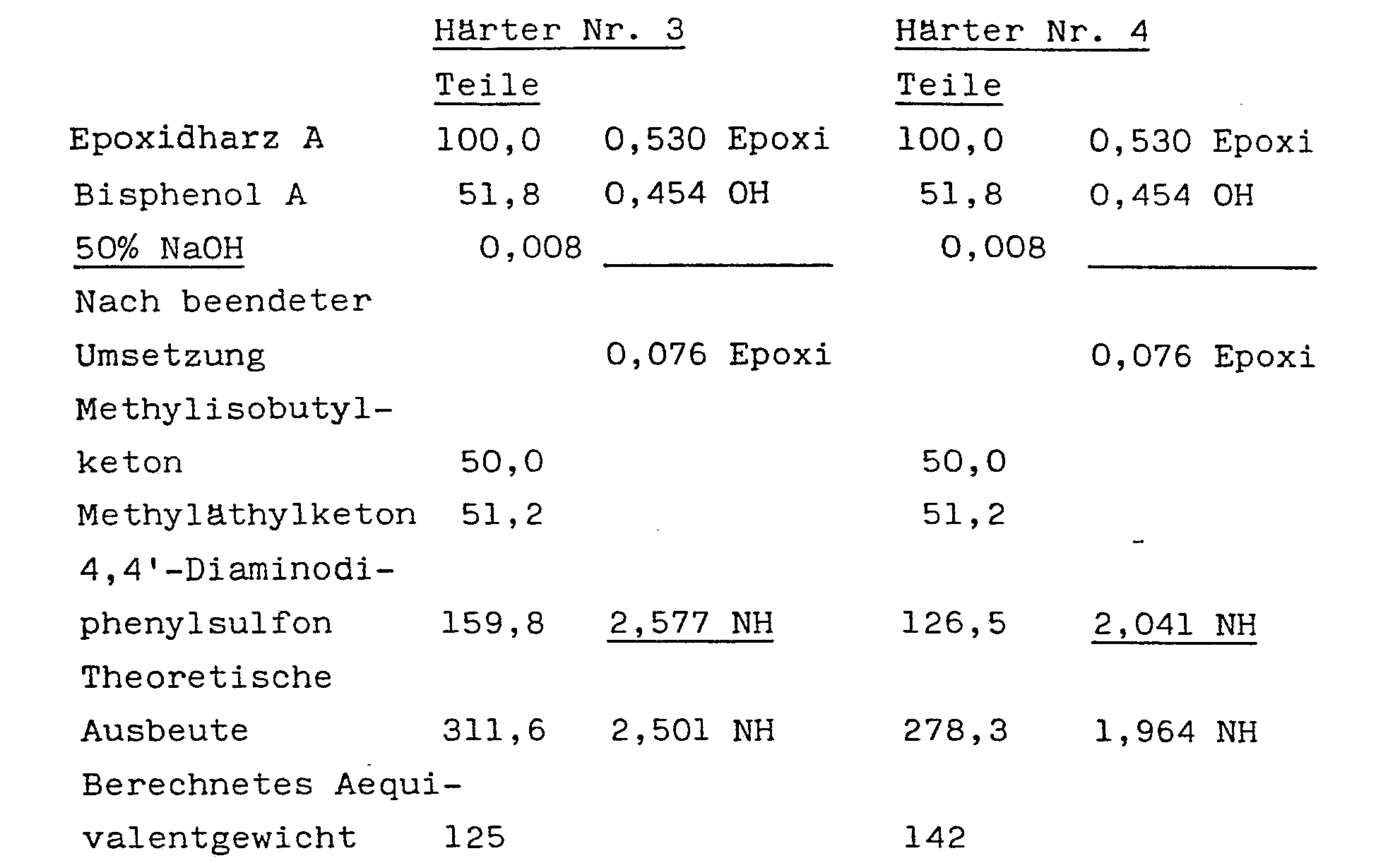
Der Diglycidyläther wird in ein Gefäss eingebracht und auf 115°C erhitzt. Dann gibt man Bisphenol A und NaOH dazu, wobei man die Temperatur auf 100°C hält. Der Druck wird auf etwa 133 mbar erniedrigt und die Temperatur auf 190°C erhöht und drei Stunden bei 190°C-200°C gehalten, bis der Epoxidwert 0,050 Aequivalente auf 100 Gramm erreicht. Dann wird auf Rückfluss bei Atmosphärendruck umgeschaltet, die Ketone zur Auflösung des Harzes zugesetzt und das System abgekühlt. Danach gibt man das Diaminodiphenylsulfon dazu. Zur Destillation wird die Aufschlämmung auf 180°C-185°C erhitzt und der Druck wiederum auf 100 Torr erniedrigt. Man hält das System noch drei Stunden bei 180°C-185°C, wonach das geschmolzene Produkt ausgetragen wird.The diglycidyl ether is placed in a vessel and heated to 115 ° C. Then add bisphenol A and NaOH, keeping the temperature at 100 ° C. The pressure is reduced to about 133 mbar and the temperature is raised to 190 ° C. and held at 190 ° C.-200 ° C. for three hours until the epoxy value reaches 0.050 equivalents per 100 grams. It is then switched to reflux at atmospheric pressure, the ketones are added to dissolve the resin and the system is cooled. Then add the diaminodiphenyl sulfone. For the distillation, the slurry is heated to 180 ° C-185 ° C and the pressure is again reduced to 100 Torr. The system is kept at 180 ° C-185 ° C for three hours after which the molten product is discharged.
Beispiel 3: Die nachfolgenden Beispiele beziehen sich auf die Leistungskennwerte der modifizierten Härter aus Beispielen 1 und 2 sowie auf das verarbeitete Epoxidharz. Dabei wird jeweils tetraglycidyliertes Methylendianilin (Epoxidharz B) eingesetzt. Zur Kontrolle wird ein unmodifizierter 4,4'-Diaminodiphenylsulfonäther ebenfalls geprüft. In allen Kombinationen beträgt der Aminowasserstoff 85% der stöchiometrischen Menge bezogen auf Epoxidäquivalent.Example 3: The following examples relate to the performance characteristics of the modified hardeners from Examples 1 and 2 and to the processed epoxy resin. Tetraglycidylated methylene dianiline (epoxy resin B) is used in each case. An unmodified 4,4'-diaminodiphenyl sulfone ether is used as a control if checked. In all combinations, the amino hydrogen is 85% of the stoichiometric amount based on epoxy equivalent.
I. Die physikalischen Eigenschaften der vier hergestellten modifizierten Härter sowie des unmodifizierten Härters (Kontrolle) sind unten angegeben:I. The physical properties of the four modified hardeners produced and the unmodified hardener (control) are given below:

Es ist zu bemerken, dass das mittlere Molekulargewicht der modifizierten Härter von Nr.. 1 auf Nr. 4 zunimmt, wie aus den Lösungsviskositäten ersichtlich ist, sowie dass sämtliche modifizierte Härterausführungen eine verbesserte Löslichkeit in dem geschmolzenen Epoxidharz B aufweisen, während der reine Härter weniger verträglich ist.It should be noted that the average molecular weight of the modified hardeners increases from No. 1 to No. 4, as can be seen from the solution viscosities, and that all modified hardener designs have improved solubility in the melted epoxy resin B, while the pure hardener less is tolerated.
Die Schmelzviskositäten werden für die fünf Systeme (Tabelle 2) jeweils dadurch bestimmt, dass man eine bekannte Menge EpoxidharzBin eine Aluminiumschale gibt und auf 150°C erhitzt. Dann versetzt manmitder erforderlichen Menge Härter und mischt gründlich für 142 Sekunden. Man entfernt die Schale von der Heizquelle und lässt sie auf Raumtemperatur abkühlen.The melt viscosities for the five systems (Table 2) are determined by adding a known amount of epoxy resin to an aluminum pan and heating to 150 ° C. Then add the required amount of hardener and mix thoroughly for 142 seconds. The shell is removed from the heat source and allowed to cool to room temperature.
Die Schmelzviskositäten der Gemische werden auf einem Kegel- und Plattenviskosimeter (Research Equipment, London, Ltd.) bei 150°C bestimmt. Der bei dieser Messung erhaltene Wert stellt eine Anfangsviskosität bei erhöhter Temperatur dar, die mit der beim Härtungsvorgang erhaltenen Minimumviskosität in Beziehung steht. Vergleichsprüfungen zwischen dieser Kegel- und Plattenviskosität und der Minimumviskosität nach Rheometrics DMA (2°C/min. Erhitzungsgeschwindigkeit) zeigen eine hohe positive Korrelation. Die diese Beziehung beschreibende Gleichung lautet: Gleichung (1):

- R = Rheometrics-Minimumviskosität in cps für eine Erhitzungsgeschwindigkeit von 2°C/min.
- B = Kegel- und Plattenviskosität in cps bei 150°C.
- R = Rheometrics minimum viscosity in cps for a heating rate of 2 ° C / min.
- B = cone and plate viscosity in cps at 150 ° C.
In der nachfolgenden Tabelle sind die Kegel- und Plattenviskositäten bei 150°C für jedes der fünf Systeme sowie die projizierte Minimumviskosität nach Rheometrics DMA laut Gleichung (1) angegeben. Kegel- und Plattenviskositäten bei 150°C und projizierte Minimumviskosität nach Rheometrics

Diese Daten sind bedeutsam, da in der Luft- und Raumfahrtindustrie ein Bedarf für ein Hochleistungsharzsystem mit "kontrolliertem Verlauf" besteht. Kontrollierter Verlauf lässt sich als höhere Minimumschmelzflussviskosität während eines unveränderlichen Verarbeitungszyklus definieren. Diese Eigenschaft ist für Präpregsysteme mit niedrigem oder keinem Auslauf zur Verwendung als Wabenhäute vorteilhaft. Die modifizierten Systeme zeigen verschiedene Ausmasse von Zunahmen in der Schmelzviskosität oder "kontrolliertem Verlauf" je nach der Molekulargewichtverteilung des Härters. Die oben angegebenen Daten demonstrieren diesen Effekt mit einer mehr als 100-fachen Zunahme der Schmelzflussviskosität in System Nr. 4 gegenüber dem Standardsystem.This data is significant because there is a need in the aerospace industry for a "controlled flow" high performance resin system. Controlled flow can be defined as a higher minimum melt flow viscosity during an unchangeable processing cycle. This property is for prepreg systems with little or no spout for use as honeycomb skins advantageous. The modified systems show different amounts of increases in melt viscosity or "controlled course" depending on the molecular weight distribution of the hardener. The data above demonstrate this effect with a more than 100-fold increase in melt flow viscosity in system # 4 over the standard system.
Giesslinge aus reinem Harz werden durch vorsichtiqes Erhitzen von Epoxidharz B auf 135°C und langsames Einrühren des gepulverten Härters, bis man eine klare Mischung erhält, hergestellt. Das Epoxidharz und der Härter zusammen werden zwanzig Minuten bei 135°C im Vakuum bei 762 Torr entgast, um jegliche Luft oder gelöste Gase zu entfernen. Dann wird das Material in eine Plattenform gegossen und gehärtet. Der Härtungsplan und dieEpoxid/Härteranteile für die untersuchten Systeme sind unten angegeben.Pure resin castings are made by carefully heating epoxy resin B to 135 ° C and slowly stirring in the powdered hardener until a clear mixture is obtained. The epoxy and hardener together are degassed for 20 minutes at 135 ° C in vacuum at 762 torr to remove any air or dissolved gases. Then the material is poured into a plate mold and hardened. The curing schedule and epoxy / curing agent proportions for the systems tested are given below.

Die Biege- und Festigkeitsdaten des gehärteten reinen Harzes für die fünf Systeme werden bei Raumtemperatur und 150°C gemäss ASTM-Prüfmethoden D-790 bzw. D-638 erhalten. Zusätzlich bestimmt man die Druckfestigkeitseigenschaften bei Raumtemperatur nach ASTM D-695.The bending and strength data of the cured pure resin for the five systems are obtained at room temperature and 150 ° C according to ASTM test methods D-790 and D-638. In addition, the compressive strength properties at room temperature are determined in accordance with ASTM D-695.
Die Wärmestandfestigkeiten (HDT) der Harzsysteme werden nach ASTM D-648 bestimmt. Zur Bestimmung des Glasübergangspunkts (Tg) wird eine thermomechanische Analyse (TMA) im Durchstossversuch mit einer Erhitzungsgeschwindigkeit von 10°C/min. und 5 Gramm Last durchgeführt Diese Werte sind unten angegeben:The heat resistance (HDT) of the resin systems are determined according to ASTM D-648. To determine the glass transition point (Tg), a thermomechanical analysis (TMA) is carried out in a puncture test with a heating rate of 10 ° C / min. and 5 gram load performed These values are given below:

Die Daten für die physikalischen Eigenschaften der untersuchten reinen Harzsysteme veranschaulichen die wesentlichen Verbesserungen bei den Raumtemperaturbiege- und -zugfestigkeiten, die man für die modifizierten Systeme erhält, mit einer gewissen Abnahme in der durch HDT beobachteten thermischen Anwendbarkeit. Die Systeme Nr. 3 und Nr. 4 besitzen die besten Zugfestigkeitseigenschaften bei Raumtemperatur, während die Zugfestigkeitseigenschaften der Systeme Nr. 1 und Nr. 2 bei erhöhten Temperaturen überlegen sind. Die Biegungsdaten zeigen, dass sämtliche modifizierten Systeme bei Raumtemperatur stärker als die Kontrolle sind, wobei die Systeme Nr. 1 und Nr. 2 unter den modifizierten Formen die besten Festigkeiten bei erhöhten Temperaturen aufweisen. Die Druckfestigkeiten und -moduln für die Systeme Nr. 1 bis Nr. 4 sind mit der Kontrolle vergleichbar, während die Quetschspannung eine Abnahme zeigt, wahrscheinlich wegen einer Verringerung der Vernetzungsdichte. Im ganzen zeigen die Systeme Nr. 3 und Nr. 4 die besten statischen mechanischen Eigenschaften bei Raumtemperatur, während die Systeme Nr. 1 und Nr. 2 die besten Eigenschaften bei erhöhter Temperatur aufweisen.The data for the physical properties of the investigated pure resin systems illustrate the significant improvements in room temperature bending and tensile strengths obtained for the modified systems with a certain decrease in the thermal applicability observed by HDT. Systems # 3 and # 4 have the best tensile properties at room temperature, while the tensile properties of systems # 1 and # 2 are superior at elevated temperatures. The bend data shows that all modified systems are stronger than the control at room temperature, with systems # 1 and # 2 having the best strengths at elevated temperatures among the modified forms. The compressive strengths and moduli for systems # 1 through # 4 are comparable to the control, while the crushing stress shows a decrease, probably due to a reduction in the crosslink density. Overall, systems # 3 and # 4 show the best static mechanical properties at room temperature, while systems # 1 and # 2 have the best properties at elevated temperature.
Schlagprüfungen bei Raumtemperatur werden an den reinen Harzsystemen nach zwei Methoden durchgeführt. Die erste ist eine ungekerbte Charpy-Probe, um die zur Einleitung und Ausbreitung des Bruchs erforderliche Energie zu bestimmen. Diese Prüfung wird gemäss ASTM D-256 ausgeführt, ausser dass man an der Probe keine Kerbe anbringt. Die zweite Methode besteht in einer modifizierten Gardner-Schlagprüfung, wobei eine 25 x 25 x 3 mm grosse, nicht eingespannte Probe durch ein fallendes Gewicht mit 6 mm Nasenradius zerbrochen wird. Die Schlagfestigkeit wird gemessen als die Kraft, bei der Bruch eintritt. Diese Werte sind unten zusammen mit den Zugdehnungen bei Raumtemperaturen und 150°C angegeben.Impact tests at room temperature are carried out on the pure resin systems using two methods. The first is a non-notched Charpy sample to determine the energy required to initiate and propagate the fracture. This test is carried out according to ASTM D-256, except that no notch is made on the sample. The second method consists of a modified Gardner impact test, where a 25 x 25 x 3 mm, non-clamped sample is broken by a falling weight with a 6 mm nose radius. Impact resistance is measured as the force at which breakage occurs. These values are given below together with the tensile strains at room temperature and 150 ° C.

Je nach der Schlagmessmethode, ob durch Zugdehnung, Charpy-Prüfung oder Kugelfall, erhält man verschiedene Werte, da die Prüfungen jeweils einen anderen Gesichtspunkt der Schlagfestigkeit oder Zähigkeit messen. Sämtliche untersuchten modifizierten Systeme zeigen erhöhte Schlagfestigkeit und Zähigkeit, wobei die Systeme Nr. 3 und Nr.4 die grössten Zunahmen aufweisen.Depending on the impact measurement method, whether by tensile elongation, Charpy test or falling from a ball, different values are obtained, since the tests each measure a different aspect of impact resistance or toughness. All investigated modified systems show increased impact strength and toughness, with systems No. 3 and No. 4 showing the greatest increases.
Um diese Verbesserungen in den physikalischen Eigenschaften zu erhalten, muss man einen gewissen Verlust an Wärmestandfestigkeit (Tragfestigkeit bei erhöhten Temperaturen) in Kauf nehmen, doch ist die durch TMA gemessene Glasübergangstemperatur bei den Systemen Nr. 3 und Nr. 4 unverändert und bei den Systemen Nr. 1 und Nr. 2 sogar erhöht.In order to obtain these improvements in physical properties, you have to accept a certain loss of heat resistance (load bearing capacity at elevated temperatures), but the glass transition temperature measured by TMA is unchanged for systems No. 3 and No. 4 and for systems No. 1 and No. 2 even increased.
Die Feuchtigkeitsprüfungen an den reinen Harzsystemen werden bei 80°C und 95% relativer Feuchte durchgeführt. Die Feuchtigkeitsaufnahme ist wie folgt:The moisture tests on the pure resin systems are carried out at 80 ° C and 95% relative humidity. The moisture absorption is as follows:
Bei 80°C und 100% relativer Feuchte bis zum Gleichgewicht gealtert (25 Tage)

Die modifizierten Systeme zeigen eine deutliche Verbesserung der Beständigkeit gegen Feuchtigkeit.The modified systems show a significant improvement in resistance to moisture.
Weiterhin ist aus der nachfolgenden Tabelle er- : sichtlich, dass die erwünschten Eigenschaften auch nach Feuchtigkeitsalterung im wesentlichen erhalten sind.Furthermore, it can be seen from the following table that the desired properties are essentially retained even after moisture aging.

Ein Vergleich der obigen Werte mit den in der Tabelle unter der Ueberschrift "Physikalische Eigenschaften des reinen Harzes" angegebenen zeigt, dass die mechanischen Eigenschaften der erfindungsgemassen modifizierten Systeme weniger als die der Kontrolle beeinträchtigt werden. Diese Beibehaltung der Eigenschaften lässt sich also der erhöhten Beständigkeit der vorliegenden Systeme gegen Feuchtigkeit zuschreiben.A comparison of the above values with those given in the table under the heading "Physical properties of the pure resin" shows that the mechanical properties of the modified systems according to the invention are less impaired than those of the control. This retention of properties can therefore be attributed to the increased resistance of the present systems to moisture.
Ein unidirektionaler Graphitpräpreg wird aus Graphitgarn Thornel-300 (Qualität WYP-30, Ausrüstung UC-309, ohne Zwirnung) hergestellt. Das Garn wird durch eine 30-35 Gew. %iger Lösung von Harz/Härter in MEK/Aceton (50/50 geführt und auf einen Trommelwickler aufgewickelt, wobei man ein 3,65 m langes und 45 cm breites Band mit 8 Kabeln/cm erhält. Den Präpreg lässt man eine Stunde in der Luft trocknen und unterwirft ihn dann für drei Minuten einer Erhitzungsstufe bei 120°C. Dies gibt einen Präpreg mit annehmbarer Anpassungsfähigkeit und Klebrigkeit. Der Präpreg wird geschnitten, in Schichten gelegt und durch Verpressen gehärtet. Die Imprägnierlösungen und der Härtungszyklus sind unten angegeben.A unidirectional graphite prepreg is made from graphite yarn Thornel-300 (quality WYP-30, finish UC-309, without twisting). The yarn is mixed with a 30-35% by weight solution of resin / hardener in MEK / acetone (50/50 led and wound on a drum winder, whereby a 3.65 m long and 45 cm wide tape with 8 cables / cm is obtained. The prepreg is left to air dry for one hour and then subjected to a heating step at 120 ° C. for three minutes. This gives a prepreg with acceptable adaptability and stickiness. The P räpreg is cut, put in layers, and cured by pressing. The impregnation solutions and the curing cycle are given below.

Sämtliche für Prüfungszwecke hergestellten Laminate werden nach den ASTM-Methoden D-3171, D-2734 und D-792 auf ihren Hohlraumgehalt analysiert. Es zeigt sich, dass alle gefertigten Tafeln gar keine Hohlräume enthalten. Die vorgelegten Verbundstoffdaten sind auf 30 Gewichtsprozent Harzgehalt korrigiert.All laminates produced for test purposes are analyzed for their void content according to ASTM methods D-3171, D-2734 and D-792. It can be seen that all the panels produced do not contain any cavities. The composite data presented are corrected to 30 percent by weight resin content.
Zwanziglagige 0°-Tafeln werden jeweils aus den oben beschriebenen Systemen hergestellt. Aus diesen Laminaten erhält man Kurzstabscherproben und prüft diese gemäss ASTM D-2344 bei Raumtemperatur, -59°C und 93°C. Die 0°-Biegeeigenschaften erhält man mit 10-lagigen Tafeln, die gemäss ASTM D-790 bei Raumtemperatur, -59°C und 93°C geprüft werden. Vierzehnlagige, auf + 45/90/-45/90 orientierte und in der 0°-Richtung gemäss ASTM D-3039 bei Raumtemperatur und -59°C geprüfte Matrixzugproben werden zur Messung der kombinierten Auswirkungen von Scherspannung und Matrixfestigkeit verwendet. Die Daten für Kurzstabscherung, Biege- und Matrixzugfestigkeit sind unten angegeben.

Obwohl die zur Herstellung der Prüftafeln angewandte Arbeitsweise nicht unbedingt optimal ist, werden die oben für jedes der fünf Systeme gegebenen Daten als gültig für einen Vergleich der Systeme angesehen. Die Schereigenschaften der modifizierten Härter scheinen ähnlich wie beim Standardhärter zu sein, und die stark vom Fasergehalt abhängigen Biegeeigenschaften sind ebenfalls ähnlich.Although the methodology used to make the test panels is not necessarily optimal, the data given above for each of the five systems is considered valid for a comparison of the systems. The shear properties of the modified hardener appear to be similar to that of the standard hardener, and the bending properties, which are highly dependent on the fiber content, are also similar.
Die Matrixzugprüfungen werden an allen fünf Systemen durchgeführt. Diese Prüfung misst die kombinierten Auswirkungen der Harzmatrix und der Schereigenschaften auf den Verbundstoff. Eine solche Messung kann als Hinweis auf Zähigkeit angesehen werden, wobei zunehmende Festigkeit und Bruchdehnung mit einer Zunahme der Zähigkeit in Beziehung stehen. Diese Daten zeigen einen realen Unterschied, da sämtliche modifizierten Systeme Verbesserungen über die Kontrolle zeigen, doch scheinen die Systeme Nr. 1 und Nr. 3 die besten zu sein.The matrix tensile tests are carried out on all five systems. This test measures the combined effects of the resin matrix and the shear properties on the composite. Such a measurement can be viewed as an indication of toughness, with increasing strength and elongation at break being related to an increase in toughness. These data show a real difference since all modified systems show improvements over control, but systems # 1 and # 3 appear to be the best.
Zusammenfassend ist ersichtlich, dass diese Erfindung neuartige, modifizierte Härtersysteme für Epoxidharze zur Verfügung stellt, die ausgezeichnete Leistungskennwerte aufweisen. Aenderungen in der Herstellung, der Arbeitsweise und den Materialien sind möglich, ohne den durch die nachfolgenden Ansprüche definierten Schutzumfang der Erfindung zu überschreiten.In summary, it can be seen that this invention provides novel, modified curing systems for epoxy resins that have excellent performance characteristics. Changes in the manufacture, the method of operation and the materials are possible without exceeding the scope of protection of the invention defined by the following claims.
Claims (10)


Applications Claiming Priority (4)
| Application Number | Priority Date | Filing Date | Title |
|---|---|---|---|
| US19409480A | 1980-10-06 | 1980-10-06 | |
| US194094 | 1980-10-06 | ||
| US267117 | 1981-05-26 | ||
| US06/267,117 US4330659A (en) | 1980-10-06 | 1981-05-26 | Modified amine hardener systems |
Publications (3)
| Publication Number | Publication Date |
|---|---|
| EP0049687A2 true EP0049687A2 (en) | 1982-04-14 |
| EP0049687A3 EP0049687A3 (en) | 1982-10-27 |
| EP0049687B1 EP0049687B1 (en) | 1986-01-08 |
Family
ID=26889691
Family Applications (1)
| Application Number | Title | Priority Date | Filing Date |
|---|---|---|---|
| EP81810396A Expired EP0049687B1 (en) | 1980-10-06 | 1981-09-30 | Modified amine hardener system for epoxy resins, and its use |
Country Status (4)
| Country | Link |
|---|---|
| US (1) | US4330659A (en) |
| EP (1) | EP0049687B1 (en) |
| CA (1) | CA1181891A (en) |
| DE (1) | DE3173459D1 (en) |
Cited By (6)
| Publication number | Priority date | Publication date | Assignee | Title |
|---|---|---|---|---|
| EP0130270A1 (en) * | 1983-06-30 | 1985-01-09 | Amoco Corporation | Epoxy compositions containing oligomeric diamine hardeners and high strength composites therefrom |
| EP0131281A1 (en) * | 1983-07-08 | 1985-01-16 | Kanegafuchi Kagaku Kogyo Kabushiki Kaisha | Process for preparing polyglycidylamine derivatives |
| FR2596405A1 (en) * | 1986-03-28 | 1987-10-02 | Elf Aquitaine | USINABLE EPOXY RESIN COMPOSITION, IN PARTICULAR AFTER PREPARATION, AS PRECURSOR OF MATRIXES FOR COMPOSITE MATERIALS, COMPOSITE MATERIALS OBTAINED AND NEW EPOXY RESINS WITH SULFON GROUPS |
| EP0425424A3 (en) * | 1989-08-31 | 1991-09-11 | United Technologies Corporation | Method for fabricating graphite fiber epoxy composites |
| EP0539331A1 (en) * | 1991-10-25 | 1993-04-28 | Ciba-Geigy Ag | Adducts of diaminodiphenyl sulfone compounds as hardeners for epoxy resins |
| US6620510B1 (en) | 1998-12-25 | 2003-09-16 | Mitsubishi Rayon Co., Ltd. | Epoxy resin composition, prepreg, and roll made of resin reinforced with reinforcing fibers |
Families Citing this family (15)
| Publication number | Priority date | Publication date | Assignee | Title |
|---|---|---|---|---|
| US4567216A (en) * | 1983-12-22 | 1986-01-28 | Union Carbide Corporation | Thermoplastic modified epoxy compositions |
| US4656208A (en) * | 1985-02-19 | 1987-04-07 | Hercules Incorporated | Thermosetting epoxy resin compositions and thermosets therefrom |
| US4656207A (en) * | 1985-02-19 | 1987-04-07 | Hercules Incorporated | Epoxy thermosets having improved toughness |
| US4822832A (en) * | 1985-02-19 | 1989-04-18 | Hercules Incorporated | Thermosetting epoxy resin compositions and thermosets therefrom |
| DE3540352A1 (en) * | 1985-11-14 | 1987-05-21 | Messerschmitt Boelkow Blohm | SANDWICH COMPONENT |
| US4808441A (en) * | 1987-05-15 | 1989-02-28 | Ford Motor Company | Metal articles having corrosion-resistant epoxy coatings |
| US4874661A (en) * | 1987-12-15 | 1989-10-17 | Browne James M | Impact enhanced prepregs and formulations |
| US5593770A (en) * | 1989-10-25 | 1997-01-14 | Thiokol Corporation | Chemorheologically tailored matrix resin formulations containing anhydride curing agents |
| US5545278A (en) * | 1989-10-25 | 1996-08-13 | Thiokol Corporation | Method for increasing fiber strength translation in composition pressure vessels using matrix resin formulations containing anhydride curing agents and surface-active agents |
| US5360840A (en) * | 1992-12-29 | 1994-11-01 | Hercules Incorporated | Epoxy resin compositions with improved storage stability |
| EP0776917B1 (en) | 1995-11-29 | 2002-05-29 | Vantico AG | Core/Shell particles and epoxy resin compositions containing them |
| CA2449198A1 (en) * | 2001-05-21 | 2002-11-28 | Vantico Ag | Processes for the production of components of electronic apparatuses |
| US20050197026A1 (en) * | 2004-03-03 | 2005-09-08 | Kenneth Keuchel | Thermoplastic nylon adhesive matrix having a uniform thickness and composite laminates formed therefrom |
| TWI491638B (en) * | 2010-11-16 | 2015-07-11 | Ind Tech Res Inst | Thermosetting composition |
| KR101262588B1 (en) * | 2011-07-28 | 2013-05-08 | 엘지이노텍 주식회사 | Epoxy resin compound and radiant heat circuit board using the same |
Family Cites Families (6)
| Publication number | Priority date | Publication date | Assignee | Title |
|---|---|---|---|---|
| US2909448A (en) * | 1955-03-07 | 1959-10-20 | Shell Dev | Salts of polyamine polyepoxide adducts and their use as curing agents for polyepoxides |
| US3155743A (en) * | 1956-12-31 | 1964-11-03 | Shell Oil Co | Compositions of matter containing polyepoxides and polyaminodiphenylsulfones |
| US2993026A (en) * | 1958-08-25 | 1961-07-18 | Tennessee Corp | Epoxy resin composition containing diglycidyl ether of 2, 4'-dihydroxy diphenyl sulfone |
| CH406640A (en) * | 1959-11-23 | 1966-01-31 | Micafil Ag | Thin, hardenable mixture |
| CH548431A (en) * | 1971-05-25 | 1974-04-30 | Ciba Geigy Ag | STORAGE-STABLE, FAST-CURING EPOXY RESIN COMPRESSION COMPOUNDS. |
| CH547329A (en) * | 1971-06-15 | 1974-03-29 | Ciba Geigy Ag | STORAGE-STABLE, FAST-CURING EPOXY RESIN COMPRESSION COMPOUNDS. |
-
1981
- 1981-05-26 US US06/267,117 patent/US4330659A/en not_active Expired - Lifetime
- 1981-09-30 EP EP81810396A patent/EP0049687B1/en not_active Expired
- 1981-09-30 DE DE8181810396T patent/DE3173459D1/en not_active Expired
- 1981-10-02 CA CA000387172A patent/CA1181891A/en not_active Expired
Cited By (9)
| Publication number | Priority date | Publication date | Assignee | Title |
|---|---|---|---|---|
| EP0130270A1 (en) * | 1983-06-30 | 1985-01-09 | Amoco Corporation | Epoxy compositions containing oligomeric diamine hardeners and high strength composites therefrom |
| EP0131281A1 (en) * | 1983-07-08 | 1985-01-16 | Kanegafuchi Kagaku Kogyo Kabushiki Kaisha | Process for preparing polyglycidylamine derivatives |
| FR2596405A1 (en) * | 1986-03-28 | 1987-10-02 | Elf Aquitaine | USINABLE EPOXY RESIN COMPOSITION, IN PARTICULAR AFTER PREPARATION, AS PRECURSOR OF MATRIXES FOR COMPOSITE MATERIALS, COMPOSITE MATERIALS OBTAINED AND NEW EPOXY RESINS WITH SULFON GROUPS |
| EP0240421A1 (en) * | 1986-03-28 | 1987-10-07 | Societe Nationale Elf Aquitaine | Reinforced epoxy resin composition, in particular in the form of prepregs, starting product for composites, the obtained composites and epoxy resins containing sulphone groups |
| WO1987005917A1 (en) * | 1986-03-28 | 1987-10-08 | Societe Nationale Elf Aquitaine | Epoxide resin-reinforced composition, particularly in the form of preimpregnated products, precursor of composite materials, composite materials obtained and new epoxide resins with sulphone groupings |
| EP0425424A3 (en) * | 1989-08-31 | 1991-09-11 | United Technologies Corporation | Method for fabricating graphite fiber epoxy composites |
| EP0539331A1 (en) * | 1991-10-25 | 1993-04-28 | Ciba-Geigy Ag | Adducts of diaminodiphenyl sulfone compounds as hardeners for epoxy resins |
| US5331068A (en) * | 1991-10-25 | 1994-07-19 | Ciba-Geigy Corporation | Adducts of diaminodiphenyl sulfone compounds as hardeners for epoxy resins |
| US6620510B1 (en) | 1998-12-25 | 2003-09-16 | Mitsubishi Rayon Co., Ltd. | Epoxy resin composition, prepreg, and roll made of resin reinforced with reinforcing fibers |
Also Published As
| Publication number | Publication date |
|---|---|
| CA1181891A (en) | 1985-01-29 |
| EP0049687B1 (en) | 1986-01-08 |
| US4330659A (en) | 1982-05-18 |
| DE3173459D1 (en) | 1986-02-20 |
| EP0049687A3 (en) | 1982-10-27 |
Similar Documents
| Publication | Publication Date | Title |
|---|---|---|
| EP0049687B1 (en) | Modified amine hardener system for epoxy resins, and its use | |
| DE3782589T2 (en) | MULTI-PHASE EPOXYDDUROPLASTE WITH RUBBER IN THE DISPERSE PHASE. | |
| DE69323129T2 (en) | Thermosetting resins toughened with sulfone polymers | |
| DE68915567T2 (en) | Two-component type epoxy resin hardener. | |
| EP0429395A2 (en) | Curable epoxy resin composition containing a latent curing agent, an amine and a thiol | |
| DE3587089T2 (en) | PARTLY PROPOSED EPOXY RESIN COMPOSITIONS AND PRODUCTS PRODUCED BY THEIR REACTION AND NETWORKING. | |
| DE2650746A1 (en) | EPOXY RESIN COMPOUNDS | |
| DE3424700A1 (en) | FIBER COMPOSITES BASED ON EPOXY RESINS | |
| DE2818091B2 (en) | Heat-resistant resin compound | |
| DE68920086T2 (en) | Thermosetting epoxy resin composition. | |
| DE69427119T2 (en) | EPOXY RESINS BASED ON SUBSTITUTED RESORCINOL | |
| US4500582A (en) | Modified amine hardener systems | |
| DE3514347A1 (en) | EPOXY RESIN MIXTURES | |
| EP0139110A1 (en) | Curable epoxy resins | |
| DE69608054T2 (en) | 1-Imidazolylmethyl-2-naphthols as catalysts for the curing of epoxy resins | |
| DE102006032063B4 (en) | Process for the preparation of a molding material | |
| EP3233961B1 (en) | High-temperature resistant duromers on the basis of naphthalene-based epoxy resins and cyanate esters, and improvement of the impact strength | |
| DE3624314A1 (en) | USE OF EPOXY RESIN / HARDENER BLENDS FOR PRODUCING COATINGS WITH INCREASED INTERLAYER LIABILITY | |
| CH672492A5 (en) | ||
| DE69211290T2 (en) | Adducts of diaminodiphenylsulfone derivatives for epoxy resin hardeners | |
| DE2130156C3 (en) | Oxazolidinone-modified epoxy novolak resin and its use for adhesives or molding compounds | |
| DE68919817T2 (en) | Thermosetting organic composition. | |
| DE4039715A1 (en) | Epoxy resin compositions for fiber composite materials | |
| DE3891105C1 (en) | Resin compsn. for composite material | |
| DE2534693C3 (en) | Heat-curable, solid epoxy resin compounds |
Legal Events
| Date | Code | Title | Description |
|---|---|---|---|
| PUAI | Public reference made under article 153(3) epc to a published international application that has entered the european phase |
Free format text: ORIGINAL CODE: 0009012 |
|
| 17P | Request for examination filed |
Effective date: 19811002 |
|
| AK | Designated contracting states |
Designated state(s): DE FR GB IT NL SE |
|
| PUAL | Search report despatched |
Free format text: ORIGINAL CODE: 0009013 |
|
| AK | Designated contracting states |
Designated state(s): DE FR GB IT NL SE |
|
| ITF | It: translation for a ep patent filed | ||
| GRAA | (expected) grant |
Free format text: ORIGINAL CODE: 0009210 |
|
| AK | Designated contracting states |
Designated state(s): DE FR GB IT NL SE |
|
| REF | Corresponds to: |
Ref document number: 3173459 Country of ref document: DE Date of ref document: 19860220 |
|
| ET | Fr: translation filed | ||
| PLBE | No opposition filed within time limit |
Free format text: ORIGINAL CODE: 0009261 |
|
| STAA | Information on the status of an ep patent application or granted ep patent |
Free format text: STATUS: NO OPPOSITION FILED WITHIN TIME LIMIT |
|
| 26N | No opposition filed | ||
| PGFP | Annual fee paid to national office [announced via postgrant information from national office to epo] |
Ref country code: NL Payment date: 19870930 Year of fee payment: 7 |
|
| PG25 | Lapsed in a contracting state [announced via postgrant information from national office to epo] |
Ref country code: GB Effective date: 19880930 |
|
| PG25 | Lapsed in a contracting state [announced via postgrant information from national office to epo] |
Ref country code: SE Effective date: 19881001 |
|
| PG25 | Lapsed in a contracting state [announced via postgrant information from national office to epo] |
Ref country code: NL Effective date: 19890401 |
|
| NLV4 | Nl: lapsed or anulled due to non-payment of the annual fee | ||
| PG25 | Lapsed in a contracting state [announced via postgrant information from national office to epo] |
Ref country code: FR Free format text: LAPSE BECAUSE OF NON-PAYMENT OF DUE FEES Effective date: 19890531 |
|
| PG25 | Lapsed in a contracting state [announced via postgrant information from national office to epo] |
Ref country code: DE Effective date: 19890601 |
|
| GBPC | Gb: european patent ceased through non-payment of renewal fee | ||
| REG | Reference to a national code |
Ref country code: FR Ref legal event code: ST |
|
| EUG | Se: european patent has lapsed |
Ref document number: 81810396.2 Effective date: 19890619 |