EP0049703B1 - Verfahren zur Steuerung des Förderbeginns einer Einspritzpumpe sowie Vorrichtung zur Durchführung dieses Verfahrens - Google Patents
Verfahren zur Steuerung des Förderbeginns einer Einspritzpumpe sowie Vorrichtung zur Durchführung dieses Verfahrens Download PDFInfo
- Publication number
- EP0049703B1 EP0049703B1 EP81890166A EP81890166A EP0049703B1 EP 0049703 B1 EP0049703 B1 EP 0049703B1 EP 81890166 A EP81890166 A EP 81890166A EP 81890166 A EP81890166 A EP 81890166A EP 0049703 B1 EP0049703 B1 EP 0049703B1
- Authority
- EP
- European Patent Office
- Prior art keywords
- engine
- processor
- sensor
- revolution speed
- injection pump
- Prior art date
- Legal status (The legal status is an assumption and is not a legal conclusion. Google has not performed a legal analysis and makes no representation as to the accuracy of the status listed.)
- Expired
Links
- 238000002347 injection Methods 0.000 title claims description 37
- 239000007924 injection Substances 0.000 title claims description 37
- 238000000034 method Methods 0.000 title claims description 15
- 238000002485 combustion reaction Methods 0.000 claims description 9
- 239000000446 fuel Substances 0.000 claims description 8
- 239000007789 gas Substances 0.000 claims description 8
- 230000009467 reduction Effects 0.000 claims description 4
- UGFAIRIUMAVXCW-UHFFFAOYSA-N Carbon monoxide Chemical compound [O+]#[C-] UGFAIRIUMAVXCW-UHFFFAOYSA-N 0.000 claims description 2
- 229910002091 carbon monoxide Inorganic materials 0.000 claims description 2
- 230000008859 change Effects 0.000 claims description 2
- 239000007921 spray Substances 0.000 description 16
- 238000005259 measurement Methods 0.000 description 10
- 230000001419 dependent effect Effects 0.000 description 8
- 239000003344 environmental pollutant Substances 0.000 description 5
- 231100000719 pollutant Toxicity 0.000 description 5
- 238000013461 design Methods 0.000 description 4
- 238000006073 displacement reaction Methods 0.000 description 3
- 230000006870 function Effects 0.000 description 3
- 230000008878 coupling Effects 0.000 description 2
- 238000010168 coupling process Methods 0.000 description 2
- 238000005859 coupling reaction Methods 0.000 description 2
- 230000006872 improvement Effects 0.000 description 2
- 238000006243 chemical reaction Methods 0.000 description 1
- 238000011156 evaluation Methods 0.000 description 1
- 230000002349 favourable effect Effects 0.000 description 1
- 230000007246 mechanism Effects 0.000 description 1
- 239000011295 pitch Substances 0.000 description 1
- 238000012545 processing Methods 0.000 description 1
Images
Classifications
-
- F—MECHANICAL ENGINEERING; LIGHTING; HEATING; WEAPONS; BLASTING
- F02—COMBUSTION ENGINES; HOT-GAS OR COMBUSTION-PRODUCT ENGINE PLANTS
- F02D—CONTROLLING COMBUSTION ENGINES
- F02D41/00—Electrical control of supply of combustible mixture or its constituents
- F02D41/30—Controlling fuel injection
- F02D41/38—Controlling fuel injection of the high pressure type
- F02D41/40—Controlling fuel injection of the high pressure type with means for controlling injection timing or duration
- F02D41/401—Controlling injection timing
-
- F—MECHANICAL ENGINEERING; LIGHTING; HEATING; WEAPONS; BLASTING
- F02—COMBUSTION ENGINES; HOT-GAS OR COMBUSTION-PRODUCT ENGINE PLANTS
- F02B—INTERNAL-COMBUSTION PISTON ENGINES; COMBUSTION ENGINES IN GENERAL
- F02B1/00—Engines characterised by fuel-air mixture compression
- F02B1/02—Engines characterised by fuel-air mixture compression with positive ignition
- F02B1/04—Engines characterised by fuel-air mixture compression with positive ignition with fuel-air mixture admission into cylinder
-
- F—MECHANICAL ENGINEERING; LIGHTING; HEATING; WEAPONS; BLASTING
- F02—COMBUSTION ENGINES; HOT-GAS OR COMBUSTION-PRODUCT ENGINE PLANTS
- F02B—INTERNAL-COMBUSTION PISTON ENGINES; COMBUSTION ENGINES IN GENERAL
- F02B3/00—Engines characterised by air compression and subsequent fuel addition
- F02B3/06—Engines characterised by air compression and subsequent fuel addition with compression ignition
-
- F—MECHANICAL ENGINEERING; LIGHTING; HEATING; WEAPONS; BLASTING
- F02—COMBUSTION ENGINES; HOT-GAS OR COMBUSTION-PRODUCT ENGINE PLANTS
- F02D—CONTROLLING COMBUSTION ENGINES
- F02D2200/00—Input parameters for engine control
- F02D2200/02—Input parameters for engine control the parameters being related to the engine
- F02D2200/04—Engine intake system parameters
- F02D2200/0402—Engine intake system parameters the parameter being determined by using a model of the engine intake or its components
-
- F—MECHANICAL ENGINEERING; LIGHTING; HEATING; WEAPONS; BLASTING
- F02—COMBUSTION ENGINES; HOT-GAS OR COMBUSTION-PRODUCT ENGINE PLANTS
- F02D—CONTROLLING COMBUSTION ENGINES
- F02D2200/00—Input parameters for engine control
- F02D2200/02—Input parameters for engine control the parameters being related to the engine
- F02D2200/04—Engine intake system parameters
- F02D2200/0406—Intake manifold pressure
-
- F—MECHANICAL ENGINEERING; LIGHTING; HEATING; WEAPONS; BLASTING
- F02—COMBUSTION ENGINES; HOT-GAS OR COMBUSTION-PRODUCT ENGINE PLANTS
- F02D—CONTROLLING COMBUSTION ENGINES
- F02D2200/00—Input parameters for engine control
- F02D2200/02—Input parameters for engine control the parameters being related to the engine
- F02D2200/06—Fuel or fuel supply system parameters
- F02D2200/0602—Fuel pressure
-
- F—MECHANICAL ENGINEERING; LIGHTING; HEATING; WEAPONS; BLASTING
- F02—COMBUSTION ENGINES; HOT-GAS OR COMBUSTION-PRODUCT ENGINE PLANTS
- F02D—CONTROLLING COMBUSTION ENGINES
- F02D2200/00—Input parameters for engine control
- F02D2200/02—Input parameters for engine control the parameters being related to the engine
- F02D2200/10—Parameters related to the engine output, e.g. engine torque or engine speed
- F02D2200/1002—Output torque
-
- F—MECHANICAL ENGINEERING; LIGHTING; HEATING; WEAPONS; BLASTING
- F02—COMBUSTION ENGINES; HOT-GAS OR COMBUSTION-PRODUCT ENGINE PLANTS
- F02D—CONTROLLING COMBUSTION ENGINES
- F02D2250/00—Engine control related to specific problems or objectives
- F02D2250/18—Control of the engine output torque
-
- Y—GENERAL TAGGING OF NEW TECHNOLOGICAL DEVELOPMENTS; GENERAL TAGGING OF CROSS-SECTIONAL TECHNOLOGIES SPANNING OVER SEVERAL SECTIONS OF THE IPC; TECHNICAL SUBJECTS COVERED BY FORMER USPC CROSS-REFERENCE ART COLLECTIONS [XRACs] AND DIGESTS
- Y02—TECHNOLOGIES OR APPLICATIONS FOR MITIGATION OR ADAPTATION AGAINST CLIMATE CHANGE
- Y02T—CLIMATE CHANGE MITIGATION TECHNOLOGIES RELATED TO TRANSPORTATION
- Y02T10/00—Road transport of goods or passengers
- Y02T10/10—Internal combustion engine [ICE] based vehicles
- Y02T10/40—Engine management systems
Definitions
- the invention relates to a method for controlling the start of delivery of an injection pump for injection internal combustion engines, in particular for fuel injection on a diesel engine, in which operating variables such as speed, boost pressure, engine temperature or the like are measured and the torque emitted by the engine is determined. whereupon the start of delivery of the fuel injection pump is adjusted as a function of the determined engine torque, taking into account at least the measured speed, and a device suitable for carrying out this method.
- the pollutant emissions from internal combustion engines can be significantly reduced by a suitable choice of the ignition timing in gasoline engines or the start of injection in injection engines, in particular in diesel engines.
- the load that is used in gasoline engines by introducing the negative pressure in the intake manifold to a spring-loaded diaphragm to adjust the ignition timing is important as a parameter for the relative displacement of this relevant point.
- a device for carrying out the above-mentioned method in which, in addition to an electrical signal proportional to the speed, the position of the control rod of the injection pump is used to determine the load on the engine, with the control rod a position transmitter is arranged.
- the position of the control rod is an insufficient criterion for the actual extent of the load on the engine, especially in overrun mode, and the use of position sensors on the control rod requires additional compensation for the thermal expansion of the control rod during operation.
- the known device cannot therefore optimize the pollutant emissions in the required manner.
- the invention now aims to provide a method of the type mentioned at the outset, with which the pollutant emission and the consumption of an injection internal combustion engine, in particular a diesel engine, can be reduced in all operating states and in particular also in overrun mode.
- the invention essentially consists in that the engine torque is determined from the boost pressure generated by a turbocharger and the amount of air blown off from a certain, maximum admissible boost pressure with increasing engine speed.
- the measurement of the boost pressure is sufficient to determine the torque output by the engine, this measured value also taking into account the actual conditions when the engine is operating in overrun mode.
- the maximum boost pressure generated by the turbocharger is achieved or the maximum admissible boost pressure is delivered before the maximum permissible engine speed is reached.
- an increasing amount of air is blown off from a certain speed, so that the amount of blown air must also be determined in order to obtain a correct statement about the load condition of the engine.
- the speed of the engine is also taken into account to adjust the start of delivery of the fuel injection pump. With this procedure, it can be found with simple and reliable measuring sensors.
- a manipulated variable for adjusting the injection timing can be calculated, the load-dependent adjustment of the start of injection for the diesel engine in addition to the reduction in pollutant emissions also an improvement in performance and consumption values and one Reduction of the thermal and mechanical stress on the engine components.
- the injection time must be adjusted in a known manner as a function of the engine speed, and the use of a microprocessor makes it possible in a particularly simple manner to simultaneously convert the influences of engine speed and load torque into a common manipulated variable for the distribution of the injection time.
- the injection timing can be adjusted in various ways depending on the design of the injection pump; For example, in a configuration in which the injection pump is driven by a camshaft via a rocker arm, the bearing point can be shifted by actuating an eccentric, which results in an earlier or later injection time. This eccentric can be adjusted, for example, hydraulically or electrically, for example by means of a stepping motor.
- a device for determining the start of delivery of an injection pump has become known, for example, from AT-B No. 298881.
- a coupling sleeve is axially displaced, whereby the two shafts connected by the sleeve; which have external gears with different pitches are rotated against each other.
- the displacement of the coupling sleeve of this known device can take place, for example, hydraulically, electrically and in particular by means of a stepping motor.
- a stepping motor can, for example, be directly and non-positively coupled to this control rod.
- a stepper motor could be controlled by the microprocessor without the interposition of other components. For a hy drastic actuation of the spray adjuster would require a corresponding mechanical-hydraulic conversion of the control signal.
- a number of signals are suitable for evaluation in a microprocessor, which are either directly proportional to the load or are based on a simple law.
- measurement values for the speed and possibly the exhaust gas temperature and / or the carbon monoxide content of the exhaust gases are preferably used, so that the improvement in the pollutant emission can be achieved particularly precisely.
- the opening stroke of the exhaust valve can be measured in a particularly simple manner for the measurement of the exhaust gas air quantity, which means that simple sensors can also be used here.
- the device according to the invention for carrying out this method has sensors for operating variables such as speed, boost pressure, engine temperature or the like, and at least one further sensor for determining the torque emitted by the engine, which sensors are connected to a processor for performing at least one computing operation Which processor has a memory for storing the program to be executed, and with an actuating device connected to the processor for controlling the start of fuel delivery of the injection pump.
- the device mentioned is essentially characterized in that a measurement sensor is provided for the boost pressure, and that another measurement sensor is designed as a pressure sensor for the pressure difference occurring at a throttle point and forwards a value for the blow-off air quantity to the processor.
- the design can be made in a simple manner in such a way that a measurement sensor is designed as an electrically heated or cooled wire located in the air flow of the blow-off air, which provides the processor with a value for the blow-off air quantity via the temperature reduction or change. In all cases, electrical signals are immediately obtained, which can be passed on to a microprocessor.
- the control unit containing the microprocessor can be connected to an actuator for setting the start of fuel delivery, which is formed by a hydraulic or pneumatic working piston, an electric solenoid, an electric motor, an electric servomotor or an electric stepping motor. Since the control device is not only supplied with a load-dependent signal, but generally also with a signal corresponding to the speed, complicated relationships can be achieved with a common actuator of this type. In this case, it is preferably possible to proceed in such a way that, based on the speed and load signals input into the control unit, a spray adjustment characteristic value stored in the control unit is called up and assigned to the actuator.
- EP-A Nos. 49701, 49702 and 49704 which have the same registration and priority days, each describe a similar method for controlling the start of delivery of an injection pump and a similar device for carrying out this method, only the engine torque being determined by different parameters.
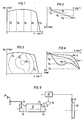
- FIGS. 1 and 2 show the linear injection adjustment speed relationship independent of the torque of the engine, as is done in conventional controls.
- the injection timing curves in the engine map are therefore straight lines over the speed.
- FIGS. 3 and 4 show speed and load-dependent spray adjustments as can be achieved according to the invention.
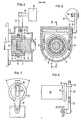
- 5 and 6 show a device for adjusting the angle of rotation between the pump drive and pump camshaft in section
- FIG. 5 showing a section along the line V-V of FIG. 6.
- 7 and 8 show an embodiment of the actuator as a stepper motor
- FIG. 9 shows a schematic overall structure for an injection system
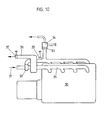
- FIG. 10 shows a schematic representation of the arrangement of the measurement sensors on a diesel engine.
- FIG. 1 the engine speed (min- 1 ) is plotted on the abscissa and the motor torque in nanometers is plotted on the ordinate.
- the spray adjustment at different engine speeds plotted on the negative ordinate axis as camshaft angle in degrees before top dead center of the piston of the internal combustion engine, results in a straight line which is independent of the engine torque in the conventional control.
- FIGS. 3 and 4 show analogous representations for different engine torques, any speed and load-dependent spray adjustments should be possible.
- FIGS. 5 and 6 denotes a housing which is flange-mounted, for example, on the injection pump housing 2.
- the shaft 3 which has an external toothing 4.
- a second shaft 5 is mounted in the shaft 3 and in the housing 1 and also has an external toothing 6.
- the sliding sleeve 7, which has an internal toothing 8 be sits, is longitudinally displaceable via a slide ring 9.
- the servomotor 15 can work according to the hydraulic, pneumatic or electrical principle. The prerequisite is that the servomotor 15 can follow all occurring changes in load and speed of the internal combustion engine.
- FIG. 7 and 8 show exemplary embodiments with a stepper motor 16.
- the stepper motor is distinguished by a high step frequency and high accuracy.
- On the shaft 17 there is a disk 18 in which a bolt 19 is located. This bolt 19 engages in a groove 20 of the outer lever 13.
- the outer lever 13 is now actuated and the required spray adjustment is thus achieved.
- FIG. 9 shows the overall schematic structure for a conventional injection system.
- the invention is not necessarily coupled to such an injection system, but is intended for any injection system.
- a regulator 22 and the attached spray adjuster 23 are located on the pump 21.
- the outer lever 25 of the regulator is now actuated via the driving foot lever 24 and the required engine speed or engine load is thus preselected.
- On the flywheel 26 of the internal combustion engine there is a sensor 27 which measures the speed. This speed is transmitted to the control unit 28.
- the engine torque is determined via a transducer.
- this sensor is indicated schematically at 29.
- the signal from the sensor 29, which is proportional to the load torque, is forwarded to the control unit 28.
- the target injection adjustment characteristic values are stored in the control unit 28.
- the load point in the engine map is precisely defined from the measurement of engine torque and engine speed, and with it the required spray adjustment.
- the control unit 28 now controls the servomotor 15 according to the engine load point, which sets the desired spray adjustment via the outer lever 13.
- the motor is designated 30.
- the intake air enters at 31 and is compressed by an exhaust gas turbocharger 32.
- the boost pressure is registered by the sensor 29, in the case shown a blow-off valve 33 is provided, via which part of the air is blown off again as the speed increases.
- a measurement sensor 34 is fixed, with which the blow-off quantity is determined.
- the exhaust gases emitted by the engine pass through the exhaust manifold 35 and the turbocharger into the exhaust line 36, a further sensor 37 being provided, with which the CO content or the temperature of the exhaust gases can be determined.
- the signals from the measurement sensors 29, 34 and 37 can be fed directly to the microprocessor in the control unit 28, and in this way an exact control signal for the adjustment of the injection timing can be derived in order to achieve particularly favorable emission and consumption values.
- the arbitrary load and speed-dependent spray adjustment is achieved by operating the outer lever of the device in accordance with AT-B No. 298881.
- the speed-dependent spray adjustment can be carried out depending on the speed measuring mechanism shown, for example, in AT-B No. 298881.
- the values for the speed and for load-dependent signals can be combined in any way, so that the special requirements of a particular internal combustion engine can be taken into account to an improved extent.
Landscapes
- Engineering & Computer Science (AREA)
- Chemical & Material Sciences (AREA)
- Combustion & Propulsion (AREA)
- Mechanical Engineering (AREA)
- General Engineering & Computer Science (AREA)
- Electrical Control Of Air Or Fuel Supplied To Internal-Combustion Engine (AREA)
- High-Pressure Fuel Injection Pump Control (AREA)
- Output Control And Ontrol Of Special Type Engine (AREA)
- Combined Controls Of Internal Combustion Engines (AREA)
Description
- Die Erfindung bezieht sich auf ein Verfahren zur Steuerung des Förderbeginns einer Einspritzpumpe für Einspritzbrennkraftmaschinen, insbesondere zur Kraftstoffeinspritzung an einem Dieselmotor, bei welchem Betriebsgrössen, wie Drehzahl, Ladedruck, Motortemperatur od. dgl., gemessen werden und das jeweils vom Motor abgegebene Drehmoment ermittelt wird, worauf in Abhängigkeit von dem ermittelten Motordrehmoment unter Berücksichtigung zumindest der gemessenen Drehzahl der Förderbeginn der Kraftstoffeinspritzpumpe verstellt wird, sowie auf eine zur Durchführung dieses Verfahrens geeignete Vorrichtung.
- Es ist bekannt, dass die Schadstoffemission von Verbrennungsmotoren durch geeignete Wahl des Zündzeitpunktes bei Ottomotoren bzw. des Einspritzbeginns bei Einspritzbrennkraftmaschinen, insbesondere bei Dieselmotoren, wesentlich verringertwerden kann. Dabei ist als Parameter für die relative Verlagerung dieses massgeblichen Punktes neben der Motordrehzahl auch die Last von Wichtigkeit, die bei Ottomotoren durch die Einleitung des Unterdruckes im Saugrohr auf eine federbelastete Membrane zur Zündzeitpunktverstellung eingesetzt wird.
- Aus der DE-A Nr. 2903875 ist bereits eine Einrichtung zur Durchführung des eingangs genannten Verfahrens bekannt geworden, bei welcher neben einem der Drehzahl proportionalen elektrischen Signal die Stell ung der Regelstange der Einspritzpumpe zur Ermittlung der Belastung des Motors herangezogen wird, wobei an der Regelstange ein Positionsgeber angeordnet ist. Die Stellung der Regelstange ist aber insbesondere im Schubbetrieb ein ungenügendes Kriterium für das tatsächliche Ausmass der Belastung des Motors, und die Verwendung von Positionsgebern an der Regelstange erfordert eine zusätzliche Kompensation der thermischen Ausdehnung der Regelstange im Betrieb. Insbesondere bei Kraftfahrzeugmotoren, bei welchen häufig ein Schubbetrieb auftritt, kann daher mit der bekannten Einrichtung die Schadstoffemission nicht in der erforderlichen Weise optimiert werden.
- Die Erfindung zielt nun darauf ab, ein Verfahren der eingangs genannten Art zu schaffen, mit welchem die Schadstoffemission und der Verbrauch einer Einspritzbrennkraftmaschine, insbesondere eines Dieselmotors, bei allen Betriebszuständen und insbesondere auch im Schubbetrieb verringert werden kann. Zur Lösung dieser Aufgabe besteht die Erfindung im wesentlichen darin, dass das Motordrehmoment aus dem von einem Turbolader erzeugten Ladedruck und der ab einem bestimmten, maximal zulässigen Ladedruck bei steigender Drehzahl abgeblasenen Luftmenge ermittelt wird. Bei Ausbildungen, bei welchen der Turbolader so ausgelegt ist, dass der maximale Druck des Turboladers erst bei der höchsten zulässigen Drehzahl erzielt wird, genügt die Messung des Ladedrucks für die Bestimmung des vom Motor abgegebenen Drehmoments, wobei dieser Messwert auch dann den tatsächlichen Verhältnissen Rechnung trägt, wenn der Motor im Schubbetrieb betrieben wird. Bei Ausbildungen des Turboladers, bei welchen der Lader für hohen Druck und damit hohe Leistung der Brennkraftmaschine bei niederen Drehzahlen ausgelegt ist, wird bereits vor Errreichen der maximal zulässigen Drehzahl der Brennkraftmaschine der maximale, vom Turbolader erzeugte Ladedruck erzielt bzw. der maximal zulässige Ladedruck abgegeben. In diesen Fällen wird ab einer bestimmten Drehzahl eine steigende Luftmenge abgeblasen, so dass zusätzlich die Menge der abgeblasenen Luft ermittelt werden muss, um eine korrekte Aussage über den Belastungszustand des Motors zu erhalten. Fürdie Verstellung des Förderbeginns der Kraftstoffeinspritzpumpe wird in allen Fällen zusätzlich die Drehzahl des Motors berücksichtigt. Mit diesem Verfahren kann mit einfachen und betriebssicheren Messwertgebern das Auslangen gefunden werden. Durch die Messung des Signals für das Motordrehmoment und die Verarbeitung dieser Messgrösse in einem Mikroprozessor lässt sich eine Stellgrösse für die Verstellung des Einspritzzeitpunktes errechnen, wobei die lastabhängige Verstellung des Spritzbeginns beim Dieselmotor neben der Verringerung der Schadstoffemission auch eine Verbesserung der Leistungs- und Verbrauchswerte und eine Verminderung der thermischen und mechanischen Beanspruchung der Motorbauteile mit sich bringt.
- Der Einspritzzeitpunkt muss in bekannter Weise in Abhängigkeit von der Motordrehzahl verstellt werden, und die Verwendung eines Mikroprozessors ermöglicht es, in besonders einfacher Weise die Einflüsse von Motordrehzahl und Lastmoment gleichzeitig in eine gemeinsame Stellgrösse für die Verteilung des Einspritzzeitpunktes umzusetzen. Die Verstellung des Einspritzzeitpunktes kann je nach Konstruktion der Einspritzpumpe in verschiedener Weise erfolgen; beispielsweise kann bei einer Ausbildung, bei welcher die Einspritzpumpe über einen Kipphebel von einer Nockenwelle angetrieben wird, der Lagerpunkt durch Betätigung eines Exzenters verschoben werden, wodurch sich ein früherer oder späterer Einspritzzeitpunkt ergibt. Die Verstellung dieses Exzenters kann beispielsweise hydraulisch oder elektrisch, beispielsweise mittels eines Schrittmotors, erfolgen. Eine Einrichtung zur Feststellung des Förderbeginns einer Einspritzpumpe ist beispielsweise aus der AT-B Nr. 298881 bekannt geworden. Bei dieser Ausbildung wird eine Kupplungsmuffe axial verschoben, wodurch die beiden, durch die Muffe verbundenen Wellen; welche Aussenverzahnungen mit verschiedenen Steigungen aufweisen, gegeneinander verdreht werden. Die Verschiebung der Kupplungsmuffe dieser bekannten Einrichtung kann beispielsweise hydraulisch, elektrisch und insbesondere mittels eines Schrittmotors erfolgen. Bei Einspritzpumpen, welche eine gesonderte Regelstange für die Verstellung des Einspritzzeitpunktes aufweisen, kann beispielsweise ein Schrittmotor unmittelbar kraftschlüssig mit dieser Regelstange gekoppelt werden. Ein Schrittmotor könnte ohne Zwischenschaltung von weiteren Bauteilen vom Mikroprozessor angesteuert werden. Für eine hydraulische Betätigung des Spritzverstellers müsste eine entsprechende mechanisch-hydraulische Umsetzung des Stellsignales erfolgen. Erfindungsgemäss kommen eine Reihe von Signalen für eine Auswertung in einem Mikroprozessor in Betracht, welche entweder direkt proportional der Last sind oder aber in einer einfachen Gesetzmässigkeit zur Last stehen.
- Vorzugsweise werden für die Ermittlung des Motordrehmoments Messwerte für die Drehzahl und gegebenenfalls die Abgastemperatur und/ oder den Kohlenmonoxydgehalt der Abgase herangezogen, so dass sich die Verbesserung der Schadstoffemission besonders exakt erzielen lässt. Für die Messung der Abgasluftmenge kann in besonders einfacher Weise der Öffnungshub des Abgasventils gemessen werden, wodurch auch hier mit einfachen Messwertgebern gearbeitet werden kann.
- Die erfindungsgemässe Vorrichtung zur Durchführung dieses Verfahrens weist Messwertaufnehmerfür Betriebsgrössen, wie Drehzahl, Ladedruck, Motortemperatur od. dgl., sowie wenigstens einen weiteren Messwertaufnehmer zur Ermittlung des jeweils vom Motor abgegebenen Drehmomentes auf, welche Messwertaufnehmer mit einem Prozessor zum Ausführen von mindestens einer Rechenoperation verbunden sind, welcher Prozessor einen Speicher zur Speicherung des auszuführenden Programms aufweist, und mit einer mit dem Prozessor verbundenen Betätigungseinrichtung zur Steuerung des Beginns der Kraftstofförderung der Einspritzpumpe. Die genannte Vorrichtung ist erfindungsgemäss im wesentlichen dadurch gekennzeichnet, dass ein Messwertaufnehmer für den Ladedruck vorgesehen ist, und dass ein weiterer Messwertaufnehmer als Drucksensor für den an einer Drosselstelle anfallenden Druckunterschied ausgebildet ist und einen Wert für die Abblasluftmenge dem Prozessor weiterleitet. Die Ausbildung kann hiebei in einfacher Weise so getroffen sein, dass ein Messwertaufnehmer als elektrisch beheizter oder gekühlter, im Luftstrom der Abblasluft befindlicher Draht ausgebildet ist, welcher über die Temperaturverminderung bzw. -veränderung einen Wert für die Abblasluftmenge dem Prozessor zur Verfügung stellt. In allen Fällen werden unmittelbar elektrische Signale erzielt, welche in einen Mikroprozessor weitergeleitet werden können.
- Das den Mikroprozessor enthaltende Steuergerät kann mit einem Stellglied für die Einstellung des Beginns der Kraftstofförderung verbunden sein, welches von einem hydraulischen oder pneumatischen Arbeitskolben, einem elektrischen Hubmagneten, einem Elektromotor, einem elektrischen Stellmotor oder einem elektrischen Schrittmotor gebildet ist. Da dem Steuergerät nicht nur ein lastabhängiges Signal, sondern in der Regel auch ein der Drehzahl entsprechendes Signal zugeführt wird, lassen sich komplizierte Zusammenhänge mit einem gemeinsamen Stellglied dieser Art bewerkstelligen. Hiebei kann vorzugsweise so vorgegangen werden, dass auf Grund der in das Steuergerät eingesteuerten Drehzahl- und Lastsignale ein im Steuergerät gespeicherter Spritzverstellungskennwert abgerufen und dem Stellglied zugeordnet wird.
- Die EP-A Nrn. 49701, 49702 und 49704, welche gleiche Anmelde- und Prioritätstage haben, beschreiben jeweils ein ähnliches Verfahren zur Steuerung des Förderbeginns einer Einspritzpumpe sowie eine ähnliche Vorrichtung zur Durchführung dieses Verfahrens, wobei lediglich das Motordrehmoment durch unterschiedliche Parameter ermittelt wird.
- Die Erfindung wird nachfolgend an Hand der Zeichnung näher erläutert, in welcher eine Einrichtung zur last- und drehzahlabhängigen Spritzverstellung gezeigt ist, bei welcher die Spritzverstellung durch Differenzdrehbewegung zwischen Pumpenantrieb und Pumpennockenwelle erzeugt wird.
- Fig. 1 und 2 zeigen den linearen Spritzverstellungs-Drehzahlzusammenhang unabhängig vom Drehmoment des Motors, wie er bei konventionellen Regelungen vorgenommen wird. Die Spritzverstellungskurven im Motorkennfeld sind daher Geraden über der Drehzahl. In Fig. 3 und 4 sind drehzahl- und lastabhängige Spritzverstellungen dargestellt, wie sie erfindungsgemäss erzielbar sind. Fig. 5 und 6 zeigen eine Einrichtung zur Verstellung des Drehwinkels zwischen Pumpenantrieb und Pumpennockenwelle im Schnitt, wobei Fig. 5 einen Schnitt nach der Linie V-V der Fig. 6 darstellt. Fig. 7 und 8 zeigen eine Ausbildung des Stellgliedes als Schrittmotor, Fig. 9 einen schematischen Gesamtaufbau für ein Einspritzsystem und Fig. 10 eine schematische Darstellung der Anordnung der Messwertaufnehmer an einem Dieselmotor.
- In Fig. 1 ist auf der Abszisse die Motordrehzahl (min-1) und auf der Ordinate das Motordrehmoment in Nanometer aufgetragen. Wie aus Fig. 2 hervorgeht, ergibt die Spritzverstellung bei verschiedenen Motordrehzahlen, aufgetragen auf der negativen Ordinatenachse als Nockenwellenwinkel in Grad vor dem oberen Totpunkt des Kolbens der Brennkraftmaschine, eine Gerade, welche bei der konventionellen Regelung unabhängig vom Motordrehmoment ist. Abweichend von derartigen konventionellen Verstellcharakteristiken sind in den Fig. 3 und 4 den Fig. 1 und 2 analoge Darstellungen für verschiedene Motordrehmomente wiedergegeben, wobei beliebige drehzahl- und lastabhängige Spritzverstellungen möglich sein sollen.
- Die Möglichkeit für die Erzielung der in Fig. 3 und 4 wiedergegebenen Charakteristiken wird beispielsweise durch eine Ausbildung der Verstelleinrichtung für den Einspritzzeitpunkt nach den Fig. 5 und 6 gegeben, wobei das Stellglied von einer Steuereinrichtung angesteuert wird. In Fig. 5 und 6 ist mit 1 ein Gehäuse bezeichnet, das z.B. am Einspritzpumpengehäuse 2 angeflanscht ist. Im Gehäuse 1 befindet sich die Welle 3, die eine Aussenverzahnung 4 besitzt. In der Welle 3 und im Gehäuse 1 ist eine zweite Welle 5 gelagert, die ebenfalls eine Aussenverzahnung 6 trägt. Die Schiebemuffe 7, die eine Innenverzahnung 8 besitzt, ist über einen Gleitring 9 längs verschiebbar. Durch die Kombination von Schrägverzahnungen bzw. Geradverzahnungen und Schrägverzahnungen wird durch die Längsverschiebung der Schiebemuffe 7 eine Relativbewegung der Wellen 3 und 5 zueinander erreicht. Auf dem Gleitring 9 sind Bolzen 10 angebracht, die über ein Gestänge 11 von einer Welle 12 und einem Aussenhebel 13 betätigt werden. Je nach Lage des Aussenhebels 13 ergibt sich nun eine ganz definierte Stellung der Schiebemuffe 7 und damit eine entsprechende Drehdifferenz zwischen den Wellen 3 und 5. Da die Drehdifferenz zwischen den Wellen 3 und 5 der Spritzverstellung proportional ist, kann damit über den Aussenhebel 13 jede beliebige Spritzverstellung erreicht werden. Der Aussenhebel 13 ist über eine Stange 14 mit einem Stellmotor 15 verbunden. Dieser steuert in Funktion der Motorlast und des Motordrehmomentes die Lage der Schiebemuffe 7 und damit die Spritzverstellung. Der Stellmotor 15 kann sowohl nach dem hydraulischen, pneumatischen oder elektrischen Prinzip arbeiten. Voraussetzung ist, dass der Stellmotor 15 allen vorkommenden Last- und Drehzahländerungen des Verbrennungsmotors folgen kann.
- Fig. 7 und 8 zeigen Ausführungsbeispiel mit einem Schrittmotor 16. Der Schrittmotor zeichnet sich durch eine hohe Schrittfrequenz und eine hohe Genauigkeit aus. Auf der Welle 17 sitzt eine Scheibe 18, in der sich ein Bolzen 19 befindet. Dieser Bolzen 19 greift in eine Nut 20 des Aussenhebels 13 ein. Je nach Drehlage des Schrittmotors wird nun der Aussenhebel 13 betätigt und damit die erforderliche Spritzverstellung erreicht.
- In Fig. 9 ist der schematische Gesamtaufbau für ein konventionelles Einspritzsystem dargestellt. Die Erfindung ist jedoch nicht notwendigerweise mit einem derartigen Einspritzsystem gekoppelt, sondern ist für jedes beliebige Einspritzsystem gedacht. An der Pumpe 21 befindet sich ein Regler 22 und der angebaute Spritzversteller 23. Über den Fahrfusshebel 24 wird nun der Aussenhebel 25 des Reglers betätigt und damit die erforderliche Motordrehzahl bzw. Motorlast vorgewählt. Am Schwungrad 26 des Verbrennungsmotors befindet sich ein Aufnehmer 27, der die Drehzahl misst. Diese Drehzahl wird in das Steuergerät 28 übertragen. Gleichzeitig wird über einen Aufnehmer das Motordrehmoment festgestellt. In Fig. 9 ist dieser Aufnehmer mit 29 schematisch angedeutet. Das Signal des Messwertaufnehmers 29, welches dem Lastmoment proportional ist, wird an das Steuergerät 28 weitergeleitet. I n dem Steuergerät 28 sind die Soll-Spritzverstellungskennwerte gespeichert. Aus der Messung von Motordrehmoment und Motordrehzahl ist der Lastpunkt im Motorkennfeld genau definiert, und damit auch die erforderliche Spritzverstellung. Das Steuergerät 28 steuert nun entsprechend dem Motorlastpunkt den Stellmotor 15 an, der über den Aussenhebel 13 die gewünschte Spritzverstellung einstellt.
- In Fig. 10 ist der Motor mit 30 bezeichnet. Die Ansaugluft tritt bei 31 ein und wird von einem Abgasturbolader 32 komprimiert. Der Ladedruck wird durch den Messwertaufnehmer 29 registriert, wobei im dargestellten Fall ein Abblasventil 33 vorgesehen ist, über welches bei steigender Drehzahl ein Teil der Luft wieder abgeblasen wird. Am Abblasventil 33 ist ein Messwertaufnehmer 34 festgelegt, mit welchem die Abblasmenge bestimmt wird.
- Die vom Motor abgegebenen Abgase gelangen über die Abgassammelleitung 35 und den Turbolader in die Auspuffleitung 36, wobei ein weiterer Messwertaufnehmer 37 vorgesehen ist, mit welchem der CO-Gehalt bzw. die Temperatur der Abgase bestimmt werden kann. Die Signale der Messwertaufnehmer 29,34 und 37 können unmittelbar dem Mikroprozessor im Steuergerät 28 zugeführt werden und es lässt sich auf diese Weise ein genaues Steuersignal für die Verstellung des Spritzzeitpunktes zur Erzielung von besonders günstigen Emissions- und Verbrauchswerten ableiten.
- Als weitere Ausführungsform ist denkbar, dass die beliebige last- und drehzahlabhängige Spritzverstellung über eine lastabhängige Bedienung des Aussenhebels der Einrichtung gemäss der AT-B Nr. 298881 erreicht wird. Die drehzahlabhängige Spritzverstellung kann in Abhängigkeit von dem beispielsweise in der AT- B Nr. 298881 dargestellten Drehzahlmesswerk erfolgen. Bei Verwendung eines Mikroprozessors lassen sich die Werte für die Drehzahl und für lastabhängige Signale in beliebiger Weise kombinieren, so dass den speziellen Erfordernissen einer bestimmten Brennkraftmaschine in verbessertem Masse Rechnung getragen werden kann.
Claims (5)
Priority Applications (1)
| Application Number | Priority Date | Filing Date | Title |
|---|---|---|---|
| AT81890166T ATE8071T1 (de) | 1981-10-08 | 1981-10-08 | Verfahren zur steuerung des foerderbeginns einer einspritzpumpe sowie vorrichtung zur durchfuehrung dieses verfahrens. |
Applications Claiming Priority (2)
| Application Number | Priority Date | Filing Date | Title |
|---|---|---|---|
| AT499980 | 1980-10-08 | ||
| AT4999/80 | 1980-10-08 |
Publications (3)
| Publication Number | Publication Date |
|---|---|
| EP0049703A2 EP0049703A2 (de) | 1982-04-14 |
| EP0049703A3 EP0049703A3 (en) | 1982-09-15 |
| EP0049703B1 true EP0049703B1 (de) | 1984-06-20 |
Family
ID=3570790
Family Applications (4)
| Application Number | Title | Priority Date | Filing Date |
|---|---|---|---|
| EP81890167A Withdrawn EP0049704A3 (de) | 1980-10-08 | 1981-10-08 | Verfahren zur Steuerung des Förderbeginns einer Einspritzpumpe sowie Vorrichtung zur Durchführung dieses Verfahrens |
| EP81890165A Expired EP0049702B1 (de) | 1980-10-08 | 1981-10-08 | Verfahren zur Steuerung des Förderbeginns einer Einspritzpumpe sowie Vorrichtung zur Durchführung dieses Verfahrens |
| EP81890164A Withdrawn EP0049701A3 (de) | 1980-10-08 | 1981-10-08 | Verfahren zur Steuerung des Förderbeginns einer Einspritzpumpe sowie Vorrichtung zur Durchführung dieses Verfahrens |
| EP81890166A Expired EP0049703B1 (de) | 1980-10-08 | 1981-10-08 | Verfahren zur Steuerung des Förderbeginns einer Einspritzpumpe sowie Vorrichtung zur Durchführung dieses Verfahrens |
Family Applications Before (3)
| Application Number | Title | Priority Date | Filing Date |
|---|---|---|---|
| EP81890167A Withdrawn EP0049704A3 (de) | 1980-10-08 | 1981-10-08 | Verfahren zur Steuerung des Förderbeginns einer Einspritzpumpe sowie Vorrichtung zur Durchführung dieses Verfahrens |
| EP81890165A Expired EP0049702B1 (de) | 1980-10-08 | 1981-10-08 | Verfahren zur Steuerung des Förderbeginns einer Einspritzpumpe sowie Vorrichtung zur Durchführung dieses Verfahrens |
| EP81890164A Withdrawn EP0049701A3 (de) | 1980-10-08 | 1981-10-08 | Verfahren zur Steuerung des Förderbeginns einer Einspritzpumpe sowie Vorrichtung zur Durchführung dieses Verfahrens |
Country Status (4)
| Country | Link |
|---|---|
| US (1) | US4426982A (de) |
| EP (4) | EP0049704A3 (de) |
| JP (4) | JPS5793639A (de) |
| DE (2) | DE3164329D1 (de) |
Families Citing this family (46)
| Publication number | Priority date | Publication date | Assignee | Title |
|---|---|---|---|---|
| US4476837A (en) * | 1982-12-07 | 1984-10-16 | Stanadyne, Inc. | Method and system for fuel injection timing |
| JPS60138248A (ja) * | 1983-12-27 | 1985-07-22 | Diesel Kiki Co Ltd | 内燃機関用燃料噴射装置 |
| US4708112A (en) * | 1985-07-11 | 1987-11-24 | Kokusan Denki Co. Ltd. | Electronic governor for an internal combustion engine |
| DE3605824A1 (de) * | 1986-02-22 | 1987-08-27 | Bosch Gmbh Robert | Kraftstoffeinspritzpumpe zur versorgung der brennraeume von fuer fahrzeugantriebe vorgesehenen brennkraftmaschinen |
| DE3771942D1 (de) * | 1986-06-19 | 1991-09-12 | Nippon Clean Engine Res | Brennkraftmaschine mit brennstoffeinspritzung. |
| US4885935A (en) * | 1988-06-27 | 1989-12-12 | Ford Motor Company | Engine testing system |
| JPH0765523B2 (ja) * | 1989-07-20 | 1995-07-19 | 日産自動車株式会社 | ディーゼルエンジンの燃料噴射制御装置 |
| DE4446246C2 (de) * | 1994-12-23 | 1999-10-21 | Mtu Friedrichshafen Gmbh | Verfahren zur Regelung des Lastannahme- und Beschleunigungsverhaltens von aufgeladenen Brennkraftmaschinen |
| DE19535056C2 (de) * | 1995-09-21 | 2000-09-14 | Daimler Chrysler Ag | Verfahren zur Steuerung der Kraftstoffeinspritzung bei einem Dieselmotor |
| US5709196A (en) * | 1996-09-24 | 1998-01-20 | Caterpillar Inc. | Fuel control system for an internal combustion engine using a low cetane quality fuel |
| US6517330B2 (en) * | 2000-05-10 | 2003-02-11 | Kioritz Corporation | Reciprocating pump |
| WO2002004799A1 (de) * | 2000-07-07 | 2002-01-17 | Siemens Aktiengesellschaft | Verfahren zur regelung eines ladedrucks in einer brennkraftmaschine mit einem abgasturbolader |
| US7743606B2 (en) * | 2004-11-18 | 2010-06-29 | Honeywell International Inc. | Exhaust catalyst system |
| US7182075B2 (en) * | 2004-12-07 | 2007-02-27 | Honeywell International Inc. | EGR system |
| US7165399B2 (en) * | 2004-12-29 | 2007-01-23 | Honeywell International Inc. | Method and system for using a measure of fueling rate in the air side control of an engine |
| US7591135B2 (en) * | 2004-12-29 | 2009-09-22 | Honeywell International Inc. | Method and system for using a measure of fueling rate in the air side control of an engine |
| US7328577B2 (en) | 2004-12-29 | 2008-02-12 | Honeywell International Inc. | Multivariable control for an engine |
| US7467614B2 (en) | 2004-12-29 | 2008-12-23 | Honeywell International Inc. | Pedal position and/or pedal change rate for use in control of an engine |
| US7275374B2 (en) * | 2004-12-29 | 2007-10-02 | Honeywell International Inc. | Coordinated multivariable control of fuel and air in engines |
| US20060168945A1 (en) * | 2005-02-02 | 2006-08-03 | Honeywell International Inc. | Aftertreatment for combustion engines |
| US7752840B2 (en) * | 2005-03-24 | 2010-07-13 | Honeywell International Inc. | Engine exhaust heat exchanger |
| US7469177B2 (en) * | 2005-06-17 | 2008-12-23 | Honeywell International Inc. | Distributed control architecture for powertrains |
| US7389773B2 (en) | 2005-08-18 | 2008-06-24 | Honeywell International Inc. | Emissions sensors for fuel control in engines |
| US7155334B1 (en) | 2005-09-29 | 2006-12-26 | Honeywell International Inc. | Use of sensors in a state observer for a diesel engine |
| US7765792B2 (en) * | 2005-10-21 | 2010-08-03 | Honeywell International Inc. | System for particulate matter sensor signal processing |
| US7357125B2 (en) * | 2005-10-26 | 2008-04-15 | Honeywell International Inc. | Exhaust gas recirculation system |
| US20070144149A1 (en) * | 2005-12-28 | 2007-06-28 | Honeywell International Inc. | Controlled regeneration system |
| US7415389B2 (en) * | 2005-12-29 | 2008-08-19 | Honeywell International Inc. | Calibration of engine control systems |
| US8060290B2 (en) | 2008-07-17 | 2011-11-15 | Honeywell International Inc. | Configurable automotive controller |
| US8620461B2 (en) | 2009-09-24 | 2013-12-31 | Honeywell International, Inc. | Method and system for updating tuning parameters of a controller |
| US8504175B2 (en) | 2010-06-02 | 2013-08-06 | Honeywell International Inc. | Using model predictive control to optimize variable trajectories and system control |
| US9677493B2 (en) | 2011-09-19 | 2017-06-13 | Honeywell Spol, S.R.O. | Coordinated engine and emissions control system |
| US20130111905A1 (en) | 2011-11-04 | 2013-05-09 | Honeywell Spol. S.R.O. | Integrated optimization and control of an engine and aftertreatment system |
| US9650934B2 (en) | 2011-11-04 | 2017-05-16 | Honeywell spol.s.r.o. | Engine and aftertreatment optimization system |
| EP3051367B1 (de) | 2015-01-28 | 2020-11-25 | Honeywell spol s.r.o. | Ansatz und system zur handhabung von einschränkungen für gemessene störungen mit unsicherer vorschau |
| EP3056706A1 (de) | 2015-02-16 | 2016-08-17 | Honeywell International Inc. | Ansatz zur nachbehandlungssystemmodellierung und modellidentifizierung |
| EP3091212A1 (de) | 2015-05-06 | 2016-11-09 | Honeywell International Inc. | Identifikationsansatz für verbrennungsmotor-mittelwertmodelle |
| EP3125052B1 (de) | 2015-07-31 | 2020-09-02 | Garrett Transportation I Inc. | Quadratischer programmlöser für mpc mit variabler anordnung |
| US10272779B2 (en) | 2015-08-05 | 2019-04-30 | Garrett Transportation I Inc. | System and approach for dynamic vehicle speed optimization |
| US10415492B2 (en) | 2016-01-29 | 2019-09-17 | Garrett Transportation I Inc. | Engine system with inferential sensor |
| US10036338B2 (en) | 2016-04-26 | 2018-07-31 | Honeywell International Inc. | Condition-based powertrain control system |
| US10124750B2 (en) | 2016-04-26 | 2018-11-13 | Honeywell International Inc. | Vehicle security module system |
| EP3548729B1 (de) | 2016-11-29 | 2023-02-22 | Garrett Transportation I Inc. | Inferenzflusssensor |
| US10591003B2 (en) | 2017-06-16 | 2020-03-17 | Polaris Industries Inc. | Brake assembly shield and scraper |
| US11057213B2 (en) | 2017-10-13 | 2021-07-06 | Garrett Transportation I, Inc. | Authentication system for electronic control unit on a bus |
| US11293372B1 (en) | 2020-09-30 | 2022-04-05 | Ford Global Technologies, Llc | Method and system for adjusting operation of a fuel injector |
Family Cites Families (19)
| Publication number | Priority date | Publication date | Assignee | Title |
|---|---|---|---|---|
| CA862492A (en) | 1971-02-02 | D. Mcdowell Robert | Engine fuel injection timing device | |
| US1718586A (en) | 1925-12-10 | 1929-06-25 | Motorenfabrik Deutz Ag | Governing system for diesel engines with arrangements to work with increased admission pressure (supercharging) |
| US2270410A (en) | 1938-06-01 | 1942-01-20 | Atlas Diesel Ab | Means for automatically controlling the fuel injecting mechanism of internal combustion engines |
| GB1322502A (en) * | 1969-06-30 | 1973-07-04 | Cav Ltd | Compression ignition engine fuel systems |
| DE2011712C3 (de) * | 1970-03-12 | 1979-07-12 | Robert Bosch Gmbh, 7000 Stuttgart | Kraftstoff-Einspritzanlage einer Dieselbrennkraftmaschine |
| FR2098627A5 (de) * | 1970-07-22 | 1972-03-10 | Bowles Fluidics Corp | |
| US3897766A (en) * | 1971-05-10 | 1975-08-05 | Massachusetts Inst Technology | Apparatus adapted to opto-electrically monitor the output of a prime mover to provide signals which are fed back to the input and thereby provide control of the prime mover |
| US3742925A (en) | 1971-07-19 | 1973-07-03 | Caterpillar Tractor Co | Timing mechanism for engines |
| GB1429302A (en) * | 1972-04-04 | 1976-03-24 | Cav Ltd | Control systems for fuel supply systems for engines |
| GB1413099A (en) * | 1974-03-05 | 1975-11-05 | Fiat Spa | Electronic injection timing control for fuel injection pumps |
| GB1520427A (en) * | 1974-07-19 | 1978-08-09 | Bosch Gmbh Robert | Process of and system for regulating the operating behavaiour of an internal combustion engine |
| JPS5139285A (ja) * | 1974-09-20 | 1976-04-01 | Katsumi Konno | Jidoteijikyujiki |
| US4023403A (en) * | 1975-07-11 | 1977-05-17 | Scans Associates, Inc. | Method and apparatus for timing diesel engines |
| JPS5351945Y2 (de) * | 1975-07-26 | 1978-12-12 | ||
| US4166440A (en) * | 1977-09-29 | 1979-09-04 | The Bendix Corporation | Engine control system utilizing torque converter slip |
| FR2417642A1 (fr) * | 1978-02-20 | 1979-09-14 | List Hans | Moteur a injection de carburant, notamment moteur diesel avec installation de reglage de l'instant d'injection |
| GB2024462B (en) * | 1978-05-08 | 1983-03-30 | Bendix Corp | Integrated closed loop engine control system |
| DE2923445C2 (de) | 1979-06-09 | 1987-01-22 | Robert Bosch Gmbh, 7000 Stuttgart | Steuereinrichtung für die Änderung des Förderbeginns einer Kraftstoffeinspritzpumpe einer Brennkraftmaschine |
| DE2943950A1 (de) * | 1979-10-31 | 1981-05-14 | Robert Bosch Gmbh, 7000 Stuttgart | Verfahren zur verbesserung des beschleunigungsverhaltens einer mit einem abgasturbolader betriebenen brennkraftmaschine |
-
1981
- 1981-10-02 US US06/307,939 patent/US4426982A/en not_active Expired - Fee Related
- 1981-10-07 JP JP56158908A patent/JPS5793639A/ja active Granted
- 1981-10-07 JP JP56158909A patent/JPS5793640A/ja active Granted
- 1981-10-07 JP JP56158910A patent/JPS5793641A/ja active Pending
- 1981-10-07 JP JP56158907A patent/JPS5793638A/ja active Pending
- 1981-10-08 EP EP81890167A patent/EP0049704A3/de not_active Withdrawn
- 1981-10-08 DE DE8181890166T patent/DE3164329D1/de not_active Expired
- 1981-10-08 EP EP81890165A patent/EP0049702B1/de not_active Expired
- 1981-10-08 DE DE8181890165T patent/DE3164206D1/de not_active Expired
- 1981-10-08 EP EP81890164A patent/EP0049701A3/de not_active Withdrawn
- 1981-10-08 EP EP81890166A patent/EP0049703B1/de not_active Expired
Also Published As
| Publication number | Publication date |
|---|---|
| EP0049704A3 (de) | 1982-09-15 |
| DE3164206D1 (en) | 1984-07-19 |
| JPS6225856B2 (de) | 1987-06-05 |
| JPS5793640A (en) | 1982-06-10 |
| EP0049701A3 (de) | 1982-09-15 |
| EP0049704A2 (de) | 1982-04-14 |
| EP0049701A2 (de) | 1982-04-14 |
| EP0049703A2 (de) | 1982-04-14 |
| EP0049703A3 (en) | 1982-09-15 |
| DE3164329D1 (en) | 1984-07-26 |
| EP0049702A2 (de) | 1982-04-14 |
| JPS5793638A (en) | 1982-06-10 |
| EP0049702A3 (en) | 1982-09-22 |
| EP0049702B1 (de) | 1984-06-13 |
| JPS5793641A (en) | 1982-06-10 |
| US4426982A (en) | 1984-01-24 |
| JPS5793639A (en) | 1982-06-10 |
| JPS6225857B2 (de) | 1987-06-05 |
Similar Documents
| Publication | Publication Date | Title |
|---|---|---|
| EP0049703B1 (de) | Verfahren zur Steuerung des Förderbeginns einer Einspritzpumpe sowie Vorrichtung zur Durchführung dieses Verfahrens | |
| DE69404630T2 (de) | Abgasturbolader für brennkraftmaschinen | |
| DE3204918A1 (de) | Verfahren und system zum steuern des einlassdruckes bei einem verbrennungsmotor | |
| DE4000220C2 (de) | ||
| DE4330368A1 (de) | Verfahren und Vorrichtung zur Steuerung der Antriebsleistung eines Fahrzeugs | |
| DE3020131A1 (de) | Vorrichtung zur luftdurchsatzsteuerung bei einem brennkraftmotor | |
| DE3522414A1 (de) | Treibstoff-einspritzsystem fuer verbrennungsmotoren | |
| DE19727866C2 (de) | Einrichtung zum Steuern einer Brennkraftmaschine | |
| DE10319666A1 (de) | Verfahren und Vorrichtung zur Einstellung einer variablen Verdichtung bei einem Verbrennungsmotor | |
| EP0067369B1 (de) | Kraftstoffeinspritzeinrichtung für Brennkraftmaschinen | |
| DE69033251T2 (de) | Luftzufuhrsystem für verbrennungsmotor | |
| EP1152128B1 (de) | Verfahren und Vorrichtung zur elektronischen Steuerung von Aktuatoren einer Brennkraftmaschine mit variabler Gaswechselsteuerung | |
| EP1611318B1 (de) | Verfahren zum steuern einer brennkraftmaschine | |
| EP1849979B1 (de) | Kolbenmotor und zugehöriges Betriebsverfahren | |
| DE19650249A1 (de) | Einrichtung zur Erfassung des Verdrehwinkels und/oder des Ventilhubes bei einer mehrzylindrigen Brennkraftmaschine | |
| EP0085082A1 (de) | Verbindungseinrichtung zwischen einem leistungssteuerglied einer brennkraftmaschine und einem betätigungsglied | |
| DE19534878B4 (de) | Verfahren zur automatischen Kalibrierung eines Winkelmarkengebers an der Kurbelwelle einer Kolbenbrennkraftmaschine | |
| DE3701170A1 (de) | Lufteinlassvorrichtung fuer einen dieselmotor | |
| EP1273795B1 (de) | Verfahren und Vorrichtung zum Einspritzen von Kraftstoff | |
| DE3242833A1 (de) | Vorrichtung zur kraftstoff- und luftzufuehrung fuer brennkraftmaschinen | |
| EP0044289A1 (de) | Einrichtung zum Steuern und Regeln des Verstellweges der Regelstange einer Einspritzbrennkraftmaschine in Abhängigkeit von Betriebsgrössen | |
| EP2236798B1 (de) | Verfahren und Vorrichtung zur Diagnose eines variablen Ventiltriebs einer Brennkraftmaschine | |
| EP1429007A2 (de) | Verfahren zum Einstellen einer Abgasrückführrate | |
| DE102014217563B3 (de) | Verfahren und Vorrichtung zur Verbesserung der in den Zylindern einer Brennkraftmaschine erfolgenden Verbrennungsvorgänge mittels einer Nockenwellenverstellung | |
| DE102017205034B4 (de) | Verfahren zum Betreiben einer Brennkraftmaschine und Brennkraftmaschine |
Legal Events
| Date | Code | Title | Description |
|---|---|---|---|
| PUAI | Public reference made under article 153(3) epc to a published international application that has entered the european phase |
Free format text: ORIGINAL CODE: 0009012 |
|
| AK | Designated contracting states |
Designated state(s): AT DE FR GB |
|
| PUAL | Search report despatched |
Free format text: ORIGINAL CODE: 0009013 |
|
| AK | Designated contracting states |
Designated state(s): AT DE FR GB |
|
| 17P | Request for examination filed |
Effective date: 19821021 |
|
| GRAA | (expected) grant |
Free format text: ORIGINAL CODE: 0009210 |
|
| AK | Designated contracting states |
Designated state(s): AT DE FR GB |
|
| REF | Corresponds to: |
Ref document number: 8071 Country of ref document: AT Date of ref document: 19840715 Kind code of ref document: T |
|
| REF | Corresponds to: |
Ref document number: 3164329 Country of ref document: DE Date of ref document: 19840726 |
|
| ET | Fr: translation filed | ||
| PGFP | Annual fee paid to national office [announced via postgrant information from national office to epo] |
Ref country code: FR Payment date: 19841022 Year of fee payment: 4 |
|
| PGFP | Annual fee paid to national office [announced via postgrant information from national office to epo] |
Ref country code: DE Payment date: 19841221 Year of fee payment: 4 |
|
| PLBE | No opposition filed within time limit |
Free format text: ORIGINAL CODE: 0009261 |
|
| STAA | Information on the status of an ep patent application or granted ep patent |
Free format text: STATUS: NO OPPOSITION FILED WITHIN TIME LIMIT |
|
| 26N | No opposition filed | ||
| PGFP | Annual fee paid to national office [announced via postgrant information from national office to epo] |
Ref country code: AT Payment date: 19861007 Year of fee payment: 6 |
|
| PG25 | Lapsed in a contracting state [announced via postgrant information from national office to epo] |
Ref country code: GB Effective date: 19881008 Ref country code: AT Effective date: 19881008 |
|
| PG25 | Lapsed in a contracting state [announced via postgrant information from national office to epo] |
Ref country code: FR Free format text: LAPSE BECAUSE OF NON-PAYMENT OF DUE FEES Effective date: 19890630 |
|
| PG25 | Lapsed in a contracting state [announced via postgrant information from national office to epo] |
Ref country code: DE Effective date: 19890701 |
|
| GBPC | Gb: european patent ceased through non-payment of renewal fee | ||
| REG | Reference to a national code |
Ref country code: FR Ref legal event code: ST |