EP0049854A2 - Pyridin- und Pyrazin-Derivate, Herstellung dieser Verbindungen, fungizide Mittel, die diese Verbindungen als Wirkstoffe enthalten sowie Verwendung solcher Verbindungen bzw. Mittel zur Bekämpfung von Fungi in der Landwirtschaft und im Gartenbau - Google Patents
Pyridin- und Pyrazin-Derivate, Herstellung dieser Verbindungen, fungizide Mittel, die diese Verbindungen als Wirkstoffe enthalten sowie Verwendung solcher Verbindungen bzw. Mittel zur Bekämpfung von Fungi in der Landwirtschaft und im Gartenbau Download PDFInfo
- Publication number
- EP0049854A2 EP0049854A2 EP81107990A EP81107990A EP0049854A2 EP 0049854 A2 EP0049854 A2 EP 0049854A2 EP 81107990 A EP81107990 A EP 81107990A EP 81107990 A EP81107990 A EP 81107990A EP 0049854 A2 EP0049854 A2 EP 0049854A2
- Authority
- EP
- European Patent Office
- Prior art keywords
- acetophenone
- pyrazinyl
- dichloro
- compounds
- pyridyl
- Prior art date
- Legal status (The legal status is an assumption and is not a legal conclusion. Google has not performed a legal analysis and makes no representation as to the accuracy of the status listed.)
- Granted
Links
Classifications
-
- C—CHEMISTRY; METALLURGY
- C07—ORGANIC CHEMISTRY
- C07D—HETEROCYCLIC COMPOUNDS
- C07D213/00—Heterocyclic compounds containing six-membered rings, not condensed with other rings, with one nitrogen atom as the only ring hetero atom and three or more double bonds between ring members or between ring members and non-ring members
- C07D213/02—Heterocyclic compounds containing six-membered rings, not condensed with other rings, with one nitrogen atom as the only ring hetero atom and three or more double bonds between ring members or between ring members and non-ring members having three double bonds between ring members or between ring members and non-ring members
- C07D213/04—Heterocyclic compounds containing six-membered rings, not condensed with other rings, with one nitrogen atom as the only ring hetero atom and three or more double bonds between ring members or between ring members and non-ring members having three double bonds between ring members or between ring members and non-ring members having no bond between the ring nitrogen atom and a non-ring member or having only hydrogen or carbon atoms directly attached to the ring nitrogen atom
- C07D213/24—Heterocyclic compounds containing six-membered rings, not condensed with other rings, with one nitrogen atom as the only ring hetero atom and three or more double bonds between ring members or between ring members and non-ring members having three double bonds between ring members or between ring members and non-ring members having no bond between the ring nitrogen atom and a non-ring member or having only hydrogen or carbon atoms directly attached to the ring nitrogen atom with substituted hydrocarbon radicals attached to ring carbon atoms
- C07D213/44—Radicals substituted by doubly-bound oxygen, sulfur, or nitrogen atoms, or by two such atoms singly-bound to the same carbon atom
- C07D213/53—Nitrogen atoms
-
- A—HUMAN NECESSITIES
- A01—AGRICULTURE; FORESTRY; ANIMAL HUSBANDRY; HUNTING; TRAPPING; FISHING
- A01N—PRESERVATION OF BODIES OF HUMANS OR ANIMALS OR PLANTS OR PARTS THEREOF; BIOCIDES, e.g. AS DISINFECTANTS, AS PESTICIDES OR AS HERBICIDES; PEST REPELLANTS OR ATTRACTANTS; PLANT GROWTH REGULATORS
- A01N43/00—Biocides, pest repellants or attractants, or plant growth regulators containing heterocyclic compounds
- A01N43/34—Biocides, pest repellants or attractants, or plant growth regulators containing heterocyclic compounds having rings with one nitrogen atom as the only ring hetero atom
- A01N43/40—Biocides, pest repellants or attractants, or plant growth regulators containing heterocyclic compounds having rings with one nitrogen atom as the only ring hetero atom six-membered rings
-
- A—HUMAN NECESSITIES
- A01—AGRICULTURE; FORESTRY; ANIMAL HUSBANDRY; HUNTING; TRAPPING; FISHING
- A01N—PRESERVATION OF BODIES OF HUMANS OR ANIMALS OR PLANTS OR PARTS THEREOF; BIOCIDES, e.g. AS DISINFECTANTS, AS PESTICIDES OR AS HERBICIDES; PEST REPELLANTS OR ATTRACTANTS; PLANT GROWTH REGULATORS
- A01N43/00—Biocides, pest repellants or attractants, or plant growth regulators containing heterocyclic compounds
- A01N43/48—Biocides, pest repellants or attractants, or plant growth regulators containing heterocyclic compounds having rings with two nitrogen atoms as the only ring hetero atoms
- A01N43/60—1,4-Diazines; Hydrogenated 1,4-diazines
-
- C—CHEMISTRY; METALLURGY
- C07—ORGANIC CHEMISTRY
- C07D—HETEROCYCLIC COMPOUNDS
- C07D241/00—Heterocyclic compounds containing 1,4-diazine or hydrogenated 1,4-diazine rings
- C07D241/02—Heterocyclic compounds containing 1,4-diazine or hydrogenated 1,4-diazine rings not condensed with other rings
- C07D241/10—Heterocyclic compounds containing 1,4-diazine or hydrogenated 1,4-diazine rings not condensed with other rings having three double bonds between ring members or between ring members and non-ring members
- C07D241/12—Heterocyclic compounds containing 1,4-diazine or hydrogenated 1,4-diazine rings not condensed with other rings having three double bonds between ring members or between ring members and non-ring members with only hydrogen atoms, hydrocarbon or substituted hydrocarbon radicals, directly attached to ring carbon atoms
Definitions
- R is preferably 4-chlorophenyl or 2,4-dichlorophenyl, especially the latter group.
- R 3 is preferably hydrogen, methyl or ethyl, especially hydrogen.
- the base is preferably an alkali metal hydride, for example sodium hydride.
- the compounds according to the invention are notable for systemic activity and good plant tolerance.
Landscapes
- Chemical & Material Sciences (AREA)
- Organic Chemistry (AREA)
- Life Sciences & Earth Sciences (AREA)
- Dentistry (AREA)
- Pest Control & Pesticides (AREA)
- Plant Pathology (AREA)
- Health & Medical Sciences (AREA)
- Engineering & Computer Science (AREA)
- Agronomy & Crop Science (AREA)
- General Health & Medical Sciences (AREA)
- Wood Science & Technology (AREA)
- Zoology (AREA)
- Environmental Sciences (AREA)
- Pyridine Compounds (AREA)
- Agricultural Chemicals And Associated Chemicals (AREA)
- Plural Heterocyclic Compounds (AREA)
Abstract

Description
- Die Erfindung betrifft Verbindungen der allgemeinen Formel

- Die Verbindungen der Formel I und deren Säureadditionssalze besitzen fungizide Eigenschaften und eignen sich als fungizide Wirkstoffe, insbesondere zur Verwendung in der Landwirtschaft und im Gartenbau.
- Die Erfindung betrifft ferner ein Verfahren zur Herstellung der Verbindungen der Formel I und ihrer Säureadditionssalze, Verbindungen der Formel I und Säureadditionssalze davon als fungizide Wirkstoffe, fungizide Mittel, die Verbindungen der Formel I oder Säureadditionssalze davon als Wirkstoffe enthalten, sowie die Verwendung solcher Verbindungen, Säureadditionssalze und Mittel zur Bekämpfung von Pilzen in der Landwirtschaft und im Gartenbau.
- Der Ausdruck "Halo" in der Definition der Formel I umfasst Fluor, Chlor, Brom und Jod, wobei Chlor bevorzugt .ist.
- Die Halogenatome im Rest R in der Bedeutung 2,4-Dihalo-phenyl können gleich oder verschieden sein.
- Die Ausdrücke "C1-6-Alkyl", "C3-6-Alkenyl" und "C3-6- Alkinyl" umfassen sowohl geradkettige als auch verzweigte Kohlenwasserstoffreste. Unter Alkyl sind je nach Anzahl der Kohlenstoffatome z.B. folgende Gruppen zu verstehen: Methyl, Aethyl, n-Propyl, Isopropyl, n-Butyl, tert. Butyl, Isoamyl und n-Hexyl.
- R4 in der Bedeutung C1-6-Alkyl, C3-6-Alkenyl bzw. C3-6-Alkinyl ist vorzugsweise C1-4-Alkyl, C3 oder 4-Alkenyl bzw. C 3 oder 4-Alkinyl. Eine besonders bevorzugte Alkenyl- bzw. Alkinylgruppe ist die Allyl- bzw. Propargylgruppe.
- R bedeutet vorzugsweise 4-Chlorphenyl oder 2,4-Dichlorphenyl, insbesondere die letztere Gruppe.
- R 3 bedeutet vorzugsweise Wasserstoff, Methyl oder Aethyl, insbesondere Wasserstoff.
- Eine besonders bevorzugte Verbindung der Formel I ist das 2',4'-Dichlor-2-(3-pyridyl)-acetophenon-O-methyloxim. Weitere Vertreter von Verbindungen der Formel I sind:
- 4'-Chlor-2-(3-pyridyl)-acetophenon-O-allyloxim und 2',4'-Dichlor-2-(2-pyrazinyl)-acetophenon-0-isopropyl- oxim.
- Durch das Vorliegen der C=N-Doppelbindung in den Verbindungen der Formel I tritt geometrische Isomerie auf. Zusätzlich können asymmetrische Kohlenstoffatome vorhanden sein, so dass die Verbindungen als optische Antipoden vorliegen können. Die Formel I soll demnach all diese möglichen isomeren Formen umfassen.
- Als Säureadditionssalze der Verbindungen der Formel I kommen physiologisch verträgliche Salze in Frage. Hierzu gehören vorzugsweise Salze der Verbindungen I mit anorganischen oder organischen Säuren wie Salzsäure, Salpetersäure, Phosphorsäure, mono- und bifunktionellen Carbonsäuren und Hydroxycarbonsäuren, z.B. Essigsäure, Maleinsäure, Bernsteinsäure, Fumarsäure, Weinsäure, Zitronensäure, Salicylsäure, Sorbinsäure und Milchsäure, und Sulfonsäuren, z.B. 1,5-Naphthalin-disulfonsäure.
- Das erfindungsgemässe Verfahren zur Herstellung der Verbindungen der Formel I und von deren Salzen ist dadurch gekennzeichnet, dass man
- a) ein Oxim der Formel


- b) ein Keton der Formel


- Die Verfahrensvariante a) kann durchgeführt werden, indem man das Ausgangsmaterial der Formel II mit der Verbindung der Formel III, zweckmässigerweise in Gegenwart einer Base, in einem organischen Lösungsmittel und in einem Temperaturbereich zwischen 0°C und der Rückflusstemperatur des Reaktionsgemisches versetzt. Das Lösungsmittel kann protisch oder nicht protisch sein. Im Falle von protischen Lösungsmitteln, wie z.B. Alkoholen, insbesondere Methanol oder Aethanol, ist die verwendete Base vorzugsweise ein Alkalimetallhydroxid, z.B. Natrium- oder Kaliumhydroxid, oder ein Alkalimetallalkoholat. Bei Verwendung von nichtprotischen Lösungsmitteln, wie z.B.Aethern oder ätherartigen Verbindungen, insbesondere Tetrahydrofuran oder Dimethoxyäthan, und Dialkylamiden, insbesondere Dimethylformamid, ist die Base vorzugsweise ein Alkalimetallhydrid, z.B. Natriumhydrid.
- In einer bevorzugten Ausführungsform dieser Variante werden Natriumhydrid als Base und ein Aether oder eine ätherartige Verbindung, insbesondere Tetrahydrofuran oder Dimethoxyäthan, oder ein Dialkylamid, insbesondere Dimethylformamid, als Lösungsmittel verwendet.
- Gemäss Verfahrensvariante b), die zu Verbindungen der Formel I führt, worin R4 C1-6-Alkyl, C.-6-Cycloalkyl oder C3-6-Alkenyl bedeutet, erfolgt die Umsetzung zweckmässigerweise in einem organischen Lösungsmittel, z.B. einem Alkohol, wie Methanol oder Aethanol, einem Dialkylamid, wie Dimethylformamid, oder einem tertiären Amin, wie Pyridin. Man arbeitet vorzugsweise in einem Temperaturbereich zwischen der Raumtemperatur und der Rückflusstemperatur des Reaktionsgemisches. Da das Ausgangsmaterial der Formel V vorzugsweise in Form eines Säureadditionssalzes, z.B. des Hydrochlorids oder Hydrosulfats, eingesetzt wird, wird dem Reaktionsgemisch zweckmässigerweise eine Base, wie Natrium-oder Kaliumcarbonat, Triäthylamin oder Pyridin, zugesetzt.
- Zur Herstellung von Säureadditionssalzen können erwünschtenfalls die Verbindungen der Formel I mit anorganischen oder organischen Säuren, wie z.B. Salzsäure,Salpetersäure, Phosphorsäure, mono- und bifunktionellen Carbonsäuren und Hydroxycarbonsäuren oder Sulfonsäuren, umgesetzt werden.
- Die Isolierung und Reinigung der so hergestellten Verbindungen der Formel I und deren Säureadditionssalze erfolgen nach an sich bekannten Methoden.
- Die als Ausgangsmaterialien verwendbaren Verbindungen der Formeln II, III, IV und V sind entweder bekannt oder können nach an sich bekannten Methoden hergestellt werden. Beispielsweise können die Oxime der Formel II aus den entsprechenden Ketonen der Formel IV durch Umsetzung mit Hydroxylamin, und die Ketone selbst gemäss den in der DOS 2 221 546, der DOS 2 800 010 und der britischen Patentschrift Nr. 2 015 524 beschriebenen Verfahren hergestellt werden.
- Die erfindungsgemässen Verbindungen, d.h. die Verbindungen der Formel I und deren Säureadditionssalze, besitzen fungizide Wirkung und können dementsprechend zur Bekämpfung von Fungi in der Landwirtschaft und im Gartenbau Verwendung finden. Sie eignen sich insbesondere zur Vernichtung oder Eindämmung von phytopathogenen Pilzen auf Pflanzenteilen, z.B. Blättern, Stengeln, Wurzeln, Knollen, Früchten oder Blüten, und auf Saatgut sowie im Erdboden und sind besonders wirksam bei der Bekämpfung von echten Mehltaupilzen, wie beispielsweise Erysiphe graminis (Getreidemehltau), Erysiphe cichoracearum (Gurkenmehltau), Podosphaera leucotricha (Apfelmehltau) und Sphaerotheca pannosa (Rosenmehltau); von Venturia inaequalis (Apfelschorf); und von Rostpilzen, wie beispielsweise solchen der Gattungen Puccinia, Uromyces und Hemileia, insbesondere Puccinia coronata (Haferkronenrost), Puccinia recondita (Getreidebraunrost), Uromyces appendiculatus (Bohnenrost) und Hemileia vastatrix (Kaffeerost).
- Ferner wirken verschiedene dieser Verbindungen auch gegen phytopathogene Pilze der folgenden Gattungen:
- Helminthosporium, Rhizoctonia, Septoria, Cercospora, Corticium, Tilletia und Ustilago.
- .Einzelne Vertreter dieser Verbindungsklasse besitzen zudem eine ausgeprägte Wirkung gegen holzzerstörende Pilze, wie z.B. Coniophora puteana und Lenzites trabea. Ausserdem wirken einzelne der Verbindungen auch gegen phytopathogene Bakterien, wie z.B. Xanthomonas oryzae.
- Die erfindungsgemässen Verbindungen zeichnen sich durch systemische Wirkung sowie durch eine gute Pflanzenverträglichkeit aus.
- Die erfindungsgemässen Verbindungen wirken unter Gewächshausbedingungen bereits bei einer Konzentration von 5 mg bis 500 mg Wirksubstanz pro Liter Spritzbrühe. Im Freiland werden vorteilhaft Konzentrationen von 50 g bis 1000 g Wirksubstanz der Formel I pro Hektar und Behandlung zur Anwendung gebracht. Beispielsweise wird zur erfolgreichen Bekämpfung von Apfelmehltau und Apfelschorf eine Konzentration von 50 g bis 400 g Wirksubstanz der Formel I pro Hektar und Behandlung benützt. Zur Bekämpfung von samenbürtigen Pilzen im Beizverfahren werden mit Vorteil 0,1 g bis 2,5 g Wirksubstanz der Formel I pro kg Samen verwendet.
- Die erfindungsgemässen Verbindungen können in verschiedenartigen Mitteln, z.B. Spritzbrühen, wässrigen Suspensionen, Emulsionen, emulgierbaren Konzentraten und pulverförmigen Präparaten, formuliert werden. Die erfindungsgemässen fungiziden Mittel sind dadurch gekennzeichnet, dass sie eine wirksame; Menge von mindestens einer Verbindung der allgemeinen Formel I, wie oben definiert, oder einem Säureadditionssalz einer solchen Verbindung sowie inertes Trägermaterial enthalten.
- Im allgemeinen enthält ein Mittel, je nach dessen Art, zwischen 0,0001 und 95 Gewichtsprozent an erfindungsgemässer Verbindung bzw. erfindungsgemässen Verbindungen als Wirkstoff(en).
- Zur Herstellung von pulverförmigen Präparaten kommen verschiedene inerte pulverförmige Trägerstoffe in Frage, wie z.B. Kaolin, Bentonit, Talkum, Schlämmkreide, Magnesiumcarbonat und Kieselgur. Die aktiven Komponenten werden mit solchen Trägerstoffen vermischt, z.B. durch Zusammenmahlen; oder man imprägniert den inerten Trägerstoff mit einer Lösung der aktiven Komponenten und entfernt dann das Lösungsmittel durch Abdunsten, Erhitzen oder durch Absaugen unter vermindertem Druck. Solche pulverförmigen Präparate können als Stäubemittel mit Hilfe der üblichen Verstäubergeräte auf die zu schützenden Pflanzen aufgebracht werden. Durch Zusatz von Netz- und/oder Dispergiermitteln kann man solche pulverförmigen Präparate mit Wasser leicht benetzbar machen, so dass sie in Form von wässrigen Suspensionen als Spritzmittel anwendbar sind.
- Zur Herstellung emulgierbarer Konzentrate können die aktiven Stoffe beispielsweise mit einem Emulgiermittel gemischt oder auch in einem inerten Lösungsmittel gelöst und mit einem Emulgator gemischt werden. Durch Verdünnen solcher Konzentrate mit Wasser erhält man gebrauchsfertige Emulsionen. Derartige Konzentrate können 5 bis 95 Gewichtsprozent, insbesondere 25 bis 75 Gewichtsprozent, Wirkstoff enthalten.
- Die erfindungsgemässen fungiziden Mittel können neben den Wirkstoffen der Formel I auch andere Wirkstoffe enthalten, z.B. anderweitige fungizide Mittel, insektizide und akarizide Mittel, anderweitige Bakterizide, Pflanzenwachstumsregulatoren und Düngemittel. Solche Kombinationsmittel eignen sich zur Verbreiterung des Wirkungsspektrums oder zur spezifischen Beeinflussung des Pflanzenwachstums.
- Die Verwendung der erfindungsgemässen Mittel kann nach den im Pflanzenschutz bzw. in der Landwirtschaft üblichen Applikationsmethoden erfolgen. Das erfindungsgemässe Verfahren zur Bekämpfung von Fungi ist dadurch gekennzeichnet, dass man das zu schützende Gut, z.B. Pflanzen, Pflanzenteile bzw. Samen, mit einer wirksamen Menge einer erfindungsgemässen Verbindung bzw. eines erfindungsgemässen Mittels behandelt.
- Die nachstehenden Beispiele illustrieren die Erfindung. Alle Temperaturen sind in °C angegeben.
- Eine Lösung von 13,3 g 2',4'-Dichlor-2-(3-pyridyl)-acetcphenon in 40 ml Aethanol wird mit 10 g Natriumcarbonat und 8,3 g O-Methylhydroxylamin-hydrochlorid versetzt und anschliessend unter Rühren auf Rückflusstemperatur erhitzt. Nach 4 Stunden wird das Reaktionsgemisch auf Eis gegossen und mit Essigester extrahiert. Die organische Phase wird gewaschen, über Natriumsulfat getrocknet und unter vermindertem Druck eingeengt. Man erhält 2',4'-Dichlor-2-(3-pyridyl)-acetophenon-O-methyloxim als E,Z-Isomerengemisch in Form eines gelblichen Oels. Bei der chromatographischen Trennung an Silicagel mit n-Hexan/Essigester (4:1) wird zuerst das E-Isomere,


- Auf analoge Weise erhält man:
- Aus 4'-Chlor-2-(3-pyridyl)-acetophenon und O-Methylhydroxylamin-hydrochlorid das 4'-Chlor-2-(3-pyridyl)-acetophenon-O-methyloxim, Smp. 55-58°.
- Aus 4'-Chlor-2-(2-pyrazinyl)-acetophenon und O-Methylhydroxylamin-hydrochlorid das 4'-Chlor-2-(2-pyrazinyl)-acetophenon-O-methyloxim, Smp. 53-58°.
- Aus 4'-Chlor-2-(2-pyrazinyl)-acetophenon und O-Aethylhydroxylamin-hydrochlorid das 4'-Chlor-2-(2-pyrazinyl)-acetophenon-O-äthyloxim, Smp. 44-46°.
- Aus 4'-Chlor-2-(2-pyrazinyl)-acetophenon und O-Allylhydroxylamin-hydrochlorid das 4'-Chlor-2-(2-pyrazinyl)-acetophenon-O-allyloxim als gelbliches Oel.
- Aus 2',4'-Dichlor-2-(3-pyridyl)-acetophenon und O-Allylhydroxylamin-hydrochlorid das 2',4'-Dichlor-2-(3-pyridyl)-acetophenon-O-allyloxim als farbloses Oel.
- 3 g 2'-Chlor-2-(2-pyrazinyl)-acetophenon und 0,8 g O-Methylhydroxylamin-hydrochlorid werden in 10 ml Pyridin gelöst und während 30 Minuten auf 80° erhitzt. Dann wird das Pyridin unter vermindertem Druck entfernt und Wasser zum Rohprodukt zugefügt. Hierauf extrahiert man mit Essigester, trocknet die organische Phase über Natriumsulfat und engt ein. Man erhält 2'-Chlor-2-(2-pyrazinyl)-acetophenon-O-methyloxim als Oel.
- Auf analoge Weise erhält man:
- Aus 4'-Fluor-2-(2-pyrazinyl)-acetophenon und O-Methylhydroxlamin-hydrochlorid das 4'-Fluor-2-(2-pyrazinyl)-acetophenon-O-methyloxim, Smp. 52-54°.
- Aus 4'-Brom-2-(2-pyrazinyl)-acetophenon und O-Methylhydroxylamin-hydrochlorid das 4'-Brom-2-(2-pyrazinyl)-acetophenon-O-methyloxim, Smp. 81-84°.
- Aus 4'-Chlor-2-(2-pyrazinyl)-propiophenon und O-Methylhydroxylamin-hydrochlorid das 4'-Chlor-2-(2-pyrazinyl)-propiophenon-O-methyloxim als Oel.
- Aus 2',4'-Dichlor-2-(2-pyrazinyl)-acetophenon und O-Methylhydroxylamin-hydrochlorid das 2',4'-Dichlor-2- (2-pyrazinyl)-acetophenon-O-methyloxim als Oel.
- Aus 2',4'-Dichlor-2-(2-pyrazinyl)-acetophenon und O-Aethylhydroxylamin-hydrochlorid das 2',4'-Dichlor-2-(2-pyrazinyl)-acetophenon-O-äthyloxim als Oel.
- Aus 2',4'-Dichlor-2-(2-pyrazinyl)-acetophenon und O-Allylhydroxylamin-hydrochlorid das 2',4'-Dichlor-2-(2-pyrazinyl)-acetophenon-O-allyloxim als Oel.
- Aus 2',4'-Dichlor-2-(2-pyrazinyl)-propiophenon und 0-Methylhydroxylamin-hydrochlorid das 2',4'-Dichlor-2-(2-pyrazinyl)-propiophenon-O-methyloxim als Oel.
- Eine Lösung von 3 g 2',4'-Dichlor-2-(3-pyridyl)-aceto- phenonoxim in 25 ml Dimethoxyäthan wird portionenweise mit 0,51 g Natriumhydrid-Dispersion (55% in Oel) versetzt und 30 Minuten bei Raumtemperatur gerührt. Darauf gibt man 2,0 g Aethyljodid zu und erhitzt das Reaktionsgemisch auf Rückflusstemperatur. Nach 4 Stunden wird auf Eis gegossen, mit Essigester extrahiert, die organische Phase über Natriumsulfat getrocknet und unter vermindertem Druck eingeengt. Das Rohprodukt wird durch Chromatographie an Silicagel gereinigt. Man erhält 2',4'-Dichlor-2-(3-pyridyl)-acetophenon-0-äthyloxim als gelbliches Oel.
- Auf analoge Weise erhält man:
- Aus 2',4'-Dichlor-2-(3-pyridyl)-acetophenonoxim und Isopropylbromid das 2',4'-Dichlor-2-(3-pyridyl)-acetophenon-O-isopropyloxim als gelbliches Oel.
- Aus 2',4'-Dichlor-2-(3-pyridyl)-acetophenonoxim und Propargylbromid das 2',4'-Dichlor-2-(3-pyridyl)-acetophenon-O-propargyloxim, Smp. 60-62°.
- Aus 4'-Chlor-2-(2-pyrazinyl)-acetophenonoxim und Propargylbromid das 4'-Chlor-2-(2-pyrazinyl)-acetophenon-O-propargyloxim, Smp. 76-77°.
- Aus 2',4'-Dichlor-2-(2-pyrazinyl)-acetophenonoxim und Propargylbromid das 2',4'-Dichlor-2-(2-pyrazinyl)-acetophenon-O-propargyloxim als Oel.
- Das als Ausgangsmaterial im Beispiel 1 benötigte 2',4'-Dichlor-2-(3-pyridyl)-aceto?henon kann wie folgt hergestellt werden:
- Ein Gemisch von 27,6 g 2,4-Dichlorbenzoesäure-äthylester und 20,81 g 3-Pyridylessigsäureäthylester bei 20-25° wird portionenweise mit 10,59 g Natriummethylat versetzt. Das Reaktionsgemisch wird anschliessend auf 65-70° erhitzt, und entstehende leichtflüchtige Produkte werden mit trockenem Stickstoff abgeblasen. Nach 20 Stunden wird mit 40 ml konzentrierter Salzsäure versetzt und 18 Stunden bei Rückflusstemperatur erhitzt. Das Gemisch wird mit Diäthyläther gewaschen und die wässerige Phase durch Zugabe von konzentriertem Ammoniak basisch gestellt und mit Methylenchlorid extrahiert. Die organische Phase wird eingeengt und das Rohprodukt an Kieselgel mit Methylenchlorid/ Methanol (98:2) chromatographiert. Das Produkt, 2',4'-Dichlor-2-(3-pyridyl)-acetophenon, kann aus Diäthyläther/ n-Pentan zur Kristallisation gebracht werden und schmilzt bei 55-56°.
- Das als Ausgangsmaterial im Beispiel 2 benötigte 2',4'-Dichlor-2-(2-pyrazinyl)-acetophenon kann wie folgt hergestellt werden:
- Zu einer Suspension von Natriumamid in flüssigem Ammoniak (aus 200 ml Ammoniak und 4,83 g Natrium) bei -30° tropft man 20 g 2-Methylpyrazin und lässt 30 Minuten rühren. Dann wird 20,5 g 2,4-Dichlorbenzoesäuremethylester langsam zugetropft und 1 Stunde bei -30° reagieren gelassen. Nun wird mit Ammoniumchlorid versetzt, Ammoniak abgetrieben und Diäthyläther zugefügt. Die organische Phase wird mit Wasser gewaschen, über Natriumsulfat getrocknet und eingeengt. Mit wenig Aethanol versetzt, kristallisiert 2',4'-Dichlor-2-(2-pyrazinyl)-acetophenon aus dem Reaktions rohprodukt aus. Das Produkt schmilzt bei 96-98°.
- Auf analoge Weise erhält man:
- Aus 2-Methylpyrazin und 2-Chlorbenzoesäuremethylester das 2'-Chlor-2-(2-pyrazinyl)-acetophenon als Oel.
- Aus 2-Methylpyrazin und 4-Fluorbenzoesäuremethylester das 4'-Fluor-2-(2-pyrazinyl)-acetophenon, Smp. 100-103°.
- Aus 2-Methylpyrazin und 4-Brombenzoesäuremethylester das 4'-Brom-2-(2-pyrazinyl)-acetophenon, Smp. 121-122°.
- Aus 2-Aethylpyrazin und 4-Chlorbenzoesäuremethylester das 4'-Chlor-2-(2-pyrazinyl)-propiophenon, Smp. 85°.
- Aus 2-Aethylpyrazin und 2,4-Dichlorbenzoesäuremethylester das 2',4'-Dichlor-2-(2-pyrazinyl)-propiophenon als Oel.
- Das als Ausgangsmaterial im Beispiel 3 benötigte 4'-Chlor-2-(2-pyrazinyl)-acetophenonoxim kann wie folgt hergestellt werden:
- 10 g 4'-Chlor-2-(2-pyrazinyl)-acetophenon, 10 g Hydroxylamin-hydrochlorid und 12 g wasserfreies Soda werde in 100 ml Aethanol während 2 Stunden bei 60° gerührt. Danr versetzt man mit Wasser, extrahiert'mit Essigester, trocknet die organische Phase über Natriumsulfat und engt anschliessend ein. Der Rest wird aus Aceton/n-Hexan kristallisiert. Man erhält 4'-Chlor-2-(2-pyrazinyl)-acetophenonoxim, Smp. 134°.
- Auf analoge Weise erhält man:
- Aus 2',4'-Dichlor-2-(2-pyrazinyl)-acetophenon und Hydroxylamin-hydrochlorid das 2',4'-Dichlor-2-(2-pyrazinyl)-acetophenonoxim als zähes Oel.
- Aus 2',4'-Dichlor-2-(3-pyridyl)-acetophenon und Hydroxylamin-hydrochlorid das 2',4'-Dichlor-2-(3-pyridyl)-acetophenonoxim, Smp. 134-136°.
-

- Der flüssige oder geschmolzene.Wirkstoff wird auf die Kieselsäure aufgezogen, die übrigen Komponenten zugemischt und das Ganze in einer geeigneten Mühle feingemahlen.
- 2. Spritzpulver (für feste, über 75° schmelzende Wirkstoffe)

- Die Komponenten werden miteinander vermischt und das Ganze in einer geeigneten Mühle feingemahlen.
- Emulgierbares Konzentrat (für bei 20-25° flüssige Wirkstoffe)
-
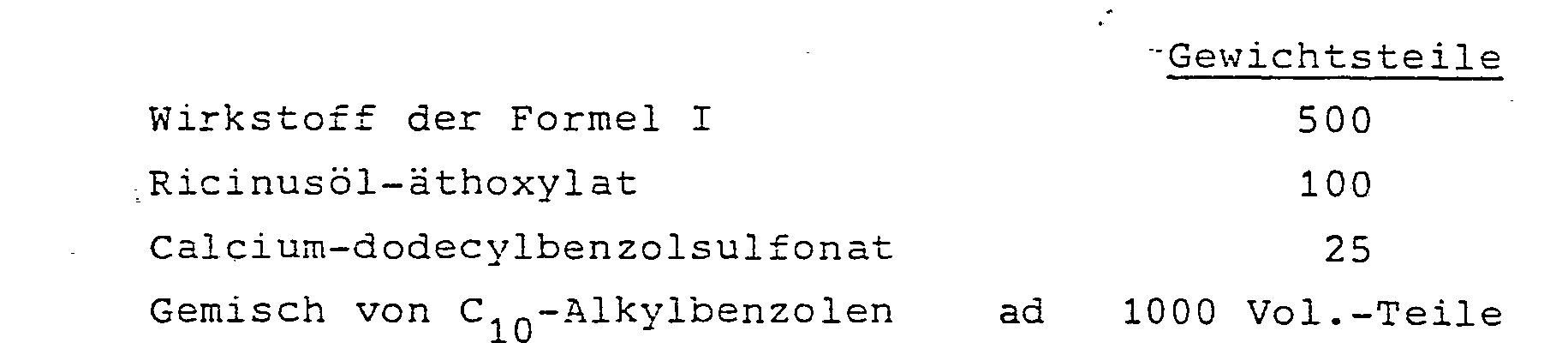
- Die Komponenten werden miteinander vermischt, bis eine klare Lösung entsteht.
Claims (25)


Priority Applications (1)
| Application Number | Priority Date | Filing Date | Title |
|---|---|---|---|
| AT81107990T ATE11286T1 (de) | 1980-10-10 | 1981-10-06 | Pyridin- und pyrazin-derivate, herstellung dieser verbindungen, fungizide mittel, die diese verbindungen als wirkstoffe enthalten sowie verwendung solcher verbindungen bzw. mittel zur bekaempfung von fungi in der landwirtschaft und im gartenbau. |
Applications Claiming Priority (4)
| Application Number | Priority Date | Filing Date | Title |
|---|---|---|---|
| CH7584/80 | 1980-10-10 | ||
| CH758480 | 1980-10-10 | ||
| CH4642/81 | 1981-07-15 | ||
| CH464281 | 1981-07-15 |
Publications (3)
| Publication Number | Publication Date |
|---|---|
| EP0049854A2 true EP0049854A2 (de) | 1982-04-21 |
| EP0049854A3 EP0049854A3 (en) | 1982-04-28 |
| EP0049854B1 EP0049854B1 (de) | 1985-01-16 |
Family
ID=25695975
Family Applications (1)
| Application Number | Title | Priority Date | Filing Date |
|---|---|---|---|
| EP81107990A Expired EP0049854B1 (de) | 1980-10-10 | 1981-10-06 | Pyridin- und Pyrazin-Derivate, Herstellung dieser Verbindungen, fungizide Mittel, die diese Verbindungen als Wirkstoffe enthalten sowie Verwendung solcher Verbindungen bzw. Mittel zur Bekämpfung von Fungi in der Landwirtschaft und im Gartenbau |
Country Status (15)
| Country | Link |
|---|---|
| US (1) | US4605656A (de) |
| EP (1) | EP0049854B1 (de) |
| AR (1) | AR231633A1 (de) |
| AU (1) | AU552881B2 (de) |
| BR (1) | BR8106236A (de) |
| CA (1) | CA1225092A (de) |
| DD (1) | DD202092A5 (de) |
| DE (1) | DE3168350D1 (de) |
| ES (2) | ES8301945A1 (de) |
| GB (1) | GB2085007B (de) |
| HU (1) | HU187375B (de) |
| KE (1) | KE3484A (de) |
| NZ (1) | NZ198534A (de) |
| OA (1) | OA06918A (de) |
| PL (1) | PL233387A1 (de) |
Cited By (24)
| Publication number | Priority date | Publication date | Assignee | Title |
|---|---|---|---|---|
| FR2523966A1 (fr) * | 1982-03-26 | 1983-09-30 | Hoffmann La Roche | Derives de pyridine et de pyrazine, leur preparation et leur application en tant qu'agents fongicides |
| DE3310148A1 (de) * | 1982-03-31 | 1983-10-06 | Hoffmann La Roche | Heterocyclische verbindungen |
| EP0385267A3 (de) * | 1989-03-01 | 1991-09-04 | Ciba-Geigy Ag | Pyridinderivate, deren Herstellung und Verwendung als Fungizide |
| EP0445069A1 (de) * | 1990-02-16 | 1991-09-04 | Ciba-Geigy Ag | Heterocyclische Verbindungen |
| EP0461487A3 (en) * | 1990-06-07 | 1992-01-02 | Basf Aktiengesellschaft | Beta picoline derivatives and plant protecting agents containing them |
| WO2009040397A1 (en) | 2007-09-26 | 2009-04-02 | Basf Se | Ternary fungicidal compositions comprising boscalid and chlorothalonil |
| EP2258177A2 (de) | 2006-12-15 | 2010-12-08 | Rohm and Haas Company | Mischungen mit 1-Methylcyclopropen |
| WO2011026796A1 (en) | 2009-09-01 | 2011-03-10 | Basf Se | Synergistic fungicidal mixtures comprising lactylates and method for combating phytopathogenic fungi |
| EP2392662A2 (de) | 2007-04-23 | 2011-12-07 | Basf Se | Pflanzenproduktivitätserhöhung durch Kombination chemischer Wirkstoffe mit transgenen Modifikationen |
| WO2012084670A1 (en) | 2010-12-20 | 2012-06-28 | Basf Se | Pesticidal active mixtures comprising pyrazole compounds |
| EP2481284A2 (de) | 2011-01-27 | 2012-08-01 | Basf Se | Pestizidgemische |
| EP2489268A2 (de) | 2006-09-18 | 2012-08-22 | Basf Se | Pestizide Mischungen, die ein Anthranilamidinsektizid und ein Fungizid enthalten |
| WO2012127009A1 (en) | 2011-03-23 | 2012-09-27 | Basf Se | Compositions containing polymeric, ionic compounds comprising imidazolium groups |
| WO2013030338A2 (en) | 2011-09-02 | 2013-03-07 | Basf Se | Agricultural mixtures comprising arylquinazolinone compounds |
| WO2013189801A1 (en) | 2012-06-20 | 2013-12-27 | Basf Se | Pyrazole compound and pesticidal mixtures comprising a pyrazole compound |
| EP2679096A1 (de) | 2007-02-06 | 2014-01-01 | Basf Se | Pestizidgemische |
| WO2014056780A1 (en) | 2012-10-12 | 2014-04-17 | Basf Se | A method for combating phytopathogenic harmful microbes on cultivated plants or plant propagation material |
| WO2014095994A1 (en) | 2012-12-20 | 2014-06-26 | Basf Se | Compositions comprising a triazole compound |
| EP2783569A1 (de) | 2013-03-28 | 2014-10-01 | Basf Se | Zusammensetzungen mit einer Triazol-Verbindung |
| EP2835052A1 (de) | 2013-08-07 | 2015-02-11 | Basf Se | Fungizide Mischungen mit Pyrimidinfungiziden |
| WO2015036058A1 (en) | 2013-09-16 | 2015-03-19 | Basf Se | Fungicidal pyrimidine compounds |
| WO2015036059A1 (en) | 2013-09-16 | 2015-03-19 | Basf Se | Fungicidal pyrimidine compounds |
| EP2979549A1 (de) | 2014-07-31 | 2016-02-03 | Basf Se | Verfahren zur verbesserung der gesundheit einer pflanze |
| US10899932B2 (en) | 2014-10-24 | 2021-01-26 | Basf Se | Non-amphoteric, quaternisable and water-soluble polymers for modifying the surface charge of solid particles |
Families Citing this family (2)
| Publication number | Priority date | Publication date | Assignee | Title |
|---|---|---|---|---|
| US5493024A (en) * | 1991-04-11 | 1996-02-20 | Dowelanco | 3,4,N-trisubstituted-4,5-dihydro-1H-pyrazole-1-carboxamides and their use as insectioides |
| BRPI0509093A (pt) * | 2004-04-27 | 2007-08-28 | Basf Aktiengeeellschaft | misturas fungicidas para combater fungos nocivos fitopatogênicos, agente, processo para combater fungos nocivos, semente, e, uso dos compostos |
Family Cites Families (9)
| Publication number | Priority date | Publication date | Assignee | Title |
|---|---|---|---|---|
| US3205234A (en) * | 1961-06-30 | 1965-09-07 | Upjohn Co | Nu-oxides of pyridyl ketone omicron-hydrocarbonoximes |
| US3167563A (en) * | 1962-03-05 | 1965-01-26 | Upjohn Co | O-(ring-substituted) benzyl ethers of acyl-pyridineoxime 1-oxides |
| DE2723942C2 (de) * | 1977-05-27 | 1982-11-11 | Basf Ag, 6700 Ludwigshafen | ω-(1,2,4-Triazol-1-yl) acetophenonoximäther |
| GB2015524A (en) * | 1978-03-06 | 1979-09-12 | Ici Ltd | Pyridine derivatives |
| US4297359A (en) * | 1978-07-25 | 1981-10-27 | Acf Chemiefarma Nv | Anti-ulcer compositions containing certain pyridyl oxime ethers |
| US4352804A (en) * | 1978-07-25 | 1982-10-05 | Acf Chemiefarma Nv | Oxime ethers, their preparation and pharmaceutical compositions containing them |
| US4263305A (en) * | 1979-03-12 | 1981-04-21 | Interx Research Corporation | Novel pyridiniumaldoximes having micellar characteristics |
| US4244959A (en) * | 1979-07-02 | 1981-01-13 | Chevron Research Company | Fungicidal O-acyl (alpha-nitro-formaldoxime) and (alpha-halo-formaldoxime)-pyridines |
| US4305947A (en) * | 1980-08-26 | 1981-12-15 | Survival Technology, Inc. | Stable aqueous solutions of pralidoxime salts |
-
1981
- 1981-08-21 CA CA000384356A patent/CA1225092A/en not_active Expired
- 1981-09-29 BR BR8106236A patent/BR8106236A/pt unknown
- 1981-10-02 NZ NZ198534A patent/NZ198534A/en unknown
- 1981-10-05 DD DD81233896A patent/DD202092A5/de unknown
- 1981-10-06 DE DE8181107990T patent/DE3168350D1/de not_active Expired
- 1981-10-06 EP EP81107990A patent/EP0049854B1/de not_active Expired
- 1981-10-07 HU HU812893A patent/HU187375B/hu unknown
- 1981-10-08 OA OA57513A patent/OA06918A/xx unknown
- 1981-10-09 ES ES506141A patent/ES8301945A1/es not_active Expired
- 1981-10-09 AR AR287049A patent/AR231633A1/es active
- 1981-10-09 AU AU76185/81A patent/AU552881B2/en not_active Expired
- 1981-10-09 PL PL23338781A patent/PL233387A1/xx unknown
- 1981-10-09 GB GB8130521A patent/GB2085007B/en not_active Expired
-
1982
- 1982-05-11 ES ES512076A patent/ES512076A0/es active Granted
-
1983
- 1983-10-21 US US06/736,061 patent/US4605656A/en not_active Expired - Lifetime
-
1984
- 1984-12-07 KE KE3484A patent/KE3484A/xx unknown
Cited By (34)
| Publication number | Priority date | Publication date | Assignee | Title |
|---|---|---|---|---|
| FR2523966A1 (fr) * | 1982-03-26 | 1983-09-30 | Hoffmann La Roche | Derives de pyridine et de pyrazine, leur preparation et leur application en tant qu'agents fongicides |
| DE3310148A1 (de) * | 1982-03-31 | 1983-10-06 | Hoffmann La Roche | Heterocyclische verbindungen |
| FR2524466A1 (fr) * | 1982-03-31 | 1983-10-07 | Hoffmann La Roche | Composes heterocycliques azotes, leur preparation et produits fongicides en contenant |
| EP0385267A3 (de) * | 1989-03-01 | 1991-09-04 | Ciba-Geigy Ag | Pyridinderivate, deren Herstellung und Verwendung als Fungizide |
| EP0445069A1 (de) * | 1990-02-16 | 1991-09-04 | Ciba-Geigy Ag | Heterocyclische Verbindungen |
| EP0461487A3 (en) * | 1990-06-07 | 1992-01-02 | Basf Aktiengesellschaft | Beta picoline derivatives and plant protecting agents containing them |
| EP2489268A2 (de) | 2006-09-18 | 2012-08-22 | Basf Se | Pestizide Mischungen, die ein Anthranilamidinsektizid und ein Fungizid enthalten |
| EP2489265A2 (de) | 2006-09-18 | 2012-08-22 | Basf Se | Pestizide Mischungen, die ein Anthranilamidinsektizid und ein Fungizid enthalten |
| EP2489267A2 (de) | 2006-09-18 | 2012-08-22 | Basf Se | Pestizide Mischungen, die ein Anthranilamidinsektizid und ein Fungizid enthalten |
| EP2489266A2 (de) | 2006-09-18 | 2012-08-22 | Basf Se | Pestizide Mischungen, die ein Anthranilamidinsektizid und ein Fungizid enthalten |
| EP2258177A2 (de) | 2006-12-15 | 2010-12-08 | Rohm and Haas Company | Mischungen mit 1-Methylcyclopropen |
| EP2679096A1 (de) | 2007-02-06 | 2014-01-01 | Basf Se | Pestizidgemische |
| EP2679095A1 (de) | 2007-02-06 | 2014-01-01 | Basf Se | Pestizidgemische |
| EP2679094A1 (de) | 2007-02-06 | 2014-01-01 | Basf Se | Pestizidgemische |
| EP2392662A2 (de) | 2007-04-23 | 2011-12-07 | Basf Se | Pflanzenproduktivitätserhöhung durch Kombination chemischer Wirkstoffe mit transgenen Modifikationen |
| WO2009040397A1 (en) | 2007-09-26 | 2009-04-02 | Basf Se | Ternary fungicidal compositions comprising boscalid and chlorothalonil |
| WO2011026796A1 (en) | 2009-09-01 | 2011-03-10 | Basf Se | Synergistic fungicidal mixtures comprising lactylates and method for combating phytopathogenic fungi |
| WO2012084670A1 (en) | 2010-12-20 | 2012-06-28 | Basf Se | Pesticidal active mixtures comprising pyrazole compounds |
| EP2481284A2 (de) | 2011-01-27 | 2012-08-01 | Basf Se | Pestizidgemische |
| WO2012127009A1 (en) | 2011-03-23 | 2012-09-27 | Basf Se | Compositions containing polymeric, ionic compounds comprising imidazolium groups |
| EP3378313A1 (de) | 2011-03-23 | 2018-09-26 | Basf Se | Zusammensetzungen mit polymeren, ionischen verbindungen mit imidazoliumgruppen |
| WO2013030338A2 (en) | 2011-09-02 | 2013-03-07 | Basf Se | Agricultural mixtures comprising arylquinazolinone compounds |
| EP3300602A1 (de) | 2012-06-20 | 2018-04-04 | Basf Se | Pestizidmischungen mit einer pyrazolverbindung |
| WO2013189801A1 (en) | 2012-06-20 | 2013-12-27 | Basf Se | Pyrazole compound and pesticidal mixtures comprising a pyrazole compound |
| EP3646731A1 (de) | 2012-06-20 | 2020-05-06 | Basf Se | Pestizidmischungen, eine pyrazolverbindung umfassend |
| WO2014056780A1 (en) | 2012-10-12 | 2014-04-17 | Basf Se | A method for combating phytopathogenic harmful microbes on cultivated plants or plant propagation material |
| WO2014095994A1 (en) | 2012-12-20 | 2014-06-26 | Basf Se | Compositions comprising a triazole compound |
| EP3498098A1 (de) | 2012-12-20 | 2019-06-19 | BASF Agro B.V. | Zusammensetzungen enthaltend eine triazol-verbindung |
| EP2783569A1 (de) | 2013-03-28 | 2014-10-01 | Basf Se | Zusammensetzungen mit einer Triazol-Verbindung |
| EP2835052A1 (de) | 2013-08-07 | 2015-02-11 | Basf Se | Fungizide Mischungen mit Pyrimidinfungiziden |
| WO2015036059A1 (en) | 2013-09-16 | 2015-03-19 | Basf Se | Fungicidal pyrimidine compounds |
| WO2015036058A1 (en) | 2013-09-16 | 2015-03-19 | Basf Se | Fungicidal pyrimidine compounds |
| EP2979549A1 (de) | 2014-07-31 | 2016-02-03 | Basf Se | Verfahren zur verbesserung der gesundheit einer pflanze |
| US10899932B2 (en) | 2014-10-24 | 2021-01-26 | Basf Se | Non-amphoteric, quaternisable and water-soluble polymers for modifying the surface charge of solid particles |
Also Published As
| Publication number | Publication date |
|---|---|
| CA1225092A (en) | 1987-08-04 |
| AU7618581A (en) | 1982-04-22 |
| DD202092A5 (de) | 1983-08-31 |
| ES8302660A1 (es) | 1983-02-01 |
| PL233387A1 (de) | 1982-12-20 |
| GB2085007B (en) | 1984-08-08 |
| BR8106236A (pt) | 1982-06-15 |
| AR231633A1 (es) | 1985-01-31 |
| ES506141A0 (es) | 1982-12-16 |
| ES8301945A1 (es) | 1982-12-16 |
| HU187375B (en) | 1985-12-28 |
| OA06918A (fr) | 1983-05-31 |
| KE3484A (en) | 1985-01-25 |
| US4605656A (en) | 1986-08-12 |
| ES512076A0 (es) | 1983-02-01 |
| GB2085007A (en) | 1982-04-21 |
| DE3168350D1 (en) | 1985-02-28 |
| EP0049854B1 (de) | 1985-01-16 |
| AU552881B2 (en) | 1986-06-26 |
| NZ198534A (en) | 1985-03-20 |
| EP0049854A3 (en) | 1982-04-28 |
Similar Documents
| Publication | Publication Date | Title |
|---|---|---|
| EP0049854B1 (de) | Pyridin- und Pyrazin-Derivate, Herstellung dieser Verbindungen, fungizide Mittel, die diese Verbindungen als Wirkstoffe enthalten sowie Verwendung solcher Verbindungen bzw. Mittel zur Bekämpfung von Fungi in der Landwirtschaft und im Gartenbau | |
| DE2429523C2 (de) | ||
| EP0085333A2 (de) | Ether-Derivate von substituierten 1-Hydroxyalkyl-azolen, Verfahren zu ihrer Herstellung sowie ihre Verwendung als Fungizide und Pflanzenwachstumsregulatoren | |
| EP0061051A1 (de) | Substituierte Triazolylmethyl-oxirane, Verfahren zu ihrer Herstellung sowie ihre Verwendung als Zwischenprodukte | |
| EP0055833A1 (de) | Substituierte 1-Azolyl-butan-2-ole, Verfahren zu ihrer Herstellung und ihre Verwendung als Pflanzenschutzmittel sowie als Zwischenprodukte | |
| EP0040744A1 (de) | Aminopropiophenon-oxime, Verfahren zu ihrer Herstellung und ihre Verwendung als Fungizide | |
| EP0071009B1 (de) | Fungizide Alkinyl-azol-Derivate und deren Verwendung | |
| DE1793229B2 (de) | Cyclohexylpentadiensäurederivate, ihre Herstellung und ihre Verwendung als Wachstumsregulatoren für Pflanzen | |
| EP0146047B1 (de) | Mittel zur Beeinflussung des Pflanzenwachstums | |
| EP0004315B1 (de) | 1.1-Diphenyläthenderivate, Verfahren zu ihrer Herstellung und ihre Verwendung als Mikrobizide | |
| EP0158205A2 (de) | (1,2,4-Triazol-1-yl)-methyl-carbinole | |
| EP0062238B1 (de) | 1,3-Dioxolan-Derivate, Herstellung dieser Verbindungen, fungizide Mittel, die diese Verbindungen als Wirkstoffe enthalten sowie Verwendung solcher Verbindungen bzw. Mittel zur Bekämpfung von Fungi in der Landwirtschaft und im Gartenbau | |
| EP0058347B1 (de) | Benzyl-pyrimidinylalkyl-ether, Verfahren zu ihrer Herstellung, ihre Verwendung als Pflanzenwachstumsregulatoren und Fungizide sowie Zwischenprodukte und deren Herstellung | |
| DE3909862A1 (de) | Azolylethylcyclopropane, verfahren zu ihrer herstellung und ihre verwendung als pflanzenschutzmittel | |
| EP0229642B1 (de) | Azolverbindungen und diese enthaltende Fungizide und Wachstumsregulatoren | |
| EP0086901A1 (de) | Azolyl-thioether-Derivate, Verfahren zu ihrer Herstellung sowie ihre Verwendung als Fungizide und Pflanzenwachstumsregulatoren | |
| DE2624529A1 (de) | Aminomethylazol-derivate, verfahren zu ihrer herstellung sowie ihre verwendung als fungizide und zur regulierung des pflanzenwachstums | |
| DD211941A5 (de) | Fungizide mittel und pflanzenwachstumsregulatoren | |
| EP0363766B1 (de) | Azolylmethylcyclopropane und ihre Verwendung als Pflanzenschutzmittel | |
| DD144353A5 (de) | Fungizide mittel | |
| DD158848A5 (de) | Substituierte phenyl-trazolyl-vinyl-ketone,verfahren zu ihrer herstellung sowie ihre verwendung als fungizide | |
| DE3321158A1 (de) | Azolylmethyl-thienyl-carbinol-derivate | |
| DD221343A5 (de) | Fungizide mittel | |
| EP0224056B1 (de) | Triazolylglykolether, Fungizide und Bioregulatoren | |
| DE3941593A1 (de) | Azolylmethylcycloalkanole |
Legal Events
| Date | Code | Title | Description |
|---|---|---|---|
| PUAI | Public reference made under article 153(3) epc to a published international application that has entered the european phase |
Free format text: ORIGINAL CODE: 0009012 |
|
| PUAL | Search report despatched |
Free format text: ORIGINAL CODE: 0009013 |
|
| 17P | Request for examination filed |
Effective date: 19811006 |
|
| AK | Designated contracting states |
Designated state(s): AT BE CH DE FR IT NL |
|
| AK | Designated contracting states |
Designated state(s): AT BE CH DE FR IT NL |
|
| ITF | It: translation for a ep patent filed | ||
| GRAA | (expected) grant |
Free format text: ORIGINAL CODE: 0009210 |
|
| AK | Designated contracting states |
Designated state(s): AT BE CH DE FR IT LI NL |
|
| REF | Corresponds to: |
Ref document number: 11286 Country of ref document: AT Date of ref document: 19850215 Kind code of ref document: T |
|
| REF | Corresponds to: |
Ref document number: 3168350 Country of ref document: DE Date of ref document: 19850228 |
|
| ET | Fr: translation filed | ||
| PLBE | No opposition filed within time limit |
Free format text: ORIGINAL CODE: 0009261 |
|
| STAA | Information on the status of an ep patent application or granted ep patent |
Free format text: STATUS: NO OPPOSITION FILED WITHIN TIME LIMIT |
|
| 26N | No opposition filed | ||
| ITPR | It: changes in ownership of a european patent |
Owner name: CESSIONE;F. HOFFMANN - LA ROCHE AG |
|
| NLS | Nl: assignments of ep-patents |
Owner name: F. HOFFMANN-LA ROCHE AG TE BAZEL, ZWITSERLAND. |
|
| REG | Reference to a national code |
Ref country code: FR Ref legal event code: TP |
|
| REG | Reference to a national code |
Ref country code: CH Ref legal event code: PUE Owner name: F. HOFFMANN-LA ROCHE AG |
|
| REG | Reference to a national code |
Ref country code: CH Ref legal event code: PUE Owner name: CIBA-GEIGY AG |
|
| ITPR | It: changes in ownership of a european patent |
Owner name: CESSIONE;CIBA - GEIGY AG |
|
| NLS | Nl: assignments of ep-patents |
Owner name: CIBA-GEIGY A.G. TE BAZEL, ZWITSERLAND. |
|
| REG | Reference to a national code |
Ref country code: FR Ref legal event code: TP |
|
| ITTA | It: last paid annual fee | ||
| NLV4 | Nl: lapsed or anulled due to non-payment of the annual fee | ||
| NLXE | Nl: other communications concerning ep-patents (part 3 heading xe) |
Free format text: A REQUEST FOR RESTORATION TO THE PRIOR STATE HAS BEEN FILED ON 921113 |
|
| NLXE | Nl: other communications concerning ep-patents (part 3 heading xe) |
Free format text: THE REQUEST FOR RESTORATION TO THE PRIOR STATE AS PROVIDED FOR IN ARTICLE 17A OF THE PATENTS ACT HAS BEEN GRANTED;THE RESTORATION OF THE PATENT HAS BEEN ENTERED IN THE PATENT REGISTER |
|
| REG | Reference to a national code |
Ref country code: CH Ref legal event code: PFA Free format text: CIBA-GEIGY AG TRANSFER- NOVARTIS AG |
|
| NLS | Nl: assignments of ep-patents |
Owner name: NOVARTIS AG |
|
| REG | Reference to a national code |
Ref country code: FR Ref legal event code: TP |
|
| PGFP | Annual fee paid to national office [announced via postgrant information from national office to epo] |
Ref country code: AT Payment date: 20000811 Year of fee payment: 20 |
|
| PGFP | Annual fee paid to national office [announced via postgrant information from national office to epo] |
Ref country code: FR Payment date: 20000822 Year of fee payment: 20 |
|
| PGFP | Annual fee paid to national office [announced via postgrant information from national office to epo] |
Ref country code: BE Payment date: 20000823 Year of fee payment: 20 |
|
| PGFP | Annual fee paid to national office [announced via postgrant information from national office to epo] |
Ref country code: NL Payment date: 20000828 Year of fee payment: 20 Ref country code: DE Payment date: 20000828 Year of fee payment: 20 Ref country code: CH Payment date: 20000828 Year of fee payment: 20 |
|
| BE20 | Be: patent expired |
Free format text: 20011006 *NOVARTIS A.G. |
|
| PG25 | Lapsed in a contracting state [announced via postgrant information from national office to epo] |
Ref country code: LI Free format text: LAPSE BECAUSE OF EXPIRATION OF PROTECTION Effective date: 20011005 Ref country code: CH Free format text: LAPSE BECAUSE OF EXPIRATION OF PROTECTION Effective date: 20011005 |
|
| PG25 | Lapsed in a contracting state [announced via postgrant information from national office to epo] |
Ref country code: NL Free format text: LAPSE BECAUSE OF EXPIRATION OF PROTECTION Effective date: 20011006 Ref country code: AT Free format text: LAPSE BECAUSE OF EXPIRATION OF PROTECTION Effective date: 20011006 |
|
| REG | Reference to a national code |
Ref country code: CH Ref legal event code: PL |
|
| NLV7 | Nl: ceased due to reaching the maximum lifetime of a patent |
Effective date: 20011006 |