EP0050251A2 - Stossdämpfer mit Druckentlastungsmechanismus - Google Patents
Stossdämpfer mit Druckentlastungsmechanismus Download PDFInfo
- Publication number
- EP0050251A2 EP0050251A2 EP81107874A EP81107874A EP0050251A2 EP 0050251 A2 EP0050251 A2 EP 0050251A2 EP 81107874 A EP81107874 A EP 81107874A EP 81107874 A EP81107874 A EP 81107874A EP 0050251 A2 EP0050251 A2 EP 0050251A2
- Authority
- EP
- European Patent Office
- Prior art keywords
- chamber
- vortex
- fluid
- piston
- shock absorber
- Prior art date
- Legal status (The legal status is an assumption and is not a legal conclusion. Google has not performed a legal analysis and makes no representation as to the accuracy of the status listed.)
- Granted
Links
- 230000035939 shock Effects 0.000 title claims abstract description 70
- 239000006096 absorbing agent Substances 0.000 title claims abstract description 53
- 239000012530 fluid Substances 0.000 claims abstract description 151
- 238000004891 communication Methods 0.000 claims abstract description 20
- 238000000638 solvent extraction Methods 0.000 claims 2
- 238000010276 construction Methods 0.000 abstract description 8
- 230000004048 modification Effects 0.000 description 10
- 238000012986 modification Methods 0.000 description 10
- 230000006835 compression Effects 0.000 description 6
- 238000007906 compression Methods 0.000 description 6
- 230000004044 response Effects 0.000 description 5
- 230000000694 effects Effects 0.000 description 3
- 230000002787 reinforcement Effects 0.000 description 3
- 238000007789 sealing Methods 0.000 description 3
- 238000013016 damping Methods 0.000 description 1
- 230000007423 decrease Effects 0.000 description 1
- 238000000034 method Methods 0.000 description 1
- 230000008569 process Effects 0.000 description 1
- 230000001105 regulatory effect Effects 0.000 description 1
- 239000000725 suspension Substances 0.000 description 1
- 238000011144 upstream manufacturing Methods 0.000 description 1
Images





Classifications
-
- F—MECHANICAL ENGINEERING; LIGHTING; HEATING; WEAPONS; BLASTING
- F16—ENGINEERING ELEMENTS AND UNITS; GENERAL MEASURES FOR PRODUCING AND MAINTAINING EFFECTIVE FUNCTIONING OF MACHINES OR INSTALLATIONS; THERMAL INSULATION IN GENERAL
- F16F—SPRINGS; SHOCK-ABSORBERS; MEANS FOR DAMPING VIBRATION
- F16F9/00—Springs, vibration-dampers, shock-absorbers, or similarly-constructed movement-dampers using a fluid or the equivalent as damping medium
- F16F9/32—Details
- F16F9/34—Special valve constructions; Shape or construction of throttling passages
- F16F9/344—Vortex flow passages
Definitions
- the present invention relates generally to a hydraulic shock absorber with a vortex valve therein. More specifically, the invention relates to a shock absorber capable of effectively preventing the shock absorber from producing excessive absorbing force.
- a shock absorber having a vortex chamber in the piston thereof for producing an absorbing force against a shock applied thereto is well known.
- Typical construction of such shock absorber has been disclosed in the United States Patent No. 3,362,508 to Mayer.
- U.S. Patent No. 3,362,508 there is illustrated a shock absorber having a piston in sliding engagement with a cyl.inder, dividing the cylinder into first and second chambers.
- a vortex chamber is mounted on the piston with an axial passageway for communication with the first chamber, tangential and radial passageways for communication with the second chamber, and a member with an opening which is movable with respect to the piston to vary the restriction of the radial and axial passageways.
- a similar vortex valve shock absorber has also been disclosed in the United States Patent No. 3,672,474 to Mayer et al.
- a shock absorber which produces a flowrate tailored to fit a pressure difference relationship, including a laminar flow device and an orifice restriction connected to a radial-and-tangential inlet of a vortex valve, with both connected in parallel to the upstream pressure source.
- Flow across the assemblage will be such that the vortex valve will act like a smaller orifice at lower flows and a large orifice at high flows, or vice versa, due to the shifting of the respective shares of the total flow accommodated by the laminar flow device and the orifice restriction.
- This arrangement is incorporated into a shock absorber to produce improved output damping characteristics.
- U.S. Patent No. 3,672,474 has a means for relieving the excessive fluid pressure in the vortex chamber.
- the relieving means comprises a plurality of radially-extending multiconduit fluid passages.
- the fluid passages permit fluid flow therethrough regulated by the fluid pressure in the vortex chamber.
- Another typical conventional construction of the pressure-relieving means for excessive fluid pressure produced by the vortex in the vortex chamber comprises a fluid passage formed in the piston and a resilient closure member provided for closing one end of the fluid passage in response to a set pressure given to the resilient closure member. According to this construction, the fluid pressure in the vortex chamber can be prevented from increasing excessively.
- the present invention is to improve the conventional construction of the shock absorber with a resilient closure member in order to provide improved shock absorbing characteristics.
- a shock absorber having a piston in which a vortex chamber is formed.
- the vortex chamber communicates with upper and lower fluid chambers via communication passages.
- One of the communication passages opens to the vortex chamber tangentially to produce a vortex in the vortex chamber.
- a resiliently-urged member narrows the area through which the fluid flows, in the normal condition. The member is responsive to fluid pressure exceeding a predetermined value to move in the .direction increasing the area allowing fluid flow.
- a shock absorber comprising a hollow cylinder defining therein a fluid chamber filled with a working fluid, a piston movably disposed within the fluid chamber to divide the fluid chamber into first and second chambers, the piston being formed with a circular recess on one of plane surfaces thereof, a resilient member disposed within the circular recess and defining a vortex chamber together with the piston, the resilient member having means for defining first and second fluid passages for communication between the first chamber and the vortex chamber, the second passage being normally closed and responsive to a pressure difference between the first chamber and the vortex chamber greater than a set pressure provided to the resilient member, and means for establishing communication between the second chamber and the vortex chamber such that the fluid flowing into the vortex chamber from the second chamber generates a vortex in the vortex chamber.
- a shock absorber comprises an inner hollow cylinder defining therein a fluid chamber filled with a working fluid, an outer -hollow cylinder of slightly larger diameter concentric with the inner cylinder, the outer cylinder defining a fluid reservoir chamber outside the inner cylinder;
- the shock absorber has coaxially-arranged inner and outer cylinders 30 and 32.
- the outer cylinder 32 is sealingly closed at both ends with end fittings 34 and 36.
- a cap 38 is engaged at the top of the outer cylinder 32 for closing the top and preventing the end fitting 34 from loosening.
- the concentric inner and outer cylinders, 30 and 32 respectively, are of slightly-differing diameters in order to define a fluid reservoir chamber 40 therebetween.
- the fluid reservoir chamber 40 is filled with a gas to absorb and compensate for the pressure of the working fluid.
- the upper end of the inner cylinder 30 is sealingly closed with .an end fitting 42.
- bottom fitting 200 of the first embodiment is attached to the lower end of the inner cylinder 30 so that it defines a fluid chamber 44 within the inner cylinder.
- a piston 100 of the preferred embodiment is slidably disposed within the fluid chamber 44 to divide the latter into upper and lower chambers, 46 and 48 respectively.
- the piston 100 is fixedly attached onto the lower end of a piston rod 52.
- the piston rod 52 extends upwards through openings 54, 56 and 58 formed in the end fittings 42 and 34 and the cap 38 respectively to connect the piston 100 with the vehicle body, such as an outer shelf (not shown), for example.
- a steering knuckle 60 may be attached on the outer periphery of the outer cylinder adjacent the lower end thereof.
- a spring seat 62 for a suspension spring may also be attached to the outer periphery of the outer cylinder 32.
- the piston 100 has a circular recess 102.
- a pair of vortex passages 104 is . formed in the piston 100, and each has an outer end opening onto the upper surface and an inner end tangentially opening into the circular recess 102.
- a plurality of vertical openings 106 are formed in the piston 100 and extend vertically through an horizontal section 108 of the piston. The upper ends of the vertical openings 106 are closed by an annular valve member 110, the inner edge of which is inserted between the piston rod 52 and the horizontal section 108 of the piston to be fixedly secured.
- a plurality of recesses 112 are formed on the inner periphery of the piston 100 and extend between the lower ends of the vertical openings 106 and of the circular recess 102.
- a disc-shaped plate 114 is disposed within the circular recess 102.
- the disc-shaped plate 114 is formed with an aperture 116 in the central portion thereof.
- the disc-shaped plate 114 is urged in the direction away from the inner surface of the horizontal section 108 by a coil spring 117 to define therebetween a vortex chamber 118.
- a stop ring 120 is secured on the internal circumference of the circular recess 102 near the lower end thereof.
- a sealing pad 122 is mounted on the upper surface of the stop ring 120. In the normal position, the sealing pad 122 contacts the the disc-shaped plate 114.
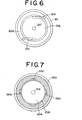
- Figs. 5 to 7 show the first embodiment of the bottom fitting 200 which is attached to the lower end of the inner cylinder 30.
- the bottom fitting 200 has substantially the same construction as that of the piston 100.
- a circular recess 202- is formed in the lower surface of the bottom fitting 200.
- a disc-shaped plate 204 is movably disposed within the circular recess 202 to define therebetween a vortex chamber 206.
- the disc-shaped plate 204 is urged by a coil spring 209 toward an annular stop 208 attached to the internal periphery of the circular recess 202.
- the vortex chamber 206 communicates with the lower chamber 48 via a pair of vortex passages 210 formed in the bottom fitting 200.
- the vortex passage 210 has an outer end opening into the lower chamber 48 and an inner end tangentially opening into the vortex chamber 206.
- the vortex chamber 206 communicates with the lower chamber 48 via a plurality of vertical passages 212 extending vertically through an horizontal section 214 of the bottom fitting.
- An elastic leaf valve member 216 is secured on the upper surface of the horizontal section 214 by a rivet 217 to elastically close the upper end of the vertical passages 212.
- the vortex chamber 206 communicates with the fluid reservoir chamber 40 via a central aperture 218 in the disc-shaped plate 204.
- the bottom fitting 200 is formed with a plurality of recesses 220 extending vertically along the internal periphery of the circular recess 202 and further extending horizontally to the lower end of the vertical passages 214.
- the volume of the upper chamber 46 is increased and, in turn the volume of the lower chamber 48 is reduced to produce fluid flow from the lower chamber to the upper chamber.
- the fluid flows into the vortex chamber 118 via the aperture 116 of the disc-shaped plate 114. If the fluid pressure in the vortex chamber 118 becomes greater than a set pressure, the valve member 110 is displaced from the upper end of the vertical openings 106 to allow the fluid to flow therethrough. Since the aperture l16 of the disc-shaped plate 114 is small enough to limit fluid flow therethrough, the fluid pressure difference between the vortex chamber 110 and the lower chamber 48 increases in accordance with the piston stroke and piston speed.
- the fluid in the lower chamber 48 flows through the vortex passages 210 and into the vortex chamber 206 in the bottom fitting 200. Due to the fluid flow through the vortex passages 210, a vortex is generated in the vortex chamber 206 to produce an absorbing force against the shock. The increase in fluid pressure in the fluid reservoir chamber 40 is partially absorbed by the compressible gas therein.
- the fluid pressure in the upper chamber becomes greater than that of the lower chamber to cause fluid flow from the upper chamber 46 to the lower chamber 48.
- the fluid in the upper chamber 46 at first, flows into the vortex chamber 118 via the vortex passages 104.
- the fluid flow in the vortex chamber 118 produces a vortex limiting the flow of fluid therethrough to produce an absorbing force against the shock.
- the fluid pressure in the fluid reservoir chamber 40 becomes greater than that in the lower chamber 48.
- the fluid in the fluid reservoir chamber 40 flows through the bottom fitting 200 into the lower chamber 48. Fluid flow in this direction is limited by the size of the vortex passage 210 to produce some absorbing force. If the pressure difference between the fluid in the vortex chamber 206 and the fluid reservoir chamber 40 becomes greater than a set pressure of the coil spring 209, the disc-shaped plate 204 is moved upwards to. establish communication between the recesses 220 formed on the internal circumference of the vortex chamber 206 and the fluid reservoir chamber 40 to allow fluid flow.
- the fluid in the vortex chamber flows through the vortex passages 210 at a substantially limited rate and thus fluid pressure builds up in the vortex chamber. If the fluid pressure built up in the vortex chamber 210 becomes greater than a set pressure of the valve member 216, the valve member 216 is displaced from the upper ends of the vertical passages 212 to allow fluid flow therethrough.
- the shock absorbing force in response to relatively small piston stroke and/or piston speed is produced by orifice effect due to the apertures 116 and 218 and vortex passages 104 and 210.
- relatively strong shock absorbing force is produced against a shock in which the piston stroke and/or piston speed is sufficiently great to produce a vortex in either of vortex chambers l18 and 206. If the absorbing force becomes greater than a predetermined value, disc-shaped plates 114 and 204 are moved to relieve the absorbing force in order to provide riding comfort.
- the bottom fitting becomes effective to produce greater absorbing force than that produced by the piston, and the absorbing force of the piston becomes greater than that of the bottom fitting in the piston expansion stroke.
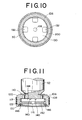
- FIGs. 8 to 11 there are shown modifications of the first embodiment of the present invention.
- the first modification of the piston to be employed in the shock absorber of Fig. 1 is illustrated.
- the shape of the disc-shaped plate 130 is different from. its counterpart in the first embodiment.
- the disc-shaped plate 130 is formed with a plurality of substantially L-shaped cut-outs 132 leading from the circumference thereof.
- the disc-shaped plate 130 is urged by a coil spring 136 toward a stop 134 secured on the internal circumference of the circular recess 102.
- the disc-shaped plate 130 functions substantially the same as that of the foregoing disc-shaped plate of the first embodiment.
- Fig. 11 shows a further modification of the first embodiment of the present invention, in which an annular projection 140 is formed on the lower surface of the horizontal section 108 of the piston 100.
- the annular projection 140 limits the upward motion of the disc-shaped plate 142 for maintaining a minimum volume in the vortex chamber 144.
- the disc-shaped plate 142 is formed with a plurality of cut-outs 146.
- the piston 150 generally comprises an upper member 152 with a circular recess 154 on the lower surface thereof and an .annular lower member 156 with a bore 158.
- the bore 158 of the lower member 156 has the same diameter to that of the circular recess 154.
- the upper member 152 is formed with a cut-out 160 along the inner edge of the lower end thereof.
- the lower member 156 is formed with a cut-out 162 along the outer edge of its upper end to mate with the cut-out of the upper member.
- the upper and lower members 152 and 156 are engaged with each other and secure therebetween the circumferential edge 163 of a resilient plate 164.
- the resilient plate 164 in conjunction with the upper member 156 defines a vortex chamber 166.
- a pair of openings 168 is formed vertically in the upper member 152 near the circumference thereof.
- the openings 168 are connected to vortex passages 170 having inner ends tangentially opening into the vortex chamber 166.
- the openings 168 in turn, open to the upper chamber 46 and thus establish communication between the upper chamber 46 and the vortex chamber 166.
- a plurality of one-way passages 172 are formed vertically in a horizontal section 174 of the upper member 152.
- the upper end of the one-way passages 172 are closed by a resilient valve member 176 which is secured between the upper horizontal surface of the upper member 152 and the lower end of the piston rod 52.
- the resilient plate 164 is formed with a central circular opening 178 and a plurality of round-ended slots 180 extending radially from the central opening 178.
- the sections of the resilient member 164 separated by the slots 180 are deformed in response to a sufficiently great fluid pressure difference between the vortex chamber 166 and the lower chamber 48.
- Figs. 14 and-15 show the second embodiment of the bottom fitting 250 according to the present invention.
- the bottom fitting 250 is formed with a stepped circular recess 252 including upper and lower sections, 254 and 256 respectively.
- an annular fitting 258 is received in the lower section 256.
- a resilient plate 260 is secured between the horizontal plane 262 of the step between the upper and lower recesses and the fitting 258.
- the resilient plate 260 in conjunction with the upper section 254 of the recess 252 defines a vortex chamber 264.
- the vortex chamber 264 communicates with the lower chamber 48 via a pair of vertical passages 266 and vortex passages 268.
- One-way passages 270 are formed in the horizontal section of the bottom fitting 250.
- the upper ends of the one-way passages 270 are closed by a resilient valve member 272 which is secured on the upper surface of the bottom fitting with a rivet 274.
- the resilient plate 260 is formed with a central circular opening 276 and a plurality of round-ended slots 278.
- the sections of the resilient plate 260 separated by the slots 278 are deformable in response to the pressure difference between the vortex chamber 264 and the fluid reservoir chamber 40.
- the volume of the upper chamber 46 is increased and the volume of the lower chamber 48 is reduced to produce a pressure difference between the fluid in the upper and lower chambers 46 and 48. Due to the produced pressure difference, the fluid in the lower chamber 48 flows to the upper chamber via the piston vortex chamber 166. During the fluid flow from the lower chamber 48 to the vortex chamber 166, the flow of the fluid "is limited by the central opening 178 to generate an absorbing force against the shock applied to the shock absorber. If the pressure difference between the lower chamber 48 and the vortex chamber 166 becomes greater than a set pressure provided for the resilient plate 164, the sections separated by the slots 180 are deformed to increase the area allowing the fluid flow therethrough. This will serve as a relief valve for preventing surge in the fluid flow during the piston compression stroke.
- the fluid in the lower chamber 48 flows into the vortex chamber 264 of the bottom fitting 250 via the vortex passages 270 to generate a vortex in the vortex chamber 264. Due to the vortex in the vortex chamber 264, the flow of the fluid in the lower chamber 48 to the vortex chamber 264 is limited to create the absorbing force against the shock applied to the shock absorber.
- the fluid in the reservoir chamber -40 and in the upper chamber 46 flows into the lower chamber 48 via the vortex chambers 166 and 264.
- a vortex is generated in the vortex chamber 166 to limit the flow of the fluid in the upper chamber, thus acting to absorb the shock applied to the shock absorber.
- the central opening 276 of the resilient plate 260 serves to limit the flow of the fluid in the .fluid reservoir chamber 40. If the pressure difference between the fluid reservoir chamber 40 and the vortex chamber 264 becomes greater than a set pressure of the resilient plate 260, the sections separated by the slots 278 are deformed to increase the effective cross-sectional area of the central opening 276.
- the slots 180 and 278 permit increase of the area permitting fluid flow. This prevents the shock absorber from creating absorbing force greater than a predetermined value. Also, the resilient plates 164 and 260 serve as .pressure-relief valves for preventing surge in the fluid- flow.
- Fig. 16 shows characteristics of the absorbing force produced by the shock absorber having the piston and bottom fitting according to the second embodiment as set forth hereabove.
- the dashed line indicates characteristics of a prior-art shock absorber.
- the absorbing force in Fig. 16 varies corresponding to the piston speed and piston stroke.
- the relief valve provided in the piston and the bottom fitting serves for relieving the absorbing force when the absorbing force produced becomes greater than a predetermined value.
- Figs. 17 to 21 show embodiments of the present invention showing the piston of the present invention employed in a double-action shock absorber.
- the shock absorber comprises a hollow cylinder 330 and a piston 400 movably disposed within the cylinder 330.
- the piston 400 is secured on the lower end of a piston rod 334 which has an upper end extending out of the cylinder 330 and attached to . a vehicle body chassis (not shown).
- the- lower end of the cylinder 330 is attached to a wheel axle (not shown).
- a free piston 336 with annular sealing ring 338 is also movably disposed within the tube to define within the cylinder 330 a pneumatic chamber 340.
- a chamber 342 defined within the cylinder 330 and filled with a working fluid is divided into upper and lower chambers 344 and 346 respectively by the piston 400.
- the piston 400 comprises upper and lower predominately disc-shaped members 402 and 404 respectively formed with horizontally- oriented circular recesses 406 and 408 respectively.
- the upper and lower members are formed with recesses 410 and 412 respectively on the circumferences thereof.
- Vortex passages 414 and 416 are defined in the piston 4.00 such that the outer ends of the vortex passages 414 and 416 open toward the recesses 410 and 412 respectively and the inner ends thereof open toward the recesses 406 and 408 respectively.
- the inner ends of the vortex passages 414 and 416 are directed tangentially along the circumference of the recesses 406 and 408 respectively.
- a resilient plate 418 is interposed between the upper and lower members 402 and 404.
- the resilient plate 418 has a diameter substantially equal to that of the recesses 406 and 408.
- the resilient plate 418 is formed with a plurality of slots 420 extending from the center thereof.
- the sections 422 of the resilient plate 418 separated by the slots 420 are deformable responsive to the pressure- difference between the upper and lower sides thereof.
- the planes having the recesses 406 and 408 face each other.
- the resilient plate 418 is mounted within the recesses 406 and 408.
- the upper and lower members 402 and 404 are secured to one another with the resilient plate therebetween.
- the assembled piston 400 defines upper and lower vortex chambers 424 and 426, respectively, therein.
- the piston 400 has vertical vortex passages 428 on its circumference, which are defined by the internal periphery of the cylinder 330 and the recesses 410 and 412. The vertical vortex passages 428 establish communication between the vortex chambers 424 and 426.
- the upper member 402 of the piston 400 is provided with a projecting portion 430 with a threaded bore 432 on the surface facing the piston rod 334.
- the piston rod 334 has a threaded portion 434 at the lower end thereof.
- the threaded portion 434 engages with the threaded bore 432 for attaching the piston 400 onto the lower end of the piston rod 334.
- a dish-shaped member 348 is mounted on the top of the projecting portion 430 and secured thereto by engagement of the threaded portion 434 and the threaded bore 432.
- a pair of radial passages 436 extend radially through the projecting portion 430.
- The- outer ends of the passages 436 open into the upper fluid chamber 344 at the circumference of the projecting portion 430 and the inner ends thereof open toward the threaded bore 432.
- the threaded bore 432 in turn, communicates with the upper vortex chamber 424 via an opening 350.
- the lower member 404 of the piston 400 is formed with an opening 352 in its central portion for communication between the lower vortex chamber 426 and the lower fluid chamber 346.
- the volume of the lower fluid chamber 346 is reduced corresponding to the downward movement of the piston 400 to increase the fluid .pressure therein.
- the downward movement of the piston 400 decreases the fluid pressure in the upper fluid chamber 344 due to expansion of the volume of that chamber.
- the fluid in the lower chamber 346 flows into the upper chamber 344 via the piston 400.
- the fluid in the lower fluid chamber 346 enters the lower vortex chamber through the opening 352.
- the fluid flows via the lower vortex chamber 426, the vortex passage 408, the vertical vortex passage 428 and the vortex passage 406 into the upper vortex chamber 424.
- the fluid is discharged into the upper chamber 424 along a tangent to the circle of the upper vortex chamber 424 in order to produce a vortex therein.
- the fluid flows into the upper chamber 344 via the opening 350 and the passages 436.
- the- fluid passages 436 serve as orifices to limit the flow therethrough.
- the vortex passages 408 and 406 limit the flow of fluid therethrough to produce resistance against fluid flow.
- the resistance against the fluid flow produced by the vortex in the upper vortex chamber 424 is insignificant.
- the fluid passages 436 and the vortex passages 425 and 427 serve to provide resistance against the fluid flow at this time.
- the absorbing force against the shock which, in turn, corresponds to the resistance against the fluid flow, is mainly produced by the orifice effect provided by the fluid passages 436 and the vortex passages 416 and 414.
- the resistance against the fluid flow provided by the vortex in the upper vortex chamber 424 becomes sufficient to absorb the shock.
- the threshold where the piston stroke becomes great enough to absorb the shock is determined by the dimensional relationship between the effective cross-sectional area of the piston and the cross-sectional area of the vortex chamber.
- the sections 422 of the resilient plate 418 are deformed toward the lower vortex chamber 426. This permits unhindered fluid flow- between the lower and upper vortex chambers and thus relieves the fluid pressure in the upper vortex chamber 424. This will prevent the shock absorber from producing too much absorbing force against the shock applied thereto.
- the fluid flow is directed from the upper chamber 344 to the lower chamber 346.
- the fluid flowing from the upper chamber 344 flows through the upper vortex chamber 424 to the lower vortex chamber 426 to produce the vortex therein.
- the resistance against the fluid flow produced by the vortex is in the lower vortex chamber 426 is insignificant.
- the absorbing force corresponds mainly to office effect provided by the radial passages 436 and the vortex passages 416 and 414.
- the resilient plate 418 serves as a pressure-relief valve for relieving excessive fluid pressure in the lower vortex chamber.
- the third embodiment . illustrated can be modified otherwise.
- Figs.-20 and 21 show a modification of the third embodiment of the present invention.
- the resilient plate 440 is provided with an annular reinforcement member 442 on both surfaces thereof along the circumferential edge.
- the reinforcement member 442 is secured between the upper and lower members 402 and 404 to togetherer with the resilient plate 440.
- the reinforcement member 442 serves to apply tension to .the resilient plate so that the resilience of the resilient place serves solely for valve purposes and not for structural purposes.
- the present invention fulfills all of the objects and advantages sought thereto.
Landscapes
- Engineering & Computer Science (AREA)
- General Engineering & Computer Science (AREA)
- Mechanical Engineering (AREA)
- Fluid-Damping Devices (AREA)
Applications Claiming Priority (4)
| Application Number | Priority Date | Filing Date | Title |
|---|---|---|---|
| JP14779380U JPS614758Y2 (de) | 1980-10-16 | 1980-10-16 | |
| JP147793/80 | 1980-10-16 | ||
| JP151737/80 | 1980-10-29 | ||
| JP15173780A JPS5776337A (en) | 1980-10-29 | 1980-10-29 | Shock absorber |
Publications (3)
| Publication Number | Publication Date |
|---|---|
| EP0050251A2 true EP0050251A2 (de) | 1982-04-28 |
| EP0050251A3 EP0050251A3 (en) | 1983-01-12 |
| EP0050251B1 EP0050251B1 (de) | 1985-01-23 |
Family
ID=26478234
Family Applications (1)
| Application Number | Title | Priority Date | Filing Date |
|---|---|---|---|
| EP81107874A Expired EP0050251B1 (de) | 1980-10-16 | 1981-10-02 | Stossdämpfer mit Druckentlastungsmechanismus |
Country Status (3)
| Country | Link |
|---|---|
| US (1) | US4407397A (de) |
| EP (1) | EP0050251B1 (de) |
| DE (1) | DE3168513D1 (de) |
Families Citing this family (7)
| Publication number | Priority date | Publication date | Assignee | Title |
|---|---|---|---|---|
| JPS58211037A (ja) * | 1982-05-31 | 1983-12-08 | Nissan Motor Co Ltd | シヨツクアブソ−バ |
| US4601309A (en) * | 1985-04-23 | 1986-07-22 | The United States Of America As Represented By The United States Department Of Energy | Valve and dash-pot assembly |
| FR2636390B1 (fr) * | 1988-09-14 | 1994-02-18 | Peugeot Automobiles | Verin de suspension hydropneumatique pour vehicule |
| US5070972A (en) * | 1990-06-18 | 1991-12-10 | General Motors Corporation | Vortex valving assembly for a hydraulic damper |
| KR101288612B1 (ko) | 2011-07-21 | 2013-07-22 | 주식회사 만도 | 쇽업소버의 밸브 구조 |
| US9611915B2 (en) * | 2011-07-21 | 2017-04-04 | Mando Corporation | Valve structure of shock absorber |
| US11448286B2 (en) * | 2017-04-27 | 2022-09-20 | Prospira Corporation | Vibration-damping device |
Family Cites Families (12)
| Publication number | Priority date | Publication date | Assignee | Title |
|---|---|---|---|---|
| US2181415A (en) * | 1935-12-14 | 1939-11-28 | Donald E Willard | Valve mechanism for shock absorbers |
| FR845638A (fr) * | 1937-11-10 | 1939-08-29 | Kronprinz Ag Fu R Metallindust | Dispositif de suspension applicable par exemple aux trains d'atterrissage pour avions |
| FR868980A (fr) * | 1939-08-02 | 1942-01-21 | Valve ou clapet particulièrement utilisable dans les amortisseurs hydrauliques | |
| DE900061C (de) * | 1943-06-11 | 1953-12-17 | Fichtel & Sachs Ag | Anordnung von Plattenventilen an Teleskopstossdaempfern, insbesondere fuer Kraftfahrzeuge |
| DE909661C (de) * | 1950-11-18 | 1954-04-22 | Stabilus Ind Und Handelsgesell | Ventilanordnung fuer Fluessigkeits-Stossdaempfer |
| DE1123164B (de) * | 1959-08-05 | 1962-02-01 | Stabilus Ind Und Handelsgesell | Hydraulischer Stossdaempfer |
| DE1287867B (de) * | 1966-06-06 | 1969-01-23 | ||
| US3672474A (en) * | 1970-02-16 | 1972-06-27 | Bendix Corp | Fluid flow device for a shock absorber |
| DE2302310A1 (de) * | 1973-01-18 | 1974-07-25 | Hemscheidt Maschf Hermann | Hydraulischer schwingungsdaempfer |
| US4082169A (en) * | 1975-12-12 | 1978-04-04 | Bowles Romald E | Acceleration controlled fluidic shock absorber |
| US4114735A (en) * | 1976-03-15 | 1978-09-19 | Tokico Ltd. | Hydraulic damper and valve structure |
| GB2044882B (en) * | 1979-02-27 | 1983-10-26 | Nissan Motor | Hydraulic shock absorber with vortex valve |
-
1981
- 1981-09-28 US US06/306,181 patent/US4407397A/en not_active Expired - Fee Related
- 1981-10-02 DE DE8181107874T patent/DE3168513D1/de not_active Expired
- 1981-10-02 EP EP81107874A patent/EP0050251B1/de not_active Expired
Also Published As
| Publication number | Publication date |
|---|---|
| US4407397A (en) | 1983-10-04 |
| EP0050251A3 (en) | 1983-01-12 |
| DE3168513D1 (en) | 1985-03-07 |
| EP0050251B1 (de) | 1985-01-23 |
Similar Documents
| Publication | Publication Date | Title |
|---|---|---|
| US4442925A (en) | Vortex flow hydraulic shock absorber | |
| CN101541571B (zh) | 具有无级半主动阀的减振器 | |
| CA1263414A (en) | Restriction valve device for hydraulic pressure fluids in vehicle shock absorbing mechanisms | |
| US4203507A (en) | Shock absorber | |
| CA1310989C (en) | Shock absorber with variable damping characteristics depending upon stroke speed | |
| US5538276A (en) | Tunable air spring | |
| US8511447B2 (en) | Triple tube shock absorber having a shortened intermediate tube | |
| AU578785B2 (en) | A restriction valve device for hydraulic pressure fluids in vehicle shock absorbing mechanisms | |
| JPS6213534B2 (de) | ||
| GB2070730A (en) | Shock absorber piston valves | |
| US20010009214A1 (en) | Hydraulic damper for suspension systems | |
| US4515252A (en) | Piston stroke responsive vortex-flow shock absorber | |
| EP0122532B1 (de) | Stossdämpfer | |
| US4407397A (en) | Shock absorber with pressure-relief mechanism | |
| GB2044882A (en) | Hydraulic shock absorber with vortex valve | |
| US6039159A (en) | Shock absorber arrangement and use | |
| US4687187A (en) | Oleopneumatic suspension for vehicles, suitable in particular for motorcycles | |
| EP0053378B1 (de) | Wirbelströmungsventil mit Druckentlastungsvorrichtung für Stossdämpfer | |
| FR2355210A1 (fr) | Perfectionnement aux amortisseurs hydrauliques telescopiques | |
| US4475635A (en) | Vortex flow shock absorber with one-way valve | |
| US6148969A (en) | Frequency dependant damper | |
| EP0047954B1 (de) | Hydraulischer Stossdämpfer mit Wirbelströmung | |
| JPH023052B2 (de) | ||
| EP0049844B1 (de) | Stossdämpfer mit Leitblech für die Wirbelströmung | |
| JP3988092B2 (ja) | 減衰力調整式油圧緩衝器 |
Legal Events
| Date | Code | Title | Description |
|---|---|---|---|
| PUAI | Public reference made under article 153(3) epc to a published international application that has entered the european phase |
Free format text: ORIGINAL CODE: 0009012 |
|
| AK | Designated contracting states |
Designated state(s): DE FR GB |
|
| PUAL | Search report despatched |
Free format text: ORIGINAL CODE: 0009013 |
|
| AK | Designated contracting states |
Designated state(s): DE FR GB |
|
| 17P | Request for examination filed |
Effective date: 19821207 |
|
| GRAA | (expected) grant |
Free format text: ORIGINAL CODE: 0009210 |
|
| AK | Designated contracting states |
Designated state(s): DE FR GB |
|
| REF | Corresponds to: |
Ref document number: 3168513 Country of ref document: DE Date of ref document: 19850307 |
|
| ET | Fr: translation filed | ||
| RAP2 | Party data changed (patent owner data changed or rights of a patent transferred) |
Owner name: NISSAN MOTOR CO., LTD. |
|
| PLBE | No opposition filed within time limit |
Free format text: ORIGINAL CODE: 0009261 |
|
| STAA | Information on the status of an ep patent application or granted ep patent |
Free format text: STATUS: NO OPPOSITION FILED WITHIN TIME LIMIT |
|
| 26N | No opposition filed | ||
| GBPC | Gb: european patent ceased through non-payment of renewal fee | ||
| PG25 | Lapsed in a contracting state [announced via postgrant information from national office to epo] |
Ref country code: FR Free format text: LAPSE BECAUSE OF NON-PAYMENT OF DUE FEES Effective date: 19880630 |
|
| PG25 | Lapsed in a contracting state [announced via postgrant information from national office to epo] |
Ref country code: DE Effective date: 19880701 |
|
| REG | Reference to a national code |
Ref country code: FR Ref legal event code: ST |
|
| PG25 | Lapsed in a contracting state [announced via postgrant information from national office to epo] |
Ref country code: GB Effective date: 19881118 |