EP0050736A1 - Ammoniumsalze von Polymaleinsäuren und ihre Verwendung als Korrosionsinhibitoren in Mineralölen - Google Patents
Ammoniumsalze von Polymaleinsäuren und ihre Verwendung als Korrosionsinhibitoren in Mineralölen Download PDFInfo
- Publication number
- EP0050736A1 EP0050736A1 EP81107454A EP81107454A EP0050736A1 EP 0050736 A1 EP0050736 A1 EP 0050736A1 EP 81107454 A EP81107454 A EP 81107454A EP 81107454 A EP81107454 A EP 81107454A EP 0050736 A1 EP0050736 A1 EP 0050736A1
- Authority
- EP
- European Patent Office
- Prior art keywords
- acid
- mineral oils
- corrosion inhibitors
- acids
- ammonium salts
- Prior art date
- Legal status (The legal status is an assumption and is not a legal conclusion. Google has not performed a legal analysis and makes no representation as to the accuracy of the status listed.)
- Granted
Links
Classifications
-
- C—CHEMISTRY; METALLURGY
- C10—PETROLEUM, GAS OR COKE INDUSTRIES; TECHNICAL GASES CONTAINING CARBON MONOXIDE; FUELS; LUBRICANTS; PEAT
- C10L—FUELS NOT OTHERWISE PROVIDED FOR; NATURAL GAS; SYNTHETIC NATURAL GAS OBTAINED BY PROCESSES NOT COVERED BY SUBCLASSES C10G OR C10K; LIQUIFIED PETROLEUM GAS; USE OF ADDITIVES TO FUELS OR FIRES; FIRE-LIGHTERS
- C10L1/00—Liquid carbonaceous fuels
- C10L1/10—Liquid carbonaceous fuels containing additives
- C10L1/14—Organic compounds
- C10L1/22—Organic compounds containing nitrogen
- C10L1/222—Organic compounds containing nitrogen containing at least one carbon-to-nitrogen single bond
- C10L1/2222—(cyclo)aliphatic amines; polyamines (no macromolecular substituent 30C); quaternair ammonium compounds; carbamates
-
- C—CHEMISTRY; METALLURGY
- C10—PETROLEUM, GAS OR COKE INDUSTRIES; TECHNICAL GASES CONTAINING CARBON MONOXIDE; FUELS; LUBRICANTS; PEAT
- C10L—FUELS NOT OTHERWISE PROVIDED FOR; NATURAL GAS; SYNTHETIC NATURAL GAS OBTAINED BY PROCESSES NOT COVERED BY SUBCLASSES C10G OR C10K; LIQUIFIED PETROLEUM GAS; USE OF ADDITIVES TO FUELS OR FIRES; FIRE-LIGHTERS
- C10L1/00—Liquid carbonaceous fuels
- C10L1/10—Liquid carbonaceous fuels containing additives
- C10L1/14—Organic compounds
- C10L1/22—Organic compounds containing nitrogen
- C10L1/222—Organic compounds containing nitrogen containing at least one carbon-to-nitrogen single bond
- C10L1/224—Amides; Imides carboxylic acid amides, imides
Definitions
- Oil-soluble substances must be used as inhibitors against such corrosion. In addition to a satisfactory protective effect, such substances must also have the property of not acting as little or as little as possible as an emulsifier, so that the condensed water can be removed as quickly as possible.
- the aim of the invention was to find substances which have both the lowest possible emulsifying action and the best possible anticorrosive properties and which are oil-soluble.
- Particularly preferred are C 12 - C 16 alkyl ammonium salts, especially the mono or dialkyl of which are technically Monoisotridecylammoniumsalze of particular interest.
- the oligomaleic acids on which the salts are based can be obtained by various methods which belong to the prior art.
- maleic anhydride (MA) is polymerized in an inert solvent in the presence of acetic anhydride and H 2 0 2 .
- a similar procedure is followed according to DE-OS 20 47 340, according to which acetic anhydride and H202 are also added to the polymerization batch.
- a preferred method is the procedure according to DE-OS 28 40 167, to which reference is expressly made here. This method makes it possible to get from hydrolyzed oligomaleic acid from maleic anhydride in a single operation, which supplies undyed products compared to the above-mentioned processes.
- the reaction takes place at 100 to 140 ° C, preferably 100 to 120 ° C, within 1 to 8 hours.
- the H 2 0 2 can be added immediately or gradually, preferably the hydrogen peroxide is allowed to slowly slowly with strong mechanical movement of the reaction mixture at the temperatures mentioned.
- the addition time is preferably 1 to 5 hours.
- Such acids are non-oxidizing and, for example, hydrochloric acid, sulfuric acid, orthoboric acid, p-toluic acid, phosphoric acid, tartaric acid, citric acid and / or adipic acid may be mentioned.
- Possible reducing agents are, for example, hydrazine, hydroxylamine and their salts, then hydroquinone, pyrogallol, aldehydes, such as formaldehyde, acetaldehyde or glutardialdehyde, and reducing acids, which are preferably recommended because they combine reducing power and acid action, are hypophosphorous acid, phosphorous acid sulfurous acid, then aldehyde acids such as glyoxylic acid, phenol carboxylic acids such as salicylic acid, and sugar acids such as ascorbic acid. Oxalic acid can also be used successfully as a reducing acid.
- the salts according to the invention are obtained by simply mixing or neutralizing the oligomaleic acid obtained with one of the amines according to the definition in an equivalent ratio of 1: 1 until a pH of about 7 is reached.
- the salts are hardly emulsifying, which is surprising given their oil solubility and the presence of hydrophilic groups (polymaleate anions!). It has been shown that when the carbon numbers of the amine component and the molecular weight of the polymaleic acids are exceeded or undershot, the properties of the emulsifying effect deteriorate immediately. In addition, they have a perfectly anticorrosive effect in all types of mineral oils, especially lubricating oils, and are at least equivalent to the state-of-the-art products and in many cases even superior.
- Polymaleic acids in free form or as simple salts are known from US Pat. Nos. 4,105,581 and 4,018,702 and from DE-OS 28 06 342 as corrosion inhibitors.
- these substances only work in pure aqueous systems, since they are not oil-soluble, and, in order to achieve optimal results, they require additions of phosphates or phosphonates (US Pat. No. 4,105,581 and DE-OS 28 02 342), or zinc ions (US Pat. PS 4 018 702).
- the salts according to the invention can be added to the mineral oils in bulk or prediluted in a solvent in amounts of 100 to 10,000 ppm, preferably 100 to 500 ppm.
- solvents are aromatic hydrocarbons or aliphatic alcohols or alcohol mixtures with 6 to 12 carbon atoms.
- Mineral oils to which the corrosion inhibitors can be added are e.g. Petroleum products such as gas oil, gasoline, diesel fuels, heavy and light heating oils and mineral oil lubricants.
- the 35% H 2 0 2 is added dropwise at 105 to 110 ° C within about 5 hours.
- the solution turns dark, but brightens again towards the end of the reaction.
- the mixture is stirred at about 110 ° C. for about 2 hours.
- the low-boiling components water, acetic acid
- water, acetic acid water, acetic acid
- 146.25 g (0.225 mol) of the polymaleic acid are dissolved in 146.25 g of water with stirring, then the pH is adjusted to 7 with 50 g to 60 ° C. with 320 g (1.61 mol) of mono-i-tridecylamine, with up to is stirred to constant pH. Development of two phases. The aqueous phase is separated off and discarded, the org. Evaporated phase in vacuo at 70 ° C and about 20 mbar to dryness.
- steel sheets of a certain composition are immersed in the sample and left to stand in a humidity chamber for 200 h at a certain temperature. After this time, the steel sheets are visually assessed (see table) and the weight difference of the test sheets is also determined.
- the inhibitor to be tested is mixed in increasing amounts with 100 ml of test oil and underlaid with 100 ml of condensed water.
- the prepared weighed test strips are wetted in the inhibited test oil by gentle stirring and then immersed in the aqueous phase. Half of them are in the water phase. The cleaned test strips are then weighed. The evaluation is carried out in comparison to the blank value.
- Additized fuels (petrol) are layered in 100 ml measuring cylinders with a standard buffer solution (pH 6.85) and shaken intensively for 2 minutes. Then, after 5 or 10 minutes, it is assessed visually in accordance with DIN 51 415.
- the emulsion (intermediate phase) can be given in ml.
- the separation layer formed is evaluated as follows: (DIN 51 415)
Landscapes
- Chemical & Material Sciences (AREA)
- Oil, Petroleum & Natural Gas (AREA)
- Engineering & Computer Science (AREA)
- Chemical Kinetics & Catalysis (AREA)
- General Chemical & Material Sciences (AREA)
- Organic Chemistry (AREA)
- Lubricants (AREA)
- Preventing Corrosion Or Incrustation Of Metals (AREA)
- Liquid Carbonaceous Fuels (AREA)
- Anti-Oxidant Or Stabilizer Compositions (AREA)
- Production Of Liquid Hydrocarbon Mixture For Refining Petroleum (AREA)
Abstract
Description
- Wenn Mineralöle, Benzin- oder Dieselkraftstoffe mit Eisen oder eisenhaltigen Metallen in Kontakt kommen, stellt sich das Problem der Korrosion immer dann, wenn Kondenswasser zugegen ist. Solche Kondenswässer können Säuren, Sauerstoff oder Schwefelwasserstoff enthalten, welche alle empfindliche korrosive Schäden bewirken können.
- Als Inhibitoren gegen derartige Korrosionen müssen öllösliche Stoffe eingesetzt werden. Solche Stoffe müssen neben einer befriedigenden Schutzwirkung auch die Eigenschaft besitzen, nicht oder möglichst wenig als Emulgator zu wirken, damit das Kondenswasser möglichst schnell abtrennbar bleibt.
- Für solche Zwecke hat man bisher vor allem bestimmte Amide langkettiger Fettsäuren, insbesondere der Ölsäure vorgeschlagen. So werden z.B. in der DE-PS 11 72 925 Umsetzungsprodukte der Stearin- oder ölsäure mit Diethylentriamin oder ähnlichen Alkylenpolyaminen als Korrosionsschutzmittel beschrieben. Diese Stoffe wirken zwar in Kraftstoffen oder Mineralölen antikorrosiv, jedoch wirken sie stark emulgierend, und man war daher gezwungen, noch weitere Additive zuzusetzen, die desmulgierend wirken.
- Das Ziel der Erfindung bestand in der Auffindung von Stoffen, die sowohl eine möglichst geringe Emulgierwirkung als auch möglichst gute antikorrosive Eigenschaften zeigen, und die öllöslich sind.
- Dieses Ziel wird erfindungsgemäß mit den Ammoniumsalzen von niedermolekularen Polymaleinsäuren (Oligomaleinsäuren) erreicht, wie sie im Patentanspruch 1 definiert sind.
- Es handelt sich somit um Salze primärer, sekundärer oder tertiärer Amine von Oligomaleinsäuren des Molgewichts von 200 bis 1500, wobei die Alkyl- oder Alkenylreste des Amins jeweils 9 bis 20 C-Atome enthalten. Besonders bevorzugt sind C12- bis C 16 -Alkylammoniumsalze, vor allem die Mono-oder Dialkylammoniumsalze, von denen Monoisotridecylammoniumsalze technisch von besonderem Interesse sind.
- Die den Salzen zugrundeliegenden Oligomaleinsäuren sind nach verschiedenen Methoden erhältlich, die zum Stand der Technik gehören. Gemäß der GB-PS 1 349 969 wird z.B. Maleinsäureanhydrid (MSA) in einem inerten Lösungsmittel in Gegenwart von Acetanhydrid und H202 polymerisiert. Ähnlich verfährt man auch gemäß der DE-OS 20 47 340, wonach ebenfalls Acetanhydrid und H202 dem Polymerisationsansatz zugefügt werden. Eine bevorzugte Methode stellt die Arbeitsweise gemäß der DE-OS 28 40 167 dar, auf die hier ausdrücklich Bezug genommen wird. Diese Methode erlaubt es, in einem einzigen Arbeitsgang aus Maleinsäureanhydrid zu hydrolysierter Oligomaleinsäure zu gelangen, der gegenüber den oben genannten Verfahren unverfärbte Produkte liefert.
- Man löst Maleinsäureanhydrid in der 1 bis 5fachen molaren Menge (100 bis 500 Molprozent - bezogen auf MSA) Acetanhydrid und gibt bei 80 bis 140oC, vorzugsweise 100 bis 120°C die 0,2 bis 0,5fache molare Menge (20-50 Molprozent, bezogen auf MSA) H202, vorzugsweise in Form einer 30 bis 50 prozentigen wäßrigen Lösung zu. Nach der Zugabe läuft die Reaktion bei 100 bis 140°C, vorzugsweise 100 bis 120°C, innerhalb 1 bis 8 Stunden ab.
- Die Zugabe des H202 kann sofort oder allmählich erfolgen, vorzugsweise läßt man das Wasserstoffperoxid langsam unter starker mechanischer Bewegung des Reaktionsansatzes bei den genannten Temperaturen zulaufen.-Die Zugabedauer beträgt vorzugsweise 1 bis 5 Stunden.
- Zur Beschleunigung der Reaktion und zur Verbesserung der Ausbeuten und der Reinheit der Polymerisate hat es sich als günstig erwiesen, dem Reaktionsansatz geringe Mengen (0,1 bis 3 Gewichtsprozent - bezogen auf MSA -, vorzugsweise 0,1 bis 2 Gewichtsprozent) einer anorganischen oder organischen Säure zuzusetzen.
- Solche Säuren sind nichtoxidierend, und es seien beispielsweise Salzsäure, Schwefelsäure, Orthoborsäure, p-Toluolsäure, Phosphorsäure, Weinsäure, citronensäure und/oder Adipinsäure genannt.
- Ähnlich positiv wirkt sich der Zusatz von Reduktionsmitteln und vor allem von reduzierend wirkenden Säuren aus, die in den selben Mengen wie die oben genannten Säuren zugesetzt werden.
- Als Reduktionsmittel kommen beispielsweise Hydrazin, Hydroxylamin und deren Salze, sodann Hydrochinon, Pyrogallol, Aldehyde, wie Formaldehyd, Acetaldehyd oder Glutardialdehyd in Betracht und als reduzierende Säuren, die bevorzugt zu empfehlen sind, weil sie Reduziervermögen und Säurewirkung vereinigen, seien unterphosphorige Säure, phosphorige Säure, schweflige Säure, sodann Aldehydsäuren, wie Glyoxylsäure, Phenolcarbonsäuren, wie Salicylsäure, und Zuckersäuren, wie Ascorbinsäure zu nennen. Auch Oxalsäure ist als reduzierende Säure mit Erfolg einsetzbar.
- Die erfindungsgemäßen Salze erhält man durch einfaches Abmischen bzw. Neutralisieren der erhaltenen Oligomaleinsäure mit einem der definitionsgemäßen Amine im Äquivalentverhältnis 1 : 1, bis ein pH-Wert von ca. 7 erreicht ist. Die Salze wirken kaum emulgierend, was angesichts ihrer öllöslichkeit und der vorhandenen hydrophilen Gruppen (Polymaleat-Anionen!) überraschend ist. Es hat sich gezeigt, daß bei über- oder Unterschreitung der Kohlenstoffzahlen der Aminkomponente und des Molgewichts der Polymaleinsäuren hinsichtlich der Emulgierwirkung eine sofortige Verschlechterung der Eigenschaften auftritt. Außerdem wirken sie in Mineralölen aller Art, vor allem in Schmierölen einwandfrei antikorrosiv und sind hier den Produkten gemäß dem Stand der Technik zumindest gleichwertig und in vielen Fällen sogar überlegen.
- Polymaleinsäuren in freier Form oder als einfache Salze sind zwar aus den US-PSen 4 105 581 und 4 018 702 sowie aus der DE-OS 28 06 342 als Korrosionsinhibitoren bekannt. Diese Stoffen wirken aber nur in reinwäßrigen Systemen, da sie nicht öllöslich sind, und benötigen, um optimale Ergebnisse zu erbringen, Zusätze von Phosphaten oder Phosphonaten (US-PS 4 105 581 und DE-OS 28 02 342), oder Zinkionen (US-PS 4 018 702).
- Die erfindungsgemäßen Salze können den Mineralölen in Substanz oder vorverdünnt in einem Lösungsmittel in Mengen von 100 bis 10 000 ppm, vorzugsweise 100 bis 500 ppm zugesetzt werden.
- Als Lösungsmittel kommen z.B. aromatische Kohlenwasserstoffe oder aliphatische Alkohole bzw. Alkoholgemische mit 6 bis 12 C-Atomen in Betracht.
- Mineralöle, denen die Korrosionsinhibitoren zugesetzt werden können, sind z.B. Erdölprodukte, wie Gasöl, Benzin, Dieselkraftstoffe, schwere und leichte Heizöle und Mineralölschmierstoffe.
- Die nun folgenden Beispiele erläutern die Erfindung.
- a) Herstellung der Oligomaleinsäure Einsatzstoffe 1000 Teile Maleinsäureanhydrid (MSA) 1400 Teile Acetanhydrid 10 Teile H 3 P0 3 857 Teile einer 35 gew.-%igen wäßrigen H202-Lösung.
- In einem Reaktionsgefäß mit Rückflußkühler, Rührer, Tropftrichter und Innenthermometer werden MSA und der Katalysator in Acetanhydrid bei Raumtemperatur gelöst.
- Unter Rühren wird bei 105 bis 110°C innerhalb ca. 5 Stunden das 35 %ige H202 zugetropft. Die Lösung färbt sich dabei dunkel, hellt sich aber gegen Ende der Reaktion wieder auf. Zur Beendigung der Polymerisation wird noch ca. 2 Stunden bei ca. 110°C nachgerührt.
- Nun werden am absteigenden Kühler die niedrig siedenden Anteile (Wasser, Essigsäure) bei ca. 30 bis 75 mbar und 120°C Innentemperatur abdestilliert bzw. zur Trockene eingedampft. Anschließend wird im Trockenschrank getrocknet.
- Ausbeute: quantitativ, Molgewicht: ca. 650
- 146,25 g (0,225 Mol) der Polymaleinsäure werden unter Rühren in 146,25 g Wasser gelöst, anschließend wird bei 50 bis 60°C mit 320 g (1,61 Mol) Mono-i-tridecylamin auf pH 7 gestellt, wobei bis zur pH-Konstanz gerührt wird. Ausbildung zweier Phasen. Die wäßrige Phase wird abgetrennt und verworfen, die org. Phase im Vakuum bei 70°C und ca. 20 mbar zur Trockene eingedampft.
- 107,25 g (0,165 Mol) Polymaleinsäure werden unter Rühren in 107,25 g Wasser gelöst, anschließend wird bei 50 bis 60°C mit 402 g (1,056 Mol) Ditridecylamin auf pH 7 gestellt, wobei bis zur pH-Konstanz gerührt wird. Ausbildung zweier Phasen. Die wäßrige Phase wird abgetrennt und verworfen, die org. Phase im Vakuum bei 70°C und ca. 20 mbar zur Trockne eingedampft.
- 65 g (0,1 Mol) Polymaleinsäure werden in 65 g Wasser gelöst. Anschließend setzt man 207 g eines C8- bis C12-A1- koholgemisches ("Oxoöl") zu und läßt 142 g (0,715 Mol) Mono-i-tridecylamin zutropfen, wobei ein pH-Wert von ca. 7 erreicht wird. Nach einstündigem Nachrühren bei 70 bis 80°C wird das Wasser destillativ bei 70°C und 20 mbar entfernt.
- Die Wirkung der Polymaleinate wurde nach 3 Testmethoden geprüft:
- Hierbei werden Stahlbleche bestimmter Zusammensetzung in die Probe getaucht und 200 h bei bestimmter Temperatur in einer Feuchtigkeitskammer sich selbst überlassen. Nach dieser Zeit werden die Stahlbleche optisch beurteilt (siehe Tabelle) und außerdem die Gewichtsdifferenz der Prüfbleche bestimmt.

- a) mit Kondenswasser Je 100 ml Testöl werden mit dem zu prüfenden Inhibitor in steigenden Mengen versetzt und mit 100 ml Kondenswasser unterschichtet. Die vorbereiteten gewogenen Teststreifen werden im inhibierten Testöl durch leichtes Rühren benetzt und dann in die wäßrige Phase getaucht. Sie stehen somit zur Hälfte in der Wasserphase.

- b) mit Schwefelwasserstoff Die Versuche werden wie unter a) durchgeführt. In die Testflüssigkeiten wird zuerst H2S eingeleitet (30 min durchblasen)

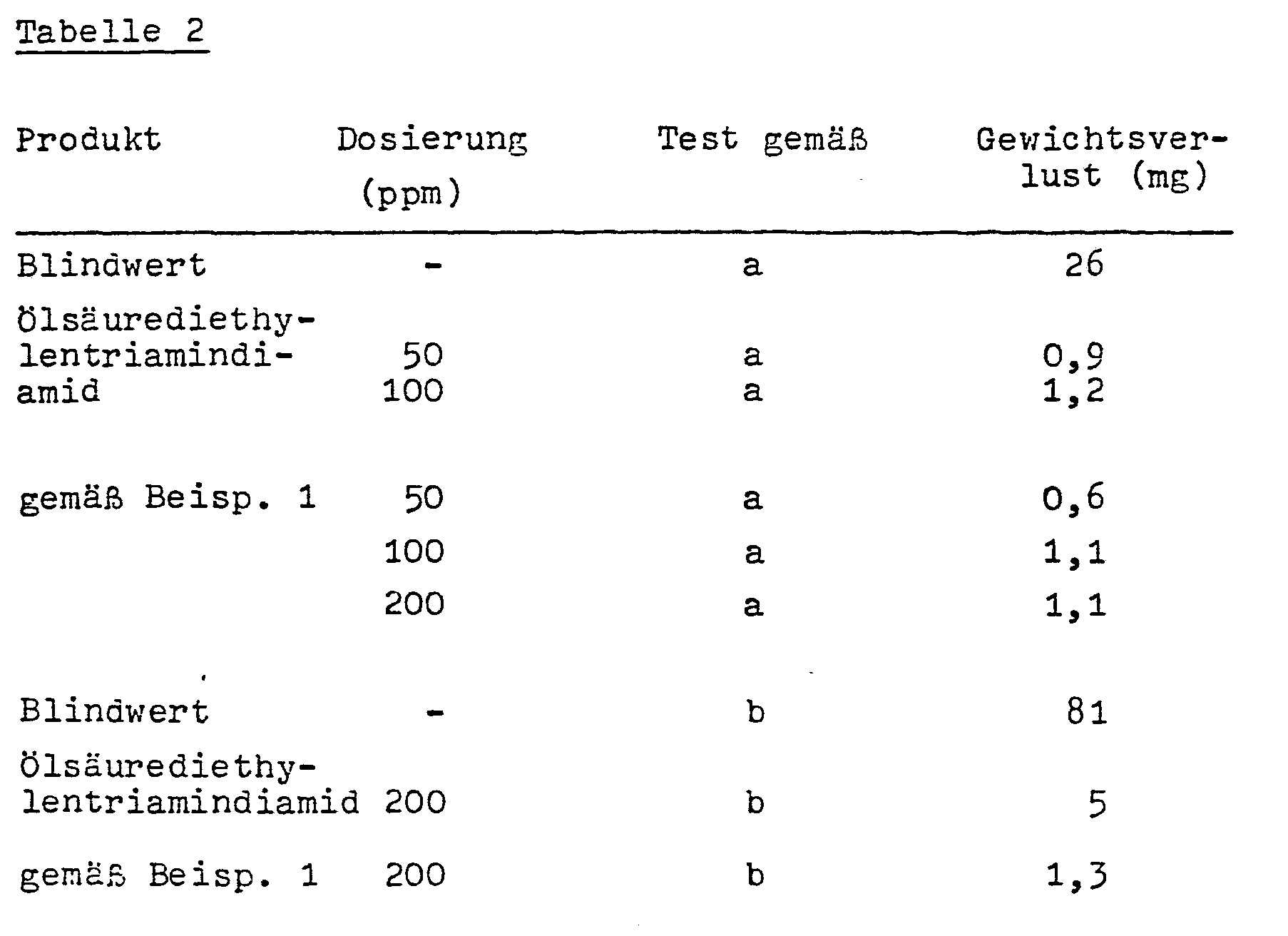
- Hier zeigt sich vor allem die verbesserte Korrosionsschutzwirkung des erfindungsgemäßen Produkts gegenüber H2S-haltigem Wasser.
- Additivierte Kraftstoffe (Benzin) werden in 100 ml Meßzylindern mit einer Standard-Pufferlösung (pH 6,85) unterschichtet und 2 Minuten intensiv geschüttelt. Anschließend wird nach 5 bzw. 10 Minuten gemäß DIN 51 415 visuell bewertet. Die Emulsion (Zwischenphase) kann in ml angegeben werden.
- Die gebildete Trennschicht wird wie folgt bewertet: (DIN 51 415)


Claims (2)

Priority Applications (1)
| Application Number | Priority Date | Filing Date | Title |
|---|---|---|---|
| AT81107454T ATE5892T1 (de) | 1980-10-23 | 1981-09-19 | Ammoniumsalze von polymaleinsaeuren und ihre verwendung als korrosionsinhibitoren in mineraloelen. |
Applications Claiming Priority (2)
| Application Number | Priority Date | Filing Date | Title |
|---|---|---|---|
| DE19803039977 DE3039977A1 (de) | 1980-10-23 | 1980-10-23 | Ammoniumsalze von polymaleinsaeuren und ihre verwendung korrosionsinhibitoren in mineraloelen |
| DE3039977 | 1980-10-23 |
Publications (2)
| Publication Number | Publication Date |
|---|---|
| EP0050736A1 true EP0050736A1 (de) | 1982-05-05 |
| EP0050736B1 EP0050736B1 (de) | 1984-01-18 |
Family
ID=6115006
Family Applications (1)
| Application Number | Title | Priority Date | Filing Date |
|---|---|---|---|
| EP81107454A Expired EP0050736B1 (de) | 1980-10-23 | 1981-09-19 | Ammoniumsalze von Polymaleinsäuren und ihre Verwendung als Korrosionsinhibitoren in Mineralölen |
Country Status (5)
| Country | Link |
|---|---|
| US (1) | US4435298A (de) |
| EP (1) | EP0050736B1 (de) |
| AT (1) | ATE5892T1 (de) |
| CA (1) | CA1180031A (de) |
| DE (2) | DE3039977A1 (de) |
Cited By (1)
| Publication number | Priority date | Publication date | Assignee | Title |
|---|---|---|---|---|
| EP0065191A1 (de) * | 1981-05-15 | 1982-11-24 | BASF Aktiengesellschaft | Inhibitoren gegen die Korrosion von H2S und CO2 in Wasser-in-Öl-Emulsionen |
Families Citing this family (2)
| Publication number | Priority date | Publication date | Assignee | Title |
|---|---|---|---|---|
| US5599779A (en) * | 1996-03-20 | 1997-02-04 | R. T. Vanderbilt Company, Inc. | Synergistic rust inhibitors and lubricating compositions |
| CN108949319A (zh) * | 2018-07-26 | 2018-12-07 | 界首市鑫龙机械设备购销有限公司 | 一种具有缓蚀防腐性能的金属机械润滑剂 |
Citations (6)
| Publication number | Priority date | Publication date | Assignee | Title |
|---|---|---|---|---|
| GB828701A (en) * | 1955-04-21 | 1960-02-24 | Monsanto Chemicals | Rust-inhibiting compositions and lubricants containing the same |
| US2975133A (en) * | 1955-04-21 | 1961-03-14 | Gulf Oil Corp | Corrosion-inhibiting mineral oil compositions |
| US3003858A (en) * | 1958-01-07 | 1961-10-10 | Socony Mobil Oil Co Inc | Stabilized distillate fuel oil |
| US3893825A (en) * | 1970-12-30 | 1975-07-08 | Universal Oil Prod Co | Inhibition of corrosion |
| US3909215A (en) * | 1973-03-27 | 1975-09-30 | Chevron Res | Rust inhibitors for hydrocarbon fuels |
| US4105581A (en) * | 1977-02-18 | 1978-08-08 | Drew Chemical Corporation | Corrosion inhibitor |
Family Cites Families (5)
| Publication number | Priority date | Publication date | Assignee | Title |
|---|---|---|---|---|
| GB1349769A (en) | 1971-11-01 | 1974-04-10 | Fmc Corp | Polymerization process |
| GB1445993A (en) | 1973-06-27 | 1976-08-11 | Exxon Research Engineering Co | Lubricating oil compositions |
| US4018702A (en) | 1974-03-11 | 1977-04-19 | Calgon Corporation | Corrosion inhibition with amine adducts of maleic anhydride polymers |
| US4079012A (en) | 1976-10-04 | 1978-03-14 | Bosniack David S | Synthetic ester oil compositions containing organic sulfonic acid ammonium salts as load-carrying agents |
| DE2840167A1 (de) | 1978-09-15 | 1980-03-27 | Basf Ag | Verfahren zur herstellung von polymaleinsaeuren aus maleinsaeureanhydrid in gegenwart von acetanhydrid und wasserstoffperoxid |
-
1980
- 1980-10-23 DE DE19803039977 patent/DE3039977A1/de not_active Withdrawn
-
1981
- 1981-09-19 AT AT81107454T patent/ATE5892T1/de active
- 1981-09-19 DE DE8181107454T patent/DE3161978D1/de not_active Expired
- 1981-09-19 EP EP81107454A patent/EP0050736B1/de not_active Expired
- 1981-09-29 US US06/306,765 patent/US4435298A/en not_active Expired - Fee Related
- 1981-10-22 CA CA000388536A patent/CA1180031A/en not_active Expired
Patent Citations (7)
| Publication number | Priority date | Publication date | Assignee | Title |
|---|---|---|---|---|
| GB828701A (en) * | 1955-04-21 | 1960-02-24 | Monsanto Chemicals | Rust-inhibiting compositions and lubricants containing the same |
| US2975133A (en) * | 1955-04-21 | 1961-03-14 | Gulf Oil Corp | Corrosion-inhibiting mineral oil compositions |
| US3003858A (en) * | 1958-01-07 | 1961-10-10 | Socony Mobil Oil Co Inc | Stabilized distillate fuel oil |
| US3893825A (en) * | 1970-12-30 | 1975-07-08 | Universal Oil Prod Co | Inhibition of corrosion |
| US3909215A (en) * | 1973-03-27 | 1975-09-30 | Chevron Res | Rust inhibitors for hydrocarbon fuels |
| US4105581A (en) * | 1977-02-18 | 1978-08-08 | Drew Chemical Corporation | Corrosion inhibitor |
| DE2806342A1 (de) * | 1977-02-18 | 1978-08-24 | Drew Chem Corp | Korrosionsinhibitor und verfahren zu dessen anwendung |
Cited By (1)
| Publication number | Priority date | Publication date | Assignee | Title |
|---|---|---|---|---|
| EP0065191A1 (de) * | 1981-05-15 | 1982-11-24 | BASF Aktiengesellschaft | Inhibitoren gegen die Korrosion von H2S und CO2 in Wasser-in-Öl-Emulsionen |
Also Published As
| Publication number | Publication date |
|---|---|
| EP0050736B1 (de) | 1984-01-18 |
| ATE5892T1 (de) | 1984-02-15 |
| US4435298A (en) | 1984-03-06 |
| CA1180031A (en) | 1984-12-27 |
| DE3161978D1 (en) | 1984-02-23 |
| DE3039977A1 (de) | 1982-06-03 |
Similar Documents
| Publication | Publication Date | Title |
|---|---|---|
| DE2745909C2 (de) | ||
| EP0065191B1 (de) | Inhibitoren gegen die Korrosion von H2S und CO2 in Wasser-in-Öl-Emulsionen | |
| EP0154177A2 (de) | Copolymere auf Basis von Maleinsäureanhydrid und alpha, beta-ungesättigten Verbindungen, ein Verfahren zu ihrer Herstellung und ihre Verwendung als Paraffininhibitoren | |
| EP0009080B1 (de) | Korrosionsinhibitoren; Gemische zum Schützen von eisenhaltigen Metallen und die geschützten Metalle | |
| EP0222311A2 (de) | Verwendung von Alkoxyhydroxyfettsäuren als Korrosionsinhibitoren in Ölen und Ölhaltigen Emulsionen | |
| DE2405284C2 (de) | Verfahren zur Herstellung von Polymaleinsäureanhydrid | |
| CH631480A5 (de) | Einen korrosionsinhibitor enthaltendes material. | |
| DE2806908C2 (de) | Polyaminoäthergemisch und dessen Verwendung als Additiv | |
| CH626900A5 (de) | ||
| DE69007664T2 (de) | Detergent, Dispersant und Antikorrosionszusätze für Kraftstoffe und Schmieröle. | |
| DE3023523C2 (de) | Schmieröladditiv und dessen Verwendung | |
| EP0212265A1 (de) | Quaternäre oxalkylierte Polykondensate, Verfahren zu deren Herstellung und deren Verwendung | |
| DE1594648A1 (de) | Verfahren zur Stabilisierung von organischen Substanzen | |
| EP0050736B1 (de) | Ammoniumsalze von Polymaleinsäuren und ihre Verwendung als Korrosionsinhibitoren in Mineralölen | |
| DE2840112A1 (de) | Wassermischbare korrosionsschutzmittel | |
| DE3730475A1 (de) | Polyaralkylamine als korrosionsinhibitoren | |
| DE889297C (de) | Verfahren zur Herstellung von substituierten Tetrahydropyrimidin-Derivaten | |
| DE2416726C3 (de) | Verfahren zur Herstellung von sauren Harzen durch Umsetzung mehrfach ungesättigter Monocarbonfettsäiiren mit einer a, ß -ungesättigten Monocarbonsäure | |
| EP0009171A2 (de) | Verfahren zur Herstellung von Polymaleinsäuren aus Maleinsäureanhydrid in Gegenwart von Acetanhydrid und Wasserstoffperoxid und die Verwendung der so hergestellten Polymaleinsäuren als Gerüststoffsubstanzen und Inkrustierungsinhibitoren in Waschmitteln | |
| EP0191952B1 (de) | Salze von Alkenylbernsteinsäurehalbamiden, Verfahren zu deren Herstellung und deren Verwendung als Korrosionsinhibitoren | |
| DE1420867A1 (de) | Heizoelgemisch | |
| EP0144738B1 (de) | Bernsteinsäure-mono-dialkylamide als wasserlösliche Korrosionsschutzmittel | |
| EP0074077B1 (de) | Bisimidazoline, Verfahren zu deren Herstellung und deren Verwendung | |
| DE2443538C2 (de) | Verfahren zur Herstellung eines Esters einer Alkyl- oder Alkenylbernsteinsäure und eines mehrwertigen Alkohols | |
| EP0190104A2 (de) | Herstellung von hydrolysiertem Polymaleinsäureanhydrid |
Legal Events
| Date | Code | Title | Description |
|---|---|---|---|
| PUAI | Public reference made under article 153(3) epc to a published international application that has entered the european phase |
Free format text: ORIGINAL CODE: 0009012 |
|
| 17P | Request for examination filed |
Effective date: 19811022 |
|
| AK | Designated contracting states |
Designated state(s): AT BE CH DE FR GB IT NL SE |
|
| ITF | It: translation for a ep patent filed | ||
| GRAA | (expected) grant |
Free format text: ORIGINAL CODE: 0009210 |
|
| AK | Designated contracting states |
Designated state(s): AT BE CH DE FR GB IT LI NL SE |
|
| REF | Corresponds to: |
Ref document number: 5892 Country of ref document: AT Date of ref document: 19840215 Kind code of ref document: T |
|
| REF | Corresponds to: |
Ref document number: 3161978 Country of ref document: DE Date of ref document: 19840223 |
|
| ET | Fr: translation filed | ||
| PLBE | No opposition filed within time limit |
Free format text: ORIGINAL CODE: 0009261 |
|
| STAA | Information on the status of an ep patent application or granted ep patent |
Free format text: STATUS: NO OPPOSITION FILED WITHIN TIME LIMIT |
|
| 26N | No opposition filed | ||
| PGFP | Annual fee paid to national office [announced via postgrant information from national office to epo] |
Ref country code: CH Payment date: 19910808 Year of fee payment: 11 |
|
| PGFP | Annual fee paid to national office [announced via postgrant information from national office to epo] |
Ref country code: BE Payment date: 19910830 Year of fee payment: 11 |
|
| ITTA | It: last paid annual fee | ||
| PG25 | Lapsed in a contracting state [announced via postgrant information from national office to epo] |
Ref country code: LI Effective date: 19920930 Ref country code: CH Effective date: 19920930 Ref country code: BE Effective date: 19920930 |
|
| BERE | Be: lapsed |
Owner name: BASF A.G. Effective date: 19920930 |
|
| REG | Reference to a national code |
Ref country code: CH Ref legal event code: PL |
|
| PGFP | Annual fee paid to national office [announced via postgrant information from national office to epo] |
Ref country code: SE Payment date: 19930805 Year of fee payment: 13 |
|
| PGFP | Annual fee paid to national office [announced via postgrant information from national office to epo] |
Ref country code: AT Payment date: 19930812 Year of fee payment: 13 |
|
| PGFP | Annual fee paid to national office [announced via postgrant information from national office to epo] |
Ref country code: NL Payment date: 19930930 Year of fee payment: 13 |
|
| PG25 | Lapsed in a contracting state [announced via postgrant information from national office to epo] |
Ref country code: AT Effective date: 19940919 |
|
| PG25 | Lapsed in a contracting state [announced via postgrant information from national office to epo] |
Ref country code: SE Effective date: 19940920 |
|
| EAL | Se: european patent in force in sweden |
Ref document number: 81107454.1 |
|
| PG25 | Lapsed in a contracting state [announced via postgrant information from national office to epo] |
Ref country code: NL Effective date: 19950401 |
|
| NLV4 | Nl: lapsed or anulled due to non-payment of the annual fee | ||
| EUG | Se: european patent has lapsed |
Ref document number: 81107454.1 |
|
| PGFP | Annual fee paid to national office [announced via postgrant information from national office to epo] |
Ref country code: FR Payment date: 19950815 Year of fee payment: 15 |
|
| PGFP | Annual fee paid to national office [announced via postgrant information from national office to epo] |
Ref country code: GB Payment date: 19950904 Year of fee payment: 15 |
|
| PGFP | Annual fee paid to national office [announced via postgrant information from national office to epo] |
Ref country code: DE Payment date: 19950919 Year of fee payment: 15 |
|
| PG25 | Lapsed in a contracting state [announced via postgrant information from national office to epo] |
Ref country code: GB Effective date: 19960919 |
|
| PG25 | Lapsed in a contracting state [announced via postgrant information from national office to epo] |
Ref country code: FR Effective date: 19960930 |
|
| GBPC | Gb: european patent ceased through non-payment of renewal fee |
Effective date: 19960919 |
|
| PG25 | Lapsed in a contracting state [announced via postgrant information from national office to epo] |
Ref country code: DE Effective date: 19970603 |
|
| REG | Reference to a national code |
Ref country code: FR Ref legal event code: ST |
|
| REG | Reference to a national code |
Ref country code: FR Ref legal event code: ST |