EP0050917B1 - Elektronisches Musikinstrument und Verfahren zum Erzeugen von Musiktönen - Google Patents
Elektronisches Musikinstrument und Verfahren zum Erzeugen von Musiktönen Download PDFInfo
- Publication number
- EP0050917B1 EP0050917B1 EP81304376A EP81304376A EP0050917B1 EP 0050917 B1 EP0050917 B1 EP 0050917B1 EP 81304376 A EP81304376 A EP 81304376A EP 81304376 A EP81304376 A EP 81304376A EP 0050917 B1 EP0050917 B1 EP 0050917B1
- Authority
- EP
- European Patent Office
- Prior art keywords
- waveform
- waveforms
- time
- frequency
- train
- Prior art date
- Legal status (The legal status is an assumption and is not a legal conclusion. Google has not performed a legal analysis and makes no representation as to the accuracy of the status listed.)
- Expired
Links
- 238000000034 method Methods 0.000 title claims description 19
- 230000002238 attenuated effect Effects 0.000 claims abstract description 10
- 230000006870 function Effects 0.000 claims description 40
- 238000005070 sampling Methods 0.000 claims description 12
- 238000001228 spectrum Methods 0.000 claims description 12
- 230000003252 repetitive effect Effects 0.000 claims description 5
- 230000000737 periodic effect Effects 0.000 description 9
- 239000000523 sample Substances 0.000 description 8
- 230000015572 biosynthetic process Effects 0.000 description 7
- 238000010586 diagram Methods 0.000 description 7
- 210000000056 organ Anatomy 0.000 description 7
- 238000003786 synthesis reaction Methods 0.000 description 7
- 230000003595 spectral effect Effects 0.000 description 6
- 238000013459 approach Methods 0.000 description 4
- 238000001914 filtration Methods 0.000 description 4
- 238000007792 addition Methods 0.000 description 2
- 230000008859 change Effects 0.000 description 2
- 230000003247 decreasing effect Effects 0.000 description 2
- 238000004519 manufacturing process Methods 0.000 description 2
- 238000002156 mixing Methods 0.000 description 2
- 230000008447 perception Effects 0.000 description 2
- 230000008569 process Effects 0.000 description 2
- 238000010561 standard procedure Methods 0.000 description 2
- 230000009471 action Effects 0.000 description 1
- 239000000654 additive Substances 0.000 description 1
- 230000000996 additive effect Effects 0.000 description 1
- 230000008901 benefit Effects 0.000 description 1
- 125000004122 cyclic group Chemical group 0.000 description 1
- 230000007423 decrease Effects 0.000 description 1
- 230000002950 deficient Effects 0.000 description 1
- 230000000994 depressogenic effect Effects 0.000 description 1
- 239000000203 mixture Substances 0.000 description 1
- 238000012545 processing Methods 0.000 description 1
- 230000003134 recirculating effect Effects 0.000 description 1
- 230000009467 reduction Effects 0.000 description 1
- 238000011160 research Methods 0.000 description 1
Images


Classifications
-
- G—PHYSICS
- G10—MUSICAL INSTRUMENTS; ACOUSTICS
- G10H—ELECTROPHONIC MUSICAL INSTRUMENTS; INSTRUMENTS IN WHICH THE TONES ARE GENERATED BY ELECTROMECHANICAL MEANS OR ELECTRONIC GENERATORS, OR IN WHICH THE TONES ARE SYNTHESISED FROM A DATA STORE
- G10H7/00—Instruments in which the tones are synthesised from a data store, e.g. computer organs
- G10H7/08—Instruments in which the tones are synthesised from a data store, e.g. computer organs by calculating functions or polynomial approximations to evaluate amplitudes at successive sample points of a tone waveform
-
- G—PHYSICS
- G10—MUSICAL INSTRUMENTS; ACOUSTICS
- G10H—ELECTROPHONIC MUSICAL INSTRUMENTS; INSTRUMENTS IN WHICH THE TONES ARE GENERATED BY ELECTROMECHANICAL MEANS OR ELECTRONIC GENERATORS, OR IN WHICH THE TONES ARE SYNTHESISED FROM A DATA STORE
- G10H2250/00—Aspects of algorithms or signal processing methods without intrinsic musical character, yet specifically adapted for or used in electrophonic musical processing
- G10H2250/131—Mathematical functions for musical analysis, processing, synthesis or composition
- G10H2250/215—Transforms, i.e. mathematical transforms into domains appropriate for musical signal processing, coding or compression
- G10H2250/235—Fourier transform; Discrete Fourier Transform [DFT]; Fast Fourier Transform [FFT]
-
- G—PHYSICS
- G10—MUSICAL INSTRUMENTS; ACOUSTICS
- G10H—ELECTROPHONIC MUSICAL INSTRUMENTS; INSTRUMENTS IN WHICH THE TONES ARE GENERATED BY ELECTROMECHANICAL MEANS OR ELECTRONIC GENERATORS, OR IN WHICH THE TONES ARE SYNTHESISED FROM A DATA STORE
- G10H2250/00—Aspects of algorithms or signal processing methods without intrinsic musical character, yet specifically adapted for or used in electrophonic musical processing
- G10H2250/131—Mathematical functions for musical analysis, processing, synthesis or composition
- G10H2250/261—Window, i.e. apodization function or tapering function amounting to the selection and appropriate weighting of a group of samples in a digital signal within some chosen time interval, outside of which it is zero valued
- G10H2250/265—Blackman Harris window
-
- G—PHYSICS
- G10—MUSICAL INSTRUMENTS; ACOUSTICS
- G10H—ELECTROPHONIC MUSICAL INSTRUMENTS; INSTRUMENTS IN WHICH THE TONES ARE GENERATED BY ELECTROMECHANICAL MEANS OR ELECTRONIC GENERATORS, OR IN WHICH THE TONES ARE SYNTHESISED FROM A DATA STORE
- G10H2250/00—Aspects of algorithms or signal processing methods without intrinsic musical character, yet specifically adapted for or used in electrophonic musical processing
- G10H2250/471—General musical sound synthesis principles, i.e. sound category-independent synthesis methods
- G10H2250/481—Formant synthesis, i.e. simulating the human speech production mechanism by exciting formant resonators, e.g. mimicking vocal tract filtering as in LPC synthesis vocoders, wherein musical instruments may be used as excitation signal to the time-varying filter estimated from a singer's speech
-
- Y—GENERAL TAGGING OF NEW TECHNOLOGICAL DEVELOPMENTS; GENERAL TAGGING OF CROSS-SECTIONAL TECHNOLOGIES SPANNING OVER SEVERAL SECTIONS OF THE IPC; TECHNICAL SUBJECTS COVERED BY FORMER USPC CROSS-REFERENCE ART COLLECTIONS [XRACs] AND DIGESTS
- Y10—TECHNICAL SUBJECTS COVERED BY FORMER USPC
- Y10S—TECHNICAL SUBJECTS COVERED BY FORMER USPC CROSS-REFERENCE ART COLLECTIONS [XRACs] AND DIGESTS
- Y10S84/00—Music
- Y10S84/09—Filtering
-
- Y—GENERAL TAGGING OF NEW TECHNOLOGICAL DEVELOPMENTS; GENERAL TAGGING OF CROSS-SECTIONAL TECHNOLOGIES SPANNING OVER SEVERAL SECTIONS OF THE IPC; TECHNICAL SUBJECTS COVERED BY FORMER USPC CROSS-REFERENCE ART COLLECTIONS [XRACs] AND DIGESTS
- Y10—TECHNICAL SUBJECTS COVERED BY FORMER USPC
- Y10S—TECHNICAL SUBJECTS COVERED BY FORMER USPC CROSS-REFERENCE ART COLLECTIONS [XRACs] AND DIGESTS
- Y10S84/00—Music
- Y10S84/10—Feedback
Definitions
- the present invention relates to electronic musical instruments and to methods of generating musical tones.
- Synthesizers typically utilize highly complex mathematical algorithms and with the exception of a small number of research oriented instruments, are capable of the simultaneous sounding of only a very small number of distinct voices. When played by a skilled keyboard musician who may depress as many as twelve keys at any one time, these instruments have proven to be deficient in fulfilling the full artistic desires of the performer. Synthesizers often utilize additive or frequency modulation synthesis techniques.
- the first step in subtractive synthesis is the generation of a harmonically rich waveform of a desired fundamental frequency.
- the waveform is then processed by frequency division circuitry to provide the various footages which are desired, for example, the 2', 4', 8' and 16' versions of the fundamental note.
- a commonly used waveform is the squarewave, which is very rich in odd harmonics.
- the last step of subtractive synthesis is usually preceded by a weighted mixing of the various footages of a fundamental frequency in order to obtain the desired spectral overtone pattern.
- This last step often includes a summing of all notes currently being generated for the purpose of applying common filtering for formant emphasis. Since the filtering normally does not introduce new harmonics to the tonal mixture, but only emphasizes some frequency bands at the expense of others, it is this filtering action which gives subtractive synthesis its name.
- square waves have often been utilized in electronic organs because of their rich overtone content.
- discrete-time implementations such as in digital tone generation
- the problem of aliasing renders square waves virtually useless.
- a stored waveform is sampled in a repetitive fashion to produce the output tone.
- the fundamental and all harmonics produce mirrored tones on both sides of the Nyquist frequency, which is one-half the sampling rate.
- these folded overtones fall back within the spectral range of human hearing and appear as noise or other objectionable sounds.
- a digital oscillator signal must be specified that is not only harmonically rich, but which can always be guaranteed to possess negligibly small aliased overtones regardless of the fundamental frequency desired.
- These waveforms must be rich in the sense that their audible overtone structure always extends across the entire spectral range of human hearing, regardless of fundamental frequency. For example, a fundamental note of 40 Hz, has in excess of a hundred times the number of audible overtones as that possessed by a five kilohertz fundamental note, yet the five kilohertz note must still be incapable of causing audible aliasing when an economical sampling rate is used.
- DE-A-2515624 discloses an electronic instrument utilising a stored waveform and in which the pulse width or duration between pulses is changed for different frequency ranges of the instrument. By causing the pulse width to vary for different frequency ranges, the hardware implementation becomes increasingly difficult and large numbers of independent oscillators may be necessary.
- the cited reference also teaches the concept of selecting a formant having peaks and nulls at certain frequencies regardless of the fundamental frequency so that the relative amplitudes between harmonics will vary depending on the frequency of the fundamental.
- US-A-4133241 discloses a technique for generating a waveform wherein one sample point is computed from the preceding sample point.
- This invention provides an electronic musical instrument comprising: memory means for storing in digital form one cycle of a window function waveform, having a limited bandwidth with greatly attenuated side lobes, means for reading said waveform out of said memory at a fixed rate throughout substantially the entire frequency range of the instrument and in a repetitive manner wherein the effective width of the waveform is constant and the period of time between successive readings of the waveform is selectively varied to thereby produce a train of time sequential said waveforms having a fundamental frequency inversely proportional to the period of time between successive readings, the waveforms read out forming a cyclically recurring series of said waveforms, and means for adjusting the respective amplitudes of the waveforms in the series to set the relative amplitudes of the fundamental and harmonics independently of the frequency of the fundamental.
- the invention also provides an electronic musical instrument comprising: memory means for storing in digital form one cycle of a harmonically rich window function waveform having a limited bandwidth with greatly attenuated side lobes, means for reading said waveform out of said memory at a fixed rate throughout substantially the entire frequency range of the instrument and in a repetitive manner wherein the period of time between successive operable readings of the waveform is selectively varied to thereby produce an output signal comprising a train of said waveforms wherein each waveform has a fixed width throughout the frequency range of the instrument and is separated from adjacent wave forms by time intervals in which a zero signal level is present equal to the period of time between the respective successive operable readings of the stored waveform; said train of waveforms comprising a plurality of cyclically recurring series of a plurality of said waveforms, and including means for controlling the harmonic content of the waveform train comprising means for adjusting independently of each other the respective amplitudes of the waveforms in each series; and means responsive to said output signal for producing an audible tone
- the invention further provides a method of generating a musical tone comprising: providing a memory in which a digital representation of one cycle of a window function waveform having a limited bandwidth with greatly attenuated side lobes is stored; addressing the memory to read the stored representation of the waveform repetitively at a fixed rate regardless of frequency but selectively varying the period of time between successive readings of the waveform to produce a wavefrom train comprising a series of the read out waveforms that are cyclically repeated and wherein the waveforms are separated by said period of time; controlling the relative amplitudes of the harmonics independently of the frequency of the fundamental of the waveform train by independently scaling the respective waveforms in the series; and producing a musical tone from the scaled waveform train wherein the fundamental pitch of the tone varies inversely as the period of time between successive waveforms.
- w(t) be a continuous-time signal with a duration T w , and whose value is zero outside the interval
- W(jw) represent its Fourier transform.
- w o Given a prescribed fundamental frequency, w o , we may form the periodic signal whose transform is in turn given by an impulse train enveloped by the spectrum of w(t). Note that as w o is changed, the impulse train spacing interval w o also changes. However the multiplicative envelope is unaffected.
- T W the time duration of the window function signal w(t)
- W(J o ) has a centerlobe zero crossing at the Nyquist frequency f s /2
- the four-term Blackman-Harris window w(t) can thus be arranged to have a centerlobe edge which coincides with the Nyquist frequency.
- the spectrum of a wp(t), which is a periodic waveform formed from w(t) will be an impulse train enveloped by this w o -independent window spectrum.
- all harmonic components of the fundamental w o occurring at frequencies below the Nyquist will fall within the envelope centerlobe. Therefore, only the harmonics approaching f s /2 in frequency will suffer significant attenuation.
- those harmonics appearing at a frequency high enough to exceed the Nyquist will be enveloped by the window spectrum sidelobes, and these are at least 92 db down with respect to the centerlobe peak.
- audible aliasing will not be a problem.
- the standard continuous-time approach to the generation of harmonically-rich tone signals is to produce a square wave or pulse train with the desired w o .
- the width (in time) of the rectangular pulse varies also, since generally a given duty cycle, such as fifty percent, is to be maintained.
- the pulse width is held constant while the inter-pulse "dead time" alone is varied to vary the frequency of the tone. This, in turn, holds the spectral envelope of wp constant, regardless of the fundamental being generated, and it is this property of the signal which so dramatically reduces the aliasing problem heretofore experienced in discrete-time tone generation systems.
- any wp spectrum which is generated is intrinsically low-pass filtered by the very nature of the waveform generation process.
- All harmonics that are dangerously high automatically fall within the W(Jw) sidelobe structure where they undergo severe attenuation.
- a fifty percent duty cycle squarewave it is known that only the fundamental frequency lies within the resulting "sin x/x" spectral centerlobe; all other harmonics appear within the sidelobes and these sidelobes have relatively large peak amplitudes.
- the squarewave derives its rich overtone structure precisely from these strong sidelobes, thus, the usage of the sidelobe structure in the present system is quite different from that in the squarewave tone generation methods.
- Figure 1 is an envelope plot of relative amplitude versus harmonic number wherein curve 10 relates to a fifty percent duty cycle squarewave, and curve twelve to the fourterm Blackman-Harris window.
- the harmonic strengths of both the squarewave and window function signals are shown for (just above "middle C"). In the squarewave case, only odd-numbered harmonics appear, of course. Those window function harmonics beyond the 64 th are in excess of 90 db below the fundamental's amplitude. Observe that out to the 47 th harmonic, the window signal is richer in harmonic content than is the squarewave.
- the stored waveform is scanned or addressed in a cyclic fashion wherein the rate of scanning or addressing is increased for the production of higher frequency tones and decreased for the production of lower frequency tones.
- the resultant periodic wave comprises a plurality of the stored waveforms time-con- cationated so that an uninterrupted signal results.
- the time duration of each individual waveform period decreases with increasing frequency caused by a higher rate of scanning, and there are more such individual waveforms per unit length of time due to the fact that there is no "dead space" between the individual waveforms.
- the stored waveform is scanned at a fixed rate regardless of fundamental frequency, and the frequency of the resultant signal is varied by varying the dead space, i.e. the time between successive waveforms, in which no signal is present.
- Figure 2 illustrates the periodic window function signal trains produced according to the present invention in the 2', 4', 8' and 16' ranges.
- the 2' version of a musical note to be generated occurs at a fundamental frequency less than f s /8, wherein f s is the sampling frequency.
- f s 40 khz
- the 2' signal 14 comprises the individual window waveforms spaced as closely together as required by the 2' fundamental frequency desired.
- the 4' signal 16 is achieved by deleting or setting to zero alternate pulses within the 2' pulse train 14 thereby producing a signal having a frequency which is half that of the 2' signal 14 and an octave lower.
- the 8' waveform 18 window pulses are separated by intervals equal to the intervals between alternate pulses in the 4' signal 16
- the 16' signal window pulses 20 are separated by intervals equal to the interval between alternate pulses in the 8' signal 18.
- the lower frequency footage signals can be generated by simply deleting alternate pulses within the signal representing the next higher frequency footage, so that the 4' signal 16 may be derived from the 2' signal 14, the 8' signal 18 from the 4' signal 16, and the 16' signal 20 from the 8' signal 18.
- the alternate pulses can be multiplied by nonzero quantities in order to obtain a different timbre. For example, if a footage waveform contains one occupied pulse slot followed by n-1 pulse slots set to zero within a single period, then these pulse slots could instead be multiplied by the weights a o , a,, ..., an- 1'
- Figure 3 is an envelope plot of relative amplitude versus harmonic number for the 16' 625 hz signal 22 compared with a squarewave signal 24.
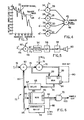
- FIG. 4 A straightforward digital implementation of the standard method of producing a complex 16' voice is illustrated in Figure 4. This comprises four multipliers 26, 28,30 and 32 having as their inputs the 2', 4', 8' and 16' signals.
- the weighting inputs 34, 36, 38 and 40 modify the incoming signals to produce the appropriate amplitudes of the respective footages, and the outputs are summed by adder 42 to produce the complex voice on output 44.
- the output of filter 54 is connected to the input of digital to analog converter 56 which converts the signal to analog form, and this is amplified by amplifier 58 and reproduced acoustically by speaker 60.
- the acoustic tone reproduced by speaker 60 may be a typical organ voice, the harmonic structure of which is developed by multiplier 48 having as its inputs the weightings on input line 50 and the periodic repetition of window functions on input line 46, and wherein the formant emphasis is achieved by filter 54.
- the a weighting factors may be allowed to vary slowly with time according to, for example, a piecewise linear curve. This would provide the ability to change a large part of the harmonic structure during the attack, sustain, and decay portions of a note and would aid greatly in the psycho-acoustic - identification of an instrument.
- the a, multipliers may also be relied on to handle, not only the spectral evolution but also the amplitude enveloping of a note. This places the keying operation at the voicing stage of the note generation process, which is, in many cases, desirable.
- FIG. 6 An example of the hardware required to generate the periodic four-term Blackman-Harris window function signals is illustrated in Figure 6.
- the window function being utilized is stored in read only memory 62, and the input 64 to the address portion 66 of read only memory 62 is connected to the output 67 of delay circuit 68.
- the output 69 of read only memory 62 is connected to one of the inputs of AND gate 70.
- This input on line 74 to subtractor 76 is equal to the period To of a single window function (including dead time) divided by the period of a single sample time T, and this quantity equals the number of samples per window function waveform.
- the window function minus dead time may equal eight samples per waveform generated.
- the other input to subtractor 76 is the output 78 from adder 80, which has as one of its inputs 81 the integer value 1, and as its other input 82 the output from delay circuit 68 in the feedback loop comprising adder 80, subtractor 76, multiplexer 84 and delay circuit 68.
- subtractor 76 subtracts from the number of samples for an entire single period (including dead time) a recirculating data -stream that is being incremented by the integer 1 for each cycle through the feedback loop.
- Multiplexer 84 has as its first input 88 the output from adder 80, which is the recirculated data stream being incremented by one each cycle, and as its second input 89 the output from subtractor 76, which is the difference between the total number of sample times per period and the number being recirculated and incremented in the feedback loop.
- multiplexer 84 When the control input 90 of multiplexer 84 detects a change in sign, which indicates that the entire period has been completely counted through, multiplexer 84 no longer passes to its output 92 the incrementing count on the input 88, but, instead, passes the output from subtractor 76, thereby permitting the counting sequence to be again initiated.
- the input 64 to the address portion 66 of read only memory 62 addresses a sequence of sample points within read only memory 62 to produce on output 69 samples of the four-term Blackman-Harris window function. Since outputs are desired only during the time period for which the window function is to be produced, and since, in this particular case, the time period comprises eight samples, it is necessary to disable gate 70 at all times other than those during which the window function is to be sampled. This is accomplished by comparator 94, which has its input 96 connected to the output of the feedback loop, and its output 98 connected to the other input of AND gate 70. Comparator 94 compares the value on input 96 with the integer 8, and when this value is less than or equal to 8, it enables AND gate 70 by producing on output 98 a logic 1.
- AND gate 70 carries the sampled four-term Blackman-Harris window function followed by a zero-signal interval of appropriate duration, and this would be connected to the input of multiplier 48 ( Figure 5), for example.
- multiplier 48 Figure 5
- the multiplication technique can be used to produce complex voices having the appropriate harmonic content.
- the fundamental frequencies to be generated can exceed the "overlap" limit f s /8, there are several methods one can use to raise this limit.
- the simplest is to produce two periodic signals of frequency fo/2 that are 180° out of phase. The sum of these two signals will be a 2' signal with a fundamental frequency limit offg/4. Either of these two signals separately yields a 4' version of f o .
- a 16-bit representation for T o /T turns out to be a good choice: Eleven bits for the integer portion and five bits reserved for the fractional part. This sets a low fundamental frequency limit of about 19.5 Hz. Also, the frequency ratio of two successive fundamental frequencies is 1.000015625 at 20 Hz and 1.00390625 at 5 kHz.
- a general formula for the ratio of two successive fundamental frequencies using the window method is where n is the number of fractional bits in T o /T.
- the usual technique for waveform lookup in ROM tables prescribes a constant phase increment which augments an accumulator (every T seconds) whose contents serve as a ROM address. If the number of accumulator bits is m, then the ratio of two successive fundamental frequencies achievable by the "usual" method is Note that the window approach exhibits an increasing ratio as F n+1 (or f " ) increases, while the standard technique displays a decreasing ratio. Since the human ear appears to be sensitive to percentage changes in pitch, we see that the new method places more accuracy than is needed at the lower frequencies, while the well-known approach establishes excess accuracy at the higher fundamentals. An ideal digital oscillator would hold this ratio constant.
- FIG 8 illustrates an alternative system for producing the window pulses.
- Keyboard 102 has the outputs 104 of the respective keyswitches connected to the inputs of a diode read only memory encoder 106.
- Encoder 106 produces on its outputs 108 a digital word representative of the period To for the particular key of keyboard 102 which is depressed.
- a keydown signal is placed on line 110, and this causes latch 112 to latch the digital word on inputs 108 into eleven bit counter 114.
- Counter 114 which is clocked by the phase 1 signal on line 116, counts down from the number loaded into it from latch 112, and the outputs 118 thereof are decoded to produce a decode 0 signal on line 120, which is connected to alternate logic circuit 122.
- Five bit counter 124 is clocked by the output of divide-by-two divider 126, which is fed by the phase 1 clock signal on line 128.
- Counter 124 produces a series of five bit binary words on outputs 130, which address a 2704 electronically programmable read only memory 132, in which is stored the thirty-two samples of the four-term Blackman-Harris window function. By choosing a sampling comprising thirty-two points, a five bit binary address word can be utilized.
- Alternate logic block 122 has as its input the decode 0 signal on line 120 and causes five bit counter 124 and eleven bit counter 114 to operate in opposite time frames. During the time that eleven bit counter 114 is counting down to 0 from the number set into it by encoder 106, five bit counter 124 is disabled so that no addressing of memory 132 is occurring. When counter 114 has counted completely down to 0, which signals the end of the dead time between successive window pulses, alternate logic block 122 detects the corresponding signal on line 120, and activates five bit counter 124 to count through the thirty-two bit sequence. At this time, eleven bit counter 114 is disabled.
- memory 132 As memory 132 is addressed, it produces on outputs 136 the digital numbers representative of the respective samples of the window function. Digital numbers 136 are latched in latch 138, which latches the digital representations of the samples to the scaling factor multiplier 48 ( Figure 5). Latch 138 is actuated at the appropriate time in the sequence, when the multiplier 48 is in an accessible state.
- the tone generation system described above solves the problem of aliasing, which is so prevalent in discrete-time tone generation systems. It accomplishes this by utilizing the four-term BIackman-Harris window function, which has a fixed time width, and varies the spacing between successive window function waveforms to produce output signals of varying frequency.
Landscapes
- Physics & Mathematics (AREA)
- Engineering & Computer Science (AREA)
- Pure & Applied Mathematics (AREA)
- Mathematical Analysis (AREA)
- Mathematical Optimization (AREA)
- Mathematical Physics (AREA)
- General Physics & Mathematics (AREA)
- Algebra (AREA)
- General Engineering & Computer Science (AREA)
- Acoustics & Sound (AREA)
- Multimedia (AREA)
- Electrophonic Musical Instruments (AREA)
- Table Devices Or Equipment (AREA)
Claims (11)
Priority Applications (1)
| Application Number | Priority Date | Filing Date | Title |
|---|---|---|---|
| AT81304376T ATE12436T1 (de) | 1980-09-25 | 1981-09-23 | Elektronisches musikinstrument und verfahren zum erzeugen von musiktoenen. |
Applications Claiming Priority (2)
| Application Number | Priority Date | Filing Date | Title |
|---|---|---|---|
| US06/190,631 US4351219A (en) | 1980-09-25 | 1980-09-25 | Digital tone generation system utilizing fixed duration time functions |
| US190631 | 1988-05-05 |
Publications (2)
| Publication Number | Publication Date |
|---|---|
| EP0050917A1 EP0050917A1 (de) | 1982-05-05 |
| EP0050917B1 true EP0050917B1 (de) | 1985-03-27 |
Family
ID=22702140
Family Applications (1)
| Application Number | Title | Priority Date | Filing Date |
|---|---|---|---|
| EP81304376A Expired EP0050917B1 (de) | 1980-09-25 | 1981-09-23 | Elektronisches Musikinstrument und Verfahren zum Erzeugen von Musiktönen |
Country Status (6)
| Country | Link |
|---|---|
| US (1) | US4351219A (de) |
| EP (1) | EP0050917B1 (de) |
| JP (1) | JPS57150893A (de) |
| AT (1) | ATE12436T1 (de) |
| CA (1) | CA1160872A (de) |
| DE (1) | DE3169560D1 (de) |
Families Citing this family (11)
| Publication number | Priority date | Publication date | Assignee | Title |
|---|---|---|---|---|
| JPS5748792A (en) * | 1980-09-08 | 1982-03-20 | Nippon Musical Instruments Mfg | Electronic musical instrument |
| JPS5756895A (en) * | 1980-09-24 | 1982-04-05 | Nippon Musical Instruments Mfg | Electronic musical instrument |
| US4440058A (en) * | 1982-04-19 | 1984-04-03 | Kimball International, Inc. | Digital tone generation system with slot weighting of fixed width window functions |
| US4597318A (en) * | 1983-01-18 | 1986-07-01 | Matsushita Electric Industrial Co., Ltd. | Wave generating method and apparatus using same |
| JPH0782340B2 (ja) * | 1985-12-17 | 1995-09-06 | ヤマハ株式会社 | 楽音波形信号発生装置 |
| JP2504172B2 (ja) * | 1989-03-29 | 1996-06-05 | ヤマハ株式会社 | フォルマント音発生装置 |
| FR2676880B1 (fr) * | 1991-05-24 | 1994-12-30 | France Telecom | Analyseur modulaire de trafic de signaux numeriques. |
| US5596159A (en) * | 1995-11-22 | 1997-01-21 | Invision Interactive, Inc. | Software sound synthesis system |
| US5969282A (en) * | 1998-07-28 | 1999-10-19 | Aureal Semiconductor, Inc. | Method and apparatus for adjusting the pitch and timbre of an input signal in a controlled manner |
| US7847177B2 (en) * | 2008-07-24 | 2010-12-07 | Freescale Semiconductor, Inc. | Digital complex tone generator and corresponding methods |
| CN103675447B (zh) * | 2013-12-17 | 2017-08-15 | 国网河南省电力公司电力科学研究院 | 一种电气化铁路的高精度实时谐波分析方法 |
Family Cites Families (23)
| Publication number | Priority date | Publication date | Assignee | Title |
|---|---|---|---|---|
| US3515792A (en) * | 1967-08-16 | 1970-06-02 | North American Rockwell | Digital organ |
| US3668294A (en) * | 1969-07-16 | 1972-06-06 | Tokyo Shibaura Electric Co | Electronic synthesis of sounds employing fundamental and formant signal generating means |
| US3610799A (en) * | 1969-10-30 | 1971-10-05 | North American Rockwell | Multiplexing system for selection of notes and voices in an electronic musical instrument |
| US3763364A (en) * | 1971-11-26 | 1973-10-02 | North American Rockwell | Apparatus for storing and reading out periodic waveforms |
| US3809786A (en) * | 1972-02-14 | 1974-05-07 | Deutsch Res Lab | Computor organ |
| US3809788A (en) * | 1972-10-17 | 1974-05-07 | Nippon Musical Instruments Mfg | Computor organ using parallel processing |
| US3809789A (en) * | 1972-12-13 | 1974-05-07 | Nippon Musical Instruments Mfg | Computor organ using harmonic limiting |
| JPS5824460B2 (ja) * | 1973-08-07 | 1983-05-21 | 東レ株式会社 | ナンネンセイポリエステルソセイブツ |
| US3894463A (en) * | 1973-11-26 | 1975-07-15 | Canadian Patents Dev | Digital tone generator |
| US3908504A (en) * | 1974-04-19 | 1975-09-30 | Nippon Musical Instruments Mfg | Harmonic modulation and loudness scaling in a computer organ |
| US3913442A (en) * | 1974-05-16 | 1975-10-21 | Nippon Musical Instruments Mfg | Voicing for a computor organ |
| US3956960A (en) * | 1974-07-25 | 1976-05-18 | Nippon Gakki Seizo Kabushiki Kaisha | Formant filtering in a computor organ |
| DE2515624A1 (de) * | 1975-04-10 | 1976-10-21 | Karlhans Mueller | Befestigungsanordnung fuer eine gedeckelte verkleidung |
| US4133241A (en) * | 1975-05-27 | 1979-01-09 | Nippon Gakki Seizo Kabushiki Kaisha | Electronic musical instrument utilizing recursive algorithm |
| US4108036A (en) * | 1975-07-31 | 1978-08-22 | Slaymaker Frank H | Method of and apparatus for electronically generating musical tones and the like |
| US4085644A (en) * | 1975-08-11 | 1978-04-25 | Deutsch Research Laboratories, Ltd. | Polyphonic tone synthesizer |
| JPS5858679B2 (ja) * | 1975-12-16 | 1983-12-26 | ヤマハ株式会社 | デンシガツキ |
| US4176577A (en) * | 1976-10-30 | 1979-12-04 | Nippon Gakki Seizo Kabushiki Kaisha | Electronic musical instrument of waveshape memory reading type |
| US4150600A (en) * | 1977-05-10 | 1979-04-24 | Nippon Gakki Seizo Kabushiki Kaisha | Computer organ with extended harmonics |
| JPS5813465B2 (ja) * | 1977-07-09 | 1983-03-14 | 株式会社日立製作所 | エレベ−タ速度指令装置 |
| JPS5420851A (en) * | 1977-07-14 | 1979-02-16 | Sato Zoki Co Ltd | Tailings returning device of thresher |
| US4205574A (en) * | 1978-01-27 | 1980-06-03 | The Wurlitzer Company | Electronic musical instrument with variable pulse producing system |
| JPS5532028A (en) * | 1978-08-29 | 1980-03-06 | Nippon Musical Instruments Mfg | Electronic musical instrument |
-
1980
- 1980-09-25 US US06/190,631 patent/US4351219A/en not_active Expired - Lifetime
-
1981
- 1981-09-16 CA CA000386010A patent/CA1160872A/en not_active Expired
- 1981-09-23 EP EP81304376A patent/EP0050917B1/de not_active Expired
- 1981-09-23 AT AT81304376T patent/ATE12436T1/de not_active IP Right Cessation
- 1981-09-23 DE DE8181304376T patent/DE3169560D1/de not_active Expired
- 1981-09-25 JP JP56151899A patent/JPS57150893A/ja active Pending
Also Published As
| Publication number | Publication date |
|---|---|
| ATE12436T1 (de) | 1985-04-15 |
| US4351219A (en) | 1982-09-28 |
| EP0050917A1 (de) | 1982-05-05 |
| JPS57150893A (en) | 1982-09-17 |
| DE3169560D1 (en) | 1985-05-02 |
| CA1160872A (en) | 1984-01-24 |
Similar Documents
| Publication | Publication Date | Title |
|---|---|---|
| US4130043A (en) | Electronic musical instrument having filter-and-delay loop for tone production | |
| US4313361A (en) | Digital frequency follower for electronic musical instruments | |
| US3888153A (en) | Anharmonic overtone generation in a computor organ | |
| De Poli | A tutorial on digital sound synthesis techniques | |
| US4351219A (en) | Digital tone generation system utilizing fixed duration time functions | |
| JPS6214834B2 (de) | ||
| US4114498A (en) | Electronic musical instrument having an electronic filter with time variant slope | |
| US4108036A (en) | Method of and apparatus for electronically generating musical tones and the like | |
| GB2032159A (en) | Electronic tone generator | |
| US4471681A (en) | Electronic musical instrument capable of producing a musical tone by varying tone color with time | |
| US4440058A (en) | Digital tone generation system with slot weighting of fixed width window functions | |
| JPS6140118B2 (de) | ||
| US4446770A (en) | Digital tone generation system utilizing fixed duration time functions | |
| US4108035A (en) | Musical note oscillator | |
| US20060217984A1 (en) | Critical band additive synthesis of tonal audio signals | |
| KR100190484B1 (ko) | 악음 발생 장치(Sound generating appratus) | |
| JPS6068387A (ja) | 電子楽器 | |
| US4641563A (en) | Electronic musical instrument | |
| US5521325A (en) | Device for synthesizing a musical tone employing random modulation of a wave form signal | |
| US4643067A (en) | Signal convolution production of time variant harmonics in an electronic musical instrument | |
| US4177707A (en) | Electronic music synthesizer | |
| JP2504179B2 (ja) | ノイズ音発生装置 | |
| JP2784399B2 (ja) | 楽音発生装置 | |
| JPS6060693A (ja) | 電子楽器 | |
| JP2504173B2 (ja) | フォルマント音合成装置 |
Legal Events
| Date | Code | Title | Description |
|---|---|---|---|
| PUAI | Public reference made under article 153(3) epc to a published international application that has entered the european phase |
Free format text: ORIGINAL CODE: 0009012 |
|
| AK | Designated contracting states |
Designated state(s): AT BE CH DE FR GB IT LU NL SE |
|
| 17P | Request for examination filed |
Effective date: 19821018 |
|
| ITF | It: translation for a ep patent filed | ||
| GRAA | (expected) grant |
Free format text: ORIGINAL CODE: 0009210 |
|
| AK | Designated contracting states |
Designated state(s): AT BE CH DE FR GB IT LI LU NL SE |
|
| PG25 | Lapsed in a contracting state [announced via postgrant information from national office to epo] |
Ref country code: LI Effective date: 19850327 Ref country code: CH Effective date: 19850327 Ref country code: BE Effective date: 19850327 Ref country code: AT Effective date: 19850327 |
|
| REF | Corresponds to: |
Ref document number: 12436 Country of ref document: AT Date of ref document: 19850415 Kind code of ref document: T |
|
| PG25 | Lapsed in a contracting state [announced via postgrant information from national office to epo] |
Ref country code: SE Effective date: 19850330 |
|
| REF | Corresponds to: |
Ref document number: 3169560 Country of ref document: DE Date of ref document: 19850502 |
|
| ET | Fr: translation filed | ||
| REG | Reference to a national code |
Ref country code: CH Ref legal event code: PL |
|
| PG25 | Lapsed in a contracting state [announced via postgrant information from national office to epo] |
Ref country code: LU Free format text: LAPSE BECAUSE OF NON-PAYMENT OF DUE FEES Effective date: 19850930 |
|
| PLBE | No opposition filed within time limit |
Free format text: ORIGINAL CODE: 0009261 |
|
| STAA | Information on the status of an ep patent application or granted ep patent |
Free format text: STATUS: NO OPPOSITION FILED WITHIN TIME LIMIT |
|
| 26N | No opposition filed | ||
| GBPC | Gb: european patent ceased through non-payment of renewal fee | ||
| PGFP | Annual fee paid to national office [announced via postgrant information from national office to epo] |
Ref country code: NL Payment date: 19860930 Year of fee payment: 6 |
|
| PG25 | Lapsed in a contracting state [announced via postgrant information from national office to epo] |
Ref country code: NL Effective date: 19880401 |
|
| NLV4 | Nl: lapsed or anulled due to non-payment of the annual fee | ||
| PG25 | Lapsed in a contracting state [announced via postgrant information from national office to epo] |
Ref country code: FR Free format text: LAPSE BECAUSE OF NON-PAYMENT OF DUE FEES Effective date: 19880531 |
|
| PG25 | Lapsed in a contracting state [announced via postgrant information from national office to epo] |
Ref country code: DE Effective date: 19880601 |
|
| REG | Reference to a national code |
Ref country code: FR Ref legal event code: ST |
|
| PG25 | Lapsed in a contracting state [announced via postgrant information from national office to epo] |
Ref country code: GB Effective date: 19881118 |