EP0051029A1 - Verfahren und Anordnung zum Gruppieren von Informationen, die mittels kodierter Telefonanrufe übertragen werden - Google Patents
Verfahren und Anordnung zum Gruppieren von Informationen, die mittels kodierter Telefonanrufe übertragen werden Download PDFInfo
- Publication number
- EP0051029A1 EP0051029A1 EP81401671A EP81401671A EP0051029A1 EP 0051029 A1 EP0051029 A1 EP 0051029A1 EP 81401671 A EP81401671 A EP 81401671A EP 81401671 A EP81401671 A EP 81401671A EP 0051029 A1 EP0051029 A1 EP 0051029A1
- Authority
- EP
- European Patent Office
- Prior art keywords
- code
- information
- grouping
- participant
- station
- Prior art date
- Legal status (The legal status is an assumption and is not a legal conclusion. Google has not performed a legal analysis and makes no representation as to the accuracy of the status listed.)
- Granted
Links
- 238000000034 method Methods 0.000 title claims description 8
- 230000005540 biological transmission Effects 0.000 claims abstract description 14
- 230000015654 memory Effects 0.000 claims description 48
- 230000004044 response Effects 0.000 claims description 6
- 230000000295 complement effect Effects 0.000 claims 1
- 230000008520 organization Effects 0.000 abstract description 6
- 238000010586 diagram Methods 0.000 description 3
- 238000006677 Appel reaction Methods 0.000 description 1
- 230000006978 adaptation Effects 0.000 description 1
- 230000003321 amplification Effects 0.000 description 1
- 230000001186 cumulative effect Effects 0.000 description 1
- 230000006870 function Effects 0.000 description 1
- 238000003199 nucleic acid amplification method Methods 0.000 description 1
- 230000008054 signal transmission Effects 0.000 description 1
- 230000001960 triggered effect Effects 0.000 description 1
Images

Classifications
-
- H—ELECTRICITY
- H04—ELECTRIC COMMUNICATION TECHNIQUE
- H04M—TELEPHONIC COMMUNICATION
- H04M11/00—Telephonic communication systems specially adapted for combination with other electrical systems
- H04M11/02—Telephonic communication systems specially adapted for combination with other electrical systems with bell or annunciator systems
Definitions
- the present invention relates to telecommunications and in particular the techniques for transmitting information by means of code calls, formed for example of sequences of numbers and / or letters, from the points of a telephone network.
- the telecommunications services have set up retransmission facilities, by radio, of calls originating from telephone network stations which make it possible to selectively deliver such calls to receivers, dispersed and not directly connected to the telephone network , according to a code contained in the call itself and recognized by one of these receivers.
- a known call transmission network comprises one or more stations connected to the ordinary telephone network. These stations can be called from the extensions of this telephone network by dialing a code number which includes an identification code of the station followed by a code number, for example six digits, characteristic of a recipient or of '' a particular sender, or carrier, of other information.
- the station has radio relay equipment for the code numbers it receives from the telephone network.
- the reception of such a call has for the subscriber a service agreed in advance.
- the receiver can be equipped to receive calls from several codes, four for example, to each of which is attached a particular meaning, for example identifying the origin of the call.
- the invention relates to a new type of use of a network such as the previous one specific to the transmission of calls operated by dialing numbers on telephone sets.
- the gathering of information concerning a set of dispersed participants, to each of whom is assigned at least one code by transmitting this information by radio link to one or more gathering places using '' a network for transmitting telephone calls. It is thus possible to have at this place or each of these places a state of said information concerning the participants, which is updated by the successive calls received. If there are several meeting places, this update takes place simultaneously in these different places. It makes it possible to keep up to date in each of these places a file suitable for being consulted by or for different users.
- participant is used in this text to designate any entity in relation to which information can be transmitted. By calling at least one respective code by telephone within the framework of an organization capable of allowing the regrouping of this information into a or any number of points within the area served by the network.
- the information transmitted can be represented by a signal obtained by dialing a number on a telephone set in association with the code called or, according to a preferred embodiment, by the call of this code itself. It can also result, for a given participant, a combination of calls to such codes.
- the invention can be implemented using a station for grouping information relating to a set of dispersed participants each assigned at least one respective code, and each transmitted by the composition to a call station telephone of at least one number constituting this code which is retransmitted in the form of radio signals, characterized in that it comprises a receiver of such radio signals, a decoder capable of deciphering the signals received to recognize the codes corresponding to said participants , and means for recording successive calls corresponding to each code to keep up to date a state of the corresponding information relating to each participant of said set.
- Such a grouping station thus realizes the concentration of information relating to a set of dispersed participants, in a place where they are available at all times and where their status can be updated by simple telephone call.
- the information gathered in accordance with the invention may in particular relate to the availability or non-availability of participants such as service providers, for example hotels.
- the regrouping station is installed in a place frequented by travelers, terminals or tourist offices, for example.
- Several identical grouping stations are advantageously provided in a given territory served by the call transmission network for the creation of files with simultaneous updating.
- the station can advantageously include means for interrogating the memory in which the information is recorded, and means for presenting information available to users in a place where it can be permanently installed. the post. It is also advantageous to provide that the recording means associate with each code a capacity for storing relatively detailed information relating to each participant, such as for example telephone numbers and addresses in the case of service providers, as well that, possibly, certain characteristics of specialty and geographic location.
- the interrogation means available to the users of the grouping station can then be equipped with means for making a selection among the participants according to. criteria stored in memory to display only information concerning certain participants.
- the recording device may be of the bistable type for updating a binary state of the information, in which the arrival of a call from a code corresponds to information, and the next call of the same code to its opposite. It is also possible, according to another embodiment, to provide that the recording means are suitable for keeping in memory a cumulative state of the calls of a determined code. In the latter case, the interrogation means associated with these recording means for reading them can be provided to deliver binary information of a state or its opposite according to the parity of the number of recorded calls.
- the recording means comprise a memory position for each code in which the call information of this code is suitable for being recorded.
- the decoding means can be arranged to authorize the recording of calls only for codes corresponding to a list or to a category of preset codes, in particular when the call transmission network, in connection with which the telephone set grouping is intended to be used, is intended for other uses such as for example calling people.
- the decoders equipping such grouping stations are preferably suitable for decoding a large number of codes to allow the grouping of information relating to participants in numbers greater than fifty and which may exceed several hundred.
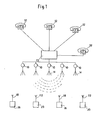
- a call transmission network (FIG. 1) includes a set of radio signal transmission stations 10 each comprising an antenna 14. These stations are all connected to the output 11 of a telephone call center 13 suitable for receiving code calls originating from the stations 12 of the telephone network and retransmitting them to the stations 10.
- the radio signals transmitted are picked up by the antennas 18 or 22 of a plurality of receivers 16, respectively vement 20.
- the receivers 16 are portable receivers of calls to people.
- the receivers 20 equip regrouping stations installed in establishments accessible to the public. They make it possible to gather information concerning the availability of a set of participating service providers from an appropriate organization. For example, a grouping station installed in an airport terminal is arranged to decode calls from a certain number of hotels to each of which is assigned a code.
- a participating hotel wishes to indicate to the regrouping stations that it has no more vacant rooms, it only has to call the transmission network by dialing its code number for the call to be received by the regrouping stations and recorded, the reception of this call constituting in itself information of the state of unavailability of all the rooms of the hotel. If a room becomes available, the hotel can recall the call transmission network by dialing its code number. The recording of the call to the regrouping stations makes it possible to display again an indication of availability for this hotel in response to questions from users at the regrouping stations.
- the radio signals transmitted by a station 10 are modulated to provide, for example, after demodulation, a series of musical frequencies, or tones, corresponding to the code number of the participant dialed on the telephone calling station. Each tone corresponds to a specific character of the code.
- an interval frequency indicates the start and / or end of a code message.
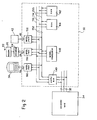
- the general architecture of such a station is shown in FIG. 2.
- the receiver 20 equipped with its antenna 22 receives and demodulates radio signals originating from a station 10. Its output is connected to the input of a multicode decoder 24 which provides code information to a multibit input 26 of a management unit 30.
- the management unit 30 is connected by a bus 32 to a random access memory 34 , in which the management unit 30 can direct call information of a determined code received on its input 26 to a position in the memory 34 corresponding to this code.
- the management unit 30 is also connected by an input-output port 36 to a terminal for processing the data grouped in the station, comprising a screen keyboard 38, and, by another data port 40, to a memory.
- non-volatile auxiliary 42 the content of which is suitable for being loaded into the memory 34 for storing therein a certain number of information known in advance, corresponding to each of the codes, and an operating software.
- the signals received by the antenna 22 (FIG. 3) of the reception chain 20 are transmitted to the input of a bandpass filter 50 tuned to the frequency of the carrier of the radio signals.
- a bandpass filter 50 tuned to the frequency of the carrier of the radio signals.
- the filter 50 At the output of the filter 50, they are received in a frequency amplification and lowering circuit 69, the output 75 of which is connected to the input of a demodulator 84 at the output 86 of which the input of an automatic gain control loop 56 connected to the gain control input 71 of the circuit 69.
- the output 86 is also connected to the input of a low-frequency bandpass filter 88 which delivers on its output signals of different tones, corresponding to the different characters (numbers) of the code, transmitted to the input of a low-frequency amplifier 90, the output of which is connected to the input 92 of the multicode decoder 24.
- the input 92 is connected to each of the respective inputs 96 . to 96 17 from a battery 93 of bandpass filters 94 1 to 94 17 .
- These filters 94 are discrete analog input filters each tuned to a respective tone.
- the respective outputs 97 1 to 97 16 of the filters 94 1 to 94 16 are connected to the respective inputs IOI 1-16 of an interface circuit 100 of which another input l03 receives the signal from the output 95 of the filter 94 17 tuned to the frequency interval.
- the interface circuit 100 is suitable for producing - the adaptation of the signals to the inputs IOI 1 to IOI 16 and 103 to a programmed management circuit 102 of which it constitutes the input and which comprises a central management unit 106, for example of the microprocessor type.
- the processing circuit l02 associated with the management unit l06 conventionally comprises a link bus 130 to which are connected, in addition to the management unit 106, a working random access memory (RAM) 132, the input interface 100, an output interface 136, a read only memory (ROM) 134 containing programmed instructions for orchestrating the operation of the management unit, and a read only memory 138 containing identification data of preset numbers or groups of code numbers corresponding to the participants in the organization.
- RAM working random access memory
- ROM read only memory
- the inputs of the interface 100 are scanned by the management unit 106.
- the presence of a signal on one of the inputs 101 or 103 of the interface 100 provides an indication of the start of the corresponding message.
- the successive signals appearing on the inputs IOI 1 to IOI 16 each correspond to the recognition of a corresponding tone by a filter 94 at the output of the receiver 20 and are read under the control of the management unit 106, which detects the rank of each IOI input on which such a signal appears and stores in memory 132 a code character corresponding to this rank in a memory location corresponding to the order of arrival of this signal.
- the end of the code message is detected by the appearance of a signal on the input 103.
- the memory 132 then contains the recording of the code contained in the hertzian message detected and decoded, in the form of a series of characters. digital t insomnia corresponding to the succession of demodulated tones.
- the management unit 106 When the reception of the message is finished, the management unit 106 carries out a comparison of the code thus acquired in the random access memory 132 with the data identifying the authorized codes present in the memory 138. It rejects the new code acquired in this memory s 'it does not correspond to any of the codes identified by the inscriptions in memory 138.
- the microprocessor transmits on one of the outputs 144 of the output interface 136, a signal to the management unit 30, in response to which the management unit can authorize the transfer of the call information. of the code stored in memory 132 by a corresponding multibit output 145 of the interface 136.
- the management unit 30 (FIG. 2) comprises a microprocessor 150 connected to a link bus 152 comprising an address link 153, a control link 154 and a data link 155. To this bus 152 are connected an interface 156 comprising the port 40 for connection with the auxiliary memory 42, an interface 158 comprising the port 26 for connection with the multicode decoder 24 and an interface 160 comprising the port 36 for connection with the terminal 38.
- the bus link 152 On the link of the bus 152 are also connected the memories cooperating with the microprocessor 150, namely a random access memory 162 and a read-only memory 164 containing the software for loading into the random access memory 34 programs and file data associated with each code of participant, contained in the auxiliary memory 42.
- the bus link 152 is connected to the bus link 32 by a bus amplifier 149.
- RAM 3.4 plays two roles. It makes it possible to store the software for operating the management unit 30 to allow not only the acquisition of the calls decoded by the multicode decoder 24 but also the dialogue between this memory and the data terminal 38. This software is loaded into the memory 34 from the auxiliary memory 42 in order to save it in the event of failure or stopping of the supply voltage. power station.
- the second function of memory 34 is to allow the creation of a file of each participant identified by their code number.
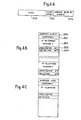
- the memory 34 is organized into two types of blocks I and II respectively.
- the type I blocks (see FIG. 4A) each comprise six bytes per code, divided into a first position 250, of three bytes, for recording the respective participant code, a position 251 of a capacity byte for counting. successive calls received to this code number and a position 252 of two bytes of capacity for entering the address of a type II block located in another part of the memory and in which a certain number of d 'more detailed information associated with the participant whose code is stored in position 250.
- the memory 34 comprises 1000 blocks of six bytes each of the type I described with reference to FIG. 4A.
- FIG. 4B represents a first example of filling a type II memory block concerning information specific to each participant.
- the address of each of these blocks is stored in position 252 of the type I blocks.
- the block in FIG. 6B is intended to collect a certain amount of information for each hotel (numbered from 1 to 5) from a grouping of small hotels identified in the system under a unique participant code number.
- the address of the corresponding type I block is entered in position 260 (two bytes) -.
- a memory byte (position 261) is reserved for a category indication for grouping hotels.
- the following positions are specific to each hotel in the series 1 to 5 and each include a telephone number memory 262 (four bytes), a one-byte location memory 263, and a one-byte selection memory 264.
- the latter memory is used as a turn indicator for the rotating display of information during interrogations of the grouping station by a user.
- the characteristic information of each hotel in the grouping is displayed in turn during successive interrogations, under the control of memory 251, so as to present only one piece of information in response to each interrogation and to allow an equitable distribution of these displays between the different members of the group.
- the type II block is assigned to a single hotel and comprises for the latter, in addition to the address indication of the type I block (FIG. 4A), an indication of category, a number telephone, a location indication and a selection indication to also allow rotation of the display with hotels of comparable category and location and various indications of nature of service.
- the writable memory positions 251 and the type II blocks at the addresses listed in 252 are suitable for being interrogated, via the bus link 152 by the terminal 38.
- the application software stored in memory 34 is provided for perform elementary processing of the number of calls stored in position 251 of each type I block interrogated from terminal 38 to display on the display screen the information of availability or non-availability of the participating hotel corresponding to this block.
- the memory 34 thus performs the regrouping of the state information corresponding to the call of each code within the framework of an organization grouping a multitude of participants.
- the keyboard interrogation device of the terminal 38 with possibilities of preliminary sorting among the information stored in the memory 34.
- the The user can interrogate, via the keyboard 38 and the management unit 30, the memory 34 to know the availability status of the only hotels corresponding to a location code and to a determined category code.
- the auxiliary memory 42 in which the instructions of the control software of the management unit 30 are written, as well as the information associated with each code to constitute the file, is read to load memory 34.
- the station is ready to start operating. Originally, all participants are expected to be available. As the participants call the grouping station, the entries for these calls are made in the memory positions assigned to each of these codes. This operation can for example take place at the start of the day. Thereafter, the state information entered in the memory 34 can be continuously modified by successive calls in successive coming from the different participants. Thus, at any time, users can, via the terminal 38, inquire about the availability of rooms in the hotels of a zone considered.
- Similar grouping stations and concerning the same participants can be located in different places in an area served by a call transmission network of the type defined above to constitute a set of files which are updated simultaneously as and as the information reaches them arrives. Some of these files may only partially overlap. This is the case when these files are established at points relatively distant from each other and each group information on hotels in a respective area around these points; only the hotels established in a territory at the intersection of these zones appear in common in these files.
- Such grouping stations thus make it possible to obtain, inexpensively and using an already existing infrastructure, a dissemination of useful information to the public. They also allow participating establishments to improve their load factor by displaying at any time of the day the existence of any availability as soon as they appear. This objective is achieved without requiring very expensive investments comparable to those of traditional reservation and information systems using wire transmission networks.
- the establishment of information gathering and file-keeping organizations which has just been described does not require any allocation of specific radio frequencies. Their operating cost is low, each update of the files by a call corresponding for example to the payment of a basic fee at the tariff in force on the call transmission network used.
Landscapes
- Engineering & Computer Science (AREA)
- Signal Processing (AREA)
- Mobile Radio Communication Systems (AREA)
Priority Applications (1)
| Application Number | Priority Date | Filing Date | Title |
|---|---|---|---|
| AT81401671T ATE12999T1 (de) | 1980-10-23 | 1981-10-22 | Verfahren und anordnung zum gruppieren von informationen, die mittels kodierter telefonanrufe uebertragen werden. |
Applications Claiming Priority (2)
| Application Number | Priority Date | Filing Date | Title |
|---|---|---|---|
| FR8022722 | 1980-10-23 | ||
| FR8022722A FR2493088B1 (fr) | 1980-10-23 | 1980-10-23 | Procede et dispositif pour le regroupement d'informations transmises par l'intermediaire d'appels telephoniques de codes |
Publications (2)
| Publication Number | Publication Date |
|---|---|
| EP0051029A1 true EP0051029A1 (de) | 1982-05-05 |
| EP0051029B1 EP0051029B1 (de) | 1985-04-24 |
Family
ID=9247247
Family Applications (1)
| Application Number | Title | Priority Date | Filing Date |
|---|---|---|---|
| EP81401671A Expired EP0051029B1 (de) | 1980-10-23 | 1981-10-22 | Verfahren und Anordnung zum Gruppieren von Informationen, die mittels kodierter Telefonanrufe übertragen werden |
Country Status (4)
| Country | Link |
|---|---|
| EP (1) | EP0051029B1 (de) |
| AT (1) | ATE12999T1 (de) |
| DE (1) | DE3170167D1 (de) |
| FR (1) | FR2493088B1 (de) |
Cited By (2)
| Publication number | Priority date | Publication date | Assignee | Title |
|---|---|---|---|---|
| GB2216319A (en) * | 1988-02-18 | 1989-10-04 | Marconi Gec Ltd | Information distribution system |
| GB2291565A (en) * | 1994-07-21 | 1996-01-24 | Mitel Corp | Mobility Management in an Integrated Telecommunications System |
Citations (1)
| Publication number | Priority date | Publication date | Assignee | Title |
|---|---|---|---|---|
| FR1565651A (de) * | 1968-03-21 | 1969-05-02 |
-
1980
- 1980-10-23 FR FR8022722A patent/FR2493088B1/fr not_active Expired
-
1981
- 1981-10-22 EP EP81401671A patent/EP0051029B1/de not_active Expired
- 1981-10-22 AT AT81401671T patent/ATE12999T1/de active
- 1981-10-22 DE DE8181401671T patent/DE3170167D1/de not_active Expired
Patent Citations (1)
| Publication number | Priority date | Publication date | Assignee | Title |
|---|---|---|---|---|
| FR1565651A (de) * | 1968-03-21 | 1969-05-02 |
Non-Patent Citations (1)
| Title |
|---|
| ELECTRONIQUE & APPLICATIONS INDUSTRIELLES, no. 239, 15 juin 1977, PARIS (FR) M. HARDY: "Réalisation des systèmes d'appels sélectifs", pages 42-47 * |
Cited By (4)
| Publication number | Priority date | Publication date | Assignee | Title |
|---|---|---|---|---|
| GB2216319A (en) * | 1988-02-18 | 1989-10-04 | Marconi Gec Ltd | Information distribution system |
| GB2291565A (en) * | 1994-07-21 | 1996-01-24 | Mitel Corp | Mobility Management in an Integrated Telecommunications System |
| US5602843A (en) * | 1994-07-21 | 1997-02-11 | Mitel Corporation | Integrated wired and wireless telecommunications system |
| GB2291565B (en) * | 1994-07-21 | 1998-04-08 | Mitel Corp | Integrated wired and wireless telecommunications system |
Also Published As
| Publication number | Publication date |
|---|---|
| FR2493088A1 (fr) | 1982-04-30 |
| FR2493088B1 (fr) | 1986-02-28 |
| DE3170167D1 (en) | 1985-05-30 |
| EP0051029B1 (de) | 1985-04-24 |
| ATE12999T1 (de) | 1985-05-15 |
Similar Documents
| Publication | Publication Date | Title |
|---|---|---|
| EP0460486B1 (de) | Verfahren zur zentralen Wartung für ein schnurloses Telefonnetzwerk | |
| EP0117181B1 (de) | Verfahren zur Berechnung von Gebühren für den Verkauf von Informationen über Telefon | |
| FR2745970A1 (fr) | Procede de prepaiement de consommation de communications telephoniques | |
| FR2581281A1 (fr) | Systeme de television par cable distribuant selectivement des messages sonores et video preenregistres | |
| FR2725578A1 (fr) | Radiotelephone ayant une pluralite d'identites d'abonne et procede pour le fonctionnement de celui-ci | |
| EP0459337A1 (de) | Teilnehmer-Zugriffsverfahren auf Abonnementdaten für einen schnurlosen Telefondienst | |
| EP0631452B1 (de) | Verwaltungsverfahren eines Botschaftensystems für Zellularfunknachrichtensystem | |
| FR2705177A1 (fr) | Procédé radiotéléphonique de localisation d'abonnés mobiles et installation radiotéléphonique pour la mise en Óoeuvre dudit procédé. | |
| EP0004497B1 (de) | Apparat für die Verkehrsbeobachtung von öffentlichen Fernsprechstellen sowie Fernüberwachungseinrichtung zur Verkehrsbeobachtung von öffentlichen Fernsprechstellen, die von mehreren Telefonzentralen versorgt werden | |
| WO2001030093A1 (fr) | Systeme et procede de transmission de messages, et utilisation du systeme de transmission pour l'investigation de services fournis | |
| FR2466921A1 (fr) | Appareil d'affectation et de selection de parties de canaux de transmission de donnees | |
| FR2662034A1 (fr) | Dispositif et procede d'interconnexion telephoniques pour reseau de communication a stations autonomes. | |
| EP0051029B1 (de) | Verfahren und Anordnung zum Gruppieren von Informationen, die mittels kodierter Telefonanrufe übertragen werden | |
| EP0827359B1 (de) | Billiges, automatisches und transparentes Zugriffverfahren und Protokoll für Telekommunikationsdienste-Anbieter über ISDN | |
| CA2228791A1 (fr) | Systeme de communication multireseau pour organisation disposant de terminaux de reseau radio cellulaire numerique | |
| EP0681408A1 (de) | Verfahren und Vorrichtung zur Herstellung von Fernsprechverbindungen von oder zu einem mobilen Teilnehmer mit mehreren Abonnementenmoden | |
| WO1994005119A1 (fr) | Dispositif de controle et de maintenance a distance de reseaux cables | |
| EP0239503B1 (de) | Verfahren und Einrichtung zur Überwachung von Kommunikationen, insbesondere Fernsprechkommunikationen | |
| FR2827689A1 (fr) | Procede et systeme informatique pour adapter une zone geographique a des comportements de population | |
| FR2808403A1 (fr) | Installation et procede de telecommunication pour l'echange d'informations entre des telephones et des fournisseurs de services | |
| EP0011070A1 (de) | Anordnung für die Fernanzeige von sich ändernden Information | |
| EP1344411B1 (de) | Kommunikationsschnittstelle zwischen pcs und hilfsbühnenabstützungen in einem intelligenten netzwerk | |
| FR2779603A1 (fr) | Procede pour l'envoi d'un groupe d'informations a un terminal radiotelephonique en communication et terminaux correspondants | |
| CH385930A (fr) | Installation téléphonique | |
| EP0569645A1 (de) | Verfahren und Einrichtung für telefonische Verbindungen mit ununterbrochener Dienstleistung in einem Netzwerk von selbstständigen Stationen |
Legal Events
| Date | Code | Title | Description |
|---|---|---|---|
| PUAI | Public reference made under article 153(3) epc to a published international application that has entered the european phase |
Free format text: ORIGINAL CODE: 0009012 |
|
| AK | Designated contracting states |
Designated state(s): AT BE CH DE GB IT LI LU NL SE |
|
| 17P | Request for examination filed |
Effective date: 19821013 |
|
| RAP1 | Party data changed (applicant data changed or rights of an application transferred) |
Owner name: PARTNER INFORMATIQUE Owner name: ELECTRONIQUE SERGE DASSAULT |
|
| GRAA | (expected) grant |
Free format text: ORIGINAL CODE: 0009210 |
|
| AK | Designated contracting states |
Designated state(s): AT BE CH DE GB IT LI LU NL SE |
|
| PG25 | Lapsed in a contracting state [announced via postgrant information from national office to epo] |
Ref country code: NL Effective date: 19850424 Ref country code: IT Free format text: LAPSE BECAUSE OF FAILURE TO SUBMIT A TRANSLATION OF THE DESCRIPTION OR TO PAY THE FEE WITHIN THE PRESCRIBED TIME-LIMIT;WARNING: LAPSES OF ITALIAN PATENTS WITH EFFECTIVE DATE BEFORE 2007 MAY HAVE OCCURRED AT ANY TIME BEFORE 2007. THE CORRECT EFFECTIVE DATE MAY BE DIFFERENT FROM THE ONE RECORDED. Effective date: 19850424 Ref country code: AT Effective date: 19850424 |
|
| REF | Corresponds to: |
Ref document number: 12999 Country of ref document: AT Date of ref document: 19850515 Kind code of ref document: T |
|
| PG25 | Lapsed in a contracting state [announced via postgrant information from national office to epo] |
Ref country code: SE Effective date: 19850430 |
|
| REF | Corresponds to: |
Ref document number: 3170167 Country of ref document: DE Date of ref document: 19850530 |
|
| NLV1 | Nl: lapsed or annulled due to failure to fulfill the requirements of art. 29p and 29m of the patents act | ||
| PG25 | Lapsed in a contracting state [announced via postgrant information from national office to epo] |
Ref country code: LU Free format text: LAPSE BECAUSE OF NON-PAYMENT OF DUE FEES Effective date: 19851031 Ref country code: LI Effective date: 19851031 Ref country code: CH Effective date: 19851031 |
|
| PLBE | No opposition filed within time limit |
Free format text: ORIGINAL CODE: 0009261 |
|
| STAA | Information on the status of an ep patent application or granted ep patent |
Free format text: STATUS: NO OPPOSITION FILED WITHIN TIME LIMIT |
|
| 26N | No opposition filed | ||
| REG | Reference to a national code |
Ref country code: CH Ref legal event code: PL |
|
| PGFP | Annual fee paid to national office [announced via postgrant information from national office to epo] |
Ref country code: LU Payment date: 19891025 Year of fee payment: 9 |
|
| PGFP | Annual fee paid to national office [announced via postgrant information from national office to epo] |
Ref country code: GB Payment date: 19891031 Year of fee payment: 9 Ref country code: BE Payment date: 19891031 Year of fee payment: 9 |
|
| PGFP | Annual fee paid to national office [announced via postgrant information from national office to epo] |
Ref country code: DE Payment date: 19891227 Year of fee payment: 9 |
|
| PG25 | Lapsed in a contracting state [announced via postgrant information from national office to epo] |
Ref country code: GB Effective date: 19901022 |
|
| PG25 | Lapsed in a contracting state [announced via postgrant information from national office to epo] |
Ref country code: BE Effective date: 19901031 |
|
| BERE | Be: lapsed |
Owner name: PARTNER INFORMATIQUE Effective date: 19901031 Owner name: ELECTRONIQUE SERGE DASSAULT Effective date: 19901031 |
|
| GBPC | Gb: european patent ceased through non-payment of renewal fee | ||
| PG25 | Lapsed in a contracting state [announced via postgrant information from national office to epo] |
Ref country code: DE Effective date: 19910702 |