EP0051085A1 - Gyroscope à deux degrés de liberté - Google Patents
Gyroscope à deux degrés de liberté Download PDFInfo
- Publication number
- EP0051085A1 EP0051085A1 EP80106811A EP80106811A EP0051085A1 EP 0051085 A1 EP0051085 A1 EP 0051085A1 EP 80106811 A EP80106811 A EP 80106811A EP 80106811 A EP80106811 A EP 80106811A EP 0051085 A1 EP0051085 A1 EP 0051085A1
- Authority
- EP
- European Patent Office
- Prior art keywords
- rotor
- shaft
- gyroscope
- rings
- rotation
- Prior art date
- Legal status (The legal status is an assumption and is not a legal conclusion. Google has not performed a legal analysis and makes no representation as to the accuracy of the status listed.)
- Granted
Links
- 238000006073 displacement reaction Methods 0.000 claims description 20
- 239000000463 material Substances 0.000 claims description 11
- 230000000452 restraining effect Effects 0.000 claims description 4
- 241000239290 Araneae Species 0.000 claims description 3
- 230000005484 gravity Effects 0.000 claims description 3
- 239000000725 suspension Substances 0.000 description 14
- 230000008878 coupling Effects 0.000 description 7
- 238000010168 coupling process Methods 0.000 description 7
- 238000005859 coupling reaction Methods 0.000 description 7
- 230000000694 effects Effects 0.000 description 2
- 230000005489 elastic deformation Effects 0.000 description 2
- 230000005415 magnetization Effects 0.000 description 2
- 238000004519 manufacturing process Methods 0.000 description 2
- 238000004891 communication Methods 0.000 description 1
- 239000002131 composite material Substances 0.000 description 1
- 230000003247 decreasing effect Effects 0.000 description 1
- 239000012530 fluid Substances 0.000 description 1
- 230000004907 flux Effects 0.000 description 1
- 230000002452 interceptive effect Effects 0.000 description 1
- 238000003475 lamination Methods 0.000 description 1
- 238000003754 machining Methods 0.000 description 1
- 230000035699 permeability Effects 0.000 description 1
- 238000007493 shaping process Methods 0.000 description 1
- 125000006850 spacer group Chemical group 0.000 description 1
- 238000009987 spinning Methods 0.000 description 1
Images

Classifications
-
- G—PHYSICS
- G01—MEASURING; TESTING
- G01C—MEASURING DISTANCES, LEVELS OR BEARINGS; SURVEYING; NAVIGATION; GYROSCOPIC INSTRUMENTS; PHOTOGRAMMETRY OR VIDEOGRAMMETRY
- G01C19/00—Gyroscopes; Turn-sensitive devices using vibrating masses; Turn-sensitive devices without moving masses; Measuring angular rate using gyroscopic effects
- G01C19/02—Rotary gyroscopes
- G01C19/04—Details
- G01C19/16—Suspensions; Bearings
- G01C19/18—Suspensions; Bearings providing movement of rotor with respect to its rotational axes
Definitions
- This invention relates to two-degree-of-freedom gyroscopes and more particularly pertains to a two-degree-of-freedom gyroscope in which the rotor is elastically suspended from a wire held taut within a drive shaft for the rotor and wherein the rotor is radially supported by magnetic repulsion.
- the free-rotor type of gyroscope the rotor is supported on a spherical electrostatic bearing or on a spherical autolubricated gas bearing.
- the dry-tuned type of gyroscope the rotor is supported on a mechanical spring or flexure system which must be precisely tuned to resonate at the spin frequency. Both of these types of displacement gyroscopes are fabricated from costly precision-machined parts.
- An object of this invention is to provide a gyroscope having a two-degree-of-freedom suspension for the gyroscope rotor.
- Another object of the invention is to provide a two-degree-of-freedom gyroscope which is comparatively easy and inexpensive to fabricate from relatively few parts.
- Still another object of the invention is to provide a two-degree-of-freedom gyroscope which is comparatively easy and inexpensive to assemble and adjust.
- a gyroscope having a rotor directly attached to an axial suspenseion wire held in tension in a drive shaft for the rotor.
- the drive shaft and the suspension wire are directly along the rotor spin axis.
- the wire permits limited rotation of the rotor about any axis perpendicular to the shaft axis but the wire restrains axial displacement of the rotor.
- Magnets affixed to the shaft and the rotor act as a magnetic bearing supporting the rotor and restraining radial displacement thereof.
- a gyroscope in accordance with the invention is relatively inexpensive to produce.
- a gyroscope in accordance with the invention may be manufactured in embodiments which are both highly rugged and yet small in size.
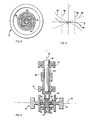
- FIG. 1 there is shown a shaft 10 for driving and supporting a gyroscope rotor 12.
- the rotor 12 is formed as a substantially cylindrical flywheel.
- the shaft 10 is mounted by means of bearings 14 for rotation relative to a housing (not shown).
- Torque for spinning the shaft 10 and rotor 12 about a central shaft axis 16 is provided by a suitable electrical spin motor. That portion of the spin motor which is fixed to the shaft 10 is represented in FIG. 1 by laminations 18 of magnetizable material axially located by spacers 20.
- a cavity 22 is formed in, the shaft 10 in the region thereof adjacent to the place where the rotor 12 is disposed.
- An axial suspension wire 24 directed along and coincident with the central shaft axis 16 is mounted on the shaft 10 and is held in tension thereby in the shaft cavity 22.
- Slotted openings 26 in the shaft wall permit communication between the exterior of the shaft 10 and the cavity 22 in the interior thereof.
- the center of rotation 28 of the rotor 12 is at the point where 'the rotor center plane 29 is intersected by the rotor axis of symmetry.
- the rotor 12 is fabricated to have an outer rim 30 and an inner cylindrical flange 32 position closer to the shaft 10.
- the inner portion of the rotor 12 is formed as a spider or spoked wheel having a plurality of arms 34 radiating outward from the central rotor axis and center of rotation 28 to the inner rotor flange 32.
- the rotor arms 34 emerge from the interior of the shaft 10 through the slots 26.
- the rotor arms 34 are attached to the axial suspension wire 24.
- the attachment may be accomplished, for example, by swaging a small flange 35 to the wire 24 and then clamping the rotor arms 34 to the flange 35.
- This elastic suspension of the rotor 12 permits limited, frictionless rotation of the rotor 12 about any axis perpendicular to the central shaft axis 16 by elastic deformation of the wire 24.
- the axial suspension wire 24 restrains axial displacement of the rotor 12, i.e., displacement along the central shaft axis 16.
- a magnetic bearing is provided for radially supporting and restraining the rotor 12 to keep it centered with respect to the shaft 10 at any orientation of the shaft 10 relative to gravity.
- a ring 36 of magnetized material is mounted on, and preferably attached to, the shaft 10 at a selected distance to one side of the center plan 29 of the rotor 12.
- Ring 36 is nested within and concentric with a second ring 38 of magnetized material mounted on, and preferably attached to, the inner'flange 32 of the rotor 12. Rings 36 and 38 are'suitably spaced apart from each other by a narrow gap.
- the outer surface of the shaft ring 36 and the adjacent inner surface of the rotor ring 38 preferably each have an unvarying polarity of magnetization around their periphery.
- the outer surface of the shaft ring 36 has the same polarity of magnetization as the adjacent inner surface of the rotor ring 38.
- the magnetic bearing for the gyroscope of FIG. 1 further includes a second pair of nested, concentric rings 40 and 42 similar to rings 36 and 38, respectively. Rings 40 and 42 are mounted on, and preferably attached to, the shaft 10 and rotor 12, respectively, at the same selected distance from the center plan 29 as the rings 36 and 38. Rings 40 and 42 act on each other in repulsion to keep the rotor 12 centered on the shaft 10 in the same manner as the rings 36 and 38, as discussed above.
- the torque produced by the magnetic bearing which comprises rings 36, 38, 40 and 42, preferably varies linearly with angular deflection in the range of interest.
- the magnetic bearing is preferably designed to have a spring rate which is constant.
- the rings, 36, 38, 40 and 42 are preferably permanent magnets of a material which may be readily shaped to provide such a constant spring rate.
- the magnetic bearing described herein may be fabricated relatively easily and inexpensively inasmuch as tolerances for the dimensions of the rings 36, 38, 40 and 42 may be relatively liberal. Tolerances in the range from about 0.1 to 0.5 mil are expected to be adequate for these magnetic parts. On the other hand, precision-machined parts in prior-art gyros are frequently required to conform to much tighter tolerances which are in the range of tens of microinches.
- FIG. 3 a preferred approach for shaping the end view cross-section of magnetic rings 36 and 38 is shown.
- the adjacent surfaces of rings 36 and 38 are shaped to follow a conforming, undulating contour.
- the lobes thus formed on the adjacent surfaces of each of rings 36 and 38 project into corresponding recesses formed on the other ring.
- This feature provides the advantage of preventing mechanical contact between the rotor arms 34 and the shaft 10 when the rotor 12 is at operating speed. If such mechanical contact were permitted to occur, the undesirable frictional effects resulting would degrade the performance of the gyroscope.
- contact between the rotor arms 34 and the shaft 10 may occur without causing any problem while the gyroscope is being brought up to speed or being shut down.
- magnetic rings 40 and 42 are conformed to each other in the same undulated, lobed pattern as is provided for rings 36 and 38 for the same reasons.
- a magnetic bearing for the rate gyroscope of FIG. 1 may be fabricated using cylindrical permanent magnets mounted on the shaft 10 and inner rotor flange 32 where the cylindrical permanent magnets are axially polarized. Such magnets would be used in conjunction with end pieces of high permeability material for directing the magnetic flux in the radial direction. The magnets and end pieces would replace magnetic r.ings 36, 38, 40 and 42. The end pieces would preferably be given the same lobed shape as is shown for the rings 36 and 38 in FIG. 3.
- the two-degree-of-freedom displacement gyroscope of FIG. 4 is, in most respects, similar to the rate gyroscope of FIG. 1.
- the rotor 12 is elastically suspended from and axially restrained by a wire 24 held taut within a cavity 22 in the rotor drive shaft 10.
- the wire 24 is directed along the central shaft axis 16.
- radial restraint and centering of the rotor 12 for the displacement gyroscope of FIG. 4 is provided by a magnetic bearing acting in repulsion.
- only two nested, concentric magnetic rings 44 and 46 are required.
- the ring 44 is mounted on the shaft 10 and the ring 46 is mounted on the rotor 12 at the center plane 29 of the rotor.
- the object here is to eliminate or nullify any uncontrolled torque tending to cause or restrain rotation about any axis perpendicular to the central shaft axis 16.
- the positioning of the rings 44 and 46 at the rotor center plane 29 tends to accomplish this since the magnetic repulsion between them tends to cause such rotation while the attendant elastic deformation of the wire 24 with such rotation tends to restrain it.
- the arms 48 of the spider by which the rotor 12 is attached to the wire 24 are formed to provide an attachment thereto without interfering with the positioning of the magnetic rings 44 and 46.
- magnetic rings 44 and 46 are preferably fabricated and mounted in the same manner as magnetic rings 36, 38, 40 and 42 as discussed above in connection with FIGs. 1, 2 and 3.
- FIG. 5 Additional considerations for the fabrication of the magnetic rings 44 and 46 for the preferred embodiment displacement gyroscope are illustrated in FIG. 5.
- e the angular deflection between the rotor spin axis and the central shaft axis 16 is plotted along the abscissa.
- T the coupling torque acting on the rotor 12 perpendicular to its spin axis, is plotted along the ordinate.
- Dashed line 50 shows the linear variation of coupling restoring torque produced by the axial suspension wire 24. This component of torque tends to restrain angular deflection.
- the variation is representative of the positive spring rate of the elastic suspension.
- the magnetic suspension has a negative spring rate. That is to say, the magnetic forces tend to induce angular deflection of the rotor spin axis away from angular coincidence with the central shaft axis 16. This effect of the magnetic suspension is represented by dashed curve 52.
- the characteristic 52 for the negative coupling torque produced by the magnetic suspension preferably has a substantially linear variation over a suitably wide region centered on the ordinate as, for example, the region between dotted vertical lines 54 and 56.
- the slope of curve 52 in this region be equal in magnitude, albeit opposite in sign, to the slope of the characteristic curve 50 for the restoring torque provided by the wire 24.
- controlled torques which may be applied to the rotor 12 by, for example, electromagnetic torquers are in addition to the coupling torques discussed hereinabove.
- the wire 24 is required to provide only axial restraint.
- the wire 24 may be very thin.
- a thin wire has a very low cross-axis spring rate. Because of the low spring rate of the wire, only a similarly low negative spring rate will be required of the magnetic bearing for cancellation of the negative and positive coupling.torques as discussed above. As is well known, cancellation of such quantities is more readily accomplished when the quantities are small.
- the combined use of a wire for axial support and a magnetic bearing for radial support of the rotor 12 thus readily provides the very low levels of cross-axis coupling required in a high performance displacement gyroscope.
Landscapes
- Physics & Mathematics (AREA)
- Engineering & Computer Science (AREA)
- General Physics & Mathematics (AREA)
- Radar, Positioning & Navigation (AREA)
- Remote Sensing (AREA)
- Magnetic Bearings And Hydrostatic Bearings (AREA)
Priority Applications (2)
| Application Number | Priority Date | Filing Date | Title |
|---|---|---|---|
| DE8080106811T DE3071603D1 (en) | 1980-11-05 | 1980-11-05 | Two-degree-of-freedom gyroscope |
| EP19800106811 EP0051085B1 (fr) | 1980-11-05 | 1980-11-05 | Gyroscope à deux degrés de liberté |
Applications Claiming Priority (1)
| Application Number | Priority Date | Filing Date | Title |
|---|---|---|---|
| EP19800106811 EP0051085B1 (fr) | 1980-11-05 | 1980-11-05 | Gyroscope à deux degrés de liberté |
Publications (2)
| Publication Number | Publication Date |
|---|---|
| EP0051085A1 true EP0051085A1 (fr) | 1982-05-12 |
| EP0051085B1 EP0051085B1 (fr) | 1986-05-14 |
Family
ID=8186875
Family Applications (1)
| Application Number | Title | Priority Date | Filing Date |
|---|---|---|---|
| EP19800106811 Expired EP0051085B1 (fr) | 1980-11-05 | 1980-11-05 | Gyroscope à deux degrés de liberté |
Country Status (2)
| Country | Link |
|---|---|
| EP (1) | EP0051085B1 (fr) |
| DE (1) | DE3071603D1 (fr) |
Cited By (1)
| Publication number | Priority date | Publication date | Assignee | Title |
|---|---|---|---|---|
| GB2146118A (en) * | 1983-09-05 | 1985-04-11 | Magyar Optikai Muevek | Vertical shaft system for gyroscopic theodolites |
Citations (6)
| Publication number | Priority date | Publication date | Assignee | Title |
|---|---|---|---|---|
| FR1082038A (fr) * | 1952-05-30 | 1954-12-24 | Sperry Gyroscope Co Ltd | Appareil gyroscopique avec rotor à entraînement par flexible |
| US3529477A (en) * | 1968-04-10 | 1970-09-22 | Sperry Rand Corp | Gyroscopic rotor suspension |
| US3540293A (en) * | 1968-01-04 | 1970-11-17 | Bendix Corp | Combination gyroscope and accelerometer |
| DE1623589A1 (de) * | 1967-11-27 | 1971-04-15 | Teldix Gmbh | Kreisel mit von einem Federstift getragenen Rotor |
| US3630091A (en) * | 1970-06-01 | 1971-12-28 | North American Rockwell | Rate and/or acceleration sensor |
| DE2627852A1 (de) * | 1976-06-22 | 1977-12-29 | Anschuetz & Co Gmbh | Kreiselgeraet, dessen kreisellaeufer durch eine auf ihn selbst wirkende magnetische einrichtung einem fuehrmoment unterworfen ist |
-
1980
- 1980-11-05 DE DE8080106811T patent/DE3071603D1/de not_active Expired
- 1980-11-05 EP EP19800106811 patent/EP0051085B1/fr not_active Expired
Patent Citations (6)
| Publication number | Priority date | Publication date | Assignee | Title |
|---|---|---|---|---|
| FR1082038A (fr) * | 1952-05-30 | 1954-12-24 | Sperry Gyroscope Co Ltd | Appareil gyroscopique avec rotor à entraînement par flexible |
| DE1623589A1 (de) * | 1967-11-27 | 1971-04-15 | Teldix Gmbh | Kreisel mit von einem Federstift getragenen Rotor |
| US3540293A (en) * | 1968-01-04 | 1970-11-17 | Bendix Corp | Combination gyroscope and accelerometer |
| US3529477A (en) * | 1968-04-10 | 1970-09-22 | Sperry Rand Corp | Gyroscopic rotor suspension |
| US3630091A (en) * | 1970-06-01 | 1971-12-28 | North American Rockwell | Rate and/or acceleration sensor |
| DE2627852A1 (de) * | 1976-06-22 | 1977-12-29 | Anschuetz & Co Gmbh | Kreiselgeraet, dessen kreisellaeufer durch eine auf ihn selbst wirkende magnetische einrichtung einem fuehrmoment unterworfen ist |
Cited By (1)
| Publication number | Priority date | Publication date | Assignee | Title |
|---|---|---|---|---|
| GB2146118A (en) * | 1983-09-05 | 1985-04-11 | Magyar Optikai Muevek | Vertical shaft system for gyroscopic theodolites |
Also Published As
| Publication number | Publication date |
|---|---|
| EP0051085B1 (fr) | 1986-05-14 |
| DE3071603D1 (en) | 1986-06-19 |
Similar Documents
| Publication | Publication Date | Title |
|---|---|---|
| US4316394A (en) | Magnetically suspended free rotor gyroscope | |
| US4036565A (en) | Pump construction | |
| US3565495A (en) | Magnetic suspension apparatus | |
| US4000929A (en) | Magnetic bearing system | |
| US4633722A (en) | Gyroscope apparatus | |
| US4285552A (en) | Torquer apparatus for magnetically suspended members | |
| JPH0137608B2 (fr) | ||
| US5736798A (en) | Passive magnetic damper | |
| US4487083A (en) | Pick-off, torquer, and reference signal generator for free rotor gyroscopes | |
| US6326714B1 (en) | Two-axis pointing motor | |
| US4285248A (en) | Two-degree-of-freedom gyroscope | |
| JPS645161B2 (fr) | ||
| US4397185A (en) | Inertial instrument with cup-shaped inertial mass | |
| US4357837A (en) | Dynamically tuned gyroscopes | |
| US5804899A (en) | Miniature magnetic bearing with at least one active axis | |
| EP0027799B1 (fr) | Moteur a aimants permanents a entrefer axial | |
| US3438270A (en) | Two-axis torquer | |
| US3490297A (en) | Dual-rotor inertial sensor | |
| EP0025446B1 (fr) | Gyroscope a deux degres de liberte ayant un moteur a aimants permanents | |
| JPS6146684B2 (fr) | ||
| US5105669A (en) | Dynamically tuned gyro | |
| EP0051085B1 (fr) | Gyroscope à deux degrés de liberté | |
| US5892310A (en) | Torquer assembly | |
| JPS60237313A (ja) | ジヤイロ装置 | |
| JPH0236883B2 (ja) | Jairosukoopu |
Legal Events
| Date | Code | Title | Description |
|---|---|---|---|
| PUAI | Public reference made under article 153(3) epc to a published international application that has entered the european phase |
Free format text: ORIGINAL CODE: 0009012 |
|
| 17P | Request for examination filed |
Effective date: 19810907 |
|
| AK | Designated contracting states |
Designated state(s): DE FR GB |
|
| GRAA | (expected) grant |
Free format text: ORIGINAL CODE: 0009210 |
|
| AK | Designated contracting states |
Kind code of ref document: B1 Designated state(s): DE FR GB |
|
| REF | Corresponds to: |
Ref document number: 3071603 Country of ref document: DE Date of ref document: 19860619 |
|
| ET | Fr: translation filed | ||
| PLBE | No opposition filed within time limit |
Free format text: ORIGINAL CODE: 0009261 |
|
| STAA | Information on the status of an ep patent application or granted ep patent |
Free format text: STATUS: NO OPPOSITION FILED WITHIN TIME LIMIT |
|
| 26N | No opposition filed | ||
| PGFP | Annual fee paid to national office [announced via postgrant information from national office to epo] |
Ref country code: FR Payment date: 19971021 Year of fee payment: 18 |
|
| PGFP | Annual fee paid to national office [announced via postgrant information from national office to epo] |
Ref country code: GB Payment date: 19971027 Year of fee payment: 18 |
|
| PGFP | Annual fee paid to national office [announced via postgrant information from national office to epo] |
Ref country code: DE Payment date: 19971029 Year of fee payment: 18 |
|
| PG25 | Lapsed in a contracting state [announced via postgrant information from national office to epo] |
Ref country code: GB Free format text: LAPSE BECAUSE OF NON-PAYMENT OF DUE FEES Effective date: 19981105 |
|
| GBPC | Gb: european patent ceased through non-payment of renewal fee |
Effective date: 19981105 |
|
| PG25 | Lapsed in a contracting state [announced via postgrant information from national office to epo] |
Ref country code: FR Free format text: LAPSE BECAUSE OF NON-PAYMENT OF DUE FEES Effective date: 19990730 |
|
| REG | Reference to a national code |
Ref country code: FR Ref legal event code: ST |
|
| PG25 | Lapsed in a contracting state [announced via postgrant information from national office to epo] |
Ref country code: DE Free format text: LAPSE BECAUSE OF NON-PAYMENT OF DUE FEES Effective date: 19990901 |