EP0051402A1 - A photomask for, and a method of, producing semiconductor devices - Google Patents
A photomask for, and a method of, producing semiconductor devices Download PDFInfo
- Publication number
- EP0051402A1 EP0051402A1 EP81304970A EP81304970A EP0051402A1 EP 0051402 A1 EP0051402 A1 EP 0051402A1 EP 81304970 A EP81304970 A EP 81304970A EP 81304970 A EP81304970 A EP 81304970A EP 0051402 A1 EP0051402 A1 EP 0051402A1
- Authority
- EP
- European Patent Office
- Prior art keywords
- photomask
- substrate
- roughened
- photoresist
- semiconductor devices
- Prior art date
- Legal status (The legal status is an assumption and is not a legal conclusion. Google has not performed a legal analysis and makes no representation as to the accuracy of the status listed.)
- Granted
Links
Images
Classifications
-
- G—PHYSICS
- G03—PHOTOGRAPHY; CINEMATOGRAPHY; ANALOGOUS TECHNIQUES USING WAVES OTHER THAN OPTICAL WAVES; ELECTROGRAPHY; HOLOGRAPHY
- G03F—PHOTOMECHANICAL PRODUCTION OF TEXTURED OR PATTERNED SURFACES, e.g. FOR PRINTING, FOR PROCESSING OF SEMICONDUCTOR DEVICES; MATERIALS THEREFOR; ORIGINALS THEREFOR; APPARATUS SPECIALLY ADAPTED THEREFOR
- G03F1/00—Originals for photomechanical production of textured or patterned surfaces, e.g., masks, photo-masks, reticles; Mask blanks or pellicles therefor; Containers specially adapted therefor; Preparation thereof
- G03F1/60—Substrates
-
- G—PHYSICS
- G03—PHOTOGRAPHY; CINEMATOGRAPHY; ANALOGOUS TECHNIQUES USING WAVES OTHER THAN OPTICAL WAVES; ELECTROGRAPHY; HOLOGRAPHY
- G03F—PHOTOMECHANICAL PRODUCTION OF TEXTURED OR PATTERNED SURFACES, e.g. FOR PRINTING, FOR PROCESSING OF SEMICONDUCTOR DEVICES; MATERIALS THEREFOR; ORIGINALS THEREFOR; APPARATUS SPECIALLY ADAPTED THEREFOR
- G03F1/00—Originals for photomechanical production of textured or patterned surfaces, e.g., masks, photo-masks, reticles; Mask blanks or pellicles therefor; Containers specially adapted therefor; Preparation thereof
- G03F1/50—Mask blanks not covered by G03F1/20 - G03F1/34; Preparation thereof
Definitions
- This invention relates to a photomask for producing semiconductor devices.
- a series of photoprocesses is used for producing semiconductor devices. Firstly, a mastermask is produced by making reduced copies of reticle patterns by reducing each pattern to one tenth of their original size. Secondly a copymask is produced by the inverse projection of the pattern of the mastermask. Then, the pattern on the mask is transferred onto a photoresist layer which is applied to, for example, a uniform metal layer on the surface of a semiconductor substrate.
- a mastermask and a copymask comprise a transparent substrate of, for example, glass or silica, on which a mask pattern is formed by a metallic film, for example, chromium, or a metal oxide film such as chromium oxide.
- a contact exposure technique is commonly used for transferring the pattern from a mask onto the photoresist layer.
- light is irradiated from the back surface of the mask through thenask and onto the photoresist layer to be patterned.
- the surface of the photoresist layer and the patterning of the mask make close contact with each other and the patterning casts shadows over the photoresist layer so that only parts of the photo resist layer are exposed to light.
- minute particles of dust unavoidably adhere to the surfaces of the transparent substrate of the mask and these can also cast shadows.
- a photomask comprising a transparent substrate on one surface of which a mask pattern is formed by a photoshielding film is characterised in that the opposite surface of the substrate is roughened so that rays of light incident upon the roughened surface are randomly refracted by it.
- a method for producing a semiconductor device includes the step of forming an image in a layer of photoresist on a semiconductor substrate by contact printing using a photomask having a mask pattern formed by a photoshielding film on one surface and a roughened opposite surface so that rays of light incident upon the other surface are randomly refracted to prevent dust particles present on the surfaces of the photomask casting shadows and contributing to the image in the photoresist.
- the photomask may be a mastermask or a copymask.
- the roughness of the opposite surface of the transparent surface has a maximum extent normal to the substrate in a range from 1 ⁇ m to 50 pm and the width of the substrate is substantially 2.5 mm.
- the maximum extent of the roughness of the surface is larger than 50 ⁇ m, it becomes difficult to obtain a sharp image of the transferred pattern.
- a photomask comprises a glass substrate 1 having a thickness of 2.:5 mm.
- One surface of the substrate 1 is roughened by sandblasting and the maximum extent of unevenness ranges from 1 to 50 ⁇ m.
- On the other surface of the substrate 1 a line pattern of chromium 2 is formed 0.1 pm in thickness with lines 11.6 pm in width. Minute particles of dust 3 are present on both surfaces of the substrate 1.
- the dust typically has a size or maximum dimension a factor of 10 smaller than the width of the pattern lines.
- the light energy required for the exposure of the photoresist layer 4 has to be increased by about 10% in comparison with a conventional photomask.
- the exposure time required is usually only increased by 1 or 2 seconds. Therefore, the present invention is no more trouble than the conventional method and apparatus used in the photoprocess technique for producing semiconductor devices and, yet is capable of transferring the exact mask pattern without the transfer of images of minute particles of dust. This improves the yield and the reliability of the semiconductor devices so produced.
Landscapes
- Physics & Mathematics (AREA)
- General Physics & Mathematics (AREA)
- Exposure And Positioning Against Photoresist Photosensitive Materials (AREA)
- Preparing Plates And Mask In Photomechanical Process (AREA)
Abstract
Description
- This invention relates to a photomask for producing semiconductor devices.
- A series of photoprocesses is used for producing semiconductor devices. Firstly, a mastermask is produced by making reduced copies of reticle patterns by reducing each pattern to one tenth of their original size. Secondly a copymask is produced by the inverse projection of the pattern of the mastermask. Then, the pattern on the mask is transferred onto a photoresist layer which is applied to, for example, a uniform metal layer on the surface of a semiconductor substrate.
- A mastermask and a copymask comprise a transparent substrate of, for example, glass or silica, on which a mask pattern is formed by a metallic film, for example, chromium, or a metal oxide film such as chromium oxide. A contact exposure technique is commonly used for transferring the pattern from a mask onto the photoresist layer. Thus, light is irradiated from the back surface of the mask through thenask and onto the photoresist layer to be patterned. The surface of the photoresist layer and the patterning of the mask make close contact with each other and the patterning casts shadows over the photoresist layer so that only parts of the photo resist layer are exposed to light. However, minute particles of dust unavoidably adhere to the surfaces of the transparent substrate of the mask and these can also cast shadows.
- During the contact exposure, images of the minute particles of dust are transferred together with the mask pattern onto the plain surface to be patterned. Thus, the transferred images of the minute particles of dust result in the formation of pin holes in the metal coductor when a negative type photoresist is used, and undesired residues of metal are deposited between the required pattern elements when a positive type photoresist is used, leading to disconnection and short circuiting of the metal conductor patterns, respectively.
- According to one aspect of the invention a photomask comprising a transparent substrate on one surface of which a mask pattern is formed by a photoshielding film is characterised in that the opposite surface of the substrate is roughened so that rays of light incident upon the roughened surface are randomly refracted by it.
- According to another apsect of the invention, a method for producing a semiconductor device includes the step of forming an image in a layer of photoresist on a semiconductor substrate by contact printing using a photomask having a mask pattern formed by a photoshielding film on one surface and a roughened opposite surface so that rays of light incident upon the other surface are randomly refracted to prevent dust particles present on the surfaces of the photomask casting shadows and contributing to the image in the photoresist.
- The photomask may be a mastermask or a copymask.
- Preferably the roughness of the opposite surface of the transparent surface has a maximum extent normal to the substrate in a range from 1 µm to 50 pm and the width of the substrate is substantially 2.5 mm.
- If the maximum extent of the roughness of the surface is larger than 50 µm, it becomes difficult to obtain a sharp image of the transferred pattern.
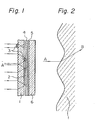
- An example of an apparatus in accordance with this invention will now be described with reference to the accompanying drawings;, in which
- Figure 1 is a section through a photomask and substrate: and,
- Figure 2 is a scrap section to an enlarged scale of part of the roughened surface of the photomask.
- A photomask comprises a glass substrate 1 having a thickness of 2.:5 mm. One surface of the substrate 1 is roughened by sandblasting and the maximum extent of unevenness ranges from 1 to 50 µm. On the other surface of the substrate 1 a line pattern of
chromium 2 is formed 0.1 pm in thickness with lines 11.6 pm in width. Minute particles ofdust 3 are present on both surfaces of the substrate 1. The dust typically has a size or maximum dimension a factor of 10 smaller than the width of the pattern lines. - Rays of light incident on the uneven surface of the substrate 1 are refracted randomly, asshown in Figure 2. Since the rays of light are randomly refracted some of them are refracted beneath the images of the particles of dust and thus substantially no shadows are formed beneath the dust particles. A
photoresist layer 4 is applied on top of analuminium layer 5 which is in turn located on asilicon substrate 6. Whilst thedust particles 3 do not cast a shadow, the image of thepatterning chromium 2 is clearly transferred on to thephotoresist layer 4. The lines of thepatterning chromium 2 are much wider than the size of thedust particles 3 and consequently, although the light is randomly refracted by the roughened surface a shadow is still cast by thepatterning chromium 2. A slight change in the width of the lines of the patterning may occur. - In addition, the light energy required for the exposure of the
photoresist layer 4 has to be increased by about 10% in comparison with a conventional photomask. The exposure time required is usually only increased by 1 or 2 seconds. Therefore, the present invention is no more trouble than the conventional method and apparatus used in the photoprocess technique for producing semiconductor devices and, yet is capable of transferring the exact mask pattern without the transfer of images of minute particles of dust. This improves the yield and the reliability of the semiconductor devices so produced. - The above example of the present invention describes the use of a copymask, however, the invention can also be applied to the production of a copy mask from a mastermask.
Claims (6)
Applications Claiming Priority (2)
| Application Number | Priority Date | Filing Date | Title |
|---|---|---|---|
| JP1980156206U JPS5779848U (en) | 1980-10-31 | 1980-10-31 | |
| JP156206/80 | 1980-10-31 |
Publications (2)
| Publication Number | Publication Date |
|---|---|
| EP0051402A1 true EP0051402A1 (en) | 1982-05-12 |
| EP0051402B1 EP0051402B1 (en) | 1984-04-25 |
Family
ID=15622681
Family Applications (1)
| Application Number | Title | Priority Date | Filing Date |
|---|---|---|---|
| EP81304970A Expired EP0051402B1 (en) | 1980-10-31 | 1981-10-22 | A photomask for, and a method of, producing semiconductor devices |
Country Status (4)
| Country | Link |
|---|---|
| US (1) | US4402600A (en) |
| EP (1) | EP0051402B1 (en) |
| JP (1) | JPS5779848U (en) |
| DE (1) | DE3163315D1 (en) |
Families Citing this family (5)
| Publication number | Priority date | Publication date | Assignee | Title |
|---|---|---|---|---|
| JPS6197924A (en) * | 1984-10-19 | 1986-05-16 | Nippon Sheet Glass Co Ltd | Protective cover |
| WO1994017449A1 (en) * | 1993-01-21 | 1994-08-04 | Sematech, Inc. | Phase shifting mask structure with multilayer optical coating for improved transmission |
| US5411824A (en) * | 1993-01-21 | 1995-05-02 | Sematech, Inc. | Phase shifting mask structure with absorbing/attenuating sidewalls for improved imaging |
| US5418095A (en) * | 1993-01-21 | 1995-05-23 | Sematech, Inc. | Method of fabricating phase shifters with absorbing/attenuating sidewalls using an additive process |
| CN1311301C (en) * | 2002-12-23 | 2007-04-18 | Asml荷兰有限公司 | Photoetching projection device |
Citations (1)
| Publication number | Priority date | Publication date | Assignee | Title |
|---|---|---|---|---|
| DE2416186A1 (en) * | 1974-04-03 | 1975-10-16 | Siemens Ag | PROCESS FOR STRUCTURING THIN LAYERS |
Family Cites Families (3)
| Publication number | Priority date | Publication date | Assignee | Title |
|---|---|---|---|---|
| US3507593A (en) * | 1967-05-08 | 1970-04-21 | Tektronix Inc | Contact negative with method and apparatus employing the same |
| NL7200295A (en) * | 1972-01-08 | 1973-07-10 | ||
| JPS6016703Y2 (en) * | 1981-08-12 | 1985-05-23 | 敏雄 中嶋 | drainage trap device |
-
1980
- 1980-10-31 JP JP1980156206U patent/JPS5779848U/ja active Pending
-
1981
- 1981-10-22 DE DE8181304970T patent/DE3163315D1/en not_active Expired
- 1981-10-22 EP EP81304970A patent/EP0051402B1/en not_active Expired
- 1981-10-23 US US06/314,429 patent/US4402600A/en not_active Expired - Fee Related
Patent Citations (1)
| Publication number | Priority date | Publication date | Assignee | Title |
|---|---|---|---|---|
| DE2416186A1 (en) * | 1974-04-03 | 1975-10-16 | Siemens Ag | PROCESS FOR STRUCTURING THIN LAYERS |
Also Published As
| Publication number | Publication date |
|---|---|
| DE3163315D1 (en) | 1984-05-30 |
| JPS5779848U (en) | 1982-05-17 |
| US4402600A (en) | 1983-09-06 |
| EP0051402B1 (en) | 1984-04-25 |
Similar Documents
| Publication | Publication Date | Title |
|---|---|---|
| EP0907105A3 (en) | Method for fabricating photomasks having a phase shift layer | |
| JP3912949B2 (en) | Photomask forming method and semiconductor device manufacturing method | |
| EP0051402B1 (en) | A photomask for, and a method of, producing semiconductor devices | |
| EP0720051A2 (en) | Self-aligned opaque regions for attenuating phase-shifting masks | |
| JP3177948B2 (en) | Photomask for exposure | |
| US6682858B2 (en) | Method of forming small contact holes using alternative phase shift masks and negative photoresist | |
| JPH1115132A (en) | Halftone type phase shift mask and blank for halftone type phase shift mask | |
| US6635394B2 (en) | Three dimensional mask | |
| US5798192A (en) | Structure of a mask for use in a lithography process of a semiconductor fabrication | |
| KR920009369B1 (en) | How to make a mask | |
| JP3110801B2 (en) | Photomask manufacturing method and photomask | |
| JPH0664337B2 (en) | Photomask for semiconductor integrated circuit | |
| JPH06105678B2 (en) | Method for manufacturing semiconductor device | |
| JP3031728B2 (en) | Reticle and exposure equipment | |
| JPS6127548A (en) | Non-contact type exposing device | |
| JP2892014B2 (en) | Light exposure mask and exposure method | |
| US20040013948A1 (en) | Chromeless PSM with chrome assistant feature | |
| JP2624335B2 (en) | Resist exposure method | |
| KR0151228B1 (en) | Photomask for preparing resist pattern | |
| JPS5984245A (en) | Photomask | |
| JPH05275303A (en) | Exposure method and photomask used therefor | |
| JPH0683036A (en) | Reticule for stepping | |
| JPH05232675A (en) | Photomask and resist pattern forming method using the same | |
| JPH05347244A (en) | Resist pattern formation method | |
| JPS5720738A (en) | Mask for pattern transfer |
Legal Events
| Date | Code | Title | Description |
|---|---|---|---|
| PUAI | Public reference made under article 153(3) epc to a published international application that has entered the european phase |
Free format text: ORIGINAL CODE: 0009012 |
|
| AK | Designated contracting states |
Designated state(s): DE FR GB NL |
|
| 17P | Request for examination filed |
Effective date: 19820820 |
|
| GRAA | (expected) grant |
Free format text: ORIGINAL CODE: 0009210 |
|
| AK | Designated contracting states |
Designated state(s): DE FR GB NL |
|
| REF | Corresponds to: |
Ref document number: 3163315 Country of ref document: DE Date of ref document: 19840530 |
|
| ET | Fr: translation filed | ||
| PLBE | No opposition filed within time limit |
Free format text: ORIGINAL CODE: 0009261 |
|
| STAA | Information on the status of an ep patent application or granted ep patent |
Free format text: STATUS: NO OPPOSITION FILED WITHIN TIME LIMIT |
|
| 26N | No opposition filed | ||
| PGFP | Annual fee paid to national office [announced via postgrant information from national office to epo] |
Ref country code: GB Payment date: 19921012 Year of fee payment: 12 |
|
| PGFP | Annual fee paid to national office [announced via postgrant information from national office to epo] |
Ref country code: FR Payment date: 19921028 Year of fee payment: 12 |
|
| PGFP | Annual fee paid to national office [announced via postgrant information from national office to epo] |
Ref country code: NL Payment date: 19921031 Year of fee payment: 12 |
|
| PGFP | Annual fee paid to national office [announced via postgrant information from national office to epo] |
Ref country code: DE Payment date: 19921226 Year of fee payment: 12 |
|
| PG25 | Lapsed in a contracting state [announced via postgrant information from national office to epo] |
Ref country code: GB Effective date: 19931022 |
|
| PG25 | Lapsed in a contracting state [announced via postgrant information from national office to epo] |
Ref country code: NL Effective date: 19940501 |
|
| NLV4 | Nl: lapsed or anulled due to non-payment of the annual fee | ||
| GBPC | Gb: european patent ceased through non-payment of renewal fee |
Effective date: 19931022 |
|
| PG25 | Lapsed in a contracting state [announced via postgrant information from national office to epo] |
Ref country code: FR Effective date: 19940630 |
|
| PG25 | Lapsed in a contracting state [announced via postgrant information from national office to epo] |
Ref country code: DE Effective date: 19940701 |
|
| REG | Reference to a national code |
Ref country code: FR Ref legal event code: ST |