EP0051701A1 - Système de frein pour moteur à combustion interne - Google Patents
Système de frein pour moteur à combustion interne Download PDFInfo
- Publication number
- EP0051701A1 EP0051701A1 EP19800303980 EP80303980A EP0051701A1 EP 0051701 A1 EP0051701 A1 EP 0051701A1 EP 19800303980 EP19800303980 EP 19800303980 EP 80303980 A EP80303980 A EP 80303980A EP 0051701 A1 EP0051701 A1 EP 0051701A1
- Authority
- EP
- European Patent Office
- Prior art keywords
- valve
- pushrod
- area
- stable
- ball
- Prior art date
- Legal status (The legal status is an assumption and is not a legal conclusion. Google has not performed a legal analysis and makes no representation as to the accuracy of the status listed.)
- Ceased
Links
- 239000012530 fluid Substances 0.000 claims abstract description 26
- 230000006835 compression Effects 0.000 claims abstract description 25
- 238000007906 compression Methods 0.000 claims abstract description 25
- 238000013016 damping Methods 0.000 claims abstract description 14
- 238000002485 combustion reaction Methods 0.000 claims abstract description 7
- 230000004048 modification Effects 0.000 claims description 5
- 238000012986 modification Methods 0.000 claims description 5
- 230000010355 oscillation Effects 0.000 abstract description 6
- 230000002028 premature Effects 0.000 abstract description 2
- 230000000694 effects Effects 0.000 description 7
- 239000000446 fuel Substances 0.000 description 7
- 230000003247 decreasing effect Effects 0.000 description 3
- 238000010586 diagram Methods 0.000 description 3
- 230000007246 mechanism Effects 0.000 description 3
- 244000304337 Cuminum cyminum Species 0.000 description 2
- 238000006243 chemical reaction Methods 0.000 description 2
- 230000003292 diminished effect Effects 0.000 description 2
- 230000014509 gene expression Effects 0.000 description 2
- 230000000979 retarding effect Effects 0.000 description 2
- 230000001133 acceleration Effects 0.000 description 1
- 230000009471 action Effects 0.000 description 1
- 230000002411 adverse Effects 0.000 description 1
- 230000008859 change Effects 0.000 description 1
- 230000002301 combined effect Effects 0.000 description 1
- 238000010276 construction Methods 0.000 description 1
- 230000008030 elimination Effects 0.000 description 1
- 238000003379 elimination reaction Methods 0.000 description 1
- QSHDDOUJBYECFT-UHFFFAOYSA-N mercury Chemical compound [Hg] QSHDDOUJBYECFT-UHFFFAOYSA-N 0.000 description 1
- 229910052753 mercury Inorganic materials 0.000 description 1
- 230000001105 regulatory effect Effects 0.000 description 1
- 230000002441 reversible effect Effects 0.000 description 1
- 239000013589 supplement Substances 0.000 description 1
Images


Classifications
-
- F—MECHANICAL ENGINEERING; LIGHTING; HEATING; WEAPONS; BLASTING
- F16—ENGINEERING ELEMENTS AND UNITS; GENERAL MEASURES FOR PRODUCING AND MAINTAINING EFFECTIVE FUNCTIONING OF MACHINES OR INSTALLATIONS; THERMAL INSULATION IN GENERAL
- F16K—VALVES; TAPS; COCKS; ACTUATING-FLOATS; DEVICES FOR VENTING OR AERATING
- F16K17/00—Safety valves; Equalising valves, e.g. pressure relief valves
- F16K17/02—Safety valves; Equalising valves, e.g. pressure relief valves opening on surplus pressure on one side; closing on insufficient pressure on one side
- F16K17/04—Safety valves; Equalising valves, e.g. pressure relief valves opening on surplus pressure on one side; closing on insufficient pressure on one side spring-loaded
- F16K17/0406—Safety valves; Equalising valves, e.g. pressure relief valves opening on surplus pressure on one side; closing on insufficient pressure on one side spring-loaded in the form of balls
-
- F—MECHANICAL ENGINEERING; LIGHTING; HEATING; WEAPONS; BLASTING
- F01—MACHINES OR ENGINES IN GENERAL; ENGINE PLANTS IN GENERAL; STEAM ENGINES
- F01L—CYCLICALLY OPERATING VALVES FOR MACHINES OR ENGINES
- F01L13/00—Modifications of valve-gear to facilitate reversing, braking, starting, changing compression ratio, or other specific operations
- F01L13/06—Modifications of valve-gear to facilitate reversing, braking, starting, changing compression ratio, or other specific operations for braking
- F01L13/065—Compression release engine retarders of the "Jacobs Manufacturing" type
-
- F—MECHANICAL ENGINEERING; LIGHTING; HEATING; WEAPONS; BLASTING
- F02—COMBUSTION ENGINES; HOT-GAS OR COMBUSTION-PRODUCT ENGINE PLANTS
- F02D—CONTROLLING COMBUSTION ENGINES
- F02D13/00—Controlling the engine output power by varying inlet or exhaust valve operating characteristics, e.g. timing
- F02D13/02—Controlling the engine output power by varying inlet or exhaust valve operating characteristics, e.g. timing during engine operation
- F02D13/04—Controlling the engine output power by varying inlet or exhaust valve operating characteristics, e.g. timing during engine operation using engine as brake
Definitions
- This invention relates generally to engine braking apparatus of a gas compression relief type.
- the invention relates more particularly to a pressure relief apparatus which automatically disables one or more operating cylinders of the compression relief engine brake whenever the forces in the hydraulic circuit of the engine brake exceed a predetermined level.
- Engine brakes of the compression relief type are well known in the art. Such engine brakes are designed to convert, temporarily, an internal combustion engine of the spark ignition or compression ignition type into an air compressor so as to develop a retarding horsepower which may be a substantial portion of the operating horsepower normally developed by the engine.
- the engine brake will supplement the braking capacity of the primary vehicle wheel braking system and extend, substantially, the life of the primary braking system.
- the basic design ror an engine braKing system of the type here involved is disclosed in the Cummins U.S. Patent 3,220,392.
- the compression relief engine brake of the type disclosed in Patent 3,220,392 employs a hydraulic system wherein the motion of a master piston controls the motion of a slave piston which opens the exhaust valve of the internal combustion engine near the end of the compression stroke whereby the work done in compressing the intake air is not recovered during the expansion or "power" stroke but, instead, is dissipated through the exhaust and radiator systems.
- the master piston is customarily driven by a pushrod controlled by the engine camshaft. It will be apparent that the force required to open the exhaust valve will be transmitted back through the hydraulic system to the pushrod and camshaft.
- the problem of assigning a second function to an existing pushrod is that an increased load may be experienced which may exceed the design capacity of the pushrod or cam shaft.
- the present invention generally solves this problem by providing an automatic means (a) to unload the engine brake whenever an excessive loading condition becomes imminent and (b) to reactivate the engine brake as soon as the temporary excess loading condition has terminated so as not to interfere with the effectiveness of the engine brake.
- an engine braking apparatus of a gas compression relief type including an internal combustion engine having exhaust valve means and pushrod means, hydraulically actuated piston means for opening said exhaust valve means at a predetermined time, and further piston means actuated by said pushrod means and hydraulically interconnected with said exhaust valve opening piston means in a high pressure hydraulic fluid circuit, characterized by a bi-stable valve located in said high pressure hydraulic fluid circuit and having at least primary and secondary orifices, and damping means associated with said valve to rapidly damp out vibrations of said valve .while it is moving from its closed position defining a high pressure condition, until it comes. to rest in an open position defining- a low pressure condition, said primary and secondary orifices and damping means maximizing the flow through said valve and minimizing the time required to attain said low pressure condition.
- the apparatus of the invention will rapidly respond to a hydraulic pressure in the brake system above a desired predetermined pressure and maintain the system pressure for the balance of a cycle at a fraction of the predetermined pressure whenever an excess pressure is sensed. With our apparatus the pressure drop will occur rapidly and with a minimum number of pressure oscillations and the apparatus will automatically reset itself after operation so as to restore it to the regular operating mode.
- Figure 1 is a schematic diagram of a compression relief engine brake adapted for use in conjunction with an internal combustion engine of the spark ignition or compression ignition type.
- the basic design of the compression relief brake is disclosed in the Cummins U.S. Patent 3,220,392.
- the present invention will be described with reference to an engine brake applied to a Cummins compression ignition engine in which the master piston of the engine brake is driven by the injector pushrod. It will be understood that the invention may also be applied to other applications where, for example, the master piston is driven by an exhaust valve pushrod.
- the pressure relief device herein disclosed may be placed at any convenient point in the high pressure hydraulic circuit although its combination with the master piston is particularly desirable.
- the numeral 10 represents a housing fitted on an internal combustion engine within which the components of a compression relief engine brake are contained.
- Oil 12 from a sump 14 which may be, for example, the engine crankcase is pumped through a duct 16 by a low pressure pump 18 to the inlet 20 of a solenoid valve 22 mounted in the housing 10.
- Low pressureoil12 is conducted from the solenoid valve 22 to a control cylinder 24 by a duct 26.
- a control valve 28 is fitted for reciprocating movement within the control cylinder and is urged into a closed position by a compression spring 30.
- the control valve 28 contains an inlet passage 32 closed by a ball check valve 34 which is biased into the closed position by a compression spring 36 and an outlet passage 38.
- a slave piston 50 is fitted for reciprocating motion within the slave cylinder 42.
- the slave piston 50 is biased in an upward direction (as shown in Figure 1) against an adjustable stop 52 by a compression spring 54 which is mounted within the slave piston 50 and acts against a bracket 56 seated in the slave cylinder 42.
- the lower end of the slave piston 50 acts against an exhaust valve cap or crosshead 58 fitted on the stem of exhaust valve 60 which is, in turn, seated in the engine cylinder head 62.
- exhaust valve spring 64 normally biases the exhaust valve 60 to the closed position as shown in Figure 1
- the adjustable stop 52 is set to provide a clearance of about 0,018 inch (i.e, "lash") between the slave piston 50 and the exhaust valve cap 58 when the exhaust valve 60 is closed, the slave piston 50 is seated against the adjustable stop 52 and the engine is cold. This clearance is required and is normally sufficient to accommodate expansion of the parts comprising the exhaust valve train when the engine is hot without opening the exhaust valve 60.
- a master piston 66 is fitted for reciprocating movement within the master cylinder 48 and biased in an upward direction (as viewed in Figure 1) by a light leaf spring 68, The lower end of the master piston 66 contacts an adjusting screw mechanism 70 of a rocker arm 72 controlled by a pushrod 74 driven from the engine camshaft (not shown).
- the rocker arm 72 is conveniently the fuel injector rocker arm and the pushrod 74 is the injector pushrod.
- the pushrod 74 and the exhaust valve 60 are associated with the same engine cylinder,
- the solenoid valve 22 When it is desired to deactivate the compression brake, the solenoid valve 22 is closed whereby the oil 12 in the control valve cylinder 24 passes through the duct 26, the solenoid valve 22 and the return duct 76 to the sump 14, When the control valve 28 drops downwardly as viewed in Figure 1, a portion of the oil in the slave cylinder 42 and master cylinder 48 is vented past the control valve 28 and returned to the sump 14 by duct means (not shown).
- the electrical control system for the engine brake includes the vehicle battery 78 which is grounded at 80.
- the hot terminal of the battery 78 is connected, in series, to a fuse 82, a dash switch 84, a clutch switch 86, a fuel pump switch 88 and, preferably, through a diode 90 back to ground 80,
- the switches 84, 86 and 88 are provided to assure the safe operation of the system.
- Switch 84 is a manual control to deactivate the entire system.
- Switch 86 is an automatic switch connected to the clutch to deactivate the system whenever the clutch is disengaged so as to prevent engine stalling.
- Switch 88 is a second automatic switch connected to the fuel system to prevent engine fueling when the engine brake is in operation.
- the master piston 66 comprises a hollow cylindrical body 92 open at the top and having a plurality of drainage passageways 94 communicating between the interior and exterior of the body 92, A cap 96 is threaded into the top of the body 92 and contains adjusting bores 98 adapted to receive an appropriate wrench or spanner (not shown), A central or primary orifice 100 is formed in the cap 96 and communicates with a larger valve bore or secondary orifice 102.
- valve seat 104 for a valve 106, preferably in the form of a spheroid or ball, but which may also, for example, be conical in shape,
- the diameter of the valve 106 is selected so as to be slightly smaller than the bore 102 while the cap 96 has a thickness such that the bottom surface 108 lies slightly below the center of the valve 106,
- a spring 110 mounted within the body 92 of the master piston 66 carries a valve guide 112 which biases the valve 106 against the valve seat 104,
- the valve guide includes a seat portion 114 and a plunger portion 116 designed to limit the downward motion of the valve guide 112 before the spring 110 becomes fully compressed.
- valve 106 If the force due to the hydraulic pressure exceeds the force due to the spring 110, the valve 106 will be displaced slightly from the seat 104 whereupon the hydraulic pressure will act on the full projected cross-section of the valve 106, an area known as the "secondary" area.
- valve 106 will be rapidly accelerated to the fully displaced position as limited by contact between the plunger end 116 of the valve guide 112 with the bottom of the piston body 92.
- the annular area may be called the "tertiary” area as distinguished from the "primary" area of the orifice 100 and the "secondary" projected area of the valve 106, Applicants have discovered that the ratio of the tertiary and primary areas should be at least 1.0 and preferably about 1.5.
- the ratio is less than 1,0 a throttling of the flow of hydraulic fluid occurs which tends to decrease the rate at which hydraulic fluid is dumped through the piston
- the "tertiary" area is controlled so as to be between about 100% and 150% of the size of the orifice 100, the resistance to the flow of hydraulic fluid is sufficient so that the pressure acts on the upper surface of the valve guide 112 and quickly damps out the vibratory motion of the valve guide 112 and the valve 106 resulting from the reaction of the spring 110.
- the average opening and the average time in the open position of the valve 106 are increased whereby the flow through the valve is maximized.
- valve 106 when- fully contained in the valve bore 102, allows a pressure to develop behind the valve 106 in the valve bore 102 and this causes a greater acceleration and increased velocity of the valve.
- the effect is that the valve is open for a longer time and the average opening is greater whereby the flow through the ball valve is maximized.
- the pressure at which the valve 106 will begin to open is controlled by the bias exerted by the spring 110 which acts through the valve guide 112 to hold the valve 106 against the seat 104.
- bias may be regulated by adjusting the cap 96 until the desired load on the spring 110 is attained. Once adjusted, the cap 96 may be staked or otherwise locked in the body 92 of the master piston 66 to maintain the adjustment.
- valve 106 will automatically reseat and the hydraulic system will be restored to its normal operating mode, Thus, the engine brake will again be in condition to operate.
- FIG. 3 another form of a pressure relief valve is shown. Parts which are common to both Figures2 and 3 bear the same identification.
- the principal difference in construction lies in the structure of the valve guide 122 of Figure 1 which comprises a assymmetric structure having a radially extending shoulder portion 124, an axially extending plunger 125 and a skew seat 127.
- skew seat applicants mean that the plane of the seat in the valve guide l22 against which the valve 106 acts is not normal or perpendicular to the axis of the guide 122 but, instead, is inclined with respect to that axis as is clearly shown in Figure 3.
- valve 106 should be a ball valve, If the force due to hydraulic pressure exceeds the force due to the spring 110, the ball 106 will be displaced slightly from the seat 104 whereupon the hydraulic pressure will act upon the full projected cross-section of the ball valve 106. As a result, the ball valve 106 will be rapidly accelerated to the fully displaced position and will tend to "ride down" the skew seat 127.
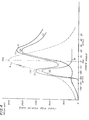
- Curve A represents the force required at the injector pushrod to open an exhaust valve, This is the force transmited through the high pressure hydraulic system of the engine brake by the slave piston 50 and the master piston 66.
- Curve A is in the form of a bell curve essentially symmetric about the TDC point and reflects the changing pressure within the cylinder. Curve A may be displaced vertically depending upon the degree of boost given by the engine supercharger. In Figure 4, curve A is shown with a typical normal boost of 15 inches of mercury. If a higher boost were used, the curve would be raised while with a lower boost it would be lowered.
- Curve B represents the force induced in the pushrod to open the exhaust valve and hold it open.
- Curve C represents the force induced in the pushrod due to the operation of the fuel injector train.
- This force normally peaks shortly after TDC and the peak, indicated at point 128, represents the crushing load on the injector train as the injector is mechanically seated in the injector body.
- the maximum force occurs at point 128 and is considered in the normal design of the engine.
- Curve D represents the total force on the pushrod due to the combined effect of the exhaust valve opening load and the injector load and is determined as the sum of the forces shown by Curves B and C.
- Curve D will have two peaks -- the first occurring approximately when the exhaust valve begins to open and the second when the injector seats. These peaks are indicated, respectively, at points 130 and 132. It will be appreciated that if the time interval between the peak loads indicated by points 130 and 132 is decreased for any reason, such as excessive lash in the system or increased supercharger boost, for example, the force required to open the exhaust valve may not have decreased to its minimum value before the maximum injector load occurs with the result that the total load on the injector pushrod becomes excessive and buckling of the pushrod may occur.
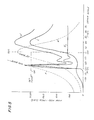
- Figure 5 illustrates a typical operation of the present invention wherein the engine brake hydraulic system is unloaded to prevent damage to the injector pushrods when an overload condition occurs as a result of excessive supercharger boost.
- Curve A is identical to Curve A of Figure 4 and represents a normal 15 inch supercharger boost while Curve E indicates the maximum boost capable of being provided by the engine supercharger
- Curve C is also identical to Curve C of Figure 4 and represents the force on the injector pushrod due to the injector load alone.
- the line 134 represents the set point for the pressure relief system of the present invention. This is the predetermined pressure within the hydraulic system of the engine brake at which the valve 106 will be displaced from its seat 104 so as to dump hydraulic fluid through the master piston 66 and therefore unload the system.
- Curve B' in Figure 5 represents the force in the pushrod due to the hydraulic pressure in the engine brake mechanism and the exhaust valve train. It is similar to Curve B of Figure 4 but, because of the increased supercharger boost, the curve reaches the set point 134 before it coincides with the boost curve E.
- Figure 6 is a graph showing the effect of the variations in the size of the fluid flow passages of the configuration of Figure 2 on the performance of the pressure relief system.
- a pressure relief system of the type shown in Figure 2 was employed wherein the area of the orifice 100 (the "primary" area) was 0.0102 square inches.
- Curve 136 shows the performance of a pressure relief system wherein the area between the inner surface of the master piston body 92 and the shoulder 118 of the valve guide 112 (the "tertiary" area) was 0.0676 square inches while Curve 138 shows the improved performance resulting from a decrease in the size of the orifice between the shoulder 118 and the inner surface of the master piston body 92 (the "tertiary” area) to 0.0146 square inches.
- Curve C of Figure 6 is identical to Curve C of figures 4 and 5 and is reproduced for reference in the following discussion.
- Figure 6 shows two improvements which result from the change exemplified by Curve 138; First, the pressure maintained in the system after TDC was substantially lower and, second, the time, measured in crank angle degrees required to dump the pressure, was substantially decreased. Both effects are important: The first reduces the total maximum load on the injector pushrod while the second tends to separate the effect of the peak load required to open the exhaust valve from the injector seating load.
- the resistance to the flow of hydraulic fluid is sufficient so that the pressure acts on the upper surface of the valve guide 112 and quickly damps out the vibratory motion of the valve guide 112 and the valve 106 resulting from the reaction of the spring 110.
- the average opening and the average time in the open position of the valve 106 are increased whereby the flow through the valve 106 is maximized.
- hydraulic fluid which is vented from the system is returned to the system without the need for additional ducts or pumps since it is delivered to the pushrod area, an area where hydraulic fluid is normally present.
- the pressure relief system herein contemplated may be placed at any point in the high pressure hydraulic fluid circuit, for example, in ducts 40 or 46. While in such locations the dimensional limitations presented by the master piston 66 are not present, hydraulic fluid return ducts would be required, It will be understood that if the pressure relief system of the present invention were placed elsewhere in the high pressure circuit, the body 92 or its equivalent would be threaded or otherwise connected to the high pressure circuit and the drainage passageways would be connected to a hydraulic fluid return duct. In such a system, it is apparent that either the three area pressure relief valve as shown in Figure 2 or the equivalent two area and skew seat pressure relief valve of Figure 3 could be employed.
- the coil spring 110 and the valve guide 122 of Figure 3 may be combined in the form of an equivalent leaf spring having a ball engaging surface of the shape and orientation of the ball guide seat 127 and a spring rate equal to that of the coil spring 110.
- Such a modification would operate in a manner similar to the pressure relief system of Figure 3, as described herebefore but, as also noted, could be located at any convenient point in the high pressure hydraulic system.
Landscapes
- Engineering & Computer Science (AREA)
- General Engineering & Computer Science (AREA)
- Mechanical Engineering (AREA)
- Chemical & Material Sciences (AREA)
- Combustion & Propulsion (AREA)
- Output Control And Ontrol Of Special Type Engine (AREA)
- Valve Device For Special Equipments (AREA)
Priority Applications (1)
| Application Number | Priority Date | Filing Date | Title |
|---|---|---|---|
| EP19800303980 EP0051701A1 (fr) | 1980-11-06 | 1980-11-06 | Système de frein pour moteur à combustion interne |
Applications Claiming Priority (1)
| Application Number | Priority Date | Filing Date | Title |
|---|---|---|---|
| EP19800303980 EP0051701A1 (fr) | 1980-11-06 | 1980-11-06 | Système de frein pour moteur à combustion interne |
Publications (1)
| Publication Number | Publication Date |
|---|---|
| EP0051701A1 true EP0051701A1 (fr) | 1982-05-19 |
Family
ID=8187293
Family Applications (1)
| Application Number | Title | Priority Date | Filing Date |
|---|---|---|---|
| EP19800303980 Ceased EP0051701A1 (fr) | 1980-11-06 | 1980-11-06 | Système de frein pour moteur à combustion interne |
Country Status (1)
| Country | Link |
|---|---|
| EP (1) | EP0051701A1 (fr) |
Cited By (3)
| Publication number | Priority date | Publication date | Assignee | Title |
|---|---|---|---|---|
| EP0967039A3 (fr) * | 1998-06-24 | 2002-11-13 | Sandvik Aktiebolag | Porte-outil pour outil de coupe |
| US8501158B2 (en) | 1999-04-09 | 2013-08-06 | Amag Pharmaceuticals, Inc. | Polyol and polyether iron oxide complexes as pharmacological and/or MRI contrast agents |
| CN113794019A (zh) * | 2021-08-17 | 2021-12-14 | 阳萍 | 一种具有电解液排放能力的防爆燃型锂离子电池 |
Citations (6)
| Publication number | Priority date | Publication date | Assignee | Title |
|---|---|---|---|---|
| US2572816A (en) * | 1944-10-11 | 1951-10-23 | Sk Wellman Co | Pressure relief valve |
| US2672882A (en) * | 1949-09-30 | 1954-03-23 | Theodore W Bergquist | Safety valve |
| US2704549A (en) * | 1955-03-22 | Non-chattering relief valve | ||
| FR1269428A (fr) * | 1960-08-18 | 1961-08-11 | Système d'entraînement et de freinage pour véhicules | |
| DE2221461A1 (de) * | 1972-05-02 | 1973-11-15 | Heinrich Pfeil | Ueberdruckventil |
| US4150640A (en) * | 1977-12-20 | 1979-04-24 | Cummins Engine Company, Inc. | Fluidic exhaust valve opening system for an engine compression brake |
-
1980
- 1980-11-06 EP EP19800303980 patent/EP0051701A1/fr not_active Ceased
Patent Citations (6)
| Publication number | Priority date | Publication date | Assignee | Title |
|---|---|---|---|---|
| US2704549A (en) * | 1955-03-22 | Non-chattering relief valve | ||
| US2572816A (en) * | 1944-10-11 | 1951-10-23 | Sk Wellman Co | Pressure relief valve |
| US2672882A (en) * | 1949-09-30 | 1954-03-23 | Theodore W Bergquist | Safety valve |
| FR1269428A (fr) * | 1960-08-18 | 1961-08-11 | Système d'entraînement et de freinage pour véhicules | |
| DE2221461A1 (de) * | 1972-05-02 | 1973-11-15 | Heinrich Pfeil | Ueberdruckventil |
| US4150640A (en) * | 1977-12-20 | 1979-04-24 | Cummins Engine Company, Inc. | Fluidic exhaust valve opening system for an engine compression brake |
Cited By (5)
| Publication number | Priority date | Publication date | Assignee | Title |
|---|---|---|---|---|
| EP0967039A3 (fr) * | 1998-06-24 | 2002-11-13 | Sandvik Aktiebolag | Porte-outil pour outil de coupe |
| US8501158B2 (en) | 1999-04-09 | 2013-08-06 | Amag Pharmaceuticals, Inc. | Polyol and polyether iron oxide complexes as pharmacological and/or MRI contrast agents |
| US8926947B2 (en) | 1999-04-09 | 2015-01-06 | Amag Pharmaceuticals, Inc. | Polyol and polyether iron oxide complexes as pharmacological and/or MRI contrast agents |
| US9555133B2 (en) | 1999-04-09 | 2017-01-31 | Amag Pharmaceuticals, Inc. | Polyol and polyether iron oxide complexes as pharmacological and/or MRI contrast agents |
| CN113794019A (zh) * | 2021-08-17 | 2021-12-14 | 阳萍 | 一种具有电解液排放能力的防爆燃型锂离子电池 |
Similar Documents
| Publication | Publication Date | Title |
|---|---|---|
| US4271796A (en) | Pressure relief system for engine brake | |
| US4399787A (en) | Engine retarder hydraulic reset mechanism | |
| US4485780A (en) | Compression release engine retarder | |
| EP0034681B1 (fr) | Système de frein moteur | |
| US4423712A (en) | Engine retarder slave piston return mechanism | |
| US4706625A (en) | Engine retarder with reset auto-lash mechanism | |
| US4592319A (en) | Engine retarding method and apparatus | |
| US5996550A (en) | Applied lost motion for optimization of fixed timed engine brake system | |
| US6012424A (en) | Method and apparatus to accomplish exhaust gas recirculation and/or engine braking to overhead cam internal combustion engines | |
| US6594996B2 (en) | Method and system for engine braking in an internal combustion engine with exhaust pressure regulation and turbocharger control | |
| US4706624A (en) | Compression release retarder with valve motion modifier | |
| US11384698B2 (en) | Self-contained compression brake control module for compression-release brake system of an internal combustion engine | |
| US20220307392A1 (en) | Compact engine brake with pressure-control reset | |
| US5048480A (en) | Variable timing process and mechanism for a compression release engine retarder | |
| CA2085935A1 (fr) | Soupape d'ecretage pour ralentisseur sur moteur a commande de depression | |
| US4996957A (en) | Control valve for a compression release engine retarder | |
| EP1389270A4 (fr) | Procede et systeme de freinage moteur dans un moteur a combustion interne | |
| US20050224046A1 (en) | Apparatus and method for retarding an engine with an exhaust brake and a compression release brake | |
| US4898206A (en) | Compression release retarder with valve motion modifier | |
| CA1156526A (fr) | Frein sur moteur thermique | |
| JPH0141846Y2 (fr) | ||
| JPH0634102U (ja) | 内燃機関の動弁装置 | |
| JPS6313023B2 (fr) |
Legal Events
| Date | Code | Title | Description |
|---|---|---|---|
| PUAI | Public reference made under article 153(3) epc to a published international application that has entered the european phase |
Free format text: ORIGINAL CODE: 0009012 |
|
| AK | Designated contracting states |
Designated state(s): AT BE CH DE FR GB IT LU NL SE |
|
| 17P | Request for examination filed |
Effective date: 19820615 |
|
| RAP1 | Party data changed (applicant data changed or rights of an application transferred) |
Owner name: THE JACOBS MANUFACTURING COMPANY |
|
| STAA | Information on the status of an ep patent application or granted ep patent |
Free format text: STATUS: THE APPLICATION HAS BEEN REFUSED |
|
| 18R | Application refused |
Effective date: 19850201 |
|
| RIN1 | Information on inventor provided before grant (corrected) |
Inventor name: QUENNEVILLE, RAYMOND NOEL Inventor name: SICKLER, KENNETH HAROLD Inventor name: MCCARTHY, DONALD JOSEPH |