EP0051714B1 - Vêtement chauffant tel que veste, parka, combinaison, manteau, blouson ou similaire, pour conducteurs de véhicules à moteur - Google Patents
Vêtement chauffant tel que veste, parka, combinaison, manteau, blouson ou similaire, pour conducteurs de véhicules à moteur Download PDFInfo
- Publication number
- EP0051714B1 EP0051714B1 EP81103486A EP81103486A EP0051714B1 EP 0051714 B1 EP0051714 B1 EP 0051714B1 EP 81103486 A EP81103486 A EP 81103486A EP 81103486 A EP81103486 A EP 81103486A EP 0051714 B1 EP0051714 B1 EP 0051714B1
- Authority
- EP
- European Patent Office
- Prior art keywords
- clothing
- item
- layers
- hot air
- warm air
- Prior art date
- Legal status (The legal status is an assumption and is not a legal conclusion. Google has not performed a legal analysis and makes no representation as to the accuracy of the status listed.)
- Expired
Links
Images
Classifications
-
- B—PERFORMING OPERATIONS; TRANSPORTING
- B62—LAND VEHICLES FOR TRAVELLING OTHERWISE THAN ON RAILS
- B62J—CYCLE SADDLES OR SEATS; AUXILIARY DEVICES OR ACCESSORIES SPECIALLY ADAPTED TO CYCLES AND NOT OTHERWISE PROVIDED FOR, e.g. ARTICLE CARRIERS OR CYCLE PROTECTORS
- B62J33/00—Arrangements for warming riders specially adapted for cycles
-
- A—HUMAN NECESSITIES
- A41—WEARING APPAREL
- A41D—OUTERWEAR; PROTECTIVE GARMENTS; ACCESSORIES
- A41D13/00—Professional, industrial or sporting protective garments, e.g. surgeons' gowns or garments protecting against blows or punches
- A41D13/002—Professional, industrial or sporting protective garments, e.g. surgeons' gowns or garments protecting against blows or punches with controlled internal environment
- A41D13/005—Professional, industrial or sporting protective garments, e.g. surgeons' gowns or garments protecting against blows or punches with controlled internal environment with controlled temperature
- A41D13/0051—Heated garments
Definitions
- the invention relates to a piece of clothing, such as a jacket, parka, overalls, coat, blouson or the like, made of air-impermeable material, for heating people who drive motor vehicles, which consists of two layers, with the formation of an air control system, which one of Warm air is fed to an internal combustion engine-fed warm air generating device, sections of which are connected to one another and of which the position facing the body of the person to be heated is provided with hot air outlet openings.
- a piece of clothing such as a jacket, parka, overalls, coat, blouson or the like, made of air-impermeable material, for heating people who drive motor vehicles, which consists of two layers, with the formation of an air control system, which one of Warm air is fed to an internal combustion engine-fed warm air generating device, sections of which are connected to one another and of which the position facing the body of the person to be heated is provided with hot air outlet openings.
- the back and chest areas of the traveling person in particular are most likely to be overcooled, so that damage and diseases of the respiratory tract, lungs and kidneys are particularly easy.
- the tight-fitting protective clothing especially worn by motorcyclists, does not allow sufficient air circulation between the wearer and the clothing, which can lead to impaired concentration of the driver, who is forced to take more and more breaks to refresh himself by opening his clothing.
- Protective clothing for e.g. B. outdoor and winter working people are known in various embodiments.
- Protective clothing, to which hoses that run in turns, heat-transferring and liquid-flow-through hoses are fastened, is known from DE-A No. 1610647.
- the hoses are held freely movably individually or in groups in holding means consisting of channels. Since the tubes in this protective clothing can move freely in the holding means and the entire tube system can be moved like an accordion due to the winding arrangement of the tubes when the wearer moves, the wearer of such protective clothing should have the greatest possible freedom of movement.
- the production of such protective clothing is very labor-intensive and costly.
- this protective clothing is intended in particular for people working standing, because the hose system designed on the protective clothing leads to a considerable handicap for the person wearing this protective clothing, especially when a pressure is exerted on sections of the hose system to ensure that the heat-emitting agent flows through it properly Hose system is not guaranteed.
- a suit designed in this way is intended in particular as an undergarment for swimming or diving suits.
- an item of clothing such as overalls or a jacket, is known for heating people who work outdoors.
- This item of clothing is double-walled and hot air is supplied to the interior of the item of clothing by a warm air generating device via a flexible connecting hose.
- the item of clothing In the area of the knees and the crooks of the arms, the item of clothing has air outlet openings, so that there is no air congestion and thus inflation in the interior of the item of clothing.
- the two layers of clothing which form the interior into which the warm air is introduced, are in no way kept at a distance by spacing devices, so that the action of pressure from outside on the item of clothing through which warm air flows is disadvantageous insofar as in those areas, in which the item of clothing is then compressed, perfect airflow is no longer possible, so that congestion occurs.
- the known item of clothing has no warm air outlet openings on the side facing the person wearing the item of clothing, so that direct exposure of the body of the person wearing the item of clothing to hot air is not possible. The entire item of clothing is thus warmed by means of the warm air, so that it is missing Warm air dissipation can easily lead to moisture build-up, with the result that clothing that is located between the body surface and the windproof clothing can become partially moist.
- a device for a cold air supply is known according to US-A No. 2460269, in which the air supply takes place via a specially designed piping system via which cooling air is supplied to a person, the interconnected pipes of this cooling air system are provided with a number of openings through which the cooling air is supplied.
- the entire piping system is placed on the body of the person to be cooled, and incorporation into vest-like clothing is also possible.
- sections of the item of clothing or piping system to be pinched off under the action of external pressure and for the further inflow of cooling air to be interrupted.
- the invention seeks to remedy this.
- the invention solves the problem of creating a garment for heating people, which is economical and simple to manufacture, which enables warm air to be distributed over the body parts covered by the garment of the wearer wearing this garment, which can be obtained by introducing or blowing in warm air does not inflate too much and, without reducing the effectiveness of the warm air supply, allows interruption of individual warm air supply sections in the interior of the item of clothing even when sections of the item of clothing are pressed together when sitting.
- the invention provides a garment for heating people according to the type described above, which is designed in such a way that the two layers of the garment are connected to one another by forming a plurality of air outlet openings via spot-like, web-like or columnar welding sections , wherein the body-side air outlet openings are formed in the inner layer adjacent or in the area of the welding sections, while in the fastening area of the hot air supply pipe opening into the space between the two layers on the outer of the inner layer, on the opposite wall surface of the other layer and in the hot air supply connection area on the mutually facing wall surfaces of the layers of insulating coatings are provided, the layers in the connection and hot air entry area of the hot air supply connection with a reinforcement is provided.
- a heating device is created with which people who drive on motorcycles or in open vehicles for a variety of purposes experience heating, so that the otherwise inconvenience is avoided.
- the item of clothing can be connected to any hot air generator, regardless of whether the warm air is generated by the waste heat from the engine of a vehicle or by an electric hot air blower.
- the field of application extends to vehicles of all kinds, such as motorcycles, open motor vehicles, agricultural tractors, construction vehicles, water vehicles, such as motor boats and motor yachts, as well as track-bound work machines in which the drivers or passengers are unprotected.
- the item of clothing can consist of one piece of pants and jacket; However, it can also be designed only as a Jakke, parka or coat or as an inner part for a piece of clothing. It is advantageous to use an inner part formed with a warm air duct system, which can be detached in accordance with an inner lining in a corresponding item of clothing, i.e.
- buttons or zippers can be arranged, and there is also the possibility of pulling such an inner part under an item of clothing, such as a jacket, parka, coat or the like, so that people who ride on motorcycles or in open vehicles are not on one specially trained and expensive protective clothing is required.
- the inner part is put on before putting on the usual item of clothing or previously connected to the item of clothing by means of push buttons or zippers.
- the inner part thus also creates a personal heating device which is inexpensive to manufacture and does not require a high level of technical outlay.
- the special design of the interior of the item of clothing ensures that hot air is supplied and directed to the air outlet openings in the inner layer of the item of clothing, so that all parts of the body covered by the item of clothing of the person wearing the item of clothing are exposed to warm air.
- the special design of the warm air duct system in the interior of the item of clothing prevents the item of clothing from being inflated unnaturally when warm air is blown in, while the welds arranged in sections and connecting the inner and outer layers give the item of clothing high strength and durability.
- the air outlet openings are provided in the position of the item of clothing which faces the body side of the person wearing this item of clothing, so that the air from the interior of the loading Warm air escaping from the garment contributes to a uniform heating of the parts of the body covered with the garment.
- openings are formed in the connection areas of the welding sections for the two layers of the item of clothing, while maintaining closed, annular welding points. This ensures that the openings are not closed when the item of clothing is folded, which is achieved by the annular welding points stiffening the edge region of the openings.
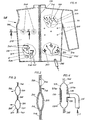
- the item of clothing shown in FIG. 1 is designated 210 and is jacket-like.
- the garment 210 can be sleeveless or sleeved.
- the garment is closed on the front by means of a zipper indicated at 215, but other connecting means, such as a button strip, push button strip or the like, can also be used.
- the item of clothing 210 is double-walled and consists of two layers, an outer layer 211 and an inner layer 311, the latter representing the side facing the body of the person wearing the item of clothing.
- the two layers 211, 311 consist of weldable plastic film or of a fabric laminated with a plastic film.
- the two layers 211, 311 are edge-welded at 212 to form a closed interior 213.
- a warm air duct system 220 is formed, which is formed from a plurality of interconnected air duct sections 221.
- These air duct-like and coherent sections 221 are formed by section-wise or point-like welding of the two layers 211 and 311 to one another. Since the two layers 211, 311 of the item of clothing 210 consist of weldable plastic film or of a fabric laminated by means of a weldable plastic film, it is effortlessly possible to weld the two layers 211, 311 in sections.
- the welding sections designated with 240 are attached in such a way that a coherent, warm air duct system 220 is formed.
- the two layers 211, 311 of the item of clothing 210 can be welded in sections, as indicated at 242 in FIG. 1. These spot welds are then approximately columnar. 1 also shows welding sections 240 of a different design, which are, for example, web-shaped and indicated at 241. These web-like welding sections 240 are arranged offset from one another, so that the air guided through the interior 213 of the item of clothing 210 can flow in the direction of the arrow X, X1 and X2. However, the welding webs 241 can also be cross-shaped, as indicated at 341 in FIG. 1. Here too, an offset arrangement and assignment of the crossbars is advantageously provided.
- the supply of warm air into the interior 213 of the item of clothing 211 takes place via a warm air supply connection piece 230, which is designed as a flexible hose line and is connected to a warm air generating device which is designed in a manner known per se and is not shown in the drawing.
- This warm air generating device can be designed as a heat exchanger connected to the internal combustion engine of a vehicle or motorcycle.
- the hot air can be pressed into the interior 213 of the item of clothing 210 through the warm air supply connection 230 by means of a blower.
- the connection of the warm air supply connection 230 to one of the two layers 211, 311 of the item of clothing 210 is shown in FIG. 4.
- the connection of the warm air supply connection 230 to the interior 213 of the item of clothing 210 takes place in the area of the outer layer 211, but a connection to the inner layer 311 of the item of clothing can also be provided.
- the warm air is supplied through the warm air supply connection 230 in the direction of the arrow Y.
- an insulating coating 235 is provided (Fig. 4).
- These insulating coatings 235 can be designed in such a way that they have a stiffening effect at the same time, so that compression of the opposite wall surfaces of the two layers 211, 311 in the connection region 211a of the hot air supply connection piece 230 is avoided, so that the hot air supply is in no way impaired in such situations.
- one of the two insulating coatings can be provided with a spacing profile 235a be provided, so that even when the two layers 211, 311 are pressed together, a flow of the warm air from the warm air supply connection 230 into the interior 213 of the item of clothing 210 is ensured.
- the inner layer 311 of the item of clothing 210 has air outlet openings 225 in the area of the air duct-like sections 221, which extend over the entire area of the layer 311 are distributed.
- the air outlet openings 225 are provided adjacent to or in the region of the welding sections 240, which can also be designed as stiffening webs (FIGS. 1 and 3).
- openings 250 are provided in the connection areas of the welding sections 240, which are formed in the area of these welding sections 240 in such a way that that closed, annular welding points 245 are maintained adjacent to the individual openings 250, so that the mode of operation of the provided welding sections 240 is maintained, but at the same time with the formation of ventilation / ventilation openings, so that it closes in the interior between the applied article of clothing and the body no moisture can accumulate.
- the double-walled construction extends over the entire item of clothing and, if arm and leg parts are provided, also onto this.
- An inflation effect is avoided by the welding sections 240 or 241 or 242, which connect the two foils of the inner and outer layer 211, 311 of the item of clothing.
- the warm air blown into the interior 213 of the item of clothing 210 can spread over the entire interior 213 of the item of clothing 210 and, through the air outlet openings 225 provided, has the possibility of heating the parts of the body covered with the item of clothing 210.
- the arrangement and assignment of the welding sections 240 connecting the two film layers 211 and 311 to one another is such that individual sections of the item of clothing 210 cannot expand in a bubble-like manner when the warm air is blown in.
- the material used to make the garment 210 is airtight and waterproof.
- the formation of condensation by the wearer of the item of clothing is reduced or completely avoided by the warm air supplied to the body and discharge through the openings 250. If the air supply is interrupted, e.g. when the wearer of such a piece of clothing ends the journey, sweating could occur, but this is avoided due to the openings 250 used. Since the item of clothing can also be worn under normal clothing, air compensation, temperature compensation and air circulation can be achieved by means of the openings 250.
- the openings 250 provided in the welding sections 240 can be both circular and square. The welding sections 240 are then designed in a corresponding manner in this area, so that an annular welding point 245 is maintained adjacent to each opening 250.
- a piece of clothing 210 designed in this way can be produced very inexpensively, since it only consists of two plastic foils which are connected to one another in sections and an additional heat-insulating material, such as lining or the like, can be dispensed with.
- the hot air duct system 220 is also functional when parts of the duct system are disconnected, e.g. when using the garment when sitting with a backrest. In this area, the air flow in the interior 213 of the item of clothing 210 is probably interrupted, but the further warm air flow in the remaining area of the interior 213 is in no way impaired.
- a shut-off valve (not shown in the drawing) can be provided in the flexible hot air supply connection 230, which allows the wearer of the item of clothing 210 to regulate the amount of warm air supplied on the one hand and to interrupt the warm air supply on the other hand if body heating is not desired.
- Such a shut-off valve can also be provided with an outside air supply connection and can be controlled in such a way that the warm air can be mixed with cold air in such a way that a temperature which is bearable and pleasant for the wearer is reached.
- the item of clothing 210 is designed as an inner part, then it can be provided in a manner known per se with connecting devices, not shown in the drawing, in order to be able to fasten the inner part, for example in the manner of an inner lining, in an item of clothing, such as a jacket, parka, coat or the like.
- Connect-button fasteners or zippers or other suitable connecting means can be used as the fastening device.
- the inner part can also be provided with sleeves.
- the sleeves are then also formed in accordance with the item of clothing 210.
- the interior of the item of clothing 210 can also be connected to a cooling air generating device via the flexible line 230, so that there is the possibility of supplying cooling air to the human body when the item of clothing is put on, which is particularly the case It is an advantage if the clothing is worn in warmer seasons or in warm regions.
Landscapes
- Engineering & Computer Science (AREA)
- Mechanical Engineering (AREA)
- Environmental & Geological Engineering (AREA)
- Health & Medical Sciences (AREA)
- General Health & Medical Sciences (AREA)
- Physical Education & Sports Medicine (AREA)
- Textile Engineering (AREA)
- Professional, Industrial, Or Sporting Protective Garments (AREA)
- Thermotherapy And Cooling Therapy Devices (AREA)
Claims (2)
Applications Claiming Priority (8)
| Application Number | Priority Date | Filing Date | Title |
|---|---|---|---|
| DE19808027178 DE8027178U1 (de) | 1980-10-11 | 1980-10-11 | Bekleidungsstueck zur erwaermung von personen, die verbrennungskraftmaschinen aufweisende kraftraeder oder kraftfahrzeuge, insbesondere offene kraftfahrzeuge, oder wasserfahrzeuge oder schienengebundene fahrzeuge, insbesondere arbeitsfahrzeuge, fahren |
| DE8027178U | 1980-10-11 | ||
| DE19808027524 DE8027524U1 (de) | 1980-10-15 | 1980-10-15 | Vorrichtung zur Erwärmung von Personen, die Verbrennungskraftmaschinen aufweisende Krafträder oder Kraftfahrzeuge, insbesondere offene Kraftfahrzeuge oder Wasserfahrzeuge oder schienengebundene Fahrzeuge, insbesondere Arbeitsfahrzeuge, fahren und die ein Bekleidungsstück für eine Warmluftdurchführung tragen |
| DE8027524U | 1980-10-15 | ||
| DE8029729U | 1980-11-07 | ||
| DE19808029729 DE8029729U1 (de) | 1980-11-07 | 1980-11-07 | Bekleidungsstück, wie Jacke, Parka, Mantel u.dgl. mit einem lösbar mit diesem verbundenen, ärmellosen Innenteil, insbesondere zur Erwärmung von Verbrennungskraftmaschinen aufweisende Krafträder oder Kraftfahrzeuge, insbesondere offene Kraftfahrzeuge oder Wasserfahrzeuge oder schienengebundene Fahrzeuge fahrenden Personen |
| DE19808031329 DE8031329U1 (de) | 1980-11-25 | 1980-11-25 | Bekleidungsstueck, wie jacke, parka, mantel, blouson oder bekleidungsstueckartiges innenteil, zur erwaermung von verbrennungskraftmaschinen aufweisende kraftraeder oder kraftfahrzeuge, insbesondere offenen kraftfahrzeuge oder wasserfahrzeuge oder schienengebundene fahrzeuge fahrenden personen |
| DE8031329U | 1980-11-25 |
Publications (2)
| Publication Number | Publication Date |
|---|---|
| EP0051714A1 EP0051714A1 (fr) | 1982-05-19 |
| EP0051714B1 true EP0051714B1 (fr) | 1984-08-22 |
Family
ID=27436240
Family Applications (1)
| Application Number | Title | Priority Date | Filing Date |
|---|---|---|---|
| EP81103486A Expired EP0051714B1 (fr) | 1980-10-11 | 1981-05-07 | Vêtement chauffant tel que veste, parka, combinaison, manteau, blouson ou similaire, pour conducteurs de véhicules à moteur |
Country Status (4)
| Country | Link |
|---|---|
| US (1) | US4418745A (fr) |
| EP (1) | EP0051714B1 (fr) |
| CA (1) | CA1165051A (fr) |
| ES (1) | ES8204949A1 (fr) |
Families Citing this family (23)
| Publication number | Priority date | Publication date | Assignee | Title |
|---|---|---|---|---|
| FR2437973A1 (fr) * | 1978-10-05 | 1980-04-30 | Bidou Gabriel | Vetement ou combinaison chauffe a l'air chaud, pour motocycliste, aviateur ou conducteur d'engin sans habitacle. dispositif de phonie permettant au porteur du vetement ci-dessus de communiquer avec un tiers pareillement equipe |
| FR2522306A1 (fr) * | 1982-02-26 | 1983-09-02 | Gpl Equipement | Dispositif pour climatiser une combinaison de conducteur de vehicule a moteur |
| GB2130871A (en) * | 1982-11-23 | 1984-06-13 | Terence David Walker | Improved diving suit |
| US4557320A (en) * | 1982-12-30 | 1985-12-10 | Allen Norris K | Centralized airlock compartment unit |
| GR910100503A (el) * | 1991-12-16 | 1993-08-31 | Konstantinos Kakatsos | Κλιματιζομενη φορμα και γαντια χρησιμοποιωντας για το σκοπο αυτο τα καυσαερια των μηχανων εσωτερικης καυσεως. |
| GB9306000D0 (en) * | 1993-03-23 | 1993-05-12 | Rogers Joseph A | Air conditioning system |
| GB2302793A (en) * | 1995-07-04 | 1997-02-05 | Peter John Mckay | Suit with vehicle-exhaust-heated liquid |
| US5921467A (en) * | 1996-08-05 | 1999-07-13 | Larson; David J. | Forced air helmet heater and defroster system for sport and utility vehicles |
| US6131645A (en) * | 1998-12-01 | 2000-10-17 | Barr; Raymond S. | Individualized cooling system used in a motor vehicle |
| DE19961310A1 (de) * | 1999-12-18 | 2001-06-21 | Bayerische Motoren Werke Ag | Halteeinrichtung |
| US7000682B2 (en) * | 2001-06-25 | 2006-02-21 | Chambers Paul A | Personal cooling or warming system using closed loop fluid flow |
| US7008445B2 (en) | 2002-04-29 | 2006-03-07 | Medcool, Inc. | Method and device for rapidly inducing hypothermia |
| US7052509B2 (en) | 2002-04-29 | 2006-05-30 | Medcool, Inc. | Method and device for rapidly inducing and then maintaining hypothermia |
| JP4658612B2 (ja) | 2002-12-12 | 2011-03-23 | メドクール・インコーポレイテッド | 低体温症を速やかに誘発して維持するための方法および装置 |
| GB0325998D0 (en) * | 2003-11-07 | 2003-12-10 | Nissan Technical Ct Europ Ltd | Vehicle defrosting |
| HU2768U (en) * | 2003-12-05 | 2004-07-28 | Gabor Pusztay | Thermostatic equipment |
| US8529613B2 (en) | 2006-10-18 | 2013-09-10 | Medcool, Inc. | Adjustable thermal cap |
| US20090218335A1 (en) * | 2008-02-28 | 2009-09-03 | Kyie Wallace | Heated Motorcycle Gas Tank Cover |
| US20090218334A1 (en) * | 2008-02-28 | 2009-09-03 | Kyie Wallace | Heated Motorcycle Gas Tank Cover |
| USD623382S1 (en) | 2009-11-05 | 2010-09-14 | Clayton Hodgson | Heating or cooling vest |
| US20130019611A1 (en) * | 2010-10-27 | 2013-01-24 | John Sims | Personal Temperature Control System |
| CN107041579A (zh) * | 2017-01-19 | 2017-08-15 | 李清福 | 多功能空调着装 |
| CN109334835A (zh) * | 2018-10-15 | 2019-02-15 | 张金锁 | 电动车保温装置 |
Citations (7)
| Publication number | Priority date | Publication date | Assignee | Title |
|---|---|---|---|---|
| US2413386A (en) * | 1944-08-11 | 1946-12-31 | Carrier Corp | Suit for circulating conditioned air about a person |
| US2460269A (en) * | 1945-03-16 | 1949-02-01 | William R Appeldoorn | Personal body air conditioning device |
| FR1163641A (fr) * | 1955-12-30 | 1958-09-29 | Pelisse chauffante pour motocycliste | |
| US2966684A (en) * | 1957-11-05 | 1961-01-03 | John H Bonin | Heat protective outfit |
| FR1503619A (fr) * | 1966-08-10 | 1967-12-01 | Dispositif de chauffage pour les conducteurs de scooters, motocyclettes et analogues | |
| US3452812A (en) * | 1967-07-10 | 1969-07-01 | John Crowther Betts | Body heating and cooling garment |
| FR2079350A1 (fr) * | 1970-02-11 | 1971-11-12 | Sanders Nuclear Corp |
Family Cites Families (14)
| Publication number | Priority date | Publication date | Assignee | Title |
|---|---|---|---|---|
| FR571398A (fr) * | 1923-10-01 | 1924-05-16 | Alsacienne D Accessoires Pour | Installation de chauffage pour automobiles |
| US2540547A (en) * | 1947-03-24 | 1951-02-06 | Stewart Warner Corp | Air-conditioned garment |
| US3211216A (en) * | 1952-09-13 | 1965-10-12 | Calmac Corp | Personal thermal device |
| US2930594A (en) * | 1954-06-25 | 1960-03-29 | Jet Heet Inc | Personal thermal devices |
| FR1155985A (fr) * | 1956-07-12 | 1958-05-12 | Aerazur Constr Aeronaut | Vêtement ventilé |
| US3468299A (en) * | 1967-12-20 | 1969-09-23 | Carl D Amato | Air-conditioned garment |
| US3738367A (en) * | 1971-02-11 | 1973-06-12 | Angelica Corp | Patient garment with temperature control |
| US3743012A (en) * | 1971-07-28 | 1973-07-03 | Us Navy | Controlled temperature garment |
| US4067064A (en) * | 1976-01-09 | 1978-01-10 | U.S. Divers Co. | Diving suit |
| US4146933A (en) * | 1976-07-19 | 1979-04-03 | Barry R. Jenkins | Conditioned-air suit and system |
| FR2436063A1 (fr) * | 1978-09-12 | 1980-04-11 | Biaille Langibaudiere Jean Yve | Dispositif de combinaison chauffante pour motocyclistes |
| FR2437973A1 (fr) * | 1978-10-05 | 1980-04-30 | Bidou Gabriel | Vetement ou combinaison chauffe a l'air chaud, pour motocycliste, aviateur ou conducteur d'engin sans habitacle. dispositif de phonie permettant au porteur du vetement ci-dessus de communiquer avec un tiers pareillement equipe |
| BE881337A (fr) * | 1980-01-25 | 1980-05-16 | Denis Fernand | Chauffage combine air chaud, resistances electriques cordon chauffant pour vetements ou combinaison de motocycliste, chauffeurs de tracteur ou d'autres vehicules sans chauffage. |
| US4347893A (en) * | 1981-04-06 | 1982-09-07 | Donald Moyer | Oil heated motorcycle handlebar construction |
-
1981
- 1981-04-08 US US06/252,068 patent/US4418745A/en not_active Expired - Lifetime
- 1981-04-30 CA CA000376639A patent/CA1165051A/fr not_active Expired
- 1981-05-07 EP EP81103486A patent/EP0051714B1/fr not_active Expired
- 1981-06-25 ES ES503347A patent/ES8204949A1/es not_active Expired
Patent Citations (7)
| Publication number | Priority date | Publication date | Assignee | Title |
|---|---|---|---|---|
| US2413386A (en) * | 1944-08-11 | 1946-12-31 | Carrier Corp | Suit for circulating conditioned air about a person |
| US2460269A (en) * | 1945-03-16 | 1949-02-01 | William R Appeldoorn | Personal body air conditioning device |
| FR1163641A (fr) * | 1955-12-30 | 1958-09-29 | Pelisse chauffante pour motocycliste | |
| US2966684A (en) * | 1957-11-05 | 1961-01-03 | John H Bonin | Heat protective outfit |
| FR1503619A (fr) * | 1966-08-10 | 1967-12-01 | Dispositif de chauffage pour les conducteurs de scooters, motocyclettes et analogues | |
| US3452812A (en) * | 1967-07-10 | 1969-07-01 | John Crowther Betts | Body heating and cooling garment |
| FR2079350A1 (fr) * | 1970-02-11 | 1971-11-12 | Sanders Nuclear Corp |
Also Published As
| Publication number | Publication date |
|---|---|
| EP0051714A1 (fr) | 1982-05-19 |
| US4418745A (en) | 1983-12-06 |
| CA1165051A (fr) | 1984-04-10 |
| ES503347A0 (es) | 1982-05-16 |
| ES8204949A1 (es) | 1982-05-16 |
Similar Documents
| Publication | Publication Date | Title |
|---|---|---|
| EP0051714B1 (fr) | Vêtement chauffant tel que veste, parka, combinaison, manteau, blouson ou similaire, pour conducteurs de véhicules à moteur | |
| EP0073291B1 (fr) | Dispositif de réchauffement, en particulier pour personnes utilisant des véhicules à moteur | |
| DE3601449C2 (de) | Chirurgische Gesichtsmaske | |
| EP0780061B1 (fr) | Combinaison spéciale | |
| DE69212211T2 (de) | Patienten-wärmende oder-kühlende Decke | |
| DE10017852B4 (de) | Kühlendes Kleidungsstück für Personen | |
| DE69807437T2 (de) | Textiler verbundstoff für wärmeschutz des menschlichen körpers | |
| DE20319382U1 (de) | Schutzkleidungsstück für den Oberkörper | |
| EP2263731A2 (fr) | Système flexible pour acheminer un gaz à respirer | |
| WO2004017775A1 (fr) | Piece vestimentaire a systeme d'aeration | |
| DE69530314T2 (de) | Aufblasbare decke mit eingeformten öffnungen | |
| DE4113679C2 (de) | Temperierendes Kleidungsstück | |
| DE102004002287A1 (de) | Kleidungsstück zur Personenklimatisierung | |
| WO2008061571A1 (fr) | Vêtement spécial constitué d'un matériau spécial en trois couches | |
| DE102005044687A1 (de) | Hose mit beidseitig angeordneten Verschlüssen | |
| EP2560591B1 (fr) | Dispositif de refroidissement | |
| DE8031329U1 (de) | Bekleidungsstueck, wie jacke, parka, mantel, blouson oder bekleidungsstueckartiges innenteil, zur erwaermung von verbrennungskraftmaschinen aufweisende kraftraeder oder kraftfahrzeuge, insbesondere offenen kraftfahrzeuge oder wasserfahrzeuge oder schienengebundene fahrzeuge fahrenden personen | |
| DE3044279A1 (de) | Bekleidungsstueck, wie jacke, parka, mantel, blouson oder bekleidungsstueckartiges innenteil, zur erwaermung von verbrennungskraftmaschinen aufweisende kraftraeder oder kraftfahrzeuge, insbesondere offene kraftfahrzeuge oder wasserfahrzeuge oder schienengebundene fahrzeuge fahrenden personen | |
| DE3043027A1 (de) | Einrichtung zum erwaermen von personen, die verbrennungskraftmaschinen aufweisende kraftraeder oder kraftfahrzeuge, insbesondere offene kraftfahrzeuge, oder wasserfahrzeuge oder schienengebundene fahrzeuge, insbesondere arbeitsfahrzeuge fahren | |
| DD201849A5 (de) | Einrichtung zum erwaermen v. personen, die verbrennungskraftmaschinen aufweisende kraftraeder o. kraftfahrzeuge, insbes. offene kraftfahrzeuge, o. wasserfahrzeuge o. schienengebundene fahrzeuge, insbes. arbeitsfahrzeuge, fahren o. auf seeschiffen schwimmenden bohrinseln o. dgl. taetig sind | |
| DE2852601A1 (de) | Verfahren und vorrichtung zum kuehlen von arbeitspersonen in heisser umgebung | |
| DE8029729U1 (de) | Bekleidungsstück, wie Jacke, Parka, Mantel u.dgl. mit einem lösbar mit diesem verbundenen, ärmellosen Innenteil, insbesondere zur Erwärmung von Verbrennungskraftmaschinen aufweisende Krafträder oder Kraftfahrzeuge, insbesondere offene Kraftfahrzeuge oder Wasserfahrzeuge oder schienengebundene Fahrzeuge fahrenden Personen | |
| EP0225646B1 (fr) | Combinaison à double paroi de protection contre la chaleur | |
| DE202006009317U1 (de) | Bekleidungsstück | |
| EP0843975A1 (fr) | Dispositif pour empêcher un rayonnement de chaleur d'être visible à l'extérieur |
Legal Events
| Date | Code | Title | Description |
|---|---|---|---|
| PUAI | Public reference made under article 153(3) epc to a published international application that has entered the european phase |
Free format text: ORIGINAL CODE: 0009012 |
|
| AK | Designated contracting states |
Designated state(s): BE CH FR GB IT LU NL SE |
|
| 17P | Request for examination filed |
Effective date: 19820520 |
|
| ITF | It: translation for a ep patent filed | ||
| GRAA | (expected) grant |
Free format text: ORIGINAL CODE: 0009210 |
|
| AK | Designated contracting states |
Designated state(s): BE CH FR GB IT LI LU NL SE |
|
| PG25 | Lapsed in a contracting state [announced via postgrant information from national office to epo] |
Ref country code: BE Effective date: 19840822 Ref country code: SE Effective date: 19840822 Ref country code: NL Effective date: 19840822 |
|
| ET | Fr: translation filed | ||
| NLV1 | Nl: lapsed or annulled due to failure to fulfill the requirements of art. 29p and 29m of the patents act | ||
| PG25 | Lapsed in a contracting state [announced via postgrant information from national office to epo] |
Ref country code: LI Effective date: 19850531 Ref country code: CH Effective date: 19850531 Ref country code: LU Free format text: LAPSE BECAUSE OF NON-PAYMENT OF DUE FEES Effective date: 19850531 |
|
| PLBE | No opposition filed within time limit |
Free format text: ORIGINAL CODE: 0009261 |
|
| STAA | Information on the status of an ep patent application or granted ep patent |
Free format text: STATUS: NO OPPOSITION FILED WITHIN TIME LIMIT |
|
| 26N | No opposition filed | ||
| REG | Reference to a national code |
Ref country code: CH Ref legal event code: PL |
|
| PGFP | Annual fee paid to national office [announced via postgrant information from national office to epo] |
Ref country code: GB Payment date: 19970505 Year of fee payment: 17 |
|
| PGFP | Annual fee paid to national office [announced via postgrant information from national office to epo] |
Ref country code: FR Payment date: 19970530 Year of fee payment: 17 |
|
| PG25 | Lapsed in a contracting state [announced via postgrant information from national office to epo] |
Ref country code: GB Free format text: LAPSE BECAUSE OF NON-PAYMENT OF DUE FEES Effective date: 19980507 |
|
| PG25 | Lapsed in a contracting state [announced via postgrant information from national office to epo] |
Ref country code: FR Free format text: LAPSE BECAUSE OF NON-PAYMENT OF DUE FEES Effective date: 19980531 |
|
| GBPC | Gb: european patent ceased through non-payment of renewal fee |
Effective date: 19980507 |
|
| REG | Reference to a national code |
Ref country code: FR Ref legal event code: ST |