EP0051765B1 - Procédé pour la détermination du contenu d'eau dans le béton frais - Google Patents
Procédé pour la détermination du contenu d'eau dans le béton frais Download PDFInfo
- Publication number
- EP0051765B1 EP0051765B1 EP81108610A EP81108610A EP0051765B1 EP 0051765 B1 EP0051765 B1 EP 0051765B1 EP 81108610 A EP81108610 A EP 81108610A EP 81108610 A EP81108610 A EP 81108610A EP 0051765 B1 EP0051765 B1 EP 0051765B1
- Authority
- EP
- European Patent Office
- Prior art keywords
- vacuum
- fresh concrete
- water content
- fresh
- container
- Prior art date
- Legal status (The legal status is an assumption and is not a legal conclusion. Google has not performed a legal analysis and makes no representation as to the accuracy of the status listed.)
- Expired
Links
- 238000000034 method Methods 0.000 title claims abstract description 32
- XLYOFNOQVPJJNP-UHFFFAOYSA-N water Substances O XLYOFNOQVPJJNP-UHFFFAOYSA-N 0.000 title claims abstract description 21
- 239000000463 material Substances 0.000 claims abstract description 12
- 238000001291 vacuum drying Methods 0.000 claims description 8
- 238000001035 drying Methods 0.000 claims description 7
- 239000004568 cement Substances 0.000 description 7
- 238000010438 heat treatment Methods 0.000 description 5
- 238000012360 testing method Methods 0.000 description 5
- 238000001704 evaporation Methods 0.000 description 4
- 239000000203 mixture Substances 0.000 description 4
- 230000004580 weight loss Effects 0.000 description 4
- 230000008020 evaporation Effects 0.000 description 3
- 239000011521 glass Substances 0.000 description 3
- 238000003756 stirring Methods 0.000 description 3
- 238000010276 construction Methods 0.000 description 2
- 239000002184 metal Substances 0.000 description 2
- 238000005303 weighing Methods 0.000 description 2
- 230000015572 biosynthetic process Effects 0.000 description 1
- 238000009835 boiling Methods 0.000 description 1
- 235000013339 cereals Nutrition 0.000 description 1
- 239000003245 coal Substances 0.000 description 1
- 235000013312 flour Nutrition 0.000 description 1
- 238000004108 freeze drying Methods 0.000 description 1
- 238000004519 manufacturing process Methods 0.000 description 1
- 238000005259 measurement Methods 0.000 description 1
- 238000012544 monitoring process Methods 0.000 description 1
- 238000005086 pumping Methods 0.000 description 1
- 239000004576 sand Substances 0.000 description 1
- 238000005029 sieve analysis Methods 0.000 description 1
- 238000009423 ventilation Methods 0.000 description 1
Images
Classifications
-
- G—PHYSICS
- G01—MEASURING; TESTING
- G01N—INVESTIGATING OR ANALYSING MATERIALS BY DETERMINING THEIR CHEMICAL OR PHYSICAL PROPERTIES
- G01N33/00—Investigating or analysing materials by specific methods not covered by groups G01N1/00 - G01N31/00
- G01N33/38—Concrete; Lime; Mortar; Gypsum; Bricks; Ceramics; Glass
- G01N33/383—Concrete or cement
-
- G—PHYSICS
- G01—MEASURING; TESTING
- G01N—INVESTIGATING OR ANALYSING MATERIALS BY DETERMINING THEIR CHEMICAL OR PHYSICAL PROPERTIES
- G01N5/00—Analysing materials by weighing, e.g. weighing small particles separated from a gas or liquid
- G01N5/04—Analysing materials by weighing, e.g. weighing small particles separated from a gas or liquid by removing a component, e.g. by evaporation, and weighing the remainder
- G01N5/045—Analysing materials by weighing, e.g. weighing small particles separated from a gas or liquid by removing a component, e.g. by evaporation, and weighing the remainder for determining moisture content
Definitions
- the invention relates to a method for determining the water content of a material, in which a material sample is weighed, then dried under the application of heat and vacuum, weighed again and then the water content is determined from the weight loss.
- the strength of concrete depends on the mixing ratio and can be determined after a setting time of 28 days using a pressure test on test specimens.
- the strength is determined by the water / cement ratio (water cement value). To achieve a certain strength, this ratio must therefore be strictly observed, or for concrete with special properties, a certain water cement value must not be exceeded.
- the pressure test can only be used to verify the concrete quality, but not to monitor the concreting process.
- the so-called tool value water cement value
- the so-called tool value water cement value
- testing the water cement value to a certain extent is mandatory.
- the most important and most widely used method to determine this value is the Darr method. In this known method, a weighed fresh concrete sample located in an open container is z. B. heated on a gas burner as quickly as possible and dried quickly. The concrete is then weighed again and the tool value calculated based on the weight loss.
- a disadvantage of this previously known method is that the stirring, by the formation of steam bubbles and also by delay in boiling, result in loss of material, which can significantly impair the determination of the weight loss. There is also the risk of insufficient drying, since the determination of the end of drying time with the aid of a glass plate held over the sample is imprecise. Another source of error can be seen in the fact that if the concrete sample already sets during heating, some of the water is chemically bound and can no longer evaporate. Finally, the previously known method constantly requires the presence of a person who has to stir the concrete sample.
- a method of the type mentioned in the opening paragraph is known from GB-A-718 444.
- Coal samples of approximately 1 g each are used as the material. These are each placed in a container and covered with a lid.
- the individual containers are then inserted into openings in a metal block with an edge.
- a glass plate can be placed on the edge, so that an evacuable space is created. This space is evacuated for about '/ 2 to 3/4 h with simultaneous heating of the metal block.
- the entire system is then cooled to room temperature and ventilated.
- the containers are removed and fed to the second weighing.
- GB-A-830 525 finally discloses a device for determining moisture, in which small amounts of sample, together with a balance, are introduced into a vacuum recipient. During the evacuation, the sample is dried with an infrared lamp.
- a disadvantage of the methods previously known from the GB documents is that, owing to the extremely small material samples used, they are not suitable for determining the tool value of fresh concrete.
- fresh concrete In addition to the water and cement components, fresh concrete also contains sand, gravel and often other aggregates, so that a sample of 1 g or less cannot reproduce the characteristic composition of the fresh concrete.
- the present invention has for its object to provide a method with which the determination of the water content or the tool value of fresh concrete can be carried out much easier and more accurately.
- this object is achieved in that the method of the type mentioned is applied to fresh concrete samples in an amount of at least 4000 g.
- the temperature of the fresh concrete sample can be kept below the setting temperature, since the energy necessary for the evaporation of the water is initially the Concrete sample is extracted in the form of heat.
- the concrete sample Only in the second phase of the vacuum drying process does the concrete sample reach higher temperatures, which means that the residual moisture is driven out quantitatively. There is practically no setting in this phase.
- the accuracy can be increased if the fresh concrete sample is frozen beforehand, i.e. a freeze-drying process is used. However, the effort for carrying out the method then also increases.
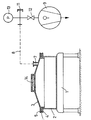
- a device for performing the described method expediently comprises a heatable container which can be closed in a vacuum-tight manner and can be connected to a vacuum generating device.
- 1 denotes a heating plate on which the container 2 for the fresh concrete sample is located.
- the container 2 can be closed with a lid 3 in a vacuum-tight manner.
- container 2 and lid 3 have mutually adapted flanges 4 and 5, between which a seal 6 is located in the closed state.
- the lid 3 is equipped with a connecting piece 7, to which via the line 8 - preferably a flexible line, for. B. a plastic hose - the vacuum pump 9 is connected.
- a ventilation flap 11 and a valve 12 are switched on.
- a vacuum meter 13 is connected to line 8.
- the cover 3 is also provided with a sight glass 14 so that the sample can be observed during the vacuum drying process.
- the fresh concrete sample the water content of which is to be determined, is introduced into the container 2.
- the size of the container should be such that at least 4 kg of fresh concrete can be poured into it, otherwise no exact sample composition is guaranteed.
- the container 2 is closed with the aid of the lid 3 and the vacuum pump 9, which has already warmed up, is connected to the interior of the container 2 by opening the valve 12 via the nozzle 7 and the line 8. This will initiate the vacuum drying process.
- the container 2 is supplied with heat using the heating plate 1, so that a rapid evaporation of the water contained in the sample is ensured.
- the performance of the heating plate 1 and the pumping speed of the vacuum pump 9 are to be adapted to the size of the container 2 or the amount of fresh concrete usually to be dried in this container 2.
- the end of the drying process can be determined by observing the pressure in the container 2 when the valve 12 is closed, that is to say the vacuum pump 9 separated from the container 2. If the concrete sample is not yet dry, the pressure in container 2 will rise relatively quickly after valve 12 is closed. If there is practically no pressure increase, the drying process is finished.
- valve 12 is closed and the container 2 is ventilated by means of the flap 11, so that the lid 3 can be removed.
- a certain value e.g. 100 mbar.
- the amount of water already evaporating before this time then cools down the fresh concrete sample due to the necessary evaporation energy, so that it is safely achieved that the temperature of the fresh concrete sample remains below the setting temperature.
Landscapes
- Life Sciences & Earth Sciences (AREA)
- Chemical & Material Sciences (AREA)
- Health & Medical Sciences (AREA)
- Analytical Chemistry (AREA)
- Physics & Mathematics (AREA)
- Engineering & Computer Science (AREA)
- Biochemistry (AREA)
- General Health & Medical Sciences (AREA)
- General Physics & Mathematics (AREA)
- Immunology (AREA)
- Pathology (AREA)
- Ceramic Engineering (AREA)
- Food Science & Technology (AREA)
- Medicinal Chemistry (AREA)
- Drying Of Solid Materials (AREA)
- Sampling And Sample Adjustment (AREA)
Claims (5)
Priority Applications (1)
| Application Number | Priority Date | Filing Date | Title |
|---|---|---|---|
| AT81108610T ATE15543T1 (de) | 1980-11-06 | 1981-10-21 | Verfahren zur bestimmung des wassergehaltes in frischbeton. |
Applications Claiming Priority (2)
| Application Number | Priority Date | Filing Date | Title |
|---|---|---|---|
| DE19803041820 DE3041820A1 (de) | 1980-11-06 | 1980-11-06 | Verfahren und vorrichtung zur bestimmung des wassergehaltes in frischbeton |
| DE3041820 | 1980-11-06 |
Publications (2)
| Publication Number | Publication Date |
|---|---|
| EP0051765A1 EP0051765A1 (fr) | 1982-05-19 |
| EP0051765B1 true EP0051765B1 (fr) | 1985-09-11 |
Family
ID=6116062
Family Applications (1)
| Application Number | Title | Priority Date | Filing Date |
|---|---|---|---|
| EP81108610A Expired EP0051765B1 (fr) | 1980-11-06 | 1981-10-21 | Procédé pour la détermination du contenu d'eau dans le béton frais |
Country Status (3)
| Country | Link |
|---|---|
| EP (1) | EP0051765B1 (fr) |
| AT (1) | ATE15543T1 (fr) |
| DE (1) | DE3041820A1 (fr) |
Cited By (1)
| Publication number | Priority date | Publication date | Assignee | Title |
|---|---|---|---|---|
| CN104062201A (zh) * | 2014-06-27 | 2014-09-24 | 东北大学 | 测量真空干燥和真空冷冻干燥过程工艺参数的实验装置 |
Families Citing this family (3)
| Publication number | Priority date | Publication date | Assignee | Title |
|---|---|---|---|---|
| CN105403479A (zh) * | 2015-12-23 | 2016-03-16 | 东南大学 | 一种测定硬化水泥浆基体结合水和自由水的方法 |
| CN111999202A (zh) * | 2020-08-24 | 2020-11-27 | 河海大学 | 快速测试新拌混凝土水灰比的装置及方法 |
| CN115112519B (zh) * | 2022-07-05 | 2025-09-05 | 福建船政交通职业学院 | 一种测量矿石粉含水量的装置及其控制方法 |
Family Cites Families (4)
| Publication number | Priority date | Publication date | Assignee | Title |
|---|---|---|---|---|
| GB718444A (en) * | 1952-01-21 | 1954-11-17 | Coal Industry Patents Ltd | Apparatus for determining moisture content |
| GB830525A (en) * | 1957-04-15 | 1960-03-16 | Townson & Mercer Ltd | Improvements in or relating to apparatus for measuring moisture-content of materials |
| DD102043A3 (fr) * | 1971-07-30 | 1973-12-12 | ||
| US4142403A (en) * | 1977-10-17 | 1979-03-06 | Iowa State University Research Foundation, Inc. | Method and means for testing soils |
-
1980
- 1980-11-06 DE DE19803041820 patent/DE3041820A1/de not_active Ceased
-
1981
- 1981-10-21 AT AT81108610T patent/ATE15543T1/de not_active IP Right Cessation
- 1981-10-21 EP EP81108610A patent/EP0051765B1/fr not_active Expired
Cited By (1)
| Publication number | Priority date | Publication date | Assignee | Title |
|---|---|---|---|---|
| CN104062201A (zh) * | 2014-06-27 | 2014-09-24 | 东北大学 | 测量真空干燥和真空冷冻干燥过程工艺参数的实验装置 |
Also Published As
| Publication number | Publication date |
|---|---|
| DE3041820A1 (de) | 1982-07-22 |
| ATE15543T1 (de) | 1985-09-15 |
| EP0051765A1 (fr) | 1982-05-19 |
Similar Documents
| Publication | Publication Date | Title |
|---|---|---|
| EP1125177B1 (fr) | Procede et dispositif pour le sechage de materiaux | |
| DE2806747C2 (de) | Verfahren und Vorrichtung zum Trocknen eines feuchtigkeitsaufnehmenden Materials | |
| EP1850110A1 (fr) | Appareil de mesure destiné à la détermination de l'humidité gravimétrique | |
| DE69217735T2 (de) | "On-line" Feuchtigkeitsmessystem für pulverförmige oder körnige Stoffe | |
| EP0333063B1 (fr) | Procédé et dispositif de détermination de la teneur en liants de matériaux de construction bitumineux | |
| DE3803109A1 (de) | Verfahren zum entzug von fluessigkeit aus feuchtem material | |
| DE4309188C2 (de) | Vorrichtung zum Vergießen von Bauteilen mit einer imprägnierenden Masse | |
| DE2247569A1 (de) | Trocknungsverfahren | |
| EP1231258B1 (fr) | Procédé pour l'humidification de l'espace utile d'un incubateur et incubateur à atmosphère controlée | |
| DE3109461C2 (de) | Verfahren und Vorrichtung zur Hochtemperaturtrocknung von Holz | |
| EP0051765A1 (fr) | Procédé pour la détermination du contenu d'eau dans le béton frais | |
| DE3923641A1 (de) | Verfahren zur aerob-thermischen kompostierung von organischen abfaellen | |
| DE69505245T2 (de) | Verfahren und vorrichtung zur steruerung von gefriertrocknung | |
| DE1448230A1 (de) | Verfahren zur Untersuchung bituminoeser Baustoffe | |
| WO2010012391A1 (fr) | Dispositif pour déterminer la fraction de substance sèche dans un aliment pour animaux et son procédé de fonctionnement | |
| DE2446718A1 (de) | Verfahren und vorrichtung zum trocknen von nassem pulver, insbesondere von schiessoder sprengpulver | |
| CH654403A5 (de) | Verfahren und vorrichtung zur trocknung von feuchtem schuettgut. | |
| DE3343800A1 (de) | Verfahren und vorrichtung zur steuerung des trocknungsverlaufs von nahrungsmitteln, insbesondere rohwurst | |
| DE19513701A1 (de) | Verfahren zur Kompostierung von organischen Abfällen und/oder Klärschlamm und Vorrichtung zur Durchführung dieses Verfahrens | |
| Krober et al. | Effect of relative humidity on the determination of oil in soybeans | |
| DE2049548C3 (de) | Verfahren und Vorrichtung zum Konditionieren von lockerem Tabak | |
| DE2214126A1 (de) | Verfahren und vorrichtung zum pruefen nichtmetallischer stoffe, z.b. von baustoffen, auf ihre mechanischen, physikalischen und festigkeitseigenschaften | |
| DE3433133A1 (de) | Vorrichtung zur organ- gewebsfixierung | |
| EP2708811A1 (fr) | Procédé de réglage de l'humidité de l'air dans une pièce fermée | |
| DE3411495A1 (de) | Verfahren und vorrichtung zur messung des feuchtigkeitsgehalts eines pulverfoermigen, staubfoermigen, pelletfoermigen oder rieselfaehigen materials |
Legal Events
| Date | Code | Title | Description |
|---|---|---|---|
| PUAI | Public reference made under article 153(3) epc to a published international application that has entered the european phase |
Free format text: ORIGINAL CODE: 0009012 |
|
| AK | Designated contracting states |
Designated state(s): AT BE CH FR GB NL |
|
| 17P | Request for examination filed |
Effective date: 19821021 |
|
| GRAA | (expected) grant |
Free format text: ORIGINAL CODE: 0009210 |
|
| AK | Designated contracting states |
Designated state(s): AT BE CH FR GB LI NL |
|
| PG25 | Lapsed in a contracting state [announced via postgrant information from national office to epo] |
Ref country code: NL Effective date: 19850911 |
|
| REF | Corresponds to: |
Ref document number: 15543 Country of ref document: AT Date of ref document: 19850915 Kind code of ref document: T |
|
| RAP2 | Party data changed (patent owner data changed or rights of a patent transferred) |
Owner name: LAMBERTUS, ECKHARD |
|
| PGFP | Annual fee paid to national office [announced via postgrant information from national office to epo] |
Ref country code: AT Payment date: 19851202 Year of fee payment: 5 |
|
| ET | Fr: translation filed | ||
| NLV1 | Nl: lapsed or annulled due to failure to fulfill the requirements of art. 29p and 29m of the patents act | ||
| PLBE | No opposition filed within time limit |
Free format text: ORIGINAL CODE: 0009261 |
|
| STAA | Information on the status of an ep patent application or granted ep patent |
Free format text: STATUS: NO OPPOSITION FILED WITHIN TIME LIMIT |
|
| 26N | No opposition filed | ||
| PG25 | Lapsed in a contracting state [announced via postgrant information from national office to epo] |
Ref country code: AT Effective date: 19861021 |
|
| PG25 | Lapsed in a contracting state [announced via postgrant information from national office to epo] |
Ref country code: LI Effective date: 19861031 Ref country code: CH Effective date: 19861031 Ref country code: BE Effective date: 19861031 |
|
| BERE | Be: lapsed |
Owner name: LAMBERTUS ECKHARD Effective date: 19861031 |
|
| PG25 | Lapsed in a contracting state [announced via postgrant information from national office to epo] |
Ref country code: FR Free format text: LAPSE BECAUSE OF NON-PAYMENT OF DUE FEES Effective date: 19870630 |
|
| REG | Reference to a national code |
Ref country code: CH Ref legal event code: PL |
|
| GBPC | Gb: european patent ceased through non-payment of renewal fee | ||
| REG | Reference to a national code |
Ref country code: FR Ref legal event code: ST |
|
| PG25 | Lapsed in a contracting state [announced via postgrant information from national office to epo] |
Ref country code: GB Effective date: 19881118 |