EP0051787B1 - Neue Amidine und Amidin/Isocyanat-Addukte, Verfahren zu ihrer Herstellung und ihre Verwendung als Katalysatoren für die Härtung von Epoxidharzen - Google Patents
Neue Amidine und Amidin/Isocyanat-Addukte, Verfahren zu ihrer Herstellung und ihre Verwendung als Katalysatoren für die Härtung von Epoxidharzen Download PDFInfo
- Publication number
- EP0051787B1 EP0051787B1 EP81108895A EP81108895A EP0051787B1 EP 0051787 B1 EP0051787 B1 EP 0051787B1 EP 81108895 A EP81108895 A EP 81108895A EP 81108895 A EP81108895 A EP 81108895A EP 0051787 B1 EP0051787 B1 EP 0051787B1
- Authority
- EP
- European Patent Office
- Prior art keywords
- atoms
- amidines
- acid
- amidine
- group
- Prior art date
- Legal status (The legal status is an assumption and is not a legal conclusion. Google has not performed a legal analysis and makes no representation as to the accuracy of the status listed.)
- Expired
Links
- 150000001409 amidines Chemical class 0.000 title claims abstract description 73
- 239000003054 catalyst Substances 0.000 title claims abstract description 32
- 229920000647 polyepoxide Polymers 0.000 title claims abstract description 32
- 239000003822 epoxy resin Substances 0.000 title claims abstract description 25
- 238000000034 method Methods 0.000 title claims description 30
- 239000012948 isocyanate Substances 0.000 title abstract description 15
- 150000002513 isocyanates Chemical class 0.000 title abstract description 14
- LNEPOXFFQSENCJ-UHFFFAOYSA-N haloperidol Chemical compound C1CC(O)(C=2C=CC(Cl)=CC=2)CCN1CCCC(=O)C1=CC=C(F)C=C1 LNEPOXFFQSENCJ-UHFFFAOYSA-N 0.000 title abstract description 11
- -1 bicyclic amidines Chemical class 0.000 claims abstract description 62
- 239000008199 coating composition Substances 0.000 claims abstract description 4
- 125000004432 carbon atom Chemical group C* 0.000 claims description 54
- 229920000728 polyester Polymers 0.000 claims description 51
- 125000003178 carboxy group Chemical group [H]OC(*)=O 0.000 claims description 45
- 239000002253 acid Substances 0.000 claims description 44
- 239000005056 polyisocyanate Substances 0.000 claims description 21
- 229920001228 polyisocyanate Polymers 0.000 claims description 21
- 238000006243 chemical reaction Methods 0.000 claims description 20
- 238000002360 preparation method Methods 0.000 claims description 20
- IISBACLAFKSPIT-UHFFFAOYSA-N bisphenol A Chemical compound C=1C=C(O)C=CC=1C(C)(C)C1=CC=C(O)C=C1 IISBACLAFKSPIT-UHFFFAOYSA-N 0.000 claims description 18
- 230000008569 process Effects 0.000 claims description 16
- 125000004435 hydrogen atom Chemical group [H]* 0.000 claims description 14
- 125000000217 alkyl group Chemical group 0.000 claims description 12
- 150000001875 compounds Chemical class 0.000 claims description 11
- 229920005989 resin Polymers 0.000 claims description 11
- 239000011347 resin Substances 0.000 claims description 11
- 125000003118 aryl group Chemical group 0.000 claims description 8
- 229920000642 polymer Polymers 0.000 claims description 8
- 239000007795 chemical reaction product Substances 0.000 claims description 7
- 238000002844 melting Methods 0.000 claims description 7
- 230000008018 melting Effects 0.000 claims description 7
- GYZLOYUZLJXAJU-UHFFFAOYSA-N diglycidyl ether Chemical class C1OC1COCC1CO1 GYZLOYUZLJXAJU-UHFFFAOYSA-N 0.000 claims description 6
- IQPQWNKOIGAROB-UHFFFAOYSA-N isocyanate group Chemical group [N-]=C=O IQPQWNKOIGAROB-UHFFFAOYSA-N 0.000 claims description 6
- 125000002496 methyl group Chemical group [H]C([H])([H])* 0.000 claims description 6
- 125000001997 phenyl group Chemical group [H]C1=C([H])C([H])=C(*)C([H])=C1[H] 0.000 claims description 6
- 125000003710 aryl alkyl group Chemical group 0.000 claims description 5
- 125000000753 cycloalkyl group Chemical group 0.000 claims description 5
- 150000004985 diamines Chemical class 0.000 claims description 5
- 150000001732 carboxylic acid derivatives Chemical class 0.000 claims description 4
- 125000001797 benzyl group Chemical group [H]C1=C([H])C([H])=C(C([H])=C1[H])C([H])([H])* 0.000 claims description 3
- 150000002118 epoxides Chemical class 0.000 claims description 3
- 229920001187 thermosetting polymer Polymers 0.000 claims description 3
- 238000004519 manufacturing process Methods 0.000 abstract description 8
- 239000007858 starting material Substances 0.000 abstract description 2
- 238000000576 coating method Methods 0.000 description 51
- 239000000843 powder Substances 0.000 description 45
- 239000011248 coating agent Substances 0.000 description 39
- 238000012360 testing method Methods 0.000 description 36
- 150000007513 acids Chemical class 0.000 description 23
- 239000000203 mixture Substances 0.000 description 23
- OUPZKGBUJRBPGC-UHFFFAOYSA-N 1,3,5-tris(oxiran-2-ylmethyl)-1,3,5-triazinane-2,4,6-trione Chemical compound O=C1N(CC2OC2)C(=O)N(CC2OC2)C(=O)N1CC1CO1 OUPZKGBUJRBPGC-UHFFFAOYSA-N 0.000 description 16
- 239000003795 chemical substances by application Substances 0.000 description 15
- 239000000047 product Substances 0.000 description 14
- 239000004848 polyfunctional curative Substances 0.000 description 13
- 229920005862 polyol Polymers 0.000 description 12
- 150000003077 polyols Chemical class 0.000 description 11
- 150000003254 radicals Chemical class 0.000 description 11
- 229920001577 copolymer Polymers 0.000 description 10
- OFOBLEOULBTSOW-UHFFFAOYSA-N Malonic acid Chemical compound OC(=O)CC(O)=O OFOBLEOULBTSOW-UHFFFAOYSA-N 0.000 description 9
- PPBRXRYQALVLMV-UHFFFAOYSA-N Styrene Chemical compound C=CC1=CC=CC=C1 PPBRXRYQALVLMV-UHFFFAOYSA-N 0.000 description 9
- 230000000052 comparative effect Effects 0.000 description 9
- 238000002474 experimental method Methods 0.000 description 9
- 125000002887 hydroxy group Chemical group [H]O* 0.000 description 9
- 239000000049 pigment Substances 0.000 description 9
- RTZKZFJDLAIYFH-UHFFFAOYSA-N Diethyl ether Chemical compound CCOCC RTZKZFJDLAIYFH-UHFFFAOYSA-N 0.000 description 8
- LYCAIKOWRPUZTN-UHFFFAOYSA-N Ethylene glycol Chemical compound OCCO LYCAIKOWRPUZTN-UHFFFAOYSA-N 0.000 description 8
- 239000011230 binding agent Substances 0.000 description 8
- 150000002148 esters Chemical class 0.000 description 8
- VZCYOOQTPOCHFL-UHFFFAOYSA-N trans-butenedioic acid Natural products OC(=O)C=CC(O)=O VZCYOOQTPOCHFL-UHFFFAOYSA-N 0.000 description 8
- XLYOFNOQVPJJNP-UHFFFAOYSA-N water Substances O XLYOFNOQVPJJNP-UHFFFAOYSA-N 0.000 description 8
- QWDQYHPOSSHSAW-UHFFFAOYSA-N 1-isocyanatooctadecane Chemical compound CCCCCCCCCCCCCCCCCCN=C=O QWDQYHPOSSHSAW-UHFFFAOYSA-N 0.000 description 7
- UHOVQNZJYSORNB-UHFFFAOYSA-N Benzene Chemical compound C1=CC=CC=C1 UHOVQNZJYSORNB-UHFFFAOYSA-N 0.000 description 7
- 239000000654 additive Substances 0.000 description 7
- 150000001991 dicarboxylic acids Chemical class 0.000 description 7
- 238000001125 extrusion Methods 0.000 description 7
- NIMLQBUJDJZYEJ-UHFFFAOYSA-N isophorone diisocyanate Chemical compound CC1(C)CC(N=C=O)CC(C)(CN=C=O)C1 NIMLQBUJDJZYEJ-UHFFFAOYSA-N 0.000 description 7
- ZTXDHEQQZVFGPK-UHFFFAOYSA-N 1,2,4-tris(oxiran-2-ylmethyl)-1,2,4-triazolidine-3,5-dione Chemical compound C1OC1CN1C(=O)N(CC2OC2)C(=O)N1CC1CO1 ZTXDHEQQZVFGPK-UHFFFAOYSA-N 0.000 description 6
- CSCPPACGZOOCGX-UHFFFAOYSA-N Acetone Chemical compound CC(C)=O CSCPPACGZOOCGX-UHFFFAOYSA-N 0.000 description 6
- PEDCQBHIVMGVHV-UHFFFAOYSA-N Glycerine Chemical compound OCC(O)CO PEDCQBHIVMGVHV-UHFFFAOYSA-N 0.000 description 6
- CERQOIWHTDAKMF-UHFFFAOYSA-N Methacrylic acid Chemical compound CC(=C)C(O)=O CERQOIWHTDAKMF-UHFFFAOYSA-N 0.000 description 6
- GWEVSGVZZGPLCZ-UHFFFAOYSA-N Titan oxide Chemical compound O=[Ti]=O GWEVSGVZZGPLCZ-UHFFFAOYSA-N 0.000 description 6
- 125000001931 aliphatic group Chemical group 0.000 description 6
- 239000013078 crystal Substances 0.000 description 6
- 238000001723 curing Methods 0.000 description 6
- 229910052736 halogen Inorganic materials 0.000 description 6
- RRAMGCGOFNQTLD-UHFFFAOYSA-N hexamethylene diisocyanate Chemical compound O=C=NCCCCCCN=C=O RRAMGCGOFNQTLD-UHFFFAOYSA-N 0.000 description 6
- 239000011976 maleic acid Substances 0.000 description 6
- 239000000178 monomer Substances 0.000 description 6
- KYVBNYUBXIEUFW-UHFFFAOYSA-N 1,1,3,3-tetramethylguanidine Chemical compound CN(C)C(=N)N(C)C KYVBNYUBXIEUFW-UHFFFAOYSA-N 0.000 description 5
- MKMMDUNWJMDPHL-UHFFFAOYSA-N 1-chloro-6-isocyanatohexane Chemical compound ClCCCCCCN=C=O MKMMDUNWJMDPHL-UHFFFAOYSA-N 0.000 description 5
- NIXOWILDQLNWCW-UHFFFAOYSA-N Acrylic acid Chemical compound OC(=O)C=C NIXOWILDQLNWCW-UHFFFAOYSA-N 0.000 description 5
- VZCYOOQTPOCHFL-OWOJBTEDSA-N Fumaric acid Chemical compound OC(=O)\C=C\C(O)=O VZCYOOQTPOCHFL-OWOJBTEDSA-N 0.000 description 5
- 239000005057 Hexamethylene diisocyanate Substances 0.000 description 5
- 239000005058 Isophorone diisocyanate Substances 0.000 description 5
- 150000005840 aryl radicals Chemical class 0.000 description 5
- 150000001735 carboxylic acids Chemical class 0.000 description 5
- 125000003055 glycidyl group Chemical group C(C1CO1)* 0.000 description 5
- 150000002357 guanidines Chemical class 0.000 description 5
- 150000002367 halogens Chemical class 0.000 description 5
- QQVIHTHCMHWDBS-UHFFFAOYSA-N isophthalic acid Chemical compound OC(=O)C1=CC=CC(C(O)=O)=C1 QQVIHTHCMHWDBS-UHFFFAOYSA-N 0.000 description 5
- WGGLDBIZIQMEGH-UHFFFAOYSA-N 1-bromo-4-ethenylbenzene Chemical compound BrC1=CC=C(C=C)C=C1 WGGLDBIZIQMEGH-UHFFFAOYSA-N 0.000 description 4
- KTZVZZJJVJQZHV-UHFFFAOYSA-N 1-chloro-4-ethenylbenzene Chemical compound ClC1=CC=C(C=C)C=C1 KTZVZZJJVJQZHV-UHFFFAOYSA-N 0.000 description 4
- IJGRMHOSHXDMSA-UHFFFAOYSA-N Atomic nitrogen Chemical compound N#N IJGRMHOSHXDMSA-UHFFFAOYSA-N 0.000 description 4
- MUBZPKHOEPUJKR-UHFFFAOYSA-N Oxalic acid Chemical compound OC(=O)C(O)=O MUBZPKHOEPUJKR-UHFFFAOYSA-N 0.000 description 4
- ATUOYWHBWRKTHZ-UHFFFAOYSA-N Propane Chemical compound CCC ATUOYWHBWRKTHZ-UHFFFAOYSA-N 0.000 description 4
- LINDOXZENKYESA-UHFFFAOYSA-N TMG Natural products CNC(N)=NC LINDOXZENKYESA-UHFFFAOYSA-N 0.000 description 4
- KKEYFWRCBNTPAC-UHFFFAOYSA-N Terephthalic acid Chemical compound OC(=O)C1=CC=C(C(O)=O)C=C1 KKEYFWRCBNTPAC-UHFFFAOYSA-N 0.000 description 4
- BZHJMEDXRYGGRV-UHFFFAOYSA-N Vinyl chloride Chemical compound ClC=C BZHJMEDXRYGGRV-UHFFFAOYSA-N 0.000 description 4
- 230000002378 acidificating effect Effects 0.000 description 4
- 150000008064 anhydrides Chemical class 0.000 description 4
- 230000008901 benefit Effects 0.000 description 4
- QMKYBPDZANOJGF-UHFFFAOYSA-N benzene-1,3,5-tricarboxylic acid Chemical compound OC(=O)C1=CC(C(O)=O)=CC(C(O)=O)=C1 QMKYBPDZANOJGF-UHFFFAOYSA-N 0.000 description 4
- WPYMKLBDIGXBTP-UHFFFAOYSA-N benzoic acid Chemical compound OC(=O)C1=CC=CC=C1 WPYMKLBDIGXBTP-UHFFFAOYSA-N 0.000 description 4
- 239000012043 crude product Substances 0.000 description 4
- FJKIXWOMBXYWOQ-UHFFFAOYSA-N ethenoxyethane Chemical compound CCOC=C FJKIXWOMBXYWOQ-UHFFFAOYSA-N 0.000 description 4
- 150000002462 imidazolines Chemical class 0.000 description 4
- 125000005397 methacrylic acid ester group Chemical group 0.000 description 4
- VNWKTOKETHGBQD-UHFFFAOYSA-N methane Chemical compound C VNWKTOKETHGBQD-UHFFFAOYSA-N 0.000 description 4
- BDAGIHXWWSANSR-UHFFFAOYSA-N methanoic acid Natural products OC=O BDAGIHXWWSANSR-UHFFFAOYSA-N 0.000 description 4
- 229910052757 nitrogen Inorganic materials 0.000 description 4
- 238000003756 stirring Methods 0.000 description 4
- 150000005326 tetrahydropyrimidines Chemical class 0.000 description 4
- SMZOUWXMTYCWNB-UHFFFAOYSA-N 2-(2-methoxy-5-methylphenyl)ethanamine Chemical compound COC1=CC=C(C)C=C1CCN SMZOUWXMTYCWNB-UHFFFAOYSA-N 0.000 description 3
- ZWEHNKRNPOVVGH-UHFFFAOYSA-N 2-Butanone Chemical compound CCC(C)=O ZWEHNKRNPOVVGH-UHFFFAOYSA-N 0.000 description 3
- QTBSBXVTEAMEQO-UHFFFAOYSA-N Acetic acid Chemical compound CC(O)=O QTBSBXVTEAMEQO-UHFFFAOYSA-N 0.000 description 3
- HEDRZPFGACZZDS-UHFFFAOYSA-N Chloroform Chemical compound ClC(Cl)Cl HEDRZPFGACZZDS-UHFFFAOYSA-N 0.000 description 3
- 239000004593 Epoxy Substances 0.000 description 3
- LFQSCWFLJHTTHZ-UHFFFAOYSA-N Ethanol Chemical compound CCO LFQSCWFLJHTTHZ-UHFFFAOYSA-N 0.000 description 3
- BAPJBEWLBFYGME-UHFFFAOYSA-N Methyl acrylate Chemical compound COC(=O)C=C BAPJBEWLBFYGME-UHFFFAOYSA-N 0.000 description 3
- ZMXDDKWLCZADIW-UHFFFAOYSA-N N,N-Dimethylformamide Chemical compound CN(C)C=O ZMXDDKWLCZADIW-UHFFFAOYSA-N 0.000 description 3
- WYURNTSHIVDZCO-UHFFFAOYSA-N Tetrahydrofuran Chemical compound C1CCOC1 WYURNTSHIVDZCO-UHFFFAOYSA-N 0.000 description 3
- YXFVVABEGXRONW-UHFFFAOYSA-N Toluene Chemical compound CC1=CC=CC=C1 YXFVVABEGXRONW-UHFFFAOYSA-N 0.000 description 3
- ZJCCRDAZUWHFQH-UHFFFAOYSA-N Trimethylolpropane Chemical compound CCC(CO)(CO)CO ZJCCRDAZUWHFQH-UHFFFAOYSA-N 0.000 description 3
- 239000004305 biphenyl Substances 0.000 description 3
- KRKNYBCHXYNGOX-UHFFFAOYSA-N citric acid Chemical compound OC(=O)CC(O)(C(O)=O)CC(O)=O KRKNYBCHXYNGOX-UHFFFAOYSA-N 0.000 description 3
- 238000009833 condensation Methods 0.000 description 3
- 230000005494 condensation Effects 0.000 description 3
- 238000001816 cooling Methods 0.000 description 3
- MTHSVFCYNBDYFN-UHFFFAOYSA-N diethylene glycol Chemical compound OCCOCCO MTHSVFCYNBDYFN-UHFFFAOYSA-N 0.000 description 3
- 150000002009 diols Chemical class 0.000 description 3
- 239000007789 gas Substances 0.000 description 3
- 230000009477 glass transition Effects 0.000 description 3
- RAXXELZNTBOGNW-UHFFFAOYSA-N imidazole Natural products C1=CNC=N1 RAXXELZNTBOGNW-UHFFFAOYSA-N 0.000 description 3
- 239000000155 melt Substances 0.000 description 3
- CHJJGSNFBQVOTG-UHFFFAOYSA-N methylguanidine Chemical compound CNC(N)=N CHJJGSNFBQVOTG-UHFFFAOYSA-N 0.000 description 3
- SLCVBVWXLSEKPL-UHFFFAOYSA-N neopentyl glycol Chemical compound OCC(C)(C)CO SLCVBVWXLSEKPL-UHFFFAOYSA-N 0.000 description 3
- 239000002245 particle Substances 0.000 description 3
- 150000002989 phenols Chemical class 0.000 description 3
- 230000001681 protective effect Effects 0.000 description 3
- 230000009467 reduction Effects 0.000 description 3
- 229920006395 saturated elastomer Polymers 0.000 description 3
- CXMXRPHRNRROMY-UHFFFAOYSA-N sebacic acid Chemical compound OC(=O)CCCCCCCCC(O)=O CXMXRPHRNRROMY-UHFFFAOYSA-N 0.000 description 3
- 238000005245 sintering Methods 0.000 description 3
- 239000002904 solvent Substances 0.000 description 3
- 239000012463 white pigment Substances 0.000 description 3
- NQOFYFRKWDXGJP-UHFFFAOYSA-N 1,1,2-trimethylguanidine Chemical compound CN=C(N)N(C)C NQOFYFRKWDXGJP-UHFFFAOYSA-N 0.000 description 2
- JNROUINNEHNBIZ-UHFFFAOYSA-N 1,1,3,3-tetraethylguanidine Chemical compound CCN(CC)C(=N)N(CC)CC JNROUINNEHNBIZ-UHFFFAOYSA-N 0.000 description 2
- OTPDWCMLUKMQNO-UHFFFAOYSA-N 1,2,3,4-tetrahydropyrimidine Chemical compound C1NCC=CN1 OTPDWCMLUKMQNO-UHFFFAOYSA-N 0.000 description 2
- ZWVMLYRJXORSEP-UHFFFAOYSA-N 1,2,6-Hexanetriol Chemical compound OCCCCC(O)CO ZWVMLYRJXORSEP-UHFFFAOYSA-N 0.000 description 2
- HXEJAEDEMWCUTP-UHFFFAOYSA-N 1,2-dibutylguanidine Chemical compound CCCCNC(=N)NCCCC HXEJAEDEMWCUTP-UHFFFAOYSA-N 0.000 description 2
- MCMBEBOHGREEOP-UHFFFAOYSA-N 1,2-diethylguanidine Chemical compound CCNC(=N)NCC MCMBEBOHGREEOP-UHFFFAOYSA-N 0.000 description 2
- PCHXZXKMYCGVFA-UHFFFAOYSA-N 1,3-diazetidine-2,4-dione Chemical compound O=C1NC(=O)N1 PCHXZXKMYCGVFA-UHFFFAOYSA-N 0.000 description 2
- OWRCNXZUPFZXOS-UHFFFAOYSA-N 1,3-diphenylguanidine Chemical compound C=1C=CC=CC=1NC(=N)NC1=CC=CC=C1 OWRCNXZUPFZXOS-UHFFFAOYSA-N 0.000 description 2
- PXGZQGDTEZPERC-UHFFFAOYSA-N 1,4-cyclohexanedicarboxylic acid Chemical compound OC(=O)C1CCC(C(O)=O)CC1 PXGZQGDTEZPERC-UHFFFAOYSA-N 0.000 description 2
- UZKWTJUDCOPSNM-UHFFFAOYSA-N 1-ethenoxybutane Chemical compound CCCCOC=C UZKWTJUDCOPSNM-UHFFFAOYSA-N 0.000 description 2
- OVGRCEFMXPHEBL-UHFFFAOYSA-N 1-ethenoxypropane Chemical compound CCCOC=C OVGRCEFMXPHEBL-UHFFFAOYSA-N 0.000 description 2
- DEOIEELDLIWVGF-UHFFFAOYSA-N 1-ethyl-2-methylguanidine Chemical compound CCNC(=N)NC DEOIEELDLIWVGF-UHFFFAOYSA-N 0.000 description 2
- OQURWGJAWSLGQG-UHFFFAOYSA-N 1-isocyanatopropane Chemical compound CCCN=C=O OQURWGJAWSLGQG-UHFFFAOYSA-N 0.000 description 2
- QEDJMOONZLUIMC-UHFFFAOYSA-N 1-tert-butyl-4-ethenylbenzene Chemical class CC(C)(C)C1=CC=C(C=C)C=C1 QEDJMOONZLUIMC-UHFFFAOYSA-N 0.000 description 2
- XACKQJURAZIUES-UHFFFAOYSA-N 2,4,4-trimethylhexane-1,6-diol Chemical compound OCC(C)CC(C)(C)CCO XACKQJURAZIUES-UHFFFAOYSA-N 0.000 description 2
- JAHNSTQSQJOJLO-UHFFFAOYSA-N 2-(3-fluorophenyl)-1h-imidazole Chemical compound FC1=CC=CC(C=2NC=CN=2)=C1 JAHNSTQSQJOJLO-UHFFFAOYSA-N 0.000 description 2
- GOXQRTZXKQZDDN-UHFFFAOYSA-N 2-Ethylhexyl acrylate Chemical compound CCCCC(CC)COC(=O)C=C GOXQRTZXKQZDDN-UHFFFAOYSA-N 0.000 description 2
- CGWBIHLHAGNJCX-UHFFFAOYSA-N 2-butylguanidine Chemical compound CCCCNC(N)=N CGWBIHLHAGNJCX-UHFFFAOYSA-N 0.000 description 2
- KEWLVUBYGUZFKX-UHFFFAOYSA-N 2-ethylguanidine Chemical compound CCNC(N)=N KEWLVUBYGUZFKX-UHFFFAOYSA-N 0.000 description 2
- TVXROJOVQZPPOP-UHFFFAOYSA-N 2-methyl-1-propan-2-ylguanidine Chemical compound CNC(=N)NC(C)C TVXROJOVQZPPOP-UHFFFAOYSA-N 0.000 description 2
- VWSLLSXLURJCDF-UHFFFAOYSA-N 2-methyl-4,5-dihydro-1h-imidazole Chemical compound CC1=NCCN1 VWSLLSXLURJCDF-UHFFFAOYSA-N 0.000 description 2
- LWZNQGJGMBRAII-UHFFFAOYSA-N 2-methylhexyl prop-2-enoate Chemical compound CCCCC(C)COC(=O)C=C LWZNQGJGMBRAII-UHFFFAOYSA-N 0.000 description 2
- BKCCAYLNRIRKDJ-UHFFFAOYSA-N 2-phenyl-4,5-dihydro-1h-imidazole Chemical compound N1CCN=C1C1=CC=CC=C1 BKCCAYLNRIRKDJ-UHFFFAOYSA-N 0.000 description 2
- HPSGLFKWHYAKSF-UHFFFAOYSA-N 2-phenylethyl prop-2-enoate Chemical compound C=CC(=O)OCCC1=CC=CC=C1 HPSGLFKWHYAKSF-UHFFFAOYSA-N 0.000 description 2
- QRJZGVVKGFIGLI-UHFFFAOYSA-N 2-phenylguanidine Chemical compound NC(=N)NC1=CC=CC=C1 QRJZGVVKGFIGLI-UHFFFAOYSA-N 0.000 description 2
- BHDCTKUOBUNTTP-UHFFFAOYSA-N 3-(isocyanatomethyl)heptane Chemical compound CCCCC(CC)CN=C=O BHDCTKUOBUNTTP-UHFFFAOYSA-N 0.000 description 2
- OSWFIVFLDKOXQC-UHFFFAOYSA-N 4-(3-methoxyphenyl)aniline Chemical compound COC1=CC=CC(C=2C=CC(N)=CC=2)=C1 OSWFIVFLDKOXQC-UHFFFAOYSA-N 0.000 description 2
- HRPVXLWXLXDGHG-UHFFFAOYSA-N Acrylamide Chemical compound NC(=O)C=C HRPVXLWXLXDGHG-UHFFFAOYSA-N 0.000 description 2
- NLHHRLWOUZZQLW-UHFFFAOYSA-N Acrylonitrile Chemical compound C=CC#N NLHHRLWOUZZQLW-UHFFFAOYSA-N 0.000 description 2
- 239000005711 Benzoic acid Substances 0.000 description 2
- FERIUCNNQQJTOY-UHFFFAOYSA-N Butyric acid Chemical compound CCCC(O)=O FERIUCNNQQJTOY-UHFFFAOYSA-N 0.000 description 2
- XDTMQSROBMDMFD-UHFFFAOYSA-N Cyclohexane Chemical compound C1CCCCC1 XDTMQSROBMDMFD-UHFFFAOYSA-N 0.000 description 2
- FBPFZTCFMRRESA-KVTDHHQDSA-N D-Mannitol Chemical compound OC[C@@H](O)[C@@H](O)[C@H](O)[C@H](O)CO FBPFZTCFMRRESA-KVTDHHQDSA-N 0.000 description 2
- IAZDPXIOMUYVGZ-UHFFFAOYSA-N Dimethylsulphoxide Chemical compound CS(C)=O IAZDPXIOMUYVGZ-UHFFFAOYSA-N 0.000 description 2
- JIGUQPWFLRLWPJ-UHFFFAOYSA-N Ethyl acrylate Chemical compound CCOC(=O)C=C JIGUQPWFLRLWPJ-UHFFFAOYSA-N 0.000 description 2
- AEMRFAOFKBGASW-UHFFFAOYSA-N Glycolic acid Chemical compound OCC(O)=O AEMRFAOFKBGASW-UHFFFAOYSA-N 0.000 description 2
- QIGBRXMKCJKVMJ-UHFFFAOYSA-N Hydroquinone Chemical compound OC1=CC=C(O)C=C1 QIGBRXMKCJKVMJ-UHFFFAOYSA-N 0.000 description 2
- GYCMBHHDWRMZGG-UHFFFAOYSA-N Methylacrylonitrile Chemical compound CC(=C)C#N GYCMBHHDWRMZGG-UHFFFAOYSA-N 0.000 description 2
- ALQSHHUCVQOPAS-UHFFFAOYSA-N Pentane-1,5-diol Chemical compound OCCCCCO ALQSHHUCVQOPAS-UHFFFAOYSA-N 0.000 description 2
- XSQUKJJJFZCRTK-UHFFFAOYSA-N Urea Chemical compound NC(N)=O XSQUKJJJFZCRTK-UHFFFAOYSA-N 0.000 description 2
- XTXRWKRVRITETP-UHFFFAOYSA-N Vinyl acetate Chemical compound CC(=O)OC=C XTXRWKRVRITETP-UHFFFAOYSA-N 0.000 description 2
- QROGIFZRVHSFLM-QHHAFSJGSA-N [(e)-prop-1-enyl]benzene Chemical compound C\C=C\C1=CC=CC=C1 QROGIFZRVHSFLM-QHHAFSJGSA-N 0.000 description 2
- CIUQDSCDWFSTQR-UHFFFAOYSA-N [C]1=CC=CC=C1 Chemical compound [C]1=CC=CC=C1 CIUQDSCDWFSTQR-UHFFFAOYSA-N 0.000 description 2
- 230000002411 adverse Effects 0.000 description 2
- 125000003158 alcohol group Chemical group 0.000 description 2
- 150000001299 aldehydes Chemical class 0.000 description 2
- 125000003545 alkoxy group Chemical group 0.000 description 2
- XYLMUPLGERFSHI-UHFFFAOYSA-N alpha-Methylstyrene Chemical compound CC(=C)C1=CC=CC=C1 XYLMUPLGERFSHI-UHFFFAOYSA-N 0.000 description 2
- GCAIEATUVJFSMC-UHFFFAOYSA-N benzene-1,2,3,4-tetracarboxylic acid Chemical compound OC(=O)C1=CC=C(C(O)=O)C(C(O)=O)=C1C(O)=O GCAIEATUVJFSMC-UHFFFAOYSA-N 0.000 description 2
- NHDLVKOYPQPGNT-UHFFFAOYSA-N benzene-1,2,3,5-tetracarboxylic acid Chemical compound OC(=O)C1=CC(C(O)=O)=C(C(O)=O)C(C(O)=O)=C1 NHDLVKOYPQPGNT-UHFFFAOYSA-N 0.000 description 2
- UJMDYLWCYJJYMO-UHFFFAOYSA-N benzene-1,2,3-tricarboxylic acid Chemical compound OC(=O)C1=CC=CC(C(O)=O)=C1C(O)=O UJMDYLWCYJJYMO-UHFFFAOYSA-N 0.000 description 2
- 235000010233 benzoic acid Nutrition 0.000 description 2
- GCTPMLUUWLLESL-UHFFFAOYSA-N benzyl prop-2-enoate Chemical compound C=CC(=O)OCC1=CC=CC=C1 GCTPMLUUWLLESL-UHFFFAOYSA-N 0.000 description 2
- 230000015572 biosynthetic process Effects 0.000 description 2
- 238000012662 bulk polymerization Methods 0.000 description 2
- OWBTYPJTUOEWEK-UHFFFAOYSA-N butane-2,3-diol Chemical compound CC(O)C(C)O OWBTYPJTUOEWEK-UHFFFAOYSA-N 0.000 description 2
- DKPFZGUDAPQIHT-UHFFFAOYSA-N butyl acetate Chemical compound CCCCOC(C)=O DKPFZGUDAPQIHT-UHFFFAOYSA-N 0.000 description 2
- CQEYYJKEWSMYFG-UHFFFAOYSA-N butyl acrylate Chemical compound CCCCOC(=O)C=C CQEYYJKEWSMYFG-UHFFFAOYSA-N 0.000 description 2
- YCIMNLLNPGFGHC-UHFFFAOYSA-N catechol Chemical compound OC1=CC=CC=C1O YCIMNLLNPGFGHC-UHFFFAOYSA-N 0.000 description 2
- 150000001805 chlorine compounds Chemical class 0.000 description 2
- MVPPADPHJFYWMZ-UHFFFAOYSA-N chlorobenzene Chemical compound ClC1=CC=CC=C1 MVPPADPHJFYWMZ-UHFFFAOYSA-N 0.000 description 2
- VKONPUDBRVKQLM-UHFFFAOYSA-N cyclohexane-1,4-diol Chemical compound OC1CCC(O)CC1 VKONPUDBRVKQLM-UHFFFAOYSA-N 0.000 description 2
- JHIVVAPYMSGYDF-UHFFFAOYSA-N cyclohexanone Chemical compound O=C1CCCCC1 JHIVVAPYMSGYDF-UHFFFAOYSA-N 0.000 description 2
- KBLWLMPSVYBVDK-UHFFFAOYSA-N cyclohexyl prop-2-enoate Chemical compound C=CC(=O)OC1CCCCC1 KBLWLMPSVYBVDK-UHFFFAOYSA-N 0.000 description 2
- BGTOWKSIORTVQH-UHFFFAOYSA-N cyclopentanone Chemical compound O=C1CCCC1 BGTOWKSIORTVQH-UHFFFAOYSA-N 0.000 description 2
- BTQLDZMOTPTCGG-UHFFFAOYSA-N cyclopentyl prop-2-enoate Chemical compound C=CC(=O)OC1CCCC1 BTQLDZMOTPTCGG-UHFFFAOYSA-N 0.000 description 2
- QGBSISYHAICWAH-UHFFFAOYSA-N dicyandiamide Chemical compound NC(N)=NC#N QGBSISYHAICWAH-UHFFFAOYSA-N 0.000 description 2
- 238000004455 differential thermal analysis Methods 0.000 description 2
- 125000005442 diisocyanate group Chemical group 0.000 description 2
- XBDQKXXYIPTUBI-UHFFFAOYSA-N dimethylselenoniopropionate Natural products CCC(O)=O XBDQKXXYIPTUBI-UHFFFAOYSA-N 0.000 description 2
- USIUVYZYUHIAEV-UHFFFAOYSA-N diphenyl ether Chemical compound C=1C=CC=CC=1OC1=CC=CC=C1 USIUVYZYUHIAEV-UHFFFAOYSA-N 0.000 description 2
- KZTYYGOKRVBIMI-UHFFFAOYSA-N diphenyl sulfone Chemical compound C=1C=CC=CC=1S(=O)(=O)C1=CC=CC=C1 KZTYYGOKRVBIMI-UHFFFAOYSA-N 0.000 description 2
- 238000004821 distillation Methods 0.000 description 2
- 238000009826 distribution Methods 0.000 description 2
- YMMPOZJLEKHPAB-UHFFFAOYSA-N dodecane-1,12-diol;hexane-2,5-diol Chemical compound CC(O)CCC(C)O.OCCCCCCCCCCCCO YMMPOZJLEKHPAB-UHFFFAOYSA-N 0.000 description 2
- 239000000975 dye Substances 0.000 description 2
- 238000005886 esterification reaction Methods 0.000 description 2
- UIWXSTHGICQLQT-UHFFFAOYSA-N ethenyl propanoate Chemical compound CCC(=O)OC=C UIWXSTHGICQLQT-UHFFFAOYSA-N 0.000 description 2
- 125000001495 ethyl group Chemical group [H]C([H])([H])C([H])([H])* 0.000 description 2
- WUDNUHPRLBTKOJ-UHFFFAOYSA-N ethyl isocyanate Chemical compound CCN=C=O WUDNUHPRLBTKOJ-UHFFFAOYSA-N 0.000 description 2
- 239000000945 filler Substances 0.000 description 2
- 238000010285 flame spraying Methods 0.000 description 2
- 235000019253 formic acid Nutrition 0.000 description 2
- 238000010528 free radical solution polymerization reaction Methods 0.000 description 2
- 239000001530 fumaric acid Substances 0.000 description 2
- 125000005843 halogen group Chemical group 0.000 description 2
- YDNLNVZZTACNJX-UHFFFAOYSA-N isocyanatomethylbenzene Chemical compound O=C=NCC1=CC=CC=C1 YDNLNVZZTACNJX-UHFFFAOYSA-N 0.000 description 2
- JVTAAEKCZFNVCJ-UHFFFAOYSA-N lactic acid Chemical compound CC(O)C(O)=O JVTAAEKCZFNVCJ-UHFFFAOYSA-N 0.000 description 2
- PBOSTUDLECTMNL-UHFFFAOYSA-N lauryl acrylate Chemical compound CCCCCCCCCCCCOC(=O)C=C PBOSTUDLECTMNL-UHFFFAOYSA-N 0.000 description 2
- 239000007788 liquid Substances 0.000 description 2
- VZCYOOQTPOCHFL-UPHRSURJSA-N maleic acid Chemical compound OC(=O)\C=C/C(O)=O VZCYOOQTPOCHFL-UPHRSURJSA-N 0.000 description 2
- 239000000463 material Substances 0.000 description 2
- FQPSGWSUVKBHSU-UHFFFAOYSA-N methacrylamide Chemical compound CC(=C)C(N)=O FQPSGWSUVKBHSU-UHFFFAOYSA-N 0.000 description 2
- HAMGRBXTJNITHG-UHFFFAOYSA-N methyl isocyanate Chemical compound CN=C=O HAMGRBXTJNITHG-UHFFFAOYSA-N 0.000 description 2
- XJRBAMWJDBPFIM-UHFFFAOYSA-N methyl vinyl ether Chemical compound COC=C XJRBAMWJDBPFIM-UHFFFAOYSA-N 0.000 description 2
- LVHBHZANLOWSRM-UHFFFAOYSA-N methylenebutanedioic acid Natural products OC(=O)CC(=C)C(O)=O LVHBHZANLOWSRM-UHFFFAOYSA-N 0.000 description 2
- 150000002763 monocarboxylic acids Chemical class 0.000 description 2
- OZRCULZKJLSCQW-UHFFFAOYSA-N n-(diaminomethylidene)butanamide Chemical compound CCCC(=O)N=C(N)N OZRCULZKJLSCQW-UHFFFAOYSA-N 0.000 description 2
- XEBPBJPZBUSUEO-UHFFFAOYSA-N n-(diaminomethylidene)formamide Chemical compound NC(=N)NC=O XEBPBJPZBUSUEO-UHFFFAOYSA-N 0.000 description 2
- SYSQUGFVNFXIIT-UHFFFAOYSA-N n-[4-(1,3-benzoxazol-2-yl)phenyl]-4-nitrobenzenesulfonamide Chemical class C1=CC([N+](=O)[O-])=CC=C1S(=O)(=O)NC1=CC=C(C=2OC3=CC=CC=C3N=2)C=C1 SYSQUGFVNFXIIT-UHFFFAOYSA-N 0.000 description 2
- HNHVTXYLRVGMHD-UHFFFAOYSA-N n-butyl isocyanate Chemical compound CCCCN=C=O HNHVTXYLRVGMHD-UHFFFAOYSA-N 0.000 description 2
- LQNUZADURLCDLV-UHFFFAOYSA-N nitrobenzene Chemical compound [O-][N+](=O)C1=CC=CC=C1 LQNUZADURLCDLV-UHFFFAOYSA-N 0.000 description 2
- KHLCTMQBMINUNT-UHFFFAOYSA-N octadecane-1,12-diol Chemical compound CCCCCCC(O)CCCCCCCCCCCO KHLCTMQBMINUNT-UHFFFAOYSA-N 0.000 description 2
- DGTNSSLYPYDJGL-UHFFFAOYSA-N phenyl isocyanate Chemical compound O=C=NC1=CC=CC=C1 DGTNSSLYPYDJGL-UHFFFAOYSA-N 0.000 description 2
- WLJVXDMOQOGPHL-UHFFFAOYSA-N phenylacetic acid Chemical compound OC(=O)CC1=CC=CC=C1 WLJVXDMOQOGPHL-UHFFFAOYSA-N 0.000 description 2
- XNGIFLGASWRNHJ-UHFFFAOYSA-N phthalic acid Chemical compound OC(=O)C1=CC=CC=C1C(O)=O XNGIFLGASWRNHJ-UHFFFAOYSA-N 0.000 description 2
- QROGIFZRVHSFLM-UHFFFAOYSA-N prop-1-enylbenzene Chemical compound CC=CC1=CC=CC=C1 QROGIFZRVHSFLM-UHFFFAOYSA-N 0.000 description 2
- LYBIZMNPXTXVMV-UHFFFAOYSA-N propan-2-yl prop-2-enoate Chemical compound CC(C)OC(=O)C=C LYBIZMNPXTXVMV-UHFFFAOYSA-N 0.000 description 2
- 239000001294 propane Substances 0.000 description 2
- YPFDHNVEDLHUCE-UHFFFAOYSA-N propane-1,3-diol Chemical compound OCCCO YPFDHNVEDLHUCE-UHFFFAOYSA-N 0.000 description 2
- PNXMTCDJUBJHQJ-UHFFFAOYSA-N propyl prop-2-enoate Chemical compound CCCOC(=O)C=C PNXMTCDJUBJHQJ-UHFFFAOYSA-N 0.000 description 2
- CYIDZMCFTVVTJO-UHFFFAOYSA-N pyromellitic acid Chemical compound OC(=O)C1=CC(C(O)=O)=C(C(O)=O)C=C1C(O)=O CYIDZMCFTVVTJO-UHFFFAOYSA-N 0.000 description 2
- 230000009257 reactivity Effects 0.000 description 2
- 238000010992 reflux Methods 0.000 description 2
- GHMLBKRAJCXXBS-UHFFFAOYSA-N resorcinol Chemical compound OC1=CC=CC(O)=C1 GHMLBKRAJCXXBS-UHFFFAOYSA-N 0.000 description 2
- 239000007787 solid Substances 0.000 description 2
- 239000000243 solution Substances 0.000 description 2
- 239000007921 spray Substances 0.000 description 2
- 238000005507 spraying Methods 0.000 description 2
- 239000000126 substance Substances 0.000 description 2
- 125000001424 substituent group Chemical group 0.000 description 2
- 239000000758 substrate Substances 0.000 description 2
- VZGDMQKNWNREIO-UHFFFAOYSA-N tetrachloromethane Chemical compound ClC(Cl)(Cl)Cl VZGDMQKNWNREIO-UHFFFAOYSA-N 0.000 description 2
- KQTIIICEAUMSDG-UHFFFAOYSA-N tricarballylic acid Chemical compound OC(=O)CC(C(O)=O)CC(O)=O KQTIIICEAUMSDG-UHFFFAOYSA-N 0.000 description 2
- QXJQHYBHAIHNGG-UHFFFAOYSA-N trimethylolethane Chemical compound OCC(C)(CO)CO QXJQHYBHAIHNGG-UHFFFAOYSA-N 0.000 description 2
- 229920001567 vinyl ester resin Polymers 0.000 description 2
- DNIAPMSPPWPWGF-VKHMYHEASA-N (+)-propylene glycol Chemical compound C[C@H](O)CO DNIAPMSPPWPWGF-VKHMYHEASA-N 0.000 description 1
- WLHJCCUFRCTNRZ-UHFFFAOYSA-N (1-phenylcyclohexyl)benzene Chemical compound C1CCCCC1(C=1C=CC=CC=1)C1=CC=CC=C1 WLHJCCUFRCTNRZ-UHFFFAOYSA-N 0.000 description 1
- QBYIENPQHBMVBV-HFEGYEGKSA-N (2R)-2-hydroxy-2-phenylacetic acid Chemical compound O[C@@H](C(O)=O)c1ccccc1.O[C@@H](C(O)=O)c1ccccc1 QBYIENPQHBMVBV-HFEGYEGKSA-N 0.000 description 1
- OBETXYAYXDNJHR-SSDOTTSWSA-M (2r)-2-ethylhexanoate Chemical compound CCCC[C@@H](CC)C([O-])=O OBETXYAYXDNJHR-SSDOTTSWSA-M 0.000 description 1
- GGAUUQHSCNMCAU-ZXZARUISSA-N (2s,3r)-butane-1,2,3,4-tetracarboxylic acid Chemical compound OC(=O)C[C@H](C(O)=O)[C@H](C(O)=O)CC(O)=O GGAUUQHSCNMCAU-ZXZARUISSA-N 0.000 description 1
- 125000004169 (C1-C6) alkyl group Chemical group 0.000 description 1
- BJEPYKJPYRNKOW-REOHCLBHSA-N (S)-malic acid Chemical compound OC(=O)[C@@H](O)CC(O)=O BJEPYKJPYRNKOW-REOHCLBHSA-N 0.000 description 1
- LGXVIGDEPROXKC-UHFFFAOYSA-N 1,1-dichloroethene Chemical compound ClC(Cl)=C LGXVIGDEPROXKC-UHFFFAOYSA-N 0.000 description 1
- OPNUROKCUBTKLF-UHFFFAOYSA-N 1,2-bis(2-methylphenyl)guanidine Chemical compound CC1=CC=CC=C1N\C(N)=N\C1=CC=CC=C1C OPNUROKCUBTKLF-UHFFFAOYSA-N 0.000 description 1
- FXQVBOJLSKRNLL-UHFFFAOYSA-N 1,2-bis(4-methylphenyl)guanidine Chemical compound C1=CC(C)=CC=C1NC(N)=NC1=CC=C(C)C=C1 FXQVBOJLSKRNLL-UHFFFAOYSA-N 0.000 description 1
- ZTNJGMFHJYGMDR-UHFFFAOYSA-N 1,2-diisocyanatoethane Chemical compound O=C=NCCN=C=O ZTNJGMFHJYGMDR-UHFFFAOYSA-N 0.000 description 1
- RTTZISZSHSCFRH-UHFFFAOYSA-N 1,3-bis(isocyanatomethyl)benzene Chemical compound O=C=NCC1=CC=CC(CN=C=O)=C1 RTTZISZSHSCFRH-UHFFFAOYSA-N 0.000 description 1
- OHTRJOZKRSVAOX-UHFFFAOYSA-N 1,3-diisocyanato-2-methylcyclohexane Chemical compound CC1C(N=C=O)CCCC1N=C=O OHTRJOZKRSVAOX-UHFFFAOYSA-N 0.000 description 1
- 229940035437 1,3-propanediol Drugs 0.000 description 1
- RYHBNJHYFVUHQT-UHFFFAOYSA-N 1,4-Dioxane Chemical compound C1COCCO1 RYHBNJHYFVUHQT-UHFFFAOYSA-N 0.000 description 1
- ALQLPWJFHRMHIU-UHFFFAOYSA-N 1,4-diisocyanatobenzene Chemical compound O=C=NC1=CC=C(N=C=O)C=C1 ALQLPWJFHRMHIU-UHFFFAOYSA-N 0.000 description 1
- 229940008841 1,6-hexamethylene diisocyanate Drugs 0.000 description 1
- DPVAXLIXQRRYKZ-UHFFFAOYSA-N 1-[2-(4,5-dihydroimidazol-1-yl)phenyl]-4,5-dihydroimidazole Chemical compound C1=NCCN1C1=CC=CC=C1N1C=NCC1 DPVAXLIXQRRYKZ-UHFFFAOYSA-N 0.000 description 1
- FVUYJAGLGSXVEI-UHFFFAOYSA-N 1-[4-(4,5-dihydroimidazol-1-yl)butyl]-4,5-dihydroimidazole Chemical compound C1CN=CN1CCCCN1CCN=C1 FVUYJAGLGSXVEI-UHFFFAOYSA-N 0.000 description 1
- ISNRCPCOXSJZRZ-UHFFFAOYSA-N 1-benzhydryl-2,3,4-triisocyanatobenzene Chemical compound N(=C=O)C1=C(C(=C(C=C1)C(C1=CC=CC=C1)C1=CC=CC=C1)N=C=O)N=C=O ISNRCPCOXSJZRZ-UHFFFAOYSA-N 0.000 description 1
- GPNDHIHNPSXXSM-UHFFFAOYSA-N 1-methylcyclohexane-1,3-diamine Chemical class CC1(N)CCCC(N)C1 GPNDHIHNPSXXSM-UHFFFAOYSA-N 0.000 description 1
- RTBFRGCFXZNCOE-UHFFFAOYSA-N 1-methylsulfonylpiperidin-4-one Chemical compound CS(=O)(=O)N1CCC(=O)CC1 RTBFRGCFXZNCOE-UHFFFAOYSA-N 0.000 description 1
- HYZJCKYKOHLVJF-UHFFFAOYSA-N 1H-benzimidazole Chemical compound C1=CC=C2NC=NC2=C1 HYZJCKYKOHLVJF-UHFFFAOYSA-N 0.000 description 1
- CZOUBLCZKPGNPI-UHFFFAOYSA-N 2,6-dimethyl-1,2,3,4-tetrahydropyrimidine Chemical compound CC1NCC=C(C)N1 CZOUBLCZKPGNPI-UHFFFAOYSA-N 0.000 description 1
- ZNWOXGIEIAGCQA-UHFFFAOYSA-N 2-(2-methylphenyl)-4,5-dihydro-1h-imidazole Chemical compound CC1=CC=CC=C1C1=NCCN1 ZNWOXGIEIAGCQA-UHFFFAOYSA-N 0.000 description 1
- OEPOKWHJYJXUGD-UHFFFAOYSA-N 2-(3-phenylmethoxyphenyl)-1,3-thiazole-4-carbaldehyde Chemical compound O=CC1=CSC(C=2C=C(OCC=3C=CC=CC=3)C=CC=2)=N1 OEPOKWHJYJXUGD-UHFFFAOYSA-N 0.000 description 1
- VDGKMJYQQUTBQD-UHFFFAOYSA-N 2-(4-methylphenyl)-4,5-dihydro-1h-imidazole Chemical compound C1=CC(C)=CC=C1C1=NCCN1 VDGKMJYQQUTBQD-UHFFFAOYSA-N 0.000 description 1
- FALRKNHUBBKYCC-UHFFFAOYSA-N 2-(chloromethyl)pyridine-3-carbonitrile Chemical compound ClCC1=NC=CC=C1C#N FALRKNHUBBKYCC-UHFFFAOYSA-N 0.000 description 1
- XNWFRZJHXBZDAG-UHFFFAOYSA-N 2-METHOXYETHANOL Chemical compound COCCO XNWFRZJHXBZDAG-UHFFFAOYSA-N 0.000 description 1
- ANTWTOPSVBXCKZ-UHFFFAOYSA-N 2-[2,3,4-tris(carboxymethyl)phenyl]acetic acid Chemical compound C=1(C(=C(C(=CC=1)CC(=O)O)CC(=O)O)CC(=O)O)CC(=O)O ANTWTOPSVBXCKZ-UHFFFAOYSA-N 0.000 description 1
- LCULLFKXTQXVNM-UHFFFAOYSA-N 2-[2,3-bis(carboxymethyl)phenyl]acetic acid Chemical compound OC(=O)CC1=CC=CC(CC(O)=O)=C1CC(O)=O LCULLFKXTQXVNM-UHFFFAOYSA-N 0.000 description 1
- LCZVSXRMYJUNFX-UHFFFAOYSA-N 2-[2-(2-hydroxypropoxy)propoxy]propan-1-ol Chemical compound CC(O)COC(C)COC(C)CO LCZVSXRMYJUNFX-UHFFFAOYSA-N 0.000 description 1
- HVHAKHMDFVZIDW-UHFFFAOYSA-N 2-[3,4-bis(carboxymethyl)phenyl]acetic acid Chemical compound OC(=O)CC1=CC=C(CC(O)=O)C(CC(O)=O)=C1 HVHAKHMDFVZIDW-UHFFFAOYSA-N 0.000 description 1
- AJEIBHNKBLRDNT-UHFFFAOYSA-N 2-[3,5-bis(carboxymethyl)phenyl]acetic acid Chemical compound OC(=O)CC1=CC(CC(O)=O)=CC(CC(O)=O)=C1 AJEIBHNKBLRDNT-UHFFFAOYSA-N 0.000 description 1
- CMBVSYQSELVHQA-UHFFFAOYSA-N 2-benzyl-1,2,3,4-tetrahydropyrimidine Chemical compound C=1C=CC=CC=1CC1NCC=CN1 CMBVSYQSELVHQA-UHFFFAOYSA-N 0.000 description 1
- GVPLALUKJMMFAU-UHFFFAOYSA-N 2-ethyl-1,2,3,4-tetrahydropyrimidine Chemical compound CCC1NCC=CN1 GVPLALUKJMMFAU-UHFFFAOYSA-N 0.000 description 1
- QUPKCFBHJFNUEW-UHFFFAOYSA-N 2-ethyl-4,5-dihydro-1h-imidazole Chemical compound CCC1=NCCN1 QUPKCFBHJFNUEW-UHFFFAOYSA-N 0.000 description 1
- GKUYEWXKJWAGHB-UHFFFAOYSA-N 2-ethyl-4-methyl-1,2,3,4-tetrahydropyrimidine Chemical compound CCC1NC=CC(C)N1 GKUYEWXKJWAGHB-UHFFFAOYSA-N 0.000 description 1
- SHYARJUKNREDGB-UHFFFAOYSA-N 2-ethyl-5-methyl-4,5-dihydro-1h-imidazole Chemical compound CCC1=NCC(C)N1 SHYARJUKNREDGB-UHFFFAOYSA-N 0.000 description 1
- FEJIGNDKURQIRD-UHFFFAOYSA-N 2-methyl-1,2,3,4-tetrahydropyrimidine Chemical compound CC1NCC=CN1 FEJIGNDKURQIRD-UHFFFAOYSA-N 0.000 description 1
- 150000000376 2-oxazolines Chemical class 0.000 description 1
- HALGJUKFQIYBHW-UHFFFAOYSA-N 2-phenyl-1,2,3,4-tetrahydropyrimidine Chemical compound N1C=CCNC1C1=CC=CC=C1 HALGJUKFQIYBHW-UHFFFAOYSA-N 0.000 description 1
- WMRCTEPOPAZMMN-UHFFFAOYSA-N 2-undecylpropanedioic acid Chemical compound CCCCCCCCCCCC(C(O)=O)C(O)=O WMRCTEPOPAZMMN-UHFFFAOYSA-N 0.000 description 1
- CTFCCNFCRXCPPD-UHFFFAOYSA-N 3,10-bis(isocyanatomethyl)tricyclo[6.2.1.02,7]undecane Chemical compound C1CCC(CN=C=O)C2C1C1CC(CN=C=O)C2C1 CTFCCNFCRXCPPD-UHFFFAOYSA-N 0.000 description 1
- MBRFGGHJIHPHGK-UHFFFAOYSA-N 3-(4,5-dihydro-1h-imidazol-2-yl)pyridine Chemical compound N1CCN=C1C1=CC=CN=C1 MBRFGGHJIHPHGK-UHFFFAOYSA-N 0.000 description 1
- FKBYRLPRGMWTIO-UHFFFAOYSA-N 3-benzyliminoazepan-2-one Chemical compound O=C1NCCCCC1=NCC1=CC=CC=C1 FKBYRLPRGMWTIO-UHFFFAOYSA-N 0.000 description 1
- UPMLOUAZCHDJJD-UHFFFAOYSA-N 4,4'-Diphenylmethane Diisocyanate Chemical compound C1=CC(N=C=O)=CC=C1CC1=CC=C(N=C=O)C=C1 UPMLOUAZCHDJJD-UHFFFAOYSA-N 0.000 description 1
- LFEWXDOYPCWFHR-UHFFFAOYSA-N 4-(4-carboxybenzoyl)benzoic acid Chemical compound C1=CC(C(=O)O)=CC=C1C(=O)C1=CC=C(C(O)=O)C=C1 LFEWXDOYPCWFHR-UHFFFAOYSA-N 0.000 description 1
- MIFGCULLADMRTF-UHFFFAOYSA-N 4-[(4-hydroxy-3-methylphenyl)methyl]-2-methylphenol Chemical compound C1=C(O)C(C)=CC(CC=2C=C(C)C(O)=CC=2)=C1 MIFGCULLADMRTF-UHFFFAOYSA-N 0.000 description 1
- QTKDDPSHNLZGRO-UHFFFAOYSA-N 4-methylcyclohexane-1,3-diamine Chemical compound CC1CCC(N)CC1N QTKDDPSHNLZGRO-UHFFFAOYSA-N 0.000 description 1
- JPKWOUABJRCSLE-UHFFFAOYSA-N 5-methyl-2-(3-methylphenyl)-4,5-dihydro-1h-imidazole Chemical compound CC1CNC(C=2C=C(C)C=CC=2)=N1 JPKWOUABJRCSLE-UHFFFAOYSA-N 0.000 description 1
- JJUVAPMVTXLLFR-UHFFFAOYSA-N 5-methyl-2-phenyl-4,5-dihydro-1h-imidazole Chemical compound N1C(C)CN=C1C1=CC=CC=C1 JJUVAPMVTXLLFR-UHFFFAOYSA-N 0.000 description 1
- OQLZINXFSUDMHM-UHFFFAOYSA-N Acetamidine Chemical compound CC(N)=N OQLZINXFSUDMHM-UHFFFAOYSA-N 0.000 description 1
- NIXOWILDQLNWCW-UHFFFAOYSA-M Acrylate Chemical compound [O-]C(=O)C=C NIXOWILDQLNWCW-UHFFFAOYSA-M 0.000 description 1
- WKBOTKDWSSQWDR-UHFFFAOYSA-N Bromine atom Chemical compound [Br] WKBOTKDWSSQWDR-UHFFFAOYSA-N 0.000 description 1
- MDJCRRPBYLOXJB-UHFFFAOYSA-N CC(C)(C)N=C1CCCCNC1=O Chemical compound CC(C)(C)N=C1CCCCNC1=O MDJCRRPBYLOXJB-UHFFFAOYSA-N 0.000 description 1
- ZDEZGZDLNQIHJU-UHFFFAOYSA-N CCC(C)C(C1(C)CC)=NC(CCC2)CC2C1=C Chemical compound CCC(C)C(C1(C)CC)=NC(CCC2)CC2C1=C ZDEZGZDLNQIHJU-UHFFFAOYSA-N 0.000 description 1
- VZTLXLPYVZMEHG-UHFFFAOYSA-N CCCC1=NC(CCC2)CC2N1 Chemical compound CCCC1=NC(CCC2)CC2N1 VZTLXLPYVZMEHG-UHFFFAOYSA-N 0.000 description 1
- 0 CCNC(CC*(C)C1)CC1N=C Chemical compound CCNC(CC*(C)C1)CC1N=C 0.000 description 1
- ZAMOUSCENKQFHK-UHFFFAOYSA-N Chlorine atom Chemical compound [Cl] ZAMOUSCENKQFHK-UHFFFAOYSA-N 0.000 description 1
- FEWJPZIEWOKRBE-JCYAYHJZSA-N Dextrotartaric acid Chemical compound OC(=O)[C@H](O)[C@@H](O)C(O)=O FEWJPZIEWOKRBE-JCYAYHJZSA-N 0.000 description 1
- BRLQWZUYTZBJKN-UHFFFAOYSA-N Epichlorohydrin Chemical compound ClCC1CO1 BRLQWZUYTZBJKN-UHFFFAOYSA-N 0.000 description 1
- IAYPIBMASNFSPL-UHFFFAOYSA-N Ethylene oxide Chemical compound C1CO1 IAYPIBMASNFSPL-UHFFFAOYSA-N 0.000 description 1
- PNKUSGQVOMIXLU-UHFFFAOYSA-N Formamidine Chemical compound NC=N PNKUSGQVOMIXLU-UHFFFAOYSA-N 0.000 description 1
- 229940123457 Free radical scavenger Drugs 0.000 description 1
- OAKJQQAXSVQMHS-UHFFFAOYSA-N Hydrazine Chemical compound NN OAKJQQAXSVQMHS-UHFFFAOYSA-N 0.000 description 1
- UFHFLCQGNIYNRP-UHFFFAOYSA-N Hydrogen Chemical compound [H][H] UFHFLCQGNIYNRP-UHFFFAOYSA-N 0.000 description 1
- 229930194542 Keto Natural products 0.000 description 1
- 238000005684 Liebig rearrangement reaction Methods 0.000 description 1
- 229930195725 Mannitol Natural products 0.000 description 1
- NTIZESTWPVYFNL-UHFFFAOYSA-N Methyl isobutyl ketone Chemical compound CC(C)CC(C)=O NTIZESTWPVYFNL-UHFFFAOYSA-N 0.000 description 1
- UIHCLUNTQKBZGK-UHFFFAOYSA-N Methyl isobutyl ketone Natural products CCC(C)C(C)=O UIHCLUNTQKBZGK-UHFFFAOYSA-N 0.000 description 1
- FXHOOIRPVKKKFG-UHFFFAOYSA-N N,N-Dimethylacetamide Chemical compound CN(C)C(C)=O FXHOOIRPVKKKFG-UHFFFAOYSA-N 0.000 description 1
- 229920002396 Polyurea Polymers 0.000 description 1
- XBDQKXXYIPTUBI-UHFFFAOYSA-M Propionate Chemical compound CCC([O-])=O XBDQKXXYIPTUBI-UHFFFAOYSA-M 0.000 description 1
- GOOHAUXETOMSMM-UHFFFAOYSA-N Propylene oxide Chemical compound CC1CO1 GOOHAUXETOMSMM-UHFFFAOYSA-N 0.000 description 1
- IWYDHOAUDWTVEP-UHFFFAOYSA-N R-2-phenyl-2-hydroxyacetic acid Natural products OC(=O)C(O)C1=CC=CC=C1 IWYDHOAUDWTVEP-UHFFFAOYSA-N 0.000 description 1
- 235000021355 Stearic acid Nutrition 0.000 description 1
- AWMVMTVKBNGEAK-UHFFFAOYSA-N Styrene oxide Chemical compound C1OC1C1=CC=CC=C1 AWMVMTVKBNGEAK-UHFFFAOYSA-N 0.000 description 1
- KDYFGRWQOYBRFD-UHFFFAOYSA-N Succinic acid Natural products OC(=O)CCC(O)=O KDYFGRWQOYBRFD-UHFFFAOYSA-N 0.000 description 1
- NINIDFKCEFEMDL-UHFFFAOYSA-N Sulfur Chemical compound [S] NINIDFKCEFEMDL-UHFFFAOYSA-N 0.000 description 1
- FEWJPZIEWOKRBE-UHFFFAOYSA-N Tartaric acid Natural products [H+].[H+].[O-]C(=O)C(O)C(O)C([O-])=O FEWJPZIEWOKRBE-UHFFFAOYSA-N 0.000 description 1
- 239000007983 Tris buffer Substances 0.000 description 1
- 239000012963 UV stabilizer Substances 0.000 description 1
- 235000011054 acetic acid Nutrition 0.000 description 1
- KXKVLQRXCPHEJC-UHFFFAOYSA-N acetic acid trimethyl ester Natural products COC(C)=O KXKVLQRXCPHEJC-UHFFFAOYSA-N 0.000 description 1
- 125000005396 acrylic acid ester group Chemical group 0.000 description 1
- 230000000996 additive effect Effects 0.000 description 1
- 150000001298 alcohols Chemical class 0.000 description 1
- 125000005907 alkyl ester group Chemical group 0.000 description 1
- 125000002947 alkylene group Chemical group 0.000 description 1
- 125000005263 alkylenediamine group Chemical group 0.000 description 1
- OBETXYAYXDNJHR-UHFFFAOYSA-N alpha-ethylcaproic acid Natural products CCCCC(CC)C(O)=O OBETXYAYXDNJHR-UHFFFAOYSA-N 0.000 description 1
- BJEPYKJPYRNKOW-UHFFFAOYSA-N alpha-hydroxysuccinic acid Natural products OC(=O)C(O)CC(O)=O BJEPYKJPYRNKOW-UHFFFAOYSA-N 0.000 description 1
- 150000001412 amines Chemical class 0.000 description 1
- JFCQEDHGNNZCLN-UHFFFAOYSA-N anhydrous glutaric acid Natural products OC(=O)CCCC(O)=O JFCQEDHGNNZCLN-UHFFFAOYSA-N 0.000 description 1
- 238000010539 anionic addition polymerization reaction Methods 0.000 description 1
- 239000000010 aprotic solvent Substances 0.000 description 1
- 239000007900 aqueous suspension Substances 0.000 description 1
- QVGXLLKOCUKJST-UHFFFAOYSA-N atomic oxygen Chemical compound [O] QVGXLLKOCUKJST-UHFFFAOYSA-N 0.000 description 1
- PXXJHWLDUBFPOL-UHFFFAOYSA-N benzamidine Chemical compound NC(=N)C1=CC=CC=C1 PXXJHWLDUBFPOL-UHFFFAOYSA-N 0.000 description 1
- RWCCWEUUXYIKHB-UHFFFAOYSA-N benzophenone Chemical compound C=1C=CC=CC=1C(=O)C1=CC=CC=C1 RWCCWEUUXYIKHB-UHFFFAOYSA-N 0.000 description 1
- OHJMTUPIZMNBFR-UHFFFAOYSA-N biuret Chemical compound NC(=O)NC(N)=O OHJMTUPIZMNBFR-UHFFFAOYSA-N 0.000 description 1
- 229920001400 block copolymer Polymers 0.000 description 1
- 230000000903 blocking effect Effects 0.000 description 1
- 238000007664 blowing Methods 0.000 description 1
- 230000031709 bromination Effects 0.000 description 1
- 238000005893 bromination reaction Methods 0.000 description 1
- GDTBXPJZTBHREO-UHFFFAOYSA-N bromine Substances BrBr GDTBXPJZTBHREO-UHFFFAOYSA-N 0.000 description 1
- CODNYICXDISAEA-UHFFFAOYSA-N bromine monochloride Chemical compound BrCl CODNYICXDISAEA-UHFFFAOYSA-N 0.000 description 1
- 229910052794 bromium Inorganic materials 0.000 description 1
- KDYFGRWQOYBRFD-NUQCWPJISA-N butanedioic acid Chemical compound O[14C](=O)CC[14C](O)=O KDYFGRWQOYBRFD-NUQCWPJISA-N 0.000 description 1
- 239000004202 carbamide Substances 0.000 description 1
- 229910052799 carbon Inorganic materials 0.000 description 1
- BVKZGUZCCUSVTD-UHFFFAOYSA-N carbonic acid Chemical class OC(O)=O BVKZGUZCCUSVTD-UHFFFAOYSA-N 0.000 description 1
- 150000001244 carboxylic acid anhydrides Chemical class 0.000 description 1
- 238000005660 chlorination reaction Methods 0.000 description 1
- 239000000460 chlorine Substances 0.000 description 1
- 229910052801 chlorine Inorganic materials 0.000 description 1
- 235000015165 citric acid Nutrition 0.000 description 1
- 238000007796 conventional method Methods 0.000 description 1
- 238000005336 cracking Methods 0.000 description 1
- 239000003431 cross linking reagent Substances 0.000 description 1
- 150000004292 cyclic ethers Chemical class 0.000 description 1
- 125000004122 cyclic group Chemical group 0.000 description 1
- GEQHKFFSPGPGLN-UHFFFAOYSA-N cyclohexane-1,3-diamine Chemical compound NC1CCCC(N)C1 GEQHKFFSPGPGLN-UHFFFAOYSA-N 0.000 description 1
- 210000003298 dental enamel Anatomy 0.000 description 1
- 230000001419 dependent effect Effects 0.000 description 1
- 230000006866 deterioration Effects 0.000 description 1
- CZZYITDELCSZES-UHFFFAOYSA-N diphenylmethane Chemical compound C=1C=CC=CC=1CC1=CC=CC=C1 CZZYITDELCSZES-UHFFFAOYSA-N 0.000 description 1
- SZXQTJUDPRGNJN-UHFFFAOYSA-N dipropylene glycol Chemical compound OCCCOCCCO SZXQTJUDPRGNJN-UHFFFAOYSA-N 0.000 description 1
- 239000006185 dispersion Substances 0.000 description 1
- 238000012674 dispersion polymerization Methods 0.000 description 1
- 238000010291 electrical method Methods 0.000 description 1
- 230000008030 elimination Effects 0.000 description 1
- 238000003379 elimination reaction Methods 0.000 description 1
- JBKVHLHDHHXQEQ-UHFFFAOYSA-N epsilon-caprolactam Chemical compound O=C1CCCCCN1 JBKVHLHDHHXQEQ-UHFFFAOYSA-N 0.000 description 1
- 230000032050 esterification Effects 0.000 description 1
- 125000005670 ethenylalkyl group Chemical group 0.000 description 1
- 125000002573 ethenylidene group Chemical group [*]=C=C([H])[H] 0.000 description 1
- AIJZIRPGCQPZSL-UHFFFAOYSA-N ethylenetetracarboxylic acid Chemical compound OC(=O)C(C(O)=O)=C(C(O)=O)C(O)=O AIJZIRPGCQPZSL-UHFFFAOYSA-N 0.000 description 1
- 230000002349 favourable effect Effects 0.000 description 1
- 229920000578 graft copolymer Polymers 0.000 description 1
- 150000008282 halocarbons Chemical class 0.000 description 1
- 238000010438 heat treatment Methods 0.000 description 1
- 125000005842 heteroatom Chemical group 0.000 description 1
- 125000000623 heterocyclic group Chemical group 0.000 description 1
- 229920001519 homopolymer Polymers 0.000 description 1
- 229940091173 hydantoin Drugs 0.000 description 1
- 239000001257 hydrogen Substances 0.000 description 1
- 229910052739 hydrogen Inorganic materials 0.000 description 1
- 238000005984 hydrogenation reaction Methods 0.000 description 1
- WGCNASOHLSPBMP-UHFFFAOYSA-N hydroxyacetaldehyde Natural products OCC=O WGCNASOHLSPBMP-UHFFFAOYSA-N 0.000 description 1
- 125000002768 hydroxyalkyl group Chemical group 0.000 description 1
- 150000002463 imidates Chemical class 0.000 description 1
- 239000012442 inert solvent Substances 0.000 description 1
- 239000003112 inhibitor Substances 0.000 description 1
- ZFSLODLOARCGLH-UHFFFAOYSA-N isocyanuric acid Chemical compound OC1=NC(O)=NC(O)=N1 ZFSLODLOARCGLH-UHFFFAOYSA-N 0.000 description 1
- 125000000468 ketone group Chemical group 0.000 description 1
- 150000002576 ketones Chemical class 0.000 description 1
- 239000004310 lactic acid Substances 0.000 description 1
- 235000014655 lactic acid Nutrition 0.000 description 1
- 239000001630 malic acid Substances 0.000 description 1
- 235000011090 malic acid Nutrition 0.000 description 1
- 229960002510 mandelic acid Drugs 0.000 description 1
- 239000000594 mannitol Substances 0.000 description 1
- 235000010355 mannitol Nutrition 0.000 description 1
- 239000006224 matting agent Substances 0.000 description 1
- 125000005395 methacrylic acid group Chemical group 0.000 description 1
- WSFSSNUMVMOOMR-NJFSPNSNSA-N methanone Chemical compound O=[14CH2] WSFSSNUMVMOOMR-NJFSPNSNSA-N 0.000 description 1
- 238000002156 mixing Methods 0.000 description 1
- SUKZACKQRJZHMT-UHFFFAOYSA-N n'-benzyl-n-ethylbenzenecarboximidamide Chemical compound C=1C=CC=CC=1C(NCC)=NCC1=CC=CC=C1 SUKZACKQRJZHMT-UHFFFAOYSA-N 0.000 description 1
- RIWDLLQJDJLJOW-UHFFFAOYSA-N n'-benzyl-n-tert-butylethanimidamide Chemical compound CC(C)(C)NC(C)=NCC1=CC=CC=C1 RIWDLLQJDJLJOW-UHFFFAOYSA-N 0.000 description 1
- 125000004108 n-butyl group Chemical group [H]C([H])([H])C([H])([H])C([H])([H])C([H])([H])* 0.000 description 1
- DFFZOPXDTCDZDP-UHFFFAOYSA-N naphthalene-1,5-dicarboxylic acid Chemical compound C1=CC=C2C(C(=O)O)=CC=CC2=C1C(O)=O DFFZOPXDTCDZDP-UHFFFAOYSA-N 0.000 description 1
- 125000000449 nitro group Chemical group [O-][N+](*)=O 0.000 description 1
- BDJRBEYXGGNYIS-UHFFFAOYSA-N nonanedioic acid Chemical compound OC(=O)CCCCCCCC(O)=O BDJRBEYXGGNYIS-UHFFFAOYSA-N 0.000 description 1
- 229920003986 novolac Polymers 0.000 description 1
- QIQXTHQIDYTFRH-UHFFFAOYSA-N octadecanoic acid Chemical compound CCCCCCCCCCCCCCCCCC(O)=O QIQXTHQIDYTFRH-UHFFFAOYSA-N 0.000 description 1
- OQCDKBAXFALNLD-UHFFFAOYSA-N octadecanoic acid Natural products CCCCCCCC(C)CCCCCCCCC(O)=O OQCDKBAXFALNLD-UHFFFAOYSA-N 0.000 description 1
- DLTZIQGUEWGCCS-UHFFFAOYSA-N octahydro-2,5-bis(isocyanatomethyl)-4,7-methano-1h-indene Chemical compound C1C2CC(CN=C=O)C1C1C2CC(CN=C=O)C1 DLTZIQGUEWGCCS-UHFFFAOYSA-N 0.000 description 1
- 235000006408 oxalic acid Nutrition 0.000 description 1
- 230000003647 oxidation Effects 0.000 description 1
- 238000007254 oxidation reaction Methods 0.000 description 1
- 239000001301 oxygen Substances 0.000 description 1
- 229910052760 oxygen Inorganic materials 0.000 description 1
- 239000003973 paint Substances 0.000 description 1
- DSNHSQKRULAAEI-UHFFFAOYSA-N para-diethylbenzene Natural products CCC1=CC=C(CC)C=C1 DSNHSQKRULAAEI-UHFFFAOYSA-N 0.000 description 1
- WXZMFSXDPGVJKK-UHFFFAOYSA-N pentaerythritol Chemical compound OCC(CO)(CO)CO WXZMFSXDPGVJKK-UHFFFAOYSA-N 0.000 description 1
- PNJWIWWMYCMZRO-UHFFFAOYSA-N pent‐4‐en‐2‐one Natural products CC(=O)CC=C PNJWIWWMYCMZRO-UHFFFAOYSA-N 0.000 description 1
- 229940083254 peripheral vasodilators imidazoline derivative Drugs 0.000 description 1
- 239000003279 phenylacetic acid Substances 0.000 description 1
- 229960003424 phenylacetic acid Drugs 0.000 description 1
- 150000003053 piperidines Chemical class 0.000 description 1
- 150000008442 polyphenolic compounds Chemical class 0.000 description 1
- 235000013824 polyphenols Nutrition 0.000 description 1
- 229920000166 polytrimethylene carbonate Polymers 0.000 description 1
- 238000012545 processing Methods 0.000 description 1
- 235000019260 propionic acid Nutrition 0.000 description 1
- 239000011814 protection agent Substances 0.000 description 1
- IUVKMZGDUIUOCP-BTNSXGMBSA-N quinbolone Chemical compound O([C@H]1CC[C@H]2[C@H]3[C@@H]([C@]4(C=CC(=O)C=C4CC3)C)CC[C@@]21C)C1=CCCC1 IUVKMZGDUIUOCP-BTNSXGMBSA-N 0.000 description 1
- 239000002516 radical scavenger Substances 0.000 description 1
- 238000007363 ring formation reaction Methods 0.000 description 1
- 229930195734 saturated hydrocarbon Natural products 0.000 description 1
- 238000012216 screening Methods 0.000 description 1
- 238000004904 shortening Methods 0.000 description 1
- 238000007873 sieving Methods 0.000 description 1
- 159000000000 sodium salts Chemical class 0.000 description 1
- 238000010561 standard procedure Methods 0.000 description 1
- 229920006301 statistical copolymer Polymers 0.000 description 1
- 239000008117 stearic acid Substances 0.000 description 1
- 229940014800 succinic anhydride Drugs 0.000 description 1
- 150000005846 sugar alcohols Polymers 0.000 description 1
- 150000003457 sulfones Chemical class 0.000 description 1
- 229910052717 sulfur Inorganic materials 0.000 description 1
- 125000004434 sulfur atom Chemical group 0.000 description 1
- 238000010557 suspension polymerization reaction Methods 0.000 description 1
- 239000011975 tartaric acid Substances 0.000 description 1
- 235000002906 tartaric acid Nutrition 0.000 description 1
- ISXSCDLOGDJUNJ-UHFFFAOYSA-N tert-butyl prop-2-enoate Chemical compound CC(C)(C)OC(=O)C=C ISXSCDLOGDJUNJ-UHFFFAOYSA-N 0.000 description 1
- YLQBMQCUIZJEEH-UHFFFAOYSA-N tetrahydrofuran Natural products C=1C=COC=1 YLQBMQCUIZJEEH-UHFFFAOYSA-N 0.000 description 1
- 238000001029 thermal curing Methods 0.000 description 1
- 239000013008 thixotropic agent Substances 0.000 description 1
- 238000004448 titration Methods 0.000 description 1
- JIVZKJJQOZQXQB-UHFFFAOYSA-N tolazoline Chemical compound C=1C=CC=CC=1CC1=NCCN1 JIVZKJJQOZQXQB-UHFFFAOYSA-N 0.000 description 1
- RUELTTOHQODFPA-UHFFFAOYSA-N toluene 2,6-diisocyanate Chemical compound CC1=C(N=C=O)C=CC=C1N=C=O RUELTTOHQODFPA-UHFFFAOYSA-N 0.000 description 1
- 150000004998 toluenediamines Chemical class 0.000 description 1
- ZIBGPFATKBEMQZ-UHFFFAOYSA-N triethylene glycol Chemical compound OCCOCCOCCO ZIBGPFATKBEMQZ-UHFFFAOYSA-N 0.000 description 1
- SRPWOOOHEPICQU-UHFFFAOYSA-N trimellitic anhydride Chemical compound OC(=O)C1=CC=C2C(=O)OC(=O)C2=C1 SRPWOOOHEPICQU-UHFFFAOYSA-N 0.000 description 1
- KGLSETWPYVUTQX-UHFFFAOYSA-N tris(4-isocyanatophenoxy)-sulfanylidene-$l^{5}-phosphane Chemical compound C1=CC(N=C=O)=CC=C1OP(=S)(OC=1C=CC(=CC=1)N=C=O)OC1=CC=C(N=C=O)C=C1 KGLSETWPYVUTQX-UHFFFAOYSA-N 0.000 description 1
- 229930195735 unsaturated hydrocarbon Natural products 0.000 description 1
- AVWRKZWQTYIKIY-UHFFFAOYSA-N urea-1-carboxylic acid Chemical group NC(=O)NC(O)=O AVWRKZWQTYIKIY-UHFFFAOYSA-N 0.000 description 1
- 238000000214 vapour pressure osmometry Methods 0.000 description 1
- 125000000391 vinyl group Chemical group [H]C([*])=C([H])[H] 0.000 description 1
- 229920002554 vinyl polymer Polymers 0.000 description 1
- 230000000007 visual effect Effects 0.000 description 1
- 239000008096 xylene Substances 0.000 description 1
- 150000003738 xylenes Chemical class 0.000 description 1
Classifications
-
- C—CHEMISTRY; METALLURGY
- C09—DYES; PAINTS; POLISHES; NATURAL RESINS; ADHESIVES; COMPOSITIONS NOT OTHERWISE PROVIDED FOR; APPLICATIONS OF MATERIALS NOT OTHERWISE PROVIDED FOR
- C09D—COATING COMPOSITIONS, e.g. PAINTS, VARNISHES OR LACQUERS; FILLING PASTES; CHEMICAL PAINT OR INK REMOVERS; INKS; CORRECTING FLUIDS; WOODSTAINS; PASTES OR SOLIDS FOR COLOURING OR PRINTING; USE OF MATERIALS THEREFOR
- C09D163/00—Coating compositions based on epoxy resins; Coating compositions based on derivatives of epoxy resins
-
- C—CHEMISTRY; METALLURGY
- C07—ORGANIC CHEMISTRY
- C07D—HETEROCYCLIC COMPOUNDS
- C07D239/00—Heterocyclic compounds containing 1,3-diazine or hydrogenated 1,3-diazine rings
- C07D239/70—Heterocyclic compounds containing 1,3-diazine or hydrogenated 1,3-diazine rings condensed with carbocyclic rings or ring systems
-
- C—CHEMISTRY; METALLURGY
- C08—ORGANIC MACROMOLECULAR COMPOUNDS; THEIR PREPARATION OR CHEMICAL WORKING-UP; COMPOSITIONS BASED THEREON
- C08G—MACROMOLECULAR COMPOUNDS OBTAINED OTHERWISE THAN BY REACTIONS ONLY INVOLVING UNSATURATED CARBON-TO-CARBON BONDS
- C08G18/00—Polymeric products of isocyanates or isothiocyanates
- C08G18/06—Polymeric products of isocyanates or isothiocyanates with compounds having active hydrogen
- C08G18/70—Polymeric products of isocyanates or isothiocyanates with compounds having active hydrogen characterised by the isocyanates or isothiocyanates used
- C08G18/72—Polyisocyanates or polyisothiocyanates
- C08G18/80—Masked polyisocyanates
- C08G18/8061—Masked polyisocyanates masked with compounds having only one group containing active hydrogen
- C08G18/807—Masked polyisocyanates masked with compounds having only one group containing active hydrogen with nitrogen containing compounds
-
- C—CHEMISTRY; METALLURGY
- C08—ORGANIC MACROMOLECULAR COMPOUNDS; THEIR PREPARATION OR CHEMICAL WORKING-UP; COMPOSITIONS BASED THEREON
- C08G—MACROMOLECULAR COMPOUNDS OBTAINED OTHERWISE THAN BY REACTIONS ONLY INVOLVING UNSATURATED CARBON-TO-CARBON BONDS
- C08G59/00—Polycondensates containing more than one epoxy group per molecule; Macromolecules obtained by polymerising compounds containing more than one epoxy group per molecule using curing agents or catalysts which react with the epoxy groups
- C08G59/18—Macromolecules obtained by polymerising compounds containing more than one epoxy group per molecule using curing agents or catalysts which react with the epoxy groups ; e.g. general methods of curing
- C08G59/40—Macromolecules obtained by polymerising compounds containing more than one epoxy group per molecule using curing agents or catalysts which react with the epoxy groups ; e.g. general methods of curing characterised by the curing agents used
- C08G59/42—Polycarboxylic acids; Anhydrides, halides or low molecular weight esters thereof
- C08G59/4246—Polycarboxylic acids; Anhydrides, halides or low molecular weight esters thereof polymers with carboxylic terminal groups
-
- C—CHEMISTRY; METALLURGY
- C08—ORGANIC MACROMOLECULAR COMPOUNDS; THEIR PREPARATION OR CHEMICAL WORKING-UP; COMPOSITIONS BASED THEREON
- C08G—MACROMOLECULAR COMPOUNDS OBTAINED OTHERWISE THAN BY REACTIONS ONLY INVOLVING UNSATURATED CARBON-TO-CARBON BONDS
- C08G59/00—Polycondensates containing more than one epoxy group per molecule; Macromolecules obtained by polymerising compounds containing more than one epoxy group per molecule using curing agents or catalysts which react with the epoxy groups
- C08G59/18—Macromolecules obtained by polymerising compounds containing more than one epoxy group per molecule using curing agents or catalysts which react with the epoxy groups ; e.g. general methods of curing
- C08G59/68—Macromolecules obtained by polymerising compounds containing more than one epoxy group per molecule using curing agents or catalysts which react with the epoxy groups ; e.g. general methods of curing characterised by the catalysts used
- C08G59/686—Macromolecules obtained by polymerising compounds containing more than one epoxy group per molecule using curing agents or catalysts which react with the epoxy groups ; e.g. general methods of curing characterised by the catalysts used containing nitrogen
-
- C—CHEMISTRY; METALLURGY
- C08—ORGANIC MACROMOLECULAR COMPOUNDS; THEIR PREPARATION OR CHEMICAL WORKING-UP; COMPOSITIONS BASED THEREON
- C08G—MACROMOLECULAR COMPOUNDS OBTAINED OTHERWISE THAN BY REACTIONS ONLY INVOLVING UNSATURATED CARBON-TO-CARBON BONDS
- C08G2150/00—Compositions for coatings
- C08G2150/20—Compositions for powder coatings
Definitions
- the invention relates to new bicyclic amidines and new amidine / isocyanate adducts as well as processes for their preparation and their use as catalysts for the curing of epoxy resins, i. H. of thermosetting compositions based on polyepoxides and optionally polymers containing carboxyl groups.
- the properties of the amidine / isocyanate adducts according to the invention are particularly useful when used as a hardener for powder coating binders.
- Powdery coating compositions which can be applied to a substrate by fluidized bed sintering, by flame spraying or by the electrostatic powder spraying process are known. At moderately high temperatures, they should be baked into crosslinked coatings as quickly as possible. It should be noted that, on the one hand, when the mixture of binder, pigments, fillers and, if appropriate, other auxiliaries is extruded at temperatures of 80 to 160 ° C., preferably 90 to 120 ° C., there must be no reaction between resin and hardener, but on the other hand a need after shorter and shorter burn-in times at low temperatures, i.e. after increased reactivity.
- the resin component with such a high number of carboxyl groups that a complete reaction is achieved under baking conditions of 150-160 ° C / 30 minutes;
- an undesirable pre-reaction occurs during the extrusion process, which can only be kept within tolerable limits by vigorous cooling of the extrudate.
- the shelf life is also adversely affected by the fact that an undesirable reaction takes place even at room temperature, which then adversely affects the course of the powder coating and / or the mechanical properties of the stoving coating.
- DE-A-21 63 962 discloses a powder coating binder which consists of a polyester containing carboxyl groups and triglycidyl isocyanurate (cf. claim 4). These binders are said to lead to weatherproof (chalk-resistant) coatings. Normally, the baking conditions of such systems for layer thicknesses of 40 to 120 ILm are 200 ° C / 10 minutes or 160 ° C / 30 minutes. There was therefore a need to provide powder coatings that can be cured under more favorable conditions without sacrificing flow or shelf life.
- DE-A-21 32079 relates to a process for the preparation of optionally C-alkylated cyclic amidines by reacting aldehydes with diaminoalkanes and elemental sulfur. These amidines are recommended as auxiliaries and as starting materials for the production of crop protection agents and dyes.
- DE-A-21 54 948 relates to a process for the preparation of optionally substituted cyclic amidines by reacting alkylenediamines with A 2- oxazolines at temperatures from 100 to 240 ° C. A use for the amidines thus produced is not specified.
- DE-A-25 22 226 relates to vinyl-substituted imidazolines and tetrahydropyrimidines, a process for their preparation by reacting imidoesters with diamines, followed by cyclization and cracking.
- the amidines obtained can be used to prepare mono- or copolymers.
- DE-A-28 35 029 describes tetrahydropyrimidine / polyisocyanate adducts which are split during the hardening of coating agents, whereupon the released polyisocyanates act as crosslinking agents.
- guanidines are also considered to be a subclass of amidines and are therefore also referred to as «amidines.
- Preferred amidines I are the following compounds:
- preferred compounds XVIII are in particular the methyl 1,3-diaminocyclohexanes which are formed by hydrogenation of the large-scale toluenediamines.
- the 2,4- and 2,6-diamine isomers and their mixtures can be used equally well.
- Preferred carboxylic acids XIX are formic acid, acetic acid, propionic acid, butyric acid, 2-ethylhexanoic acid, stearic acid, benzoic acid and phenylacetic acid.
- the invention further relates to a process for the preparation of the amidines I from the compounds XVIII and XIX, characterized in that 1 to 2.5, preferably 1 to 1.5, mol of diamine XVIII. Per mole of carboxylic acid (derivative) group of the compound XIX at 150-280, preferably 200 to 250 ° C, for 2 to 10 hours to react with each other.
- Bicyclic amidines I are known from DE-OS 27 22 514 (formula Ic on page 8); however, the formula in question includes 5-rings as well as 6- and 7-rings and, since this literature reference relates to reaction accelerators for the production of polyureas, there is no suggestion that the amidines I according to the invention are used in isocyanate-capped form as catalysts for the Use hardening of epoxy resins.
- amidines of the imidazole type and their use for the bonding of heat-curable one-component epoxy systems are known.
- these imidazolines usually do not have the desired reactivity for curing epoxy-based powder coatings.
- DE-OS 2751 805 describes amidines of the tetrahydropyrimidine type and their use for blocking polyisocyanates.
- the blocked polyisocyanates are said to be used as catalysts in the anionic polymerization of e-caprolactam and in the production of wire enamels.
- the amidines I according to the invention are neither previously described nor suggested by DE-OS 27 51 805.
- the invention furthermore relates to addition products obtainable from polyisocyanates - preferably those having 4 to 25, in particular 4 to 16, carbon atoms and 2 to 4, preferably 2, isocyanate groups - and amidines of structure I.
- Polyisocyanates preferred for the reaction with the amidines I to give isocyanate addition products are aliphatic, cycloaliphatic, araliphatic, i.e. H. aryl-substituted aliphatic and / or aromatic diisocyanates, as described, for example, in “Methods of Organic Chemistry” (Houben-Weyl), vol. 14/2, 4th edition, Georg Thieme-Verlag, Stuttgart 1963, pp. 61-70, and by W. Siefken, Liebigs Ann. Chem. 562, 75-136, e.g. B.
- aliphatic, cycloaliphatic or aromatic diisocyanates in particular hexamethylene diisocyanate, 3-isocyanatomethyl-3,5,5-trimethylcyclohexyl isocyanate and 2,4- or 2,6-tolylene diisocyanate and their mixtures of isomers.
- polyisocyanates for the preparation of the amidine / polyisocyanate addition products are prepolymers obtainable from the abovementioned polyisocyanates and polyhydric alcohols having 2 to 12 carbon atoms and 2 to 6 OH groups.
- Other preferred polyisocyanates result from self-addition of some of the above polyisocyanates; in addition to free isocyanate groups, they can also contain biuret, uretdione, uretonimine, isocyanurate, urea and / or allophanate groups.
- Another object of the invention is a process for the preparation of the addition products mentioned above, characterized in that the amidines I and polyisocyanates in a ratio, after which an NH group of the amidines I 0.8 to 3, preferably 0.95 to 1 , 5, isocyanate groups are used, at 50 to 150, preferably 80 to 120 ° C, reacted with each other.
- the component which can be better metered at the selected reaction temperature is generally added to the heated reaction partner which is initially introduced.
- Liquid polyisocyanates are preferably added to the liquid amidine I.
- the reaction can be carried out in the presence or absence of inert solvents.
- Preferred solvents are ketones, such as acetone, methyl ethyl ketone, methyl isobutyl ketone, cyclopentanone, cyclohexanone; Aromatics, such as benzene, toluene, xylenes, chlorobenzene, nitrobenzene; cyclic ethers such as tetrahydrofuran, dioxane; Esters such as methyl acetate, n-butyl acetate; aliphatic chlorinated hydrocarbons, such as chloroform, carbon tetrachloride; and aprotic solvents such as dimethylformamide, dimethylacetamide, dimethyl sulfoxide.
- the solvent is optionally removed, the amidine / polyisocyanate addition products according to the invention obtained are discharged and converted into a form suitable for processing.
- amidine / polyisocyanate adducts according to the invention generally have a specific molecular weight which results from the type and amount of the starting components; When using a polyisocyanate mixture with molecules of different molecular weights, addition products are obtained which have a specific molecular weight distribution. They usually have an average molecular weight M n of 200 to 3,000, preferably from 300 to 1,000 (determined by vapor pressure osmometry in acetone) and melt in the range from 30 to 220, preferably from 80 to 160 ° C. (DIN 53 180). 53 180).
- the invention furthermore relates to addition products obtainable from monoisocyanates having 2 to 20 carbon atoms and amidines which have the structure at least once contain.
- the less volatile isocyanates with at least 6 C atoms are preferably used, in particular 6-chlorohexyl isocyanate and stearyl isocyanate.
- Preferred imidazolines XXII are e.g. B. 2-phenylimidazoline, 2-phenyl-4-methylimidazoline, 2- (m-tolyl) -4-methylimidazoline, 2- (m-pyridyl) imidazoline, 1,4-tetramethylene-bis- (4-methyl -imidazolin-2), 2-methyl-imidazoline, 2,4-dimethyi-imidazo) in, 2-ethyl-imidazoline, 2-ethyl-4-methyl-imidazoline, 2-benzyl-imidazoline, 2- (o-tolyl ) -imidazoline, 2- (p-tolyl) -imidazoline, tetramethylene-bis-imidazoline, 1,1,3-trimethyl-1,4-tetramethylene-bis-imidazoline, 1,1,3-trimethyl-1,4- tetramethylene-bis-4-methyl-imidazoline, 1,3,3-trimethyl
- amidines XX and XXI are tetrahydropyrimidines of the formula wherein
- R 10 -R 16 denote a hydrogen atom, an alkyl radical with 1 to 6 C atoms, a cycloalkyl radical with 5 to 10 C atoms, an aralkyl radical with 7 to 12 C atoms and an aryl radical with 6 to 15 C atoms, where two geminal or vicinal substituents together with the carbon atom on which they are located can form a cycloaliphatic ring with 5 to 6 carbon atoms.
- Preferred tetrahydropyrimidines XXIII are e.g. B. 2-methyl-tetrahydropyrimidine, 2,4-, 2,5- and 2,6-dimethyl-tetrahydropyrimidine, 2-ethyl-tetrahydropyrimidine, 2-ethyl-4-methyl-tetrahydropyrimidine, 2-benzyl-tetrahydropyrimidine, 2-phenyl tetrahydropyrimidine, 2-phenyl-4-methyl-, -5-methyl- and -6-methyl-tetrahydropyrimidine, 2,4-diaza-3-phenyl-7,9,9- and -7,7,9-trimethylbicyclo ( 4,3,0) -nonen-2, 2,4-diaza-3-methyl-7,9,9- and -7,7,9-trimethylbicyclo (4,3,0) -nonen-2 and mixtures thereof Tetrahydropyrimidines.
- Preferred amidines XXIV are e.g. B. formamidine, acetamidine, caproylamidine, benzamidine, benzyliminocaprolactam, n-butyl and tert-butyliminocaprolactam, N-ethyl-N'-benzylbenzamidine, N-tert-butyl-N'-benzylacetamidine and Nn-butylamino-N'- benzylacetamidine.
- the invention further relates to a process for the preparation of the amidine / monoisocyanate addition products mentioned, characterized in that the amidines XX and XXI and the monoisocyanates having 2 to 20 carbon atoms in a ratio, after which an NH group of the amidines XX or XXI 0.8 to 1.1, preferably about 1, isocyanate group is used, at 50 to 130, preferably 80 to 110 ° C.
- Another object of the invention is the use of the amidine / polyisocyanate and amidine / monoisocyanate addition products according to the invention as a catalyst for the curing of thermosetting epoxy resins, in particular for the curing of powdery coating compositions based on polyepoxides and optionally polymers which contain carboxyl groups.
- the catalysts of the invention are generally used in amounts of 0.1 to 5, preferably 1 to 2,% by weight, based on the sum of epoxy resin and any acidic polymer present (exception see page 32).
- the addition is preferably carried out in one step in the production of the ready-to-use powder coating system by extrusion.
- the polyepoxides that can be used are solid, mostly resin-like substances that melt in the range from 30 to 140 ° C., preferably between 40 and 80 ° C. (determined according to the differential thermal analysis method) and that have on average more than one 1,2-epoxy group per molecule contain.
- polyepoxide compounds based on polyhydric phenols for example from pyrocatechol, resorcinol, hydroquinone, from 4,4'-dihydroxidiphenylmethane, from 4,4'-dihydroxy-3,3'-dimethyl-diphenylmethane, from 4.4 '-Dihydroxidiphenyldimethylmethan (Bisphenol A), from 4,4'-Dihydroxidiphenylmethylmethan, from 4,4'-Dihydroxidiphenylcyclohexan, from 4,4'-Dihydroxi-3,3'- dimethyldiphenylpropane, from 4,4'-dihydroxidiphenyl, from 4,4'-dihydroxidiphenylsulfone, from tris (4-hydroxiphenyl) methane, from the chlorination and bromination products of the abovementioned diphenols, in particular from biphenol A; from novolaks (ie from reaction
- solid epoxy resins of the diglycidyl ether type of bisphenol A i.e. reaction products of bisphenol A with epichlorohydrin
- the epoxide equivalent of which is between 400 and 2500 are preferably used.
- R 24 is a straight-chain or branched-chain, saturated or unsaturated hydrocarbon radical having 4-20 carbon atoms or an optionally substituted phenyl radical.
- Triglycidyl isocyanurate and / or its oligomers and triglycidylurazole and its oligomers and mixtures of the substance classes mentioned can also be used as compounds which can be used according to the invention.
- the carboxyl group-containing polymers can be polyester polycarboxylic acids which are produced from polyols and polycarboxylic acids or their derivatives.
- the carboxyl group-containing polymers should have a melting and softening range (determined by differential thermal analysis) of 20 ° C.-150 ° C., preferably 50 ° C.-100 ° C., and an acid number of 10-150, preferably 20-120, in particular 30-50 , to have.
- the OH numbers should preferably be below 20, in particular below 10.
- the esterification reaction to build up the polyester carboxylic acids can be carried out by known processes by esterification of appropriate polycarboxylic acids and polyols, in particular dicarboxylic acids and dialcohols, or by ester formation from suitable derivatives of these alcohols and carboxylic acids, such as, for. B. the anhydrides, acid chlorides and also with hydroxycarboxylic acids.
- At least trifunctional polycarboxylic acids or their anhydrides such as benzene-1,3,5-tricarboxylic acid or trimellitic anhydride, particularly preferred branched, ie. H. receive at least trisfunctional, polyester-polycarboxylic acids.
- branched polyester polycarboxylic acids can also be used, which can be obtained by incorporating preferably aliphatic polyols which carry at least three hydroxyl groups, such as trimethylolpropane or glycerol.
- polyester-polycarboxylic acids to be used according to the invention in particular those of the general formula are to be used suitable, where A is a bond or an x-valent, optionally substituted aliphatic radical with preferably 1-20 C atoms, a cycloaliphatic radical with preferably 5-16 C atoms, an aliphatic-aromatic radical with preferably 7-20 C atoms , an aromatic radical with preferably 6-15 C atoms, or a hetero atom, such as N, 0 or S, in the ring containing aromatic or cycloaliphatic radical with 2-12 C atoms and x is an integer from 2 to 4, preferably 2 and 3, mean.
- A is a bond or an x-valent, optionally substituted aliphatic radical with preferably 1-20 C atoms, a cycloaliphatic radical with preferably 5-16 C atoms, an aliphatic-aromatic radical with preferably 7-20 C atoms , an aromatic radical with preferably 6-15 C atoms
- Hydroxyarboxylic acids are those of the formula preferred, in which A has the meanings given above and y and z independently of one another can be an integer from 1 to 3, preferably 1 or 2.
- Preferred examples are glycolic acid, lactic acid, mandelic acid, malic acid, citric acid, tartaric acid, 2-, 3- and 4-hydroxibenzoic acid as well as hydroxibenzenedicarboxylic acids.
- the polyols required for the production of the polyester polycarboxylic acids are in particular those of the formula where B is an a-valent aliphatic radical with 2 to 20 C atoms, a cycloaliphatic radical with 5 to 16 C atoms, an araliphatic radical with 7 to 20 C atoms, an aromatic radical with 6 to 15 C atoms and one N, 0 or S containing heterocyclic radical having 2 to 12 carbon atoms and a is an integer from 2 to 6, preferably 2 and 3.
- Preferred polyols of this type are, for example: diethylene glycol, triethylene glycol, dipropylene glycol, tripropylene glycol, dibutylene glycol, 1,4-bis / 2-hydroxy-ethoxy / cyclohexane, 1,4-bis / 2-hydroxy-ethoxymethane / cyclohexane, 1,4-bis / 2-hydroxy-ethoxy / benzene, 4,4'-bis / 2-hydroxy-ethoxy / diphenylmethane, diphenyl-propane-2, diphenyl ether, diphenyl sulfone, diphenyl ketone and diphenyl cyclohexane.
- carboxylic acids or carboxylic acid derivatives to be used and the polyols to be used can also be polymeric in nature.
- bisbenzene dicarboxylic acid esters of the structural form here and bisalkanedicarboxylic acid esters of the structural formula be used.
- R 29 and R 3 ° therein mean an at least divalent aromatic radical having 6 to 15 carbon atoms, an araliphatic radical having 7 to 20 carbon atoms, a saturated or unsaturated aliphatic radical having 2 to 20 carbon atoms, and a cycloaliphatic radical 5 to 15 carbon atoms, which condenses with aromatic (C 6 -C 12 ), cycloaliphatic (C 4 -C 12 ) or heterocyclic (C 2 -C, 2 ) ring systems as well as via ether, keto, ester or sulfo bridges connected and which may optionally be substituted by halogen, nitro or alkoxy groups having 1 to 20 carbon atoms.
- r represents an integer from 1-20;
- s and t can be the same or different and represent zero or an integer from 1 to 20.
- polyester polycarboxylic acids are generally prepared by known processes in such a way that the polycarboxylic acids and polyols are melted together and the water liberated is possibly removed by applying a vacuum or by blowing out with nitrogen. The course of the reaction can be followed by titration of the excess carboxyl groups, so that the end of the reaction can be easily determined.
- hydroxyl-containing polyesters which are prepared by known processes from polycarboxylic acids, anhydrides, acid chlorides and / or alkyl esters and polyols can also be reacted with polycarboxylic acids and anhydrides to give the polyester-polycarboxylic acids. It is of course also possible to use such hydroxyl-containing polyesters with low molecular weight acidic, ie. H. implement carboxyl-containing polyesters to the polyester polycarboxylic acids.
- branched polyester polycarboxylic acids are required, they can be prepared in such a way that all components are condensed in the presence of an at least trifunctional alcohol or an at least trifunctional polycarboxylic acid by melt condensation to give a branched polyester.
- the at least trifunctional polyol can also be reacted together with the dicarboxylic acids or derivatives to give a short-chain polyester containing carboxyl groups or derivatives, which is then condensed with further diols and dicarboxylic acids to give the polyester polycarboxylic acids.
- an at least trifunctional polycarboxylic acid can also react with diols to form a branched short-chain polyester containing hydroxyl groups, which is further reacted with further diols and dicarboxylic acids to give the polyester polycarboxylic acids to be used according to the invention.
- Branched polyester polycarboxylic acids are of course also available if at least partially trifunctional polycarboxylic acids are reacted with the hydroxyl-containing polyester described above.
- carboxyl group-containing polymers are the carboxyl group-containing copolymers, which consist of copolymerized units of 2-25 parts by weight of at least one copolymerizable, ⁇ - ⁇ -ethylenically unsaturated carboxylic acid with 3-5 C atoms and 75-98 parts by weight of at least one further copolymerizable monomer .
- the ⁇ , ⁇ -ethylenic Unsaturated carboxylic acids can be monocarboxylic acids or dicarboxylic acids or half esters of dicarboxylic acids with 1-12 C atoms in the alcohol component.
- hydroxyl-containing copolymers When using the hydroxyl-containing monomers, hydroxyl-containing copolymers are obtained, which by reaction with carboxylic acid anhydrides such. B. succinic anhydride can be converted into carboxyl-containing copolymers.
- Copolymers are understood not only as copolymers with a statistical distribution of the copolymerized monomers or block copolymers, but also as graft copolymers in which monomers have been grafted onto a preformed homopolymer and copolymer. Statistical copolymers are preferred.
- copolymers containing carboxyl groups to be used according to the invention are prepared by known processes, such as bulk, solution, dispersion and bead polymerization, preferably by solution or bulk polymerization. Such methods are described, for example, in “Methods of Organic Chemistry (Houben-Weyl), 4th edition, volume 14/1, pages 24-556, Georg Thieme Verlag, Stuttgart, 1961, and in DE-OS 2,600,318 and DE -OS 1 965 740.
- the amounts of the individual powder coating binder components can largely be varied.
- the mixing ratio depends on the acid number of the carboxyl polyester. So z. B. usually at an acid number of 30 to 40, the weight ratio of epoxy resin / carboxyl polyester 60:40 to 80:20, but preferably 70:30. At higher acid numbers of the carboxyl polyester, such as. B. 40 to 110, the usual weight ratio epoxy resin / carboxyl polyester is 40:60 to 60:40, preferably about 50:50.
- the resin / hardener ratio also depends on the acid number of the carboxyl polyester. So the weight ratio of carboxyl polyesters with an acid number of 30 to 40 with hardeners such as TGIC and / or TGUZ and / or glycidyl esters amounts to 90: 10 to 95: 5. Carboxyl polyesters with higher acid numbers, such as. B. 40-100, usually require a higher hardener additive, so that the weight ratio of carboxyl polyester to hardeners such as TGIC and / or TGUZ and / or glycidyl esters is 88: 12 to 92: 8.
- powder coatings such as. B. pigments, dyes, fillers, leveling agents, thixotropic agents, deaerators, UV stabilizers and oxidation inhibitors and quenchers (Free radical scavengers, such as N-alkyl-substituted piperidines) and matting agents and agents which improve the surface smoothness can be varied within a wide range.
- B. pigments, dyes, fillers, leveling agents, thixotropic agents, deaerators, UV stabilizers and oxidation inhibitors and quenchers Free radical scavengers, such as N-alkyl-substituted piperidines
- matting agents and agents which improve the surface smoothness can be varied within a wide range.
- Powder coatings are usually produced as follows: The selected binders are first mixed together with the amidine / isocyanate addition compounds according to the invention and, if appropriate, further additives, and homogenized in the melt. This can be done in suitable units, such as. B. heatable kneaders, but preferably by extrusion, the extrusion temperature being chosen so that a maximum of shear acts on the mixture. An upper temperature limit of 140 ° C should not be exceeded.
- the extruded mass After cooling to room temperature and after suitable comminution, the extruded mass is ground to a powder coating, with average particle sizes of 40-70 ⁇ m, but preferably approximately 50 ⁇ m, being sought, depending on the intended use. Where applicable, a coarse fraction of particles larger than 100 I Lm is removed by sieving.
- the application of the powder coatings produced in this way to suitable substrates can be carried out by known methods, such as, B. by electrostatic powder spraying, fluidized bed sintering, electrostatic fluidized bed sintering and in the flame spraying process or by applying aqueous suspension by conventional or electrical methods.
- the coated workpieces are heated to temperatures of 140 ° C. or higher for curing, the duration of the heating being essentially dependent on the heat capacity of the coated workpiece or its temperature before coating.
- the advantage according to the invention is based on a considerable reduction in the so-called burn-in time and / or reduction in the burn-in temperature.
- the isocyanate-capped amidines according to the invention are used as hardener components for powder coatings based on epoxy resins of the diglycidyl ether type of bisphenol A, there are further advantages, on the one hand, in the excellent compatibility of the resin component with the amidine / isocyanate adducts according to the invention, which in this case act as hardeners, so that high gloss level is achieved. On the other hand, the production of the powder coating is facilitated because an undesired pre-reaction of resin and hardener during the extrusion process is avoided, since, given the residence time of the mixture in the extruder and at the required extrusion temperature, the amidine / isocyanate does not usually cleave -Adducts is coming.
- amidine / isocyanate adducts described also apply analogously if a mixture of the same with a suitable carboxyl polyester is used as the powder coating binder instead of the epoxy resin of the diglycidyl ether type of bisphenol A or if a binder is used to produce weather-resistant coatings customary carboxyl polyester is used which contains TGIC and / or TGUZ and / or suitable glycidyl esters as hardener component.
- the amidine / isocyanate adducts described are effective as latent catalysts.
- the latter also has the problem of lowering the energy requirement when baking in by lowering the baking temperatures and / or shortening the baking times. The problem has so far only been able to be solved by adding catalysts which have resulted in a deterioration in the course of the coatings and / or a reduction in the shelf life of the coating material.
- Residue 62 g Yellowish oil that gradually solidifies to a resin with a product of 45-55 ° C.
- Example 3 Analogously to Example 3, 34.5 g (0.25 mol) of amidine according to Example 2 at 100-120 ° C with 73.7 g (0.25 mol) of stearyl isocyanate in portions in 20 minutes. A brownish resin is obtained which is ground to an almost colorless powder with a softening point of approximately 35 ° C.
- Example 3 Analogously to Example 3, 122.5 g (0.5 mol) of amidine according to Example 1 at 120-150 ° C with 42 g (0.25 mol) of hexamethylene diisocyanate in portions in 30 minutes. Pale yellow crystals with a melting point of 79-86 ° C. are obtained.
- Example 3 Analogously to Example 3, 33.3 g (0.15 mol) of isophorone diisocyanate are added in portions in 30 minutes to 76.5 g (0.3 mol) of amidine according to Example 1 at 120-130 ° C.
- Example 3 Analogously to Example 3, 82.4 g (0.6 mol) of amidine according to Example 2 are mixed in portions at 30-150 ° C. with 50.4 g (0.3 mol) of hexamethylene diisocyanate in 30 minutes.
- Example 3 Analogously to Example 3, 55.4 g (0.4 mol) of amidine according to Example 2 at 130-185 ° C with 44.4 g (0.2 mol) of isophorone diisocyanate in portions in 30 minutes.
- 38.5 parts of a carboxyl polyester with an acid number of 36 which consists of terephthalic acid (68.64 parts), isophthalic acid (10.27 parts), neopentyl glycol (22.29 parts), ethylene glycol (13.29 parts) and glycerol (2, 29 parts) was prepared by melt condensation with elimination of water, with 25.6 parts of an epoxy resin of the diglycidyl ether type of bisphenol A with an epoxide equivalent of 850 and a glass transition temperature of 59 ° C.
- the extrudate After cooling and pre-comminution, the extrudate is ground to a powder coating to an average grain size of 50 ⁇ m on a type 200 AS blower mill, spiral jet mill from Alpine, Augsburg. After screening the existing coarse grain fraction of particle sizes above 100 ⁇ m, the ready-to-use powder coating is applied to double-de-papered, degreased test sheets (length 165 mm, width 65 mm, thickness 0.8 mm) with an electrostatic spray device of the type ESB, spray gun model 50458, with a negative voltage sprayed from approx. 60 kV. The sheets are then baked in a baking oven (type Kelvi Plast UL 350 / S) at 140 ° C for 30 minutes. The properties of the coatings are tested using standard methods (see Table I).
- Example 10 38.9 parts of the carboxyl polyester from Example 10 are mixed with 25.8 parts of the epoxy resin from Example 10 and with 1.9 parts of the catalyst from Example 3 as well as with pigment and leveling agent as in Example 10 and added according to the method described in Example 10 processed a powder coating, which was applied to test panels as in Example 10 and then baked at 140 ° C for 30 minutes. The properties of the coatings are tested using the methods described (see Table I).
- Example 10 60.81 parts of a commercially available carboxyl polyester with an acid number of 31 and a glass transition temperature of 72 ° C. (DTA) are mixed with 4.58 parts of triglycidyl isocyanurate and with 0.81 parts of a white pigment of the type of a highly resistant titanium dioxide rutile and with 0.7 parts of the commercially available leveling agent from Example 10 is first mixed dry. This mixture is on a twin-screw extruder, screw diameter 43 mm, at 80 revolutions / min. and temperatures of 80-120 ° C dispersed in the melt. The extrudate is processed into a powder coating analogously to Example 10. The powder coating produced in this way is sprayed onto test panels analogous to Example 10 and baked at 160 ° C. for 10 minutes (test results see Table 11).
- DTA glass transition temperature of 72 ° C.
- Example 12 61.32 parts of the carboxyl polyester from Example 12 are processed with 4.62 parts of triglycidyl isocyanurate and 0.26 part of the catalyst from Example 2 and furthermore with the same additives as in Example 12 to a powder coating, sprayed onto the test panels described in Example 10 and then baked under the same conditions as in Example 12 (test results see Table 11).
- Example 12 60.98 parts of the carboxyl polyester from Example 12 are mixed with 4.59 parts of triglycidyl isocyanurate and 0.63 parts of the catalyst from Example 3 and with 33.1 parts of a commercially available, highly resistant rutile titanium dioxide type and with 0.7 parts of a commercially available leveling agent as in Example 10 to give a powder coating.
- the powder coating produced in this way is sprayed onto test sheets analogously to Example 10 and baked at 160 ° C. for 10 minutes (for test results see Table 11).
- Example 12 61.32 parts of the carboxyl polyester from Example 12 are processed with 4.62 parts of triglycidyl isocyanurate and 0.26 part of the catalyst from Example 1 and further with the same additives as in Example 13 to form a powder coating and sprayed onto test panels and then under the same Conditions baked as in Example 13 (test results see Table II).
- Example 14 61.31 parts of the carboxyl polyester from Example 14 are processed with 4.63 parts of triglycidyl isocyanurate and 0.26 part of the commercially available product tetramethylguanidine and further with the same additives as in Example 14 to give a powder coating and sprayed onto test panels and then under the same conditions as baked in example 14 (test results see table III).
- Example 10 39.2 parts of the carboxyl polyester from Example 10 are mixed with 26.1 parts of the epoxy resin from Example 10 and with 1.3 parts of the catalyst from Example 8 as well as with pigment and leveling agent as in Example 10 and added according to the method described in Example 10 processed a powder coating, which is applied to test panels as in Example 10 and then baked for 30 minutes at 140 ° C (test results see Table IV).
- Example 10 39.4 parts of the carboxyl polyester from Example 10 are mixed with 26.1 parts of the epoxy resin from Example 10 and with 1.1 parts of the catalyst from Example 6 as well as with pigment and leveling agent as in Example 10 and added according to the method described in Example 10 processed a powder coating, which is applied to test panels as in Example 10 and then baked for 30 minutes at 140 ° C (test results see Table IV).
- Example 17 61.32 parts of the carboxyl polyester from Example 17 are processed with 4.62 parts of triglycidyl isocyanurate and 0.26 part of the catalyst from Example 2 and further with the same additives as in Example 17 to a powder coating, sprayed onto the test panels described in Example 10 and then baked under the same conditions as in Example 17 (test results see Table V).
- Example 10 60.90 parts of the carboxyl polyester from Example 14 are analogous with 4.6 parts of triglycidyl isocyanurate and 0.7 part of the catalyst from Example 7 with 33.1 parts of a commercially available, highly resistant rutile titanium dioxide type and with 0.7 parts of a commercially available leveling agent Example 10 mixed, extruded and processed to a powder coating. The powder coating thus produced is sprayed onto test panels as in Example 10 and baked at 160 ° C. for 10 minutes (for test results see Table V).
- Example 18 61.12 parts of the carboxyl polyester from Example 18 are processed with 4.62 parts of the polyepoxide from Example 18 and 0.46 parts of the catalyst from Example 1 and furthermore with the same additives as in Example 18 to give a powder coating to that in Example 10 test sheets described sprayed and then baked under the same conditions as in Example 18 (test results see Table V).
Landscapes
- Chemical & Material Sciences (AREA)
- Organic Chemistry (AREA)
- Health & Medical Sciences (AREA)
- Polymers & Plastics (AREA)
- Medicinal Chemistry (AREA)
- Chemical Kinetics & Catalysis (AREA)
- Materials Engineering (AREA)
- Wood Science & Technology (AREA)
- Engineering & Computer Science (AREA)
- Life Sciences & Earth Sciences (AREA)
- Polyurethanes Or Polyureas (AREA)
- Information Transfer Between Computers (AREA)
- Detergent Compositions (AREA)
- Management, Administration, Business Operations System, And Electronic Commerce (AREA)
- Epoxy Resins (AREA)
- Paints Or Removers (AREA)
Description
- Die Erfindung betrifft neue bicyclische Amidine und neue Amidin/Isocyanat-Addukte sowie Verfahren zu ihrer Herstellung und ihre Verwendung als Katalysatoren für die Härtung von Epoxidharzen, d. h. von wärmehärtbaren Massen auf Basis von Polyepoxiden und gegebenenfalls Polymeren, die Carboxylgruppen enthalten. Die Eigenschaften der erfindungsgemäßen Amidin/Isocyanat-Addukte kommen besonders beim Einsatz als Härter für Pulverlackbindemittel zur Geltung.
- Pulverförmige Überzugsmittel, die durch Wirbelsintern, durch Flammspritzen oder nach dem elektrostatischen Pulversprühverfahren auf ein Substrat aufgebracht werden können, sind bekannt. Sie sollen bei mäßig hohen Temperaturen innerhalb möglichst kurzer Zeit zu vernetzten Beschichtungen eingebrannt werden können. Dabei ist zu beachten, daß einerseits beim Extrudieren der Mischung aus Bindemittel, Pigmenten, Füllstoffen und gegebenenfalls weiteren Hilfsmitteln bei Temperaturen von 80 bis 160 °C, vorzugsweise 90 bis 120 °C, keine Reaktion zwischen Harz und Härter stattfinden darf, andererseits aber ein Bedürfnis nach immer kürzeren Einbrennzeiten bei niedrigen Temperaturen, also nach erhöhter Reaktivität besteht.
- Es ist zwar möglich, die Harzkomponente mit einer derart hohen Anzahl von Carboxylgruppen zu versehen, daß bei Einbrennbedingungen von 150-160 °C/30 Minuten eine vollständige Reaktion erzielt wird ; allerdings tritt aufgrund der hohen Säurezahl schon während des Extrusionsvorgangs eine unerwünschte Vorreaktion ein, die sich nur durch energisches Abkühlen des Extrudats in tolerierbaren Grenzen halten läßt. Auch die Lagerfähigkeit wird dadurch beeinträchtigt, daß selbst bei Raumtemperatur eine unerwünschte Reaktion abläuft, die dann den Verlauf des Pulverlacks und/oder die mechanischen Eigenschaften der Einbrennlackierung negativ beeinflußt.
- Aus der DE-A-21 63 962 ist ein Pulverlackbindemittel bekannt, das aus einem Carboxylgruppenhaltigen Polyester und Triglycidylisocyanurat (vgl. Anspruch 4) besteht. Diese Bindemittel sollen zu wetterfesten (kreidungsbeständigen) Lackierungen führen. Im Normalfall liegen die Einbrennbedingungen derartiger Systeme für Schichtdicken von 40 bis 120 ILm bei 200°C/10 Minuten oder 160 °C/30 Minuten. Es bestand daher ein Bedürfnis, Pulverlacke bereitzustellen, die unter günstigeren Bedingungen gehärtet werden können, ohne daß Verlauf oder Lagerfähigkeit leiden.
- Die DE-A-21 32079 betrifft ein Verfahren zur Herstellung von ggf. C-alkylierten cyclischen Amidinen durch Umsetzung von Aldehyden mit Diaminoalkanen und elementarem Schwefel. Diese Amidine werden als Hilfsmittel und als Ausgangsmaterialien für die Herstellung von Pflanzenschutzmitteln und Farbstoffen empfohlen.
- Die DE-A-21 54 948 betrifft ein Verfahren zur Herstellung ggf. substituierter cyclischer Amidine durch Umsetzung von Alkylendiaminen mit A2-Oxazolinen bei Temperaturen von 100 bis 240 °C. Eine Verwendung für die so hergestellten Amidine wird nicht angegeben.
- Die DE-A-25 22 226 betrifft Vinyl-substituierte Imidazoline und Tetrahydropyrimidine, ein Verfahren zu ihrer Herstellung durch Umsetzung von Imidoestern mit Diaminen, anschließende Cyclisierung und Crackung. Die erhaltenen Amidine können zur Herstellung von Mono- oder Copolymerisaten eingesetzt werden.
- In der DE-A-28 35 029 sind Tetrahydropyrimidin/Polyisocyanat-Addukte beschrieben, welche bei der Härtung von Überzugsmitteln gespalten werden, worauf dann die freigesetzten Polyisocyanate als Vernetzer wirken.
- Keine der genannten Literaturstellen konnte die erfindungsgemäßen Amidine, ihre Umsetzungsprodukte mit Isocyanaten oder deren Verwendung als Katalysatoren für die Härtung von Epoxidharzen nahelegen.
- Überraschenderweise wurde nun gefunden, daß Katalysatoren auf Basis bestimmter Isocyanat-verkappter Amidine die Extrusion der Ausgangskomponenten zum gebrauchsfertigen Pulverlack unbeschadet überstehen und ihre Wirksamkeit erst im Zuge der endgültigen thermischen Aushärtung entfalten.
- Im Sinne der Erfindung werden auch Guanidine als Unterklasse der Amidine betrachtet und deswegen ebenfalls als « Amidine bezeichnet.
- Gegenstand der Erfindung sind bicyclische Amidine der Formel

- R1 ein Wasserstoffatom oder eine Alkylgruppe mit 1 bis 4 C-Atomen, vorzugsweise ein Wasserstoffatom oder eine Methylgruppe, und
- R2 ein Wasserstoffatom, eine Alkylgruppe mit 1 bis 18 C-Atomen, eine Cycloalkylgruppe mit 5 bis 14 C-Atomen, eine Aralkylgruppe mit 7 bis 16 C-Atomen oder eine Arylgruppe mit 6 bis 20 C-Atomen bedeuten.
- Bevorzugte Amidine I sind folgende Verbindungen :


- Die obigen mit ungeraden römischen Zahlen versehenen Formeln sind jeweils Abkürzungen für die vier verschiedenen Isomeren, in denen die Methylgruppe in 4-, 5-, 6- und 7-Position steht. Bevorzugt sind die 4- und 7-Methylderivate.
- Die Amidine I lassen sich auf an sich bekannte Weise herstellen, vorzugsweise durch Reaktion der cycloaliphatischen Diamine XVIII mit - vorzugsweise gesättigten - Monocarbonsäuren XIX oder ihren reaktionsfähigen Derivaten XIX :

- R1 und R2 die oben angegebene Bedeutung haben und
- R3 COCI, CN, C02R4 und
- R4 ein Wasserstoffatom, C1-C6-Alkyl, Phenyl oder Benzyl bedeuten.
- Neben 1,3-Diaminocyclohexan selbst sind bevorzugte Verbindungen XVIII insbesondere die Methyl-1,3-diaminocyclohexane, die durch Hydrierung der großtechnisch anfallenden Toluylendiamine entstehen. Die 2,4- und die 2,6-Diaminisomeren sowie ihre Gemische lassen sich gleichermaßen gut verwenden.
- Bevorzugte Carbonsäuren XIX sind Ameisensäure, Essigsäure, Propionsäure, Buttersäure, 2-Ethylhexansäure, Stearinsäure, Benzoesäure und Phenylessigsäure.
- Weiterer Gegenstand der Erfindung ist ein Verfahren zur Herstellung der Amidine I aus den Verbindungen XVIII und XIX, dadurch gekennzeichnet, daß man pro Mol Carbonsäure (derivat) gruppe der Verbindung XIX 1 bis 2,5, vorzugsweise 1 bis 1,5, Mol Diamin XVIII bei 150-280, vorzugsweise 200 bis 250 °C, 2 bis 10 Stunden lang miteinander reagieren läßt.
- Der Überschuß an Diamin XVIII hat sich als vorteilhaft erwiesen, da er die Bildung des entsprechenden Diamids weniger begünstigt. In manchen Fällen ist es ratsam, einen Katalysator mitzuverwenden.
- Bicyclische Amidine I sind zwar aus der DE-OS 27 22 514 (Formel Ic auf Seite 8) bekannt ; doch umfaßt die fragliche Formel 5-Rioge ebenso wie 6- und 7-Ringe und gibt, da es sich in dieser Literaturstelle um Reaktionsbeschleuniger für die Herstellung von Polyharnstoffen handelt, keinerlei Anregung, die erfindungsgemäßen Amidine I in Isocyanat-verkappter Form als Katalysatoren für die Härtung von Epoxidharzen einzusetzen.
- Aus der DE-OS 27 31 335 sind Amidine des Imidazoltyps und ihre Verwendung zum Verkleben von in der Wärme härtbaren Einkomponenten-Epoxidsystemen bekannt. Für die Härtung von Pulverlacken auf Epoxidharzbasis weisen diese Imidazoline jedoch meist nicht die gewünschte Reaktivität auf.
- In der DE-OS 2751 805 werden Amidine vom Tetrahydropyrimidin-Typ und ihre Verwendung zur Blockierung von Polyisocyanaten beschrieben. Die blockierten Polyisocyanate sollen als Katalysatoren bei der anionischen Polymerisation von e-Caprolactam sowie bei der Herstellung von Drahtlacken verwendet werden. Die erfindungsgemäßen Amidine I werden durch die DE-OS 27 51 805 weder vorbeschrieben noch nahegelegt.
- Weiterer Gegenstand der Erfindung sind Additionsprodukte, erhältlich aus Polyisocyanaten - vorzugsweise solchen mit 4 bis 25, insbesondere 4 bis 16, C-Atomen und 2 bis 4, vorzugsweise 2, Isocyanatgruppen - und Amidinen der Struktur I.
- Für die Umsetzung mit den Amidinen I zu Isocyanat-Additionsprodukten bevorzugte Polyisocyanate sind aliphatische, cycloaliphatische, araliphatische, d. h. arylsubstituierte aliphatische, und/oder aromatische Diisocyanate, wie sie beispielsweise in « Methoden der organischen Chemie » (Houben-Weyl), Bd. 14/2, 4. Aufl., Georg Thieme-Verlag, Stuttgart 1963, S. 61-70, und von W. Siefken, Liebigs Ann. Chem. 562, 75-136, beschrieben werden, z. B. 1,2-Ethylendiisocyanat, 1,4-Tetramethyiendiisocyanat, 1,6-Hexamethylendiisocyanat, 2,2,4- bzw. 2,4,4-Trimethyl-1,6-hexamethylendiisocyanat, 1,12-Dodecandiisocyanat, ω,ω-Diisocyanatodipropylether, Cyciobutan-1,3-diisocyanat, Cyclohexan-1,3- und 4,4-diisocyanat, 2,2-und 2,6-Diisocyanato-1-methylcyclohexan, 3-lsocyanatomethyl-3,5,5-trimethylcyclohexylisocyanat (« Isophorondiisocyanat »), 2,5- und 3,5-Bis-(isocyanatomethyl)-1,4-methano-decahydronaphthalin, 1,5-, 2,5-, 1,6- und 2,6-Bis(isocyanatomethyl)-4,7-methano-hexahydroindan, 1,5-, 2,5-, 1,6- und 2,6-Bis-(isocyana- to)-4,7-methano-hexahydroindan, Dicyclohexyl-2,4'- und -4,4'-diisocyanat, 2,4- und 2,6-Hexahydrotoluylendiisocyanat, Perhydro-2,4'- und -4,4'-diphenyimethan-diisocyanat, w,w', -Diisocyanato-1,4-diethylbenzol,1,3- und 1,4-Phenylendiisocyanat, 4,4'-Diisocyanato-diphenyl, 4,4'-Diisocyanato-3,3'-dichlordiphenyl, 4,4'-Diisocyanato-3,3'-dimethoxi-diphenyl, 4,4'-Diisocyanato-3,3'-dimethyl-diphenyl, 4,4'-Diisocyanato-3,3'-diphenyl-diphenyl, 2,4'- und 4,4'-Diisocyanato-diphenylmethan, Naphthyien-1,5-diisocyanat, Toluylendiisocyanate, 2,4- bzw. 2,6-Toluyien-diisocyanat, N,N'-(4,4'-Dimethyl-3,3'-diisocya- natodiphenyl)-uretdion, m-Xylylen-diisocyanat, aber auch die Triisocyanate wie 2,4,4'-Triisocyanatodiphenylether, 4,4',4"-Triisocyanatotriphenylmethan, Tris(4-isocyanatophenyl)-thiophosphat, sowie beliebige Gemische dieser Isomeren.
- Besonders bevorzugt werden in der Regel die technisch leicht zugänglichen aliphatischen, cycloaliphatischen oder aromatischen Diisocyanate, insbesondere Hexamethylendiisocyanat, 3-Isocyanatomethyl-3,5,5-trimethylcyclohexylisocyanat und 2,4- bzw. 2,6-Toluylendiisocyanat sowie deren Isomerengemische.
- Weitere bevorzugte Polyisocyanate zur Herstellung der Amidin/Polyisocyanat-Additionsprodukte sind aus den obengenannten Polyisocyanaten und mehrwertigen Alkoholen mit 2 bis 12 C-Atomen und 2 bis 6 OH-Gruppen erhältliche Präpolymere. Andere bevorzugte Polyisocyanate entstehen durch Selbstaddition einiger der obengenannten Polyisocyanate ; sie können neben freien Isocyanatgruppen noch Biuret-, Uretdion-, Uretonimin-, Isocyanurat-, Harnstoff- und/oder Allophanatgruppen enthalten.
- Ein weiterer Gegenstand der Erfindung ist ein Verfahren zur Herstellung der oben erwähnten Additionsprodukte, dadurch gekennzeichnet, daß man die Amidine I und Polyisocyanate in einem Verhältnis, wonach auf eine NH-Gruppe der Amidine I 0,8 bis 3, vorzugsweise 0,95 bis 1,5, Isocyanatgruppen eingesetzt werden, bei 50 bis 150, vorzugsweise 80 bis 120 °C, miteinander umsetzt.
- Es versteht sich von selbst, daß man in der Regel die bei der gewählten Reaktionstemperatur besser dosierbare Komponente dem vorgelegten erhitzten Reaktionspartner zugibt. So werden flüssige Polyisocyanate vorzugsweise dem flüssig vorgelegten Amidin I zugesetzt.
- Die Reaktion kann in An- oder Abwesenheit inerter Lösungsmittel durchgeführt werden. Bevorzugte Lösungsmittel sind Ketone, wie Aceton, Methylethylketon, Methylisobutylketon, Cyclopentanon, Cyclohexanon ; Aromaten, wie Benzol, Toluol, Xylole, Chlorbenzol, Nitrobenzol ; cyclische Ether, wie Tetrahydrofuran, Dioxan ; Ester, wie Methylacetat, n-Butylacetat ; aliphatische Chlorkohlenwasserstoffe, wie Chloroform, Tetrachlorkohlenstoff ; sowie aprotische Lösungsmittel, wie Dimethylformamid, Dimethylacetamid, Dimethylsulfoxid.
- Nach Beendigung der Reaktion wird gegebenenfalls das Lösungsmittel entfernt, die erhaltenen erfindungsgemäßen Amidin/Polyisocyanat-Additionsprodukte ausgetragen und in eine verarbeitungsgerechte Form überführt.
- Die erfindungsgemäßen Amidin/Polyisocyanat-Addukte besitzen im allgemeinen ein konkretes Molekulargewicht, das sich aus Art und Menge der Ausgangskomponenten ergibt ; bei Einsatz eines Polyisocyanatgemisches mit Molekülen unterschiedlichen Molekulargewichts erhält man Additionsprodukte, die eine bestimmte Molekulargewichtsverteilung aufweisen. Sie besitzen meist ein mittleres Molekulargewicht Mn von 200 bis 3 000, vorzugsweise von 300 bis 1 000 (dampfdruckosmometrisch in Aceton bestimmt) und schmelzen im Bereich von 30 bis 220, vorzugsweise von 80 bis 160 °C (DIN 53 180). 53 180).
- Ein weiterer Gegenstand der Erfindung sind Additionsprodukte, erhältlich aus Monoisocyanaten mit 2 bis 20 C-Atomen und Amidinen, die mindestens einmal die Struktur

- Bevorzugte Monoisocyanate sind Alkyl-, Cycloalkyl-, Aralkyl- und Arylisocyanate mit 2 bis 20 C-Atomen, wie z. B.
- Methylisocyanat,
- Ethylisocyanat,
- Propylisocyanat,
- Butylisocyanate,
- 2-Ethyl-hexylisocyanat,
- 6-Chlorhexylisocyanat,
- Stearylisocyanat,
- Phenylisocyanat und
- Benzylisocyanat.
- Vorzugsweise werden die weniger flüchtigen Isocyanate mit mindestens 6 C-Atomen verwendet, insbesondere 6-Chlorhexylisocyanat und Stearylisocyanat.
- Besonders bevorzugte Amidine XX und XXI sind die obengenannten Amidine I ; weitere bevorzugte Amidine XX und XXI sind Imidazoline der Formel

- R5, R6, R7, R8 ein Wasserstoffatom, einen Alkylrest mit 1 bis 6 C-Atomen, einen Cycloalkylrest mit 5 bis 10 C-Atomen, einen Aralkylrest mit 7 bis 12 C-Atomen, einen Arylrest mit 6 bis 15 C-Atomen oder einen heterocyclischen Rest mit 5 bis 10 C-Atomen und 1 bis 2 Sauerstoff- und/oder Stickstoff- und/oder Schwefelatomen und
- R9 einen Alkyl- oder Alkylenrest mit 1 bis 6 C-Atomen, einen Aryl- oder Arylenrest mit 6 bis 15 C-Atomen, die jeweils durch Alkyl-, Cycloalkyl-, Aralkyl-, Aryl- reste oder heterocyclische Reste (wie für R5, R6, R7, R8 definiert) substituiert sein können,
- n 1 oder 2 und
- R9 für den Fall n = 1 auch ein Wasserstoffatom bedeuten.
- Bevorzugte Imidazoline XXII sind z. B. 2-Phenylimidazolin, 2-Phenyl-4-methylimidazolin, 2-(m-Tolyl)-4-methyl-imidazolin, 2-(m-Pyridyl)-imidazolin, 1,4-Tetramethylen-bis-(4-methyl-imidazolin-2), 2-Methyl-imidazolin, 2,4-Dimethyi-imidazo)in, 2-Ethyl-imidazolin, 2-Ethyl-4-methyl-imidazolin, 2-Benzyl-imidazolin, 2-(o-Tolyl)-imidazolin, 2-(p-Tolyl)-imidazolin, Tetramethylen-bis-imidazolin, 1,1,3-Trimethyl-1,4-tetramethylen-bis-imidazolin, 1,1,3-Trimethyl-1,4-tetramethylen-bis-4-methyl-imidazolin, 1,3,3-Trimethyl-1,4-tetramethylen-bis-4-methyl-imidazolin, 1,2-Phenylen-bis-imidazolin, 1,3-Phenylen-bis-4-methyl-imidazolin. Es können auch Gemische der Imidazolin-Derivate eingesetzt werden ; besonders bevorzugt werden 2-Phenyl-imidazolin oder 2-Methyl-imidazolin.
- Weitere bevorzugte Amidine XX und XXI sind Tetrahydropyrimidine der Formel

- R10-R16 ein Wasserstoffatom, einen Alkylrest mit 1 bis 6 C-Atomen, einen Cycloalkylrest mit 5 bis 10 C-Atomen, einen Aralkylrest mit 7 bis 12 C-Atomen und einen Arylrest mit 6 bis 15 C-Atomen bedeuten, wobei auch zwei geminale oder vicinale Substituenten zusammen mit dem Kohlenstoffatom, an dem sie sitzen, einen cycloaliphatischen Ring mit 5 bis 6 C-Atomen bilden können.
- Bevorzugte Tetrahydropyrimidine XXIII sind z. B. 2-Methyl-tetrahydropyrimidin, 2,4-, 2,5- und 2,6-Dimethyl-tetrahydropyrimidin, 2-Ethyltetrahydropyrimidin, 2-Ethyl-4-methyl-tetrahydropyrimidin, 2-Benzyl-tetrahydropyrimidin, 2-Phenyl-tetrahydropyrimidin, 2-Phenyl-4-methyl-, -5-methyl- und -6-methyl-tetrahydropyrimidin, 2,4-Diaza-3-phenyl-7,9,9- und -7,7,9-trimethylbicyclo(4,3,0)-nonen-2, 2,4-Diaza-3-methyl-7,9,9- und -7,7,9-trimethylbicyclo(4,3,0)-nonen-2 und Gemische dieser Tetrahydropyrimidine.
- Weitere bevorzugte Amidine XX und XXI sind Verbindungen der Formel

- R17, R18, R19 die oben für die Substituenten R5 bis R8 geschilderte Bedeutung haben.
- R17 und R18 aber nicht gemeinsame Glieder eines Ringes sind.
- Bevorzugte Amidine XXIV sind z. B. Formamidin, Acetamidin, Caproylamidin, Benzamidin, Benzyliminocaprolactam, n-Butyl- und tert.-Butyliminocaprolactam, N-Ethyl-N'-benzylbenzamidin, N-tert.-Butyl-N'-benzylacetamidin und N-n-Butylamino-N'-benzylacetamidin.
- Weitere bevorzugte Amidine XX und XXI sind Guanidine der Formel

- R20, R21, R22, R23 ein Wasserstoffatom, einen C1-C12-Alkylrest, eine C5-C12-Cycloalkylrest, einen C7-C127Aralkylrest, einen C6-C12-Arylrest oder einen C1-C12-Acylrest, vorzugsweise einen C1-C4-Alkylrest und einen Phenylrest bedeuten.
- Bevorzugte Guanidine XXV sind z. B.
- N-Methyl-guanidin,
- N-Ethyl-guanidin,
- N-Butyl-guanidin,
- N-Methyl-N'-ethyl-guanidin,
- N,N'-Dimethyl-guanidin,
- N,N'-Diethyl-guanidin,
- N-Methyl-N'-isopropyl-guanidin,
- N,N'-Dibutyl-guanidin,
- N,N,N'-Trimethyl-guanidin,
- N,N,N',N'-Tetramethyl-guanidin,
- N,N,N',N'-Tetraethyl-guanidin,
- N-Phenyl-guanidin,
- N,N'-Diphenyl-guanidin,
- N,N'-Ditolyl-guanidin,
- N-Formyl-guanidin und
- N-Butyryl-guanidin.
- Weiterer Gegenstand der Erfindung ist ein Verfahren zur Herstellung der genannten Amidin/Monoisocyanat-Additionsprodukte, dadurch gekennzeichnet, daß man die Amidine XX bzw. XXI und die Monoisocyanate mit 2 bis 20 C-Atomen in einem Verhältnis, wonach auf eine NH-Gruppe der Amidine XX bzw. XXI 0,8 bis 1,1, vorzugsweise ca. 1, Isocyanatgruppe, eingesetzt wird, bei 50 bis 130, vorzugsweise 80 bis 110°C miteinander umsetzt.
- Für die Mitverwendung eines Lösungsmittels gilt das oben für die Amidin/Polyisocyanat-Additionsprodukte Gesagte analog.
- Ein weiterer Gegenstand der Erfindung ist die Verwendung der erfindungsgemäßen Amidin/Polyisocyanat- und Amidin/Monoisocyanat-Additionsprodukte als Katalysator für die Härtung von wärmehärtbaren Epoxidharzen, insbesondere für die Härtung pulverförmiger Überzugsmassen auf Basis von Polyepoxiden und gegebenenfalls Polymeren, die Carboxylgruppen enthalten.
- Die erfindungsgemäßen Katalysatoren werden im allgemeinen in Mengen von 0,1 bis 5, vorzugsweise von 1 bis 2, Gew.-%, bezogen auf die Summe von Epoxidharz und dem gegebenenfalls vorhandenen sauren Polymeren, eingesetzt (Ausnahme s. S. 32). Die Zugabe wird vorzugsweise in einem Arbeitsgang bei der Herstellung des gebrauchsfertigen Pulverlacksystems durch Extrusion vorgenommen.
- Die verwendbaren Polyepoxide sind feste, zumeist harzartige Stoffe, die im Bereich von 30 bis 140 °C, vorzugsweise zwischen 40 und 80 °C (bestimmt nach der Methode der Differentialthermoanalyse) schmelzen und die im Durchschnitt mehr als eine 1,2-Epoxygruppe pro Molekül enthalten.
- Zum einen handelt es sich hierbei um Polyepoxidverbindungen auf Basis mehrwertiger Phenole, beispielsweise aus Brenzkatechin, Resorcin, Hydrochinon, aus 4,4'-Dihydroxidiphenylmethan, aus 4,4'-Dihydroxi-3,3'-dimethyl-diphenylmethan, aus 4,4'-Dihydroxidiphenyldimethylmethan (Bisphenol A), aus 4,4'-Dihydroxidiphenylmethylmethan, aus 4,4'-Dihydroxidiphenylcyclohexan, aus 4,4'-Dihydroxi-3,3'-dimethyldiphenylpropan, aus 4,4'-Dihydroxidiphenyl, aus 4,4'-Dihydroxidiphenylsulfon, aus Tris-(4-hydroxiphenyl)-methan, aus den Chlorierungs- und Bromierungsprodukten der vorstehend gennanten Diphenole, insbesondere aus Biphenol A ; aus Novolaken (d. h. aus Umsetzungsprodukten von ein- oder mehrwertigen Phenolen mit Aldehyden, insbesondere Formaldehyd, in Gegenwart saurer Katalysatoren), aus Diphenolen, die durch Veresterung von 2 Mol des Natriumsalzes einer aromatischen Oxicarbonsäure mit einem Mol eines Dihalogenalkans oder Dihalogendialkylethers erhalten wurden (vgl. britische Patentschrift 1017612), aus Polyphenolen, die durch Kondensation von Phenolen und langkettigen, mindestens 2 Halogenatome enthaltenden Halogenparaffinen erhalten wurden (vgl. britische Patentschrift 1 024 288).
- Bevorzugt werden handelsübliche, feste Epoxidharze des Typs Diglycidylether des Bisphenols A (d. h. Umsetzungsprodukte von Bisphenol A mit Epichlorhydrin), deren Epoxidäquivalent zwischen 400 und 2 500 liegt, eingesetzt.
- Weiter kommen Verbindungen wie (Poly)glycidylester der Formel

- Ferner können als erfindungsgemäß verwendbare Verbindungen Triglycidylisocyanurat und/oder dessen Oligomere und Triglycidylurazol sowie dessen Oligomere sowie Mischungen der genannten Stoffklassen eingesetzt werden.
- Die carboxylgruppenhaltigen Polymeren können Polyesterpolycarbonsäuren sein, welche aus Polyolen und Polycarbonsäuren bzw. deren Derivaten hergestellt werden.
- Die carboxylgruppenhaltigen Polymeren sollen einen Schmelz- und Erweichungsbereich (bestimmt durch Differentialthermoanalyse) von 20 °C-150 °C, vorzugsweise 50°C-100°C, und eine Säurezahl von 10-150, vorzugsweise 20-120, insbesondere von 30-50, haben. Die OH-Zahlen sollen vorzugsweise unter 20, insbesondere unter 10, liegen.
- Die Veresterungsreaktion zum Aufbau der Polyestercarbonsäuren kann nach bekannten Verfahren durch Veresterung entsprechender Polycarbonsäuren und Polyole, insbesondere von Dicarbonsäuren und Dialkoholen oder durch Esterbildung aus geeigneten Derivaten dieser Alkohole und Carbonsäuren, wie z. B. der Anhydride, Säurechloride sowie auch mit Hydroxicarbonsäuren durchgeführt werden.
- Durch den Einbau von mindestens trifunktionellen Polycarbonsäuren bzw. deren Anhydriden, wie Benzol-1,3,5-tricarbonsäure oder Trimellithsäureanhydrid werden besonders bevorzugte verzweigte, d. h. mindestens trisfunktionelle, Polyester-polycarbonsäuren erhalten.
- Es können jedoch auch verzweigte Polyesterpolycarbonsäuren verwendet werden, welche durch den Einbau von vorzugsweise aliphatischen, mindestens drei Hydroxylgruppen tragenden Polyolen, wie Trimethylolpropan oder Glycerin, erhältlich sind.
- Zur Herstellung der erfindungsgemäß zu verwendenden Polyester-polycarbonsäuren einzusetzende Polycarbonsäuren sind insbesondere solche der allgemeinen Formel

- Bevorzugte derartige Polycarbonsäuren sind beispielsweise :
- Oxalsäure, Malonsäure, Bernsteinsäure, Glutarsäure, Adipin-, Trimethyladipin-, Azelain-, Sebacinsäure, Decandicarbonsäure, Dodecandicarbonsäure, Fumarsäure, Maleinsäure, Hexahydroterephthalsäure, Phthalsäure, Isophthalsäure, Terephthalsäure, Benzol-1,3,5-tricarbonsäure, Benzol-1,2,4-tricarbonsäure, Benzol-1,2,3-tricarbonsäure, Naphthalin-1,5-dicarbonsäure, Benzophenon-4,4'-dicarbonsäure, Diphenylsulfon-4,4'-dicarbonsäure, Butantetracarbonsäure, Tricarballylsäure, Ethylentetracarbonsäure, Pyromellithsäure, Benzol-1,2,3,4-tetracarbonsäure, Benzol-1,2,3,5-tetracarbonsäure sowie


- -O-, -S-, -SO2-, -CO-
- -N=N-, -CH2-, CH3-C-CH 3
- Als Hydroxicarbonsäuren sind solche der Formel

- Bevorzugte Beispiele sind Glykolsäure, Milchsäure, Mandelsäure, Apfelsäure, Zitronensäure, Weinsäure, 2-, 3- und 4-Hydroxibenzoesäure sowie Hydroxibenzoldicarbonsäuren.
- Die zur Herstellung der Polyesterpolycarbonsäuren erforderlichen Polyole sind insbesondere solche der Formel

- Als bevorzugte derartige Polyole seien aufgeführt :
- Ethylenglykol, 1,2- und 1,3-Propandiol, 1,2-, 1,3-, 1,4- und 2,3-Butandiol, 1,5-Pentandiol, 2,2-Dimethyl-1,3-propandiol, 1,6- und 2,5-Hexandiol- 1,12-Dodecandiol, 1,12-Octadecandiol, 2,2,4- und 2,4,4-Trimethyl-1,6-hexandiol, Trimethylolpropan, Trimethylolethan, Gycerin, 1,2,6-Hexantriol, Pentaerythrit, Mannit, 1,4-Bis-hydroximethyl-cyclohexan, Cyclohexan-1,4-diol, 2,2-Bis-(4-hydroxicyclohexyl)-propan, Bis-(4-hydro- xiphenyl)-methan, Bis-(4-hydroxiphenyl)-sulfon, 1,4-Bis-hydroximethyl-benzol, 1,4-Dihydroxibenzol, 2,2-Bis-(4-hydroxiphenyl)-propan, 1,3-Bis-hydroxialkylhydantoin, Trishydroxialkylisocyanurat und Trishydro- xialkyltriazolidin-3,5-dion.
- Weitere Polyole, die zur Herstellung der Polyesterpolycarbonsäuren geeignet sind, sind die durch Addition von gegebenenfalls substituierten Alkylenoxiden wie Ethylenoxid, Propylenoxid, Butylenoxid, Styroloxid an die oben erwähnten Polyole entstandenen Hydroxialkylether der Formel

- B und a die oben angegebene Bedeutung haben, m für eine ganze Zahl von 1 bis 7 und R25, R26, R27 und R28 für Wasserstoffatom, einen gegebenenfalls mit Halogen substituierten aliphatischen C1-C10-Rest, cycloaliphatischen C4-C8-Rest, araliphatischen C7-C17-Rest oder einen gegebenenfalls mit Halogen, Alkyl und/oder Alkoxi substituierten aromatischen C6-C16-Rest stehen. Vorzugsweise bedeuten R25, R26, R27 und R28 Wasserstoff, einen Alkylrest mit 1 bis 4 C-Atomen, vorzugsweise Methyl, Ethyl oder einen gegebenenfalls mit Halogenatomen (Chlor, Brom), C1-C4-Alkylresten und/oder mit C1-C4-Alkoxigruppen substituierten C6-C12-Arylrest, insbesondere aber Phenyl.
- Bevorzugte derartige Polyole sind beispielsweise : Diethylenglykol, Triethylenglykol, Dipropylenglykol, Tripropylenglykol, Dibutylenglykol, 1,4-Bis-/2-hydroxi-ethoxi/-cyclohexan, 1,4-Bis-/2-hydroxi-ethoxi- methan/-cyclohexan, 1,4-Bis-/2-hydroxi-ethoxi/-benzol, 4,4'-Bis-/2-hydroxiethoxi/-diphenylmethan, -diphenyl-propan-2, -diphenylether, -diphenylsulfon, -diphenylketon und -diphenylcyclohexan.
- Selbstverständlich können die einzusetzenden Carbonsäuren bzw. Carbonsäurederivate und die zu verwendenden Polyole auch polymerer Natur sein. So können hier beispielsweise Bisbenzoldicarbonsäureester der Strukturfornmel


- R29 und R3° bedeuten darin einen mindestens zweiwertigen aromatischen Rest mit 6 bis 15 C-Atomen, einen araliphatischen Rest mit 7 bis 20 C-Atomen, einen gesättigten oder ungesättigten aliphatischen Rest mit 2 bis 20 C-Atomen, einen cycloaliphatischen Rest mit 5 bis 15 C-Atomen, der mit aromatischen (C6-C12), cycloaliphatischen (C4-C12) oder heterocyclischen (C2-C,2) Ringsystemen kondensiert sowie über Ether-, Keto-, Ester- oder Sulfobrücken verbunden und der gegebenenfalls durch Halogen, Nitro- oder Alkoxigruppen mit 1 bis 20 C-Atomen substituiert sein kann. r steht für eine ganze Zahl von 1-20 ; s und t können gleich oder verschieden sein und bedeuten Null oder eine ganze Zahl von 1 bis 20.
- Bevorzugte Beispiele für (R29)r bzw. (R3°)r sind :


- Die Herstellung dieser Polyesterpolycarbonsäuren erfolgt nach bekannten Verfahren in der Regel so, daß die Polycarbonsäuren und Polyole zusammen aufgeschmolzen werden und das freiwerdende Wasser eventuell durch Anlegen von Vakuum bzw. durch Ausblasen mit Stickstoff entfernt wird. Der Reaktionsverlauf kann dabei durch Titration der überschüssigen Carboxylgruppen verfolgt werden, so daß das Ende der Reaktion leicht bestimmt werden kann.
- Selbstverständlich können auch Hydroxylgruppen enthaltende Polyester, die nach bekannten Verfahren aus Polycarbonsäuren, -anhydriden, -säurechloriden und/oder -alkylestern und Polyolen hergestellt werden, mit Polycarbonsäuren und -anhydriden zu den Polyester-polycarbonsäuren umgesetzt werden. Es ist natürlich auch möglich, solche hydroxylgruppenhaltige Polyester mit niedermolekularen sauren, d. h. carboxylgruppenhaltigen, Polyestern zu den Polyesterpolycarbonsäuren umzusetzen.
- Werden verzweigte Polyesterpolycarbonsäuren benötigt, so kann deren Herstellung so erfolgen, daß alle Komponenten in Gegenwart eines mindestens trifunktionellen Alkohols bzw. einer mindestens trifunktionellen Polycarbonsäure nach den oben beschriebenen Verfahren durch Schmelzkondensation zu einem verzweigten Polyester kondensiert werden.
- Es kann aber auch das mindestens trifunktionelle Polyol zusammen mit den Dicarbonsäuren bzw. -derivaten zu einem kurzkettigen Carboxylgruppen bzw. -derivate enthaltenden Polyester umgesetzt werden, welcher dann mit weiteren Diolen und Dicarbonsäuren zu den Polyesterpolycarbonsäuren kondensiert wird.
- Selbstverständlich kann auch eine mindestens trifunktionelle Polycarbonsäure mit Diolen zu einem hydroxylgruppenhaltigen verzweigten kurzkettigen Polyester reagieren, welcher mit weiteren Diolen und Dicarbonsäuren zu den erfindungsgemäß zu verwendenden Polyesterpolycarbonsäuren weiter umgesetzt wird.
- Verzweigte Polyesterpolycarbonsäuren sind natürlich auch erhältlich, wenn mindestens teilweise trifunktionelle Polycarbonsäuren mit dem oben beschriebenen hydroxylgruppenhaltigen Polyester zur Reaktion gebracht werden.
- Eine weitere Gruppe von carboxylgruppenhaltigen Polymeren stellen die carboxylgruppenhaltigen Copolymerisate dar, welche aus copolymerisierten Einheiten von 2-25 Gewichtsteilen mindestens einer copolymerisierbaren, a-ß-ethylenisch ungesättigten Carbonsäure mit 3-5 C-Atomen und 75-98 Gewichtsteilen mindestens eines weiteren copolymerisierbaren Monomeren bestehen. Die α,β-ethylenisch ungesättigten Carbonsäuren können Monocarbonsäuren oder Dicarbonsäuren oder Halbester der Dicarbonsäuren mit 1-12 C-Atomen in der Alkoholkomponente sein.
- Als bevorzugte copolymerisierbare Monomere seien genannt :
- I. Maleinsäurediester und Ester der Acryl- oder Methacrylsäure mit aliphatischen C1-C12-, cycloaliphatischen C5-C6-, araliphatischen C7-C8-Monoalkoholen, beispielsweise Methylacrylat, Ethylacrylat, n-Propylacrylat, Isopropylacrylat, n-Butylacrylat, tert.-Butylacrylat, 2-Methylhexylacrylat, 2-Ethylhexylacrylat, Dodecylacrylat und die entsprechenden Methacrylsäureester und Maleinsäurediester ; Cyclopentylacrylat, Cyclohexylacrylat oder die entsprechenden Methacrylsäureester und Maleinsäurediester ; Benzylacrylat, β-Phenylethylacrylat, entsprechende Methacrylsäureester und Maleinsäurediester ;
- II. Aromatische Vinyl- und Vinylidenverbindunge, beispielsweise Styrol, a-Methylstyrol, a-Methyl-p-isopropylstyrol, a-Methyl-m-isopropylstyrol, o-, p-Chlorstyrol, o-, p-Bromstyrol, kernsubstituierte Methylstyrole, p-tert.-Butyl-styrol oder deren Mischungen ;
- 111. Vinylester organischer Monocarbonsäuren, wobei die Säurekomponente 2-4 C-Atome enthält, wie Vinylacetat und Vinylpropionat ;
- IV. monoolefinisch ungesättigte Halogenkohlenwasserstoffe, wie Vinylchlorid oder Vinylidenchlorid, vorzugsweise Vinylchlorid ;
- V. Acrylnitril, Methacrylnitril, Acrylamid, Methacrylamid ;
- Vl. Vinylalkylether mit 1-4 C-Atomen in der Alkylgruppe, wie Vinylmethylether, Vinylethylether, Vinylpropylether, Vinylbutylether.
- Bevorzugte carboxylgruppenhaltige Copolymerisate bestehen aus polymerisierten Einheiten von
- a) 0-60 Gew.-% Styrol, a-Methylstyrol, o-, p-Chlor-styrol, o-, p-Bromstyrol, p-tert.-Butylstyrol oder deren Mischungen, vorzugsweise Styrol,
- b) 0-98 Gew.-% Acrylsäureestern mit aliphatischen C1-C8-Alkoholresten oder Methacrylsäureestern mit aliphatischen C1-Ca-Alkoholresten oder deren Mischungen
- c) 2-25 Gew.-% Acrylsäure, Methacrylsäure, Itaconsäure-, Maleinsäure- und Furmarsäurehalbester mit 1-8 C-Atomen in der Alkoholkomponente oder deren Mischungen, vorzugsweise Acrylsäure und/oder Methacrylsäure,
- Bei der Verwendung der Hydroxylgruppen enthaltenden Monomeren werden Hydroxylgruppen enthaltende Copolymerisate erhalten, die durch Umsetzung mit Carbonsäureanhydriden wie z. B. Bernsteinsäureanhydrid in carboxylgruppenhaltige Copolymerisate übergeführt werden können.
- Unter Copolymerisaten werden nicht nur Copolymerisate mit statistischer Verteilung der einpolymerisierten Monomeren oder Blockcopolymerisate verstanden, sondern auch Pfropfcopolymerisate, bei denen auf ein vorgebildetes Homo- und Copolymerisat Monomere aufgepfropft worden sind. Statistische Copolymerisate sind bevorzugt.
- Die Herstellung der erfindungsgemäß zu verwendenden carboxylgruppenhaltigen Copolymerisate erfolgt nach bekannten Verfahren, wie Masse-, Lösungs-, Dispersions- und Perlpolymerisation, vorzugsweise durch Lösungs- oder Massepolymerisation. Derartige Verfahren sind beispielsweise in « Methoden der Organischen Chemie (Houben-Weyl), 4. Auflage, Band 14/1, Seiten 24-556, Georg Thieme Verlag, Stuttgart, 1961, bzw. in der DE-OS 2 600 318 und DE-OS 1 965 740 beschrieben.
- Die Mengen der einzelnen Pulverlack-Bindemittelkomponenten können weitgehend variiert werden.
- Im Falle der ausschließlichen Verwendung (d. h. in Abwesenheit saurer Polyester) von Epoxidharzen des Typs Diglycidylether des Biphenols A mit einem Schmelzpunkt von 50 bis 120 °C und einem Epoxidäquivalent von 400 bis 2 000, können die praxisüblichen Härter, wie z. B. Dicyandiamid, Benzimidazol, Guanidine mit Vorteil durch die erfindungsgemäßen Amidin/Isocyanat-Additionsprodukte ersetzt werden, wobei man als Mischungsverhältnis von Harz/Härter in den Gewichtsgrenzen von 99 : bis 85:15, vorzugsweise aber 97 : 3 bis 88 : 12, wählen kann.
- Im Falle der Verwendung von Gemischen aus Epoxidharzen des Typs Diglycidylester des Bisphenols A und Carboxylpolyester richtet sich das Mischungsverhältnis nach der Säurezahl des Carboxylpolyesters. So wird z. B. üblicherweise bei einer Säurezahl von 30 bis 40 das Gewichtsverhältnis Epoxidharz/Carboxylpolyester 60 : 40 bis 80 : 20, vorzugsweise jedoch 70 : 30, betragen. Bei höheren Säurezahlen des Carboxylpolyesters, wie z. B. 40 bis 110, beläuft sich das praxisübliche Gewichtsverhältnis Epoxidharz/Carboxylpolyester auf 40 : 60 bis 60 : 40, vorzugsweise auf ca. 50 : 50.
- Bei Verwendung von Carboxylpolyestern, die durch Zumischung von Triglycidylisocyanurat (TGIC) und/oder Triglycidylurazol (TGUZ) und/oder Glycidylestern gehärtet werden, ist das Harz/Härter-Verhältnis ebenfalls von der Säurezahl des Carboxylpolyesters abhängig. So beläuft sich das Gewichtsverhältnis von Carboxylpolyestern mit einer Säurezahl von 30 bis 40 mit Härtern wie TGIC und/oder TGUZ und/oder Glycidylestern auf 90 : 10 bis 95 : 5. Carboxylpolyester mit höheren Säurezahlen, wie z. B. 40-100, benötigen in der Regel einen höheren Härterzusatz, so daß das Gewichtsverhältnis von Carboxylpolyester zu Härtern wie TGIC und/oder TGUZ und/oder Glycidylestern 88 : 12 bis 92 : 8, beträgt.
- Andere mögliche Bestandteile von Pulverlacken, wie z. B. Pigmente, Farbstoffe, Füllstoffe, Verlaufsmittel, Thixotropiermittel, Entlüftungsmittel, UV-Stabilisatoren und Oxidationsinhibitoren und Quencher (Radikal-Fänger, wie z. B. N-alkylsubstituierte Piperidine) sowie Mattierungsmittel und solche Mittel, die die Oberflächenglätte verbessern, können innerhalb eines weiten Bereiches variiert werden.
- Die Herstellung von Pulverlacken geschieht üblicherweise wie folgt : Die gewählten Bindemittel werden zusammen mit den erfindungsgemäßen Amidin/Isocyanat-Additionsverbindungen und gegebenenfalls weiteren Zusätzen zunächst gemischt und in der Schmelze homogenisiert. Dies kann in geeigneten Aggregaten, wie z. B. beheizbaren Knetern, vorzugsweise jedoch durch Extrudieren erfolgen, wobei die Extrusionstemperatur so zu wählen ist, daß ein Maximum an Scherkraft auf die Mischung einwirkt. Dabei sollte eine Temperaturobergrenze von 140 °C nicht überschritten werden.
- Die extrudierte Masse wird nach Abkühlung auf Raumtemperatur und nach einer geeigneten Vorzerkleinerung zu einem Pulverlack gemahlen, wobei je nach dem Verwendungszweck mittlere Teilchengrößen von 40-70 µm, vorzugsweise jedoch ca. 50 µm, angestrebt werden. Ein eventuell vorhandener Grobkornanteil von Teilchengrößen von mehr als 100 ILm wird durch Absieben entfernt.
- Das Auftragen der so hergestellten Pulverlacke auf geeignete Substrate kann nach den bekannten Verfahren, wie z. B. durch elektrostatisches Pulversprühen, Wirbelsintern, elektrostatisches Wirbelsintern sowie im Flammspritzverfahren oder durch das Auftragen von wäßriger Suspension nach konventionellen oder elektrischen Verfahren erfolgen.
- Nach dem Auftragen des Pulverlackes nach einem der genannten Verfahren werden die beschichteten Werkstücke zur Aushärtung auf Temperaturen von 140 °C oder höher erhitzt, wobei sich die Zeitdauer der Erhitzung im wesentlichen nach der Wärmekapazität des beschichteten Werkstückes oder dessen Temperatur vor der Beschichtung richtet.
- Der erfindungsgemäße Vorteil beruht auf einer erheblichen Verkürzung der sogenannten Einbrennzeit und/oder Senkung der Einbrenntemperatur.
- Im Falle der Verwendung der erfindungsgemäßen Isocyanatverkappten Amidine als Härterkomponente für Pulverlacke auf Basis von Epoxidharzen des Typs Diglycidylether von Bisphenol A liegen weitere Vorteile zum einen in der ausgezeichneten Verträglichkeit der Harzkomponente mit den in diesem Fall als Härter wirkenden erfindungsgemäßen Amidin/Isocyanat-Addukten, wodurch ein hoher Glanzgrad erzielt wird. Zum anderen wird die Herstellung des Pulverlackes erleichtert, weil eine unerwünschte Vorreaktion von Harz und Härter während des Extrusionsprozesses vermieden wird, da es bei der gegebenen Verweilzeit des Gemisches im Extruder und bei der benötigten Extrusionstemperatur in der Regel noch nicht zu einer Spaltung der Amidin/Isocyanat-Addukte kommt.
- Ein weiterer Vorteil gegenüber der Anwendung bekannter Härter, wie z. B. Dicyandiamid, Aminen oder Guanidinen, ist in der Tatsache zu sehen, daß durch ihre Verwendung ein deutlichg besserer Verlauf erzielt werden kann.
- Die gleichen Vorteile für die Verwendung der beschriebenen Amidin/Isocyanat-Addukte ergeben sich sinngemäß auch dann, wenn als Pulverlackbindemittel anstelle des Epoxidharzes vom Typ Diglycidylether des Bisphenols A eine Mischung desselben mit einem geeigneten Carboxylpolyesters benutzt wird oder wenn zur Herstellung von wetterbeständigen Beschichtungen als Bindemittel ein praxisüblicher Carboxylpolyester benutzt wird, der als Härterkomponente TGIC und/oder TGUZ und/oder geeignete Glycidylester enthält. In beiden Fällen sind die beschriebenen Amidin/Isocyanat-Addukte als latente Katalysatoren wirksam. Auch bei letzteren stellt sich das Problem der Senkung des Energiebedarfs beim Einbrennen durch Senkung der Einbrenntemperaturen und/oder Verkürzung der Einbrennzeiten. Das Problem war bisher nur durch solche Zusätze an Katalysatoren zu lösen, die eine Verschlechterung des Verlaufs der Beschichtungen und/oder eine Herabsetzung der Lagerfähigkeit des Beschichtungsmittels zur Folge hatten.
- Die in den nachfolgenden Beispiele erwähnten Teile sind Gewichtsteile.
-

- In einem 4 I Dreihalskolben, versehen mit Rührer, Thermometer und Claisenbrücke mit einem 1 I Vorlagekolben, werden 768 g (6 Mol) 2,4-Diamino (methyl-cyclohexan) (Isomerengemisch), im folgenden « PH-Tolamin » genannt, und 200 ml Wasser unter Rühren und N2-Schutzgas vorgelegt. Dazu werden 732 g (6 Mol) Benzoesäure portionsweise innerhalb von 30 Minuten eingetragen. Die Temperatur steigt dabei auf 80 °C an. Sodann wird zügig auf 250 °C aufgeheizt, wobei Wasser und überschüssiges PH-Tolamin abdestillieren. Nach 4 Stunden bei 250 °C wird die Reaktion beendet. Das Destillat enthält 250 g Wasser und PH-Tolamin. Das verbleinbende Reaktionsprodukt wird bei ca. 0,3 mbar destilliert (bis 240 °C). Man erhält 733 g Rohprodukt, das zu gelblichen Kristallen erstarrt und 346 g Rückstand. Die Destillation des Rohproduktes ergibt folgende Fraktionen :
- Vorlauf Kpo,3 mbar 80-160 °C = 35 g (ca. 90 % PH-Tolamin)
- Hauptlauf Kp0.3 mbar 160-195 °C = 671 g Amidin, weiße Kristalle ; Fp 50-60°C, , Rückstand : 27 g.
- Analog Beispiel 1 werden 2 048 g (16 Mol) PH-Tolamin und 400 ml Wasser in 2 Stunden portionsweise mit 736 g (16 Mol) Ameisensäure versetzt. Die Temperatur steigt dabei auf 90 °C an. Dann wird zügig auf 250 °C aufgeheizt, wobei Wasser und überschüssiges PH-Tolamin abdestillieren. Nach 4 Stunden Nachrühren bei 250 °C is die Reaktion beendet. Das Destillat enthält 806 g Wasser und PH-Tolamin. Das verbleibende Reaktionsprodukt wird bei ca. 0,3 mbar (bis 200 °C) destilliert. Man erhält 806 g Rohprodukt (gelbes Öl, Kpo,3 120-170 °C). Der Rückstand beträgt 480 g. Die Destillation des Rohproduktes ergibt folgende Fraktionen:
- Vorlauf Kp0.3 mbar 35-107 °C = 139 g (90 % PH-Tolamin)
- Hauptlauf Kp0.3 mbar 107-130 °C = 595 g Öl
- Rückstand 62 g. Gelbliches Öl, das allmählich zu einem Harz mit einem Erreichungsprodukt von 45-55 °C erstarrt.
- In einem 250 ml Dreihalskolben, versehen mit Rührer, Thermometer, Rückflußkühler und Tropftrichter, werden 49 g (0,2 Mol, bezogen auf Äquivalentgewicht) Amidin nach Beispiel 1 unter Rühren und N2-Schutzgas bei 100 bis 120 °C mit 59 g (0,2 Mol) Stearylisocyanat in 20 Minuten portionsweise versetzt. Man erhält ein fast farbloses Harz mit einem Erweichungspunkt von ca. 35 °C.
- Analog Beispiel 3 werden 34,5 g (0,25 Mol) Amidin nach Beispiel 2 bei 100-120 °C mit 73,7 g (0,25 Mol) Stearylisocyanat in 20 Minuten portionsweise versetzt. Man erhält ein bräunliches Harz, das zu einem fast farblosen Pulver mit einem Erweichungspunkt von ca. 35 °C gemahlen wird.
- In einem 250 ml Dreihalskolben, versehen mit Rührer, Thermometer, Rückflußkühler und Tropftrichter werden 57,0 g (0,5 Mol) Tetramethylguanidin unter Rühren und N2- Schutzgas bei 105-110 °C mit 80,5 g (0,5 Mol) 6-Chlorhexylisocyanat innerhalb von 20 Minuten portionsweise versetzt. Die leicht exotherme Reaktion ist nach weiteren 30 Minuten Nachrühren bei 110°C beendet. Man erhält ein leicht gelbliches Harz mit einem Erweichungspunkt von ca. 35 °C. Der NCO-Gehalt beträgt 0,5 Gew.-%.
- Analog Beispiel 3 werden 122,5 g (0,5 Mol) Amidin nach Beispiel 1 bei 120-150 °C mit 42 g (0,25 Mol) Hexamethylendiisocyanat in 30 Minuten portionsweise versetzt. Man erhält hellgelbe Kristalle mit einem Schmelzpunkt von 79-86 °C.
- Analog Beispiel 3 werden 76,5 g (0,3 Mol) Amidin nach Beispiel 1 bei 120-130 °C mit 33,3 g (0,15 Mol) Isophorondiisocyanat in 30 Minuten portionsweise versetzt.
- Man erhält hellgelbe Kristalle mit einem Schmelzpunkt von 108-113 °C.
- Analog Beispiel 3 werden 82,8 g (0,6 Mol) Amidin nach Beispiel 2 bei 130-150 °C mit 50,4 g (0,3 Mol) Hexamethylendiisocyanat in 30 Minuten portionsweise versetzt.
- Man erhält hellgelbe Kristalle mit einem Schmelzpunkt von 85-90 °C.
- Analog Beispiel 3 werden 55,2 g (0,4 Mol) Amidin nach Beispiel 2 bei 130-185 °C mit 44,4 g (0,2 Mol) Isophorondiisocyanat in 30 Minuten portionsweise versetzt.
- Man erhält hellgelbe Kristalle mit einem Schmp. von 155-160 °C. NCO-Gehalt : 0,2 Gew.-%.
- 38,5 Teile eines Carboxylpolyesters mit einer Säurezahl von 36, der aus Terephthalsäure (68,64 Teile), Isophthalsäure (10,27 Teile), Neopentylglykol (22,29 Teile), Ethylenglykol (13,29 Teile) und Glycerin (2,29 Teile) durch Schmelzkondensation unter Wasserabspaltung hergestellt wurde, werden mit 25,6 Teilen eines Epoxidharzes des Typs Diglycidylether des Bisphenols A mit einem Epoxidäquivalent von 850 und einer Glasübergangstemperatur von 59 °C (DTA) und mit 2,5 Teilen des erfindungsgemäßen Katalysators aus Beispiel 4 sowie mit 33,0 Teilen eines Weißpigmentes vom Typ eines hochbeständigen Titandioxid-Rutils und mit 0,4 Teilen eines Verlaufsmittels (Dichte 0,975 g/cm3 ; Viskosität 23,3 Pa - s bei 20 °C) auf Basis eines Acrylat-Oligomeren, zunächst trocken gemischt. Diese Mischung wird auf einem Laborextruder der Firma Werner & Pfleiderer, Typ ZDSK 28, bei Temperaturen von 80-120 °C in der Schmelze dispergiert. Das Extrudat wird nach Abkühlung und Vorzerkleinerung auf einer Gebläsemühle des Typs 200 AS, Spiralstrahlmühle der Firma Alpine, Augsburg, auf eine durchschnittliche Korngröße von 50 µm zu einem Pulverlack gemahlen. Nach Absiebung des vorhandenen Grobkornanteils von Teilchengrößen oberhalb 100 µm wird der gebrauchsfertige Pulverlack auf doppelt dekapierte, entfettete Prüfbleche (Länge 165 mm, Breite 65 mm, Stärke 0,8 mm) mit einer elektrostatischen Sprühvorrichtung des Typs ESB, Sprühpistole Modell 50458, bei einer Negativspannung von ca. 60 kV aufgesprüht. Die Bleche werden anschließend in einem Einbrennofen (Typ Kelvi Plast UL 350/S) 30 Minuten bei 140°C eingebrannt. Die Beschichtungen werden nach den praxisüblichen Methoden auf ihre Eigenschaften geprüft (vgl. Tabelle I).
- Bei diesen sowie bei den folgenden Versuchen wurden die lacktechnischen Eigenschaften nach folgenden Verfahren geprüft :
- 1) Gelierzeit des Pulverlackes nach DIN-Entwurf 55 990, Teil 8 ;
- 2) Tiefungswerte nach DIN 53 156 (nach Erichsen) ;
- 3) Schlagdeformation, rückwärtig in Anlehnung an ASTM G-14 mit einem Gewicht von 1 kg und einem Kugeldurchmesser von 1/2 Zoll ; Angabe in cm - kg (Fallhöhe - Gewicht) ;
- 4) Gitterschnittprüfung nach DIN 53 151 ;
- 5) Glanzgrad nach Gardner, DIN 67 530, 60°-Winkel,
- 6) Verlauf visuelle Abmusterung.
- 39,5 Teile des Carboxylpolyesters aus Beispiel 10 werden mit 26,3 Teilen des Epoxidharzes aus Beispiel 10 und mit 0,8 Teilen des unverkappten Katalysators aus Beispiel 2 sowie mit Pigment und Verlaufmittel wie in Beispiel 10 vermischt und analog Beispiel 10 zu einem Pulverlack verarbeitet, der auf Prüfbleche wie in Beispiel 10 aufgetragen und anschließend 30 Minuten bei 140 °C eingebrannt wird.
- Prüfergebnisse siehe Tabelle I.
- 38,9 Teile des Carboxylpolyesters aus Beispiel 10 werden mit 25,8 Teilen des Epoxidharzes aus Beispiel 10 und mit 1,9 Teilen des Katalysators aus Beispiel 3 sowie mit Pigment und Verlaufmittel wie in Beispiel 10 vermischt und nach der in Beispiel 10 beschriebenen Methode zu einem Pulverlack verarbeitet, der auf Prüfbleche wie in Beispiel 10 aufgetragen und anschließend 30 Minuten bei 140 °C eingebrannt wird. Die Beschichtungen werden nach den beschriebenen Methoden auf ihre Eigenschaften geprüft (vgl. Tabelle I).
- 39,5 Teile des Carboxylpolyesters aus Beispiel 10 werden mit 26,3 Teilen des Epoxidharzes aus Beispiel 10 und mit 0,8 Teilen des unverkappten Katalysators aus Beispiel 1 sowie mit Pigment und Verlaufmittel analog Beispiel 10 vermischt und zu einem Pulverlack verarbeitet, der auf Prüfbleche wie in Beispiel 10 aufgetragen und anschließend 30 Minuten bei 140 °C eingebrannt wird.
- (Prüfergebnisse siehe Tabelle I).

- 60,81 Teile eines handelsüblichen Carboxylpolyesters mit einer Säurezahl von 31 und einer Glasübergangstemperatur von 72 °C (DTA) werden mit 4,58 Teilen Triglycidylisocyanurat und mit 0,81 Teilen eines Weißpigments vom Typ eines hochbeständigen Titandioxid-Rutils und mit 0,7 Teilen des handelsüblichen Verlaufsmittels aus Beispiel 10 zunächst trocken gemischt. Diese Mischung wird auf einem Doppelschneckenextruder, Schneckendurchmesser 43 mm, bei 80 Umdrehungen/Min. und Temperaturen von 80-120 °C in der Schmelze dispergiert. Das Extrudat wird analog Beispiel 10 zu einem Pulverlack verarbeitet. Der so hergestellte Pulverlack wird auf Prüfbleche analog Beispiel 10 aufgesprüht und 10 Minuten bei 160 °C eingebrannt (Prüfergebnisse s. Tabelle 11).
- 61,32 Teile des Carboxylpolyesters aus Beispiel 12 werden mit 4,62 Teilen Triglycidylisocyanurat sowie 0,26 Teilen des Katalysators aus Beispiel 2 und im weiteren mit den gleichen Zusätzen wie in Beispiel 12 zu einem Pulverlack verarbeitet, auf die in Beispiel 10 beschriebenen Prüfbleche aufgesprüht und anschließend unter den gleichen Bedingungen wie in Beispiel 12 eingebrannt (Prüfergebnisse s. Tabelle 11).
- 60,98 Teile des Carboxylpolyesters aus Beispiel 12 werden mit 4,59 Teilen Triglycidylisocyanurat sowie 0,63 Teilen des Katalysators aus Beispiel 3 und mit 33,1 Teilen eines handelsüblichen, hochbeständigen Rutil-Titandioxid-Typs und mit 0,7 Teilen eines handelsüblichen Verlaufmittels wie in Beispiel 10 zu einem Pulverlack verarbeitet. Der so hergestellte Pulverlack wird auf Prüfbleche analog Beispiel 10 aufgesprüht und 10 Minuten bei 160 °C eingebrannt (Prüfergebnisse siehe Tabelle 11).
- 61,32 Teile des Carboxylpolyesters aus Beispiel 12 werden mit 4,62 Teilen Triglycidylisocyanurat sowie 0,26 Teilen des Katalysators aus Beispiel 1 und im weiteren mit den gleichen Zusätzen wie in Beispiel 13 zu einem Pulverlack verarbeitet und auf Prüfbleche aufgesprüht und anschließend unter den gleichen Bedingungen wie in Beispiel 13 eingebrannt (Prüfergebnisse s. Tabelle II).

- 60,9 Teile eines handelsüblichen Carboxylpolyesters mit einer Säurezahl von 31 und einer Glasübergangstemperatur von 66 °C (DTA) werden mit 4,6 Teilen Triglycidylisocyanurat sowie 0,7 Teilen des Katalysators aus Beispiel 5 und mit 33,1 Teilen eines handelsüblichen, hochbeständigen Rutil-Titandioxid-Typs und mit 0,7 Teilen eines handelsüblichen Verlaufmittels analog Beispiel 10 zu einem Pulverlack verarbeitet. Der so hergestellte Pulverlack wird auf Prüfbleche wie in Beispiel 10 aufgesprüht und 10 Minuten bei 160 °C eingebrannt (Prüfergebnisse siehe Tabelle 111).
- 61,31 Teile des Carboxylpolyesters aus Beispiel 14 werden mit 4,63 Teilen Triglycidylisocyanurat sowie 0,26 Teilen des handelsüblichen Produktes Tetramethylguanidin und im weiteren mit den gleichen Zusätzen wie in Beispiel 14 zu einem Pulverlack verarbeitet und auf Prüfbleche aufgesprüht und anschließend unter den gleichen Bedingungen wie in Beispiel 14 eingebrannt (Prüfergebnisse siehe Tabelle III).
-

- 39,2 Teile des Carboxylpolyesters aus Beispiel 10 werden mit 26,1 Teilen des Epoxidharzes aus Beispiel 10 und mit 1,3 Teilen des Katalysators aus Beispiel 8 sowie mit Pigment und Verlaufmittel wie in Beispiel 10 vermischt und nach der in Beispiel 10 beschriebenen Methode zu einem Pulverlack verarbeitet, der auf Prüfbleche wie in Beispiel 10 aufgetragen und anschließend 30 Minuten bei 140 °C eingebrannt wird (Prüfergebnisse siehe Tabelle IV).
- 39,5 Teile des Carboxylpolyesters aus Beispiel 10 werden mit 26,3 Teilen des Epoxidharzes aus Beispiel 10 und mit 0,8 Teilen des unverkappten Katalysators aus Beispiel 2 sowie mit Pigment und Verlaufmittel wie in Beispiel 10 vermischt und nach der in Beispiel 10 beschriebenen Methode zu einem Pulverlack verarbeitet, der auf Prüfbleche wie in Beispiel 10 aufgetragen und anschließend 30 Minuten bei 140 °C eingebrannt wird (Prüfergebnisse siehe Tabelle IV).
- 39,4 Teile des Carboxylpolyesters aus Beispiel 10 werden mit 26,1 Teilen des Epoxidharzes aus Beispiel 10 und mit 1,1 Teilen des Katalysators aus Beispiel 6 sowie mit Pigment und Verlaufmittel wie in Beispiel 10 vermischt und nach der in Beispiel 10 beschriebenen Methode zu einem Pulverlack verarbeitet, der auf Prüfbleche wie in Beispiel 10 aufgetragen und anschließend 30 Minuten bei 140 °C eingebrannt wird (Prüfergebnisse siehe Tabelle IV).
- 39,5 Teile des Carboxylpolyesters aus Beispiel 10 werden mit 26,3 Teilen des Epoxidharzes aus Beispiel 10 und mit 0,8 Teilen des unverkappten Katalysators aus Beispiel 1 sowie mit Pigment und Verlaufmittel wie in Beispiel 10 vermischt und nach der in Beispiel 10 beschriebenen Methode zu einem Pulverlack verarbeitet, der auf Prüfbleche wie in Beispiel 10 aufgetragen und anschließend 30 Minuten bei 140 °C eingebrannt wird (Prüfergebnisse siehe Tabelle IV).
-

- 60,9 Teile des Carboxylpolyesters aus Beispiel 12 werden mit 4,6 Teilen Triglycidylisocyanurat und mit 0,7 Teilen des Katalysators aus Beispiel 9 sowie mit 33,1 Teilen eines Weißpigments vom Typ eines hochbeständigen Titandioxid-Rutils und mit 0,7 Teilen eines handelsüblichen Verlaufmittels analog Beispiel 10 zu einem Pulverlack verarbeitet. Der so hergestellte Pulverlack wird auf Prüfbleche wie in Beispiel 10 aufgesprüht und 10 Minuten bei 160 °C eingebrannt (Prüfergebnisse siehe Tabelle V).
- 61,32 Teile des Carboxylpolyesters aus Beispiel 17 werden mit 4,62 Teilen Triglycidylisocyanurat sowie 0,26 Teilen des Katalysators aus Beispiel 2 und im weiteren mit den gleichen Zusätzen analog Beispiel 17 zu einem Pulverlack verarbeitet, auf die in Beispiel 10 beschriebenen Prüfbleche aufgesprüht und anschließend unter den gleichen Bedingungen wie in Beispiel 17 eingebrannt (Prüfergebnisse siehe Tabelle V).
- 60,90 Teile des Carboxylpolyesters aus Beispiel 14 werden mit 4,6 Teilen Triglycidylisocyanurat sowie 0,7 Teilen des Katalysators aus Beispiel 7 mit 33,1 Teilen eines handelsüblichen, hochbeständigen Rutil-Titandioxid-Typs und mit 0,7 Teilen eines handelsüblichen Verlaufmittels analog Beispiel 10 gemischt, extrudiert und zu einem Pulverlack verarbeitet. Der so hergestellte Pulverlack wird auf Prüfbleche wie im Beispiel 10 aufgesprüht und 10 Minuten bei 160 °C eingebrannt (Prüfergebnisse siehe Tabelle V).
- 61,12 Teile des Carboxylpolyesters aus Beispiel 18 werden mit 4,62 Teilen des Polyepoxids aus Beispiel 18 sowie 0,46 Teilen des Katalysators aus Beispiel 1 und im weiteren mit den gleichen Zusätzen wie in Beispiel 18 zu einem Pulverlack verarbeitet, auf die in Beispiel 10 beschriebenen Prüfbleche aufgesprüht und anschließend unter den gleichen Bedingungen wie in Beispiel 18 eingebrannt (Prüfergebnisse siehe Tabelle V).
-

wobei die Summe der Prozentgehalte von a bis c 100 beträgt. Anstelle von c) können auch 2-25 Gew.-% mindestens eines Hydroxylgruppen enthaltenden, olefinisch ungesättigten, copolymerisierbaren Monomeren wie Hydroxialkylester der Acryl-, Methacryl-, Malein-, Furmar- oder Itaconsäure mit 2 bis 4 C-Atomen im Alkoholrest im Copolymerisat vorhanden sein.
Claims (8)


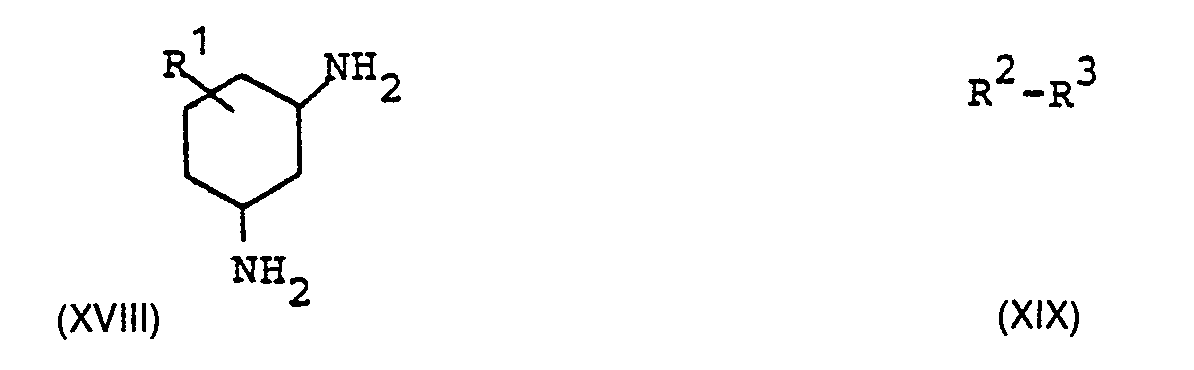
dadurch gekennzeichnet, daß man pro Mol Carbonsäure (derivat) gruppe der Verbindung XIX 1 bis 2,5, vorzugsweise 1 bis 1,5, Mol Diamin XVIII bei 150-280, vorzugsweise 200 bis 250 °C 2 bis 10 Stunden lang miteinander reagieren läßt.
Priority Applications (1)
| Application Number | Priority Date | Filing Date | Title |
|---|---|---|---|
| AT81108895T ATE10839T1 (de) | 1980-11-06 | 1981-10-24 | Neue amidine und amidin/isocyanat-addukte, verfahren zu ihrer herstellung und ihre verwendung als katalysatoren fuer die haertung von epoxidharzen. |
Applications Claiming Priority (2)
| Application Number | Priority Date | Filing Date | Title |
|---|---|---|---|
| DE3041834 | 1980-11-06 | ||
| DE19803041834 DE3041834A1 (de) | 1980-11-06 | 1980-11-06 | Neue amidine und amidin/isocyanat-addukte, verfahren zu ihrer herstellung und ihre verwendung als katalysatoren fuer die haertung von epoxidharzen |
Publications (3)
| Publication Number | Publication Date |
|---|---|
| EP0051787A2 EP0051787A2 (de) | 1982-05-19 |
| EP0051787A3 EP0051787A3 (en) | 1982-08-18 |
| EP0051787B1 true EP0051787B1 (de) | 1984-12-19 |
Family
ID=6116076
Family Applications (1)
| Application Number | Title | Priority Date | Filing Date |
|---|---|---|---|
| EP81108895A Expired EP0051787B1 (de) | 1980-11-06 | 1981-10-24 | Neue Amidine und Amidin/Isocyanat-Addukte, Verfahren zu ihrer Herstellung und ihre Verwendung als Katalysatoren für die Härtung von Epoxidharzen |
Country Status (6)
| Country | Link |
|---|---|
| US (3) | US4424353A (de) |
| EP (1) | EP0051787B1 (de) |
| JP (1) | JPS57108076A (de) |
| AT (1) | ATE10839T1 (de) |
| DE (2) | DE3041834A1 (de) |
| ES (1) | ES506878A0 (de) |
Families Citing this family (15)
| Publication number | Priority date | Publication date | Assignee | Title |
|---|---|---|---|---|
| DE3041834A1 (de) * | 1980-11-06 | 1982-06-09 | Bayer Ag, 5090 Leverkusen | Neue amidine und amidin/isocyanat-addukte, verfahren zu ihrer herstellung und ihre verwendung als katalysatoren fuer die haertung von epoxidharzen |
| DE3211301A1 (de) * | 1982-03-26 | 1983-09-29 | Bayer Ag, 5090 Leverkusen | Cyclische amidine, verfahren zu ihrer herstellung und die verwendung cyclischer amidine als katalysatoren fuer die haertung von epoxidharzen |
| DE3217875A1 (de) * | 1982-05-12 | 1983-11-17 | Bayer Ag, 5090 Leverkusen | Verfahren zur herstellung von glycidyl-1,2,4-triazolidin-3,5-dionen |
| US4513060A (en) * | 1984-02-08 | 1985-04-23 | E. I. Du Pont De Nemours And Company | Chlorosulfonated polyethylene coating composition |
| US4578286A (en) * | 1984-02-08 | 1986-03-25 | E. I. Du Pont De Nemours And Company | Electrically conductive coating composition of a chlorosulfonated polyethylene |
| US4572870A (en) * | 1984-08-09 | 1986-02-25 | E. I. Du Pont De Nemours And Company | Chlorosulfonated ethylene vinyl acetate polymer coating composition |
| EP0226511B1 (de) * | 1985-12-13 | 1989-08-02 | LABORATOIRE L. LAFON Société anonyme dite: | 5-Phenyl-1,4,5,6-tetrahydropyrimidinderivate, Verfahren zur Herstellung und Verwendung in Arzneimitteln |
| DE3545061A1 (de) * | 1985-12-19 | 1987-06-25 | Bayer Ag | Pulverfoermige ueberzugsmittel |
| US4798879A (en) * | 1987-03-25 | 1989-01-17 | The B.F. Goodrich Company | Catalyzed fast cure polyurethane sealant composition |
| US4952659A (en) * | 1987-03-25 | 1990-08-28 | The B. F. Goodrich Company | Catalyzed fast cure polyurethane sealant composition |
| NL9102113A (nl) * | 1991-12-18 | 1993-07-16 | Dsm Nv | Katalysator voor de reaktie tussen carboxylfunctionele polymeren en epoxyfunctionele verbindingen als basis voor poedercoatings. |
| DE4400931A1 (de) * | 1994-01-14 | 1995-07-20 | Huels Chemische Werke Ag | Salze der Pyromellitsäure, ein Verfahren zu ihrer Herstellung sowie deren Verwendung |
| DE19627951A1 (de) * | 1996-07-11 | 1998-01-15 | Huels Chemische Werke Ag | Pulverförmige Verbindungen, ein Verfahren zu ihrer Herstellung sowie deren Verwendung |
| EP2465886A1 (de) * | 2010-12-16 | 2012-06-20 | Bayer MaterialScience AG | Polyisocyanat-Polyadditionsprodukte, ein Verfahren zu ihrer Herstellung und ihre Verwendung |
| JP7723818B1 (ja) * | 2024-10-21 | 2025-08-14 | 株式会社T&K Toka | 潜在性硬化剤、及びそれを含む熱硬化性エポキシド組成物 |
Citations (1)
| Publication number | Priority date | Publication date | Assignee | Title |
|---|---|---|---|---|
| DE2835029A1 (de) * | 1978-08-10 | 1980-02-14 | Huels Chemische Werke Ag | Pulverfoermige ueberzugsmittel und deren anwendung |
Family Cites Families (12)
| Publication number | Priority date | Publication date | Assignee | Title |
|---|---|---|---|---|
| US4147737A (en) * | 1970-12-23 | 1979-04-03 | Internationale Octrooi Maatschappij Octropa B.V. | Powder coating composition employing mixture of polyepoxide resin with modified polyester resin |
| GB1381262A (en) * | 1970-12-23 | 1975-01-22 | Unilever Ltd | Coating composition |
| DE2132079C3 (de) * | 1971-06-28 | 1980-04-10 | Basf Ag, 6700 Ludwigshafen | Verfahren zur Herstellung von 1 ,3-Diazacycloalkenen |
| DE2154948A1 (de) * | 1971-11-05 | 1973-05-10 | Huels Chemische Werke Ag | Verfahren zur herstellung von cyclischen amidinen |
| ZA752896B (en) * | 1975-05-05 | 1976-04-28 | American Cyanamid Co | Unsaturated imidazolines |
| US4024259A (en) | 1976-01-26 | 1977-05-17 | American Hoechst Corporation | 3-Anilino-2,4-diazabicyclo[3.2.1]octenes |
| DE2722514C2 (de) * | 1977-05-18 | 1982-10-14 | Bayer Ag, 5090 Leverkusen | Verfahren zur Herstellung von Harnstoffengruppen aufweisenden hochmolekularen Verbindungen |
| DE2731335A1 (de) * | 1977-07-12 | 1979-01-25 | Veba Chemie Ag | Verfahren zum verkleben von werkstoffen |
| DE2739313A1 (de) * | 1977-09-01 | 1979-03-15 | Bayer Ag | Cycloaminale, ein verfahren zu ihrer herstellung, sowie ihre verwendung |
| DE2751805A1 (de) * | 1977-11-19 | 1979-05-23 | Veba Chemie Ag | Verfahren zur herstellung von blockierten polyisocyanaten |
| DE3041834A1 (de) * | 1980-11-06 | 1982-06-09 | Bayer Ag, 5090 Leverkusen | Neue amidine und amidin/isocyanat-addukte, verfahren zu ihrer herstellung und ihre verwendung als katalysatoren fuer die haertung von epoxidharzen |
| US4404302A (en) * | 1982-05-27 | 1983-09-13 | Ferro Corporation | Acylated hindered hexahydropyrimidines and their use as light stabilizing agents |
-
1980
- 1980-11-06 DE DE19803041834 patent/DE3041834A1/de not_active Withdrawn
-
1981
- 1981-10-24 EP EP81108895A patent/EP0051787B1/de not_active Expired
- 1981-10-24 DE DE8181108895T patent/DE3167875D1/de not_active Expired
- 1981-10-24 AT AT81108895T patent/ATE10839T1/de not_active IP Right Cessation
- 1981-11-02 JP JP56174700A patent/JPS57108076A/ja active Pending
- 1981-11-02 US US06/317,299 patent/US4424353A/en not_active Expired - Fee Related
- 1981-11-05 ES ES506878A patent/ES506878A0/es active Granted
-
1982
- 1982-09-24 US US06/423,025 patent/US4455425A/en not_active Expired - Fee Related
- 1982-09-30 US US06/428,852 patent/US4455426A/en not_active Expired - Fee Related
Patent Citations (1)
| Publication number | Priority date | Publication date | Assignee | Title |
|---|---|---|---|---|
| DE2835029A1 (de) * | 1978-08-10 | 1980-02-14 | Huels Chemische Werke Ag | Pulverfoermige ueberzugsmittel und deren anwendung |
Also Published As
| Publication number | Publication date |
|---|---|
| US4455425A (en) | 1984-06-19 |
| EP0051787A2 (de) | 1982-05-19 |
| US4424353A (en) | 1984-01-03 |
| US4455426A (en) | 1984-06-19 |
| ES8206489A1 (es) | 1982-08-16 |
| EP0051787A3 (en) | 1982-08-18 |
| DE3167875D1 (en) | 1985-01-31 |
| JPS57108076A (en) | 1982-07-05 |
| ES506878A0 (es) | 1982-08-16 |
| ATE10839T1 (de) | 1985-01-15 |
| DE3041834A1 (de) | 1982-06-09 |
Similar Documents
| Publication | Publication Date | Title |
|---|---|---|
| EP0051787B1 (de) | Neue Amidine und Amidin/Isocyanat-Addukte, Verfahren zu ihrer Herstellung und ihre Verwendung als Katalysatoren für die Härtung von Epoxidharzen | |
| DE602004005471T2 (de) | Bei niedriger temperatur aushärtende pulverlacke und anwendungsverfahren dafür | |
| EP0104424B1 (de) | Verwendung blockierter Polyisocyanate als Härter für Hydroxylgruppen-haltige Bindemittel | |
| DE10320266A1 (de) | Feste Uretdiongruppenhaltige Polyurethan-Pulverlackzusammensetzungen bei niedriger Temperatur härtbar | |
| DE3624775A1 (de) | Pulverlack und seine verwendung zur beschichtung von hitzeresistenten substraten | |
| DE3328131C2 (de) | Pulverlacke auf der Basis teilblockierter IPDI-Isocyanurate und hydroxylgruppenhaltiger Polyester sowie ein Verfahren zur Herstellung matter Überzüge | |
| DE2738270A1 (de) | Pulverfoermige ueberzugsmittel und deren anwendung | |
| EP0024680B1 (de) | Pulverlackbindemittel und Verfahren zu ihrer Herstellung | |
| EP0001468B1 (de) | Pulverförmige Überzugsmittel, Verfahren zu deren Herstellung und deren Anwendung | |
| DE2539104C3 (de) | Lösungsmittelarme Einbrennlacke | |
| EP0317741B1 (de) | PUR-Pulverlacke für matte Überzüge | |
| EP0085913B1 (de) | Reaktive carboxylgruppenhaltige Polymere, Verfahren zu ihrer Herstellung und ihre Verwendung als Bindemittelkomponente für Pulverlacke | |
| DE19725742C2 (de) | Verwendung von Harnstoffverbindungen und Formaldehyd liefernden Substanzen in Klarlacküberzugsmitteln | |
| EP0001467B1 (de) | Lagerstabile Einbrennlacke auf Basis imidazolinblockierter Polyisocyanate | |
| EP0512213B1 (de) | Verfahren zur Herstellung eines blockierten Lackpolyisocyanats | |
| EP0519186B1 (de) | Pulverlacke | |
| EP0475108B1 (de) | Pulverlacke und die Verwendung von ausgewählten Bindemittelkombinationen für Pulverlacke | |
| EP3660066A1 (de) | Polyisocyanatzusammensetzung auf basis von pentamethylendiisocyanat für beschichtungen | |
| EP0000971B1 (de) | Pulverförmige Überzugsmittel | |
| DE3610758C2 (de) | ||
| DE19717092A1 (de) | Vernetzer für Epoxidharze bzw. neue Polyisocyanat-modifizierte Polycarbonsäuren | |
| DE19711225A1 (de) | Neue Epoxidharz-Härter, Verfahren zu ihrer Herstellung sowie ihre Verwendung | |
| DE3328130C2 (de) | EP-Pulverlacke auf Basis von amidinblockierten IPDI-Addukten und ein Verfahren zur Herstellung matter Überzüge | |
| DE19731392A1 (de) | Blockierte Polyisocyanate, ein Verfahren zu ihrer Herstellung sowie die daraus hergestellten PUR-Pulverlacke | |
| DE3328132C2 (de) | EP-Pulverlacke, die mit Mischungen aus aromatischen Polycarbonsäuren und amidinblockierten Isocyanaten oder deren Addukten gehärtet werden, und ein Verfahren zur Herstellung matter Überzüge |
Legal Events
| Date | Code | Title | Description |
|---|---|---|---|
| PUAI | Public reference made under article 153(3) epc to a published international application that has entered the european phase |
Free format text: ORIGINAL CODE: 0009012 |
|
| 17P | Request for examination filed |
Effective date: 19811024 |
|
| AK | Designated contracting states |
Designated state(s): AT CH DE FR GB IT NL SE |
|
| PUAL | Search report despatched |
Free format text: ORIGINAL CODE: 0009013 |
|
| AK | Designated contracting states |
Designated state(s): AT CH DE FR GB IT NL SE |
|
| ITF | It: translation for a ep patent filed | ||
| GRAA | (expected) grant |
Free format text: ORIGINAL CODE: 0009210 |
|
| AK | Designated contracting states |
Designated state(s): AT CH DE FR GB IT LI NL SE |
|
| REF | Corresponds to: |
Ref document number: 10839 Country of ref document: AT Date of ref document: 19850115 Kind code of ref document: T |
|
| REF | Corresponds to: |
Ref document number: 3167875 Country of ref document: DE Date of ref document: 19850131 |
|
| ET | Fr: translation filed | ||
| PLBE | No opposition filed within time limit |
Free format text: ORIGINAL CODE: 0009261 |
|
| STAA | Information on the status of an ep patent application or granted ep patent |
Free format text: STATUS: NO OPPOSITION FILED WITHIN TIME LIMIT |
|
| 26N | No opposition filed | ||
| PGFP | Annual fee paid to national office [announced via postgrant information from national office to epo] |
Ref country code: AT Payment date: 19890929 Year of fee payment: 9 |
|
| PGFP | Annual fee paid to national office [announced via postgrant information from national office to epo] |
Ref country code: SE Payment date: 19891026 Year of fee payment: 9 |
|
| PG25 | Lapsed in a contracting state [announced via postgrant information from national office to epo] |
Ref country code: AT Effective date: 19901024 |
|
| PG25 | Lapsed in a contracting state [announced via postgrant information from national office to epo] |
Ref country code: SE Effective date: 19901025 |
|
| PGFP | Annual fee paid to national office [announced via postgrant information from national office to epo] |
Ref country code: DE Payment date: 19910919 Year of fee payment: 11 |
|
| PGFP | Annual fee paid to national office [announced via postgrant information from national office to epo] |
Ref country code: CH Payment date: 19910923 Year of fee payment: 11 |
|
| PGFP | Annual fee paid to national office [announced via postgrant information from national office to epo] |
Ref country code: FR Payment date: 19910927 Year of fee payment: 11 |
|
| PGFP | Annual fee paid to national office [announced via postgrant information from national office to epo] |
Ref country code: GB Payment date: 19911011 Year of fee payment: 11 |
|
| ITTA | It: last paid annual fee | ||
| PGFP | Annual fee paid to national office [announced via postgrant information from national office to epo] |
Ref country code: NL Payment date: 19911031 Year of fee payment: 11 |
|
| PG25 | Lapsed in a contracting state [announced via postgrant information from national office to epo] |
Ref country code: GB Effective date: 19921024 |
|
| PG25 | Lapsed in a contracting state [announced via postgrant information from national office to epo] |
Ref country code: LI Effective date: 19921031 Ref country code: CH Effective date: 19921031 |
|
| PG25 | Lapsed in a contracting state [announced via postgrant information from national office to epo] |
Ref country code: NL Effective date: 19930501 |
|
| NLV4 | Nl: lapsed or anulled due to non-payment of the annual fee | ||
| GBPC | Gb: european patent ceased through non-payment of renewal fee |
Effective date: 19921024 |
|
| PG25 | Lapsed in a contracting state [announced via postgrant information from national office to epo] |
Ref country code: FR Effective date: 19930630 |
|
| REG | Reference to a national code |
Ref country code: CH Ref legal event code: PL |
|
| PG25 | Lapsed in a contracting state [announced via postgrant information from national office to epo] |
Ref country code: DE Effective date: 19930701 |
|
| REG | Reference to a national code |
Ref country code: FR Ref legal event code: ST |
|
| EUG | Se: european patent has lapsed |
Ref document number: 81108895.4 Effective date: 19910603 |