EP0051802A1 - Process for the preparation of aromatic amines - Google Patents
Process for the preparation of aromatic amines Download PDFInfo
- Publication number
- EP0051802A1 EP0051802A1 EP81109097A EP81109097A EP0051802A1 EP 0051802 A1 EP0051802 A1 EP 0051802A1 EP 81109097 A EP81109097 A EP 81109097A EP 81109097 A EP81109097 A EP 81109097A EP 0051802 A1 EP0051802 A1 EP 0051802A1
- Authority
- EP
- European Patent Office
- Prior art keywords
- aromatic amines
- preparation
- azine
- see diagramm
- radicals
- Prior art date
- Legal status (The legal status is an assumption and is not a legal conclusion. Google has not performed a legal analysis and makes no representation as to the accuracy of the status listed.)
- Granted
Links
- 150000004982 aromatic amines Chemical class 0.000 title claims abstract description 9
- 238000000034 method Methods 0.000 title claims abstract description 9
- 239000003054 catalyst Substances 0.000 claims abstract description 16
- JHIVVAPYMSGYDF-UHFFFAOYSA-N cyclohexanone Chemical compound O=C1CCCCC1 JHIVVAPYMSGYDF-UHFFFAOYSA-N 0.000 claims abstract description 12
- JUJWROOIHBZHMG-UHFFFAOYSA-N Pyridine Chemical compound C1=CC=NC=C1 JUJWROOIHBZHMG-UHFFFAOYSA-N 0.000 claims abstract description 7
- 239000001257 hydrogen Substances 0.000 claims abstract description 7
- 229910052739 hydrogen Inorganic materials 0.000 claims abstract description 7
- 150000003254 radicals Chemical class 0.000 claims abstract description 7
- UFHFLCQGNIYNRP-UHFFFAOYSA-N Hydrogen Chemical compound [H][H] UFHFLCQGNIYNRP-UHFFFAOYSA-N 0.000 claims abstract description 6
- 229910000510 noble metal Inorganic materials 0.000 claims abstract description 6
- 230000000737 periodic effect Effects 0.000 claims abstract description 4
- 125000001997 phenyl group Chemical group [H]C1=C([H])C([H])=C(*)C([H])=C1[H] 0.000 claims abstract description 4
- KDLHZDBZIXYQEI-UHFFFAOYSA-N Palladium Chemical compound [Pd] KDLHZDBZIXYQEI-UHFFFAOYSA-N 0.000 claims description 10
- BASFCYQUMIYNBI-UHFFFAOYSA-N platinum Chemical compound [Pt] BASFCYQUMIYNBI-UHFFFAOYSA-N 0.000 claims description 8
- 239000000203 mixture Substances 0.000 claims description 5
- 239000007789 gas Substances 0.000 claims description 4
- 229910052763 palladium Inorganic materials 0.000 claims description 4
- 229910052697 platinum Inorganic materials 0.000 claims description 4
- 125000004169 (C1-C6) alkyl group Chemical group 0.000 claims description 2
- FWFSEYBSWVRWGL-UHFFFAOYSA-N cyclohex-2-enone Chemical compound O=C1CCCC=C1 FWFSEYBSWVRWGL-UHFFFAOYSA-N 0.000 abstract description 4
- 229910052736 halogen Inorganic materials 0.000 abstract description 2
- 239000007792 gaseous phase Substances 0.000 abstract 1
- 125000005843 halogen group Chemical group 0.000 abstract 1
- QGZKDVFQNNGYKY-UHFFFAOYSA-N Ammonia Chemical compound N QGZKDVFQNNGYKY-UHFFFAOYSA-N 0.000 description 6
- IJGRMHOSHXDMSA-UHFFFAOYSA-N Atomic nitrogen Chemical compound N#N IJGRMHOSHXDMSA-UHFFFAOYSA-N 0.000 description 6
- 238000006243 chemical reaction Methods 0.000 description 5
- PAYRUJLWNCNPSJ-UHFFFAOYSA-N Aniline Chemical compound NC1=CC=CC=C1 PAYRUJLWNCNPSJ-UHFFFAOYSA-N 0.000 description 4
- OAKJQQAXSVQMHS-UHFFFAOYSA-N Hydrazine Chemical compound NN OAKJQQAXSVQMHS-UHFFFAOYSA-N 0.000 description 4
- 150000002989 phenols Chemical class 0.000 description 4
- 229910021529 ammonia Inorganic materials 0.000 description 3
- -1 aromatic nitro compounds Chemical class 0.000 description 3
- 229910052757 nitrogen Inorganic materials 0.000 description 3
- MKARNSWMMBGSHX-UHFFFAOYSA-N 3,5-dimethylaniline Chemical compound CC1=CC(C)=CC(N)=C1 MKARNSWMMBGSHX-UHFFFAOYSA-N 0.000 description 2
- XKRFYHLGVUSROY-UHFFFAOYSA-N Argon Chemical compound [Ar] XKRFYHLGVUSROY-UHFFFAOYSA-N 0.000 description 2
- 0 CC*C(C1)C=C(CI)C(*)=C1N Chemical compound CC*C(C1)C=C(CI)C(*)=C1N 0.000 description 2
- LYCAIKOWRPUZTN-UHFFFAOYSA-N Ethylene glycol Chemical compound OCCO LYCAIKOWRPUZTN-UHFFFAOYSA-N 0.000 description 2
- 150000001412 amines Chemical class 0.000 description 2
- 239000012159 carrier gas Substances 0.000 description 2
- 150000001875 compounds Chemical class 0.000 description 2
- 150000003997 cyclic ketones Chemical class 0.000 description 2
- DMBHHRLKUKUOEG-UHFFFAOYSA-N diphenylamine Chemical compound C=1C=CC=CC=1NC1=CC=CC=C1 DMBHHRLKUKUOEG-UHFFFAOYSA-N 0.000 description 2
- 238000004817 gas chromatography Methods 0.000 description 2
- 150000002576 ketones Chemical class 0.000 description 2
- VNWKTOKETHGBQD-UHFFFAOYSA-N methane Chemical compound C VNWKTOKETHGBQD-UHFFFAOYSA-N 0.000 description 2
- 150000002828 nitro derivatives Chemical class 0.000 description 2
- 239000012071 phase Substances 0.000 description 2
- XLYOFNOQVPJJNP-UHFFFAOYSA-N water Chemical compound O XLYOFNOQVPJJNP-UHFFFAOYSA-N 0.000 description 2
- 125000004191 (C1-C6) alkoxy group Chemical group 0.000 description 1
- NHJNEVDNUSFTSG-UHFFFAOYSA-N 1,5-dimethylcyclohexa-2,4-dien-1-ol Chemical compound CC1=CC=CC(C)(O)C1 NHJNEVDNUSFTSG-UHFFFAOYSA-N 0.000 description 1
- DURPTKYDGMDSBL-UHFFFAOYSA-N 1-butoxybutane Chemical compound CCCCOCCCC DURPTKYDGMDSBL-UHFFFAOYSA-N 0.000 description 1
- GVNVAWHJIKLAGL-UHFFFAOYSA-N 2-(cyclohexen-1-yl)cyclohexan-1-one Chemical compound O=C1CCCCC1C1=CCCCC1 GVNVAWHJIKLAGL-UHFFFAOYSA-N 0.000 description 1
- VGVHNLRUAMRIEW-UHFFFAOYSA-N 4-methylcyclohexan-1-one Chemical compound CC1CCC(=O)CC1 VGVHNLRUAMRIEW-UHFFFAOYSA-N 0.000 description 1
- 229910018072 Al 2 O 3 Inorganic materials 0.000 description 1
- LMAUULKNZLEMGN-UHFFFAOYSA-N CCc1cc(C)cc(C)c1 Chemical compound CCc1cc(C)cc(C)c1 LMAUULKNZLEMGN-UHFFFAOYSA-N 0.000 description 1
- OKTJSMMVPCPJKN-UHFFFAOYSA-N Carbon Chemical compound [C] OKTJSMMVPCPJKN-UHFFFAOYSA-N 0.000 description 1
- VGGSQFUCUMXWEO-UHFFFAOYSA-N Ethene Chemical compound C=C VGGSQFUCUMXWEO-UHFFFAOYSA-N 0.000 description 1
- 239000005977 Ethylene Substances 0.000 description 1
- KJTLSVCANCCWHF-UHFFFAOYSA-N Ruthenium Chemical compound [Ru] KJTLSVCANCCWHF-UHFFFAOYSA-N 0.000 description 1
- 229910004298 SiO 2 Inorganic materials 0.000 description 1
- CIUQDSCDWFSTQR-UHFFFAOYSA-N [C]1=CC=CC=C1 Chemical compound [C]1=CC=CC=C1 CIUQDSCDWFSTQR-UHFFFAOYSA-N 0.000 description 1
- 150000001299 aldehydes Chemical class 0.000 description 1
- 125000001931 aliphatic group Chemical group 0.000 description 1
- 125000000217 alkyl group Chemical group 0.000 description 1
- 229910052782 aluminium Inorganic materials 0.000 description 1
- IHNDUGMUECOVKK-UHFFFAOYSA-N aluminum chromium(3+) oxygen(2-) Chemical compound [O-2].[Cr+3].[O-2].[Al+3] IHNDUGMUECOVKK-UHFFFAOYSA-N 0.000 description 1
- 229910052786 argon Inorganic materials 0.000 description 1
- 125000003118 aryl group Chemical group 0.000 description 1
- QXJJQWWVWRCVQT-UHFFFAOYSA-K calcium;sodium;phosphate Chemical compound [Na+].[Ca+2].[O-]P([O-])([O-])=O QXJJQWWVWRCVQT-UHFFFAOYSA-K 0.000 description 1
- 229910052799 carbon Inorganic materials 0.000 description 1
- 125000004432 carbon atom Chemical group C* 0.000 description 1
- 238000004587 chromatography analysis Methods 0.000 description 1
- 239000011280 coal tar Substances 0.000 description 1
- 125000004122 cyclic group Chemical group 0.000 description 1
- 150000001983 dialkylethers Chemical class 0.000 description 1
- SBZXBUIDTXKZTM-UHFFFAOYSA-N diglyme Chemical compound COCCOCCOC SBZXBUIDTXKZTM-UHFFFAOYSA-N 0.000 description 1
- 239000003814 drug Substances 0.000 description 1
- 239000000975 dye Substances 0.000 description 1
- 150000002170 ethers Chemical class 0.000 description 1
- 239000011521 glass Substances 0.000 description 1
- 150000002367 halogens Chemical class 0.000 description 1
- 229930195733 hydrocarbon Natural products 0.000 description 1
- 150000002430 hydrocarbons Chemical class 0.000 description 1
- 150000002431 hydrogen Chemical class 0.000 description 1
- WGCNASOHLSPBMP-UHFFFAOYSA-N hydroxyacetaldehyde Natural products OCC=O WGCNASOHLSPBMP-UHFFFAOYSA-N 0.000 description 1
- 239000000543 intermediate Substances 0.000 description 1
- 229910052741 iridium Inorganic materials 0.000 description 1
- GKOZUEZYRPOHIO-UHFFFAOYSA-N iridium atom Chemical compound [Ir] GKOZUEZYRPOHIO-UHFFFAOYSA-N 0.000 description 1
- 239000007791 liquid phase Substances 0.000 description 1
- 239000000463 material Substances 0.000 description 1
- 238000006396 nitration reaction Methods 0.000 description 1
- 230000003647 oxidation Effects 0.000 description 1
- 238000007254 oxidation reaction Methods 0.000 description 1
- 229920000151 polyglycol Polymers 0.000 description 1
- 239000010695 polyglycol Substances 0.000 description 1
- 239000010970 precious metal Substances 0.000 description 1
- 239000002243 precursor Substances 0.000 description 1
- QQONPFPTGQHPMA-UHFFFAOYSA-N propylene Natural products CC=C QQONPFPTGQHPMA-UHFFFAOYSA-N 0.000 description 1
- 125000004805 propylene group Chemical group [H]C([H])([H])C([H])([*:1])C([H])([H])[*:2] 0.000 description 1
- 229910052703 rhodium Inorganic materials 0.000 description 1
- 239000010948 rhodium Substances 0.000 description 1
- MHOVAHRLVXNVSD-UHFFFAOYSA-N rhodium atom Chemical compound [Rh] MHOVAHRLVXNVSD-UHFFFAOYSA-N 0.000 description 1
- 229910052707 ruthenium Inorganic materials 0.000 description 1
- 238000000926 separation method Methods 0.000 description 1
- 239000002904 solvent Substances 0.000 description 1
- 229910052566 spinel group Inorganic materials 0.000 description 1
- 238000011144 upstream manufacturing Methods 0.000 description 1
- 239000010457 zeolite Substances 0.000 description 1
Classifications
-
- C—CHEMISTRY; METALLURGY
- C07—ORGANIC CHEMISTRY
- C07C—ACYCLIC OR CARBOCYCLIC COMPOUNDS
- C07C209/00—Preparation of compounds containing amino groups bound to a carbon skeleton
- C07C209/68—Preparation of compounds containing amino groups bound to a carbon skeleton from amines, by reactions not involving amino groups, e.g. reduction of unsaturated amines, aromatisation, or substitution of the carbon skeleton
Definitions
- the present invention relates to a process for the preparation of aromatic amines by reacting cyclohexanone or cyclohexenonazines in the gas phase over precious metal of the 8th subgroup of the periodic table containing catalysts.
- Aromatic amines are versatile intermediates, e.g. for dyes, pharmaceuticals or crop protection products.
- aromatic amines have been mainly produced by reducing the corresponding aromatic nitro compounds or by reacting corresponding phenols with ammonia at high temperatures and pressures.
- the aim of the present invention was therefore to find a preparation of aromatic amines which is independent of aromatic precursors, starting from simple aliphatic basic materials such as cycloaliphatic ketones.
- Cyclic ketones for example cyclohexanone
- Unsaturated cyclic ketones for example 3,5-dialkylcyclohexenones, are easily accessible from aldehydes and ⁇ -keto esters (cf. DE-OS 2 654 850).
- radicals R 1 to R 5 are hydrogen or C 1 - c 6 alkyl groups or one of the radicals can be a phenyl group, characterized in that a cyclohexenone azine or cyclohexanone azine of the general formula IIa and IIb wherein the radicals R 1 to R 5 have the meaning given above in the gas phase at temperatures from 200 to 500 ° C. over a catalyst containing at least one noble metal of the 8th subgroup of the periodic table.
- the compounds of the formula IIa can be prepared in the following way (DE-OS 2 654 850; Ann. 281, 104 (1894)):
- the cyclohexanonazines of formula IIb are derived from cycloaliphatic ketones, e.g. Cyclohexanone, methylcyclohexanone, cyclohexenylcyclohexanone, and hydrazine.
- the radicals R 1 to R 5 together have no more than 12 C atoms.
- the C 1 -C 6 -alkyl radicals suitable for R 1 to R 5 can be straight-chain, branched or cyclic.
- One of the radicals R 1 to R 5 can also be a phenyl radical. This can also be substituted, for example by halogen, C 1 -C 6 -alkyl or C 1 - C 6 -alkoxy groups. However, it is preferably unsubstituted or only monosubstituted,
- catalysts are generally used which contain ruthenium, rhodium, palladium, iridium or platinum or mixtures thereof. Palladium, platinum and palladium / platinum are preferred.
- supported catalysts are used, for example with carbon, Si0 2 , Al 2 O 3 , aluminum silicates, spinels, chromium oxide ⁇ aluminum oxide and zeolites.
- concentration of the noble metal on the carrier is generally 0.05 to 10% by weight, preferably 0.2 to 5% by weight, in particular 0.3 to 2.5% by weight, based on the weight of the carrier.
- the noble metals are applied to the carrier as compounds and are preferably reduced before the start of the reaction, for example by passing hydrogen over them.
- the catalyst can be arranged either as a fixed bed, as a moving bed or as a fluidized bed.
- the reaction temperature is generally 200-500 ° C, preferably 250-400 ° C, especially 270-380 ° C.
- a carrier gas is preferably used to transport the azine over the catalyst. Hydrogen, nitrogen, ammonia, argon, CO 2 , methane, water vapor, ethylene and propylene are particularly suitable as carrier gas.
- the azine can also be used upstream of the reactor with volatile solvents such as e.g. Hydrocarbons, ethers, especially glycol and polyglycol dialkyl ethers or water are diluted.
- volatile solvents such as e.g. Hydrocarbons, ethers, especially glycol and polyglycol dialkyl ethers or water are diluted.
- Example 2 With the aid of the reactor and catalyst described in Example 1, a mixture of 20 g of cyclohexanonazine and 80 g of di-n-butyl ether was reacted at 270 to 280 ° C. for 2 hours. During this time 40 1 N 2 and 28 1 H 2 were also passed over the catalyst. According to GC analysis, the product collected at the reactor outlet contained 15.1 g of aniline, 2.7 g of diphenylamine and 1.0 g of unreacted cyclohexanonazine.
Landscapes
- Chemical & Material Sciences (AREA)
- Organic Chemistry (AREA)
- Chemical Kinetics & Catalysis (AREA)
- Organic Low-Molecular-Weight Compounds And Preparation Thereof (AREA)
- Low-Molecular Organic Synthesis Reactions Using Catalysts (AREA)
Abstract
Description
Gegenstand der vorliegenden Erfindung ist ein Verfahren zur Herstellung von aromatischen Aminen durch Umsetzung von Cyclohexanon- bzw. Cyclohexenonazinen in der Gasphase an Edelmetall der 8. Nebengruppe des Periodensystems enthaltenden Katalysatoren.The present invention relates to a process for the preparation of aromatic amines by reacting cyclohexanone or cyclohexenonazines in the gas phase over precious metal of the 8th subgroup of the periodic table containing catalysts.
Aromatische Amine sind vielseitig verwendbare Zwischenprodukte, z.B. für Farbstoffe, Arzneimittel oder Pflanzenschutzpräparate.Aromatic amines are versatile intermediates, e.g. for dyes, pharmaceuticals or crop protection products.
Bisher stellt man aromatische Amine hauptsächlich durch Reduktion der entsprechenden aromatischen Nitroverbindungen oder durch Umsetzung von entsprechenden Phenolen mit Ammoniak bei hohen Temperaturen und Drücken her.So far, aromatic amines have been mainly produced by reducing the corresponding aromatic nitro compounds or by reacting corresponding phenols with ammonia at high temperatures and pressures.
Voraussetzung für diese Verfahren ist also die Verfügbarkeit der entsprechenden Nitroverbindungen bzw. Phenole. Da bei der Nitrierung von Aromaten immer verschiedene Isomere anfallen, ergibt sich oft ein schwieriges Trennproblem, das entweder vor der Reduktion,dh. auf der Stufe der Nitroverbindungen, oder nach der Reduktion,dh. auf der Aminstufe,gelöst werden muß. Die Umsetzung der Phenole mit Ammoniak bedingt einen sehr großen technischen und apparativen Aufwand. Außerdem müssen diese Phenole häufig aus Steinkohlenteer gewonnen werden,beispielsweise das sym. m-Xylenol.A prerequisite for these processes is the availability of the corresponding nitro compounds or phenols. Since different isomers always arise in the nitration of aromatics, a difficult separation problem often arises, which either occurs before the reduction, ie. at the nitro compound level, or after the reduction, ie. at the amine stage, must be solved. The reaction of the phenols with ammonia requires a very large amount of technical and apparatus expenditure. In addition, these phenols often have to be obtained from coal tar, for example the sym. M-xylenol.
Ziel der vorliegenden Erfindung war es daher, eine von aromatischen Vorstufen unabhängige Herstellung aromatischer Amine zu finden, und zwar ausgehend von einfachen ali.- phatischen Grundstoffen wie z.B. cycloaliphatischen Ketonen. Cyclische Ketone, beispielsweise Cyclohexanon, werden in großem Maßstaab durch Oxidation von Cycloaliphaten hergestellt. Ungesättigte cyclische Ketone, beispielsweise 3,5-Dialkylcyclohexenone, sind aus Aldehyden und δ-Ketoestern leicht zugänglich (vgl. DE-OS 2 654 850).The aim of the present invention was therefore to find a preparation of aromatic amines which is independent of aromatic precursors, starting from simple aliphatic basic materials such as cycloaliphatic ketones. Cyclic ketones, for example cyclohexanone, are produced on a large scale by oxidation of cycloaliphatics. Unsaturated cyclic ketones, for example 3,5-dialkylcyclohexenones, are easily accessible from aldehydes and δ-keto esters (cf. DE-OS 2 654 850).
Nach E.C. Horning (J. Am. Chem. Soc., 69, 1907 (1947)) gelingt die überführung von Cyclohexenon in Anilin durch Umsetzung des Cyclohexenons mit Hydrazin und katalytische Dehydrierung des dabei gebildeten Cyclohexenonazins an Pd/C-Katalysatoren in der Flüssigphase bei Temperaturen zwischen 136°C und 252°C:

Eine wirtschaftliche Herstellung aromatischer Amine nach diesem Verfahren ist jedoch wegen der nur etwa 50 % erreichenden Ausbeuten nicht möglich.However, it is not possible to produce aromatic amines economically using this process because of the yields which only reach about 50%.
Es wurde nun ein Verfahren zur Herstellung von aromatischen Aminen der allgemeinen Formeln Ia bzw. Ib
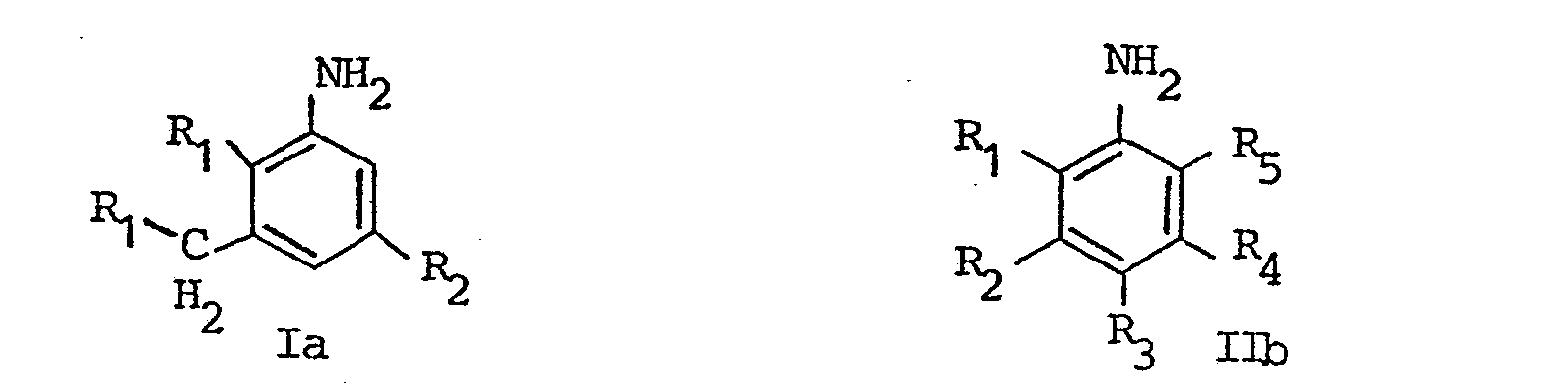

Die Verbindungen der Formel IIa können auf folgende Weise (DE-OS 2 654 850; Ann. 281, 104 (1894)) hergestellt werden:

Die Cyclohexanonazine der Formel IIb werden aus cycloaliphatischen Ketonen, z.B. Cyclohexanon, Methylcyclohexanon, Cyclohexenylcyclohexanon, und Hydrazin hergestellt.The cyclohexanonazines of formula IIb are derived from cycloaliphatic ketones, e.g. Cyclohexanone, methylcyclohexanone, cyclohexenylcyclohexanone, and hydrazine.
Im allgemeinen haben die Reste R1 bis R5 zusammen nicht mehr als 12-C-Atome. Die für R1 bis R5 in Frage kommenden C1-C6-Alkylreste können geradkettig, verzweigt oder cyclisch sein. Einer der Reste R1 bis R5 kann auch ein Phenylrest sein. Dieser kann auch substituiert sein, z.B. durch Halogen-, C1 - C6-Alkyl- oder C1 - C6-Alkoxy-Gruppen. Vorzugsweise ist er aber unsubstituiertoder nur einfach substituiert,In general, the radicals R 1 to R 5 together have no more than 12 C atoms. The C 1 -C 6 -alkyl radicals suitable for R 1 to R 5 can be straight-chain, branched or cyclic. One of the radicals R 1 to R 5 can also be a phenyl radical. This can also be substituted, for example by halogen, C 1 -C 6 -alkyl or C 1 - C 6 -alkoxy groups. However, it is preferably unsubstituted or only monosubstituted,
Zur erfindungsgemäßen Umsetzung der Azine in Amine verwendet man im allgemeinen Katalysatoren, die Ruthenium, Rhodium, Palladium, Iridium oder Platin oder deren Gemische enthalten. Palladium, Platin und Palladium/Platin sind bevorzugt.For the conversion of the azines into amines according to the invention, catalysts are generally used which contain ruthenium, rhodium, palladium, iridium or platinum or mixtures thereof. Palladium, platinum and palladium / platinum are preferred.
Im allgemeinen werden geträgerte Katalysatoren, beispielweise mit Kohle, Si02, Al2O3, Aluminiumsilikaten, Spinellen, Chromoxid―Aluminiumoxid und Zeolithen als Trägern, verwendet. Die Konzentration des Edelmetalls auf dem Träger beträgt dabei im allgemeinen 0.05 bis 10 Gew.%, vorzugsweise 0.2 bis 5 Gew.%, insbesondere 0.3 bis 2.5 Gew.%, bezogen auf das Gewicht des Trägers. Die Edelmetalle werden als Verbindungen auf den Träger aufgebracht und vorzugsweise vor Beginn der Reaktion reduziert, z.B. durch überleiten von Wasserstoff. Der Katalysator kann entweder als Festbett, als bewegtes Bett oder als Wirbelschicht angeordnet sein.In general, supported catalysts are used, for example with carbon, Si0 2 , Al 2 O 3 , aluminum silicates, spinels, chromium oxide ― aluminum oxide and zeolites. The concentration of the noble metal on the carrier is generally 0.05 to 10% by weight, preferably 0.2 to 5% by weight, in particular 0.3 to 2.5% by weight, based on the weight of the carrier. The noble metals are applied to the carrier as compounds and are preferably reduced before the start of the reaction, for example by passing hydrogen over them. The catalyst can be arranged either as a fixed bed, as a moving bed or as a fluidized bed.
Die Reaktionstemperatur beträgt im allgemeinen 200 - 500°C, vorzugsweise 250 - 400°C, insbesondere 270 - 380°C.The reaction temperature is generally 200-500 ° C, preferably 250-400 ° C, especially 270-380 ° C.
Im allgemeinen wird Unterdruck bis herab zu etwa 10 mbar oder Normaldruck angewandt, man kann jedoch auch bei höheren Drucken bis etwa 20 bar arbeiten. Vorzugsweise verwendet man ein Trägergas, um das Azin über den Katalysator zu transportieren. Als Trägergas eignen sich besonders Wasserstoff, Stickstoff, Ammoniak, Argon, CO2, Methan, Wasserdampf, Ethylen und Propylen.In general, vacuum is used down to about 10 mbar or normal pressure, but you can also work at higher pressures up to about 20 bar. A carrier gas is preferably used to transport the azine over the catalyst. Hydrogen, nitrogen, ammonia, argon, CO 2 , methane, water vapor, ethylene and propylene are particularly suitable as carrier gas.
Das Azin kann vor dem Reaktor auch mit leichtflüchtigen Lösemitteln,wie z.B. Kohlenwasserstoffen, Ethern, insbesondere Glykol- und Polyglykol-dialkylethern oder Wasser verdünnt werden.The azine can also be used upstream of the reactor with volatile solvents such as e.g. Hydrocarbons, ethers, especially glycol and polyglycol dialkyl ethers or water are diluted.
Die folgenden Beispiele dienen zur Erläuterung des erfindungsgemäßen Verfahrens. Die angegebenen Litermengen an N2 und H2 beziehen sich stets auf den Normzustand (O°C, 1.013 bar).The following examples serve to explain the method according to the invention. The stated liter quantities of N 2 and H 2 always refer to the standard condition (0 ° C, 1,013 bar).
In einem Glasreaktor vom 18 mm Durchmesser und 40 cm Länge befanden sich von oben nach unten zuerst.eine 5 cm lange Schicht aus Glaskugeln und unmittelbar danach eine 16 cm lange Schicht eines Katalysators, bestehend aus 1 Gew.% Pd auf SiO2-Kugeln. Der Reaktor wurde im N2-Strom auf 300°C aufgeheizt, anschließend wurde der Katalysator mit 24 1 Stickstoff und 6 1 Wasserstoff pro Stunde 2 Stunden lang bei 280°C aktiviert. Daraufhin wurden in 2 Stunden 100 g einer Mischung, bestehend aus 80 g Dimethyldiglykol und 20 g 3,5-Dimethylcyclohexen-2-azin-1 (Kp0.5105°C) zusammen mit 40 1 Stickstoff und 28 l Wasserstoff von oben über den durch eine elektrische Heizung auf 280°C erhitzten Katalysator geleitet.In a glass reactor 18 mm in diameter and 40 cm in length, from top to bottom there was first a 5 cm long layer of glass spheres and immediately thereafter a 16 cm long layer of a catalyst consisting of 1% by weight Pd on SiO 2 spheres. The reactor was heated to 300 ° C. in a stream of N 2 , and the catalyst was then activated with 24 l of nitrogen and 6 l of hydrogen per hour at 280 ° C. for 2 hours. Thereupon 100 g of a mixture consisting of 80 g of dimethyl diglycol and 20 g of 3,5-dimethylcyclohexen-2-azine-1 (bp 0.5 105 ° C.) together with 40 l of nitrogen and 28 l of hydrogen were passed over from above in 2 hours an electric heater directed to 280 ° C heated catalyst.
Am Reaktorausgang wurden während der 2. Stunde 48 g Produkt aufgefangen. Die gaschromatographische Analyse (GC) ergab 7.7 g 3,5-Dimethylanilin,d.h. 78% d.Th., und 1.2 g Dixylylamin ≙ 13% d.Th.

Mit Hilfe des in Beispiel 1 beschriebenen Reaktors und Katalysators wurde bei 300°C 3 Stunden lang ein Gemisch aus 20 g 3-Methyl-5-propyl-cyclohexen-2-onazin-1 (Kp0.5 198 - 200°C) und 80 g Tb luol umgesetzt. Gleichzeitig wurden in dieser Zeit 60 1 N2 und 30 1 H2 über den Katalysator geleitet. Das am Reaktorende kondensierte Produkt enthielt laut GC-Analyse 14 g 3-Methyl-S-propyl-anilin ≙ 70% d.Th. (Kp1 106 °C).With the aid of the reactor and catalyst described in Example 1, a mixture of 20 g of 3-methyl-5-propyl-cyclohexen-2-onazin-1 (bp 0.5 198-200 ° C) and 80 g was at 300 ° C for 3 hours Tb luol implemented. At the same time, 60 1 N 2 and 30 1 H 2 were passed over the catalyst during this time. According to GC analysis, the product condensed at the end of the reactor contained 14 g of 3-methyl-S-propyl-aniline ≙ 70% of theory (Bp 1 106 ° C).
Mit Hilfe des in Beispiel 1 beschriebenen Reaktors und Katalysators wurde bei 270 bis 280°C 2 Stunden lang eine Mischung von 20 g Cyclohexanonazin und 80 g Di-n-butylether umgesetzt. Während dieser Zeit wurden ebenfalls 40 1 N2 und 28 1 H2 über den Katalysator geleitet. Das am Reaktorausgang aufgefangene Produkt enthielt laut GC-Analyse 15.1 g Anilin, 2.7 g Diphenylamin und 1.0 g unumgesetztes Cyclohexanonazin.With the aid of the reactor and catalyst described in Example 1, a mixture of 20 g of cyclohexanonazine and 80 g of di-n-butyl ether was reacted at 270 to 280 ° C. for 2 hours. During this time 40 1 N 2 and 28 1 H 2 were also passed over the catalyst. According to GC analysis, the product collected at the reactor outlet contained 15.1 g of aniline, 2.7 g of diphenylamine and 1.0 g of unreacted cyclohexanonazine.
Claims (2)


Applications Claiming Priority (2)
| Application Number | Priority Date | Filing Date | Title |
|---|---|---|---|
| DE19803041892 DE3041892A1 (en) | 1980-11-06 | 1980-11-06 | METHOD FOR PRODUCING AROMATIC AMINES |
| DE3041892 | 1980-11-06 |
Publications (2)
| Publication Number | Publication Date |
|---|---|
| EP0051802A1 true EP0051802A1 (en) | 1982-05-19 |
| EP0051802B1 EP0051802B1 (en) | 1985-01-23 |
Family
ID=6116124
Family Applications (1)
| Application Number | Title | Priority Date | Filing Date |
|---|---|---|---|
| EP81109097A Expired EP0051802B1 (en) | 1980-11-06 | 1981-10-28 | Process for the preparation of aromatic amines |
Country Status (4)
| Country | Link |
|---|---|
| EP (1) | EP0051802B1 (en) |
| JP (1) | JPS57108043A (en) |
| CA (1) | CA1204452A (en) |
| DE (2) | DE3041892A1 (en) |
Families Citing this family (1)
| Publication number | Priority date | Publication date | Assignee | Title |
|---|---|---|---|---|
| DE4100514A1 (en) * | 1991-01-10 | 1992-07-16 | Bayer Ag | Di:phenylamine and derivs. prodn. from corresp. N=cyclohexylidene aniline |
Citations (1)
| Publication number | Priority date | Publication date | Assignee | Title |
|---|---|---|---|---|
| DE2331878B2 (en) * | 1972-06-24 | 1976-03-04 | Snam Prögetti S.p.A., Mailand (Italien) | PROCESS FOR THE PRODUCTION OF DIPHENYLAMINE AND ITS DERIVATIVES |
-
1980
- 1980-11-06 DE DE19803041892 patent/DE3041892A1/en not_active Withdrawn
-
1981
- 1981-10-28 DE DE8181109097T patent/DE3168530D1/en not_active Expired
- 1981-10-28 EP EP81109097A patent/EP0051802B1/en not_active Expired
- 1981-11-05 JP JP56176589A patent/JPS57108043A/en active Pending
- 1981-11-05 CA CA000389541A patent/CA1204452A/en not_active Expired
Patent Citations (1)
| Publication number | Priority date | Publication date | Assignee | Title |
|---|---|---|---|---|
| DE2331878B2 (en) * | 1972-06-24 | 1976-03-04 | Snam Prögetti S.p.A., Mailand (Italien) | PROCESS FOR THE PRODUCTION OF DIPHENYLAMINE AND ITS DERIVATIVES |
Non-Patent Citations (1)
| Title |
|---|
| Houben-Weyl "Methoden der Organischen Chemie" 4. Auflage, Band XI/1 1957, Georg Thieme Verlag, Stuttgart seite 537 & E.C HORNING et al. "J. Am. Chem. Soc." Band 69, 1947, seite 1907 * |
Also Published As
| Publication number | Publication date |
|---|---|
| CA1204452A (en) | 1986-05-13 |
| DE3168530D1 (en) | 1985-03-07 |
| DE3041892A1 (en) | 1982-06-09 |
| JPS57108043A (en) | 1982-07-05 |
| EP0051802B1 (en) | 1985-01-23 |
Similar Documents
| Publication | Publication Date | Title |
|---|---|---|
| DE2435818C3 (en) | Process for the production of aromatic diamines | |
| EP0400426A2 (en) | Process for the preparation of alpha-omega-diamines | |
| EP0206054B1 (en) | Method for the production of carboxylic acids | |
| DE2118283A1 (en) | Process for the preparation of secondary or tertiary aliphatic or cycloaliphatic amines | |
| EP0050229B1 (en) | Process for the preparation of primary aromatic amines from cyclic alcohols and/or ketones | |
| DE2535725A1 (en) | PROCESS FOR PREPARING LONG CHAIN TERTIAER AMINE | |
| EP0051802B1 (en) | Process for the preparation of aromatic amines | |
| DE2603076C2 (en) | Process for the preparation of 2-aminobutan-1-ol | |
| EP0064605B1 (en) | Process for the preparation of derivatives of resorcin, and the use of certain derivatives of resorcin as perfumes | |
| DE19803667A1 (en) | Process for the preparation of 5-alkoxy (or 5-aroxy) -2,3-dihydrofuran-2-ones | |
| EP0051803B1 (en) | Process for the preparation of 3,5-dimethyl aniline (sym. m-xylidine) | |
| DE2615308C3 (en) | Process for the production of higher ketones | |
| DE1443974A1 (en) | Process for the production of cyclododecene | |
| EP0093892B1 (en) | Process for preparing aromatic amines | |
| EP0374416B1 (en) | Process for preparing 2,6,6-trimethyl cyclohex-2-ene-1,4 dione | |
| EP0051805B1 (en) | Process for the preparation of aromatic amines | |
| CH622489A5 (en) | Process for the preparation of 2-amino-1-alcohols | |
| DE1668437A1 (en) | Process for converting a carbonyl compound | |
| DE4210311A1 (en) | High yield amine prodn. from aldazine(s) or ketazine(s) - by hydrogenative cleavage in presence of ammonia and specified catalyst | |
| DE2733928A1 (en) | PROCESS FOR MANUFACTURING A BIZYCLIC ALCOHOL | |
| DE2820928C2 (en) | Process for the production of ionons and irons | |
| DE69011244T2 (en) | Process for the preparation of alpha-beta-unsaturated carbonyl compounds. | |
| EP0470375A1 (en) | Process for the preparation of aromatic amines substituted in the p position by C1-4 alkoxy | |
| DE2053736C3 (en) | Process for the production of 1- and 2-formylindane by the oxo synthesis | |
| DE2524797C3 (en) | Process for the preparation of tertiary amines |
Legal Events
| Date | Code | Title | Description |
|---|---|---|---|
| PUAI | Public reference made under article 153(3) epc to a published international application that has entered the european phase |
Free format text: ORIGINAL CODE: 0009012 |
|
| 17P | Request for examination filed |
Effective date: 19811028 |
|
| AK | Designated contracting states |
Designated state(s): CH DE FR GB |
|
| GRAA | (expected) grant |
Free format text: ORIGINAL CODE: 0009210 |
|
| AK | Designated contracting states |
Designated state(s): CH DE FR GB LI |
|
| REF | Corresponds to: |
Ref document number: 3168530 Country of ref document: DE Date of ref document: 19850307 |
|
| ET | Fr: translation filed | ||
| PLBE | No opposition filed within time limit |
Free format text: ORIGINAL CODE: 0009261 |
|
| STAA | Information on the status of an ep patent application or granted ep patent |
Free format text: STATUS: NO OPPOSITION FILED WITHIN TIME LIMIT |
|
| 26N | No opposition filed | ||
| PG25 | Lapsed in a contracting state [announced via postgrant information from national office to epo] |
Ref country code: LI Effective date: 19861031 Ref country code: CH Effective date: 19861031 |
|
| PG25 | Lapsed in a contracting state [announced via postgrant information from national office to epo] |
Ref country code: FR Free format text: LAPSE BECAUSE OF NON-PAYMENT OF DUE FEES Effective date: 19870630 |
|
| REG | Reference to a national code |
Ref country code: CH Ref legal event code: PL |
|
| GBPC | Gb: european patent ceased through non-payment of renewal fee | ||
| PG25 | Lapsed in a contracting state [announced via postgrant information from national office to epo] |
Ref country code: DE Effective date: 19870701 |
|
| REG | Reference to a national code |
Ref country code: FR Ref legal event code: ST |
|
| PG25 | Lapsed in a contracting state [announced via postgrant information from national office to epo] |
Ref country code: GB Effective date: 19881118 |