EP0051807A2 - Water-soluble disazo compounds, process for their preparation and their use as dyestuffs - Google Patents
Water-soluble disazo compounds, process for their preparation and their use as dyestuffs Download PDFInfo
- Publication number
- EP0051807A2 EP0051807A2 EP81109103A EP81109103A EP0051807A2 EP 0051807 A2 EP0051807 A2 EP 0051807A2 EP 81109103 A EP81109103 A EP 81109103A EP 81109103 A EP81109103 A EP 81109103A EP 0051807 A2 EP0051807 A2 EP 0051807A2
- Authority
- EP
- European Patent Office
- Prior art keywords
- group
- oder
- radical
- substituted
- hydroxy
- Prior art date
- Legal status (The legal status is an assumption and is not a legal conclusion. Google has not performed a legal analysis and makes no representation as to the accuracy of the status listed.)
- Granted
Links
- 0 C*c(cc1)cc(*)c1N Chemical compound C*c(cc1)cc(*)c1N 0.000 description 3
- FQZFUFDQHMHZGQ-UHFFFAOYSA-N CCN(C)c(cc1)ccc1N=C Chemical compound CCN(C)c(cc1)ccc1N=C FQZFUFDQHMHZGQ-UHFFFAOYSA-N 0.000 description 1
- MVWBPVHHQSBGRJ-HNENSFHCSA-N CCS(c(cc1)cc(S(O)(=O)=O)c1/N=N\c(c(C)c1)cc(C)c1N)(=O)=O Chemical compound CCS(c(cc1)cc(S(O)(=O)=O)c1/N=N\c(c(C)c1)cc(C)c1N)(=O)=O MVWBPVHHQSBGRJ-HNENSFHCSA-N 0.000 description 1
- WNGFDYJEGYVMQZ-UHFFFAOYSA-N CS(c(cc1)cc(S(O)(=O)=O)c1N)(=O)=O Chemical compound CS(c(cc1)cc(S(O)(=O)=O)c1N)(=O)=O WNGFDYJEGYVMQZ-UHFFFAOYSA-N 0.000 description 1
- METAIDWKNVRMQR-UHFFFAOYSA-N NC(C1C=CC(S(O)(=O)=O)=CC11)=CC=C1N Chemical compound NC(C1C=CC(S(O)(=O)=O)=CC11)=CC=C1N METAIDWKNVRMQR-UHFFFAOYSA-N 0.000 description 1
Classifications
-
- C—CHEMISTRY; METALLURGY
- C09—DYES; PAINTS; POLISHES; NATURAL RESINS; ADHESIVES; COMPOSITIONS NOT OTHERWISE PROVIDED FOR; APPLICATIONS OF MATERIALS NOT OTHERWISE PROVIDED FOR
- C09B—ORGANIC DYES OR CLOSELY-RELATED COMPOUNDS FOR PRODUCING DYES, e.g. PIGMENTS; MORDANTS; LAKES
- C09B62/00—Reactive dyes, i.e. dyes which form covalent bonds with the substrates or which polymerise with themselves
- C09B62/44—Reactive dyes, i.e. dyes which form covalent bonds with the substrates or which polymerise with themselves with the reactive group not directly attached to a heterocyclic ring
- C09B62/443—Reactive dyes, i.e. dyes which form covalent bonds with the substrates or which polymerise with themselves with the reactive group not directly attached to a heterocyclic ring the reactive group being alternatively specified
- C09B62/447—Azo dyes
- C09B62/453—Disazo or polyazo dyes
-
- C—CHEMISTRY; METALLURGY
- C09—DYES; PAINTS; POLISHES; NATURAL RESINS; ADHESIVES; COMPOSITIONS NOT OTHERWISE PROVIDED FOR; APPLICATIONS OF MATERIALS NOT OTHERWISE PROVIDED FOR
- C09B—ORGANIC DYES OR CLOSELY-RELATED COMPOUNDS FOR PRODUCING DYES, e.g. PIGMENTS; MORDANTS; LAKES
- C09B62/00—Reactive dyes, i.e. dyes which form covalent bonds with the substrates or which polymerise with themselves
- C09B62/44—Reactive dyes, i.e. dyes which form covalent bonds with the substrates or which polymerise with themselves with the reactive group not directly attached to a heterocyclic ring
- C09B62/503—Reactive dyes, i.e. dyes which form covalent bonds with the substrates or which polymerise with themselves with the reactive group not directly attached to a heterocyclic ring the reactive group being an esterified or non-esterified hydroxyalkyl sulfonyl or mercaptoalkyl sulfonyl group, a quaternised or non-quaternised aminoalkyl sulfonyl group, a heterylmercapto alkyl sulfonyl group, a vinyl sulfonyl or a substituted vinyl sulfonyl group, or a thiophene-dioxide group
- C09B62/507—Azo dyes
- C09B62/513—Disazo or polyazo dyes
Definitions
- the formula members R 2 and R 3 may have meanings which are the same or different from one another.
- alkyl or alkylene or alkenyl radical contained in the group has 1 to 6 or 2 to 6 C atoms, preferably 1 to 4 or 2 to 4 C atoms , consists.
- Alkaline eliminable groups Z are, for example, halogen atoms such as the chlorine, bromine or fluorine atom, ester groups of organic carboxylic and sulfonic acids, such as lower alkanoyloxy, for example the acetoxy, or an acyloxy of an aromatic carbon or sulfonic acid such as the benzoyloxy, sulfobenzoyloxy, benzenesulfonyloxy or toluenesulfonyloxy, further the lower alkylsulfonylamino and arylsulfonylamino groups, the phenoxy group, the phenoxy group 4 carbon atoms, such as the dimethylamino or diethylamino group, and the monoester groups, for example thiosulfuric acid, phosphoric acid and in particular sulfuric acid.
- halogen atoms such as the chlorine, bromine or fluorine atom
- the new disazo compounds can be present both in the form of the free acid and in the form of their salts. They are preferred in the form of the salts, in particular the alkali and alkaline earth metal salts, of which in particular as the sodium, potassium and also calcium salts. They are preferably used in the form of these salts as dyes for dyeing and printing fibers containing hydroxyl and / or carbonamide groups or leather.
- the present invention further relates to a process for the preparation of the above-mentioned and defined disazo compounds of the general formula (1).
- This process is characterized in that a compound of the general formula (2) in which D, E, Y and n have the meanings given above, diazotized in a manner known per se and with a coupling component of the general formula (3) in which M , A , R 1 , R 2 and R 3 have the abovementioned meanings, couples to the disazo compound of the general formula (1) and, if Y is the ß-hydroxyethyl group, this disazo compound with the ß-hydroxyethyl -Group with the aid of a sulfating agent in the corresponding disazo compound of the general formula (1), in which Y represents the ⁇ -sulfatoethyl group, or with a phosphating agent in the corresponding compound of general formula (1), in which Y represents the ⁇ -phosphatoethyl -Group stands, convicted.
- Suitable sulfating agents are, for example, 90 to 100% sulfuric acid, chlorosulfonic acid, amidosulfonic acid or other compounds which donate sulfur trioxide.
- Suitable phosphating agents are, for example, concentrated phosphoric acid, pyrophosphoric acid, metaphosphoric acid or polyphosphoric acid, furthermore polyphosphoric acid alkyl esters, phosphorus oxychloride or mixtures of phosphoric acid and phosphorus (V) oxide.
- the aminoazo compounds of the general formula (2) can be prepared in a manner known per se by coupling a diazotized amine of the general formula (4) in which D, Y and n have the meanings given above, with a couplable compound of the general formula (5) in which E has the meaning given above.
- the further reaction according to the invention (diazotization and coupling) of this aminoazo compound of the general formula (2) to the disazo compound of the general formula (1) can be carried out without intermediate isolation after its preparation gene; for example, this further reaction can be carried out in the same reaction mixture in the manner according to the invention.
- the compounds of the formula (4) are known and can be prepared in the manner described many times in the literature.
- the preferred compounds of the formula (4) having a ⁇ -sulfatoethylsulfonyl group are obtained from the corresponding ⁇ -hydroxyethylsulfonyl compounds by esterification, for example by means of aqueous or concentrated sulfuric acid or by means of amidosulfonic acid, for example by entering the corresponding ⁇ -hydroxyethylsulfonyl anilines and -naphthylamines in an equimolar amount of 60% sulfuric acid and subsequent heating in an analogous manner to the method described in German Patent 1,150,163 or.
- Aromatic amines of the general formula (5) which serve as coupling components for the preparation of the aminoazo compounds of the general formula (2), are also generally known.
- the formula radical R 1 is preferably a hydrogen atom or an alkyl group of 2, 3 or 4 carbon atoms which are substituted by a phenyl radical, a hydroxyl, lower alkanoyloxy, cyano or carbonamide group or a chlorine atom can; furthermore R 1 is preferably the group of the formula -A-S0 3 M defined above.
- R 2 is preferably a hydrogen atom or a methyl or ethyl group, a methoxy or ethoxy group, both of which are hydroxyl, acetoxy or carboxy -, carbonamide or a cyano group or a chlorine atom may be substituted; furthermore, R 2 is preferably a chlorine or bromine atom, in particular a chlorine atom thereof.
- R 3 preferably represents a hydrogen atom or a methyl or ethyl group, a methoxy or ethoxy group, both of which can be substituted by a hydroxyl, acetoxy, carboxy, carbonamide or cyano group or a chlorine atom; furthermore R 3 is preferably a chlorine or bromine atom, in particular a chlorine atom thereof.
- the formula radical D denotes the 1,4-phenylene radical or the 1,4-naphthylene radical, both by one or two substituents from the group methyl, methoxy, hydroxy , Chlorine, bromine, carboxy and sulfo can be substituted.
- Compounds according to the invention are also preferred general formula (1), in which E represents the 1,4-phenylene radical, which is substituted by one or two lower alkyl groups, such as in particular the methyl or ethyl group, by one or two lower alkoxy groups, such as in particular the methoxy and ethoxy group Carboxy group or by a lower alkanoylamino group, such as the acetylamino or propionylamino group, or by an ureido group or by a lower alkanoylamino group and a sulfo group or by an ureido group and a sulfo group, or in which E is the 1,4-naphthylene radical, which is is substituted by a sulfo group or by a lower alkoxy group, such as, for example, the methoxy and in particular ethoxy group, and a sulfo group.
- E represents the 1,4-phenylene radical, which is substitute
- the sulfoalkylanilines of the general formula (3) used as coupling components for the synthesis of the compounds of the general formula (1) can be prepared in a known manner, for example by the methods known from German Offenlegungsschriften 1,481,831 and 1,493,636, and further by the methods , which in RB Wagner and HD Zock, Synthetic Organic Chemistry, John Wiley u. Sons, Inc., New York, 1953, pages 812-819 . Reaction of ⁇ , ⁇ -dichlorohydrin with sodium sulfite according to DE-PS 258 473 and condensation of this reaction product with an aromatic amine, for example according to the reaction equation or by reacting propane sultone with aromatic amines.
- ⁇ -sulfoethyl aniline derivatives can also be prepared by reacting ⁇ -chloroethanesulfonic acid or its salts with aromatic amines, for example according to the method described by J.W. James in Journ. Prakt. Chem. [2] 31, 413 (1885). However, they can also be produced in very good purity, for example by adding vinylsulfonyl fluoride to aniline derivatives and subsequent alkaline hydrolysis of the sulfofluoride group.
- the coupling components of formula (3) which contain a ⁇ -sulfato-ethylamino group can, for example, according to the by K.H. Saunders, J. Chem. Soc. (London) 121, 2667-2675 (1922). Furthermore, they can be prepared by esterifying their ⁇ -hydroxyethyl aniline derivatives, for example by reaction with sulfuric acid, for example in 100% sulfuric acid in the presence of chlorosulfonic acid or sulfuric acid (oleum) containing sulfur trioxide.
- the coupling components of the formula (3) esterified in this way can also be used in non-isolated form in the form of the reaction mixture resulting from the esterification to use the process according to the invention.
- the amines of the general formulas (2) and (4) can be diazotized by generally known methods, for example by the action of alkali metal nitrite and an inorganic acid, such as hydrochloric acid, sulfuric acid or phosphoric acid, or by nitrosylsulfuric acid.
- the coupling reaction with the coupling components of the general formulas (3) or (5) can also be carried out in a manner known per se in a neutral to acidic medium, preferably in a pH range between 1 and 7 and at a temperature between -5 ° C and + 25 ° C, optionally in the presence of sodium acetate or similar buffer substances or catalysts which influence the coupling rate, such as dimethylformamide or pyridine.
- the compounds of the formula (1) prepared according to the invention can be separated from the reaction solution by salting out using electrolytes, for example sodium chloride or potassium chloride, advantageously after the reaction mixture has been adjusted to a pH of 3.5 to 7.0; after filtration they are dried. Furthermore, the compounds according to the invention can be isolated from their synthesis batches by evaporation or spray drying. In cases in which large amounts of sulfate ions are present in the reaction solution obtained, it is advisable to precipitate the sulfate ions as poorly soluble salts, for example as calcium sulfate, before spray drying. It is also possible to feed the solutions of the compound of the formula (1) obtained after the synthesis, if appropriate after adding a buffer substance, directly as a liquid preparation for dyeing.
- electrolytes for example sodium chloride or potassium chloride
- the new compounds of the formula (1) are suitable as dyes, in particular as fiber-reactive dyes; they can preferably be applied to the substrates mentioned below using the application methods known for reactive dyes and can be fixed in place.
- the present invention thus also relates to the use of the compounds of the formula (1) as dyes, in particular for dyeing and printing cellulose fibers and natural or synthetic polyamide fibers or of leather, or a process for dyeing and printing cellulose fiber materials or natural or synthetic polyamide fiber materials or of leather using the compounds of formula (1).
- Preferred cellulose fiber materials are cotton and regenerated cellulose, such as viscose silk, as well as linen, hemp and jute.
- Suitable polyamide fiber materials are in particular wool and other animal hair and silk, of the synthetic polyamides in particular polyamide-6,6, polyamide-6, polyamide-11 or polyamide-4.
- disazo compounds according to the invention on cellulose fibers by the exhaust process using a wide variety of alkali additives, dyeings with a very good color yield are obtained. They also dye cellulose fibers with excellent color yields using the known padding process, it being possible to fix the compound of the formula (1) by means of alkali by staying at room temperature, by steaming or with dry heat.
- the usual single-phase processes in the presence of an acid-binding agent or alkali-donating agent such as, for example, sodium bicarbonate, sodium carbonate or sodium trichloroacetate
- an acid-binding agent or alkali-donating agent such as, for example, sodium bicarbonate, sodium carbonate or sodium trichloroacetate
- the two-phase processes using neutral ones or weakly acidic printing pastes after the printing of which the fiber material is either passed through a hot electrolyte-containing alkaline bath or padded with an alkaline electrolyte-containing pad liquor and the compound of the formula (1) is then fixed by steaming or dry heat.
- the dyeings or prints on cellulose fiber materials obtainable with the compounds of the formula (1) have remarkable fastness properties; Of these, the most important fastnesses to manufacture and use are to be emphasized, such as lightfastness, washfastness, for example at 60 ° C or 95 ° C, acidic and alkaline whalefastness, waterfastness, seawaterfastness, acidic overdye fastness, alkaline and acidic sweatfastness as well the pleating, ironing and rubbing fastness.
- Both the natural and the synthetic polyamide fiber materials are preferably dyed with the new compounds of the formula (1) from an acidic, aqueous dyebath or an acidic, aqueous dyebath.
- the desired pH of the dyebath or the dyebath is preferably adjusted with acetic acid or acetic acid and ammonium acetate or sodium acetate.
- leveling aids for example compounds based on a reaction product of a fatty amine, such as stearylamine, with an alkylene oxide, such as ethylene oxide, and / or a reaction product of cyanuric chloride the triple molar amount of an aminobenzenesulfonic acid and / or an aminonaphthalenesulfonic acid to be used in the dyebath or in the dyebath.
- the dyeings can usually be carried out at temperatures of 60-105 ° C., preferably in the exhaust process, in particular at the boiling point of the dye bath, or else in a pressure dyeing machine at temperatures up to 120 ° C.
- a pH of 5.5 to 6 is set and the disazo compound according to the invention is isolated either by salting out with sodium chloride or by spray drying.
- a dark brown powder is obtained which, in addition to the electrolyte, contains the sodium salt of the compound of the formula contains. It has very good dye properties and, following the application and fixing methods customary and known for fiber-reactive dyes, on the fiber materials mentioned in the description, such as cotton and wool, provides very strong yellowish brown dyeings and prints with very good resistance to washing treatments.
- Example 1 To prepare a disazo compound according to the invention, the procedure of Example 1 is followed, except that the disodium salt of N, N-bis- ( ⁇ -sulfoethyl) -3-chloroaniline, which serves as the coupling component, is replaced by one of the coupling components given in the table examples below according to the general formula (3) in an equivalent amount.
- the disazo compound according to the invention, given the general formula (1), is likewise obtained in good yield.
- fiber-reactive disazo compounds according to the invention likewise show very good dye properties with very good application properties; they provide dyeings and prints on the fiber materials mentioned in the description, in particular on cellulose fiber materials and wool, according to the application and fixing methods customary for fiber-reactive dyes, with good to very good fastness properties in the hue given in the respective table example.
- the formula member M located in the compounds given by formula has the meaning given above; preferably it is an alkali metal, especially sodium,
- the formula radical D 1 given for the compound according to the invention represents the rest of the formula with M of the meaning given above.
- a cooled solution of 25.7 parts of the sodium salt of N- ( ⁇ -sulfoethyl) -3-chloroaniline in 180 parts of water is then added and the pH is kept between 4 and 5 by sprinkling in sodium acetate.
- the disazo compound formed is removed the coupling approach isolated either by salting out with sodium chloride or by spray drying.
- a dark brown powder is obtained which, in addition to the electrolyte, contains the sodium salt of the compound of the formula contains.
- This compound is very suitable as a dye and, following the application and fixing methods customary for fiber-reactive dyes on cotton and wool, produces very strong brown dyeings and prints which have good fastness properties.
- Example 14 To prepare a disazo compound according to the invention, the procedure of Example 14 is followed, except that the sodium salt of N- ( ⁇ -sulfoethyl) -3-chloroaniline, which serves as the coupling component, is replaced by one of the coupling components given in the table examples below in accordance with the general formula (3) in equivalent amount.
- the disazo compound according to the invention given the general formula (1), is likewise obtained in good yield.
- These fiber-reactive disazo compounds according to the invention likewise show very good dye properties with very good application properties; they provide coloring and prints on the fiber materials mentioned in the description, in particular on cellulose fiber materials and wool, according to the application and fixing methods customary for fiber-reactive dyes with good to very good fastness properties in the color shade given in the respective table example.
- the formula member M in the compounds given by formula has the meaning given above; it is preferably an alkali metal, in particular sodium.
- the formula radical D 2 given for the compound according to the invention represents the rest of the formula with M of the meaning given above.
- 59.4 parts of the aminoazo compound of the formula are diazotized as described in Example 14 and then coupled to a disazo compound with a cooled aqueous solution of 26.5 parts of N- ( ⁇ -sulfoethyl) -N-ethyl-3-methyl-aniline.
- the alkali metal salt of the compound of the formula is obtained which has very good dye properties.
- the dye salt provides the usual for fiber-reactive dyes. Application methods on cotton and wool very strong bluish violet dyeings and prints that have good fastness properties.
- a cooled aqueous solution of 25.1 parts of the sodium salt of N-ethyl-N- ( ⁇ -sulfoethyl) aniline is then added and the pH is adjusted to 5.5 to 6 by sprinkling sodium bicarbonate.
- the sodium salt of the compound of the formula is isolated in the usual way by spray drying. It has very good dye properties and delivers dyeings and prints in the nuances of the bluish bordo with good fastness properties using the application and fixing methods customary for fiber-reactive dyes on cotton and wool.
- Example 31 To prepare a disazo compound according to the invention, the procedure of Example 31 is followed, except that the coupling component N- ( ⁇ -sulfoethyl) -N-ethyl-3-methyl-aniline is replaced by one of the coupling components given in the table examples below in accordance with the general procedure Formula (3) in equivalent amount.
- the disazo compound according to the invention given the general formula (1), is likewise obtained in good yield.
- These fiber-reactive disazo compounds according to the invention likewise show very good dye properties with very good application properties; they provide dyeings and prints on the fiber materials mentioned in the description, in particular on cellulose fiber materials and wool, according to the application and fixing methods customary for fiber-reactive dyes, with good to very good fastness properties in the color shade given in the respective table example.
- the formula member M located in the compounds given by formula has the meaning given above; it is preferably an alkali metal, in particular sodium.
- the formula radical D 3 given for the compound according to the invention represents the rest of the formula with M the
- Further disazo compounds according to the invention written in the form of the free acid, are recorded in the table examples below. They can be produced in the manner according to the invention from their diazo and coupling components which can be seen from the formulas, for example analogously to one of the exemplary embodiments specified above. They are preferably isolated from the reaction mixtures in the form of their sodium salts. They are also very good dyes with fiber-reactive properties and have very good application properties; on the fiber materials mentioned in the description, in particular on cellulose fiber materials and wool, they provide dyeings and prints with good to very good fastness properties in the specified shades according to the application and fixing methods customary for fiber-reactive dyes.
Landscapes
- Chemical & Material Sciences (AREA)
- Organic Chemistry (AREA)
- Coloring (AREA)
Abstract
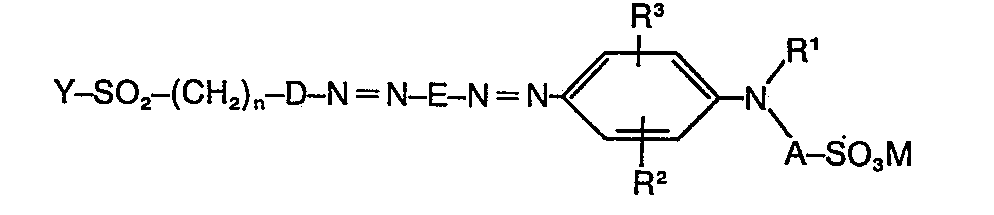
Wasserlösliche Disazoverbindungen, die als faserreaktive Farbstoffe verwendbar sind und der allgemeinen Formel (1)
- Y ist die Vinylgruppe oder eine Gruppe der Formel -CH2-CH2-Z, in welcher Z einen organischen oder anorganischen, alkalisch eliminierbaren Rest oder die Hydroxygruppe bedeutet;
- n steht für die Zahl Null, 1 oder 2;
- D ist der Phenylrest, der durch niederes Alkyl, niederes Alkoxy, Hydroxy, niederes Alkanoylamino, Benzoylamino, Chlor, Brom, Fluor, Carboxy, Nitro und Sulfo substituiert sein kann, oder ist der Naphthylenrest, der durch niederes Alkyl, niederes Alkoxy, Hydroxy, niederes Alkanoylamino, Benzoylamino, Chlor, Brom, Fluor, Carboxy, Sulfo und Nitro substituiert sein kann, oder ist der Benzthiazol-2-yl-Rest, der durch niederes Alkyl, niederes Alkoxy, Hydroxy, niederes Alkanoylamino, Benzoylamino, Nitro, Chlor, Brom und Sulfo substituiert sein kann;
- E ist der 1,4-Phenylen- oder der 1,4-Naphthylenrest, die beide durch niederes Alkyl, niederes Alkoxy, Hydroxy, Ureido, niederes Alkanoylamino, einen Benzoylaminorest, einen Benzolsulfonylaminorest, Chlor, Brom, Carboxy und Sulfo substituiert sein können;
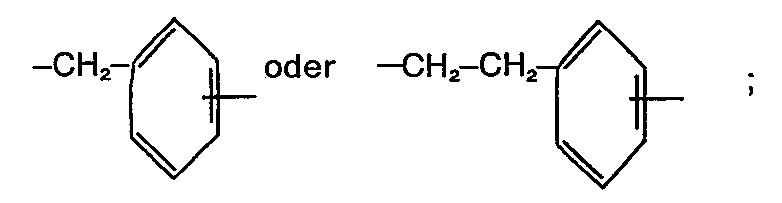
- A ist der Äthylenrest oder Äthylenoxyrest oder ein Propylenrest oder ein durch eine Hydroxygruppe oder eine Acyloxygruppe einer niederen Alkancarbonsäure oder ein Halogenatom oder die Sulfatogruppe oder Phosphatogruppe substituierter Propylenrest oder ein Rest der Formel
- M ist ein Wasserstoffatom oder das Äquivalent eines Metalls;
- R' ist ein Wasserstoffatom, eine niedere Alkylgruppe, eine niedere Alkenylgruppe oder eine niedere durch einen Phenylrest und/oder Hydroxy substituierte Alkylgruppe oder eine mit einer Säure veresterte Hydroxyalkylgruppe mit 2 bis 4 C-Atomen in diesem Alkylrest oder eine Cyanalkylgruppe mit 2 bis 4 C-Atomen im Alkylrest, eine Carb-(Fortsetzung nächste Seite) oxy-, Carbonamido- oder Carbalkoxyalkylengruppe mit jeweils 1 bis 4 C-Atomen in dem Alkyl- bzw. Alkylenrest, eine Halogenalkylgruppe mit 2 oder 3 C-Atomen, eine niedere Halogenalkenylgruppe oder eine Gruppe der obenstehend definierten Formel -A-SO3M;
- R2 ist ein Wasserstoffatom, eine niedere Alkylgruppe, eine niedere Alkoxygruppe, die durch Hydroxy, Acetoxy, Carboxy, Carbonamid, Cyan oder Halogen substituiert sein kann, oder ein Halogenatom oder eine Trifluormethylgruppe;
- R3 ist ein Wasserstoffatom, eine niedere Alkylgruppe, eine niedere Alkoxygruppe, die durch Hydroxy, Acetoxy, Carboxy, Carbonamid, Cyan oder Halogen substituiert sein kann, oder ein Halogenatom.
- Y is the vinyl group or a group of the formula -CH 2 -CH 2 -Z, in which Z represents an organic or inorganic, alkali-eliminable radical or the hydroxyl group;
- n stands for the number zero, 1 or 2;
- D is the phenyl radical which can be substituted by lower alkyl, lower alkoxy, hydroxy, lower alkanoylamino, benzoylamino, chlorine, bromine, fluorine, carboxy, nitro and sulfo, or is the naphthylene radical which is substituted by lower alkyl, lower alkoxy, hydroxy, lower alkanoylamino, benzoylamino, chlorine, bromine, fluorine, carboxy, sulfo and nitro may be substituted, or is the benzthiazol-2-yl radical which is substituted by lower alkyl, lower alkoxy, hydroxy, lower alkanoylamino, benzoylamino, nitro, chlorine, Bromine and sulfo may be substituted;
- E is 1,4-phenylene or 1,4-naphthylene, both of which may be substituted by lower alkyl, lower alkoxy, hydroxy, ureido, lower alkanoylamino, a benzoylamino group, a benzenesulfonylamino group, chlorine, bromine, carboxy and sulfo;
- A is the ethylene radical or ethyleneoxy radical or a propylene radical or a propylene radical substituted by a hydroxyl group or an acyloxy group of a lower alkane carboxylic acid or a halogen atom or the sulfato group or phosphato group or a radical of the formula
- M is a hydrogen atom or the equivalent of a metal;
- R 'is a hydrogen atom, a lower alkyl group, a lower alkenyl group or a lower alkyl group substituted by a phenyl radical and / or hydroxy or a hydroxyalkyl group esterified with an acid having 2 to 4 C atoms in this alkyl radical or a cyanoalkyl group having 2 to 4 C -Atoms in the alkyl radical, a carb- (continued on next page) oxy, carbonamido or carbalkoxyalkylene groups each having 1 to 4 carbon atoms in the alkyl or alkylene radical, a haloalkyl group having 2 or 3 carbon atoms, a lower haloalkenyl group or a group of the formula -A-SO 3 M defined above;
- R 2 is a hydrogen atom, a lower alkyl group, a lower alkoxy group which may be substituted by hydroxy, acetoxy, carboxy, carbonamide, cyano or halogen, or a halogen atom or a trifluoromethyl group;
- R 3 is a hydrogen atom, a lower alkyl group, a lower alkoxy group which may be substituted by hydroxy, acetoxy, carboxy, carbonamide, cyano or halogen, or a halogen atom.
Diese Diazoverbindungen lassen sich in an und für sich bekannter Weise durch Umsetzung der aus der Formel (1) ersichtlichen Diazo- und Kupplungskomponenten herstellen. Sie dienen als Farbstoffe zum Färben und Bedrucken von hydroxy- und/oder carbonamidgruppenhaltigen Fasern, wie Cellulosefasern, Wolle oder synthetischen Polyamidfasern oder von Leder. Auf diesen Materialien liefern sie, insbesondere nach den Applikations- und Fixiermethoden für faserreaktive Farbstoffe, farbstarke Färbungen mit guten Echtheitseigenschaften.These diazo compounds can be prepared in a manner known per se by reacting the diazo and coupling components evident from the formula (1). They serve as dyes for dyeing and printing fibers containing hydroxyl and / or carbonamide groups, such as cellulose fibers, wool or synthetic polyamide fibers or leather. On these materials, especially in accordance with the application and fixing methods for fiber-reactive dyes, they provide strong colorations with good fastness properties.
Description
Die vorliegende Erfindung liegt auf dem technischen Gebiet der wasserlöslichen Disazofarbstoffe, die faserreaktive Eigenschaften besitzen. Sie betrifft neue wasserlösliche Disazoverbindungen der allgemeinen Formel (1)

- Y ist die Vinylgruppe oder eine Gruppe der Formel -CH2-CH2-Z, in welcher Z einen organischen oder anorganischen, alkalisch eliminierbaren Rest oder die Hydroxygruppe bedeutet;
- n steht für die Zahl Null, 1 oder 2;
- D ist der Phenylenrest, der durch einen oder zwei Substituenten aus der Gruppe niederes Alkyl, niederes Alkoxy, Hydroxy, niederes Alkanoylamino, Benzoylamino, Chlor, Brom, Fluor und.Carboxy und/oder durch eine Nitrogruppe und/oder durch eine Sulfogruppe substituiert sein kann, oder
- D ist ein Naphthylenrest, der durch einen oder zwei Substituenten aus der Gruppe niederes Alkyl, niederes Alkoxy, Hydroxy, niederes Alkanoylamino, Benzoylamino, Chlor, Brom, Fluor, Carboxy und Sulfo und/oder durch eine Nitrogruppe substituiert sein kann, oder
- D ist der Benzthiazol-2-yl-Rest, der im carbocyclischen Ring die angegebene Gruppe der Formel Y-SO2-(CH2)n gebunden enthält und in diesem Benzolkern weiterhin durch einen Substituenten aus der Gruppe niederes Alkyl, niederes Alkoxy, Hydroxy, niederes Alkanoylamino, Benzoylamino, Nitro, Chlor, Brom und Sulfo substituiert sein kann;
- E ist der 1,4-Phenylen- oder der 1,4-Naphthylenrest, die beide durch einen oder zwei Substituenten aus der Gruppe niederes Alkyl, niederes Alkoxy, Hydroxy, Ureido, niederes Alkanoylamino, Benzoylamino, Benzolsulfonylamino, durch niederes Alkyl, niederes Alkoxy, Chlor und/oder Sulfo substituiertes Benzoylamino, durch niederes Alkyl, niederes Alkoxy, Chlor und/oder Sulfo substituiertes Benzolsulfonylamino, Chlor, Brom, Carboxy und Sulfo substituiert sein kann;
- A ist der Äthylenrest der Formel -CH2-CH2- oder der Äthylenoxyrest der Formel -CH2-CH2-O- oder ein Propylenrest der Formel


- M ist ein Wasserstoffatom oder das Äquivalent eines Metalls, vorzugsweise eines Alkalimetalls oder eines Erdalkalimetalls, wie insbesondere des Natriums, Kaliums oder Calciums;
- R1 ist ein Wasserstoffatom, eine niedere Alkylgruppe, eine niedere.Alkenylgruppe oder eine niedere, durch Phenyl und/oder Hydroxy substituierte Alkylgruppe, wobei der Phenylrest durch Methyl, Methoxy und/oder Chlor substituiert sein kann, wie insbesondere die Benzyl- oder Phenäthylgruppe und eine Hydroxyalkylgruppe mit 2 bis 4 C-Atomen, oder ist eine mit einer Säure veresterte Hydroxyalkylgruppe mit 2 bis 4 C-Atomen in diesem Alkylrest, wie bspw. Phenylsulfonyloxyalkyl- oder niedere Alkanoyloxy-alkyl-Gruppe, wie eine Acetoxyalkyl- oder Pro- pionyloxyalkyl-Gruppe,oder eine Cyanalkylgruppe mit 2 bis 4 C-Atomen im Alkylrest, eine Carboxy-, Carbonamido-oder Carbalkoxyalkylengruppe mit jeweils 1 bis 4 C-Atomen in dem Alkyl- bzw. Alkylenrest, eine Halogenalkylgruppe mit 2 bis 4, bevorzugt 2 oder 3 C-Atomen, bevorzugt eine Chloralkylgruppe, oder eine niedere Halogenalkenylgruppe, in welcher das Halogen bevorzugt Chlor oder Brom ist, oder ist eine Gruppe der obenstehend definierten Formel -A-S0 3 M;
- R2 ist ein Wasserstoffatom, eine niedere Alkylgruppe, bevorzugt hiervon eine Methylgruppe, oder eine niedere Alkoxygruppe, die durch Hydroxy, Acetoxy, Carboxy, Carbonamid, Cyan oder Halogen, wie Chlor und Brom, substituiert sein kann, oder ein Halogenatom, wie ein Chlor-, Brom- oder Fluoratom, oder eine niedere Alkanoylamino-, wie Acetylamino-, eine Benzoylamino-, Ureido- oder Trifluormethylgruppe;
- R3 ist ein Wasserstoffatom, eine niedere Alkylgruppe, bevorzugt hiervon eine Methylgruppe, oder eine niedere Alkoxygruppe, die durch Hydroxy, Acetoxy, Carboxy, Carbonamid, Cyan oder Halogen, wie Chlor oder Brom, substituiert sein kann, oder ist ein Halogenatom, wie Chlor-, Brom- oder Fluoratom.
- Y is the vinyl group or a group of the formula -CH 2 -CH 2 -Z, in which Z represents an organic or inorganic, alkali-eliminable radical or the hydroxyl group;
- n stands for the number zero, 1 or 2;
- D is the phenylene radical which can be substituted by one or two substituents from the group lower alkyl, lower alkoxy, hydroxy, lower alkanoylamino, benzoylamino, chlorine, bromine, fluorine and carboxy and / or by a nitro group and / or by a sulfo group , or
- D is a naphthylene radical which can be substituted by one or two substituents from the group consisting of lower alkyl, lower alkoxy, hydroxy, lower alkanoylamino, benzoylamino, chlorine, bromine, fluorine, carboxy and sulfo and / or by a nitro group, or
- D is the benzothiazol-2-yl radical which contains the group of the formula Y-SO 2 - (CH 2 ) n bound in the carbocyclic ring and in this benzene nucleus furthermore by a substituent from the group lower alkyl, lower alkoxy, hydroxy , lower alkanoylamino, Benzoylamino, nitro, chlorine, bromine and sulfo can be substituted;
- E is the 1,4-phenylene or the 1,4-naphthylene radical, both by one or two substituents from the group lower alkyl, lower alkoxy, hydroxy, ureido, lower alkanoylamino, benzoylamino, benzenesulfonylamino, by lower alkyl, lower alkoxy , Chlorine and / or sulfo substituted benzoylamino, substituted by lower alkyl, lower alkoxy, chlorine and / or sulfo substituted benzenesulfonylamino, chlorine, bromine, carboxy and sulfo;
- A is the ethylene radical of the formula -CH 2 -CH 2 - or the ethyleneoxy radical of the formula -CH2-CH2-O- or a propylene radical of the formula
- M is a hydrogen atom or the equivalent of a metal, preferably an alkali metal or an alkaline earth metal, such as especially sodium, potassium or calcium;
- R 1 is a hydrogen atom, a lower alkyl group, a lower alkenyl group or a lower alkyl group substituted by phenyl and / or hydroxy, where the phenyl radical can be substituted by methyl, methoxy and / or chlorine, such as in particular the benzyl or phenethyl group and a hydroxyalkyl group with 2 to 4 carbon atoms, or is an acid-esterified hydroxyalkyl group with 2 to 4 carbon atoms in this alkyl radical, such as, for example, phenylsulfonyloxyalkyl or lower alkanoyloxyalkyl group, such as an acetoxyalkyl or propionyloxyalkyl group, or a cyanoalkyl group having 2 to 4 carbon atoms in the alkyl radical, a carboxy, carbonamido or carbalkoxyalkylene group each having 1 up to 4 carbon atoms in the alkyl or alkylene radical, a haloalkyl group with 2 to 4, preferably 2 or 3 carbon atoms, preferably a chloroalkyl group, or a lower haloalkenyl group in which the halogen is preferably chlorine or bromine, or is one Group of the formula defined above -AS 0 3 M;
- R 2 is a hydrogen atom, a lower alkyl group, preferably a methyl group, or a lower alkoxy group, which can be substituted by hydroxy, acetoxy, carboxy, carbonamide, cyano or halogen, such as chlorine and bromine, or a halogen atom, such as chlorine -, Bromine or fluorine atom, or a lower alkanoylamino, such as acetylamino, a benzoylamino, ureido or trifluoromethyl group;
- R 3 is a hydrogen atom, a lower alkyl group, preferably a methyl group, or a lower alkoxy group, which may be substituted by hydroxy, acetoxy, carboxy, carbonamide, cyano or halogen, such as chlorine or bromine, or is a halogen atom, such as chlorine -, bromine or fluorine atom.
Die Formelglieder R 2 und R3 können zueinander gleiche oder voneinander verschiedene Bedeutungen besitzen.The formula members R 2 and R 3 may have meanings which are the same or different from one another.
Die Angaben "niedere" bedeuten hier wie im folgenden, daß der in der Gruppe enthaltene Alkyl- oder Alkylen- oder Alkenylrest aus 1 bis 6 bzw. 2 bis 6 C-Atomen, bevorzugt aus 1 bis 4 bzw. 2 bis 4 C-Atomen, besteht.The terms "lower" here, as in the following, mean that the alkyl or alkylene or alkenyl radical contained in the group has 1 to 6 or 2 to 6 C atoms, preferably 1 to 4 or 2 to 4 C atoms , consists.
Alkalisch eliminierbare Gruppen Z sind beispielsweise Halogenatome, wie das Chlor-, Brom- oder Fluoratom, Estergruppen organischer Carbon- und Sulfonsäuren, wie ein niederer Alkanoyloxyrest, beispielsweise der Acetoxyrest, oder ein Acyloxyrest einer aromatischen Carbon- oder Sulfonsäure, wie der Benzoyloxy-, Sulfobenzoyloxy-, Benzolsulfonyloxy- oder Toluolsulfonyloxyrest, des weiteren die niederen Alkylsulfonylamino- und Arylsulfonylaminogruppen, die Phenoxygruppe, die Dialkylaminogruppen mit Alkylgruppen von jeweils 1 bis 4 C-Atomen, wie die Dimethylamino- oder Diäthylaminogruppe, sowie die Monoestergruppen, beispielsweise der Thioschwefelsäure, der Phosphorsäure und insbesondere der Schwefelsäure.Alkaline eliminable groups Z are, for example, halogen atoms such as the chlorine, bromine or fluorine atom, ester groups of organic carboxylic and sulfonic acids, such as lower alkanoyloxy, for example the acetoxy, or an acyloxy of an aromatic carbon or sulfonic acid such as the benzoyloxy, sulfobenzoyloxy, benzenesulfonyloxy or toluenesulfonyloxy, further the lower alkylsulfonylamino and arylsulfonylamino groups, the phenoxy group, the phenoxy group 4 carbon atoms, such as the dimethylamino or diethylamino group, and the monoester groups, for example thiosulfuric acid, phosphoric acid and in particular sulfuric acid.
Die neuen Disazoverbindungen können sowohl in Form der freien Säure als auch in Form ihrer Salze vorliegen.Bevorzugt sind sie in Form der Salze, insbesondere der Alkali-und Erdalkalimetallsalze, hiervon insbesondere als Natrium-, Kalium- und auch Calciumsalze. Sie finden bevorzugt in Form dieser Salze Verwendung als Farbstoffe zum Färben und Bedrucken von hydroxy- und/oder carbonamidgruppenhaltigen Fasern oder von Leder.The new disazo compounds can be present both in the form of the free acid and in the form of their salts. They are preferred in the form of the salts, in particular the alkali and alkaline earth metal salts, of which in particular as the sodium, potassium and also calcium salts. They are preferably used in the form of these salts as dyes for dyeing and printing fibers containing hydroxyl and / or carbonamide groups or leather.
Die vorliegende Erfindung betrifft weiterhin ein Verfahren zur Herstellung der obengenannten und definierten Disazoverbindungen der allgemeinen Formel (1). Dieses Verfahren ist dadurch gekennzeichnet, daß man eine Verbindung der allgemeinen Formel (2)


Geeignete Sulfatierungsmittel sind beispielsweise 90 bis 100 %ige Schwefelsäure, Chlorsulfonsäure, Amidosulfonsäure oder andere schwefeltrioxidabgebende Verbindungen. Geeignete Phosphatierungsmittel sind beispielsweise konzentrierte Phosphorsäure, Pyrophosphorsäure, Metaphosphorsäure oder Polyphosphorsäure, weiterhin Polyphosphorsäurealkylester, Phosphoroxychlorid oder Gemische aus Phosphorsäure und Phosphor(V)-oxid.Suitable sulfating agents are, for example, 90 to 100% sulfuric acid, chlorosulfonic acid, amidosulfonic acid or other compounds which donate sulfur trioxide. Suitable phosphating agents are, for example, concentrated phosphoric acid, pyrophosphoric acid, metaphosphoric acid or polyphosphoric acid, furthermore polyphosphoric acid alkyl esters, phosphorus oxychloride or mixtures of phosphoric acid and phosphorus (V) oxide.
Die Aminoazoverbindungen der allgemeinen Formel (2) lassen sich in an und für sich bekannter Weise durch Kupplung eines diazotierten Amins der allgemeinen Formel (4)


Aromatische Amine der allgemeinen Formel (4), die als Diazokomponenten zur Herstellung der erfindungsgemäßen Verbindungen dienen, sind beispielsweise insbesondere folgende:
- 4-ß-Sulfatoäthylsulfonyl-anilin, 4-ß-Chloräthylsulfonylanilin, 4-ß-Phosphatoäthylsulfonyl-anilin, 4-Vinylsulfonylanilin, 4-ß-Thiosulfatoäthylsulfonyl-anilin, 2-Sulfo-4-ß-sulfatoäthylsulfonyl-anilin, 2-Brom-4-ß-sulfatoäthylsulfonyl-anilin, 2-Chlor-4-ß-sulfatoäthylsulfonyl-anilin, 2-Chlor-5-ß-chloräthylsulfonyl-anilin, 3-ß-Sulfatoäthylsulfonylanilin, 2-Brom-5-ß-sulfatoäthylsulfonyl-anilin, 2,6-Dichlor-4-ß-sulfatoäthylsulfonyl-anilin, 2,6-Dibrom-4- ß-sulfatoäthylsulfonyl-anilin, 2,5-Dichlor-4-ß-sulfatoäthylsulfonyl-anilin, 2-Methyl-5-ß-sulfatoäthylsulfonyl-anilin, 2-Methoxy-5-ß-sulfatoäthylsulfonyl-anilin, 2-Methoxy-4-ß-sulfatoäthylsulfonyl-anilin, 2-Methyl-6-chlor-4-ß-sulfatoäthylsulfonyl-anilin, 2,6-Dimethyl-4-ß-sulfatoäthylsulfonyl-anilin, 2,6-Dimethyl-3-ß-sulfatoäthylsulfonyl-anilin, 2,5-Dimethoxy-4-ß-sulfatoäthylsulfonyl-anilin, 2-Methoxy-5-methyl-4-ß-sulfatoäthylsulfonyl-anilin, 2-Nitro-4-ß-sulfatoäthylsulfonyl-anilin, 4-Nitro-2-ß-sulfatoäthylsulfonyl-anilin, 6-ß-Sulfatoäthylsulfonyl-2-naphthyl-amin, 1-Sulfo-6-ß-sulfatoäthylsulfonyl-2-naphthylamin, 8-ß-Sulfatoäthylsulfonyl-2-naphthylamin, 6-Sulfo-8-ß-sulfatoäthylsulfonyl-2-naphthylamin, 6-Vinylsulfonyl-2-aminobenzthia- zol, 6-ß-Sulfatoäthylsulfonyl-2-aminobenzthiazol, 4-ω-(β-Sulfatoäthylsulfonyl) -tolylamin, 3- ω-(β-Sulfatoäthylsulfonyl) -tolylamin, 6-Methoxy-3-ω-(β-sulfatoäthylsulfonyl) - tolylamin, 4-Methoxy-3-ω-(β-sulfatoäthylsulfonyl)-tolyl- amin, 4-ω-(β-Sulfatoäthylsulfonyl)-äthyl-anilin, 3-ω-(β-Sulfatoäthylsulfonyli-äthyl-anilin, 5-(ß-Sulfatoäthylsulfonyl-methyl)-1-naphthylamin und deren ß-Hydroxyäthylsulfonyl-Abkömmlinge.
- 4-ß-sulfatoethylsulfonyl-aniline, 4-ß-chloroethylsulfonylaniline, 4-ß-phosphatoethylsulfonyl-aniline, 4-vinylsulfonylaniline, 4-ß-thiosulfatoethylsulfonyl-aniline, 2-sulfo-4-ßsulfonyl-sulfatoethyl 4-ß-sulfatoethylsulfonyl-aniline, 2-chloro-4-ß-sulfatoethylsulfonyl-aniline, 2-chloro-5-ß-chloroethylsulfonyl-aniline, 3-ß-sulfatoethylsulfonylaniline, 2-bromo-5-ß-sulfatoethylsulfonyl-aniline 2,6-dichloro-4-ß-sulfatoethylsulfonyl-aniline, 2,6-dibromo-4- ß-sulfatoethylsulfonyl-aniline, 2,5-dichloro-4-ß-sulfatoethylsulfonyl-aniline, 2-methyl-5-ß- sulfatoethylsulfonyl aniline, 2-methoxy-5-ß-sulfatoethylsulfonyl aniline, 2-methoxy-4-ß-sulfatoethylsulfonyl aniline, 2-methyl-6-chloro-4-ß-sulfatoethylsulfonyl aniline, 2,6-dimethyl 4-ß-sulfatoethylsulfonyl-aniline, 2,6-dimethyl-3-ß-sulfatoethylsulfonyl-aniline, 2,5-dimethoxy-4-ß-sulfatoethylsulfonyl-aniline, 2-methoxy-5-methyl-4-ß-sulfatoethylsulfonyl- aniline, 2-nitro-4-ß-sulfatoethylsulfonyl-aniline, 4-nitro-2-ß-sulfatoethylsulfonyl-aniline, 6-ß-sulfatoethylsulfony l-2-naphthylamine, 1-sulfo-6-ß-sulfatoethylsulfonyl-2-naphthylamine, 8-ß-sulfatoethylsulfonyl-2-naphthylamine, 6-sulfo-8-ß-sulfatoethylsulfonyl-2-naphthylamine, 6-vinylsulfonyl- 2-aminobenzthiazole, 6-ß-sulfatoethylsulfonyl-2-aminobenzothiazole, 4-ω- (β-sulfatoethylsulfonyl) tolylamine, 3- ω- (β-sulfatoethylsulfonyl) tolylamine, 6-methoxy-3-ω- (β -sulfatoethylsulfonyl) tolylamine, 4-methoxy-3-ω- (β-sulfatoethylsulfonyl) -tolyl-amine, 4-ω- (β-sulfatoethylsulfonyl) ethyl-aniline, 3-ω- (β-sulfatoethylsulfonyli-ethyl-aniline , 5- (ß-sulfatoethylsulfonyl-methyl) -1-naphthylamine and their ß-hydroxyethylsul fonyl descendants.
Die Verbindungen der Formel (4) sind bekannt und lassen sich in der in der Literatur vielfach beschriebenen Weise herstellen. Beispielsweise erhält man die bevorzugten Verbindungen der Formel (4) mit einer ß-Sulfatoäthylsulfonyl- - gruppe aus den entsprechenden ß-Hydroxyäthylsulfonyl-Verbindungen durch Veresterung, beispielsweise durch wasserhaltige oder konzentrierte Schwefelsäure oder mittels Amidosulfonsäure, wie beispielsweise durch Eintragen der entsprechenden ß-Hydroxyäthylsulfonyl-aniline und -naphthylamine in eine äquimolare Menge 60 %iger Schwefelsäure und anschließendes Erhitzen in analoger Weise zu dem in der deutschen Patentschrift 1 150 163 beschriebenen Verfahren oder . beispielsweise durch Lösen der ß-Hydroxyäthylsulfonylaniline oder -naphthylamine in überschüssiger konzentrierter Schwefelsäure oder 100 %iger Schwefelsäure (Monohydrat) bei Raumtemperatur oder durch Umsetzung mit Amidosulfonsäure in Anwesenheit von Pyridin oder einer Pyridinbase in analoger Weise zu den in der deutschen Patentschrift 1 443 877 beschriebenen Veresterungsverfahren. Die so hergestellten ß-Sulfatoäthylsulfonyl-aniline und -naphthylamine können für den Einsatz im erfindungsgemäßen Verfahren auch in nicht isolierter Form in Form des aus der Veresterung anfallenden Reaktionsgemisches verwendet werden.The compounds of the formula (4) are known and can be prepared in the manner described many times in the literature. For example, the preferred compounds of the formula (4) having a β-sulfatoethylsulfonyl group are obtained from the corresponding β-hydroxyethylsulfonyl compounds by esterification, for example by means of aqueous or concentrated sulfuric acid or by means of amidosulfonic acid, for example by entering the corresponding β-hydroxyethylsulfonyl anilines and -naphthylamines in an equimolar amount of 60% sulfuric acid and subsequent heating in an analogous manner to the method described in German Patent 1,150,163 or. for example by dissolving the ß-hydroxyethylsulfonylaniline or naphthylamine in excess concentrated sulfuric acid or 100% sulfuric acid (monohydrate) at room temperature or by reaction with amidosulfonic acid in the presence of pyridine or a pyridine base in an analogous manner to the esterification process described in German patent 1,443,877 . The β-sulfatoethylsulfonyl-anilines and -naphthylamines thus produced can also be used in the form of the reaction mixture resulting from the esterification for use in the process according to the invention.
Aromatische Amine der allgemeinen Formel (5), die als Kupplungskomponenten zur Herstellung der Aminoazoverbindungen der allgemeinen Formel (2) dienen, sind ebenfalls allgemein bekannt. Von ihnen sind bevorzugt zu nennen: Anilin, o-Toluidin, m-Toluidin, o-Anisidin, m-Anisidin, Anthranilsäure, Kresidin, 2,5-Xylidin, 2,5-Dimethoxy-anilin, 3-Aminoacetanilid, 3-Amino-acetanilid-4-carbonsäure, 3-Amino- acetanilid-4-sulfonsäure, 3-Aminophenylharnstoff, 3-Aminophenylharnstoff-4-sulfonsäure, 1-Napthylamin-6-sulfonsäure, 1-Naphthylamin-7-sulfonsäure und 2-Äthoxy-1-naphthylamin-6-sulfonsäure.Aromatic amines of the general formula (5), which serve as coupling components for the preparation of the aminoazo compounds of the general formula (2), are also generally known. The following should preferably be mentioned: aniline, o-toluidine, m-toluidine, o-anisidine, m-anisidine, anthranilic acid, cresidine, 2,5-xylidine, 2,5-dimethoxy-aniline, 3-aminoacetanilide, 3-amino acetanilide-4-carboxylic acid, 3-amino-acetanilide-4-sulfonic acid, 3-aminophenylurea, 3-aminophenylurea-4-sulfonic acid, 1-naphthylamine-6-sulfonic acid, 1-naphthylamine-7-sulfonic acid and 2-ethoxy-1-naphthylamine-6-sulfonic acid.
Bevorzugt ist in der allgemeinen Formel (1) der Formelrest R1 ein Wasserstoffatom oder eine Alkylgruppe von 2, 3 oder 4 C-Atomen, die durch einen Phenylrest, eine Hydroxy-, niedere Alkanoyloxy-, Cyan- oder Carbonamidgruppe oder ein Chloratom substituiert sein kann; weiterhin ist R1 bevorzugt die oben definierte Gruppe der Formel -A-S03M. Der Formelrest R2 ist bevorzugt ein Wasserstoffatom oder eine Methyl- oder Äthylgruppe, eine Methoxy-oder Äthoxygruppe, die beide durch eine Hydroxy-, Acetoxy-, Carboxy-, Carbonamid- oder eine Cyangruppe oder ein Chloratom substituiert sein können; weiterhin ist R2 bevorzugt ein Chlor- oder Bromatom, insbesondere hiervon ein Chloratom. Ebenso steht R3 bevorzugt für ein Wasserstoffatom oder eine Methyl- oder Äthylgruppe, eine Methoxy- oder Äthoxygruppe, die beide durch eine Hydroxy-, Acetoxy-, Carboxy-, Carbonamid- oder Cyangruppe oder ein Chloratom substituiert sein können; weiterhin ist R3 bevorzugt ein Chlor- oder Bromatom, insbesondere hiervon ein Chloratom.In the general formula (1), the formula radical R 1 is preferably a hydrogen atom or an alkyl group of 2, 3 or 4 carbon atoms which are substituted by a phenyl radical, a hydroxyl, lower alkanoyloxy, cyano or carbonamide group or a chlorine atom can; furthermore R 1 is preferably the group of the formula -A-S0 3 M defined above. The formula radical R 2 is preferably a hydrogen atom or a methyl or ethyl group, a methoxy or ethoxy group, both of which are hydroxyl, acetoxy or carboxy -, carbonamide or a cyano group or a chlorine atom may be substituted; furthermore, R 2 is preferably a chlorine or bromine atom, in particular a chlorine atom thereof. Likewise, R 3 preferably represents a hydrogen atom or a methyl or ethyl group, a methoxy or ethoxy group, both of which can be substituted by a hydroxyl, acetoxy, carboxy, carbonamide or cyano group or a chlorine atom; furthermore R 3 is preferably a chlorine or bromine atom, in particular a chlorine atom thereof.
Von den erfindungsgemäßen Verbindungen der allgemeinen Formel (1) sind insbesondere diejenigen bevorzugt, für die der Formelrest D den 1,4-Phenylenrest oder den 1,4-Naphthylenrest bedeutet, die beide durch einen oder zwei Substituenten aus der Gruppe Methyl, Methoxy, Hydroxy, Chlor, Brom, Carboxy und Sulfo substituiert sein können.Of the compounds of the general formula (1) according to the invention, those are particularly preferred for which the formula radical D denotes the 1,4-phenylene radical or the 1,4-naphthylene radical, both by one or two substituents from the group methyl, methoxy, hydroxy , Chlorine, bromine, carboxy and sulfo can be substituted.
Ebenso bevorzugt sind erfindungsgemäße Verbindungen der allgemeinen Formel (1), in welcher E den 1,4-Phenylenrest bedeutet, der durch eine oder zwei niedere Alkylgruppen, wie insbesondere die Methyl- oder Äthylgruppe, durch eine oder zwei niedere Alkoxygruppen, wie insbesondere die Methoxy- und Äthoxygruppe, durch eine Carboxygruppe oder durch eine niedere Alkanoylaminogruppe, wie die Acetylamino- oder Propionylaminogruppe, oder durch eine Ureidogruppe oder durch eine niedere Alkanoylaminogruppe und eine Sulfogruppe oder durch eine Ureidogruppe und eine Sulfogruppe substituiert sein kann, oder in welcher E den 1,4-Naphthylenrest bedeutet, der durch eine Sulfogruppe oder durch eine niedere Alkoxygruppe, wie beispielsweise die Methoxy- und insbesondere Äthoxygruppe,und eine Sulfogruppe substituiert ist.Compounds according to the invention are also preferred general formula (1), in which E represents the 1,4-phenylene radical, which is substituted by one or two lower alkyl groups, such as in particular the methyl or ethyl group, by one or two lower alkoxy groups, such as in particular the methoxy and ethoxy group Carboxy group or by a lower alkanoylamino group, such as the acetylamino or propionylamino group, or by an ureido group or by a lower alkanoylamino group and a sulfo group or by an ureido group and a sulfo group, or in which E is the 1,4-naphthylene radical, which is is substituted by a sulfo group or by a lower alkoxy group, such as, for example, the methoxy and in particular ethoxy group, and a sulfo group.
Die zur Synthese der Verbindungen der allgemeinen Formel (1) als Kupplungskomponenten verwendeten Sulfoalkylaniline der allgemeinen Formel (3) können in bekannter Weise hergestellt werden, so beispielsweise nach den aus den Deutschen Offenlegungsschriften 1 481 831 und 1 493 636 bekannten Verfahrensweisen, weiterhin nach den Methoden, die in R.B. Wagner und H.D. Zock, Synthetic Organic Chemistry, John Wiley u. Sons, Inc., New York, 1953, Seiten 812-819, beschrieben sind, des weiteren durch.Umsetzung von α,α-Dichlorhydrin mit Natriumsulfit gemäß DE-PS 258 473 und Kondensation dieses Reaktionsproduktes mit einem aromatischen Amin, wie bspw. nach der Reaktionsgleichung


ß-Sulfoäthylanilin-Derivate lassen sich auch durch Umsetzung von β-Chloräthansulfonsäure bzw. deren Salzen mit aromatischen Aminen herstellen, beispielsweise nach der von J.W. James in Journ. prakt. Chem. [2] 31, 413 (1885) beschriebenen Methode. Sie sind aber auch in sehr guter Reinheit beispielsweise durch Addition von Vinylsulfonylfluorid an Anilinderivate und nachfolgende alkalische Hydrolyse der Sulfofluorid-Gruppe herstellbar.β-sulfoethyl aniline derivatives can also be prepared by reacting β-chloroethanesulfonic acid or its salts with aromatic amines, for example according to the method described by J.W. James in Journ. Prakt. Chem. [2] 31, 413 (1885). However, they can also be produced in very good purity, for example by adding vinylsulfonyl fluoride to aniline derivatives and subsequent alkaline hydrolysis of the sulfofluoride group.
Die Kupplungskomponenten der Formel (3), die eine ß-Sulfato- äthylaminogruppe enthalten, können beispielsweise nach den von K.H. Saunders, J. Chem. Soc. (London) 121, 2667-2675 (1922), beschriebenen Methoden hergestellt werden. Des weiteren lassen sie sich durch Veresterung ihrer ß-Hydroxyäthyl-anilin-Abkömmlinge herstellen, beispielsweise durch Umsetzung mit Schwefelsäure, so in 100 %iger Schwefelsäure in Gegenwart von Chlorsulfonsäure oder in Schwefeltrioxid enthaltender Schwefelsäure (Oleum). Die so veresterten Kupplungskomponenten der Formel (3) können zum Einsatz des erfindungsgemäßen Verfahrens auch in nicht-isolierter Form in Form des aus der Veresterung resultierenden Reaktionsgemisches verwendet werden.The coupling components of formula (3) which contain a β-sulfato-ethylamino group can, for example, according to the by K.H. Saunders, J. Chem. Soc. (London) 121, 2667-2675 (1922). Furthermore, they can be prepared by esterifying their β-hydroxyethyl aniline derivatives, for example by reaction with sulfuric acid, for example in 100% sulfuric acid in the presence of chlorosulfonic acid or sulfuric acid (oleum) containing sulfur trioxide. The coupling components of the formula (3) esterified in this way can also be used in non-isolated form in the form of the reaction mixture resulting from the esterification to use the process according to the invention.
Verbindungen der allgemeinen Formel (3), die als Kupplungskomponenten zur Herstellung der erfindungsgemäßen Verbindungen dienen, sind beispielsweise:
- N-ß-Sulfoäthyl-anilin, N-ß-Sulfoäthyl-2-chloranilin, N-ß-Sulfoäthyl-3-chloranilin, N-ß-Sulfoäthyl-2-methylanilin, N-ß-Sulfoäthyl-2-methoxyanilin, N-ß-Sulfoäthyl-2-methyl-5-chloranilin, N-ß-Sulfoäthyl-2-methoxy-5-chloranilin, N-ß-Sulfoäthyl-2-chlor-5-methoxyanilin, N-ß-Sulfoäthyl-2,5-dichloranilin, N-ß-Sulfoäthyl-N-methyl-anilin, N-ß-Sulfoäthyl-N-äthyl-anilin, N-ß-Sulfoäthyl-N-äthyl-3-methyl- anilin, N-ß-Sulfoäthyl-N-äthyl-3-chloranilin, N-ß-Sulfoäthyl-N-allyl-anilin, N-ß-Sulfoäthyl-N-benzyl-anilin, N-ß-Sulfoäthyl-N-phenäthyl-anilin, N-ß-Sulfoäthyl-N-ßcarbonamidoäthyl-anilin, N-ß-Sulfoäthyl-N-ß-carboxyäthylanilin, N-ß-Sulfoäthyl-N-ß-cyanäthyl-anilin, N-ß-Sulfoäthyl-N-ß-acetoxyäthyl-anilin, N-ß-Sulfoäthyl-N-ß-hydroxyäthyl-anilin, N-ß-Sulfoäthyl-N-äthyl-2-methoxy-5-chloranilin, N-ß-Sulfoäthyl-N-ß-hydroxyäthyl-2-methoxy-5-chloranilin, N-ß-Sulfoäthyl-N-ß-hydroxyäthyl-3-chloranilin, N-ß-Sulfoäthyl-N-ß-carboxyäthyl-3-chloranilin, N,N-Bis-(ß-sulfoäthyl)-anilin, N,N-Bis-(ß-sulfoäthyl)-3-methyl-anilin, N,N-Bis-(ß-sulfoäthyl)-3-chloranilin, N- δ-Sulfopropylanilin, N-δ-Sulfopropyl-3-chloranilin, N- δ--Sulfopropyl-2-methyl-5-chloranilin, N-(δ-Sulfo-β-hydroxypropyl)-2-methoxy-5-chloranilin, N-(f-Sulfo-ß-hydroxypropyl)-2- chloranilin, N-(γ-Sulfo-β-hydroxypropyl)-2,5-dichloranilin, N-(γ-Sulfo-β-hydroxypropyl)-N-äthylanilin, N-(γ-Sulfo-β-sulfatopropyl)-N-äthyl-3-methylanilin, N-(r-Sulfo-ß- sulfatopropyl)-N-ß-sulfatoäthyl-anilin, N-(γ-Sulfo-β-hydroxypropyl)-N-phenäthyl-anilin, N-(γ-Sulfo-β-hydroxypropyl)-N-(ß-hydroxyäthyl)-2-methoxy-5-chloranilin, N-(γ-Sulfo-β-hydroxypropyl)-anilin, N-(γ-Sulfo-ß-hydroxypropyl)-2-chlor-3-methyl-anilin, N-(γ-Sulfopropyl)-N-äthyl-3-methylanilin, N-(γ-Sulfo-ß-hydroxypropyl)-N-β-carboxyäthyl-3-chloranilin, N-(β-Sulfo-α-methyl-äthyl)-anilin, N-(β-Sulfo-α-methyl-äthyl)-2-methoxy-5-chloranilin, N,N-Bis-(r-sulfo-ß-hydroxypropyl)-3-chloranilin, N-(γ-Sulfopropyl)-2,5-dichloranilin, N-ß-Sulfatoäthylanilin, N-ß-Sulfatoäthyl-N-äthyl-anilin, N-ß-Sulfatoäthyl-N-methyl-anilin, N-ß-Sulfatoäthyl-N-n-butyl-anilin, N-ß-Sulfatoäthyl-N-äthyl-3-methyl-anilin, N-ß-Sulfatoäthyl-N-äthyl-3-chlor-anilin, N-ß-Sulfatoäthyl-N-ß-hydroxyäthyl-3-chloranilin, N,N-Di-ß-sulfatoäthyl-anilin, N,N-Di-ß-sulfatoäthyl-3-chlor-anilin, N-ß-Sulfatoäthyl-N-2-bromallyl- anilin, N-ß-Sulfatoäthyl-N-2-chlorallyl-anilin, N-ß-Sulfatoäthyl-N-benzyl-anilin, N-ß-Sulfatoäthyl-N-ß-carbonamido- äthyl-ani.lin, N-β-Sulfatoäthyl-N-β-carboxyäthyl-anilin, N-(4'-Sulfophenäthyl)-anilin, N-(ß-Cyanäthyl)-N-(41-sulfo- phenäthyl)--anilin, N-ß-Sulfatoäthyl-N-ß-carbäthoxyäthyl-anilin, N-ß-Sulfatoäthyl-N-ß-Cyanäthyl-anilin, N-ß-Sulfatoäthyl-N-ß-acetoxy- äthyl-anilin, N-ß-Sulfatoäthyl-N-ß-cyanäthyl-3-methyl-anilin, N-ß-Sulfatoäthyl-N-ß-hydroxyäthyl-anilin.
- N-ß-sulfoethyl-aniline, N-ß-sulfoethyl-2-chloroaniline, N-ß-sulfoethyl-3-chloroaniline, N-ß-sulfoethyl-2-methylaniline, N-ß-sulfoethyl-2-methoxyaniline, N- ß-sulfoethyl-2-methyl-5-chloroaniline, N-ß-sulfoethyl-2-methoxy-5-chloroaniline, N-ß-sulfoethyl-2-chloro-5-methoxyaniline, N-ß-sulfoethyl-2,5- dichloroaniline, N-ß-sulfoethyl-N-methyl-aniline, N-ß-sulfoethyl-N-ethyl-aniline, N-ß-sulfoethyl-N-ethyl-3-methyl-aniline, N-ß-sulfoethyl-N- ethyl 3-chloroaniline, N-ß-sulfo ethyl-N-allyl-aniline, N-ß-sulfoethyl-N-benzyl-aniline, N-ß-sulfoethyl-N-phenethyl-aniline, N-ß-sulfoethyl-N-ßcarbonamidoethyl-aniline, N-ß-sulfoethyl N-ß-carboxyethylaniline, N-ß-sulfoethyl-N-ß-cyanoethyl-aniline, N-ß-sulfoethyl-N-ß-acetoxyethyl-aniline, N-ß-sulfoethyl-N-ß-hydroxyethyl-aniline, N- ß-sulfoethyl-N-ethyl-2-methoxy-5-chloroaniline, N-ß-sulfoethyl-N-ß-hydroxyethyl-2-methoxy-5-chloroaniline, N-ß-sulfoethyl-N-ß-hydroxyethyl-3- chloraniline, N-ß-sulfoethyl-N-ß-carboxyethyl-3-chloroaniline, N, N-bis (ß-sulfoethyl) aniline, N, N-bis (ß-sulfoethyl) -3-methyl-aniline, N, N-bis (ß-sulfoethyl) -3-chloroaniline, N- δ-sulfopropylaniline, N-δ-sulfopropyl-3-chloroaniline, N- δ - sulfopropyl-2-methyl-5-chloroaniline, N- ( δ-sulfo-β-hydroxypropyl) -2-methoxy-5-chloroaniline, N- (f-sulfo-β-hydroxypropyl) -2-chloroaniline, N- (γ-sulfo-β-hydroxypropyl) -2,5-dichloroaniline , N- (γ-sulfo-β-hydroxypropyl) -N-ethylaniline, N- (γ-sulfo-β-sulfatopropyl) -N-ethyl-3-methylaniline, N- (r-sulfo-β-sulfatopropyl) -N -ß-sulfatoethyl-aniline, N- (γ-sulfo-β-h ydroxypropyl) -N-phenethyl-aniline, N- (γ-sulfo-β-hydroxypropyl) -N- (ß-hydroxyethyl) -2-methoxy-5-chloroaniline, N- (γ-sulfo-β-hydroxypropyl) aniline , N- (γ-sulfo-ß-hydroxypropyl) -2-chloro-3-methyl-aniline, N- (γ-sulfopropyl) -N-ethyl-3-methylaniline, N- (γ-sulfo-ß-hydroxypropyl) -N-β-carboxyethyl-3-chloroaniline, N- (β-sulfo-α-methyl-ethyl) -aniline, N- (β-sulfo-α-methyl-ethyl) -2-methoxy-5-chloroaniline, N , N-bis- (r-sulfo-ß-hydroxypropyl) -3-chloroaniline, N- (γ-sulfopropyl) -2,5-dichloroaniline, N-ß-sulfatoethylaniline, N-ß-sulfatoethyl-N-ethyl-aniline , N-ß-sulfatoethyl-N-methyl-aniline, N-ß-sulfatoethyl-Nn-butyl-aniline, N-ß-sulfatoethyl-N-ethyl-3-methyl-aniline, N-ß-sulfatoethyl-N-ethyl -3-chloro-aniline, N-ß-sulfatoethyl-N-ß-hydroxyethyl-3-chloroaniline, N, N-di-ß-sulfatoethyl-aniline, N, N-di-ß-sulfatoethyl-3-chloro-aniline , N-ß-sulfatoethyl-N-2-bromoallyl-aniline, N-ß-sulfatoethyl-N-2-chloroallyl-aniline, N-ß-sulfatoethyl-N-benzyl-aniline, N-ß-sulfatoethyl-N - ß -carbonamido-ethyl-ani.lin, N-β-sulfatoethyl-N-β-carboxyethyl-aniline , N- (4'-sulfophenethyl) aniline, N- (ß-cyanoethyl) -N- (4 1 -sulfophenethyl) aniline, N-ß-sulfatoethyl-N-ß-carbäthoxyäthyl-aniline, N-ß-sulfatoethyl-N-ß-cyanoethyl-aniline, N-ß-sulfatoethyl-N-ß-acetoxy-ethyl-aniline, N-ß-sulfatoethyl N-ß-cyanoethyl-3-methyl-aniline, N-ß-sulfatoethyl-N-ß-hydroxyethyl-aniline.
Die Diazotierung der Amine der allgemeinen Formeln (2) bzw. (4) kann nach allgemein bekannten Methoden, beispielsweise durch Einwirkung von Alkalinitrit und einer anorganischen Säure, wie Salzsäure, Schwefelsäure oder Phosphorsäure, oder durch Nitrosylschwefelsäure erfolgen.The amines of the general formulas (2) and (4) can be diazotized by generally known methods, for example by the action of alkali metal nitrite and an inorganic acid, such as hydrochloric acid, sulfuric acid or phosphoric acid, or by nitrosylsulfuric acid.
Die Kupplungsreaktion mit den Kupplungskomponenten der allgemeinen Formeln (3) bzw. (5) kann ebenfalls in an und für sich bekannter Weise in neutralem bis saurem Milieu, bevorzugt in einem pH-Bereich zwischen 1 und 7 und bei einer Temperatur zwischen -5°C und +25°C, gegebenenfalls in Gegenwart von Natriumacetat oder ähnlichen, die Kupplungsgeschwindigkeit beeinflussenden Puffersubstanzen oder Katalysatoren, wie beispielsweise Dimethylformamid oder Pyridin, vorgenommen werden.The coupling reaction with the coupling components of the general formulas (3) or (5) can also be carried out in a manner known per se in a neutral to acidic medium, preferably in a pH range between 1 and 7 and at a temperature between -5 ° C and + 25 ° C, optionally in the presence of sodium acetate or similar buffer substances or catalysts which influence the coupling rate, such as dimethylformamide or pyridine.
Die erfindungsgemäß hergestellten Verbindungen der Formel (1)- können durch Aussalzen mittels Elektrolyten, beispielsweise Natriumchlorid oder Kaliumchlorid, vorteilhaft nach Einstellung des Reaktionsgemisches auf einen pH-Wert von 3,5 bis 7,0, aus der Reaktionslösung abgeschieden werden; nach Filtration werden sie getrocknet. Weiterhin lassen sich die erfindungsgemäßen Verbindungen aus ihren Syntheseansätzen durch Eindampfen oder Sprühtrocknen isolieren. In Fällen, in denen in der anfallenden Reaktionslösung größere Mengen an Sulfationen vorliegen, empfiehlt es sich, die Sulfationen vor der Sprühtrocknung als schwerlösliche Salze, beispielsweise als Calciumsulfat, auszufällen. Es ist auch möglich, die nach der Synthese erhaltenen Lösungen der Verbindung der Formel (1), gegebenenfalls nach Zusatz einer Puffersubstanz, direkt als Flüssigpräparation der färberischen Verwendung zuzuführen.The compounds of the formula (1) prepared according to the invention can be separated from the reaction solution by salting out using electrolytes, for example sodium chloride or potassium chloride, advantageously after the reaction mixture has been adjusted to a pH of 3.5 to 7.0; after filtration they are dried. Furthermore, the compounds according to the invention can be isolated from their synthesis batches by evaporation or spray drying. In cases in which large amounts of sulfate ions are present in the reaction solution obtained, it is advisable to precipitate the sulfate ions as poorly soluble salts, for example as calcium sulfate, before spray drying. It is also possible to feed the solutions of the compound of the formula (1) obtained after the synthesis, if appropriate after adding a buffer substance, directly as a liquid preparation for dyeing.
Die neuen Verbindungen der Formel (1) eignen sich als Farbstoffe, insbesondere als faserreaktive Farbstoffe; sie lassen sich bevorzugt auf den nachgenannten Substraten nach den für Reaktivfarbstoffe bekannten Anwendungsverfahren applizieren und echt fixieren.The new compounds of the formula (1) are suitable as dyes, in particular as fiber-reactive dyes; they can preferably be applied to the substrates mentioned below using the application methods known for reactive dyes and can be fixed in place.
Gegenstand der vorliegenden Erfindung ist somit auch die Verwendung der Verbindungen der Formel (1) als Farbstoffe, insbesondere zum Färben und Bedrucken von Cellulosefasern und natürlichen oder synthetischen Polyamidfasern oder von Leder bzw. ein Verfahren zum Färben und Bedrucken von Cellulosefasermaterialien oder natürlichen oder synthetischen Polyamidfasermaterialien oder von Leder unter Verwendung der Verbindungen der Formel (1). Als Cellulosefasermaterialien sind Baumwolle und regenerierte Cellulose, wie Viskoseseide, sowie Leinen, Hanf und Jute bevorzugt. Geeignete Polyamidfasermaterialien sind insbesondere Wolle und andere Tierhaare sowie Seide, von den synthetischen Polyamiden insbesondere Polyamid-6,6, Polyamid-6, Polyamid-11 oder Polyamid-4.The present invention thus also relates to the use of the compounds of the formula (1) as dyes, in particular for dyeing and printing cellulose fibers and natural or synthetic polyamide fibers or of leather, or a process for dyeing and printing cellulose fiber materials or natural or synthetic polyamide fiber materials or of leather using the compounds of formula (1). Preferred cellulose fiber materials are cotton and regenerated cellulose, such as viscose silk, as well as linen, hemp and jute. Suitable polyamide fiber materials are in particular wool and other animal hair and silk, of the synthetic polyamides in particular polyamide-6,6, polyamide-6, polyamide-11 or polyamide-4.
Beispielsweise erhält man mit den erfindungsgemäßenDisazoverbindungen auf Cellulosefasern nach dem Ausziehverfahren unter Verwendung verschiedenster Alkalizusätze aus langer Flotte Färbungen mit sehr guter Farbausbeute. Mit ebenfalls ausgezeichneten Farbausbeuten färben sie Cellulosefasern nach den bekannten Klotzverfahren, wobei die Verbindung der Formel (1) mittels Alkali durch Verweilen bei Raumtemperatur, durch Dämpfen oder mit Trockenhitze fixiert werden kann. Bei den Druckverfahren können ebenfalls die üblichen einphasigen Verfahren in Anwesenheit eines säurebindenden Mittels oder alkalispendenden Mittels, wie beispielsweise Natriumbicarbonat, Natriumcarbonat oder Natriumtrichloracetat, in der Druckpaste mit anschließendem Fixieren durch Dämpfen, beispielsweise bei 100 - 103°C, oder die zweiphasigen Verfahren unter Verwendung neutraler oder schwach saurer Druckpasten, nach deren Druck das Fasermaterial entweder durch ein heißes elektrolythaltiges alkalisches Bad geführt oder aber mit einer alkalischen elektrolythaltigen Klotzflotte überklotzt und die Verbindung der Formel (1) danach durch Dämpfen oder Trockenhitze fixiert wird, verwendet werden. Man erhält mit diesen Verfahren farbstarke Drucke mit gutem Stand der Konturen und einem klaren Weißfond. Die Qualität der Drucke wird von wechselnden Fixierbedingungen praktisch nicht beeinflußt, und die Drucke zeigen somit eine befriedigende Nuancenkonstanz.For example, with the disazo compounds according to the invention on cellulose fibers by the exhaust process using a wide variety of alkali additives, dyeings with a very good color yield are obtained. They also dye cellulose fibers with excellent color yields using the known padding process, it being possible to fix the compound of the formula (1) by means of alkali by staying at room temperature, by steaming or with dry heat. In the printing processes, the usual single-phase processes in the presence of an acid-binding agent or alkali-donating agent, such as, for example, sodium bicarbonate, sodium carbonate or sodium trichloroacetate, can also be used in the printing paste with subsequent fixing by steaming, for example at 100-103 ° C., or the two-phase processes using neutral ones or weakly acidic printing pastes, after the printing of which the fiber material is either passed through a hot electrolyte-containing alkaline bath or padded with an alkaline electrolyte-containing pad liquor and the compound of the formula (1) is then fixed by steaming or dry heat. With this process, you get prints that are rich in color and have good contours and a clear white background. The quality of the prints is practically unaffected by changing fixing conditions, and the prints thus have a satisfactory consistency of shades.
Die mit den Verbindungen der Formel (1) erhältlichen Färbungen oder Drucke auf Cellulosefasermaterialien besitzen beachtliche Echtheiten; hiervon sind insbesondere die wichtigsten Fabrikations- und Gebrauchsechtheiten hervorzuheben, wie die Lichtechtheit, die Waschechtheit, beispielsweise bei 60°C oder 95°C, die saure und alkalische Walkechtheit, die Wasserechtheit, die Seewasserechtheit, die saure Überfärbeechtheit, die alkalische und saure Schweißechtheit sowie die Plissier-, Bügel- und Reibechtheiten.The dyeings or prints on cellulose fiber materials obtainable with the compounds of the formula (1) have remarkable fastness properties; Of these, the most important fastnesses to manufacture and use are to be emphasized, such as lightfastness, washfastness, for example at 60 ° C or 95 ° C, acidic and alkaline whalefastness, waterfastness, seawaterfastness, acidic overdye fastness, alkaline and acidic sweatfastness as well the pleating, ironing and rubbing fastness.
Sowohl die natürlichen als auch die synthetischen Polyamidfasermaterialien werden mit den neuen Verbindungen der Formel (1) bevorzugt aus saurem, wäßrigem Färbebad oder saurer, wäßriger Färbeflotte gefärbt. Vorzugsweise wird der gewünschte pH-Wert des Färbebades oder der Färbeflotte mit Essigsäure oder Essigsäure und Ammoniumacetat oder Natriumacetat eingestellt. Um eine gute Egalität der Färbungen zu erreichen oder deren Egalität zu verbessern, ist es vorteilhaft, übliche Egalisierhilfsmittel, beispielsweise Verbindungen auf Basis eines Umsetzungsproduktes von einem Fettamin, wie beispielsweise Stearylamin, mit einem Alkylenoxid, wie Äthylenoxid,und/oder eines Umsetzungsproduktes von Cyanurchlorid mit der etwa dreifach molaren Menge einer Aminobenzolsulfonsäure und/oder einer Aminonaphthalinsulfonsäure, im Färbebad oder der Färbeflotte mitzuverwenden. Die Färbungen können üblicherweise bei Temperaturen von 60 - 105°C, vorzugsweise im Ausziehverfahren, insbesondere bei Siedetemperatur des Färbebades, oder auch in einem Druckfärbeapparat bei Temperaturen bis zu 120°C ausgeführt werden.Both the natural and the synthetic polyamide fiber materials are preferably dyed with the new compounds of the formula (1) from an acidic, aqueous dyebath or an acidic, aqueous dyebath. The desired pH of the dyebath or the dyebath is preferably adjusted with acetic acid or acetic acid and ammonium acetate or sodium acetate. In order to achieve good levelness of the dyeings or to improve their levelness, it is advantageous to include conventional leveling aids, for example compounds based on a reaction product of a fatty amine, such as stearylamine, with an alkylene oxide, such as ethylene oxide, and / or a reaction product of cyanuric chloride the triple molar amount of an aminobenzenesulfonic acid and / or an aminonaphthalenesulfonic acid to be used in the dyebath or in the dyebath. The dyeings can usually be carried out at temperatures of 60-105 ° C., preferably in the exhaust process, in particular at the boiling point of the dye bath, or else in a pressure dyeing machine at temperatures up to 120 ° C.
Die nachfolgenden Beispiele dienen zur Erläuterung der Erfindung. Die dort angegebenen Teile sind Gewichtsteile, die Angaben in Prozent beziehen sich auf Gewichtsprozent, sofern nicht anders vermerkt. Volumenteile verhalten sich zu Gewichtsteilen wie Liter zu Kilogramm.The following examples serve to explain the invention. The parts specified there are parts by weight, the percentages relate to percent by weight, unless stated otherwise. Volumes are by weight like liters to kilograms.
36,1 Teile 4-ß-Sulfatoäthylsulfonyl-anilin-2-sulfonsäure werden unter Rühren durch Zugabe von Natriumbicarbonat in 200 Teilen warmem Wasser gelöst; 20 Volumenteile einer wäßrigen 5n-Natriumnitritlösung werden hinzugegeben, und das Ganze wird auf 200 Teile Eis gegossen. Unter Rühren läßt man sodann 35 Teile einer 31 %igen wäßrigen Salzsäure langsam zufließen; anschließend rührt man noch 30 Minuten bei etwa 5°C nach. Überschüssige salpetrige Säure wird mit etwas Amidosulfonsäure zerstört. Zu dieser Diazoniumsalzlösung gibt man eine saure Lösung von 10,7 Teilen 3-Methylanilin in 60 Teilen Wasser und führt die Kupplung anfangs in stark saurem Bereich, später durch allmähliche Zugabe von Natriumbicarbonat im pH-Bereich von 3 bis 3,5 durch. Nach beendigter Kupplung stellt man durch Zugabe von Natriumbicarbonat auf einen pH-Wert von 6,5 ein, fügt 20 Volumenteile einer wäßrigen 5n-Natriumnitritlösung zu und gießt das Gemisch langsam zu einer Mischung aus 300 Teilen Eis und 35 Teilen 31 %iger Salzsäure. Nachdem dieses Diazotierungsgemisch 2 bis 3 Stunden bei etwa 5°C gerührt worden ist, wird.die überschüssige salpetrige Säure mit wenig Amidosulfonsäure zerstört.-Dazu gibt man eine Lösung von 41,9 Teilen des Dinatriumsalzes von N,N-Bis-(ß-sulfatoäthyl)-3-chloranilin in 150 Teilen Wasser und führt die Kupplung zunächst in stark saurem Bereich, dann durch Zugabe von Natriumbicarbonat bei einem pH-Wert von etwa 4 bis 5 durch. Nach beendigter Kupplung wird ein pH-Wert von 5,5 bis 6 eingestellt und die hergestellte erfindungsgemäße Disazoverbindung entweder durch Aussalzen mit Natriumchlorid oder durch Sprühtrocknung isoliert.36.1 parts of 4-β-sulfatoethylsulfonyl-aniline-2-sulfonic acid are dissolved in 200 parts of warm water with stirring by adding sodium bicarbonate; 20 volumes of an aqueous 5N sodium nitrite solution are added and the whole is poured onto 200 parts of ice. 35 parts of a 31% aqueous hydrochloric acid are then allowed to flow in slowly while stirring; then stirred for a further 30 minutes at about 5 ° C. Excess nitrous acid is destroyed with a little amidosulfonic acid. An acidic solution of 10.7 parts of 3-methylaniline in 60 parts of water is added to this diazonium salt solution and the coupling is carried out initially in a strongly acidic range, later by gradually adding sodium bicarbonate in the pH range from 3 to 3.5. When coupling is complete, the pH is adjusted to 6.5 by adding sodium bicarbonate, 20 parts by volume of an aqueous 5N sodium nitrite solution are added and the mixture is slowly poured into a mixture of 300 parts of ice and 35 parts of 31% hydrochloric acid. After this diazotization mixture has been stirred for 2 to 3 hours at about 5 ° C, the excess nitrous acid is destroyed with a little amidosulfonic acid. A solution of 41.9 parts of the disodium salt of N, N-bis- (ß- sulfatoethyl) -3-chloroaniline in 150 parts of water and carries out the coupling first in a strongly acidic range, then by adding sodium bicarbonate at a pH of about 4 to 5. When coupling is complete, a pH of 5.5 to 6 is set and the disazo compound according to the invention is isolated either by salting out with sodium chloride or by spray drying.
Man erhält ein dunkelbraunes Pulver, das neben Elektrolyt das Natriumsalz der Verbindung der Formel

Zur Herstellung einer erfindungsgemäßen Disazoverbindung verfährt man gemäß der Verfahrensweise des Beispieles 1, ersetzt jedoch hierbei das Dinatriumsalz von N,N-Bis-(ß-sulfoäthyl)-3-chloranilin, das als Kupplungskomponente dient, durch eine der in den nachfolgenden Tabellenbeispielen angegebenen Kupplungskomponenten entsprechend der allgemeinen Formel (3) in äquivalenter Menge. Man erhält in ebenfalls guter Ausbeute die hierzu angegebene erfindungsgemäße Disazoverbindung entsprechend der allgemeinen Formel (1). Diese faserreaktiven erfindungsgemäßen Disazoverbindungen zeigen ebenfalls sehr gute Farbstoffeigenschaften mit sehr guten anwendungstechnischen Eigenschaften; sie liefern Färbungen und Drucke auf den in der Beschreibung genannten Fasermaterialien, insbesondere auf Cellulosefasermaterialien und Wolle, nach den für faserreaktive Farbstoffe üblichen Applikations- und Fixiermethoden mit guten bis sehr guten Echtheiten in dem in dem jeweiligen Tabellenbeispiel angegebenen Farbton.To prepare a disazo compound according to the invention, the procedure of Example 1 is followed, except that the disodium salt of N, N-bis- (β-sulfoethyl) -3-chloroaniline, which serves as the coupling component, is replaced by one of the coupling components given in the table examples below according to the general formula (3) in an equivalent amount. The disazo compound according to the invention, given the general formula (1), is likewise obtained in good yield. These fiber-reactive disazo compounds according to the invention likewise show very good dye properties with very good application properties; they provide dyeings and prints on the fiber materials mentioned in the description, in particular on cellulose fiber materials and wool, according to the application and fixing methods customary for fiber-reactive dyes, with good to very good fastness properties in the hue given in the respective table example.
Das in den formelmäßig angegebenen Verbindungen befindliche Formelglied M hat die oben angegebene Bedeutung; vorzugsweise stellt es ein Alkalimetall, insbesondere Natrium, dar. Der für die erfindungsgemäße Verbindung angegebene Formelrest D1 steht für den Rest der Formel


36,1 Teile 4-ß-Sulfatoäthylsulfonyl-anilin-2-sulfonsäure werden nach den Angaben von Beispiel 1 diazotiert. Zu dieser Diazoniumsalzlösung fügt man eine neutralisierte Lösung von 22,3 Teilen 1-Naphthylamin-6-sulfonsäure in 150 Teilen Wasser hinzu und führt die Kupplung durch allmähliche Zugabe von Natriumbicarbonat bei einem pH-Wert von 4 zu Ende. Sodann stellt man auf einen pH-Wert von 6,5 ein, gibt 20 Volumenteile einer wäßrigen 5n-Natriumnitritlösung zu und gießt die Lösung langsam zu einem Gemisch aus 400 Teilen Eis und 35 Teilen 31 %iger Salzsäure. Es wird etwa 2 Stunden bei ca. 5°C nachgerührt, anschließend die überschüssige salpetrige Säure mit wenig Amidosulfonsäure zerstört.36.1 parts of 4-β-sulfatoethylsulfonyl-aniline-2-sulfonic acid are diazotized as described in Example 1. A neutralized solution of 22.3 parts of 1-naphthylamine-6-sulfonic acid in 150 parts of water is added to this diazonium salt solution and the coupling is completed by the gradual addition of sodium bicarbonate at a pH of 4. The pH is then adjusted to 6.5, 20 parts by volume of an aqueous 5N sodium nitrite solution are added and slowly pour the solution into a mixture of 400 parts of ice and 35 parts of 31% hydrochloric acid. The mixture is stirred for about 2 hours at about 5 ° C, then the excess nitrous acid is destroyed with a little amidosulfonic acid.
Dann fügt man eine gekühlte Lösung von 25,7 Teilen des Natriumsalzes von N-(ß-Sulfoäthyl)-3-chloranilin in 180 Teilen Wasser zu und hält den pH-Wert durch Einstreuen von Natriumacetat zwischen 4 und 5. Die entstandene Disazoverbindung wird aus dem Kupplungsansatz entweder durch Aussalzen mit Natriumchlorid oder durch Sprühtrocknung isoliert. Man erhält ein dunkelbraunes Pulver, das neben Elektrolyt das Natriumsalz der Verbindung der Formel
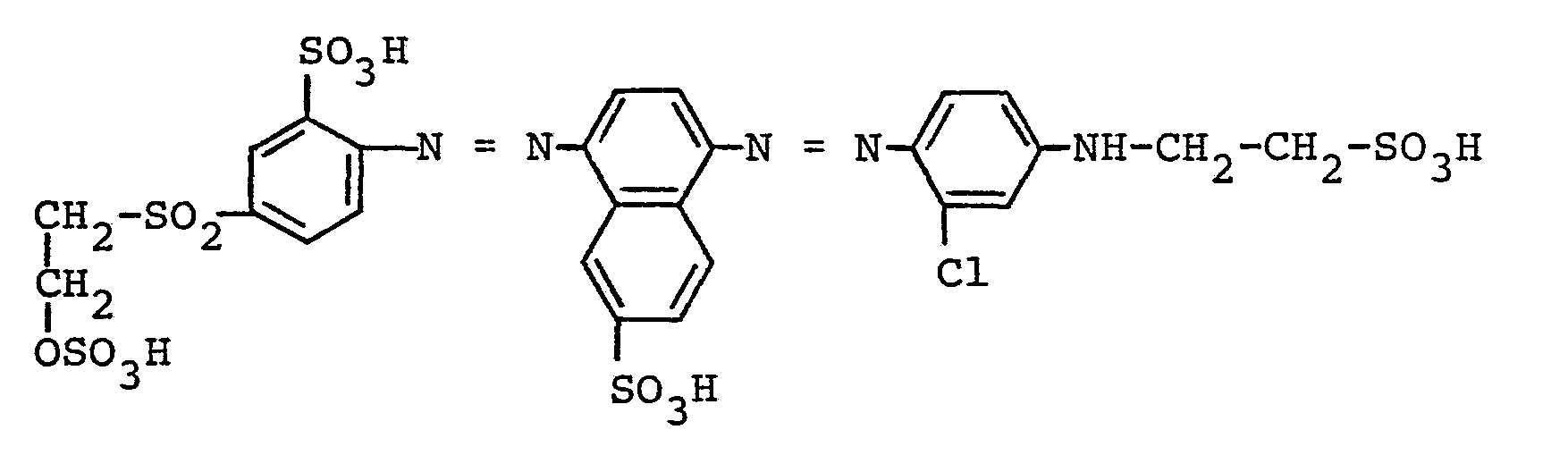
Zur Herstellung einer erfindungsgemäßen Disazoverbindung verfährt man gemäß der Verfahrensweise des Beispieles 14, ersetzt jedoch hierbei das Natriumsalz von N-(ß-Sulfoäthyl)-3-chloranilin, das als Kupplungskomponente dient, durch eine der in den nachfolgenden Tabellenbeispielen angegebenen Kupplungskomponenten entsprechend der allgemeinen Formel (3) in äquivalenter Menge. Man erhält in ebenfalls guter Ausbeute die hierzu angegebene erfindungsgemäße Disazoverbindung entsprechend der allgemeinen Formel (1). Diese faserreaktiven erfindungsgemäßen Disazoverbindungen zeigen ebenfalls sehr gute Farbstoffeigenschaften mit sehr guten anwendungstechnischen Eigenschaften; sie liefern Färbungen und Drucke auf den in der Beschreibung genannten Fasermaterialien, insbesondere auf Cellulosefasermaterialien und Wolle, nach den für faserreaktive Farbstoffe üblichen Applikations- und Fixiermethoden mit guten bis sehr guten Echtheiten in dem in dem jeweiligen Tabellenbeispiel angegebenen Farbton.To prepare a disazo compound according to the invention, the procedure of Example 14 is followed, except that the sodium salt of N- (β-sulfoethyl) -3-chloroaniline, which serves as the coupling component, is replaced by one of the coupling components given in the table examples below in accordance with the general formula (3) in equivalent amount. The disazo compound according to the invention, given the general formula (1), is likewise obtained in good yield. These fiber-reactive disazo compounds according to the invention likewise show very good dye properties with very good application properties; they provide coloring and prints on the fiber materials mentioned in the description, in particular on cellulose fiber materials and wool, according to the application and fixing methods customary for fiber-reactive dyes with good to very good fastness properties in the color shade given in the respective table example.
Das in den formelmäßig angegebenen Verbindungen befindliche Formelglied M hat die oben angegebene Bedeutung; vorzugsweise stellt es ein Alkalimetall, insbesondere Natrium, dar. Der für die erfindungsgemäße Verbindung angegebene Formelrest D2 steht für den Rest der Formel


59,4 Teile der Aminoazoverbindung der Formel
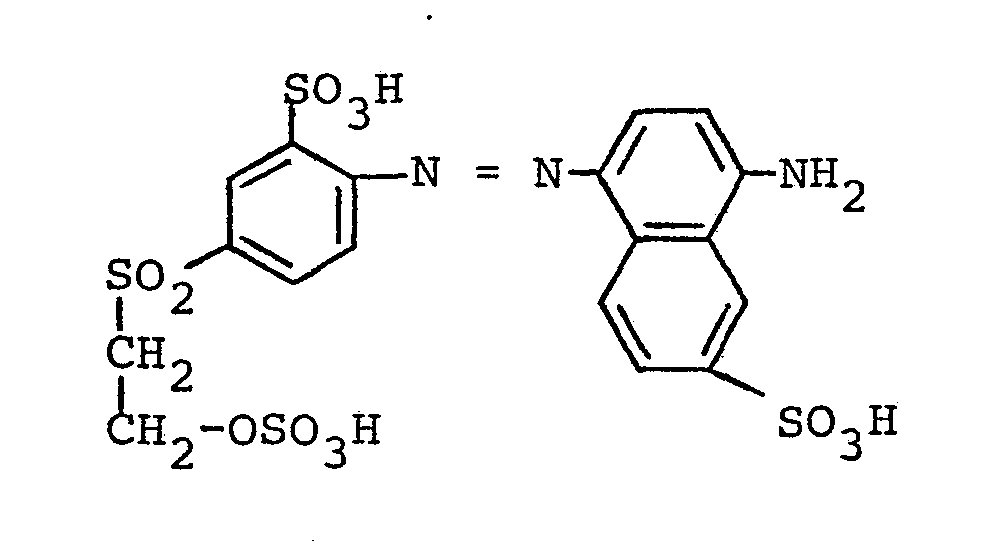

49,3 Teile 4-(ß-Sulfatoäthylsulfonyl)-3',6'-dimethyl-4'-aminoazobenzol-2-sulfonsäure werden in 300 Teilen Wasser mit Natriumbicarbonat auf einen pH-Wert von 6 gestellt, und die Lösung wird mit 20 Volumenteilen einer wäßrigen 5n-Natriumnitritlösung versetzt. Diese Mischung gibt man langsam in ein Gemisch aus 200 Teilen Eis und 35 Teilen einer 31 %igen wäßrigen Salzsäure; die einsetzende Diazotierungsreaktion wird bei einer Temperatur von 5 - 10°C während 3 Stunden unter Rühren vervollständigt. Uberschüssige salpetrige Säure zerstört man mit wenig Amidosulfonsäure. Zur Kupplung gibt man anschließend eine gekühlte wäßrige Lösung von 25,1 Teilen des Natriumsalzes von N-Äthyl-N-(ß-sulfoäthyl)-anilin zu und stellt den pH-Wert durch Einstreuen von Natriumbicarbonat auf 5,5 bis 6 ein. Nach beendigter Kupplung isoliert man das Natriumsalz der Verbindung der Formel
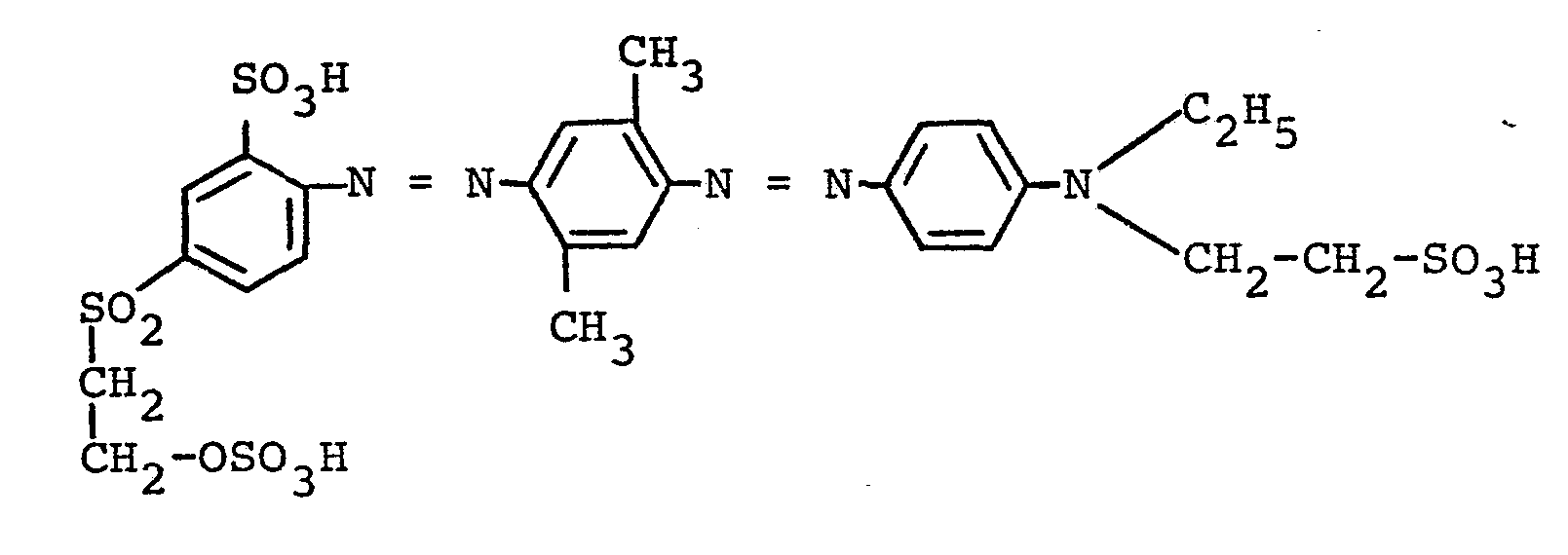
In den nachfolgenden Tabellenbeispielen sind weitere erfindungsgemäße Disazoverbindungen, in Form der freien Säure geschrieben, aufgezeichnet. Sie lassen sich in erfindungsgemäßer Weise aus ihren, aus den Formeln ersichtlichen Diazo- und Kupplungskomponenten herstellen, beispielsweise analog einem der oben angegebenen Ausführungsbeispiele. Sie werden aus den Reaktionsansätzen vorzugsweise in Form ihrer Natriumsalze isoliert. Sie stellen ebenfalls sehr gute Farbstoffe mit faserreaktiven Eigenschaften dar und besitzen sehr gute anwendungstechnische Eigenschaften; auf den in der Beschreibung genannten Fasermaterialien, insbesondere auf Cellulosefasermaterialien und Wolle, liefern sie nach den für faserreaktive Farbstoffe üblichen Applikations- und Fixiermethoden Färbungen und Drucke mit guten bis sehr guten Echtheiten in den angegebenen Farbtönen.


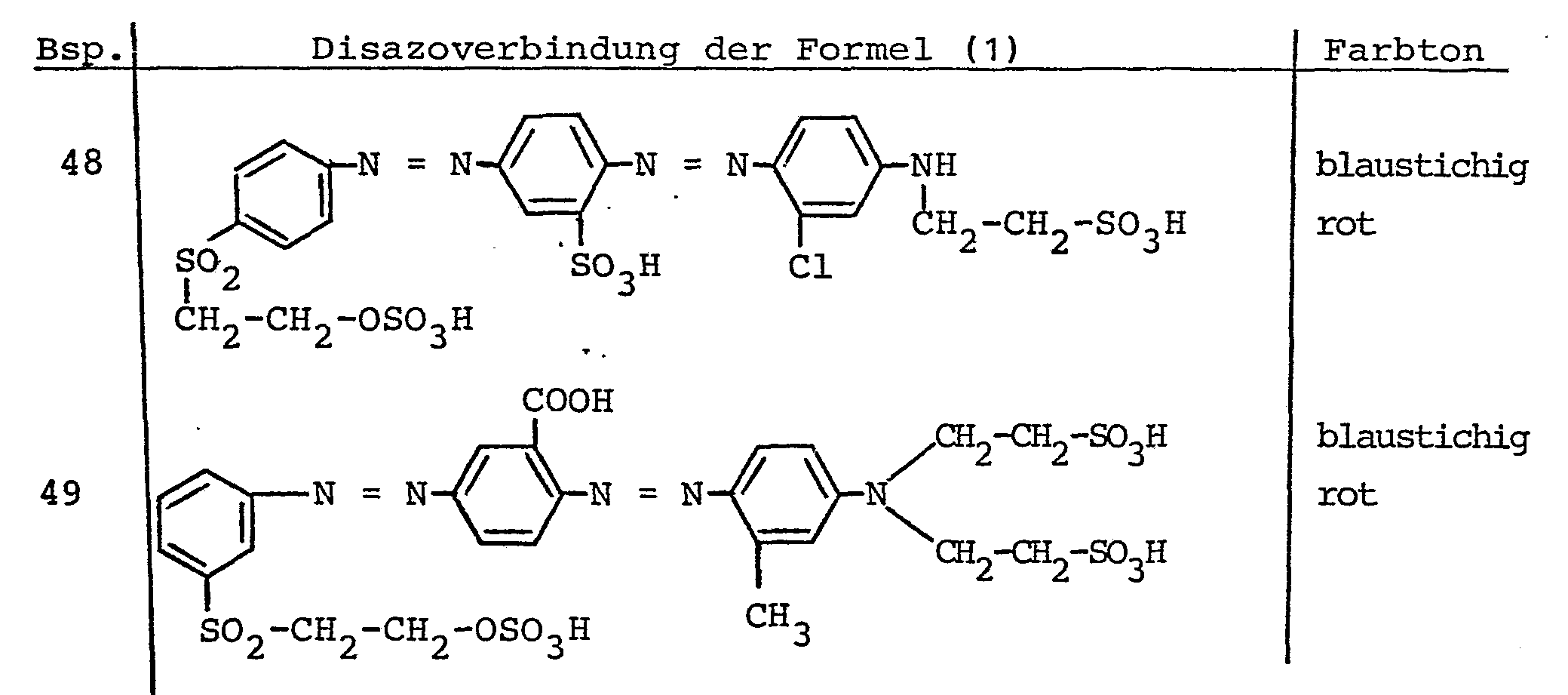
Zur Herstellung einer erfindungsgemäßen Disazoverbindung verfährt man gemäß der Verfahrensweise des Beispieles 31, ersetzt jedoch hierbei das als Kupplungskomponente dienende N-(ß-Sulfoäthyl)-N-äthyl-3-methyl-anilin durch eine der in den nachfolgenden Tabellenbeispielen angegebenen Kupplungskomponenten entsprechend der allgemeinen Formel (3) in äquivalenter Menge. Man erhält in ebenfalls guter Ausbeute die hierzu angegebene erfindungsgemäße Disazoverbindung entsprechend der allgemeinen Formel (1). Diese faserreaktiven erfindungsgemäßen Disazoverbindungen zeigen ebenfalls sehr gute Farbstoffeigenschaften mit sehr guten anwendungstechnischen Eigenschaften; sie liefern Färbungen und Drucke auf den in der Beschreibung genannten Fasermaterialien, insbesondere auf Cellulosefasermaterialien und Wolle, nach den für faserreaktive Farbstoffe üblichen Applikations- und Fixiermethoden mit guten bis sehr guten Echtheiten in dem in dem jeweiligen Tabellenbeispiel angegebenen Farbton. - Das in den formelmäßig angegebenen Verbindungen befindliche Formelglied M hat die oben angegebene Bedeutung; vorzugsweise stellt es ein Alkalimetall, insbesondere Natrium, dar. Der für die erfindungsgemäße Verbindung angegebene Formelrest D3 steht für den Rest der Formel
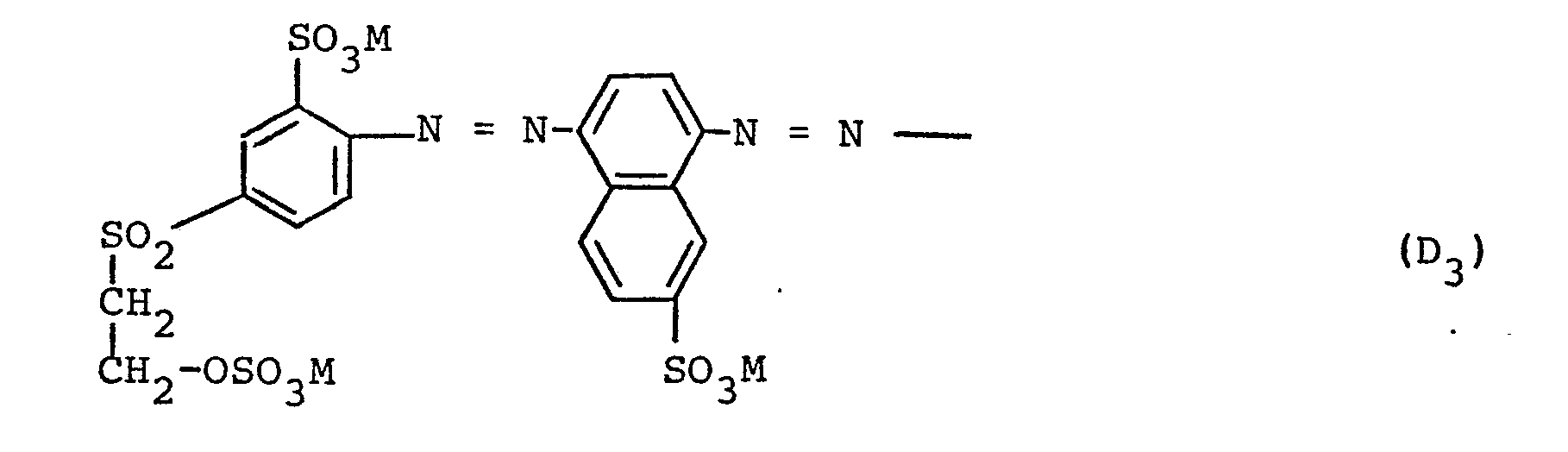


In den nachfolgenden Tabellenbeispielen sind weitere erfindungsgemäße Disazoverbindungen, in Form der freien Säure geschrieben, aufgezeichnet. Sie lassen sich in erfindungsgemäßer Weise aus ihren aus den Formeln ersichtlichen Diazo-und Kupplungskomponenten herstellen, beispielsweise analog einem der oben angegebenen Ausführungsbeispiele. Sie werden aus den Reaktionsansätzen vorzugsweise in Form ihrer Natriumsalze isoliert. Sie stellen ebenfalls sehr gute Farbstoffe mit faserreaktiven Eigenschaften dar und besitzen sehr gute anwendungstechnische Eigenschaften; auf den in der Beschreibung genannten Fasermaterialien, insbesondere auf Cellulosefasermaterialien und Wolle, liefern sie nach den für faserreaktive Farbstoffe üblichen Applikations- und Fixiermethoden Färbungen und Drucke mit guten bis sehr guten Echtheiten in den angegebenen Farbtönen.


Claims (7)


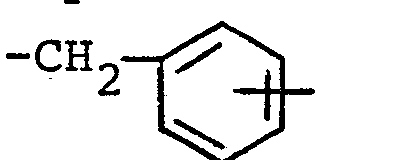
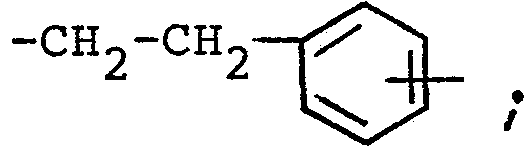
daß E den 1,4-Naphthylenrest bedeutet, der durch eine Sulfogruppe oder durch eine niedere Alkoxygruppe und eine Sulfogruppe substituiert ist.2. Compounds according to claim 1 of the general formula (1) indicated and defined therein, characterized in that the formula radical E denotes the 1,4-phenylene radical, which is substituted by one or two lower alkyl groups, by one or two lower alkoxy groups, by a carboxy group or may be substituted by a lower alkanoylamino group or by an ureido group or by a lower alkanoylamino group or a sulfo group or by an ureido group and a sulfo group, or
that E represents the 1,4-naphthylene radical which is substituted by a sulfo group or by a lower alkoxy group and a sulfo group.


Applications Claiming Priority (4)
| Application Number | Priority Date | Filing Date | Title |
|---|---|---|---|
| DE3041891 | 1980-11-06 | ||
| DE3041891 | 1980-11-06 | ||
| DE3139657 | 1981-10-06 | ||
| DE19813139657 DE3139657A1 (en) | 1980-11-06 | 1981-10-06 | WATER-SOLUBLE DISAZO COMPOUNDS, METHOD FOR THEIR PRODUCTION AND THEIR USE AS DYES |
Publications (3)
| Publication Number | Publication Date |
|---|---|
| EP0051807A2 true EP0051807A2 (en) | 1982-05-19 |
| EP0051807A3 EP0051807A3 (en) | 1983-01-19 |
| EP0051807B1 EP0051807B1 (en) | 1985-02-13 |
Family
ID=25788961
Family Applications (1)
| Application Number | Title | Priority Date | Filing Date |
|---|---|---|---|
| EP81109103A Expired EP0051807B1 (en) | 1980-11-06 | 1981-10-28 | Water-soluble disazo compounds, process for their preparation and their use as dyestuffs |
Country Status (5)
| Country | Link |
|---|---|
| US (1) | US4430259A (en) |
| EP (1) | EP0051807B1 (en) |
| KR (1) | KR880002250B1 (en) |
| BR (1) | BR8107193A (en) |
| DE (2) | DE3139657A1 (en) |
Cited By (2)
| Publication number | Priority date | Publication date | Assignee | Title |
|---|---|---|---|---|
| EP0292825A3 (en) * | 1987-05-27 | 1989-03-08 | Bayer Ag | Reactive dyes |
| EP0554561A1 (en) * | 1991-12-26 | 1993-08-11 | Sumitomo Chemical Company, Limited | Bisazo compounds and method for dyeing or printing fiber materials using the same |
Families Citing this family (8)
| Publication number | Priority date | Publication date | Assignee | Title |
|---|---|---|---|---|
| DE3427188A1 (en) * | 1984-07-24 | 1986-01-30 | Hoechst Ag, 6230 Frankfurt | WATER-SOLUBLE PYRIDON MONOAZO COMPOUNDS, METHOD FOR THE PRODUCTION THEREOF AND THEIR USE AS DYES |
| US5432266A (en) * | 1991-06-22 | 1995-07-11 | Bayer Aktiengesellschaft | Fiber-reactive monoazo and disazo dyes |
| EP0559617B1 (en) * | 1992-03-05 | 1998-01-07 | Ciba SC Holding AG | Reactive dyes, method for their preparation and the use thereof |
| EP0586331B1 (en) * | 1992-07-31 | 1999-01-07 | Ciba SC Holding AG | Process for dyeing synthetic polyamid fibre materials |
| DE4309554A1 (en) * | 1993-03-24 | 1994-09-29 | Bayer Ag | Fiber reactive azo dyes |
| ES2397184T3 (en) * | 2006-05-16 | 2013-03-05 | Clariant Finance (Bvi) Limited | Disazo acid dyes |
| CN102292399A (en) * | 2008-11-20 | 2011-12-21 | 德司达染料德国有限责任公司 | Cyclic Fluorinated Reactive Dyes |
| PT3126452T (en) | 2014-04-01 | 2020-07-15 | Archroma Ip Gmbh | Bisazo dyes and mixtures thereof |
Family Cites Families (7)
| Publication number | Priority date | Publication date | Assignee | Title |
|---|---|---|---|---|
| BE620899A (en) * | ||||
| NL74990C (en) | 1950-01-09 | |||
| US3531459A (en) * | 1964-12-02 | 1970-09-29 | Gen Aniline & Film Corp | Monoazo-dyestuffs containing fiber-reactive and water solubilizing radicals |
| DE2159216A1 (en) | 1971-11-30 | 1973-06-14 | Hoechst Ag | NEW HYDRO-SOLUBLE DISAZO DYES AND METHODS FOR THEIR PRODUCTION |
| CH586739A5 (en) | 1973-10-17 | 1977-04-15 | Hoechst Ag | |
| DE2653478C3 (en) * | 1976-11-25 | 1980-03-06 | Hoechst Ag, 6000 Frankfurt | Water-soluble dyes, processes for their production and their use for dyeing and printing cellulose and polyamide fiber materials |
| US4271072A (en) | 1977-12-20 | 1981-06-02 | American Hoechst Corporation | Azo dyestuffs containing -SO2 CH2 CH2 OSO3 H and -N(CH2 CH2 OSO3 H)2 groups |
-
1981
- 1981-10-06 DE DE19813139657 patent/DE3139657A1/en not_active Withdrawn
- 1981-10-28 EP EP81109103A patent/EP0051807B1/en not_active Expired
- 1981-10-28 DE DE8181109103T patent/DE3168949D1/en not_active Expired
- 1981-11-04 KR KR1019810004285A patent/KR880002250B1/en not_active Expired
- 1981-11-04 US US06/318,112 patent/US4430259A/en not_active Expired - Fee Related
- 1981-11-05 BR BR8107193A patent/BR8107193A/en unknown
Cited By (4)
| Publication number | Priority date | Publication date | Assignee | Title |
|---|---|---|---|---|
| EP0292825A3 (en) * | 1987-05-27 | 1989-03-08 | Bayer Ag | Reactive dyes |
| EP0554561A1 (en) * | 1991-12-26 | 1993-08-11 | Sumitomo Chemical Company, Limited | Bisazo compounds and method for dyeing or printing fiber materials using the same |
| US5306814A (en) * | 1991-12-26 | 1994-04-26 | Sumitomo Chemical Company, Limited | Bisazo compounds having sulfophenylazonaphtylazophenylamino-s-triazinyl group and use thereof for dyeing or printing fiber materials |
| TR28115A (en) * | 1991-12-26 | 1996-03-01 | Sumitomo Chemical Co | Method for dyeing or printing fibrous materials using bisazo compounds and these. |
Also Published As
| Publication number | Publication date |
|---|---|
| KR830007769A (en) | 1983-11-07 |
| DE3168949D1 (en) | 1985-03-28 |
| US4430259A (en) | 1984-02-07 |
| DE3139657A1 (en) | 1982-06-16 |
| KR880002250B1 (en) | 1988-10-20 |
| BR8107193A (en) | 1982-07-27 |
| EP0051807B1 (en) | 1985-02-13 |
| EP0051807A3 (en) | 1983-01-19 |
Similar Documents
| Publication | Publication Date | Title |
|---|---|---|
| EP0048355B1 (en) | Water-soluble disazo compounds, process for their preparation and their use as dyestuffs | |
| EP0073481B1 (en) | Water-soluble azo compounds, process for their manufacture and their use as dyestuffs | |
| EP0094055A1 (en) | Monoazo compounds, process for their preparation and their use as dyestuffs | |
| EP0051808B1 (en) | Water-soluble monoazo compounds, process for their preparation and their use as dyestuffs | |
| EP0036582B1 (en) | Water-soluble azo compounds, process for their preparation and their use as dyestuffs | |
| EP0028787B1 (en) | Copper-formazane compounds, process for their production, and their use as dyestuffs | |
| EP0051807B1 (en) | Water-soluble disazo compounds, process for their preparation and their use as dyestuffs | |
| EP0028788A1 (en) | Copper complex formazane compounds, process for their preparation and their use as dyestuffs | |
| EP0219080B1 (en) | Water soluble disazo compounds, process for their preparation and their use as dyestuffs | |
| EP0169457A1 (en) | Water soluble pyridone-monoazo compounds, process for their preparation and their use as dyestuffs | |
| EP0133283B1 (en) | Water-soluble disazo compounds, process for their preparation and their use as dyestuffs | |
| EP0043575B1 (en) | Water-soluble azo compounds, process for their preparation and their use as dyestuffs | |
| DE3843014A1 (en) | WATER-SOLUBLE DYES, METHOD FOR THEIR PRODUCTION AND THEIR USE | |
| EP0076922B1 (en) | Water-soluble disazo compounds and their new coupling components, process for their manufacture and use of the disazo compounds as dyestuffs | |
| DE3703565A1 (en) | WATER-SOLUBLE MONOAZO-PYRAZOLONE COMPOUNDS, METHOD FOR THE PRODUCTION THEREOF AND THEIR USE AS DYES | |
| WO1997043345A1 (en) | Reactive azo dyes with a reactive-anchor-carrying diazo component from the series of m-phenylene diamine | |
| DE3717667A1 (en) | WATER-SOLUBLE NAPHTHYL-AZO-PYRAZOLONE COMPOUNDS, METHOD FOR THE PRODUCTION THEREOF AND THEIR USE AS DYES | |
| DE3903455A1 (en) | COPPER COMPLEX MOLDING COMPOUNDS, METHOD FOR THE PRODUCTION THEREOF AND THEIR USE AS DYES | |
| EP0082415B1 (en) | Heavy metal complex azo compounds soluble in water, process for their preparation and their use as dyestuffs | |
| EP0381133B1 (en) | Water soluble azo compounds, method for their preparation and their use as dyestuffs | |
| EP0079562B1 (en) | Water-soluble disazo compounds, process for their preparation and their use as dyestuffs | |
| DE4437265A1 (en) | Reactive dyes, preparation thereof and use thereof | |
| DE3922503A1 (en) | WATER-SOLUBLE DISAZO COMPOUNDS, METHOD FOR THEIR PRODUCTION AND THEIR USE AS DYES | |
| EP0326011B1 (en) | Water soluble disazo compounds, process for their preparation and their use as dyestuffs | |
| DE3828849A1 (en) | WATER-SOLUBLE AZO COMPOUNDS, METHOD FOR THE PRODUCTION THEREOF AND THEIR USE AS DYES |
Legal Events
| Date | Code | Title | Description |
|---|---|---|---|
| PUAI | Public reference made under article 153(3) epc to a published international application that has entered the european phase |
Free format text: ORIGINAL CODE: 0009012 |
|
| AK | Designated contracting states |
Designated state(s): BE CH DE FR GB IT |
|
| PUAL | Search report despatched |
Free format text: ORIGINAL CODE: 0009013 |
|
| AK | Designated contracting states |
Designated state(s): BE CH DE FR GB IT LI |
|
| 17P | Request for examination filed |
Effective date: 19830504 |
|
| ITF | It: translation for a ep patent filed | ||
| GRAA | (expected) grant |
Free format text: ORIGINAL CODE: 0009210 |
|
| AK | Designated contracting states |
Designated state(s): BE CH DE FR GB IT LI |
|
| REF | Corresponds to: |
Ref document number: 3168949 Country of ref document: DE Date of ref document: 19850328 |
|
| ET | Fr: translation filed | ||
| PLBE | No opposition filed within time limit |
Free format text: ORIGINAL CODE: 0009261 |
|
| STAA | Information on the status of an ep patent application or granted ep patent |
Free format text: STATUS: NO OPPOSITION FILED WITHIN TIME LIMIT |
|
| 26N | No opposition filed | ||
| PGFP | Annual fee paid to national office [announced via postgrant information from national office to epo] |
Ref country code: FR Payment date: 19910916 Year of fee payment: 11 |
|
| PGFP | Annual fee paid to national office [announced via postgrant information from national office to epo] |
Ref country code: GB Payment date: 19910918 Year of fee payment: 11 Ref country code: CH Payment date: 19910918 Year of fee payment: 11 |
|
| PGFP | Annual fee paid to national office [announced via postgrant information from national office to epo] |
Ref country code: BE Payment date: 19911009 Year of fee payment: 11 |
|
| ITTA | It: last paid annual fee | ||
| PGFP | Annual fee paid to national office [announced via postgrant information from national office to epo] |
Ref country code: DE Payment date: 19911207 Year of fee payment: 11 |
|
| PG25 | Lapsed in a contracting state [announced via postgrant information from national office to epo] |
Ref country code: GB Effective date: 19921028 |
|
| PG25 | Lapsed in a contracting state [announced via postgrant information from national office to epo] |
Ref country code: LI Effective date: 19921031 Ref country code: CH Effective date: 19921031 Ref country code: BE Effective date: 19921031 |
|
| BERE | Be: lapsed |
Owner name: HOECHST A.G. Effective date: 19921031 |
|
| GBPC | Gb: european patent ceased through non-payment of renewal fee |
Effective date: 19921028 |
|
| PG25 | Lapsed in a contracting state [announced via postgrant information from national office to epo] |
Ref country code: FR Effective date: 19930630 |
|
| REG | Reference to a national code |
Ref country code: CH Ref legal event code: PL |
|
| PG25 | Lapsed in a contracting state [announced via postgrant information from national office to epo] |
Ref country code: DE Effective date: 19930701 |
|
| REG | Reference to a national code |
Ref country code: FR Ref legal event code: ST |