EP0052031A1 - In beschränktem Volumen und beschränkter Länge klappbarer Stuhl - Google Patents
In beschränktem Volumen und beschränkter Länge klappbarer Stuhl Download PDFInfo
- Publication number
- EP0052031A1 EP0052031A1 EP81401612A EP81401612A EP0052031A1 EP 0052031 A1 EP0052031 A1 EP 0052031A1 EP 81401612 A EP81401612 A EP 81401612A EP 81401612 A EP81401612 A EP 81401612A EP 0052031 A1 EP0052031 A1 EP 0052031A1
- Authority
- EP
- European Patent Office
- Prior art keywords
- folding
- support
- articulated
- seat
- seat according
- Prior art date
- Legal status (The legal status is an assumption and is not a legal conclusion. Google has not performed a legal analysis and makes no representation as to the accuracy of the status listed.)
- Withdrawn
Links
- 210000001364 upper extremity Anatomy 0.000 claims abstract description 10
- 239000004744 fabric Substances 0.000 claims abstract description 9
- 230000003993 interaction Effects 0.000 claims description 7
- 125000006850 spacer group Chemical group 0.000 description 8
- 230000000903 blocking effect Effects 0.000 description 7
- 239000000463 material Substances 0.000 description 4
- 238000012423 maintenance Methods 0.000 description 2
- 238000004804 winding Methods 0.000 description 2
- 230000009347 mechanical transmission Effects 0.000 description 1
- 230000002028 premature Effects 0.000 description 1
- 239000011800 void material Substances 0.000 description 1
Images






Classifications
-
- A—HUMAN NECESSITIES
- A47—FURNITURE; DOMESTIC ARTICLES OR APPLIANCES; COFFEE MILLS; SPICE MILLS; SUCTION CLEANERS IN GENERAL
- A47C—CHAIRS; SOFAS; BEDS
- A47C4/00—Foldable, collapsible or dismountable chairs
- A47C4/28—Folding chairs with flexible coverings for the seat or back elements
- A47C4/286—Folding chairs with flexible coverings for the seat or back elements foldable side to side and front to back, e.g. umbrella type
-
- A—HUMAN NECESSITIES
- A47—FURNITURE; DOMESTIC ARTICLES OR APPLIANCES; COFFEE MILLS; SPICE MILLS; SUCTION CLEANERS IN GENERAL
- A47C—CHAIRS; SOFAS; BEDS
- A47C4/00—Foldable, collapsible or dismountable chairs
- A47C4/28—Folding chairs with flexible coverings for the seat or back elements
- A47C4/30—Attachment of upholstery or fabric to frames
Definitions
- the present invention relates to equipment of the "foldable seat” type, making it possible to offer maximum comfort to its user, this for use, its transport and its storage having to be done in the smallest possible footprint.
- folding systems generally reduce the chair to a relatively large volume, since the interior space of the assembly remains constant, at least in one dimension.
- the fabrics constituting the seat and the backrest, when folding, take the most diverse positions. This results on the one hand, discomfort at the joints of the frame, on the other hand premature wear of these. fabrics because of the numerous "creases" or jams to which they are subjected.
- the seat or armchair, object of the invention makes it possible to avoid these drawbacks. It is in fact designed in such a way that after folding, there is no "void” in its volume.
- the rigid frameworks of the sides close in “portfolio", they are interconnected by two parallelograms with automatic locking, the whole being rigid.
- the fabrics or slats constituting the seat and the backrest are mounted on reels integrated in the profiles of the frame. When the folding is done, the mechanical elements also integrate into the foot profiles. The combination of these systems allows extremely space low of the folded assembly, because it is limited to the volume of the elements nested between them, without vacuum.
- the proposed folding seat is of the type in which a seat and a backrest can be put in place between two lateral support structures, interconnected transversely by connections allowing their folding against one another.
- each of the lateral structures consists of parts pivotally articulated on the seat support, all these articulations admitting a pivoting of the elements of the support structure one on the other around perpendicular axes. in terms of the support structure, which allows the lateral structures to be folded into an elongated compact block against the seat supports now placed side by side.
- the lateral support structure comprises an articulated interaction link between at least the front leg and the back support upright at the rear.
- the articulated interaction link comprises a short upright articulated at an intermediate point of the seat support, an articulated arm between one end of this short upright and an intermediate point of the backrest support, and a connecting rod articulated between another point of this short amount and the front foot.
- the articulated interaction link is arranged so that in the unfolded position, the arm is substantially horizontal, to form an armrest.
- the back support and the rear leg interact to form a stop in the unfolded position.
- the rear foot folds first, to come into position folded between the seat support and the corresponding front leg.
- the fabrics or slats constituting the seat and the backrest are fitted with reels integrated into the frame.
- the transverse interconnection links between the support structures act in deformable parallelograms and are lockable in the unfolded position.
- the parallelograms can also be directly balanced by the reaction of contact with the ground.
- these parallelograms also ensure the locking of the feet and / or the backrest.
- the chair has two fabrics, one forming the seat 1, the other constituting the backrest 2. These two fabrics are integral with spring-loaded winding mandrels 31 and 32, on which they retract during folding.
- Parallelograms (elements 41 and 44 at the front, 51 to 54 at the rear) ensure first of all the normal deployment of the chair when it is opened, secondly the parallelism of winding of the fabrics, and finally the rigidity of the assembly in the "open" position.
- Tension springs 61 to 64 compensate for the force exerted by the reels 31 and 32, these being subjected to a permanent torque tending to bring the sides of the chair closer.
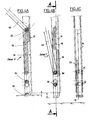
- Blocking of the parallelograms is ensured by sliding spacers such as 7 (detail according to FIGS. 4A to 4C or 5A and 5B, as a variant).
- the contour drawn in thin dashed line along the axis of the drawing in FIG. 3 represents the size of the chair after the first folding phase.
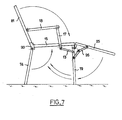
- the chair in its second folding phase, operates according to the deflections shown diagrammatically by the arrow arcs ( Figure 2).
- the tilting of the backrest 8 causes the front (71 and 72) and rear (73 and 74) feet to be folded.
- a gear with a multiplier ratio (90 FIG. 6) allows the rear feet such as 74 to be rotated and bent before the front feet such as 72.
- the rear feet 73 and 74 are held in position by jamming.
- the establishment of the front legs 71 and 72 is therefore done with a "delay" which makes it possible to keep the folding order without the possibility of inversion.
- the tilting of the uprights 81 and 82 of the backrest 8 causes the rotation of the rotating uprights 10 and 17, articulated on the seat supports 15 and 16, by means of the armrests 9 and 18 articulated on the one hand at an intermediate point of the file amount and on the other hand at the top of the corresponding rotating amount.
- These same amounts 10 and 17 are furthermore articulated on connecting rods 11 and 13 which in turn are articulated on the front legs 71 and 72.
- the gear 90 allows, if desired, the joint and prior folding of the rear legs between the front legs and the seat support.
- the folded assembly is illustrated in Figure lA. And handles 12 and 12A can be used to help the first folding phase and allow the transport of the folded assembly. In addition, a mechanical transmission could make the two folding phases simultaneous.
- the automatic blocking system for the parallelograms (detail 7) works as follows:
- FIG. 4A represents the same assembly during folding. The chair being raised, the blocking is no longer ensured by the support on the ground.
- the spacer 21 "falls back" (FIG. 4B and section AA of FIG. 4C), and releases the end of the parallelogram. Manual intervention by the user then makes it possible to slide the assembly until the parallelogram 53 and compensating spring assembly is retracted, inside the foot 74. In the folded position, the spacer is held in position low by contact of the parallelogram on a wing of the spacer.
- the variant of the blocking means by spacer is associated with a leaf spring 23 which locks the chair.
- this leaf spring 23 maintains the positioning of the parallelogram 53, thus avoiding inadvertent closing of the chair, during its movement for example.
- the use of this leaf spring 23 imposes on the user a greater effort to perform the unlocking.
- the gear 90 ensures, by its multiplier ratio, the folding of the rear feet before those of the front arrive under the seat.
- the driving part is a toothed sector 91 which acts only in the first part of the folding on the sector 92 of the rear foot; beyond its action, the rear feet are held by wedging in the closed position.
- the chair is equipped with a footrest 25, the elements of which are similar to the seat or the backrest.
- a compass 26 allows the maintenance of the footrest.
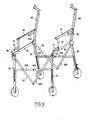
- Figures 8 and 8A show a variant of the chair according to the invention, respectively in the service position and in the fully folded position.
- the unchanged elements keep the same reference numbers and will not be described again.
- the arms 141 and 142, or 151 and 152 remain oblique.
- the other arms 143 and 144, or 153 and 154 are blocked like a compass in a horizontal position, the chair being unfolded. It is then no longer necessary to provide a lock against the sliding of these arms in the feet.
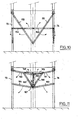
- FIG. 10 allows a better understanding in rear view of the folding of the parallelograms in the case of FIGS. 8 and 9.
- Figure 11 also in rear view, illustrates another variant of parallelogram, without sliding in the rear legs 73 and 74: a symmetrical double parallelogram is formed between the legs 73 and 74 and a central upright 160 by the sides 161 and 163 d 'on the one hand, 162 and 164 ... on the other hand, these parallelograms descending towards each other.
- Intermediate points on the high sides 161 and 162 are articulated symmetrically on rods 165 and 166 articulated at their other end on an eyelet 167 sliding on the upright 160, which ensures the maintenance of the symmetry.
- At the same points on the sides 161 and 162 are articulated other links 168 and 169 forming, in the unfolded position of the chair, a horizontal locking compass.
- FIGS 12A and 12B illustrate in 190 a simplified variant replacing the gear 90.
- the backrest upright 82 abuts on the seat support 16.
- the foot 73 comes into abutment on the rear of the backrest upright 82 , blocking it back and forth.
- the part 51 of the parallelogram abuts on the shoulder 191 of the housing 190, thus preventing any movement of the rear foot and thereby of the backrest, the latter now in turn the front foot by the articulation already described.
- the material, object of the invention can be used in all cases where a space requirement is imposed on the user. This is particularly the case in the field of camping or hiking. In fact, the known materials have a fairly large "folded” volume, which makes their transport restricting, sometimes even impossible.
- This material as described and its many variants such as chairs, "relax”, slatted tables or bed in the field of leisure or occasional furniture, is suitable for all forms of transport. It can easily find a place on the luggage rack of a "two wheeler", or be carried in addition to a backpack for a hiker. Another application is that of a wheelchair for the disabled, which thus becomes easy to transport by car. Children's strollers are also an area of application of this invention.
Landscapes
- Chairs For Special Purposes, Such As Reclining Chairs (AREA)
- Special Chairs (AREA)
Applications Claiming Priority (2)
| Application Number | Priority Date | Filing Date | Title |
|---|---|---|---|
| FR8023650 | 1980-10-28 | ||
| FR8023650A FR2492644A1 (fr) | 1980-10-28 | 1980-10-28 | Fauteuil pliable sous volume et longueur restreints |
Publications (1)
| Publication Number | Publication Date |
|---|---|
| EP0052031A1 true EP0052031A1 (de) | 1982-05-19 |
Family
ID=9247701
Family Applications (1)
| Application Number | Title | Priority Date | Filing Date |
|---|---|---|---|
| EP81401612A Withdrawn EP0052031A1 (de) | 1980-10-28 | 1981-10-15 | In beschränktem Volumen und beschränkter Länge klappbarer Stuhl |
Country Status (2)
| Country | Link |
|---|---|
| EP (1) | EP0052031A1 (de) |
| FR (1) | FR2492644A1 (de) |
Cited By (7)
| Publication number | Priority date | Publication date | Assignee | Title |
|---|---|---|---|---|
| US5429413A (en) * | 1990-06-01 | 1995-07-04 | Levy; Lionel | Folding lounge chair |
| GB2304279A (en) * | 1995-08-14 | 1997-03-19 | Gary Linley | Folding chair |
| US5897161A (en) * | 1997-02-12 | 1999-04-27 | Karg; Peter W. | Two-directionally folding chair |
| WO2002069761A1 (en) * | 2001-03-02 | 2002-09-12 | Tofasco | Single-motion collapsible quad chair with solid armrest |
| US6607240B2 (en) * | 2001-12-19 | 2003-08-19 | Edward Zheng | Collapsible chair with solid arm rest and tensioned seat |
| US6854797B1 (en) * | 2002-09-09 | 2005-02-15 | John S. Thomas | Foldable bench |
| CN104137820A (zh) * | 2014-08-06 | 2014-11-12 | 刘军 | 一种便携式垂钓凳 |
Citations (4)
| Publication number | Priority date | Publication date | Assignee | Title |
|---|---|---|---|---|
| FR771257A (fr) * | 1933-12-09 | 1934-10-04 | Chaise longue pliante | |
| CH269753A (de) * | 1949-01-05 | 1950-07-31 | Erni Maurice | Klappstuhl. |
| US2713385A (en) * | 1951-04-11 | 1955-07-19 | Dwight E Mcquilkin | Four way folding chair |
| DE2856938A1 (de) * | 1973-10-01 | 1980-01-10 | Bemico Enschede | Gelenk fuer klappmoebel |
-
1980
- 1980-10-28 FR FR8023650A patent/FR2492644A1/fr not_active Withdrawn
-
1981
- 1981-10-15 EP EP81401612A patent/EP0052031A1/de not_active Withdrawn
Patent Citations (4)
| Publication number | Priority date | Publication date | Assignee | Title |
|---|---|---|---|---|
| FR771257A (fr) * | 1933-12-09 | 1934-10-04 | Chaise longue pliante | |
| CH269753A (de) * | 1949-01-05 | 1950-07-31 | Erni Maurice | Klappstuhl. |
| US2713385A (en) * | 1951-04-11 | 1955-07-19 | Dwight E Mcquilkin | Four way folding chair |
| DE2856938A1 (de) * | 1973-10-01 | 1980-01-10 | Bemico Enschede | Gelenk fuer klappmoebel |
Cited By (9)
| Publication number | Priority date | Publication date | Assignee | Title |
|---|---|---|---|---|
| US5429413A (en) * | 1990-06-01 | 1995-07-04 | Levy; Lionel | Folding lounge chair |
| GB2304279A (en) * | 1995-08-14 | 1997-03-19 | Gary Linley | Folding chair |
| GB2304279B (en) * | 1995-08-14 | 1999-04-28 | Gary Linley | Folding chair |
| US5897161A (en) * | 1997-02-12 | 1999-04-27 | Karg; Peter W. | Two-directionally folding chair |
| WO2002069761A1 (en) * | 2001-03-02 | 2002-09-12 | Tofasco | Single-motion collapsible quad chair with solid armrest |
| US6607240B2 (en) * | 2001-12-19 | 2003-08-19 | Edward Zheng | Collapsible chair with solid arm rest and tensioned seat |
| US6854797B1 (en) * | 2002-09-09 | 2005-02-15 | John S. Thomas | Foldable bench |
| US7303228B1 (en) | 2002-09-09 | 2007-12-04 | Thomas John S | Foldable bench |
| CN104137820A (zh) * | 2014-08-06 | 2014-11-12 | 刘军 | 一种便携式垂钓凳 |
Also Published As
| Publication number | Publication date |
|---|---|
| FR2492644A1 (fr) | 1982-04-30 |
Similar Documents
| Publication | Publication Date | Title |
|---|---|---|
| EP0689784B1 (de) | Ruhesessel | |
| EP0575243B1 (de) | Fahrzeugsitz mit mehrfachen Einstellungen | |
| FR2933362A1 (fr) | Poussette pliable | |
| FR2548106A1 (fr) | Siege auxiliaire pour vehicules | |
| EP3335965A1 (de) | Kinderwagengestell, das zwischen einer liege- und mindestens einer sitzposition verstellbar ist, und entsprechender kinderwagen | |
| FR2672193A1 (fr) | Chaise longue pliable. | |
| EP0127511B1 (de) | Faltbarer Rollstuhl | |
| FR2501486A1 (fr) | Appuie-jambes, notamment pour vehicules de transport et plus particulierement pour aeronefs | |
| FR2882016A1 (fr) | Poussette pour enfant, a pliage parapluie | |
| FR2567733A1 (fr) | Siege de repos | |
| FR2492644A1 (fr) | Fauteuil pliable sous volume et longueur restreints | |
| EP0406044B1 (de) | Vorrichtung für eine Bettcouch | |
| FR2661088A1 (fr) | Perfectionnements aux fauteuils roulants pour handicapes. | |
| FR2768909A1 (fr) | Canape-lit a depliage transversal | |
| FR2672194A1 (fr) | Fauteuil a pietement en x, reglable notamment en inclinaison pour le dossier. | |
| FR2718336A1 (fr) | Dispositif de repose-jambres pour siège ou fauteuil. | |
| EP0046109A2 (de) | Zusammenfaltbarer Rollstuhl | |
| FR2797166A1 (fr) | Fauteuil reglable | |
| FR2778321A1 (fr) | Dispositif de reglage de l'inclinaison d'une chaise pour enfant, et chaise correspondante | |
| FR2651977A1 (fr) | Fauteuil repliable. | |
| FR2761327A1 (fr) | Siege articule pour enfant et poussette equipee d'un tel siege | |
| FR2914240A3 (fr) | Siege de vehicule automobile comprenant des moyens formant verrou | |
| FR2637790A1 (fr) | Siege pliant notamment pour la plage | |
| FR2488114A1 (fr) | Fauteuil | |
| FR2768035A1 (fr) | Siege convertible en lit |
Legal Events
| Date | Code | Title | Description |
|---|---|---|---|
| PUAI | Public reference made under article 153(3) epc to a published international application that has entered the european phase |
Free format text: ORIGINAL CODE: 0009012 |
|
| AK | Designated contracting states |
Designated state(s): AT BE CH DE FR GB IT LU NL SE |
|
| 17P | Request for examination filed |
Effective date: 19820909 |
|
| STAA | Information on the status of an ep patent application or granted ep patent |
Free format text: STATUS: THE APPLICATION IS DEEMED TO BE WITHDRAWN |
|
| 18D | Application deemed to be withdrawn |
Effective date: 19831214 |