EP0052052A1 - Verfahren und Gerät zur geophysikalischen Vermessung - Google Patents
Verfahren und Gerät zur geophysikalischen Vermessung Download PDFInfo
- Publication number
- EP0052052A1 EP0052052A1 EP81401757A EP81401757A EP0052052A1 EP 0052052 A1 EP0052052 A1 EP 0052052A1 EP 81401757 A EP81401757 A EP 81401757A EP 81401757 A EP81401757 A EP 81401757A EP 0052052 A1 EP0052052 A1 EP 0052052A1
- Authority
- EP
- European Patent Office
- Prior art keywords
- pulses
- mhz
- set forth
- range
- waves
- Prior art date
- Legal status (The legal status is an assumption and is not a legal conclusion. Google has not performed a legal analysis and makes no representation as to the accuracy of the status listed.)
- Granted
Links
- 238000000034 method Methods 0.000 title claims abstract description 61
- 230000008569 process Effects 0.000 title claims abstract description 51
- 238000012545 processing Methods 0.000 claims abstract description 16
- 230000000007 visual effect Effects 0.000 claims abstract description 10
- 239000000463 material Substances 0.000 description 32
- 239000002245 particle Substances 0.000 description 11
- 239000011159 matrix material Substances 0.000 description 10
- 239000004576 sand Substances 0.000 description 9
- 239000000523 sample Substances 0.000 description 5
- 239000002689 soil Substances 0.000 description 5
- 230000015572 biosynthetic process Effects 0.000 description 4
- 238000013461 design Methods 0.000 description 4
- 238000005755 formation reaction Methods 0.000 description 4
- 239000000203 mixture Substances 0.000 description 4
- 238000005070 sampling Methods 0.000 description 4
- 238000013507 mapping Methods 0.000 description 3
- 239000003921 oil Substances 0.000 description 3
- 238000010420 art technique Methods 0.000 description 2
- 230000008901 benefit Effects 0.000 description 2
- 239000003086 colorant Substances 0.000 description 2
- 238000012937 correction Methods 0.000 description 2
- 238000011156 evaluation Methods 0.000 description 2
- 239000013505 freshwater Substances 0.000 description 2
- 239000007789 gas Substances 0.000 description 2
- 238000005259 measurement Methods 0.000 description 2
- VNWKTOKETHGBQD-UHFFFAOYSA-N methane Chemical compound C VNWKTOKETHGBQD-UHFFFAOYSA-N 0.000 description 2
- 230000001105 regulatory effect Effects 0.000 description 2
- 239000007787 solid Substances 0.000 description 2
- 230000032258 transport Effects 0.000 description 2
- XLYOFNOQVPJJNP-UHFFFAOYSA-N water Substances O XLYOFNOQVPJJNP-UHFFFAOYSA-N 0.000 description 2
- 238000010521 absorption reaction Methods 0.000 description 1
- 230000002411 adverse Effects 0.000 description 1
- 238000009412 basement excavation Methods 0.000 description 1
- 229910002056 binary alloy Inorganic materials 0.000 description 1
- 230000015556 catabolic process Effects 0.000 description 1
- 230000008859 change Effects 0.000 description 1
- 238000004590 computer program Methods 0.000 description 1
- 230000001276 controlling effect Effects 0.000 description 1
- 230000002596 correlated effect Effects 0.000 description 1
- 238000005336 cracking Methods 0.000 description 1
- 239000010779 crude oil Substances 0.000 description 1
- 230000001419 dependent effect Effects 0.000 description 1
- 238000011161 development Methods 0.000 description 1
- 238000010586 diagram Methods 0.000 description 1
- 230000000694 effects Effects 0.000 description 1
- 230000007613 environmental effect Effects 0.000 description 1
- 239000005457 ice water Substances 0.000 description 1
- 238000003384 imaging method Methods 0.000 description 1
- 229910052500 inorganic mineral Inorganic materials 0.000 description 1
- 238000009434 installation Methods 0.000 description 1
- 230000001788 irregular Effects 0.000 description 1
- 239000011707 mineral Substances 0.000 description 1
- 239000003345 natural gas Substances 0.000 description 1
- 238000001208 nuclear magnetic resonance pulse sequence Methods 0.000 description 1
- 230000035515 penetration Effects 0.000 description 1
- 230000003449 preventive effect Effects 0.000 description 1
- 230000005855 radiation Effects 0.000 description 1
- 230000008439 repair process Effects 0.000 description 1
- 230000004044 response Effects 0.000 description 1
- 150000003839 salts Chemical class 0.000 description 1
- 239000004575 stone Substances 0.000 description 1
- 239000000126 substance Substances 0.000 description 1
- 239000000725 suspension Substances 0.000 description 1
- 238000010257 thawing Methods 0.000 description 1
- 239000002699 waste material Substances 0.000 description 1
Images
Classifications
-
- G—PHYSICS
- G01—MEASURING; TESTING
- G01S—RADIO DIRECTION-FINDING; RADIO NAVIGATION; DETERMINING DISTANCE OR VELOCITY BY USE OF RADIO WAVES; LOCATING OR PRESENCE-DETECTING BY USE OF THE REFLECTION OR RERADIATION OF RADIO WAVES; ANALOGOUS ARRANGEMENTS USING OTHER WAVES
- G01S7/00—Details of systems according to groups G01S13/00, G01S15/00, G01S17/00
- G01S7/02—Details of systems according to groups G01S13/00, G01S15/00, G01S17/00 of systems according to group G01S13/00
- G01S7/41—Details of systems according to groups G01S13/00, G01S15/00, G01S17/00 of systems according to group G01S13/00 using analysis of echo signal for target characterisation; Target signature; Target cross-section
- G01S7/411—Identification of targets based on measurements of radar reflectivity
-
- G—PHYSICS
- G01—MEASURING; TESTING
- G01S—RADIO DIRECTION-FINDING; RADIO NAVIGATION; DETERMINING DISTANCE OR VELOCITY BY USE OF RADIO WAVES; LOCATING OR PRESENCE-DETECTING BY USE OF THE REFLECTION OR RERADIATION OF RADIO WAVES; ANALOGOUS ARRANGEMENTS USING OTHER WAVES
- G01S13/00—Systems using the reflection or reradiation of radio waves, e.g. radar systems; Analogous systems using reflection or reradiation of waves whose nature or wavelength is irrelevant or unspecified
- G01S13/02—Systems using reflection of radio waves, e.g. primary radar systems; Analogous systems
- G01S13/0209—Systems with very large relative bandwidth, i.e. larger than 10 %, e.g. baseband, pulse, carrier-free, ultrawideband
-
- G—PHYSICS
- G01—MEASURING; TESTING
- G01S—RADIO DIRECTION-FINDING; RADIO NAVIGATION; DETERMINING DISTANCE OR VELOCITY BY USE OF RADIO WAVES; LOCATING OR PRESENCE-DETECTING BY USE OF THE REFLECTION OR RERADIATION OF RADIO WAVES; ANALOGOUS ARRANGEMENTS USING OTHER WAVES
- G01S13/00—Systems using the reflection or reradiation of radio waves, e.g. radar systems; Analogous systems using reflection or reradiation of waves whose nature or wavelength is irrelevant or unspecified
- G01S13/88—Radar or analogous systems specially adapted for specific applications
- G01S13/89—Radar or analogous systems specially adapted for specific applications for mapping or imaging
-
- G—PHYSICS
- G01—MEASURING; TESTING
- G01V—GEOPHYSICS; GRAVITATIONAL MEASUREMENTS; DETECTING MASSES OR OBJECTS; TAGS
- G01V3/00—Electric or magnetic prospecting or detecting; Measuring magnetic field characteristics of the earth, e.g. declination, deviation
- G01V3/15—Electric or magnetic prospecting or detecting; Measuring magnetic field characteristics of the earth, e.g. declination, deviation specially adapted for use during transport, e.g. by a person, vehicle or boat
- G01V3/17—Electric or magnetic prospecting or detecting; Measuring magnetic field characteristics of the earth, e.g. declination, deviation specially adapted for use during transport, e.g. by a person, vehicle or boat operating with electromagnetic waves
-
- G—PHYSICS
- G01—MEASURING; TESTING
- G01S—RADIO DIRECTION-FINDING; RADIO NAVIGATION; DETERMINING DISTANCE OR VELOCITY BY USE OF RADIO WAVES; LOCATING OR PRESENCE-DETECTING BY USE OF THE REFLECTION OR RERADIATION OF RADIO WAVES; ANALOGOUS ARRANGEMENTS USING OTHER WAVES
- G01S13/00—Systems using the reflection or reradiation of radio waves, e.g. radar systems; Analogous systems using reflection or reradiation of waves whose nature or wavelength is irrelevant or unspecified
- G01S13/88—Radar or analogous systems specially adapted for specific applications
- G01S13/885—Radar or analogous systems specially adapted for specific applications for ground probing
Definitions
- This invention relates to a process for conducting exploration of the earth's sub- surface up to depths of about fifteen meters, by the use of electromagnetic waves emanating from an airborne source.
- the bore hole technique will give an accurate indication of the condition of the sample taken, but it does not necessarily give an accurate indication of sub-surface conditions proximate to or remote from the bore hole.
- the bore hole could be sixty or ninety centimeters from a sub-surface ice formation, and yet not detect the presence of that ice.
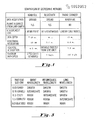
- Figure 1 is a chart which compares certain significant aspects of the two prior art techniques for geotechnic surveying with the instant invention.
- geotechnic exploration means exploration of the composition of the area down from the earth's surface to approximately 15 meters below the surface of the earth.
- an airborne platform mounts all of the equipment necessary for the operation of the process.
- a microwave generator which is connected to a suitable microwave antenna mounted outside of the aircraft body.
- the generator produces three sequential pulses, respectively of short, medium and long wavelengths and of frequencies in the range from about 100 to about 1500 mHz and desirably of about 280, 480 and 1300 mHz, for example.
- the pulses are preferably extremely short single cycle pulses of nanoseconds (order of magnitude) duration, and the airborne platform is desirably flown at a level of about one hundred feet above the ground, although higher elevations are possible.
- the platform can desirably fly at an airspeed of about sixty knots and desirably from about twenty to about one hundred knots, the airspeed is variable within wide ranges.
- the complexity of the required radar system is unnecessarily great (and therefore uneconomical) at airspeeds above one hundred knots.
- geotechnic exploration is accomplished by radiating a plurality of microwave pulses, preferably three pulses, from one airborne antenna or several antennae, to the ground. Part of each radiated pulse penetrates the ground and is absorbed or scattered and reflected by changes in the subsurface dielectric properties, at the interfaces between materials having different dielectric properties. The amount of radiation absorption and scattering will depend upon the distance travelled by the signal and the dielectric properties at the interface between layers of different materials.
- a detector mounted on the airborne platform senses the reflected signals, and has an empirically predetermined set of reflection criteria for each material interface. For example, with a set of incident pulses of given wavelengths, a sand above gravel interface would produce one result, 'a gravel above sand interface would provide a different result and a sand above ice interface yet another result. These results are approximately constant for specified incident wavelengths and types of materials. Therefore, when the three reflected or radiating pulses are sensed, the strength of those three pulses in relation to each other characterizes the nature of the two materials at each interface, after the reflected pulses have been filtered for extraneous noise, and adjusted to a standard to take into account any distortion which may have occurred.
- a cylindrical pipe on an uncorrected signal may appear as somewhat elliptical. If it is known that the pipe is cylindrical, then the elliptical image can be corrected to appear on a CRT screen or photograph as cylindrical and the correction then can be applied to the other portions of the output.
- the signal can also be stored in a suitable recording unit, in tape or disc form, for example, for future use.
- the process and apparatus of the invention are particularly intended for surveying frozen ground for the location of pipes before or after they are laid, they are also useful for other purposes.
- they may be used in archaelogical exploration for the purpose of locating covered archaelogical sites which may be suitable for archaelogical exploration. They may be used in temperate or tropical climates where underground pipes are to be dug to locate underground obstacles (such as boulders) which would interfere with the trench-digging process.
- the process and apparatus may also be used for other forms of geologic exploration.
- the process and apparatus could have military application for the location of underground silos.
- the process and apparatus could also be used to monitor a pipeline to detect thaw areas around the pipeline and anticipate the pipeline cracking which can result in the area of the thaw where the pipe section loses support.
- Another object of this invention is to provide a process for the accurate, airborne evaluation of sub-surface areas, so that sites for laying pipeline and sites in which pipelines have been laid in locales of extreme ground conditions may readily be surveyed.
- the altimeter unit which may be a commercially available unit, such as a Cullen ALT 50 radar altimeter.
- the altimeter readings are used as a basis for comparing the other three reflected waves, to determine the depths of varying reflected signals, by comparing the time taken to sense the reflected altimeter pulse, when it reflects from the upper surface of the area being surveyed, and the other pulses as they are reflected by sub-surface strata and materials.
- the altimeter cues the antenna receiver apparatus when to receive and the pulse generator when to send another pulse, in coordination with the position indicator (described below).
- the pulses are generated and received only when necessary to produce and sense the pulses desired to be measured and thus to avoid the necessity to account for much extraneous information which would otherwise be received.
- the typical types of materials to be encountered in doing geotechnic exploration in the Alaskan tundra comprises the following materials: ice (which may be salt water ice or fresh water ice); water or party thawed ice; sand; gravel; bedrock; and cobble (pieces of stone, larger than pebbles and smaller than bedrock).
- ice which may be salt water ice or fresh water ice
- water or party thawed ice water or party thawed ice
- sand gravel
- bedrock and cobble (pieces of stone, larger than pebbles and smaller than bedrock).
- cobble pieces of stone, larger than pebbles and smaller than bedrock
- The.practice of the invention is based on the fact that the energy loss pattern of radiant energy (such as microwave energy) dissemenated, for example, from an airborne platform at any area of cross-section of the sub-surface of the earth is dependent upon the dielectric characteristics of the interface between the different materials (if in fact there are different materials) at that area.
- the information which is used in the process of this invention about the reflected signal for each wavelength of incident microwave energy are the strength of the reflection and its phase.
- microwave pulses are used.
- One pulse is simply used as an altimeter, to determine the height of the airborne platform and to establish the depth of penetration of the earth by the three other microwave pulses in comparison to the first.
- pulses are selected which will uniquely describe, when measured alone and in combination, when reflected from a dielectric interface between any two materials being sensed, those two materials.
- the reflection characteristics which define a particular interface between materials are determined empirically. It has been determined that microwave pulses of 280, 480 and 1,300 mHz are particularly suitable in characterizing the Alaskan tundra, although other wavelengths and combinations are usable within the purview of this invention.
- One pulse is selected of relatively short wavelength, one of relatively long wavelength and one of'intermediate wavelength. The wavelengths are sufficiently different as not to be confused with each other and to be able accurately to characterize the particles being measured because of their different reflective characteristics.
- the return of each may be ratioed with the others to characterize approximately the soil types. These are determined from the "roughness" characteristic (degree of scattering) of the return. When the soil particle diameter is approximately five percent of the emitted wavelength, scattering begins to occur. The larger this percentage (particle diameter to wavelength), the more scattering there is.
- sand, silt, gravel, cobbles of different particle size. It is the particle size which determines the scattering characteristics of a material.
- three wavelengths can be used to establish a matrix as shown in Figure 3 to determine the scattering characteristics of the materials being evaluated. It is to be noted that the use of three different wavelengths of microwave energy are adequate for the task although more wavelengths could be used if more precision information were needed. It might be possible to use only one or two different wavelengths to characterize the materials but the computer program needed to analyze the backscatter would be needlessly complicated for the purpose.
- the matrix to be used is initially done empirically, but once done is accurate enough to be used in distant areas of similar geologic characteristics. This is to say, if a matrix is established for one end of a possible pipeline route being investigated and the route is 320 kilometers long, passing through the same general types of geologic formations, a single matrix is accurate enough to characterize the entire 320 kilometers.
- the matrix is initially developed by exposing (or taking an already-exposed) a cut through the area to be surveyed, so that the location of various particle size materials can be determined and measuring the backscattering of each wavelength separately from the predetermined strata.
- fresh water ice is transparent to microwave pulses (that is, they will pass through the ice and not reflect or scatter) but this feature is useful in characterizing ice formations, since they will show up as "voids" (i.e., no reflected information) on a print-out or photograph, etc. of the area being evaluated.
- voids i.e., no reflected information
- the ice mass has a large quantity of, say, silt suspended throughout a given area, this too will show up on the print-out as a hybrid between a solid ice mass and a solid mass of silt.
- the microwave pulses used in this invention are very "short,” which is to say they are on the order of several nanoseconds in duration or less. For example, if pulses having frequencies of 280, 480 and 1300 mHz are used, the duration of those pulses would respectively be 5 nanoseconds, 2 nanoseconds and 0.5 nanoseconds. Pulses of significantly longer duration would complicate the backscattering and require unnecessarily complex programs to analyze and even then would be less accurate than shorter pulses and produce visual (and electronic) images with less clear resolution. Although shorter pulse durations are better, there are technical and economic limits on the shortness of the pulses which can be achieved with current technology and at a realistic cost. However, should it become feasible to produce pulses of fractions of a nanosecond duration, at economical cost, these are desirable for use in the process of this invention.
- the time period which is allowed to elapse between each generation of a sequence of three pulses is on the order of about one thousand nanoseconds, in order to permit a clear delineation between each sequence of pulses.
- the sub-surface geography is characterized not only by the scattering effect of the various sizes of particles, but also by the time which it takes for the microwave pulses to be received, since the pulses attenuate significantly at each dielectric interface between materials of two different particle sizes.
- These reflected pulses then, not only characterize the nature of the materials at each dielectric interface, but also the depth of the interface below the aircraft (and therefore below the ground 'surface, since the altimeter pulses establish that level).
- Single cycle microwave pulses rather than multiple cycle pulses, are preferred in the practice of this invention, simply because single cycle pulses are easier and less expensive to create and, more important, are simpler and less expensive to receive and analyze.
- the single cycle pulses will produce optimum resolution and therefore clarity of the electronic pulse being received and therefore the visual image being created, so that the clearest and most easily read images are produced by the use of single cycle pulses.
- the airborne platform is preferably a helicopter, because of the ease with which a helicopter can be maintained at a relatively low level above the surface without creating undue hazards.
- a helicopter is a Bell Jet Ranger II helicopter.
- a helicopter is preferred to a standard take-off and landing (winged) aircraft, because it is safer and easier to handle at low speeds and low altitudes.
- helicopters are preferred, it is also within the purview of this invention to use conventional aircraft or airborne balloons, for example.
- the antenna which is used to radiate the microwave pulses which are utilized to describe the character of the sub-surface area being explored, and which also receives the reflected pulses.
- the antenna which is used to radiate the microwave pulses which are utilized to describe the character of the sub-surface area being explored, and which also receives the reflected pulses.
- two or more antennae can be utilized, it is preferred to use a single antenna, simply because it is easier and more convenient to use, mount, calibrate and handle one antenna. It is, however, possible to have plural antennae for the purpose of radiating the microwave pulses and even to have an additional antenna or antennae for sensing the reflected pulses.
- the antenna to be utilized is an important feature of the invention, and it is preferred to use a single cycle radiating antenna having a very broad band of frequencies of single cycle pulses which it can radiate and receive from about one hundred to about 1,500 mHz.
- the preferred type of antenna to be utilized is called a transverse electric mode (TEM) horn antenna. This type of antenna is not commercially available. However, given the desired charactistics of the antenna described herein, it is within the abilities of a skilled designer of radar antennae to design a TEM horn antenna which is suitable for use in the process of this invention.
- the criteria for designing the antenna are the frequency and duration of the microwave pulses to be sent and received, the beam width desired to be used (more fully discussed below) and the need for precision and clarity in radiating and receiving microwave pulses, so that, for example, the operation ' of the antenna will not be adversely affected by extraneous "noises.”
- the most desirable frequencies of the individual pulses desirably used in the process of this invention are respectively 280, 480 and 1,300 mHz. These frequencies are chosen arbitrarily within the. range of 100 to 1,500 mHz reasonably capable of being radiated by a broad band, single cycle radiating antenna, and are arbitrarily selected to be sufficiently different from each other so that they will not interfere with each other and so that they can reasonably be ratioed. However, other frequencies and frequency interrelationships can also be chosen. For examples, frequencies of 200, 800 and 1200 mHz are also theoretically usable. However, there may be biological reasons for not using particular wavelengths. For example, the use of 700 mHz could interfere with the functioning of the hearts of persons proximate to pulses, and this obviously would not be acceptable.
- Each set of frequencies chosen must be tested in use to determine the particular reflective characteristics which will be experienced at different material interfaces with the use of those frequencies. Once determined, those reflective characterists are reasonably accurate and may be used for the same types of materials at different locations where the precise composition of the individual materials at different locations may vary. For example, the reflective characteristics for 280, 480 and 1300 mHz signals at one location will produce one result when reflected from an interface of sand above gravel. However, the chemical composition (e.g., mineral traces) and physical characteristics (e.g. particle size) may vary from one location to another. Notwithstanding this the reflective characteristics from one location to the other are close enough that reasonably accurate readings can be taken without adjusting for those differences. Frequencies below 100 mHz and above 1500 mHz could be used in the process of this invention, but they would be technically too difficult to produce and use.
- the program which is established for operating the microwave detector 22 is established with a pre-determined set of reflection criteria for the three characterizing signals utilized in this process, in order accurately and carefully to characterize the materials being surveyed.
- the criteria for establishing the relationship between these three signals for each material are determined as described above.
- the wave length, frequency and number of cycles of the wave and number of waves being utilized are selected so that, upon reflection, they will provide a satisfactory indicia of the physical characteristics of the types of area being surveyed.
- the beam width of the antenna being utilized it is desirable to limit the beam width of the antenna being utilized, by controlling design of the antenna, for a beam angle and beam width at the ground as small as possible, for optimum clarity of image.
- the beam width and angle will be determined by the purpose for which the survey is being conducted. For example, if an existing pipeline is being surveyed there is no need for a wide beam, since all that is needed to be visualized is an area about 1 meter wider than the pipeline diameter.
- a beam angle of about 10° at an aircraft elevation of about thirty meters would be satisfactory. If a virgin area is being surveyed for possible installation of a pipeline, a wider terrain is desired to be studied and a beam angle of, say, 57° at an aircraft elevation of about thirty meters could be utilized.
- the particular angle utilized is not critical. Rather, the beam angle is selected which will provide the maximum amount of information with maximum clarity for the particular antenna, elevation of aircraft, etc. being utilized.
- the thickness of the beam is desirably about sixty centimeters.
- the system of this invention is preferably operated so that a reading is received for every linear three meters over which the platform flies, although this can easily be regulated to shorten or lengthen the distance, if desired, depending on the needs of the survey and the amount of data desired.
- the airspeed of the aircraft will have to be coordinated with the intervals of sub-surface cross-section being measured, to insure that the speed is slow enough to assure clear and accurate readings of the equipment and a clear and accurate output.
- an airspeed of about one hundred knots would be acceptable at a thirty meter elevation. If readings every 60 centimeters were desired, all other things being equal, an airspeed of about sixty knots would be preferred to obtain clear and accurate readings.
- the antenna that is utilized can be modified to take into account the elevation at which the airborne platform is to be operated.
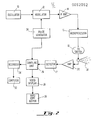
- FIG. 2 is a schematic outline of suitable process equipment. Other types of pulse radar systems might also be utilized.
- the apparatus illustrated is, however, believed to be the simplest and therefore most desirable.
- the apparatus of this invention comprises an oscillator 10, which produces the signals to be emitted by the antenna.
- Each signal is processed through a modulator 12, which may be a pin diode to double balanced mixer, and is then amplified in power amplifier 14, which is preferably a class A amplifier.
- power amplifier 14 which is preferably a class A amplifier.
- Each signal is then transmitted to the microprocessor 16 which controls the timing of the pulses, so that the pulses are radiated in a predetermined time sequence between the individual pulses of each series of three pulses and between the series of three pulses and between the series of threes pulses.
- the microprocessor output. is controlled by a TR (transmit-receive) switch 18, which is used to prevent receiver overloading during the transmit pulse.
- the transmitted pulses then energize the antenna 36, which radiates pulses of predetermined frequency, cyclicity, duration and timing vertically toward the ground in a predetermined beam shape.
- the antenna 36 is mounted suitably on an airborne platform (not shown) such as the underside of an helicopter and emits and receives the radiated pulses and the reflected pulses.
- the modulator 12 is regulated by a pulse generator 34, which also releases timed pulses into a sampling unit 24.
- the pulse generator 34 thus provides the control pulses for comparison of the returned pulses.
- the return pulses are received by antenna 36, which may be the same (and is illustrated as being the same) as the emitting antenna, and are suitably amplified by amplifier 20.
- the amplified signals are then transmitted to a detector diode 22, which senses and compares the signals with the pre-determined standards of the matrix illustrated in Figure 3, for example, so that the characteristics of the surface being measured are determined. These are then compared in sampling unit 24 and the output of the sampling unit is recorded on magnetic tape, for example, by recorder 26 for suitable permanent recording and later processing.
- the reflected and analyzed information is also provided in hard copy output in printer 30, so that the cross-section can be visually examined.
- a video display 28 may also be desired to provide an instantaneous visual reading for the persons in the aircraft. It is important to note that the output must be related to the particular points at which the cross-sections are being evaluated.
- the position indicator also regulates the pulse generator, so that pulses are generated on a geographic basis (e . g. every three meters) rather than on a time basis (e.g. every ten seconds) because changes in aircraft speed would produce erratically spaced readings, whereas uniformly spaced readings are preferred.
- the position indicator also produces an input to the data tape for coordinating the "pictures" of the sub-surface of the earth with their linear positions.
- the altimeter produces a "fourth" pulse in each sequence which is utilized when reflected to indicate the elevation of the aircraft above the ground. This is a reference for the measurement of the depth of the sub-surface dielectric interfaces measured by the reflection characteristics of the three pulse sequences.
- the data which is derived from the pulses received by the antenna 36 is preferably digitized. Once that data has been digitized, the machinery necessary to analyze it is within the purview of the skilled artisan. Briefly, the processing of the returned signals requires the supression of any noise or extraneous signals in the raw image which is produced at the antenna, a geometry correction, as described above, to correct the geometry of the returned signal so that any object which are perceived as different from their true shape (such as a round pipe which is sensed as oblong, can be corrected to make the ultimate image look more realistic.) The signal is then brightness corrected, so that the intensity of the image being recorded is the same, independent of the depth at which the image is sent, and the brightness corrected image is then color coded for the different variables.
- a geometry correction as described above
- Arbitrary colors are assigned, on a consistent basis, to the various components of the cross-section in the area, such as blue for boulders, red for cobble, green for pebbles, yellow for sand, etc.
- a Quantex D5301 or International Imaging System VIP 1776 color unit can correct for color and produce the desired photographic output.
- the image processing required is relatively standard technology. Computer processing of images is not new; the military and intelligence communities have employed digital image processing for a number of years. Any image may be thought of as consisting of tiny equal areas or picture elements arranged in regular rows and columns. The position of any picture element is determined by an x and a y coordinate. The brightness of each element is assigned a number ranging from black equals zero to white equals some higher number, usually in powers of 2.
- the picture may have 2 5 or 32 shades of gray.
- any picture may be described by a series of three numbers which are the x and y position coordinates of each picture element and the gray scale intensity value.
- This three dimensional array when fed into a computer core, may be easily manipulated by suitnblo software to display the desired variables.
- the following describes computer processing from the raw image through color-density assignments of a slow traverse of a segment of the Alyeska pipeline.
- the intensity of the radar return is assigned to a gray scale, no return being black, intense return being white.
- the helicopter clutter is the brightest feature of the image, consisting of alternating light and dark bands. Against this background, the surface of the ground appears dark. This noise is removed, allowing the sky to become dead black, or zero return, and eliminating the unwanted clutter in the rest of the image.
- the pipe is, at this point in the processing, unclear.
- the next step is to brightness correct, so that a feature near the surface has the same brightness as it would have if it were deep underground.
- the pipe is plainly seen, but, unfortunately, is the wrong shape.
- the image is, therefore, geometrically corrected to give a 1:1 horizontal to vertical aspect ratio.
- the pipe is now easily seen and geometrically "correct,” there are other areas in the image which appear as bright.
- the human eye is a color receptor; it does not distinguish well among shades of gray.
- the image is then color coded, black being black and white transformed into red, in rainbow fashion so that different areas (representing different particle sizes) of the image may be easily correlated. It is then possible to manipulate the image in any manner desired, for example to magnify the area containing the pipe to examine the fine structure not previously displayed.
- the purpose of computer 32 is to analyze the recorded data for any variable, such as time rate of change, which was not otherwise performed by the apparatus. It is useful to know the geologic changes, such as development or movement of permafrost, which occur around a pipeline from time to time.
- the computer can have stored the conditions of a given length of pipeline when surveyed in prior years by the process of the invention to allow trends in changing geologic conditions to be seen, so that corrective or preventive measures can be planned and taken.
- the invention constitutes an efficient, effective, rapid and relatively inexpensive process and apparatus for geotechnic survey.
- the process of the invention is not suitable at depths significantly in excess of fifteen meters because there is too much attenuation and scattering of the the microwaves and the antenna does not receive strong enough signals to permit their clear evaluation. This is because, if the microwave has an energy level of 100 dB about 7 dB is lost per meter (energy is lost both entering and leaving the ground) so that almost no reflected energy is sensed by the antenna. It is not possible to generate a pulse level, at the present state of the art, substantially in excess of 100 dB and which can conveniently and economically be handled on an airborne platform. However, if and when this limitation is no longer significant, still deeper levels of the earth's subsurface could be explored using the process and apparatus of this invention.
- the process and apparatus of the invention can be used to examine the sub-surface preparatory to digging an excavation to lay a pipeline.
- the process and apparatus may also be used after a pipeline has been laid to determine if any areas of ice around the pipeline have thawed, so that the stability of the pipeline is jeopardized.
- the process and apparatus of the invention can also be used for geological exploration for other materials, archeological exploration and other applications which will be obvious to the skilled artisan.
Landscapes
- Engineering & Computer Science (AREA)
- Remote Sensing (AREA)
- Radar, Positioning & Navigation (AREA)
- Physics & Mathematics (AREA)
- General Physics & Mathematics (AREA)
- Computer Networks & Wireless Communication (AREA)
- Electromagnetism (AREA)
- Life Sciences & Earth Sciences (AREA)
- Environmental & Geological Engineering (AREA)
- Geology (AREA)
- General Life Sciences & Earth Sciences (AREA)
- Geophysics (AREA)
- Geophysics And Detection Of Objects (AREA)
- Radar Systems Or Details Thereof (AREA)
Priority Applications (1)
| Application Number | Priority Date | Filing Date | Title |
|---|---|---|---|
| AT81401757T ATE12551T1 (de) | 1980-11-07 | 1981-10-30 | Verfahren und geraet zur geophysikalischen vermessung. |
Applications Claiming Priority (2)
| Application Number | Priority Date | Filing Date | Title |
|---|---|---|---|
| US06/204,781 US4381544A (en) | 1980-11-07 | 1980-11-07 | Process and apparatus for geotechnic exploration |
| US204781 | 2005-08-16 |
Publications (2)
| Publication Number | Publication Date |
|---|---|
| EP0052052A1 true EP0052052A1 (de) | 1982-05-19 |
| EP0052052B1 EP0052052B1 (de) | 1985-04-03 |
Family
ID=22759415
Family Applications (1)
| Application Number | Title | Priority Date | Filing Date |
|---|---|---|---|
| EP81401757A Expired EP0052052B1 (de) | 1980-11-07 | 1981-10-30 | Verfahren und Gerät zur geophysikalischen Vermessung |
Country Status (6)
| Country | Link |
|---|---|
| US (1) | US4381544A (de) |
| EP (1) | EP0052052B1 (de) |
| AT (1) | ATE12551T1 (de) |
| CA (1) | CA1175105A (de) |
| DE (2) | DE52052T1 (de) |
| MX (1) | MX150554A (de) |
Cited By (4)
| Publication number | Priority date | Publication date | Assignee | Title |
|---|---|---|---|---|
| WO1986003305A1 (en) * | 1984-11-28 | 1986-06-05 | Hans Hellsten | A method for radar mapping an area and a radar equipment to carry out the method |
| WO1992019989A1 (en) * | 1991-05-06 | 1992-11-12 | Peter John Elliott | Airborne transient electromagnetic method with ground loops |
| WO2015088205A1 (ko) * | 2013-12-09 | 2015-06-18 | 한국지질자원연구원 | 3차원 항공 자력 탐사 시스템 및 이를 이용한 3차원 항공 자력 탐사 방법 |
| CN115628049A (zh) * | 2022-09-29 | 2023-01-20 | 哈尔滨工业大学 | 一种用于星球物性随钻测量及水冰预判传感的装置 |
Families Citing this family (34)
| Publication number | Priority date | Publication date | Assignee | Title |
|---|---|---|---|---|
| US4581599A (en) * | 1982-02-05 | 1986-04-08 | Troxler Electronic Laboratories, Inc. | Nuclear radiation apparatus and methods for surveying physical characteristics and properties |
| US4581584A (en) * | 1984-02-03 | 1986-04-08 | Mobil Oil Corporation | Microwave electromagnetic borehole dipmeter |
| JPH0619471B2 (ja) * | 1984-03-30 | 1994-03-16 | 株式会社日立製作所 | 地中物体の識別方法および装置 |
| AU573436B2 (en) * | 1985-04-11 | 1988-06-09 | Nippon Steel Corporation | Electromagnetic measurement of particle sizes |
| US4910692A (en) * | 1985-10-09 | 1990-03-20 | Outram John D | Adaptive data logger |
| US4738377A (en) * | 1986-09-17 | 1988-04-19 | Demoss Jr John E | Method and apparatus for controlling rate of application of fertilizer |
| US4888720A (en) * | 1987-12-07 | 1989-12-19 | Fryer Glenn E | Tunnel measuring apparatus and method |
| US4937580A (en) * | 1988-05-19 | 1990-06-26 | Trustees Of Dartmouth College | Geophysical radar apparatus and method |
| US4973970A (en) * | 1989-07-14 | 1990-11-27 | General Atomics | Integrated automated system for waste site characterization |
| US5321612A (en) * | 1991-02-26 | 1994-06-14 | Swift Energy Company | Method for exploring for hydrocarbons utilizing three dimensional modeling of thermal anomalies |
| US5325095A (en) * | 1992-07-14 | 1994-06-28 | The United States Of America As Represented By The United States Department Of Energy | Stepped frequency ground penetrating radar |
| US5457394A (en) * | 1993-04-12 | 1995-10-10 | The Regents Of The University Of California | Impulse radar studfinder |
| US5420589A (en) * | 1993-06-07 | 1995-05-30 | Wells; C. T. | System for evaluating the inner medium characteristics of non-metallic materials |
| US5576973A (en) * | 1994-04-18 | 1996-11-19 | Radiodetection Limited | Apparatus and method for obtaining geographical positional data for an object located underground |
| US5682164A (en) * | 1994-09-06 | 1997-10-28 | The Regents Of The University Of California | Pulse homodyne field disturbance sensor |
| US5592170A (en) * | 1995-04-11 | 1997-01-07 | Jaycor | Radar system and method for detecting and discriminating targets from a safe distance |
| US5672820A (en) * | 1995-05-16 | 1997-09-30 | Boeing North American, Inc. | Object location identification system for providing location data of an object being pointed at by a pointing device |
| US5845261A (en) * | 1996-06-12 | 1998-12-01 | Mcabian; Adi Jacob | Interactive multi-media presentation and marketing apparatus |
| WO1999059002A2 (en) * | 1998-05-12 | 1999-11-18 | Lockheed Martin Corporation | System and process for optimizing gravity gradiometer measurements |
| GB9921042D0 (en) | 1999-09-07 | 1999-11-10 | Stove George C | Radar apparatus for spectrometric analysis and a method of performing spectrometric analysis of a substance |
| NL1013661C2 (nl) * | 1999-11-24 | 2001-06-14 | Univ Delft Tech | Gronddoordringende radarinrichting en werkwijze voor het detecteren van een object op of onder een grondoppervlak. |
| US9372279B2 (en) * | 2001-05-08 | 2016-06-21 | Shuji Mori | Method of determining petroleum location |
| US6549012B2 (en) * | 2001-06-07 | 2003-04-15 | Larry G. Stolarczyk | Radio system for characterizing and outlining underground industrial developments and facilities |
| US20030030582A1 (en) * | 2001-08-10 | 2003-02-13 | Vickers Roger S. | Environment measurement methods, systems, media, signals and data structures |
| DE10346816A1 (de) * | 2003-10-06 | 2005-05-04 | Rst Gmbh | Verfahren zum Ermitteln von Unregelmässigkeiten in Bodenformationen |
| US8290765B2 (en) * | 2005-03-16 | 2012-10-16 | Research In Motion Limited | Handheld electronic device with reduced keyboard and associated method of providing improved disambiguation |
| CN102662186B (zh) * | 2012-03-29 | 2016-08-17 | 中国国土资源航空物探遥感中心 | 一种航空物探异常追踪系统及其追踪方法 |
| US9140785B2 (en) * | 2012-12-07 | 2015-09-22 | Harris Corporation | Method and system using coordinated airborne and ground platforms for detecting oil covered by ice |
| US10884128B2 (en) | 2015-03-24 | 2021-01-05 | Utilis Israel Ltd. | System and method of underground water detection |
| US9945942B2 (en) | 2015-03-24 | 2018-04-17 | Utilis Israel Ltd. | System and method of underground water detection |
| US10514341B2 (en) | 2015-03-24 | 2019-12-24 | Utilis Israel Ltd. | System and method of detecting underground gas leakage |
| US10976461B2 (en) * | 2017-10-17 | 2021-04-13 | California Institute Of Technology | Sub-surface imaging of dielectric structures and voids via narrowband electromagnetic resonance scattering |
| CN118091628B (zh) * | 2024-04-25 | 2024-08-06 | 山东省煤田地质局第三勘探队 | 一种探测煤层结构图形的雷达装置以及方法 |
| CN119952968B (zh) * | 2025-04-09 | 2025-06-27 | 同济大学 | 一种用于3d打印的冻融敏感性复合材料的设计方法 |
Citations (4)
| Publication number | Priority date | Publication date | Assignee | Title |
|---|---|---|---|---|
| US2901747A (en) * | 1946-06-07 | 1959-08-25 | Philco Corp | Color identification in radar systems |
| FR1475996A (fr) * | 1965-03-12 | 1967-04-07 | Barringer Research Ltd | Procédé et appareil pour identifier les caractéristiques d'une cible depuis un poste éloigné de cette cible |
| US3523292A (en) * | 1967-10-18 | 1970-08-04 | Sperry Rand Corp | Radar target-identifying apparatus |
| US3806795A (en) * | 1972-01-03 | 1974-04-23 | Geophysical Survey Sys Inc | Geophysical surveying system employing electromagnetic impulses |
Family Cites Families (11)
| Publication number | Priority date | Publication date | Assignee | Title |
|---|---|---|---|---|
| US3351936A (en) * | 1966-01-10 | 1967-11-07 | Texas Instruments Inc | Method and apparatus for exploring the earth with electromagnetic energy |
| US3490032A (en) * | 1966-12-08 | 1970-01-13 | Gulf Research Development Co | Method and apparatus utilizing a pair of spaced magnetometers for making magnetic surveys |
| US3753134A (en) * | 1967-03-27 | 1973-08-14 | Chevron Res | Method of mapping permafrost by electromagnetic radiation to indicate thickness thereof |
| US3828245A (en) * | 1967-03-27 | 1974-08-06 | Chevron Res | Method of mapping bedding interfaces in a permafrost zone of an earth formation by electromagnetic radiation |
| US3604660A (en) * | 1969-12-04 | 1971-09-14 | Rotorcraft Gyro Support System | Helicopter sensor platform assembly |
| US3665466A (en) * | 1970-03-20 | 1972-05-23 | Exxon Production Research Co | Determination of ice thickness |
| US3663953A (en) * | 1970-09-17 | 1972-05-16 | Commissariat Energie Atomique | Helicopter carried magnetometer assembly compensated for the parasitic field of the helicopter |
| US3808519A (en) * | 1972-06-13 | 1974-04-30 | Commissariat Energie Atomique | Method and device for determining the depth of a magnetic anomaly |
| US3976937A (en) * | 1973-04-16 | 1976-08-24 | Atlantic Richfield Company | Method and apparatus for recording position of sensor in airborne magnetic surveying |
| US4100481A (en) * | 1977-01-21 | 1978-07-11 | Mobil Oil Corporation | Hydrocarbon exploration with display of re-radiated and reflected microwave energy |
| US4308499A (en) * | 1978-05-26 | 1981-12-29 | Kali Und Salz A.G. | Method utilizing electromagnetic wave pulses for determining the locations of boundary surfaces of underground mineral deposits |
-
1980
- 1980-11-07 US US06/204,781 patent/US4381544A/en not_active Expired - Lifetime
-
1981
- 1981-10-30 DE DE198181401757T patent/DE52052T1/de active Pending
- 1981-10-30 DE DE8181401757T patent/DE3169730D1/de not_active Expired
- 1981-10-30 EP EP81401757A patent/EP0052052B1/de not_active Expired
- 1981-10-30 AT AT81401757T patent/ATE12551T1/de not_active IP Right Cessation
- 1981-11-05 CA CA000389533A patent/CA1175105A/en not_active Expired
- 1981-11-06 MX MX190001A patent/MX150554A/es unknown
Patent Citations (4)
| Publication number | Priority date | Publication date | Assignee | Title |
|---|---|---|---|---|
| US2901747A (en) * | 1946-06-07 | 1959-08-25 | Philco Corp | Color identification in radar systems |
| FR1475996A (fr) * | 1965-03-12 | 1967-04-07 | Barringer Research Ltd | Procédé et appareil pour identifier les caractéristiques d'une cible depuis un poste éloigné de cette cible |
| US3523292A (en) * | 1967-10-18 | 1970-08-04 | Sperry Rand Corp | Radar target-identifying apparatus |
| US3806795A (en) * | 1972-01-03 | 1974-04-23 | Geophysical Survey Sys Inc | Geophysical surveying system employing electromagnetic impulses |
Non-Patent Citations (2)
| Title |
|---|
| Mechanical Engineering, Volume 100, No. 6, June 1978 New York (US) "Subsurface Radar Camera", page 54 * |
| Proceedings of the IEEE, Volume 62, No. 1, January 1974, New York (US) L.A. ROBINSON et al. "Location and Recognition of Discontinuities in Dielectric Media using Synthetic RF Pulses" pages 36-44 * |
Cited By (7)
| Publication number | Priority date | Publication date | Assignee | Title |
|---|---|---|---|---|
| WO1986003305A1 (en) * | 1984-11-28 | 1986-06-05 | Hans Hellsten | A method for radar mapping an area and a radar equipment to carry out the method |
| US4866446A (en) * | 1984-11-28 | 1989-09-12 | Hellsten Hans O | Method for radar mapping an area and a radar equipment to carry out the method |
| WO1992019989A1 (en) * | 1991-05-06 | 1992-11-12 | Peter John Elliott | Airborne transient electromagnetic method with ground loops |
| US5610523A (en) * | 1991-05-06 | 1997-03-11 | Elliot; Peter J. | Method and apparatus of interrogating a volume of material beneath the ground including an airborne vehicle with a detector being synchronized with a generator in a ground loop |
| WO2015088205A1 (ko) * | 2013-12-09 | 2015-06-18 | 한국지질자원연구원 | 3차원 항공 자력 탐사 시스템 및 이를 이용한 3차원 항공 자력 탐사 방법 |
| US10185048B2 (en) | 2013-12-09 | 2019-01-22 | Korea Institute Of Geoscience And Mineral Resources | 3-dimensional airborne magnetic survey system and 3-dimensional airborne magnetic survey method using the same |
| CN115628049A (zh) * | 2022-09-29 | 2023-01-20 | 哈尔滨工业大学 | 一种用于星球物性随钻测量及水冰预判传感的装置 |
Also Published As
| Publication number | Publication date |
|---|---|
| MX150554A (es) | 1984-05-28 |
| EP0052052B1 (de) | 1985-04-03 |
| CA1175105A (en) | 1984-09-25 |
| ATE12551T1 (de) | 1985-04-15 |
| DE52052T1 (de) | 1983-01-05 |
| US4381544A (en) | 1983-04-26 |
| DE3169730D1 (en) | 1985-05-09 |
Similar Documents
| Publication | Publication Date | Title |
|---|---|---|
| US4381544A (en) | Process and apparatus for geotechnic exploration | |
| US8508402B2 (en) | System and method for detecting, locating and identifying objects located above the ground and below the ground in a pre-referenced area of interest | |
| Utsi | Ground penetrating radar: theory and practice | |
| US6119376A (en) | Excavator data acquisition and control system and process | |
| Xie et al. | Building simplified uncertainty models of object depth measurement by ground penetrating radar | |
| US3651395A (en) | Method for exploring the surface of the earth with electromagnetic energy including comparing reradiation characteristics of gases to locate escaping hydrocarbon gases at the surface emitted by deposits of petroleum and/or natural gas at depth | |
| Annan et al. | Simplified GPR beam model for survey design | |
| Carpenter et al. | Geophysical Character of Buried Sinkholes on the Oak Ridge Reservation, Tennessee (Presented at SAGEEP95 in Orlando, FL) | |
| CN118501958A (zh) | 一种地下暗井探测方法 | |
| RU2054702C1 (ru) | Способ поиска залежей углеводородов | |
| Takahashi | ISRM suggested methods for land geophysics in rock engineering | |
| US3828245A (en) | Method of mapping bedding interfaces in a permafrost zone of an earth formation by electromagnetic radiation | |
| Solla et al. | Ground penetrating radar: Fundamentals, methodologies and applications in structures and infrastructure | |
| Vrbancich et al. | Airborne electromagnetic bathymetry of Sydney Harbour | |
| Bonomo et al. | Pipe-flange detection with GPR | |
| RU2647221C2 (ru) | Способ обнаружения границы локального подземного торфяного пожара и способ доставки на поверхность торфяника портативного георадара и приёма данных зондирования в режиме реального времени | |
| Parwatiningtyas | Application of the GPR (Ground Penetration Radar) method for soil investigation and building structure analysis test | |
| KR200188711Y1 (ko) | 지피알 시스템을 이용한 지하매설물 탐측장치의 안테나 구조 | |
| Smith et al. | Helicopter electromagnetic and magnetic geophysical survey data, portions of the North Platte and South Platte Natural Resources Districts, western Nebraska, May 2009 | |
| Luthfin et al. | Identification of Cavity Zone Under the Surface of the Badut Temple Foundation Using the GPR (Ground Penetrating Radar) Method | |
| Swinnen et al. | Seismics for tunneling applications in soft soil: Adapted focusing techniques | |
| McGill | Ground penetrating radar investigations with applications for southern Arizona | |
| Plichta et al. | Lidar and ground penetrating radar data in determining road surface conditions and geological characteristics of unstable soils | |
| Cameron et al. | Development and application of airborne gound penetrating radar for environmental disciplines | |
| KR200194860Y1 (ko) | 지피알 시스템을 이용한 지하매설물 탐측장치의 수신전치 증폭기 |
Legal Events
| Date | Code | Title | Description |
|---|---|---|---|
| PUAI | Public reference made under article 153(3) epc to a published international application that has entered the european phase |
Free format text: ORIGINAL CODE: 0009012 |
|
| AK | Designated contracting states |
Designated state(s): AT BE CH DE FR GB IT LI LU NL SE |
|
| TCNL | Nl: translation of patent claims filed | ||
| ITCL | It: translation for ep claims filed |
Representative=s name: JACOBACCI CASETTA & PERANI S.P.A. |
|
| TCAT | At: translation of patent claims filed | ||
| DET | De: translation of patent claims | ||
| 17P | Request for examination filed |
Effective date: 19821115 |
|
| RAP1 | Party data changed (applicant data changed or rights of an application transferred) |
Owner name: NORTHWEST ENERGY COMPANY |
|
| RAP1 | Party data changed (applicant data changed or rights of an application transferred) |
Owner name: NORTHWEST ENERGY COMPANY |
|
| ITF | It: translation for a ep patent filed | ||
| GRAA | (expected) grant |
Free format text: ORIGINAL CODE: 0009210 |
|
| AK | Designated contracting states |
Designated state(s): AT BE CH DE FR GB IT LI LU NL SE |
|
| REF | Corresponds to: |
Ref document number: 12551 Country of ref document: AT Date of ref document: 19850415 Kind code of ref document: T |
|
| REF | Corresponds to: |
Ref document number: 3169730 Country of ref document: DE Date of ref document: 19850509 |
|
| ET | Fr: translation filed | ||
| PG25 | Lapsed in a contracting state [announced via postgrant information from national office to epo] |
Ref country code: AT Effective date: 19851030 |
|
| PG25 | Lapsed in a contracting state [announced via postgrant information from national office to epo] |
Ref country code: SE Effective date: 19851031 Ref country code: LU Free format text: LAPSE BECAUSE OF NON-PAYMENT OF DUE FEES Effective date: 19851031 Ref country code: LI Effective date: 19851031 Ref country code: CH Effective date: 19851031 Ref country code: BE Effective date: 19851031 |
|
| PLBE | No opposition filed within time limit |
Free format text: ORIGINAL CODE: 0009261 |
|
| STAA | Information on the status of an ep patent application or granted ep patent |
Free format text: STATUS: NO OPPOSITION FILED WITHIN TIME LIMIT |
|
| 26N | No opposition filed | ||
| BERE | Be: lapsed |
Owner name: NORTHWEST ENERGY CY Effective date: 19851031 |
|
| PG25 | Lapsed in a contracting state [announced via postgrant information from national office to epo] |
Ref country code: NL Effective date: 19860501 |
|
| GBPC | Gb: european patent ceased through non-payment of renewal fee | ||
| PG25 | Lapsed in a contracting state [announced via postgrant information from national office to epo] |
Ref country code: FR Free format text: LAPSE BECAUSE OF NON-PAYMENT OF DUE FEES Effective date: 19860630 |
|
| REG | Reference to a national code |
Ref country code: CH Ref legal event code: PL |
|
| PG25 | Lapsed in a contracting state [announced via postgrant information from national office to epo] |
Ref country code: DE Effective date: 19860701 |
|
| NLV4 | Nl: lapsed or anulled due to non-payment of the annual fee | ||
| REG | Reference to a national code |
Ref country code: FR Ref legal event code: ST |
|
| PG25 | Lapsed in a contracting state [announced via postgrant information from national office to epo] |
Ref country code: GB Effective date: 19881118 |
|
| EUG | Se: european patent has lapsed |
Ref document number: 81401757.0 Effective date: 19860805 |