EP0052056B1 - Verfahren zur Herstellung eines Bleches mit selektiver Absorption der Sonnenbestrahlung und dieser Gegenstand - Google Patents
Verfahren zur Herstellung eines Bleches mit selektiver Absorption der Sonnenbestrahlung und dieser Gegenstand Download PDFInfo
- Publication number
- EP0052056B1 EP0052056B1 EP81401770A EP81401770A EP0052056B1 EP 0052056 B1 EP0052056 B1 EP 0052056B1 EP 81401770 A EP81401770 A EP 81401770A EP 81401770 A EP81401770 A EP 81401770A EP 0052056 B1 EP0052056 B1 EP 0052056B1
- Authority
- EP
- European Patent Office
- Prior art keywords
- selective absorption
- film
- sheet
- solar radiation
- stainless steel
- Prior art date
- Legal status (The legal status is an assumption and is not a legal conclusion. Google has not performed a legal analysis and makes no representation as to the accuracy of the status listed.)
- Expired
Links
Images




Classifications
-
- C—CHEMISTRY; METALLURGY
- C23—COATING METALLIC MATERIAL; COATING MATERIAL WITH METALLIC MATERIAL; CHEMICAL SURFACE TREATMENT; DIFFUSION TREATMENT OF METALLIC MATERIAL; COATING BY VACUUM EVAPORATION, BY SPUTTERING, BY ION IMPLANTATION OR BY CHEMICAL VAPOUR DEPOSITION, IN GENERAL; INHIBITING CORROSION OF METALLIC MATERIAL OR INCRUSTATION IN GENERAL
- C23C—COATING METALLIC MATERIAL; COATING MATERIAL WITH METALLIC MATERIAL; SURFACE TREATMENT OF METALLIC MATERIAL BY DIFFUSION INTO THE SURFACE, BY CHEMICAL CONVERSION OR SUBSTITUTION; COATING BY VACUUM EVAPORATION, BY SPUTTERING, BY ION IMPLANTATION OR BY CHEMICAL VAPOUR DEPOSITION, IN GENERAL
- C23C22/00—Chemical surface treatment of metallic material by reaction of the surface with a reactive liquid, leaving reaction products of surface material in the coating, e.g. conversion coatings, passivation of metals
- C23C22/05—Chemical surface treatment of metallic material by reaction of the surface with a reactive liquid, leaving reaction products of surface material in the coating, e.g. conversion coatings, passivation of metals using aqueous solutions
- C23C22/06—Chemical surface treatment of metallic material by reaction of the surface with a reactive liquid, leaving reaction products of surface material in the coating, e.g. conversion coatings, passivation of metals using aqueous solutions using aqueous acidic solutions with pH less than 6
- C23C22/24—Chemical surface treatment of metallic material by reaction of the surface with a reactive liquid, leaving reaction products of surface material in the coating, e.g. conversion coatings, passivation of metals using aqueous solutions using aqueous acidic solutions with pH less than 6 containing hexavalent chromium compounds
-
- F—MECHANICAL ENGINEERING; LIGHTING; HEATING; WEAPONS; BLASTING
- F24—HEATING; RANGES; VENTILATING
- F24S—SOLAR HEAT COLLECTORS; SOLAR HEAT SYSTEMS
- F24S70/00—Details of absorbing elements
- F24S70/20—Details of absorbing elements characterised by absorbing coatings; characterised by surface treatment for increasing absorption
- F24S70/225—Details of absorbing elements characterised by absorbing coatings; characterised by surface treatment for increasing absorption for spectrally selective absorption
-
- F—MECHANICAL ENGINEERING; LIGHTING; HEATING; WEAPONS; BLASTING
- F24—HEATING; RANGES; VENTILATING
- F24S—SOLAR HEAT COLLECTORS; SOLAR HEAT SYSTEMS
- F24S70/00—Details of absorbing elements
- F24S70/20—Details of absorbing elements characterised by absorbing coatings; characterised by surface treatment for increasing absorption
- F24S70/25—Coatings made of metallic material
-
- Y—GENERAL TAGGING OF NEW TECHNOLOGICAL DEVELOPMENTS; GENERAL TAGGING OF CROSS-SECTIONAL TECHNOLOGIES SPANNING OVER SEVERAL SECTIONS OF THE IPC; TECHNICAL SUBJECTS COVERED BY FORMER USPC CROSS-REFERENCE ART COLLECTIONS [XRACs] AND DIGESTS
- Y02—TECHNOLOGIES OR APPLICATIONS FOR MITIGATION OR ADAPTATION AGAINST CLIMATE CHANGE
- Y02E—REDUCTION OF GREENHOUSE GAS [GHG] EMISSIONS, RELATED TO ENERGY GENERATION, TRANSMISSION OR DISTRIBUTION
- Y02E10/00—Energy generation through renewable energy sources
- Y02E10/40—Solar thermal energy, e.g. solar towers
-
- Y—GENERAL TAGGING OF NEW TECHNOLOGICAL DEVELOPMENTS; GENERAL TAGGING OF CROSS-SECTIONAL TECHNOLOGIES SPANNING OVER SEVERAL SECTIONS OF THE IPC; TECHNICAL SUBJECTS COVERED BY FORMER USPC CROSS-REFERENCE ART COLLECTIONS [XRACs] AND DIGESTS
- Y10—TECHNICAL SUBJECTS COVERED BY FORMER USPC
- Y10S—TECHNICAL SUBJECTS COVERED BY FORMER USPC CROSS-REFERENCE ART COLLECTIONS [XRACs] AND DIGESTS
- Y10S126/00—Stoves and furnaces
- Y10S126/907—Absorber coating
- Y10S126/908—Particular chemical
-
- Y—GENERAL TAGGING OF NEW TECHNOLOGICAL DEVELOPMENTS; GENERAL TAGGING OF CROSS-SECTIONAL TECHNOLOGIES SPANNING OVER SEVERAL SECTIONS OF THE IPC; TECHNICAL SUBJECTS COVERED BY FORMER USPC CROSS-REFERENCE ART COLLECTIONS [XRACs] AND DIGESTS
- Y10—TECHNICAL SUBJECTS COVERED BY FORMER USPC
- Y10T—TECHNICAL SUBJECTS COVERED BY FORMER US CLASSIFICATION
- Y10T428/00—Stock material or miscellaneous articles
- Y10T428/12—All metal or with adjacent metals
- Y10T428/12493—Composite; i.e., plural, adjacent, spatially distinct metal components [e.g., layers, joint, etc.]
- Y10T428/12535—Composite; i.e., plural, adjacent, spatially distinct metal components [e.g., layers, joint, etc.] with additional, spatially distinct nonmetal component
- Y10T428/12542—More than one such component
- Y10T428/12549—Adjacent to each other
-
- Y—GENERAL TAGGING OF NEW TECHNOLOGICAL DEVELOPMENTS; GENERAL TAGGING OF CROSS-SECTIONAL TECHNOLOGIES SPANNING OVER SEVERAL SECTIONS OF THE IPC; TECHNICAL SUBJECTS COVERED BY FORMER USPC CROSS-REFERENCE ART COLLECTIONS [XRACs] AND DIGESTS
- Y10—TECHNICAL SUBJECTS COVERED BY FORMER USPC
- Y10T—TECHNICAL SUBJECTS COVERED BY FORMER US CLASSIFICATION
- Y10T428/00—Stock material or miscellaneous articles
- Y10T428/12—All metal or with adjacent metals
- Y10T428/12493—Composite; i.e., plural, adjacent, spatially distinct metal components [e.g., layers, joint, etc.]
- Y10T428/12771—Transition metal-base component
- Y10T428/12861—Group VIII or IB metal-base component
- Y10T428/12951—Fe-base component
- Y10T428/12958—Next to Fe-base component
Definitions
- the present invention relates to a method for producing a selective absorption sheet of solar radiation made of stainless steel and having an improved selective absorption property of solar radiation as well as having improved properties in rust proofing, weldability, heat resistance and the like.
- the present invention is also related to a selective absorption sheet of solar radiation made of stainless steel and obtainable by the method mentioned above.
- the selective absorption sheet of solar radiation is required to have a good selective absorption property of the solar radiation, i.e. a good energy-transmission property within the wave length of solar light and the lowest possible energy emission of solar light having a wave length range corresponding to that of a radiation spectrum of a black body at 100°C.
- a good selective absorption property of the solar radiation i.e. a good energy-transmission property within the wave length of solar light and the lowest possible energy emission of solar light having a wave length range corresponding to that of a radiation spectrum of a black body at 100°C.
- the method for forming a selective absorption film on a stainless steel sheet proposed in USP No. 3,210,200 is one using as chemical conversion bath an acidic oxidizing bath of a chromic anhydride-sulfuric acid solution.
- the method and product by means of an acidic oxidizing bath proposed in USP No. 4,097,311 discloses using a solution of sulfuric acid with sodium bichromate or potassium bichromate, in which the concentration of the sodium or potassium bichromate is from 100 to 400 g/I and the concentration of the sulfuric acid is from 150 to 800 g/I, preferably 400 to 800 g/I.
- the metal sheet pieces cut into a predetermined dimension are shaped and welded to each other.
- the assembled selective absorption sheet pieces are then provided with a film on the surface thereof.
- the chemical conversion treatment of the stainless steel sheet for forming the selective absorption film is carried out conventionally by dipping the shaped and assembled sheet pieces into the chemical conversion bath, so that the vessel containing the chemical conversion bath is required to have an extra space for the heat collector as well as a space for the volume of the sheet pieces.
- the apparent specific gravity of the heat collector is decreased, which leads the dipping operation to be complicated.
- the chemical conversion solution may be left in the clearances between the assembled sheet pieces after the chemical conversion or coloring treatment, so that rinsing of the heat collector after the chemical conversion treatment becomes difficult.
- the coating method of the individual shaped sheet pieces is of a low production efficiency, because the shaped sheet pieces are coated and baked separately.
- the problems of the conventional methods could be solved and the production cost of the heat collector could be decreased considerably, if the finished article, i.e. the solar collector, could be manufactured by preliminarily carrying out the coating or chemical conversion of a coil or cut sheets, then shaping and welding the coil or cut sheets with the coating film.
- most welding methods of the selective absorption sheet pieces presently carried out in practice are based on electric resistance heating, such as in the seam welding and spot welding.
- the selective absorption films presently used in practice are the acryl resin film with the mixed black pigments in the case of the black coating film and is mainly comprised of oxides or hydroxides of chromium or iron in the case of the chemical conversion film described hereinabove. These films are electrically insulating or semiconductive, so that their high electric resistance makes the seam or spot welding based on the electric resistance heating difficult.
- the first mentioned object is achieved in the present invention by providing a method for producing a selective absorption sheet of solar radiation, in which a stainless steel sheet is subjected to a chemical conversion treatment in an acidic oxidizing bath, which contains from 70 to 90 g/I of at least one member selected from the group consisting of sodium bichromate and potassium bichromate and from 550 to 630 g/I of sulfuric acid, at a temperature range of from 80°C to boiling point of the acidic oxidizing bath (approximately 115°C), thereby forming on the stainless steel sheet a film of metal oxides or metal hydroxides, in which film the metal is dispersed with a concentration gradient from the surface toward the interior of the film.
- an acidic oxidizing bath which contains from 70 to 90 g/I of at least one member selected from the group consisting of sodium bichromate and potassium bichromate and from 550 to 630 g/I of sulfuric acid, at a temperature range of from 80°C to boiling point of the acidic oxidizing
- a selective absorption sheet of solar radiation comprising a base made of a stainless steel sheet and a selective absorption film which has a low electric resistance, and which comprises metal oxides or metal hydroxides finely dispersed in said film with a concentration gradient of metal from the surface toward the interior of said film.
- the stainless steel sheet in order to form a selective absorption film on a stainless steel sheet, the stainless steel sheet is dipped into an acidic oxidizing bath having the composition of:
- the industrial chemical purity of bichromates and sulfuric acid may be sufficient for the present invention, and tap water can be used for adjusting the bath concentration.
- the temperature of the chemical conversion bath is from 80°C to the boiling point of the acidic oxidizing bath and is preferably from 105 to 110°C.
- the chemical conversion treatment time is dependent on the bath composition and bath temperature of chemical conversion treatment, but usually it ranges from approximately 10 to 30 minutes. A bath temperature of below 80°C is impractical, since a long time is necessary for forming a film having an excellent selective absorption property.
- the results of accelerated tests for rust proofing of the film, which was formed by the chemical conversion treatment providing the highest selective absorption property, are illustrated.
- the grades of rust proofing were determined by the number of rust points or spots formed after dipping into the acidic oxidizing bath.
- the rust proofing equivalent to that of the blank sheet could be provided by the bath composition of chemical conversion treatment having a sodium bichromate concentration range of from 50 to 100 g/I and the sulfuric acid concentration range of from 500 to 850 g/I.
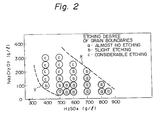
- the rust proofing of the selective absorption film can also be determined by the etching degree of grain boundaries of the stainless steel.
- the results of the microscopic observation of the stainless steel, which has been subjected to the chemical conversion treatment, is shown in Figure 2.
- the present inventors discovered that the originating points or spots of rust correspond to the location, where the grain boundaries or non metallic inclusions are locally dissolved into the acidic oxidizing bath so that minute pores are formed.
- the claimed concentration range of the sodium bichromate and sulfuric acid is determined to provide the bath composition of the chemical conversion treatment, in which range the possibility of forming the originating points of rust is very low.
- An electron microscopic observation of carbon replica demonstrates minute pores which are fewer in the present invention than in the known method. The minute pores are not more than fifty per p M 2 on the surface of film in the present invention, while the minute pores are about five hundreds per IJm2 in the known method.
- the selective absorption property of a solar radiation is largely dependent upon the bath composition of the chemical conversion treatment.
- the solar radiation has an energy distribution as shown by the curve H in Figure 3.
- the selective absorption property of solar radiation has such a characteristic that the absorption property is high at the short-wave length side of from 0.3 to 2.5 pm, where the solar energy is concentrated, while absorption property is low, i.e. reflectance is high, at the long-wave length side of more than 2.5 ⁇ m, thereby preventing emission of heat.
- the broken line G in Figure 3 indicates the ideal selective absorptance curve which is obtained by a theoretical calculation.
- the curve F indicates the measured absorptance of an example of the selective absorption film according to the present invention.
- the heat collecting property of a heat collecting surface is indicated by an average absorptance taking into consideration the solar energy distribution.
- a parameter used for evaluating the selective absorption property is such that the emission of heat is taken into consideration.
- the parameter usually used for evaluating the selective absorption property is the ratio of absorptance to emittance. This parameter is however impractical, because it varies largely in accordance with the change of emittance, when the emittance is lower than 20%, which however does not appreciably exert an influence upon the heat collecting property at a relatively low heat collecting temperature of up to 100°C according to the aim of the present invention.
- the present inventors devised the r value explained below, as a new parameter for evaluating the selective absorption property of solar radiation and measured the r value of the selective absorption sheets obtained by the method of present invention.
- the r value disclosed herein is essentially the same as r value disclosed in Japanese Patent Application No. 53-71000 (Japanese Laid Open Patent Application No. 54-163440) but is slightly modified from this application.
- the r value previously disclosed corresponds to P of the formula (4) shown, below, and has a corelationship with the herein disclosed r value as indicated by formula (5) shown below. Both r values are, therefore, proportional to one another.
- the herein disclosed r value is characterized by easiness in measurement and good sensitivity.
- the herein disclosed r value hereinafter simply referred to as the r value, can be measured by the method disclosed in Japanese Patent Application No. 53-71000 (Japanese Laid Open Patent Application No. 54-163440) and by using as an additional standard sample a white plate.
- the r value shown in formula (1) is proportional to the maximum obtainable temperature of a selective absorption-heat collecting sheet, which temperature is standardized by the maximum obtainable temperature of a heat collecting sheet with black coating.
- the characteristic values of the selective absorption-heat collecting sheet and the heat collecting sheet with black coating are defined by formulas (2) and (3), respectively.
- the parameter for evaluating the selective absorption property is defined by formula (4).
- the r value shown in (1) has the same relationship with P as is shown in formula (5).
- a and b are constants.
- P which indicates the selective absorption property, is proportional to the r value shown in formula (1), and, therefore, the higher the r value is, the better selective absorption property.
- the r value can be obtained by exposing a selective absorption-heat collecting surface, a white sheet and a black sheet to solar light and then measuring the surface temperature of the respective sheets.
- Figure 4 and Figure 5 illustrate the dependency of the previously used absorptance and the r value (a parameter for evaluating the selective absorption as explained hereinabove), respectively, upon the bath composition of chemical conversion treatment.
- the previously used absorptance and r value exhibit a dependency substantially coincident with one another and peak values at a bath composition of 80 g/I of sodium bichromate and 600 g/I.
- the selective absorption property in terms of the previously used absorptance and the r value is decreased as the contour lines showing concentrations of sodium bichromate and sulfuric acid are distant from those exhibiting the peak value mentioned above.
- the r value is preferably approximately 1.80 or more for the selective absorption property.
- the bath composition of chemical conversion treatment is selected so that the sodium or potassium bichromate ranges from 70 to 90 g/I and sulfuric acid ranges from 550 to 630 g/l.
- Figure 6 illustrates how the color tone of the heat-collecting selective absorption sheet varies in accordance with the bath composition of the chemical conversion treatment.
- the color tone is blackish when the bath composition of chemical conversion treatment falls within the range of the present invention.
- the change of color tone or film thickness in accordance with the change of the composition mentioned above is very slight as compared with that in using the known composition of USP No. 4,097,311. Also, it is easy to control the film thickness in the present invention.
- Figure 7 illustrates the results of examination how the length of time of chemical conversion treatment in the optimum bath composition of chemical conversion treatment (80 g/I of sodium bichromate and 600 g/l of sulfuric acid) is varied in accordance with the bath temperature.
- the length of time of chemical conversion treatment is increased with the decrease in the bath temperature.
- the time is decreased, and simultaneously the time period necessary for the formation of a selective absorption film is decreased.
- the length of time of the chemical conversion treatment is desirably short in the light of the production cost of the selective absorption heat collecting sheet.
- an appropriate length of time of chemical conversion treatment is from 16 to 24 minutes under the condition that the bath temperature is from 105 to 110°C.
- the acidic oxidizing bath mainly explained hereinabove is one containing sodium bichromate and sulfuric acid, the same effects can be achieved by replacing a part or all of the sodium bichromate with potassium bichromate.
- the curve X shown in Figures 1, 2 and 6 is the solubility curve of sodium bichromate and the curve Y indicates a time longer than 40 minutes necessary for the chemical conversion treatment.
- the concentration of sodium bichromate of from 70 to 90 g/l according to the present invention is lower than the known concentration in USP No. 4,097,311, which contributes to provide the selective absorption sheet with a very excellent selective absorption property and rust proofing.
- USP No. 4,097,311 which contributes to provide the selective absorption sheet with a very excellent selective absorption property and rust proofing.
- Another feature is that the weldability of the selective absorption sheet is substantially as good as in the blank sheet, with the consequence that the solar collector can be easily assembled and manufactured by various welding methods after the chemical conversion treatment. The weldability is now explained.
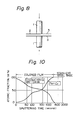
- the electric resistance of selective absorption films was measured by the method illustrated in Figure 8.
- the bar electrodes 1,1 having diameter of 4.5 mm were disposed above and below the specimen 2 as shown in Figure 8 and the bar electrodes 1,1 were contacted with the specimen 2 at a load of 200 kg.
- a current of 1 A was conducted through the bar electrodes and the electric resistance was measured when three seconds had lapsed after the initiation of the current conduction.
- the resistance of a 0.3 mm thick ferritic stainless steel sheet was approximately 2 m ⁇ (approximately 0.32 mO/cm 2 ); and, the resistance of such sheet with a 1000A thick chromium oxide film 3 (Figure 8) on both sheet surfaces was from approximately 20 to 300 m ⁇ (3.2-31.8 m ⁇ /cm2).
- the resistance is not more than 10 m ⁇ (1.6 m ⁇ /cm 2 ), preferably not more than 5 m ⁇ (1 m ⁇ /cm2), both seam welding and spot welding are possible.
- the resistance is from 10 to 100 mf2 (1.6 to 15.9 mO/cm 2 )
- welding becomes difficult in some instances. Welding is impossible at the resistance of 100 m ⁇ (15.9 m ⁇ /cm 2 ) or higher.
- a special selective absorption film explained hereinafter can be obtained by dipping a stainless steel sheet, which contains from 16 to 24% of chromium, into the acidic oxidizing bath having the composition explained hereinabove and containing from 70 to 90 g/I of sodium and/or potassium bichromate and from 550 to 630 g/I of sulfuric acid.
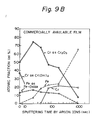
- concentration profiles of the components of a selective absorption film according to the present invention and of a commercially available solar radiation-absorption film are illustrated.
- the concentration of metal on the surface of the selective absorption film is preferably from 3 to 10 atomic%.
- Such metal present on the surface of the selective absorption film is usually mainly iron.
- the metal concentration is increased toward its content of the base, as the analysis place of the metal concentration is distant or separated from the surface of the selective absorption film.
- the selective absorption film has preferably a thickness of from 1000 to 2500A (100 to 250 nm).
- the film of the present invention only exhibited a slight color change upon heating to 250°C over a period of 1000 hours and the color change degree was of practically no problem. Contrary to this, a complete color change took place upon the heating of the commercially available panels at 230°C, which would later result in problems during its use.
- the selective absorption property is largely influenced by the surface property, mainly the surface roughness, and by the pretreatment of a stainless steel sheet according to the chemical conversion treatment of the US patent.
- the rust proofing and selective absorption property explained above can be achieved, and no pretreatment, such as degreasing, is necessary, when the surface finish of a stainless steel sheet is equivalent to or better than No. 4B finish of JIS G 4305 (Cold Rolled Stainless Steel Sheets and Plates).
- the present invention is, therefore, very advantageous from the industrial point of view.
- the surface roughness of a stainless steel used in the method of the present invention is advantageously from Ra approximately 0.08 to 0.5.
- a selective absorption film can be formed on one surface of a stainless steel sheet. Namely, when, prior to forming a colored film on the stainless steel sheet, such sheet is subjected to the surface finishing so as to obtain the predetermined surface roughness degree, only the surface of the sheet, on which the colored sheet is to be formed, is ground and then an extremely thin oxide film (air formed film) is formed on the ground surface in ambient air.
- the stainless steel sheet is then dipped in an acidic oxidizing bath of the present invention over a predetermined time period and lifted up from the acidic oxidizing bath, with the result that the selective absorption film is formed only on one surface, namely the surface, on which the air formed film is formed, and no selective absorption film is formed on the other surface.
- Stainless steel sheets (19% Cr-2% Mo-Ti, B steel with No. 2 finish) having a thickness of 0.3 mm were subjected to a chemical conversion treatment in baths comprising various concentrations of sulfuric acid and sodium bichromate or potassium bichromate. Subsequently, the measurement of optical properties (absorptance and emittance) by an emission spectroscopic test, the measurement of rust proofing by an immersion test in a 5% sodium chloride-0.2% hydrogen peroxide solution as well as the r values obtained by the measurement of the surface temperature by solar radiation were carried out. The measurement results are shown in Table 2.
- the absorptance was higher than about 90%, the emittance was lower than about 15%, the grade of rust proofing was A, and the r value was 1.80 or higher.
- Example 3 The same experiments as in Example 1 were carried out using 0.3 mm thick JIS 304 stainless steel sheets with BA finish. The results of the experiments are shown in Table 3.
- the absorptance was 90% or higher and the emittance was lower than 15%, when the bath composition of chemical conversion treatment fell within the range of the present invention.
- the r value was 1.80 or higher.
- Example 2 The same experiment as in Example 1 was carried out using the 0.3 mm thick JIS SUS 430 stainless steel sheets with No. 2 finish.
- Example Nos. 1 and 2 were similar to those in Example Nos. 1 and 2, namely, some of, but not all of, the properties of each film obtained by the comparative method were equivalent to those obtained by the chemical conversion treatment with the bath composition falling within the range of the present invention.
- the absorptance was about 90% or higher, the emittance was about 15% or lower, the r value was 1.80 or higher and the grades of rust proofing were C and D.
- the rust proofing in the present example was similar to that in Example 1, because the corrosion resistance of the SUS 430 stainless blank steel sheet is inferior to that of the ferritic 19% Cr-2% Mo-Ti, B stainless steel.
- a ferritic stainless steel sheet was dipped over a period of 18 minutes in a bath comprising 80 g/l of sodium bichromate and 600 g/I of sulfuric acid at 110°C, thereby forming a selective absorption film on the surface of the steel sheet.
- the composition of the film was measured by an electron beam spectrometer (ESCA) along the vertical direction of the film.
- ESA electron beam spectrometer
- the measurement result is shown in Figure 10.
- the abscissa in Figure 10 indicates the argon ion sputtering time at a removing rate of the film amounting to 1 A/sec, while the ordinate indicates the atomic fraction of the chromium plus iron or hydroxides plus oxides based on the components of the film.
- the curve "Fe+Cr" in Figure 10 represents the metallic iron and metallic chromium, and they are contained in a large quantity in the film, and their concentration is increased and the concentration of the hydroxides and oxides of chromium and iron is correspondingly decreased as the measuring depth approaches the base or blank sheet.
- the selective absorption property is enhanced and the electric resistance is descreased due to the presence of the metallic iron and the metallic chromium.
- the absorptance of solar light was 91.5% and the electric resistance was 0.5 mQ/cm 2 in the present example.
Landscapes
- Engineering & Computer Science (AREA)
- Chemical & Material Sciences (AREA)
- Mechanical Engineering (AREA)
- Physics & Mathematics (AREA)
- Sustainable Energy (AREA)
- Thermal Sciences (AREA)
- Sustainable Development (AREA)
- Combustion & Propulsion (AREA)
- Life Sciences & Earth Sciences (AREA)
- General Engineering & Computer Science (AREA)
- General Chemical & Material Sciences (AREA)
- Chemical Kinetics & Catalysis (AREA)
- Materials Engineering (AREA)
- Metallurgy (AREA)
- Organic Chemistry (AREA)
- Spectroscopy & Molecular Physics (AREA)
- Chemical Treatment Of Metals (AREA)
Claims (12)
Applications Claiming Priority (2)
| Application Number | Priority Date | Filing Date | Title |
|---|---|---|---|
| JP156392/80 | 1980-11-06 | ||
| JP55156392A JPS5819950B2 (ja) | 1980-11-06 | 1980-11-06 | 太陽熱選択吸収板の製造法 |
Publications (2)
| Publication Number | Publication Date |
|---|---|
| EP0052056A1 EP0052056A1 (de) | 1982-05-19 |
| EP0052056B1 true EP0052056B1 (de) | 1985-08-28 |
Family
ID=15626731
Family Applications (1)
| Application Number | Title | Priority Date | Filing Date |
|---|---|---|---|
| EP81401770A Expired EP0052056B1 (de) | 1980-11-06 | 1981-11-06 | Verfahren zur Herstellung eines Bleches mit selektiver Absorption der Sonnenbestrahlung und dieser Gegenstand |
Country Status (5)
| Country | Link |
|---|---|
| US (2) | US4491487A (de) |
| EP (1) | EP0052056B1 (de) |
| JP (1) | JPS5819950B2 (de) |
| AU (1) | AU547222B2 (de) |
| ZA (1) | ZA817676B (de) |
Cited By (1)
| Publication number | Priority date | Publication date | Assignee | Title |
|---|---|---|---|---|
| US7495089B2 (en) | 1995-10-23 | 2009-02-24 | The Children's Medical Center Corporation | Therapeutic antiangiogenic endostatin compositions |
Families Citing this family (11)
| Publication number | Priority date | Publication date | Assignee | Title |
|---|---|---|---|---|
| JPS5819950B2 (ja) * | 1980-11-06 | 1983-04-20 | 新日本製鐵株式会社 | 太陽熱選択吸収板の製造法 |
| CA1264636A (en) * | 1984-07-19 | 1990-01-23 | Florence Stoffel | Sterile surgical needle having dark non-reflective surface |
| US5789086A (en) * | 1990-03-05 | 1998-08-04 | Ohmi; Tadahiro | Stainless steel surface having passivation film |
| DE19804846A1 (de) * | 1998-01-30 | 1999-08-05 | Ethicon Gmbh | Verfahren zum Herstellen von geschwärzten chirurgischen Nadeln |
| NL1014629C2 (nl) * | 2000-03-13 | 2001-09-14 | Inventum B V | Inrichting voor het chemisch behandelen van een oppervlak. |
| JP2005042130A (ja) * | 2003-07-22 | 2005-02-17 | Nippon Kinzoku Co Ltd | ステンレス鋼板、その製造方法及びゴム被覆ステンレス鋼板製ガスケット |
| JP6110672B2 (ja) * | 2013-01-24 | 2017-04-05 | 矢崎エナジーシステム株式会社 | 高性能な選択吸収処理膜の形成方法 |
| MX2014001213A (es) * | 2014-01-29 | 2015-07-29 | En Suministros E Instalaciones S A De C V | Recubrimiento absorbente selectivo de la radiacion y su proceso de obtencion a temperatura ambiente. |
| CN109414738B (zh) * | 2017-01-31 | 2021-01-05 | 亚伯株式会社 | 着色不锈钢板、着色不锈钢卷以及它们的制造方法 |
| US20240063399A1 (en) * | 2020-12-15 | 2024-02-22 | Jfe Steel Corporation | Chromium-containing steel sheet for current collector of nonaqueous electrolyte secondary battery |
| EP4265761A4 (de) * | 2020-12-15 | 2024-05-29 | JFE Steel Corporation | Rostfreies stahlblech für brennstoffzellenseparator |
Family Cites Families (9)
| Publication number | Priority date | Publication date | Assignee | Title |
|---|---|---|---|---|
| US3518169A (en) * | 1965-07-13 | 1970-06-30 | Toyo Kahan Co Ltd | Alkali solution treatment of cathodically chromated metal surface |
| DE2423877A1 (de) * | 1973-05-30 | 1974-12-19 | Walter Franke Ag Aarburg | Verfahren zum faerben der oberflaeche von rostfreien und korrosionsbestaendigen staehlen |
| AU503043B2 (en) * | 1974-10-22 | 1979-08-23 | Nippon Steel Corporation | Coloring a stainless steel |
| JPS6014275B2 (ja) * | 1975-09-22 | 1985-04-12 | 矢崎総業株式会社 | 太陽熱利用集熱器の選択吸収面およびその製法 |
| JPS5269807A (en) * | 1975-12-08 | 1977-06-10 | Tdk Corp | Recovering of powder of ferromagnetic metal or alloy |
| JPS5334653A (en) * | 1976-09-13 | 1978-03-31 | Kobe Steel Ltd | Arc welding |
| JPS5415327A (en) * | 1977-07-07 | 1979-02-05 | Obayashi Gumi Kk | Hydraulic concrete crusher |
| JPS5464034A (en) * | 1977-10-31 | 1979-05-23 | Toyo Kohan Co Ltd | Pretreatment of steel plate treated with electrolytic chromic acid |
| JPS5819950B2 (ja) * | 1980-11-06 | 1983-04-20 | 新日本製鐵株式会社 | 太陽熱選択吸収板の製造法 |
-
1980
- 1980-11-06 JP JP55156392A patent/JPS5819950B2/ja not_active Expired
-
1981
- 1981-11-02 AU AU77007/81A patent/AU547222B2/en not_active Ceased
- 1981-11-06 ZA ZA817676A patent/ZA817676B/xx unknown
- 1981-11-06 EP EP81401770A patent/EP0052056B1/de not_active Expired
-
1983
- 1983-10-17 US US06/541,491 patent/US4491487A/en not_active Expired - Fee Related
-
1984
- 1984-10-03 US US06/657,485 patent/US4579606A/en not_active Expired - Fee Related
Cited By (2)
| Publication number | Priority date | Publication date | Assignee | Title |
|---|---|---|---|---|
| US7495089B2 (en) | 1995-10-23 | 2009-02-24 | The Children's Medical Center Corporation | Therapeutic antiangiogenic endostatin compositions |
| US7867975B2 (en) | 1995-10-23 | 2011-01-11 | The Children's Medical Center Corporation | Therapeutic antiangiogenic endostatin compositions |
Also Published As
| Publication number | Publication date |
|---|---|
| JPS5779177A (en) | 1982-05-18 |
| JPS5819950B2 (ja) | 1983-04-20 |
| ZA817676B (en) | 1982-10-27 |
| AU547222B2 (en) | 1985-10-10 |
| US4579606A (en) | 1986-04-01 |
| AU7700781A (en) | 1982-06-24 |
| US4491487A (en) | 1985-01-01 |
| EP0052056A1 (de) | 1982-05-19 |
Similar Documents
| Publication | Publication Date | Title |
|---|---|---|
| EP0052056B1 (de) | Verfahren zur Herstellung eines Bleches mit selektiver Absorption der Sonnenbestrahlung und dieser Gegenstand | |
| CA1074647A (en) | Solar collector panel | |
| Bayati et al. | Design of chemical composition and optimum working conditions for trivalent black chromium electroplating bath used for solar thermal collectors | |
| US4177325A (en) | Aluminium or copper substrate panel for selective absorption of solar energy | |
| CA1124674A (en) | Electrolytically coloured anodized aluminium panels for solar energy absorption | |
| WO2022138006A1 (ja) | 表面処理鋼板およびその製造方法 | |
| US4104134A (en) | Method for making an aluminum or copper substrate panel for selective absorption of solar energy | |
| Spitz et al. | Chromium black coatings for photothermal conversion of solar energy, part I: Preparation and structural characterization | |
| US4931317A (en) | Composition and process for the formation of a black coating on surfaces of materials | |
| KR20240146032A (ko) | 표면 처리 강판 및 그 제조 방법 | |
| CN114636719B (zh) | 一种定量评价冷轧汽车钢锌系磷化膜覆盖率的方法 | |
| EP0291606B1 (de) | Sehr korrosionsfestes, plattiertes Verbund-Stahlband und Verfahren zu seiner Herstellung | |
| US4444600A (en) | Process for making a selective absorber for a solar collector and selective absorber obtained | |
| US4940638A (en) | Plated steel sheet for a can | |
| EP0039360B1 (de) | Verfahren zur herstellung eines dunklen für wellenlänge selektiven oxydfilmes auf aluminium | |
| AU2021406790B2 (en) | Surface-treated steel sheet and method of producing the same | |
| Mabon et al. | Optimization and evaluation of black zinc selective solar absorber surfaces | |
| Homhual et al. | Microstructural and mechanical property evaluation of zinc oxide coated solar collectors | |
| JPS60155695A (ja) | 製缶用表面処理鋼板 | |
| JP2021123729A (ja) | 表面処理めっき鋼板およびそれに用いるめっき鋼板、ならびに表面処理めっき鋼板の製造方法 | |
| Culham et al. | Low cost solar selective chromate conversion coatings applied to stainless steel substrates | |
| US4350574A (en) | Method for depositing an oxide coating | |
| WO2025220722A1 (ja) | 電池用表面処理金属板 | |
| JP3241170B2 (ja) | アルミニウム系金属材料のカチオン電着塗装前処理方法 | |
| KR0125318B1 (ko) | 건식 흑색 아연-구리 합금도금강판의 제조방법 |
Legal Events
| Date | Code | Title | Description |
|---|---|---|---|
| PUAI | Public reference made under article 153(3) epc to a published international application that has entered the european phase |
Free format text: ORIGINAL CODE: 0009012 |
|
| 17P | Request for examination filed |
Effective date: 19811111 |
|
| AK | Designated contracting states |
Designated state(s): FR SE |
|
| GRAA | (expected) grant |
Free format text: ORIGINAL CODE: 0009210 |
|
| AK | Designated contracting states |
Designated state(s): FR SE |
|
| ET | Fr: translation filed | ||
| PLBE | No opposition filed within time limit |
Free format text: ORIGINAL CODE: 0009261 |
|
| STAA | Information on the status of an ep patent application or granted ep patent |
Free format text: STATUS: NO OPPOSITION FILED WITHIN TIME LIMIT |
|
| 26N | No opposition filed | ||
| PG25 | Lapsed in a contracting state [announced via postgrant information from national office to epo] |
Ref country code: SE Effective date: 19881107 |
|
| PG25 | Lapsed in a contracting state [announced via postgrant information from national office to epo] |
Ref country code: FR Free format text: LAPSE BECAUSE OF NON-PAYMENT OF DUE FEES Effective date: 19890731 |
|
| REG | Reference to a national code |
Ref country code: FR Ref legal event code: ST |
|
| EUG | Se: european patent has lapsed |
Ref document number: 81401770.3 Effective date: 19890726 |