EP0052070A1 - Armbanduhr mit einem Dauerkalendermechanismus - Google Patents
Armbanduhr mit einem Dauerkalendermechanismus Download PDFInfo
- Publication number
- EP0052070A1 EP0052070A1 EP81810429A EP81810429A EP0052070A1 EP 0052070 A1 EP0052070 A1 EP 0052070A1 EP 81810429 A EP81810429 A EP 81810429A EP 81810429 A EP81810429 A EP 81810429A EP 0052070 A1 EP0052070 A1 EP 0052070A1
- Authority
- EP
- European Patent Office
- Prior art keywords
- cam
- disc
- month
- years
- date
- Prior art date
- Legal status (The legal status is an assumption and is not a legal conclusion. Google has not performed a legal analysis and makes no representation as to the accuracy of the status listed.)
- Granted
Links
- 238000006073 displacement reaction Methods 0.000 claims description 5
- 230000007704 transition Effects 0.000 abstract 2
- 238000012937 correction Methods 0.000 description 2
- 230000000694 effects Effects 0.000 description 2
- 230000009191 jumping Effects 0.000 description 1
Images

Classifications
-
- G—PHYSICS
- G04—HOROLOGY
- G04B—MECHANICALLY-DRIVEN CLOCKS OR WATCHES; MECHANICAL PARTS OF CLOCKS OR WATCHES IN GENERAL; TIME PIECES USING THE POSITION OF THE SUN, MOON OR STARS
- G04B27/00—Mechanical devices for setting the time indicating means
- G04B27/005—Mechanical devices for setting the time indicating means stepwise or on determined values
-
- G—PHYSICS
- G04—HOROLOGY
- G04B—MECHANICALLY-DRIVEN CLOCKS OR WATCHES; MECHANICAL PARTS OF CLOCKS OR WATCHES IN GENERAL; TIME PIECES USING THE POSITION OF THE SUN, MOON OR STARS
- G04B19/00—Indicating the time by visual means
- G04B19/24—Clocks or watches with date or week-day indicators, i.e. calendar clocks or watches; Clockwork calendars
- G04B19/243—Clocks or watches with date or week-day indicators, i.e. calendar clocks or watches; Clockwork calendars characterised by the shape of the date indicator
- G04B19/247—Clocks or watches with date or week-day indicators, i.e. calendar clocks or watches; Clockwork calendars characterised by the shape of the date indicator disc-shaped
- G04B19/253—Driving or releasing mechanisms
- G04B19/25306—Independent date indicating devices activated by hand or by clockwork, e.g. calendar watches
- G04B19/25313—Independent date indicating devices activated by hand or by clockwork, e.g. calendar watches driven or released by a steady movement
- G04B19/2532—Independent date indicating devices activated by hand or by clockwork, e.g. calendar watches driven or released by a steady movement automatically corrected at the end of mounths having less than 31 days
Definitions
- the present invention relates to a watch with a perpetual calendar mechanism comprising a date disc, means for advancing said disc and means driven at the end of the month by the date disc and acting on said advancing means to determine the magnitude. displacement of said date disc.
- the mechanism uses a tilting control principle of the Longines date disc described in patent CH 621,665 and published application CH 624,533 G.
- the peculiarity of this mechanism is that it allows a rapid date change and in both direction of rotation of the hour hand, such as when changing time zones around midnight.
- the leap year correction mechanism comprises according to figs. 1 and 2 a wheel L with four teeth driven at the rate of 1/4 turn per year, from 31.12 to 1.1, by a pin b 3 of the wheel of months B.
- this wheel L doesn ' has no effect.
- its increased diameter exceeds in the February notch b 2 of the wheel B, which prevents the advancement lever H from descending to the normal depth of the notch b 2 . This therefore limits the driving of the wheel B by the lever H.
- the mechanism is not symmetrical, so that it operates only in the normal direction of advance of the hands of the timepiece. lo g series.
- the object of the invention is a watch with a perpetual calendar mechanism operating in the two directions of rotation of the hands and in which the corrections of the date, the month and the year are easy and quick to execute.
- the watch according to the invention is characterized in that said means acting on said advancement means comprise a first cam known as months of annual rotation comprising fingers of different widths to determine different durations of action of said advancement means and a second cam known as years performing a revolution in four years and comprising fingers cooperating with said fingers of the first cam so as to determine said durations of action of the advancement means of the date disc according to the months 28, 29, 30 or 31 days.
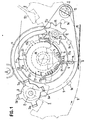
- the mechanism of fig. 1 includes a rocker 1 carrying a pinion 2 which performs a turn in 4 hours and which is secured to a mobile 3 to 4 pins 3a.
- the pinion 2 is driven by a wheel 4 performing 1 revolution in 24 h wearing a finger 5 coming to work once a day, around 24 h, with a boss 6 of the rocker 1.
- the scale 1 includes a lug 9 which works with a cam for the months 17, coaxial with the wheel 4 of 24 h and comprising 48 steps around its periphery, corresponding to 12 times 4 steps ( 28-29, 29-30, 30-31, 31-1 of each month).
- This cam 17 is integral with a wheel 11 of 48 teeth driven tooth by tooth by a pinion 12 of 8 wings fixed on a star 13 of 8 teeth.
- This star 13 is itself driven by four pins or lugs 14 fixed under the calendar disc 8, the pitch between two successive pins being 1 / 31st of a turn, or 1 pin per day for the days 29 - 30 - 31 - 1 Consequently, each time the star 13 advances by one tooth, the cam 17 moves one step.
- the second pin 14 drives a new tooth of the star 13 and the cam 17 advances again one step. If the 30 must be displayed (every month except February) the lug 9 is not hampered by the cam 17.
- the third pin 14 drives a new star tooth 13 and the cam 17 advances a new step. If the 31 must be displayed (January, March, May, July, August, October and December) the pin 9 is not hampered by the cam 17.
- the lug 9 is hampered by one of the fingers 17a of the cam 17.
- the rocker 1 is prevented from withdrawing under the action of the spring 16, and this despite the fact that the finger 5 is released from the boss 6 of the lever 1.
- the pinion 2 and its lugs 3a therefore remain in engagement with the teeth 7 of the calendar disc 8, so that one hour after the jump from 30 to 31 (1/4 turn of pinion 2), a new lug 3a drives a new tooth 7 of the disc 8.
- the 4th pin 14 drives a new star tooth 13 advancing the cam 17 a new step, which displays the 1 of the next month.
- the mechanism described above can make it possible to produce a semi-perpetual calendar, provided that the month cam 17 has a finger 17b of the lug 9 of sufficient width to allow each year the passage from February 28 to March 1, ie a displacement of four steps of the date disc 8.
- the finger should therefore have a width corresponding to four steps of the calendar disc.
- Such a device does not however make it possible to produce a perpetual calendar, which is the subject of the invention, so that, for reasons which will become apparent below, the finger 17b of the cam 17 of FIG. 1 actually has a width corresponding to three steps of the displacement of the calendar disc.
- the novelty consists in including a device programming every four years a end of February with 3 jumps (29-30, 30-31, 31-1), the 29 being displayed normally while the other three years, the program at the end of February orders four jumps (28-29, 29-30, 30-31, 31-1) from calendar disc 8.
- a cam from the 20s coaxial with the cam from the 17 months, and comprising three fingers 21 arranged so as to leave between them angular spaces of 90 °, 90 ° and 180 °, performs a revolution in 4 years, thanks to a wheel 22 (of the same diameter as the wheel 11) coaxial with the cam of the 20s and carrying 48 teeth.
- the cam 20 is secured to the wheel 22.
- This wheel 22 is driven by 2 adjacent teeth 23, integral and coaxial with the star 13 and the pinion 12. It has been shown above that the star 13 rotates at the rate of 4 teeth per month, i.e. 1 full turn in 2 months.
- the 2 teeth 23 therefore drive 2 teeth of the wheel 22 all the two months.
- the cam 20, integral with the wheel 22, therefore performs 1 revolution every 4 years.
- the three fingers 21 of the cam 20 are similar to those 17 a of the month cam 17 of FIG. 1. They also perform the same functions, that is to say that when the program requires it, they impede the movement of the lug 9 of the rocker 1, and consequently the return movement of the latter.
- the cam for the months 17 includes for the month of February a finger 17b whose width corresponds to three steps of displacement of the calendar disc 8.
- the fourth step necessary for the years normal where February is 28 days old, is obtained by one of the teeth 21 of the cam of the 20s coming to juxtapose at the end of February with the finger 17b of the cam of the months 17 in order to present to the lug 9 a width of obstacle corresponding to four steps to quickly move the calendar disc.
- the finger 21 of the cam 20 therefore covers one step and the finger 17b of the cam 17 three steps, ie a total of four steps (4 / 48th turn) for the passage from February 28 to March 1 of each normal year.
- the finger 21 does not exist on the cam 20, which allows the normal display of the number 29 before making the rapid change to March 1.
- FIGS. 1 and 2 An examination of FIGS. 1 and 2 shows that the mechanism has symmetry at the level of actuation of the rocker 1 by the finger 5 of the 24-hour wheel acting on the boss 6. There is also a symmetry of the movement of the calendar disc 8 by the pins 3a of the mobile 3 and a third symmetry in the actuation of the star 13 by the pins 14 of the calendar disc. Consequently, the mechanism operates indifferently in the two directions of rotation of the hands, and more particularly in the two directions of rotation of the hour hand, during a change of time zone. Specifically, all time zone changes made during the three-hour period (time during which the display successively indicates 29, 30 and 31) required to change the display from February 28 to March 1 of each normal year simply move the date display forward or backward according to the direction of rotation of the hour hand.
- the above is an important and fundamental characteristic of the perpetual calendar mechanism according to the invention:
- the mechanism is perfectly symmetrical with respect to the direction of rotation of the hands.
- Figs. 2 and 3 show sections through the mechanism of FIG. 1. Their purpose is to facilitate understanding of the date, month and year setting, for example when changing the battery in an electronic watch.
- the plate or the bridge 24 comprises a pivot tube 25 on or in which all the coaxial mobiles of the system rotate, that is: the 24-hour wheel 4 secured to the finger 5 and the cam of the 20s on which is fixed the drive wheel 22 to 48 teeth.
- This cam 20 has a barrel 20a pivoting in the tube 25 and supporting a display disc 26 on which are indicated the 4 years (3 normal, 1 leap) of the cycle.
- the month cam 17 carrying the wheel 11 of 48 teeth has a barrel 18 also pivoting about the axis of the tube 25.
- This barrel supports a display disc for the months 27 on which the 12 months of the year are indicated.
- a screw 28 screwed into the barrel 18 assembles everything on the tube 25.
- the wheel 11 of the months meshes with the pinion 12 to 8 wings, itself secured to the pinion carrying the 2 teeth 23 which meshes with the wheel 22 .
Landscapes
- Physics & Mathematics (AREA)
- General Physics & Mathematics (AREA)
- Electromechanical Clocks (AREA)
- Electric Clocks (AREA)
- Diaphragms For Electromechanical Transducers (AREA)
Applications Claiming Priority (2)
| Application Number | Priority Date | Filing Date | Title |
|---|---|---|---|
| CH827280A CH642809B (fr) | 1980-11-07 | 1980-11-07 | Montre avec un mecanisme de quantieme perpetuel. |
| CH8272/80 | 1980-11-07 |
Publications (2)
| Publication Number | Publication Date |
|---|---|
| EP0052070A1 true EP0052070A1 (de) | 1982-05-19 |
| EP0052070B1 EP0052070B1 (de) | 1985-02-13 |
Family
ID=4337791
Family Applications (1)
| Application Number | Title | Priority Date | Filing Date |
|---|---|---|---|
| EP81810429A Expired EP0052070B1 (de) | 1980-11-07 | 1981-10-29 | Armbanduhr mit einem Dauerkalendermechanismus |
Country Status (5)
| Country | Link |
|---|---|
| US (1) | US4427300A (de) |
| EP (1) | EP0052070B1 (de) |
| JP (1) | JPS57108783A (de) |
| CH (1) | CH642809B (de) |
| DE (1) | DE3168952D1 (de) |
Cited By (2)
| Publication number | Priority date | Publication date | Assignee | Title |
|---|---|---|---|---|
| FR2561524A1 (fr) * | 1984-03-23 | 1985-09-27 | Ciba Geigy Ag | Comprimes de principes actifs pharmaceutiques a delitement rapide, stables au stockage |
| EP2565729A1 (de) * | 2011-08-30 | 2013-03-06 | Breitling AG | Kalendermechanismus |
Families Citing this family (13)
| Publication number | Priority date | Publication date | Assignee | Title |
|---|---|---|---|---|
| CH649433GA3 (de) * | 1983-08-30 | 1985-05-31 | ||
| US4852030A (en) * | 1984-09-24 | 1989-07-25 | Westinghouse Electric Corp. | Time-of-use-meter with a calendar of cyclic events |
| CH672222B5 (de) * | 1987-11-11 | 1990-05-15 | Rolex Montres | |
| US5689476A (en) * | 1995-05-16 | 1997-11-18 | Leach; Terrence T. | Telephone cost monitor |
| ES2149058B1 (es) * | 1996-11-27 | 2001-05-01 | Dolcet Cavero Antoni | Mecanismo de calendario perpetuo |
| US7027361B2 (en) * | 2003-11-18 | 2006-04-11 | Timex Group B.V. | Perpetual calendar for a timepiece |
| ATE337574T1 (de) * | 2004-06-28 | 2006-09-15 | Grisogono S A De | Vorrichtung zur grossdatumsanzeige |
| DE102005014328B3 (de) * | 2005-03-24 | 2006-07-20 | Lange Uhren Gmbh | Datumschaltung |
| CH711749A1 (fr) * | 2015-11-13 | 2017-05-15 | Gfpi Sa | Mécanisme de calendrier pour pièce d'horlogerie. |
| EP3173878B1 (de) * | 2015-11-26 | 2021-05-26 | Rolex Sa | Kalendersystem für uhr |
| EP3193217A1 (de) * | 2016-01-18 | 2017-07-19 | ETA SA Manufacture Horlogère Suisse | Uhrwerk, das eine analoganzeige umfasst |
| EP3671366B1 (de) * | 2018-12-21 | 2022-04-20 | ETA SA Manufacture Horlogère Suisse | Vorrichtung zur anzeige einer folge von periodischen ereignissen, die einen jahreszyklus bilden, und eine solche anzeigevorrichtung umfassende uhr |
| EP4325303B1 (de) * | 2022-08-16 | 2024-12-25 | Manufacture d'Horlogerie Audemars Piguet SA | Mechanismus eines immerwährenden kalenders mit konzentrischen nocken |
Citations (6)
| Publication number | Priority date | Publication date | Assignee | Title |
|---|---|---|---|---|
| US387005A (en) * | 1888-07-31 | nilson | ||
| US527386A (en) * | 1893-10-12 | 1894-10-09 | Calendar-clock | |
| CH318902A (fr) * | 1954-02-05 | 1957-01-31 | Bringolf John | Pièce d'horlogerie à calendrier |
| US3841084A (en) * | 1972-04-05 | 1974-10-15 | Suisse Horlogerie | Calendar mechanism for time-pieces |
| FR2392430A1 (fr) * | 1977-05-27 | 1978-12-22 | Longines Montres Comp D | Montre a affichage analogique avec calendrier |
| CH624533GA3 (en) * | 1979-05-02 | 1981-08-14 | Watch with analog display of the time and calendar |
Family Cites Families (5)
| Publication number | Priority date | Publication date | Assignee | Title |
|---|---|---|---|---|
| US2470692A (en) | 1946-02-13 | 1949-05-17 | Farr Ivor A Court | Perpetual calendar |
| JPS5517353B1 (de) | 1970-03-11 | 1980-05-10 | ||
| CH552845A (de) | 1971-11-26 | 1974-08-15 | ||
| CH583433B5 (de) | 1973-08-09 | 1976-12-31 | Ebauchesfabrik Eta Ag | |
| JPS5474465A (en) | 1977-11-26 | 1979-06-14 | Citizen Watch Co Ltd | Month correcting mechanism for calendar watch |
-
1980
- 1980-11-07 CH CH827280A patent/CH642809B/fr not_active IP Right Cessation
-
1981
- 1981-10-29 DE DE8181810429T patent/DE3168952D1/de not_active Expired
- 1981-10-29 EP EP81810429A patent/EP0052070B1/de not_active Expired
- 1981-11-03 US US06/317,877 patent/US4427300A/en not_active Expired - Fee Related
- 1981-11-06 JP JP56178267A patent/JPS57108783A/ja active Pending
Patent Citations (6)
| Publication number | Priority date | Publication date | Assignee | Title |
|---|---|---|---|---|
| US387005A (en) * | 1888-07-31 | nilson | ||
| US527386A (en) * | 1893-10-12 | 1894-10-09 | Calendar-clock | |
| CH318902A (fr) * | 1954-02-05 | 1957-01-31 | Bringolf John | Pièce d'horlogerie à calendrier |
| US3841084A (en) * | 1972-04-05 | 1974-10-15 | Suisse Horlogerie | Calendar mechanism for time-pieces |
| FR2392430A1 (fr) * | 1977-05-27 | 1978-12-22 | Longines Montres Comp D | Montre a affichage analogique avec calendrier |
| CH624533GA3 (en) * | 1979-05-02 | 1981-08-14 | Watch with analog display of the time and calendar |
Cited By (4)
| Publication number | Priority date | Publication date | Assignee | Title |
|---|---|---|---|---|
| FR2561524A1 (fr) * | 1984-03-23 | 1985-09-27 | Ciba Geigy Ag | Comprimes de principes actifs pharmaceutiques a delitement rapide, stables au stockage |
| EP2565729A1 (de) * | 2011-08-30 | 2013-03-06 | Breitling AG | Kalendermechanismus |
| US8644116B2 (en) | 2011-08-30 | 2014-02-04 | Breitling Ag | Calendar mechanism |
| US9042206B2 (en) | 2011-08-30 | 2015-05-26 | Breitling Ag | Mechanism for driving an indicator for a timepiece |
Also Published As
| Publication number | Publication date |
|---|---|
| EP0052070B1 (de) | 1985-02-13 |
| CH642809GA3 (de) | 1984-05-15 |
| US4427300A (en) | 1984-01-24 |
| DE3168952D1 (en) | 1985-03-28 |
| JPS57108783A (en) | 1982-07-06 |
| CH642809B (fr) |
Similar Documents
| Publication | Publication Date | Title |
|---|---|---|
| EP1677165B1 (de) | Uhr mit mechanischem chinesischen Kalender | |
| EP0052070B1 (de) | Armbanduhr mit einem Dauerkalendermechanismus | |
| EP1785783B1 (de) | Jahreskalendermechanismus für Uhrwerk | |
| EP3009893B1 (de) | Ewiger Kalender mit Ausgleichsgetriebe | |
| EP0987609B1 (de) | Jährlicher Kalendermechanismus für Uhrwerk | |
| WO2015062839A2 (fr) | Calendrier hegirien | |
| EP0606576A1 (de) | Islamitischer Kalender | |
| EP1012675B1 (de) | Ewige kalenderuhr | |
| EP3671366B1 (de) | Vorrichtung zur anzeige einer folge von periodischen ereignissen, die einen jahreszyklus bilden, und eine solche anzeigevorrichtung umfassende uhr | |
| EP0970407A1 (de) | Zeigerstellungsmechanismus für eine ewige kalenderuhr | |
| WO2004097535A1 (fr) | Mecanisme indicateur de quantieme pour mouvement de montre | |
| EP3667434A1 (de) | Grossanzeigemechanismus für datum, und mit einem solchen mechanismus ausgestattete uhr | |
| EP1240559A1 (de) | Jährliches, ewiges oder sekuläres datumschaltwerk | |
| EP4254079B1 (de) | Mechanismus zur anzeige der mondphasen für uhr | |
| EP4189489B1 (de) | Zeitstellungverfahren einer uhr von einer uhreinheit "sympathique" | |
| EP1321831B1 (de) | Uhr mit springenden Stunden und Mechanismus zum schnellen Wechsel von Zeitzonen | |
| EP3731027B1 (de) | Anzeigevorrichtung des kalenders, der uhrzeit des sonnenaufgangs und/oder des sonnenuntergangs | |
| EP3667435A1 (de) | Einstellsystem der position eines ersten gezahnten drehteils in bezug auf eine halterung, auf der dieses erste gezahnte drehteil drehbar befestigt ist, und uhr, die ein solches system umfasst | |
| EP3731028B1 (de) | Anzeigevorrichtung der somerzeit sowie der uhrzeit des sonnenaufgangs und/oder des sonnenuntergangs | |
| CH691149A5 (fr) | Mécanisme de mise à l'heure d'un mouvement d'horlogerie à quantième perpétuel. | |
| CH719134B1 (fr) | Dispositif d'affichage d'une succession d'indications d'une grandeur temporelle pour une pièce d'horlogerie | |
| EP4180881A1 (de) | Vorrichtung zur anzeige einer folge von zeitgrössenangaben für eine uhr | |
| CH717651B1 (fr) | Procédé de remontage d'une montre sympathique. | |
| CH717699B1 (fr) | Ensemble sympathique d'horlogerie. | |
| EP4617793A1 (de) | Kalendermechanismus für uhrwerk, der mindestens den retrograden kalender anzeigt |
Legal Events
| Date | Code | Title | Description |
|---|---|---|---|
| PUAI | Public reference made under article 153(3) epc to a published international application that has entered the european phase |
Free format text: ORIGINAL CODE: 0009012 |
|
| AK | Designated contracting states |
Designated state(s): DE FR GB IT |
|
| 17P | Request for examination filed |
Effective date: 19820913 |
|
| GRAA | (expected) grant |
Free format text: ORIGINAL CODE: 0009210 |
|
| AK | Designated contracting states |
Designated state(s): DE FR GB IT |
|
| PG25 | Lapsed in a contracting state [announced via postgrant information from national office to epo] |
Ref country code: IT Free format text: LAPSE BECAUSE OF FAILURE TO SUBMIT A TRANSLATION OF THE DESCRIPTION OR TO PAY THE FEE WITHIN THE PRESCRIBED TIME-LIMIT;WARNING: LAPSES OF ITALIAN PATENTS WITH EFFECTIVE DATE BEFORE 2007 MAY HAVE OCCURRED AT ANY TIME BEFORE 2007. THE CORRECT EFFECTIVE DATE MAY BE DIFFERENT FROM THE ONE RECORDED. Effective date: 19850213 |
|
| REF | Corresponds to: |
Ref document number: 3168952 Country of ref document: DE Date of ref document: 19850328 |
|
| PLBE | No opposition filed within time limit |
Free format text: ORIGINAL CODE: 0009261 |
|
| STAA | Information on the status of an ep patent application or granted ep patent |
Free format text: STATUS: NO OPPOSITION FILED WITHIN TIME LIMIT |
|
| 26N | No opposition filed | ||
| PGFP | Annual fee paid to national office [announced via postgrant information from national office to epo] |
Ref country code: DE Payment date: 19881017 Year of fee payment: 8 |
|
| PG25 | Lapsed in a contracting state [announced via postgrant information from national office to epo] |
Ref country code: GB Effective date: 19891029 |
|
| GBPC | Gb: european patent ceased through non-payment of renewal fee | ||
| PG25 | Lapsed in a contracting state [announced via postgrant information from national office to epo] |
Ref country code: FR Effective date: 19900629 |
|
| PG25 | Lapsed in a contracting state [announced via postgrant information from national office to epo] |
Ref country code: DE Effective date: 19900703 |
|
| REG | Reference to a national code |
Ref country code: FR Ref legal event code: ST |