EP0052237A2 - Papier pour béton lavé et procédé pour sa fabrication - Google Patents
Papier pour béton lavé et procédé pour sa fabrication Download PDFInfo
- Publication number
- EP0052237A2 EP0052237A2 EP81108383A EP81108383A EP0052237A2 EP 0052237 A2 EP0052237 A2 EP 0052237A2 EP 81108383 A EP81108383 A EP 81108383A EP 81108383 A EP81108383 A EP 81108383A EP 0052237 A2 EP0052237 A2 EP 0052237A2
- Authority
- EP
- European Patent Office
- Prior art keywords
- concrete
- paper
- layer
- washed
- retarder
- Prior art date
- Legal status (The legal status is an assumption and is not a legal conclusion. Google has not performed a legal analysis and makes no representation as to the accuracy of the status listed.)
- Withdrawn
Links
Images
Classifications
-
- B—PERFORMING OPERATIONS; TRANSPORTING
- B28—WORKING CEMENT, CLAY, OR STONE
- B28B—SHAPING CLAY OR OTHER CERAMIC COMPOSITIONS; SHAPING SLAG; SHAPING MIXTURES CONTAINING CEMENTITIOUS MATERIAL, e.g. PLASTER
- B28B7/00—Moulds; Cores; Mandrels
- B28B7/36—Linings or coatings, e.g. removable, absorbent linings, permanent anti-stick coatings; Linings becoming a non-permanent layer of the moulded article
- B28B7/362—Linings or coatings, e.g. removable, absorbent linings, permanent anti-stick coatings; Linings becoming a non-permanent layer of the moulded article specially for making moulded articles from concrete with exposed aggregate
Definitions
- the invention relates to a washed concrete paper, consisting of several layers, the cover layer containing a concrete setting retarder, and the cover layer being partially ornament-like to deactivate the retarder in these areas.
- Usual washed concrete papers consist of a multi-layer material with the following layer structure from bottom to top: plastic-paper-bitumen-paper retarder.
- the total thickness of the washed concrete paper is approximately 0.2 to 0.25 mm.
- the retarder contained in the retarder layer has the task of delaying the solidification of the facing concrete on the visible surface of the wash concrete slab until the slab has hardened, so that the concrete that is still soft on the visible surface can be washed out and the desired wash concrete surface is created.
- Washed concrete slabs are manufactured in presses at a pressure of 250 to 750 tons.
- the washed concrete paper is placed in the press.
- the facing is shaken in and then the filling of the back concrete.
- the plates are pushed out of the press and placed vertically next to one another, or stored horizontally one on top of the other, until the desired strength is achieved.
- the wash concrete paper is removed and the visible surface is washed.
- the object of the invention is therefore to provide an ornament-washed concrete paper which can be produced both by machine and used for the fully automatic ornament plate production.
- This paper With this paper, the production of ornamental panels with sharp contours between exposed concrete sections and washed concrete sections should be possible, with special emphasis being placed on really flat exposed concrete sections.
- a washed concrete paper of the type mentioned which is characterized in that the oranment-like cover consists of a flexible, water-resistant and water-repellent lacquer layer with a thickness of at most 100 ⁇ m.
- the lacquer layer of at most 100 ⁇ m used according to the invention leads to excellent results.
- the lacquer layers can be printed on the retarder layer using the screen printing method, in particular also by machine.
- the wash-concrete paper obtained is suitable for the mechanical production of ornament plates, and ornament plates with very good contour sharpness between exposed concrete sections and wash-concrete sections are obtained. In particular, really flat exposed concrete sections are obtained, which is not the case with the known ornament-washed concrete papers with a cardboard cover. According to the invention, there are decorative possibilities up to a very high degree of fineness.
- ornament plates can be produced semi-automatically and fully automatically without using special negative molds or inserts.
- the application can e.g. semi-automatically on vibrating tables and sliding presses, fully automatically on plate presses with steel matrices (e.g. Rinopresses and similar processes) or, depending on the grain size of the header, also on presses with the hardest possible rubber matrices.
- a prefabricated concrete with an increased proportion of fine grain and stone powder is preferably used for the production of ornament plates using the ornament papers according to the invention.
- the invention further relates to a process for the production of wash concrete paper with an ornament-like covering of the retarder layer, which is characterized in that, in the case of a conventional wash concrete paper, the retardation layer is partially covered in an ornament-like manner by printing in a screen printing process with a flexible, water-resistant and water-repellent lacquer with a dry layer thickness of at most 100 ⁇ m.
- This type of process makes it possible, in addition to large runs, to machine even the smallest quantities at low cost.
- lacquer refers both to the lacquer solutions used for the screen printing process and to the lacquer film covering remaining after drying. However, all thicknesses refer exclusively to the dry film thicknesses.
- This lacquer layer has a maximum thickness of 100 ⁇ m, preferably up to 50 ⁇ m, with film thicknesses of 7 to 12 ⁇ m leading in practice to particularly good results.
- Increasing the paint film thickness beyond 100 ⁇ m has no further advantage; on the contrary, one has to expect various disadvantages.
- higher paint film thicknesses naturally require a higher paint coat need.
- such lacquer film thicknesses are difficult to achieve without special measures with regard to the lacquer composition and the printing technique in the screen printing process, and finally, with larger lacquer film thicknesses, tension on the paper surface can also be expected, which in turn can endanger the flat position of the overall sheet.
- the lower limit of the coating film thickness is not sharp and depends to a certain extent also on the properties of the coating used and the retarder type of the paper. A minimum thickness is therefore necessary in order to prevent diffusion of the retarder through the paint film under the influence of the concrete milk, since otherwise the contours between the exposed concrete sections and the washed concrete sections will be blurred.
- the desired lacquer covering pattern is preferably applied with a single screen printing process.
- the above-mentioned preferred range of the lacquer film thickness of 7 to 12 ⁇ m can be easily achieved.
- a flexible, waterproof and water-repellent lacquer is used. It is preferably ensured here that the dried lacquer films are non-blocking, so that when using the ornament wash concrete papers printed according to the invention for the fully automatic production of ornament plates, faults are avoided with certainty.
- the flexibility of the varnish is necessary so that the varnish film adheres well even when the printed wash concrete paper is bent or even kinked.
- the paint film should be covered by the grain of the facing concrete must withstand high deformations due to high pressures without significant damage in order to prevent the retarder from penetrating at these points.
- the varnish used according to the invention must also be water-resistant for a long time, since the washed-out concrete slabs usually store for up to 24 hours after being pushed out of the press with the washed-in concrete paper attached to them.
- the lacquer film must not be attacked by the alkaline-aqueous environment of the concrete milk, in particular it must not happen that the retarder passes through the lacquer film, or that the washed concrete paper blisters at the areas masked with lacquer or even completely at these points the ornament plate.
- the paint used must also be water-repellent in order to prevent concrete milk containing retarders from infiltrating the areas of the washed concrete paper masked with paint and thus again causing a blurring of contours. It is therefore preferable to ensure that the paint does not contain too many hydrophilic groups. Possible hydrophilic groups of solvents must also be taken into account here, since solvent residues generally remain stubbornly enclosed in the paint film.
- the coating solutions used for the screen printing process must on the one hand have the highest possible solids content in order to achieve the desired coating film thicknesses; on the other hand, the viscosity of the coating solutions must meet the requirements of the screen printing technology used. In many cases compromises have to be made.
- the binder base of the varnish does not play a special role in itself, provided the required properties with regard to elasticity, water resistance, water repellency and non-blocking are given.
- Varnishes based on Polyacrylic acid esters and polymethacrylic acid esters have been tried and tested. Examples include the methyl, ethyl, propyl and butyl esters. If these acrylic resins are too hard or too soft when used alone as binders, the desired elasticity and non-blocking can be adjusted by adding other binders or by mixing them together.
- Polymethacrylic acid butyl esters which are commercially available either in dissolved form or as solid resins are preferred, optionally in combination with smaller amounts of a binder which improves the antiblocking properties.
- the solvent system is not subject to any particular restriction, with sufficient dissolving power for the paint components being taken for granted.
- aromatic solvents such as toluene are used; Ketones; or esters, such as butyl acetate or butyl glycol acetate.
- the solvent system preferably takes care that the solvent power for the retardant used, e.g. Sugar, is as low as possible.
- sieves with a fabric thickness of 100 to 400 ⁇ m, preferably about 200 to 250 ⁇ m and lacquers with a solids content of 30 to 60% are used.
- the method of the invention is suitable for printing conventional wash concrete papers.
- Suitable are e.g. Papers with the following layer structure from bottom to top: plastic-paper-bitumen-paper retarder or plastic-paper retarder. These washed concrete papers have thicknesses of approximately 0.1 to 0.25 mm.
- a washed concrete paper with a retarder layer is used, which has a slow water solubility due to a special addition to the retarder formulation.
- a special addition to the retarder formulation For example, by adding about 10 to 12% by weight of polyvinyl alcohol to the retarder mass, calculated on dry substances, to delay the retarder release by about 5 to 10 seconds.
- polyvinyl alcohol it is also possible to use other water-soluble binders which delay the release of the retarder into the aqueous phase.
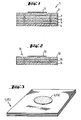
- V erzögerer GmbH 12 and resist mask 13 correspond to the layers 2 and 3 in Fig. 1.
- the total thickness of the aggregate concrete ornament paper in Fig. 2 is 0.12 mm.
- FIG. 3 shows a perspective illustration of the wash concrete ornament papers from FIGS. 1 and 2.
- the resist mask 3, 13 is in each case on a commercially available washed concrete paper.
- the lacquer mask 3, 13 with a thickness of approximately 10 ⁇ m was produced in one operation using the screen printing method using a lacquer according to the following example.
- Both washed concrete ornament papers deliver washed concrete ornament plates with excellent contour definition and a particularly flat exposed concrete surface where the paint mask 3, 13 is located.
- other ornaments are also possible, especially with a complicated pattern.
- the example explains the invention.
- a paint which, based on 1000 parts by weight, 267 parts by weight of butyl polymethacrylic acid, 67 parts of ethylhydroxyethylcellulose, small amounts of dye and other auxiliaries, remainder mixed solvents made from aromatic hydrocarbons (toluene, xylene and others) and esters (butyl acetate, butylglycol acetate).
- wash concrete ornament papers obtained are then connected send used for the production of wash concrete ornamental panels. Here you get sharp-contoured ornament panels with particularly flat exposed concrete sections.
Landscapes
- Engineering & Computer Science (AREA)
- Manufacturing & Machinery (AREA)
- Chemical & Material Sciences (AREA)
- Ceramic Engineering (AREA)
- Mechanical Engineering (AREA)
- Moulds, Cores, Or Mandrels (AREA)
- Devices For Post-Treatments, Processing, Supply, Discharge, And Other Processes (AREA)
- Laminated Bodies (AREA)
- Paper (AREA)
- Application Of Or Painting With Fluid Materials (AREA)
- Lining Or Joining Of Plastics Or The Like (AREA)
Applications Claiming Priority (2)
| Application Number | Priority Date | Filing Date | Title |
|---|---|---|---|
| DE3043064 | 1980-11-14 | ||
| DE3043064A DE3043064C2 (de) | 1980-11-14 | 1980-11-14 | Waschbetonpapier und Verfahren zu seiner Herstellung |
Publications (2)
| Publication Number | Publication Date |
|---|---|
| EP0052237A2 true EP0052237A2 (fr) | 1982-05-26 |
| EP0052237A3 EP0052237A3 (fr) | 1983-06-29 |
Family
ID=6116826
Family Applications (1)
| Application Number | Title | Priority Date | Filing Date |
|---|---|---|---|
| EP81108383A Withdrawn EP0052237A3 (fr) | 1980-11-14 | 1981-10-15 | Papier pour béton lavé et procédé pour sa fabrication |
Country Status (6)
| Country | Link |
|---|---|
| EP (1) | EP0052237A3 (fr) |
| JP (1) | JPS57109605A (fr) |
| DE (1) | DE3043064C2 (fr) |
| DK (1) | DK443081A (fr) |
| NO (1) | NO813852L (fr) |
| ZA (1) | ZA816956B (fr) |
Cited By (3)
| Publication number | Priority date | Publication date | Assignee | Title |
|---|---|---|---|---|
| DE102009035267A1 (de) | 2009-07-29 | 2011-02-03 | Fabrino Produktionsgesellschaft Mbh & Co. Kg | Wasserbasiertes Beschichtungsmittel |
| DE102010052250A1 (de) * | 2010-11-23 | 2012-05-24 | Hebau Gmbh | Waschbeton-Kontaktverzögerer für Betonschalungen mit filmbildender Trennfunktion |
| WO2017046308A3 (fr) * | 2015-09-17 | 2017-05-11 | Kennwert RD GmbH | Procédé de réalisation d'un profil topographique altimétrique et de pistes conductrices électriques sur une surface en béton |
Families Citing this family (2)
| Publication number | Priority date | Publication date | Assignee | Title |
|---|---|---|---|---|
| JP2545864B2 (ja) * | 1987-06-24 | 1996-10-23 | 大日本印刷株式会社 | 化粧コンクリ−ト |
| FI990326A0 (fi) * | 1999-02-17 | 1999-02-17 | Janne Samuli Naamanka | Menetelmä kuvioidun betonipinnan aikaansaamiseksi |
Family Cites Families (3)
| Publication number | Priority date | Publication date | Assignee | Title |
|---|---|---|---|---|
| DE7504533U (de) * | 1975-02-14 | 1976-01-29 | Krause, Hermann, 5909 Burbach | Vorrichtung zur Herstellung bemusterter Waschbetonplatten |
| US4055322A (en) * | 1975-11-13 | 1977-10-25 | Cassidy Hugh I | Permeable liner having concrete setting retardant |
| DE2604516A1 (de) * | 1976-02-06 | 1977-08-11 | Hebau Vertrieb Gmbh | Waschbetonpapier |
-
1980
- 1980-11-14 DE DE3043064A patent/DE3043064C2/de not_active Expired
-
1981
- 1981-10-07 DK DK443081A patent/DK443081A/da not_active Application Discontinuation
- 1981-10-07 ZA ZA816956A patent/ZA816956B/xx unknown
- 1981-10-15 EP EP81108383A patent/EP0052237A3/fr not_active Withdrawn
- 1981-11-13 NO NO813852A patent/NO813852L/no unknown
- 1981-11-14 JP JP56182944A patent/JPS57109605A/ja active Pending
Cited By (4)
| Publication number | Priority date | Publication date | Assignee | Title |
|---|---|---|---|---|
| DE102009035267A1 (de) | 2009-07-29 | 2011-02-03 | Fabrino Produktionsgesellschaft Mbh & Co. Kg | Wasserbasiertes Beschichtungsmittel |
| EP2289859A2 (fr) | 2009-07-29 | 2011-03-02 | Fabrino Produktionsgesellschaft mbH & Co. KG | Moyen de revêtement à base d'eau |
| DE102010052250A1 (de) * | 2010-11-23 | 2012-05-24 | Hebau Gmbh | Waschbeton-Kontaktverzögerer für Betonschalungen mit filmbildender Trennfunktion |
| WO2017046308A3 (fr) * | 2015-09-17 | 2017-05-11 | Kennwert RD GmbH | Procédé de réalisation d'un profil topographique altimétrique et de pistes conductrices électriques sur une surface en béton |
Also Published As
| Publication number | Publication date |
|---|---|
| ZA816956B (en) | 1982-09-29 |
| NO813852L (no) | 1982-05-18 |
| DK443081A (da) | 1982-05-15 |
| DE3043064C2 (de) | 1983-07-28 |
| JPS57109605A (en) | 1982-07-08 |
| DE3043064A1 (de) | 1982-07-15 |
| EP0052237A3 (fr) | 1983-06-29 |
Similar Documents
| Publication | Publication Date | Title |
|---|---|---|
| DE68928891T2 (de) | Ein dekoratives wärmehärtbares Laminat für Böden | |
| DE3712972C2 (de) | Warmformgepreßter Gegenstand und Verfahren zum Warmformpressen | |
| EP2006447B1 (fr) | Laminé résistant à l'abrasion doté d'un effet optique particulier et son procédé de fabrication | |
| EP0732449A1 (fr) | Procédé de fabrication de papier décor pour l'usage pendant la production des laminés résistant à l'abrasion, ainsi qu'un papier décor | |
| DE3840877A1 (de) | Dekorative schichtpressstoffplatte und verfahren zur herstellung einer deckschicht hierfuer | |
| DE1794235C3 (de) | Praegeeinlage und Verfahren zu deren Herstellung | |
| DE69321853T2 (de) | Imprägniertes papier als dekorative oberflächenschicht | |
| DE3545399C1 (de) | Vorrichtung zum Zurichten von Spaltleder od.dgl. | |
| DE3043064C2 (de) | Waschbetonpapier und Verfahren zu seiner Herstellung | |
| DE2804139C3 (de) | Bahnenmaterials auf der Grundlage von mit Füllstoffen versehenem Polyvinylacetat | |
| DE2516916B2 (de) | Außenwanddämmung mit Putzbeschichtung für Bauwerke | |
| DE1161415B (de) | Verfahren und Einrichtung zum Herstellen von Platten aus mit einem Bindemittel versehenen Spaenen und/oder Fasern, insbesondere aus Holz | |
| DE3142587A1 (de) | Dekoratives laminat und verfahren zu dessen herstellung | |
| DE19903914B4 (de) | Widerstandsfähiges Dekor | |
| DE2919847B1 (de) | Flaechengebilde mit Holzmaserung und Verfahren zu dessen Herstellung | |
| DE2833066C2 (de) | Übertragungsmaterial, Verfahren zu dessen Herstellung und daraus hergestelltes dekoratives Material | |
| EP1026008A2 (fr) | Couche de support | |
| DE3228394A1 (de) | Zusammengesetzte verkleidung, verfahren zu ihrer herstellung sowie ihre anwendung, insbesondere auf dem gebiet der innenbezuege von automobilen | |
| EP1621331B1 (fr) | Procédé de fabrication d'une plaque avec une surface résistante aux salissures et plaque avec une surface résistante aux salissures | |
| WO1998023265A1 (fr) | Substance de scellage pour materiaux d'emballage composites | |
| AT126135B (de) | Materialverbindung. | |
| EP0702116B1 (fr) | Méthode de production d'une plaque de plâtre recouvert d'une feuille en fibre de verre revêtu | |
| DE908066C (de) | Verfahren zur Herstellung eines schichtenfreien elektrischen Isolierstoffes | |
| EP4617080A1 (fr) | Procédé de fabrication de panneaux décorés, en particulier de panneaux en bois ainsi que plusieurs panneaux décorés | |
| WO2025191074A1 (fr) | Procédé de production de panneaux décorés, en particulier de panneaux en bois composites, et pluralité de panneaux décorés |
Legal Events
| Date | Code | Title | Description |
|---|---|---|---|
| PUAI | Public reference made under article 153(3) epc to a published international application that has entered the european phase |
Free format text: ORIGINAL CODE: 0009012 |
|
| AK | Designated contracting states |
Designated state(s): AT BE CH DE FR GB IT LU NL SE |
|
| PUAL | Search report despatched |
Free format text: ORIGINAL CODE: 0009013 |
|
| AK | Designated contracting states |
Designated state(s): AT BE CH DE FR GB IT LI LU NL SE |
|
| STAA | Information on the status of an ep patent application or granted ep patent |
Free format text: STATUS: THE APPLICATION IS DEEMED TO BE WITHDRAWN |
|
| 18D | Application deemed to be withdrawn |
Effective date: 19840630 |
|
| RIN1 | Information on inventor provided before grant (corrected) |
Inventor name: DASCH, JOSEF Inventor name: POERNER, HANS-MICHAEL |