EP0052665B1 - Austragsorgan für eine Behälterwaage - Google Patents
Austragsorgan für eine Behälterwaage Download PDFInfo
- Publication number
- EP0052665B1 EP0052665B1 EP80107264A EP80107264A EP0052665B1 EP 0052665 B1 EP0052665 B1 EP 0052665B1 EP 80107264 A EP80107264 A EP 80107264A EP 80107264 A EP80107264 A EP 80107264A EP 0052665 B1 EP0052665 B1 EP 0052665B1
- Authority
- EP
- European Patent Office
- Prior art keywords
- discharge
- housing
- wall
- agitators
- worm
- Prior art date
- Legal status (The legal status is an assumption and is not a legal conclusion. Google has not performed a legal analysis and makes no representation as to the accuracy of the status listed.)
- Expired
Links
- 210000000056 organ Anatomy 0.000 title 1
- 239000000463 material Substances 0.000 claims abstract description 12
- 238000004519 manufacturing process Methods 0.000 claims abstract description 11
- 238000000034 method Methods 0.000 claims abstract description 3
- 239000002360 explosive Substances 0.000 claims abstract 2
- 238000004880 explosion Methods 0.000 description 4
- 239000002817 coal dust Substances 0.000 description 2
- 238000005303 weighing Methods 0.000 description 2
- 238000010276 construction Methods 0.000 description 1
- 230000001419 dependent effect Effects 0.000 description 1
- 230000009972 noncorrosive effect Effects 0.000 description 1
- 238000007493 shaping process Methods 0.000 description 1
- 230000035939 shock Effects 0.000 description 1
- 238000003756 stirring Methods 0.000 description 1
- 238000003860 storage Methods 0.000 description 1
Images
Classifications
-
- B—PERFORMING OPERATIONS; TRANSPORTING
- B65—CONVEYING; PACKING; STORING; HANDLING THIN OR FILAMENTARY MATERIAL
- B65G—TRANSPORT OR STORAGE DEVICES, e.g. CONVEYORS FOR LOADING OR TIPPING, SHOP CONVEYOR SYSTEMS OR PNEUMATIC TUBE CONVEYORS
- B65G65/00—Loading or unloading
- B65G65/30—Methods or devices for filling or emptying bunkers, hoppers, tanks, or like containers, of interest apart from their use in particular chemical or physical processes or their application in particular machines, e.g. not covered by a single other subclass
- B65G65/34—Emptying devices
- B65G65/40—Devices for emptying otherwise than from the top
- B65G65/46—Devices for emptying otherwise than from the top using screw conveyors
-
- G—PHYSICS
- G01—MEASURING; TESTING
- G01G—WEIGHING
- G01G13/00—Weighing apparatus with automatic feed or discharge for weighing-out batches of material
- G01G13/02—Means for automatically loading weigh pans or other receptacles, e.g. disposable containers, under control of the weighing mechanism
- G01G13/022—Material feeding devices
- G01G13/026—Material feeding devices by mechanical conveying means, e.g. belt or vibratory conveyor
-
- G—PHYSICS
- G01—MEASURING; TESTING
- G01G—WEIGHING
- G01G13/00—Weighing apparatus with automatic feed or discharge for weighing-out batches of material
- G01G13/16—Means for automatically discharging weigh receptacles under control of the weighing mechanism
- G01G13/20—Means for automatically discharging weigh receptacles under control of the weighing mechanism by screw conveyors in the weigh receptacle
-
- G—PHYSICS
- G01—MEASURING; TESTING
- G01G—WEIGHING
- G01G21/00—Details of weighing apparatus
- G01G21/22—Weigh pans or other weighing receptacles; Weighing platforms
Definitions
- a discharge member for a container scale in explosion-proof design, known, consisting of a trough-shaped, open-top discharge housing with an approximately rectangular connection cross section, which is firmly connected at its connection opening to the outlet opening of a weighing container and in which two agitators and one between and below the Stirring discharge screw are arranged with substantially horizontal axes, the inner contour of the housing is adapted to the contours of the stirrers and the discharge screw and the discharge screw runs in a screw trough.
- the inner contour of the screw trough also corresponds to the outer contour.
- the necessary rigidity of the trough housing is caused by ribbing and stiffening, which are arranged on the outside. Therefore, for example, welded-on ribs and webs with many weld seams result in a complex outer shape, which requires considerable manufacturing effort and is expensive.
- the object of the present invention is to find a constructive solution for the discharge member of a container scale, which fulfills both the requirement for dimensional stability and for simple and therefore inexpensive production. This object is achieved by the features specified in the patent claims. The claims also cover embodiments of the invention.
- the casing forming the inner contour of the housing can be manufactured easily and therefore inexpensively practically without considering strength requirements.
- the forces acting on the inner jacket in the event of a fault are transferred to the outer jacket via the pressure-resistant material located between the inner and outer jacket.
- the outer jacket has a geometric shape that is easy to manufacture in terms of production, and thus has a high strength and dimensional stability, and is easy to calculate in terms of safety and easy to manufacture in terms of production.
- the subclaims relate to advantageous refinements of the invention.
- a particularly expedient arrangement results if the outer jacket is semicircular in cross section.
- the invention is illustrated schematically using an exemplary embodiment in the drawing and explained in more detail in the description.
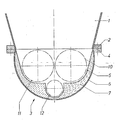
- the drawing shows a cross-section of a discharge element for a container scale with a double casing, two agitators and a discharge screw.
- connection cross section of the scale container 1 is rectangular.
- a discharge housing 3 with approximately the same connection cross section as the scale container 1 is firmly connected to the scale container via connecting flanges 4.
- the discharge housing 3 is designed as a double-shell housing. It has a shaping inner jacket 5, a pressure-maintaining, ie. H. the required strength ensuring outer jacket 6 and two end walls, not shown.
- the space between the inner and outer jacket is covered with a pressure-resistant material 7, e.g. B. lightweight concrete. Such a material is easy to process, non-corrosive, pressure-resistant and temperature-resistant. Other materials that meet these requirements can also be used.
- the entire discharge housing 3 is dimensionally stable in the event of a pressure surge.
- agitators 10, 11 and a discharge screw 12 are arranged, which are only indicated schematically in the drawing.
- the agitators are mounted in the end walls of the discharge housing 3 by suitable arrangements.
- the bushings through the end walls for driving the agitators 10, 11 or the bearings are appropriately sealed.
- the discharge screw 12 is guided to the outside in a known manner via a discharge pipe which is arranged on the outside of an end wall in the extension of the screw trough in the discharge container.
- the material to be conveyed can, for example, be discharged downwards on this discharge pipe.
- the storage and drive of the discharge screw is designed in a known manner similar to that of the agitators.
- the inner jacket 5 of the discharge housing 3 is adapted to the contours of the agitators 10, 11 and the discharge screw 12, similar to that shown in the drawing.
- the discharge screw runs here in a screw trough formed by the inner casing 5, which opens into the discharge pipe on one end face.
- Strength considerations play a subordinate role, since the strength of the discharge container is essentially guaranteed by the outer jacket.
- the wall thickness of the inner jacket can therefore be kept small.
- the inner jacket can also consist of several, easily manufactured individual parts that are welded together. It is welded to the end walls and at the connection cross section to the connection flanges 4 and the outer jacket.
- the outer jacket 6 has an approximately semicircular cross section. It can also be a different cross-section that is easy to manufacture, e.g. B. in a trapezoidal shape.
- the outer jacket is calculated and designed so that it can absorb the stresses that arise in the event of a fault. It is welded to the connecting flanges 4 and to the end walls. The end walls also have connection flanges (corresponding to flanges 4) on the side of the balance container for attachment to the balance container.
Landscapes
- Physics & Mathematics (AREA)
- General Physics & Mathematics (AREA)
- Engineering & Computer Science (AREA)
- Mechanical Engineering (AREA)
- Containers And Packaging Bodies Having A Special Means To Remove Contents (AREA)
- Mixers Of The Rotary Stirring Type (AREA)
- Graft Or Block Polymers (AREA)
- Processing And Handling Of Plastics And Other Materials For Molding In General (AREA)
- Feeding, Discharge, Calcimining, Fusing, And Gas-Generation Devices (AREA)
- Filling Or Emptying Of Bunkers, Hoppers, And Tanks (AREA)
Description
- Es ist ein Austragsorgan für eine Behälterwaage, in explosionsdruckstoßfester Ausführung, bekannt, bestehend aus einem trogförmigen, oben offenen Austragsgehäuse mit etwa rechteckigem Anschlußquerschnitt, das an seiner Anschlußöffnung fest mit der Austrittsöffnung eines Waagenbehälters verbindbar ist und in dem zwei Rührwerke sowie eine zwischen und unterhalb der Rührwerke befindliche Austragsschnecke mit im wesentlichen horizontalen Achsen angeordnet sind, wobei die innere Kontur des Gehäuses an die Konturen der Rührwerke und der Austragsschnecke angepaßt ist und hierbei die Austragsschnecke in einem Schnekkentrog läuft.
- Beim Einsatz von Wägeeinrichtungen in Kohlestaubanlagen oder bei Stäuben, die zu Verpuffungen neigen, ist es aus sicherheitstechnischen Gründen erforderlich, die Waagen und insbesondere auch das Austragsorgan mit Rührwerk und Austragsschnecke in explosionsdruckstoßfester Ausführung entsprechend dem maximalen Explosionsdruck von ca. 10 bar bei einer Kohlenstaubexplosion auszulegen. Wegen der materialabhängigen Austragsbedingungen im Materialeinlauf zur Schnecke ist dabei in bezug auf den Schneckentrog die Gehäuseform vorgegeben. Die vorgegebene Trogform muß hinsichtlich des Innendruckstoßes formstabil sein, d. h. bei einem maximalen Explosionsdruck von ca. 10 bar darf sich das Gehäuse nicht bleibend verformen.
- Bei bekannten Austragsorganen entspricht die innere Kontur des Schneckentrogs gleichzeitig der Außenkontur. Die notwendige Steifigkeit des Troggehäuses wird durch Verrippungen und Versteifungen bewirkt, die an der Außenseite angeordnet sind. Daher ergibt sich beispielsweise durch angeschweißte Rippen und Stege mit vielen Schweißnähten eine komplexe Außenform, die einen erheblichen Fertigungsaufwand erfordert und teuer ist.
- Aufgabe der vorliegenden Erfindung ist es, eine konstruktive Lösung für das Austragsorgan einer Behälterwaage zu finden, die sowohl die Forderung nach Formstabilität als auch nach einfacher und damit kostengünstiger Herstellung erfüllt. Diese Aufgabe wird durch die in den Patentansprüchen angegebenen Merkmale gelöst. Die Ansprüche erfassen auch Ausgestaltungen der Erfindung.
- Durch die erfindungsgemäße Lösung ergeben sich folgende Vorteile. Der die innere Kontur des Gehäuses bildende Mantel kann praktisch ohne Berücksichtigung von Festigkeitsforderungen leicht und damit billig hergestellt werden. Die im Störfall auf den inneren Mantel wirkenden Kräfte werden über das zwischen Innen- und Außenmantel befindliche druckfeste Material auf den Außenmantel übertragen. Der Außenmantel weist eine fertigungstechnisch einfach herzustellende geometrische Form und damit eine hohe Festigkeit und Formstabilität auf und ist in sicherheitstechnischer Hinsicht leicht zu berechnen und fertigungsmäßig einfach herzustellen.
- Die Unteransprüche betreffen vorteilhafte Ausgestaltungen der Erfindung. Eine besonders zweckmäßige Anordnung ergibt sich, wenn der äußere Mantel im Querschnitt halbkreisförmig ausgebildet ist.
- Die Erfindung wird an einem Ausführungsbeispiel in der Zeichnung schematisch dargestellt und in der Beschreibung näher erläutert. Die Zeichnung zeigt im Querschnitt ein Austragsorgan für eine Behälterwaage mit Doppelmantelgehäuse, zwei Rührwerken und einer Austragsschnecke.
- In der Zeichnung ist der Waagenbehälter 1 mit Anschlußflanschen 2 nur schematisch angedeutet. Der Anschlußquerschnitt des Waagenbehälters 1 ist rechteckig ausgebildet. Ein Austragsgehäuse 3 mit etwa gleichem Anschlußquerschnitt wie der Waagenbehälter 1 ist über Anschlußflansche 4 fest mit dem Waagenbehälter verbunden.
- Das Austragsgehäuse 3 ist als Doppelmantelgehäuse ausgebildet. Es weist einen formgebenden Innenmantel 5, einen druckhaltenden, d. h. die erforderliche Festigkeit gewährleistenden Außenmantel 6 und zwei nicht dargestellte Stirnwände auf. Der Zwischenraum zwischen Innen-und Außenmantel ist mit einem druckfesten Material 7, z. B. Leichtbeton, ausgefüllt. Ein solches Material ist leicht zu verarbeiten, nicht korrodierend, druckfest und temperaturbeständig. Es können auch andere, diese Forderungen erfüllende Materialien verwendet werden. Das gesamte Austragsgehäuse 3 ist bei Druckstoß formstabil.
- Im Austragsgehäuse 3 sind zwei Rührwerke 10, 11 und eine Austragsschnecke 12 angeordnet, die in der Zeichnung nur schematisch angedeutet sind. Die Rührwerke sind in den Stirnwänden des Austragsgehäuses 3 durch geeignete Anordnungen gelagert. Die Durchführungen durch die Stirnwände für den Antrieb der Rührwerke 10, 11 bzw. die Lagerungen sind zweckentsprechend abgedichtet.
- Die Austragsschnecke 12 ist über ein Austragsrohr, das an der Außenseite einer Stirnwand in Verlängerung des Schneckentrogs im Austragsbehälter angeordnet ist, in bekannter Weise nach außen geführt. Der Austrag des zu fördernden Materials kann beispielsweise an diesem Austragsrohr nach unten hin erfolgen. Die Lagerung und der Antrieb der Austragsschnecke ist in bekannter Weise ähnlich wie bei den Rührwerken ausgebildet.
- Der Innenmantel 5 des Austragsgehäuses 3 ist an die Konturen der Rührwerke 10, 11 und der Austragsschnecke 12, ähnlich wie in der Zeichnung dargestellt, angepaßt. Die Austragsschnecke läuft hierbei in einem durch den Innenmantel 5 gebildeten Schneckentrog, der an einer Stirnseite in das Austragsrohr mündet. Bei der Konstruktion und Herstellung des Innenmantels spielen Festigkeitsüberlegungen eine untergeordnete Rolle, da die Festigkeit des Austragsbehälters im wesentlichen durch den Außenmantel gewährleistet ist.
- Die Wandstärke des Innenmantels kann daher klein gehalten werden. Der Innenmantel kann auch aus mehreren, leicht herstellbaren Einzelteilen bestehen, die zusammengeschweißt werden. Er ist mit den Stirnwänden und am Anschlußquerschnitt mit den Anschlußflanschen 4 bzw. dem Außenmantel verschweißt.
- Der Außenmantel 6 weist einen etwa halbkreisförmigen Querschnitt auf. Es kann auch ein anderer, fertigungstechnisch einfach herzustellender Querschnitt, z. B. in Trapezform, vorgesehen werden. Der Außenmantel ist so berechnet und ausgebildet, daß er die im Störfall auftretenden Beanspruchungen aufnehmen kann. Er ist mit den Anschlußflanschen 4 sowie mit den Stirnwänden verschweißt. Die Stirnwände weisen an der Waagenbehälterseite ebenfalls Anschlußflansche (entsprechend den Flanschen 4) zur Befestigung am Waagenbehälter auf.
- Das Austragsgehäuse wird zweckmäßigerweise in Schweißkonstruktion ausgeführt. Nach der Herstellung des Gehäuses wird das druckfeste Füllmaterial 7 durch Einfüllöffnungen an einer Stirnwand in den Zwischenraum des Doppelmantels eingebracht. Das Füllmaterial kann durch einen Rüttler zusätzlich verdichtet werden.
Claims (4)
Priority Applications (3)
| Application Number | Priority Date | Filing Date | Title |
|---|---|---|---|
| DE8080107264T DE3067897D1 (en) | 1980-11-21 | 1980-11-21 | Delivery organ for a hopper balance |
| AT80107264T ATE7480T1 (de) | 1980-11-21 | 1980-11-21 | Austragsorgan fuer eine behaelterwaage. |
| EP80107264A EP0052665B1 (de) | 1980-11-21 | 1980-11-21 | Austragsorgan für eine Behälterwaage |
Applications Claiming Priority (1)
| Application Number | Priority Date | Filing Date | Title |
|---|---|---|---|
| EP80107264A EP0052665B1 (de) | 1980-11-21 | 1980-11-21 | Austragsorgan für eine Behälterwaage |
Publications (2)
| Publication Number | Publication Date |
|---|---|
| EP0052665A1 EP0052665A1 (de) | 1982-06-02 |
| EP0052665B1 true EP0052665B1 (de) | 1984-05-16 |
Family
ID=8186903
Family Applications (1)
| Application Number | Title | Priority Date | Filing Date |
|---|---|---|---|
| EP80107264A Expired EP0052665B1 (de) | 1980-11-21 | 1980-11-21 | Austragsorgan für eine Behälterwaage |
Country Status (3)
| Country | Link |
|---|---|
| EP (1) | EP0052665B1 (de) |
| AT (1) | ATE7480T1 (de) |
| DE (1) | DE3067897D1 (de) |
Families Citing this family (3)
| Publication number | Priority date | Publication date | Assignee | Title |
|---|---|---|---|---|
| DE9410287U1 (de) * | 1994-06-24 | 1994-09-01 | Kampwerth Umwelttechnik GmbH & Co. KG, 49196 Bad Laer | Schneckenverdichter mit Einzugshilfe |
| ITUB201558316U1 (it) * | 2015-07-28 | 2017-01-28 | Wamgroup Spa | Apparato dosatore per sostanze in polvere o in granuli |
| CN108545417B (zh) * | 2018-05-23 | 2024-02-23 | 佛山市南海天富科技有限公司 | 一种下料口组件 |
Family Cites Families (4)
| Publication number | Priority date | Publication date | Assignee | Title |
|---|---|---|---|---|
| US2743850A (en) * | 1956-05-01 | hamilton | ||
| US3702128A (en) * | 1971-03-26 | 1972-11-07 | Celanese Corp | Solids feeder apparatus |
| FR2156446A1 (de) * | 1971-10-20 | 1973-06-01 | Toole Et Cie O | |
| CH607825A5 (de) * | 1976-04-15 | 1978-11-15 | Sulzer Ag |
-
1980
- 1980-11-21 AT AT80107264T patent/ATE7480T1/de active
- 1980-11-21 EP EP80107264A patent/EP0052665B1/de not_active Expired
- 1980-11-21 DE DE8080107264T patent/DE3067897D1/de not_active Expired
Also Published As
| Publication number | Publication date |
|---|---|
| ATE7480T1 (de) | 1984-06-15 |
| DE3067897D1 (en) | 1984-06-20 |
| EP0052665A1 (de) | 1982-06-02 |
Similar Documents
| Publication | Publication Date | Title |
|---|---|---|
| DE2500987C2 (de) | "Vorrichtung zum Abscheiden von Verunreinigungen aus Gasen" | |
| EP0052665B1 (de) | Austragsorgan für eine Behälterwaage | |
| EP1187145A1 (de) | Stossdämpfer für einen Behälter | |
| DE1049203B (de) | Kreiselbrechergehaeuse | |
| EP0363668B1 (de) | Transport- und/oder Lagerbehälter für Flüssigkeiten sowie für feinteiliges Schüttgut | |
| DE2716727C3 (de) | Refiner-Fundament | |
| DE3021388C2 (de) | Wasserablauftülle, insbesondere für Hohlräume in Kraftwagenaufbauten | |
| DE1279986B (de) | Ruetteltisch | |
| DE2853357A1 (de) | Doppelwandiges panzergehaeuse | |
| DE2549547C3 (de) | Aus Stahlbeton-Fertigbauteilen gebildeter Kabelschacht | |
| DE841874C (de) | Zerlegbare Kiste | |
| DE3229724C2 (de) | Mittelsäule für Aufbauten von Personen- oder Kombinationskraftwagen | |
| DE3520265A1 (de) | Mischbehaelter | |
| DE3010443C2 (de) | Einrichtung zum Austragen von Material aus einem Behälter | |
| DE270070C (de) | ||
| DE9106809U1 (de) | Warmwasserspeicher | |
| DE2412436A1 (de) | Vorrichtung zur bildung von resonatoren und daraus hergestellte waende | |
| DE1248557B (de) | Lagerbehaelter fuer Fluessigkeiten | |
| DE2114914C3 (de) | Zellensilo | |
| DE2928133C2 (de) | Lager, insbesondere für Brücken | |
| AT257480B (de) | Vorratsbehälter zum Lagern von Flüssigkeiten | |
| DE8503182U1 (de) | Gehäuse für Gasreinigungsapparate | |
| DE2819669A1 (de) | Moertelmisch- und -foerdervorrichtung | |
| EP0162133A1 (de) | Ringtrog-Vibrationsscheuerbehälter | |
| DE1247358B (de) | Gehaeusekoerper fuer eine Tiefkuehltruhe od. dgl. |
Legal Events
| Date | Code | Title | Description |
|---|---|---|---|
| PUAI | Public reference made under article 153(3) epc to a published international application that has entered the european phase |
Free format text: ORIGINAL CODE: 0009012 |
|
| 17P | Request for examination filed |
Effective date: 19811014 |
|
| AK | Designated contracting states |
Designated state(s): AT CH DE GB |
|
| RBV | Designated contracting states (corrected) |
Designated state(s): AT CH DE GB LI |
|
| GRAA | (expected) grant |
Free format text: ORIGINAL CODE: 0009210 |
|
| AK | Designated contracting states |
Designated state(s): AT CH DE GB LI |
|
| REF | Corresponds to: |
Ref document number: 7480 Country of ref document: AT Date of ref document: 19840615 Kind code of ref document: T |
|
| REF | Corresponds to: |
Ref document number: 3067897 Country of ref document: DE Date of ref document: 19840620 |
|
| PLBE | No opposition filed within time limit |
Free format text: ORIGINAL CODE: 0009261 |
|
| STAA | Information on the status of an ep patent application or granted ep patent |
Free format text: STATUS: NO OPPOSITION FILED WITHIN TIME LIMIT |
|
| 26N | No opposition filed | ||
| PGFP | Annual fee paid to national office [announced via postgrant information from national office to epo] |
Ref country code: AT Payment date: 19911009 Year of fee payment: 12 |
|
| PGFP | Annual fee paid to national office [announced via postgrant information from national office to epo] |
Ref country code: GB Payment date: 19911015 Year of fee payment: 12 Ref country code: CH Payment date: 19911015 Year of fee payment: 12 |
|
| PG25 | Lapsed in a contracting state [announced via postgrant information from national office to epo] |
Ref country code: GB Effective date: 19921121 Ref country code: AT Effective date: 19921121 |
|
| PG25 | Lapsed in a contracting state [announced via postgrant information from national office to epo] |
Ref country code: LI Effective date: 19921130 Ref country code: CH Effective date: 19921130 |
|
| GBPC | Gb: european patent ceased through non-payment of renewal fee |
Effective date: 19921121 |
|
| REG | Reference to a national code |
Ref country code: CH Ref legal event code: PL |
|
| PGFP | Annual fee paid to national office [announced via postgrant information from national office to epo] |
Ref country code: DE Payment date: 19931118 Year of fee payment: 14 |
|
| PG25 | Lapsed in a contracting state [announced via postgrant information from national office to epo] |
Ref country code: DE Effective date: 19950801 |