EP0052718A1 - Verfahren und Vorrichtung zum Feststellen von Stoffen in biologischen Flüssigkeiten bei Differential-pH-Messung - Google Patents
Verfahren und Vorrichtung zum Feststellen von Stoffen in biologischen Flüssigkeiten bei Differential-pH-Messung Download PDFInfo
- Publication number
- EP0052718A1 EP0052718A1 EP81107733A EP81107733A EP0052718A1 EP 0052718 A1 EP0052718 A1 EP 0052718A1 EP 81107733 A EP81107733 A EP 81107733A EP 81107733 A EP81107733 A EP 81107733A EP 0052718 A1 EP0052718 A1 EP 0052718A1
- Authority
- EP
- European Patent Office
- Prior art keywords
- electrodes
- solution
- determining
- capillary
- electrode
- Prior art date
- Legal status (The legal status is an assumption and is not a legal conclusion. Google has not performed a legal analysis and makes no representation as to the accuracy of the status listed.)
- Granted
Links
Images



Classifications
-
- G—PHYSICS
- G01—MEASURING; TESTING
- G01N—INVESTIGATING OR ANALYSING MATERIALS BY DETERMINING THEIR CHEMICAL OR PHYSICAL PROPERTIES
- G01N27/00—Investigating or analysing materials by the use of electric, electrochemical, or magnetic means
- G01N27/26—Investigating or analysing materials by the use of electric, electrochemical, or magnetic means by investigating electrochemical variables; by using electrolysis or electrophoresis
- G01N27/28—Electrolytic cell components
- G01N27/30—Electrodes, e.g. test electrodes; Half-cells
- G01N27/327—Biochemical electrodes, e.g. electrical or mechanical details for in vitro measurements
- G01N27/3271—Amperometric enzyme electrodes for analytes in body fluids, e.g. glucose in blood
Definitions
- This invention relates to the fields of analytical chemistry, clinical chemistry and biochemistry wherein electrometric methods using a pH electrode and a reference electrode, such as a calomel or a silver/silver chloride electrode, have heretofore been widely used for the determination of pH in solution.
- glucose in solution can be transformed by the addition of the enzyme glucose oxidase (GOD), into gluconic acid, according to the reaction
- GOD glucose oxidase
- reaction (1) can be made to occur in a medium having a known pH value
- the determination of ⁇ [H + ], i.e., of the number of hydrogen ions liberated in the reaction, can be used to determine stoichiometrically the concentration of glucose, or, in principle, of any other substance producing or absorbing hydrogen ions in solution.
- the pH value of the medium does not change below or above certain limits. This is assured by the use of buffer solutions, which are a group of substances able to engage themselves into ionization reactions.
- buffer solutions which are a group of substances able to engage themselves into ionization reactions.
- the theoretical principles underlying such concepts are well known and are exhaustively treated in any textbook relating to the physical chemistry of electrolytic solutions.
- ⁇ [H + ] is the equation where dpH and ⁇ [H + ] are infinitesimal changes in the pH value of the solution caused by an infinitesimal amount of hydrogen ions, and P is the so-called "buffer value" of the solution.
- ⁇ is a function of the concentration of buffers in solutions, of their respective ionization constants, and of the pH of the solution, according to the equation where the number of buffer species present in solution, whose individual concentration is C (i) , varies between 1 and n.
- ⁇ i is the fractional ionization of each species, given by the formula wherein pK equals, for each species, -log K (i) , where K (i) is the ionization constant of the buffer component i.
- Equation (2) Integration of equation (2) over a definite pH range gives equation (5):
- ⁇ (H + ] is the number of hydrogen ions, in moles per liter, which are required to change the pH value of the solution between pH(o) and pH(l).
- the amount of hydrogen ions required to change the pH of plasma or blood, by one pH unit is respectively 7.5 x 10 -3 moles/liter for plasma and 30 x 10 -3 moles/liter for blood.
- the concentration of many metabolites of clinical interest in biological fluids lies in the concentration range of 5 to 0.1 x 10 -3 moles/liter, the considerations reported above indicate, at least in principle, the usefulness of applying electrochemical methods based on pH measurements to the estimation of the concentration of many chemical species of physiological interest, such as urea, glucose, uric acid, etc. It should be added that the estimation of the amount of hydrogen ions released or absorbed in a chemical reaction by pH electrode measurements can be obtained irrespectively of the optical quality of the sample, which severely limits the application of spectrophotometric methods to the study of whole blood or other turbid solutions.
- the main difficulties in the prior art can be traced to the following points: (a) the two glass electrodes in the apparatus described by Luzzana et al are located in separate compartments which have to be accurately thermostated to obtain the required stability in reading; (b) the renewal of fresh test solutions in contact with the two electrodes could not be accomplished automatically and required at least a few minutes of manual operations; (c) the volume of the reactions required for each single measurement was at least 10 ml, thus preventing the use of microsamples of the solution under tests; (d) the junction solution between the two test solutions could not be renewed automatically; and (e) all calculations required to obtain the concentration of a given substance under test from the measured values of pH had to be obtained by hand calculation.
- the present invention overcomes such difficulties, making possible the development of an entirely new apparatus which can automatically estimate the concentration of many substances of interest in the field of clinical chemistry, biochemistry and analytical chemistry.
- the pH of (a) a solution containing the substances of interest and (b) of the same solution to which a small amount of a specific reagent such as, for example, an enzyme, has been added is measured by two pH electrodes.
- the difference in pH between the two solutions (ApH) when corrected for small blank effects due to the addition of reagents, is free from aspecific drifts in pH and is related only to the effect of the specific reaction. Since under appropriate conditions ApH is a function of the amount of ⁇ [H + ], i.e. of the hydrogen ions produced or absorbed by the reaction, ⁇ [H + ] can be obtained by calculation from ApH, whence, from the stoichiometry of the reaction, the concentration of the substance of interest can be determined.
- the reagent solution should include a buffer capable of maintaining the reaction medium within a range in which the titration curve for the specific reaction is substantially linear. Ordinarily this would be a range of no greater than 1 pH unit and more preferably no greater than 0.5 pH unit, and most preferably whithin a range of no greater than 0.1 pH unit.
- All substances participating in a chemical reaction resulting in an uptake or release of hydrogen ions can be determined by this method and apparatus, which may then find application in many fields such as in clinico-chem - istry, in the food and beverage industry, in analytical chemistry, etc.
- Typical substances which may be determined by this technique are glucose, urea, total carbon dioxide, chloride, and generally all metabolites which are connected through the adenosine triphosphate/adenosine diphosphate (ATP/ADP) system and the diphosphopyridine nucleotide and its reduced form (NAD /NADH) system to a change in hydrogen ion concentration in solution.
- ATP/ADP adenosine triphosphate/adenosine diphosphate
- NAD /NADH diphosphopyridine nucleotide and its reduced form
- the present invention provides a number of advantages over conventional methods of analysis such as those employing colorimetric methods.
- the present invention employs very stable and durable sensors, i.e., the two pH electrodes, and does not depend on optical measurements.
- the method and apparatus may be used for the determination of chemical substances in turbid solutions or in solutions of high optical absorbancy such as diluted plasma, blood, syrups, beverages, or products of the food or cosmetric industry.
- the invention is highly sensitive since a change of ! 0.0001 pH units can be easily measured, leading to the determination of substances present in solution at very low concentrations (10 -5 moles/liter or less).
- the invention also uses a relatively small number of proven electronic and mechanical components and under the control of the microprocessor program, it automatically performs all of the analytical steps required for the analysis and gives final results of the concentration of the substance of interest in a digital form. Further, analysis by the invention herein is reproducible to about 2%, and uses microvolumes of the solution to be analyzed (10 microliters or less). The complete analysis may be accomplished in about 40 seconds to provide the final results from the beginning of the analysis.
- the method of the invention involves use of the formula: wherein [substance] represents the concentration of the substance in question, "FCAL" represents a calibration factor which is a combination of P and a dilution factor, ⁇ pH c represents the ⁇ pH value of the solution after reaction, ⁇ pH b represents the ⁇ pH b value of the solution of the reagents, but without the sample, and ⁇ pH o represents the ApH value indicative of the level of noise and drift of the machine components.
- the analyzer of the present invention is seen to include a housing 12 and is provided with a sample inlet 14 through which the sample being analysed is introduced.
- a digital display panel 16 is provided to display the results of the analysis, particularly the value of the concentration of the substance under test, in digital form.
- a lamp 18 is provided to give an indication by the microcomputer when the instrument is ready to accept a sample.
- Button 20 is used to initiate a cycle of measurements leading to the calibration of the apparatus, and button 22 is used to initiate a cycle of measurements leading to the measurement of the concentration of a given substance under test.
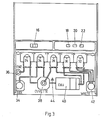
- Figures 2 and 3 show the general layout of the interior of the housing 12 which includes five peristaltic pumps 24, 26, 28, 30 and 32 which, when activated in the proper order by the microcomputer, move, by programmed steps, the solutions contained in solution reservoir 34, enzyme (e.g.) reservoir 36 through the cuvette 38 and cell 40 into the waste container 42.
- Tubing 44 forms a liquid junction between the two electrodes, as will be seen, and thus should be of a conductive material, preferably stainless steel, and should be at machine ground potential. It should be noted that only when the grounding point is fixed before or at the liquid junction between the two electrodes, and the solution after such point is insulated from ground, is it possible to avoid superious electrochemical signals and obtain ⁇ pH measurements reproducible to + 0.0001 pH units.
- the other tubing used to connect reservoir 34 and 36, pumps 24-32, cuvette 38, and cell 40 may be any appropriate tubing such as suitable inert plastic or metal tubing.
- the cuvette 38 is seen to include a DC motor 46 which holds a small cylindrical magnet 48.
- the motor is normally inserted into the circular cavity 50 within block 52 and is held in place by means of a screw inserted into bore 54.
- a circular cavity 56 is provided in block 52 and may be filled by the peristaltic pump 26 with the solution contained in reservoir 34.
- a small bore hole 58 is drilled into the block 52 for connecting the cavity 56 with the glass electrodes in cell 40.
- a similar small bore 60 is provided through which a volume of solution contained in reservoir 34 can be pumped by means of the peristaltic pump 26 into the cavity 56.
- a circular magnetic stirrer 62 is provided and normally rests at the bottom of the cavity 56 and is magnetically coupled to the motor 46 through the magnet48. It is used to mix the contents of the cavity 56.
- the sample inlet 14 is seen to include a block 64, and is provided with an inlet passageway 65, and a bore 66 is connected via pump 28 to the waste reservoir 42.
- a suitable seal such as O-ring 68 seals the block 64 within the block 52 since under operating conditions, the block 64 is fully inserted into the cavity 56 of the block 52, thus defining a space of definite volume wherein a chemical reaction may take place.
- the small passageway 65 is preferably of a diameter of approximately 1.5 mm. A sample contained in a microsyringe or micropipette may be introduced into the cavity 56 through passageway 65.
- Another bore 72 is provided within block 52 and is connected to-reservoir 36 by means of peristaltic pump 24 for introduction of the reagent contained in reservoir 36.
- Cell 40 which holds the two capillary glass pH electrodes is shown.
- Cell 40 -comprises a block 74 of plastic material of suitable composition through which appropriate passageways have been drilled as shown.
- An inlet connection 76 is provided between the cuvette 38 and the two capillary pH electrodes.
- the cell 40 is formed of two stainless steel blocks 78 and 80 having electrode chamber halves 82, 84, 86 and 88 machined therein.
- the blocks 78 and 80 although preferably formed of stainless steel, may be formed of any suitable material which has a high temperature transfer coefficient and will insulate and shield the two pH electrodes both magnetically and thermally. This insures uniformity of temperature between the two electrodes.
- the electrodes 90 are both of identical construction and are commercially available electrodes, and include a mounting bushing 92 which serves to support the electrodes within the cell 40 and seal one end of the electrode chambers.
- the solution passes through a capillary passageway 91 in the electrode 90. Solution may be fed to the electrode passageway, and thus through the electrodes, from the inlet passage 76 through the passages 94 and 96.
- the solution is aspirated by peristaltic pumps 30 and 32 from the reaction chamber or cuvette 38 into cell 40, and 0 flows through the twp pH sensitive glass capillary electrodes 90, and via an appropriate length of tubing connected at the end 98 of the electrode to the waste container 42.
- the connection between the cuvette 38 and the cell inlet 76 is made by a length of capillary stainless steel tubing which is at machine ground potential.
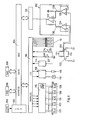
- FIG. 6 a schematic illustration of the electronic circuitry used to control the functions of the apparatus is shown.
- the system is based on a Z80A ( Z ilog) microprocessor 100 which is run by an appropriate program for data acquisition and elaboration, instrument control, and presentation of results in a known manner.
- Clock 102 generates a 4 MHz square wave which is sent to the clock input of the Z80A central processing unit (CPU) 100.
- Address and data lines coming from the CPU 100 are sent to the address data bus 104. This allows the interconnection of the CPU 100 to the read only memory (ROM) 106, the random access memory (RAM) 108, parallel input/ output 110 and the analog-digital converter 112.
- ROM read only memory
- RAM random access memory
- the ROM memory 106 comprises two 2716 EPROM of a total capacity of 4 K bytes, of which approximately 2K are needed for. the mathematical package. Temporary data are stored in the RAM 108, whose size is 500 bytes.
- the input lines are used to get commands or logic signals as follows: “sample”, push button 22; “calibration”, push button 20; a line frequency clock 114 which is used to synchronize functions such as start/stop of motors, to start the conversion of the analog to digital converter 112, etc.
- the output lines are used to provide logic levels to various devices such as the motor driver 116, which drives one or more of the synchronous motors of the peristaltic pumps 24-32, starting the motor when the corresponding line coming from 110 is at a logic level of 1 and stopping the motor when the logic level is 0; (2) the DC driver 118 which turns on the READY light 18 or the stirring motor 46; (3) the display 16, which provides a three digit digital output.
- This display according to the logical configuration on its input, can display numbers, or letters A through F to code diagnostic messages by the microprocessor 100, such as "E" for error.
- the five sychronous motors 120, 122, 124, 126, and 128 are associated with the peristaltic pump 24, 26, 28, 30 and 32 respectively.
- the potential difference produced between the two capillary pH electrodes contained in cell 40 is amplified by the differential amplifier circuit 130.
- the input of the two electrodes shown at terminals E 1 and E 2 is fed into two low bias current, low drift and high input impedence field effect transistors 132 and 1.33. To maintain thermal stability, these transistors are preferably contained in a single chip.
- the output of the two field effect transistors is applied to operational amplifiers 134 and 135, which are connected in a differential amplifier circuit configuration. Their input is applied through two 5000 ohm resistors 136 and 138 respectively, to the negative and positive inputs of an operational amplifier 140.
- the output of the differential amplifier 130 is then fed into the analog-to-digital converter 112, which is a 12-bit analog-to-digital converter type AD 574 (Analog Devices) with a three state output buffer circuit for direct interface with the address data but x 104.
- AD 574 Analog Devices
- Other similar analog-to-digital converters may of course be employed.
- reservoir 34 is filled with a solution containing 25 x 10 -3 moles/liter phosphate buffer, pH 7.4; 2 x 10 -3 moles/liter adenosine triphosphate (ATP); and 1 x 10 -1 moles/liter KC1.
- Reservoir 36 is filled with a solution containing 0.5 units per microliter of the enzyme hexokinase.
- the operator next introduces ten microliters of a standard solution containing a known amount of glucose.
- a typical such standard glucose solution would be 11 mM/ liter.
- the solution is introduced by the use of a micropipette through the sample inlet 14 into the known volume of reagent contained in cavity 56.
- the user presses the calibration button 20 to start the calibration cycle.
- the standard solution is mixed with the solution contained in cavity 56 by the magnetic stirrer 62 which is magnetically driven by the magnet 43 and the DC motor 46.
- Half of the solution volume is then aspirated into the two capillary electrodes contained in cell 40 by the action of peristaltic pumps 30 and 32.
- the output voltage of the electrodes is amplified by the, differential amplifier 130, converted by the analog to digital converter 112, and read several times by the microprocessor through the data bus 104, and analyzed to detect the level of noise and drift.
- the noise level may be affected by, e.g. damaged electrodes, or electrodes which have dried out through extended periods of nonuse.
- the standard deviation of the data is calculated, and if the noise and drift levels are within predetermined values, no error message is sent to the digital display 16. If the predetermined values are exceeded, such as by a severely damaged electrode, an error message is sent to the digital display 16 in order that the operator may take appropriate corrective action before measuring the sample solution.
- a plurality of readings of the difference of potential between the two electrodes are taken, averaged, converted into pH units and stored in the microprocessor RAM 108 as a zero reading ( ⁇ pH o ).
- the concentrations of ATP and hexokinase are such that reaction (7) is driven, in a few seconds, completely to the right producing a definite amount of hydrogen ions, which amount is proportional to the concentration of glucose in solution.
- the hydrogen ions liberated by the reaction will cause a change of pH in the solution in accordance with equation (2).
- Pump 32 is then activated aspirating into the second capillary electrode a volume of the reacted solution.
- the difference in potential between the two pH glass electrodes respectively containing (1) the glucose solution, and (2) the same solution plus hexokinase is read as described for the zero reading. Again, 100 measurements are taken, averaged, and converted into pH units to give a second reading ( ⁇ pH c ).
- the microprocessor 100 commands a series of three washing cycles. For the first two of these cycles, the reservoir 56 is filled with an appropriate amount of fresh reagent solution from reservoir 34, emptying the cavity 56, and washing the two capillary electrodes, via the peristaltic pumps 30 and 32. The last cycle consists of filling the cavity 56 by the peristaltic pump 26, and removing the excess reagent with the peristaltic pump 28.
- READY lamp 18 is then turned on to signal the operator that the instrument is ready to accept a sample.
- the calibration factor FCAL is automatically calculated and stored in the RAM 108.
- the operator introduces into fresh reagent contained in cavity 56, 10 microliters of a solution containing an unknown amount of glucose.
- the solution may be undiluted plasma, whole blood, urine, or any other biological fluid containing or suspected of containing glucose.
- ⁇ pH' o and ⁇ pH' c as in the calibration step.
- ⁇ pH b is assumed to be the same, to a first order of approximation, as the value obtained in the calibration steps. Since it can be shown that under the experimental conditions described: and all terms on the righthand side of equation (9) have been determined, the concentration of the glucose in the sample may be calculated and presented in digital form on the display panel 16.
- Table 1 shows determinations of glucose concentration in human plasma as determined by the present invention and by a U.S. Food and Drug Administration proposed manual method of determination using a spectrophotometric procedure (Federal Register, Vol. 39, No. 126, June 28, 1974). Similar results were obtained on samples of whole blood from normal and pathological individuals.
- the determinations have been carried out on 10 different days. During each day, the 3 pools and 12 serum samples were assayed in duplicatie; with the reference method, with the test method pools, were assayed in triplicate (two series of measurements each day) and the 12 serum samples were assayed in duplicate.
- the data presented illustrate the accuracy and precision of the invention described. It should be noted that most other commercial instrumentation applying different principles of analysis do not give meaningful results when the glucose concentration of the solution under test exceed about 350 mg%.
- the instrument described herein is linear at least up to a glucose concentration of 1000 mg%, a value 10 times higher than that found in normal individuals.
- a reaction for determination of other substances (1) than those shown a reaction must be chosen by the substance of interestis involved in a chemical reaction leading to the liberation of hydrogen ions; (2) the specificity of the reaction must be secured by the addition of a suitable reactant, and (3) the reaction should occur in a buffered medium where pH changes are linear.
- a suitable reactant may be an enzyme or a chemical agent specific for the substance to be determined.
- an enzyme may be determined by use of a substrate reactant for such enzyme.
- the method and instrumentation described herein can thus be used to determine the concentration of chemical substances such as uric acid, proteolytic enzymes, lactic acid pyruvate, and, in general, substances involved in a chain of reactions involving ATP/ADP or NAD/NADH coenzymes.
- the method and apparatus also allows the direct estimation of substances such as glucose, urea, alcohol, cholesterol, etc. in turbid solutions such as whole blood, thus avoiding the lengthy and tedious process of red cell precipitation or centrifugation, and the many analytical steps required for obtaining an estimate of the concentration of such substances.
Landscapes
- Health & Medical Sciences (AREA)
- Chemical & Material Sciences (AREA)
- Life Sciences & Earth Sciences (AREA)
- Analytical Chemistry (AREA)
- Molecular Biology (AREA)
- Chemical Kinetics & Catalysis (AREA)
- Electrochemistry (AREA)
- Physics & Mathematics (AREA)
- Hematology (AREA)
- Biochemistry (AREA)
- General Health & Medical Sciences (AREA)
- General Physics & Mathematics (AREA)
- Immunology (AREA)
- Pathology (AREA)
- Investigating Or Analysing Biological Materials (AREA)
- Measuring Or Testing Involving Enzymes Or Micro-Organisms (AREA)
Applications Claiming Priority (2)
| Application Number | Priority Date | Filing Date | Title |
|---|---|---|---|
| US06/192,204 US4353867A (en) | 1980-09-30 | 1980-09-30 | Method and apparatus for the determination of substances in biological solutions by differential pH measurement |
| US192204 | 1980-09-30 |
Publications (2)
| Publication Number | Publication Date |
|---|---|
| EP0052718A1 true EP0052718A1 (de) | 1982-06-02 |
| EP0052718B1 EP0052718B1 (de) | 1985-09-11 |
Family
ID=22708677
Family Applications (1)
| Application Number | Title | Priority Date | Filing Date |
|---|---|---|---|
| EP81107733A Expired EP0052718B1 (de) | 1980-09-30 | 1981-09-29 | Verfahren und Vorrichtung zum Feststellen von Stoffen in biologischen Flüssigkeiten bei Differential-pH-Messung |
Country Status (8)
| Country | Link |
|---|---|
| US (1) | US4353867A (de) |
| EP (1) | EP0052718B1 (de) |
| JP (1) | JPS57131045A (de) |
| AU (1) | AU550744B2 (de) |
| CA (1) | CA1174731A (de) |
| DE (1) | DE3172239D1 (de) |
| DK (1) | DK156977C (de) |
| ES (1) | ES8206858A1 (de) |
Cited By (2)
| Publication number | Priority date | Publication date | Assignee | Title |
|---|---|---|---|---|
| EP0335859A3 (en) * | 1988-03-28 | 1990-08-29 | Avl Medical Instruments Ag | Device for determining components in a sample |
| EP0805350A1 (de) * | 1996-05-02 | 1997-11-05 | Universita'degli Studi Di Milano | Methode und Gerät zur Bestimmung von Substanzen in Lösungen, Suspensionen und Emulsionen durch differentielle pH-Messung |
Families Citing this family (12)
| Publication number | Priority date | Publication date | Assignee | Title |
|---|---|---|---|---|
| US4713165A (en) * | 1986-07-02 | 1987-12-15 | Ilex Corporation | Sensor having ion-selective electrodes |
| FI80800C (fi) * | 1986-10-03 | 1990-07-10 | Kone Oy | Foerfarande foer bestaemning av den totala karbonathalten speciellt i en biologisk vaetska. |
| DE3712440C2 (de) * | 1987-04-11 | 1996-09-19 | Merck Patent Gmbh | Testsystem und Verfahren zur Bestimmung mehrerer Substanzen auf der Basis der Bestimmung einer pH-Änderung |
| US4912417A (en) * | 1989-02-21 | 1990-03-27 | Fisher Scientific Company | Measurement of pH and specific ion concentration |
| TR200200942A2 (tr) * | 2002-04-08 | 2004-02-23 | Tuncer De��M �. | Üre ölçer/üre saati:insan kanındaki ürenin ters iyontoforez ile, kan veya biyolojik örnek alınmadan tespiti. |
| JP3705260B2 (ja) * | 2002-10-30 | 2005-10-12 | 株式会社デンソー | オイル劣化検出装置 |
| US20050194296A1 (en) * | 2004-03-03 | 2005-09-08 | Fong -Jei Lin | pH measurement system for buoyant water chlorinator |
| US7445372B1 (en) | 2004-10-01 | 2008-11-04 | Access Business Group International Llc | Custom cosmetic mixer |
| US7291502B2 (en) * | 2006-03-15 | 2007-11-06 | Franco Wayne P | Method for performing a non-invasive blood gas test |
| KR101786967B1 (ko) * | 2013-08-01 | 2017-10-18 | 삼성전자주식회사 | 가스 센서 모듈, 이를 포함하는 냉장고 및 그 제어 방법 |
| CN111879831B (zh) * | 2020-06-18 | 2022-11-18 | 杭州牛斗科技有限公司 | 用于锂电行业的反应液pH值检测添加装置 |
| CN112782252B (zh) * | 2021-01-07 | 2022-03-25 | 安徽大学 | 一种定量检测高锰酸钾的方法 |
Citations (4)
| Publication number | Priority date | Publication date | Assignee | Title |
|---|---|---|---|---|
| US4003705A (en) * | 1975-06-12 | 1977-01-18 | Beckman Instruments, Inc. | Analysis apparatus and method of measuring rate of change of electrolyte pH |
| DE2649102A1 (de) * | 1975-10-30 | 1977-05-12 | Leco Corp | Saeurepruefgeraet |
| DE2648538B1 (de) * | 1976-10-27 | 1978-04-27 | Oelsch Fernsteuergeraete | Verfahren zur automatisch geregelten Konstanthaltung der Zusammensetzung von Baedern und Vorrichtung zur Durchfuehrung des Verfahrens |
| US4149949A (en) * | 1978-07-06 | 1979-04-17 | Beckman Instruments, Inc. | Electrochemical analysis apparatus employing single ion measuring sensor |
Family Cites Families (7)
| Publication number | Priority date | Publication date | Assignee | Title |
|---|---|---|---|---|
| US3367849A (en) * | 1964-03-20 | 1968-02-06 | Atomic Energy Commission Usa | Amperometric determination of glucose |
| US3591480A (en) * | 1968-07-15 | 1971-07-06 | Ibm | Glucose measuring system |
| US3763422A (en) * | 1971-10-21 | 1973-10-02 | Corning Glass Works | Method and apparatus for electrochemical analysis of small samples of blood |
| US3874850A (en) * | 1972-07-24 | 1975-04-01 | Radiometer As | Blood analyzing method and apparatus |
| US3920969A (en) * | 1974-01-31 | 1975-11-18 | Robert E Berglas | Digital glucose analyzer |
| US3960497A (en) * | 1975-08-19 | 1976-06-01 | Beckman Instruments, Inc. | Chemical analyzer with automatic calibration |
| US4233031A (en) * | 1978-12-11 | 1980-11-11 | Environmental Sciences Associates, Inc. | Electrochemical testing system and method |
-
1980
- 1980-09-30 US US06/192,204 patent/US4353867A/en not_active Expired - Lifetime
-
1981
- 1981-09-29 ES ES506488A patent/ES8206858A1/es not_active Expired
- 1981-09-29 CA CA000386932A patent/CA1174731A/en not_active Expired
- 1981-09-29 EP EP81107733A patent/EP0052718B1/de not_active Expired
- 1981-09-29 DK DK430281A patent/DK156977C/da active
- 1981-09-29 DE DE8181107733T patent/DE3172239D1/de not_active Expired
- 1981-09-30 AU AU75790/81A patent/AU550744B2/en not_active Ceased
- 1981-09-30 JP JP56156079A patent/JPS57131045A/ja active Granted
Patent Citations (5)
| Publication number | Priority date | Publication date | Assignee | Title |
|---|---|---|---|---|
| US4003705A (en) * | 1975-06-12 | 1977-01-18 | Beckman Instruments, Inc. | Analysis apparatus and method of measuring rate of change of electrolyte pH |
| DE2649102A1 (de) * | 1975-10-30 | 1977-05-12 | Leco Corp | Saeurepruefgeraet |
| US4060717A (en) * | 1975-10-30 | 1977-11-29 | Leco Corporation | Acid tester |
| DE2648538B1 (de) * | 1976-10-27 | 1978-04-27 | Oelsch Fernsteuergeraete | Verfahren zur automatisch geregelten Konstanthaltung der Zusammensetzung von Baedern und Vorrichtung zur Durchfuehrung des Verfahrens |
| US4149949A (en) * | 1978-07-06 | 1979-04-17 | Beckman Instruments, Inc. | Electrochemical analysis apparatus employing single ion measuring sensor |
Cited By (2)
| Publication number | Priority date | Publication date | Assignee | Title |
|---|---|---|---|---|
| EP0335859A3 (en) * | 1988-03-28 | 1990-08-29 | Avl Medical Instruments Ag | Device for determining components in a sample |
| EP0805350A1 (de) * | 1996-05-02 | 1997-11-05 | Universita'degli Studi Di Milano | Methode und Gerät zur Bestimmung von Substanzen in Lösungen, Suspensionen und Emulsionen durch differentielle pH-Messung |
Also Published As
| Publication number | Publication date |
|---|---|
| DK156977C (da) | 1990-03-19 |
| CA1174731A (en) | 1984-09-18 |
| US4353867A (en) | 1982-10-12 |
| ES506488A0 (es) | 1982-08-16 |
| AU550744B2 (en) | 1986-04-10 |
| JPH0129260B2 (de) | 1989-06-08 |
| ES8206858A1 (es) | 1982-08-16 |
| DK156977B (da) | 1989-10-23 |
| AU7579081A (en) | 1982-04-08 |
| DK430281A (da) | 1982-03-31 |
| JPS57131045A (en) | 1982-08-13 |
| EP0052718B1 (de) | 1985-09-11 |
| DE3172239D1 (en) | 1985-10-17 |
Similar Documents
| Publication | Publication Date | Title |
|---|---|---|
| US3933593A (en) | Rate sensing batch analysis method | |
| US3857771A (en) | Rate sensing batch analyzer | |
| CA1316981C (en) | Sample analysis | |
| EP0052718B1 (de) | Verfahren und Vorrichtung zum Feststellen von Stoffen in biologischen Flüssigkeiten bei Differential-pH-Messung | |
| US3765841A (en) | Method and apparatus for chemical analysis | |
| US8712701B2 (en) | Potentiometric-sensor chip, potentiometric assay, and assay kit | |
| CN101999073A (zh) | 斜率式补偿 | |
| US7816145B2 (en) | Method, device and apparatus for measuring the concentration of creatinine, and method, device and apparatus for measuring the amount of salt using the same | |
| Llenado et al. | Ion-electrode based autoanalysis system for enzymes | |
| EP0805350B1 (de) | Methode und Gerät zur Bestimmung von Substanzen in Lösungen, Suspensionen und Emulsionen durch differentielle pH-Messung | |
| Llenado et al. | Ion-electrode based automatic glucose analysis system | |
| US3890099A (en) | Colorimetric assay for urea | |
| US4045296A (en) | Rate sensing batch analysis method and enzyme used therein | |
| Park et al. | A simple method for the estimation of plasma ammonia using an ion specific electrode | |
| JP2873170B2 (ja) | 二種類の出発溶液の混合方法およびそれを実施する装置 | |
| Trayser et al. | A new" kinetic" method for enzyme analysis suitable for automation | |
| Luzzana et al. | Measurement of glucose in plasma by a differential pH technique. | |
| US4218535A (en) | Determination of enzyme substrate concentration | |
| US5158868A (en) | Method of sample analysis | |
| Schwartz et al. | Simple microtitrimetric constant-pH method for accurate enzyme assays | |
| JPH029302B2 (de) | ||
| Cho et al. | Development of a multichannel electrochemical centrifugal analyzer. | |
| OKUDA et al. | A Rapid Polarographic Microdetermination of Glucose with Glucose Oxidase | |
| JP3074361B2 (ja) | 定量分析装置 | |
| Diamandis et al. | Continuous-flow determination of reducing sugars and sucrose in natural and industrial products with periodate oxidation and a periodate-sensitive flow-through electrode |
Legal Events
| Date | Code | Title | Description |
|---|---|---|---|
| PUAI | Public reference made under article 153(3) epc to a published international application that has entered the european phase |
Free format text: ORIGINAL CODE: 0009012 |
|
| 17P | Request for examination filed |
Effective date: 19810929 |
|
| AK | Designated contracting states |
Designated state(s): BE CH DE FR GB NL SE |
|
| GRAA | (expected) grant |
Free format text: ORIGINAL CODE: 0009210 |
|
| AK | Designated contracting states |
Designated state(s): BE CH DE FR GB LI NL SE |
|
| REF | Corresponds to: |
Ref document number: 3172239 Country of ref document: DE Date of ref document: 19851017 |
|
| ET | Fr: translation filed | ||
| PLBE | No opposition filed within time limit |
Free format text: ORIGINAL CODE: 0009261 |
|
| STAA | Information on the status of an ep patent application or granted ep patent |
Free format text: STATUS: NO OPPOSITION FILED WITHIN TIME LIMIT |
|
| 26N | No opposition filed | ||
| EAL | Se: european patent in force in sweden |
Ref document number: 81107733.8 |
|
| PGFP | Annual fee paid to national office [announced via postgrant information from national office to epo] |
Ref country code: SE Payment date: 19980904 Year of fee payment: 18 |
|
| PGFP | Annual fee paid to national office [announced via postgrant information from national office to epo] |
Ref country code: FR Payment date: 19980909 Year of fee payment: 18 |
|
| PGFP | Annual fee paid to national office [announced via postgrant information from national office to epo] |
Ref country code: NL Payment date: 19980929 Year of fee payment: 18 |
|
| PGFP | Annual fee paid to national office [announced via postgrant information from national office to epo] |
Ref country code: GB Payment date: 19981001 Year of fee payment: 18 |
|
| PGFP | Annual fee paid to national office [announced via postgrant information from national office to epo] |
Ref country code: DE Payment date: 19981005 Year of fee payment: 18 |
|
| PGFP | Annual fee paid to national office [announced via postgrant information from national office to epo] |
Ref country code: CH Payment date: 19981009 Year of fee payment: 18 |
|
| PGFP | Annual fee paid to national office [announced via postgrant information from national office to epo] |
Ref country code: BE Payment date: 19981118 Year of fee payment: 18 |
|
| PG25 | Lapsed in a contracting state [announced via postgrant information from national office to epo] |
Ref country code: SE Free format text: THE PATENT HAS BEEN ANNULLED BY A DECISION OF A NATIONAL AUTHORITY Effective date: 19990929 Ref country code: GB Free format text: LAPSE BECAUSE OF NON-PAYMENT OF DUE FEES Effective date: 19990929 |
|
| PG25 | Lapsed in a contracting state [announced via postgrant information from national office to epo] |
Ref country code: LI Free format text: LAPSE BECAUSE OF NON-PAYMENT OF DUE FEES Effective date: 19990930 Ref country code: CH Free format text: LAPSE BECAUSE OF NON-PAYMENT OF DUE FEES Effective date: 19990930 Ref country code: BE Free format text: LAPSE BECAUSE OF NON-PAYMENT OF DUE FEES Effective date: 19990930 |
|
| BERE | Be: lapsed |
Owner name: LUZZANA MASSIMO Effective date: 19990930 |
|
| PG25 | Lapsed in a contracting state [announced via postgrant information from national office to epo] |
Ref country code: NL Free format text: LAPSE BECAUSE OF NON-PAYMENT OF DUE FEES Effective date: 20000401 |
|
| EUG | Se: european patent has lapsed |
Ref document number: 81107733.8 |
|
| REG | Reference to a national code |
Ref country code: CH Ref legal event code: PL |
|
| GBPC | Gb: european patent ceased through non-payment of renewal fee |
Effective date: 19990929 |
|
| PG25 | Lapsed in a contracting state [announced via postgrant information from national office to epo] |
Ref country code: FR Free format text: LAPSE BECAUSE OF NON-PAYMENT OF DUE FEES Effective date: 20000531 |
|
| NLV4 | Nl: lapsed or anulled due to non-payment of the annual fee |
Effective date: 20000401 |
|
| PG25 | Lapsed in a contracting state [announced via postgrant information from national office to epo] |
Ref country code: DE Free format text: LAPSE BECAUSE OF NON-PAYMENT OF DUE FEES Effective date: 20000701 |
|
| REG | Reference to a national code |
Ref country code: FR Ref legal event code: ST |