EP0052799B1 - Neue D-Homosteroide, ihre Verwendung und Herstellung, sowie pharmazeutische Präparate damit - Google Patents
Neue D-Homosteroide, ihre Verwendung und Herstellung, sowie pharmazeutische Präparate damit Download PDFInfo
- Publication number
- EP0052799B1 EP0052799B1 EP81109202A EP81109202A EP0052799B1 EP 0052799 B1 EP0052799 B1 EP 0052799B1 EP 81109202 A EP81109202 A EP 81109202A EP 81109202 A EP81109202 A EP 81109202A EP 0052799 B1 EP0052799 B1 EP 0052799B1
- Authority
- EP
- European Patent Office
- Prior art keywords
- homo
- oxo
- methyl
- androst
- androsta
- Prior art date
- Legal status (The legal status is an assumption and is not a legal conclusion. Google has not performed a legal analysis and makes no representation as to the accuracy of the status listed.)
- Expired
Links
- 0 CC(CC1)(C(CCC2)C(CC3)C1C(C)(CC1)C3=C(*)C1=O)[C@@]2(*)C(CO)=O Chemical compound CC(CC1)(C(CCC2)C(CC3)C1C(C)(CC1)C3=C(*)C1=O)[C@@]2(*)C(CO)=O 0.000 description 3
Classifications
-
- C—CHEMISTRY; METALLURGY
- C07—ORGANIC CHEMISTRY
- C07J—STEROIDS
- C07J63/00—Steroids in which the cyclopenta(a)hydrophenanthrene skeleton has been modified by expansion of only one ring by one or two atoms
- C07J63/008—Expansion of ring D by one atom, e.g. D homo steroids
-
- A—HUMAN NECESSITIES
- A61—MEDICAL OR VETERINARY SCIENCE; HYGIENE
- A61P—SPECIFIC THERAPEUTIC ACTIVITY OF CHEMICAL COMPOUNDS OR MEDICINAL PREPARATIONS
- A61P13/00—Drugs for disorders of the urinary system
- A61P13/02—Drugs for disorders of the urinary system of urine or of the urinary tract, e.g. urine acidifiers
-
- A—HUMAN NECESSITIES
- A61—MEDICAL OR VETERINARY SCIENCE; HYGIENE
- A61P—SPECIFIC THERAPEUTIC ACTIVITY OF CHEMICAL COMPOUNDS OR MEDICINAL PREPARATIONS
- A61P15/00—Drugs for genital or sexual disorders; Contraceptives
Definitions
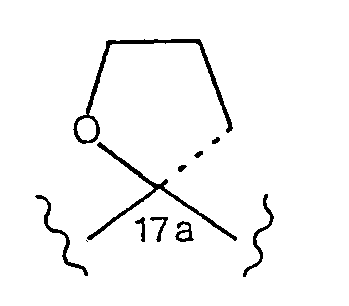
- the invention relates to new D-homosteroids of the formula wherein R 4 is hydrogen, methyl, chlorine or hydroxy; R 6 is hydrogen or methylene; R 17a ⁇ is hydrogen, methyl or chlorine and R 17ass carboxy, esterified carboxy, cyano, formyl, carbamoyl, mono- or di-lower alkyl carbamoyl; or R 17a ⁇ and R 17 ⁇ together form a spiro ether ring of the formula mean and in which the dotted bonds in the D-ring represent an optional 16 (17) or 17 (17a) double bond, in the latter case R17aa being absent.
- the invention further relates to a method for producing the D-homosteroids of the formula and pharmaceutical preparations containing D-homosteroids.
- “Lower” alkyl alone or in combination, means straight-chain or branched alkyl groups with 1-7, preferably 1-4, carbon atoms.
- esterified carboxy refers to carboxyl groups that are esterified with an aliphatic, cycloaliphatic, aromatic or araliphatic radical.
- esterified carboxy groups are alkoxycarbonyl, in particular lower alkoxycarbonyl optionally substituted by halogen such as chlorine or amino, such as methoxy, ethoxy, propoxy and butoxycarbonyl; Cycloalkoxycarbonyl such as cyclohexyloxy and cyclopentyloxycarbonyl; Aryloxycarbonyl such as phenyloxy and tolyloxycarbonyl; and aralkoxycarbonyl such as benzyloxycarbonyl.
- Examples of mono-lower alkyl carbamoyl groups are methyl, ethyl and propyl carbamoyl; and lower-alkylamino-substituted lower-alkylcarbamoyl, such as di-lower-alkylamino-ethyl-carbamoyl.
- Examples of di-lower alkylcarbamoyl groups are dimethyl, diethyl, dipropyl and N-methyl-N-ethylcarbamoyl.
- Preferred D-homosteroids of the formula I are those in which R 4 , R 6 and R 17a ⁇ are hydrogen and R17ass carboxy, lower alkoxycarbonyl or cyano, or R 17a ⁇ and R17ass together represent a spiroether ring as defined above.
- R 4 , R 6 and R 17a ⁇ are hydrogen and R17ass carboxy, lower alkoxycarbonyl or cyano, or R 17a ⁇ and R17ass together represent a spiroether ring as defined above.
- R 17a ⁇ carboxy or lower alkoxycarbonyl and saturated D ring, such as 3-oxo-D-homo-androst-4-ene-17ass-carboxylic acid and its methyl ester.
- oxidation of a D-homosteroid of the formula II according to process variant a) yields a D-homosteroid of the formula I, in which R 17 is carboxy.
- Reagents such as periodic acid can be used as oxidizing agents.
- the oxidation is conveniently carried out at room temperature.
- Suitable solvents are those in which both reactants are soluble, e.g. B. aqueous alcohols.
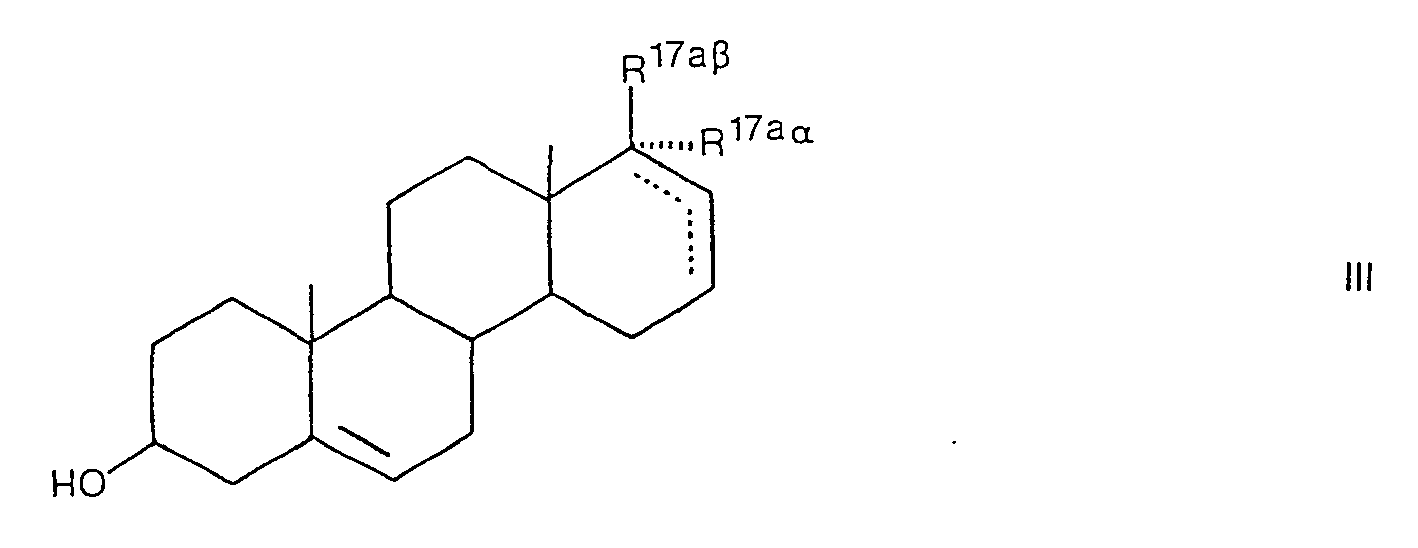
- the oxidation of the 3-hydroxy- 5 grouping of a D-homosteroid of the formula III to the corresponding 3-keto-A I- D homosteroids can be carried out by means of the Oppenauer reaction, e.g. B. with aluminum isopropylate or with oxidizing agents such as chromium trioxide (e.g. Jones' reagent) or according to Pfitzner-Moffatt with dimethyl sulfoxide / dicyclohexylcarbodiimide (the ⁇ 5- 3-ketone obtained initially must then be isomerized to the ⁇ 4 -3-ketone) , or be carried out using pyridine / S0 3 .
- oxidizing agents such as chromium trioxide (e.g. Jones' reagent) or according to Pfitzner-Moffatt with dimethyl sulfoxide / dicyclohexylcarbodiimide (the ⁇ 5- 3-ketone obtained initially must then be isomerized to the ⁇ 4
- the dehydration of the hydroxymethyl group of a D-homosteroid of the formula IV to produce a D-homosteroid of the formula I in which R 6 is methylene can be accomplished by treatment with acids, such as p-toluenesulfonic acid.
- the cyclization reaction according to process variant d), which provides D-homosteroids of the formula 1, in which R 17a ⁇ and R 17 ⁇ together form a spiro ether group of the formula can form by treatment with a dehydrating agent, e.g. B. p-toluenesulfochloride or methanesulfonyl chloride in pyridine.
- a dehydrating agent e.g. B. p-toluenesulfochloride or methanesulfonyl chloride in pyridine.
- the esterification of a 17ass carboxy group in a D-homosteroid of the formula I can, for. B. by treating the acid with a diazoalkane, such as diazomethane in ether, or with an O-alkyl-N, N'-dicyclohexylisourea in an aprotic solvent, e.g. B. dimethylacetamide or dimethylformamide; or by reacting a salt of the acid, e.g. B. an alkali salt, with an alkyl, cycloalkyl, aryl or aralkyl halide.
- a diazoalkane such as diazomethane in ether
- an O-alkyl-N, N'-dicyclohexylisourea in an aprotic solvent, e.g. B. dimethylacetamide or dimethylformamide
- a salt of the acid e.g. B. an alkali salt
- An esterified carboxy group R 17a ⁇ can be treated by treatment with alkaline reagents such as alcoholic alkali hydroxides, e.g. B. methanolic potassium hydroxide solution at elevated temperature to the carboxy group (process variant f).
- alkaline reagents such as alcoholic alkali hydroxides, e.g. B. methanolic potassium hydroxide solution at elevated temperature to the carboxy group (process variant f).
- the chlorination according to process variant g) is expediently carried out by introducing chlorine or sulfuryl chloride into a reaction medium which contains the starting steroid of the formula I.
- the chlorination can be carried out in the presence of a proton acceptor, for example pyridine, picoline, dimethylformamide or dimethylazetamide; or ethylene oxide or propylene oxide, optionally with the addition of a further solvent, such as benzene.
- a proton acceptor for example pyridine, picoline, dimethylformamide or dimethylazetamide
- ethylene oxide or propylene oxide optionally with the addition of a further solvent, such as benzene.
- the chlorination can be carried out in the absence of a proton acceptor. In this case, the primary chlorination product is then treated with one of the proton acceptors mentioned.
- a preferred method for introducing a 4-hydroxy group consists in reacting a 4,5-saturated starting steroid with a strong base such as potassium tert-butoxide in tert-butanol with aeration (oxygen supply) (cf. Tetrahydron Lett. 1961, 554 ).
- 4-Hydroxy-D-homosteroids of the formula I can furthermore be prepared by alkaline hydrolysis of corresponding 4-halo-D-homosteroids, [cf. 11 Farmaco-Ed. Pr. 17, 721 (1962)].
- the 4-methylation according to process variant g) can, for. B.'d by making a 4-unsubstituted D-homosteroid of formula I by reaction with pyrrolidine or another secondary cyclic amine, such as morpholine or piperidine, converted into a 3-enamine and this with a methylating agent, e.g. B. a methyl halide, and the enamine group is split off from the reaction product by hydrolysis.
- a methylating agent e.g. B. a methyl halide
- the methylation of the 3-enamine is preferably carried out in the presence of an organic solvent, such as ethanol, methanol, ethyl acetate, in particular also dimethylformamide etc.
- an organic solvent such as ethanol, methanol, ethyl acetate, in particular also dimethylformamide etc.
- the iodide or bromide is expediently used as the halide.
- the hydrolysis of the 3-enamine grouping in order to reintroduce the original 3-keto- 4 grouping can be carried out in a manner known per se, e.g. B. with water, aqueous acid or base (for example with a solution of sodium hydroxide in aqueous methanol) or directly in the course of the alkylation or aralkylation, such. B. when using dimethylformamide as a solvent.
- Another method for 4-methylation is that the 3-keto- ⁇ 4 starting steroid is used with formaldehyde and a thiol (e.g. an aliphatic, aromatic, alicyclic or heterocyclic thiol, such as ethyl mercaptan, thiophenol, cyclohexyl mercaptan, pyridyl mercaptan) in the presence of a base, especially an organic base, such as a tertiary amine, e.g. B. trialkylamine, converted into a thiomethyl ether, for example the phenylthiomethyl ether of the formula and the latter reductively desulfurized to the ⁇ 4 -4-methyl compound, for. B. with deactivated Raney nickel (see, for example, Chem. Soc. 1962, 1091).
- a base especially an organic base, such as a tertiary amine, e.g. B. trialkylamine, converted into a
- a 3-keto- ⁇ 4 starting steroid can be methylated in the 4-position with a methylating agent, in particular a methyl iodide or bromide in the presence of a proton acceptor, such as potassium tert-butoxide in tert-butanol [cf. e.g. BJ Am. Chem. Soc. 85, 196 (1963)].
- a methylating agent in particular a methyl iodide or bromide in the presence of a proton acceptor, such as potassium tert-butoxide in tert-butanol [cf. e.g. BJ Am. Chem. Soc. 85, 196 (1963)].
- the conversion of a carboxyl group R 17a ß into a carbamoyl group can be carried out by converting the carboxylic acid into an acid halide, e.g. B. using an acyl halide such as oxalyl chloride, and Reaction of the acid halide with ammonia or a mono- or di-lower alkylamine can be carried out (process variant h).
- an acid halide e.g. B. using an acyl halide such as oxalyl chloride
- Reaction of the acid halide with ammonia or a mono- or di-lower alkylamine can be carried out (process variant h).
- Dehydration of an acid amide, ie, a D-homosteroid of formula I, wherein R17 is carbamoyl, to a D-homosteroid of formula I, wherein R 17a ⁇ is cyano can be accomplished with mild dehydrating agents such as triphenylphosphine oxide / trifluoroacetic anhydride.
- the D-homosteroids of the formulas II-V used as starting materials are known or can be prepared as described in the examples below, or in analogy thereto.
- the D-homosteroids of formula I are therapeutically effective. In particular, they act as 5a reductase inhibitors and, as a result, can be used as anti-androgens, for example for the treatment of acne, hirsutism and prostate hypertrophy.
- the D-homosteroids of the formula I can be administered topically (for example in the case of acne), enterally or parenterally.
- D-homosteroids with a 17a-carboxylic acid function are known from EP-A-0 013 959 and FR-A-2 305 976. These D-homosteroids have an anti-inflammatory effect. From US-A-3 917 829 normal steroid-17-carboxylic acids with anti-androgenic activity are known. Other normal steroids (i.e., 5-membered D-ring steroids) with anti-androgenic activity are known from US-A-3,705,179. From US-A-3 254 074 17-spiro ether steroids of the normal series are known which inhibit the action of aldosterone.
- the activity of the D-homosteroids of formula I in the inhibition of 5a-reductase in vitro was determined according to a modified method by M. S. P. Manandhar and J. A. Thomas (Investigat. Urology 14 (1976) 20-22).
- a 10% (weight / volume) homogenate of ventral prostate glands of albino rats (180-200 g weight) in ice-cold 0.05 M glycylglycine buffer (pH 7.0) was used as the enzyme preparation.
- the homogenate was filtered through nylon gauze and diluted to 1% with buffer solution before running the test.
- the in vivo test was carried out as follows: Adult male albino rats weighing 200 were castrated. Two hours later, they received the first of 10 daily doses of the test substance suspended in 0.5% carboxymethyl cellulose, 0.4% Tween 80, 0.9% benzyl alcohol in physiological saline. 3 hours after the last medication on the tenth day of treatment, the animals were decapitated, the blood from the trunk was collected and the seminal vesicles, the ventral prostate and the levator ani muscle were removed and weighed. The results are given as ng NIAMDD-RP-I / ml.
- IC 50 denotes the molar ratio of testosterone: test substance in which the conversion of testosterone to dihydrotestosterone is reduced by half.
- the D-homosteroids of the formula I can be used as medicines, e.g. B. in the form of pharmaceutical preparations are used, which they or their salts in a mixture with a suitable for enteral, percutaneous or parenteral application pharmaceutical, organic or inorganic inert carrier material, such as. B. water, gelatin, gum arabic, milk sugar, starch, magnesium sulfate, talc, vegetable oils, polyalkylene glycols, petroleum jelly, etc. contain.
- the pharmaceutical preparations can be in solid form, e.g. B. as tablets, dragees, suppositories, capsules; in semi-solid form, e.g. B. as ointments; or in liquid form, e.g. B.
- auxiliaries such as preservatives, stabilizers, wetting agents or emulsifiers, salts for changing the osmotic pressure or buffers. They can also contain other therapeutically valuable substances.
- the starting material was prepared by reacting methyl 3ß-hydroxy-D-homo-androsta-5,17-diene-17ass-carboxylic acid with methyl iodide in DMF in the presence of potassium tert-butoxide at 50 °.
- the starting material was cat. Hydrogenation of 3ß-hydroxy-17a-methyl-D-homo-androsta-5,16-diene-17ass-carboxylic acid methyl ester obtained.
- the starting material was obtained from 3 ⁇ -acetoxy-17a ⁇ -chloro-D-homo-androst-5-en-17a-carboxaldehyde by splitting off the chlorine with lithium carbonate in DMF and then saponifying the 3-acetate with potassium carbonate in methanol.
- the starting material was prepared by reducing 3-oxo-D-homo-17aa-pregna-4,16-diene-21,17a-carbolactone with LiAIH 4 and oxidation of the 3-ol obtained with Mn0 2 .
Landscapes
- Health & Medical Sciences (AREA)
- Chemical & Material Sciences (AREA)
- Organic Chemistry (AREA)
- General Health & Medical Sciences (AREA)
- Pharmacology & Pharmacy (AREA)
- Veterinary Medicine (AREA)
- General Chemical & Material Sciences (AREA)
- Medicinal Chemistry (AREA)
- Nuclear Medicine, Radiotherapy & Molecular Imaging (AREA)
- Chemical Kinetics & Catalysis (AREA)
- Bioinformatics & Cheminformatics (AREA)
- Life Sciences & Earth Sciences (AREA)
- Animal Behavior & Ethology (AREA)
- Engineering & Computer Science (AREA)
- Public Health (AREA)
- Urology & Nephrology (AREA)
- Endocrinology (AREA)
- Reproductive Health (AREA)
- Steroid Compounds (AREA)
- Pharmaceuticals Containing Other Organic And Inorganic Compounds (AREA)
- Medicines Containing Material From Animals Or Micro-Organisms (AREA)
Description
- Die Erfindung betrifft neue D-Homosteroide der Formel


- Die Erfindung betrifft weiterhin ein Verfahren zur Herstellung der D-Homosteroide der Formel sowie D-Homosteroide enthaltende pharmazeutische Präparate.
- Unter « nieder »-Alkyl allein oder in Kombination werden geradkettige oder verzweigte Alkylgruppen mit 1-7, vorzugsweise 1-4 C-Atomen verstanden.
- Der Ausdruck « verestertes Carboxy bezieht sich auf Carboxylgruppen, die mit einem aliphatischen, cycloaliphatischen, aromatischen oder araliphatischen Rest verestert sind. Beispiele von veresterten Carboxygruppen sind Alkoxycarbonyl, insbesondere ggf. durch Halogen, wie Chlor, oder Amino substituiertes nieder-Alkoxycarbonyl, wie Methoxy-, Aethoxy-, Propoxy- und Butoxycarbonyl ; Cycloalkoxycarbonyl, wie Cyclohexyloxy- und Cyclopentyloxycarbonyl ; Aryloxycarbonyl, wie Phenyloxy- und Tolyloxycarbonyl ; und Aralkoxycarbonyl, wie Benzyloxycarbonyl. Beispiele von mono-nieder-Alkylcarbamoylgruppen sind Methyl-, Aethyl- und Propyl-carbamoyl ; und nieder-Alkyl-amino-substituiertes nieder-Alkylcarbamoyl, wie Di-nieder-alkylamino-äthyl-carbamoyl. Beispiele von di-nieder-Alkylcarbamoylgruppen sind Dimethyl-, Diäthyl-, Dipropyl- und N-Methyl-N-Aethyl-carbamoyl.
- Bevorzugte D-Homosteroide der Formel I sind solche, in denen R4, R6 und R17aα Wasserstoff und R17aß Carboxy, nieder-Alkoxycarbonyl oder Cyano, oder R17aα und R17aß zusammen eine wie oben definierten Spiroätherring darstellen. Besonders bevorzugt sind davon die Verbindungen mit R17aß = Carboxy oder nieder-Alkoxycarbonyl und gesättigtem D-Ring, wie die 3-Oxo-D-homo-androst-4-en-17aß-carbonsäure und deren Methylester.
- Die D-Homosteroide der Formel I können erfindungsgemäss dadurch hergestellt werden, dass man
- a) ein D-Homosteroid der Formel

- b) ein D-Homosteroid der Formel

- c) ein D-Homosteroid der Formel

- d) ein D-Homosteroid der Formel

- e) in einem D-Homosteroid der Formel I, in der R17aβ Carboxy ist, die Carboxygruppe verestert ; oder
- f) in einem D-Homosteroid der Formel I, in der R17aβ verestertes Carboxy ist, die veresterte Carboxygruppe verseift ; oder
- g) ein D-Homosteroid der Formel I, in der R4 und R6 Wasserstoff sind, in 4-Stellung methyliert, chloriert oder hydroxyliert ; oder
- h) in einem D-Homosteroid der Formel I, in der R17aβ Carboxy ist, die Carboxygruppe amidiert ; oder
- i) in einem D-Homosteroid der Formel I, in dem R17aß Carbomoyl ist, die Carbamoylgruppe in die Cyanogruppe umwandelt.
- Die Oxidation eines D-Homosteroids der Formel II gemäss Verfahrensvariante a) liefert ein D-Homosteroid der Formel I, worin R17aß Carboxy ist. Als Oxidationsmittel kommen Reagentien wie Perjodsäure in Betracht. Die Oxidation wird zweckmässig bei Raumtemperatur durchgeführt. Als Lösungsmittel eignen sich solche, in denen beide Reaktionspartner löslich sind, z. B. wässrige Alkohole.
- Die Oxidation der 3-Hydroxy-ä5-Gruppierung eines D-Homosteroids der Formel III zu entsprechenden 3-Keto-AI-D-Homosteroiden (Verfahrensvariante b) kann mittels der Oppenauer-Reaktion, z. B. mit Aluminiumisopropylat oder mit Oxidationsmitteln wie Chromtrioxid (z. B. Jones' Reagens) oder nach Pfitzner-Moffatt mit Dimethylsulfoxid/Dicyclohexylcarbodiimid (wobei das primär erhaltene Δ5-3-Keton anschliessend zum Δ4-3-Keton isomerisiert werden muss), oder mittels Pyridin/S03 durchgeführt werden.
- Die Dehydratisierung der Hydroxymethylgruppe eines D-Homosteroids der Formel IV zur Herstellung eines D-Homosteroids der Formel I in der R6 Methylen ist (Verfahrensvariante c) kann durch Behandlung mit Säuren, wie p-Toluolsulfonsäure, bewerkstelligt werden.
- Die Cyclisierungsreaktion gemäss Verfahrensvariante d), die D-Homosteroide der Formel 1 liefert, in der R17aα und R17αβ zusammen eine Spiroäthergruppe der Formel

- Die Veresterung einer 17aß-Carboxygruppe in einem D-Homosteroid der Formel I (Verfahrensvariante e) kann z. B. durch Behandlung der Säure mit einem Diazoalkan, wie Diazomethan in Aether, oder mit einem O-Alkyl-N,N'-dicyclohexylisoharnstoff in einem aprotischen Lösungsmittel, z. B. Dimethylacetamid oder Dimethylformamid ; oder durch Umsetzung eines Salzes der Säure, z. B. eines Alkalisalzes, mit einem Alkyl-, Cycloalkyl-, Aryl- oder Aralkylhalogenid durchgeführt werden.
- Eine veresterte Carboxygruppe R17aβ kann durch Behandlung mit alkalischen Reagentien, wie alkoholischen Alkalihydroxiden, z. B. methanolischer Kalilauge bei erhöhter Temperatur zur Carboxygruppe verseift werden (Verfahrensvariante f).
- Die Chlorierung gemäss Verfahrensvariante g) wird zweckmässigerweise durch Einleiten von Chlor oder Sulfurylchlorid in ein Reaktionsmedium, das das Ausgangssteroid der Formel I enthält, bewerkstelligt. Die Chlorierung kann in Gegenwart eines Protonenakzeptors, beispielsweise Pyridin, Picolin, Dimethylformamid oder Dimethylazetamid ; oder Aethylenoxid oder Propylenoxid, gegebenenfalls unter Zusatz eines weiteren Lösungsmittels, wie Benzol, durchgeführt werden. Andererseits kann die Chlorierung in Abwesenheit eines Protonenakzeptors durchgeführt werden. In diesem Falle wird das primäre Chlorierungsprodukt anschliessend mit einem der genannten Protonenakzeptoren behandelt.
- Eine bevorzugte Methode zur Einführung einer 4-Hydroxygruppe besteht in der Umsetzung eines 4,5- gesättigten Ausgangssteroids mit einer starken Base wie Kalium-tert.-butylat in tert.-Butanol unter Belüftung (Sauerstoffzufuhr) (vgl. Tetrahydron Lett. 1961, 554). 4-Hydroxy-D-homosteroide der Formel I können ferner durch alkalische Hydrolyse entsprechender 4-Halogen-D-homosteroide, [vgl. 11 Farmaco-Ed. Pr. 17, 721 (1962)], erhalten werden.
- Die 4-Methylierung gemäss Verfahrensvariante g) kann z. B.'dadurch vorgenommen werden, dass man ein 4-unsubstituiertes D-Homosteroid der Formel I durch Umsetzung mit Pyrrolidin oder einem anderen sekundären cyclischen Amin, wie Morpholin oder Piperidin, in ein 3-Enamin überführt und dieses mit einem Methylierungsmittel, z. B. einem Methylhalogenid, umsetzt und aus dem Reaktionsprodukt die Enamingruppe durch Hydrolyse abspaltet.
- Die Methylierung des 3-Enamins erfolgt bevorzugt in Gegenwart eines organischen Lösungsmittels, wie Aethanol, Methanol, Aethylacetat, insbesondere auch Dimethylformamid etc. Als Halogenid verwendet man zweckmässig das Jodid oder Bromid. Die Hydrolyse der 3-Enamingruppierung zwecks Wiedereinführung der ursprünglichen 3-Keto-ä4-gruppierung kann auf an sich bekannte Art erfolgen, z. B. mit Wasser, wässeriger Säure oder Base (beispielsweise mit einer Lösung von Natriumhydroxyd in wässrigem Methanol) oder auch direkt im Verlauf der Alkylierung bzw. Aralkylierung vonstatten gehen, wie z. B. bei Verwendung von Dimethylformamid als Lösungsmittel. Eine weitere Methode zur 4-Methylierung besteht darin, dass man das 3-Keto-Δ4-Ausgangssteroid mit Formaldehyd und einem Thiol (z. B. einem aliphatischen, aromatischen, alicyclischen oder heterocyclischen Thiol, wie Aethylmercaptan, Thiophenol, Cyclohexylmercaptan, Pyridylmercaptan) in Gegenwart einer Base, insbesondere einer organischen Base, wie eines tertiären Amins, z. B. Trialkylamin, in einen Thiomethyläther, beispielsweise den Phenylthiomethyläther der Formel überführt und letzteren zur Δ4-4-Methylverbindung reduktiv entschwefelt, z. B. mit desaktiviertem Raney-Nickel (gl. z. B. Chem. Soc. 1962, 1091).
- Weiterhin kann ein 3-Keto-Δ4-Ausgangssteroid mit einem Methylierungsmittel, insbesondere einem Methyljodid oder -bromid in Gegenwart eines Protonenakzeptors, wie Kalium-tert.-butylat in tert.-Butanol, in 4-Stellung methyliert werden [vgl. z. B. J. Am. Chem. Soc. 85, 196 (1963)].
- Die Umwandlung einer Carboxylgruppe R17aß in eine Carbamoylgruppe kann durch Ueberführung der Carbonsäure in ein Säurehalogenid, z. B. mittels eines Acylhalogenids wie Oxalylchlorid, und Reaktion des Säurehalogenids, mit Ammoniak oder einem mono- oder di-nieder-Alkylamin durchgeführt werden (Verfahrensvariante h).
- Die Dehydratisierung eines Säureamids, d. h. eines D-Homosteroids der Formel I, worin R17aß Carbamoyl ist, zu einem D-Homosteroid der Formel I, worin R17aβ Cyano ist, kann mit milden dehydratisierenden Agentien wie Triphenylphosphinoxid/Trifluoracetanhydrid, erreicht werden.
- Die als Ausgangsstoffe verwendeten D-Homosteroide der Formeln II-V sind bekannt oder können wie in den nachstehenden Beispielen beschrieben, oder in Analogie dazu, hergestellt werden.
- Die D-Homosteroide der Formel I sind therapeutisch wirksam. Insbesondere wirken sie als 5a-Reduktasehemmer und können infolgedessen als anti-Androgene Verwendung finden, beispielsweise zur Behandlung von Akne, Hirsutismus und Prostatahypertrophie. Die D-Homosteroide der Formel I können topisch (z. B. bei Akne), enteral oder parenteral verabreicht werden.
- Aus der EP-A-0 013 959 und der FR-A-2 305 976 sind D-Homosteroide mit einer 17a-Carbonsäurefunktion bekannt. Diese D-Homosteroide wirken anti-inflammatorisch. Aus der US-A-3 917 829 sind normale Steroid-17-carbonsäuren mit anti-androgener Wirkung bekannt. Anderer normale Steroide (d. h. Steroide mit 5-gliedrigem D-Ring) mit anti-androgener Wirkung sind aus der US-A-3 705 179 bekannt. Aus der US-A-3 254 074 sind 17-Spiroäther-steroide der Normalreihe bekannt, die die Wirkung von Aldosteron hemmen.
- Die Aktivität der D-Homosteroide der Formel I bei der Hemmung der 5a-Reduktase in vitro wurde nach einer modifizierten Methode von M. S. P. Manandhar und J. A. Thomas (Investigat. Urology 14 (1976) 20-22) bestimmt. Als Enzympräparat diente ein 10%iges (GewichtNolumen) Homogenat von ventralen Prostatadrüsen von Albinoratten (180-200 g Gewicht) in eiskaltem 0,05 M Glycylglycinpuffer (pH 7,0). Das Homogenat wurde durch Nylongaze filtriert und vor der Durchführung des Tests mit Pufferlösung auf 1 % verdünnt.
- Als Substrat dienten 6 Picomole [1,2,6,7-3H] Testosteron (83 Ci/nMol) in 100 µm Benzol, das in einem Stickstoffstrom abgedampft wurde. Dazu wurden 1,5 ml eines NADPH-Iiefernden Systems bestehend aus 10-4 M NADP, 5 I. U. Glucose-6-phosphatdehydrogenase, 4 x 10⁻³ M Glucose-6-phosphat und 5 x 10⁻⁵ M Dithiothreit gegeben und das Gemisch wurde 10 Minuten bei 37 °C im Wasserbad unter Schütteln präinkubiert. Die Testverbindungen wurden in 20 µl Dimethylsulfoxid gelöst zugegeben, wobei ein Konzentrationsbereich eingehalten wurde, der das 0,1 bis 50-fache der Substratkonzentration vor der prä-Inkubation betrug. Von allen Konzentrationen wurden Dreifachbestimmungen vorgenommen. Die Reaktion wurde durch Zusatz von 0,5 ml Homogenat eingeleitet und die Inkubation nach 6 Minuten durch Zusatz von 5 ml Dichlormethan beendet. Nach Extraktion mit 15 ml Dichlormethan und Zusatz von nichtmarkierten 3a-Androstandiol, 5a-Androstandion, Androstendion, Epi-androsteron, Testosteron und 5a-Dihydrotestosteron (je 20 µg) wurden die Extrakte zur Trockene eingedampft und der Rückstand in einem Minimum von Methanol gelöst und einer Dünnschichtchromatographie auf Silicagel 60 (E. Merck) mit Benzol Aceton (85 15) als Lösungsmittel unterworfen. Die aufgetrennten Steroide wurden durch Besprühen mit konzentrierter Schwefelsäure : Aethanol (1 : 1) und 10 Minuten Heizen auf 100 °C sichtbar gemacht. Die entsprechenden Flecke wurden ausgschnitten, in Zählröhrchen verbracht und in einem Scintillationszähler gemessen.
- Die in vivo-Prüfung wurde wie folgt durchgeführt: Erwachsene männliche Albinoratten im Gewicht von 200 wurden kastriert. 2 Stunden später erhielten sie die erste von 10 täglichen Dosen der Testsubstanz, suspendiert in 0,5% Carboxymethylcellulose, 0,4% Tween 80, 0,9% Benzylalkohol in physiologischer Kochsalzlösung. 3 Stunden nach der letzten Medikation am zehnten Behandlungstag wurden die Tiere dekapitiert, das Blut aus dem Rumpf wurde gesammelt und die Samenblasen, die ventrale Prostata und der Muskulus levator ani wurden entfernt und gewogen. Die Resultate sind als ng NIAMDD-RP-I/ml angegeben.
- Versuchssubstanzen :
- A 3-Oxo-D-homo-androst-4-en-17aß-carbonsäure
- B 3-Oxo-D-homo-androst-4,17-dien-17a-carbonsäure-(2-diäthylamino)-äthylester
- C 17a-Methyl-3-oxo-D-homo-androsta-4,16-dien-17aß-carbonsäuremethylester
- D 4-Chlor-3-oxo-D-homo-androst-4-en-17aß-carbonsäuremethylester
- E 3-Oxo-D-homo-androsta-4,17-dien-17a-carbonsäure-methylamid
- F 4,5-Dihydrospiro[furan-2(3H), 17'a(β1)-D-hono-androsta-4,16-dien]-3'-on
- G 3-Oxo-D-homo-androst-4-en-17aß-carbonsäuremethylester
- H 3-Oxo-D-homo-androsta-4,17-dien-17a-carbonsäurechlormethylester
- I 3-Oxo-4-methyl-D-homo-androst-4-en-17aß-carbonsäuremethylester
- J 3-Oxo-D-homo-androst-4-en-17aß-carbonsäureamid
- K 4,5-Dihydro-6'-methylenspiro[furan-2(3H), 17'a(ß1)-D-homo-androsta-4,16-dien]-3'-on
- L 3-Oxo-D-Homo-androsta-4,17-dien-17a-carbonsäuremethylester
- M 3-Oxo-D-homo-androst-4-en-17aß-carbonsäure-dimethylamid
- N 3-Oxo-D-homo-androst-4-en-17aβ-carbonsäurenitril
- Resultate :
-

- IC50 bezeichnet das molare Verhältnis von Testosteron : Versuchssubstanz, bei dem die Umwandlung des Testosterons in Dihydrotestosteron auf die Hälfte reduziert ist.
-


- Die D-Homosteroide der Formel I können als Heilmittel z. B. in Form pharmazeutischer Präparate Verwendung finden, welche sie oder ihre Salze in Mischung mit einem für die enterale, perkutane oder parenterale Applikation geeigneten pharmazeutischen, organischen oder anorganischen inerten Trägermaterial, wie z. B. Wasser, Gelatine, Gummi arabicum, Milchzucker, Stärke, Magnesiumsulfat, Talk, pflanzliche Oele, Polyalkylenglykole, Vaseline, usw. enthalten. Die pharmazeutischen Präparate können in fester Form, z. B. als Tabletten, Dragees, Suppositorien, Kapseln ; in halbfester Form, z. B. als Salben ; oder in flüssiger Form, z. B. als Lösungen, Suspensionen oder Emulsionen, vorliegen. Gegebenenfalls sind sie sterilisiert und bzw. oder enthalten Hilfsstoffe, wie Konservierungs-, Stabilisierungs-, Netz- oder Emulgiermittel, Salze zur Veränderung des osmotischen Druckes oder Puffer. Sie können auch noch andere therapeutisch wertvolle Stoffe enthalten.
- 10,0 g 21-Hydroxy-D-homo-pregn-4-en-3,20-dion wurden in 500 ml Methanol gelöst und mit einer Lösung von 15,0 g Perjodsäure in 100 ml Wasser versetzt. Die Reaktionslösung wurde 2 1/2 Stunden bei Raumtemperatur gehalten. Zur Aufarbeitung wurde auf 3 I Wasser gegossen, der ausgefallene Niederschlag abgenutscht und im Vakuum über KOH bei 60° getrocknet. Der Rückstand wurde aus Methylenchlorid-Isopropyläther umkristallisiert. Die reine 3-Oxo-D-homo-androst-4-en-17aß-carbonsäure schmolz bei 238-240°. [α]D 25 = + 98° (c = 0,1 in Dioxan).
- Eine Mischung von 3,8 g 3-Oxo-D-homo-androst-4-en-17aß-carbonsäure, 1,90 ml Methyljodid, 1,90 g Natriumhydrogencarbonat und 20 ml N,N-Dimethylacetamid wurde 24 Stunden bei Raumtemperatur gerührt. Zur Aufarbeitung wurde auf Eiswasser gegossen, mit Aether extrahiert, die Aether-Extrakte mit Na2S04 getrocknet und im Vakuum eingedampft. Der Rückstand wurde auf der 50-fachen Menge Silicagel mit Methylenchlorid-Aceton 99 : chromatographiert. Die dünnschichtchromatographisch einheitlichen Fraktionen wurden aus Aether-Hexan um kristallisiert und lieferten reinen 3-Oxo-D-homo- androst-4-en-17aß-carbonsäure-methylester, Smp. 132-133°, [α]D 25 = + 147° (c = 0,1 in Dioxan).
- Analog Beispiel 2 wurden hergestellt :
- aus 3-Oxo-D-homo-androstä-4,17-dien-17a-carbonsäu're und lsopropyljodid
- der 3-Oxo-D-homo-androsta-4,17-dien-17a-carbonsäure-isopropylester, Smp. 83-84°, [α]D 25 = + 180° (c = 1,0 in Dioxan) ;
- aus 3-Oxo-D-homo-androsta-4,17-dien-17a-carbonsäure und Diäthylaminoaethanol
- der 3-Oxo-D-homo-androsta-4,17-dien-17a-carbonsäure-(2'-diäthylamino)äthylester; Smp. 75-77° (Aceton-Hexan) ; [α]D 20 = 158° (c = 1,0 in Dioxan),
- aus 3-Oxo-D-homo-androsta-4,17-dien-17a-carbonsäure und Chlorjodmethan
- der 3-Oxo-D-homo-androsta-4,17-dien-17a-carbonsäure-chlormethylester, Smp. 144-145° (Aceton-Hexan) ; [α]D 20 = + 179° (c = 0,1 in Dioxan) ;
- Eine Mischung von 13,8 g 3ß-Hydroxy-D-homo-androsta-5,17-dien-17aß-carbonsäure-methylester, 600 ml abs. Toluol, 270 ml Cyclohexanon und 16,6 g Aluminium-tert. butylat wurde 1 1/2 Stunden unter Rückfluss am Wasserabscheider erhitzt. Die Reaktionsmischung wurde abgekühlt, auf Eiswasser gegossen und mit Methylenchlorid extrahiert. Der Extrakt wurde mit Wasser gewaschen, mit Na2S04 getrocknet und im Vakuum eingedampft. Den Rückstand chromatographierte man auf 1 kg Silicagel. Mit Methylenchlorid-Aceton 98:2 wurde reiner 3-Oxo-D-homo-androsta-4,17-dien-17a-carbonsäure-methylester vom Schmelzpunkt 140-141 eluiert. [α]D 25 = + 178° (c = 0,1 in Dioxan).
- Das Ausgangsmaterial wurde wie folgt hergestellt :
- 3ß-Acetoxy-D-homo-androst-5-en-17a-on wurde mit Dichlormethyllithium bei - 60° umgesetzt und das intermediär entstehende « Dichlorepoxyd durch Erhitzen in Toluol in 3β-Acetoxy-17aα-chlor-D-homo-androst-5-en-17a-carboxyaldehyd vom Schmelzpunkt 149-151° umgewandelt. Der Aldehyd wurde mit Chromsäure zu 3ß-Acetoxy-17aß-chlor-D-homo-androst-5-en-17a-carbonsäure oxidiert; Behandlung der Carbonsäure mit Li2CO3/DMF bei 60° lieferte 3ß-Acetoxy-D-homo-androsta-5,17-dien-17a-carbonsäure, aus der mit Methyljodid in Dimethylacetamid in Gegenwart von NaHC03 der Methylester, Smp. 182-183°, erhalten wurde. Verseifung des Methylesters mit Natriummethylat in Methanol bei Ramtemperatur führte zum 3β-Hydroxy-D-homo-androsta-5,17-dien-17aβ-carbonsäure-methylester, Smp. 197-198°.
- Analog Beispiel 3 wurde hergestellt:
- aus 3ß-Hydroxy-17a-methyl-D-homo-androsta-5,16-dien-17aß-carbonsäure-methylester
- der 17a-Methyl-3-oxo-D-homo-androsta-4,16-dien-17aß-carbonsäure-methylester, Smp. 130-132°, [α]D 25 = + 22,6° (c = 0,7 in Dioxan).
- Das Ausgangsmaterial wurde hergestellt durch Reaktion von 3ß-Hydroxy-D-homo-androsta-5,17-dien-17aß-carbonsäure-methylester mit Methyljodid in DMF in Gegenwart von Kalium-tert.butylat bei 50°.
- Analog Beispiel 3 wurde hergestellt :
- aus 3β-Hydroxy-17a-methyl-D-homo-androst-5-en-17aβ-carbonsäure-methylester
- der 17a-Methyl-3-oxo-D-homo-androst-4-en-17aß-carbonsäure-methylester, Smp. 123-124° ; [α]D 25 = + 84° (c = 1,0 in Dioxan).
- Das Ausgangsmaterial wurde durch kat. Hydrierung von 3ß-Hydroxy-17a-methyl-D-homo-androsta-5,16-dien-17aß-carbonsäure-methylester erhalten.
- Analog Beispiel 3 wurde hergestellt :
- aus 3ß-Hydroxy-D-homo-androsta-5,17-dien-17a-carboxaldehyd
- der 3-Oxo-D-homo-androsta-4,17-dien-17a-carboxaldehyd, Smp. 145-148° ; [α]D 25 = + 178° (c = 0,1 in Dioxan).
- Das Augsgangsmaterial wurde aus 3β-Acetoxy-17aα-chlor-D-homo-androst-5-en-17a-carboxaldehyd durch Abspaltung des Chlors mit Lithiumcarbonat in DMF und anschliessende Verseifung des 3-Acetats mit Kaliumcarbonat in Methanol erhalten.
- Eine Mischung von 4,0 g 3-Oxo-D-homo-androsta-4,17-dien-17a-carbonsäure-methylester, 10 g Lithiumjodid und 300 ml Collidin wurde 16 Stunden unter Rückfluss erhitzt. Zur Aufarbeitung wurde auf Eiswasser gegossen, mit KOH auf pH 11 eingestellt und dreimal mit Aether extrahiert. Die wässerigalkalische Lösung wurde mit Salzsäure auf pH 2 angesäuert und dreimal mit Aether-Methylenchlorid 3 : 1 extrahiert. Der Aether-Methylenchlorid-Extrakt wurde mit Wasser gewaschen, mit Natriumsulfat getrocknet und im Vakuum eingedampft. Den Rückstand kristallisierte man aus Methanol und erhielt reine 3-Oxo-D-homo-androsta-4,17-dien-17a-carbonsäure, Smp. 229-231°; [α]D 25 = + 205° (c = 0,1 in Dioxan).
- Nach der gleichen Methode wurde aus 4-Methyl-3-oxo-D-homo-androsta-4,17-dien-17a-carbonsäuremethylester die 4-Methyl-3-oxo-D-homo-androsta-4,17-dien-17a-carbonsäure ; Smp. 280-283 ; [α]D 25 = + 210° (c = 0,5 in Dioxan); und aus 4-Methyl-3-oxo-D-homo-androst-4-en-17aß-carbonsäuremethylester die 4-Methyl-3-oxo-D-homo-androst-4-en-17aß-carbonsäure erhalten ; Smp. 258-259°; [α]D 25 = + 147° (c = 1,0 in Dioxan).
- Zu einer gut gerührten, unter Rückfluss siedenden Lösung von 2,0 3-Oxo-D-homo-androst-4-en-17aß-carbonsäure-methylester und 1,16 g Kalium-tert.butylat in 40 ml tert.Butanol tropfte man während 2 1/2 Stunden eine Mischung von 0,55 ml Methyljodid und 100 ml tert.Butanol. Die Reaktionsmischung wurde dann abgekühlt, mit 20 ml 2 N HCI angesäuert, im Vakuum auf ein kleines Volumen eingeengt, auf Wasser gegossen und mit Aether extrahiert. Die Aether-Extrakte wusch man mit Wasser, trocknete mit Na2S04 und dampfte im Vakuum ein. Der Rückstand wurde auf 150 g Silicagel chromatographiert. Die mit Hexan-Aether 3:1 1 eluierten, reinen Fraktionen wurden aus Aceton-Hexan umkristallisiert und lieferten reinen 3-Oxo-4-methyl-D-homo-androst-4-en-17aß-carbonsäure-methylester, Smp. 130-132°; [α]D 25 = + 147° (c = 1,0 in Dioxan).
- Zu einer Lösung von 0,684g 3-Oxo-D-homo-androsta-4,17-dien-17a-carbonsäure-methylester in 10 ml Pyridin gab man unter Rühren tropfenweise 0,34 ml Sulfurylchlorid. Die Lösung wurde 15 Minuten bei Raumtemperatur gehalten, dann auf Eiswasser gegossen und mit Methylenchlorid extrahiert. Der Extrakt wurde mit verdünnter Salzsäure und Wasser neutral gewaschen, mit Na2S04 getrocknet und im Vakuum eingedampft. Der Rückstand wurde auf 30 g Silicagel chromatographiert. Mit Hexan-Aether 3 : 1 konnte reiner 4-Chlor-3-oxo-D-homo-androsta-4,17-dien-17a-carbonsäure-methylester eluiert werden. Smp. 148-152° (Aceton-Hexan) ; [α]D 25 = + 11,8° (c = 1,0 in Dioxan).
- Analog wurde hergestellt :
- aus 3-Oxo-D-homo-androst-4-en-17aß-carbonsäure-methylester
- der 4-Chlor-3-oxo-D-homo-androst-4-en-17aß-carbonsäure-methylester, Smp. 163-164° ; [α]D 25 = + 154,8° (c = 0,8 in Dioxan).
- Eine Mischung von 2,0 g 3-Oxo-D-homo-androsta-4,17-dien-17a-carbonsäure-methyiester, 1,6g g Thiophenol, 2,0 g 40 % Formaldehydlösung und 4,0 g Triäthanolamin wurde 18 Stunden unter Rückfluss erhitzt. Dann wurde auf Eiswasser gegossen, mit Methylenchlorid extrahiert, die Extrakte mit verdünnter Salzsäure, verdünnter Natronlauge und Wasser neutral gewaschen, mit Na2S04 getrocknet und im Vakuum eingedampft. Man erhielt 2,7 g rohe 4-Phenyl-thiomethyl-Verbindung, welche in 70 ml Aceton mit 10 g desaktiviertem Raney-Nickel 40 Stunden unter Rückfluss erhitzt wurde. Das abgekühlte Reaktionsgemisch wurde filtriert, das Filtrat im Vakuum eingedampft. Den Rückstand chromatographierte man auf 150 g Silicagel. Mit Methylenchlorid konnte 0,9 g reiner 4-Methyl-3-oxo-D-homo-androsta-4,17-dien-17a-carbonsäure-methylester eluiert werden. Smp. 121-122°; [α]D 25 = + 212° (c = 0,29 in Dioxan).
- 289mg 17a-Chlor-3ß-hydroxy-D-homoandrost-5-en-17aß-carbonsäure-methylester wurden bei 0° unter Argon in 23 ml Aceton mit 0,285 ml Jones-Reagens versetzt. Nach 5 Minuten wurde mit 1 ml Isopropanol gewaschen und nach weiteren 5 Minuten wurde das Reaktionsgemisch mit Wasser und Methylenchlorid verdünnt. Die organische Phase wurde mit Wasser neutral gewaschen, getrocknet und im Vakuum eingedampft. Der erhaltene Rückstand wurde in 8 ml Eisessig und 0,8 ml 2 N Salzsäure 1 Stunde bei 20° gerührt. Das Reaktionsgemisch wurde zur Trockene eingedampft. Chromatographie des Rückstandes an Kieselgel gab 17a-Chlor-3-oxo-D-homo-androst-4-en-17aß-carbonsäure-methylester, Smp. 163° ; [α]D 25 = + 53° (c = 0,1 % in Dioxan).
- Eine Mischung von 0,68 g 3-Oxo-D-homo-androsta-4,17-dien-17a-carbonsäure-methylester, 15 ml Methanol, 0,7 ml 10 % NaOH und 1,4 ml 30 % H202 wurde 23 Stunden bei 0° gehalten. Zur Aufarbeitung wurde mit 0,2 ml Essigsäure versetzt, auf Eiswasser gegossen und mit Methylenchlorid extrahiert. Der Extrakt wurde im Vakuum eingedampft, in 30 ml Methanol gelöst und mit 6 ml Wasser und 6 ml 2 N Schwefelsäure versetzt. Die Reaktionsmischung wurde 40 Stunden bei Raumtemperatur gehalten, dann auf Eiswasser gegossen und mit Methylenchlorid extrahiert. Den Extrakt wusch man mit Wasser, trocknete mit Na2S04, dampfte im Vakuum ein und chromatographierte den Rückstand auf Silicagel. Mit Methylenchlorid konnte reines 4-Hydroxy-3-oxo-D-homo-androsta-4,17-dien-17a-carbonsäure-methylester eluiert werden. Smp. 176-179° ; [α]D 25 = + 192,6° (c = 0,5 in Dioxan).
- Analog wurde hergestellt :
- aus 3-Oxo-D-homo-androst-4-en-17aβ-carbonsäure-methylester
- der 4-Hydroxy-3-oxo-D-homoandrost-4-en-17aß-carbonsäure-methylester, Smp. 184-187° ; [α]D 25 = + 127° (c = 0,73 in Dioxan).
- Zu einer auf 0° abgekühlten Lösung von 0,713 g 3ß-Hydroxy-D-homo-androst-5-en-17ß-carboxalde- hyd in 20 ml Aceton und 20 ml Methylenchlorid tropfte man unter Rühren eine Mischung von 0,68 ml Jones-Reagens in 2 ml Aceton. Anschliessend wurde noch 15 Minuten gerührt, mit 1 ml Isopropylalkohol versetzt, auf Eiswasser gegossen und mit Methylenchlorid extrahiert. Uebliche Aufarbeitung lieferte 650 mg Rohprodukt, das in 20 mi Essigsäure und 2 mi 2 N Salzsäure gelöst, 2 Stunden bei Raumtemperatur gehalten wurde. Zur Aufarbeitung wurde auf Eiswasser gegossen, mit Methylenchlorid extrahiert, der Methylenchlorid-Extrakt mit Wasser gewaschen, mit Na2S04 getrocknet und im Vakuum eingedampft. Der Rückstand wurde auf Silicagel chromatographiert. Mit Methylenchlorid konnte reiner 3-Oxo-D-homo- androst-4-17aß-carboxaldehyd eluiert werden. SMP. 123-125° ; [α]D 25 = + 133°.
- Analog wurde hergestellt:
- aus 3β-Hydroxy-17a-methyl-D-homo-androsta-5,16-dien-17aβ-carbonsäure
- die 17a-Methyl-3-oxo-D-homo-androsta-4,16-dien-17aß-carbonsäure, Smp. 270-280° ; [α]D 25=0° (c = 0,2 in Dioxan).
- Zu einer auf 5° gekühlten Suspension von 0,99 g 3-Oxo-D-homo-androst-4-en-17aß-carbonsäure in 30 ml Benzol tropfte man unter Rühren 4,5 ml Oxalylchlorid. Die Reaktionslösung wurde 20 Minuten bei Raumtemperatur gerührt und anschliessend im Vakuum eingedampft. Der Rückstand wurde in 25 ml Benzol gelöst, worauf während 30 Minuten Ammoniak in die Lösung eingeleitet wurde. Das ausgefallene Ammoniumchlorid wurde abfiltriert und das Filtrat im Vakuum eingeengt. Der Rückstand wurde auf Silicagel chromatographiert. Mit Methylenchlorid/Aceton 5 : 1 wurde reines 3-Oxo-D-homo-androst-4-en-17aß-carbonsäureamid eluiert. Smp. 226-227° (Aceton-Hexan), [α]D 25 = + 114° (c = 0,4 in Dioxan).
- Analog wurden hergestellt :
- aus 3-Oxo-D-homo-androst-4-en-17aß-carbonsäure und Dimethylamin
- das 3-Oxo-D-homo-androst-4-en-17aß-carbonsäure-dimethylamid ; Smp. 153-154° (Aceton-Hexan) ; [α]D 25 = 115° (c = 0,4 in dioxan).
- aus 3-Oxo-D-homo-androsta-4,17-dien-17a-carbonsäure und Methylamin
- das 3-Oxo-D-homo-androsta-4,17-dien-17a-carbonsäure-methylamid ; Smp. 256-257° (Aceton-Hexan), [α]D 20 = + 196° (c = 0,4 in Dioxan).
- aus 3-Oxo-D-homo-androst-4-en-17aß-carbonsäure und (2-Diäthylamino)-äthylamin
- das 3-Oxo-D-homo-androst-4-en-17aβ-carbonsäure-(2'-diäthylaminoäthyl)amid-hydrochlorid ; amorph ; [α]D 20 = + 59° (c = 0,15 in Dioxan).
- Zu einer Mischung von 2,1 g Triphenylphosphinoxid und 15 ml Methylenchlorid gab man bei 0-5° unter Rühren eine Lösung von 1,2 ml Trifluoressigsäureanghydrid in 15 ml Methylenchlorid. Es wurde 15 Minuten bei 0-5° gerührt, dann 1,4g 3-Oxo-D-homo-androst-4-en-17aß-carbonsäureamid in 10 ml Methylenchlorid zugegeben. Die Reaktionsmischung wurde 16 Stunden bei Raumtemperatur gerührt, dann auf Eiswasser gegossen und mit Methylenchlorid extrahiert. Der organische Extrakt wurde mit Wasser neutral gewaschen, mit Na2S04 getrocknet und im Vakuum eingedampft. Den Rückstand chromatographierte man auf Silicagel. Mit Hexan-Aceton 95:5 eluierte man reines 3-Oxo-D-homo- androst-4-en-17aß-carbonsäurenitril ; Smp. 133-135° ; [α]D 20 = + 137° (c = 0,15 in Dioxan).
- Zu einer Lösung von 44,6 g 17aß-Hydroxy-17a-(3'-hydroxypropyl)-D-homo-androsta-4,16-dien-3-on in 200 ml Pyridin gab man 28 g p-Toluolsulfochlorid und rührte die Mischung 3 Stunden bei Raumtemperatur. Das Reaktionsgemisch wurde auf Eiswasser gegossen, mit Aether extrahiert, die Aether-Extrakte mit 1 N NaOH und anschliessend mit Wasser gewaschen, mit Na2S04 getrocknet und in Vakuum eingedampft. Der Rückstand wurde auf 1,2 kg Silicagel chromatographiert. Mit Toluol-Essigester 95 : 5 konnten 30 g reines 4,5-Dihydrospiro[furan-2(3H), 17'a(ß1)-D-homoandrosta-4,16-dien]3'-on isoliert werden. Smp. 131-132° (Aceton-Hexan), [α]D 25 = + 8° (c = 0,1 in Methanol).
- Das Ausgangsmaterial wurde durch Reduktion von 3-Oxo-D-homo-17aa-pregna-4,16-dien-21,17a-carbolacton mit LiAIH4 und Oxidation des erhaltenen 3-ols mit Mn02 hergestellt.
- 5,65 g 1-[4,5-Dihydrospiro]furan-2(3H), 17'a(β1)-D-homoandrosta-3,5,16-trien-3'-yl]pyrrolidin wurden in 350 ml Benzol, 175 ml Methanol und 10 ml 35 %ige Formaldehydlösung gelöst und die Mischung 45 Minuten bei Raumtemperatur gerührt. Zur Aufarbeitung wurde die Reaktionslösung bei 35° in Vakuum eingedampft und der Rückstand auf 400 g Silicagel chromatographiert. Mit Hexan-Aether 5 : 1 wurde 3,80 reines 4,5-Dihydro-6'ß-(hydroxymethyl)-spiro[furan-2(3H), 17'a(ß1)-D-homoandrosta-4,16-dien]-3'-on eluiert, das in 250 ml Dioxan gelöst, mit 10 ml 18 %iger Salzsäure innert 10 Minuten versetzt und anschliessend 1 3/4 Stunden bei Raumtemperatur gerührt wurde. Zur Aufarbeitung gab man 18 g Natriumhydrogencarbonat zu, rührte 1 Stunde bei Raumtemperatur, filtrierte den Niederschlag ab und konzentrierte das Filtrat im Vakuum. Man erhielt 3,5 g beige Kristalle, die auf 150 g Silicagel chromatographiert wurden. Mit Hexan-Aceton 9:1 konnte reines 4,5-Dihydro-6'-methylenspiro[furan-2(3H),-17'a(ß1)-D-homoandrosta-4,16-dien]-3'-on eluiert werden. Smp. 167-169°; [α]D 25=+154,5° (c=0,6 in Dioxan).
- Das Ausgangsmaterial wird wie folgt hergestellt :
- 5,0 g 4,5-Dihydrospiro[furan-2(3H), 17'a(β1)-D-homo-androsta-4,16-dien]-3'-on wurden in 150 ml Methanol gelöst, mit 3 ml Pyrrolidin versetzt und 5 Minuten unter Rückfluss gekocht. Die Reaktionslösung wurde dann auf - 15° abgekühlt. Das ausgefallene Enamin wurde abgenutscht und im Vakuum bei Raumtemperatur getrocknet. Smp. 176-178°.
- Lotion zur topischen Anwendung, z. B. bei Akne :

- Gel :

- Salbe :

Claims (14)




Priority Applications (1)
| Application Number | Priority Date | Filing Date | Title |
|---|---|---|---|
| AT81109202T ATE11547T1 (de) | 1980-11-21 | 1981-10-29 | Neue d-homosteroide, ihre verwendung und herstellung, sowie pharmazeutische praeparate damit. |
Applications Claiming Priority (2)
| Application Number | Priority Date | Filing Date | Title |
|---|---|---|---|
| CH8622/80 | 1980-11-21 | ||
| CH862280 | 1980-11-21 |
Publications (2)
| Publication Number | Publication Date |
|---|---|
| EP0052799A1 EP0052799A1 (de) | 1982-06-02 |
| EP0052799B1 true EP0052799B1 (de) | 1985-01-30 |
Family
ID=4342759
Family Applications (1)
| Application Number | Title | Priority Date | Filing Date |
|---|---|---|---|
| EP81109202A Expired EP0052799B1 (de) | 1980-11-21 | 1981-10-29 | Neue D-Homosteroide, ihre Verwendung und Herstellung, sowie pharmazeutische Präparate damit |
Country Status (13)
| Country | Link |
|---|---|
| US (1) | US4361578A (de) |
| EP (1) | EP0052799B1 (de) |
| JP (1) | JPS57116100A (de) |
| AT (1) | ATE11547T1 (de) |
| AU (1) | AU547672B2 (de) |
| CA (1) | CA1187483A (de) |
| DE (1) | DE3168681D1 (de) |
| DK (1) | DK465481A (de) |
| IE (1) | IE51874B1 (de) |
| IL (1) | IL64292A (de) |
| NZ (1) | NZ198978A (de) |
| PH (1) | PH17094A (de) |
| ZA (1) | ZA817896B (de) |
Families Citing this family (20)
| Publication number | Priority date | Publication date | Assignee | Title |
|---|---|---|---|---|
| US4462577A (en) * | 1982-12-16 | 1984-07-31 | C.I. Hayes Inc. | Apparatus for gas cooling work parts under high pressure in a continuous heat treating vacuum furnace |
| DK23984A (da) * | 1983-02-11 | 1984-08-12 | Hoffmann La Roche | D-homosteroider |
| US5237065A (en) * | 1987-01-28 | 1993-08-17 | Smithkline Beecham Corporation | Steroid 5-alpha-reductase inhibitors |
| US5110939A (en) * | 1987-01-28 | 1992-05-05 | Smithkline Beecham Corporation | Intermediates in the preparation of steriod 5-alpha-reductase inhibitors |
| US5041433A (en) * | 1987-04-29 | 1991-08-20 | Smithkline Beecham Corporation | 11-keto or hydroxy 3,5-diene steroids as inhibitors of steriod 5-α-reductase |
| ZA883034B (en) * | 1987-04-29 | 1989-03-29 | Smithkline Beckman Corp | Steroid 5-alpha-reductase inhibitors |
| US4954446A (en) * | 1988-05-25 | 1990-09-04 | Smithkline Beecham Corporation | Aromatic steroid 5-α-reductase inhibitors |
| US4937237A (en) * | 1988-12-23 | 1990-06-26 | Smithkline Beckman Corporation | Phosphinic acid substituted aromatic steroids as inhibitors of steroid 5-60 -reductase |
| US4970205A (en) * | 1988-12-23 | 1990-11-13 | Smithkline Beecham Corporation | Sulfonic acid substituted aromatic steroids as inhibitors of steroid 5-α-reductase |
| US4946834A (en) * | 1988-12-23 | 1990-08-07 | Smithkline Beecham Corporation | Phosphonic acid substituted steroids as steroid 5α-reductase inhibitors |
| US5026882A (en) * | 1988-12-23 | 1991-06-25 | Smithkline Beecham Corporation | Phosphinic acid substituted steroids as inhibitors of steroid 5α-reductase |
| US4970204A (en) * | 1989-08-23 | 1990-11-13 | Smithkline Beecham Corporation | 3-substituted nitro-steroid derivatives as 5-α-reductase inhibitors |
| US5032586A (en) * | 1989-08-24 | 1991-07-16 | Smithkline Beecham Corporation | 7-keto or hydroxy 3,5-diene steroids as inhibitors of steroid 5-alpha reductase |
| US5137882A (en) * | 1990-06-11 | 1992-08-11 | Holt Dennis A | Steroidal 3-acetic acid derivatives as 5-alpha-reductase inhibitors |
| EP0641356B1 (de) * | 1991-12-20 | 1998-04-22 | Glaxo Wellcome Inc. | Inhibitoren von testosteron-5-alpha reductase. |
| JPH07506575A (ja) * | 1992-05-21 | 1995-07-20 | アンドルシェルシュ・インコーポレイテッド | テストステロン5α−レダクターゼ活性の阻害剤 |
| US5302589A (en) * | 1992-08-07 | 1994-04-12 | Glaxo, Inc. | Heterocyclic inhibitors of 5-α-testosterone reductase |
| TW369521B (en) * | 1993-09-17 | 1999-09-11 | Smithkline Beecham Corp | Androstenone derivative |
| US5541322A (en) * | 1994-10-14 | 1996-07-30 | Glaxo Wellcome Inc. | Synthesis of 6-azaandrostenones |
| DE10307103A1 (de) * | 2003-02-19 | 2004-09-09 | Schering Ag | Antitumor wirksame 2-substituierte D-Homostra-1,3,5(10)-trien-3-yl sulfamate |
Family Cites Families (7)
| Publication number | Priority date | Publication date | Assignee | Title |
|---|---|---|---|---|
| US2874179A (en) * | 1958-02-10 | 1959-02-17 | Searle & Co | Lower alkyl esters of 1, 4a-dimethyl-8-oxo-1, 2, 3, 4, 4a, 4b, 5, 6, 7, 9, 10, 11, 12, 12a-tetradecahydrochrysene-1-carboxylic acid |
| US3254074A (en) * | 1962-04-25 | 1966-05-31 | Merck & Co Inc | Spiroxenones |
| US3705179A (en) * | 1971-03-15 | 1972-12-05 | American Home Prod | Antiandrogenic steroids |
| US3917829A (en) * | 1971-11-08 | 1975-11-04 | Research Corp | Novel methods of inhibiting the activity of testosterone 5{60 -reductase |
| SE427276B (sv) * | 1975-04-03 | 1983-03-21 | Hoffmann La Roche | Forfarande for framstellning av d-homosteroider |
| US4202841A (en) * | 1977-08-25 | 1980-05-13 | Hoffmann-La Roche Inc. | D-Homopregnanes |
| CA1138857A (en) * | 1979-01-24 | 1983-01-04 | Leo Alig | D-homosteroids |
-
1981
- 1981-10-21 DK DK465481A patent/DK465481A/da not_active Application Discontinuation
- 1981-10-22 CA CA000388479A patent/CA1187483A/en not_active Expired
- 1981-10-29 DE DE8181109202T patent/DE3168681D1/de not_active Expired
- 1981-10-29 EP EP81109202A patent/EP0052799B1/de not_active Expired
- 1981-10-29 AT AT81109202T patent/ATE11547T1/de not_active IP Right Cessation
- 1981-11-09 PH PH26463A patent/PH17094A/en unknown
- 1981-11-13 ZA ZA817896A patent/ZA817896B/xx unknown
- 1981-11-16 US US06/321,954 patent/US4361578A/en not_active Expired - Fee Related
- 1981-11-16 AU AU77522/81A patent/AU547672B2/en not_active Ceased
- 1981-11-16 NZ NZ198978A patent/NZ198978A/en unknown
- 1981-11-16 IL IL64292A patent/IL64292A/xx unknown
- 1981-11-20 IE IE2720/81A patent/IE51874B1/en unknown
- 1981-11-21 JP JP56186143A patent/JPS57116100A/ja active Pending
Also Published As
| Publication number | Publication date |
|---|---|
| AU547672B2 (en) | 1985-10-31 |
| PH17094A (en) | 1984-05-29 |
| NZ198978A (en) | 1985-05-31 |
| AU7752281A (en) | 1982-05-27 |
| CA1187483A (en) | 1985-05-21 |
| US4361578A (en) | 1982-11-30 |
| IL64292A0 (en) | 1982-02-28 |
| ZA817896B (en) | 1982-10-27 |
| DK465481A (da) | 1982-05-22 |
| DE3168681D1 (en) | 1985-03-14 |
| IE812720L (en) | 1982-05-21 |
| IL64292A (en) | 1985-07-31 |
| JPS57116100A (en) | 1982-07-19 |
| EP0052799A1 (de) | 1982-06-02 |
| IE51874B1 (en) | 1987-04-15 |
| ATE11547T1 (de) | 1985-02-15 |
Similar Documents
| Publication | Publication Date | Title |
|---|---|---|
| EP0052799A1 (de) | Neue D-Homosteroide, ihre Verwendung und Herstellung, sowie pharmazeutische Präparate damit | |
| EP0122232B1 (de) | 20-Spiroxane und Analoge mit geöffnetem Ring E, Verfahren zu ihrer Herstellung, sowie pharmazeutische Präparate davon | |
| DE69333317T2 (de) | Neue 7-beta-substituierte 4-Aza-5-alpha-Androstan-3-onen als Inhibitoren von 5-alpha-Reduktase | |
| DE69225244T2 (de) | Inhibitoren von testosteron-5-alpha reductase. | |
| US3644421A (en) | 4-oxa-3-keto-delta**1-pregnene derivatives | |
| US3304314A (en) | Novel 9beta, 10alpha-steroids and process for the manufacture thereof | |
| EP0440752B1 (de) | Verfahren zur herstellung von 3-desoxy-4-en-steroiden | |
| DE2445783A1 (de) | Neue d-homosteroide | |
| Atwater et al. | 4-Oxasteroid Analogs | |
| DE1947221A1 (de) | 3-Aza-19-hydroxy-3,19-cyclo-A-homosteroide und ein Verfahren zu deren Herstellung | |
| EP0116329A1 (de) | Neue D-Homosteroide, deren Herstellung und pharmazeutische Präparate | |
| DE2349023A1 (de) | Neue d-homo-steroide | |
| DE3539244A1 (de) | 1-methyl-15(alpha)-alkyl-androsta- 1,4-dien-3,17-dione, verfahren zu deren herstellung und diese enthaltende pharmazeutische praeparate | |
| DE69324595T2 (de) | 7-substituierte oxa-steroid verbindung | |
| US3081298A (en) | New cyclohemiacetals and cyclohemiacetal esters of the pregnane series and a processfor their manufacture | |
| DE1593052A1 (de) | Verfahren zur Herstellung von 16-Methylen-19-norprogesteronderivate der Formel I | |
| EP0000368B1 (de) | D-Homosteroide und solche enthaltende Präparate sowie Verfahren zur Herstellung solcher D-Homosteroide | |
| AT275751B (de) | Verfahren zur Herstellung von neuen 16-Methylen-19-nor-progesteron-derivaten | |
| DE2651364A1 (de) | Neue d-homosteroide | |
| DE2544701A1 (de) | Neue steroide | |
| EP0013959A1 (de) | Neue D-Homosteroide, Verfahren zu deren Herstellung und diese D-Homosteroide enthaltende Arzneimittel | |
| US3372173A (en) | Seleno-substituted steroid compounds | |
| DE2445818A1 (de) | Neue steroide | |
| DE1668205B2 (de) | 16 alpha-alkylthio-9beta, 10alphasteroide, verfahren zu ihrer herstellung und diese enthaltende pharmazeutische praeparate | |
| DE1227899B (de) | Verfahren zur Herstellung von 4-Acylthiotesto-steronen bzw. -19-nor-testosteronen sowie von deren 1-Dehydroderivaten |
Legal Events
| Date | Code | Title | Description |
|---|---|---|---|
| PUAI | Public reference made under article 153(3) epc to a published international application that has entered the european phase |
Free format text: ORIGINAL CODE: 0009012 |
|
| 17P | Request for examination filed |
Effective date: 19811029 |
|
| AK | Designated contracting states |
Designated state(s): AT BE CH DE FR GB IT LU NL SE |
|
| ITF | It: translation for a ep patent filed | ||
| GRAA | (expected) grant |
Free format text: ORIGINAL CODE: 0009210 |
|
| AK | Designated contracting states |
Designated state(s): AT BE CH DE FR GB IT LI LU NL SE |
|
| REF | Corresponds to: |
Ref document number: 11547 Country of ref document: AT Date of ref document: 19850215 Kind code of ref document: T |
|
| REF | Corresponds to: |
Ref document number: 3168681 Country of ref document: DE Date of ref document: 19850314 |
|
| ET | Fr: translation filed | ||
| PG25 | Lapsed in a contracting state [announced via postgrant information from national office to epo] |
Ref country code: LU Free format text: LAPSE BECAUSE OF NON-PAYMENT OF DUE FEES Effective date: 19851031 |
|
| PLBE | No opposition filed within time limit |
Free format text: ORIGINAL CODE: 0009261 |
|
| STAA | Information on the status of an ep patent application or granted ep patent |
Free format text: STATUS: NO OPPOSITION FILED WITHIN TIME LIMIT |
|
| 26N | No opposition filed | ||
| PGFP | Annual fee paid to national office [announced via postgrant information from national office to epo] |
Ref country code: AT Payment date: 19861030 Year of fee payment: 6 |
|
| PGFP | Annual fee paid to national office [announced via postgrant information from national office to epo] |
Ref country code: NL Payment date: 19861031 Year of fee payment: 6 |
|
| PG25 | Lapsed in a contracting state [announced via postgrant information from national office to epo] |
Ref country code: AT Effective date: 19871029 |
|
| PG25 | Lapsed in a contracting state [announced via postgrant information from national office to epo] |
Ref country code: SE Effective date: 19871030 |
|
| PG25 | Lapsed in a contracting state [announced via postgrant information from national office to epo] |
Ref country code: LI Effective date: 19871031 Ref country code: CH Effective date: 19871031 Ref country code: BE Effective date: 19871031 |
|
| BERE | Be: lapsed |
Owner name: F. HOFFMANN-LA ROCHE & CO. A.G. Effective date: 19871031 |
|
| PG25 | Lapsed in a contracting state [announced via postgrant information from national office to epo] |
Ref country code: NL Effective date: 19880501 |
|
| NLV4 | Nl: lapsed or anulled due to non-payment of the annual fee | ||
| GBPC | Gb: european patent ceased through non-payment of renewal fee | ||
| PG25 | Lapsed in a contracting state [announced via postgrant information from national office to epo] |
Ref country code: FR Free format text: LAPSE BECAUSE OF NON-PAYMENT OF DUE FEES Effective date: 19880630 |
|
| REG | Reference to a national code |
Ref country code: CH Ref legal event code: PL |
|
| REG | Reference to a national code |
Ref country code: FR Ref legal event code: ST |
|
| PG25 | Lapsed in a contracting state [announced via postgrant information from national office to epo] |
Ref country code: GB Effective date: 19881118 |
|
| PGFP | Annual fee paid to national office [announced via postgrant information from national office to epo] |
Ref country code: DE Payment date: 19890918 Year of fee payment: 9 |
|
| PG25 | Lapsed in a contracting state [announced via postgrant information from national office to epo] |
Ref country code: DE Effective date: 19910702 |
|
| EUG | Se: european patent has lapsed |
Ref document number: 81109202.2 Effective date: 19880707 |