EP0052855B1 - Procédé pour l'épuration biologique d'eau usée - Google Patents
Procédé pour l'épuration biologique d'eau usée Download PDFInfo
- Publication number
- EP0052855B1 EP0052855B1 EP19810109745 EP81109745A EP0052855B1 EP 0052855 B1 EP0052855 B1 EP 0052855B1 EP 19810109745 EP19810109745 EP 19810109745 EP 81109745 A EP81109745 A EP 81109745A EP 0052855 B1 EP0052855 B1 EP 0052855B1
- Authority
- EP
- European Patent Office
- Prior art keywords
- stage
- activated carbon
- sludge
- activating
- process according
- Prior art date
- Legal status (The legal status is an assumption and is not a legal conclusion. Google has not performed a legal analysis and makes no representation as to the accuracy of the status listed.)
- Expired
Links
- 238000000034 method Methods 0.000 title claims abstract description 19
- 238000000746 purification Methods 0.000 title claims abstract description 5
- 239000002351 wastewater Substances 0.000 title description 15
- OKTJSMMVPCPJKN-UHFFFAOYSA-N Carbon Chemical compound [C] OKTJSMMVPCPJKN-UHFFFAOYSA-N 0.000 claims abstract description 77
- 239000010802 sludge Substances 0.000 claims abstract description 34
- 230000008569 process Effects 0.000 claims abstract description 11
- 229910017464 nitrogen compound Inorganic materials 0.000 claims abstract description 4
- 150000002830 nitrogen compounds Chemical class 0.000 claims abstract description 4
- 239000012535 impurity Substances 0.000 claims abstract description 3
- 230000003213 activating effect Effects 0.000 claims abstract 8
- 239000010865 sewage Substances 0.000 claims abstract 3
- 238000000354 decomposition reaction Methods 0.000 claims abstract 2
- PNEYBMLMFCGWSK-UHFFFAOYSA-N Alumina Chemical compound [O-2].[O-2].[O-2].[Al+3].[Al+3] PNEYBMLMFCGWSK-UHFFFAOYSA-N 0.000 claims description 23
- IJGRMHOSHXDMSA-UHFFFAOYSA-N Atomic nitrogen Chemical compound N#N IJGRMHOSHXDMSA-UHFFFAOYSA-N 0.000 claims description 11
- 229910052757 nitrogen Inorganic materials 0.000 claims description 6
- 239000007788 liquid Substances 0.000 claims description 5
- 239000000203 mixture Substances 0.000 claims description 5
- 238000004062 sedimentation Methods 0.000 claims description 3
- 239000004927 clay Substances 0.000 claims 3
- 239000008187 granular material Substances 0.000 claims 1
- 238000004064 recycling Methods 0.000 claims 1
- 239000007789 gas Substances 0.000 description 20
- 238000005273 aeration Methods 0.000 description 15
- QVGXLLKOCUKJST-UHFFFAOYSA-N atomic oxygen Chemical compound [O] QVGXLLKOCUKJST-UHFFFAOYSA-N 0.000 description 14
- 239000001301 oxygen Substances 0.000 description 14
- 229910052760 oxygen Inorganic materials 0.000 description 14
- 230000004913 activation Effects 0.000 description 13
- 241000894006 Bacteria Species 0.000 description 6
- 239000002028 Biomass Substances 0.000 description 6
- 238000005352 clarification Methods 0.000 description 5
- 230000001580 bacterial effect Effects 0.000 description 4
- TWNQGVIAIRXVLR-UHFFFAOYSA-N oxo(oxoalumanyloxy)alumane Chemical compound O=[Al]O[Al]=O TWNQGVIAIRXVLR-UHFFFAOYSA-N 0.000 description 4
- 239000002245 particle Substances 0.000 description 4
- 230000004071 biological effect Effects 0.000 description 3
- 230000001546 nitrifying effect Effects 0.000 description 3
- 238000007254 oxidation reaction Methods 0.000 description 3
- XLYOFNOQVPJJNP-UHFFFAOYSA-N water Substances O XLYOFNOQVPJJNP-UHFFFAOYSA-N 0.000 description 3
- 230000015572 biosynthetic process Effects 0.000 description 2
- 230000015556 catabolic process Effects 0.000 description 2
- 238000004140 cleaning Methods 0.000 description 2
- 239000002131 composite material Substances 0.000 description 2
- 239000000470 constituent Substances 0.000 description 2
- 238000006731 degradation reaction Methods 0.000 description 2
- 230000000694 effects Effects 0.000 description 2
- 230000006872 improvement Effects 0.000 description 2
- 235000015097 nutrients Nutrition 0.000 description 2
- 230000003647 oxidation Effects 0.000 description 2
- 230000036284 oxygen consumption Effects 0.000 description 2
- 238000000926 separation method Methods 0.000 description 2
- 238000004065 wastewater treatment Methods 0.000 description 2
- 229910002651 NO3 Inorganic materials 0.000 description 1
- NHNBFGGVMKEFGY-UHFFFAOYSA-N Nitrate Chemical compound [O-][N+]([O-])=O NHNBFGGVMKEFGY-UHFFFAOYSA-N 0.000 description 1
- 239000000654 additive Substances 0.000 description 1
- 230000000996 additive effect Effects 0.000 description 1
- XKMRRTOUMJRJIA-UHFFFAOYSA-N ammonia nh3 Chemical compound N.N XKMRRTOUMJRJIA-UHFFFAOYSA-N 0.000 description 1
- 230000001174 ascending effect Effects 0.000 description 1
- 230000001651 autotrophic effect Effects 0.000 description 1
- 229910052799 carbon Inorganic materials 0.000 description 1
- 150000001722 carbon compounds Chemical class 0.000 description 1
- 239000012876 carrier material Substances 0.000 description 1
- 239000003054 catalyst Substances 0.000 description 1
- 230000003197 catalytic effect Effects 0.000 description 1
- 239000000356 contaminant Substances 0.000 description 1
- 230000006735 deficit Effects 0.000 description 1
- 238000007599 discharging Methods 0.000 description 1
- 238000004519 manufacturing process Methods 0.000 description 1
- 244000005700 microbiome Species 0.000 description 1
- 150000002829 nitrogen Chemical class 0.000 description 1
- 239000002957 persistent organic pollutant Substances 0.000 description 1
- 231100000572 poisoning Toxicity 0.000 description 1
- 230000000607 poisoning effect Effects 0.000 description 1
- 230000009467 reduction Effects 0.000 description 1
- 230000008929 regeneration Effects 0.000 description 1
- 238000011069 regeneration method Methods 0.000 description 1
- 238000003860 storage Methods 0.000 description 1
- 239000000126 substance Substances 0.000 description 1
- 231100000331 toxic Toxicity 0.000 description 1
- 230000002588 toxic effect Effects 0.000 description 1
- 238000009423 ventilation Methods 0.000 description 1
Images
Classifications
-
- C—CHEMISTRY; METALLURGY
- C02—TREATMENT OF WATER, WASTE WATER, SEWAGE, OR SLUDGE
- C02F—TREATMENT OF WATER, WASTE WATER, SEWAGE, OR SLUDGE
- C02F3/00—Biological treatment of water, waste water, or sewage
- C02F3/02—Aerobic processes
- C02F3/08—Aerobic processes using moving contact bodies
- C02F3/085—Fluidized beds
-
- C—CHEMISTRY; METALLURGY
- C02—TREATMENT OF WATER, WASTE WATER, SEWAGE, OR SLUDGE
- C02F—TREATMENT OF WATER, WASTE WATER, SEWAGE, OR SLUDGE
- C02F3/00—Biological treatment of water, waste water, or sewage
- C02F3/02—Aerobic processes
- C02F3/12—Activated sludge processes
- C02F3/1205—Particular type of activated sludge processes
- C02F3/121—Multistep treatment
-
- C—CHEMISTRY; METALLURGY
- C02—TREATMENT OF WATER, WASTE WATER, SEWAGE, OR SLUDGE
- C02F—TREATMENT OF WATER, WASTE WATER, SEWAGE, OR SLUDGE
- C02F3/00—Biological treatment of water, waste water, or sewage
- C02F3/02—Aerobic processes
- C02F3/12—Activated sludge processes
- C02F3/26—Activated sludge processes using pure oxygen or oxygen-rich gas
-
- Y—GENERAL TAGGING OF NEW TECHNOLOGICAL DEVELOPMENTS; GENERAL TAGGING OF CROSS-SECTIONAL TECHNOLOGIES SPANNING OVER SEVERAL SECTIONS OF THE IPC; TECHNICAL SUBJECTS COVERED BY FORMER USPC CROSS-REFERENCE ART COLLECTIONS [XRACs] AND DIGESTS
- Y02—TECHNOLOGIES OR APPLICATIONS FOR MITIGATION OR ADAPTATION AGAINST CLIMATE CHANGE
- Y02W—CLIMATE CHANGE MITIGATION TECHNOLOGIES RELATED TO WASTEWATER TREATMENT OR WASTE MANAGEMENT
- Y02W10/00—Technologies for wastewater treatment
- Y02W10/10—Biological treatment of water, waste water, or sewage
Definitions
- the invention relates to a process for the biological purification of wastewater in an activation plant with two stages having separate sludge cycles, in which in the first stage essentially the majority of the organic impurities are degraded and in the second stage the residual degradation is carried out and inorganic nitrogen compounds are oxidized if necessary , and an apparatus for performing the method.
- wastewater is first mixed in the first stage with activated sludge with simultaneous addition of oxygen. Due to the activity of the aerobic microorganisms contained in the activated sludge, the organic contaminants in the wastewater are partly converted into bacterial substances and partly converted to CO 2 and water by means of oxygen, so that in the first stage the carbon compounds are largely oxidized.
- the second stage after the wastewater / activated sludge mixture has been transferred from the first stage, the residual degradation and, with sufficient oxygen supply, sufficient water temperature and low sludge load, nitrification of the wastewater, in which ammonium nitrogen is mainly due to the autotrophic bacteria present in the sludge Nitrate is oxidized.
- it is known to gas the aeration tanks of both stages with air or a gas containing more vol.% Oxygen than air.
- the invention has for its object to provide a method of the type mentioned and an apparatus for performing the method so that the quality of the purified wastewater can be improved in a simple and economical manner and, if necessary, a high degree of nitrification can be achieved.
- the advantages of the activated carbon additive lie in an increase in cleaning performance and a reduction in cleaning time. This is due to the fact that the addition of activated carbon makes it possible to maintain a high concentration of nitrifiers and the sedimentation properties of the sludge are improved, so that a good separation between waste water and sludge can be achieved even with a small, low investment cost clarification.
- the activated carbon In addition to the catalytic effect in N-oxidation, the activated carbon also offers settlement areas for special biocenoses, such as. B. nitrifying bacteria, which are then no longer discharged from the system, so that inorganic nitrogen compounds can be oxidized quickly and safely.
- biocenoses such as. B. nitrifying bacteria
- toxic wastewater constituents are partially adsorbed by the activated carbon and thus a hindrance or poisoning of nitrification by these wastewater constituents is largely excluded.
- the activated carbon in powdered and / or granular form, the addition of granular activated carbon having a grain size of at most 5 mm.
- the suspended, very small activated carbon particles then form a bond with the bacterial mass, which has very good biological properties, since on the one hand the activated carbon particles are stored directly in the biomass and on the other hand the biomass settles on the activated carbon particles, all in all a large surface area for the settlement of the Bacteria is available. Due to the good biological properties, there is also a high mechanical strength of the composite, so that the agglomerates that form, for example, cannot be broken up by mixing units present in the aeration tank.
- the activated carbon embedded in the biomass also acts as an oxygen storage and catalyst, so that in anoxic zones such.
- latent aeration and nitrogen oxidation still takes place and denitrification, combined with the formation of floating sludge, is largely excluded.
- this effect supplies the bacterial flakes with oxygen right into the interior of the flake.
- the activated carbon is expediently added in such a way that an activated carbon content of 1 to 20 g / l is maintained in the liquid / activated sludge mixture in the second stage.
- an activated carbon portion can maintain adequate aeration and mixing of the activated sludge flakes and the waste water, whereby an excellent mass transfer compared to known methods can reduce the energy expenditure at least for the gas input.
- the activated carbon it is also advantageous to admix the activated carbon with alumina and / or alumina in fine-grained form, an alumina and / or alumina content of 10 to 50% by volume of the activated carbon being maintained.
- This not only provides a further carrier material for the bacterial masses in addition to the activated carbon, but also makes the entire biomass specifically heavier, so that a quick separation of wastewater and sludge can be obtained in the clarification due to good settling properties.
- a device for carrying out the method comprises a biological wastewater treatment plant with two stages, in each of which the activation tank of the two stages is followed by a secondary clarifier with sludge recirculation into the stage in question.
- a biological wastewater treatment plant with two stages, in each of which the activation tank of the two stages is followed by a secondary clarifier with sludge recirculation into the stage in question.
- such a device is characterized in that an addition device for powdered and / or granular activated carbon and optionally an addition device for alumina and / or aluminum oxide are assigned to the activation tank of the second stage.
- the addition devices after start-up of the plant can compensate for the inevitable losses of activated carbon and alumina and / or aluminum oxide, which are themselves very low due to the low excess sludge production in the second stage, so that the above-mentioned activated carbon content from 1 to 20 g / l can be kept largely constant. If there is an addition device for alumina and / or alumina, which is not absolutely necessary for carrying out the method according to the invention, but only if a further improvement in the settling properties of the existing biomass is desired, this should be adjusted so that an alumina and / or alumina content of 10 to 50 vol.% of the activated carbon portion is present.
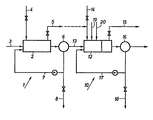
- the first stage of the wastewater treatment plant is denoted by 1 and the second stage by 10.
- the first stage comprises an activation tank 2 with a waste water supply line 3, with a gas supply line 4 for the supply of oxygen or at least one oxygen-containing gas and with an exhaust gas line 5, and an intermediate clarification tank 6 downstream of the activation tank 2 with a sludge return line 7 for returning sludge to the activation tank 2 and with a sludge drain 8 for discharging excess sludge.
- the second stage 10 is constructed essentially the same as the first stage 1 and comprises an aeration tank 12 divided into two cascade chambers of different sizes with an inlet 13 connected to the intermediate clarifier 6 of the first stage 1 and a secondary clarifier 16 downstream of the aeration tank 12 with sludge return line 17 and Sludge drainage 18.
- a gas feed line 14 is also connected to it, which can optionally be connected to the exhaust gas line 5 of the activated sludge pool 2 of the first stage 1. Exhaust gas is withdrawn from the activation tank 12 of the second stage 10 via an exhaust gas line 15.
- the gas input into the liquid mixture present in the two activation tanks 2, 12 can, for example, take place in such a way that the gas atmosphere which forms under the covers of the activation tanks 2, 12 results from the oxygen-rich gas supplied via the gas supply lines 4, 14 and from composed of the liquid mixture ascending gas, gas is withdrawn via a line, not shown, and passed to a gas distributor arranged near the pool floor. Mixing devices must then be arranged above the gas distributors to ensure that wastewater, activated sludge and oxygen are thoroughly mixed.
- aeration tanks that are open to the atmosphere can also be used, in which case the gas supply lines 4, 14 and gas discharge lines 5, 15 are omitted and, for example, surface ventilation gyroscope is used to supply oxygen to enter the liquid in the aeration tanks to supply oxygen will. It is also possible to combine a step with an open aeration tank with a step with a closed aeration tank.
- the first stage can have activation tanks connected in series.
- the activation tank 12 of the second stage 10 is an addition device 19 for pulverized and / or granular activated carbon and, if appropriate, a further addition device 20 for alumina and / or alumina assigned.
- the activated carbon supplied via the addition device 19 forms a composite with the biomass present in the activation tank 12, which has very good biological properties and a high mechanical strength.
- the addition of alumina and / or aluminum oxide via the addition device 20 takes place above all if the improvement in the settling properties of the activated sludge achieved by the addition of the activated carbon is not sufficient.
- the secondary clarifier 16 can be made significantly smaller than the secondary clarifier 6 of the first stage 1. Since, in addition, hardly any excess sludge is produced in the second stage 10, hardly any activated carbon is discharged from the system via line 18, so that activated carbon only has to be added to the activation tank 12 via the addition device 19 to start up the entire system.
Landscapes
- Life Sciences & Earth Sciences (AREA)
- Biodiversity & Conservation Biology (AREA)
- Microbiology (AREA)
- Hydrology & Water Resources (AREA)
- Engineering & Computer Science (AREA)
- Environmental & Geological Engineering (AREA)
- Water Supply & Treatment (AREA)
- Chemical & Material Sciences (AREA)
- Organic Chemistry (AREA)
- Activated Sludge Processes (AREA)
- Biological Treatment Of Waste Water (AREA)
Claims (7)
Priority Applications (1)
| Application Number | Priority Date | Filing Date | Title |
|---|---|---|---|
| AT81109745T ATE5710T1 (de) | 1980-11-20 | 1981-11-17 | Verfahren und vorrichtung zur biologischen reinigung von abwasser. |
Applications Claiming Priority (2)
| Application Number | Priority Date | Filing Date | Title |
|---|---|---|---|
| DE3043820 | 1980-11-20 | ||
| DE19803043820 DE3043820A1 (de) | 1980-11-20 | 1980-11-20 | Verfahren und vorrichtung zur biologischen reinigung von abwasser |
Publications (2)
| Publication Number | Publication Date |
|---|---|
| EP0052855A1 EP0052855A1 (fr) | 1982-06-02 |
| EP0052855B1 true EP0052855B1 (fr) | 1983-12-28 |
Family
ID=6117222
Family Applications (1)
| Application Number | Title | Priority Date | Filing Date |
|---|---|---|---|
| EP19810109745 Expired EP0052855B1 (fr) | 1980-11-20 | 1981-11-17 | Procédé pour l'épuration biologique d'eau usée |
Country Status (4)
| Country | Link |
|---|---|
| EP (1) | EP0052855B1 (fr) |
| JP (1) | JPS57113898A (fr) |
| AT (1) | ATE5710T1 (fr) |
| DE (2) | DE3043820A1 (fr) |
Families Citing this family (3)
| Publication number | Priority date | Publication date | Assignee | Title |
|---|---|---|---|---|
| DE3131989A1 (de) * | 1981-08-13 | 1983-02-24 | Linde Ag, 6200 Wiesbaden | Verfahren und vorrichtung zur biologischen reinigung von abwasser |
| DE3406312C2 (de) * | 1984-02-22 | 1993-12-09 | Boehnke Botho | Verfahren für die zweistufige biologische Reinigung von Abwasser, insbesondere von kommunalem Abwasser |
| JP3717085B2 (ja) * | 1994-10-21 | 2005-11-16 | キヤノン株式会社 | 二次電池用負極、該負極を有する二次電池及び電極の作製方法 |
Citations (2)
| Publication number | Priority date | Publication date | Assignee | Title |
|---|---|---|---|---|
| US3904518A (en) * | 1970-01-14 | 1975-09-09 | Du Pont | Waste water treatment process |
| US4172781A (en) * | 1977-06-15 | 1979-10-30 | Standard Oil Company (Indiana) | Waste water process for treatment of strong wastes |
Family Cites Families (4)
| Publication number | Priority date | Publication date | Assignee | Title |
|---|---|---|---|---|
| CH545254A (de) * | 1972-09-27 | 1973-12-15 | Ciba Geigy Ag | Verfahren zum Reinigen von Abwässern |
| US3876536A (en) * | 1973-04-24 | 1975-04-08 | Sterling Drug Inc | Waste oxidation process |
| DE2808054A1 (de) * | 1978-02-24 | 1979-08-30 | Filters International Inc | Verfahren und vorrichtung zur wasserreinigung, insbesondere zur abwasserbehandlung |
| DE2812813A1 (de) * | 1978-03-23 | 1979-09-27 | Merck Patent Gmbh | Belebungsverfahren zur biologischen abwasserreinigung |
-
1980
- 1980-11-20 DE DE19803043820 patent/DE3043820A1/de not_active Withdrawn
-
1981
- 1981-11-17 DE DE8181109745T patent/DE3161803D1/de not_active Expired
- 1981-11-17 AT AT81109745T patent/ATE5710T1/de not_active IP Right Cessation
- 1981-11-17 EP EP19810109745 patent/EP0052855B1/fr not_active Expired
- 1981-11-19 JP JP18456381A patent/JPS57113898A/ja active Pending
Patent Citations (2)
| Publication number | Priority date | Publication date | Assignee | Title |
|---|---|---|---|---|
| US3904518A (en) * | 1970-01-14 | 1975-09-09 | Du Pont | Waste water treatment process |
| US4172781A (en) * | 1977-06-15 | 1979-10-30 | Standard Oil Company (Indiana) | Waste water process for treatment of strong wastes |
Non-Patent Citations (1)
| Title |
|---|
| GWF Wasser/Abwasser 119 (1978) H. 5 S. 253-256 * |
Also Published As
| Publication number | Publication date |
|---|---|
| EP0052855A1 (fr) | 1982-06-02 |
| DE3043820A1 (de) | 1982-06-24 |
| ATE5710T1 (de) | 1984-01-15 |
| JPS57113898A (en) | 1982-07-15 |
| DE3161803D1 (en) | 1984-02-02 |
Similar Documents
| Publication | Publication Date | Title |
|---|---|---|
| EP0046900B2 (fr) | Procédé et dispositif pour l'épuration des eaux usées par voie biologique | |
| DE68904598T2 (de) | Abwasserbehandlungsverfahren. | |
| EP0072495B1 (fr) | Procédé et dispositif pour la purification biologique d'eau résiduaire | |
| EP0110240B1 (fr) | Procédé et dispositif pour éliminer des métaux lourds d'eau usée | |
| DE2616212A1 (de) | Verfahren zur schlamm-abwasser- aufbereitung, insbesondere zur entfernung stickstoff- und kohlenstoffhaltiger stoffe aus haushalts- und industrieabwaessern | |
| DE3137055A1 (de) | "verfahren und vorrichtung zur biologischen reinigung von abwasser" | |
| DE19737373B4 (de) | Anlage und Verfahren zur biologischen Entfernung von Stickstoff und Phosphor aus Ab- und Klärwasser | |
| DE3726201C2 (de) | Belebtschlamm-Behandlungsverfahren für Abwasser oder Industrieabwasser | |
| EP0497114A1 (fr) | Procédé d'épuration d'eaux résiduaires contenant des phosphates et des composés azotés | |
| DE3644770C1 (de) | Verfahren zur Reinigung phosphathaltiger Abwaesser mittels biologischer Phosphorelimination sowie Anlage zur Durchfuehrung dieses Verfahrens | |
| DE2502501A1 (de) | Abwasserbehandlungsverfahren | |
| DE3833185C2 (fr) | ||
| DE3014678A1 (de) | Raffinationsanlage zur abwasserbehandlung und verfahren zur behandlung von industrieabwaessern | |
| CH667449A5 (de) | Verfahren zur biologischen reinigung von wasser oder abwasser von organischen stickstoffhaltigen verunreinigungen. | |
| DE3787006T2 (de) | Biologisches Abwasserreinigungsverfahren ohne Überschussbelebtschlammproduktion und Vorrichtung zu seiner Durchführung. | |
| EP0208253B1 (fr) | Procédé et dispositif de purification biologique d'eau usée | |
| EP0052855A1 (fr) | Procédé pour l'épuration biologique d'eau usée | |
| DE19542146C2 (de) | Verfahren zum biologischen Reinigen von Abwasser mit Regenerierstufe und Anlage zur Durchführung des Verfahrens | |
| EP0527123B1 (fr) | Procédé de traitement d'eaux usées en boue activée | |
| DE3917415C2 (de) | Verfahren zur Reinigung von Abwasser | |
| EP0002008A1 (fr) | Procédé pour le traitement biologique d'eau résiduaire | |
| DE2952342A1 (de) | Verfahren und vorrichtung zur biologischen reinigung von abwasser | |
| DE2840764A1 (de) | Verfahren zur behandlung von abwasser | |
| DE2749971C2 (de) | Verfahren zur Behandlung von Abwasser | |
| DE3310572A1 (de) | Verfahren und vorrichtung zur biologischen reinigung von abwasser |
Legal Events
| Date | Code | Title | Description |
|---|---|---|---|
| PUAI | Public reference made under article 153(3) epc to a published international application that has entered the european phase |
Free format text: ORIGINAL CODE: 0009012 |
|
| AK | Designated contracting states |
Designated state(s): AT BE CH DE FR GB IT NL |
|
| 17P | Request for examination filed |
Effective date: 19820507 |
|
| ITF | It: translation for a ep patent filed | ||
| GRAA | (expected) grant |
Free format text: ORIGINAL CODE: 0009210 |
|
| AK | Designated contracting states |
Designated state(s): AT BE CH DE FR GB IT LI NL |
|
| REF | Corresponds to: |
Ref document number: 5710 Country of ref document: AT Date of ref document: 19840115 Kind code of ref document: T |
|
| REF | Corresponds to: |
Ref document number: 3161803 Country of ref document: DE Date of ref document: 19840202 |
|
| ET | Fr: translation filed | ||
| PLBI | Opposition filed |
Free format text: ORIGINAL CODE: 0009260 |
|
| PGFP | Annual fee paid to national office [announced via postgrant information from national office to epo] |
Ref country code: FR Payment date: 19841122 Year of fee payment: 4 |
|
| PGFP | Annual fee paid to national office [announced via postgrant information from national office to epo] |
Ref country code: CH Payment date: 19841126 Year of fee payment: 4 |
|
| PGFP | Annual fee paid to national office [announced via postgrant information from national office to epo] |
Ref country code: DE Payment date: 19841127 Year of fee payment: 4 |
|
| 26 | Opposition filed |
Opponent name: BAYER AG, LEVERKUSEN KONZERNVERWALTUNG RP PATENTAB Effective date: 19840926 |
|
| PGFP | Annual fee paid to national office [announced via postgrant information from national office to epo] |
Ref country code: BE Payment date: 19841231 Year of fee payment: 4 |
|
| PGFP | Annual fee paid to national office [announced via postgrant information from national office to epo] |
Ref country code: AT Payment date: 19861112 Year of fee payment: 6 |
|
| PGFP | Annual fee paid to national office [announced via postgrant information from national office to epo] |
Ref country code: NL Payment date: 19861130 Year of fee payment: 6 |
|
| RDAG | Patent revoked |
Free format text: ORIGINAL CODE: 0009271 |
|
| STAA | Information on the status of an ep patent application or granted ep patent |
Free format text: STATUS: PATENT REVOKED |
|
| 27W | Patent revoked |
Effective date: 19871116 |
|
| REG | Reference to a national code |
Ref country code: CH Ref legal event code: PL |
|
| BERE | Be: lapsed |
Owner name: LINDE A.G. Effective date: 19871130 |
|
| NLR2 | Nl: decision of opposition | ||
| GBPR | Gb: patent revoked under art. 102 of the ep convention designating the uk as contracting state | ||
| REG | Reference to a national code |
Ref country code: GB Ref legal event code: 7102 |